Exodus 19:14

Hebrew (Westminster Leningrad Codex) Exodus 19:14 appears in the Hebrew Old Testament. The text above is from the Westminster Leningrad Codex. Each word links to its Strong’s number, a concise gloss, and parsing drawn from the Open Scriptures Hebrew Bible morphology. Click any word for its full Brown-Driver-Briggs (BDB) entry.
Download image
Cite this verse

Exodus 19:14 (World English Bible). Public Domain. Lemma interlinear Bible study tool, https://lemma.gebible.app/v/exodus/19/14.

Show BibTeX & RIS
BibTeX
RIS
English Translation
Moses went down from the mountain to the people, and sanctified the people; and they washed their clothes.
World English Bible · Public Domain
Download a study sheet

One document with this verse’s original text, its word-by-word gloss line, the meaning frame, cross-references with their text, attributed commentary, and full source and license credits — printable, and it pastes into notes with its structure intact.

This verse Autodidact and up

Study sheet (.html) Plain text (.txt)

A passage Seminary Student

Up to 50 verses in one chapter. A passage sheet keeps up to 6 commentary sources and 12 cross-references per verse, in the order this page ranks them, and says so on the sheet whenever that leaves anything out. Ask for a single verse and you get the Autodidact verse sheet above.

Everything on this page stays free to read, with no account — the sheet is a download of what is already on screen, not access to it.

Want to remove ads? Support Godless Engineer
Compare translations 3

The same verse in 3 English versions, stacked beneath the original-language interlinear above. Click any original word for its lexicon entry.

Each is an independent rendering of the whole verse — the interlinear is not word-aligned to these translations.

Highlighted words mark where these versions differ — a whole-verse word diff, not a word-by-word alignment.

  • World English Bible Public Domain
    Moses went down from the mountain to the people, and sanctified the people; and they washed their clothes.
  • King James Version Public Domain
    And Moses went down from the mount unto the people, and sanctified the people; and they washed their clothes.
  • unfoldingWord Literal Text CC BY-SA 4.0
    And Moses went down from the mountain to the people. And he made the people holy, and they washed their clothing.

unfoldingWord Literal Text — © unfoldingWord, licensed CC BY-SA 4.0. Word-aligned USFM3 via Door43 (git.door43.org/unfoldingWord/en_ult).

Versions to compare (up to 4)

3 of 4 selected

Show all 18 translations

Every available English version of this verse, each an independent rendering of the whole verse.

  • World English Bible Public Domain
    Moses went down from the mountain to the people, and sanctified the people; and they washed their clothes.
  • Berean Standard Bible Public Domain
    When Moses came down from the mountain to the people, he consecrated them, and they washed their clothes.
  • Majority Standard Bible Public Domain
    When Moses came down from the mountain to the people, he consecrated them, and they washed their clothes.
  • King James Version Public Domain
    And Moses went down from the mount unto the people, and sanctified the people; and they washed their clothes.
  • American Standard Version (1901) Public Domain
    And Moses went down from the mount unto the people, and sanctified the people; and they washed their garments.
  • Revised Version (1885) Public Domain
    And Moses went down from the mount unto the people, and sanctified the people; and they washed their garments.
  • Geneva Bible (1599) Public Domain
    Then Moses went downe from ye mount vnto the people, and sanctified the people, and they washed their clothes.
  • Douay-Rheims (1899) Public Domain
    And Moses came down from the mount to the people, and sanctified them. And when they had washed their garments,
  • Young's Literal Translation Public Domain
    And Moses cometh down from the mount unto the people, and sanctifieth the people, and they wash their garments;
  • Literal Standard Version CC BY-SA 4.0
    And Moses comes down from the mountain to the people, and sanctifies the people, and they wash their garments;
  • Unlocked Literal Bible CC BY-SA 4.0
    Then Moses went down from the mountain to the people. He set apart the people to Yahweh and they washed their garments.
  • unfoldingWord Literal Text CC BY-SA 4.0
    And Moses went down from the mountain to the people. And he made the people holy, and they washed their clothing.
  • Darby Bible Public Domain
    And Moses came down from the mountain to the people, and hallowed the people; and they washed their clothes.
  • World Messianic Bible Public Domain
    Moses went down from the mountain to the people, and sanctified the people; and they washed their clothes.
  • Webster's Bible Public Domain
    And Moses went down from the mount to the people, and sanctified the people; and they washed their clothes.
  • Free Bible Version CC BY-SA 4.0
    Moses went down the mountain and prepared the people spiritually and they washed their clothes.
  • Bible in Basic English Public Domain
    Then Moses went down from the mountain to the people, and made the people holy; and their clothing was washed.
  • JPS Tanakh (1917) Public Domain
    And Moses went down from the mount unto the people, and sanctified the people; and they washed their garments.

Literal Standard Version (2020), Covenant Press — licensed CC BY-SA 4.0. Text via the HelloAO Bible API (eBible.org). Unlocked Literal Bible (unfoldingWord) — licensed CC BY-SA 4.0. Text via the HelloAO Bible API (eBible.org). unfoldingWord Literal Text — © unfoldingWord, licensed CC BY-SA 4.0. Word-aligned USFM3 via Door43 (git.door43.org/unfoldingWord/en_ult). Free Bible Version, Dr. Jonathan Gallagher — licensed CC BY-SA 4.0. Text via the HelloAO Bible API (eBible.org).

Word by word

More ways to search: Search by grammar → Find every occurrence → Compare this word →

Practice this passage: Drill this verse → Learn its vocabulary →

שִׂמְלֹתָֽם
simlâh
H8071
“garments · their”
Noun, Common, Feminine, Plural, Construct + Suffix, Personal, 3rd Person, Masculine, Plural
Part of Speech
Noun
Type
Common
Gender
Feminine
Number
Plural
State
Construct
Full BDB Definition

Origin: perhaps by permutation for the fem. of H5566 (through the idea of a cover assuming the shape of the object beneath)

TWOT: 2270a

wrapper, mantle, covering garment, garments, clothes, raiment, a cloth
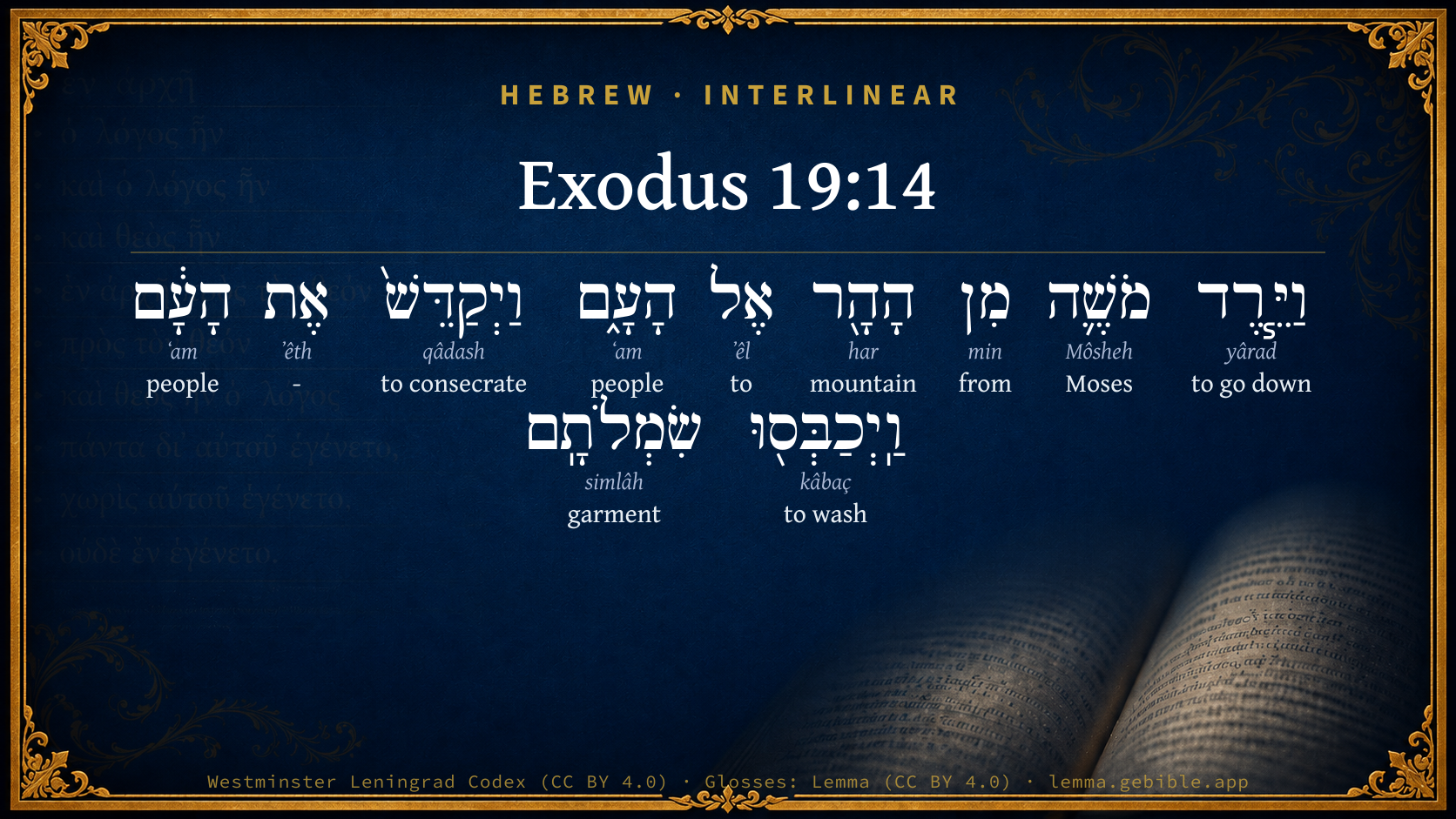
  1. וַיֵּ֧רֶד yârad H3381 “and · to go down” Conjunction + Verb, Qal, Sequential Imperfect, 3rd Person, Masculine, Singular
  2. מֹשֶׁ֛ה Môsheh H4872 “Moses” Noun, Proper
  3. מִן min H4480 “from” Preposition
  4. הָהָ֖ר har H2022 “the · mountain” Particle, Definite Article + Noun, Common, Masculine, Singular, Absolute
  5. אֶל ʼêl H413 “to” Preposition
  6. הָעָ֑ם ʻam H5971 “the · people” Particle, Definite Article + Noun, Common, Masculine, Singular, Absolute
  7. וַיְקַדֵּשׁ֙ qâdash H6942 “and · to consecrate” Conjunction + Verb, Piel, Sequential Imperfect, 3rd Person, Masculine, Singular
  8. אֶת ʼêth H853 “-” Particle, Direct Object
  9. הָעָ֔ם ʻam H5971 “the · people” Particle, Definite Article + Noun, Common, Masculine, Singular, Absolute
  10. וַֽיְכַבְּס֖וּ kâbaç H3526 “and · to wash” Conjunction + Verb, Piel, Sequential Imperfect, 3rd Person, Masculine, Plural

About this verse

These counts appear in no published source. They are computed here, from the morphology-tagged text and Lemma’s own curated glosses. What Lemma adds →

11
words
10
distinct lemmas
Pentateuch
section

Shared distinctive vocabulary

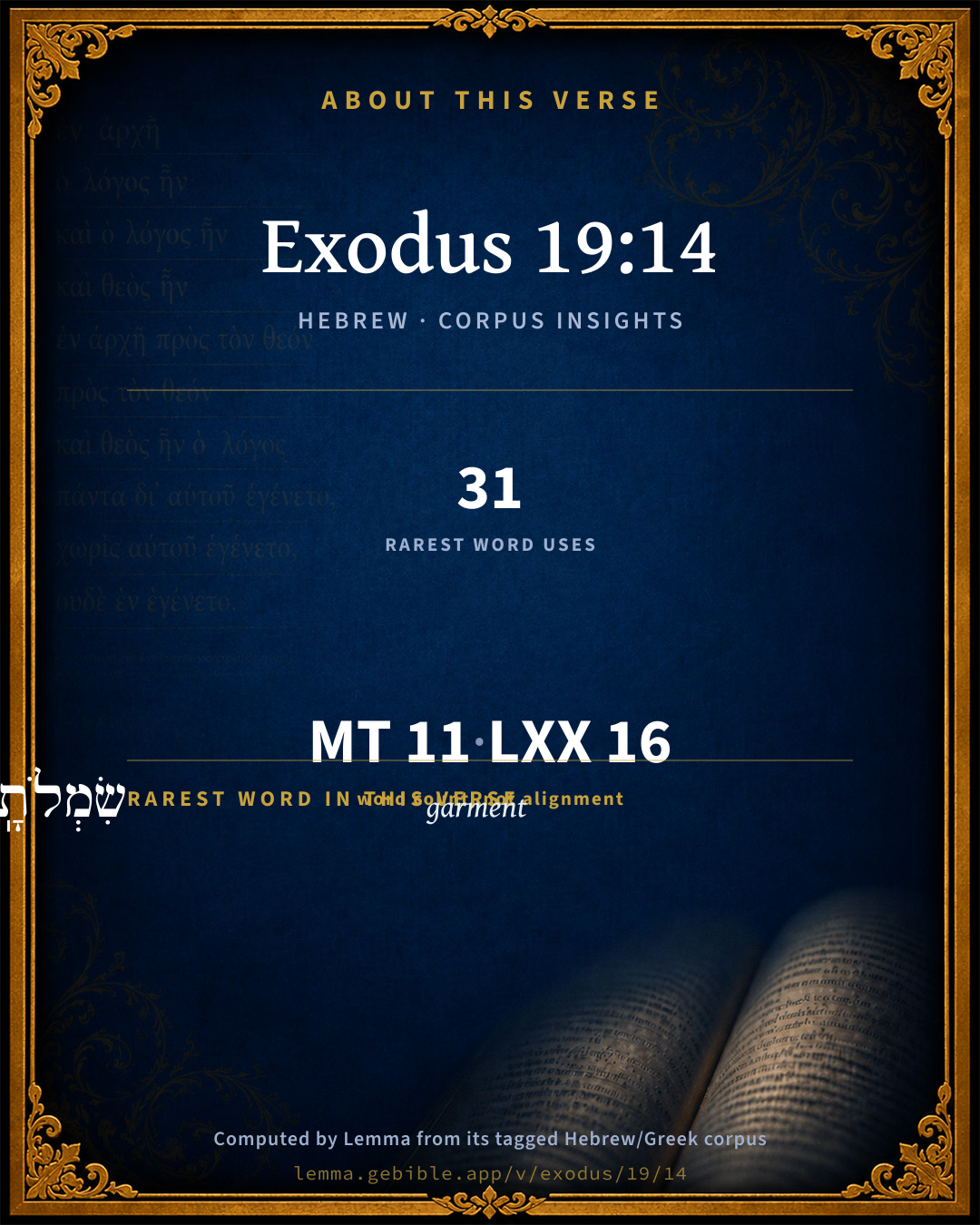
שִׂמְלֹתָֽם garment H8071 occurs in 28 verses of the Hebrew Bible. Also found in:

Grammatical profile

  • 3 verbs
  • 5 nouns
  • 2 prepositions
  • 1 particle

Verb forms

  • וַיֵּ֧רֶד Qal · Sequential Imperfect
  • וַיְקַדֵּשׁ֙ Piel · Sequential Imperfect
  • וַֽיְכַבְּס֖וּ Piel · Sequential Imperfect

Repetition

A word recurs within this verse — often emphatic in Hebrew:

  • הָעָ֑ם people H5971 ×2

Hebrew & Septuagint length

In English translation the verse runs 18 words from the Hebrew and 18 from the Septuagint (LXX English) — the same length.

A rough comparison of the two English renderings, which tokenize alike — not a word-level alignment.

Word counts can differ between the Hebrew and the Greek without any difference in meaning — e.g. the Hebrew direct-object marker אֵת has no separate Greek word, and Greek often adds the article ὁ.

In the original languages it is 11 Hebrew tokens and 16 Greek tokens — but the two are counted differently (Hebrew bundles its prefixes and suffixes into one token; the Greek is in lemma form), so that isn’t a like-for-like length.

Cross-references

1

Topical passages linked to Exodus 19:14 in the Treasury of Scripture Knowledge — connected by theme and wording, ordered by reader-vote popularity; previews shown in the World English Bible.

  • Exodus 19:10 Yahweh said to Moses, "Go to the people, and sanctify them today and tomorrow, and let them wash their garments,

Cross-references courtesy of OpenBible.info (CC BY 4.0).

Hebrew and Greek witnesses Masoretic Hebrew ↔ Greek Septuagint

The same verse in the two great witnesses to the Old Testament, shown verse-for-verse.

These are two independent witnesses, not word-aligned to each other, and the Septuagint is shown in lemma (dictionary) form.

Hebrew Exodus 19:14 Masoretic · Westminster Leningrad Codex

וַיֵּ֧רֶד מֹשֶׁ֛ה מִן הָהָ֖ר אֶל הָעָ֑ם וַיְקַדֵּשׁ֙ אֶת הָעָ֔ם וַֽיְכַבְּס֖וּ שִׂמְלֹתָֽם

Moses went down from the mountain to the people, and sanctified the people; and they washed their clothes.

World English Bible · Public Domain

Greek LXX Exodus 19:14 Septuagint · lemma form

καταβαίνω δέ μωυσῆς ἐκ ὁ ὄρος πρός ὁ λαός καί ἁγιάζω αὐτός καί πλύνω ὁ ἱμάτιον

And Moses went down from the mountain to the people, and sanctified them, and they washed their clothes.

LXX2012 (modern English Septuagint) · Public Domain

Hebrew: Westminster Leningrad Codex (CC BY 4.0). Greek: Septuagint (public domain); English from LXX2012 (modern English Septuagint) (Public Domain). How the Septuagint differs from the Hebrew →

Targum (Aramaic paraphrase)

2

The Targum is the ancient Jewish Aramaic paraphrase of the Hebrew Scriptures — an interpretive translation, not the Hebrew text itself. Onkelos (literal) and Pseudo-Jonathan (expansive) render the Torah, and Jonathan the Prophets. Coverage is partial: where no permissively-licensed English translation exists for a verse, only the Aramaic is shown. This is verse-level text, not a word-by-word alignment to the Hebrew.

  1. Targum Onkelos Torah (Genesis–Deuteronomy)
    וּנְחַת משֶׁה מִן טוּרָא לְוָת עַמָא וְזַמִין יָת עַמָא וְחַוָרוּ לְבוּשֵׁיהוֹן:

    (no public-domain English translation for this verse)

    Targum Onkelos — Aramaic: “Onkelos Genesis” (public domain); “Onkelos Exodus” (public domain); “Onkelos Leviticus” (public domain); “Onkelos Numbers” (public domain); “Onkelos Deuteronomy” (public domain). English: “Sefaria Community Translation” (CC0 1.0 (public-domain dedication)); “J.W. Etheridge. The Targums of Onkelos and Jonathan Ben Uzziel on the Pentateuch. London: Longmans, Green, 1862” (public domain). Text via Sefaria.

  2. Targum Pseudo-Jonathan Torah (Genesis–Deuteronomy)
    וּנְחַת משֶׁה בְּיוֹמָא הַהוּא לְוַת עַמָּא וְזַמִּין יַת עַמָּא וְחַוָּרוּ לְבוּשֵׁיהוֹן

    And Mosheh went down that day to the people, and prepared the people, and they blanched their clothes.

    Targum Pseudo-Jonathan — Aramaic: “Targum Jonathan on Genesis” (public domain); “Targum Jonathan on Exodus” (public domain); “Targum Jonathan on Leviticus” (public domain); “Targum Jonathan on Numbers” (public domain); “Targum Jonathan on Deuteronomy” (public domain). English: “The Targum of Jonathan ben Uzziel, trans. J. W. Etheridge, London, 1862” (public domain). Text via Sefaria.

Commentary

Notes on Exodus 19:14 from classic Christian and Jewish commentators (each source and its license shown beneath its notes). The classic Christian expositions comment on the surrounding passage and are grouped to its opening verse, so a note may address several verses; the Jewish commentaries on the Tanakh (Rashi and others) are per-verse, so they appear only where the commentator wrote on this verse.

Lemma curates 59 commentaries, every one of them public domain or Creative Commons licensed, each selected and text-cleaned for this edition rather than reprinted as found. About our sources →

Trapp's Complete Commentary

John Trapp

Exo 19:14 And Moses went down from the mount unto the people, and sanctified the people; and they washed their clothes.

Ver. 14. And they washed their clothes.] In token of washing their hearts, and "cleansing themselves from all filthiness of flesh and spirit." The Gentiles also washed, that they might go to sacrifice: and the primitive Christians before prayer. {a}

{a} Plaut., in Alul., act. iii. scen. 6. Tertul., De Orat., cap. 11.

John Trapp, A Commentary or Exposition upon All the Books of the Old and New Testament (1647–1656) — public domain. Text from a community e-Sword module.

The Cambridge Bible for Schools and Colleges

gen. ed. J. J. S. Perowne

14–15. The sequel in E to vv. 10, 11a. Moses comes down from the mountain, and sanctifies the people as instructed in vv. 10, 11a.

15b. Cf. 1Sa_21:4; and the Minaean inscr. cited in ATLAO. p. 433.

The Cambridge Bible for Schools and Colleges (gen. ed. J. J. S. Perowne; Cambridge University Press, 1878–1918) — public domain. Text from a community e-Sword module.

John Gill's Exposition

And Moses went down from the mount unto the people,.... The same day that he went up, the fourth day of the month:

and sanctified the people; instructed them and ordered them what they should do for their sanctification, in order to their hearing the law from the mouth of the Lord:

and they washed their clothes; as the Lord had directed Moses to enjoin them, and as he had commanded them; see Gill on Exo 19:10.

John Gill's Exposition of the Whole Bible (1746–1763) — public domain (CC PDM 1.0). Text via the HelloAO Bible API.

Matthew Poole's English Annotations

Moses sanctified the people, by commanding them to sanctify themselves, and directing them how to do it.

Matthew Poole's English Annotations on the Holy Bible (1683–1685) — public domain. Text from a community e-Sword/MySword module.

The Pulpit Commentary

In obedience to the commands which he had received (ver. 10), Moses returned to the camp at the foot of Sinai, and issued the order that the people were to purify themselves and wash their garments during that day and the next, and be ready for a great solemnity on the third day. He must also, at the same time, have given directions for the construction of the fence, which was to hedge in the people (ver. 12), and which he speaks of as constructed in ver. 23.

The Pulpit Commentary (1880–1919), ed. H.D.M. Spence-Jones & Joseph S. Exell — public domain. Text from a community e-Sword module.

unfoldingWord translationNotes

Door43 World Missions Community

do not go near your wives

This is a polite way of talking about sleeping with their wives. AT: "do not sleep with your wives" (See: Euphemism)

translationWords

set apart

unfoldingWord translationNotes — © Distant Shores Media and the Door43 World Missions Community, licensed CC BY-SA 4.0. Source: git.door43.org/Door43/en_tn.

Rashi

Rabbi Shlomo Yitzchaki (Rashi)

מן ההר אל העם [AND MOSES WENT DOWN] FROM THE MOUNTAIN UNTO THE PEOPLE —This tells us that Moses did not betake himself first to his personal concerns but went direct from the mountain to the people (Mekhilta).

Rashi on the Tanakh — English translations: “The Judaica Press complete Tanach with Rashi, translated by A. J. Rosenberg” (CC BY 4.0); “Pentateuch with Rashi's commentary by M. Rosenbaum and A.M. Silbermann, 1929-1934” (public domain); “The Metsudah Tanach series, Lakewood, N.J” (CC BY 4.0); and “The Book of Joshua, Metsudah Publications, 1997” (CC BY 4.0). Text via Sefaria.

Ramban (Nachmanides)

Rabbi Moshe ben Nachman (Ramban / Nachmanides)

AND MOSES WENT DOWN FROM THE MOUNT UNTO THE PEOPLE, AND SANCTIFIED THE PEOPLE. This verse teaches that the command expressed in the [above] verse, And the Eternal said unto Moses: Go unto the people and sanctify them, was also given to him on the mountain which Moses ascended everytime that he was about to speak to Him. In the Mechilta, the Rabbis have explained: “This teaches that Moses did not turn to his personal affairs nor go to his house at all, but he went directly from the mount unto the people.”

Ramban (Nachmanides) on the Tanakh — English translation: “Commentary on the Torah by Ramban (Nachmanides). Translated and annotated by Charles B. Chavel. New York, Shilo Pub. House, 1971-1976” (CC BY 4.0). Text via Sefaria.

Lesson kit

Teaching starters — assembled from the data on this page, not authored interpretation. Every prompt links to the verse data it draws on. Edit before teaching.

Exodus, in the Pentateuch, opens this verse with 11 words (10 distinct Hebrew lemmas). Its most distinctive word is simlâh (“garment”). A historical commentator’s framing appears above. Read the whole chapter for the surrounding context.

Discussion questions

  1. The word simlâh carries the sense “garment.” How does it shape the verse?
  2. How does Genesis 9:23, which shares the word «garment», read alongside this verse?
  3. What does the repetition of “people” (2× in this one verse) do in this verse?
  4. These translations render this verse differently. What is at stake in choosing one wording over another?
  5. «וַיֵּ֧רֶד» is a Qal Sequential Imperfect verb. How does that grammatical form shape the action described?
  6. Compare how Trapp's Complete Commentary and The Cambridge Bible for Schools and Colleges read this verse. Where do they agree or differ?

Things to notice

Reading settings

Reading text

Shown beneath each verse's original-language words.

Old Testament
Old Testament edition

Read the OT as the Masoretic Hebrew (MT) or the Greek Septuagint (LXX).

English shown for the Greek Septuagint (in the Hebrew ↔ Greek comparison).

Comparing translations? Open the Compare panel on any verse page to stack up to four side by side.