Leviticus 4:8

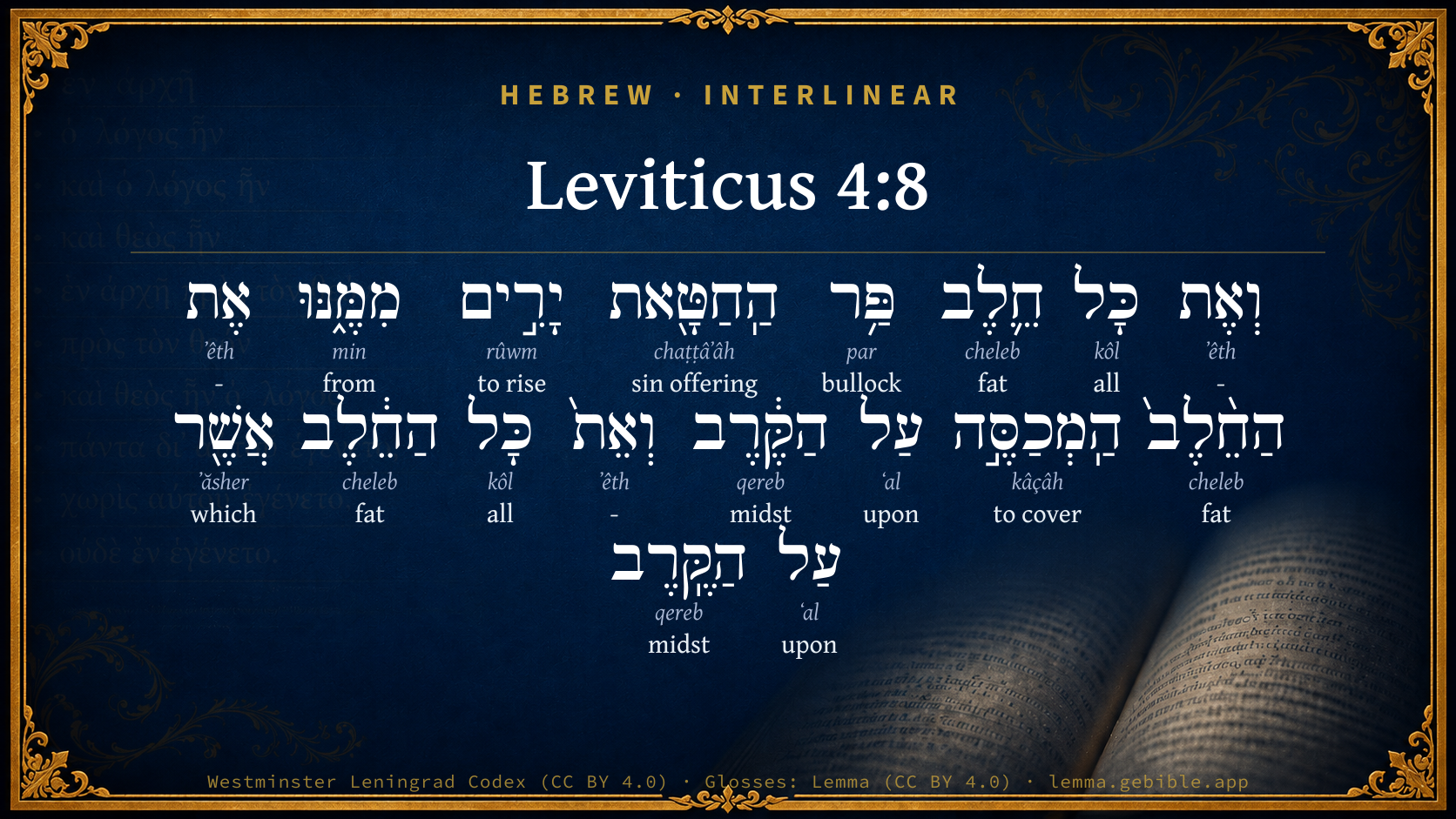
Hebrew (Westminster Leningrad Codex) Leviticus 4:8 appears in the Hebrew Old Testament. The text above is from the Westminster Leningrad Codex. Each word links to its Strong’s number, a concise gloss, and parsing drawn from the Open Scriptures Hebrew Bible morphology. Click any word for its full Brown-Driver-Briggs (BDB) entry.
Download image
Cite this verse

Leviticus 4:8 (World English Bible). Public Domain. Lemma interlinear Bible study tool, https://lemma.gebible.app/v/leviticus/4/8.

Show BibTeX & RIS
BibTeX
RIS
English Translation
He shall take all the fat of the bull of the sin offering off of it; the fat that covers the innards, and all the fat that is on the innards,
World English Bible · Public Domain
Download a study sheet

One document with this verse’s original text, its word-by-word gloss line, the meaning frame, cross-references with their text, attributed commentary, and full source and license credits — printable, and it pastes into notes with its structure intact.

This verse Autodidact and up

Study sheet (.html) Plain text (.txt)

A passage Seminary Student

Up to 50 verses in one chapter. A passage sheet keeps up to 6 commentary sources and 12 cross-references per verse, in the order this page ranks them, and says so on the sheet whenever that leaves anything out. Ask for a single verse and you get the Autodidact verse sheet above.

Everything on this page stays free to read, with no account — the sheet is a download of what is already on screen, not access to it.

Want to remove ads? Support Godless Engineer
Compare translations 3

The same verse in 3 English versions, stacked beneath the original-language interlinear above. Click any original word for its lexicon entry.

Each is an independent rendering of the whole verse — the interlinear is not word-aligned to these translations.

Highlighted words mark where these versions differ — a whole-verse word diff, not a word-by-word alignment.

  • World English Bible Public Domain
    He shall take all the fat of the bull of the sin offering off of it; the fat that covers the innards, and all the fat that is on the innards,
  • King James Version Public Domain
    And he shall take off from it all the fat of the bullock for the sin offering; the fat that covereth the inwards, and all the fat that is upon the inwards,
  • unfoldingWord Literal Text CC BY-SA 4.0
    And all the fat of the bull of the sin offering he shall lift up from it: the fat covering over the innards and all the fat that on the innards

unfoldingWord Literal Text — © unfoldingWord, licensed CC BY-SA 4.0. Word-aligned USFM3 via Door43 (git.door43.org/unfoldingWord/en_ult).

Versions to compare (up to 4)

3 of 4 selected

Show all 18 translations

Every available English version of this verse, each an independent rendering of the whole verse.

  • World English Bible Public Domain
    He shall take all the fat of the bull of the sin offering off of it; the fat that covers the innards, and all the fat that is on the innards,
  • Berean Standard Bible Public Domain
    Then he shall remove all the fat from the bull of the sin offering—the fat that covers the entrails, all the fat that is on them,
  • Majority Standard Bible Public Domain
    Then he shall remove all the fat from the bull of the sin offering—the fat that covers the entrails, all the fat that is on them,
  • King James Version Public Domain
    And he shall take off from it all the fat of the bullock for the sin offering; the fat that covereth the inwards, and all the fat that is upon the inwards,
  • American Standard Version (1901) Public Domain
    And all the fat of the bullock of the sin-offering he shall take off from it; the fat that covereth the inwards, and all the fat that is upon the inwards,
  • Revised Version (1885) Public Domain
    And all the fat of the bullock of the sin offering he shall take off from it; the fat that covereth the inwards, and all the fat that is upon the inwards,
  • Geneva Bible (1599) Public Domain
    And hee shall take away all the fat of the bullocke for the sinne offring: to wit, the fat that couereth the inwardes, and all the fatte that is about the inwardes.
  • Douay-Rheims (1899) Public Domain
    And he shall take off the fat of the calf for the sin offering, as well that which covereth the entrails, as all the inwards:
  • Young's Literal Translation Public Domain
    `And all the fat of the bullock of the sin-offering he doth lift up from it, the fat which is covering over the inwards, and all the fat which `is' on the inwards,
  • Literal Standard Version CC BY-SA 4.0
    And he lifts up from it all the fat of the bullock of the sin-offering, the fat which is covering over the innards, and all the fat which [is] on the innards,
  • Unlocked Literal Bible CC BY-SA 4.0
    He will cut away all the fat of the bull of the sin offering; the fat that covers the inner parts, all the fat that is attached to the inner parts,
  • unfoldingWord Literal Text CC BY-SA 4.0
    And all the fat of the bull of the sin offering he shall lift up from it: the fat covering over the innards and all the fat that on the innards
  • Darby Bible Public Domain
    And all the fat of the bullock of the sin-offering shall he take off from it; the fat that covereth the inwards, and all the fat that is on the inwards,
  • World Messianic Bible Public Domain
    He shall take all the fat of the bull of the sin offering from it: the fat that covers the innards, and all the fat that is on the innards,
  • Webster's Bible Public Domain
    And he shall take off from it all the fat of the bullock for the sin-offering; the fat that covereth the inwards, and all the fat that is upon the inwards,
  • Free Bible Version CC BY-SA 4.0
    Then he shall remove all the fat from the bull of the sin offering: all the fat that covers the insides,
  • Bible in Basic English Public Domain
    And he is to take away all the fat of the ox of the sin-offering; the fat covering the inside parts and all the fat of the inside parts,
  • JPS Tanakh (1917) Public Domain
    And all the fat of the bullock of the sin-offering he shall take off from it; the fat that covereth the inwards, and all the fat that is upon the inwards,

Literal Standard Version (2020), Covenant Press — licensed CC BY-SA 4.0. Text via the HelloAO Bible API (eBible.org). Unlocked Literal Bible (unfoldingWord) — licensed CC BY-SA 4.0. Text via the HelloAO Bible API (eBible.org). unfoldingWord Literal Text — © unfoldingWord, licensed CC BY-SA 4.0. Word-aligned USFM3 via Door43 (git.door43.org/unfoldingWord/en_ult). Free Bible Version, Dr. Jonathan Gallagher — licensed CC BY-SA 4.0. Text via the HelloAO Bible API (eBible.org).

Word by word

More ways to search: Search by grammar → Find every occurrence → Compare this word →

Practice this passage: Drill this verse → Learn its vocabulary →

חֵ֛לֶב
cheleb
H2459
“fat of”
Noun, Common, Masculine, Singular, Construct
Part of Speech
Noun
Type
Common
Gender
Masculine
Number
Singular
State
Construct
Full BDB Definition

Origin: from an unused root meaning to be fat

TWOT: 651a

fat - fat (of humans) - fat (of beasts) - choicest, best part, abundance (of products of the land)
  1. וְאֶת ʼêth H853 “and · -” Conjunction + Particle, Direct Object
  2. כָּל kôl H3605 “all of” Noun, Common, Masculine, Singular, Construct
  3. פַּ֥ר par H6499 “bullock of” Noun, Common, Masculine, Singular, Construct
  4. הַֽחַטָּ֖את chaṭṭâʼâh H2403 “the · sin offering” Particle, Definite Article + Noun, Common, Feminine, Singular, Absolute
  5. יָרִ֣ים rûwm H7311 “to rise” Verb, Hiphil, Imperfect, 3rd Person, Masculine, Singular
  6. מִמֶּ֑נּוּ min H4480 “from · us” Preposition + Suffix, Personal, 1st Person, Common, Plural
  7. אֶת ʼêth H853 “-” Particle, Direct Object
  8. הַחֵ֨לֶב֙ cheleb H2459 “the · fat” Particle, Definite Article + Noun, Common, Masculine, Singular, Absolute
  9. הַֽמְכַסֶּ֣ה kâçâh H3680 “the · covering” Particle, Definite Article + Verb, Piel, Participle Active, Masculine, Singular, Absolute
  10. עַל ʻal H5921 “upon” Preposition
  11. הַקֶּ֔רֶב qereb H7130 “the · midst” Particle, Definite Article + Noun, Common, Masculine, Singular, Absolute
  12. וְאֵת֙ ʼêth H853 “and · -” Conjunction + Particle, Direct Object
  13. כָּל kôl H3605 “all of” Noun, Common, Masculine, Singular, Construct
  14. הַחֵ֔לֶב cheleb H2459 “the · fat” Particle, Definite Article + Noun, Common, Masculine, Singular, Absolute
  15. אֲשֶׁ֖ר ʼăsher H834 “which” Particle, Relative
  16. עַל ʻal H5921 “upon” Preposition
  17. הַקֶּֽרֶב qereb H7130 “the · midst” Particle, Definite Article + Noun, Common, Masculine, Singular, Absolute

About this verse

These counts appear in no published source. They are computed here, from the morphology-tagged text and Lemma’s own curated glosses. What Lemma adds →

18
words
11
distinct lemmas
Pentateuch
section

Grammatical profile

  • 2 verbs
  • 9 nouns
  • 3 prepositions
  • 4 particles

Verb forms

  • יָרִ֣ים Hiphil · Imperfect
  • הַֽמְכַסֶּ֣ה Piel · Participle Active

Repetition

Words recur within this verse — often emphatic in Hebrew:

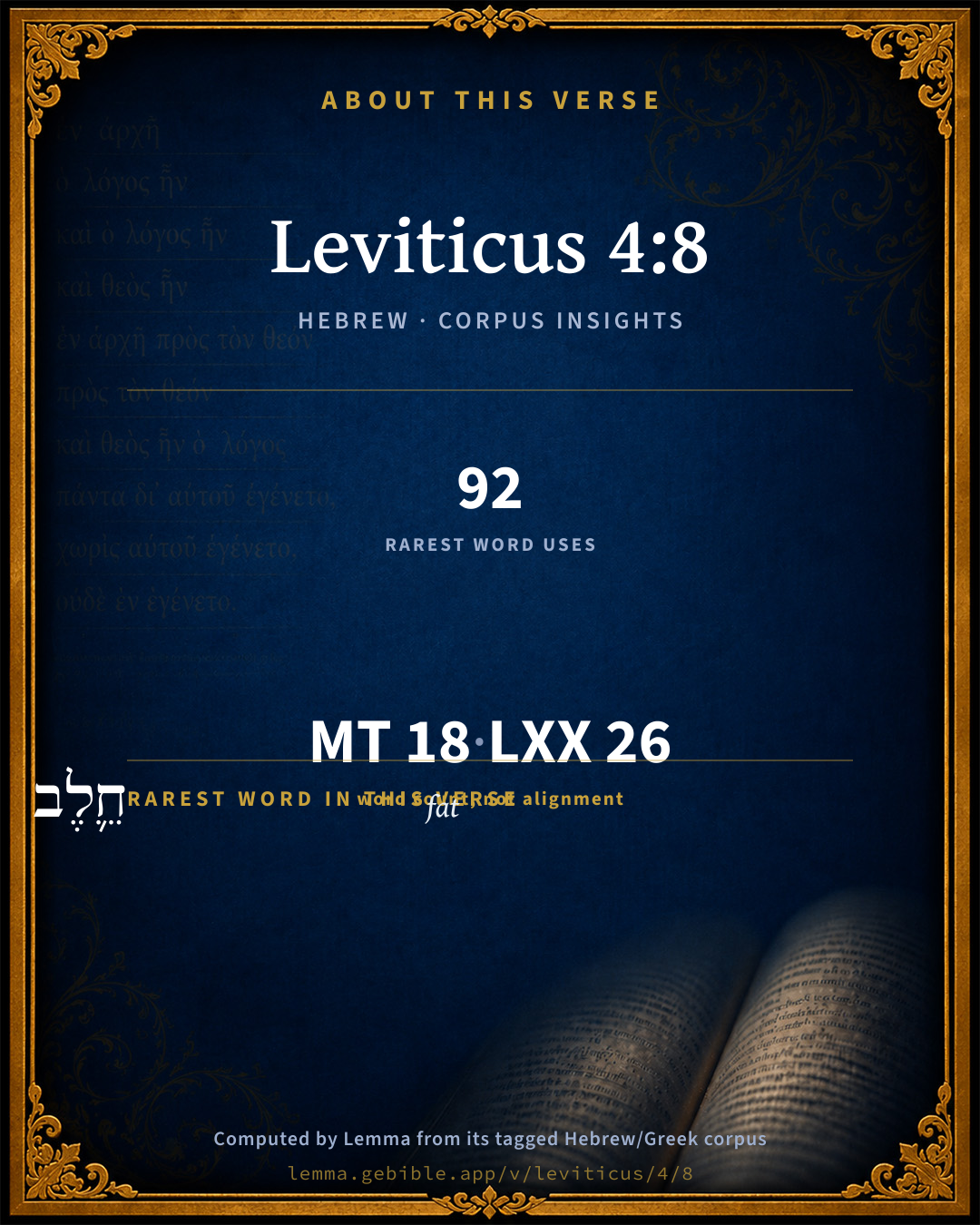
  • חֵ֛לֶב fat H2459 ×3
  • כָּל all H3605 ×2
  • עַל upon H5921 ×2
  • הַקֶּ֔רֶב midst H7130 ×2

Hebrew & Septuagint length

In English translation the verse runs 31 words from the Hebrew and 31 from the Septuagint (LXX English) — the same length.

A rough comparison of the two English renderings, which tokenize alike — not a word-level alignment.

Word counts can differ between the Hebrew and the Greek without any difference in meaning — e.g. the Hebrew direct-object marker אֵת has no separate Greek word, and Greek often adds the article ὁ.

In the original languages it is 18 Hebrew tokens and 26 Greek tokens — but the two are counted differently (Hebrew bundles its prefixes and suffixes into one token; the Greek is in lemma form), so that isn’t a like-for-like length.

Cross-references

11

Topical passages linked to Leviticus 4:8 in the Treasury of Scripture Knowledge — connected by theme and wording, ordered by reader-vote popularity; previews shown in the World English Bible.

  • Leviticus 3:3–5 He shall offer of the sacrifice of peace offerings an offering made by fire to Yahweh; the fat that covers the innards, and all the fat that is on the innards,
  • Leviticus 4:26 All its fat he shall burn on the altar, like the fat of the sacrifice of peace offerings; and the priest shall make atonement for him concerning his sin, and he will be forgiven.
  • Leviticus 3:9–11 He shall offer from the sacrifice of peace offerings an offering made by fire to Yahweh; its fat, the entire tail fat, he shall take away close to the backbone; and the fat that covers the inwards, and all the fat that is on the inwards,
  • Leviticus 3:14–16 He shall offer from it as his offering, an offering made by fire to Yahweh; the fat that covers the innards, and all the fat that is on the innards,
  • Leviticus 4:19 All its fat he shall take from it, and burn it on the altar.
  • Leviticus 4:31 All its fat he shall take away, like the fat is taken away from off of the sacrifice of peace offerings; and the priest shall burn it on the altar for a sweet savor to Yahweh; and the priest shall make atonement for him, and he will be forgiven.
  • Leviticus 4:35 All its fat he shall take away, like the fat of the lamb is taken away from the sacrifice of peace offerings; and the priest shall burn them on the altar, on the offerings of Yahweh made by fire; and the priest shall make atonement for him concerning his sin that he has sinned, and he will be forgiven.
  • Leviticus 7:3–5 He shall offer all of its fat: the fat tail, and the fat that covers the innards,
  • Leviticus 16:25 The fat of the sin offering he shall burn on the altar.
  • Isaiah 53:10 Yet it pleased Yahweh to bruise him; he has put him to grief: when you shall make his soul an offering for sin, he shall see [his] seed, he shall prolong his days, and the pleasure of Yahweh shall prosper in his hand.
  • John 12:27 "Now my soul is troubled. What shall I say? 'Father, save me from this time?' But for this cause I came to this time.

Cross-references courtesy of OpenBible.info (CC BY 4.0).

Hebrew and Greek witnesses Masoretic Hebrew ↔ Greek Septuagint

The same verse in the two great witnesses to the Old Testament, shown verse-for-verse.

These are two independent witnesses, not word-aligned to each other, and the Septuagint is shown in lemma (dictionary) form.

Hebrew Leviticus 4:8 Masoretic · Westminster Leningrad Codex

וְאֶת כָּל חֵ֛לֶב פַּ֥ר הַֽחַטָּ֖את יָרִ֣ים מִמֶּ֑נּוּ אֶת הַחֵ֨לֶב֙ הַֽמְכַסֶּ֣ה עַל הַקֶּ֔רֶב וְאֵת֙ כָּל הַחֵ֔לֶב אֲשֶׁ֖ר עַל הַקֶּֽרֶב

He shall take all the fat of the bull of the sin offering off of it; the fat that covers the innards, and all the fat that is on the innards,

World English Bible · Public Domain

Greek LXX Leviticus 4:8 Septuagint · lemma form

καί πᾶς ὁ στέαρ ὁ μόσχος ὁ ὁ ἁμαρτία περιαἱρέω ἀπό αὐτός ὁ στέαρ ὁ κατακαλύπτω ὁ ἐνδόσθια καί πᾶς ὁ στέαρ ὁ ἐπί ὁ ἐνδόσθια

and all the fat of the calf of the sin-offering shall he take off from it; the fat that covers the inwards, and all the fat that is on the inwards,

LXX2012 (modern English Septuagint) · Public Domain

Hebrew: Westminster Leningrad Codex (CC BY 4.0). Greek: Septuagint (public domain); English from LXX2012 (modern English Septuagint) (Public Domain). How the Septuagint differs from the Hebrew →

Targum (Aramaic paraphrase)

2

The Targum is the ancient Jewish Aramaic paraphrase of the Hebrew Scriptures — an interpretive translation, not the Hebrew text itself. Onkelos (literal) and Pseudo-Jonathan (expansive) render the Torah, and Jonathan the Prophets. Coverage is partial: where no permissively-licensed English translation exists for a verse, only the Aramaic is shown. This is verse-level text, not a word-by-word alignment to the Hebrew.

  1. Targum Onkelos Torah (Genesis–Deuteronomy)
    וְיָת כָּל תְּרַב תּוֹרָא דְחַטָאתָא יַפְרֵשׁ מִנֵהּ יָת תַּרְבָּא דְחָפֵי עַל גַוָא וְיָת כָּל תַּרְבָּא דִי עַל גַוָא

    (no public-domain English translation for this verse)

    Targum Onkelos — Aramaic: “Onkelos Genesis” (public domain); “Onkelos Exodus” (public domain); “Onkelos Leviticus” (public domain); “Onkelos Numbers” (public domain); “Onkelos Deuteronomy” (public domain). English: “Sefaria Community Translation” (CC0 1.0 (public-domain dedication)); “J.W. Etheridge. The Targums of Onkelos and Jonathan Ben Uzziel on the Pentateuch. London: Longmans, Green, 1862” (public domain). Text via Sefaria.

  2. Targum Pseudo-Jonathan Torah (Genesis–Deuteronomy)
    וְיַת כָּל תְּרֵיב תּוֹרָא דְחַטָאתָא יַפְרֵישׁ מִנֵיהּ יַת פְּרִיסוּתָא דְתַרְבָּא דְחָפֵי יַת כְּרֵיסָא וְיַת כָּל תַּרְבָּא דְעַל כְּרֵיסָא

    And all the fat of the bullock of the sin offering he shall separate from him, the covering of fat which covereth the inwards, even all the fat which is upon the inwards.

    Targum Pseudo-Jonathan — Aramaic: “Targum Jonathan on Genesis” (public domain); “Targum Jonathan on Exodus” (public domain); “Targum Jonathan on Leviticus” (public domain); “Targum Jonathan on Numbers” (public domain); “Targum Jonathan on Deuteronomy” (public domain). English: “The Targum of Jonathan ben Uzziel, trans. J. W. Etheridge, London, 1862” (public domain). Text via Sefaria.

Commentary

Notes on Leviticus 4:8 from classic Christian and Jewish commentators (each source and its license shown beneath its notes). The classic Christian expositions comment on the surrounding passage and are grouped to its opening verse, so a note may address several verses; the Jewish commentaries on the Tanakh (Rashi and others) are per-verse, so they appear only where the commentator wrote on this verse.

Lemma curates 59 commentaries, every one of them public domain or Creative Commons licensed, each selected and text-cleaned for this edition rather than reprinted as found. About our sources →

Trapp's Complete Commentary

John Trapp

Lev 4:8 And he shall take off from it all the fat of the bullock for the sin offering; the fat that covereth the inwards, and all the fat that [is] upon the inwards,

Ver. 8. All the fat.] Because, among other things, it signified hard heartedness and insensibleness of sin and danger. {Psa 119:70} Dionysius the Heracleot felt not needles thrust into his fat belly, saith the history.

John Trapp, A Commentary or Exposition upon All the Books of the Old and New Testament (1647–1656) — public domain. Text from a community e-Sword module.

The Expositor's Bible

THE EATING AND THE BURNING OF THE SIN OFFERING WITHOUT THE CAMP

Lev_4:8-12; Lev_4:19-21; Lev_4:26; Lev_4:31; Lev_5:10; Lev_5:12

"And all the fat of the bullock of the sin offering he shall take off from it; the fat that covereth the inwards, and all the fat that is upon the inwards, and the two kidneys, and the fat that is upon them, which is by the loins, and the caul upon the liver, with the kidneys, shall he take away, as it is taken off from the ox of the sacrifice of, peace offerings: and the priest shall burn them upon the altar of burnt offering. And the skin of the bullock, and all its flesh, with its head, and with its legs, and its inwards, and its dung, even the whole bullock shall he carry forth without the camp unto a clean place, where the ashes are poured out, and burn it on wood with fire: where the ashes are poured out shall it be burnt And all the fat thereof shall he take off from it, and burn it upon the altar. Thus shall he do with the bullock; as he did with the bullock of the sin offering, so shall he do with this: and the priest shall make atonement for them, and they shall be forgiven. And he shall carry forth the bullock without the camp, and burn it as he burned the first bullock: it is the sin offering for the assembly. And all the fat thereof shall he burn upon the altar, as the fat of the sacrifice of peace offerings: and the priest shall make atonement for him as concerning his sin, and he shall be forgiven. And all the fat thereof shall he take away, as the fat is taken away from off the sacrifice of peace offerings; and the priest shall burn it upon the altar for a sweet savour unto the Lord and the priest shall make atonement for him, and he shall be forgiven. And he shall offer the second for a burnt offering according to the ordinance: and the priest shall make atonement for him as concerning his sin which he hath sinned, and he shall be forgiven. And he shall bring it to the priest, and the priest shall take his handful of it as the memorial thereof, and burn it on the altar, upon the offerings of the Lord made by fire: it is a sin offering."

In the ritual of the sin offering, sacrificial meal, such as that of the peace offering, wherein the offerer and his house, with the priest and the Levite, partook together of the flesh of the sacrificed victim, there was none. The eating of the flesh of the sin offerings by the priests, prescribed in Lev_6:26, had, primarily, a different intention and meaning. As set forth elsewhere, {Lev_7:35} it was "the anointing portion of Aaron and his sons"; an ordinance expounded by the Apostle Paul to this effect, {1Co_9:13} they which wait upon the altar should "have their portion with the altar." Yet not of all the sin offerings might the priest thus partake. For when he was himself the one for whom the offering was made, whether as an individual, or as included in the congregation, then it is plain that he for the time stood in the same position before God as the private individual who had sinned. It was a universal principle of the law that because of the peculiarly near and solemn relation into which the expiatory victim had been brought to God, it was "most holy," and therefore he for whose sin it is offered could not eat of its flesh. Hence the general law is laid down: {Lev_6:30} "No sin offering, whereof any of the blood is brought into the tent of meeting to make atonement in the holy place, shall be eaten; it shall be burnt with fire."

And yet, although, because the priests could not eat of the flesh, it must be burnt, it could not be burnt upon the altar; not, as some have fancied, because it was regarded as unclean, which is directly contradicted by the statement that it is "most holy," but because so to dispose of it would have been to confound the sin offering with the burnt offering, which had, as we have seen, a specific symbolic meaning, quite distinct from that of the sin offering. It must be so disposed of that nothing shall divert the mind of the worshipper from the fact that, not sacrifice as representing full consecration, as in the burnt offering, but sacrifice as representing expiation, is set forth in this offering. Hence it was ordained that the flesh of these sin offerings for the anointed priest, or for the congregation, which included him, should be "burnt on wood with fire without the camp." {Lev_4:11-12; Lev_4:21} And the more carefully to guard against the possibility of confounding this burning of the flesh of the sin offering with the sacrificial burning of the victims on the altar, the Hebrew uses here, and in all places where this burning is referred to, a verb wholly distinct from that which is used of the burnings on the altar, and which, unlike that, is used of any ordinary burning of anything for any purpose.

But this burning of the victim without the camp was not therefore empty of all typical significance. The writer of the Epistle to the Hebrews calls our attention to the fact that in this part of the appointed ritual there was also that which prefigured Christ and the circumstances of His death. For we, {Heb_13:10-12} after an exhortation to Christians to have done with the ritual observances of Judaism regarding meats:-"We," that is, we Christian believers, "have an altar,"-the cross upon which Jesus suffered, -"whereof they have no right to eat which serve the tabernacle"; i.e., they who adhere to the now effete Jewish tabernacle service, the unbelieving Israelites, derive no benefit from this sacrifice of ours. "For the bodies of those beasts whose blood is brought into the Holy Place by the high priest as an offering for sin, are burned without the camp"; the priesthood are debarred from eating them, according to the law we have before us. And then attention is called to the fact that in this respect Jesus fulfilled this part of the type of the sin offering, thus: "Wherefore Jesus also, that He might sanctify the people with His own blood, suffered without the camp." That is, as Alford interprets (Comm. sub. loc.), in the circumstance that Jesus suffered without the gate, is seen a visible adumbration of the fact that He suffered outside the camp of legal Judaism, and thus, in that He suffered for the sin of the whole congregation of Israel, fulfilled the type of this sin offering in this particular. Thus a prophecy is discovered here which perhaps we had not else discerned, concerning the manner of the death of the antitypical victim. He should suffer as a victim for the sin of the whole congregation, the priestly people, who should for that reason be debarred, in fulfilment of the type, from that benefit of His death which had else been their privilege. And herein was accomplished to the uttermost that surrender of His whole being to God, in that, in carrying out that full consecration, "He, bearing His cross, went forth," not merely outside the gate of Jerusalem, -in itself a trivial circumstance, -but, as this fitly symbolised, outside the congregation of Israel, to suffer. In other words, His consecration of Himself to God in self-sacrifice found its supreme expression in this, that He voluntarily submitted to be cast out from Israel, despised and rejected of men, even of the Israel of God.

And so this burning of the flesh of the sin offering of the highest grade in two places, the fat upon the altar, in the court of the congregation, and the rest of the victim outside the camp, set forth prophetically the full self-surrender of the Son to the Father, as the sin offering, in a double aspect: in the former, emphasising simply, as in the peace offering, His surrender of all that was highest and best in Him, as Son of God and Son of man, unto the Father as a Sin offering; in the latter, foreshowing that He should also, in a special manner, be a sacrifice for the sin of the congregation of Israel, and that His consecration should receive its fullest exhibition and most complete expression in that He should die outside the camp of legal Judaism, as an outcast from the congregation of Israel.

Accordingly we find that this part of the type of the sin offering was formally accomplished when the high priest, upon Christs confession before the Sanhedrim of His Sonship to God, declared Him to be guilty of blasphemy; an offence for which it had been ordered by the Lord {Lev_24:14} that the guilty person should be taken "without the camp" to suffer for his sin.

In the light of these marvellous correspondences between the typical sin offering and the self offering of the Son of God, what a profound meaning more and more appears in those words of Christ concerning Moses: "He wrote of Me."

William Robertson Nicoll, ed., The Expositor's Bible (London: Hodder & Stoughton, 1887–1910) — public domain. 65 of 66 books (1 Corinthians is not separately keyed, as that volume carries no machine-parseable verse references); section-level commentary keyed to the opening verse. Introductory and overview sections not keyed to a specific passage are excluded.

Ellicott's Commentary for English Readers

(8) And he shall take off from it all the fat.—That is, the best or choicest part. (See Lev_3:3.) At the time of Christ the sin offering was cut open, the fat and inwards were taken out, put into a vessel, salted, stewed on the fire, and burnt upon the altar as a sweet savour unto the Lord.

A Bible Commentary for English Readers, edited by Charles John Ellicott (1878–1897) — public domain. Text from a community e-Sword module.

The Cambridge Bible for Schools and Colleges

gen. ed. J. J. S. Perowne

8–12. Cp. 19–21. The fat parts (the same as those reserved for the altar in the Peace-Offering) are then removed from the bullock, and burnt upon the altar of Burnt-Offering. All the remainder (even the whole bullock shall he carry forth in Lev_4:12 is traditionally interpreted as directing that the carcase should be carried out whole, and afterwards divided into pieces) shall be taken to a clean place (i.e. one free from ritual impurity) where the ashes (i.e. the ashes to which the Burnt-Offering, and other sacrifices burnt on the altar have been reduced by burning) are poured out (cp. Lev_1:16 and Lev_6:11) and there burnt on wood with fire (cp. Heb_13:11-12).

The traditional view of the sacrifice prescribed in Lev_4:3-12 is that it was necessary whenever the high priest had committed any offence in the discharge of his official duty as representative of the nation. In his ordinary life the high priest stands in the same relation to God’s law as any other member of the community, and may offer the same sacrifice as the ordinary Israelite. According to some commentators the ‘sin’ of Lev_4:3 refers to any offence whatever of the high priest committed in ignorance. The author of the Epistle to the Hebrews points to the ideal high priest who is undefiled, separate from sinners (Lev_7:26), as distinguished from the high priest under the law, who, by reason of his infirmity, must offer sacrifice for his own sins, and then for the sins of the people (Lev_7:27, Lev_5:3).

The Cambridge Bible for Schools and Colleges (gen. ed. J. J. S. Perowne; Cambridge University Press, 1878–1918) — public domain. Text from a community e-Sword module.

John Gill's Exposition

And the skin of the bullock,.... Not taken off; for the sin offerings that were burnt were not flayed at all, but were cut in pieces with their skins on them (a); in other burnt offerings the skin was taken off, and was a perquisite of the priest, Lev 7:8 but this being an offering for the priest, the skin was burnt with the rest:

and all his flesh, with his head, and with his legs, and his inwards, and his dung; the burning of these denoted the sufferings of Christ, and these several parts the extent of them, they reaching to all parts of his body as stretched upon the cross; and the dung particularly the reproach of them, he dying the death of the cross, and was made sin and a curse for his people.

(a) Ib. (Maasch Hakoranot) c. 5. sect. 18. & 7. 2.

John Gill's Exposition of the Whole Bible (1746–1763) — public domain (CC PDM 1.0). Text via the HelloAO Bible API.

Whedon's Commentary on the Bible

Daniel D. Whedon

8. All the fat — Suet. See notes on Lev_3:3; Lev_3:17.

Daniel D. Whedon (gen. ed.), Commentary on the Old and New Testaments (1874–1909) — public domain. Text from a community e-Sword module.

unfoldingWord translationNotes

Door43 World Missions Community

He will cut away

"The priest will cut away"

the fat that covers the inner parts ... with the kidneys—he will cut away all this

The statement "he will cut away all this" can be placed at the beginning of the sentence. AT: "He will cut away the fat that covers the inner parts ... with the kidneys"

inner parts

This is the stomach and intestines.

by the loins

This is the part of the body on the sides of the backbone between the ribs and hipbone.

the lobe of the liver

This is the curved or rounded part of the liver. This is considered the best part of the liver to eat. AT: "the best part of the liver"

translationWords

cow

sin offering

peace offering

priest

altar

burnt offering

unfoldingWord translationNotes — © Distant Shores Media and the Door43 World Missions Community, licensed CC BY-SA 4.0. Source: git.door43.org/Door43/en_tn.

Rashi

Rabbi Shlomo Yitzchaki (Rashi)

ואת כל חלב פר [AND HE SHALL TAKE UP …] ALL THE FAT OF THE BULLOCK — It ought to have said “its fat” (since the פר has just been mentioned); why does it state expressly “the fat of a bullock [of a sin-offering]” (i.e. any bullock brought as a sin-offering)? In order to include also the bullock of the Day of Atonement in respect to the burning of the kidneys, the fat portions and the lobe (Sifra, Vayikra Dibbura d'Chovah, Chapter 4 1).

החטאת — [THE FAT OF THE BULLOCK OF] THE SIN OFFERING (implying, the fat of the bullock because it is a sin-offering) consequently serves to include the goats brought as a sin-offering for idolatry (Numbers 15:24) in respect to the burning of the kidneys, the fat portions and the lobe of the liver (Sifra, Vayikra Dibbura d'Chovah, Chapter 4 1; cf. Note on the previous passage).

ירים ממנו AND HE SHALL TAKE FROM IT [ALL THE FAT] — from. “it”, i. e. from the bullock — consequently he must take it (the fat) whilst it is still connected with it (the animal), — that he must not dismember it before removing the fat from it. Thus is it explained in Torath Cohanim (Sifra, Vayikra Dibbura d'Chovah, Chapter 4 1).

Rashi on the Tanakh — English translations: “The Judaica Press complete Tanach with Rashi, translated by A. J. Rosenberg” (CC BY 4.0); “Pentateuch with Rashi's commentary by M. Rosenbaum and A.M. Silbermann, 1929-1934” (public domain); “The Metsudah Tanach series, Lakewood, N.J” (CC BY 4.0); and “The Book of Joshua, Metsudah Publications, 1997” (CC BY 4.0). Text via Sefaria.

Lesson kit

Teaching starters — assembled from the data on this page, not authored interpretation. Every prompt links to the verse data it draws on. Edit before teaching.

Leviticus, in the Pentateuch, opens this verse with 18 words (11 distinct Hebrew lemmas). Its most distinctive word is cheleb (“fat”). A historical commentator’s framing appears above. Read the whole chapter for the surrounding context.

Discussion questions

  1. The word cheleb carries the sense “fat.” How does it shape the verse?
  2. Leviticus 3:3–5 shares this passage’s theme. How do the two illuminate each other?
  3. “fat” occurs 3× in this one verse. What is the effect of the repetition?
  4. These translations render this verse differently. What is at stake in choosing one wording over another?
  5. The verb «יָרִ֣ים» is Hiphil Imperfect. How does its form color the action?
  6. Reading how Trapp's Complete Commentary and The Expositor's Bible read this verse, where do the two commentators agree and where do they part?

Things to notice

Reading settings

Reading text

Shown beneath each verse's original-language words.

Old Testament
Old Testament edition

Read the OT as the Masoretic Hebrew (MT) or the Greek Septuagint (LXX).

English shown for the Greek Septuagint (in the Hebrew ↔ Greek comparison).

Comparing translations? Open the Compare panel on any verse page to stack up to four side by side.