
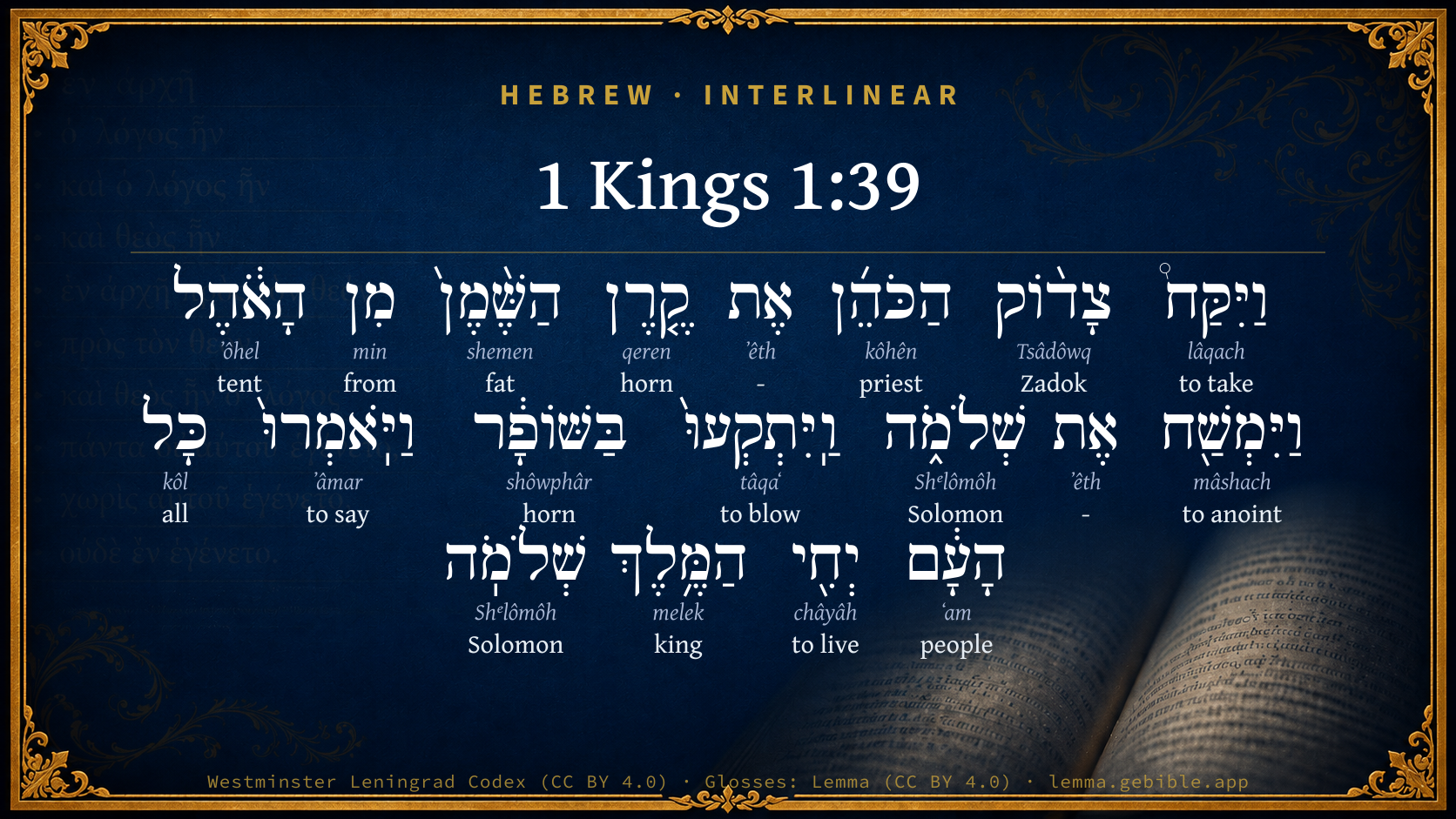
1 Kings 1:39

Hebrew (Westminster Leningrad Codex) 1 Kings 1:39 appears in the Hebrew Old Testament. The text above is from the Westminster Leningrad Codex. Each word links to its Strong’s number, a concise gloss, and parsing drawn from the Open Scriptures Hebrew Bible morphology. Click any word for its full Brown-Driver-Briggs (BDB) entry.
Download image
Cite this verse

1 Kings 1:39 (World English Bible). Public Domain. Lemma interlinear Bible study tool, https://lemma.gebible.app/v/1-kings/1/39.

Show BibTeX & RIS
BibTeX
RIS
English Translation
Zadok the priest took the horn of oil out of the Tent, and anointed Solomon. They blew the trumpet; and all the people said, [Long] live king Solomon.
World English Bible · Public Domain
Download a study sheet

One document with this verse’s original text, its word-by-word gloss line, the meaning frame, cross-references with their text, attributed commentary, and full source and license credits — printable, and it pastes into notes with its structure intact.

This verse Autodidact and up

Study sheet (.html) Plain text (.txt)

A passage Seminary Student

Up to 50 verses in one chapter. A passage sheet keeps up to 6 commentary sources and 12 cross-references per verse, in the order this page ranks them, and says so on the sheet whenever that leaves anything out. Ask for a single verse and you get the Autodidact verse sheet above.

Everything on this page stays free to read, with no account — the sheet is a download of what is already on screen, not access to it.

Want to remove ads? Support Godless Engineer
Compare translations 3

The same verse in 3 English versions, stacked beneath the original-language interlinear above. Click any original word for its lexicon entry.

Each is an independent rendering of the whole verse — the interlinear is not word-aligned to these translations.

Highlighted words mark where these versions differ — a whole-verse word diff, not a word-by-word alignment.

  • World English Bible Public Domain
    Zadok the priest took the horn of oil out of the Tent, and anointed Solomon. They blew the trumpet; and all the people said, [Long] live king Solomon.
  • King James Version Public Domain
    And Zadok the priest took an horn of oil out of the tabernacle, and anointed Solomon. And they blew the trumpet; and all the people said, God save king Solomon.
  • unfoldingWord Literal Text CC BY-SA 4.0
    And Zadok the priest took the horn of oil from the tent, and he anointed Solomon. And they blew on the shofar, and all of the people said, “May King Solomon live!”

unfoldingWord Literal Text — © unfoldingWord, licensed CC BY-SA 4.0. Word-aligned USFM3 via Door43 (git.door43.org/unfoldingWord/en_ult).

Versions to compare (up to 4)

3 of 4 selected

Show all 18 translations

Every available English version of this verse, each an independent rendering of the whole verse.

  • World English Bible Public Domain
    Zadok the priest took the horn of oil out of the Tent, and anointed Solomon. They blew the trumpet; and all the people said, [Long] live king Solomon.
  • Berean Standard Bible Public Domain
    Zadok the priest took the horn of oil from the tabernacle and anointed Solomon. Then they blew the ram’s horn, and all the people proclaimed, “Long live King Solomon!”
  • Majority Standard Bible Public Domain
    Zadok the priest took the horn of oil from the tabernacle and anointed Solomon. Then they blew the ram’s horn, and all the people proclaimed, “Long live King Solomon!”
  • King James Version Public Domain
    And Zadok the priest took an horn of oil out of the tabernacle, and anointed Solomon. And they blew the trumpet; and all the people said, God save king Solomon.
  • American Standard Version (1901) Public Domain
    And Zadok the priest took the horn of oil out of the Tent, and anointed Solomon. And they blew the trumpet; and all the people said, `Long' live king Solomon.
  • Revised Version (1885) Public Domain
    And Zadok the priest took the horn of oil out of the Tent, and anointed Solomon. And they blew the trumpet; and all the people said, God save king Solomon.
  • Geneva Bible (1599) Public Domain
    And Zadok the Priest tooke an horne of oyle out of the Tabernacle, and anointed Salomon: and they blewe the trumpet, and all the people said, God saue king Salomon.
  • Douay-Rheims (1899) Public Domain
    And Sadoc the priest took a horn of oil out of the tabernacle, and anointed Solomon: and they sounded the trumpet, and all the people said: God save king Solomon.
  • Young's Literal Translation Public Domain
    and Zadok the priest taketh the horn of oil out of the tent, and anointeth Solomon, and they blow with a trumpet, and all the people say, `Let king Solomon live.'
  • Literal Standard Version CC BY-SA 4.0
    and Zadok the priest takes the horn of oil out of the tent, and anoints Solomon, and they blow with a horn, and all the people say, “Let King Solomon live.”
  • Unlocked Literal Bible CC BY-SA 4.0
    Zadok the priest took the horn of oil out of the tent and anointed Solomon. Then they blew the trumpet, and all the people said, “Long live King Solomon!”
  • unfoldingWord Literal Text CC BY-SA 4.0
    And Zadok the priest took the horn of oil from the tent, and he anointed Solomon. And they blew on the shofar, and all of the people said, “May King Solomon live!”
  • Darby Bible Public Domain
    And Zadok the priest took the horn of oil out of the tabernacle, and anointed Solomon. And they blew the trumpet; and all the people said, Long live king Solomon!
  • World Messianic Bible Public Domain
    Zadok the priest took the horn of oil from the Tent, and anointed Solomon. They blew the shofar; and all the people said, “Long live King Solomon!”
  • Webster's Bible Public Domain
    And Zadok the priest took a horn of oil out of the tabernacle, and anointed Solomon. And they blew the trumpet; and all the people said, God save king Solomon.
  • Free Bible Version CC BY-SA 4.0
    Zadok the priest took the horn containing olive oil from the Tent and anointed Solomon. Then they blew the trumpet, and all the people shouted, “Long live King Solomon!”
  • Bible in Basic English Public Domain
    And Zadok the priest took the vessel of oil out of the Tent, and put the holy oil on Solomon. And when the horn was sounded, all the people said, Long life to King Solomon!
  • JPS Tanakh (1917) Public Domain
    And Zadok the priest took the horn of oil out of the Tent, and anointed Solomon. And they blew the ram's horn; and all the people said: 'Long live king Solomon.'

Literal Standard Version (2020), Covenant Press — licensed CC BY-SA 4.0. Text via the HelloAO Bible API (eBible.org). Unlocked Literal Bible (unfoldingWord) — licensed CC BY-SA 4.0. Text via the HelloAO Bible API (eBible.org). unfoldingWord Literal Text — © unfoldingWord, licensed CC BY-SA 4.0. Word-aligned USFM3 via Door43 (git.door43.org/unfoldingWord/en_ult). Free Bible Version, Dr. Jonathan Gallagher — licensed CC BY-SA 4.0. Text via the HelloAO Bible API (eBible.org).

Word by word

More ways to search: Search by grammar → Find every occurrence → Compare this word →

Practice this passage: Drill this verse → Learn its vocabulary →

צָד֨וֹק
Tsâdôwq
H6659
“Zadok”
Noun, Proper
Part of Speech
Noun
Type
Proper
Full BDB Definition

Origin: from H6663

TWOT: None

Zadok = "righteous" - the high priest, son of Ahitub of the house of Eleazar the son of Aaron, and 11th in descent from Aaron; joined David after Saul's death and supported him against Absalom and Adonijah; anointed Solomon as king - a priest, son of Meraioth, father of Meshullam of the house of Ahitub; apparently a nephew of 1 - father of Jerusha, the wife of king Uzziah and mother of king Jotham of Judah - son of Baana and repairer of the wall of Jerusalem in the time of Nehemiah - son of Immer and repairer of the wall of Jerusalem in the time of Nehemiah - a leader of the people in the time of Nehemiah - a scribe appointed by Nehemiah as one of the treasurers over the storehouse - a valiant warrior of the tribe of Benjamin who joined David at Hebron. Same as 1?
  1. וַיִּקַּח֩ lâqach H3947 “and · to take” Conjunction + Verb, Qal, Sequential Imperfect, 3rd Person, Masculine, Singular
  2. הַכֹּהֵ֜ן kôhên H3548 “the · priest” Particle, Definite Article + Noun, Common, Masculine, Singular, Absolute
  3. אֶת ʼêth H853 “-” Particle, Direct Object
  4. קֶ֤רֶן qeren H7161 “horn of” Noun, Common, Both, Singular, Construct
  5. הַשֶּׁ֨מֶן֙ shemen H8081 “the · fat” Particle, Definite Article + Noun, Common, Masculine, Singular, Absolute
  6. מִן min H4480 “from” Preposition
  7. הָאֹ֔הֶל ʼôhel H168 “the · tent” Particle, Definite Article + Noun, Common, Masculine, Singular, Absolute
  8. וַיִּמְשַׁ֖ח mâshach H4886 “and · to anoint” Conjunction + Verb, Qal, Sequential Imperfect, 3rd Person, Masculine, Singular
  9. אֶת ʼêth H853 “-” Particle, Direct Object
  10. שְׁלֹמֹ֑ה Shᵉlômôh H8010 “Solomon” Noun, Proper
  11. וַֽיִּתְקְעוּ֙ tâqaʻ H8628 “and · to blow” Conjunction + Verb, Qal, Sequential Imperfect, 3rd Person, Masculine, Plural
  12. בַּשּׁוֹפָ֔ר shôwphâr H7782 “in/at the · horn” Preposition, Determined + Noun, Common, Masculine, Singular, Absolute
  13. וַיֹּֽאמְרוּ֙ ʼâmar H559 “and · to say” Conjunction + Verb, Qal, Sequential Imperfect, 3rd Person, Masculine, Plural
  14. כָּל kôl H3605 “all of” Noun, Common, Masculine, Singular, Construct
  15. הָעָ֔ם ʻam H5971 “the · people” Particle, Definite Article + Noun, Common, Masculine, Singular, Absolute
  16. יְחִ֖י châyâh H2421 “to live” Verb, Qal, Jussive, 3rd Person, Masculine, Singular
  17. הַמֶּ֥לֶךְ melek H4428 “the · king” Particle, Definite Article + Noun, Common, Masculine, Singular, Absolute
  18. שְׁלֹמֹֽה Shᵉlômôh H8010 “Solomon” Noun, Proper

About this verse

These counts appear in no published source. They are computed here, from the morphology-tagged text and Lemma’s own curated glosses. What Lemma adds →

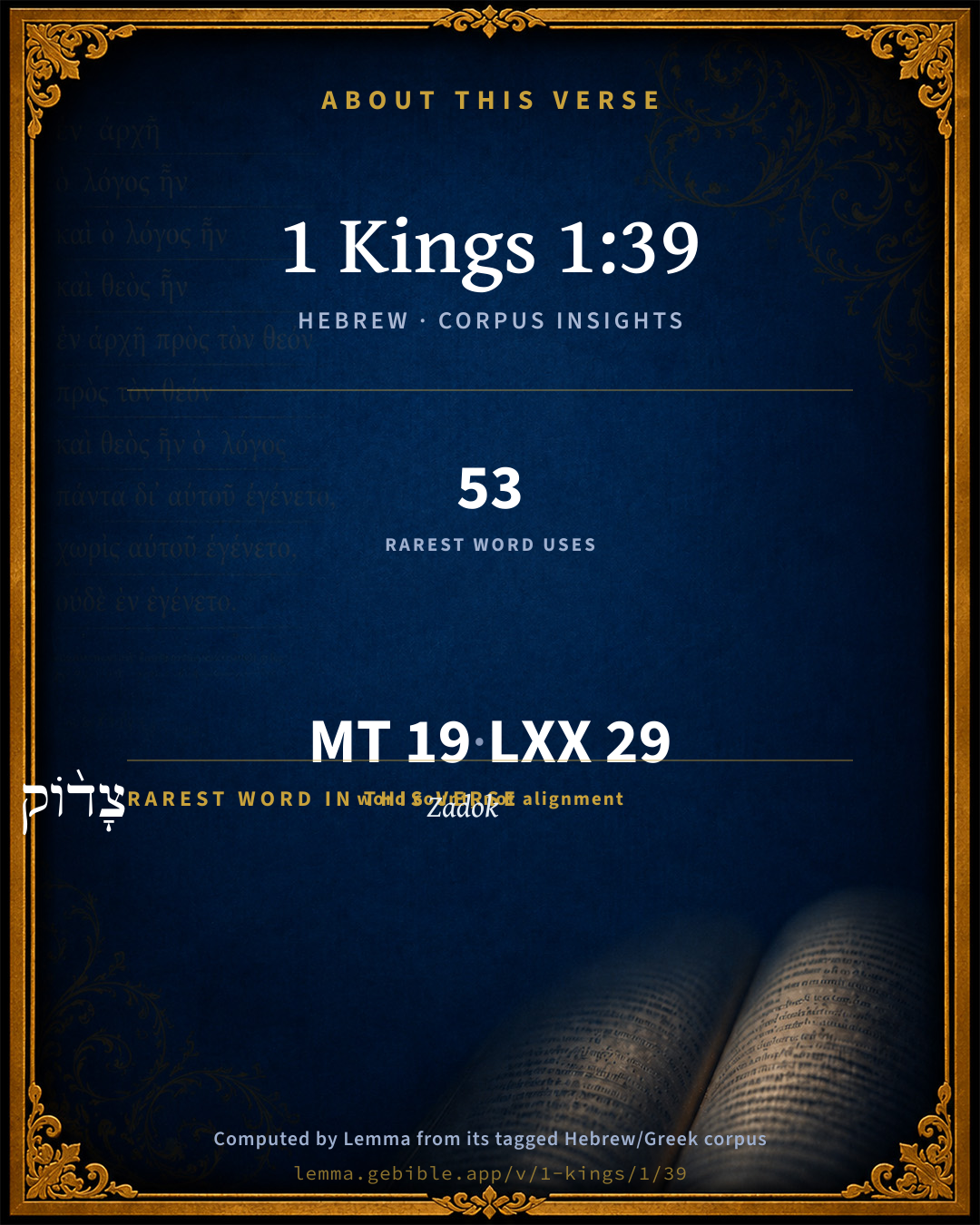
19
words
17
distinct lemmas
Historical
section

Shared distinctive vocabulary

צָד֨וֹק Zadok H6659 occurs in 50 verses of the Hebrew Bible. Also found in:

Grammatical profile

  • 5 verbs
  • 11 nouns
  • 1 preposition
  • 2 particles

Verb forms

  • וַיִּקַּח֩ Qal · Sequential Imperfect
  • וַיִּמְשַׁ֖ח Qal · Sequential Imperfect
  • וַֽיִּתְקְעוּ֙ Qal · Sequential Imperfect
  • וַיֹּֽאמְרוּ֙ Qal · Sequential Imperfect
  • יְחִ֖י Qal · Jussive

Repetition

A word recurs within this verse — often emphatic in Hebrew:

  • שְׁלֹמֹ֑ה Solomon H8010 ×2

Hebrew & Septuagint length

In English translation the verse runs 28 words from the Hebrew and 29 from the Septuagint (LXX English) — closely comparable.

A rough comparison of the two English renderings, which tokenize alike — not a word-level alignment.

Word counts can differ between the Hebrew and the Greek without any difference in meaning — e.g. the Hebrew direct-object marker אֵת has no separate Greek word, and Greek often adds the article ὁ.

In the original languages it is 19 Hebrew tokens and 29 Greek tokens — but the two are counted differently (Hebrew bundles its prefixes and suffixes into one token; the Greek is in lemma form), so that isn’t a like-for-like length.

Cross-references

10

Topical passages linked to 1 Kings 1:39 in the Treasury of Scripture Knowledge — connected by theme and wording, ordered by reader-vote popularity; previews shown in the World English Bible.

  • Psalms 89:20 I have found David, my servant. I have anointed him with my holy oil,
  • 1 Samuel 10:24 Samuel said to all the people, "You see him whom Yahweh has chosen, that there is none like him among all the people?" All the people shouted, and said, [Long] live the king.
  • 1 Kings 1:34 and let Zadok the priest and Nathan the prophet anoint him there king over Israel; and blow you the trumpet, and say, [Long] live king Solomon.
  • 1 Chronicles 29:22 and ate and drink before Yahweh on that day with great gladness. They made Solomon the son of David king the second time, and anointed him to Yahweh to be prince, and Zadok to be priest.
  • 1 Samuel 16:13 Then Samuel took the horn of oil, and anointed him in the midst of his brothers: and the Spirit of Yahweh came mightily on David from that day forward. So Samuel rose up, and went to Ramah.
  • 1 Kings 1:25 For he is gone down this day, and has slain oxen and fatlings and sheep in abundance, and has called all the king's sons, and the captains of the host, and Abiathar the priest; and, behold, they are eating and drinking before him, and say, [Long] live king Adonijah.
  • 2 Kings 11:12 Then he brought out the king's son, and put the crown on him, and [gave him] the testimony; and they made him king, and anointed him; and they clapped their hands, and said, [Long] live the king.
  • 2 Chronicles 23:11 Then they brought out the king's son, and put the crown on him, and [gave him] the testimony, and made him king: and Jehoiada and his sons anointed him; and they said, [Long] live the king.
  • 2 Chronicles 23:13 and she looked, and, behold, the king stood by his pillar at the entrance, and the captains and the trumpets by the king; and all the people of the land rejoiced, and blew trumpets; the singers also [played] on instruments of music, and led the singing of praise. Then Athaliah tore her clothes, and said, Treason! treason!
  • Exodus 30:23–33 "Also take fine spices: of liquid myrrh, five hundred shekels; and of fragrant cinnamon half as much, even two hundred and fifty; and of fragrant cane, two hundred and fifty;

Cross-references courtesy of OpenBible.info (CC BY 4.0).

Hebrew and Greek witnesses Masoretic Hebrew ↔ Greek Septuagint

The same verse in the two great witnesses to the Old Testament, shown verse-for-verse.

These are two independent witnesses, not word-aligned to each other, and the Septuagint is shown in lemma (dictionary) form.

Hebrew 1 Kings 1:39 Masoretic · Westminster Leningrad Codex

וַיִּקַּח֩ צָד֨וֹק הַכֹּהֵ֜ן אֶת קֶ֤רֶן הַשֶּׁ֨מֶן֙ מִן הָאֹ֔הֶל וַיִּמְשַׁ֖ח אֶת שְׁלֹמֹ֑ה וַֽיִּתְקְעוּ֙ בַּשּׁוֹפָ֔ר וַיֹּֽאמְרוּ֙ כָּל הָעָ֔ם יְחִ֖י הַמֶּ֥לֶךְ שְׁלֹמֹֽה

Zadok the priest took the horn of oil out of the Tent, and anointed Solomon. They blew the trumpet; and all the people said, [Long] live king Solomon.

World English Bible · Public Domain

Greek LXX 1 Kings 1:39 Septuagint · lemma form

καί λαμβάνω σαδωκ ὁ ἱερεύς ὁ κέρας ὁ ἔλαιον ἐκ ὁ σκηνή καί χρίω ὁ σαλωμών καί σαλπίζω ὁ κερατίνη καί εἶπον πᾶς ὁ λαός ζάω ὁ βασιλεύς σαλωμών

And Sadoc the priest took the horn of oil out of the tabernacle, and anointed Solomon, and blew the trumpet; and all the people said, Let king Solomon live.

LXX2012 (modern English Septuagint) · Public Domain

Hebrew: Westminster Leningrad Codex (CC BY 4.0). Greek: Septuagint (public domain); English from LXX2012 (modern English Septuagint) (Public Domain). How the Septuagint differs from the Hebrew →

Targum (Aramaic paraphrase)

1

The Targum is the ancient Jewish Aramaic paraphrase of the Hebrew Scriptures — an interpretive translation, not the Hebrew text itself. Onkelos (literal) and Pseudo-Jonathan (expansive) render the Torah, and Jonathan the Prophets. Coverage is partial: where no permissively-licensed English translation exists for a verse, only the Aramaic is shown. This is verse-level text, not a word-by-word alignment to the Hebrew.

  1. Targum Jonathan Prophets (Joshua–Malachi)
    וּנְסִיב צָדוֹק כַּהֲנָא יַת קַרְנָא דְמִשְׁחָא מִן מַשְׁכְּנָא וּמְשַׁח יַת שְׁלֹמֹה וּתְקָעוּ בְּשׁוֹפָרָא וַאֲמַרוּ כָּל עַמָא יַצְלַח מַלְכָּא שְׁלֹמֹה:

    (no public-domain English translation for this verse)

    Targum Jonathan — Aramaic: “Mikraot Gedolot” (public domain). English: “Sefaria Community Translation” (CC0 1.0 (public-domain dedication)); “London "Chaldee Paraphrase," 1871” (public domain). Text via Sefaria.

Commentary

Notes on 1 Kings 1:39 from classic Christian and Jewish commentators (each source and its license shown beneath its notes). The classic Christian expositions comment on the surrounding passage and are grouped to its opening verse, so a note may address several verses; the Jewish commentaries on the Tanakh (Rashi and others) are per-verse, so they appear only where the commentator wrote on this verse.

Lemma curates 59 commentaries, every one of them public domain or Creative Commons licensed, each selected and text-cleaned for this edition rather than reprinted as found. About our sources →

Trapp's Complete Commentary

John Trapp

1Ki 1:39 And Zadok the priest took an horn of oil out of the tabernacle, and anointed Solomon. And they blew the trumpet; and all the people said, God save king Solomon.

Ver. 39. Took an horn of oil.] Whereof there was great use in the tabernacle. It was not that holy oil which was at first provided for the anointing of the priests, {see Exo 30:32, "Upon man’s flesh shall it not be poured"} but some other, to show that magistrates should be holy and gracious: whence also the seat of judicature is called the holy place. {Ecc 8:10}

And anointed Solomon.] When he was twenty years of age, saith Lyra: some say twenty-four.

God save king Solomon,] i.e., Rex Pacificus: so the Greeks had their Irenaei, the Germans their Fredericks, (that is, rich in peace,) and the Turks their Selims and Solymans.

John Trapp, A Commentary or Exposition upon All the Books of the Old and New Testament (1647–1656) — public domain. Text from a community e-Sword module.

Joseph Benson's Commentary

1Ki 1:39-40. Zadok took a horn of oil — A vessel of oil, as the Arabic translates it; which vessel was made of an ox’s horn, as Bochart observes; out of the tabernacle, and anointed Solomon — It rendered his unction more solemn, and his person more sacred, that he was anointed with holy oil taken out of the tabernacle: though the Jews are generally of opinion, that it was not necessary to anoint their kings with this holy oil made by Moses. So that the earth rent — An hyperbolical expression, to signify the very loud noise which the people made with their shouts and their pipes.

Joseph Benson's Commentary on the Old and New Testaments (1811–1818) — public domain. Text from a community e-Sword module.

Tyndale Open Study Notes

Tyndale Open Resources

1:39 The priest . . . anointed Solomon with olive oil. This act, a widely accepted Near Eastern practice, gave the ceremony divine sanction.

Tyndale Open Study Notes — © Tyndale Open Resources, licensed CC BY-SA 4.0. Text via the HelloAO Bible API.

Geneva Bible (1599)

Geneva Bible translators

Wherewith they accustomed to anoint the Priests and the holy instruments, Exod. 30:23.

Geneva Bible (1599) marginal notes — public domain. Text via Bolls.life.

Jamieson, Fausset & Brown

Robert Jamieson, A. R. Fausset & David Brown

an horn of oil out of the tabernacle--It was the sacred oil (Exo 30:25) with which the kings were anointed.

Jamieson, Fausset & Brown — Commentary Critical and Explanatory on the Whole Bible (1871) — public domain (CC PDM 1.0). Text via the HelloAO Bible API.

Adam Clarke's Commentary

Verse 39. Zadok - took a horn of oil] Pottery and glass were little in use in those times; and horns were frequently used to hold oil and wine. The oil used here was the holy anointing oil, which was laid up in the tabernacle, and which was used for the anointing of both priests and kings.

Adam Clarke's Commentary on the Bible (1810–1826) — public domain. Text from a community e-Sword/MySword module.

Ellicott's Commentary for English Readers

(39) An horn of oil out of the tabernacle.—The sacred oil, the making of which is described in Exo_30:22-30, was to be used for anointing the Tabernacle itself, and the altars and vessels as well as the priests. It was this oil, no doubt, which was used in this case. The Tabernacle proper was still at Gibeon (see 2Ch_1:3); but a tent or tabernacle had been set up in Zion over the ark (2Ch_1:4), and the haste with which all was done would necessitate the taking the oil from the nearer source, in spite of the fact that Abiathar presided in Zion, and Zadok only in Gibeon.

A Bible Commentary for English Readers, edited by Charles John Ellicott (1878–1897) — public domain. Text from a community e-Sword module.

The Cambridge Bible for Schools and Colleges

gen. ed. J. J. S. Perowne

39. a horn of oil] The Hebrew has the horn. The ‘holy anointing oil’ was no doubt preserved for occasions like this, and for the anointing of the priests. Zadok having the care of the tabernacle at Gibeon (1Ch_16:39) would have this under his charge. And as Gibeon was ‘the great high place’ (1Ki_3:4), all that was most sacred would be kept there.

out of the tabernacle] The word here rendered ‘tabernacle’ is not the same as that so rendered in the passage from 1 Chron. just quoted, and it is advisable to make a distinction between them. The word in this verse is that usually translated, when it does not refer to the sacred dwellingplace of God’s glory, by the English ‘tent’ (Gen_9:21 &c.) and it would be well so to render here. In no other passage in Scripture does the word occur of the Divine dwellingplace without some qualifying expression added to it. It is ‘the tabernacle of the congregation,’ ‘the tabernacle of witness,’ ‘the tabernacle of the Lord.’ In all these cases ‘Tent’ might well be substituted. This word refers to the external covering of black goats’ hair, while the other word implies the interior, the very dwellingplace of God, and for this ‘Tabernacle’ might be specially retained.

all the people said] Solomon’s anointing was made a public ceremonial, news of what was to be done would go forth during the time that a messenger went to Gibeon for the sacred oil, and thus there seems to have been present not only those whom David had commissioned but a large body of the people of Jerusalem.

The Cambridge Bible for Schools and Colleges (gen. ed. J. J. S. Perowne; Cambridge University Press, 1878–1918) — public domain. Text from a community e-Sword module.

John Gill's Exposition

And Zadok the priest took an horn of oil out of the tabernacle,.... Not out of the tabernacle of Moses, for that was at Gibeon; see Ch1 21:29; and if the oil had been there, it would have been too far to have fetched it, since haste was now required; but this was taken out of the tabernacle David had built for the ark, Sa2 6:17; where the ark was, and before which the pot of oil was; so Jarchi; but Kimchi indeed says, that though it was at this time at Gibeon, Zadok went thither, or sent thither to fetch it; and though it is said, the pot of oil was set before the ark, this was when the ark was in the tabernacle; but when they took it out from thence at the war with the Philistines, that and the pot of manna were left in the tabernacle; and they took nothing but the ark; but if they brought the pot afterwards, and put it before the ark in Jerusalem, then it may be understood of the tabernacle David pitched for it; but that he disapproves of. Here Zadok is only said to take the oil, and anoint with it; which he did either as the deputy of the high priest, or he was made use of because the high priest was on the side of Adonijah:

and anointed Solomon; whether it was by pouring it on his head, as Saul was anointed, Sa1 10:1; or, as the Jews say (f), by putting it round about his head in the form of a crown, and then between his eyebrows, is not very material; and they also say (g), that it is not usual to anoint the son of a king that has been anointed; and that the reason of the anointing of Solomon was, because of the sedition of his brother Adonijah, and to confirm the kingdom to him; this anointing was an emblem of the gifts, graces, and virtues, necessary to qualify a king for the discharge of his office:

and they blew the trumpet; and proclaimed him king:

and all the people said, God save King Solomon; wished him long life and happiness, and gave him a general huzza or shouting.

(f) T. Bab. Ceritot, fol. 5. 2. (g) Ibid.

John Gill's Exposition of the Whole Bible (1746–1763) — public domain (CC PDM 1.0). Text via the HelloAO Bible API.

Albert Barnes' Notes on the Bible

The tabernacle - Probably that which David had made for the ark of the covenant on Mount Zion 2Sa 6:17. For the holy oil, see the margin reference. That it was part of the regular furniture of the tabernacle appears from Exo 31:11; Exo 39:38.

Albert Barnes' Notes on the Bible (1834–1885) — public domain. Text from a community e-Sword/MySword module.

Haydock's Catholic Bible Commentary

Horn of oil. Such liquors were commonly kept in vessels of horn. (Calmet) --- Some say that oil, for the consecration of priests, was used on this occasion; and that the ceremony was performed only, when the throne was contested: as in the case of Joas, Joachaz, &c. (Haydock) --- Nathan assisted Sadoc, (ver. 34.) who was not yet the high priest. (Menochius)

George Leo Haydock (1774–1849), Haydock's Catholic Family Bible and Commentary, 1859 edition — public domain. Excludes Psalms (Douay-Rheims chapter numbering differs from Protestant) and Deuterocanonical books (Catholic canon only).

Matthew Poole's English Annotations

Zadok the priest; for though he was not the high priest, he might do this office, especially having the direction of the prophet Nathan, 1Ki 1:34.

Out of the tabernacle; that which David had erected for the ark, 2Sa 6:17, in which oil was kept for divers sacred uses; for Moses’s tabernacle was at Gibeon, 1Ch 16:39; 21:29, which was too remote for the present occasion, which required all possible expedition.

Matthew Poole's English Annotations on the Holy Bible (1683–1685) — public domain. Text from a community e-Sword/MySword module.

Whedon's Commentary on the Bible

Daniel D. Whedon

39. Oil out of the tabernacle — The holy anointing oil described in Exo_30:22-33.

Daniel D. Whedon (gen. ed.), Commentary on the Old and New Testaments (1874–1909) — public domain. Text from a community e-Sword module.

The Pulpit Commentary

And Zadok the priest took a horn of oil Hebrews the oil. The "holy anointing oil," Exo_30:25, Exo_30:31, compounded as directed in vers. 23-25, was evidently part of the furniture of the tabernacle. (Exo_31:11 Exo_39:38) Eleazer was charged with its preservation, (Num_4:16) and the Rabbins say it lasted till the captivity out of the tabernacle the tabernacle on Mount Zion, containing the ark (2Sa_6:17; 1Ch_15:1) must be meant here. There was not time to have gone to the tabernacle at Gihon (Stanley), which was three hours distance from Jerusalem (Keil). Though Abiathar had charge of this sanctuary, yet Zadok would readily gain access to it, especially in the king"s name and anointed Solomon. And they blew the trumpet cf. 2Sa_15:10; 2Ki_9:13 2Ki_11:14 and all the people said, God save king Solomon. Notice the exact fulfilment of the threefold charge of ver. 34 and its result. Solomon was confirmed in his office by the suffrages of the people.

Vers. 39-41.

The dethronement of the false by the enthronement of the true.

When Bathsheba and Nathan brought David news of Adonijah"s revolt, and told him that Joab and Abiathar were at the coronation feast at En-rogel, it is noteworthy that the king made no direct attack on the conspirators. He merely commanded that Solomon should be seated on the royal mule, that he should ride in state to Gihon, and that there Zadok should anoint him king, and proclaim by the sound of trumpet that he was appointed ruler. It was this which paralysed the traitorous assembly. The sound of the trumpet was to their scheme what the blast of the rams" horns was to the walls of Jericho, when they fell in irreparable ruin. David"s method was the wisest, the surest; for it not only removed a present evil, but provided a future good. The lesson is obvious, and is susceptible of wide application; that the false is most surely dethroned by the enthronement of the true. The strong man armed keeps his goods in peace, until a stronger than he shall come. (Luk_11:21, Luk_11:22) Suggest: applications of this principle.

I VAIN THOUGHTS ARE TO BE EXPELLED BY THE INCOMING OF WHAT IS WISE AND GOOD. The Psalmist hated "vain thoughts," because he loved God"s law. (Psa_119:113) When the heart is empty, swept, and garnished, there is room for worse evils to come. (Mat_12:44) The full mind and heart are safe. Apply to the conquest of wandering thoughts in worship, of vanity in children, etc.

II SELF WILL IS TO BE CONQUERED BY A NOBLER AND STRONGER WILL. We are early taught this. Every child carries out his own wishes without regard to others, till he recognizes that the parent"s will is authoritative. Sooner or later there is struggle, and only when it is decided in one way is there rest. Similarly we have to learn to subordinate our thoughts to God"s revelation, our wishes to His will, and this lesson is more painfully learnt as the years pass by and the habit of self rule grows stronger.

III UNWORTHY AFFECTIONS ARE TO BE OVERCOME BY A WORTHY LOVE. When love is set on the unworthy, force is useless, argument is vain. But if the love is diverted to a nobler object, it naturally disentangles its tendrils from the unworthy. In the highest sphere it may be said of love to our Lord, "that love shall all vain love expel.

IV ERROR IS TO BE SUBDUED BY TRUTH. The hatred of artisans to machinery when first introduced was not conquered by dragoons, nor by prisons, but by the discovery on their part of the mistake they had ignorantly made. So with all errors. We shall not destroy heathenism by the abuse of the idols, but by the presentation of Christ.

V CARE IS TO BE EXTIRPATED BY PRAYER. In many hearts care is enthroned. To many a one our Lord might say, "Thou art careful and troubled about many things." We cannot reason away our anxieties, nor force them from our minds, but we can have the rest our children have, who never trouble about the morrow, because they trust in us. It would be vain to say, "Be careful for nothing," unless the apostle could add the alternative, "but in everything, by prayer and supplication, with thanksgiving, make your requests known unto God; and the peace of God which passeth all understanding shall keep your hearts and minds.

VI EVILS REIGNING IN SOCIETY ARE TO BE OVERTHROWN BY WHAT IS NOBLER THAN THEY. Apply this broadly, e.g. , wholesome literature must defeat pernicious. Low amusements, intoxicating drinks, etc., will pass away when there is the establishment of nobler substitutes for these.

The whole subject is summed up in Christ the true King of humanity, the incarnation of all that is worthy of being loved and enthroned. Draw the analogy between Solomon the anointed king, as he rides on the mule into Jerusalem amid the acclamations of the people, and the entry of our Lord into Jerusalem as described Matthew 21. If worldliness, or selfishness, or ambition, or lust has been reigning in your heart, the usurped will be dethroned when you welcome Christ as King and say, "O Lord our God, other lords besides thee have had dominion over us, but now we acknowledge Thee to be our Lord, to the glory of God the Father.

Descend to Thy Jerusalem, O Lord, Her faithful children cry with one accord; Come, ride in triumph on; behold, we lay Our guilty lusts and proud wills in Thy way.

Thy road is ready, Lord; Thy paths, made straight, In longing expectation seem to wait The consecration of Thy beauteous feet, And, hark, hosannas loud Thy footsteps greet. A. R.

The Pulpit Commentary (1880–1919), ed. H.D.M. Spence-Jones & Joseph S. Exell — public domain. Text from a community e-Sword module.

Rashi

Rabbi Shlomo Yitzchaki (Rashi)

The horn of oil. [Tzadok took] of the anointment oil compounded by Moshe.

From the Tent. Since the Holy Ark was in the City of Dovid [Yerusholayim], and the jug of oil of anointment was before the Ark. as we have learned in [Maseches] Yoma.

Rashi on the Tanakh — English translations: “The Judaica Press complete Tanach with Rashi, translated by A. J. Rosenberg” (CC BY 4.0); “Pentateuch with Rashi's commentary by M. Rosenbaum and A.M. Silbermann, 1929-1934” (public domain); “The Metsudah Tanach series, Lakewood, N.J” (CC BY 4.0); and “The Book of Joshua, Metsudah Publications, 1997” (CC BY 4.0). Text via Sefaria.

Lesson kit

Teaching starters — assembled from the data on this page, not authored interpretation. Every prompt links to the verse data it draws on. Edit before teaching.

1 Kings, in the Historical, opens this verse with 19 words (17 distinct Hebrew lemmas). Its most distinctive word is Tsâdôwq (“Zadok”). A historical commentator’s framing appears above. Read the whole chapter for the surrounding context.

Discussion questions

  1. How does “Zadok” (Tsâdôwq) shape what this verse is saying?
  2. 2 Samuel 8:17 shares the word «Zadok» with this verse. How do the two illuminate each other?
  3. “Solomon” occurs 2× in this one verse. What is the effect of the repetition?
  4. The translations on this page render this verse differently — a whole-verse word diff, not a word-by-word alignment. What might account for the different wordings?
  5. The verb «וַיִּקַּח֩» is Qal Sequential Imperfect. How does its form color the action?
  6. Reading how Trapp's Complete Commentary and Joseph Benson's Commentary read this verse, where do the two commentators agree and where do they part?

Things to notice

Reading settings

Reading text

Shown beneath each verse's original-language words.

Old Testament
Old Testament edition

Read the OT as the Masoretic Hebrew (MT) or the Greek Septuagint (LXX).

English shown for the Greek Septuagint (in the Hebrew ↔ Greek comparison).

Comparing translations? Open the Compare panel on any verse page to stack up to four side by side.