Judges 1:13

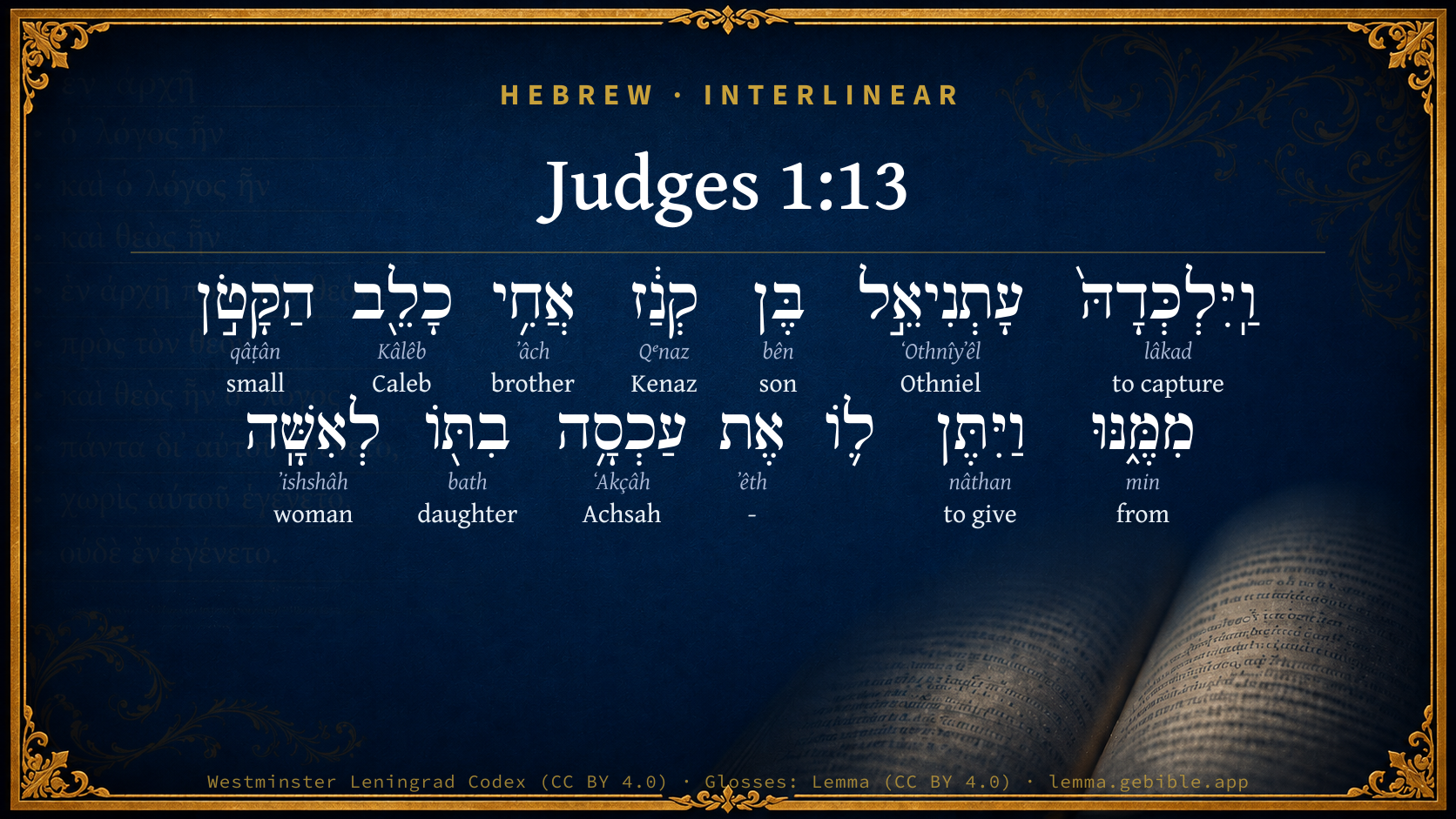
Hebrew (Westminster Leningrad Codex) Judges 1:13 appears in the Hebrew Old Testament. The text above is from the Westminster Leningrad Codex. Each word links to its Strong’s number, a concise gloss, and parsing drawn from the Open Scriptures Hebrew Bible morphology. Click any word for its full Brown-Driver-Briggs (BDB) entry.
Download image
Cite this verse

Judges 1:13 (World English Bible). Public Domain. Lemma interlinear Bible study tool, https://lemma.gebible.app/v/judges/1/13.

Show BibTeX & RIS
BibTeX
RIS
English Translation
Othniel the son of Kenaz, Caleb's younger brother, took it: and he gave him Achsah his daughter as wife.
World English Bible · Public Domain
Download a study sheet

One document with this verse’s original text, its word-by-word gloss line, the meaning frame, cross-references with their text, attributed commentary, and full source and license credits — printable, and it pastes into notes with its structure intact.

This verse Autodidact and up

Study sheet (.html) Plain text (.txt)

A passage Seminary Student

Up to 50 verses in one chapter. A passage sheet keeps up to 6 commentary sources and 12 cross-references per verse, in the order this page ranks them, and says so on the sheet whenever that leaves anything out. Ask for a single verse and you get the Autodidact verse sheet above.

Everything on this page stays free to read, with no account — the sheet is a download of what is already on screen, not access to it.

Want to remove ads? Support Godless Engineer
Compare translations 3

The same verse in 3 English versions, stacked beneath the original-language interlinear above. Click any original word for its lexicon entry.

Each is an independent rendering of the whole verse — the interlinear is not word-aligned to these translations.

Highlighted words mark where these versions differ — a whole-verse word diff, not a word-by-word alignment.

  • World English Bible Public Domain
    Othniel the son of Kenaz, Caleb's younger brother, took it: and he gave him Achsah his daughter as wife.
  • King James Version Public Domain
    And Othniel the son of Kenaz, Caleb's younger brother, took it: and he gave him Achsah his daughter to wife.
  • unfoldingWord Literal Text CC BY-SA 4.0
    And Othniel, the son of Kenaz, the brother of Caleb, the younger than him, captured it. So he gave to him Aksah, his daughter, for a wife.

unfoldingWord Literal Text — © unfoldingWord, licensed CC BY-SA 4.0. Word-aligned USFM3 via Door43 (git.door43.org/unfoldingWord/en_ult).

Versions to compare (up to 4)

3 of 4 selected

Show all 18 translations

Every available English version of this verse, each an independent rendering of the whole verse.

  • World English Bible Public Domain
    Othniel the son of Kenaz, Caleb's younger brother, took it: and he gave him Achsah his daughter as wife.
  • Berean Standard Bible Public Domain
    So Othniel son of Caleb’s younger brother Kenaz captured the city, and Caleb gave his daughter Acsah to him in marriage.
  • Majority Standard Bible Public Domain
    So Othniel son of Caleb’s younger brother Kenaz captured the city, and Caleb gave his daughter Acsah to him in marriage.
  • King James Version Public Domain
    And Othniel the son of Kenaz, Caleb's younger brother, took it: and he gave him Achsah his daughter to wife.
  • American Standard Version (1901) Public Domain
    And Othniel the son of Kenaz, Caleb's younger brother, took it: and he gave him Achsah his daughter to wife.
  • Revised Version (1885) Public Domain
    And Othniel the son of Kenaz, Caleb’s younger brother, took it: and he gave him Achsah his daughter to wife.
  • Geneva Bible (1599) Public Domain
    And Othniel the sonne of Kenaz Calebs yonger brother tooke it, to whome hee gaue Achsah his daughter to wife.
  • Douay-Rheims (1899) Public Domain
    And Othoniel the son of Cenez, the younger brother of Caleb, having taken it, he gave him Axa his daughter to wife.
  • Young's Literal Translation Public Domain
    And Othniel son of Kenaz, younger brother of Caleb, doth capture it, and he giveth to him Achsah his daughter for a wife.
  • Literal Standard Version CC BY-SA 4.0
    And Othniel son of Kenaz, younger brother of Caleb, captures it, and he gives his daughter Achsah to him for a wife.
  • Unlocked Literal Bible CC BY-SA 4.0
    Othniel, son of Kenaz (Caleb's younger brother) captured Debir, so Caleb gave him Aksah, his daughter, to be his wife.
  • unfoldingWord Literal Text CC BY-SA 4.0
    And Othniel, the son of Kenaz, the brother of Caleb, the younger than him, captured it. So he gave to him Aksah, his daughter, for a wife.
  • Darby Bible Public Domain
    And Oth'ni-el the son of Kenaz, Caleb's younger brother, took it; and he gave him Achsah his daughter as wife.
  • World Messianic Bible Public Domain
    Othniel the son of Kenaz, Caleb’s younger brother, took it, so he gave him Achsah his daughter as his wife.
  • Webster's Bible Public Domain
    And Othniel the son of Kenaz, Caleb's younger brother, took it: and he gave him Achsah his daughter for a wife.
  • Free Bible Version CC BY-SA 4.0
    Othniel, son of Kenaz, Caleb's younger brother, was the one who captured it, so he gave him his daughter Acsah in marriage.
  • Bible in Basic English Public Domain
    And Othniel, the son of Kenaz, Caleb's younger brother, took it; so he gave him his daughter Achsah for his wife.
  • JPS Tanakh (1917) Public Domain
    And Othniel the son of Kenaz, Caleb's younger brother, took it; and he gave him Achsah his daughter to wife.

Literal Standard Version (2020), Covenant Press — licensed CC BY-SA 4.0. Text via the HelloAO Bible API (eBible.org). Unlocked Literal Bible (unfoldingWord) — licensed CC BY-SA 4.0. Text via the HelloAO Bible API (eBible.org). unfoldingWord Literal Text — © unfoldingWord, licensed CC BY-SA 4.0. Word-aligned USFM3 via Door43 (git.door43.org/unfoldingWord/en_ult). Free Bible Version, Dr. Jonathan Gallagher — licensed CC BY-SA 4.0. Text via the HelloAO Bible API (eBible.org).

Word by word

More ways to search: Search by grammar → Find every occurrence → Compare this word →

Practice this passage: Drill this verse → Learn its vocabulary →

עַכְסָ֥ה
ʻAkçâh
H5915
“Achsah”
Noun, Proper
Part of Speech
Noun
Type
Proper
Full BDB Definition

Origin: from H5914

TWOT: None

Achsah = "ankle chain" or " anklet" - the daughter of Caleb and wife of Caleb's brother Othniel to whom she was given as a reward for capturing Debir
  1. וַֽיִּלְכְּדָהּ֙ lâkad H3920 “and · to capture · her” Conjunction + Verb, Qal, Sequential Imperfect, 3rd Person, Masculine, Singular + Suffix, Personal, 3rd Person, Feminine, Singular
  2. עָתְנִיאֵ֣ל ʻOthnîyʼêl H6274 “Othniel” Noun, Proper
  3. בֶּן bên H1121 “son of” Noun, Common, Masculine, Singular, Construct
  4. קְנַ֔ז Qᵉnaz H7073 “Kenaz” Noun, Proper
  5. אֲחִ֥י ʼâch H251 “brother of” Noun, Common, Masculine, Singular, Construct
  6. כָלֵ֖ב Kâlêb H3612 “Caleb” Noun, Proper
  7. הַקָּטֹ֣ן qâṭân H6996 “the · small” Particle, Definite Article + Adjective, Adjective, Masculine, Singular, Absolute
  8. מִמֶּ֑נּוּ min H4480 “from · us” Preposition + Suffix, Personal, 1st Person, Common, Plural
  9. וַיִּתֶּן nâthan H5414 “and · to give” Conjunction + Verb, Qal, Sequential Imperfect, 3rd Person, Masculine, Singular
  10. אֶת ʼêth H853 “-” Particle, Direct Object
  11. בִתּ֖וֹ bath H1323 “daughter · his” Noun, Common, Feminine, Singular, Construct + Suffix, Personal, 3rd Person, Masculine, Singular
  12. לְאִשָּֽׁה ʼishshâh H802 “to/for · woman” Preposition + Noun, Common, Feminine, Singular, Absolute

About this verse

These counts appear in no published source. They are computed here, from the morphology-tagged text and Lemma’s own curated glosses. What Lemma adds →

14
words
13
distinct lemmas
Historical
section

Notable vocabulary

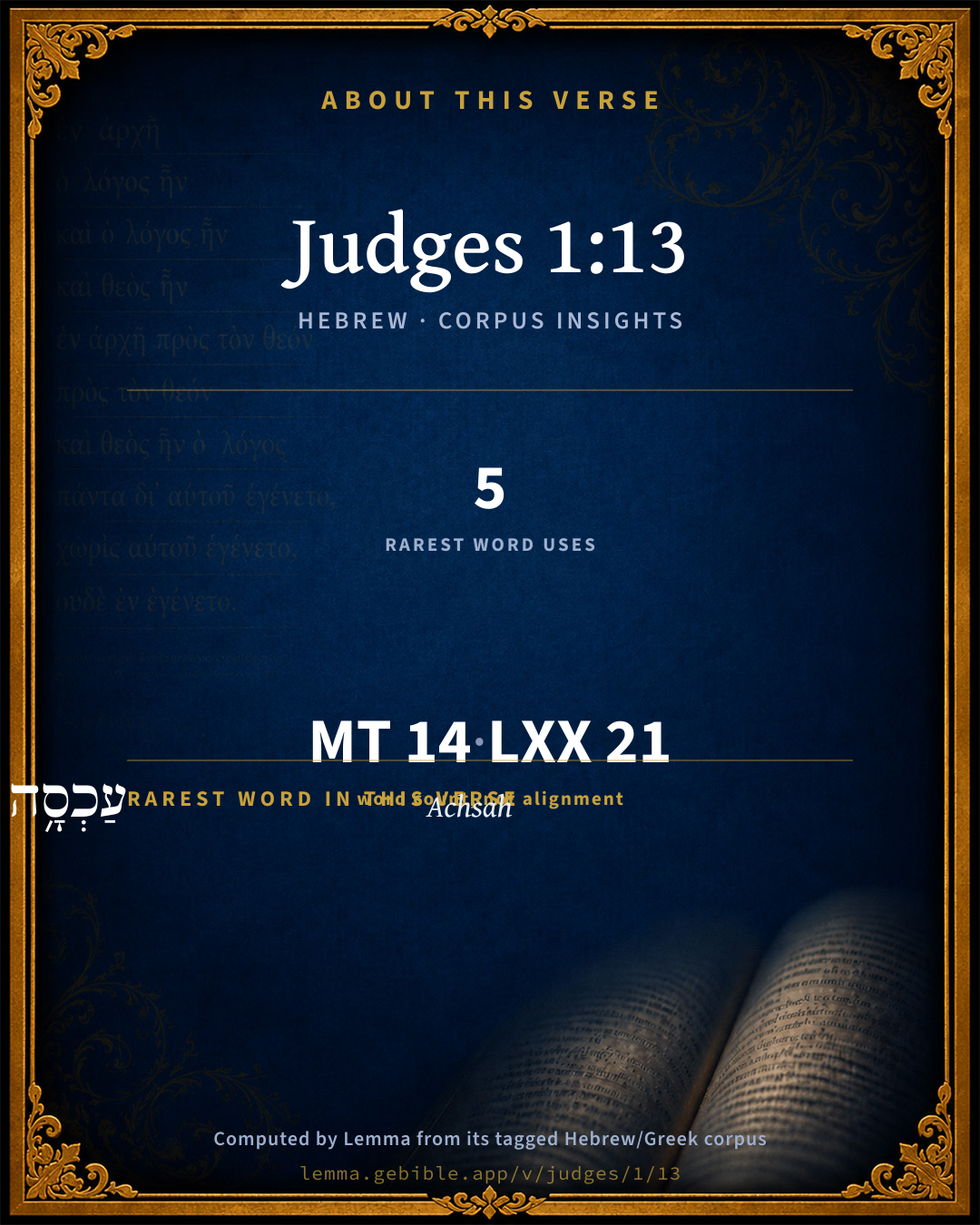
The rarest word here is עַכְסָ֥ה Achsah H5915 — appearing just 5 times in the whole Hebrew Bible.

Shared distinctive vocabulary

עַכְסָ֥ה Achsah H5915 occurs in 5 verses of the Hebrew Bible. Also found in:

Grammatical profile

  • 2 verbs
  • 8 nouns
  • 1 adjective
  • 2 prepositions
  • 1 particle

Verb forms

  • וַֽיִּלְכְּדָהּ֙ Qal · Sequential Imperfect
  • וַיִּתֶּן Qal · Sequential Imperfect

Hebrew & Septuagint length

In English translation the verse runs 19 words from the Hebrew and 22 from the Septuagint (LXX English) — closely comparable.

A rough comparison of the two English renderings, which tokenize alike — not a word-level alignment.

Word counts can differ between the Hebrew and the Greek without any difference in meaning — e.g. the Hebrew direct-object marker אֵת has no separate Greek word, and Greek often adds the article ὁ.

In the original languages it is 14 Hebrew tokens and 21 Greek tokens — but the two are counted differently (Hebrew bundles its prefixes and suffixes into one token; the Greek is in lemma form), so that isn’t a like-for-like length.

Cross-references

1

Topical passages linked to Judges 1:13 in the Treasury of Scripture Knowledge — connected by theme and wording, ordered by reader-vote popularity; previews shown in the World English Bible.

  • Judges 3:9 When the children of Israel cried to Yahweh, Yahweh raised up a savior to the children of Israel, who saved them, even Othniel the son of Kenaz, Caleb's younger brother.

Cross-references courtesy of OpenBible.info (CC BY 4.0).

Hebrew and Greek witnesses Masoretic Hebrew ↔ Greek Septuagint

The same verse in the two great witnesses to the Old Testament, shown verse-for-verse.

These are two independent witnesses, not word-aligned to each other, and the Septuagint is shown in lemma (dictionary) form.

Hebrew Judges 1:13 Masoretic · Westminster Leningrad Codex

וַֽיִּלְכְּדָהּ֙ עָתְנִיאֵ֣ל בֶּן קְנַ֔ז אֲחִ֥י כָלֵ֖ב הַקָּטֹ֣ן מִמֶּ֑נּוּ וַיִּתֶּן ל֛וֹ אֶת עַכְסָ֥ה בִתּ֖וֹ לְאִשָּֽׁה

Othniel the son of Kenaz, Caleb's younger brother, took it: and he gave him Achsah his daughter as wife.

World English Bible · Public Domain

Greek LXX Judges 1:13 Septuagint · lemma form

καί προ καταλαμβάνω αὐτός γοθονιηλ υἱός κενεζ ἀδελφός χαλεβ ὁ νέος καί δίδωμι αὐτός χαλεβ ὁ ασχα θυγάτηρ αὐτός εἰς γυνή

And Gothoniel the younger son of Kenez the brother of Chaleb took it; and Chaleb gave him his daughter Ascha to wife.

LXX2012 (modern English Septuagint) · Public Domain

On this verse, The Cambridge Bible for Schools and Colleges discusses the Septuagint’s reading. Read the note in Commentary ↓

Hebrew: Westminster Leningrad Codex (CC BY 4.0). Greek: Septuagint (public domain); English from LXX2012 (modern English Septuagint) (Public Domain). How the Septuagint differs from the Hebrew →

Targum (Aramaic paraphrase)

1

The Targum is the ancient Jewish Aramaic paraphrase of the Hebrew Scriptures — an interpretive translation, not the Hebrew text itself. Onkelos (literal) and Pseudo-Jonathan (expansive) render the Torah, and Jonathan the Prophets. Coverage is partial: where no permissively-licensed English translation exists for a verse, only the Aramaic is shown. This is verse-level text, not a word-by-word alignment to the Hebrew.

  1. Targum Jonathan Prophets (Joshua–Malachi)
    וְכַבְּשָׁהּ עָתְנִיאֵל בַּר קְנַז אֲחוֹהִי דְכָלֵב דִזְעֵיר מִנֵיהּ וִיהַב לֵיהּ יַת עַכְסָה בְרַתֵּיהּ לְאִתּוּ:

    (no public-domain English translation for this verse)

    Targum Jonathan — Aramaic: “Mikraot Gedolot” (public domain). English: “Sefaria Community Translation” (CC0 1.0 (public-domain dedication)); “London "Chaldee Paraphrase," 1871” (public domain). Text via Sefaria.

Commentary

Notes on Judges 1:13 from classic Christian and Jewish commentators (each source and its license shown beneath its notes). The classic Christian expositions comment on the surrounding passage and are grouped to its opening verse, so a note may address several verses; the Jewish commentaries on the Tanakh (Rashi and others) are per-verse, so they appear only where the commentator wrote on this verse.

Lemma curates 59 commentaries, every one of them public domain or Creative Commons licensed, each selected and text-cleaned for this edition rather than reprinted as found. About our sources →

Adam Clarke's Commentary

Verse 13. See Clarke on Jud 1:12.

Adam Clarke's Commentary on the Bible (1810–1826) — public domain. Text from a community e-Sword/MySword module.

Ellicott's Commentary for English Readers

(13) Othniel.—Jos_15:15-17. It is here added that he was Caleb’s younger brother. (See Jdg_3:9.) The Hebrew may mean either that Othniel was “son of Kenaz and brother of Caleb” (in which case he married his niece); or “son of Kenaz, who was Caleb’s brother” (as in “Jonadab, the son of Shimeah David’s brother,” 2Sa_13:3), in which case Achsah was his cousin. The Masoretes, to whom is due the punctuation, &c., of our Hebrew Scriptures, show by their pointing that they understood the words in the former sense. But though Ben-kenaz may simply mean Kenezite (Jos_14:6; Num_32:12), it is strange in that case that Othniel should never be called a son of Jephunneh. If he was a brother of Caleb’s, he must have lived to extreme old age, and have been an old man when he married Achsah. For the importance of Caleb’s family, see 1Ch_27:15. The Rabbis identify Othniel with the Jabez who is so abruptly introduced in 1Ch_4:9-10, and connect Achsah’s petition with the prayer there recorded; and they suppose that he founded the school of scribes at Jabez (1Ch_2:55), and was a teacher of law to the Kenites.

A Bible Commentary for English Readers, edited by Charles John Ellicott (1878–1897) — public domain. Text from a community e-Sword module.

The Cambridge Bible for Schools and Colleges

gen. ed. J. J. S. Perowne

13. Othniel the son of Kenaz, Caleb’s younger brother] The language leaves it uncertain whether Othniel was the nephew (LXX. cod. B) or the brother (LXX. cod. A, Vulgate) of Caleb; but tradition favours the latter alternative. Elsewhere, though in later documents, Caleb is styled ‘the son of Jephunneh, the Kenizzite’ Josh, Jos_14:6; Jos_14:14 D; Num_32:12 P. Kenaz was not the actual father, but the name of an Edomite tribe Gen_36:15; Gen_36:42; ‘the son of Kenaz,’ therefore, is equivalent to ‘the Kenizzite.’ Kenaz being a tribe, we must suppose that Othniel and Caleb were really clans belonging to it. As a tribal name Othniel may be compared with Israel and Jeraḥmeel. Caleb was closely connected with Jeraḥmeel (1Ch_2:9; 1Ch_2:25; 1Ch_2:42; 1Ch_2:49), a clan settled in the Negeb, S. of Caleb (1Sa_27:10; 1Sa_30:29), which, as the present narrative shews, settled in Hebron and the neighbourhood. How Caleb came to find a home in Judah is told in Jos_15:13 JE, cf. Jos_14:6 ff. D. In the time of David Caleb was still distinct from Judah, 1Sa_30:14; but later on the clan became absorbed into Judah, so much so that in Num_13:6; Num_34:19 P Caleb is the ‘prince’ of Judah, and the Chronicler knows of hardly any other Judahites outside the Calebite family (1 Chronicles 2). The present story gives the tribal traditions under the guise of a narrative dealing with individuals (cf. Jdg_1:3 note). Othniel is called ‘the younger’ (not in Jos_15:17) brother of Caleb to account for his being of an age to marry Caleb’s daughter, as in Jdg_3:9 to explain how he outlived Caleb so long. The marriage indicates an alliance between the Othniel clan and an off-shoot of Caleb.

Contrast the account of the conquest of Debir by Joshua and all Israel given in Jos_10:38-39; Jos_11:21 D.

The Cambridge Bible for Schools and Colleges (gen. ed. J. J. S. Perowne; Cambridge University Press, 1878–1918) — public domain. Text from a community e-Sword module.

John Gill's Exposition

And Othniel the son of Kenaz, Caleb's younger brother, took it: and he gave him Achsah his daughter to wife. See Gill on Jos 15:17.

.

Judges 1:14

jdg 1:14

jdg 1:14

jdg 1:14And it came to pass, when she came to him, that she moved him to ask of her father a field: and she lighted from off her ass;

and Caleb said unto her, What wilt thou? See Gill on Jos 15:18.

John Gill's Exposition of the Whole Bible (1746–1763) — public domain (CC PDM 1.0). Text via the HelloAO Bible API.

Trapp's Complete Commentary

John Trapp

13 Raging waves of the sea, foaming out their own shame; wandering stars, to whom is reserved the blackness of darkness for ever.

Ver. 13. Raging waves of the sea] Unsettled, turbulent, and arrogant spirits; boldly belching out their abominable opinions and detestable doctrines.

Wandering stars] That were never better than meteors. Sir Francis Drake in his Travels reporteth that in a certain island to the southward of Celebes, among the trees night by night did show themselves an infinite swarm of fiery-like worms flying in the air, whose bodies, no bigger than an ordinary fly, did make a show, and give such light as if every twig on every tree had been a lighted candle, or as if that place had been the starry sphere. Lo, such were these impostors.

John Trapp, A Commentary or Exposition upon All the Books of the Old and New Testament (1647–1656) — public domain. Text from a community e-Sword module.

Haydock's Catholic Bible Commentary

Brother, or near relation, but much younger. See Josue xv. 17. (Calmet)

George Leo Haydock (1774–1849), Haydock's Catholic Family Bible and Commentary, 1859 edition — public domain. Excludes Psalms (Douay-Rheims chapter numbering differs from Protestant) and Deuterocanonical books (Catholic canon only).

The Pulpit Commentary

Caleb"s younger brother. See note on Jud_1:3:9.

The Pulpit Commentary (1880–1919), ed. H.D.M. Spence-Jones & Joseph S. Exell — public domain. Text from a community e-Sword module.

Rashi

Rabbi Shlomo Yitzchaki (Rashi)

Coleiv's …brother. Maternally.

Rashi on the Tanakh — English translations: “The Judaica Press complete Tanach with Rashi, translated by A. J. Rosenberg” (CC BY 4.0); “Pentateuch with Rashi's commentary by M. Rosenbaum and A.M. Silbermann, 1929-1934” (public domain); “The Metsudah Tanach series, Lakewood, N.J” (CC BY 4.0); and “The Book of Joshua, Metsudah Publications, 1997” (CC BY 4.0). Text via Sefaria.

Lesson kit

Teaching starters — assembled from the data on this page, not authored interpretation. Every prompt links to the verse data it draws on. Edit before teaching.

Judges, in the Historical, opens this verse with 14 words (13 distinct Hebrew lemmas). Its most distinctive word is ʻAkçâh (“Achsah”). A historical commentator’s framing appears above. Read the whole chapter for the surrounding context.

Discussion questions

  1. The word ʻAkçâh carries the sense “Achsah.” How does it shape the verse?
  2. How does Joshua 15:16, which shares the word «Achsah», read alongside this verse?
  3. The translations on this page render this verse differently — a whole-verse word diff, not a word-by-word alignment. What might account for the different wordings?
  4. «וַֽיִּלְכְּדָהּ֙» is a Qal Sequential Imperfect verb. How does that grammatical form shape the action described?
  5. Compare how Adam Clarke's Commentary and Ellicott's Commentary for English Readers read this verse. Where do they agree or differ?

Things to notice

Reading settings

Reading text

Shown beneath each verse's original-language words.

Old Testament
Old Testament edition

Read the OT as the Masoretic Hebrew (MT) or the Greek Septuagint (LXX).

English shown for the Greek Septuagint (in the Hebrew ↔ Greek comparison).

Comparing translations? Open the Compare panel on any verse page to stack up to four side by side.