
Exodus 33:7

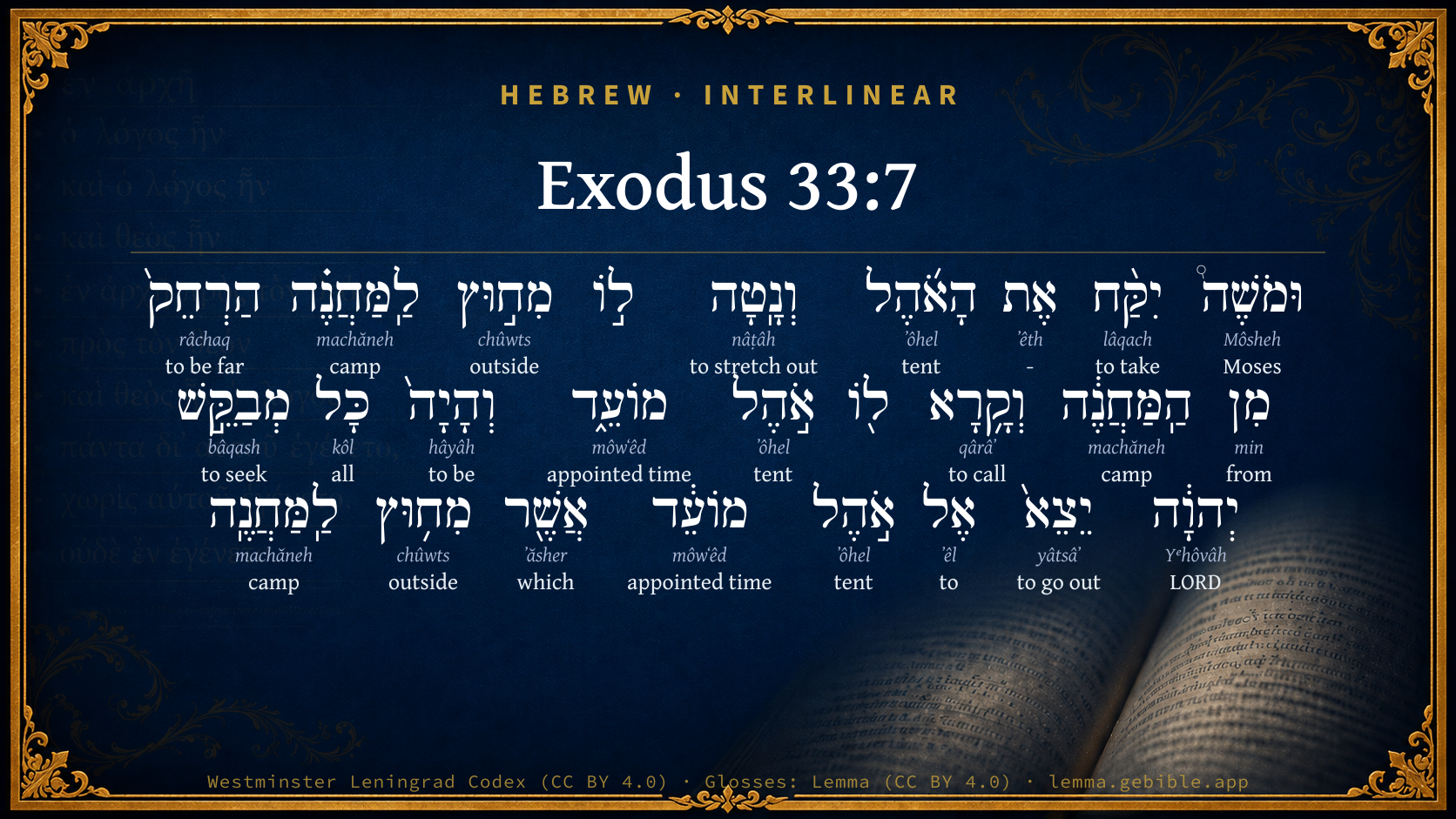
Hebrew (Westminster Leningrad Codex) Exodus 33:7 appears in the Hebrew Old Testament. The text above is from the Westminster Leningrad Codex. Each word links to its Strong’s number, a concise gloss, and parsing drawn from the Open Scriptures Hebrew Bible morphology. Click any word for its full Brown-Driver-Briggs (BDB) entry.
Download image
Cite this verse

Exodus 33:7 (World English Bible). Public Domain. Lemma interlinear Bible study tool, https://lemma.gebible.app/v/exodus/33/7.

Show BibTeX & RIS
BibTeX
RIS
English Translation
Now Moses used to take the tent and to pitch it outside the camp, far away from the camp, and he called it "The tent of meeting." It happened that everyone who sought Yahweh went out to the tent of meeting, which was outside the camp.
World English Bible · Public Domain
Download a study sheet

One document with this verse’s original text, its word-by-word gloss line, the meaning frame, cross-references with their text, attributed commentary, and full source and license credits — printable, and it pastes into notes with its structure intact.

This verse Autodidact and up

Study sheet (.html) Plain text (.txt)

A passage Seminary Student

Up to 50 verses in one chapter. A passage sheet keeps up to 6 commentary sources and 12 cross-references per verse, in the order this page ranks them, and says so on the sheet whenever that leaves anything out. Ask for a single verse and you get the Autodidact verse sheet above.

Everything on this page stays free to read, with no account — the sheet is a download of what is already on screen, not access to it.

Want to remove ads? Support Godless Engineer
Compare translations 3

The same verse in 3 English versions, stacked beneath the original-language interlinear above. Click any original word for its lexicon entry.

Each is an independent rendering of the whole verse — the interlinear is not word-aligned to these translations.

Highlighted words mark where these versions differ — a whole-verse word diff, not a word-by-word alignment.

  • World English Bible Public Domain
    Now Moses used to take the tent and to pitch it outside the camp, far away from the camp, and he called it "The tent of meeting." It happened that everyone who sought Yahweh went out to the tent of meeting, which was outside the camp.
  • King James Version Public Domain
    And Moses took the tabernacle, and pitched it without the camp, afar off from the camp, and called it the Tabernacle of the congregation. And it came to pass, that every one which sought the LORD went out unto the tabernacle of the congregation, which was without the camp.
  • unfoldingWord Literal Text CC BY-SA 4.0
    And Moses would take a tent and would pitch it on the outside of the camp, at a distance from the camp. And he called it the tent of meeting. And it happened, every seeker of Yahweh would go out to the tent of meeting that on the outside of the camp.

unfoldingWord Literal Text — © unfoldingWord, licensed CC BY-SA 4.0. Word-aligned USFM3 via Door43 (git.door43.org/unfoldingWord/en_ult).

Versions to compare (up to 4)

3 of 4 selected

Show all 18 translations

Every available English version of this verse, each an independent rendering of the whole verse.

  • World English Bible Public Domain
    Now Moses used to take the tent and to pitch it outside the camp, far away from the camp, and he called it "The tent of meeting." It happened that everyone who sought Yahweh went out to the tent of meeting, which was outside the camp.
  • Berean Standard Bible Public Domain
    Now Moses used to take the tent and pitch it at a distance outside the camp. He called it the Tent of Meeting, and anyone inquiring of the LORD would go to the Tent of Meeting outside the camp.
  • Majority Standard Bible Public Domain
    Now Moses used to take the tent and pitch it at a distance outside the camp. He called it the Tent of Meeting, and anyone inquiring of the LORD would go to the Tent of Meeting outside the camp.
  • King James Version Public Domain
    And Moses took the tabernacle, and pitched it without the camp, afar off from the camp, and called it the Tabernacle of the congregation. And it came to pass, that every one which sought the LORD went out unto the tabernacle of the congregation, which was without the camp.
  • American Standard Version (1901) Public Domain
    Now Moses used to take the tent and to pitch it without the camp, afar off from the camp; and he called it, The tent of meeting. And it came to pass, that every one that sought Jehovah went out unto the tent of meeting, which was without the camp.
  • Revised Version (1885) Public Domain
    Now Moses used to take the tent and to pitch it without the camp, afar off from the camp; and he called it, The tent of meeting. And it came to pass, that every one which sought the LORD went out unto the tent of meeting, which was without the camp.
  • Geneva Bible (1599) Public Domain
    Then Moses tooke his tabernacle, and pitched it without the host farre off from the hoste, and called it Ohel-moed. And whe any did seeke to the Lord, he went out vnto the Tabernacle of the Congregation, which was without the hoste.
  • Douay-Rheims (1899) Public Domain
    Moses also taking the tabernacle, pitched it without the camp afar off, and called the name thereof, The tabernacle of the covenant. And all the people that had any question, went forth to the tabernacle of the covenant, without the camp.
  • Young's Literal Translation Public Domain
    And Moses taketh the tent, and hath stretched it out at the outside of the camp, afar off from the camp, and hath called it, `Tent of Meeting;' and it hath come to pass, every one seeking Jehovah goeth out unto the tent of meeting, which `is' at the outside of the camp.
  • Literal Standard Version CC BY-SA 4.0
    And Moses takes the tent, and has stretched it out at the outside of the camp, far off from the camp, and has called it, “Tent of Meeting”; and it has come to pass, everyone seeking YHWH goes out to the Tent of Meeting, which [is] at the outside of the camp.
  • Unlocked Literal Bible CC BY-SA 4.0
    Moses took a tent and pitched it outside the camp, some distance from the camp. He called it the tent of meeting. Everyone who asked Yahweh for anything went out to the tent of meeting, outside the camp.
  • unfoldingWord Literal Text CC BY-SA 4.0
    And Moses would take a tent and would pitch it on the outside of the camp, at a distance from the camp. And he called it the tent of meeting. And it happened, every seeker of Yahweh would go out to the tent of meeting that on the outside of the camp.
  • Darby Bible Public Domain
    And Moses took the tent, and pitched it outside the camp, far from the camp, and called it the Tent of meeting. And it came to pass [that] every one who sought Jehovah went out to the tent of meeting which was outside the camp.
  • World Messianic Bible Public Domain
    Now Moses used to take the tent and pitch it outside the camp, far away from the camp, and he called it “The Tent of Meeting.” Everyone who sought the LORD went out to the Tent of Meeting, which was outside the camp.
  • Webster's Bible Public Domain
    And Moses took the tabernacle, and pitched it without the camp far from the camp, and called it the Tabernacle of the congregation. And it came to pass, that every one who sought the LORD, went out to the tabernacle of the congregation, which was without the camp.
  • Free Bible Version CC BY-SA 4.0
    Moses used to set up the Tent of Meeting some way outside the camp. Anyone who wanted to ask the Lord anything could go out there to the Tent of Meeting.
  • Bible in Basic English Public Domain
    Now it was Moses' way to put up the Tent of meeting outside the tent-circle, at some distance away; giving it the name of The Tent of meeting. And everyone desiring to make his prayer to the Lord went to the Tent of meeting outside the tent-circle.
  • JPS Tanakh (1917) Public Domain
    Now Moses used to take the tent and to pitch it without the camp, afar off from the camp; and he called it The tent of meeting. And it came to pass, that every one that sought the LORD went out unto the tent of meeting, which was without the camp.

Literal Standard Version (2020), Covenant Press — licensed CC BY-SA 4.0. Text via the HelloAO Bible API (eBible.org). Unlocked Literal Bible (unfoldingWord) — licensed CC BY-SA 4.0. Text via the HelloAO Bible API (eBible.org). unfoldingWord Literal Text — © unfoldingWord, licensed CC BY-SA 4.0. Word-aligned USFM3 via Door43 (git.door43.org/unfoldingWord/en_ult). Free Bible Version, Dr. Jonathan Gallagher — licensed CC BY-SA 4.0. Text via the HelloAO Bible API (eBible.org).

Word by word

More ways to search: Search by grammar → Find every occurrence → Compare this word →

Practice this passage: Drill this verse → Learn its vocabulary →

הַרְחֵק֙
râchaq
H7368
“to be far”
Verb, Hiphil, Infinitive Absolute
Part of Speech
Verb
Stem
Hiphil
Form
Infinitive Absolute
Full BDB Definition

Origin: a primitive root

TWOT: 2151

to be or become far, be or become distant, be removed, go far away (verb) - (Qal) to be far, be distant - (Piel) to send far away, extend - (Hiphil) - to make or exhibit distance, be gone far - to remove, put far away - (Niphal) loose (verb) - at a distance (verbal infinitive [as adverb])
  1. וּמֹשֶׁה֩ Môsheh H4872 “and · Moses” Conjunction + Noun, Proper
  2. יִקַּ֨ח lâqach H3947 “to take” Verb, Qal, Imperfect, 3rd Person, Masculine, Singular
  3. אֶת ʼêth H853 “-” Particle, Direct Object
  4. הָאֹ֜הֶל ʼôhel H168 “the · tent” Particle, Definite Article + Noun, Common, Masculine, Singular, Absolute
  5. וְנָֽטָה nâṭâh H5186 “and · to stretch out” Conjunction + Verb, Qal, Sequential Perfect, 3rd Person, Masculine, Singular
  6. מִח֣וּץ chûwts H2351 “from · outside” Preposition + Noun, Common, Masculine, Singular, Absolute
  7. לַֽמַּחֲנֶ֗ה machăneh H4264 “to/for the · camp” Preposition, Determined + Noun, Common, Both, Singular, Absolute
  8. מִן min H4480 “from” Preposition
  9. הַֽמַּחֲנֶ֔ה machăneh H4264 “the · camp” Particle, Definite Article + Noun, Common, Both, Singular, Absolute
  10. וְקָ֥רָא qârâʼ H7121 “and · to call” Conjunction + Verb, Qal, Perfect, 3rd Person, Masculine, Singular
  11. אֹ֣הֶל ʼôhel H168 “tent of” Noun, Common, Masculine, Singular, Construct
  12. מוֹעֵ֑ד môwʻêd H4150 “appointed time” Noun, Common, Masculine, Singular, Absolute
  13. וְהָיָה֙ hâyâh H1961 “and · to be” Conjunction + Verb, Qal, Sequential Perfect, 3rd Person, Masculine, Singular
  14. כָּל kôl H3605 “all of” Noun, Common, Masculine, Singular, Construct
  15. מְבַקֵּ֣שׁ bâqash H1245 “seeking” Verb, Piel, Participle Active, Masculine, Singular, Absolute
  16. יְהוָ֔ה Yᵉhôvâh H3068 “LORD” Noun, Proper
  17. יֵצֵא֙ yâtsâʼ H3318 “to go out” Verb, Qal, Imperfect, 3rd Person, Masculine, Singular
  18. אֶל ʼêl H413 “to” Preposition
  19. אֹ֣הֶל ʼôhel H168 “tent of” Noun, Common, Masculine, Singular, Construct
  20. מוֹעֵ֔ד môwʻêd H4150 “appointed time” Noun, Common, Masculine, Singular, Absolute
  21. אֲשֶׁ֖ר ʼăsher H834 “which” Particle, Relative
  22. מִח֥וּץ chûwts H2351 “from · outside” Preposition + Noun, Common, Masculine, Singular, Absolute
  23. לַֽמַּחֲנֶֽה machăneh H4264 “to/for the · camp” Preposition, Determined + Noun, Common, Both, Singular, Absolute

About this verse

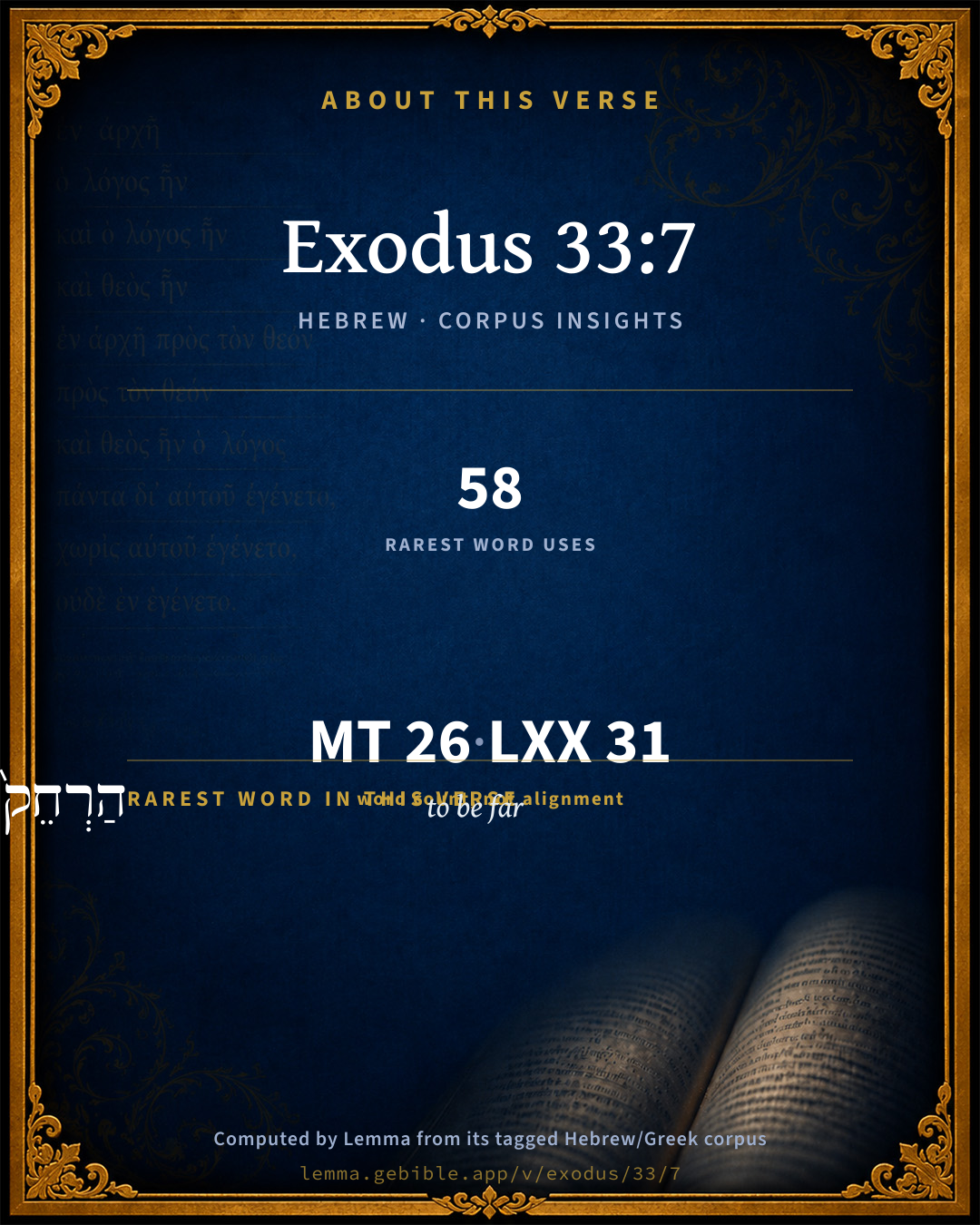
These counts appear in no published source. They are computed here, from the morphology-tagged text and Lemma’s own curated glosses. What Lemma adds →

26
words
18
distinct lemmas
Pentateuch
section

Shared distinctive vocabulary

הַרְחֵק֙ to be far H7368 occurs in 56 verses of the Hebrew Bible. Also found in:

Grammatical profile

  • 7 verbs
  • 13 nouns
  • 4 prepositions
  • 2 particles

Verb forms

  • יִקַּ֨ח Qal · Imperfect
  • וְנָֽטָה Qal · Sequential Perfect
  • הַרְחֵק֙ Hiphil · Infinitive Absolute
  • וְקָ֥רָא Qal · Perfect
  • וְהָיָה֙ Qal · Sequential Perfect
  • מְבַקֵּ֣שׁ Piel · Participle Active
  • יֵצֵא֙ Qal · Imperfect

Repetition

Words recur within this verse — often emphatic in Hebrew:

  • הָאֹ֜הֶל tent H168 ×3
  • לַֽמַּחֲנֶ֗ה camp H4264 ×3
  • מִח֣וּץ outside H2351 ×2
  • מוֹעֵ֑ד appointed time H4150 ×2

Hebrew & Septuagint length

In English translation the verse runs 46 words from the Hebrew and 47 from the Septuagint (LXX English) — closely comparable.

A rough comparison of the two English renderings, which tokenize alike — not a word-level alignment.

Word counts can differ between the Hebrew and the Greek without any difference in meaning — e.g. the Hebrew direct-object marker אֵת has no separate Greek word, and Greek often adds the article ὁ.

In the original languages it is 26 Hebrew tokens and 31 Greek tokens — but the two are counted differently (Hebrew bundles its prefixes and suffixes into one token; the Greek is in lemma form), so that isn’t a like-for-like length.

Cross-references

12

Topical passages linked to Exodus 33:7 in the Treasury of Scripture Knowledge — connected by theme and wording, ordered by reader-vote popularity; previews shown in the World English Bible.

  • Isaiah 55:6–7 Seek you Yahweh while he may be found; call you on him while he is near:
  • Proverbs 15:29 Yahweh is far from the wicked, But he hears the prayer of the righteous.
  • Exodus 29:42–43 It shall be a continual burnt offering throughout your generations at the door of the tent of meeting before Yahweh, where I will meet with you, to speak there to you.
  • Isaiah 59:2 but your iniquities have separated between you and your God, and your sins have hidden his face from you, so that he will not hear.
  • Deuteronomy 4:29 But from there you shall seek Yahweh your God, and you shall find him, when you search after him with all your heart and with all your soul.
  • 2 Samuel 21:1 There was a famine in the days of David three years, year after year; and David sought the face of Yahweh. Yahweh said, It is for Saul, and for his bloody house, because he put to death the Gibeonites.
  • Psalms 27:8 When you said, "Seek my face," My heart said to you, "I will seek your face, Yahweh."
  • Matthew 7:7–8 "Ask, and it will be given you. Seek, and you will find. Knock, and it will be opened for you.
  • Psalms 10:1 Why do you stand far off, Yahweh? Why do you hide yourself in times of trouble?
  • Psalms 35:22 You have seen it, Yahweh. Don't keep silent. Lord, don't be far from me.
  • Hosea 9:12 Though they bring up their children, Yet I will bereave them, so that not a man shall be left. Indeed, woe also to them when I depart from them!
  • Hebrews 13:11–13 For the bodies of those animals, whose blood is brought into the holy place by the high priest as an offering for sin, are burned outside of the camp.

Cross-references courtesy of OpenBible.info (CC BY 4.0).

Hebrew and Greek witnesses Masoretic Hebrew ↔ Greek Septuagint

The same verse in the two great witnesses to the Old Testament, shown verse-for-verse.

These are two independent witnesses, not word-aligned to each other, and the Septuagint is shown in lemma (dictionary) form.

Hebrew Exodus 33:7 Masoretic · Westminster Leningrad Codex

וּמֹשֶׁה֩ יִקַּ֨ח אֶת הָאֹ֜הֶל וְנָֽטָה ל֣וֹ מִח֣וּץ לַֽמַּחֲנֶ֗ה הַרְחֵק֙ מִן הַֽמַּחֲנֶ֔ה וְקָ֥רָא ל֖וֹ אֹ֣הֶל מוֹעֵ֑ד וְהָיָה֙ כָּל מְבַקֵּ֣שׁ יְהוָ֔ה יֵצֵא֙ אֶל אֹ֣הֶל מוֹעֵ֔ד אֲשֶׁ֖ר מִח֥וּץ לַֽמַּחֲנֶֽה

Now Moses used to take the tent and to pitch it outside the camp, far away from the camp, and he called it "The tent of meeting." It happened that everyone who sought Yahweh went out to the tent of meeting, which was outside the camp.

World English Bible · Public Domain

Greek LXX Exodus 33:7 Septuagint · lemma form

καί λαμβάνω μωυσῆς ὁ σκηνή αὐτός πήγνυμι ἔξω ὁ παρεμβολή μακράν ἀπό ὁ παρεμβολή καί καλέω σκηνή μαρτύριον καί γίγνομαι πᾶς ὁ ζητέω κύριος ἐκπορεύομαι εἰς ὁ σκηνή ἔξω ὁ παρεμβολή

And Moses took his tabernacle and pitched it without the camp, at a distance from the camp; and it was called the Tabernacle of Testimony: and it came to pass that every one that sought the Lord went forth to the tabernacle which was without the camp.

LXX2012 (modern English Septuagint) · Public Domain

On this verse, Ellicott's Commentary for English Readers discusses the Septuagint’s reading. Read the note in Commentary ↓

Hebrew: Westminster Leningrad Codex (CC BY 4.0). Greek: Septuagint (public domain); English from LXX2012 (modern English Septuagint) (Public Domain). How the Septuagint differs from the Hebrew →

Targum (Aramaic paraphrase)

2

The Targum is the ancient Jewish Aramaic paraphrase of the Hebrew Scriptures — an interpretive translation, not the Hebrew text itself. Onkelos (literal) and Pseudo-Jonathan (expansive) render the Torah, and Jonathan the Prophets. Coverage is partial: where no permissively-licensed English translation exists for a verse, only the Aramaic is shown. This is verse-level text, not a word-by-word alignment to the Hebrew.

  1. Targum Onkelos Torah (Genesis–Deuteronomy)
    וּמשֶׁה נְסִיב יָת מַשְׁכְּנָא וּפַרְסֵהּ לֵהּ מִבָּרָא לְמַשְׁרִיתָא אַרְחֵיק מִן מַשְׁרִיתָא וְקָרֵי לֵהּ מַשְׁכַּן בֵּית אוּלְפָנָא וִיהֵי כָּל דְתָבַע אוּלְפַן מִן קֳדָם יְיָ נְפַק לְמַשְׁכַּן בֵּית אוּלְפָנָא דִי מִבָּרָא לְמַשְׁרִיתָא:

    (no public-domain English translation for this verse)

    Targum Onkelos — Aramaic: “Onkelos Genesis” (public domain); “Onkelos Exodus” (public domain); “Onkelos Leviticus” (public domain); “Onkelos Numbers” (public domain); “Onkelos Deuteronomy” (public domain). English: “Sefaria Community Translation” (CC0 1.0 (public-domain dedication)); “J.W. Etheridge. The Targums of Onkelos and Jonathan Ben Uzziel on the Pentateuch. London: Longmans, Green, 1862” (public domain). Text via Sefaria.

  2. Targum Pseudo-Jonathan Torah (Genesis–Deuteronomy)
    וּמשֶׁה נְסִיבוּנוּן וּטְמִירִינוּן בְּמַשְׁכַּן אוּלְפַן אוֹרַיְיתָא דִּילֵיהּ בְּרַם יַת מַשְׁכְּנָא נָסַב מִתַּמָּן וּפַרְסֵיהּ לֵיהּ מִבָּרָא לְמַשְׁרִיתָא אַרְחִיק יָתֵיהּ מִן מַשִׁירְיַת עַמָּא דְּאִתְנְדוּן תְּרֵין אַלְפִין אַמִּין וַהֲוָה קָרֵי לֵיהּ מַשְׁכַּן בֵּית אוּלְפָנָא וַהֲוֵי כָּל מַאן דַּהֲדַר בִּתְתוּבָא בְּלֵב שְׁלִים קֳדָם יְיָ הֲוָה נָפִיק לְמַשְׁכַּן בֵּית אוּלְפָנָא דְמִבָּרָא לְמַשְׁרִיתָא מוֹדֵי עַל חוֹבֵיהּ וּמַצְלֵי עַל חוֹבֵיהּ וּמַצְלֵי וּמִשְׁתְּבֵק לֵיהּ

    But the tabernacle he took away from thence, and spread it without the camp, and removed it from the camp of the people to the distance of two thousand cubits; and it was called the Tabernacle of the House of Instruction: and it was that when any one turned by repentance with a true heart before the Lord, he went forth to the Tabernacle of the House of Instruction that was without the camp, to confess and pray for the pardon of his sins; and praying he was forgiven.

    Targum Pseudo-Jonathan — Aramaic: “Targum Jonathan on Genesis” (public domain); “Targum Jonathan on Exodus” (public domain); “Targum Jonathan on Leviticus” (public domain); “Targum Jonathan on Numbers” (public domain); “Targum Jonathan on Deuteronomy” (public domain). English: “The Targum of Jonathan ben Uzziel, trans. J. W. Etheridge, London, 1862” (public domain). Text via Sefaria.

Commentary

Notes on Exodus 33:7 from classic Christian and Jewish commentators (each source and its license shown beneath its notes). The classic Christian expositions comment on the surrounding passage and are grouped to its opening verse, so a note may address several verses; the Jewish commentaries on the Tanakh (Rashi and others) are per-verse, so they appear only where the commentator wrote on this verse.

Lemma curates 59 commentaries, every one of them public domain or Creative Commons licensed, each selected and text-cleaned for this edition rather than reprinted as found. About our sources →

Matthew Henry's Commentary

Here is, I. One mark of displeasure put upon them for their further humiliation: Moses took the tabernacle, not his own tent for his family, but the tent wherein he gave audience, heard causes, and enquired of God, the guild-hall (as it were) of their camp, and pitched it without, afar off from the camp (Exo 33:7), to signify to them that they had rendered themselves unworthy of it, and that, unless peace was made, it would return to them no more. God would thus let them know that he was at variance with them: The Lord is far from the wicked. Thus the glory of the Lord departed from the temple when it was polluted with sin, Eze 10:4, Eze 11:23. Note, It is a sign that God is angry when he removes his tabernacle, for his ordinances are fruits of his favour and tokens of his presence; while we have them with us we have him with us. Perhaps this tabernacle was a plan, or model rather, of the tabernacle that was afterwards to be erected, a hasty draught from the pattern shown him in the mount, designed for direction to the workmen, and used, in the mean time, as a tabernacle of meeting between God and Moses about public affairs. This was set up at a distance, to affect the people with the loss of that glorious structure which, if they had not forsaken their own mercies for lying vanities, was to have been set up in the midst of them. Let them see what they had forfeited.

II. Many encouragements give them, notwithstanding, to hope that God would yet be reconciled to them.

1. Though the tabernacle was removed, yet every one that was disposed to seek the Lord was welcome to follow it, Exo 33:7. Private persons, as well as Moses, were invited and encouraged to apply to God, as intercessors upon this occasion. A place was appointed for them to go to without the camp, to solicit God's return to them. Thus when Ezra (a second Moses) interceded for Israel there were assembled to him many that trembled at God's word, Ezr 9:4. When God designs mercy, he stirs up prayer. He will be sought unto (Eze 36:37); and, thanks be to his name, he may be sought unto, and will not reject the intercession of the poorest. Every Israelite that sought the Lord was welcome to this tabernacle, as well as Moses the man of God.

2. Moses undertook to mediate between God and Israel. He went out to the tabernacle, the place of treaty, probably pitched between them and the mount (Exo 33:8), and he entered into the tabernacle, Exo 33:9. That cause could not but speed well which had so good a manager; when their judge (under God) becomes their advocate, and he who was appointed to be their law-giver is an intercessor for them, there is hope in Israel concerning this thing.

3. The people seemed to be in a very good mind and well disposed towards a reconciliation. (1.) When Moses went out to go to the tabernacle, the people looked after him (Exo 33:8), in token of their respect to him whom before they had slighted, and their entire dependence upon his mediation. By this it appeared that they were very solicitous about this matter, desirous to be at peace with God and concerned to know what would be the issue. Thus the disciples looked after our Lord Jesus, when he ascended on high to enter into the holy place not made with hands, till a cloud received him out of their sight, as Moses here. And we must with an eye of faith follow him likewise thither, where he is appearing in the presence of God for us; then shall we have the benefit of his mediation. (2.) When they saw the cloudy pillar, that symbol of God's presence, give Moses the meeting, they all worshipped, every man at his tent door, Exo 33:10. Thereby they signified, [1.] Their humble adoration of the divine Majesty, which they will ever worship, and not gods of gold any more. [2.] Their joyful thankfulness to God that he was pleased to show them this token for good, and give them hopes of a reconciliation; for, if he had been pleased to kill them, he would not have shown them such things as these, would not have raised them up such a mediator, nor given him such countenance. [3.] Their hearty concurrence with Moses as their advocate in every thing he should promise for them, and their expectation of a comfortable and happy issue of this treaty. Thus must we worship God in our tents with an eye to Christ as the Mediator. Their worshipping in their tent doors declared plainly that they were not ashamed publicly to own their respect to God and Moses, as they had publicly worshipped the calf.

4. God was, in Moses, reconciling Israel to himself, and manifested himself very willing to be at peace. (1.) God met Moses at the place of treaty, Exo 33:9. The cloudy pillar, which had withdrawn itself from the camp when it was polluted with idolatry, now returned to this tabernacle at some distance, coming back gradually. If our hearts go forth towards God to meet him he will graciously come down to meet us. (2.) God talked with Moses (Exo 33:9), spoke to him face to face, as a man speaks to his friend (Exo 33:11), which intimates that God revealed himself to Moses, not only with greater clearness and evidence of divine light than to any other of the prophets, but also with greater expressions of particular kindness and grace. He spoke, not as a prince to a subject, but as a man to his friend, whom he loves, and with whom he takes sweet counsel. This was great encouragement to Israel, to see their advocate so great a favourite; and, that they might be encouraged by it, Moses turned again into the camp, to tell the people what hopes he had of bringing this business to a good issue, and that they might not despair if he should be long absent. But, because he intended speedily to return to the tabernacle of the congregation, he left Joshua there, for it was not fit that the place should be empty, so long as the cloud of glory stood at the door (v. 9); but, if God had any thing to say out of that cloud while Moses was absent, Joshua was there, ready to hear it.

Matthew Henry's Commentary on the Whole Bible (1708–1710) — public domain (CC PDM 1.0). Text via the HelloAO Bible API.

Trapp's Complete Commentary

John Trapp

Exo 33:7 And Moses took the tabernacle, and pitched it without the camp, afar off from the camp, and called it the Tabernacle of the congregation. And it came to pass, [that] every one which sought the LORD went out unto the tabernacle of the congregation, which [was] without the camp.

Ver. 7. Afar off from the camp.] In token of God’s deep displeasure and departure from them.

John Trapp, A Commentary or Exposition upon All the Books of the Old and New Testament (1647–1656) — public domain. Text from a community e-Sword module.

Joseph Benson's Commentary

Exo 33:7. And Moses took the tabernacle — The tent wherein he gave audience, heard causes, and inquired of God; and pitched it without, afar off from the camp — To signify to them that they were unworthy of it. Perhaps this tabernacle was a model of the tabernacle that was afterward to be erected, a hasty draft from the pattern showed him in the mount, designed for direction to the workmen, and used in the mean time as a tabernacle of meeting between God and Moses about public affairs. And called it the tabernacle of the congregation — Implying, that whosoever would seek the Lord, that is, would seek either for his favour, or for counsel and direction, must come thither.

Joseph Benson's Commentary on the Old and New Testaments (1811–1818) — public domain. Text from a community e-Sword module.

Keil & Delitzsch

C. F. Keil & F. Delitzsch

Moses then took a tent, and pitched it outside the camp, at some distance off, and called it "tent of meeting." The "tent" is neither the sanctuary of the tabernacle described in Ex 25., which was not made till after the perfect restoration of the covenant (Ex 35.), nor another sanctuary that had come down from their forefathers and was used before the tabernacle was built, as Clericus, J. D. Michaelis, Rosenmller, and others suppose; but a tent belonging to Moses, which was made into a temporary sanctuary by the fact that the pillar of cloud came down upon it, and Jehovah talked with Moses there, and which was called by the same name as the tabernacle, viz., מועד אחל (see at Exo 27:21), because Jehovah revealed Himself there, and every one who sought Him had to go to this tent outside the camp. There were two reasons for this: in the first place, Moses desired thereby to lead the people to a fuller recognition of their separation from their God, that their penitence might be deepened in consequence; and in the second place, he wished to provide such means of intercourse with Jehovah as would not only awaken in the minds of the people a longing for the renewal of the covenant, but render the restoration of the covenant possible. And this end was answered. Not only did every one who sought Jehovah go out to the tent, but the whole nation looked with the deepest reverence when Moses went out to the tent, and bowed in adoration before the Lord, every one in front of his tent, when they saw the pillar of cloud come down upon the tent and stand before the door. Out of this cloud Jehovah talked with Moses (Exo 33:7-10) "face to face, as a man talks with his friend" (Exo 33:11); that is to say, not from the distance of heaven, through any kind of medium whatever, but "mouth to mouth," as it is called in Num 12:8, as closely and directly as friends talk to one another. "These words indicate, therefore, a familiar conversation, just as much as if it had been said, that God appeared to Moses in some peculiar form of manifestation. If any one objects to this, that it is at variance with the assertion which we shall come to presently, 'Thou canst not see My face,' the answer is a very simple one. Although Jehovah showed Himself to Moses in some peculiar form of manifestation, He never appeared in His own essential glory, but only in such a mode as human weakness could bear. This solution contains a tacit comparison, viz., that there never was any one equal to Moses, or who had attained to the same dignity as he" (Calvin). When Moses returned to the tent, his servant Joshua remained behind as guard. - This condescension on the part of Jehovah towards Moses could not fail to strengthen the people in their reliance upon their leader, as the confidant of Jehovah. And Moses himself was encouraged thereby to endeavour to effect a perfect restoration of the covenant bond that had been destroyed.

Keil & Delitzsch — Biblical Commentary on the Old Testament (1861–1891) — public domain (CC PDM 1.0). Text via the HelloAO Bible API. (Old Testament only.)

Tyndale Open Study Notes

Tyndale Open Resources

33:7-11 The means of communication between God and his people before the completion of the Tabernacle are probably recorded here to explain the communications in 33:1-6 and 33:12-23.

33:7 Although the Tabernacle is often referred to as the Tent of Meeting (see study note on 27:21), the “Tent of Meeting” referred to here was another, temporary tent. When the Tabernacle was completed, it was located in the center of the camp (see Num 2:1-31).

Tyndale Open Study Notes — © Tyndale Open Resources, licensed CC BY-SA 4.0. Text via the HelloAO Bible API.

Geneva Bible (1599)

Geneva Bible translators

That is, the Tabernacle of the Congregation: so called, because the people resorted thither, when they should be instructed of the Lord’s will.

Geneva Bible (1599) marginal notes — public domain. Text via Bolls.life.

Jamieson, Fausset & Brown

Robert Jamieson, A. R. Fausset & David Brown

Moses took the tabernacle, and pitched it without the camp--Not the tabernacle, of which a pattern had been given him, for it was not yet erected, but his own tent--conspicuous as that of the leader--in a part of which he heard cases and communed with God about the people's interests; hence called "the tabernacle of the congregation," and the withdrawal of which, in abhorrence from a polluted camp, was regarded as the first step in the total abandonment with which God had threatened them.

Jamieson, Fausset & Brown — Commentary Critical and Explanatory on the Whole Bible (1871) — public domain (CC PDM 1.0). Text via the HelloAO Bible API.

Adam Clarke's Commentary

Verse 7. Moses took the tabernacle] אה האהל eth haohel, the TENT; not את המשכן eth hammishcan, the tabernacle, the dwelling-place of Jehovah, see Ex 35:11, for this was not as yet erected; but probably the tent of Moses, which was before in the midst of the camp, and to which the congregation came for judgment, and where, no doubt, God frequently met with his servant. This is now removed to a considerable distance from the camp, (two thousand cubits, according to the Talmudists,) as God refuses to dwell any longer among this rebellious people. And as this was the place to which all the people came for justice and judgment, hence it was probably called the tabernacle, more properly the tent, of the congregation.

Adam Clarke's Commentary on the Bible (1810–1826) — public domain. Text from a community e-Sword/MySword module.

Ellicott's Commentary for English Readers

(7) Moses took the tabernacle.—Rather, Moses took his tent. The Hebrew article, like the Greek, has often the force of the possessive pronoun. The LXX. translate λαβὼν Μωυσῆς τὴν σκηνὴν αὐτοῦ; and so Jarchi, Aben-Ezra, Kurtz, Kalisch, Keil, Cook, &c.

And pitched it without the camp.—Heb., and pitched it for himself without the camp. “For himself” means for his own use, that he might resort to it. This was his special object.

The Tabernacle of the congregation.—Rather, the tent of meeting. (See Note on Exo_25:22.) He gave it—i.e., by anticipation—the identical name by which the “Tabernacle” was afterwards commonly known. It was, in fact, a temporary substitute for the Tabernacle.

Every one . . . went out unto the tabernacle.—Though he had designed it for his own special use, Moses allowed all Israel to make use of it also.

MOSES ESTABLISHES A TEMPORARY TABERNACLE.

(7-11) Moses, having experienced the blessedness of solitary communion with God during the forty days spent on Sinai, felt now, as he had never felt before, the want of a “house of God,” whither he might retire for prayer and meditation, secure of being undisturbed. Months would necessarily elapse before the Tabernacle could be constructed according to the pattern which he had seen in the mount. During this interval he determined to make use of one of the existing tents as a “house of prayer,” severing it from the others, and giving it the name “Tent of Meeting,” which was afterwards appropriated to the Tabernacle. It would seem that he selected his own tent for the purpose—probably because it was the best that the camp afforded—and contented himself with another. God deigned to approve his design, and descended in the cloudy pillar on the tent each time that Moses entered it.

A Bible Commentary for English Readers, edited by Charles John Ellicott (1878–1897) — public domain. Text from a community e-Sword module.

The Cambridge Bible for Schools and Colleges

gen. ed. J. J. S. Perowne

7. used to take, &c.] at every new encampment of the Israelites.

the tent] As the context shews, not Moses’ tent, or a provisional tent, but the same sacred tent which is mentioned by P, under the same name (Exo_25:22), though described by him as a much more ornate and elaborate structure (see further Kennedy in DB. iv. 654). It is introduced as something already known (‘the tent’): in all probability it had been just mentioned in a part of E no longer preserved (cf. on v. 6); and as it was a well-known element of the tradition, the art could be retained by the compiler. The rend. ‘a tent,’ which Heb. idiom would also permit (G.-K. § 126 r, s), does not suit the sequel, which implies that not a casual, but a definite tent, is meant.

pitch it] Heb. pitch it for himself: it was intended particularly for his own use, in his converse with God. P’s ‘Tent of Meeting’ was used similarly (Exo_25:22, Lev_1:1, Num_7:89): but that is represented principally as a centre for sacrifice and other ceremonial observances.

without the camp] like the local sanctuaries of a later age, outside the towns of Canaan.

The tent of meeting] I.e. the tent where Jehovah used to ‘meet’ Moses, and communicate to him His will. See more fully on Exo_27:21.

every one which sought, &c.] Every one who desired to ‘seek’ Jehovah in order to obtain an oracle (2Sa_21:1 Heb.: cf. p. 314, McNeile, p. cxvi f., EB. iii. 3841; Jdg_18:5, 1Sa_22:10; 1Sa_23:2, 2Sa_16:23), perhaps also with sacrifice or prayer (2Sa_12:16)—would go out to the Tent of Meeting for the purpose.

7–11. The Tent of Meeting, and the use made of it by Moses. The sudden introduction of this notice of the Tent of Meeting is extremely surprising; and it is difficult to explain it, except by the conjecture mentioned on v. 6. The notice is a highly interesting and remarkable one, preserving, as it does, the oldest representation that we possess—that of E—of the Tent of Meeting, and differing in many particulars from the representation given by P (chs. 25–31, &c.). The ‘tent’ is obviously much simpler in structure than that of P; it is guarded by one attendant, the Ephraimite Joshua, instead of by the host of Levites pictured by P (Numbers 3-4); and it is outside the camp (so Num_11:26 f., Exo_12:4), at some distance from it, not in its centre, as in P (Num_2:17). The tenses, throughout the section, are frequentative, and describe what was Moses’ habitual practice—no doubt, in E’s view, during the whole time of Israel’s wanderings in the wilderness. Used in v. 7 is intended to rule the whole section: but would go out, would rise up, &c., with whenever for when in vv. 8, 9, would be clearer.

The Cambridge Bible for Schools and Colleges (gen. ed. J. J. S. Perowne; Cambridge University Press, 1878–1918) — public domain. Text from a community e-Sword module.

John Gill's Exposition

And Moses took the tabernacle,.... Not that, the pattern of which he had been shown in the mount, for that was not as yet made, rather his own tabernacle or tent, Exo 18:7 or one that was erected for worship before the large one was ordered, and while that was building; for it can hardly be thought they should have no place of worship for a whole year after they were come out of Egypt; though this might be not a place on purpose, or only erected for that use, but might be one of the apartments of Moses; who, besides what he had for the use and convenience of his family, had a special and peculiar one, hath on a religious account, where he and the people sometimes worshipped, and God met with them, and on a civil account, to hear and judge the causes of the people, and resolve their doubts, and remove their difficulties, and make inquiries of God for them:

and pitched it without the camp, afar off from the camp; 2000 cubits distant from it, as the Targum of Jonathan, and so Jarchi, which he endeavours to confirm from Jos 3:4 and was what was afterwards called a sabbath day's journey: this was done partly that he might have the opportunity of conversing with God, and bringing about a thorough reconciliation between him and the people, who declared he would not go up in the midst of them; and partly that this might be a symbol to the people of the Lord's departure from the midst of them; that so they might be brought to a thorough humiliation for their sin, who might fear that he would not only stand at a distance, but entirely remove from them: it might be considered as a token of his displeasure with them, and yet be a door of hope unto them; since he was not wholly gone from them, but might be sought unto by them as follows:

and called it the tabernacle of the congregation; as the great tabernacle was afterwards called, and as this might be before, though now renewed, to give the people some encouragement to resort here; because here he and they met together, both on civil and religious accounts, and God met with them:

and it came to pass, that everyone which sought the Lord: about any affair of moment and importance, to know his will, and to have instruction and direction what to do; or that sought to him for peace and reconciliation, for the pardon of their sins, and the acceptance of their persons, repenting of their sins, and confessing the same:

went out unto the tabernacle of the congregation, which was without the camp; these went out of the camp, from their tents there, to this; who were not the body of the people, but either such who had difficult matters to inquire about, or were seriously and heartily concerned for the evil they had committed, and for the removal of the divine Presence from them.

John Gill's Exposition of the Whole Bible (1746–1763) — public domain (CC PDM 1.0). Text via the HelloAO Bible API.

Albert Barnes' Notes on the Bible

The tabernacle - The tent. The only word in the Old Testament which ought to be rendered “tabernacle” משׁכן mı̂shkān does not occur once in this narrative Exo 26:1. What is here meant is a tent appointed for this temporary purpose by Moses, possibly that in which he was accustomed to dwell.

Pitched it without the camp, afar off from the camp - That the people might feel that they had forfeited the divine presence (see Exo 25:8). This tent was to be a place for meeting with Yahweh, like the tabernacle which was about to be constructed.

The tent of meeting (as it should be called, see Exo 27:21 note, and note at end of Exo. 40) was placed “afar off from the camp,” and the mediator and his faithful servant Joshua were alone admitted to it Exo 33:11.

Albert Barnes' Notes on the Bible (1834–1885) — public domain. Text from a community e-Sword/MySword module.

Haydock's Catholic Bible Commentary

Tabernacle: not that which God had described, which was set up later, (chap. xl.) but one destined for public and private prayer. (Menochius) --- Afar, a thousand yards. (Thalmud and Villet.) --- Covenant; or alliance, which God had entered into with the people. (Tirinus) --- The Hebrew may signify, "of the assembly or congregation," because there the people met to hear the divine doctrine explained, and to offer up their prayers. --- Camp. Thus were the people reminded of their excommunication, or separation, from the God whom they had so wantonly abandoned, and whose protection and presence were their only support and comfort. (Haydock) --- The record of the covenant was also probably torn, as Moses was ordered to write it again, chap. xxxiv. 27. (Tirinus)

George Leo Haydock (1774–1849), Haydock's Catholic Family Bible and Commentary, 1859 edition — public domain. Excludes Psalms (Douay-Rheims chapter numbering differs from Protestant) and Deuterocanonical books (Catholic canon only).

Matthew Poole's English Annotations

The tabernacle was a tent set up by Moses for the people to meet in for sacrifice and seeking of God, and other parts of God’s worship, until the great tabernacle should be finished; for such a place was necessary, or highly expedient for that use, and therefore it is not probable they would be without it for a year’s space.

Afar off from the camp; in testimony of God’s alienation from them, and displeasure against them, this being a kind of excommunication; and all was too little to bring them to a thorough repentance.

The tabernacle of the congregation; it was so before, but he called it so now, to show that God had not wholly forsaken them; and that if they truly repented, he still permitted them to come into his presence, and to seek the Lord.

Every one which sought the Lord; either for his favour, or for counsel and direction. See Exo 18:15,19,20.

Matthew Poole's English Annotations on the Holy Bible (1683–1685) — public domain. Text from a community e-Sword/MySword module.

Whedon's Commentary on the Bible

Daniel D. Whedon

7. Moses took the tabernacle — What tabernacle? Surely not the tabernacle the pattern of which had been given him in the mount, (chap. 26,) for this had not yet been constructed. Nor is it satisfactory to assume, as some expositors have done, that this was an old tabernacle or tent, previously employed for purposes of worship, but not before mentioned. More reasonable than either of these suppositions is it to believe that the tent of Moses had hitherto been the central point of the Israelitish camp, and so, par excellence, the tent of Israel. In order now to institute a new and peculiar form of service and of approach unto God, and to carry on his intercession for Israel more conspicuously in the sight of the people, he removes this tent and places it without the camp, afar off from the camp, and because of its changed purpose calls it the Tabernacle (rather, the Tent) of the congregation. Thus would Moses make more conspicuous the lesson that the sin of the people had alienated them from Jehovah, and his presence must be sought unto as something afar off. This tent, furthermore, was now to serve as the place where the symbol of Jehovah’s presence might be seen until the proper tabernacle should be erected.

Daniel D. Whedon (gen. ed.), Commentary on the Old and New Testaments (1874–1909) — public domain. Text from a community e-Sword module.

The Pulpit Commentary

Vers. 7-11. THE FIRST ERECTION OF A TABERNACLE. The decision of the matter still hung in suspense. God had not revoked his threat to withdraw himself and leave the host to the conduct of an angel. He had merely reserved his final decision (ver. 5). Moses was anxious to wrestle with him in prayer until he obtained the reversal of this sentence; but he could not be always ascending Sinai, when the camp needed his superintending care, and the camp as yet contained no place of worship, where a man could pray and be secure against disturbance. Moses, under these circumstances, with the tabernacle in his mind, but without leisure to construct it, contrived "for the present distress" a temporary tabernacle or tent. He took, apparently, the tent that had hitherto been his own, and removed it to a position outside the camp, erecting it there, and at the same time giving it the name of "the tent of meeting" (ver. 7). Hither he decreed that all persons should come who desired communion with God (ver. 7), and hither he resorted himself for the same purpose (ver. 8). It pleased God to approve these arrangements; and to show his approval by a visible token. Whenever Moses entered the "tent of meeting," the pillar of the cloud descended from the top of Sinai, and took up its station at the door of the tent (ver. 9), thus securing Moses from interruption. At the sight the people "worshipped," each at his tent"s door, while Moses was privileged to speak with God "face to face, as a man speaketh unto his friend" (ver. 11). Joshua accompanied him on the first occasion, and remained behind, to guard the tent, when Moses left it (ibid. ).

Moses took the tabernacle. The "tabernacle" proper was not yet constructed. (See chs. 35-40.) And the word used is not that properly rendered "tabernacle viz., mishkan; (Exo_26:1) but the far more common word "ohel, which means "tent." The proper translation would be, "Moses took the tent." But the question at once arises What tent? It is suggested that the article may have the force of the possessive pronoun, and indicate that he took "his tent." (Compare Mat_9:10, where "the house" undoubtedly means his house. Moses took his own tent, probably as the best in the encampment, and converted it to a sacred use, transferring his own abode to another. Afar off from the camp. The sacred and the profane must not approach each other too closely an interval must be set between them. But the distance, evidently, was not great (ver. 10). The tabernacle of the congregation. Rather, "the tent of meeting" or "of conferencei.e. , the tent in which he expected to meet and converse with God. See the comment on Exo_27:21. Every one which sought the Lord went out. Moses must have commanded this. The "tent" was not to be a mere oratory for himself, but open to all Israelites.

The Pulpit Commentary (1880–1919), ed. H.D.M. Spence-Jones & Joseph S. Exell — public domain. Text from a community e-Sword module.

John Wesley's Explanatory Notes

And Moses took the tabernacle - The tent wherein he gave audience, heard causes, and inquired of God, and pitched it without, afar off from the camp - To signify to them that they were unworthy of it. Perhaps this tabernacle was a model of the tabernacle that was afterwards to be erected, a hasty draught from the pattern shewed him in the mount, designed for direction to the workman, and used in the mean time as a tabernacle of meeting between God and Moses about public affairs.

John Wesley, Explanatory Notes Upon the Whole Bible (1754–1765) — public domain. Text via the GEBible commentary corpus.

Scofield Reference Notes

C. I. Scofield

tabernacle

CF. Exo 24:4. This "tabernacle" is not to be confounded with that afterward made by commandment of God, but not yet made.

The Scofield Reference Bible (1917 edition), notes by C. I. Scofield — public domain. Text from a community e-Sword module.

unfoldingWord translationNotes

Door43 World Missions Community

the pillar of cloud

The cloud had the shape of a pillar. See how you translated this in Exodus 13:22. AT: "the cloud shaped like a pillar" (See: Metaphor)

would come down

Where it came down from can be stated clearly. AT: "would come down from the sky" (See: Assumed Knowledge and Implicit Information)

translationWords

Moses

tent

call

tent of meeting

Yahweh

people group

column

unfoldingWord translationNotes — © Distant Shores Media and the Door43 World Missions Community, licensed CC BY-SA 4.0. Source: git.door43.org/Door43/en_tn.

Rashi

Rabbi Shlomo Yitzchaki (Rashi)

ומשה AND MOSES, from the time of the sin and henceforth,

יקח את האהל USED TO TAKE THE TENT — יקח expresses an action continually going on — he used to take his tent and pitch it without the camp. He said, “One who has been placed under an interdict by the Master must be placed under an interdict by His disciple also” (Since God had stated that He would not dwell amongst the people, Moses, the disciple, also felt compelled to remove from their midst) (Midrash Tanchuma, Ki Tisa 27).

הרחק DISTANT [FROM THE CAMP] — two thousand cubits, just as it is stated, (Joshua 3:4) Yet there shall be a space between you (the Israelites) and it (the Ark) about 2,000 cubits by measure” (Midrash Tanchuma, Ki Tisa 27).

וקרא לו AND HE CALLED IT — This does not mean that he so named it once for all but that whenever he spoke of it he used to call it the tent of meeting, i. e. a meeting-place for those who sought instruction in the Torah.

כל מבקש ה׳ EVERY ONE WHO SOUGHT THE LORD — Hence (from the fact that anyone who visited Moses is described here as “one who seeks the Lord”) we may learn that he who makes a call on (Hebrew: seeks) a scholar (זקן is a Rabbinical term for a wise man; cf. Kiddushin 32b: אין זקן אלא חכם) may be regarded as paying his respects to the Divine Presence (Midrash Tanchuma, Ki Tisa 27).

יצא אל אהל מועד WENT OUT UNTO THE APPOINTED TENT — יֵצֵא (the imperfect) has here the meaning of יוֹצֵא (the participle: cf. Rashi on יקח וכו׳), i. e. he used to go out. Another explanation of והיה כל מבקש ה׳ is: The word כל, “every one”, implies: even the ministering angels used to go out unto the appointed tent; whenever these enquired where was the place of the Divine Glory their fellow-angels used to answer them: See, He (God) is in the tent of Moses.

Rashi on the Tanakh — English translations: “The Judaica Press complete Tanach with Rashi, translated by A. J. Rosenberg” (CC BY 4.0); “Pentateuch with Rashi's commentary by M. Rosenbaum and A.M. Silbermann, 1929-1934” (public domain); “The Metsudah Tanach series, Lakewood, N.J” (CC BY 4.0); and “The Book of Joshua, Metsudah Publications, 1997” (CC BY 4.0). Text via Sefaria.

Ramban (Nachmanides)

Rabbi Moshe ben Nachman (Ramban / Nachmanides)

NOW MOSES TOOK THE TENT AND WOULD PITCH IT WITHOUT THE CAMP. Rashi wrote: “This was practiced by Moses from the Day of Atonement until the Tabernacle was set up [five and a half months later — on the first day of Nisan], but not afterwards. For on the seventeenth day of Tammuz the Tablets of the Law were broken, on the eighteenth he burnt the calf and brought the sinners to judgment, and on the nineteenth he ascended the mountain and stayed there for forty days. On the first of Ellul it was said to him, and come up in the morning to receive the second Tablets. There he spent another forty days [which terminated on the tenth day of Tishri]. On the tenth of Tishri the Holy One, blessed be He, became reconciled with Israel, and He handed over to Moses the second Tablets, whereupon Moses came down the mountain and began to command them concerning the work of the Tabernacle. This occupied them till the first of Nisan, and from that time on, since the Tabernacle was set up, G-d only communicated with him from there.” This also is the opinion of Rabbi Abraham ibn Ezra, that all this [narrated here in Verses 7-11] took place after Moses brought down the second Tablets [the account of which is narrated further on in 34:1-10], there being no strict chronological order in the narrative of the Torah.But it does not appear to me to be correct, for what reason is there to mention this [practice of Moses] here in the middle of the section? The words of our Rabbis in all Midrashim are also to the effect that Moses did this on account of their sin with the calf. Thus they explained [that Moses said], “One who is excommunicated from the master, is also excommunicated from the disciple,” and as Rashi mentioned [that G-d said to Moses], “I am angry and you are angry; if so, who will bring them near to Me?” Now if the removal of the Tent was after the Day of Atonement [as Rashi and Ibn Ezra have it], the Holy One, blessed be He, as well as Moses, was already in [complete] reconciliation with them! Rather, it appears that on the day that he came down from the mountain — on the seventeenth of Tamuz — he burnt the calf and punished the worshippers. On the next day, [i.e., on the eighteenth of Tammuz] he told them that he would go up to G-d to seek atonement for them, and so he went up to the mountain where the Glory was. This is the sense of the verse, And Moses returned unto the Eternal, Verse 31. and prayed briefly: Oh, this people have sinned a great sin, Verse 31. and G-d answered him, Whosoever hath sinned against Me, etc.;, Verse 33. And now go, lead the people, Verse 34. and the plague began., Verse 35. Then He commanded him, Depart, go up hence, thou and the people etc., and Moses told this to Israel, and they mourned, and stripped themselves of the ornaments. Then Moses realized that the matter was a very long one, and did not know what the end thereof would be, therefore he took the tent and pitched it outside the camp so that the Divine Glory would communicate with him from there, for it was no longer dwelling in the midst of the people, and if the tent were to be in the midst of the camp, He would not communicate with him from there. Scripture continues, and it came to pass, that every one that sought the Eternal…, meaning that everyone who sought the Eternal used to go out to him. (the imperfect — “was going out”) as yotzei (a participle — taking of the nature of both a verb and an adjective — “used to go out”). Rashi explained it likewise. Then Scripture [in Verse 8-11] completed the narrative of all that happened whilst the tent was there until the Tabernacle was set up, which was, according to the opinion of our Sages, from the Day of Atonement until the first day of Nisan. I have seen in Pirkei d’Rabbi Eliezer [the following text]: “Rabbi Yehoshua ben Korcha says: “[After the Revelation] Moses spent forty days on the mountain, studying the Written Law at daytime, and the Oral Law at night. After the forty days he took the Tablets and came back to the camp. On the seventeenth of Tammuz he broke the Tablets and killed the sinners of Israel, and then stayed in the camp forty days until he burnt the calf and ground it like dust of the earth. Thus he eliminated idolatry from Israel, and established each tribe in its place. On the first of Ellul the Holy One, blessed be He, said to him, come up unto Me into the mount [to be given the second Tablets]. Then the ram’s horn was sounded throughout the camp, announcing to the people that Moses was going up the mountain, so that [they might not be alarmed by his absence] and not be misled anymore after idols. [On that day] the Holy One, blessed be He, was exalted by the sound of that ram’s horn, as it is said, G-d is gone up amidst shouting, the Eternal amidst the sound of the horn. And thus likewise the Sages ordained that we blow the horn every year on the first day of Ellul.” Thus far are the words of this Agadah. And if this is so, then the whole section from: Moses took the tent, applied to the time from the eighteenth of Tammuz till the end of the forty days [i.e., up to the first of Ellul], and from the Day of Atonement till the first of Nisan [when the Tabernacle was set up]. But this exposition does not fit in well with what Scripture says, And I fell down before the Eternal, as at the first, forty days and forty nights; I did neither eat bread etc., and it is further written there, So I fell down before the Eternal the forty days and forty nights that I fell down; because the Eternal had said He would destroy you, Verse 25. and it is impossible that all this refers to the last forty days [i.e., between the first of Ellul and the Day of Atonement], since He told him, Hew thee two Tablets of stone… and come up unto Me into the mount, thus these last forty days were already those of G-d’s good-will, after He had already nullified the decree that He would destroy you! does not refer to the beginning of that verse, so I fell down before the Eternal, but reverts to the very beginning of the incident of the calf, when G-d had said He would destroy them. The verse itself can still apply then to the final forty days, which culminated on the Day of Atonement.

Ramban (Nachmanides) on the Tanakh — English translation: “Commentary on the Torah by Ramban (Nachmanides). Translated and annotated by Charles B. Chavel. New York, Shilo Pub. House, 1971-1976” (CC BY 4.0). Text via Sefaria.

Lesson kit

Teaching starters — assembled from the data on this page, not authored interpretation. Every prompt links to the verse data it draws on. Edit before teaching.

Exodus, in the Pentateuch, opens this verse with 26 words (18 distinct Hebrew lemmas). Its most distinctive word is râchaq (“to be far”). A historical commentator’s framing appears above. Read the whole chapter for the surrounding context.

Discussion questions

  1. The word râchaq carries the sense “to be far.” How does it shape the verse?
  2. How does Genesis 21:16, which shares the word «to be far», read alongside this verse?
  3. What does the repetition of “tent” (3× in this one verse) do in this verse?
  4. The translations on this page render this verse differently — a whole-verse word diff, not a word-by-word alignment. What might account for the different wordings?
  5. «יִקַּ֨ח» is a Qal Imperfect verb. How does that grammatical form shape the action described?
  6. Compare how Matthew Henry's Commentary and Trapp's Complete Commentary read this verse. Where do they agree or differ?

Things to notice

Reading settings

Reading text

Shown beneath each verse's original-language words.

Old Testament
Old Testament edition

Read the OT as the Masoretic Hebrew (MT) or the Greek Septuagint (LXX).

English shown for the Greek Septuagint (in the Hebrew ↔ Greek comparison).

Comparing translations? Open the Compare panel on any verse page to stack up to four side by side.