Leviticus 9:17

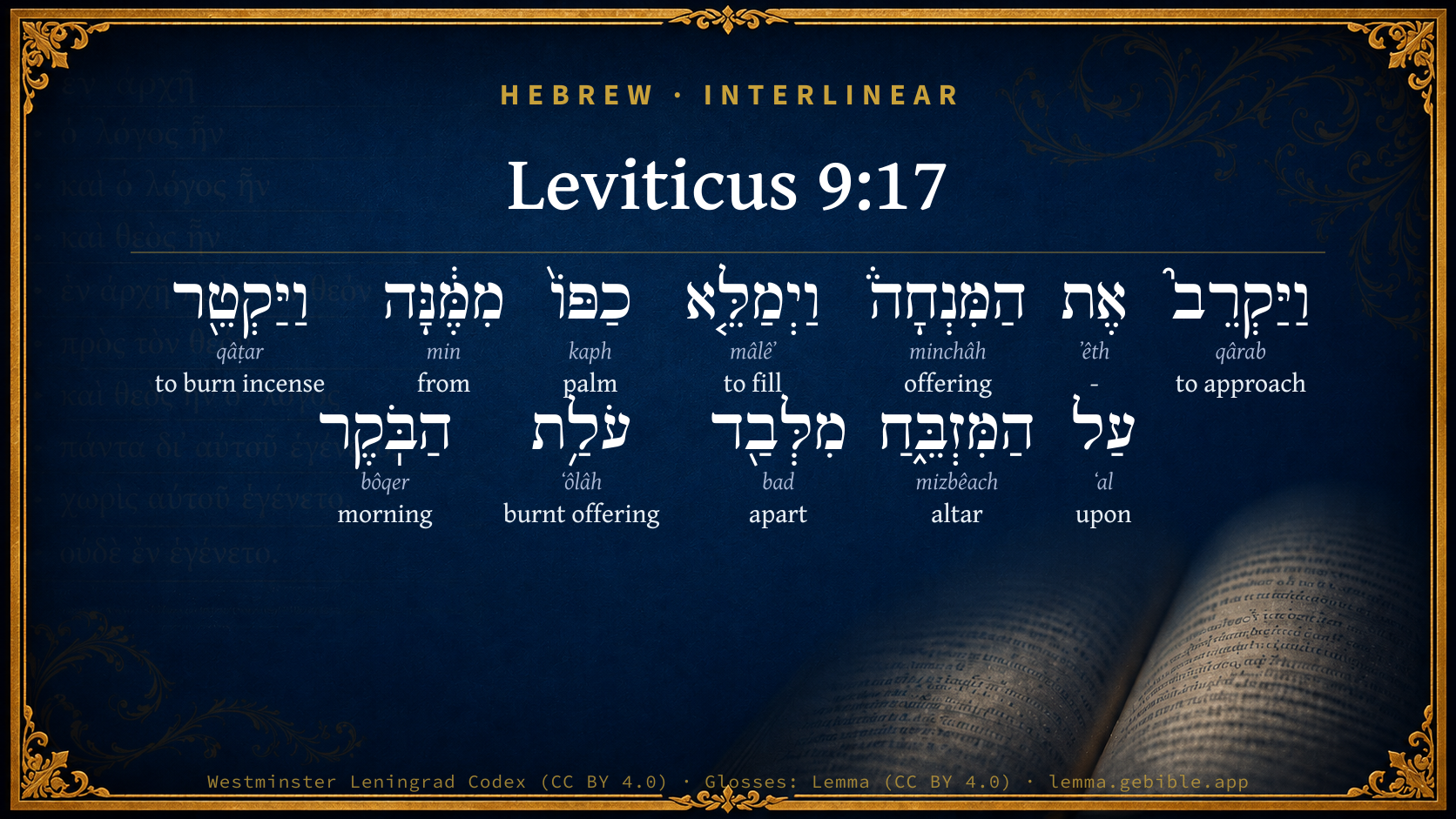
Hebrew (Westminster Leningrad Codex) Leviticus 9:17 appears in the Hebrew Old Testament. The text above is from the Westminster Leningrad Codex. Each word links to its Strong’s number, a concise gloss, and parsing drawn from the Open Scriptures Hebrew Bible morphology. Click any word for its full Brown-Driver-Briggs (BDB) entry.
Download image
Cite this verse

Leviticus 9:17 (World English Bible). Public Domain. Lemma interlinear Bible study tool, https://lemma.gebible.app/v/leviticus/9/17.

Show BibTeX & RIS
BibTeX
RIS
English Translation
He presented the meal offering, and filled his hand from there, and burned it upon the altar, besides the burnt offering of the morning.
World English Bible · Public Domain
Download a study sheet

One document with this verse’s original text, its word-by-word gloss line, the meaning frame, cross-references with their text, attributed commentary, and full source and license credits — printable, and it pastes into notes with its structure intact.

This verse Autodidact and up

Study sheet (.html) Plain text (.txt)

A passage Seminary Student

Up to 50 verses in one chapter. A passage sheet keeps up to 6 commentary sources and 12 cross-references per verse, in the order this page ranks them, and says so on the sheet whenever that leaves anything out. Ask for a single verse and you get the Autodidact verse sheet above.

Everything on this page stays free to read, with no account — the sheet is a download of what is already on screen, not access to it.

Want to remove ads? Support Godless Engineer
Compare translations 3

The same verse in 3 English versions, stacked beneath the original-language interlinear above. Click any original word for its lexicon entry.

Each is an independent rendering of the whole verse — the interlinear is not word-aligned to these translations.

Highlighted words mark where these versions differ — a whole-verse word diff, not a word-by-word alignment.

  • World English Bible Public Domain
    He presented the meal offering, and filled his hand from there, and burned it upon the altar, besides the burnt offering of the morning.
  • King James Version Public Domain
    And he brought the meat offering, and took an handful thereof, and burnt it upon the altar, beside the burnt sacrifice of the morning.
  • unfoldingWord Literal Text CC BY-SA 4.0
    And he presented the grain offering, and he filled his palm from it, and he caused to become smoke on the altar in addition to the burnt offering of the morning.

unfoldingWord Literal Text — © unfoldingWord, licensed CC BY-SA 4.0. Word-aligned USFM3 via Door43 (git.door43.org/unfoldingWord/en_ult).

Versions to compare (up to 4)

3 of 4 selected

Show all 18 translations

Every available English version of this verse, each an independent rendering of the whole verse.

  • World English Bible Public Domain
    He presented the meal offering, and filled his hand from there, and burned it upon the altar, besides the burnt offering of the morning.
  • Berean Standard Bible Public Domain
    Next he presented the grain offering, took a handful of it, and burned it on the altar in addition to the morning’s burnt offering.
  • Majority Standard Bible Public Domain
    Next he presented the grain offering, took a handful of it, and burned it on the altar in addition to the morning’s burnt offering.
  • King James Version Public Domain
    And he brought the meat offering, and took an handful thereof, and burnt it upon the altar, beside the burnt sacrifice of the morning.
  • American Standard Version (1901) Public Domain
    And he presented the meal-offering, and filled his hand therefrom, and burnt it upon the altar, besides the burnt-offering of the morning.
  • Revised Version (1885) Public Domain
    And he presented the meal offering, and filled his hand therefrom, and burnt it upon the altar, besides the burnt offering of the morning.
  • Geneva Bible (1599) Public Domain
    He presented also the meate offring, and filled his hand thereof, and beside the burnt sacrifice of the morning he burnt this vpon the Altar.
  • Douay-Rheims (1899) Public Domain
    Adding in the sacrifice the libations, which are offered withal, and burning them upon the altar, besides the ceremonies of the morning holocaust.
  • Young's Literal Translation Public Domain
    and he bringeth near the present, and filleth his palm with it, and maketh perfume on the altar, apart from the burnt-offering of the morning.
  • Literal Standard Version CC BY-SA 4.0
    and he brings the present near, and fills his palm with it, and makes incense on the altar, apart from the burnt-offering of the morning.
  • Unlocked Literal Bible CC BY-SA 4.0
    He presented the grain offering; he filled his hand with it and burned it on the altar, along with the morning's burnt offering.
  • unfoldingWord Literal Text CC BY-SA 4.0
    And he presented the grain offering, and he filled his palm from it, and he caused to become smoke on the altar in addition to the burnt offering of the morning.
  • Darby Bible Public Domain
    And he presented the oblation, and took a handful of it, and burned it on the altar, besides the burnt-offering of the morning.
  • World Messianic Bible Public Domain
    He presented the meal offering, and filled his hand from there, and burned it upon the altar, in addition to the burnt offering of the morning.
  • Webster's Bible Public Domain
    And he brought the meat-offering, and took a handful of it, and burnt it upon the altar, beside the burnt-sacrifice of the morning.
  • Free Bible Version CC BY-SA 4.0
    He presented the grain offering. He took a handful from it and burned it on the altar, in addition to the burnt offering presented earlier that morning.
  • Bible in Basic English Public Domain
    And he put the meal offering before the Lord, and taking some of it in his hand he had it burned on the altar, separately from the burned offering of the morning.
  • JPS Tanakh (1917) Public Domain
    And the meal-offering was presented; and he filled his hand therefrom, and made it smoke upon the altar, besides the burnt-offering of the morning.

Literal Standard Version (2020), Covenant Press — licensed CC BY-SA 4.0. Text via the HelloAO Bible API (eBible.org). Unlocked Literal Bible (unfoldingWord) — licensed CC BY-SA 4.0. Text via the HelloAO Bible API (eBible.org). unfoldingWord Literal Text — © unfoldingWord, licensed CC BY-SA 4.0. Word-aligned USFM3 via Door43 (git.door43.org/unfoldingWord/en_ult). Free Bible Version, Dr. Jonathan Gallagher — licensed CC BY-SA 4.0. Text via the HelloAO Bible API (eBible.org).

Word by word

More ways to search: Search by grammar → Find every occurrence → Compare this word →

Practice this passage: Drill this verse → Learn its vocabulary →

וַיַּקְטֵ֖ר
qâṭar
H6999
“and · to burn incense”
Conjunction + Verb, Hiphil, Sequential Imperfect, 3rd Person, Masculine, Singular
Part of Speech
Conjunction + Verb
Stem
Hiphil
Form
Sequential Imperfect
Person
3rd Person
Gender
Masculine
Number
Singular
Full BDB Definition

Origin: a primitive root [identical with H7000 through the idea of fumigation in a close place and perhaps thus driving out the occupants]

TWOT: 2011 , 2011e , 2011g

to sacrifice, burn incense, burn sacrifices, make sacrifices smoke (verb) - (Piel) - to make sacrifices smoke - to sacrifice - (Pual) to smoke a sacrifice - (Hiphil) - to make sacrifices smoke - to cause incense to smoke, offer incense - to make smoke upon - (Hophal) to be made to smoke - incense (noun masculine) - incense-altar (noun feminine)
  1. וַיַּקְרֵב֮ qârab H7126 “and · to approach” Conjunction + Verb, Hiphil, Sequential Imperfect, 3rd Person, Masculine, Singular
  2. אֶת ʼêth H853 “-” Particle, Direct Object
  3. הַמִּנְחָה֒ minchâh H4503 “the · offering” Particle, Definite Article + Noun, Common, Feminine, Singular, Absolute
  4. וַיְמַלֵּ֤א mâlêʼ H4390 “and · to fill” Conjunction + Verb, Piel, Sequential Imperfect, 3rd Person, Masculine, Singular
  5. כַפּוֹ֙ kaph H3709 “palm · his” Noun, Common, Feminine, Singular, Construct + Suffix, Personal, 3rd Person, Masculine, Singular
  6. מִמֶּ֔נָּה min H4480 “from · her” Preposition + Suffix, Personal, 3rd Person, Feminine, Singular
  7. עַל ʻal H5921 “upon” Preposition
  8. הַמִּזְבֵּ֑חַ mizbêach H4196 “the · altar” Particle, Definite Article + Noun, Common, Masculine, Singular, Absolute
  9. מִלְּבַ֖ד bad H905 “from · to/for · apart of” Preposition + Preposition + Noun, Common, Masculine, Singular, Construct
  10. עֹלַ֥ת ʻôlâh H5930 “burnt offering of” Noun, Common, Feminine, Singular, Construct
  11. הַבֹּֽקֶר bôqer H1242 “the · morning” Particle, Definite Article + Noun, Common, Masculine, Singular, Absolute

About this verse

These counts appear in no published source. They are computed here, from the morphology-tagged text and Lemma’s own curated glosses. What Lemma adds →

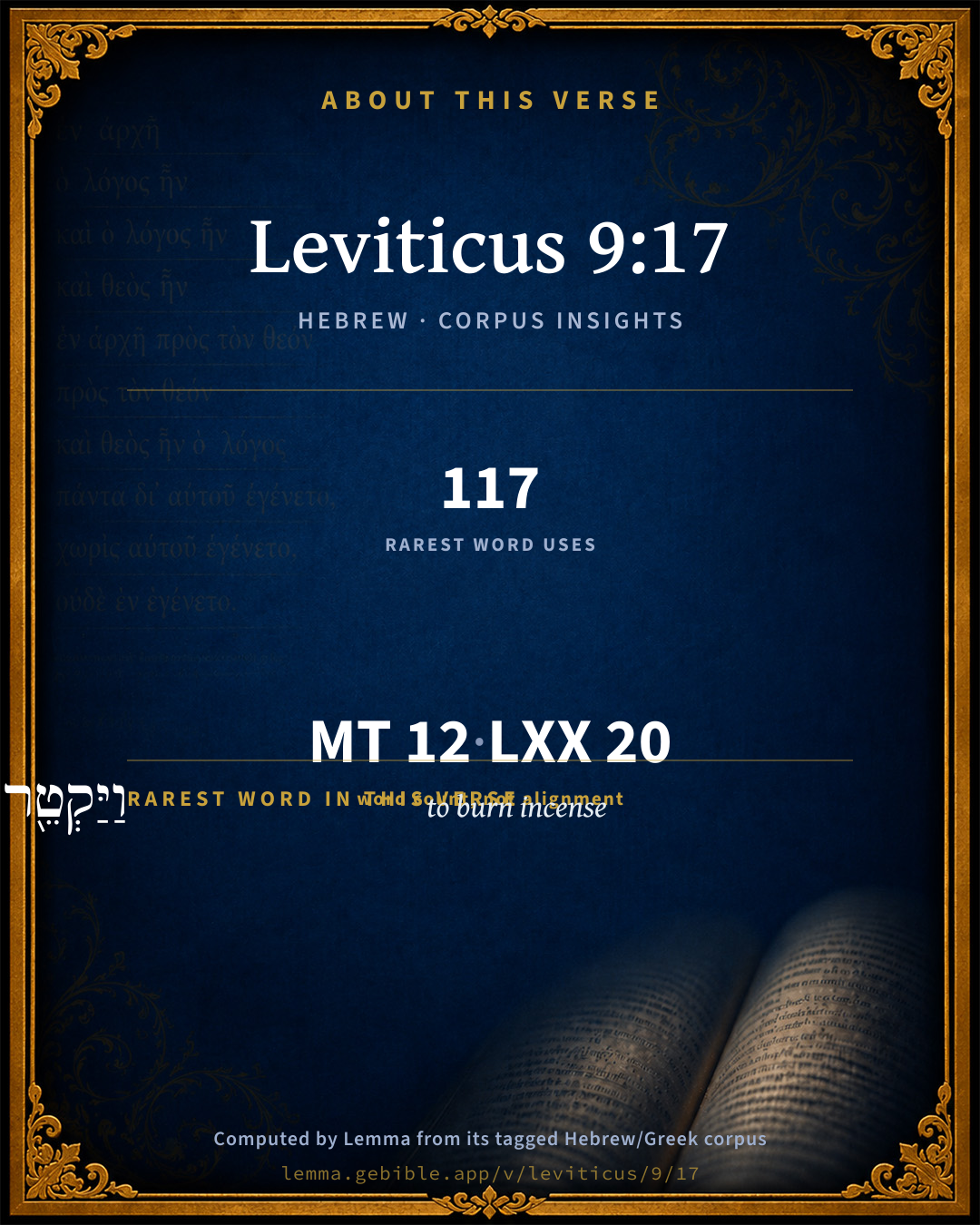
12
words
12
distinct lemmas
Pentateuch
section

Grammatical profile

  • 3 verbs
  • 6 nouns
  • 2 prepositions
  • 1 particle

Verb forms

  • וַיַּקְרֵב֮ Hiphil · Sequential Imperfect
  • וַיְמַלֵּ֤א Piel · Sequential Imperfect
  • וַיַּקְטֵ֖ר Hiphil · Sequential Imperfect

Hebrew & Septuagint length

In English translation the verse runs 24 words from the Hebrew and 23 from the Septuagint (LXX English) — closely comparable.

A rough comparison of the two English renderings, which tokenize alike — not a word-level alignment.

Word counts can differ between the Hebrew and the Greek without any difference in meaning — e.g. the Hebrew direct-object marker אֵת has no separate Greek word, and Greek often adds the article ὁ.

In the original languages it is 12 Hebrew tokens and 20 Greek tokens — but the two are counted differently (Hebrew bundles its prefixes and suffixes into one token; the Greek is in lemma form), so that isn’t a like-for-like length.

Cross-references

6

Topical passages linked to Leviticus 9:17 in the Treasury of Scripture Knowledge — connected by theme and wording, ordered by reader-vote popularity; previews shown in the World English Bible.

  • Leviticus 2:1–2 "'When anyone offers an offering of a meal offering to Yahweh, his offering shall be of fine flour; and he shall pour oil on it, and put frankincense on it.
  • Exodus 29:38–42 "Now this is that which you shall offer on the altar: two lambs a year old day by day continually.
  • Leviticus 3:5 Aaron's sons shall burn it on the altar on the burnt offering, which is on the wood that is on the fire: it is an offering made by fire, of a sweet savor to Yahweh.
  • Leviticus 9:1 It happened on the eighth day, that Moses called Aaron and his sons, and the elders of Israel;
  • John 6:53 Jesus therefore said to them, "Most assuredly I tell you, unless you eat the flesh of the Son of Man and drink his blood, you don't have life in yourselves.
  • Galatians 2:20 I have been crucified with Christ, and it is no longer I that live, but Christ living in me. That life which I now live in the flesh, I live by faith in the Son of God, who loved me, and gave himself up for me.

Cross-references courtesy of OpenBible.info (CC BY 4.0).

Hebrew and Greek witnesses Masoretic Hebrew ↔ Greek Septuagint

The same verse in the two great witnesses to the Old Testament, shown verse-for-verse.

These are two independent witnesses, not word-aligned to each other, and the Septuagint is shown in lemma (dictionary) form.

Hebrew Leviticus 9:17 Masoretic · Westminster Leningrad Codex

וַיַּקְרֵב֮ אֶת הַמִּנְחָה֒ וַיְמַלֵּ֤א כַפּוֹ֙ מִמֶּ֔נָּה וַיַּקְטֵ֖ר עַל הַמִּזְבֵּ֑חַ מִלְּבַ֖ד עֹלַ֥ת הַבֹּֽקֶר

He presented the meal offering, and filled his hand from there, and burned it upon the altar, besides the burnt offering of the morning.

World English Bible · Public Domain

Greek LXX Leviticus 9:17 Septuagint · lemma form

καί προςφέρω ὁ θυσία καί πίμπλημι ὁ χείρ ἀπό αὐτός καί ἐπιτίθημι ἐπί ὁ θυσιαστήριον χωρίς ὁ ὁλοκαύτωμα ὁ πρωινός

And he brought the sacrifice and filled his hands with it, and laid it on the altar, besides the morning whole burnt offering.

LXX2012 (modern English Septuagint) · Public Domain

Hebrew: Westminster Leningrad Codex (CC BY 4.0). Greek: Septuagint (public domain); English from LXX2012 (modern English Septuagint) (Public Domain). How the Septuagint differs from the Hebrew →

Targum (Aramaic paraphrase)

2

The Targum is the ancient Jewish Aramaic paraphrase of the Hebrew Scriptures — an interpretive translation, not the Hebrew text itself. Onkelos (literal) and Pseudo-Jonathan (expansive) render the Torah, and Jonathan the Prophets. Coverage is partial: where no permissively-licensed English translation exists for a verse, only the Aramaic is shown. This is verse-level text, not a word-by-word alignment to the Hebrew.

  1. Targum Onkelos Torah (Genesis–Deuteronomy)
    וְקָרִיב יָת מִנְחָתָא וּמְלָא יְדֵהּ מִנַהּ וְאַסֵק עַל מַדְבְּחָא בַּר מֵעֲלַת צַפְרָא

    (no public-domain English translation for this verse)

    Targum Onkelos — Aramaic: “Onkelos Genesis” (public domain); “Onkelos Exodus” (public domain); “Onkelos Leviticus” (public domain); “Onkelos Numbers” (public domain); “Onkelos Deuteronomy” (public domain). English: “Sefaria Community Translation” (CC0 1.0 (public-domain dedication)); “J.W. Etheridge. The Targums of Onkelos and Jonathan Ben Uzziel on the Pentateuch. London: Longmans, Green, 1862” (public domain). Text via Sefaria.

  2. Targum Pseudo-Jonathan Torah (Genesis–Deuteronomy)
    וּקְרֵיב יַת מִנְחָתָא וּמְלֵא יְדֵיהּ מִינָהּ וּנְסֵיב מִינָהּ צְרִיד אַרְכַּבְתָּהּ וְאַסֵיק עַל מַדְבְּחָא בַּר מִן עוֹלַת צַפְרָא

    And they brought the mincha, and he filled his hands therefrom, and took of it a portion for its memorial, and burned upon the altar, beside the morning sacrifice

    Targum Pseudo-Jonathan — Aramaic: “Targum Jonathan on Genesis” (public domain); “Targum Jonathan on Exodus” (public domain); “Targum Jonathan on Leviticus” (public domain); “Targum Jonathan on Numbers” (public domain); “Targum Jonathan on Deuteronomy” (public domain). English: “The Targum of Jonathan ben Uzziel, trans. J. W. Etheridge, London, 1862” (public domain). Text via Sefaria.

Commentary

Notes on Leviticus 9:17 from classic Christian and Jewish commentators (each source and its license shown beneath its notes). The classic Christian expositions comment on the surrounding passage and are grouped to its opening verse, so a note may address several verses; the Jewish commentaries on the Tanakh (Rashi and others) are per-verse, so they appear only where the commentator wrote on this verse.

Lemma curates 59 commentaries, every one of them public domain or Creative Commons licensed, each selected and text-cleaned for this edition rather than reprinted as found. About our sources →

Tyndale Open Study Notes

Tyndale Open Resources

9:17 regular burnt offering for the morning: A lamb was offered as a whole burnt offering each morning and evening (6:9; Num 28:2-4).

Tyndale Open Study Notes — © Tyndale Open Resources, licensed CC BY-SA 4.0. Text via the HelloAO Bible API.

Jamieson, Fausset & Brown

Robert Jamieson, A. R. Fausset & David Brown

meat offering . . . wave offering--It is observable that there is no notice taken of these in the offerings the priests made for themselves. They could not bear their own sins: and therefore, instead of eating any part of their own sin offering, as they were at liberty to do in the case of the people's offering, they had to carry the whole carcasses "without the camp and burn them with fire" [Exo 29:14; Lev 4:12].

Jamieson, Fausset & Brown — Commentary Critical and Explanatory on the Whole Bible (1871) — public domain (CC PDM 1.0). Text via the HelloAO Bible API.

Ellicott's Commentary for English Readers

(17) And he brought the meat offering.—This Aaron offered according to the rule in Lev_2:1-3.

Beside the burnt sacrifice of the morning.—That is, in addition to the lamb which was daily offered as a burnt sacrifice, and was accompanied by a meat offering (Exo_29:30; Exo_29:40). Accordingly Aaron began his priestly functions by first offering the daily morning sacrifice which took precedence of all other sacrifices, and which was never superseded by the extra offerings: then followed the other sacrifices here described.

A Bible Commentary for English Readers, edited by Charles John Ellicott (1878–1897) — public domain. Text from a community e-Sword module.

The Cambridge Bible for Schools and Colleges

gen. ed. J. J. S. Perowne

17. The Meal-Offering. The Heb. for taking a handful from the Meal-Offering in this verse is different from that in Lev_2:2.

besides the burnt offering of the morning] The same words in Num_28:23 refer to the continual Burnt-Offering enjoined in Exo_29:38-42 and Num_28:3-8. Are the Burnt-Offerings which have been already offered, or any of them, regarded as ‘the burnt offering of the morning’? or are these last words (so Dillm.) the gloss of a later scribe?

The Cambridge Bible for Schools and Colleges (gen. ed. J. J. S. Perowne; Cambridge University Press, 1878–1918) — public domain. Text from a community e-Sword module.

John Gill's Exposition

He slew also the bullock and the ram, a sacrifice of peace offerings, which was for the people,.... That they might feast, rejoice, and be glad that atonement was made for their sins, and their gifts and sacrifices accepted of God, see Rom 5:11.

and Aaron's sons presented unto him the blood; of the peace offerings, the bullock and the ram, which they had received into a vessel as they were killing:

which he sprinkled upon the altar round about; as he did with the blood of his own burnt offering, Lev 9:12.

John Gill's Exposition of the Whole Bible (1746–1763) — public domain (CC PDM 1.0). Text via the HelloAO Bible API.

Haydock's Catholic Bible Commentary

Holocaust. Which were religiously observed every day. The law respecting the libations was given already, though it be related, Numbers xv. 4. (Menochius)

George Leo Haydock (1774–1849), Haydock's Catholic Family Bible and Commentary, 1859 edition — public domain. Excludes Psalms (Douay-Rheims chapter numbering differs from Protestant) and Deuterocanonical books (Catholic canon only).

Matthew Poole's English Annotations

The meat-offering was always to be added to the burnt offering. See Le 6. The burnt-sacrifice of the morning was to be first offered every morning; for God will not have his ordinary and stated service swallowed up by extraordinary.

Matthew Poole's English Annotations on the Holy Bible (1683–1685) — public domain. Text from a community e-Sword/MySword module.

Whedon's Commentary on the Bible

Daniel D. Whedon

17. Meat offering… burnt sacrifice — “The difference between the burnt offering and the meat offering was this: in the burnt offering the surrender of a life figured man’s duty to God; while fruits in the meat offering represented man’s duty to his neighbour.” — Jukes. For the time when the fire was actually applied to all the offerings of this chapter, see Concluding Note.

Daniel D. Whedon (gen. ed.), Commentary on the Old and New Testaments (1874–1909) — public domain. Text from a community e-Sword module.

John Wesley's Explanatory Notes

Besides the burnt-sacrifice - Which was to be first offered every morning; for God will not have his ordinary and stated service swallowed up by extraordinary.

John Wesley, Explanatory Notes Upon the Whole Bible (1754–1765) — public domain. Text via the GEBible commentary corpus.

Rashi

Rabbi Shlomo Yitzchaki (Rashi)

וימלא כפו AND HE FILLED HIS HAND [THEREWITH] — this is what is elsewhere termed קמיצה (i. e. this is elsewhere expressed by the phrase … וקמץ מלא קמצו “he shall take a fistful”) (Sifra, Shemini, Mechilta d'Miluim 2 10; cf. Menachot 9b).

מלבד עלת הבקר BESIDE THE BURNT OFFERING OF THE MORNING — all these rites he carried out after the continual burnt offering.

Rashi on the Tanakh — English translations: “The Judaica Press complete Tanach with Rashi, translated by A. J. Rosenberg” (CC BY 4.0); “Pentateuch with Rashi's commentary by M. Rosenbaum and A.M. Silbermann, 1929-1934” (public domain); “The Metsudah Tanach series, Lakewood, N.J” (CC BY 4.0); and “The Book of Joshua, Metsudah Publications, 1997” (CC BY 4.0). Text via Sefaria.

Ramban (Nachmanides)

Rabbi Moshe ben Nachman (Ramban / Nachmanides)

BESIDES THE BURNT-OFFERING OF THE MORNING. Scripture had to mention this here, in order to teach us that the burnt-offering of the people [which was a special offering for that day] did not exempt [them from bringing] the Daily burnt-offering, nor did it precede it [as nothing may ever be offered before the Daily burnt-offering of the morning]. But Scripture did not have to mention this about the seven days of consecration [namely that the offerings of those days were to be offered besides the burnt-offering of the morning], because those were offerings of individuals [i.e., Aaron and his sons] to consecrate them as priests, and it is self-understood that such offerings did not exempt [them from bringing] the Daily burnt-offering, nor did they precede it.In the Torath Kohanim the Rabbis have taught: 12. The meaning of this quote will be explained by Ramban further on in the text. “And the meal-offering was presented; and he filled his hand therefrom and burnt it on the altar, besides the burnt-offering of the morning. What does this come to teach us? Shall we say it teaches us that if he could not obtain the meal-offering [which was offered with every burnt-offering] that he should nevertheless bring the animal [as a burnt-offering]? [That could not be the case], for it has already been stated, And the burnt-offering was presented, and he offered it according to the ordinances. If so, why does it say, and he burnt it [i.e., the meal-offering] upon the altar, besides the burnt-offering of the morning? It is to teach us that there were two meal-offerings there, one for the [Daily] burnt-offering and one [brought] by itself” [for the burnt-offering of the people, which was a special offering of that eighth day].The meaning of this text [of the Torath Kohanim] is as follows: Had Scripture stated, “And the burnt-offering was presented, and he offered it according to the ordinance, besides the burnt-offering of the morning,” the sense thereof would have been to teach that the Daily burnt-offering precedes [the other offerings], as He says in the section of the Additional Offerings, it shall be offered beside the continual burnt-offering, and the drink-offering thereof; beside the continual burnt-offering., Verse 31. But since He mentioned the meal-offering — stating, And the meal-offering was presented; and he filled his hand therefrom, and burnt it on the altar, besides the burnt-offering of the morning — it appears that [the phrase, besides the burnt-offering of the morning] is said with reference to the meal-offering. Therefore the Rabbis commented that if it comes to say that he offered this meal-offering alone, but did not offer the drink-offering of the Daily burnt-offering nor that of the people’s burnt-offering [of the eighth day], because he only found [ingredients] for this freewill meal-offering — [that could not be the case]. For [in the preceding verse] it has already been stated, And the burnt-offering was presented, and he offered it according to the ordinance,. The question then re-appears: why is the phrase besides the burnt-offering of the morning mentioned in connection with the meal-offering? which means that it was offered according to its ordinance, with the drink-offering. [Thus we cannot derive from here a principle that the lack of the drink-offering does not prevent the bringing of the offering itself, if the meal-offering and the wine for the drink-offering are not obtainable.] If so, why does it say, And the meal-offering was presented etc. and he burnt it on the altar, besides the burnt-offering of the morning? It is to teach that he offered this meal-offering [of the people’s burnt-offering brought on the eighth day] “besides the burnt-offering of the morning and its meal-offering,” for this meal-offering was not the drink-offering [which is an obligatory part of the Daily burnt-offering], but was the freewill meal-offering of Israel [namely part of the burnt-offering of the people which they brought on that day]. and its meal-offering.” It should be pointed out that Ramban refers to this meal-offering as minchath-nedavah (“freewill — meal-offering”) not because of its voluntary nature, namely that it be optional for Israel to bring it or not. The name minchath-nedavah is only to distinguish it from the meal-offering which constantly accompanied the Daily Whole-offering of the people, while this one represented the willing spirit of the people on this day. See further my Hebrew commentary p. 45.

Ramban (Nachmanides) on the Tanakh — English translation: “Commentary on the Torah by Ramban (Nachmanides). Translated and annotated by Charles B. Chavel. New York, Shilo Pub. House, 1971-1976” (CC BY 4.0). Text via Sefaria.

Lesson kit

Teaching starters — assembled from the data on this page, not authored interpretation. Every prompt links to the verse data it draws on. Edit before teaching.

Leviticus, in the Pentateuch, opens this verse with 12 words (12 distinct Hebrew lemmas). Its most distinctive word is qâṭar (“to burn incense”). A historical commentator’s framing appears above. Read the whole chapter for the surrounding context.

Discussion questions

  1. The word qâṭar carries the sense “to burn incense.” How does it shape the verse?
  2. How does Leviticus 2:1–2, which shares this passage’s theme, read alongside this verse?
  3. These translations render this verse differently. What is at stake in choosing one wording over another?
  4. «וַיַּקְרֵב֮» is a Hiphil Sequential Imperfect verb. How does that grammatical form shape the action described?
  5. Compare how Tyndale Open Study Notes and Jamieson, Fausset & Brown read this verse. Where do they agree or differ?

Things to notice

Reading settings

Reading text

Shown beneath each verse's original-language words.

Old Testament
Old Testament edition

Read the OT as the Masoretic Hebrew (MT) or the Greek Septuagint (LXX).

English shown for the Greek Septuagint (in the Hebrew ↔ Greek comparison).

Comparing translations? Open the Compare panel on any verse page to stack up to four side by side.