Leviticus 4:6

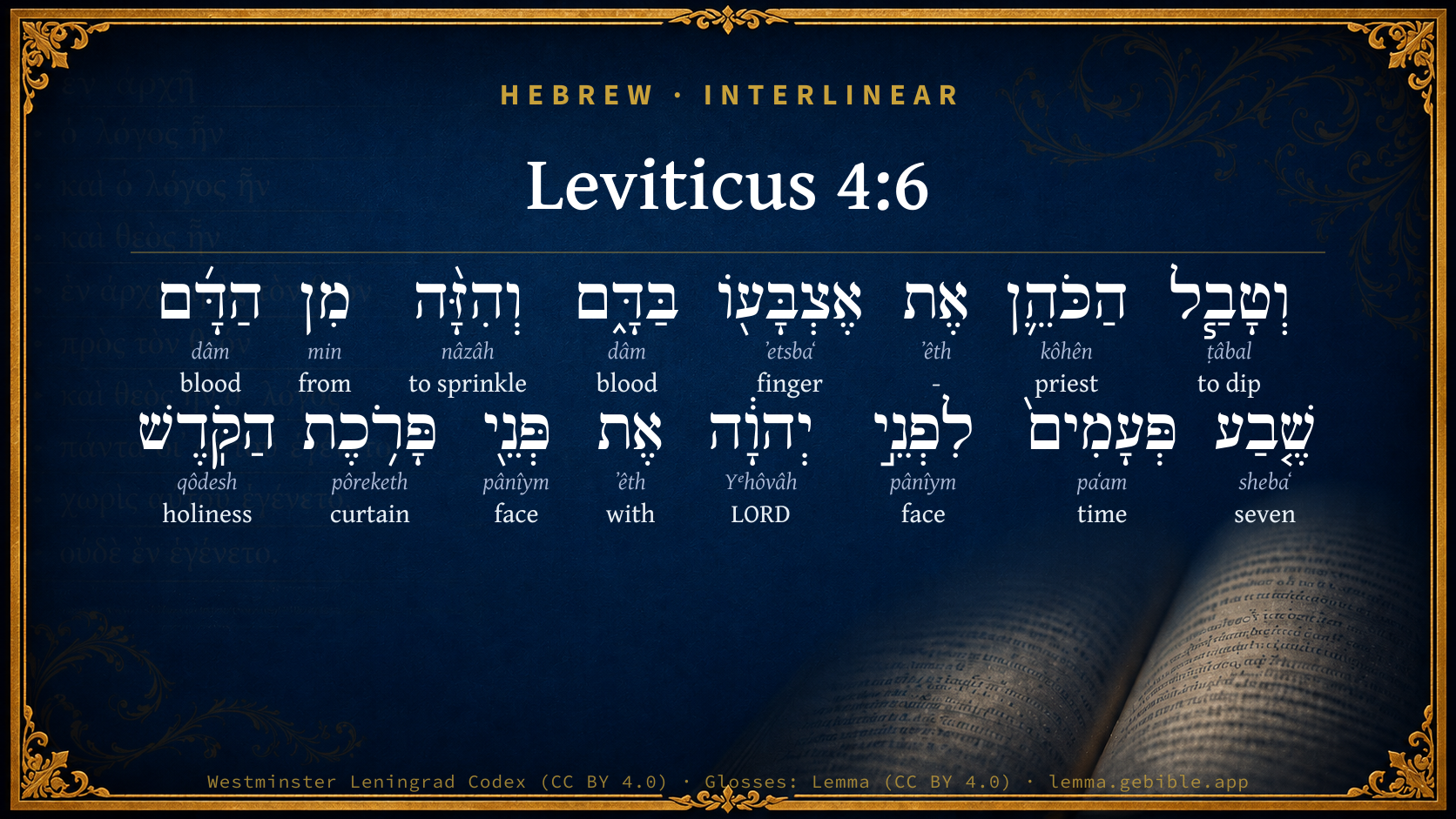
Hebrew (Westminster Leningrad Codex) Leviticus 4:6 appears in the Hebrew Old Testament. The text above is from the Westminster Leningrad Codex. Each word links to its Strong’s number, a concise gloss, and parsing drawn from the Open Scriptures Hebrew Bible morphology. Click any word for its full Brown-Driver-Briggs (BDB) entry.
Download image
Cite this verse

Leviticus 4:6 (World English Bible). Public Domain. Lemma interlinear Bible study tool, https://lemma.gebible.app/v/leviticus/4/6.

Show BibTeX & RIS
BibTeX
RIS
English Translation
The priest shall dip his finger in the blood, and sprinkle some of the blood seven times before Yahweh, before the veil of the sanctuary.
World English Bible · Public Domain
Download a study sheet

One document with this verse’s original text, its word-by-word gloss line, the meaning frame, cross-references with their text, attributed commentary, and full source and license credits — printable, and it pastes into notes with its structure intact.

This verse Autodidact and up

Study sheet (.html) Plain text (.txt)

A passage Seminary Student

Up to 50 verses in one chapter. A passage sheet keeps up to 6 commentary sources and 12 cross-references per verse, in the order this page ranks them, and says so on the sheet whenever that leaves anything out. Ask for a single verse and you get the Autodidact verse sheet above.

Everything on this page stays free to read, with no account — the sheet is a download of what is already on screen, not access to it.

Want to remove ads? Support Godless Engineer
Compare translations 3

The same verse in 3 English versions, stacked beneath the original-language interlinear above. Click any original word for its lexicon entry.

Each is an independent rendering of the whole verse — the interlinear is not word-aligned to these translations.

Highlighted words mark where these versions differ — a whole-verse word diff, not a word-by-word alignment.

  • World English Bible Public Domain
    The priest shall dip his finger in the blood, and sprinkle some of the blood seven times before Yahweh, before the veil of the sanctuary.
  • King James Version Public Domain
    And the priest shall dip his finger in the blood, and sprinkle of the blood seven times before the LORD, before the vail of the sanctuary.
  • unfoldingWord Literal Text CC BY-SA 4.0
    And the priest shall dip his finger in the blood, and he shall sprinkle some of the blood seven times to the face of Yahweh, toward the face of the curtain of the Holy.

unfoldingWord Literal Text — © unfoldingWord, licensed CC BY-SA 4.0. Word-aligned USFM3 via Door43 (git.door43.org/unfoldingWord/en_ult).

Versions to compare (up to 4)

3 of 4 selected

Show all 18 translations

Every available English version of this verse, each an independent rendering of the whole verse.

  • World English Bible Public Domain
    The priest shall dip his finger in the blood, and sprinkle some of the blood seven times before Yahweh, before the veil of the sanctuary.
  • Berean Standard Bible Public Domain
    The priest is to dip his finger in the blood and sprinkle some of it seven times before the LORD, in front of the veil of the sanctuary.
  • Majority Standard Bible Public Domain
    The priest is to dip his finger in the blood and sprinkle some of it seven times before the LORD, in front of the veil of the sanctuary.
  • King James Version Public Domain
    And the priest shall dip his finger in the blood, and sprinkle of the blood seven times before the LORD, before the vail of the sanctuary.
  • American Standard Version (1901) Public Domain
    and the priest shall dip his finger in the blood, and sprinkle of the blood seven times before Jehovah, before the veil of the sanctuary.
  • Revised Version (1885) Public Domain
    and the priest shall dip his finger in the blood, and sprinkle of the blood seven times before the LORD, before the veil of the sanctuary.
  • Geneva Bible (1599) Public Domain
    Then the Priest shall dippe his finger in the blood, and sprinkle of the blood seuen times before the Lord, before the vaile of the Sanctuarie.
  • Douay-Rheims (1899) Public Domain
    And having dipped his finger in the blood, he shall sprinkle with it seven times before the Lord, before the veil of the sanctuary.
  • Young's Literal Translation Public Domain
    and the priest hath dipped his finger in the blood, and sprinkled of the blood seven times before Jehovah, at the front of the vail of the sanctuary;
  • Literal Standard Version CC BY-SA 4.0
    and the priest has dipped his finger in the blood, and sprinkled of the blood seven times before YHWH, at the front of the veil of the holy place;
  • Unlocked Literal Bible CC BY-SA 4.0
    The priest will dip his finger into the blood and sprinkle some of it seven times before Yahweh, before the curtain of the most holy place.
  • unfoldingWord Literal Text CC BY-SA 4.0
    And the priest shall dip his finger in the blood, and he shall sprinkle some of the blood seven times to the face of Yahweh, toward the face of the curtain of the Holy.
  • Darby Bible Public Domain
    and the priest shall dip his finger in the blood, and sprinkle of the blood seven times before Jehovah before the veil of the sanctuary;
  • World Messianic Bible Public Domain
    The priest shall dip his finger in the blood, and sprinkle some of the blood seven times before the LORD, before the veil of the sanctuary.
  • Webster's Bible Public Domain
    And the priest shall dip his finger in the blood, and sprinkle of the blood seven times before the LORD, before the vail of the sanctuary.
  • Free Bible Version CC BY-SA 4.0
    The high priest shall dip his finger in the blood and sprinkle some of it seven times before the Lord in front of the veil of the sanctuary.
  • Bible in Basic English Public Domain
    And the priest is to put his finger in the blood, shaking drops of it before the Lord seven times, in front of the veil of the holy place.
  • JPS Tanakh (1917) Public Domain
    And the priest shall dip his finger in the blood, and sprinkle of the blood seven times before the LORD, in front of the veil of the sanctuary.

Literal Standard Version (2020), Covenant Press — licensed CC BY-SA 4.0. Text via the HelloAO Bible API (eBible.org). Unlocked Literal Bible (unfoldingWord) — licensed CC BY-SA 4.0. Text via the HelloAO Bible API (eBible.org). unfoldingWord Literal Text — © unfoldingWord, licensed CC BY-SA 4.0. Word-aligned USFM3 via Door43 (git.door43.org/unfoldingWord/en_ult). Free Bible Version, Dr. Jonathan Gallagher — licensed CC BY-SA 4.0. Text via the HelloAO Bible API (eBible.org).

Word by word

More ways to search: Search by grammar → Find every occurrence → Compare this word →

Practice this passage: Drill this verse → Learn its vocabulary →

וְטָבַ֧ל
ṭâbal
H2881
“and · to dip”
Conjunction + Verb, Qal, Sequential Perfect, 3rd Person, Masculine, Singular
Part of Speech
Conjunction + Verb
Stem
Qal
Form
Sequential Perfect
Person
3rd Person
Gender
Masculine
Number
Singular
Full BDB Definition

Origin: a primitive root

TWOT: 787 , 788

to dip, dip into, plunge - (Qal) - to dip in or into - to dip oneself - (Niphal) to be dipped
  1. הַכֹּהֵ֛ן kôhên H3548 “the · priest” Particle, Definite Article + Noun, Common, Masculine, Singular, Absolute
  2. אֶת ʼêth H853 “-” Particle, Direct Object
  3. אֶצְבָּע֖וֹ ʼetsbaʻ H676 “finger · his” Noun, Common, Feminine, Singular, Construct + Suffix, Personal, 3rd Person, Masculine, Singular
  4. בַּדָּ֑ם dâm H1818 “in/at the · blood” Preposition, Determined + Noun, Common, Masculine, Singular, Absolute
  5. וְהִזָּ֨ה nâzâh H5137 “and · to sprinkle” Conjunction + Verb, Hiphil, Sequential Perfect, 3rd Person, Masculine, Singular
  6. מִן min H4480 “from” Preposition
  7. הַדָּ֜ם dâm H1818 “the · blood” Particle, Definite Article + Noun, Common, Masculine, Singular, Absolute
  8. שֶׁ֤בַע shebaʻ H7651 “seven” Adjective, Cardinal number, Feminine, Singular, Absolute
  9. פְּעָמִים֙ paʻam H6471 “times” Noun, Common, Feminine, Plural, Absolute
  10. לִפְנֵ֣י pânîym H6440 “to/for · face(s) of” Preposition + Noun, Common, Both, Plural, Construct
  11. יְהוָ֔ה Yᵉhôvâh H3068 “LORD” Noun, Proper
  12. אֶת ʼêth H854 “with” Preposition
  13. פְּנֵ֖י pânîym H6440 “face(s) of” Noun, Common, Both, Plural, Construct
  14. פָּרֹ֥כֶת pôreketh H6532 “curtain of” Noun, Common, Feminine, Singular, Construct
  15. הַקֹּֽדֶשׁ qôdesh H6944 “the · holiness” Particle, Definite Article + Noun, Common, Masculine, Singular, Absolute

About this verse

These counts appear in no published source. They are computed here, from the morphology-tagged text and Lemma’s own curated glosses. What Lemma adds →

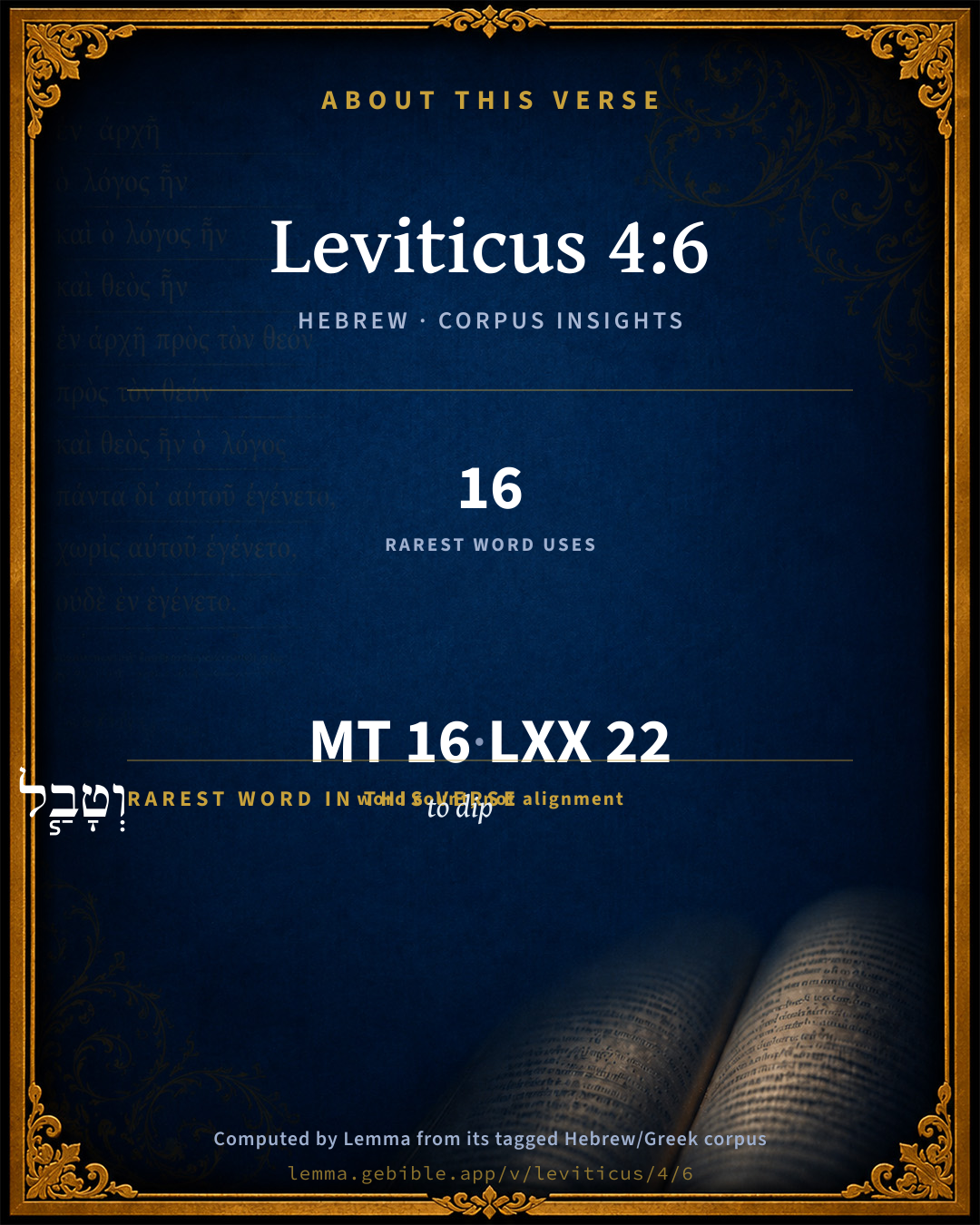
16
words
14
distinct lemmas
Pentateuch
section

Notable vocabulary

The rarest word here is וְטָבַ֧ל to dip H2881 — appearing just 16 times in the whole Hebrew Bible.

Shared distinctive vocabulary

וְטָבַ֧ל to dip H2881 occurs in 16 verses of the Hebrew Bible. Also found in:

Grammatical profile

  • 2 verbs
  • 10 nouns
  • 1 adjective
  • 2 prepositions
  • 1 particle

Verb forms

  • וְטָבַ֧ל Qal · Sequential Perfect
  • וְהִזָּ֨ה Hiphil · Sequential Perfect

Repetition

Words recur within this verse — often emphatic in Hebrew:

  • בַּדָּ֑ם blood H1818 ×2
  • לִפְנֵ֣י face H6440 ×2

Hebrew & Septuagint length

In English translation the verse runs 25 words from the Hebrew and 25 from the Septuagint (LXX English) — the same length.

A rough comparison of the two English renderings, which tokenize alike — not a word-level alignment.

Word counts can differ between the Hebrew and the Greek without any difference in meaning — e.g. the Hebrew direct-object marker אֵת has no separate Greek word, and Greek often adds the article ὁ.

In the original languages it is 16 Hebrew tokens and 22 Greek tokens — but the two are counted differently (Hebrew bundles its prefixes and suffixes into one token; the Greek is in lemma form), so that isn’t a like-for-like length.

Cross-references

18

Topical passages linked to Leviticus 4:6 in the Treasury of Scripture Knowledge — connected by theme and wording, ordered by reader-vote popularity; previews shown in the World English Bible.

  • Leviticus 14:18 The rest of the oil that is in the priest's hand he shall put on the head of him who is to be cleansed, and the priest shall make atonement for him before Yahweh.
  • Leviticus 16:14 He shall take some of the blood of the bull, and sprinkle it with his finger on the mercy seat on the east; and before the mercy seat he shall sprinkle some of the blood with his finger seven times.
  • Leviticus 16:19 He shall sprinkle some of the blood on it with his finger seven times, and cleanse it, and make it holy from the uncleanness of the children of Israel.
  • Leviticus 26:18 "'If you in spite of these things will not listen to me, then I will chastise you seven times more for your sins.
  • Leviticus 26:24 then I will also walk contrary to you; and I will strike you, even I, seven times for your sins.
  • Leviticus 26:28 then I will walk contrary to you in wrath; and I also will chastise you seven times for your sins.
  • Joshua 6:4 Seven priests shall bear seven trumpets of rams' horns before the ark: and the seventh day you shall compass the city seven times, and the priests shall blow the trumpets.
  • Joshua 6:8 It was so, that when Joshua had spoken to the people, the seven priests bearing the seven trumpets of rams' horns before Yahweh passed on, and blew the trumpets: and the ark of the covenant of Yahweh followed them.
  • Leviticus 4:17 and the priest shall dip his finger in the blood, and sprinkle it seven times before Yahweh, before the veil.
  • Leviticus 4:25 The priest shall take some of the blood of the sin offering with his finger, and put it on the horns of the altar of burnt offering. He shall pour out the rest of its blood at the base of the altar of burnt offering.
  • Leviticus 4:30 The priest shall take some of its blood with his finger, and put it on the horns of the altar of burnt offering; and the rest of its blood he shall pour out at the base of the altar.
  • Leviticus 4:34 The priest shall take some of the blood of the sin offering with his finger, and put it on the horns of the altar of burnt offering; and all the rest of its blood he shall pour out at the base of the altar.
  • Leviticus 8:15 He killed it; and Moses took the blood, and put it on the horns of the altar round about with his finger, and purified the altar, and poured out the blood at the base of the altar, and sanctified it, to make atonement for it.
  • Leviticus 9:9 The sons of Aaron presented the blood to him; and he dipped his finger in the blood, and put it on the horns of the altar, and poured out the blood at the base of the altar:
  • Leviticus 14:16 The priest shall dip his right finger in the oil that is in his left hand, and shall sprinkle some of the oil with his finger seven times before Yahweh.
  • Leviticus 14:27 and the priest shall sprinkle with his right finger some of the oil that is in his left hand seven times before Yahweh.
  • Leviticus 25:8 "'You shall count off seven Sabbaths of years, seven times seven years; and there shall be to you the days of seven Sabbaths of years, even forty-nine years.
  • Numbers 19:4 and Eleazar the priest shall take of her blood with his finger, and sprinkle her blood toward the front of the tent of meeting seven times.

Cross-references courtesy of OpenBible.info (CC BY 4.0).

Hebrew and Greek witnesses Masoretic Hebrew ↔ Greek Septuagint

The same verse in the two great witnesses to the Old Testament, shown verse-for-verse.

These are two independent witnesses, not word-aligned to each other, and the Septuagint is shown in lemma (dictionary) form.

Hebrew Leviticus 4:6 Masoretic · Westminster Leningrad Codex

וְטָבַ֧ל הַכֹּהֵ֛ן אֶת אֶצְבָּע֖וֹ בַּדָּ֑ם וְהִזָּ֨ה מִן הַדָּ֜ם שֶׁ֤בַע פְּעָמִים֙ לִפְנֵ֣י יְהוָ֔ה אֶת פְּנֵ֖י פָּרֹ֥כֶת הַקֹּֽדֶשׁ

The priest shall dip his finger in the blood, and sprinkle some of the blood seven times before Yahweh, before the veil of the sanctuary.

World English Bible · Public Domain

Greek LXX Leviticus 4:6 Septuagint · lemma form

καί βάπτω ὁ ἱερεύς ὁ δάκτυλος εἰς ὁ αἷμα καί προςῥαίνω ἀπό ὁ αἷμα ἑπτάκις ἔναντι κύριος κατά ὁ καταπέτασμα ὁ ἅγιος

And the priest shall dip his finger into the blood, and sprinkle of the blood seven times before the Lord, over against the holy veil.

LXX2012 (modern English Septuagint) · Public Domain

Hebrew: Westminster Leningrad Codex (CC BY 4.0). Greek: Septuagint (public domain); English from LXX2012 (modern English Septuagint) (Public Domain). How the Septuagint differs from the Hebrew →

Targum (Aramaic paraphrase)

2

The Targum is the ancient Jewish Aramaic paraphrase of the Hebrew Scriptures — an interpretive translation, not the Hebrew text itself. Onkelos (literal) and Pseudo-Jonathan (expansive) render the Torah, and Jonathan the Prophets. Coverage is partial: where no permissively-licensed English translation exists for a verse, only the Aramaic is shown. This is verse-level text, not a word-by-word alignment to the Hebrew.

  1. Targum Onkelos Torah (Genesis–Deuteronomy)
    וְיִטְבּוֹל כַּהֲנָא יָת אֶצְבְּעֵהּ בִּדְמָא וְיַדִי מִן דְמָא שְׁבַע זִמְנִין קֳדָם יְיָ קֳדָם פָּרוּכְתָּא דְקוּדְשָׁא

    (no public-domain English translation for this verse)

    Targum Onkelos — Aramaic: “Onkelos Genesis” (public domain); “Onkelos Exodus” (public domain); “Onkelos Leviticus” (public domain); “Onkelos Numbers” (public domain); “Onkelos Deuteronomy” (public domain). English: “Sefaria Community Translation” (CC0 1.0 (public-domain dedication)); “J.W. Etheridge. The Targums of Onkelos and Jonathan Ben Uzziel on the Pentateuch. London: Longmans, Green, 1862” (public domain). Text via Sefaria.

  2. Targum Pseudo-Jonathan Torah (Genesis–Deuteronomy)
    וִיטַמַשׁ כַּהֲנָא יַת אִצְבְּעֵיהּ בְּאַדְמָא וְיַדֵי מִן אַדְמָא שְׁבַע זִמְנִין קֳדָם יְיָ קְבֵיל פַּרְגוֹדָא דְקוּדְשָׁא

    and the priest shall dip his fingers in the blood, and sprinkle the blood seven times in the presence of the Lord before the veil of the sanctuary.

    Targum Pseudo-Jonathan — Aramaic: “Targum Jonathan on Genesis” (public domain); “Targum Jonathan on Exodus” (public domain); “Targum Jonathan on Leviticus” (public domain); “Targum Jonathan on Numbers” (public domain); “Targum Jonathan on Deuteronomy” (public domain). English: “The Targum of Jonathan ben Uzziel, trans. J. W. Etheridge, London, 1862” (public domain). Text via Sefaria.

Commentary

Notes on Leviticus 4:6 from classic Christian and Jewish commentators (each source and its license shown beneath its notes). The classic Christian expositions comment on the surrounding passage and are grouped to its opening verse, so a note may address several verses; the Jewish commentaries on the Tanakh (Rashi and others) are per-verse, so they appear only where the commentator wrote on this verse.

Lemma curates 59 commentaries, every one of them public domain or Creative Commons licensed, each selected and text-cleaned for this edition rather than reprinted as found. About our sources →

Adam Clarke's Commentary

Verse 6. Seven times] See Clarke on Ex 29:30. The blood of this sacrifice was applied in three different ways:

1. The priest put his finger in it, and sprinkled it seven times before the veil, Le 4:6.

2. He put some of it on the horns of the altar of incense.

3. He poured the remaining part at the bottom of the altar of burnt-offerings, Le 4:7.

Adam Clarke's Commentary on the Bible (1810–1826) — public domain. Text from a community e-Sword/MySword module.

Trapp's Complete Commentary

John Trapp

Lev 4:6 And the priest shall dip his finger in the blood, and sprinkle of the blood seven times before the LORD, before the vail of the sanctuary.

Ver. 6. Seven times before the Lord.] Because in this case there was need of much and great purgation.

John Trapp, A Commentary or Exposition upon All the Books of the Old and New Testament (1647–1656) — public domain. Text from a community e-Sword module.

The Biblical Illustrator

Joseph S. Exell

Lev_4:6-7

Sprinkle of the blood.

The sprinkling of the blood of the sacrifice

There is not that intensity of evil in a sin of ignorance which is to be seen in wilful transgression; but still there is sin in it: for no law can allow ignorance to be an excuse for trespass, since it is the duty of the subject to know the law. No amount of sincerity can turn injustice to righteousness, or transform falsehood into truth. If a man partakes of a deadly poison believing it to be a health-giving medicine, his sincerity will not hinder the natural course of nature: he will die in his error. It is precisely so in the moral and spiritual world. Sins committed in ignorance must be still sins in the sight of the Lord, or else no expiation would have been provided for them. I am greatly rejoiced to think there should be such a sacrifice provided, since it may yet turn out that the larger number of our sins are sins of which we have not been aware, because the hardness of our heart has prevented our discovering our error. Many good men have lived in an evil habit, and remained in it unto death, and yet have not known it to be evil. Now, if the precious blood of Jesus only put away the sin which we perceived in detail, its efficacy would be limited by the enlightenment of our conscience, and therefore some grievous sin might be overlooked and prove our ruin. Cleanse Thou me from secret faults is a prayer to which the expiation of Christ is a full answer. The atonement acts according to Gods sight of sin and not according to our sight of it, for we only see it in part, but God sees it all and blots it all out.

I. We begin with the sacrifice of Christ in its relation to the lord God of Israel.

1. In the type before us the prominent thing before God is the blood of atonement. It was Gods intent to awaken in man a great disgust of sin, by making him see that it could only be put away by suffering and death. In the Tabernacle in the wilderness almost everything was sanctified by blood. The purple drops fell even on the book, and all the people. The blood was to be seen everywhere.

2. The blood of the sacrifice was sprinkled before the veil seven times, signifying this: first, that the atonement made by the blood of Jesus is perfect in its reference to God. All through the Scriptures, as you well know, seven is the number of perfection, and in this place it is doubtless used with that intent. The seven times is the same as once for all: it conveys the same meaning as when we read, For Christ also hath once suffered for sins, and again, We are sanctified through the offering of the body of Jesus Christ once. It is a complete act. No man need bring anything more, or anything of his own, wherewith to turn away the anger of God; but he may come just as he is, guilty and defiled, and plead this precious blood which has made effectual atonement for him.

3. Note next, that not only is the atonement itself perfect, but that the presentation of that atonement is perfect, too. The sevenfold sprinkling was typical of Christ as a Priest presenting unto the Father Himself as a sacrifice for sin. This has been rally done. Jesus has in due order carried the propitiation into the sanctuary, and appeared in the presence of God on our behalf. We now pass on to a few thoughts about ourselves in relation to the type.

4. This sevenfold sprinkling of the blood upon the veil meant that the way of our access to God is only by virtue of the precious blood of Christ. Do you ever feel a veil hanging between you and God? In very truth, there is none; for Jesus has taken it away through His flesh.

5. I further think that the blood was sprinkled on the veil seven times to show that a deliberate contemplation of the death of Christ is greatly for our benefit. Whatever else you treat slightly, let the sacrifice of Calvary be seriously considered again and again.

6. Remember, too, that this sets out how great our guilt has been, since the blood must be sprinkled seven times ere the work of atonement is fully seen by you. Our guilt has a sevenfold blackness about it, and there must be a sevenfold cleansing. If you plead the blood of Jesus once and you do not obtain peace thereby, plead it again; and if still the burden lies upon your heart, still go on pleading with the Lord the one prevailing argument that Jesus bled. God, who bids us forgive unto seventy times seven, sets no bound to His own forgiveness.

7. Do reflect that if your case seems to yourself to be very difficult, it is provided for by this sevenfold sprinkling of the blood. The devils desire will be to keep you from thinking upon Christ; but do remember that thoughts about anything else will do you very little good. Your hope lies in thinking upon Jesus, not upon yourself He is able to save them to the uttermost that come unto God by Him. Mr. Moody Stuart somewhere tells us that he once talked with a woman who was in great trouble about her sins. She was a well-instructed person, and knew the Bible thoroughly, so that he was in a little difficulty what to say to her, as she was so accustomed to all-saving truth. At last he urged upon her very strongly that passage, This is a faithful saying, and worthy of all acceptation, that Jesus Christ came into the world to save sinners, and he noticed that she seemed to find a quiet relief in a gentle flow of tears. He prayed with her, and when she rose from her knees she seemed much comforted. Meeting her the next day, and seeing her smiling face, and finding her full of rest in the Lord, he asked? What was it wrought your deliverance? Oh, she said, it was that text, Jesus came to save sinners. Did you not know that before? said Mr. Stuart. Yes, she knew the words before, but she found that in her heart of hearts she had believed that Jesus came to save saints, and not sinners. Do not many awakened persons abide in the same error?

II. The blood in its influence upon prayer. The priest shall put some of the blood upon the horns of the altar of sweet incense before the Lord. Horns signify power, and the explanation of the symbol is that there is no power in intercessory prayer apart from the blood of expiation.

1. Remember, first, that the intercession of Christ Himself is based upon His atonement. He is daily pleading before the throne of God, and His great argument is that He offered Himself without spot unto God. It pleased the Father to bruise Him, and now it pleases the Father to hear Him. The bruised spices of His passion are an incense of sweet smell, and derive a double acceptance from the blood-smeared altar upon which they are presented. And now take the type to yourselves.

2. You and I are to offer incense upon this golden altar by our daily intercession for others, but our plea must always be the atoning blood of Jesus.

3. And, as this must be the plea of our intercession, so it must be our impulse in making intercession. When we pray we come, as it were, to this golden altar, and we look thereon: what is that we see? Stains of blood! We look again, and again see crimson spots, while all the four horns are red with blood. Did my Lord pour out His soul unto death for men, and shall not I pour out my soul in living earnest when I pray? Can you now bow your knee to plead with God and not feel your heart set upon the good of men, when you see that your Lord has laid down His life that they may be saved? Where He poured out His blood, will not you pour out your tears? He has given His bleeding heart for men, will not you give your pleading lips?

4. I think, too, I must say that this smearing of the horns of the altar with blood is meant to give us very great encouragement and assurance whenever we come to God in prayer. Never give anybody up, however bad he may be. Why, there is the blood of Christ. What sin is there which it cannot remove? When we pray, let us with vehement desire plead the blood of Jesus Christ. Perhaps fewer petitions, and more urging of the merit of Christ, would make better prayers.

III. The last point is, the blood in its influence upon all our service. You see we have been coming outwards from the veil to the golden altar, and now we pass outside the Holy Place into the outer court, and there in the open air stands the great brazen altar--the first object that the Israelite saw when he entered the sacred precincts.

1. That altar represents a great many things, and among the rest our Lord Jesus presenting Himself to God as an acceptable sacrifice. Whenever you think of our Lord as being an offering of a sweet smell unto God, never dissociate that fact in your mind from His being slain for sin, for all our Lords service is tinged by His atoning death.

2. Viewing the type in reference to ourselves, let us learn that whenever we come to offer any sacrifice unto the Lord we must take care that we present it by virtue of the precious blood of Christ. We must view the atonement as connected with every holy thing. I believe that our testimonies for God will be blessed of God in proportion as we keep the sacrifice of Christ to the forefront. Somebody asked our brother, Mr. Moody, how it was that he was so successful, and he is said to have replied, Well, if I must tell you, it is I believe because we come out fair anal square upon the doctrine of substitution. In that remark he hit the nail on the head. That is the saving doctrine; keep that before your own mind, keep it before the minds of those whom you would benefit.

3. And, beloved, do you not think that this pouring of the blood at the foot of this brazen altar indicates to us how much we ought to bring there? If Jesus has brought His life there, and laid Himself thereon, ought we not to bring all that we are and all that we have, and consecrate all to God?

4. Lastly, you notice the blood was poured out at the bottom of the altar. What could that mean but this--that the altar of thank-offering stood upon and grew out of a basis of blood. So all our deeds for God, our sacrifices for His cause, must spring out of the love which He has manifested in the death of His dear Son. We love Him because He first loved us. And how do we know that He loves us? Behold the death of Jesus as the surest proof. I long to put my whole being upon that altar, and I should feel as I did so that I was not giving my God anything, but only rendering to Him what His dear Son has bought a million times over by once shedding His life-blood. (C. H. Spurgeon.)

Burn all sin

The blood was put upon the horns of the altar of sweet incense to signify that no prayer can pierce up to God but in and by the blood of Christ. All the rest of the blood was poured at the foot of the altar of burnt-offering, to note still the true shedding of Christs blood for mankind, and because also it was holy, it might not be cast out as profane. The burning of the holy without the host plainly showed that Christ should not suffer in Jerusalem, but should be led out of the city to a place appointed, and there suffer; which you know was fulfilled accordingly (Heb_13:11-12). And the whole bullock was to be burned, being a sin-offering, to teach men to burn all their sins, and not to divide them, as we do, when we say, I will amend my drunkenness, but I cannot leave my swearing, or if I leave that also, yet my licentious life a little more must have a swing, &c. But burn all, thou wert best, and willingly keep none, burn them, I say, by true sorrow and detestation of them, even all, all, lest but one--being wilfully still delighted in--burn thee all, and wholly in hell for ever. When Moses, with the Israelites, was to depart out of Egypt, and Pharaoh would have had them leave their cattle behind them, saving what they intended to sacrifice, answer was made, they would not leave one hoof of a beast behind; and so deal you with your sins--leave not one hoof of sin behind. No one sin, no part of sin, that is, still I say, by wittingly, willingly, and boldly continuing in it and delighting in it. Otherwise, free from sin in this life we cannot be. But, through the grace of God, we may be free from presumptuous pleasure in sin, and sigh and groan no more, for that anyway we should offend so good a God, as we find infinite ways of Him that we do offend, desiring and longing to be free even from all sin. (Bp. Babington.)

Sprinkling the blood

Ewald thus explains the various ceremonies of sprinkling: It was in the sprinkling of the blood, the proper sacrament of sacrifice, that the distinction between the guilt-offering and the expiatory offering in the narrow sense came most clearly to the front: and it is easy to understand why it would reveal itself most plainly here. As it was right that the blood of an expiatory offering for public transgressions should be made far more conspicuous to eyes and sense, so it was sprinkled on an elevated place, or even on one which was extraordinarily sacred. The way, too, in which this was done was marked by three stages. If the atonement was made for an ordinary man or for a prince the priest sprinkled the blood against the high towering horns of the outer altar, and poured the remainder, as usual, out at its base; if it was made for the community or for the high priest, some of the blood was seven times sprinkled against the veil of the Holy of Holies, then some more against the horns of the inner altar, and only what was then left was poured out as usual at the base of the outer altar. The third and highest expiation was adopted on the yearly Day of Atonement. On the other hand, in the case of the guilt-offering no reason existed for adopting any unusual mode of sprinkling the blood. It was sprinkled, just as in other cases, round the sides and foot of the outer altar. As soon as this most sacred ceremony of the sprinkling was completed, then, according to the ancient belief, the impurity and guilt were already shaken off from the object to which they had clung.

Substitution satisfying the conscience

In Passion week as I was reading Bishop Wilson on the Lords Supper, I met with an expression to this effect, that--The Jews knew what they did when they transferred their sin to the head of their offering. The thought rushed into my mind, What I may I transfer all my guilt to another? Has God provided an offering for me that I may lay all my sins on His head? Then, God willing, I will not bear them on my own soul one moment longer. Accordingly I sought to lay my sins upon the sacred head of Jesus; and on the Wednesday began to have a hope of mercy; on the Thursday that hope increased, on the Friday and Saturday it became more strong, and on Easter Sunday I awoke early, with these words upon my heart and lips, Jesus Christ is risen to-day! Hallelujah! Hallelujah! From that hour peace flowed in rich abundance unto my soul. (C. Simeon.)

.

Repentance insufficient without atonement

1. Some tell us that repentance is sufficient without atonement. Contrition, say they, is all that God wants. Why insist on the need of sacrifice? Let a man mourn over his iniquities and he will be forgiven. This is a mode of speech not more unscriptural than unphilosophical. To maintain that repentance is sufficient without atonement is uncommonly like declaring that life is enough without bread or that heat is sufficient without the sun. The fact is, that as existence is sustained by food, and as warmth proceeds from the orb of day, so repentance is with most men the result of belief in redemption. John the Baptist was pre-eminently a preacher of repentance: we invariably associate the two. Repent ye, for the kingdom of heaven is at hand; such was the keynote of his teaching. He bids the Pharisees and Sadducees bring forth fruit meet for repentance. Yet he who thus spoke took care to cry, Behold the Lamb of God.

2. Repentance toward God, and faith toward our Lord Jesus Christ, stand in the relation of effect and cause. The executioner of Socrates, handing him the cup of hemlock, burst into tears, deeply grieved that he should, in any way, be an accessory to the death of one so illustrious. In like manner, when we hear a well-known voice exclaiming, If it be possible, let this cup pass from Me, we are conscious that our transgressions necessitated the fatal draught, and, feeling their enormity, we mourn over them. Some years ago patriotic regard for their country introduced the following fashion among Polish ladies. Each wore a small iron cross bearing upon it the name Warsaw. Thereby they were reminded of the wrong done to the nation which they loved so well, and thereby, also, they sought to stir up brothers, husbands, and sons to hatred of tyrannic Russia. Let us have the Cross near our hearts, for nothing will so effectually inflame animosity against sin. Aptly has it been remarked that contrition is the tear in the eye of faith. (T. R. Stevenson.)

The Biblical Illustrator, edited by Joseph S. Exell (c. 1880s–1900s) — public domain. Text from a community e-Sword module.

Joseph Benson's Commentary

Lev 4:6. Seven times — A number much used in Scripture, as a number of perfection; and here prescribed, either to show that his sins needed more than ordinary purgation, and more exercise of his faith and repentance, both which graces he was obliged to join with that ceremonial rite. Before the veil — The second veil, dividing between the holy place and the holy of holies, which is generally called the veil of the sanctuary.

Joseph Benson's Commentary on the Old and New Testaments (1811–1818) — public domain. Text from a community e-Sword module.

The Expositor's Bible

THE SPRINKLING OF THE BLOOD

Lev_4:6-7; Lev_4:16-18; Lev_4:25; Lev_4:30; Lev_5:9

"And the priest shall dip his finger in the blood, and sprinkle of the blood seven times before the Lord, before the veil of the sanctuary. And the priest shall put of the blood upon the horns of the altar of sweet incense before the Lord, which is in the tent of meeting; and all the blood of the bullock shall he pour out at the base of the altar of burnt offering, which is at the door of the tent of meeting And the anointed priest shall bring of the blood of the bullock to the tent of meeting, and the priest shall dip his finger in the blood, and sprinkle it seven times before the Lord, before the veil. And he shall put of the blood upon the horns of the altar which is before the Lord, that is in the tent of meeting, and all the blood shall he pour out at the base of the altar of burnt offering, which is at the door of the tent of meeting And the priest shall take of the blood of the sin offering with his finger, and put it upon the horns of the altar of burnt offering, and the blood thereof shall he pour out at the base of the altar of burnt offering And the priest shall take of the blood thereof with his finger, and put it upon the horns of the altar of burnt offering, and all the blood thereof shall he pour out at the base of the altar And he shall sprinkle of the blood of the sin offering upon the side of the altar; and the rest of the blood shall be drained out at the base of the altar; it is a sin offering."

In the case of the burnt offering and of the peace offering, in which the idea of expiation, although not absent, yet occupied a secondary place in their ethical intent, it sufficed that the blood of the victim, by whomsoever brought, be applied to the sides of the altar. But in the sin offering, the blood must not only be sprinkled on the sides of the altar of burnt offering, but, even in the case of the common people, be applied to the horns of the altar, its most conspicuous and, in a sense, most sacred part. In the case of a sin committed by the whole congregation, even this is not enough; the blood must be brought even into the Holy Place, be applied to the horns of the altar of incense, and be sprinkled seven times before the Lord before the veil which hung immediately before the mercy seat in the Holy of Holies, the place of the Shekinah glory. And in the great sin offering of the high priest once a year for the sins of all the people, yet more was required. The blood was to be taken even within the veil, and be sprinkled on the mercy seat itself over the tables of the broken law.

These several cases, according to the symbolism of these several parts of the tabernacle, differ in that atoning blood is brought ever more and more nearly into the immediate presence of God. The horns of the altar had a sacredness above the sides; the altar of the Holy Place before the veil, a sanctity beyond that of the altar in the outer court; while the Most Holy Place, where stood the ark, and the mercy seat, was the very place of the most immediate and visible manifestation of Jehovah, who is often described in Holy Scripture, with reference to the ark, the mercy seat, and the overhanging cherubim, as the God who "dwelleth between the cherubim."

From this we may easily understand the significance of the different prescriptions as to the blood in the case of different classes. A sin committed by any private individual or by a ruler, was that of one who had access only to the outer court, where stood the altar of burnt offering; for this reason, it is there that the blood must be exhibited, and that on the most sacred and conspicuous spot in that court, the horns of the altar where God meets with the people. But when it was the anointed priest that had sinned, the case was different. In that he had a peculiar position of nearer access to God than others, as appointed of God to minister before Him in the Holy Place, his sin is regarded as having defiled the Holy Place itself; and in that Holy Place must Jehovah therefore see atoning blood ere the priests position before God can be reestablished.

And the same principle required that also in the Holy Place must the blood be presented for the sin of the whole congregation. For Israel in its corporate unity was "a kingdom of priests," a priestly nation: and the priest in the Holy Place represented the nation in that capacity. Thus because of this priestly office of the nation, their collective sin was regarded as defiling the Holy Place in which, through their representatives, the priests, they ideally ministered. Hence, as the law for the priests, so is the law for the nation. For their corporate sin the blood must be applied, as in the case of the priest who represented them, to the horns of the altar in the Holy Place, whence ascended the smoke of the incense which visibly symbolised accepted priestly intercession, and, more than this, before the veil itself; in other words, as near to the very mercy seat itself as it was permitted to the priest to go; and it must be sprinkled there, not once, nor twice, but seven times, in token of the reestablishment, through the atoning blood, of Gods covenant of mercy, of which, throughout the Scripture, the number seven, the number of sabbatic rest and covenant fellowship with God, is the constant symbol.

And it is not far to seek for the spiritual thought which underlies this part of the ritual. For the tabernacle was represented as the earthly dwelling place, in a sense, of God; and just as the defiling of the house of my fellow man may be regarded as an insult to him who dwells in the house, so the sin of the priest and of the priestly people is regarded as, more than that of those outside of this relation, a special affront to the holy majesty of Jehovah, criminal just in proportion as the defilement approaches more nearly the innermost shrine of Jehovahs manifestation.

But though Israel is at present suspended from its priestly position and function among the nations of the earth, the Apostle Peter {1Pe_2:5} reminds us that the body of Christian believers now occupies Israels ancient place, being now on earth the "royal priesthood, the holy nation." Hence this ritual solemnly reminds us that the sin of a Christian is a far more evil thing than the sin of others; it is as the sin of the priest, and defiles the Holy Place, even though unwittingly committed; and thus, even more imperatively than other sin, demands the exhibition of the atoning blood of the Lamb of God, not now in the Holy Place, but more than that, in the true Holiest of all, where our High Priest is now entered. And thus, in every possible way, with this elaborate ceremonial of sprinkling of blood does the sin offering emphasise to our own consciences, no less than for ancient Israel, the solemn fact affirmed in the Epistle to the Hebrews, {Heb_9:22} "Without shedding of blood there is no remission of sin."

Because of this, we do well to meditate much and deeply on this symbolism of the sin offering, which, more than any other in the law, has to do with the propitiation of our Lord for sin. Especially does this use of the blood, in which the significance of the sin offering reached its supreme expression, claim our most reverent attention. For the thought is inseparable from the ritual, that blood of the slain victim must be presented, not before the priest, or before the offerer, but before Jehovah. Can anyone mistake the evident significance of this? Does it not luminously hold forth the thought that atonement by sacrifice has to do, not only with man, but with God?

There is cause enough in our day for insisting on this. Many are teaching that the need for the shedding of blood for the remission of sin, lies only in the nature of man; that, so far as concerns God, sin might as well have been pardoned without it; that it is only because man is so hard and rebellious, so stubbornly distrusts the Divine love, that the death of the Holy Victim of Calvary became a necessity. Nothing less than such a stupendous exhibition of the love of God could suffice to disarm his enmity to God and win him back to loving trust. Hence the need of the atonement. That all this is true, no one will deny; but it is only half the truth, and the less momentous half, -which indeed is hinted in no offering, and in the sin offering least of all. Such a conception of the matter as completely fails to account for this part of the symbolic ritual of the bloody sacrifices, as it fails to agree with other teachings of the Scriptures. If the only need for atonement in order to pardon is in the nature of the sinner, then why this constant insistence that the blood of the sacrifice should always be solemnly presented, not before the sinner, but before Jehovah? We see in this fact most unmistakably set forth, the very solemn truth that expiation by blood as a condition of forgiveness of sin is necessary, not merely because man is what he is, but most of all because God is what He is. Let us then not forget that the presentation unto God of an expiation for sin, accomplished by the death of an appointed substitutionary victim, was in Israel made an indispensable condition of the pardon of sin. Is this, as many urge, against the love of God? By no means! Least of all will it so appear, when we remember who appointed the great Sacrifice, and, above all, who came to fulfil this type. Goal does not love us because atonement has been made, but atonement has been made because the Father loved us, and sent His Son to be the propitiation for our sins.

God is none the less just, that He is love; and none the less holy, that He is merciful: and in His nature, as the Most Just and Holy One, lies this necessity of the shedding of blood in order to the forgiveness of sin, which is impressively symbolised in the unvarying ordinance of the Levitical law, that as a condition of the remission of sin, the blood of the sacrifice must be presented, not before the sinner, but before Jehovah. To this generation of ours, with its so exalted notions of the greatness and dignity of man, and its correspondingly low conceptions of the ineffable greatness and majesty of the Most Holy God, this altar truth may be most distasteful, so greatly does it magnify the evil of sin; but just in that degree is it necessary to the humiliation of mans proud self-complacency, that, whether pleasing or not, this truth be faithfully held forth.

Very instructive and helpful to our faith are the allusions to this sprinkling of Blood in the New Testament. Thus, in the Epistle to the Hebrews, {Heb_12:24} believers are reminded that they are come "unto the blood of sprinkling, that speaketh better than that of Abel." The meaning is plain. For we are told, {Gen_4:10} that the blood of Abel cried out against Cain from the ground; and that its cry for vengeance was prevailing; for God came down, arraigned the murderer, and visited him with instant judgment. But in these words we are told that the sprinkled blood of the holy Victim of Calvary, sprinkled on the heavenly altar, also has a voice, and a voice which "speaketh better than that of Abel"; better, in that it speaks, not for vengeance, but for pardoning mercy; better, in that it procures the remission even of a penitent murderers guilt; so that, "being now justified through His blood" we may all be saved from wrath through. {Rom_5:9} And, if we are truly Christs, it is our blessed comfort to remember also that we are said {1Pe_1:2} to have been chosen of God unto the sprinkling of this precious blood of Jesus Christ; words which remind us, not only that the blood of a Lamb "without blemish and without spot" has been presented unto God for us, but also that the reason for this distinguishing mercy is found, not in us, but in the free love of God, who chose us in Christ Jesus to this grace.

And as in the burnt offering, so in the sin offering, the blood was to be sprinkled by the priest. The teaching is the same in both cases. To present Christ before God, laying the hand of faith upon His head as our sin offering, this is all we can do or are required to do. With the sprinkling of the blood we have nothing to do. In other words, the effective presentation of the blood before God is not to be secured by some act of our own; it is not something, to be procured through some subjective experience, other or in addition to the faith which brings the Victim. As in the type, so in the Antitype, the sprinkling of the atoning blood-that is, its application God-ward as a propitiation-is the work of our heavenly Priest. And our part in regard to it is simply and only this, that we entrust this work to Him. He will not disappoint us; He is appointed of God to this end, and He will see that it is done.

In a sacrifice in which the sprinkling of the blood occupies such a central and essential place in the symbolism, one would anticipate that this ceremony would never be dispensed with. Very strange it thus appears, at first sight, to find that to this law an exception was made. For it was ordained (ver. 11) that a man so poor that "his means suffice not" to bring even two doves or young pigeons, might bring, as a substitute, an offering of fine flour. From this, some have hastened to infer that the shedding of the blood, and therewith the idea of substituted life, was not essential to the idea of reconciliation with God; but with little reason. Most illogical and unreasonable it is to determine a principle, not from the general rule, but from an exception; especially when, as in this case, for the exception a reason can be shown, which is not inconsistent with the rule. For had no such exceptional offering been permitted in the case of the extremely poor man, it would have followed that there would have remained a class of persons in Israel whom God had excluded from the provision of the sin offering, which He had made the inseparable condition of forgiveness. But two truths were to be set forth in the ritual; the one, atonement by means of a life surrendered in expiation of guilt; the other, -as in a similar way in the burnt offering, -the sufficiency of Gods gracious provision for even the neediest of sinners. Evidently, here was a case in which something must be sacrificed in the symbolism. One of these truths may be perfectly set forth; both cannot be, with equal perfectness; a choice must therefore be made, and is made in this exceptional regulation, so as to hold up clearly, even though at the expense of some distinctness in the other thought of expiation, the unlimited sufficiency of Gods provision of forgiving grace.

And yet the prescriptions in this form of the offering were such as to prevent anyone from confounding it with the meal offering, which typified consecrated and accepted service. The oil and the frankincense which belonged to the latter are to be left out (Lev_5:11); incense, which typifies accepted prayer, -thus reminding us of the unanswered prayer of the Holy Victim when He cried upon the cross, "My God! My God! why hast Thou forsaken Me?" and oil, which typifies the Holy Ghost, -reminding us, again, how from the soul of the Son of God was mysteriously withdrawn in that same hour all the conscious presence and comfort of the Holy Spirit, which withdrawment alone could have wrung from His lips that unanswered prayer. And, again, whereas the meal for the meal offering had no limit fixed as to quantity, in this case the amount is prescribed-"the tenth part of an ephah" (Lev_5:11); an amount which, from the story of the manna, appears to have represented the sustenance of one full day. Thus it was ordained that if, in the nature of the case, this sin offering could not set forth the sacrifice of life by means of the shedding of blood, it should at least point in the same direction, by requiring that, so to speak, the support of life for one day shall be given up, as forfeited by sin.

All the other parts of the ceremonial are in this ordinance made to take a secondary place, or are omitted altogether. Not all of the offering is burnt upon the altar, but only a part; that part, however, the fat, the choicest; for the same reason as in the peace offering. There is, indeed, a peculiar variation in the case of the offering of the two young pigeons, in that, of the one, the blood only was used in the sacrifice, while the other was wholly burnt like a burnt offering. But for this variation the reason is evident enough in the nature of the victims. For in the case of a small creature like a bird, the fat would be so insignificant in quantity, and so difficult to separate with thoroughness from the flesh, that the ordinance must needs be varied, and a second bird be taken for the burning, as a substitute for the separated fat of larger animals. The symbolism is not essentially affected by the variation. What the burning of the fat means in other offerings, that also means the burning of the second bird in this case.

William Robertson Nicoll, ed., The Expositor's Bible (London: Hodder & Stoughton, 1887–1910) — public domain. 65 of 66 books (1 Corinthians is not separately keyed, as that volume carries no machine-parseable verse references); section-level commentary keyed to the opening verse. Introductory and overview sections not keyed to a specific passage are excluded.

Geneva Bible (1599)

Geneva Bible translators

Which was between the Holiest of all, and the Sanctuary.

Geneva Bible (1599) marginal notes — public domain. Text via Bolls.life.

Ellicott's Commentary for English Readers

(6) And the priest shall dip his finger.—The different treatment of the blood is here to be noticed. Whilst in the case of the other sacrifices the priest threw the blood upon the walls of the altar of burnt offering (see Lev_1:5), in the sin offering before us the high priest is first of all to dip his finger seven times in the blood, and sprinkle it before the Lord. The finger, according to the rules which obtained during the second Temple, was that of the right hand, as the blood was always taken and sprinkled with the right hand. Seven, being a complete number, is used for the perfect finishing of a work. Hence the seven days of creation (Gen_2:2-3); seven branches were in the golden candlestick (Exo_25:37; Exo_37:23); seven times the blood was sprinkled on the day of atonement (Lev_16:14); seven times was the oil sprinkled upon the altar when it was consecrated (Lev_8:11); seven days were required for consecrating the priests (Lev_8:35); seven days were necessary for purifying the defiled (Lev_12:2; Num_19:19); seven times Naaman washed in the Jordan (2Ki_5:10; 2Ki_5:14); seven days Jericho was besieged, and seven priests with seven trumpets blew when the walls fell down (Joshua 6); the lamb had seven horns and seven eyes, which are the seven spirits of God (Rev_5:6); seven seals are on God’s book (Rev_1:5), &c.

Before the Lord.—As the Lord was enthroned on the mercy-seat between the cherubim (Exo_25:22) in the holy of holies, the phrase “before the Lord” is. used for the place in front of the holy of holies, where the altar of incense, the shewbread, and the golden candlestick stood (Exo_27:21; Exo_28:35; Exo_30:8; Exo_34:34, &c.), and towards which the blood was sprinkled.

Before the vail of the sanctuary.—This phrase is simply explanatory of the former phrase. As the vail separated the holy of holies, where the shechinah dwelt, from the holy place, the words are simply used as another expression for “before the Lord.” This clause has, however, been variously interpreted from time immemorial. As before is not in the original. but is supplied in the translation, some have maintained that the vail itself was sprinkled; whilst others, who, with the Authorised Version, regard the whole phrase to mean “before the vail,” declare that the blood was sprinkled on the floor of the sanctuary in front of the vail.

A Bible Commentary for English Readers, edited by Charles John Ellicott (1878–1897) — public domain. Text from a community e-Sword module.

John Gill's Exposition

And the priest shall put some of the blood,.... With his finger, which he dipped into it:

upon the horns of the altar of sweet incense before the Lord, which is in the tabernacle of the congregation; this was the golden altar on which incense was offered: it was placed before the vail, on the outside of it, in the holy place, see Exo 30:1 and the priest, when he put the blood on the horns of it, began at the northeast horn, so to the northwest, then to the southwest, and last to the southeast (w); and the priest dipped his finger at every horn, and when he had finished at one horn, he wiped his finger at the edge of the basin, and after that dipped a second time; for what remained of the blood on his finger was not fit to put upon another horn (x). This rite shows, that the intercession of Christ, signified by the altar of sweet incense, proceeds upon the foot of his blood and sacrifice, Rev 8:3 Jo1 2:1,

and shall pour all the blood of the bullock at the bottom of the altar of burnt offering, which is at the door of the tabernacle of the congregation; this altar stood without the holy place, and the altar of incense within; and after the priest had sprinkled of the blood of the bullock, upon the horns of the altar of incense, what remained he poured at the bottom of the altar of burnt offering; for though it is said "all" the blood, it can mean no more than what was left; wherefore the Vulgate Latin version renders it, "all the remaining blood": and Jarchi's explanatory note is, the rest of the blood. The place where this was poured, according to Maimonides (y), was the west bottom of the altar; and Gersom on the place observes the same. This denotes the efficacy of Christ's blood to make atonement for sin, and the reverent esteem it ought to be had in, being precious blood.

(w) Misn. Yoma, c. 5. sect. 5. Maimon. ib. (Maasch Hakorbanot c. 5.) sect. 10. 14. (x) Maimon. ib. sect. 8. (y) Ib. sect. 11.

John Gill's Exposition of the Whole Bible (1746–1763) — public domain (CC PDM 1.0). Text via the HelloAO Bible API.

Albert Barnes' Notes on the Bible

Before the vail of the sanctuary - This is generally understood to mean the floor of the holy place in front of the veil.

Albert Barnes' Notes on the Bible (1834–1885) — public domain. Text from a community e-Sword/MySword module.

Haydock's Catholic Bible Commentary

Seven. A number consecrated in Scripture, (Calmet) and not superstitious. (Worthington) --- Apuleius (Met. xi.) mentions it. Septies submerso fluctibus capite. (Calmet) --- Sanctuary, or most holy place. (Menochius)

George Leo Haydock (1774–1849), Haydock's Catholic Family Bible and Commentary, 1859 edition — public domain. Excludes Psalms (Douay-Rheims chapter numbering differs from Protestant) and Deuterocanonical books (Catholic canon only).

Matthew Poole's English Annotations

Seven times; a number much used in Scripture, as a number of perfection; and here prescribed, either to show that his sins needed more than ordinary purgation, and more frequent and manifest exercises of his faith and repentance, both which graces he was obliged to join with that ceremonial rite.

Before the veil, to wit, the second veil dividing between the holy of holies, which is generally called by the name here used, as Exo 26:31; 35:12; 40:3,21; Num 4:5.

Matthew Poole's English Annotations on the Holy Bible (1683–1685) — public domain. Text from a community e-Sword/MySword module.

Whedon's Commentary on the Bible

Daniel D. Whedon

6. Dip his finger in the blood — Some explain the shedding of blood in sacrifice by the theory that evil rests in that which is material, and that blood is the representation of that evil principle in matter. Hence these modern Gnostics see in the shedding of blood the putting away of moral evil. In addition to other objections to this view, is the command to the priest to come into immediate contact with the blood which would have ceremonially defiled him, if it was the representation of all impurity.

Sprinkle… seven times — This number represented perfection. The origin of the symbolism of seven has been much discussed. It is reasonable to suppose that the first idea associated with seven would be that of religious periodicity arising from the sabbath, and that the notion of the completeness of a religious act arose from this. We certainly cannot agree with Bahr’s fanciful division of seven into its component elements, three and four, the first of which=Divinity, and the second=Humanity, whence Seven =Divinity+Humanity=the God-man. The more we have of such exegesis of the Holy Scriptures, the more will sceptics be confirmed in unbelief, and thoughtful believers be perplexed.

The sanctuary — The most holy place or the holy of holies. Behind the vail the visible presence of Jehovah was enthroned above the ark of the covenant and between the outspread wings of the cherubim. The nearest that the ordinary priest could come to this throne of Jehovah was to the vail. There he might sprinkle the blood to make propitiation for sin. Within the vail only the high priest could go, one day in the year, to sprinkle the mercyseat. Lev_16:14.

Daniel D. Whedon (gen. ed.), Commentary on the Old and New Testaments (1874–1909) — public domain. Text from a community e-Sword module.

John Wesley's Explanatory Notes

Seven times - A number much used in scripture, as a number of perfection; and here prescribed, either to shew that his sins needed more then ordinary purgation, and more exercise of his faith and repentance, both which graces he was obliged to join with that ceremonial rite. Before the veil - The second veil dividing between the holy of holies, which is generally called the veil of the sanctuary.

John Wesley, Explanatory Notes Upon the Whole Bible (1754–1765) — public domain. Text via the GEBible commentary corpus.

unfoldingWord translationNotes

Door43 World Missions Community

sprinkle some of it

"drip some of it" or "splatter some of it"

horns of the altar

This refers to the corners of the altar. They are shaped like the horns of an ox. AT: "the projections at the corners of the altar"

pour out

"empty out the rest of the blood"

at the base of the altar

"at the bottom of the altar"

translationWords

priest

Yahweh

curtain

holy place

altar of incense

tent of meeting

cow

burnt offering

unfoldingWord translationNotes — © Distant Shores Media and the Door43 World Missions Community, licensed CC BY-SA 4.0. Source: git.door43.org/Door43/en_tn.

Rashi

Rabbi Shlomo Yitzchaki (Rashi)

את פני פרכת הקדש [AND THE PRIEST SHALL … SPRINKLE OF THE BLOOD …] BEFORE THE PARTITION VAIL OF THE קדש — i.e. before that spot where it is exceedingly holy — exactly in front of the space between the staves of the Ark (Sifra, Vayikra Dibbura d'Chovah, Section 3 10). The blood did not touch the Partition Vail (since he was standing some distance off), but if it happened to touch it, then it touched it, (and it did not invalidate the ceremony) (Yoma 57a).

Rashi on the Tanakh — English translations: “The Judaica Press complete Tanach with Rashi, translated by A. J. Rosenberg” (CC BY 4.0); “Pentateuch with Rashi's commentary by M. Rosenbaum and A.M. Silbermann, 1929-1934” (public domain); “The Metsudah Tanach series, Lakewood, N.J” (CC BY 4.0); and “The Book of Joshua, Metsudah Publications, 1997” (CC BY 4.0). Text via Sefaria.

Lesson kit

Teaching starters — assembled from the data on this page, not authored interpretation. Every prompt links to the verse data it draws on. Edit before teaching.

Leviticus, in the Pentateuch, opens this verse with 16 words (14 distinct Hebrew lemmas). Its most distinctive word is ṭâbal (“to dip”). A historical commentator’s framing appears above. Read the whole chapter for the surrounding context.

Discussion questions

  1. The word ṭâbal carries the sense “to dip.” How does it shape the verse?
  2. Genesis 37:31 shares the word «to dip» with this verse. How do the two illuminate each other?
  3. “blood” occurs 2× in this one verse. What is the effect of the repetition?
  4. The translations on this page render this verse differently — a whole-verse word diff, not a word-by-word alignment. What might account for the different wordings?
  5. The verb «וְטָבַ֧ל» is Qal Sequential Perfect. How does its form color the action?
  6. Reading how Adam Clarke's Commentary and Trapp's Complete Commentary read this verse, where do the two commentators agree and where do they part?

Things to notice

Reading settings

Reading text

Shown beneath each verse's original-language words.

Old Testament
Old Testament edition

Read the OT as the Masoretic Hebrew (MT) or the Greek Septuagint (LXX).

English shown for the Greek Septuagint (in the Hebrew ↔ Greek comparison).

Comparing translations? Open the Compare panel on any verse page to stack up to four side by side.