
Exodus 28:8

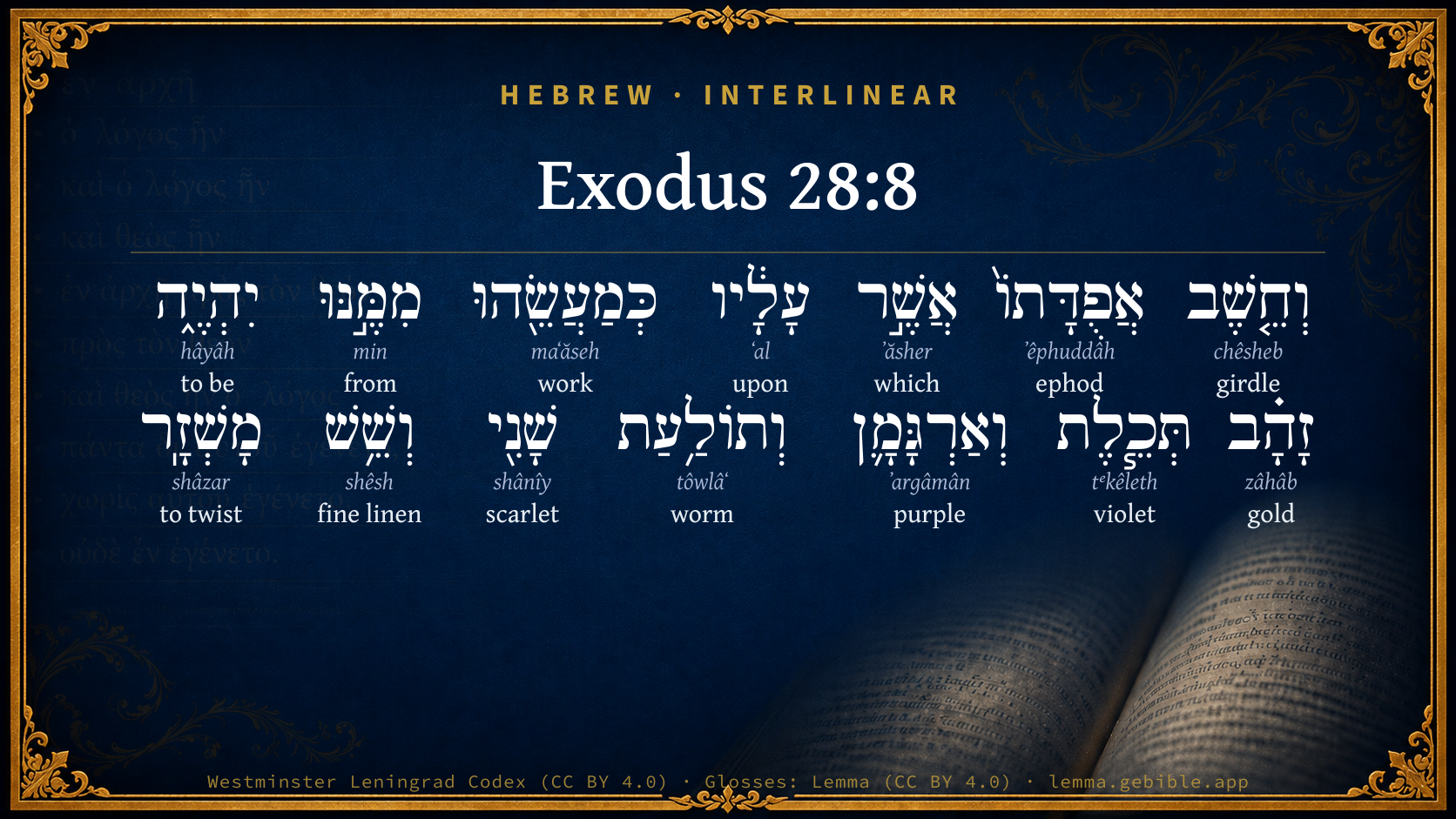
Hebrew (Westminster Leningrad Codex) Exodus 28:8 appears in the Hebrew Old Testament. The text above is from the Westminster Leningrad Codex. Each word links to its Strong’s number, a concise gloss, and parsing drawn from the Open Scriptures Hebrew Bible morphology. Click any word for its full Brown-Driver-Briggs (BDB) entry.
Download image
Cite this verse

Exodus 28:8 (World English Bible). Public Domain. Lemma interlinear Bible study tool, https://lemma.gebible.app/v/exodus/28/8.

Show BibTeX & RIS
BibTeX
RIS
English Translation
The skillfully woven band, which is on it, that is on him, shall be like its work and of the same piece; of gold, of blue, and purple, and scarlet, and fine twined linen.
World English Bible · Public Domain
Highlights
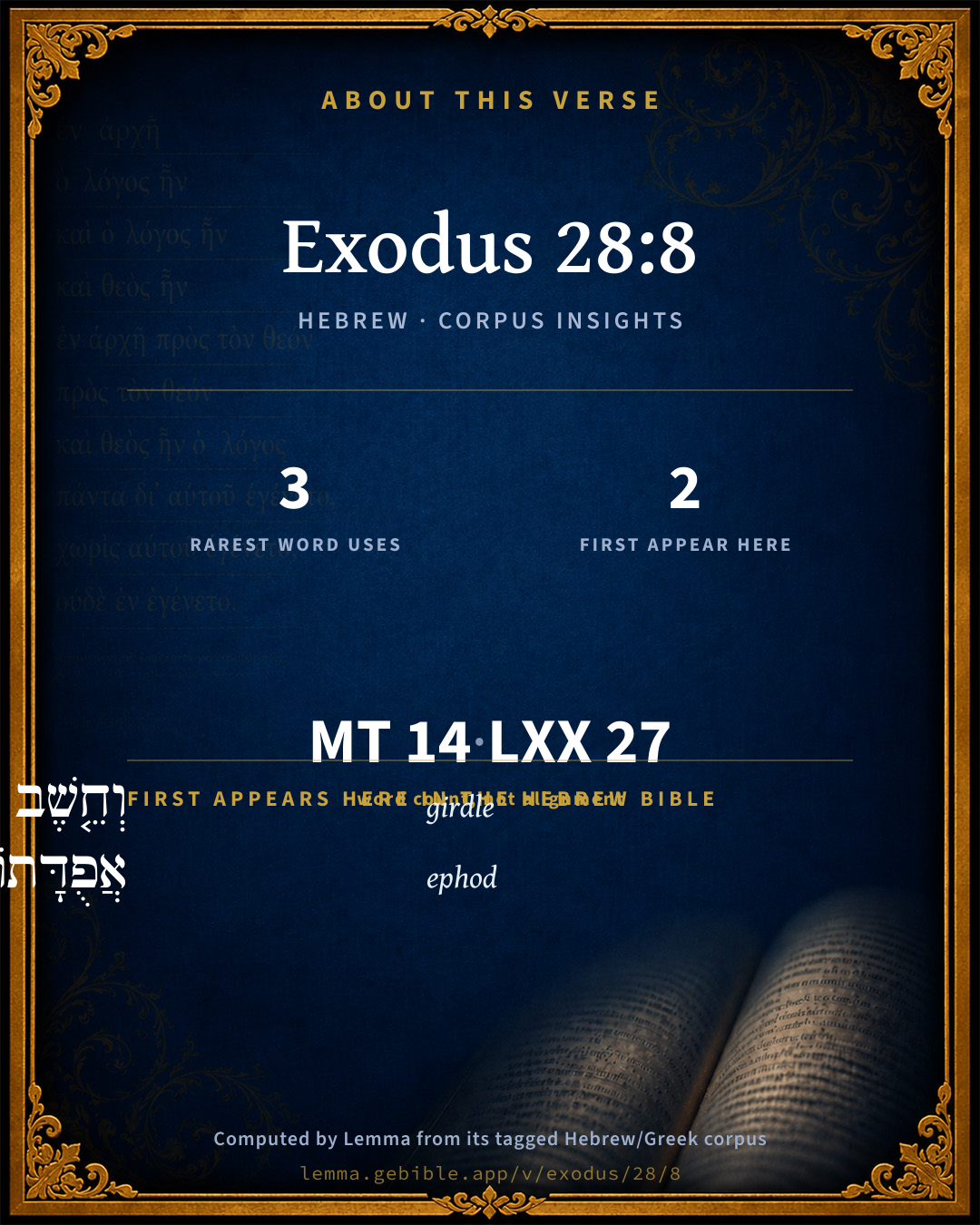
  • 2 first appearances in the Hebrew Bible
Full analysis ↓
Download a study sheet

One document with this verse’s original text, its word-by-word gloss line, the meaning frame, cross-references with their text, attributed commentary, and full source and license credits — printable, and it pastes into notes with its structure intact.

This verse Autodidact and up

Study sheet (.html) Plain text (.txt)

A passage Seminary Student

Up to 50 verses in one chapter. A passage sheet keeps up to 6 commentary sources and 12 cross-references per verse, in the order this page ranks them, and says so on the sheet whenever that leaves anything out. Ask for a single verse and you get the Autodidact verse sheet above.

Everything on this page stays free to read, with no account — the sheet is a download of what is already on screen, not access to it.

Want to remove ads? Support Godless Engineer
Compare translations 3

The same verse in 3 English versions, stacked beneath the original-language interlinear above. Click any original word for its lexicon entry.

Each is an independent rendering of the whole verse — the interlinear is not word-aligned to these translations.

Highlighted words mark where these versions differ — a whole-verse word diff, not a word-by-word alignment.

  • World English Bible Public Domain
    The skillfully woven band, which is on it, that is on him, shall be like its work and of the same piece; of gold, of blue, and purple, and scarlet, and fine twined linen.
  • King James Version Public Domain
    And the curious girdle of the ephod, which is upon it, shall be of the same, according to the work thereof; even of gold, of blue, and purple, and scarlet, and fine twined linen.
  • unfoldingWord Literal Text CC BY-SA 4.0
    And the skillfully-crafted sash of the ephod which is on it shall be of like workmanship, from it: of gold, blue and purple and worm of scarlet and fine twined linen.

unfoldingWord Literal Text — © unfoldingWord, licensed CC BY-SA 4.0. Word-aligned USFM3 via Door43 (git.door43.org/unfoldingWord/en_ult).

Versions to compare (up to 4)

3 of 4 selected

Show all 18 translations

Every available English version of this verse, each an independent rendering of the whole verse.

  • World English Bible Public Domain
    The skillfully woven band, which is on it, that is on him, shall be like its work and of the same piece; of gold, of blue, and purple, and scarlet, and fine twined linen.
  • Berean Standard Bible Public Domain
    And the skillfully woven waistband of the ephod must be of one piece, of the same workmanship—with gold, with blue, purple, and scarlet yarn, and with finely spun linen.
  • Majority Standard Bible Public Domain
    And the skillfully woven waistband of the ephod must be of one piece, of the same workmanship—with gold, with blue, purple, and scarlet yarn, and with finely spun linen.
  • King James Version Public Domain
    And the curious girdle of the ephod, which is upon it, shall be of the same, according to the work thereof; even of gold, of blue, and purple, and scarlet, and fine twined linen.
  • American Standard Version (1901) Public Domain
    And the skilfully woven band, which is upon it, wherewith to gird it on, shall be like the work thereof `and' of the same piece; of gold, of blue, and purple, and scarlet, and fine twined linen.
  • Revised Version (1885) Public Domain
    And the cunningly woven band, which is upon it, to gird it on withal, shall be like the work thereof and of the same piece; of gold, of blue, and purple, and scarlet, and fine twined linen.
  • Geneva Bible (1599) Public Domain
    And the embroydred garde of the same Ephod, which shalbe vpon him, shall be of the selfe same worke and stuffe, euen of golde, blewe silke, and purple, and skarlet, and fine twined linen.
  • Douay-Rheims (1899) Public Domain
    The very workmanship also and all the variety of the work shall be of gold, and violet, and purple, and scarlet twice dyed, and fine twisted linen.
  • Young's Literal Translation Public Domain
    `And the girdle of his ephod which `is' on him, according to its work, is of the same, of gold, blue, and purple, and scarlet, and twined linen.
  • Literal Standard Version CC BY-SA 4.0
    And the girdle of his ephod which [is] on him, according to its work, is of the same, of gold, blue, and purple, and scarlet, and twined linen.
  • Unlocked Literal Bible CC BY-SA 4.0
    Its finely-woven waistband must be like the ephod; it must be made of one piece with the ephod, made of fine twined linen that is gold, blue, purple, and scarlet.
  • unfoldingWord Literal Text CC BY-SA 4.0
    And the skillfully-crafted sash of the ephod which is on it shall be of like workmanship, from it: of gold, blue and purple and worm of scarlet and fine twined linen.
  • Darby Bible Public Domain
    And the girdle of the ephod, which is upon it, shall be of the same, according to its work of gold, blue, and purple, and scarlet and twined byssus.
  • World Messianic Bible Public Domain
    The skillfully woven band, which is on it, shall be like its work and of the same piece; of gold, blue, purple, scarlet, and fine twined linen.
  • Webster's Bible Public Domain
    And the curious girdle of the ephod, which is upon it, shall be of the same, according to its work; even of gold, of blue, and purple, and scarlet, and fine twined linen.
  • Free Bible Version CC BY-SA 4.0
    The waistband of the ephod is to be one piece made in the same way, using gold thread, with blue, purple, and crimson thread, and with finely-woven linen.
  • Bible in Basic English Public Domain
    And the beautifully worked band, which goes on it, is to be of the same work and the same material, of gold and blue and purple and red and twisted linen-work.
  • JPS Tanakh (1917) Public Domain
    And the skilfully woven band, which is upon it, wherewith to gird it on, shall be like the work thereof and of the same piece: of gold, of blue, and purple, and scarlet, and fine twined linen.

Literal Standard Version (2020), Covenant Press — licensed CC BY-SA 4.0. Text via the HelloAO Bible API (eBible.org). Unlocked Literal Bible (unfoldingWord) — licensed CC BY-SA 4.0. Text via the HelloAO Bible API (eBible.org). unfoldingWord Literal Text — © unfoldingWord, licensed CC BY-SA 4.0. Word-aligned USFM3 via Door43 (git.door43.org/unfoldingWord/en_ult). Free Bible Version, Dr. Jonathan Gallagher — licensed CC BY-SA 4.0. Text via the HelloAO Bible API (eBible.org).

Word by word

More ways to search: Search by grammar → Find every occurrence → Compare this word →

Practice this passage: Drill this verse → Learn its vocabulary →

אֲפֻדָּתוֹ֙
ʼêphuddâh
H642
“ephod · his”
Noun, Common, Feminine, Singular, Construct + Suffix, Personal, 3rd Person, Masculine, Singular
Part of Speech
Noun
Type
Common
Gender
Feminine
Number
Singular
State
Construct
Full BDB Definition

Origin: from H646

TWOT: 142 . 1b ?

ephod - priestly garment, shoulder-cape or mantle, outer garment - worn by an ordinary priest and made of white stuff - worn by the high priest - more costly, woven of gold, blue, purple, scarlet, and linen threads provided with shoulder-pieces and a breast piece of like material, ornamented with gems and gold - a metallic covering for idols, a plating over
  1. וְחֵ֤שֶׁב chêsheb H2805 “and · girdle of” Conjunction + Noun, Common, Masculine, Singular, Construct
  2. אֲשֶׁ֣ר ʼăsher H834 “which” Particle, Relative
  3. עָלָ֔יו ʻal H5921 “upon · him” Preposition + Suffix, Personal, 3rd Person, Masculine, Singular
  4. כְּמַעֲשֵׂ֖הוּ maʻăseh H4639 “like/as · work · his” Preposition + Noun, Common, Masculine, Singular, Construct + Suffix, Personal, 3rd Person, Masculine, Singular
  5. מִמֶּ֣נּוּ min H4480 “from · us” Preposition + Suffix, Personal, 1st Person, Common, Plural
  6. יִהְיֶ֑ה hâyâh H1961 “to be” Verb, Qal, Imperfect, 3rd Person, Masculine, Singular
  7. זָהָ֗ב zâhâb H2091 “gold” Noun, Common, Masculine, Singular, Absolute
  8. תְּכֵ֧לֶת tᵉkêleth H8504 “violet” Noun, Common, Feminine, Singular, Absolute
  9. וְאַרְגָּמָ֛ן ʼargâmân H713 “and · purple” Conjunction + Noun, Common, Masculine, Singular, Absolute
  10. וְתוֹלַ֥עַת tôwlâʻ H8438 “and · worm of” Conjunction + Noun, Common, Feminine, Singular, Construct
  11. שָׁנִ֖י shânîy H8144 “scarlet” Noun, Common, Masculine, Singular, Absolute
  12. וְשֵׁ֥שׁ shêsh H8336 “and · fine linen” Conjunction + Adjective, Cardinal number, Feminine, Singular, Absolute
  13. מָשְׁזָֽר shâzar H7806 “twisted” Verb, Hophal, Participle Passive, Masculine, Singular, Absolute

About this verse

These counts appear in no published source. They are computed here, from the morphology-tagged text and Lemma’s own curated glosses. What Lemma adds →

14
words
14
distinct lemmas
Pentateuch
section

Notable vocabulary

The rarest word here is אֲפֻדָּתוֹ֙ ephod H642 — appearing just 3 times in the whole Hebrew Bible.

First appearance in Scripture

These words make their first canonical appearance in the Hebrew Bible here:

  • וְחֵ֤שֶׁב girdle H2805
  • אֲפֻדָּתוֹ֙ ephod H642

Shared distinctive vocabulary

אֲפֻדָּתוֹ֙ ephod H642 occurs in 3 verses of the Hebrew Bible. Also found in:

Grammatical profile

  • 2 verbs
  • 8 nouns
  • 1 adjective
  • 2 prepositions
  • 1 particle

Verb forms

  • יִהְיֶ֑ה Qal · Imperfect
  • מָשְׁזָֽר Hophal · Participle Passive

Hebrew & Septuagint length

In English translation the verse runs 34 words from the Hebrew and 34 from the Septuagint (LXX English) — the same length.

A rough comparison of the two English renderings, which tokenize alike — not a word-level alignment.

Word counts can differ between the Hebrew and the Greek without any difference in meaning — e.g. the Hebrew direct-object marker אֵת has no separate Greek word, and Greek often adds the article ὁ.

In the original languages it is 14 Hebrew tokens and 27 Greek tokens — but the two are counted differently (Hebrew bundles its prefixes and suffixes into one token; the Greek is in lemma form), so that isn’t a like-for-like length.

Cross-references

7

Topical passages linked to Exodus 28:8 in the Treasury of Scripture Knowledge — connected by theme and wording, ordered by reader-vote popularity; previews shown in the World English Bible.

  • Exodus 28:27–28 You shall make two rings of gold, and shall put them on the two shoulder-pieces of the ephod underneath, in the forepart of it, close by the coupling of it, above the skillfully woven band of the ephod.
  • Exodus 29:5 You shall take the garments, and put on Aaron the coat, the robe of the ephod, the ephod, and the breastplate, and dress him with the skillfully woven band of the ephod;
  • Leviticus 8:7 He put the coat on him, tied the sash on him, clothed him with the robe, put the ephod on him, and he tied the skillfully woven band of the ephod on him, and fastened it to him with it.
  • Exodus 39:20–21 They made two rings of gold, and put them on the two shoulder-pieces of the ephod underneath, in the front of it, close by its coupling, above the skillfully woven band of the ephod.
  • Isaiah 11:5 Righteousness shall be the belt of his waist, and faithfulness the belt of his loins.
  • 1 Peter 1:13 Therefore, prepare your minds for action, be sober and set your hope fully on the grace that will be brought to you at the revelation of Jesus Christ--
  • Revelation 1:13 And among the lampstands was one like a son of man, clothed with a robe reaching down to his feet, and with a golden sash around his chest.

Cross-references courtesy of OpenBible.info (CC BY 4.0).

Hebrew and Greek witnesses Masoretic Hebrew ↔ Greek Septuagint

The same verse in the two great witnesses to the Old Testament, shown verse-for-verse.

These are two independent witnesses, not word-aligned to each other, and the Septuagint is shown in lemma (dictionary) form.

Hebrew Exodus 28:8 Masoretic · Westminster Leningrad Codex

וְחֵ֤שֶׁב אֲפֻדָּתוֹ֙ אֲשֶׁ֣ר עָלָ֔יו כְּמַעֲשֵׂ֖הוּ מִמֶּ֣נּוּ יִהְיֶ֑ה זָהָ֗ב תְּכֵ֧לֶת וְאַרְגָּמָ֛ן וְתוֹלַ֥עַת שָׁנִ֖י וְשֵׁ֥שׁ מָשְׁזָֽר

The skillfully woven band, which is on it, that is on him, shall be like its work and of the same piece; of gold, of blue, and purple, and scarlet, and fine twined linen.

World English Bible · Public Domain

Greek LXX Exodus 28:8 Septuagint · lemma form

καί ὁ ὕφασμα ὁ ἐπωμίς ὅς εἰμί ἐπί αὐτός κατά ὁ ποίησις ἐκ αὐτός εἰμί ἐκ χρυσίον καί ὑάκινθος καί πορφύρα καί κόκκινος διανήθω καί βύσσος κλώθω

And the woven work of the shoulder-pieces which is upon it, shall be of one piece according to the work, of pure gold and blue and purple, and spun scarlet and fine twined linen.

LXX2012 (modern English Septuagint) · Public Domain

Hebrew: Westminster Leningrad Codex (CC BY 4.0). Greek: Septuagint (public domain); English from LXX2012 (modern English Septuagint) (Public Domain). How the Septuagint differs from the Hebrew →

Targum (Aramaic paraphrase)

2

The Targum is the ancient Jewish Aramaic paraphrase of the Hebrew Scriptures — an interpretive translation, not the Hebrew text itself. Onkelos (literal) and Pseudo-Jonathan (expansive) render the Torah, and Jonathan the Prophets. Coverage is partial: where no permissively-licensed English translation exists for a verse, only the Aramaic is shown. This is verse-level text, not a word-by-word alignment to the Hebrew.

  1. Targum Onkelos Torah (Genesis–Deuteronomy)
    וְהֶמְיַן תִּקוּנֵי דִי עֲלוֹהִי כְּעוֹבָדוֹהִי מִנֵהּ יְהֵי דַהֲבָא תִּכְלָא וְאַרְגְּוָנָא וּצְבַע זְהוֹרִי וּבוּץ שְׁזִיר:

    (no public-domain English translation for this verse)

    Targum Onkelos — Aramaic: “Onkelos Genesis” (public domain); “Onkelos Exodus” (public domain); “Onkelos Leviticus” (public domain); “Onkelos Numbers” (public domain); “Onkelos Deuteronomy” (public domain). English: “Sefaria Community Translation” (CC0 1.0 (public-domain dedication)); “J.W. Etheridge. The Targums of Onkelos and Jonathan Ben Uzziel on the Pentateuch. London: Longmans, Green, 1862” (public domain). Text via Sefaria.

  2. Targum Pseudo-Jonathan Torah (Genesis–Deuteronomy)
    וְהֶמְיַן טִיכוּתֵיהּ דְּעָלוֹי הֵי כְּעוּבְדֵיהּ מִנֵיהּ יְהֵי דַהֲבָא תִּיכְלָא וְאַרְגְּוָונָא וּצְבַע זְהוֹרֵי וּבוּץ שְׁזִיר

    And the ornamented girdle which is to be upon it shall be of the same work; of gold, hyacinth, purple, and crimson, and fine twined linen, shall it be.

    Targum Pseudo-Jonathan — Aramaic: “Targum Jonathan on Genesis” (public domain); “Targum Jonathan on Exodus” (public domain); “Targum Jonathan on Leviticus” (public domain); “Targum Jonathan on Numbers” (public domain); “Targum Jonathan on Deuteronomy” (public domain). English: “The Targum of Jonathan ben Uzziel, trans. J. W. Etheridge, London, 1862” (public domain). Text via Sefaria.

Commentary

Notes on Exodus 28:8 from classic Christian and Jewish commentators (each source and its license shown beneath its notes). The classic Christian expositions comment on the surrounding passage and are grouped to its opening verse, so a note may address several verses; the Jewish commentaries on the Tanakh (Rashi and others) are per-verse, so they appear only where the commentator wrote on this verse.

Lemma curates 59 commentaries, every one of them public domain or Creative Commons licensed, each selected and text-cleaned for this edition rather than reprinted as found. About our sources →

Geneva Bible (1599)

Geneva Bible translators

Which went about his upmost coat.

Geneva Bible (1599) marginal notes — public domain. Text via Bolls.life.

Adam Clarke's Commentary

Verse 8. The curious girdle of the ephod] The word חשב chesheb, rendered here curious girdle, signifies merely a kind of diaper, or embroidered work; (See Clarke on Ex 26:1;) and it is widely different from אבנט abnet, which is properly translated girdle, Ex 28:4. The meaning therefore of the text, according to some, is this, that the two pieces, Ex 28:7, which connected the parts of the ephod at the shoulders where the onyx stones were set, should be of the same texture with the ephod itself, i.e., of gold, blue, purple, scarlet, and fine twined linen, embroidered together. But others suppose that some kind of a girdle is meant, different from the abnet, Ex 28:39, being only of plain workmanship.

Adam Clarke's Commentary on the Bible (1810–1826) — public domain. Text from a community e-Sword/MySword module.

Ellicott's Commentary for English Readers

(8) The curious girdle.—The word khésheb, which is thus translated, means properly “device,” “ornamental work,” and has not in itself the sense of “belt” or “girdle.” Still, there is no reason to doubt that the khêsheb of the ephod was in fact a girdle, as Josephus calls it (Ant. Jud., iii. 7, §4), though named from the peculiar skill displayed in its patterning. Josephus says it was “a girdle dyed of many hues, with gold interwoven in it.”

Shall be of the same.—Not sewn on, but woven continuously with the front or back piece.

A Bible Commentary for English Readers, edited by Charles John Ellicott (1878–1897) — public domain. Text from a community e-Sword module.

The Cambridge Bible for Schools and Colleges

gen. ed. J. J. S. Perowne

8. And the artistically woven band (or simply, And the band: see below) of its attachment, which is upon it, shall be, &c.] ‘Artistically woven band’ is in the Heb. one word, ḥçsheb, cognate apparently with ḥôshçb, ‘designer,’ v. 6. As however the entire ephod was to be of the same material, and the ḥçsheb was indeed to be of the same piece with it, it is not apparent why the term should be applied to this particular part of the entire fabric: hence many suppose ḥçsheb to be derived by metathesis from ḥçbesh (from ḥâbash, to bind on), and to mean simply band (cf. késheb, and kébesh, both = ‘lamb’). Whichever etymology be adopted, the general sense remains the same: the band, as the following words shew, was to be of the same work, and the same piece, as the ephod itself, though perhaps of a different pattern, so as to form a border along the bottom of the ephod. The word is used only of this band of the ephod: vv. 27, 28, Exo_29:5 (|| Lev_8:7), Exo_39:5; Exo_39:20-21†.

of its attachment] cognate with ‘ephod’; the word which in Isa_30:22 is rendered ‘plating’ (viz. of gold round an idol), probably lit. encasement. The rend. ‘to gird’ is not sufficiently distinctive.

The Cambridge Bible for Schools and Colleges (gen. ed. J. J. S. Perowne; Cambridge University Press, 1878–1918) — public domain. Text from a community e-Sword module.

John Gill's Exposition

And the curious girdle of the ephod, which is upon it,.... Which was worn along with it, and went out from it like two thongs, as Jarchi says, which girt the ephod close to the back and breast:

shall be of the same; of the same matter as the ephod, and woven in the same manner, and together with it:

according to the work thereof; wrought with the same coloured, curious, and cunning work:

even of gold, of blue, and purple, and scarlet, and fine twined linen; and from the gold in it, it was called a golden girdle, to distinguish it from others, and with it the priest was girt under the arm holes about the paps, to which the allusion is, Rev 1:13 and is an emblem of the close union of the human nature of Christ to his divine which is the effect of his love to his people; which, as it is seen in his incarnation, so more especially in his sufferings and death; and it may denote his strength to do his work as a priest, his readiness to perform it, and his faithfulness and integrity in it; righteousness being the girdle of his loins, and faithfulness the girdle of his reins.

John Gill's Exposition of the Whole Bible (1746–1763) — public domain (CC PDM 1.0). Text via the HelloAO Bible API.

Haydock's Catholic Bible Commentary

Work. Hebrew, "all the work, and the girdle, shall be of the same" materials, and net sewed on afterwards. (Calmet)

George Leo Haydock (1774–1849), Haydock's Catholic Family Bible and Commentary, 1859 edition — public domain. Excludes Psalms (Douay-Rheims chapter numbering differs from Protestant) and Deuterocanonical books (Catholic canon only).

Matthew Poole's English Annotations

The girdle of the ephod was for the closer fastening and girding of it. Which is upon it: this is added to distinguish it from the other girdle, Exo 28:4, which was to gird all the garments, and was tied in a lower place.

Of the same; either,

1. Of the same piece; or rather,

2. Of the same kind of materials and workmanship, as the following words explain it.

Matthew Poole's English Annotations on the Holy Bible (1683–1685) — public domain. Text from a community e-Sword/MySword module.

Whedon's Commentary on the Bible

Daniel D. Whedon

8. The curious girdle — By means of which the two pieces of the ephod were to be fastened about the body. These were of the same material as the rest. Comp. Exo_28:6.

Daniel D. Whedon (gen. ed.), Commentary on the Old and New Testaments (1874–1909) — public domain. Text from a community e-Sword module.

The Pulpit Commentary

The curious girdle. Josephus says of the ephod, zwnh perisfiggetai bammasi diapepoikilmenh crusou sunufasmenou, "it is fastened with a girdle dyed of many hues, with gold interwoven in it." Hence its name, khesheb, which means properly "device" or "cunning work." Of the ephod. Rather "of its girdingi.e. "wherewith it (the ephod) was to be girded." Shall be of the same. Compare above, Exo_25:19. The girdle was to be "of one piece" with the ephod, woven on to it as part of it, not a separate piece attached by sewing. According to the work thereof. Rather, "of like workmanship with it."

The Pulpit Commentary (1880–1919), ed. H.D.M. Spence-Jones & Joseph S. Exell — public domain. Text from a community e-Sword module.

Rashi

Rabbi Shlomo Yitzchaki (Rashi)

וחשב אפדתו This signifies, and the girdle by means of which he bedecks it (the ephod) and puts it in order for the priest and adorns him (cf. Rashi on v. 4).

אשר עליו WHICH WAS UPON IT — above on the edge of the apron: this is therefore the girdle.

כמעשהו ACCORDING TO THE WORK THEREOF — as the weaving of the apron — the work of an artist and of the five materials — so the weaving of the belt, also, was the work of an artist and of the five materials.

ממנה יהיה IT SHALL BE OF THE SAME — it shall be woven together with it, and one shall not weave it separately, and join its afterwards.

Rashi on the Tanakh — English translations: “The Judaica Press complete Tanach with Rashi, translated by A. J. Rosenberg” (CC BY 4.0); “Pentateuch with Rashi's commentary by M. Rosenbaum and A.M. Silbermann, 1929-1934” (public domain); “The Metsudah Tanach series, Lakewood, N.J” (CC BY 4.0); and “The Book of Joshua, Metsudah Publications, 1997” (CC BY 4.0). Text via Sefaria.

Lesson kit

Teaching starters — assembled from the data on this page, not authored interpretation. Every prompt links to the verse data it draws on. Edit before teaching.

Exodus, in the Pentateuch, opens this verse with 14 words (14 distinct Hebrew lemmas). Its most distinctive word is ʼêphuddâh (“ephod”). A historical commentator’s framing appears above. Read the whole chapter for the surrounding context.

Discussion questions

  1. The word ʼêphuddâh carries the sense “ephod.” How does it shape the verse?
  2. 2 words here appear for the first time in Scripture. What is being introduced at this debut?
  3. Exodus 39:5 shares the word «ephod» with this verse. How do the two illuminate each other?
  4. The translations on this page render this verse differently — a whole-verse word diff, not a word-by-word alignment. What might account for the different wordings?
  5. The verb «יִהְיֶ֑ה» is Qal Imperfect. How does its form color the action?
  6. Reading how Geneva Bible (1599) and Adam Clarke's Commentary read this verse, where do the two commentators agree and where do they part?

Things to notice

Reading settings

Reading text

Shown beneath each verse's original-language words.

Old Testament
Old Testament edition

Read the OT as the Masoretic Hebrew (MT) or the Greek Septuagint (LXX).

English shown for the Greek Septuagint (in the Hebrew ↔ Greek comparison).

Comparing translations? Open the Compare panel on any verse page to stack up to four side by side.