Genesis 4:11

Hebrew (Westminster Leningrad Codex) Genesis 4:11 appears in the Hebrew Old Testament. The text above is from the Westminster Leningrad Codex. Each word links to its Strong’s number, a concise gloss, and parsing drawn from the Open Scriptures Hebrew Bible morphology. Click any word for its full Brown-Driver-Briggs (BDB) entry.
Download image
Cite this verse

Genesis 4:11 (World English Bible). Public Domain. Lemma interlinear Bible study tool, https://lemma.gebible.app/v/genesis/4/11.

Show BibTeX & RIS
BibTeX
RIS
English Translation
Now you are cursed because of the ground, which has opened its mouth to receive your brother's blood from your hand.
World English Bible · Public Domain
Highlights
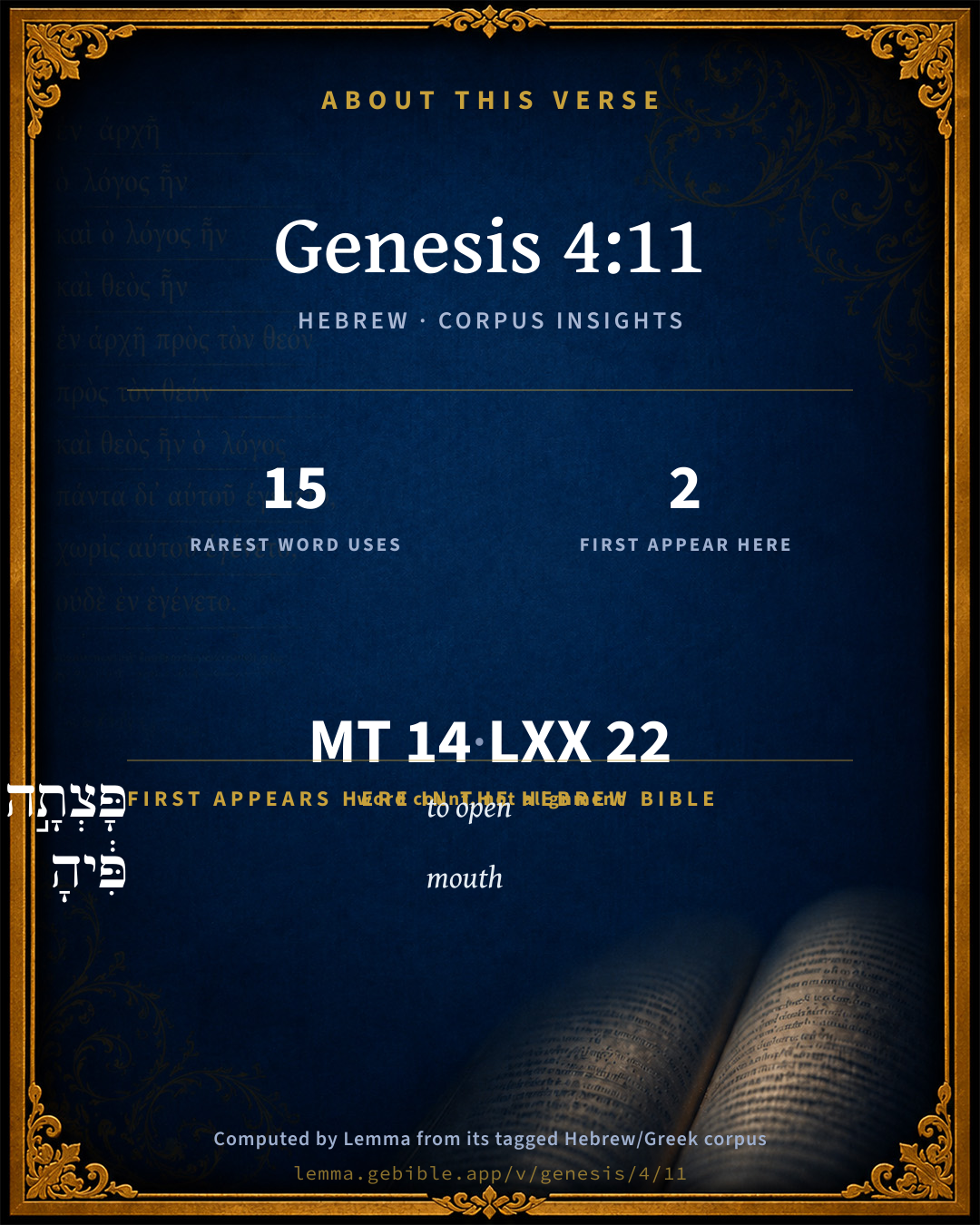
  • 2 first appearances in the Hebrew Bible
Full analysis ↓
Download a study sheet

One document with this verse’s original text, its word-by-word gloss line, the meaning frame, cross-references with their text, attributed commentary, and full source and license credits — printable, and it pastes into notes with its structure intact.

This verse Autodidact and up

Study sheet (.html) Plain text (.txt)

A passage Seminary Student

Up to 50 verses in one chapter. A passage sheet keeps up to 6 commentary sources and 12 cross-references per verse, in the order this page ranks them, and says so on the sheet whenever that leaves anything out. Ask for a single verse and you get the Autodidact verse sheet above.

Everything on this page stays free to read, with no account — the sheet is a download of what is already on screen, not access to it.

Want to remove ads? Support Godless Engineer
Compare translations 3

The same verse in 3 English versions, stacked beneath the original-language interlinear above. Click any original word for its lexicon entry.

Each is an independent rendering of the whole verse — the interlinear is not word-aligned to these translations.

Highlighted words mark where these versions differ — a whole-verse word diff, not a word-by-word alignment.

  • World English Bible Public Domain
    Now you are cursed because of the ground, which has opened its mouth to receive your brother's blood from your hand.
  • King James Version Public Domain
    And now art thou cursed from the earth, which hath opened her mouth to receive thy brother's blood from thy hand;
  • unfoldingWord Literal Text CC BY-SA 4.0
    So now you are cursed from the ground, which has opened its mouth to receive your brother’s blood from your hand.

unfoldingWord Literal Text — © unfoldingWord, licensed CC BY-SA 4.0. Word-aligned USFM3 via Door43 (git.door43.org/unfoldingWord/en_ult).

Versions to compare (up to 4)

3 of 4 selected

Show all 18 translations

Every available English version of this verse, each an independent rendering of the whole verse.

  • World English Bible Public Domain
    Now you are cursed because of the ground, which has opened its mouth to receive your brother's blood from your hand.
  • Berean Standard Bible Public Domain
    Now you are cursed and banished from the ground, which has opened its mouth to receive your brother’s blood from your hand.
  • Majority Standard Bible Public Domain
    Now you are cursed and banished from the ground, which has opened its mouth to receive your brother’s blood from your hand.
  • King James Version Public Domain
    And now art thou cursed from the earth, which hath opened her mouth to receive thy brother's blood from thy hand;
  • American Standard Version (1901) Public Domain
    And now cursed art thou from the ground, which hath opened its mouth to receive thy brother's blood from thy hand;
  • Revised Version (1885) Public Domain
    And now cursed art thou from the ground, which hath opened her mouth to receive thy brother’s blood from thy hand;
  • Geneva Bible (1599) Public Domain
    Now therefore thou art cursed from the earth, which hath opened her mouth to receiue thy brothers blood from thine hand.
  • Douay-Rheims (1899) Public Domain
    Now, therefore, cursed shalt thou be upon the earth, which hath opened her mouth and received the blood of thy brother at thy hand,
  • Young's Literal Translation Public Domain
    and now, cursed `art' thou from the ground, which hath opened her mouth to receive the blood of thy brother from thy hand;
  • Literal Standard Version CC BY-SA 4.0
    and now, cursed [are] you from the ground, which has opened her mouth to receive the blood of your brother from your hand;
  • Unlocked Literal Bible CC BY-SA 4.0
    Now cursed are you from the ground, which has opened its mouth to receive your brother's blood from your hand.
  • unfoldingWord Literal Text CC BY-SA 4.0
    So now you are cursed from the ground, which has opened its mouth to receive your brother’s blood from your hand.
  • Darby Bible Public Domain
    And now be thou cursed from the ground, which hath opened its mouth to receive thy brother's blood from thy hand.
  • World Messianic Bible Public Domain
    Now you are cursed because of the ground, which has opened its mouth to receive your brother’s blood from your hand.
  • Webster's Bible Public Domain
    And now art thou cursed from the earth, which hath opened her mouth to receive thy brother's blood from thy hand;
  • Free Bible Version CC BY-SA 4.0
    Consequently you are more cursed than the ground because you soaked it with your brother's blood.
  • Bible in Basic English Public Domain
    And now you are cursed from the earth, whose mouth is open to take your brother's blood from your hand;
  • JPS Tanakh (1917) Public Domain
    And now cursed art thou from the ground, which hath opened her mouth to receive thy brother's blood from thy hand.

Literal Standard Version (2020), Covenant Press — licensed CC BY-SA 4.0. Text via the HelloAO Bible API (eBible.org). Unlocked Literal Bible (unfoldingWord) — licensed CC BY-SA 4.0. Text via the HelloAO Bible API (eBible.org). unfoldingWord Literal Text — © unfoldingWord, licensed CC BY-SA 4.0. Word-aligned USFM3 via Door43 (git.door43.org/unfoldingWord/en_ult). Free Bible Version, Dr. Jonathan Gallagher — licensed CC BY-SA 4.0. Text via the HelloAO Bible API (eBible.org).

Word by word

More ways to search: Search by grammar → Find every occurrence → Compare this word →

Practice this passage: Drill this verse → Learn its vocabulary →

פָּצְתָ֣ה
pâtsâh
H6475
“to open”
Verb, Qal, Perfect, 3rd Person, Feminine, Singular
Part of Speech
Verb
Stem
Qal
Form
Perfect
Person
3rd Person
Gender
Feminine
Number
Singular
Full BDB Definition

Origin: a primitive root

TWOT: 1795

to part, open, separate, set free - (Qal) - to open (mouth), utter - to snatch away, set free
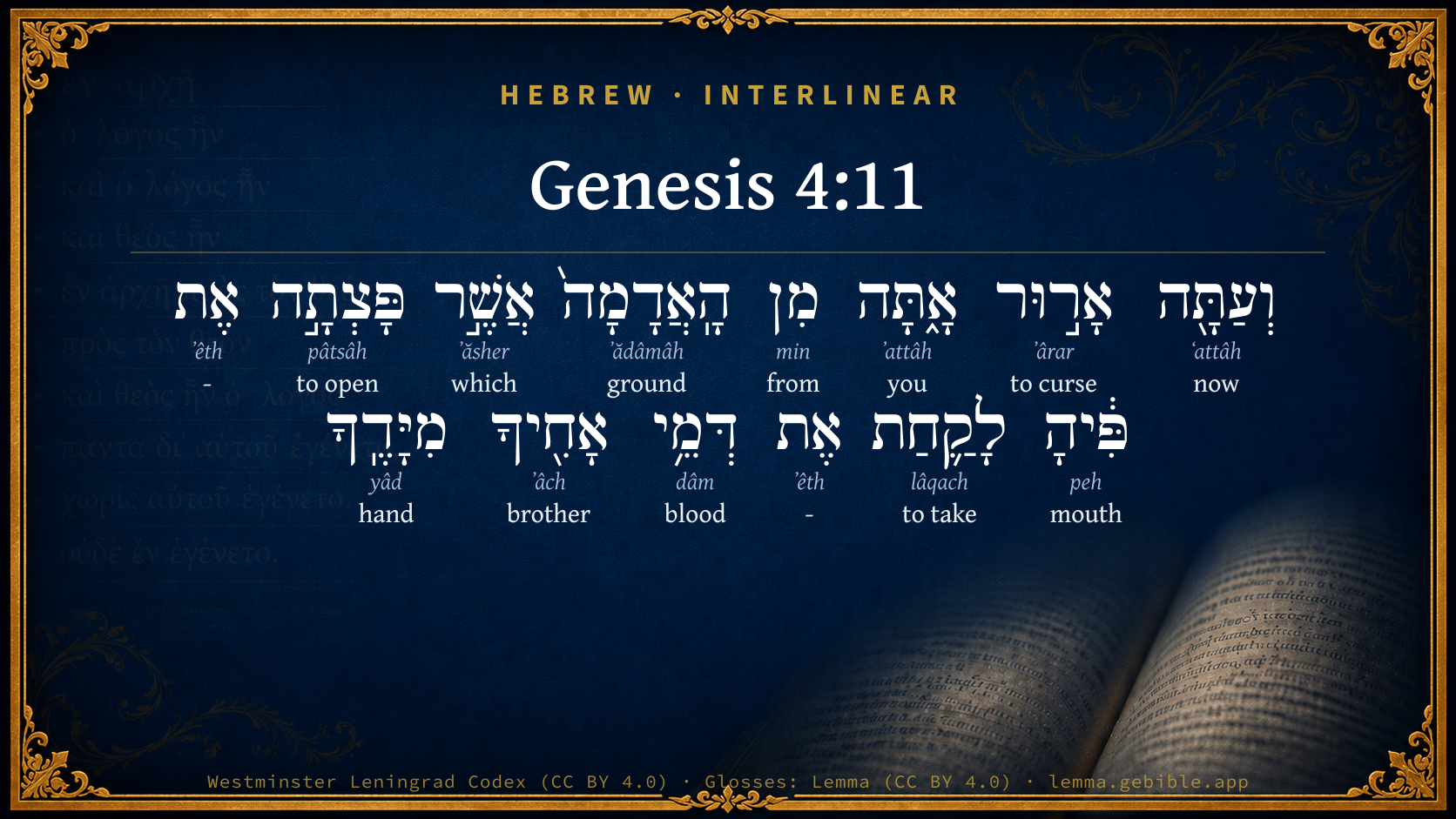
  1. וְעַתָּ֖ה ʻattâh H6258 “and · now” Conjunction + Adverb
  2. אָר֣וּר ʼârar H779 “cursed” Verb, Qal, Participle Passive, Masculine, Singular, Absolute
  3. אָ֑תָּה ʼattâh H859 “you” Pronoun, Personal, 2nd Person, Masculine, Singular
  4. מִן min H4480 “from” Preposition
  5. הָֽאֲדָמָה֙ ʼădâmâh H127 “the · ground” Particle, Definite Article + Noun, Common, Feminine, Singular, Absolute
  6. אֲשֶׁ֣ר ʼăsher H834 “which” Particle, Relative
  7. אֶת ʼêth H853 “-” Particle, Direct Object
  8. פִּ֔יהָ peh H6310 “mouth · her” Noun, Common, Masculine, Singular, Construct + Suffix, Personal, 3rd Person, Feminine, Singular
  9. לָקַ֛חַת lâqach H3947 “to take” Preposition + Verb, Qal, Infinitive Construct
  10. אֶת ʼêth H853 “-” Particle, Direct Object
  11. דְּמֵ֥י dâm H1818 “blood of” Noun, Common, Masculine, Plural, Construct
  12. אָחִ֖יךָ ʼâch H251 “brother · your” Noun, Common, Masculine, Singular, Construct + Suffix, Personal, 2nd Person, Masculine, Singular
  13. מִיָּדֶֽךָ yâd H3027 “from · hand · your” Preposition + Noun, Common, Both, Singular, Construct + Suffix, Personal, 2nd Person, Masculine, Singular

About this verse

These counts appear in no published source. They are computed here, from the morphology-tagged text and Lemma’s own curated glosses. What Lemma adds →

14
words
13
distinct lemmas
Pentateuch
section

Notable vocabulary

The rarest word here is פָּצְתָ֣ה to open H6475 — appearing just 15 times in the whole Hebrew Bible.

First appearance in Scripture

These words make their first canonical appearance in the Hebrew Bible here:

  • פָּצְתָ֣ה to open H6475
  • פִּ֔יהָ mouth H6310

Shared distinctive vocabulary

פָּצְתָ֣ה to open H6475 occurs in 15 verses of the Hebrew Bible. Also found in:

Grammatical profile

  • 3 verbs
  • 5 nouns
  • 1 pronoun
  • 1 preposition
  • 1 adverb
  • 3 particles

Verb forms

  • אָר֣וּר Qal · Participle Passive
  • פָּצְתָ֣ה Qal · Perfect
  • לָקַ֛חַת Qal · Infinitive Construct

Hebrew & Septuagint length

In English translation the verse runs 21 words from the Hebrew and 21 from the Septuagint (LXX English) — the same length.

A rough comparison of the two English renderings, which tokenize alike — not a word-level alignment.

Word counts can differ between the Hebrew and the Greek without any difference in meaning — e.g. the Hebrew direct-object marker אֵת has no separate Greek word, and Greek often adds the article ὁ.

In the original languages it is 14 Hebrew tokens and 22 Greek tokens — but the two are counted differently (Hebrew bundles its prefixes and suffixes into one token; the Greek is in lemma form), so that isn’t a like-for-like length.

Cross-references

10

Topical passages linked to Genesis 4:11 in the Treasury of Scripture Knowledge — connected by theme and wording, ordered by reader-vote popularity; previews shown in the World English Bible.

  • Galatians 3:10 For as many as are of the works of the law are under a curse. For it is written, "Cursed is everyone who doesn't continue in all things that are written in the book of the law, to do them."
  • Job 16:18 "Earth, don't cover my blood, Let my cry have no place to rest.
  • Genesis 3:14 Yahweh God said to the serpent, "Because you have done this, cursed are you above all cattle, and above every animal of the field. On your belly shall you go, and you shall eat dust all the days of your life.
  • Deuteronomy 28:15–20 But it shall come to pass, if you will not listen to the voice of Yahweh your God, to observe to do all his commandments and his statutes which I command you this day, that all these curses shall come on you, and overtake you.
  • Genesis 4:14 Behold, you have driven me out this day from the surface of the ground. I will be hidden from your face, and I will be a fugitive and a wanderer in the earth. It will happen that whoever finds me will kill me."
  • Deuteronomy 27:16–26 Cursed be he who sets light by his father or his mother. All the people shall say, Amen.
  • Deuteronomy 29:19–21 and it happen, when he hears the words of this curse, that he bless himself in his heart, saying, I shall have peace, though I walk in the stubbornness of my heart, to destroy the moist with the dry.
  • Job 31:38–40 If my land cries out against me, And the furrows of it weep together;
  • Isaiah 26:21 For, behold, Yahweh comes forth out of his place to punish the inhabitants of the earth for their iniquity: the earth also shall disclose her blood, and shall no more cover her slain.
  • Revelation 12:16 The earth helped the woman, and the earth opened its mouth and swallowed up the river which the dragon spewed out of his mouth.

Cross-references courtesy of OpenBible.info (CC BY 4.0).

Hebrew and Greek witnesses Masoretic Hebrew ↔ Greek Septuagint

The same verse in the two great witnesses to the Old Testament, shown verse-for-verse.

These are two independent witnesses, not word-aligned to each other, and the Septuagint is shown in lemma (dictionary) form.

Hebrew Genesis 4:11 Masoretic · Westminster Leningrad Codex

וְעַתָּ֖ה אָר֣וּר אָ֑תָּה מִן הָֽאֲדָמָה֙ אֲשֶׁ֣ר פָּצְתָ֣ה אֶת פִּ֔יהָ לָקַ֛חַת אֶת דְּמֵ֥י אָחִ֖יךָ מִיָּדֶֽךָ

Now you are cursed because of the ground, which has opened its mouth to receive your brother's blood from your hand.

World English Bible · Public Domain

Greek LXX Genesis 4:11 Septuagint · lemma form

καί νῦν ἐπικατάρατος σύ ἀπό ὁ γῆ ὅς χαίνω ὁ στόμα αὐτός δέχομαι ὁ αἷμα ὁ ἀδελφός σύ ἐκ ὁ χείρ σύ

And now you are cursed from the earth which has opened her mouth to receive your brother's blood from your hand.

LXX2012 (modern English Septuagint) · Public Domain

On this verse, John Gill's Exposition discusses the Septuagint’s reading. Read the note in Commentary ↓

Hebrew: Westminster Leningrad Codex (CC BY 4.0). Greek: Septuagint (public domain); English from LXX2012 (modern English Septuagint) (Public Domain). How the Septuagint differs from the Hebrew →

Targum (Aramaic paraphrase)

2

The Targum is the ancient Jewish Aramaic paraphrase of the Hebrew Scriptures — an interpretive translation, not the Hebrew text itself. Onkelos (literal) and Pseudo-Jonathan (expansive) render the Torah, and Jonathan the Prophets. Coverage is partial: where no permissively-licensed English translation exists for a verse, only the Aramaic is shown. This is verse-level text, not a word-by-word alignment to the Hebrew.

  1. Targum Onkelos Torah (Genesis–Deuteronomy)
    וּכְעַן לִיט אָתְּ מִן אַרְעָא דִּפְתָחַת יָת פּוּמַהּ וְקַבִּילַת יָת דְּמֵהּ דְּאָחוּךְ מִן יְדָךְ

    (no public-domain English translation for this verse)

    Targum Onkelos — Aramaic: “Onkelos Genesis” (public domain); “Onkelos Exodus” (public domain); “Onkelos Leviticus” (public domain); “Onkelos Numbers” (public domain); “Onkelos Deuteronomy” (public domain). English: “Sefaria Community Translation” (CC0 1.0 (public-domain dedication)); “J.W. Etheridge. The Targums of Onkelos and Jonathan Ben Uzziel on the Pentateuch. London: Longmans, Green, 1862” (public domain). Text via Sefaria.

  2. Targum Pseudo-Jonathan Torah (Genesis–Deuteronomy)
    וּכְעַן חֲלַף דִקְטַלְתֵּיהּ לַיִיט אַתְּ מִן אַרְעָא דִפְתָחַת יַת פּוּמָהּ וְקַבִּילַת יַת דְמֵי דְאָחוּךְ מִן יְדָךְ

    And now because thou hast killed him, thou art cursed from the earth, which hath opened the mouth, and received the bloods of thy brother from thy hand.

    Targum Pseudo-Jonathan — Aramaic: “Targum Jonathan on Genesis” (public domain); “Targum Jonathan on Exodus” (public domain); “Targum Jonathan on Leviticus” (public domain); “Targum Jonathan on Numbers” (public domain); “Targum Jonathan on Deuteronomy” (public domain). English: “The Targum of Jonathan ben Uzziel, trans. J. W. Etheridge, London, 1862” (public domain). Text via Sefaria.

Commentary

Notes on Genesis 4:11 from classic Christian and Jewish commentators (each source and its license shown beneath its notes). The classic Christian expositions comment on the surrounding passage and are grouped to its opening verse, so a note may address several verses; the Jewish commentaries on the Tanakh (Rashi and others) are per-verse, so they appear only where the commentator wrote on this verse.

Lemma curates 59 commentaries, every one of them public domain or Creative Commons licensed, each selected and text-cleaned for this edition rather than reprinted as found. About our sources →

Trapp's Complete Commentary

John Trapp

Gen 4:11 And now [art] thou cursed from the earth, which hath opened her mouth to receive thy brother’s blood from thy hand;

Ver. 11. And now thou art cursed.] The Pope contrarily blesses and saints traitors to their country, and murderers of their natural sovereigns; as Ravilliac, and others his assassins, those sworn swordsmen of the devil. Aphonsus Diazius, who killed his own brother for the cause of religion, as above said, fled to Rome, and was there highly commended for his zeal, and largely rewarded, as Bucer reports {a} But, driven thereto by the terrors of his own guilty conscience, like another Judas, he afterwards hanged himself upon the neck of his own mule, for want of a better gallows.

{a} Bucer in Praefat. ad Senarclaei Histor. de Morte Diaz. - Lonicer.

John Trapp, A Commentary or Exposition upon All the Books of the Old and New Testament (1647–1656) — public domain. Text from a community e-Sword module.

The Biblical Illustrator

Joseph S. Exell

Gen_4:11-12

A fugitive and a vagabond shalt thou be

Cain cursed by God

Cursed art THOU.

Fearful words, coming straight from the lips of God into the very ear of man, standing in the presence of God. No lightning bursting on him from the clouds could be half so terrible. The blessing is revoked, and the curse goes forth. It is a curse because of innocent blood, as if foreshowing the curses which the shedding of innocent blood was yet to bring upon men. This curse is represented as coming up from the ground, as if the ground which had been moistened with the blood were to be the instrument of inflicting the curse. In Ezekiel we read of the mountains devouring men (36:12-14), and elsewhere of the land spewing out (Lev_18:28; Lev_20:22); so here the very ground is impregnated with evil to Cain, and sends up its curses on him. The soil is to cast him off; the earth is to loathe him! inanimate nature, more tender-hearted than he (inasmuch as it drank in the blood), is to set its face against him. It had received the innocent blood into its bosom, and it was to send up unceasingly on the murderer an endless curse. (H. Bonar, D. D.)

The fruits of envy

Such are the fruits of envy. Burden upon burden, stroke upon stroke, sorrow upon sorrow! From above, from beneath, and from around, the torment, and the terror, and the bitterness pour in. There is no peace to the wicked, no rest, no settlement. How sin uproots and unsettles, making a man to flee hither and thither, in order to get away from himself! How vain! O SIN, sin! what horrid things are all wrapt up even in its smallest indulgence! An unkind thought, a harsh word, an envious feeling,--then sullenness, anger, murder--a brothers murder!

How little do we know sin, or reckon on its results, or calculate the fruits that come from its womb! (H. Bonar, D. D.)

The bitter curse which sin brings on an individual life

I. THAT IT RENDERS A MAN SUBJECT TO THE SOLEMN AND CONVINCING ENQUIRIES OF GOD.

II. THAT IT SENDS A MAN ON THROUGH LIFE WITH THE MOST TERRIBLE MEMORIES OF WRONG-DOING WITHIN HIS SOUL.

III. THAT IT OFTEN RUINS THE TEMPORAL PROSPERITY OF A MAN.

1. It destroys reputation.

2. Wastes earnings.

3. Enfeebles agencies.

IV. THAT IT COMMITS A MAN TO A WANDERING AND RESTLESS LIFE.

V. THAT IT CRUSHES MAN WITH A HEAVY BURDEN AND ALMOST RENDERS HIM DESPAIRING. Lessons--

1. That sin is the greatest curse of human life.

2. That God is the avenger of the good.

3. That the sinner is the greatest sufferer in the end.

4. That good men go from their worship into heaven. (J. S.Exell, M. A.)

The Biblical Illustrator, edited by Joseph S. Exell (c. 1880s–1900s) — public domain. Text from a community e-Sword module.

Joseph Benson's Commentary

Gen 4:11. And now art thou cursed — 1st, Separated to all evil, laid under the wrath of God, as it is revealed from heaven against all ungodliness and unrighteousness of men. 2d, He is cursed from the earth. Thence the cry came up to God, thence the curse came up to Cain. God could have taken vengeance by an immediate stroke from heaven: but he chose to make the earth the avenger of blood; to continue him upon the earth, and not presently to cut him off; and yet to make even that his curse. That part of it which fell to his share, and which he had the occupation of, was made unfruitful, by the blood of Abel. Besides, 3d, A fugitive and a vagabond (says God) shalt thou be in the earth — By this he was condemned to perpetual disgrace and reproach, and to perpetual disquiet and horror in his own mind. His own guilty conscience would haunt him wherever he went.

Joseph Benson's Commentary on the Old and New Testaments (1811–1818) — public domain. Text from a community e-Sword module.

Tyndale Open Study Notes

Tyndale Open Resources

4:11-12 As with his father (cp. 3:9-12, 17-19), Cain’s interrogation (4:9-10) was followed by God’s verdict. Adam’s sin had already caused the ground to be cursed. Now Cain was cursed and banished from the land he farmed because he had contaminated it with innocent blood. • homeless wanderer: Cain was condemned to ceaseless roving in a land that would provide neither sustenance nor security. The effects of sin were escalating.

Tyndale Open Study Notes — © Tyndale Open Resources, licensed CC BY-SA 4.0. Text via the HelloAO Bible API.

Geneva Bible (1599)

Geneva Bible translators

The earth shall be a witness against thee, which mercifully received that blood which thou most cruelly sheddest.

Geneva Bible (1599) marginal notes — public domain. Text via Bolls.life.

Jamieson, Fausset & Brown

Robert Jamieson, A. R. Fausset & David Brown

now art thou cursed from the earth--a curse superadded to the general one denounced on the ground for Adam's sin.

Jamieson, Fausset & Brown — Commentary Critical and Explanatory on the Whole Bible (1871) — public domain (CC PDM 1.0). Text via the HelloAO Bible API.

John Calvin's Commentaries

11. And now art thou cursed from the earth. Cain, having been convicted of the crime, judgment is now pronounced against him. And first, God constitutes the earth the minister of his vengeance, as having been polluted by the impious and horrible parricide: as if he had said, ‘Thou didst just now deny to me the murder which thou hast committed, but the senseless earth itself will demand thy punishment.’ He does this, however, to aggravate the enormity of the crime, as if a kind of contagion flowed from it even to the earth, for which the execution of punishment was required. The imagination of some, that cruelty is here ascribed to the earth, as if God compared it to a wild beast, which had drunk up the blood of Abel, is far from the true meaning. Clemency is rather, in my judgment, by personification, imputed to it; because, in abhorrence of the pollution, it had opened its mouth to cover the blood which had been shed by a brother’s hand. Most detestable is the cruelty of this man, who does not shrink from pouring forth his neighbor’s blood, of which the bosom of the earth becomes the receptacle. Yet we must not here imagine any miracle, as if the blood had been absorbed by any unusual opening of the earth; but the speech is figurative, signifying that there was more humanity in the earth than in man himself. Moreover, they who think that, because Cain is now cursed in stronger words than Adam had previously been, God had dealt more gently with the first man, from a design to spare the human race; have some color for their opinion. Adam heard the words, “Cursed is the ground for thy sake:” but now the shaft of divine vengeance vibrates against, and transfixes the person of Cain. The opinion of others, that temporal punishment is intended, because it is said, Thou art cursed from the “earth,” rather than from “heaven,” lest the posterity of Cain, being cut off from the hope of salvation, should rush the more boldly on their own damnation, seems to me not sufficiently confirmed. I rather interpret the passage thus: Judgment was committed to the earth, in order that Cain might understand that his judge had not to be summoned from a distance; that there was no need for an angel to descend from heaven, since the earth voluntarily offered itself as the avenger.

John Calvin's Commentaries (1540-1563) — public domain. Text from the Calvin Translation Society English edition (1840s-50s) via the Christian Classics Ethereal Library (ccel.org). Calvin's coverage is partial (roughly two-thirds of the Bible); uncommented books and verses are honest gaps, never fabricated. The 19th-century editor's footnotes and remarks are omitted so the notes are faithfully Calvin's own voice.

Ellicott's Commentary for English Readers

(11, 12) And now (because of thy crime) art thou cursed from the earth.—Heb., from the adâmâh, or cultivated ground. Cain was the first human being on whom a curse was inflicted, and it was to rise up from the ground, the portion of the earth won and subdued by man, to punish him. He had polluted man’s habitation, and now, when he tilled the soil, it would resist him as an enemy, by refusing “to yield unto him her strength.” He had been an unsuccessful man before, and outstripped in the race of life by the younger son; for the future his struggle with the conditions of life will be still harder. The reason for this follows: “a fugitive and a vagabond shalt thou be in the earth.” Restless and uneasy, and haunted by the remembrance of his crime, he shall become a wanderer, not merely in the adâmâh, his native soil, but in the earth. Poverty must necessarily be the lot of one thus roaming, not in search of a better lot, but under the compulsion of an evil conscience. Finally, however, we find that Cain’s feelings grew more calm, and being comforted by the presence of a wife and children, “he builded a city,” and had at last a home.

A Bible Commentary for English Readers, edited by Charles John Ellicott (1878–1897) — public domain. Text from a community e-Sword module.

The Cambridge Bible for Schools and Colleges

gen. ed. J. J. S. Perowne

11. from the ground] The meaning is not quite obvious. Probably, we should not understand, that the curse is to come from the ground upon Cain, but that Cain is driven by Jehovah’s curse from the ground. The emphasis is on “the ground” (hâ-adâmâh). It is the ground which Cain tilled, the ground whose fruits he offered, and the ground which he has caused to drink human blood. From this ground he is now driven by a curse. For pollution of the land by bloodshed cf. Num_35:33, “So ye shall not pollute the land wherein ye are: for blood, it polluteth the land: and no expiation can be made for the land, for the blood that is shed therein, but by the blood of him that shed it.”

On blood-revenge, cf. Robertson Smith, Kinship and Marriage, pp. 25–27.

The Cambridge Bible for Schools and Colleges (gen. ed. J. J. S. Perowne; Cambridge University Press, 1878–1918) — public domain. Text from a community e-Sword module.

John Gill's Exposition

When thou tillest the ground,.... Which was the business he was brought up in and followed, Gen 4:2.

it shall not henceforth yield unto thee her strength; the earth had been cursed for Adam's sin, and was not so fruitful as in its original state; and now it was cursed again for Cain's sin; not the whole earth, but that part which belonged to Cain, and was cultivated by him; and so it must be supposed to be cursed, not only in the spot where he had been settled, but in every other place where he should come and occupy, and which through this additional curse became so barren that it did not yield such good fruits, and such an increase of it as before; it lost its native and vital juice, by which seed cast into it became not so fruitful, and did not increase; but instead of this, though much pains were taken to manure it, and much was sown, yet it brought forth little, at least but little to Cain, whatever it did to others; and therefore it is said, "shall not yield unto thee"; it would not turn much to his account, or yield much profit and increase to him, or bring forth much fruit; see Job 31:38.

a fugitive and a vagabond shalt thou be in the earth; being obliged to quit his former habitation, and remove to a place at some distance from the house of his father Adam, which was near the garden of Eden, as Aben Ezra observes; and to wander about from place to place, having no quiet settlement in anyone place: the Septuagint render it "groaning and trembling"; the guilt of his sin lay heavy on his conscience, and filled him with such horror and terror that he was continually sighing and groaning, and was seized with such a tremor that he shook in all his limbs; so the Arabic writers (t) say, that he was trembling and quivering, and had a shaking in his head all the days of his life; and Aben Ezra observes, that there are some that say that the first of these words signifies to moan and lament; but it may be, it was not so much his sin, at least the evil of it, that he lamented, as the mischief that came by it, or the calamities and misfortunes it brought upon him.

(t) Patricides, apud Hottinger. Smegma Oriental. l. 1. c. 8. p. 223.

John Gill's Exposition of the Whole Bible (1746–1763) — public domain (CC PDM 1.0). Text via the HelloAO Bible API.

Matthew Poole's English Annotations

As the earth was cursed for thy father’s sake, so now art thou cursed in thy own person;

from the earth, or, in regard of the earth, which shall grudge thee both its fruits and a certain dwelling-place, and which had more humanity to thy brother than thou hadst; for it kindly received and covered that blood which thou didst cruelly and unnaturally shed upon it.

Matthew Poole's English Annotations on the Holy Bible (1683–1685) — public domain. Text from a community e-Sword/MySword module.

Whedon's Commentary on the Bible

Daniel D. Whedon

11. Cursed from the earth — The curse shall seem to come forth out of the earth, which hath opened her mouth to receive thy brother’s blood. As the next verse further explains, the ground, which so readily drank the innocent blood, will not be fruitful to the murderer’s tilling. The earth, cursed by reason of Adam’s sin, (iii, 17,) will seem to pour forth special judgments upon Cain. Others explain, less in keeping with the natural meaning of the words and the context: Thou art cursed away from the land; that is, banished out of this land, or district, where thy father and brothers dwell.

Daniel D. Whedon (gen. ed.), Commentary on the Old and New Testaments (1874–1909) — public domain. Text from a community e-Sword module.

The Pulpit Commentary

Vers. 11, 12. Convicted, if not humbled, the culprit is speechless, and can only listen in consternation to the threefold judgment which pronounced him cursed in his soul, vagabond in his body, and unprosperous in his labors" (Willet). And now either at this time, already (cf. Jos_14:11; Hos_2:10) or for this cause, because thou hast done this (Gen_3:14; cf. Gen_19:9; Exo_18:19) art thou cursed. The first curse pronounced against a human being. Adam and Eve were not cursed, though the serpent and the devil were. If we may not conclude that Cain was thereby for ever excluded from the hope of salvation if he should repent, still less must we explain the Divine judgment down to a simple sentence of banishment from Eden. The fratricide was henceforth to bear the displeasure and indignation of his Maker, whose image in Abel he had slain; of which indignation and displeasure his expatriation was to be a symbol. Different explanations have been offered of the clause, from the earth, or ground, Ad-hamah, which, however, cannot mean more than the ground, which already had been cursed, (Gen_3:17; Lunge) since "the curse of the soil and the misery of man cannot well be compared with each other" (Kalisch); or simply away from the district, the scene of his crime (Kalisch, Speaker"s, Rosenm Tuch, Gerlach, Delitzsch), as if all that the sentence implied was banishment from Eden; but must involve in addition the idea that the curse was to leap upon him from the earth, or ground, in general (Aben Ezra, Kimchi, Knobel, Alford, Murphy). Which hath opened her mouth to receive thy brother"s blood from thy hand. The terrible significance of this curse is further opened in the words which follow. The earth was to be against him

1. In refusing him its substance. When thou tillest (literally, shalt till) the ground, it shall not henceforth yield (literally, add to give) unto thee her strength. Neither a double curse upon the entire earth for man"s sake (Alford), nor a doom of sterility inflicted only on the district of Eden (Kalisch); but a judgment on Cain and his descendants with respect to their labors. Their tillage of the ground was not to prosper, which ultimately, Bonar thinks, drove the Cainites to city-building and mechanical invention.

2. In denying him a home. A fugitive and a vagabond literally, moving and wandering; groan ing and trembling" (LXX, erroneously), banished and homeless" (Keil)shalt thou be in the earth. "As robbers are wont to be who have no quiet and secure resting-place" (Calvin); driven on by the agonizing tortures of a remorseful and alarmed conscience, and not simply by the earth denying to him the expected fruits of his labor" (Delitzsch). The ban of wandering, which David pronounced upon his enemies, (Psa_59:12 Psa_109:10) in later years fell upon the Jews, who "for shedding the blood of Christ, the most innocent Lamb of God, are vagabonds to this day over the face of the earth" (Willet). Thus the earth was made the minister of God"s curse, not a partaker of it, as some have strangely imagined, as if by drinking up the blood of Abel it had become a participant of Cain"s crime (Delitzsch).

The Pulpit Commentary (1880–1919), ed. H.D.M. Spence-Jones & Joseph S. Exell — public domain. Text from a community e-Sword module.

John Wesley's Explanatory Notes

And now art thou cursed from the earth -

1. He is cursed, separated to all evil, laid under the wrath of God, as it is revealed from heaven against all ungodliness and unrighteousness of men.

2. He is cursed from the earth. Thence the cry came up to God, thence the curse came up to Cain. God could have taken vengeance by an immediate stroke from heaven: but he chose to make the earth the avenger of blood; to continue him upon the earth, and not presently to cut him off; and yet to make even that his curse. That part of it which fell to his share, and which he had the occupation of, was made unfruitful, by the blood of Abel. Besides, A fugitive and a vagabond shalt thou be in the earth. By this he was here condemned, to perpetual disgrace and reproach, and to perpetual disquietment and horror in his own mind. His own guilty conscience should haunt him where ever he went. Now to justify his complaint, Observe his descants upon the sentence.

1. He sees himself excluded by it from the favour of his God; and concludes, that being cursed, he was hid from God's face, and that is indeed the true nature of God's curse; damned sinners find it so, to whom it is said, Depart from me ye cursed. Those are cursed indeed that are forever shut out from God's love and care, and from all hopes of his grace.

2. He sees himself expelled from all the comforts of this life; and concludes, ver. 14. Thou hast driven me out this day from the face of the earth - As good have no place on earth as not have a settled place. Better rest in the grave than not rest at all. And from thy face shall I be hid - Shut out of the church, not admitted to come with the sons of God to present himself before the Lord. And it shall come to pass that every one that finds me shall slay me - Wherever he wanders he goes in peril of his life. There were none alive but his near relations, yet even of them he is justly afraid, who had himself been so barbarous to his own brother.

John Wesley, Explanatory Notes Upon the Whole Bible (1754–1765) — public domain. Text via the GEBible commentary corpus.

Keil & Delitzsch

C. F. Keil & F. Delitzsch

"And now (sc., because thou hast done this) be cursed from the earth." From: i.e., either away from the earth, driven forth so that it shall no longer afford a quiet resting-place (Gerlach, Delitzsch, etc.), or out of the earth, through its withdrawing its strength, and thus securing the fulfilment of perpetual wandering (Baumgarten, etc.). It is difficult to choose between the two; but the clause, "which hath opened her mouth," etc. seems rather to favour the latter. Because the earth has been compelled to drink innocent blood, it rebels against the murderer, and when he tills it, withdraws its strength, so that the soil yields no produce; just as the land of Canaan is said to have spued out the Canaanites, on account of their abominations (Lev 18:28). In any case, the idea that "the soil, through drinking innocent blood, became an accomplice in the sin of murder," has no biblical support, and is not confirmed by Isa 26:21 or Num 35:33. The suffering of irrational creatures through the sin of man is very different from their participating in his sin. "A fugitive and vagabond (ונד נע, i.e., banished and homeless) shalt thou be in the earth." Cain is so affected by this curse, that his obduracy is turned into despair, "My sin," he says in Gen 4:13, "is greater than can be borne." עון נשׁא signifies to take away and bear sin or guilt, and is used with reference both to God and man. God takes guilt away by forgiving it (Exo 34:7); man carries it away and bears it, by enduring its punishment (cf. Num 5:31). Luther, following the ancient versions, has adopted the first meaning; but the context sustains the second: for Cain afterwards complains, not of the greatness of the sin, but only of the severity of the punishment. "Behold, Thou hast driven me out this day from the face of the earth, and from Thy face shall I be hid;...and it shall come to pass that every one that findeth me shall slay me." The adamah, from the face of which the curse of Jehovah had driven Cain, was Eden (cf. Gen 4:16), where he had carried on his agricultural pursuits, and where God had revealed His face, i.e., His presence, to the men after their expulsion from the garden; so that henceforth Cain had to wander about upon the wide world, homeless and far from the presence of God, and was afraid lest any one who found him might slay him. By "every one that findeth me" we are not to understand omnis creatura, as though Cain had excited the hostility of all creatures, but every man; not in the sense, however, of such as existed apart from the family of Adam, but such as were aware of his crime, and knew him to be a murderer. For Cain is evidently afraid of revenge on the part of relatives of the slain, that is to say, of descendants of Adam, who were either already in existence, or yet to be born. Though Adam might not at this time have had "many grandsons and great-grandson," yet according to Gen 4:17 and Gen 5:4, he had undoubtedly other children, who might increase in number, and sooner or later might avenge Abel's death. For, that blood shed demands blood in return, "is a principle of equity written in the heart of every man; and that Cain should see that earth full of avengers is just like a murderer, who sees avenging spirits (Ἐρινύες) ready to torture him on every hand."

Keil & Delitzsch — Biblical Commentary on the Old Testament (1861–1891) — public domain (CC PDM 1.0). Text via the HelloAO Bible API. (Old Testament only.)

Rashi

Rabbi Shlomo Yitzchaki (Rashi)

ארור אתה מן האדמה CURSED BE THOU FROM THE GROUND or, MORE THAN THE GROUND — More than the ground has already been cursed on account of its sin (cf. Rashi on Genesis 1:11): in this, too, it has again sinned

אשר פצתה את פיה לקחת את דמי אחיך IN THAT IT HATH OPENED ITS MOUTH TO TAKE THY BROTHER’S BLOOD: therefore do I impose upon it an additional curse regarding you—“it shall not henceforth yield unto thee its strength”.

Rashi on the Tanakh — English translations: “The Judaica Press complete Tanach with Rashi, translated by A. J. Rosenberg” (CC BY 4.0); “Pentateuch with Rashi's commentary by M. Rosenbaum and A.M. Silbermann, 1929-1934” (public domain); “The Metsudah Tanach series, Lakewood, N.J” (CC BY 4.0); and “The Book of Joshua, Metsudah Publications, 1997” (CC BY 4.0). Text via Sefaria.

Ramban (Nachmanides)

Rabbi Moshe ben Nachman (Ramban / Nachmanides)

CURSED ART THOU FROM THE GROUND — more than it has already been cursed on account of its sin. In this, too, it has further sinned in that it hath opened its mouth to take thy brother’s blood. Therefore, I impose upon it an additional curse: it shall not continue to give unto thee her strength. Thus the words of Rashi.But this is not correct since here He did not curse the ground because of him as He did in the case of his father, rather He said that he be cursed through the ground. The explanation of the curse is that the earth shall not continue to give him its strength, and that he be a fugitive and a wanderer in it, and He further stated, “When thou tillest the ground with all your efforts to cultivate it properly by plowing and hoeing, and in all manner of service in the field and by properly sowing it, it shall not continue to give unto thee her strength. Instead, you will sow much and harvest little.” This then was the curse, in the same sense as in the verse: And I will curse your blessings. Thus He uttered the curse in connection with his occupation for he was a tiller of the ground, and so He cursed his work. This then is the sense of the expression, it shall not continue to give unto thee her strength, meaning, “It will no longer yield to you its full produce as it had done till now when you cultivated it.” And so did Rabbi Abraham ibn Ezra explain it.It is possible that He also cursed him though the ground in that it should no longer yield its strength to him of its own accord; the fig-tree and the vine would not yield their strength in his estate, and the trees of the field would not yield him their fruit. Then He added, “Even when you work the ground by plowing and sowing, it will not continue to give you its strength as before.” Thus there were two curses relating to his occupation, and a third one — that he be a fugitive and a wanderer in the world. This means that his heart will not be at rest, and he will lack the tranquility to remain in one place on the earth; he will wander forever for the punishment of murderers is exile.The expression in that it hath opened its mouth to take thy brother’s blood means: “You have killed your brother and covered his blood with the earth, and I will decree upon it that it uncover its blood, and she shall no more cover her slain for it will be punished together with all that is covered up in it, such as seed and plant.” This is the punishment for all blood-letting on the earth, even as it is written, For blood, it polluteth the land. The pollution of the land consists of a curse upon its produce, as it is written: When one came to a heap of twenty measures, there were but ten; when one came to the wine vat to draw out fifty press-measures, there were but twenty.

Ramban (Nachmanides) on the Tanakh — English translation: “Commentary on the Torah by Ramban (Nachmanides). Translated and annotated by Charles B. Chavel. New York, Shilo Pub. House, 1971-1976” (CC BY 4.0). Text via Sefaria.

Radak

Rabbi David Kimhi (Radak)

ועתה ארור אתה מן האדמה, the curse will be spelled out in the verse following, where G’d explains that Kayin will experience that the source of his curse is the very earth he had used to hide his crime. This earth would not continue to provide its strength for Kayin.

אשר פצתה את פיה, a reference to soaking up Hevel’s blood, [not as in the case of Korach being actively involved in swallowing Hevel. Ed.] We have a similar incident in Job 16,18 ארץ אל תכסי דמי, “Earth, do not cover my blood!” Also Ezekiel 24, 7-8 uses similar language, i.e. כי דמה היה על צחיח סלע שמתהו לא שפכתהו על הארץ לכסות עליו עפר, “For her blood remained within her, she placed it on a smooth rock. She did not pour it upon the ground to cover it with dust.”

Radak on the Tanakh — English translations: “Sefaria Community Translation” (CC0 1.0 (public-domain dedication)); “Eliyahu Munk, HaChut Hameshulash” (CC BY 4.0); “Rabbi Mike Feuer, Jerusalem Anthology” (CC BY 4.0); and “R. David Kimhi on the first book of Psalms, Translated by R.G. Finch, London, 1919” (public domain). Text via Sefaria.

Lesson kit

Teaching starters — assembled from the data on this page, not authored interpretation. Every prompt links to the verse data it draws on. Edit before teaching.

Genesis, in the Pentateuch, opens this verse with 14 words (13 distinct Hebrew lemmas). Its most distinctive word is pâtsâh (“to open”). A historical commentator’s framing appears above. Read the whole chapter for the surrounding context.

Discussion questions

  1. What does “to open” (pâtsâh) contribute to the verse as a whole?
  2. 2 words here appear for the first time in Scripture. What is being introduced at this debut?
  3. Numbers 16:30 shares the word «to open» with this verse. How do the two illuminate each other?
  4. The translations on this page render this verse differently — a whole-verse word diff, not a word-by-word alignment. What might account for the different wordings?
  5. The verb «אָר֣וּר» is Qal Participle Passive. How does its form color the action?
  6. Reading how Trapp's Complete Commentary and The Biblical Illustrator read this verse, where do the two commentators agree and where do they part?

Things to notice

Reading settings

Reading text

Shown beneath each verse's original-language words.

Old Testament
Old Testament edition

Read the OT as the Masoretic Hebrew (MT) or the Greek Septuagint (LXX).

English shown for the Greek Septuagint (in the Hebrew ↔ Greek comparison).

Comparing translations? Open the Compare panel on any verse page to stack up to four side by side.