
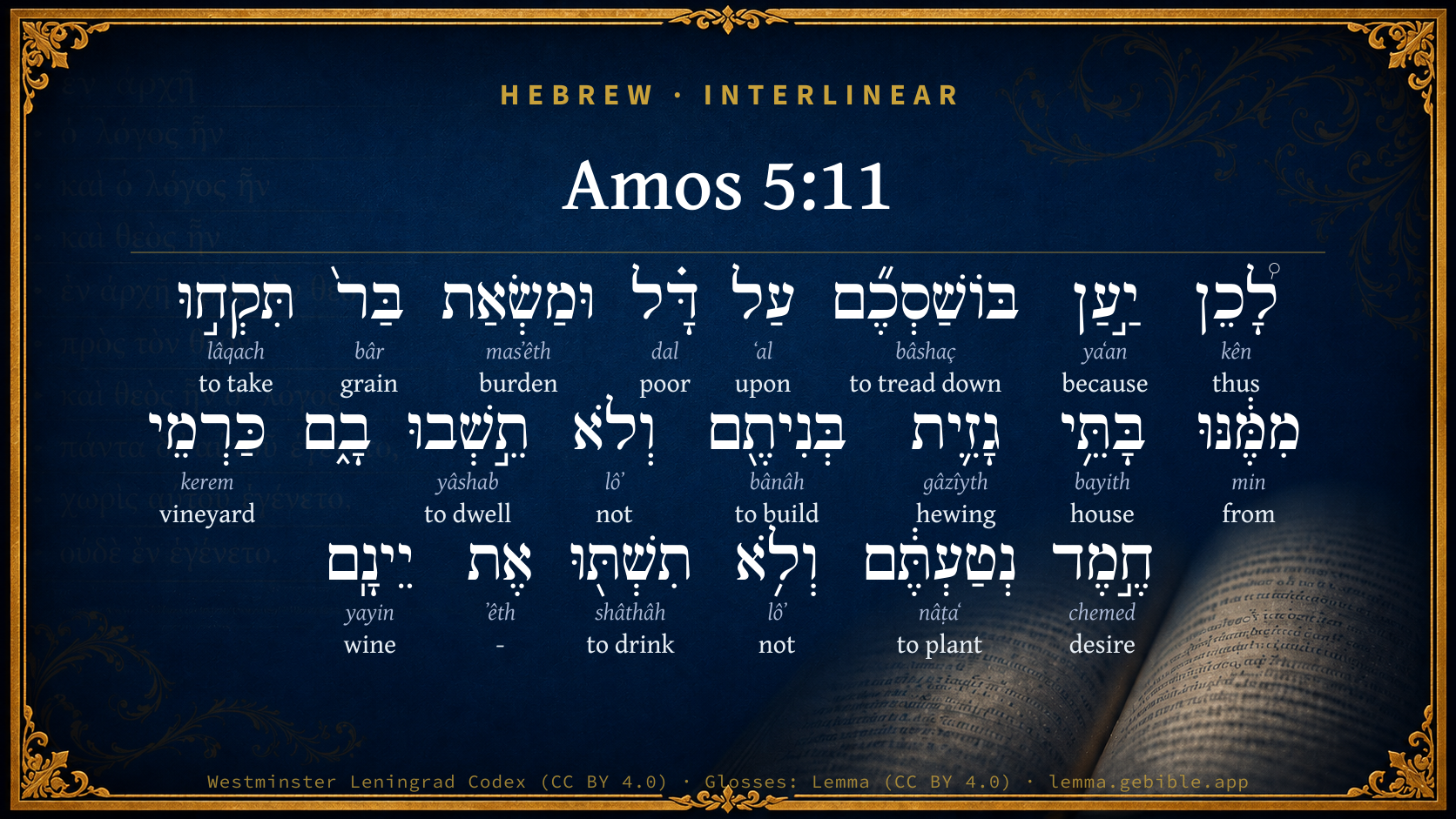
Amos 5:11

Hebrew (Westminster Leningrad Codex) Amos 5:11 appears in the Hebrew Old Testament. The text above is from the Westminster Leningrad Codex. Each word links to its Strong’s number, a concise gloss, and parsing drawn from the Open Scriptures Hebrew Bible morphology. Click any word for its full Brown-Driver-Briggs (BDB) entry.
Download image
Cite this verse

Amos 5:11 (World English Bible). Public Domain. Lemma interlinear Bible study tool, https://lemma.gebible.app/v/amos/5/11.

Show BibTeX & RIS
BibTeX
RIS
English Translation
Forasmuch therefore as you trample on the poor, And take taxes from him of wheat: You have built houses of hewn stone, But you will not dwell in them. You have planted pleasant vineyards, But you shall not drink their wine.
World English Bible · Public Domain
Highlights
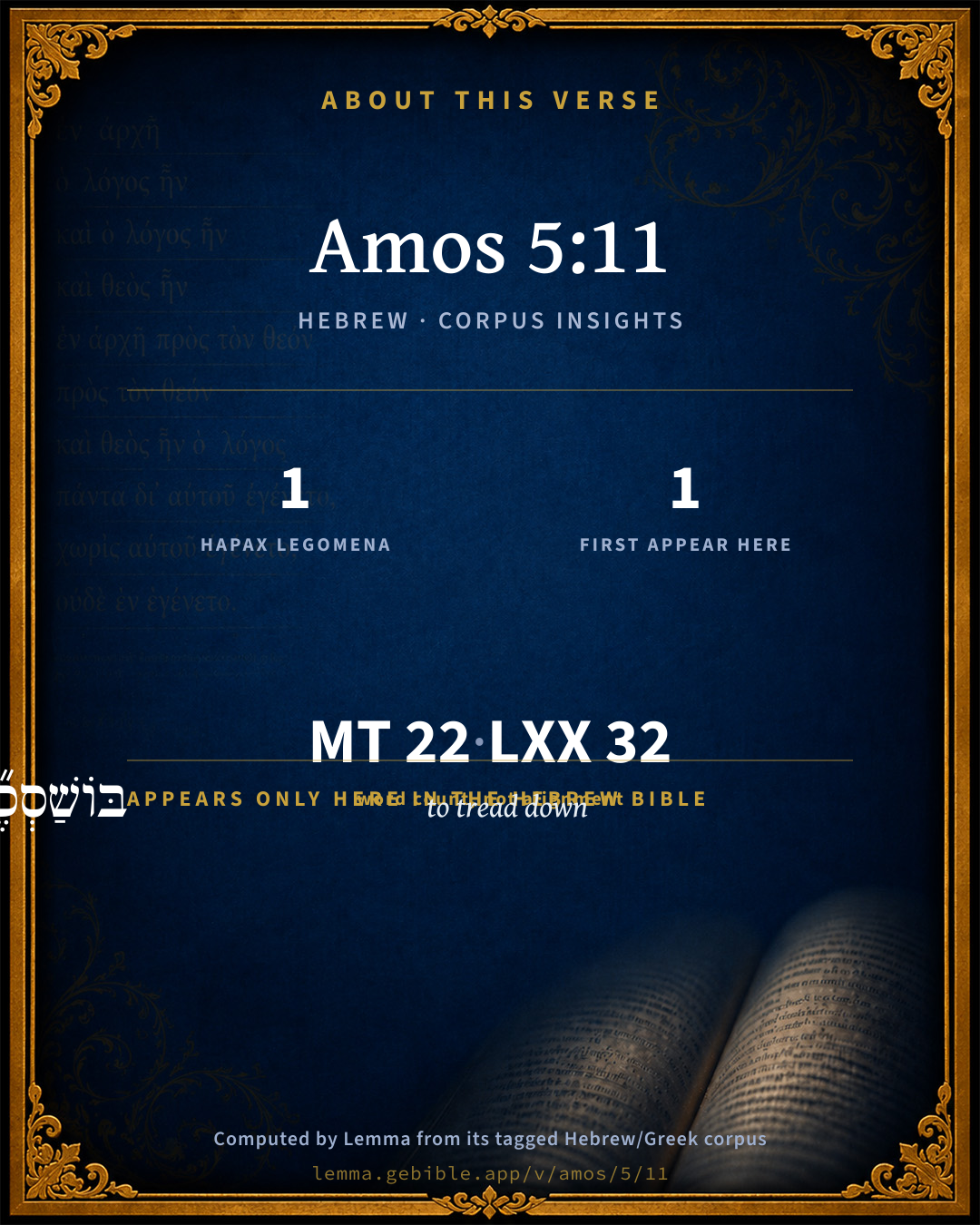
  • 1 hapax legomenon — only here in the Hebrew Bible
  • 1 first appearance in the Hebrew Bible
Full analysis ↓
Download a study sheet

One document with this verse’s original text, its word-by-word gloss line, the meaning frame, cross-references with their text, attributed commentary, and full source and license credits — printable, and it pastes into notes with its structure intact.

This verse Autodidact and up

Study sheet (.html) Plain text (.txt)

A passage Seminary Student

Up to 50 verses in one chapter. A passage sheet keeps up to 6 commentary sources and 12 cross-references per verse, in the order this page ranks them, and says so on the sheet whenever that leaves anything out. Ask for a single verse and you get the Autodidact verse sheet above.

Everything on this page stays free to read, with no account — the sheet is a download of what is already on screen, not access to it.

Want to remove ads? Support Godless Engineer
Compare translations 3

The same verse in 3 English versions, stacked beneath the original-language interlinear above. Click any original word for its lexicon entry.

Each is an independent rendering of the whole verse — the interlinear is not word-aligned to these translations.

Highlighted words mark where these versions differ — a whole-verse word diff, not a word-by-word alignment.

  • World English Bible Public Domain
    Forasmuch therefore as you trample on the poor, And take taxes from him of wheat: You have built houses of hewn stone, But you will not dwell in them. You have planted pleasant vineyards, But you shall not drink their wine.
  • King James Version Public Domain
    Forasmuch therefore as your treading is upon the poor, and ye take from him burdens of wheat: ye have built houses of hewn stone, but ye shall not dwell in them; ye have planted pleasant vineyards, but ye shall not drink wine of them.
  • unfoldingWord Literal Text CC BY-SA 4.0
    Therefore, because you trample down the poor and take portions of wheat from him— although you have built houses of worked stone, you will not live in them. You have delightful vineyards, but you will not drink their wine.

unfoldingWord Literal Text — © unfoldingWord, licensed CC BY-SA 4.0. Word-aligned USFM3 via Door43 (git.door43.org/unfoldingWord/en_ult).

Versions to compare (up to 4)

3 of 4 selected

Show all 18 translations

Every available English version of this verse, each an independent rendering of the whole verse.

  • World English Bible Public Domain
    Forasmuch therefore as you trample on the poor, And take taxes from him of wheat: You have built houses of hewn stone, But you will not dwell in them. You have planted pleasant vineyards, But you shall not drink their wine.
  • Berean Standard Bible Public Domain
    Therefore, because you trample on the poor and exact from him a tax of grain, you will never live in the stone houses you have built; you will never drink the wine from the lush vineyards you have planted.
  • Majority Standard Bible Public Domain
    Therefore, because you trample on the poor and exact from him a tax of grain, you will never live in the stone houses you have built; you will never drink the wine from the lush vineyards you have planted.
  • King James Version Public Domain
    Forasmuch therefore as your treading is upon the poor, and ye take from him burdens of wheat: ye have built houses of hewn stone, but ye shall not dwell in them; ye have planted pleasant vineyards, but ye shall not drink wine of them.
  • American Standard Version (1901) Public Domain
    Forasmuch therefore as ye trample upon the poor, and take exactions from him of wheat: ye have built houses of hewn stone, but ye shall not dwell in them; ye have planted pleasant vineyards, but ye shall not drink the wine thereof.
  • Revised Version (1885) Public Domain
    Forasmuch therefore as ye trample upon the poor, and take exactions from him of wheat: ye have built houses of hewn stone, but ye shall not dwell in them; ye have planted pleasant vineyards, but ye shall not drink the wine thereof.
  • Geneva Bible (1599) Public Domain
    Forasmuch then as your treading is vpon the poore, and yee take from him burdens of wheate, ye haue built houses of hewen stone, but ye shall not dwel in them: ye haue plated pleasant vineyards, but ye shall not drinke wine of them.
  • Douay-Rheims (1899) Public Domain
    Therefore because you robbed the poor, and took the choice prey from him: you shall build houses with square stone, and shall not dwell in them: you shall plant most delightful vineyards, and shall not drink the wine of them.
  • Young's Literal Translation Public Domain
    Therefore, because of your trampling on the poor, And the tribute of corn ye take from him, Houses of hewn work ye have built, And ye do not dwell in them, Desirable vineyards ye have planted, And ye do not drink their wine.
  • Literal Standard Version CC BY-SA 4.0
    Therefore, because of your trampling on the poor, || And the tribute of grain you take from him, || Houses of hewn work you have built, || And you do not dwell in them, || Desirable vineyards you have planted, || And you do not drink their wine.
  • Unlocked Literal Bible CC BY-SA 4.0
    Because you trample down the poor and take portions of wheat from him— although you have built houses of worked stone, you will not live in them. You have delightful vineyards, but you will not drink their wine.
  • unfoldingWord Literal Text CC BY-SA 4.0
    Therefore, because you trample down the poor and take portions of wheat from him— although you have built houses of worked stone, you will not live in them. You have delightful vineyards, but you will not drink their wine.
  • Darby Bible Public Domain
    Forasmuch, therefore, as ye trample upon the poor, and take from him presents of wheat: ye have built houses of hewn stone, but ye shall not dwell in them; ye have planted pleasant vineyards, and ye shall not drink the wine of them.
  • World Messianic Bible Public Domain
    Therefore, because you trample on the poor and take taxes from him of wheat, you have built houses of cut stone, but you will not dwell in them. You have planted pleasant vineyards, but you shall not drink their wine.
  • Webster's Bible Public Domain
    Forasmuch therefore as your treading is upon the poor, and ye take from him burdens of wheat: ye have built houses of hewn stone, but ye shall not dwell in them; ye have planted pleasant vineyards, but ye shall not drink wine of them.
  • Free Bible Version CC BY-SA 4.0
    Because you trample down the poor and impose a tax on their grain, building for yourselves impressive houses, you will not live in them, and you will not drink wine from the fine vineyards you have planted.
  • Bible in Basic English Public Domain
    So because the poor man is crushed under your feet, and you take taxes from him of grain: you have made for yourselves houses of cut stone, but you will not take your rest in them; the fair vine-gardens planted by your hands will not give you wine.
  • JPS Tanakh (1917) Public Domain
    Therefore, because ye trample upon the poor, and take from him exactions of wheat; ye have built houses of hewn stone, but ye shall not dwell in them, ye have planted pleasant vineyards, but ye shall not drink wine thereof.

Literal Standard Version (2020), Covenant Press — licensed CC BY-SA 4.0. Text via the HelloAO Bible API (eBible.org). Unlocked Literal Bible (unfoldingWord) — licensed CC BY-SA 4.0. Text via the HelloAO Bible API (eBible.org). unfoldingWord Literal Text — © unfoldingWord, licensed CC BY-SA 4.0. Word-aligned USFM3 via Door43 (git.door43.org/unfoldingWord/en_ult). Free Bible Version, Dr. Jonathan Gallagher — licensed CC BY-SA 4.0. Text via the HelloAO Bible API (eBible.org).

Word by word

More ways to search: Search by grammar → Find every occurrence → Compare this word →

Practice this passage: Drill this verse → Learn its vocabulary →

בּוֹשַׁסְכֶ֞ם
bâshaç
H1318
“to tread down · you”
Verb, Poel, Infinitive Construct + Suffix, Personal, 2nd Person, Masculine, Plural
Part of Speech
Verb
Stem
Poel
Form
Infinitive Construct
Full BDB Definition

Origin: a primitive root

TWOT: 294

to tread down, trample - (Poel) trampling
  1. לָ֠כֵן kên H3651 “to/for · thus” Preposition + Adverb
  2. יַ֣עַן yaʻan H3282 “because” Conjunction
  3. עַל ʻal H5921 “upon” Preposition
  4. דָּ֗ל dal H1800 “poor” Adjective, Adjective, Masculine, Singular, Absolute
  5. וּמַשְׂאַת masʼêth H4864 “and · burden of” Conjunction + Noun, Common, Feminine, Singular, Construct
  6. בַּר֙ bâr H1250 “grain” Noun, Common, Masculine, Singular, Absolute
  7. תִּקְח֣וּ lâqach H3947 “to take” Verb, Qal, Imperfect, 2nd Person, Masculine, Plural
  8. מִמֶּ֔נּוּ min H4480 “from · us” Preposition + Suffix, Personal, 1st Person, Common, Plural
  9. בָּתֵּ֥י bayith H1004 “houses of” Noun, Common, Masculine, Plural, Construct
  10. גָזִ֛ית gâzîyth H1496 “hewing” Noun, Common, Feminine, Singular, Absolute
  11. בְּנִיתֶ֖ם bânâh H1129 “to build” Verb, Qal, Perfect, 2nd Person, Masculine, Plural
  12. וְלֹא lôʼ H3808 “and · not” Conjunction + Particle, Negative
  13. תֵ֣שְׁבוּ yâshab H3427 “to dwell” Verb, Qal, Imperfect, 2nd Person, Masculine, Plural
  14. כַּרְמֵי kerem H3754 “vineyards of” Noun, Common, Both, Plural, Construct
  15. חֶ֣מֶד chemed H2531 “desire” Noun, Common, Masculine, Singular, Absolute
  16. נְטַעְתֶּ֔ם nâṭaʻ H5193 “to plant” Verb, Qal, Perfect, 2nd Person, Masculine, Plural
  17. וְלֹ֥א lôʼ H3808 “and · not” Conjunction + Particle, Negative
  18. תִשְׁתּ֖וּ shâthâh H8354 “to drink” Verb, Qal, Imperfect, 2nd Person, Masculine, Plural
  19. אֶת ʼêth H853 “-” Particle, Direct Object
  20. יֵינָֽם yayin H3196 “wine · their” Noun, Common, Masculine, Singular, Construct + Suffix, Personal, 3rd Person, Masculine, Plural

About this verse

These counts appear in no published source. They are computed here, from the morphology-tagged text and Lemma’s own curated glosses. What Lemma adds →

22
words
20
distinct lemmas
Prophets
section

Notable vocabulary

1 hapax legomenon — a word that appears only here in the entire Hebrew Bible:

  • בּוֹשַׁסְכֶ֞ם to tread down H1318

First appearance in Scripture

This word makes its first canonical appearance in the Hebrew Bible here:

  • בּוֹשַׁסְכֶ֞ם to tread down H1318

Shared distinctive vocabulary

חֶ֣מֶד desire H2531 occurs in 6 verses of the Hebrew Bible. Also found in:

Grammatical profile

  • 6 verbs
  • 7 nouns
  • 1 adjective
  • 3 prepositions
  • 1 conjunction
  • 1 adverb
  • 3 particles

Verb forms

  • בּוֹשַׁסְכֶ֞ם Poel · Infinitive Construct
  • תִּקְח֣וּ Qal · Imperfect
  • בְּנִיתֶ֖ם Qal · Perfect
  • תֵ֣שְׁבוּ Qal · Imperfect
  • נְטַעְתֶּ֔ם Qal · Perfect
  • תִשְׁתּ֖וּ Qal · Imperfect

Repetition

A word recurs within this verse — often emphatic in Hebrew:

  • וְלֹא not H3808 ×2

Hebrew & Septuagint length

In English translation the verse runs 41 words from the Hebrew and 44 from the Septuagint (LXX English) — closely comparable.

A rough comparison of the two English renderings, which tokenize alike — not a word-level alignment.

Word counts can differ between the Hebrew and the Greek without any difference in meaning — e.g. the Hebrew direct-object marker אֵת has no separate Greek word, and Greek often adds the article ὁ.

In the original languages it is 22 Hebrew tokens and 32 Greek tokens — but the two are counted differently (Hebrew bundles its prefixes and suffixes into one token; the Greek is in lemma form), so that isn’t a like-for-like length.

Cross-references

13

Topical passages linked to Amos 5:11 in the Treasury of Scripture Knowledge — connected by theme and wording, ordered by reader-vote popularity; previews shown in the World English Bible.

  • Deuteronomy 28:30 You shall betroth a wife, and another man shall lie with her: you shall build a house, and you shall not dwell therein: you shall plant a vineyard, and shall not use the fruit of it.
  • Micah 6:15 You will sow, but won't reap. You will tread the olives, but won't anoint yourself with oil; And crush grapes, but won't drink the wine.
  • Zephaniah 1:13 Their wealth will become a spoil, and their houses a desolation. Yes, they will build houses, but won't inhabit them. They will plant vineyards, but won't drink their wine.
  • James 2:6 But you have dishonored the poor man. Don't the rich oppress you, and personally drag you before the courts?
  • Haggai 1:6 You have sown much, and bring in little. You eat, but you don't have enough. You drink, but you aren't filled with drink. You clothe yourselves, but no one is warm, and he who earns wages earns wages to put them into a bag with holes in it."
  • Revelation 11:8–10 Their dead bodies will be in the street of the great city, which spiritually is called Sodom and Egypt, where also their Lord was crucified.
  • Amos 3:15–4:1 I will strike the winter house with the summer house; And the houses of ivory will perish, And the great houses will have an end," says Yahweh.
  • Micah 2:2 They covet fields, and seize them; And houses, and take them away: And they oppress a man and his house, Even a man and his heritage.
  • Micah 3:1–3 I said, "Please listen, you heads of Jacob, And rulers of the house of Israel: Isn't it for you to know justice?
  • Deuteronomy 28:38–39 You shall carry much seed out into the field, and shall gather little in; for the locust shall consume it.
  • Isaiah 5:7–8 For the vineyard of Yahweh of Hosts is the house of Israel, And the men of Judah his pleasant plant: And he looked for justice, but, behold, oppression; For righteousness, but, behold, a cry of distress.
  • Isaiah 59:13–14 transgressing and denying Yahweh, and turning away from following our God, speaking oppression and revolt, conceiving and uttering from the heart words of falsehood.
  • Isaiah 65:21–22 They shall build houses, and inhabit them; and they shall plant vineyards, and eat the fruit of them.

Cross-references courtesy of OpenBible.info (CC BY 4.0).

Hebrew and Greek witnesses Masoretic Hebrew ↔ Greek Septuagint

The same verse in the two great witnesses to the Old Testament, shown verse-for-verse.

These are two independent witnesses, not word-aligned to each other, and the Septuagint is shown in lemma (dictionary) form.

Hebrew Amos 5:11 Masoretic · Westminster Leningrad Codex

לָ֠כֵן יַ֣עַן בּוֹשַׁסְכֶ֞ם עַל דָּ֗ל וּמַשְׂאַת בַּר֙ תִּקְח֣וּ מִמֶּ֔נּוּ בָּתֵּ֥י גָזִ֛ית בְּנִיתֶ֖ם וְלֹא תֵ֣שְׁבוּ בָ֑ם כַּרְמֵי חֶ֣מֶד נְטַעְתֶּ֔ם וְלֹ֥א תִשְׁתּ֖וּ אֶת יֵינָֽם

Forasmuch therefore as you trample on the poor, And take taxes from him of wheat: You have built houses of hewn stone, But you will not dwell in them. You have planted pleasant vineyards, But you shall not drink their wine.

World English Bible · Public Domain

Greek LXX Amos 5:11 Septuagint · lemma form

διά οὗτος ἀντί ὅς κατακονδυλίζω πτωχός καί δῶρον ἐκλεκτός δέχομαι παρά αὐτός οἶκος ξυστός οἰκοδομέω καί οὐ μή καταοἰκέω ἐν αὐτός ἀμπελών ἐπιθυμητός φυτεύω καί οὐ μή πίνω ὁ οἶνος ἐκ αὐτός

Therefore because they have struck the poor with their fists, and you⌃ have received of them choice gifts; you⌃ have built polished houses, but you⌃ shall not dwell in them; you⌃ have planted desirable vineyards, but you⌃ shall not drink the wine of them.

LXX2012 (modern English Septuagint) · Public Domain

On this verse, The Pulpit Commentary discusses the Septuagint’s reading. Read the note in Commentary ↓

Hebrew: Westminster Leningrad Codex (CC BY 4.0). Greek: Septuagint (public domain); English from LXX2012 (modern English Septuagint) (Public Domain). How the Septuagint differs from the Hebrew →

Targum (Aramaic paraphrase)

1

The Targum is the ancient Jewish Aramaic paraphrase of the Hebrew Scriptures — an interpretive translation, not the Hebrew text itself. Onkelos (literal) and Pseudo-Jonathan (expansive) render the Torah, and Jonathan the Prophets. Coverage is partial: where no permissively-licensed English translation exists for a verse, only the Aramaic is shown. This is verse-level text, not a word-by-word alignment to the Hebrew.

  1. Targum Jonathan Prophets (Joshua–Malachi)
    בְּכֵן חֲלַף בְּמִבִּזְכוֹן מִסְכֵּנַיָא וּמְנַסְכוֹן חֲשִׁיכַיָא בָתֵּי גְזִית בְּנִיתוּן וְלָא תֵיתְבוּן בְּהוֹן כַּרְמֵי חֶמְדָתָא נְצִבְתּוּן וְלָא תִשְׁתּוּן יַת חַמְרְהוֹן:

    (no public-domain English translation for this verse)

    Targum Jonathan — Aramaic: “Mikraot Gedolot” (public domain). English: “Sefaria Community Translation” (CC0 1.0 (public-domain dedication)); “London "Chaldee Paraphrase," 1871” (public domain). Text via Sefaria.

Commentary

Notes on Amos 5:11 from classic Christian and Jewish commentators (each source and its license shown beneath its notes). The classic Christian expositions comment on the surrounding passage and are grouped to its opening verse, so a note may address several verses; the Jewish commentaries on the Tanakh (Rashi and others) are per-verse, so they appear only where the commentator wrote on this verse.

Lemma curates 59 commentaries, every one of them public domain or Creative Commons licensed, each selected and text-cleaned for this edition rather than reprinted as found. About our sources →

Joseph Benson's Commentary

Amo 5:11-13. Forasmuch, therefore, as your treading is upon the poor — It appears by this, that their acts of oppression were more than ordinarily proud and tyrannical. They were the effect of fraud executed with insolence, as the word treading, and the subsequent clause, added in explanation of it, signify. And ye take from him burdens of wheat — This expresses the most grievous inhumanity, implying that they took from the poor their very sustenance by acts of injustice and violence. Ye have built houses of hewn stone, but shall not dwell in them — God often threatens to deprive men of the enjoyment of their ill-gotten substance. For I know your manifold transgressions and mighty sins — Your daring impieties, your sins of the first magnitude, such as idolatry and oppression, reproved in the foregoing part of this chapter. Therefore the prudent shall keep silence in that time — So great is the corruption of manners, and such the insolence of power, that the prudent man, though he be virtuous, and abhor such doings, yet will incline to be silent, perceiving that his speaking by way of reproof or exhortation to others will only bring danger on himself, and be of no real use.

Joseph Benson's Commentary on the Old and New Testaments (1811–1818) — public domain. Text from a community e-Sword module.

Tyndale Open Study Notes

Tyndale Open Resources

5:11 stone houses: Again, Amos targets the rich. The houses of peasants were built of mud brick. Cut stone, the result of laborious handwork, was very expensive.

Tyndale Open Study Notes — © Tyndale Open Resources, licensed CC BY-SA 4.0. Text via the HelloAO Bible API.

Geneva Bible (1599)

Geneva Bible translators

Ye take both his money and also his food, wherewith he should live.

Geneva Bible (1599) marginal notes — public domain. Text via Bolls.life.

Jamieson, Fausset & Brown

Robert Jamieson, A. R. Fausset & David Brown

burdens of wheat--burdensome taxes levied in kind from the wheat of the needy, to pamper the lusts of the great [HENDERSON]. Or wheat advanced in time of scarcity, and exacted again at a burdensome interest [RABBI SALOMON].

built houses . . . but not dwell in them . . . vineyards, . . . but not drink wine of them--according to the original prophecy of Moses (Deu 28:30, Deu 28:38-39). The converse shall be true in restored Israel (Amo 9:14; Isa 65:21-22).

Jamieson, Fausset & Brown — Commentary Critical and Explanatory on the Whole Bible (1871) — public domain (CC PDM 1.0). Text via the HelloAO Bible API.

Adam Clarke's Commentary

Verse 11. Your treading is upon the poor] You tread them under your feet; they form the road on which ye walk; and yet it was by oppressing and improverishing them that ye gained your riches.

Ye take from him burdens of wheat] Ye will have his bread for doing him justice.

Adam Clarke's Commentary on the Bible (1810–1826) — public domain. Text from a community e-Sword/MySword module.

John Calvin's Commentaries

The Prophet here declares, that though the judges enriched themselves by plunder, yet God would not allow them to enjoy their booty, but that he would deprive them of the great wealth they had accumulated. This is the import of the whole. We hence see that the Prophet contends not here with the common people, but professedly attacks the chief men, inasmuch as from them did proceed all the prevailing evil.

The first thing is, they imposed burdens on the poor, and then, they took away corn from them He says first, “A burden have you laid”, or, “ye have trodden on the poor;” for the verb may be taken in either sense, and it matters not which as to the import of the passage. It is not indeed often that we meet with a verb of four letters; but interpreters explain this as meaning to tread under foot or to lay a burden. The Prophet, I doubt not, accuses here the judges of not sparing miserable men, but of burdening them with tributes and exactions; for this is to burden the poor. Then he adds, “Ye have taken a load of corn”. The Prophet had doubtless fixed here on a species of cruelty in robbing others, the most detestable. When judges take money, or any other gift, it is less odious than when the poor are compelled to carry corn to them on their shoulders. It was the same as though they surrendered their very life to their plunderers; for when judges constrained loads of corn to be brought to them, it was as though they strangled the poor, or drew blood from their veins, inasmuch as they robbed them of their food and support. We now perceive what the Prophet meant: You have, he says, oppressed the poor, and taken from them a load of corn. Some render בר, ber, chosen, but improperly.

Ye shall therefore build, etc. He declares here that they would not realize their hope, though they plundered on all sides to build palaces, and though they got great possessions to enrich themselves and their heirs: “This self-love,” he says, “will deceive you; defraud, rob, plunder; but the Lord will at length strip you of all your robberies: for after having been venal, and prostituted not only your souls but your shame for gain, and after having spent much labor and expense in building, ye shall not dwell in your palaces; and when ye shall have planted vineyards with great expense and care, ye shall not drink their wine.” Isaiah also speaks in the same strain,

‘O plunderer, thou shalt be exposed to plunders’ (Isaiah 33:1)

Experience also teaches the same thing; for we see how the Lord transfers from one to another the possessions of this world: he who seems to provide riches after his death for his heirs for ever, passes his whole life, as we see, without enjoying his own property; for he is hungry in the midst of the greatest abundance, and even famishes himself. This is very frequently the case. And then when his abundance comes to his heirs, it falls into the hands of prodigals, who soon dissipate the whole. And sometimes the Lord allows not that such vast wealth should have heirs, and it is scattered here and there, and the very name is extinguished, though the name to such haughty and wealthy men is a great object, as they commonly wish it to be eminent in the world for some hundred ages after their death.

This passage of the Prophet ought therefore to be especially noticed. He tells us that unjust gains were laid up by these robbers and wicked plunderers, in order to amass great riches; but he adds, “The Lord will spoil them, and will not suffer them to enjoy their abundance, however anxiously they had collected it from all quarters.” Let us now proceed —

John Calvin's Commentaries (1540-1563) — public domain. Text from the Calvin Translation Society English edition (1840s-50s) via the Christian Classics Ethereal Library (ccel.org). Calvin's coverage is partial (roughly two-thirds of the Bible); uncommented books and verses are honest gaps, never fabricated. The 19th-century editor's footnotes and remarks are omitted so the notes are faithfully Calvin's own voice.

Ellicott's Commentary for English Readers

(11) Burdens of wheat.—i.e., Ye take gifts of sifted corn, as a contribution to your own luxury, and which the poor man was not bound to offer, and only would offer to purchase your good will. Therefore your pomp and luxury shall be of no avail. Such is God’s judgment on indifference to the wants and feedings of the poor.

A Bible Commentary for English Readers, edited by Charles John Ellicott (1878–1897) — public domain. Text from a community e-Sword module.

The Cambridge Bible for Schools and Colleges

gen. ed. J. J. S. Perowne

11. The penalty for such unjust oppression of the poor is the oppressors’ own disappointment and spoliation: the houses and vineyards on which they lavished their money, and from which they expected much enjoyment, will be violently taken from them.

Therefore, because ye trample upon the poor, and take from him exactions of wheat] The allusion is not specially to bribes exacted of the poor as the price of justice, but to the presents which the poor fellahin had to offer to the grasping aristocrats, out of the hard-won produce of their toil.

ye have built houses of hewn stone, but ye shall not dwell in them, &c.] For the form of the threat, comp. Deu_28:30; Deu_28:38-39; Mic_6:15; Zep_1:13; and contrast the promise of Amo_9:14. Houses of ‘hewn stone’ are houses of exceptional solidity and beauty, such as might be built by the wealthy (cf. Isa_9:10).

The Cambridge Bible for Schools and Colleges (gen. ed. J. J. S. Perowne; Cambridge University Press, 1878–1918) — public domain. Text from a community e-Sword module.

John Gill's Exposition

Forasmuch therefore as your treading is upon the poor,.... This seems to be spoken to the princes, judges, and civil magistrates, as Kimchi observes; who oppressed the poor and needy, and crushed them to the ground, trampled upon them, stripped them of the little substance they had, and left them destitute; exercising a cruel and tyrannical power over them, they having none to stand by them, and deliver them:

and ye take from him burdens of wheat; which perhaps he had been gleaning in the field, and was carrying home for the support of his family; or which he had gotten with great labour, and was all he had in the world: this they took away from him, for the payment of pretended debts, or lawsuits; or as not in right belonging to him, but taken out of fields where he should not have entered:

ye have built houses of hewn stones; in a very grand and pompous manner for themselves and their children, with money they had extorted from the poor, and got by oppression and injustice:

but ye shall not dwell in them; at least but a very short time; for quickly and suddenly the enemy will come and turn you out of them, and destroy them, which would be a just retaliation for their spoiling the houses of the poor:

ye have planted pleasant vineyards: well situated, and filled with the choicest vines, which promise a large produce of the best wine:

but ye shall not drink wine of them; for before the grapes are fully ripe they should be either taken away by death, or be carried captive, and others should dwell in their houses, and drink the wine of their vineyards.

John Gill's Exposition of the Whole Bible (1746–1763) — public domain (CC PDM 1.0). Text via the HelloAO Bible API.

Albert Barnes' Notes on the Bible

Forasmuch therefore - (Since they rejected reproof, he pronounces the sentence of God upon them,) “as your treading is upon the poor.” This expresses more habitual trampling on the poor, than if he had said, “ye tread upon the poor.” They were ever trampling on those who were already of low and depressed condition. “And ye take from him burdens of wheat, presents of wheat.” The word always signifies presents, voluntary , or involuntary , what was carried, offered to anyone. They received “wheat” from the poor, cleansed, winnowed, and “sold the refuse Amo 8:6, requiring what it was wrong to receive, and selling what at the least it was disgraceful not to give. God had expressly forbidden to “lend food for interest” Lev 25:37; Deu 23:19. It may be that, in order to evade the law, the interest was called “a present.”

Ye have built house of hewn stone - The houses of Israel were, perhaps most commonly, built of brick dried in the sun only. As least, houses built of hewn stone, like most of our’s, are proverbially contrasted with them, as the more solid with the more ordinary building. “The white bricks are fallen down, and we will build with hewn, stones” Isa 9:10. And Ezekiel is bidden to dig through the wall of his house Eze 12:5, Eze 12:7. Houses of stone there were, as appears from the directions as to the unhealthy accretions, called the leprosy of the house Lev 14:34-48. It may be, however, that their houses of “hewn stone,” had a smoothed surface, like our “ashlar.” Anyhow, the sin of luxury is not simply measured by the things themselves, but by their relation to ourselves and our condition also; and wrong is not estimated by the extent of the gain and loss of the two parties only, but by the injury inflicted.

These men, who built houses, luxurious for them, had wrung from the poor their living, as those do, who beat down the wages of the poor. Therefore they were not to take possession of what was their own; as Ahab, who by murder possessed himself of Naboth’s vineyard, forfeited his throne and his life. God, in the law, consulted for the feeling which desires to enter into the fruit of a man’s toil. When they should go to war they were to proclaim, “what man” is there that hath built a new house, and hath not dedicated it? let him go and return to his house, lest he die in the battle, and another man dedicate it. And what man is he that hath planted a vineyard and hath not eaten of it? let him go. and return unto his house, lest he die in the battle and another man eat of it” Deu 20:5-6. Now God reversed all this, and withdrew the tender love, whereby He had provided it. The words, from their proverbial character, express a principle of God’s judgments, that wrong dealing, whereby a man would secure himself or enlarge his inheritance, destroys both. Who poorer than our Lord, bared of all upon the Cross, of whom it had been written, “They persecuted the poor helpless man, that they might slay him who was vexed at the heart” Psa 109:15, and of whom the Jews said, “Come let us kill Him, that the inheritance may be ours?” Mat 21:38. They killed Him, they said, “lest the Romans take away our place and nation” Joh 11:48. “The vineyard was taken from them;” their “place” destroyed, their “nation” dispersed.

Albert Barnes' Notes on the Bible (1834–1885) — public domain. Text from a community e-Sword/MySword module.

Matthew Poole's English Annotations

Your treading; their oppression was more than ordinarily proud and tyrannous, expressed here by treading. It was very heavy on the poor, an effect of fraud, and executed with tyrannical insolence, as the word and its paraphrase imports.

Is upon the poor, who have not power to withstand your violence, nor money to buy your friendship.

Ye take from him, receive when offered, and ye force them to offer, you extort from the poor,

burdens of wheat; great quantities of best wheat, on which the poor should live, either making bread of it to feed them, or else making money of it to serve other occasions. It is not said what burden, but probably as much as the poor man was able to carry.

Ye have built houses; perhaps these corrupt judges had built for their children; so one greedy and ravenous judge might build as many houses as he had sons, or these judges being many, had built many houses.

Of hewn stone; intimating the greatness, beauty, and strength of them, and they flatter themselves that they and their posterity shall long dwell at ease and multiply in these goodly houses.

But ye shall not dwell in them; you by oppression build, but God will by his just hand, and by the Assyrians’ violence, turn you out of those houses, and make you captives in a land where your enemies please to carry you, you shall find that, Deu 28:30, fulfilled on you.

Pleasant vineyards; most desirable for situation, for fruitfulness, for sweetness and goodness of the grape; every way delightful.

But ye shall not drink wine of them; either they shall not bear, or the enemy shall devour, or you shall be carried away into captivity. The threat, Deu 28:39, shall be executed.

Matthew Poole's English Annotations on the Holy Bible (1683–1685) — public domain. Text from a community e-Sword/MySword module.

Whedon's Commentary on the Bible

Daniel D. Whedon

11-13. Israel’s moral depravity demands speedy judgment. The sin which arouses the indignation of the prophet most is the oppression of the poor (Amo_2:6-7). In punishment the unjustly gained possessions will be withdrawn.

Therefore — Introduces the sentence, as in Amo_3:11; Amo_4:12.

Your treading is upon the poor — R.V., “ye trample upon the poor.” A figure of excessive cruelty (compare Amo_2:7).

Take from him burdens [“exactions”] of wheat — This corn tax does not refer to bribes given to corrupt judges, but to “presents which the poor fellahin had to offer to the grasping aristocrats” in order to secure permission to retain at least a part of their products (1Sa_25:7 ff.).

Hewn stone — In ancient times the houses of the Israelites were built of baked or sun-dried bricks; the use of hewn stone, a sign of wealth and luxury, may have been introduced during the prosperous eighth century B.C. The means which enabled the rich to build these houses were acquired by oppression (Mic_3:10). But Jehovah will drive them from the magnificent palaces.

Pleasant vineyards — The vineyards in the fruit of which they expected to take delight. In these expectations also they will be disappointed (Deu_28:30; Deu_28:38-39; Isa_5:8-10; Zep_1:13; compare Amo_9:14). In order to secure a more perfect parallelism, consisting of three sentences, each having a protasis and an apodosis, Hitzig suggests as a better translation for the first two clauses, “Forasmuch, therefore, as ye trample upon the poor, ye shall take presents from him of wheat”; that is, you will become so poor that you will be compelled to accept alms from him who is now poor.

In justification of this sentence the prophet continues, in Amo_5:12-13, the description of the deplorable condition, the maladministration of justice receiving the severest condemnation. In Amo_5:12 the translation of R.V. is to be preferred: “For I know how manifold are your transgressions, and how mighty are your sins — ye that afflict the just, that take a bribe, and that turn aside the needy in the gate from their right.” The popular idea was that Jehovah took little or no notice of their conduct (Hos_7:2); he assures them that he knows both the magnitude and the multitude of their sins.

Afflict — G.A. Smith, “browbeat.”

Just — See on righteous (Amo_2:6).

Bribe — The Hebrew word so translated is used ordinarily in the sense of ransom, the price paid for a life (Exo_21:30). Num_35:31, forbids the taking of a ransom for the life of a murderer. In the light of this passage the words of Amos are thought by some to be a condemnation of the judges who allow rich murderers to escape capital punishment on the payment of an illegal ransom. It is not impossible, however, that here, as in 1Sa_13:3, the word is used in the more general sense suggested by the English bribe, an illegal gift presented to the judge to secure exemption from merited punishment of any sort. Turn aside the poor [“needy”] — Discrimination was shown against the needy, who were unable to offer bribes (Isa_1:23; Isa_10:2; compare Isa_1:17; Exo_23:6, etc.).

In the gate — See on Amo_5:10.

Marti thinks that Amo_5:13 bears every mark of a later interpolation, but without good reason, for the verse fits admirably, not as a reiteration of the announcement of judgment but as an additional indication of the hopelessness of the present situation. No longer are any attempts made to bring about a reformation.

The prudent — The worldly wise, who knows when he is well off, and who is interested primarily in his own welfare. There is no indication that Amos approves the attitude of these prudent men; he simply states a fact. He himself, caring first of all for the interests of the people, does not and cannot keep silent (Amo_3:8; Amo_7:15).

Shall keep silence — Better, does keep silent; does not lift up his voice in rebuke or exhortation, because he fears the hostility of the powerful.

In that time — R.V., “such a time” — as described in Amo_5:12.

An evil time — Not only because exhortation is futile, but also because personal inconvenience and suffering come to him who attempts to stem the tide.

Daniel D. Whedon (gen. ed.), Commentary on the Old and New Testaments (1874–1909) — public domain. Text from a community e-Sword module.

The Pulpit Commentary

Therefore. Because ye refuse reproof, and oppress the poor. Your treading is upon the poor; ye trample upon. The Hebrew word boshes is found nowhere else, and is variously explained. Septuagint, katekondulizon, "smote with the fists;" so the Syriac; Vulgate, diripiebatis, with which the Chaldee agrees. Keil, Schegg, and most modern commentators explain the word, by a slight dialectical variation, as equivalent to conculcare. Burdens of wheat; rather, tribute, exactions of wheat, or presents like enforced "benevolences." They exacted such gifts before they would do justice to the poor. Or it may refer to interest for money or victuals lent, which took the form of presents in order to evade the Law (Exo_22:25; Lev_25:37; Deu_23:19) Septuagint, dwra ejklekta: Vulgate, praedam electam, the Hebrew word bar meaning either "wheat" or "elect." Hewn stone. Houses thus built were a mark of luxury and wealth, sun-dried brick being the usual material employed. (comp. Isa_9:10; Eze_12:5, Eze_12:7) Ye shall not dwell in them. This is the punishment of their evil doings, according to the threat Deu_28:30, Deu_28:39. The people shall be banished and the land desolated (Mic_6:15; Zep_1:13)

The Pulpit Commentary (1880–1919), ed. H.D.M. Spence-Jones & Joseph S. Exell — public domain. Text from a community e-Sword module.

John Wesley's Explanatory Notes

Your treading - You utterly oppress the helpless. Ye take - Ye extort from the poor great quantities of wheat, on which he should live.

John Wesley, Explanatory Notes Upon the Whole Bible (1754–1765) — public domain. Text via the GEBible commentary corpus.

Rashi

Rabbi Shlomo Yitzchaki (Rashi)

you have trodden Heb. בּוֹשַׁסְכֶם, like בּוֹסַסְכֶם, you have trodden on the poor, that you trample and tread on his head. Like (Jer. 12:10) “They have trampled (בּוֹסְסוּ) My field.”

and the burden of grain you take—The settling of the balance as a loan, that you raised the market price for them immediately to sell them grain with interest, in order to take their estate from them. Therefore, houses and vineyards that you have built and planted on those estates shall not remain in your hands. and the burden Heb. מַשְׂאֵת, an expression of מַשָּׂא, a burden, which they make heavy upon them.

precious vineyards Heb. כַּרְמֵי חֶמֶד.

Rashi on the Tanakh — English translations: “The Judaica Press complete Tanach with Rashi, translated by A. J. Rosenberg” (CC BY 4.0); “Pentateuch with Rashi's commentary by M. Rosenbaum and A.M. Silbermann, 1929-1934” (public domain); “The Metsudah Tanach series, Lakewood, N.J” (CC BY 4.0); and “The Book of Joshua, Metsudah Publications, 1997” (CC BY 4.0). Text via Sefaria.

Lesson kit

Teaching starters — assembled from the data on this page, not authored interpretation. Every prompt links to the verse data it draws on. Edit before teaching.

Amos, in the Prophets, opens this verse with 22 words (20 distinct Hebrew lemmas). Its most distinctive word is bâshaç (“to tread down”). A historical commentator’s framing appears above. Read the whole chapter for the surrounding context.

Discussion questions

  1. How does “to tread down” (bâshaç) shape what this verse is saying?
  2. 1 word here appears nowhere else in the Hebrew Bible. Why might the author reach for such rare wording?
  3. This is the first place “to tread down” appears in Scripture (first appears here). What does its debut here establish?
  4. How does Isaiah 27:2, which shares the word «desire», read alongside this verse?
  5. What does the repetition of “not” (2× in this one verse) do in this verse?
  6. The translations on this page render this verse differently — a whole-verse word diff, not a word-by-word alignment. What might account for the different wordings?
  7. «בּוֹשַׁסְכֶ֞ם» is a Poel Infinitive Construct verb. How does that grammatical form shape the action described?
  8. Compare how Joseph Benson's Commentary and Tyndale Open Study Notes read this verse. Where do they agree or differ?

Things to notice

  • 1 word in this verse appears nowhere else in the Hebrew Bible.
  • 1 word makes its first canonical appearance in Scripture here.
  • This verse counts 22 Hebrew ↔ 32 Greek words.
  • These translations choose different wording for 20 words in this verse.
  • “not” occurs 2× in this single verse.

Reading settings

Reading text

Shown beneath each verse's original-language words.

Old Testament
Old Testament edition

Read the OT as the Masoretic Hebrew (MT) or the Greek Septuagint (LXX).

English shown for the Greek Septuagint (in the Hebrew ↔ Greek comparison).

Comparing translations? Open the Compare panel on any verse page to stack up to four side by side.