
Leviticus 7:18

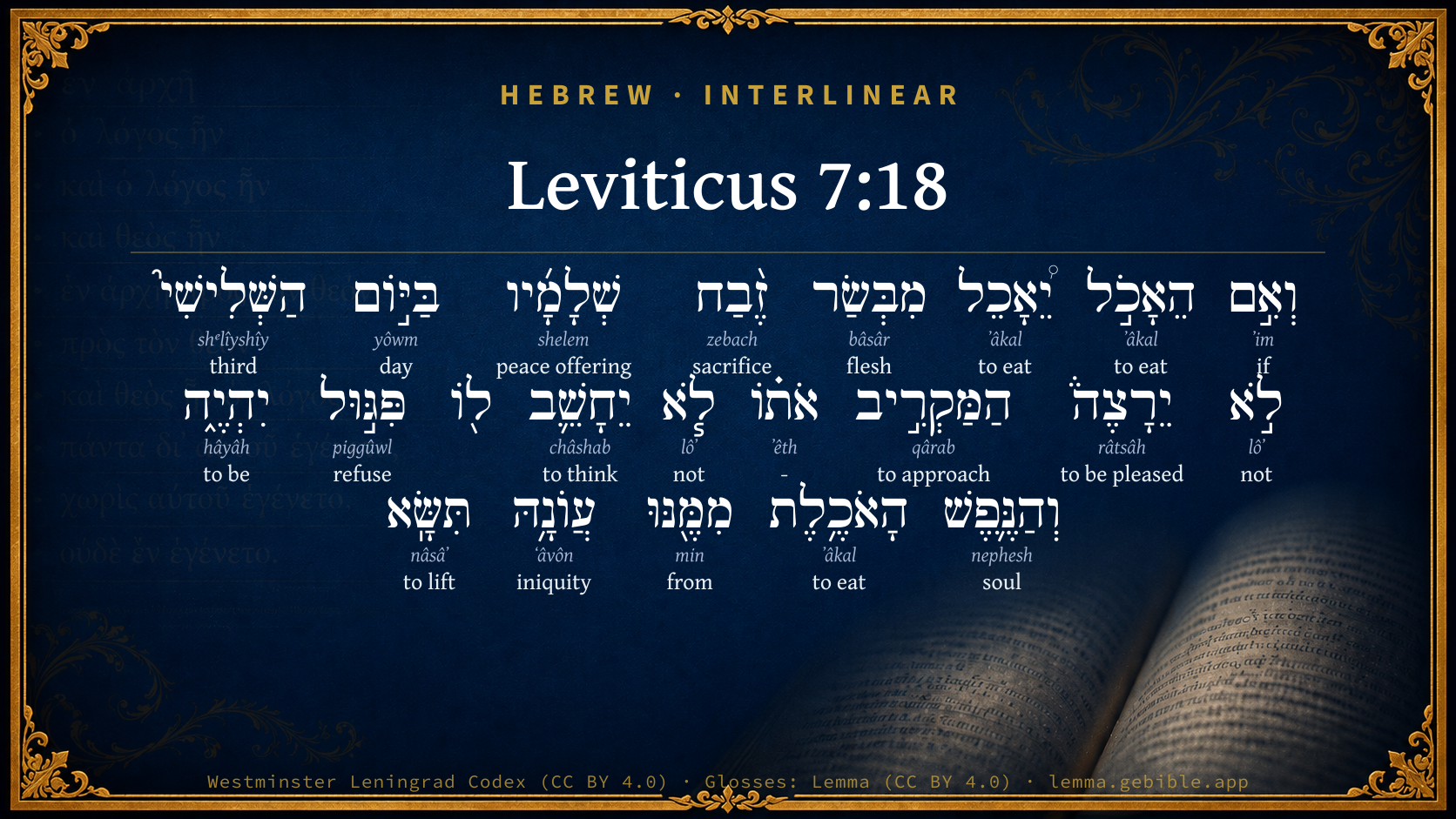
Hebrew (Westminster Leningrad Codex) Leviticus 7:18 appears in the Hebrew Old Testament. The text above is from the Westminster Leningrad Codex. Each word links to its Strong’s number, a concise gloss, and parsing drawn from the Open Scriptures Hebrew Bible morphology. Click any word for its full Brown-Driver-Briggs (BDB) entry.
Download image
Cite this verse

Leviticus 7:18 (World English Bible). Public Domain. Lemma interlinear Bible study tool, https://lemma.gebible.app/v/leviticus/7/18.

Show BibTeX & RIS
BibTeX
RIS
English Translation
If any of the flesh of the sacrifice of his peace offerings is eaten on the third day, it will not be accepted, neither shall it be imputed to him who offers it. It will be an abomination, and the soul who eats any of it will bear his iniquity.
World English Bible · Public Domain
Highlights Full analysis ↓
Download a study sheet

One document with this verse’s original text, its word-by-word gloss line, the meaning frame, cross-references with their text, attributed commentary, and full source and license credits — printable, and it pastes into notes with its structure intact.

This verse Autodidact and up

Study sheet (.html) Plain text (.txt)

A passage Seminary Student

Up to 50 verses in one chapter. A passage sheet keeps up to 6 commentary sources and 12 cross-references per verse, in the order this page ranks them, and says so on the sheet whenever that leaves anything out. Ask for a single verse and you get the Autodidact verse sheet above.

Everything on this page stays free to read, with no account — the sheet is a download of what is already on screen, not access to it.

Want to remove ads? Support Godless Engineer
Compare translations 3

The same verse in 3 English versions, stacked beneath the original-language interlinear above. Click any original word for its lexicon entry.

Each is an independent rendering of the whole verse — the interlinear is not word-aligned to these translations.

Highlighted words mark where these versions differ — a whole-verse word diff, not a word-by-word alignment.

  • World English Bible Public Domain
    If any of the flesh of the sacrifice of his peace offerings is eaten on the third day, it will not be accepted, neither shall it be imputed to him who offers it. It will be an abomination, and the soul who eats any of it will bear his iniquity.
  • King James Version Public Domain
    And if any of the flesh of the sacrifice of his peace offerings be eaten at all on the third day, it shall not be accepted, neither shall it be imputed unto him that offereth it: it shall be an abomination, and the soul that eateth of it shall bear his iniquity.
  • unfoldingWord Literal Text CC BY-SA 4.0
    And if some of the meat of the sacrifice of his peace offering is eaten, being eaten on the third day, the person who presented it will not be accepted; it will not be accounted to him. It will be defiled. And the person, the one eating from it, he will bear his iniquity.

unfoldingWord Literal Text — © unfoldingWord, licensed CC BY-SA 4.0. Word-aligned USFM3 via Door43 (git.door43.org/unfoldingWord/en_ult).

Versions to compare (up to 4)

3 of 4 selected

Show all 18 translations

Every available English version of this verse, each an independent rendering of the whole verse.

  • World English Bible Public Domain
    If any of the flesh of the sacrifice of his peace offerings is eaten on the third day, it will not be accepted, neither shall it be imputed to him who offers it. It will be an abomination, and the soul who eats any of it will bear his iniquity.
  • Berean Standard Bible Public Domain
    If any of the meat from his peace offering is eaten on the third day, it will not be accepted. It will not be credited to the one who presented it; it shall be an abomination, and the one who eats of it shall bear his iniquity.
  • Majority Standard Bible Public Domain
    If any of the meat from his peace offering is eaten on the third day, it will not be accepted. It will not be credited to the one who presented it; it shall be an abomination, and the one who eats of it shall bear his iniquity.
  • King James Version Public Domain
    And if any of the flesh of the sacrifice of his peace offerings be eaten at all on the third day, it shall not be accepted, neither shall it be imputed unto him that offereth it: it shall be an abomination, and the soul that eateth of it shall bear his iniquity.
  • American Standard Version (1901) Public Domain
    And if any of the flesh of the sacrifice of his peace-offerings be eaten on the third day, it shall not be accepted, neither shall it be imputed unto him that offereth it: it shall be an abomination, and the soul that eateth of it shall bear his iniquity.
  • Revised Version (1885) Public Domain
    And if any of the flesh of the sacrifice of his peace offerings be eaten on the third day, it shall not be accepted, neither shall it be imputed unto him that offereth it: it shall be an abomination, and the soul that eateth of it shall bear his iniquity.
  • Geneva Bible (1599) Public Domain
    For if any of the flesh of his peace offrings be eaten in the third day, he shall not be accepted that offereth it, neither shall it be reckoned vnto him, but shalbe an abomination: therefore ye person that eateth of it shall beare his iniquitie.
  • Douay-Rheims (1899) Public Domain
    If any man eat of the flesh of the victim of peace offerings on the third day, the oblation shall be of no effect, neither shall it profit the offerer: yea rather whatsoever soul shall defile itself with such meat, shall be guilty of transgression.
  • Young's Literal Translation Public Domain
    and if any of the flesh of the sacrifice of his peace-offerings be really eaten on the third day, it is not pleasing; for him who is bringing it near it is not reckoned; it is an abominable thing, and the person who is eating of it his iniquity doth bear.
  • Literal Standard Version CC BY-SA 4.0
    and if any of the flesh of the sacrifice of his peace-offerings is eaten at all on the third day, it is not pleasing; it is not reckoned for him who is bringing it near; it is an abomination, and the person who is eating of it bears his iniquity.
  • Unlocked Literal Bible CC BY-SA 4.0
    If any of the meat of the sacrifice of one's peace offering is eaten on the third day, it will not be accepted, neither will it be credited to the one who offered it. It will be a disgusting thing, and the person who eats it will carry the guilt of his sin.
  • unfoldingWord Literal Text CC BY-SA 4.0
    And if some of the meat of the sacrifice of his peace offering is eaten, being eaten on the third day, the person who presented it will not be accepted; it will not be accounted to him. It will be defiled. And the person, the one eating from it, he will bear his iniquity.
  • Darby Bible Public Domain
    And if [any] of the flesh of the sacrifice of his peace-offering be eaten at all on the third day, it shall not be accepted, it shall not be reckoned to him that hath presented it; it shall be an unclean thing, and the soul that eateth of it shall bear his iniquity.
  • World Messianic Bible Public Domain
    If any of the meat of the sacrifice of his peace offerings is eaten on the third day, it will not be accepted, and it shall not be credited to him who offers it. It will be an abomination, and the soul who eats any of it will bear his iniquity.
  • Webster's Bible Public Domain
    And if any of the flesh of the sacrifice of his peace-offerings shall be eaten at all on the third day, it shall not be accepted, neither shall it be imputed to him that offereth it; it shall be an abomination, and the soul that eateth of it shall bear his iniquity.
  • Free Bible Version CC BY-SA 4.0
    If you eat any of the meat from your peace offering on the third day, it won't be accepted. You won't receive credit for offering it. In fact it will be treated as something disgusting, and anyone who eats it will bear responsibility for their guilt.
  • Bible in Basic English Public Domain
    And if any of the flesh of the peace-offering is taken as food on the third day, it will not be pleasing to God and will not be put to the account of him who gives it; it will be unclean and a cause of sin to him who takes it as food.
  • JPS Tanakh (1917) Public Domain
    And if any of the flesh of the sacrifice of his peace-offerings be at all eaten on the third day, it shall not be accepted, neither shall it be imputed unto him that offereth it; it shall be an abhorred thing, and the soul that eateth of it shall bear his iniquity.

Literal Standard Version (2020), Covenant Press — licensed CC BY-SA 4.0. Text via the HelloAO Bible API (eBible.org). Unlocked Literal Bible (unfoldingWord) — licensed CC BY-SA 4.0. Text via the HelloAO Bible API (eBible.org). unfoldingWord Literal Text — © unfoldingWord, licensed CC BY-SA 4.0. Word-aligned USFM3 via Door43 (git.door43.org/unfoldingWord/en_ult). Free Bible Version, Dr. Jonathan Gallagher — licensed CC BY-SA 4.0. Text via the HelloAO Bible API (eBible.org).

Word by word

More ways to search: Search by grammar → Find every occurrence → Compare this word →

Practice this passage: Drill this verse → Learn its vocabulary →

פִּגּ֣וּל
piggûwl
H6292
“refuse”
Noun, Common, Masculine, Singular, Absolute
Part of Speech
Noun
Type
Common
Gender
Masculine
Number
Singular
State
Absolute
Full BDB Definition

Origin: from an unused root meaning to stink

TWOT: 1730a

foul thing, refuse - unclean sacrificial flesh (only use)
  1. וְאִ֣ם ʼim H518 “and · if” Conjunction + Conjunction
  2. הֵאָכֹ֣ל ʼâkal H398 “to eat” Verb, Niphal, Infinitive Absolute
  3. יֵ֠אָכֵל ʼâkal H398 “to eat” Verb, Niphal, Imperfect, 3rd Person, Masculine, Singular
  4. מִבְּשַׂר bâsâr H1320 “from · flesh of” Preposition + Noun, Common, Masculine, Singular, Construct
  5. זֶ֨בַח zebach H2077 “sacrifice of” Noun, Common, Masculine, Singular, Construct
  6. שְׁלָמָ֜יו shelem H8002 “peace offerings · his” Noun, Common, Masculine, Plural, Construct + Suffix, Personal, 3rd Person, Masculine, Singular
  7. בַּיּ֣וֹם yôwm H3117 “in/at the · day” Preposition, Determined + Noun, Common, Masculine, Singular, Absolute
  8. הַשְּׁלִישִׁי֮ shᵉlîyshîy H7992 “the · third” Particle, Definite Article + Adjective, Ordinal number, Masculine, Singular, Absolute
  9. לֹ֣א lôʼ H3808 “not” Particle, Negative
  10. יֵרָצֶה֒ râtsâh H7521 “to be pleased” Verb, Niphal, Imperfect, 3rd Person, Masculine, Singular
  11. הַמַּקְרִ֣יב qârab H7126 “the · approaching” Particle, Definite Article + Verb, Hiphil, Participle Active, Masculine, Singular, Absolute
  12. אֹת֗וֹ ʼêth H853 “- · him” Particle, Direct Object + Suffix, Personal, 3rd Person, Masculine, Singular
  13. לֹ֧א lôʼ H3808 “not” Particle, Negative
  14. יֵחָשֵׁ֛ב châshab H2803 “to think” Verb, Niphal, Imperfect, 3rd Person, Masculine, Singular
  15. יִהְיֶ֑ה hâyâh H1961 “to be” Verb, Qal, Imperfect, 3rd Person, Masculine, Singular
  16. וְהַנֶּ֛פֶשׁ nephesh H5315 “and · the · soul” Conjunction + Particle, Definite Article + Noun, Common, Both, Singular, Absolute
  17. הָאֹכֶ֥לֶת ʼâkal H398 “the · eating” Particle, Definite Article + Verb, Qal, Participle Active, Feminine, Singular, Absolute
  18. מִמֶּ֖נּוּ min H4480 “from · us” Preposition + Suffix, Personal, 1st Person, Common, Plural
  19. עֲוֺנָ֥הּ ʻâvôn H5771 “iniquity · her” Noun, Common, Both, Singular, Construct + Suffix, Personal, 3rd Person, Feminine, Singular
  20. תִּשָּֽׂא nâsâʼ H5375 “to lift” Verb, Qal, Imperfect, 3rd Person, Feminine, Singular

About this verse

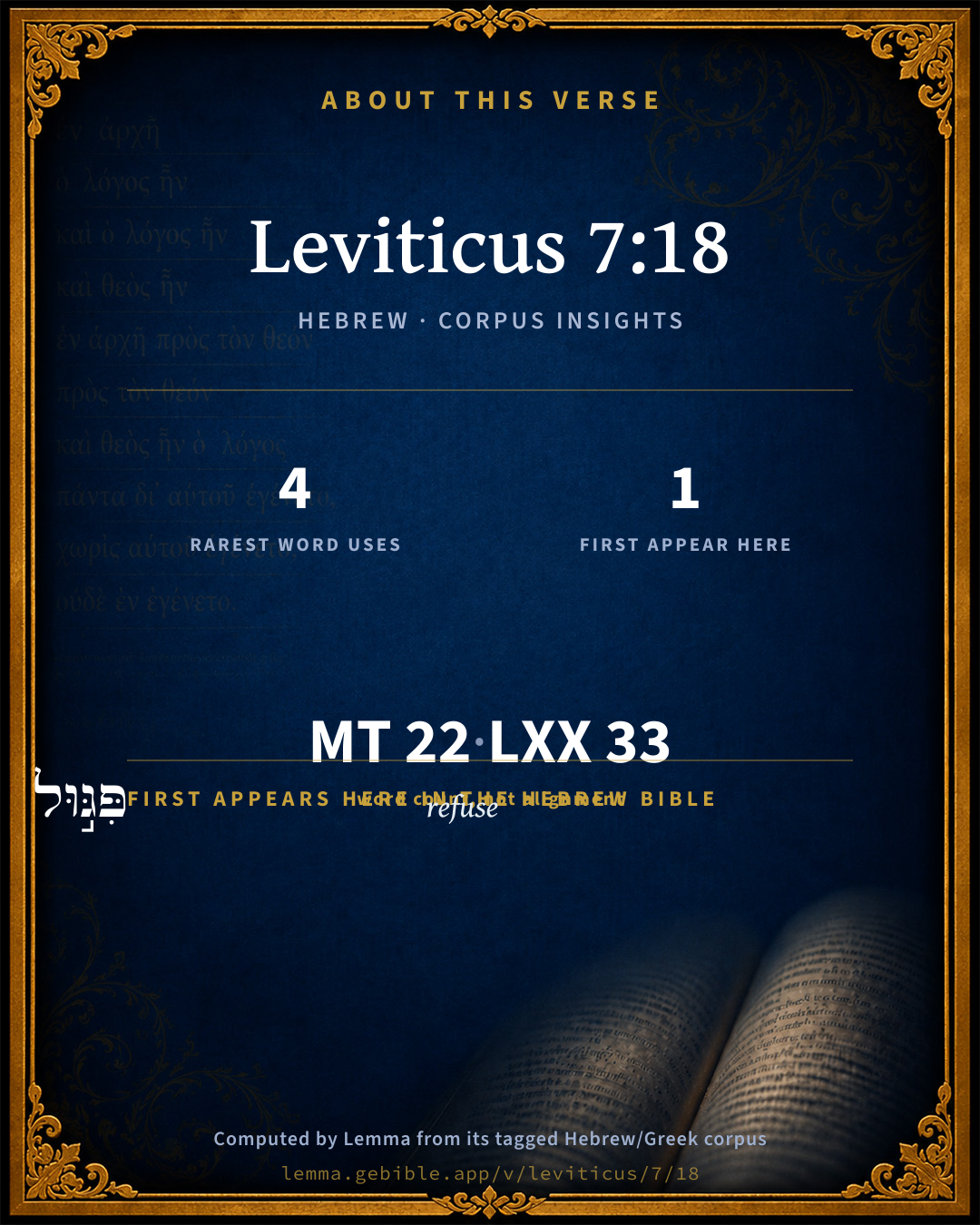
These counts appear in no published source. They are computed here, from the morphology-tagged text and Lemma’s own curated glosses. What Lemma adds →

22
words
18
distinct lemmas
Pentateuch
section

Notable vocabulary

The rarest word here is פִּגּ֣וּל refuse H6292 — appearing just 4 times in the whole Hebrew Bible.

First appearance in Scripture

This word makes its first canonical appearance in the Hebrew Bible here:

  • פִּגּ֣וּל refuse H6292

Shared distinctive vocabulary

פִּגּ֣וּל refuse H6292 occurs in 4 verses of the Hebrew Bible. Also found in:

Grammatical profile

  • 8 verbs
  • 7 nouns
  • 1 adjective
  • 2 prepositions
  • 1 conjunction
  • 3 particles

Verb forms

  • הֵאָכֹ֣ל Niphal · Infinitive Absolute
  • יֵ֠אָכֵל Niphal · Imperfect
  • יֵרָצֶה֒ Niphal · Imperfect
  • הַמַּקְרִ֣יב Hiphil · Participle Active
  • יֵחָשֵׁ֛ב Niphal · Imperfect
  • יִהְיֶ֑ה Qal · Imperfect
  • הָאֹכֶ֥לֶת Qal · Participle Active
  • תִּשָּֽׂא Qal · Imperfect

Repetition

Words recur within this verse — often emphatic in Hebrew:

  • הֵאָכֹ֣ל to eat H398 ×3
  • לֹ֣א not H3808 ×2

Hebrew & Septuagint length

In English translation the verse runs 50 words from the Hebrew and 7 from the Septuagint (LXX English) — the Septuagint runs noticeably shorter here. See the side-by-side →

A rough comparison of the two English renderings, which tokenize alike — not a word-level alignment.

Word counts can differ between the Hebrew and the Greek without any difference in meaning — e.g. the Hebrew direct-object marker אֵת has no separate Greek word, and Greek often adds the article ὁ.

In the original languages it is 22 Hebrew tokens and 33 Greek tokens — but the two are counted differently (Hebrew bundles its prefixes and suffixes into one token; the Greek is in lemma form), so that isn’t a like-for-like length.

Cross-references

28

Topical passages linked to Leviticus 7:18 in the Treasury of Scripture Knowledge — connected by theme and wording, ordered by reader-vote popularity; previews shown in the World English Bible.

  • Leviticus 19:7–8 If it is eaten at all on the third day, it is an abomination. It will not be accepted;
  • Leviticus 11:41 "'Every creeping thing that creeps on the earth is an abomination. It shall not be eaten.
  • Leviticus 22:25 Neither from the hand of a foreigner shall you offer the bread of your God of any of these; because their corruption is in them. There is a blemish in them. They shall not be accepted for you.'"
  • Numbers 18:27 Your heave-offering shall be reckoned to you, as though it were the grain of the threshing floor, and as the fullness of the winepress.
  • Leviticus 5:17 "If anyone sins, and does any of the things which Yahweh has commanded not to be done; though he didn't know it, yet he is guilty, and shall bear his iniquity.
  • Leviticus 10:17 "Why haven't you eaten the sin offering in the place of the sanctuary, seeing it is most holy, and he has given it you to bear the iniquity of the congregation, to make atonement for them before Yahweh?
  • Leviticus 10:19 Aaron spoke to Moses, "Behold, this day they have offered their sin offering and their burnt offering before Yahweh; and such things as these have happend to me: and if I had eaten the sin offering today, would it have been pleasing in the sight of Yahweh?"
  • Leviticus 11:10–11 All that don't have fins and scales in the seas, and in the rivers, of all that move in the waters, and of all the living creatures that are in the waters, they are an abomination to you,
  • Leviticus 17:16 But if he doesn't wash them, or bathe his flesh, then he shall bear his iniquity.'"
  • Leviticus 20:17 "'If a man takes his sister, his father's daughter, or his mother's daughter, and sees her nakedness, and she sees his nakedness; it is a shameful thing; and they shall be cut off in the sight of the children of their people: he has uncovered his sister's nakedness; he shall bear his iniquity.
  • Leviticus 20:19 "'You shall not uncover the nakedness of your mother's sister, nor of your father's sister; for he has made naked his close relative: they shall bear their iniquity.
  • Leviticus 22:16 and so cause them to bear the iniquity that brings guilt, when they eat their holy things: for I am Yahweh who sanctifies them.'"
  • Leviticus 22:23 Either a bull or a lamb that has any deformity or lacking in his parts, that you may offer for a freewill offering; but for a vow it shall not be accepted.
  • Isaiah 1:11–14 "What are the multitude of your sacrifices to me?," says Yahweh. "I have had enough of the burnt offerings of rams, And the fat of fed animals. I don't delight in the blood of bulls, Or of lambs, Or of male goats.
  • Isaiah 53:11–12 He shall see of the travail of his soul, [and] shall be satisfied: by the knowledge of himself shall my righteous servant justify many; and he shall bear their iniquities.
  • Isaiah 65:4 who sit among the graves, and lodge in the secret places; who eat pig's flesh, and broth of abominable things is in their vessels;
  • Isaiah 66:3 He who kills an ox is as he who kills a man; he who sacrifices a lamb, as he who breaks a dog's neck; he who offers an offering, [as he who offers] pig's blood; he who burns frankincense, as he who blesses an idol. Yes, they have chosen their own ways, and their soul delights in their abominations:
  • Jeremiah 14:10 Thus says Yahweh to this people, Even so have they loved to wander; they have not refrained their feet: therefore Yahweh does not accept them; now will he remember their iniquity, and visit their sins.
  • Jeremiah 14:12 When they fast, I will not hear their cry; and when they offer burnt offering and meal-offering, I will not accept them; but I will consume them by the sword, and by the famine, and by the pestilence.
  • Ezekiel 18:20 The soul who sins, he shall die: the son shall not bear the iniquity of the father, neither shall the father bear the iniquity of the son; the righteousness of the righteous shall be on him, and the wickedness of the wicked shall be on him.
  • Hosea 8:13 As for the sacrifices of my offerings, they sacrifice flesh and eat it; But Yahweh doesn't accept them. Now he will remember their iniquity, And punish their sins. They will return to Egypt.
  • Amos 5:22 Yes, though you offer me your burnt offerings and meal-offerings, I will not accept them; Neither will I regard the peace offerings of your fat animals.
  • Malachi 1:10 "Oh that there were one among you who would shut the doors, that you might not kindle fire on my altar in vain! I have no pleasure in you," says Yahweh of hosts, "neither will I accept an offering at your hand.
  • Malachi 1:13 You say also, 'Behold, what a weariness it is!' and you have sniffed at it," says Yahweh of Hosts; "and you have brought that which was taken by violence, the lame, and the sick; thus you bring the offering. Should I accept this at your hand?" says Yahweh.
  • Luke 16:15 He said to them, "You are those who justify yourselves in the sight of men, but God knows your hearts. For that which is exalted among men is an abomination in the sight of God.
  • Romans 4:11 He received the sign of circumcision, a seal of the righteousness of the faith which he had while he was in uncircumcision, that he might be the father of all those who believe, though they be in uncircumcision, that righteousness might also be accounted to them.
  • Hebrews 9:28 so Christ also, having been once offered to bear the sins of many, will appear a second time, without sin, to those who are eagerly waiting for him for salvation.
  • 1 Peter 2:24 who his own self bore our sins in his body on the tree, that we, having died to sins, might live to righteousness; by whose stripes you were healed.

Cross-references courtesy of OpenBible.info (CC BY 4.0).

Hebrew and Greek witnesses Masoretic Hebrew ↔ Greek Septuagint

The same verse in the two great witnesses to the Old Testament, shown verse-for-verse.

Here the Septuagint runs noticeably shorter than the Hebrew — LXX2012 (modern English Septuagint) 7 words vs World English Bible 50. A rough length comparison of the two English translations, not a word-level alignment — read both below.

These are two independent witnesses, not word-aligned to each other, and the Septuagint is shown in lemma (dictionary) form.

Hebrew Leviticus 7:18 Masoretic · Westminster Leningrad Codex

וְאִ֣ם הֵאָכֹ֣ל יֵ֠אָכֵל מִבְּשַׂר זֶ֨בַח שְׁלָמָ֜יו בַּיּ֣וֹם הַשְּׁלִישִׁי֮ לֹ֣א יֵרָצֶה֒ הַמַּקְרִ֣יב אֹת֗וֹ לֹ֧א יֵחָשֵׁ֛ב ל֖וֹ פִּגּ֣וּל יִהְיֶ֑ה וְהַנֶּ֛פֶשׁ הָאֹכֶ֥לֶת מִמֶּ֖נּוּ עֲוֺנָ֥הּ תִּשָּֽׂא

If any of the flesh of the sacrifice of his peace offerings is eaten on the third day, it will not be accepted, neither shall it be imputed to him who offers it. It will be an abomination, and the soul who eats any of it will bear his iniquity.

World English Bible · Public Domain

Greek LXX Leviticus 7:18 Septuagint · lemma form

ἐάν δέ ἐσθίω ἐσθίω ἀπό ὁ κρέας ὁ ἡμέρα ὁ τρίτος οὐ δέχομαι αὐτός ὁ προςφέρω αὐτός οὐ λογίζομαι αὐτός μίασμα εἰμί ὁ δέ ψυχή ὅστις ἐάν ἐσθίω ἀπό αὐτός ὁ ἁμαρτία λαμβάνω

And the Lord spoke to Moses, saying,

LXX2012 (modern English Septuagint) · Public Domain

Hebrew: Westminster Leningrad Codex (CC BY 4.0). Greek: Septuagint (public domain); English from LXX2012 (modern English Septuagint) (Public Domain). How the Septuagint differs from the Hebrew →

Targum (Aramaic paraphrase)

2

The Targum is the ancient Jewish Aramaic paraphrase of the Hebrew Scriptures — an interpretive translation, not the Hebrew text itself. Onkelos (literal) and Pseudo-Jonathan (expansive) render the Torah, and Jonathan the Prophets. Coverage is partial: where no permissively-licensed English translation exists for a verse, only the Aramaic is shown. This is verse-level text, not a word-by-word alignment to the Hebrew.

  1. Targum Onkelos Torah (Genesis–Deuteronomy)
    וְאִם אִתְאֲכָלָא יִתְאֲכֵל מִבְּסַר נִכְסַת קוּדְשׁוֹהִי בְּיוֹמָא תְּלִיתָאָה לָא יְהֵי לְרַעֲוָא דִמְקָרֵב יָתֵהּ לָא יִתְחַשֵׁב לֵהּ מְרָחָק יְהֵי וֶאֱנַשׁ דְתֵכוּל מִנֵהּ חוֹבֵהּ יְקַבֵּל

    (no public-domain English translation for this verse)

    Targum Onkelos — Aramaic: “Onkelos Genesis” (public domain); “Onkelos Exodus” (public domain); “Onkelos Leviticus” (public domain); “Onkelos Numbers” (public domain); “Onkelos Deuteronomy” (public domain). English: “Sefaria Community Translation” (CC0 1.0 (public-domain dedication)); “J.W. Etheridge. The Targums of Onkelos and Jonathan Ben Uzziel on the Pentateuch. London: Longmans, Green, 1862” (public domain). Text via Sefaria.

  2. Targum Pseudo-Jonathan Torah (Genesis–Deuteronomy)
    וְאִין יִתְאָכְלָא יִתְאָכֵיל מִבְּשַר נִכְסַת קוּדְשׁוֹי בְּיוֹמָא תְּלִיתָאָה לָא יִתְרְעֵי מַן דְמִקְרַב יָתֵיהּ לָא יִתְחַשֵׁב לֵיהּ לִזְכוּ פְסִיל יְהֵי וְאֵינַשׁ דְיֵכוֹל מִנֵיהּ חוֹבֵיהּ יְקַבֵּל

    If, eating, he will eat of the flesh of his hallowed sacrifice on the third day, it shall not be accepted of him who offered it, nor reckoned to him for righteousness; it will be a profane thing, and the man who eateth of it shall bear his sin.

    Targum Pseudo-Jonathan — Aramaic: “Targum Jonathan on Genesis” (public domain); “Targum Jonathan on Exodus” (public domain); “Targum Jonathan on Leviticus” (public domain); “Targum Jonathan on Numbers” (public domain); “Targum Jonathan on Deuteronomy” (public domain). English: “The Targum of Jonathan ben Uzziel, trans. J. W. Etheridge, London, 1862” (public domain). Text via Sefaria.

Commentary

Notes on Leviticus 7:18 from classic Christian and Jewish commentators (each source and its license shown beneath its notes). The classic Christian expositions comment on the surrounding passage and are grouped to its opening verse, so a note may address several verses; the Jewish commentaries on the Tanakh (Rashi and others) are per-verse, so they appear only where the commentator wrote on this verse.

Lemma curates 59 commentaries, every one of them public domain or Creative Commons licensed, each selected and text-cleaned for this edition rather than reprinted as found. About our sources →

Trapp's Complete Commentary

John Trapp

Lev 7:18 And if [any] of the flesh of the sacrifice of his peace offerings be eaten at all on the third day, it shall not be accepted, neither shall it be imputed unto him that offereth it: it shall be an abomination, and the soul that eateth of it shall bear his iniquity.

Ver. 18. It shall be an abomination.] Kept beyond the time; and so uneatable, unsacrificeable, profane, stinking.

John Trapp, A Commentary or Exposition upon All the Books of the Old and New Testament (1647–1656) — public domain. Text from a community e-Sword module.

Tyndale Open Study Notes

Tyndale Open Resources

7:18 The Hebrew term for contaminated (piggul) occurs only in three other places (19:7; Isa 65:4; Ezek 4:14). It is always used in reference to meat that is unacceptable for sacrifice or human consumption.

Tyndale Open Study Notes — © Tyndale Open Resources, licensed CC BY-SA 4.0. Text via the HelloAO Bible API.

Geneva Bible (1599)

Geneva Bible translators

The sin wherefore he offered shall remain.

Geneva Bible (1599) marginal notes — public domain. Text via Bolls.life.

Jamieson, Fausset & Brown

Robert Jamieson, A. R. Fausset & David Brown

if any of the flesh of the sacrifice . . . be eaten at all on the third day, it shall not be accepted, neither . . . imputed--The sacrifice will not be acceptable to God nor profitable to him that offers it.

Jamieson, Fausset & Brown — Commentary Critical and Explanatory on the Whole Bible (1871) — public domain (CC PDM 1.0). Text via the HelloAO Bible API.

Ellicott's Commentary for English Readers

(18) And if any of the flesh . . . be eaten.—The owner of the sacrifice was responsible for the due observance of this injunction. If, through his neglect, any one ate of the sacrifice after the limited time here specified, the efficacy of the sacrifice was disannulled, and the offerer had to bring another votive offering.

It shall be an abomination.—That is, the flesh left so long in the Eastern climate begins to putrefy, and becomes loathsome and offensive on the third day; so that which is holy becomes desecrated.

And the soul that eateth of it.—Hence he who ate it after the prescribed time was regarded as eating carrion, he bore his guilt, i.e., incurred the penalty of excision.

A Bible Commentary for English Readers, edited by Charles John Ellicott (1878–1897) — public domain. Text from a community e-Sword module.

The Cambridge Bible for Schools and Colleges

gen. ed. J. J. S. Perowne

18. it shall be an abomination] Heb. piggûl, a word which occurs here and in Lev_19:7 of the flesh of the Peace-Offering which is eaten on the third day, and elsewhere only in Isa_65:4, broth of abominable things (Heb. piggûlim); Eze_4:14, abominable flesh (Heb. flesh of Piggûl). In both these passages food of an unclean character, perhaps mixed with blood, is referred to (cp. Rel. Sem.2, 343, note 3). The word is a common technical term in the Mishna. It is unfortunate that both here and in Lev_7:21 ‘abomination,’ which is generally the translation of tô‘çbhah, should be employed as the English equivalent of two other Heb. words, but it is difficult to find a good English word for piggûl.

The Cambridge Bible for Schools and Colleges (gen. ed. J. J. S. Perowne; Cambridge University Press, 1878–1918) — public domain. Text from a community e-Sword module.

John Gill's Exposition

And the flesh that toucheth any unclean thing shall not be eaten,.... That is, the flesh of the peace offerings; should it be touched by any unclean person, man or woman; that was so in a ceremonial sense, being profluvious or menstruous, or having touched anything unclean, or touched by any unclean creature, as a dog or the like, as it might be while carried from the tabernacle to any of their tents or houses:

it shall be burnt with fire; that no profit might be had of it; and this was to make them careful in carrying it from place to place:

and as for the flesh, all that be clean shall eat thereof; that are clean in a ceremonial sense; as all that are clean in an evangelic sense, through the blood and righteousness of Christ, may, by faith, eat his flesh and drink his blood. Jarchi observes, that whereas it is said, Deu 12:27 "thou shall eat the flesh"; some might object and say, that none might eat of the peace offerings but the owners of them, therefore it is said here, "all that be clean shall eat"; not the owners only, nor the priests and Levites only, but whoever the offerer should invite to eat thereof, provided he was but clean.

John Gill's Exposition of the Whole Bible (1746–1763) — public domain (CC PDM 1.0). Text via the HelloAO Bible API.

Albert Barnes' Notes on the Bible

It was proper that the sacrificial meat should not be polluted by any approach to putrefaction. But the exclusion of a mean-spirited economy may further have furnished the ground for the distinction between the thank-offerings and the others. The most liberal distribution of the meat of the offering, particularly among the poor who were invited to partake, would plainly be becoming when the sacrifice was intended especially to express gratitude for mercies received.

Albert Barnes' Notes on the Bible (1834–1885) — public domain. Text from a community e-Sword/MySword module.

Haydock's Catholic Bible Commentary

Yea rather. Hebrew, "it is an abomination to be thrown away," and the soul, &c. Thus by neglecting to comply exactly with God’s commands, we lose the fruits of our former piety. (Haydock) --- The flesh of these victims might be eaten in any clean place, by all those who were not defiled, chap. x. 14. (Josephus) (Tirinus)

George Leo Haydock (1774–1849), Haydock's Catholic Family Bible and Commentary, 1859 edition — public domain. Excludes Psalms (Douay-Rheims chapter numbering differs from Protestant) and Deuterocanonical books (Catholic canon only).

Matthew Poole's English Annotations

It shall not be imputed unto him for an acceptable service to God.

Matthew Poole's English Annotations on the Holy Bible (1683–1685) — public domain. Text from a community e-Sword/MySword module.

Whedon's Commentary on the Bible

Daniel D. Whedon

18. Neither shall it be imputed unto him — It shall not be reckoned or accounted as a worthy act, as was Abraham’s faith. Gen_15:6. Obedience is more acceptable than sacrifice, without which an offering becomes an abomination. Isa_1:11-15.

Daniel D. Whedon (gen. ed.), Commentary on the Old and New Testaments (1874–1909) — public domain. Text from a community e-Sword module.

John Wesley's Explanatory Notes

Neither shall it be imputed - For an acceptable service to God.

John Wesley, Explanatory Notes Upon the Whole Bible (1754–1765) — public domain. Text via the GEBible commentary corpus.

Rashi

Rabbi Shlomo Yitzchaki (Rashi)

אם האכל יאכל וגו' ‏ AND IF ANY [OF THE FLESH] SHOULD BE EATEN AT ALL [ON THE THIRD DAY) — Scripture is speaking of one who has the intention whilst slaughtering thė sacrifice to eat it (the flesh) on the third day. One might think that what the text really means is, that if one has eaten of it on the third day it becomes disqualified retrospectively (i. e., that it is regarded as having been invalid from the moment that it was offered)! Scripture, however, states, “As for him that offereth it, there shall be no מחשבה to him” implying that at the time when it is offered it can become disqualified, and that it cannot become disqualified on the third day (Sifra, Tzav, Section 8 1). And the following is its meaning (that of the text): At the time when it is offered, this shall not enter the mind of any priest performing a rite with it, to eat of it on the third day, and if he does harbour such a thought, it becomes פגול, an abominable thing,

והנפש האכלת ממנו AND THE SOUL THAT EATETH OF IT even within this period (of three days), עונה תשא SHALL BEAR ITS INIQUITY.

Rashi on the Tanakh — English translations: “The Judaica Press complete Tanach with Rashi, translated by A. J. Rosenberg” (CC BY 4.0); “Pentateuch with Rashi's commentary by M. Rosenbaum and A.M. Silbermann, 1929-1934” (public domain); “The Metsudah Tanach series, Lakewood, N.J” (CC BY 4.0); and “The Book of Joshua, Metsudah Publications, 1997” (CC BY 4.0). Text via Sefaria.

Lesson kit

Teaching starters — assembled from the data on this page, not authored interpretation. Every prompt links to the verse data it draws on. Edit before teaching.

Leviticus, in the Pentateuch, opens this verse with 22 words (18 distinct Hebrew lemmas). Its most distinctive word is piggûwl (“refuse”). The Greek Septuagint runs shorter here. A historical commentator’s framing appears above. Read the whole chapter for the surrounding context.

Discussion questions

  1. How does “refuse” (piggûwl) shape what this verse is saying?
  2. The word “refuse” first appears here in Scripture. What is being introduced at this debut?
  3. Leviticus 19:7 shares the word «refuse» with this verse. How do the two illuminate each other?
  4. “to eat” occurs 3× in this one verse. What is the effect of the repetition?
  5. Compared with the Hebrew, the Septuagint runs shorter here. What questions does that raise?
  6. These translations render this verse differently. What is at stake in choosing one wording over another?
  7. The verb «הֵאָכֹ֣ל» is Niphal Infinitive Absolute. How does its form color the action?
  8. Reading how Trapp's Complete Commentary and Tyndale Open Study Notes read this verse, where do the two commentators agree and where do they part?

Things to notice

Reading settings

Reading text

Shown beneath each verse's original-language words.

Old Testament
Old Testament edition

Read the OT as the Masoretic Hebrew (MT) or the Greek Septuagint (LXX).

English shown for the Greek Septuagint (in the Hebrew ↔ Greek comparison).

Comparing translations? Open the Compare panel on any verse page to stack up to four side by side.