
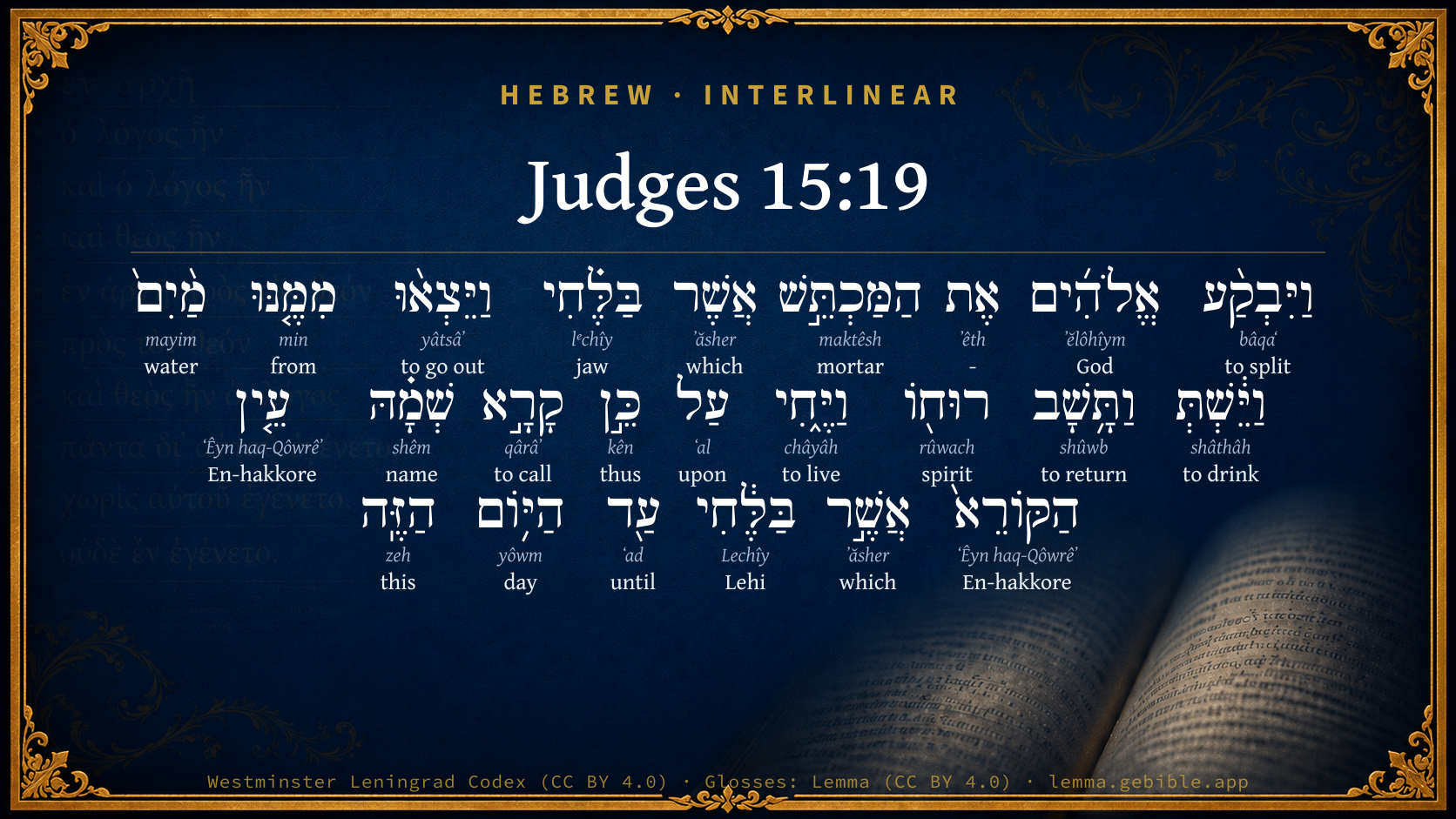
Judges 15:19

Hebrew (Westminster Leningrad Codex) Judges 15:19 appears in the Hebrew Old Testament. The text above is from the Westminster Leningrad Codex. Each word links to its Strong’s number, a concise gloss, and parsing drawn from the Open Scriptures Hebrew Bible morphology. Click any word for its full Brown-Driver-Briggs (BDB) entry.
Download image
Cite this verse

Judges 15:19 (World English Bible). Public Domain. Lemma interlinear Bible study tool, https://lemma.gebible.app/v/judges/15/19.

Show BibTeX & RIS
BibTeX
RIS
English Translation
But God split the hollow place that is in Lehi, and water came out of it. When he had drunk, his spirit came again, and he revived: therefore the name of it was called En Hakkore, which is in Lehi, to this day.
World English Bible · Public Domain
Highlights
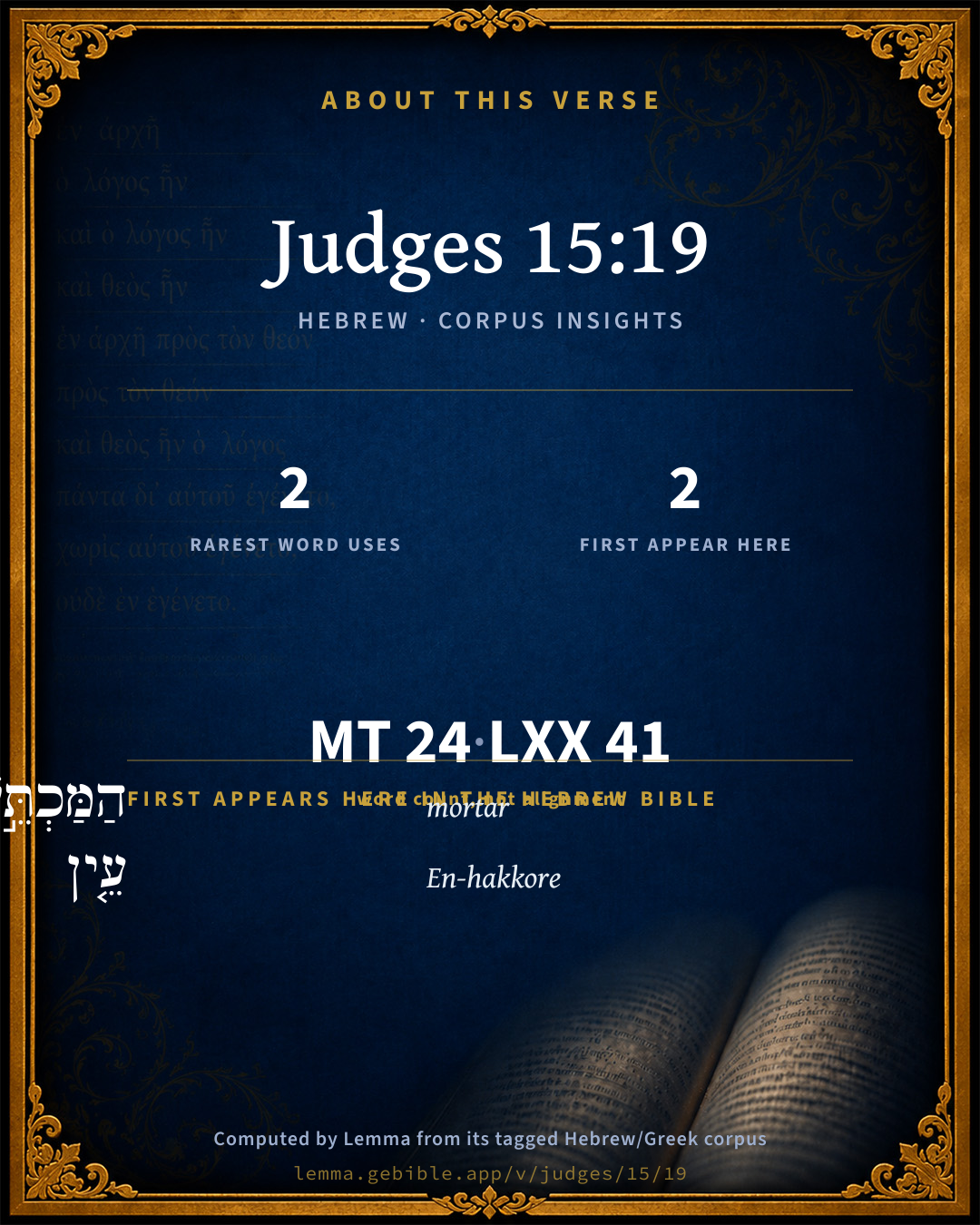
  • 2 first appearances in the Hebrew Bible
Full analysis ↓
Download a study sheet

One document with this verse’s original text, its word-by-word gloss line, the meaning frame, cross-references with their text, attributed commentary, and full source and license credits — printable, and it pastes into notes with its structure intact.

This verse Autodidact and up

Study sheet (.html) Plain text (.txt)

A passage Seminary Student

Up to 50 verses in one chapter. A passage sheet keeps up to 6 commentary sources and 12 cross-references per verse, in the order this page ranks them, and says so on the sheet whenever that leaves anything out. Ask for a single verse and you get the Autodidact verse sheet above.

Everything on this page stays free to read, with no account — the sheet is a download of what is already on screen, not access to it.

Want to remove ads? Support Godless Engineer
Compare translations 3

The same verse in 3 English versions, stacked beneath the original-language interlinear above. Click any original word for its lexicon entry.

Each is an independent rendering of the whole verse — the interlinear is not word-aligned to these translations.

Highlighted words mark where these versions differ — a whole-verse word diff, not a word-by-word alignment.

  • World English Bible Public Domain
    But God split the hollow place that is in Lehi, and water came out of it. When he had drunk, his spirit came again, and he revived: therefore the name of it was called En Hakkore, which is in Lehi, to this day.
  • King James Version Public Domain
    But God clave an hollow place that was in the jaw, and there came water thereout; and when he had drunk, his spirit came again, and he revived: wherefore he called the name thereof Enhakkore, which is in Lehi unto this day.
  • unfoldingWord Literal Text CC BY-SA 4.0
    Then God split open the hollow place that in Lehi, and water came out from it. And he drank and his spirit returned, and he revived. Therefore, he called its name En-Hakkore, which in Lehi to this day.

unfoldingWord Literal Text — © unfoldingWord, licensed CC BY-SA 4.0. Word-aligned USFM3 via Door43 (git.door43.org/unfoldingWord/en_ult).

Versions to compare (up to 4)

3 of 4 selected

Show all 18 translations

Every available English version of this verse, each an independent rendering of the whole verse.

  • World English Bible Public Domain
    But God split the hollow place that is in Lehi, and water came out of it. When he had drunk, his spirit came again, and he revived: therefore the name of it was called En Hakkore, which is in Lehi, to this day.
  • Berean Standard Bible Public Domain
    So God opened up the hollow place in Lehi, and water came out of it. When Samson drank, his strength returned, and he was revived. That is why he named it En-hakkore, and it remains in Lehi to this day.
  • Majority Standard Bible Public Domain
    So God opened up the hollow place in Lehi, and water came out of it. When Samson drank, his strength returned, and he was revived. That is why he named it En-hakkore, and it remains in Lehi to this day.
  • King James Version Public Domain
    But God clave an hollow place that was in the jaw, and there came water thereout; and when he had drunk, his spirit came again, and he revived: wherefore he called the name thereof Enhakkore, which is in Lehi unto this day.
  • American Standard Version (1901) Public Domain
    But God clave the hollow place that is in Lehi, and there came water thereout; and when he had drunk, his spirit came again, and he revived: wherefore the name thereof was called En-hakkore, which is in Lehi, unto this day.
  • Revised Version (1885) Public Domain
    But God clave the hollow place that is in Lehi, and there came water thereout; and when he had drunk, his spirit came again, and he revived: wherefore the name thereof was called En-hakkore, which is in Lehi, unto this day.
  • Geneva Bible (1599) Public Domain
    Then God brake the cheeke tooth, that was in the iawe, and water came thereout: and when he had drunke, his Spirit came againe, and he was reuiued: wherefore the name therof is called, Enhakkore, which is in Lehi vnto this day.
  • Douay-Rheims (1899) Public Domain
    Then the Lord opened a great tooth in the jaw of the ass, and waters issued out of it. And when he had drank them he refreshed his spirit, and recovered his strength. Therefore the name of that place was called, The Spring of him that invoked from the jawbone, until this present day.
  • Young's Literal Translation Public Domain
    And God cleaveth the hollow place which `is' in Lehi, and waters come out of it, and he drinketh, and his spirit cometh back, and he reviveth; therefore hath `one' called its name `The fountain of him who is calling,' which `is' in Lehi unto this day.
  • Literal Standard Version CC BY-SA 4.0
    And God cleaves the hollow place which [is] in Lehi, and waters come out of it, and he drinks, and his spirit comes back, and he revives; therefore [one] has called its name “The fountain of him who is calling,” which [is] in Lehi to this day.
  • Unlocked Literal Bible CC BY-SA 4.0
    God split open the hollow place that is at Lehi and water came out. When he drank, his strength returned and he revived. So he called the name of that place En Hakkore, and it is at Lehi to this day.
  • unfoldingWord Literal Text CC BY-SA 4.0
    Then God split open the hollow place that in Lehi, and water came out from it. And he drank and his spirit returned, and he revived. Therefore, he called its name En-Hakkore, which in Lehi to this day.
  • Darby Bible Public Domain
    And God split open the hollow place that is at Lehi, and there came water from it; and when he drank, his spirit returned, and he revived. Therefore the name of it was called En-hakkor'e; it is at Lehi to this day.
  • World Messianic Bible Public Domain
    But God split the hollow place that is in Lehi, and water came out of it. When he had drunk, his spirit came again, and he revived. Therefore its name was called En Hakkore, which is in Lehi, to this day.
  • Webster's Bible Public Domain
    But God cleaved a hollow place that was in the jaw, and there came water out of it; and when he had drank, his spirit came again, and he revived. Wherefore he called the name of it En-hakkore, which is in Lehi to this day.
  • Free Bible Version CC BY-SA 4.0
    So God split open a rock seam in Lehi, and water came out of it. Samson drank and his strength returned—he felt much better. That's why he named it the Spring of the Caller, and it's still there in Lehi to this very day.
  • Bible in Basic English Public Domain
    Then God made a crack in the hollow rock in Lehi and water came out of it; and after drinking, his spirit came back to him and he was strong again; so that place was named En-hakkore; it is in Lehi to this day.
  • JPS Tanakh (1917) Public Domain
    But God cleaved the hollow place that is in Lehi, and there came water thereout; and when he had drunk, his spirit came back, and he revived; wherefore the name thereof was called En-hakkore, which is in Lehi unto this day.

Literal Standard Version (2020), Covenant Press — licensed CC BY-SA 4.0. Text via the HelloAO Bible API (eBible.org). Unlocked Literal Bible (unfoldingWord) — licensed CC BY-SA 4.0. Text via the HelloAO Bible API (eBible.org). unfoldingWord Literal Text — © unfoldingWord, licensed CC BY-SA 4.0. Word-aligned USFM3 via Door43 (git.door43.org/unfoldingWord/en_ult). Free Bible Version, Dr. Jonathan Gallagher — licensed CC BY-SA 4.0. Text via the HelloAO Bible API (eBible.org).

Word by word

More ways to search: Search by grammar → Find every occurrence → Compare this word →

Practice this passage: Drill this verse → Learn its vocabulary →

הַמַּכְתֵּ֣שׁ
maktêsh
H4388
“the · mortar”
Particle, Definite Article + Noun, Common, Masculine, Singular, Absolute
Part of Speech
Particle + Noun
Type
Common
Gender
Masculine
Number
Singular
State
Absolute
Full BDB Definition

Origin: from H3806

TWOT: 1061a

mortar
  1. וַיִּבְקַ֨ע bâqaʻ H1234 “and · to split” Conjunction + Verb, Qal, Sequential Imperfect, 3rd Person, Masculine, Singular
  2. אֱלֹהִ֜ים ʼĕlôhîym H430 “God(s)” Noun, Common, Masculine, Plural, Absolute
  3. אֶת ʼêth H853 “-” Particle, Direct Object
  4. אֲשֶׁר ʼăsher H834 “which” Particle, Relative
  5. בַּלֶּ֗חִי lᵉchîy H3895 “in/at the · jaw” Preposition, Determined + Noun, Proper
  6. וַיֵּצְא֨וּ yâtsâʼ H3318 “and · to go out” Conjunction + Verb, Qal, Sequential Imperfect, 3rd Person, Masculine, Plural
  7. מִמֶּ֤נּוּ min H4480 “from · us” Preposition + Suffix, Personal, 1st Person, Common, Plural
  8. מַ֨יִם֙ mayim H4325 “water(s)” Noun, Common, Masculine, Plural, Absolute
  9. וַיֵּ֔שְׁתְּ shâthâh H8354 “and · to drink” Conjunction + Verb, Qal, Sequential Imperfect, 3rd Person, Masculine, Singular
  10. וַתָּ֥שָׁב shûwb H7725 “and · to return” Conjunction + Verb, Qal, Sequential Imperfect, 3rd Person, Feminine, Singular
  11. רוּח֖וֹ rûwach H7307 “spirit · his” Noun, Common, Both, Singular, Construct + Suffix, Personal, 3rd Person, Masculine, Singular
  12. וַיֶּ֑חִי châyâh H2421 “and · to live” Conjunction + Verb, Qal, Sequential Imperfect, 3rd Person, Masculine, Singular
  13. עַל ʻal H5921 “upon” Preposition
  14. כֵּ֣ן kên H3651 “thus” Particle, Demonstrative
  15. קָרָ֣א qârâʼ H7121 “to call” Verb, Qal, Perfect, 3rd Person, Masculine, Singular
  16. שְׁמָ֗הּ shêm H8034 “name · her” Noun, Common, Masculine, Singular, Construct + Suffix, Personal, 3rd Person, Feminine, Singular
  17. עֵ֤ין ʻÊyn haq-Qôwrêʼ H5875 “En-hakkore” Noun, Proper
  18. הַקּוֹרֵא֙ ʻÊyn haq-Qôwrêʼ H5875 “En-hakkore” Noun, Proper
  19. אֲשֶׁ֣ר ʼăsher H834 “which” Particle, Relative
  20. בַּלֶּ֔חִי Lechîy H3896 “in/at the · Lehi” Preposition, Determined + Noun, Proper
  21. עַ֖ד ʻad H5704 “until” Preposition
  22. הַיּ֥וֹם yôwm H3117 “the · day” Particle, Definite Article + Noun, Common, Masculine, Singular, Absolute
  23. הַזֶּֽה zeh H2088 “the · this” Particle, Definite Article + Pronoun, Demonstrative, Masculine, Singular

About this verse

These counts appear in no published source. They are computed here, from the morphology-tagged text and Lemma’s own curated glosses. What Lemma adds →

24
words
22
distinct lemmas
Historical
section

Notable vocabulary

The rarest word here is הַמַּכְתֵּ֣שׁ mortar H4388 — appearing just 2 times in the whole Hebrew Bible.

First appearance in Scripture

These words make their first canonical appearance in the Hebrew Bible here:

  • הַמַּכְתֵּ֣שׁ mortar H4388
  • עֵ֤ין En-hakkore H5875

Shared distinctive vocabulary

הַמַּכְתֵּ֣שׁ mortar H4388 occurs in 2 verses of the Hebrew Bible. Also found in:

Grammatical profile

  • 6 verbs
  • 10 nouns
  • 1 pronoun
  • 3 prepositions
  • 4 particles

Verb forms

  • וַיִּבְקַ֨ע Qal · Sequential Imperfect
  • וַיֵּצְא֨וּ Qal · Sequential Imperfect
  • וַיֵּ֔שְׁתְּ Qal · Sequential Imperfect
  • וַתָּ֥שָׁב Qal · Sequential Imperfect
  • וַיֶּ֑חִי Qal · Sequential Imperfect
  • קָרָ֣א Qal · Perfect

Repetition

Words recur within this verse — often emphatic in Hebrew:

  • עֵ֤ין En-hakkore H5875 ×2
  • אֲשֶׁר which H834 ×2

Hebrew & Septuagint length

In English translation the verse runs 43 words from the Hebrew and 45 from the Septuagint (LXX English) — closely comparable.

A rough comparison of the two English renderings, which tokenize alike — not a word-level alignment.

Word counts can differ between the Hebrew and the Greek without any difference in meaning — e.g. the Hebrew direct-object marker אֵת has no separate Greek word, and Greek often adds the article ὁ.

In the original languages it is 24 Hebrew tokens and 41 Greek tokens — but the two are counted differently (Hebrew bundles its prefixes and suffixes into one token; the Greek is in lemma form), so that isn’t a like-for-like length.

Cross-references

12

Topical passages linked to Judges 15:19 in the Treasury of Scripture Knowledge — connected by theme and wording, ordered by reader-vote popularity; previews shown in the World English Bible.

  • Genesis 45:27 They told him all the words of Joseph, which he had said to them. When he saw the wagons which Joseph had sent to carry him, the spirit of Jacob, their father, revived.
  • Isaiah 44:3 For I will pour water on him who is thirsty, and streams on the dry ground; I will pour my Spirit on your seed, and my blessing on your offspring:
  • Psalms 34:6 This poor man cried, and Yahweh heard him, And saved him out of all his troubles.
  • Genesis 16:13 She called the name of Yahweh who spoke to her, "You are a God who sees," for she said, "Have I even stayed alive after seeing him?"
  • Isaiah 40:29 He gives power to the faint; and to him who has no might he increases strength.
  • Genesis 28:19 He called the name of that place Bethel, but the name of the city was Luz at the first.
  • Genesis 30:30 For it was little which you had before I came, and it has increased to a multitude. Yahweh has blessed you wherever I turned. Now when will I provide for my own house also?"
  • Exodus 17:15 Moses built an altar, and called the name of it Yahweh our Banner.
  • 1 Samuel 30:12 They gave him a piece of a cake of figs, and two clusters of raisins: and when he had eaten, his spirit came again to him; for he had eaten no bread, nor drunk any water, three days and three nights.
  • Psalms 120:1 In my distress, I cried to Yahweh. He answered me.
  • Isaiah 40:26 Lift up your eyes on high, and see who has created these, who brings out their host by number; he calls them all by name; by the greatness of his might, and because he is strong in power, not one is lacking.
  • Isaiah 41:17–18 The poor and needy seek water, and there is none, and their tongue fails for thirst; I, Yahweh, will answer them, I, the God of Israel, will not forsake them.

Cross-references courtesy of OpenBible.info (CC BY 4.0).

Hebrew and Greek witnesses Masoretic Hebrew ↔ Greek Septuagint

The same verse in the two great witnesses to the Old Testament, shown verse-for-verse.

These are two independent witnesses, not word-aligned to each other, and the Septuagint is shown in lemma (dictionary) form.

Hebrew Judges 15:19 Masoretic · Westminster Leningrad Codex

וַיִּבְקַ֨ע אֱלֹהִ֜ים אֶת הַמַּכְתֵּ֣שׁ אֲשֶׁר בַּלֶּ֗חִי וַיֵּצְא֨וּ מִמֶּ֤נּוּ מַ֨יִם֙ וַיֵּ֔שְׁתְּ וַתָּ֥שָׁב רוּח֖וֹ וַיֶּ֑חִי עַל כֵּ֣ן קָרָ֣א שְׁמָ֗הּ עֵ֤ין הַקּוֹרֵא֙ אֲשֶׁ֣ר בַּלֶּ֔חִי עַ֖ד הַיּ֥וֹם הַזֶּֽה

But God split the hollow place that is in Lehi, and water came out of it. When he had drunk, his spirit came again, and he revived: therefore the name of it was called En Hakkore, which is in Lehi, to this day.

World English Bible · Public Domain

Greek LXX Judges 15:19 Septuagint · lemma form

καί ῥήγνυμι ὁ θεός ὁ λάκκος ὁ ἐν ὁ σιαγών καί ἐκἔρχομαι ἐκ αὐτός ὕδωρ καί πίνω καί ἐπιστρέφω ὁ πνεῦμα αὐτός καί ζάω διά οὗτος καλέω ὁ ὄνομα αὐτός πηγή ὁ ἐπικαλέω ὅς εἰμί ἐν σιαγών ἕως ὁ ἡμέρα οὗτος

And God broke open a hollow place in the jaw, and there came thence water, and he drank; and his spirit returned and he revived: therefore the name of the fountain was called 'The well of the invoker,' which is in Lechi, until this day.

LXX2012 (modern English Septuagint) · Public Domain

On this verse, The Cambridge Bible for Schools and Colleges discusses the Septuagint’s reading. Read the note in Commentary ↓

Hebrew: Westminster Leningrad Codex (CC BY 4.0). Greek: Septuagint (public domain); English from LXX2012 (modern English Septuagint) (Public Domain). How the Septuagint differs from the Hebrew →

Targum (Aramaic paraphrase)

1

The Targum is the ancient Jewish Aramaic paraphrase of the Hebrew Scriptures — an interpretive translation, not the Hebrew text itself. Onkelos (literal) and Pseudo-Jonathan (expansive) render the Torah, and Jonathan the Prophets. Coverage is partial: where no permissively-licensed English translation exists for a verse, only the Aramaic is shown. This is verse-level text, not a word-by-word alignment to the Hebrew.

  1. Targum Jonathan Prophets (Joshua–Malachi)
    וּבְזַע יְיָ יַת כֵּיפָא דִי בְּלוֹעָא וּנְפַקוּ מִנֵיהּ מַיָא וּשְׁתִי וְתָבַת רוּחֵיהּ וַחֲיָא עַל כֵּן אִתְקְרֵי שְׁמָהּ עֵינָא דְאִתְיְהִיבַת בִּצְלוֹתָא דְשִׁמְשׁוֹן הִיא קַיְמָא בַּלֶחִי עַד יוֹמָא הָדֵין:

    (no public-domain English translation for this verse)

    Targum Jonathan — Aramaic: “Mikraot Gedolot” (public domain). English: “Sefaria Community Translation” (CC0 1.0 (public-domain dedication)); “London "Chaldee Paraphrase," 1871” (public domain). Text via Sefaria.

Commentary

Notes on Judges 15:19 from classic Christian and Jewish commentators (each source and its license shown beneath its notes). The classic Christian expositions comment on the surrounding passage and are grouped to its opening verse, so a note may address several verses; the Jewish commentaries on the Tanakh (Rashi and others) are per-verse, so they appear only where the commentator wrote on this verse.

Lemma curates 59 commentaries, every one of them public domain or Creative Commons licensed, each selected and text-cleaned for this edition rather than reprinted as found. About our sources →

Trapp's Complete Commentary

John Trapp

Jdg 15:19 But God clave an hollow place that [was] in the jaw, and there came water thereout; and when he had drunk, his spirit came again, and he revived: wherefore he called the name thereof Enhakkore, which [is] in Lehi unto this day.

Ver. 19. But God clave a hollow place.] In figure like a mortar, as Pro 27:22.

That was in the jaw.] Or rather in Lehi, the place so called. See the like in Psa 78:15-16; {a} Deu 32:13, - "He made him to suck honey out of the rock," that is, water as good as honey, because in a pressing necessity.

Wherefore he called the name thereof Enhakkore.] That is, The well of him that called or cried. See Jdg 15:17. If we should not be in straits sometimes, God should have no tribute from us, as those malignants in Ezra suggested against the returned captives. {Ezr 4:13}

Which is in Lehi unto this day.] Till Samuel’s time, who is thought to have written this book. Jerome saith it remained till his time. And Glycas saith, in the suburbs of Eleutheropolis is still seen a spring called The Jaw Bone.

{a} Locus ille referebat mortarium. - Vat.

John Trapp, A Commentary or Exposition upon All the Books of the Old and New Testament (1647–1656) — public domain. Text from a community e-Sword module.

Joseph Benson's Commentary

Jdg 15:19. God clave a hollow place in the jaw — Or rather, a cavity that was in Lehi, as he had just named the place, Jdg 15:17, and as the same word is rendered in the latter part of this verse. “It is very evident,” says Dr. Dodd, “from what follows, that our translation” (namely, in the former part of the verse) “is erroneous; since, if God had caused water to come from the jaw, only for the present satisfying of Samson’s necessities, it is reasonable to suppose that Samson would have given it the name of a well, or fountain, or that the sacred historian would have told us that it remained in Lehi unto this day. The rendering, therefore, of the margin, which is followed by Dr. Waterland, is far the best. Houbigant observes, very properly, that the word rendered hollow place (מכתשׁ, miktesh,) signifies a rock; and he renders the verse thus: ‘Then God clave the rock which was in Lehi, and there came water from thence; which when he had drunk, his spirit came again, and he revived; therefore Samson called the fountain, the fountain of the implorer, which fountain is in Lehi unto this day.’ Modern travellers inform us, that in the suburbs of Eleutheropolis, (in all probability the ancient Lehi,) the fountain which flowed upon this occasion is still remaining, and called to this day the fountain of the jaw; an observation which abundantly confirms the interpretation we have given.” He called the name thereof En-hakkore; that is, the fountain of him that cried for thirst; or, that called on God for deliverance; or, the fountain that was given in answer to prayer. Which is in Lehi — So that our translators take Lehi here to be the name of a place.

Joseph Benson's Commentary on the Old and New Testaments (1811–1818) — public domain. Text from a community e-Sword module.

Geneva Bible (1599)

Geneva Bible translators

Or, the fountain of him that prayed.

Geneva Bible (1599) marginal notes — public domain. Text via Bolls.life.

Jamieson, Fausset & Brown

Robert Jamieson, A. R. Fausset & David Brown

a hollow place . . . in the jaw--"in Lehi"--taking the word as a proper noun, marking the place.

there came water thereout; and when he had drunk, his spirit came again--His strength, exhausted by the violent and long-continued exertion, was recruited by the refreshing draft from the spring; and it was called

En-hakkore--the "supplication well," a name which records the piety of this heroic champion.

Next: Judges Chapter 16

Jamieson, Fausset & Brown — Commentary Critical and Explanatory on the Whole Bible (1871) — public domain (CC PDM 1.0). Text via the HelloAO Bible API.

Adam Clarke's Commentary

Verse 19. God clave a hollow place that was in the jaw] אשר בלחי asher ballechi, that was in Lehi; that is, there was a hollow place in this Lehi, and God caused a fountain to spring up in it. Because the place was hollow it was capable of containing the water that rose up in it, and thus of becoming a well.

En-hakkore] The well of the implorer; this name he gave to the spot where the water rose, in order to perpetuate the bounty of God in affording him this miraculous supply.

Which is in Lehi unto this day.] Consequently not IN the jaw-bone of the ass, a most unfortunate rendering.

Adam Clarke's Commentary on the Bible (1810–1826) — public domain. Text from a community e-Sword/MySword module.

Ellicott's Commentary for English Readers

(19) Clave an hollow place that was in the jaw.—Rather, the (fountain called the) “socket,” which is in Lehi. The notion that God made a miraculous fountain in one of the tooth-sockets of the jawbone of the ass is one of the childish misinterpretations with which Scripture exegesis is constantly defaced. Lehi is here the name of the place, and if the fountain is said to have sprung up in Hammaktesh, “the tooth-socket” (Vulg., molarem), that is only due to the play on words which characterises the narrative. When the cliff had got the name of “Jawbone,” the spring would naturally be called a “tooth-socket.” The word maktesh properly means “a mortar” (Greek, holmiskos; Lat., mortariolum) (Pro_27:22), and this name was transferred to the sockets of teeth. We find another place with the same name in Zep_1:11. Milton understood the passage rightly:—

“God, who caused a fountain at thy prayer

From the dry ground to spring thy thirst to allay.”

For similar instances in the Bible, see Gen_21:19 (Hagar); Exo_17:6 (the smitten rock); Isa_41:17-18 (“When the poor and needy seek water, and there is none, and their tongue faileth for thirst, I the Lord will hear them. I will open rivers in high places, and fountains in the midst of the valleys . . . I will make the wilderness a pool of water, and the dry land springs of water”). Josephus says that God caused to spring up for Samson “a plentiful fountain of sweet water at a certain rock.”

He called the name thereof.—Rather, the name thereof was called.

En-hakkore.—The Spring of the Crier. These names have vanished, but perhaps traces of them may still be discovered “in the abundant springs and numerous eminences of the district round Urtas,” the place from which Solomon’s pleasure-gardens and the Temple and Bethlehem were supplied with water.

A Bible Commentary for English Readers, edited by Charles John Ellicott (1878–1897) — public domain. Text from a community e-Sword module.

The Cambridge Bible for Schools and Colleges

gen. ed. J. J. S. Perowne

19. the hollow place that is in Lehi] the Mortar which is in L., i.e. a mortar-shaped basin in the hill side. The word comes from a root meaning, not ‘to be hollow,’ but to pound (cf. in Aram. NSI., p. 171, and the Palmyrene pr. n. Maktash = ‘the pounder’); so maktçsh = ‘pounding place,’ i.e. mortar, Pro_27:22, Zep_1:11 (the name of a quarter in Jerusalem). The old interpretation, represented by the marg., went wrong by translating Lehi instead of taking it as a pr. n.; maktçsh was then understood to mean a hollow place in the jaw, or the hole of a tooth, through which the spring rose, as many Fathers and Rabbis imagine (see Ber. Rab § 98, Rashi, Ḳimḥi etc.). Some of the Greek versions render the word by ὅλμος, which can mean both a mortar and the hollow of a double tooth; Symmachus likewise translates the grinder (τὴν μύλην); and thus arose another way of understanding the word, viz. the molar tooth, so Vulgate The LXX transl. as RV. ‘the hole which is in Siagon.’

his spirit … revived] Cf. Gen_45:27.

The spring, which was pointed out in the writer’s day, and therefore could not have had anything to do with a jawbone, was known as En-hakkore, i.e. the Spring of the Partridge (lit. the crier, 1Sa_26:20, Jer_17:11); playing on the word, the story-tellers connected it with Samson’s cry to God in his thirst.

The Cambridge Bible for Schools and Colleges (gen. ed. J. J. S. Perowne; Cambridge University Press, 1878–1918) — public domain. Text from a community e-Sword module.

John Gill's Exposition

And God clave an hollow place that was in the jaw, and there came water thereout,.... A socket in which was fastened one of the teeth, and was in the form of a mortar; so Jarchi and Ben Melech, as the word for an hollow place signifies; one of the grinders was knocked out, and so the place where it had been was left hollow, and out of that sprung a stream or flow of water; which was very wonderful, since out of such a place rather blood, or purulent matter, would naturally have issued; the Targum is,"the Lord clave the rock which was in the jaw;''which Kimchi interprets thus, the rock was under the jaw and the rock was made as a hollow place, and therefore they call it "mactes", a mortar: the sense seems to be this, that the place on which Samson cast the jawbone was a rock, and there God clave an hollow place, out of which water sprung, and which perhaps was under the jawbone, and sprung under it, and through it; and so Josephus says (o), that God at his prayer brought a sweet and large fountain out of a certain rock; and the words of the text will bear to be rendered, "and God clave, an hollow place, which is in Lehi"; that is, in the place called Lehi, Jdg 15:9 and not in the jawbone itself:

and when he had drank, his spirit came again, and he revived; his spirit was sunk and gone, as it were, but upon drinking a draught of this water he was refreshed and cheered, recovered his spirits, and became brisk and lively:

wherefore he called the name thereof Enhakkore; that is,"the fountain of him that was calling;''of Samson that called upon God in prayer, and was heard, in memory of which he gave it this name; so the Targum,"therefore its name was called the fountain that was given through the prayer of Samson:"

which is in Lehi unto this day; or in the jawbone: not that the jawbone continued unto the time of the writer of this book, but the name of the place where this miracle was wrought, which was in Lehi, continued to be called Enhakkore unto that time, and it may be the fountain itself continued also; nay, Giycas (p) says, who lived but about six hundred years ago, that the fountain continued unto his time, and was to be seen in the suburbs of Eleutheropolis, and was called the fountain of the jawbone.

(o) Ibid. (Antiqu. l. 5. c. 8. sect. 9.) (p) Annal. par. 2. p. 164. apud Reland. Palestin. Illustrat. p. 872.

John Gill's Exposition of the Whole Bible (1746–1763) — public domain (CC PDM 1.0). Text via the HelloAO Bible API.

Albert Barnes' Notes on the Bible

An hollow place that was in the jaw - The right translation is, “the hollow place which is in Lehi.” The word translated “hollow place,” means a “mortar” Pro 27:22, and is here evidently a hollow or basin among the cliffs of Lehi, which, from its shape, was called “the mortar.” A spring, on the way from Socho to Eleutheropolis, was commonly called Samson’s spring in the time of Jerome and writers in the 7th, 12th, and 14th centuries.

Albert Barnes' Notes on the Bible (1834–1885) — public domain. Text from a community e-Sword/MySword module.

Haydock's Catholic Bible Commentary

Then. Hebrew, "And God clave the Mactesh (Haydock; hollow place, great tooth;" or the name of a rock, as Josephus and others understand it, perhaps on account of its resemblance with a tooth) which was at Lechi; and....he called it the fountain of him who cries out, (Calmet; En-hakkore, Protestants) which is in the Lechi, until this day." The translating of some proper names has given occasion to various difficulties. See 2 Kings vi. 3., and 1 Paralipomenon iv. 22. (Haydock) --- Sophonias (i. 11,) mentions a place called (Mactesh, or) Machtes, in Hebrew, which seems to have been built where the fountain of Samson was. (Calmet) --- It is a greater miracle to draw water out of a dry bone, than out of the earth or stones. But all things are possible to God. (Worthington)

George Leo Haydock (1774–1849), Haydock's Catholic Family Bible and Commentary, 1859 edition — public domain. Excludes Psalms (Douay-Rheims chapter numbering differs from Protestant) and Deuterocanonical books (Catholic canon only).

Matthew Poole's English Annotations

Clave an hollow place, i.e. by cleaving a place, made it hollow; an expression like that Isa 47:2, grind meal, i.e. grind corn into meal; and that Psa 74:15, thou didst cleave the fountain, i.e. cleave the rock so as to make a fountain in it.

In the jaw; in the jawbone which he had used, which God could easily effect, either by causing the jawbone to send forth water, as the rock formerly did, the miracle being in effect the same, though in a differing subject, causing a spring to break forth in Lehi: or, in that Lehi mentioned before, Jdg 15:14; for Lehi is both the name of a place, and signifies a jawbone. En-hakkore, i.e. the fountain of him that cried for thirst; or, that called upon God for deliverance; i.e. the fountain or well which was given in answer to my prayer.

Which is in Lehi unto this day. According to this translation, Lehi is the name of a place, and not a jawbone, because it seems improbable that a jawbone should continue there so long, which every traveller might take away, and would be forward enough to carry a fountain with them in those hot countries; although it is not incredible that passengers would generally forbear to meddle with or remove so great a monument of God’s power and goodness; or that the same God who made it instrumental to so great a wonder, should add one circumstance more, to wit, fix it in the earth, as a testimony to posterity of the truth of this glorious work. But these words may be otherwise rendered thus, which fountain was in that jawbone; and for the following words, unto this day, they may not be joined with the words next and immediately foregoing, as if the fountain was there to this day; but with the former words, he called, &c., and so the sense may be this, that it was so called unto this day; and the place may be thus read, he called the name thereof, or, the name thereof was called, (such active verbs being frequently put passively and impersonally,) The well or fountain of him that called or cried (which was in Lehi) unto this day.

Matthew Poole's English Annotations on the Holy Bible (1683–1685) — public domain. Text from a community e-Sword/MySword module.

Whedon's Commentary on the Bible

Daniel D. Whedon

19. God clave a hollow place that was in the jaw — So the ancient versions render, and so many expositors understand that God miraculously caused a stream of water to flow out of the jawbone with which Samson had wrought his massacre. But much more properly is the Hebrew rendered, God clave the hollow place which is in Lehi; and the remark at the end of the verse, that the place or fountain remains in Lehi unto this day, fully confirms our rendering. The meaning obviously is, that God caused a spring or fountain to break out in Lehi, which became permanent, and was existing in the historian’s day.

His spirit came again — He was reinvigorated and restored from his exhaustion.

He revived — He lived, did not perish from his extreme exhaustion. The whole passage shows that Samson’s effort on that occasion had well nigh exhausted all his bodily powers.

Called the name thereof — That is, the name of the fountain in the hollow place — En-hakkore — which means, as the margin has it, the well or the fountain of him that called. It was long known as the fountain that burst forth in answer to Samson’s prayer, but its exact location is not at present known.

Daniel D. Whedon (gen. ed.), Commentary on the Old and New Testaments (1874–1909) — public domain. Text from a community e-Sword module.

The Pulpit Commentary

But (or, and) God clave, etc. Cf. Exo_17:6 Num_20:8, Num_20:11. The A.V (as the Septuagint and Vulgate seem to have done, and Luther and others) has quite misconceived the statement in the text, as if God had cloven a hollow place in the jawbone, and brought out the water thence; whereas the statement is quite clear that God clave the hollow place which is in Lehi (hal-Lehi, ver. 9, note), and that a spring of water came out, to which Samson gave the name En-hakkorch, the spring of him that called upon God, which name continued till the time of the writer. The spring apparently continued till the time of St. Jerome, and of other later writers, in the seventh, twelfth, and fourteenth centuries; but Robinson was unable to identify it with any certainty ("B.R.," 2:64). The word translated the (not a) hollow place (ham-maktesh) means a mortar; also the cavity in the jaw from which the molar teeth grow. The hollow ground from which the spring rose, with which Samson quenched his thirst, from its shape and from the connection with hal-Lechi (the jawbone) was called hammaktech. In Zep_1:11 it is also a proper name, apparently of some spot near Jerusalem. The name thereof, i.e. of the fountain, with which thereof, which is in the feminine gender, agrees. Which is in Lehi unto this day. This punctuation does not agree with the Hebrew accents, which put a strong stop after Lehi. The Hebrew accents rather convey the sense that the name En-kakkoreh continued to be the name of the well unto the day of the writer.

The Pulpit Commentary (1880–1919), ed. H.D.M. Spence-Jones & Joseph S. Exell — public domain. Text from a community e-Sword module.

John Wesley's Explanatory Notes

In the Jaw - Either causing the jaw-bone to send forth water, as the rock formerly did, causing a spring to break forth in that Lehi, mentioned ver. 14, for Lehi is both the name of a place, and a jaw-bone. En-hakkore - That is, the fountain of him that cried for thirst; or, that called upon God for deliverance; that is, the fountain which was given in answer to my prayer. In Lehi - According to this translation, Lehi is the name of a place.

John Wesley, Explanatory Notes Upon the Whole Bible (1754–1765) — public domain. Text via the GEBible commentary corpus.

Scofield Reference Notes

C. I. Scofield

Enhakkore

The well of him that cried.

The Scofield Reference Bible (1917 edition), notes by C. I. Scofield — public domain. Text from a community e-Sword module.

unfoldingWord translationNotes

Door43 World Missions Community

split open the hollow place

"opened a hole in the ground" or "opened the low place." This refers to a low area of ground where Yahweh caused a spring of water to appear.

Lehi

See how you translated this in Judges 15:9

his strength returned and he revived

These two phrase mean basically the same thing and emphasize that Samson became strong again. These two statements can be combined. AT: "he became strong again" or "he was revived" (See: Parallelism)

En Hakkore

This is the name of a spring of water. The name means "spring of him who prayed." (See: How to Translate Names)

it is at Lehi to this day

This means that the spring did not dry up but that it remained. The phrase "to this day" refers to the "present" time. AT: "the spring can still be found at Lehi, even today" (See: Idiom)

in the days of the Philistines

This refers to the time period that the Philistines controlled the land of Israel. AT: "during the time the Philistines controlled Israel" (See: Assumed Knowledge and Implicit Information)

for twenty years

"for 20 years" (See: Numbers)

translationWords

God

judge, judges

Israel

Philistines

unfoldingWord translationNotes — © Distant Shores Media and the Door43 World Missions Community, licensed CC BY-SA 4.0. Source: git.door43.org/Door43/en_tn.

Rashi

Rabbi Shlomo Yitzchaki (Rashi)

The socket [lit. "the mortar"]. The socket where the tooth is set is shaped like a mortar.

Ein Hakorei. "The wellspring which materialized through the cry of the one who called out to Adonoy."

Rashi on the Tanakh — English translations: “The Judaica Press complete Tanach with Rashi, translated by A. J. Rosenberg” (CC BY 4.0); “Pentateuch with Rashi's commentary by M. Rosenbaum and A.M. Silbermann, 1929-1934” (public domain); “The Metsudah Tanach series, Lakewood, N.J” (CC BY 4.0); and “The Book of Joshua, Metsudah Publications, 1997” (CC BY 4.0). Text via Sefaria.

Lesson kit

Teaching starters — assembled from the data on this page, not authored interpretation. Every prompt links to the verse data it draws on. Edit before teaching.

Judges, in the Historical, opens this verse with 24 words (22 distinct Hebrew lemmas). Its most distinctive word is maktêsh (“mortar”). A historical commentator’s framing appears above. Read the whole chapter for the surrounding context.

Discussion questions

  1. What does “mortar” (maktêsh) contribute to the verse as a whole?
  2. 2 words here appear for the first time in Scripture. What is being introduced at this debut?
  3. Proverbs 27:22 shares the word «mortar» with this verse. How do the two illuminate each other?
  4. “En-hakkore” occurs 2× in this one verse. What is the effect of the repetition?
  5. These translations render this verse differently; the difference is in the English rendering, not the original. What questions does that raise?
  6. The verb «וַיִּבְקַ֨ע» is Qal Sequential Imperfect. How does its form color the action?
  7. Reading how Trapp's Complete Commentary and Joseph Benson's Commentary read this verse, where do the two commentators agree and where do they part?

Things to notice

Reading settings

Reading text

Shown beneath each verse's original-language words.

Old Testament
Old Testament edition

Read the OT as the Masoretic Hebrew (MT) or the Greek Septuagint (LXX).

English shown for the Greek Septuagint (in the Hebrew ↔ Greek comparison).

Comparing translations? Open the Compare panel on any verse page to stack up to four side by side.