Genesis 30:2

Hebrew (Westminster Leningrad Codex) Genesis 30:2 appears in the Hebrew Old Testament. The text above is from the Westminster Leningrad Codex. Each word links to its Strong’s number, a concise gloss, and parsing drawn from the Open Scriptures Hebrew Bible morphology. Click any word for its full Brown-Driver-Briggs (BDB) entry.
Download image
Cite this verse

Genesis 30:2 (World English Bible). Public Domain. Lemma interlinear Bible study tool, https://lemma.gebible.app/v/genesis/30/2.

Show BibTeX & RIS
BibTeX
RIS
English Translation
Jacob's anger was kindled against Rachel, and he said, "Am I in God's place, who has withheld from you the fruit of the womb?"
World English Bible · Public Domain
Highlights
  • 1 first appearance in the Hebrew Bible
Full analysis ↓
Download a study sheet

One document with this verse’s original text, its word-by-word gloss line, the meaning frame, cross-references with their text, attributed commentary, and full source and license credits — printable, and it pastes into notes with its structure intact.

This verse Autodidact and up

Study sheet (.html) Plain text (.txt)

A passage Seminary Student

Up to 50 verses in one chapter. A passage sheet keeps up to 6 commentary sources and 12 cross-references per verse, in the order this page ranks them, and says so on the sheet whenever that leaves anything out. Ask for a single verse and you get the Autodidact verse sheet above.

Everything on this page stays free to read, with no account — the sheet is a download of what is already on screen, not access to it.

Want to remove ads? Support Godless Engineer
Compare translations 3

The same verse in 3 English versions, stacked beneath the original-language interlinear above. Click any original word for its lexicon entry.

Each is an independent rendering of the whole verse — the interlinear is not word-aligned to these translations.

Highlighted words mark where these versions differ — a whole-verse word diff, not a word-by-word alignment.

  • World English Bible Public Domain
    Jacob's anger was kindled against Rachel, and he said, "Am I in God's place, who has withheld from you the fruit of the womb?"
  • King James Version Public Domain
    And Jacob's anger was kindled against Rachel: and he said, Am I in God's stead, who hath withheld from thee the fruit of the womb?
  • unfoldingWord Literal Text CC BY-SA 4.0
    And Jacob’s anger burned against Rachel, and he said, “Am I in the place of God, who has kept the fruit of the womb from you?”

unfoldingWord Literal Text — © unfoldingWord, licensed CC BY-SA 4.0. Word-aligned USFM3 via Door43 (git.door43.org/unfoldingWord/en_ult).

Versions to compare (up to 4)

3 of 4 selected

Show all 18 translations

Every available English version of this verse, each an independent rendering of the whole verse.

  • World English Bible Public Domain
    Jacob's anger was kindled against Rachel, and he said, "Am I in God's place, who has withheld from you the fruit of the womb?"
  • Berean Standard Bible Public Domain
    Jacob became angry with Rachel and said, “Am I in the place of God, who has withheld children from you?”
  • Majority Standard Bible Public Domain
    Jacob became angry with Rachel and said, “Am I in the place of God, who has withheld children from you?”
  • King James Version Public Domain
    And Jacob's anger was kindled against Rachel: and he said, Am I in God's stead, who hath withheld from thee the fruit of the womb?
  • American Standard Version (1901) Public Domain
    And Jacob's anger was kindled against Rachel: and he said, Am I in God's stead, who hath withheld from thee the fruit of the womb?
  • Revised Version (1885) Public Domain
    And Jacob’s anger was kindled against Rachel: and he said, Am I in God’s stead, who hath withheld from thee the fruit of the womb?
  • Geneva Bible (1599) Public Domain
    Then Iaakobs anger was kindled against Rahel, and he sayde, Am I in Gods steade, which hath withholden from thee the fruite of the wombe?
  • Douay-Rheims (1899) Public Domain
    And Jacob being angry with her, answered: Am I as God, who hath deprived thee of the fruit of thy womb?
  • Young's Literal Translation Public Domain
    And Jacob's anger burneth against Rachel, and he saith, `Am I in stead of God who hath withheld from thee the fruit of the womb?'
  • Literal Standard Version CC BY-SA 4.0
    And Jacob’s anger burns against Rachel, and he says, “Am I in stead of God who has withheld from you the fruit of the womb?”
  • Unlocked Literal Bible CC BY-SA 4.0
    Jacob's anger burned against Rachel. He said, “Am I in the place of God, who has kept you from having children?”
  • unfoldingWord Literal Text CC BY-SA 4.0
    And Jacob’s anger burned against Rachel, and he said, “Am I in the place of God, who has kept the fruit of the womb from you?”
  • Darby Bible Public Domain
    And Jacob's anger was kindled against Rachel, and he said, Am I in God's stead, who has withheld from thee the fruit of the womb?
  • World Messianic Bible Public Domain
    Jacob’s anger burned against Rachel, and he said, “Am I in God’s place, who has withheld from you the fruit of the womb?”
  • Webster's Bible Public Domain
    And Jacob's anger was kindled against Rachel; and he said, Am I in God's stead, who hath withheld from thee the fruit of the womb?
  • Free Bible Version CC BY-SA 4.0
    Jacob became angry with Rachel and told her, “Am I God? Do you think I'm the one stopping you having children?”
  • Bible in Basic English Public Domain
    But Jacob was angry with Rachel, and said, Am I in the place of God, who has kept your body from having fruit?
  • JPS Tanakh (1917) Public Domain
    And Jacob's anger was kindled against Rachel; and he said: 'Am I in God's stead, who hath withheld from thee the fruit of the womb?'

Literal Standard Version (2020), Covenant Press — licensed CC BY-SA 4.0. Text via the HelloAO Bible API (eBible.org). Unlocked Literal Bible (unfoldingWord) — licensed CC BY-SA 4.0. Text via the HelloAO Bible API (eBible.org). unfoldingWord Literal Text — © unfoldingWord, licensed CC BY-SA 4.0. Word-aligned USFM3 via Door43 (git.door43.org/unfoldingWord/en_ult). Free Bible Version, Dr. Jonathan Gallagher — licensed CC BY-SA 4.0. Text via the HelloAO Bible API (eBible.org).

Word by word

More ways to search: Search by grammar → Find every occurrence → Compare this word →

Practice this passage: Drill this verse → Learn its vocabulary →

מָנַ֥ע
mânaʻ
H4513
“to withhold”
Verb, Qal, Perfect, 3rd Person, Masculine, Singular
Part of Speech
Verb
Stem
Qal
Form
Perfect
Person
3rd Person
Gender
Masculine
Number
Singular
Full BDB Definition

Origin: a primitive root

TWOT: 1216

to withhold, hold back, keep back, refrain, deny, keep restrain, hinder - (Qal) to withhold - (Niphal) to be withheld
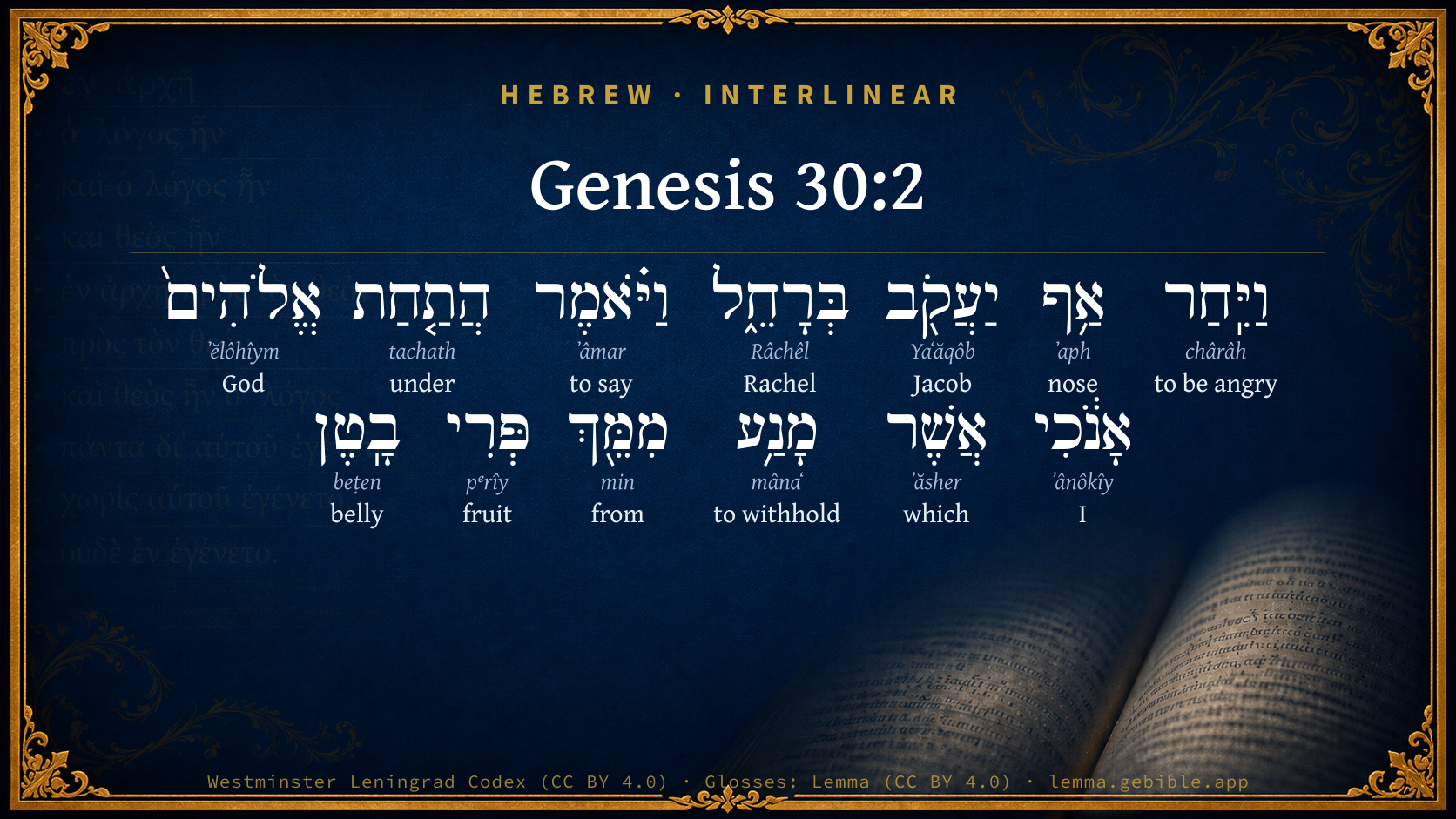
  1. וַיִּֽחַר chârâh H2734 “and · to be angry” Conjunction + Verb, Qal, Sequential Imperfect, 3rd Person, Masculine, Singular
  2. אַ֥ף ʼaph H639 “nose” Particle, Accusative
  3. יַעֲקֹ֖ב Yaʻăqôb H3290 “Jacob” Noun, Proper
  4. בְּרָחֵ֑ל Râchêl H7354 “in/at · Rachel” Preposition + Noun, Proper
  5. וַיֹּ֗אמֶר ʼâmar H559 “and · to say” Conjunction + Verb, Qal, Sequential Imperfect, 3rd Person, Masculine, Singular
  6. הֲתַ֤חַת tachath H8478 “under” Particle, Interrogative + Preposition
  7. אֱלֹהִים֙ ʼĕlôhîym H430 “God(s)” Noun, Common, Masculine, Plural, Absolute
  8. אָנֹ֔כִי ʼânôkîy H595 “I” Pronoun, Personal, 1st Person, Common, Singular
  9. אֲשֶׁר ʼăsher H834 “which” Particle, Relative
  10. מִמֵּ֖ךְ min H4480 “from · you” Preposition + Suffix, Personal, 2nd Person, Feminine, Singular
  11. פְּרִי pᵉrîy H6529 “fruit of” Noun, Common, Masculine, Singular, Construct
  12. בָֽטֶן beṭen H990 “belly” Noun, Common, Feminine, Singular, Absolute

About this verse

These counts appear in no published source. They are computed here, from the morphology-tagged text and Lemma’s own curated glosses. What Lemma adds →

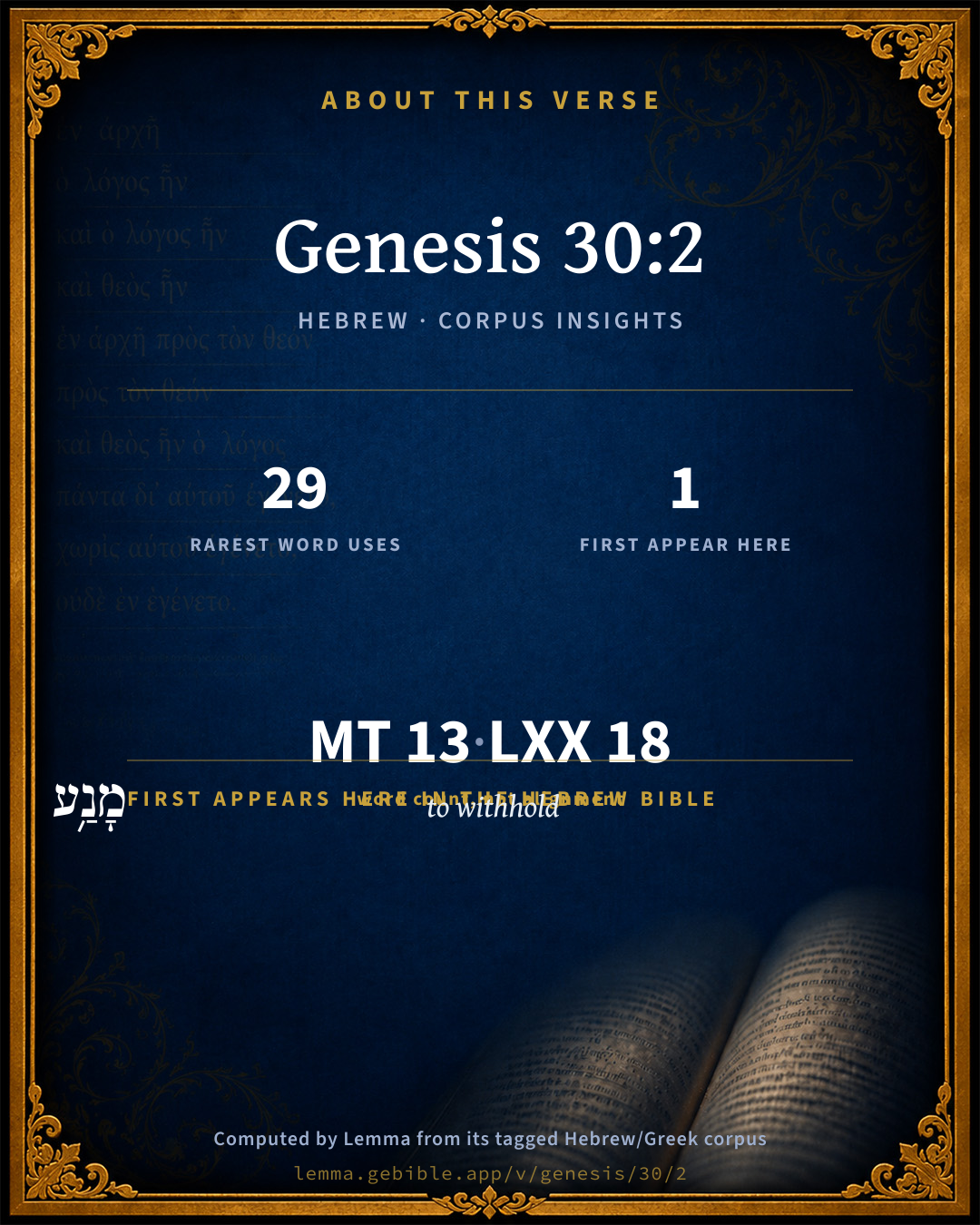
13
words
13
distinct lemmas
Pentateuch
section

First appearance in Scripture

This word makes its first canonical appearance in the Hebrew Bible here:

  • מָנַ֥ע to withhold H4513

Shared distinctive vocabulary

מָנַ֥ע to withhold H4513 occurs in 29 verses of the Hebrew Bible. Also found in:

Grammatical profile

  • 3 verbs
  • 5 nouns
  • 1 pronoun
  • 2 prepositions
  • 2 particles

Verb forms

  • וַיִּֽחַר Qal · Sequential Imperfect
  • וַיֹּ֗אמֶר Qal · Sequential Imperfect
  • מָנַ֥ע Qal · Perfect

Hebrew & Septuagint length

In English translation the verse runs 24 words from the Hebrew and 27 from the Septuagint (LXX English) — closely comparable.

A rough comparison of the two English renderings, which tokenize alike — not a word-level alignment.

Word counts can differ between the Hebrew and the Greek without any difference in meaning — e.g. the Hebrew direct-object marker אֵת has no separate Greek word, and Greek often adds the article ὁ.

In the original languages it is 13 Hebrew tokens and 18 Greek tokens — but the two are counted differently (Hebrew bundles its prefixes and suffixes into one token; the Greek is in lemma form), so that isn’t a like-for-like length.

Cross-references

17

Topical passages linked to Genesis 30:2 in the Treasury of Scripture Knowledge — connected by theme and wording, ordered by reader-vote popularity; previews shown in the World English Bible.

  • Genesis 16:2 Sarai said to Abram," See now, Yahweh has restrained me from bearing. Please go in to my handmaid. It may be that I will obtain children by her." Abram listened to the voice of Sarai.
  • 2 Kings 5:7 It happened, when the king of Israel had read the letter, that he tore his clothes, and said, Am I God, to kill and to make alive, that this man does send to me to recover a man of his leprosy? but consider, I pray you, and see how he seeks a quarrel against me.
  • Psalms 127:3 Behold, children are a heritage of Yahweh. The fruit of the womb is his reward.
  • Genesis 31:36 Jacob was angry, and argued with Laban. Jacob answered Laban, "What is my trespass? What is my sin, that you have hotly pursued after me?
  • Genesis 50:19 Joseph said to them, "Don't be afraid, for am I in the place of God?
  • 1 Samuel 1:5 but to Hannah he gave a double portion; for he loved Hannah, but Yahweh had shut up her womb.
  • Genesis 20:18 For Yahweh had closed up tight all the wombs of the house of Abimelech, because of Sarah, Abraham's wife.
  • Genesis 25:21 Isaac entreated Yahweh for his wife, because she was barren. Yahweh was entreated by him, and Rebekah his wife conceived.
  • Genesis 29:31 Yahweh saw that Leah was hated, and he opened her womb, but Rachel was barren.
  • Exodus 32:19 It happened, as soon as he came near to the camp, that he saw the calf and the dancing: and Moses' anger grew hot, and he threw the tablets out of his hands, and broke them beneath the mountain.
  • 1 Samuel 2:5–6 Those who were full have hired out themselves for bread; Those who were hungry have ceased [to hunger]: Yes, the barren has borne seven; She who has many children languishes.
  • Psalms 113:9 He settles the barren woman in her home, As a joyful mother of children. Praise Yah!
  • Matthew 5:22 But I tell you, that everyone who is angry with his brother without a cause shall be in danger of the judgment; and whoever shall say to his brother, 'Raca!' shall be in danger of the council; and whoever shall say, 'You fool!' shall be in danger of the fire of Gehenna.
  • Mark 3:5 When he had looked around at them with anger, being grieved at the hardening of their hearts, he said to the man, "Stretch out your hand." He stretched it out, and his hand was restored as healthy as the other.
  • Ephesians 4:26 "Be angry, and don't sin." Don't let the sun go down on your wrath,
  • Deuteronomy 7:13–14 and he will love you, and bless you, and multiply you; he will also bless the fruit of your body and the fruit of your ground, your grain and your new wine and your oil, the increase of your cattle and the young of your flock, in the land which he swore to your fathers to give you.
  • Luke 1:42 She called out with a loud voice, and said, "Blessed are you among women, and blessed is the fruit of your womb!

Cross-references courtesy of OpenBible.info (CC BY 4.0).

Hebrew and Greek witnesses Masoretic Hebrew ↔ Greek Septuagint

The same verse in the two great witnesses to the Old Testament, shown verse-for-verse.

These are two independent witnesses, not word-aligned to each other, and the Septuagint is shown in lemma (dictionary) form.

Hebrew Genesis 30:2 Masoretic · Westminster Leningrad Codex

וַיִּֽחַר אַ֥ף יַעֲקֹ֖ב בְּרָחֵ֑ל וַיֹּ֗אמֶר הֲתַ֤חַת אֱלֹהִים֙ אָנֹ֔כִי אֲשֶׁר מָנַ֥ע מִמֵּ֖ךְ פְּרִי בָֽטֶן

Jacob's anger was kindled against Rachel, and he said, "Am I in God's place, who has withheld from you the fruit of the womb?"

World English Bible · Public Domain

Greek LXX Genesis 30:2 Septuagint · lemma form

θυμόω δέ ἰακώβ ὁ ραχηλ καί εἶπον αὐτός μή ἀντί θεός ἐγώ εἰμί ὅς στερέω σύ καρπός κοιλία

And Jacob was angry with Rachel, and said to her, Am I in the place of God, who has deprived you of the fruit of the womb?

LXX2012 (modern English Septuagint) · Public Domain

Hebrew: Westminster Leningrad Codex (CC BY 4.0). Greek: Septuagint (public domain); English from LXX2012 (modern English Septuagint) (Public Domain). How the Septuagint differs from the Hebrew →

Targum (Aramaic paraphrase)

2

The Targum is the ancient Jewish Aramaic paraphrase of the Hebrew Scriptures — an interpretive translation, not the Hebrew text itself. Onkelos (literal) and Pseudo-Jonathan (expansive) render the Torah, and Jonathan the Prophets. Coverage is partial: where no permissively-licensed English translation exists for a verse, only the Aramaic is shown. This is verse-level text, not a word-by-word alignment to the Hebrew.

  1. Targum Onkelos Torah (Genesis–Deuteronomy)
    וּתְקֵיף רוּגְזָא דְיַעֲקֹב בְּרָחֵל וַאֲמַר הָא מִנִּי אַתְּ בַּעְיָא הֲלָא מִן קֳדָם יְיָ תִּבְעִין דִּי מְנַע מִנִּיךְ וַלְדָא דִּמְעִין

    (no public-domain English translation for this verse)

    Targum Onkelos — Aramaic: “Onkelos Genesis” (public domain); “Onkelos Exodus” (public domain); “Onkelos Leviticus” (public domain); “Onkelos Numbers” (public domain); “Onkelos Deuteronomy” (public domain). English: “Sefaria Community Translation” (CC0 1.0 (public-domain dedication)); “J.W. Etheridge. The Targums of Onkelos and Jonathan Ben Uzziel on the Pentateuch. London: Longmans, Green, 1862” (public domain). Text via Sefaria.

  2. Targum Pseudo-Jonathan Torah (Genesis–Deuteronomy)
    וּתְקֵיף רוּגְזָא דְיַעֲקב בְּרָחֵל וַאֲמַר עַד דְאַנְתְּ בַּעְיָא מִנִי בְּעִי מִן קֳדָם יְיָ דְמִן קֳדָמוֹי הִינוּן בְּנַיָא וְהוּא מְנַע מְנִיךְ פְּרִי מֵעַיָא

    And the anger of Jakob was stong against Rahel, and he said, Why do you ask of me? Ask before the Lord, from before whom are children, and who hath restrained from thee the fruit of the womb.

    Targum Pseudo-Jonathan — Aramaic: “Targum Jonathan on Genesis” (public domain); “Targum Jonathan on Exodus” (public domain); “Targum Jonathan on Leviticus” (public domain); “Targum Jonathan on Numbers” (public domain); “Targum Jonathan on Deuteronomy” (public domain). English: “The Targum of Jonathan ben Uzziel, trans. J. W. Etheridge, London, 1862” (public domain). Text via Sefaria.

Commentary

Notes on Genesis 30:2 from classic Christian and Jewish commentators (each source and its license shown beneath its notes). The classic Christian expositions comment on the surrounding passage and are grouped to its opening verse, so a note may address several verses; the Jewish commentaries on the Tanakh (Rashi and others) are per-verse, so they appear only where the commentator wrote on this verse.

Lemma curates 59 commentaries, every one of them public domain or Creative Commons licensed, each selected and text-cleaned for this edition rather than reprinted as found. About our sources →

Trapp's Complete Commentary

John Trapp

Gen 30:2 And Jacob’s anger was kindled against Rachel: and he said, [Am] I in God’s stead, who hath withheld from thee the fruit of the womb?

Ver. 2. And Jacob’s anger was kindled.] He that will be angry, and not sin, must not be angry, but for sin. Reprove thy wife, thou mayest; chide her, thou mayest not, unless the offence be against God, as here, and Job 2:10. And here a man may carry a severe rebuke in his countenance, as God doth, Psa 80:16, though he say nothing: he may chide with his looks only.

Am I in God’s stead?] Who carrieth this key under his own girdle; as is aforenoted. "Lo, children are a heritage that cometh of the Lord," as David {Psa 127:3} once sang for Solomon, who had the experience of it: for of so many wives, he had but one son, that we read of; and he was none of the wisest. {Ecc 2:19} This Solomon foresaw, and bewailed, as one unhappy bird, in his nest of vanities.

John Trapp, A Commentary or Exposition upon All the Books of the Old and New Testament (1647–1656) — public domain. Text from a community e-Sword module.

Joseph Benson's Commentary

Gen 30:2. And Jacob’s anger was kindled — He was angry at the sin, and showed his displeasure, by a grave and pious reply: Am I in God’s stead? — Can I give thee that which God denies thee? He acknowledges the hand of God in the affliction: He hath withheld the fruit of the womb. Whatever we want, it is God that withholds it, as sovereign Lord, most wise, holy, and just, who may do what he will with his own, and is debtor to no man; who never did, nor ever can do any wrong to any of his creatures. The key of the clouds, of the heart, of the grave, and of the womb, are four keys which God has in his hand, and which (the rabbins say) he trusts neither with angel nor seraph. He also acknowledges his own inability to alter what God appointed; am I in God’s stead? There is no creature that is, or can be, to us, in God’s stead. God may be to us instead of any creature, as the sun instead of the moon and stars; but the moon and all the stars will not be to us instead of the sun. No creature’s wisdom, power, and love, will be to us instead of God’s. It is therefore our sin and folly to place that confidence in any creature which is to be placed in God only.

Joseph Benson's Commentary on the Old and New Testaments (1811–1818) — public domain. Text from a community e-Sword module.

Geneva Bible (1599)

Geneva Bible translators

It is only God that maketh barren and fruitful, and therefore I am not in fault.

Geneva Bible (1599) marginal notes — public domain. Text via Bolls.life.

Adam Clarke's Commentary

Verse 2. Am I in God's stead] Am I greater than God, to give thee what he has refused?

Adam Clarke's Commentary on the Bible (1810–1826) — public domain. Text from a community e-Sword/MySword module.

John Calvin's Commentaries

2. And Jacob’s anger was kindled. The tenderness of Jacob’s affection rendered him unwilling to offend his wife; yet her unworthy conduct compelled him to do so, when he saw her petulantly exalt herself, not only against her sister, who piously, homily, and thankfully was enjoying the gifts of God; but even against God himself, of whom it is said that the fruit of the womb is his reward. (Psalm 127:3.) On this account, therefore, Jacob is angry, because his wife ascribes nothing to the providence of God, and, by imagining that children are the offspring of chance, would deprive God of the care and government of mankind. It is probable that Jacob had been already sorrowful on account of his wife’s barrenness. He now, therefore, fears lest her folly should still farther provoke God’s anger to inflict more severe strokes. This was a holy indignation, by which Jacob maintained the honor due to God, while he corrected his wife, and taught her that it was not without sufficient cause that she had been hitherto barren. For when he affirms that the Lord had shut her womb, he obliquely intimates that she ought the more deeply to humble herself.

John Calvin's Commentaries (1540-1563) — public domain. Text from the Calvin Translation Society English edition (1840s-50s) via the Christian Classics Ethereal Library (ccel.org). Calvin's coverage is partial (roughly two-thirds of the Bible); uncommented books and verses are honest gaps, never fabricated. The 19th-century editor's footnotes and remarks are omitted so the notes are faithfully Calvin's own voice.

The Cambridge Bible for Schools and Colleges

gen. ed. J. J. S. Perowne

2. Am I in God’s stead] See Gen_50:19. For God as the author and giver of human life, cf. Gen_16:2, Gen_29:31; 1Sa_1:5. A similar exclamation occurs in 2Ki_5:7.

The Cambridge Bible for Schools and Colleges (gen. ed. J. J. S. Perowne; Cambridge University Press, 1878–1918) — public domain. Text from a community e-Sword module.

John Gill's Exposition

And Jacob's anger was kindled against Rachel,.... Whom yet he dearly loved, hearing her talk in such an extravagant manner, as her words seemed to be, and were not: only expressive of great uneasiness and impatience, but implied what was not in the power of man to do:

and he said, am I in God's stead: do you take me to be God, or one that has a dispensing power from him to do what otherwise no creature can do; and which also he never gives to any? for, as the Targum of Jerusalem on Gen 30:22 says, this is one of the four keys which God delivers not to an angel or a seraph; even the key of barrenness. Children are the gift of God, and his only, and therefore he is to be sought unto for them: hence Onkelos land Jonathan paraphrase it;"wherefore dost thou seek them of me? shouldest thou not seek them of the Lord?"

who hath withheld from thee the fruit of the womb? children, Psa 127:3; not Jacob, but the Lord.

John Gill's Exposition of the Whole Bible (1746–1763) — public domain (CC PDM 1.0). Text via the HelloAO Bible API.

Haydock's Catholic Bible Commentary

Angry at the rash and apparently blasphemous demand of Rachel. (Menochius) --- As God, pro Deo. Am I to work a miracle in opposition to God, who has made thee barren? To him thou oughtest to address thyself. The Hebrews justly observe, that God has reserved to himself the four keys of nature: 1. Of generation; 2. Of sustenance, Psalm cxliv. 16; 3. Of rain, Deuteronomy xxviii. 12; And, 4. Of the grave or resurrection, Ezechiel xxxvii. 12. (Tirinus)

George Leo Haydock (1774–1849), Haydock's Catholic Family Bible and Commentary, 1859 edition — public domain. Excludes Psalms (Douay-Rheims chapter numbering differs from Protestant) and Deuterocanonical books (Catholic canon only).

Matthew Poole's English Annotations

Jacob's anger was kindled against Rachel for the injury done to himself, and especially for the sin against God, in which case anger is not only lawful, but necessary.

Am I in God's stead? It is God's prerogative to give children. See Gen 16:2; 1Sa 2:5-6; Psa 113:9; 127:3.

Matthew Poole's English Annotations on the Holy Bible (1683–1685) — public domain. Text from a community e-Sword/MySword module.

Whedon's Commentary on the Bible

Daniel D. Whedon

2. Jacob’s anger — Here is something that stings to the quick the soul of him who has hitherto showed such general gravity and calmness. Such rebuke from the lips of his beloved Rachel arouses him to a sudden outburst of anger, in which he administers to her a sharp rebuke.

Daniel D. Whedon (gen. ed.), Commentary on the Old and New Testaments (1874–1909) — public domain. Text from a community e-Sword module.

The Pulpit Commentary

And Jacob"s anger was kindled against Rachel (not without just cause, since she not only evinced a want of faith and resignation, but wrongfully imputed blame to him): and he said, Am I in God"s stead,i.e. am I omnipotent like him? This you yourself will surely not presume tobelieve. The interrogative particle conveys the force of a spirited denial (vide Ewald, "Hebrew Syntax," who hath withheld from thee the fruit of the womb? Rachel herself understood that God alone could remove sterility (ver. 6); but to this fact jealousy of Leah appears for the moment to have blinded her.

The Pulpit Commentary (1880–1919), ed. H.D.M. Spence-Jones & Joseph S. Exell — public domain. Text from a community e-Sword module.

John Wesley's Explanatory Notes

And Jacob's anger was kindled - He was angry, not at the person, but at the sin: he expressed himself so as to shew his displeasure. It was a grave and pious reply which Jacob gave to Rachel, Am I in God's stead? - Can I give thee that which God denies thee? He acknowledges the hand of God in the affliction: He hath withheld the fruit of the womb. Whatever we want, it is God that with-holds it, as sovereign Lord, most wise, holy, and just, that may do what he will with his own, and is debtor to no man: that never did, nor ever can do, any wrong to any of his creatures. The key of the clouds, of the heart, of the grave, and of the womb, are four keys which God has in his hand, and which (the Rabbins say) he intrusts neither with angel nor seraphin. He also acknowledges his own inability to alter what God appointed, Am I in God's stead? What, dost thou make a God of me? There is no creature that is, or can be, to us in God's stead. God may be to us, instead of any creature, as the sun instead of the moon and stars; but the moon and all the stars will not be to us instead of the sun. No creature's wisdom, power, and love will be to us instead of God's. It is therefore our sin and folly to place that confidence in any creature, which is to be placed in God only.

John Wesley, Explanatory Notes Upon the Whole Bible (1754–1765) — public domain. Text via the GEBible commentary corpus.

Rashi

Rabbi Shlomo Yitzchaki (Rashi)

התחת means AM I IN HIS STEAD?

אשר מנע ממך WHO HATH WITHHELD FROM THEE —You say that I should do as my father did; but I am not circumstanced as my father was. My father had no children at all, I, however, have children. From you He has withheld children and not from me (Genesis Rabbah 71:7).

Rashi on the Tanakh — English translations: “The Judaica Press complete Tanach with Rashi, translated by A. J. Rosenberg” (CC BY 4.0); “Pentateuch with Rashi's commentary by M. Rosenbaum and A.M. Silbermann, 1929-1934” (public domain); “The Metsudah Tanach series, Lakewood, N.J” (CC BY 4.0); and “The Book of Joshua, Metsudah Publications, 1997” (CC BY 4.0). Text via Sefaria.

Ramban (Nachmanides)

Rabbi Moshe ben Nachman (Ramban / Nachmanides)

AND JACOB’s ANGER WAS KINDLED. It is not in the power of the righteous that their prayer be heard and answered in any case, and because she spoke in the manner of yearning women who are loved, thus attempting to frighten him with her death, his anger was kindled. Therefore, he said to her that he is not in G-d’s stead that he should remember the barren ones by giving them children in any case, and he does not care about it since it is from her that children were withheld and not from him. He said this in order to admonish her and shame her. Now the righteous woman Rachel, seeing that she could not rely upon Jacob’s prayer, then went to pray on her own behalf to Him Who hears the cry of those in trouble. This is the sense of the verse, And G-d hearkened to her. Perhaps we can rectify Jacob’s retort in consonance with the opinion of our Rabbis [who related that Jacob said to Rachel, “It is from you that He has withheld children and not from me,”] for it is impossible to think that Jacob did not pray on behalf of his beloved wife who was barren, however his prayer was not accepted.Now Rachel came to him with a pretext saying that he should, in any case, give her children through his prayer for he is not of less stature than his father who did so. At this, his anger was kindled and he said to her that the matter is up to G-d and not to him, and that his father’s prayer was heard because he was a righteous man and was destined to have children, but here it is from her that He has withheld children. This is a correct interpretation.

Ramban (Nachmanides) on the Tanakh — English translation: “Commentary on the Torah by Ramban (Nachmanides). Translated and annotated by Charles B. Chavel. New York, Shilo Pub. House, 1971-1976” (CC BY 4.0). Text via Sefaria.

Radak

Rabbi David Kimhi (Radak)

ויחר...אשר מנע ממך, G’d denied you children, not I. You have to pray to Him, not to berate me. As far as I am concerned, I have made my contribution already having slept with you far more often than with Leah. If you are genetically barren then you have to ask G’d to open your womb. Your sister did the same and her prayer has been answered. The word מנע, prevented, which Yaakov used meant that the sperm did not enter the area of the womb where fertilisation takes place. Yaakov’s anger was due to Rachel attributing her problem to Yaakov and something Yaakov had failed to do, and not to G’d, Who decrees who is barren and who is fertile. The demand to her husband הבה לי בנים, “get me children,” was entirely out of place. Had she asked Yaakov to plead with G’d to have mercy on her, she would have been perfectly in order. He would not then have become angry at her.

Radak on the Tanakh — English translations: “Sefaria Community Translation” (CC0 1.0 (public-domain dedication)); “Eliyahu Munk, HaChut Hameshulash” (CC BY 4.0); “Rabbi Mike Feuer, Jerusalem Anthology” (CC BY 4.0); and “R. David Kimhi on the first book of Psalms, Translated by R.G. Finch, London, 1919” (public domain). Text via Sefaria.

Lesson kit

Teaching starters — assembled from the data on this page, not authored interpretation. Every prompt links to the verse data it draws on. Edit before teaching.

Genesis, in the Pentateuch, opens this verse with 13 words (13 distinct Hebrew lemmas). Its most distinctive word is mânaʻ (“to withhold”). A historical commentator’s framing appears above. Read the whole chapter for the surrounding context.

Discussion questions

  1. The word mânaʻ carries the sense “to withhold.” How does it shape the verse?
  2. This is the first place “to withhold” appears in Scripture (first appears here). What does its debut here establish?
  3. How does Numbers 22:16, which shares the word «to withhold», read alongside this verse?
  4. These translations render this verse differently; the difference is in the English rendering, not the original. What questions does that raise?
  5. «וַיִּֽחַר» is a Qal Sequential Imperfect verb. How does that grammatical form shape the action described?
  6. Compare how Trapp's Complete Commentary and Joseph Benson's Commentary read this verse. Where do they agree or differ?

Things to notice

Reading settings

Reading text

Shown beneath each verse's original-language words.

Old Testament
Old Testament edition

Read the OT as the Masoretic Hebrew (MT) or the Greek Septuagint (LXX).

English shown for the Greek Septuagint (in the Hebrew ↔ Greek comparison).

Comparing translations? Open the Compare panel on any verse page to stack up to four side by side.