Leviticus 14:3

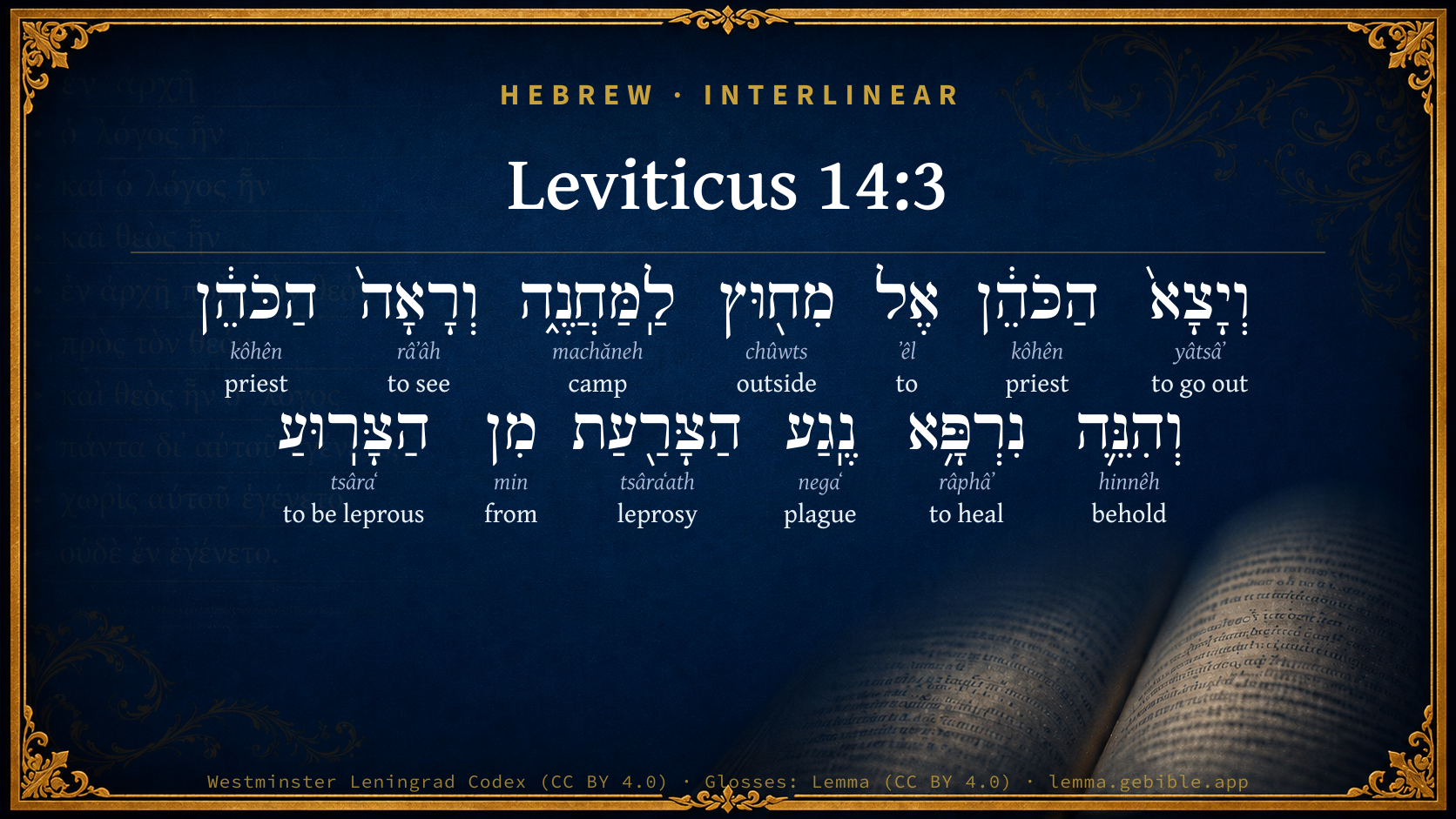
Hebrew (Westminster Leningrad Codex) Leviticus 14:3 appears in the Hebrew Old Testament. The text above is from the Westminster Leningrad Codex. Each word links to its Strong’s number, a concise gloss, and parsing drawn from the Open Scriptures Hebrew Bible morphology. Click any word for its full Brown-Driver-Briggs (BDB) entry.
Download image
Cite this verse

Leviticus 14:3 (World English Bible). Public Domain. Lemma interlinear Bible study tool, https://lemma.gebible.app/v/leviticus/14/3.

Show BibTeX & RIS
BibTeX
RIS
English Translation
and the priest shall go forth out of the camp. The priest shall examine him, and, behold, if the plague of leprosy is healed in the leper,
World English Bible · Public Domain
Download a study sheet

One document with this verse’s original text, its word-by-word gloss line, the meaning frame, cross-references with their text, attributed commentary, and full source and license credits — printable, and it pastes into notes with its structure intact.

This verse Autodidact and up

Study sheet (.html) Plain text (.txt)

A passage Seminary Student

Up to 50 verses in one chapter. A passage sheet keeps up to 6 commentary sources and 12 cross-references per verse, in the order this page ranks them, and says so on the sheet whenever that leaves anything out. Ask for a single verse and you get the Autodidact verse sheet above.

Everything on this page stays free to read, with no account — the sheet is a download of what is already on screen, not access to it.

Want to remove ads? Support Godless Engineer
Compare translations 3

The same verse in 3 English versions, stacked beneath the original-language interlinear above. Click any original word for its lexicon entry.

Each is an independent rendering of the whole verse — the interlinear is not word-aligned to these translations.

Highlighted words mark where these versions differ — a whole-verse word diff, not a word-by-word alignment.

  • World English Bible Public Domain
    and the priest shall go forth out of the camp. The priest shall examine him, and, behold, if the plague of leprosy is healed in the leper,
  • King James Version Public Domain
    And the priest shall go forth out of the camp; and the priest shall look, and, behold, if the plague of leprosy be healed in the leper;
  • unfoldingWord Literal Text CC BY-SA 4.0
    And the priest shall go out to on the outside of the camp and the priest shall see. And behold, the infection of the skin disease was healed from the person with the skin disease.

unfoldingWord Literal Text — © unfoldingWord, licensed CC BY-SA 4.0. Word-aligned USFM3 via Door43 (git.door43.org/unfoldingWord/en_ult).

Versions to compare (up to 4)

3 of 4 selected

Show all 18 translations

Every available English version of this verse, each an independent rendering of the whole verse.

  • World English Bible Public Domain
    and the priest shall go forth out of the camp. The priest shall examine him, and, behold, if the plague of leprosy is healed in the leper,
  • Berean Standard Bible Public Domain
    The priest is to go outside the camp to examine him, and if the skin disease of the afflicted person has healed,
  • Majority Standard Bible Public Domain
    The priest is to go outside the camp to examine him, and if the skin disease of the afflicted person has healed,
  • King James Version Public Domain
    And the priest shall go forth out of the camp; and the priest shall look, and, behold, if the plague of leprosy be healed in the leper;
  • American Standard Version (1901) Public Domain
    and the priest shall go forth out of the camp; and the priest shall look; and, behold, if the plague of leprosy be healed in the leper,
  • Revised Version (1885) Public Domain
    and the priest shall go forth out of the camp; and the priest shall look, and, behold, if the plague of leprosy be healed in the leper;
  • Geneva Bible (1599) Public Domain
    And the Priest shall go out of the campe, and the Priest shall consider him: and if the plague of leprosie be healed in the leper,
  • Douay-Rheims (1899) Public Domain
    Who going out of the camp when he shall And that the leprosy is cleansed,
  • Young's Literal Translation Public Domain
    and the priest hath gone out unto the outside of the camp, and the priest hath seen, and lo, the plague of leprosy hath ceased from the leper,
  • Literal Standard Version CC BY-SA 4.0
    and the priest has gone out to the outside of the camp, and the priest has seen, and behold, the plague of leprosy has ceased from the leper,
  • Unlocked Literal Bible CC BY-SA 4.0
    The priest will go out of the camp to examine the person to see if the infectious skin disease is healed.
  • unfoldingWord Literal Text CC BY-SA 4.0
    And the priest shall go out to on the outside of the camp and the priest shall see. And behold, the infection of the skin disease was healed from the person with the skin disease.
  • Darby Bible Public Domain
    and the priest shall go out of the camp; and when the priest looketh, and behold, the sore of leprosy is healed in the leper,
  • World Messianic Bible Public Domain
    and the priest shall go out of the camp. The priest shall examine him. Behold, if the plague of leprosy is healed in the leper,
  • Webster's Bible Public Domain
    And the priest shall go forth out of the camp: and the priest shall look, and behold, if the plague of leprosy is healed in the leper;
  • Free Bible Version CC BY-SA 4.0
    The priest must go outside the camp and inspect the person. If the skin disease has healed,
  • Bible in Basic English Public Domain
    And the priest is to go outside the tent-circle; and if, after looking, the priest sees that the mark of the disease has gone from him,
  • JPS Tanakh (1917) Public Domain
    And the priest shall go forth out of the camp; and the priest shall look, and, behold, if the plague of leprosy be healed in the leper;

Literal Standard Version (2020), Covenant Press — licensed CC BY-SA 4.0. Text via the HelloAO Bible API (eBible.org). Unlocked Literal Bible (unfoldingWord) — licensed CC BY-SA 4.0. Text via the HelloAO Bible API (eBible.org). unfoldingWord Literal Text — © unfoldingWord, licensed CC BY-SA 4.0. Word-aligned USFM3 via Door43 (git.door43.org/unfoldingWord/en_ult). Free Bible Version, Dr. Jonathan Gallagher — licensed CC BY-SA 4.0. Text via the HelloAO Bible API (eBible.org).

Word by word

More ways to search: Search by grammar → Find every occurrence → Compare this word →

Practice this passage: Drill this verse → Learn its vocabulary →

הַצָּרֽוּעַ
tsâraʻ
H6879
“the · leprous”
Particle, Definite Article + Verb, Qal, Participle Passive, Masculine, Singular, Absolute
Part of Speech
Particle + Verb
Stem
Qal
Form
Participle Passive
Gender
Masculine
Number
Singular
State
Absolute
Full BDB Definition

Origin: a primitive root

TWOT: 1971

to be diseased of skin, be leprous - (Qal) to be a leper - (Pual) to have leprosy
  1. וְיָצָא֙ yâtsâʼ H3318 “and · to go out” Conjunction + Verb, Qal, Sequential Perfect, 3rd Person, Masculine, Singular
  2. הַכֹּהֵ֔ן kôhên H3548 “the · priest” Particle, Definite Article + Noun, Common, Masculine, Singular, Absolute
  3. אֶל ʼêl H413 “to” Preposition
  4. מִח֖וּץ chûwts H2351 “from · outside” Preposition + Noun, Common, Masculine, Singular, Absolute
  5. לַֽמַּחֲנֶ֑ה machăneh H4264 “to/for the · camp” Preposition, Determined + Noun, Common, Both, Singular, Absolute
  6. וְרָאָה֙ râʼâh H7200 “and · to see” Conjunction + Verb, Qal, Sequential Perfect, 3rd Person, Masculine, Singular
  7. הַכֹּהֵ֔ן kôhên H3548 “the · priest” Particle, Definite Article + Noun, Common, Masculine, Singular, Absolute
  8. וְהִנֵּ֛ה hinnêh H2009 “and · behold” Conjunction + Particle, Demonstrative
  9. נִרְפָּ֥א râphâʼ H7495 “to heal” Verb, Niphal, Perfect, 3rd Person, Masculine, Singular
  10. נֶֽגַע negaʻ H5061 “plague of” Noun, Common, Masculine, Singular, Construct
  11. הַצָּרַ֖עַת tsâraʻath H6883 “the · leprosy” Particle, Definite Article + Noun, Common, Feminine, Singular, Absolute
  12. מִן min H4480 “from” Preposition

About this verse

These counts appear in no published source. They are computed here, from the morphology-tagged text and Lemma’s own curated glosses. What Lemma adds →

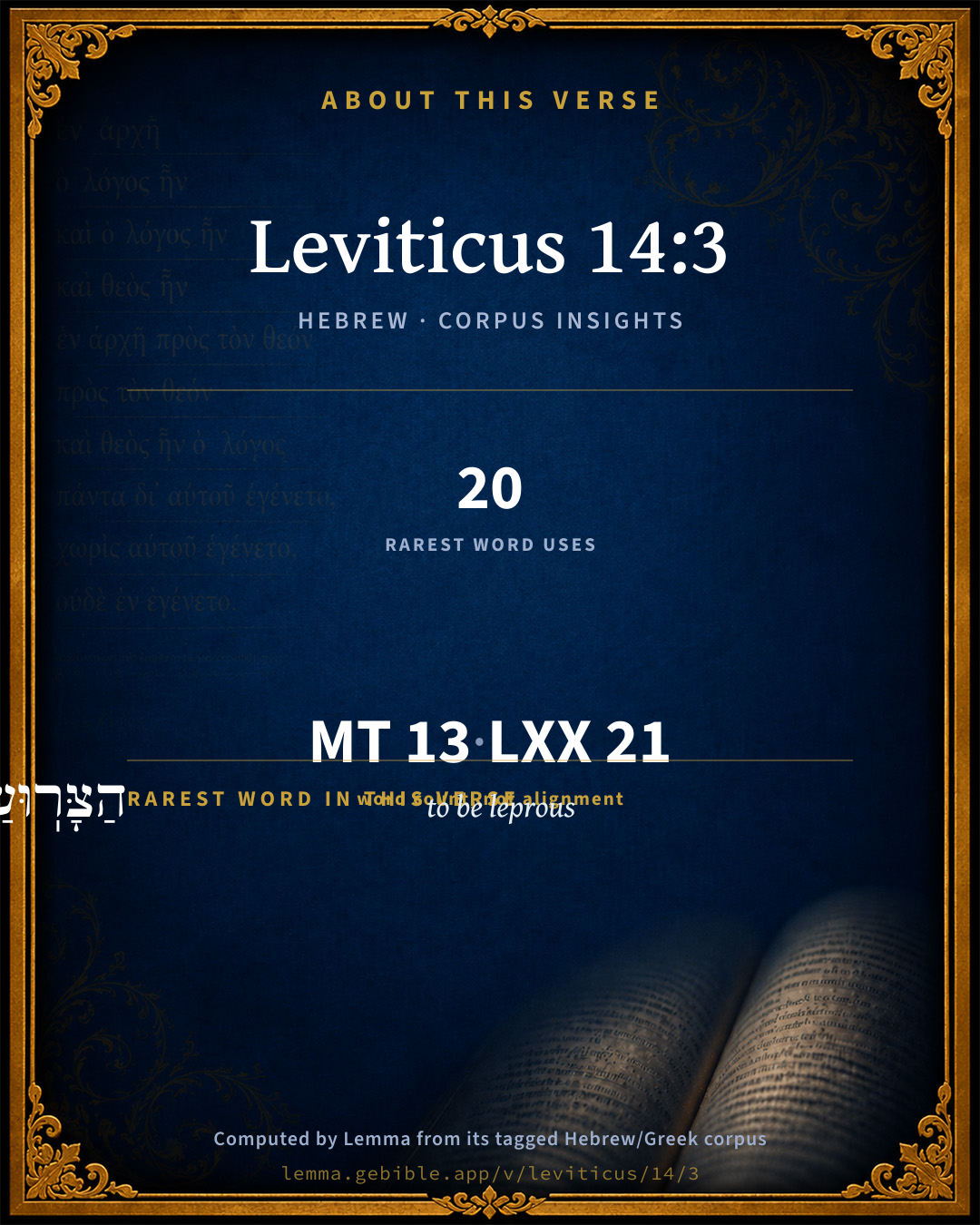
13
words
12
distinct lemmas
Pentateuch
section

Notable vocabulary

The rarest word here is הַצָּרֽוּעַ to be leprous H6879 — appearing just 20 times in the whole Hebrew Bible.

Shared distinctive vocabulary

הַצָּרֽוּעַ to be leprous H6879 occurs in 18 verses of the Hebrew Bible. Also found in:

Grammatical profile

  • 4 verbs
  • 6 nouns
  • 2 prepositions
  • 1 particle

Verb forms

  • וְיָצָא֙ Qal · Sequential Perfect
  • וְרָאָה֙ Qal · Sequential Perfect
  • נִרְפָּ֥א Niphal · Perfect
  • הַצָּרֽוּעַ Qal · Participle Passive

Repetition

A word recurs within this verse — often emphatic in Hebrew:

  • הַכֹּהֵ֔ן priest H3548 ×2

Hebrew & Septuagint length

In English translation the verse runs 27 words from the Hebrew and 27 from the Septuagint (LXX English) — the same length.

A rough comparison of the two English renderings, which tokenize alike — not a word-level alignment.

Word counts can differ between the Hebrew and the Greek without any difference in meaning — e.g. the Hebrew direct-object marker אֵת has no separate Greek word, and Greek often adds the article ὁ.

In the original languages it is 13 Hebrew tokens and 21 Greek tokens — but the two are counted differently (Hebrew bundles its prefixes and suffixes into one token; the Greek is in lemma form), so that isn’t a like-for-like length.

Cross-references

12

Topical passages linked to Leviticus 14:3 in the Treasury of Scripture Knowledge — connected by theme and wording, ordered by reader-vote popularity; previews shown in the World English Bible.

  • Leviticus 13:46 All the days in which the plague is in him he shall be unclean. He is unclean. He shall dwell alone. Outside of the camp shall be his dwelling.
  • Exodus 15:26 and he said, "If you will diligently listen to the voice of Yahweh your God, and will do that which is right in his eyes, and will pay attention to his commandments, and keep all his statutes, I will put none of the diseases on you, which I have put on the Egyptians; for I am Yahweh who heals you."
  • 2 Kings 5:3 She said to her mistress, Would that my lord were with the prophet who is in Samaria! then would he recover him of his leprosy.
  • 2 Kings 5:7–8 It happened, when the king of Israel had read the letter, that he tore his clothes, and said, Am I God, to kill and to make alive, that this man does send to me to recover a man of his leprosy? but consider, I pray you, and see how he seeks a quarrel against me.
  • 2 Kings 5:14 Then went he down, and dipped [himself] seven times in the Jordan, according to the saying of the man of God; and his flesh came again like the flesh of a little child, and he was clean.
  • Job 5:18 For he wounds, and binds up; He injures, and his hands make whole.
  • Matthew 10:8 Heal the sick, cleanse the lepers, and cast out demons. Freely you received, so freely give.
  • Matthew 11:5 the blind receive their sight, the lame walk, the lepers are cleansed, the deaf hear, the dead are raised up, and the poor have good news preached to them.
  • Luke 4:27 There were many lepers in Israel in the time of Elisha the prophet, yet not one of them was cleansed, except Naaman, the Syrian."
  • Luke 7:22 Jesus answered them, "Go and tell John the things which you have seen and heard: that the blind receive their sight, the lame walk, the lepers are cleansed, the deaf hear, the dead are raised up, and the poor have good news preached to them.
  • Luke 17:15–19 One of them, when he saw that he was healed, turned back, glorifying God with a loud voice.
  • 1 Corinthians 6:9–11 Or don't you know that the unrighteous will not inherit the Kingdom of God? Don't be deceived. Neither the sexually immoral, nor idolaters, nor adulterers, nor male prostitutes, nor homosexuals,

Cross-references courtesy of OpenBible.info (CC BY 4.0).

Hebrew and Greek witnesses Masoretic Hebrew ↔ Greek Septuagint

The same verse in the two great witnesses to the Old Testament, shown verse-for-verse.

These are two independent witnesses, not word-aligned to each other, and the Septuagint is shown in lemma (dictionary) form.

Hebrew Leviticus 14:3 Masoretic · Westminster Leningrad Codex

וְיָצָא֙ הַכֹּהֵ֔ן אֶל מִח֖וּץ לַֽמַּחֲנֶ֑ה וְרָאָה֙ הַכֹּהֵ֔ן וְהִנֵּ֛ה נִרְפָּ֥א נֶֽגַע הַצָּרַ֖עַת מִן הַצָּרֽוּעַ

and the priest shall go forth out of the camp. The priest shall examine him, and, behold, if the plague of leprosy is healed in the leper,

World English Bible · Public Domain

Greek LXX Leviticus 14:3 Septuagint · lemma form

καί ἐκἔρχομαι ὁ ἱερεύς ἔξω ὁ παρεμβολή καί ὁράω ὁ ἱερεύς καί ἰδού ἰάομαι ὁ ἁφή ὁ λέπρα ἀπό ὁ λεπρός

And the priest shall come forth out of the camp, and the priest shall look, and, behold, the plague of the leprosy is removed from the leper.

LXX2012 (modern English Septuagint) · Public Domain

Hebrew: Westminster Leningrad Codex (CC BY 4.0). Greek: Septuagint (public domain); English from LXX2012 (modern English Septuagint) (Public Domain). How the Septuagint differs from the Hebrew →

Targum (Aramaic paraphrase)

2

The Targum is the ancient Jewish Aramaic paraphrase of the Hebrew Scriptures — an interpretive translation, not the Hebrew text itself. Onkelos (literal) and Pseudo-Jonathan (expansive) render the Torah, and Jonathan the Prophets. Coverage is partial: where no permissively-licensed English translation exists for a verse, only the Aramaic is shown. This is verse-level text, not a word-by-word alignment to the Hebrew.

  1. Targum Onkelos Torah (Genesis–Deuteronomy)
    וְיִפּוֹק כַּהֲנָא לְמִבָּרָא לְמַשְׁרִיתָא וְיֶחֱזֵי כַהֲנָא וְהָא אִתַּסִי מַכְתַּשׁ סְגִירוּתָא מִן סְגִירָא

    (no public-domain English translation for this verse)

    Targum Onkelos — Aramaic: “Onkelos Genesis” (public domain); “Onkelos Exodus” (public domain); “Onkelos Leviticus” (public domain); “Onkelos Numbers” (public domain); “Onkelos Deuteronomy” (public domain). English: “Sefaria Community Translation” (CC0 1.0 (public-domain dedication)); “J.W. Etheridge. The Targums of Onkelos and Jonathan Ben Uzziel on the Pentateuch. London: Longmans, Green, 1862” (public domain). Text via Sefaria.

  2. Targum Pseudo-Jonathan Torah (Genesis–Deuteronomy)
    וְיִפּוֹק כַּהֲנָא לְמִבָּרָא לְמַשְׁרִיתָא וְיֶחֱמֵי וְהָא אִיתְּסֵי סְגִירוּתָא מִן סְגִירָא

    And the priest shall go forth out of the camp, and look, and behold, the leper hath been healed of his leprosy.

    Targum Pseudo-Jonathan — Aramaic: “Targum Jonathan on Genesis” (public domain); “Targum Jonathan on Exodus” (public domain); “Targum Jonathan on Leviticus” (public domain); “Targum Jonathan on Numbers” (public domain); “Targum Jonathan on Deuteronomy” (public domain). English: “The Targum of Jonathan ben Uzziel, trans. J. W. Etheridge, London, 1862” (public domain). Text via Sefaria.

Commentary

Notes on Leviticus 14:3 from classic Christian and Jewish commentators (each source and its license shown beneath its notes). The classic Christian expositions comment on the surrounding passage and are grouped to its opening verse, so a note may address several verses; the Jewish commentaries on the Tanakh (Rashi and others) are per-verse, so they appear only where the commentator wrote on this verse.

Lemma curates 59 commentaries, every one of them public domain or Creative Commons licensed, each selected and text-cleaned for this edition rather than reprinted as found. About our sources →

Trapp's Complete Commentary

John Trapp

Lev 14:3 And the priest shall go forth out of the camp; and the priest shall look, and, behold, [if] the plague of leprosy be healed in the leper;

Ver. 3. If the plague of leprosy be healed.] As it was in Simon the leper that entertained Christ. Jealousy, frenzy, and heresy are counted incurable diseases: not so leprosy; though the most carried it to their death, as Gehazi, Azariah, &c.

John Trapp, A Commentary or Exposition upon All the Books of the Old and New Testament (1647–1656) — public domain. Text from a community e-Sword module.

Joseph Benson's Commentary

Lev 14:3. Healed — By God, for God alone did heal or cleanse him really, the priest only declaratively.

Joseph Benson's Commentary on the Old and New Testaments (1811–1818) — public domain. Text from a community e-Sword module.

Adam Clarke's Commentary

Verse 3. The priest shall go forth out of the camp] As the leper was separated from the people, and obliged, because of his uncleanness, to dwell without the camp, and could not be admitted till the priest had declared that he was clean; hence it was necessary that the priest should go out and inspect him, and, if healed, offer for him the sacrifices required, in order to his re-admission to the camp. As the priest alone had authority to declare a person clean or unclean, it was necessary that the healed person should show himself to the priest, that he might make a declaration that he was clean and fit for civil and religious society, without which, in no case, could he be admitted; hence, when Christ cleansed the lepers, Mt 8:2-4, he commanded them to go and show themselves to the priest, &c.

Adam Clarke's Commentary on the Bible (1810–1826) — public domain. Text from a community e-Sword/MySword module.

Ellicott's Commentary for English Readers

(3) And the priest shall go forth.—To this appointed place the priest had to go to meet and examine the restored leper, and to satisfy himself that he was thoroughly cured.

A Bible Commentary for English Readers, edited by Charles John Ellicott (1878–1897) — public domain. Text from a community e-Sword module.

The Cambridge Bible for Schools and Colleges

gen. ed. J. J. S. Perowne

3. The priest goes outside to meet the leper; probably signs of convalescence have already been notified to the priest, which have satisfied him, and he now declares the plague to be healed.

The Cambridge Bible for Schools and Colleges (gen. ed. J. J. S. Perowne; Cambridge University Press, 1878–1918) — public domain. Text from a community e-Sword module.

John Gill's Exposition

And the priest shall go forth out of the camp,.... A little without the camp, as Ben Gersom notes. There have been several goings forth of Christ our High Priest; first in the council and covenant of grace and peace, when he became the surety of his people; then in time by the assumption of human nature, when he came forth from his Father, and came into the world to save them; next, when he went forth out of the city of Jerusalem to suffer for them; and also, when, at the time of conversion, he goes forth in quest of them, and looks them up, and finds them, and brings them home, which may answer to the type here; and all shows the great readiness of Christ to receive sinners:

and the priest shall look, and, behold, if the plague of leprosy be healed in the leper; that all the signs of uncleanness are removed, the swelling, the scab, or bright spot, and the white hair in them, and, instead of that, black hair is grown up. The typical priest did not heal, nor could he, the healing was of God; he only looked to see by signs if the plague was healed; but our antitypical priest looks with an eye of pity and compassion on leprous sinners, and they are enabled to look to him by faith, and virtue goes out of him to the healing of their diseases; as he looks upon them in their blood, and says to them, Live, so he looks upon them in their leprosy, and touches them, and says, "I will, be thou clean", Mat 8:3, and they are immediately healed; he is the sun of righteousness, which arises upon them with healing in his wings.

John Gill's Exposition of the Whole Bible (1746–1763) — public domain (CC PDM 1.0). Text via the HelloAO Bible API.

Haydock's Catholic Bible Commentary

Camp. The leper was not left to his own judgment to mix with society, as soon as he perceived himself cleansed. He had to send for a priest; and one of the most discerning among those who made it their employment to study in the court of the tabernacle, was commissioned to examine him. (Grotius) --- The sacrifice was offered without the camp, (Calmet) if it may be called a sacrifice. (Menochius) --- That of Christ’s body was not yet instituted, which supplies all the rest. (St. Augustine, contra adv. i. 19.) (Worthington)

George Leo Haydock (1774–1849), Haydock's Catholic Family Bible and Commentary, 1859 edition — public domain. Excludes Psalms (Douay-Rheims chapter numbering differs from Protestant) and Deuterocanonical books (Catholic canon only).

Matthew Poole's English Annotations

To wit, by God; for God alone did heal or cleanse him really, the priest only ministerially and declaratively, as ministers are said to remit sins, though it be granted that none can truly and properly forgive sins but God, Mar 2:7.

Matthew Poole's English Annotations on the Holy Bible (1683–1685) — public domain. Text from a community e-Sword/MySword module.

Whedon's Commentary on the Bible

Daniel D. Whedon

3. Healed — See introductory remarks.

Daniel D. Whedon (gen. ed.), Commentary on the Old and New Testaments (1874–1909) — public domain. Text from a community e-Sword module.

The Pulpit Commentary

The priest. The agent is stilt the priest, not the physician. The priest shall go forth out of the comp. "May we not (as Hesychius suggests) see a figure here of the compassion of our Great High Priest, who has gone forth out of heaven itself, the camp of angel hosts, and has come down to earth, not only to examine but to heal tile moral leprosy of sin, "to seek and to save the lost", (Luk_19:10) and who carefully examines and scrutinizes all the secrets of all hearts? (Heb_4:12) And he was exempt from all contagion of sin while he lived and moved among sinners, (Mat_9:11 Luk_15:1) and was "holy, harmless, and undefiled (Heb_7:26) (Wordsworth). And the priest shall look. In later times it was ordered that the examination was not to take place on the sabbath, nor in the early morning, nor in the late afternoon, nor inside a house, nor on a cloudy day, nor in the glare of midday, and that the priest must have good eyesight, and only determine one case at a time; nor was he allowed to pronounce judgment on his own kindred. And, behold, if the plague of leprosy be healed in the leper. The plague of leprosy is healed before the ceremony of purification begins, but the leper is not pronounced clean until he has been sprinkled with the blood and water (verse 7).

The Pulpit Commentary (1880–1919), ed. H.D.M. Spence-Jones & Joseph S. Exell — public domain. Text from a community e-Sword module.

John Wesley's Explanatory Notes

Healed by God-For God alone did heal or cleanse him really, the priest only declaratively.

John Wesley, Explanatory Notes Upon the Whole Bible (1754–1765) — public domain. Text via the GEBible commentary corpus.

Scofield Reference Notes

C. I. Scofield

go forth

As a type of Gospel salvation the points are:

(1) The leper does nothing Rom 4:5; Rom 4:5.

(2) the priest seeks the leper, not the leper the priest Luk 19:10.

(3) "with-out shedding of blood is no remission" Heb 9:22.

(4) "and if Christ be not raised, your faith is vain" 1Co 15:17.

The Scofield Reference Bible (1917 edition), notes by C. I. Scofield — public domain. Text from a community e-Sword module.

unfoldingWord translationNotes

Door43 World Missions Community

General Information:

Yahweh continues telling Moses and Aaron what the people must do when someone is cleansed of a skin disease.

infectious skin disease

See how you translated these words in Leviticus 13:3.

the one to be cleansed

This can be translated in active form. AT: "the person he is cleansing" (See: Active or Passive)

clean birds

Birds that God allowed the people to eat and offer as sacrifices are spoken of as if they were physically clean. (See: Metaphor)

scarlet yarn

"red yarn"

hyssop

an herb with a pleasant smell that was used for medicine (See: Translate Unknowns)

translationWords

priest

cure

command

clean

life

cedar

water

unfoldingWord translationNotes — © Distant Shores Media and the Door43 World Missions Community, licensed CC BY-SA 4.0. Source: git.door43.org/Door43/en_tn.

Rashi

Rabbi Shlomo Yitzchaki (Rashi)

אל מחוץ למחנה OUT OF THE CAMP — outside the three camps to where he (the leper) had been sent during the days he was decidedly a leper (cf. Rashi on Leviticus 13:46).

Rashi on the Tanakh — English translations: “The Judaica Press complete Tanach with Rashi, translated by A. J. Rosenberg” (CC BY 4.0); “Pentateuch with Rashi's commentary by M. Rosenbaum and A.M. Silbermann, 1929-1934” (public domain); “The Metsudah Tanach series, Lakewood, N.J” (CC BY 4.0); and “The Book of Joshua, Metsudah Publications, 1997” (CC BY 4.0). Text via Sefaria.

Lesson kit

Teaching starters — assembled from the data on this page, not authored interpretation. Every prompt links to the verse data it draws on. Edit before teaching.

Leviticus, in the Pentateuch, opens this verse with 13 words (12 distinct Hebrew lemmas). Its most distinctive word is tsâraʻ (“to be leprous”). A historical commentator’s framing appears above. Read the whole chapter for the surrounding context.

Discussion questions

  1. The word tsâraʻ carries the sense “to be leprous.” How does it shape the verse?
  2. Exodus 4:6 shares the word «to be leprous» with this verse. How do the two illuminate each other?
  3. “priest” occurs 2× in this one verse. What is the effect of the repetition?
  4. These translations render this verse differently; the difference is in the English rendering, not the original. What questions does that raise?
  5. The verb «וְיָצָא֙» is Qal Sequential Perfect. How does its form color the action?
  6. Reading how Trapp's Complete Commentary and Joseph Benson's Commentary read this verse, where do the two commentators agree and where do they part?

Things to notice

Reading settings

Reading text

Shown beneath each verse's original-language words.

Old Testament
Old Testament edition

Read the OT as the Masoretic Hebrew (MT) or the Greek Septuagint (LXX).

English shown for the Greek Septuagint (in the Hebrew ↔ Greek comparison).

Comparing translations? Open the Compare panel on any verse page to stack up to four side by side.