Leviticus 1:14

Hebrew (Westminster Leningrad Codex) Leviticus 1:14 appears in the Hebrew Old Testament. The text above is from the Westminster Leningrad Codex. Each word links to its Strong’s number, a concise gloss, and parsing drawn from the Open Scriptures Hebrew Bible morphology. Click any word for its full Brown-Driver-Briggs (BDB) entry.
Download image
Cite this verse

Leviticus 1:14 (World English Bible). Public Domain. Lemma interlinear Bible study tool, https://lemma.gebible.app/v/leviticus/1/14.

Show BibTeX & RIS
BibTeX
RIS
English Translation
"'If his offering to Yahweh is a burnt offering of birds, then he shall offer his offering of turtledoves, or of young pigeons.
World English Bible · Public Domain
Download a study sheet

One document with this verse’s original text, its word-by-word gloss line, the meaning frame, cross-references with their text, attributed commentary, and full source and license credits — printable, and it pastes into notes with its structure intact.

This verse Autodidact and up

Study sheet (.html) Plain text (.txt)

A passage Seminary Student

Up to 50 verses in one chapter. A passage sheet keeps up to 6 commentary sources and 12 cross-references per verse, in the order this page ranks them, and says so on the sheet whenever that leaves anything out. Ask for a single verse and you get the Autodidact verse sheet above.

Everything on this page stays free to read, with no account — the sheet is a download of what is already on screen, not access to it.

Want to remove ads? Support Godless Engineer
Compare translations 3

The same verse in 3 English versions, stacked beneath the original-language interlinear above. Click any original word for its lexicon entry.

Each is an independent rendering of the whole verse — the interlinear is not word-aligned to these translations.

Highlighted words mark where these versions differ — a whole-verse word diff, not a word-by-word alignment.

  • World English Bible Public Domain
    "'If his offering to Yahweh is a burnt offering of birds, then he shall offer his offering of turtledoves, or of young pigeons.
  • King James Version Public Domain
    And if the burnt sacrifice for his offering to the LORD be of fowls, then he shall bring his offering of turtledoves, or of young pigeons.
  • unfoldingWord Literal Text CC BY-SA 4.0
    And if his offering to Yahweh from the birds a burnt offering, then he shall present his offering from the doves or from the sons of the pigeon.

unfoldingWord Literal Text — © unfoldingWord, licensed CC BY-SA 4.0. Word-aligned USFM3 via Door43 (git.door43.org/unfoldingWord/en_ult).

Versions to compare (up to 4)

3 of 4 selected

Show all 18 translations

Every available English version of this verse, each an independent rendering of the whole verse.

  • World English Bible Public Domain
    "'If his offering to Yahweh is a burnt offering of birds, then he shall offer his offering of turtledoves, or of young pigeons.
  • Berean Standard Bible Public Domain
    If, instead, one’s offering to the LORD is a burnt offering of birds, he is to present a turtledove or a young pigeon.
  • Majority Standard Bible Public Domain
    If, instead, one’s offering to the LORD is a burnt offering of birds, he is to present a turtledove or a young pigeon.
  • King James Version Public Domain
    And if the burnt sacrifice for his offering to the LORD be of fowls, then he shall bring his offering of turtledoves, or of young pigeons.
  • American Standard Version (1901) Public Domain
    And if his oblation to Jehovah be a burnt-offering of birds, then he shall offer his oblation of turtle-doves, or of young pigeons.
  • Revised Version (1885) Public Domain
    And if his oblation to the LORD be a burnt offering of fowls, then he shall offer his oblation of turtledoves, or of young pigeons.
  • Geneva Bible (1599) Public Domain
    And if his sacrifice be a burnt offring to the Lord of ye foules, then he shall offer his sacrifice of the turtle doues, or of the yong pigeons.
  • Douay-Rheims (1899) Public Domain
    But if the oblation of a holocaust to the Lord be of birds, of turtles, or of young pigeons,
  • Young's Literal Translation Public Domain
    `And if his offering `is' a burnt-offering out of the fowl to Jehovah, than he hath brought near his offering out of the turtle-doves or out of the young pigeons,
  • Literal Standard Version CC BY-SA 4.0
    And if his offering [is] a burnt-offering out of the bird to YHWH, then he has brought his offering near out of the turtle-doves or out of the young pigeons,
  • Unlocked Literal Bible CC BY-SA 4.0
    If his offering to Yahweh is to be a burnt offering of birds, then he must bring as his offering either a dove or a young pigeon.
  • unfoldingWord Literal Text CC BY-SA 4.0
    And if his offering to Yahweh from the birds a burnt offering, then he shall present his offering from the doves or from the sons of the pigeon.
  • Darby Bible Public Domain
    And if his offering to Jehovah be a burnt-offering of fowls, then he shall present his offering of turtle-doves, or of young pigeons.
  • World Messianic Bible Public Domain
    “‘If his offering to the LORD is a burnt offering of birds, then he shall offer his offering from turtledoves or of young pigeons.
  • Webster's Bible Public Domain
    And if the burnt sacrifice for his offering to the LORD shall be of fowls, then he shall bring his offering of turtle doves, or of young pigeons.
  • Free Bible Version CC BY-SA 4.0
    If your offering to the Lord is a burnt offering of birds, you are to offer a turtledove or a young pigeon.
  • Bible in Basic English Public Domain
    And if his offering to the Lord is a burned offering of birds, then he is to make his offering of doves or of young pigeons.
  • JPS Tanakh (1917) Public Domain
    And if his offering to the LORD be a burnt-offering of fowls, then he shall bring his offering of turtle-doves, or of young pigeons.

Literal Standard Version (2020), Covenant Press — licensed CC BY-SA 4.0. Text via the HelloAO Bible API (eBible.org). Unlocked Literal Bible (unfoldingWord) — licensed CC BY-SA 4.0. Text via the HelloAO Bible API (eBible.org). unfoldingWord Literal Text — © unfoldingWord, licensed CC BY-SA 4.0. Word-aligned USFM3 via Door43 (git.door43.org/unfoldingWord/en_ult). Free Bible Version, Dr. Jonathan Gallagher — licensed CC BY-SA 4.0. Text via the HelloAO Bible API (eBible.org).

Word by word

More ways to search: Search by grammar → Find every occurrence → Compare this word →

Practice this passage: Drill this verse → Learn its vocabulary →

הַתֹּרִ֗ים
tôwr
H8449
“the · doves”
Particle, Definite Article + Noun, Common, Both, Plural, Absolute
Part of Speech
Particle + Noun
Type
Common
Gender
Both
Number
Plural
State
Absolute
Full BDB Definition

Origin: probably the same as H8447

TWOT: 2500c

dove, turtledove
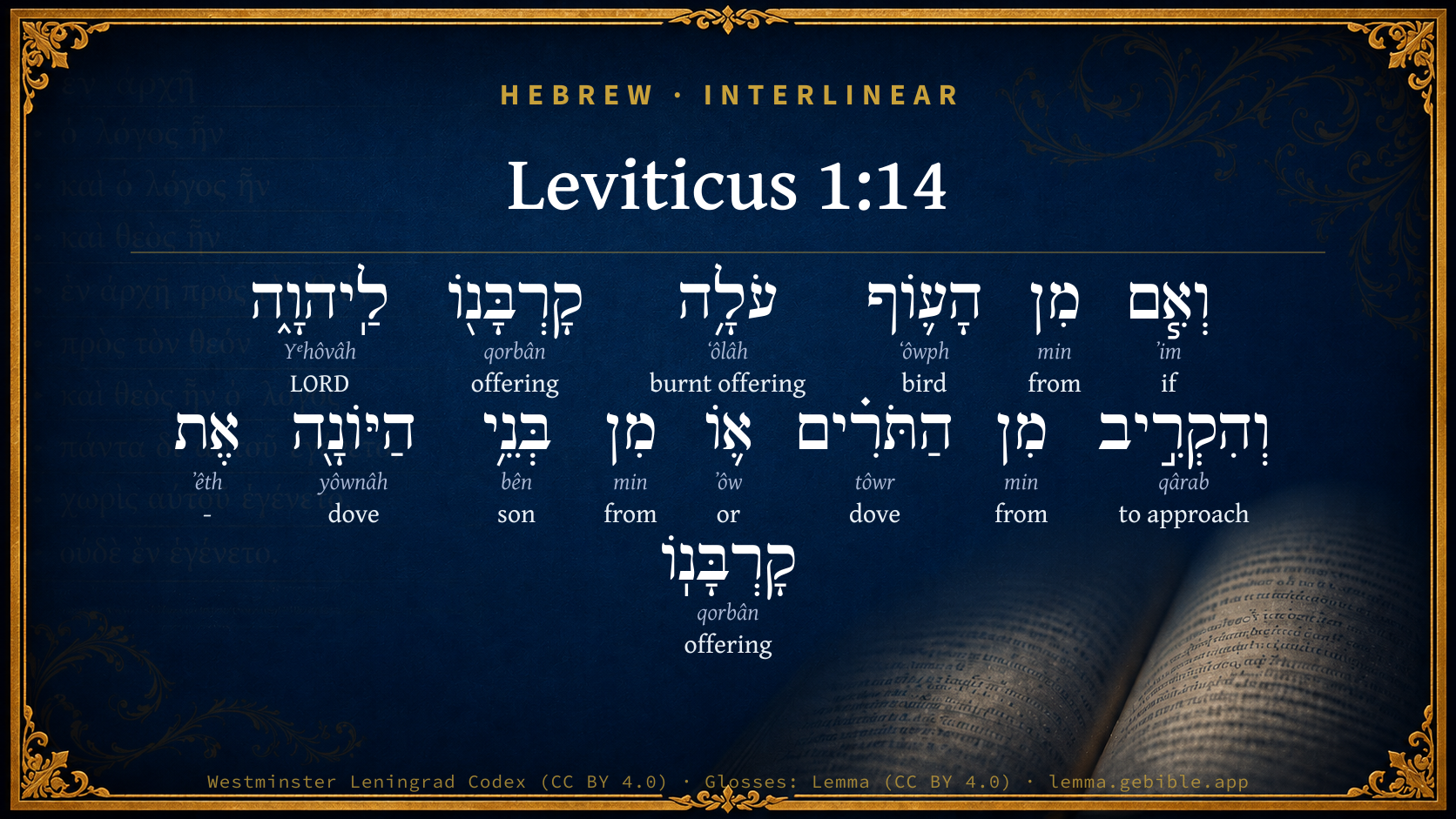
  1. וְאִ֧ם ʼim H518 “and · if” Conjunction + Conjunction
  2. מִן min H4480 “from” Preposition
  3. הָע֛וֹף ʻôwph H5775 “the · bird” Particle, Definite Article + Noun, Common, Masculine, Singular, Absolute
  4. עֹלָ֥ה ʻôlâh H5930 “burnt offering” Noun, Common, Feminine, Singular, Absolute
  5. קָרְבָּנ֖וֹ qorbân H7133 “offering · his” Noun, Common, Masculine, Singular, Construct + Suffix, Personal, 3rd Person, Masculine, Singular
  6. לַֽיהוָ֑ה Yᵉhôvâh H3068 “to/for · LORD” Preposition + Noun, Proper
  7. וְהִקְרִ֣יב qârab H7126 “and · to approach” Conjunction + Verb, Hiphil, Sequential Perfect, 3rd Person, Masculine, Singular
  8. מִן min H4480 “from” Preposition
  9. א֛וֹ ʼôw H176 “or” Conjunction
  10. מִן min H4480 “from” Preposition
  11. בְּנֵ֥י bên H1121 “sons of” Noun, Common, Masculine, Plural, Construct
  12. הַיּוֹנָ֖ה yôwnâh H3123 “the · dove” Particle, Definite Article + Noun, Common, Feminine, Singular, Absolute
  13. אֶת ʼêth H853 “-” Particle, Direct Object
  14. קָרְבָּנֽוֹ qorbân H7133 “offering · his” Noun, Common, Masculine, Singular, Construct + Suffix, Personal, 3rd Person, Masculine, Singular

About this verse

These counts appear in no published source. They are computed here, from the morphology-tagged text and Lemma’s own curated glosses. What Lemma adds →

15
words
12
distinct lemmas
Pentateuch
section

Notable vocabulary

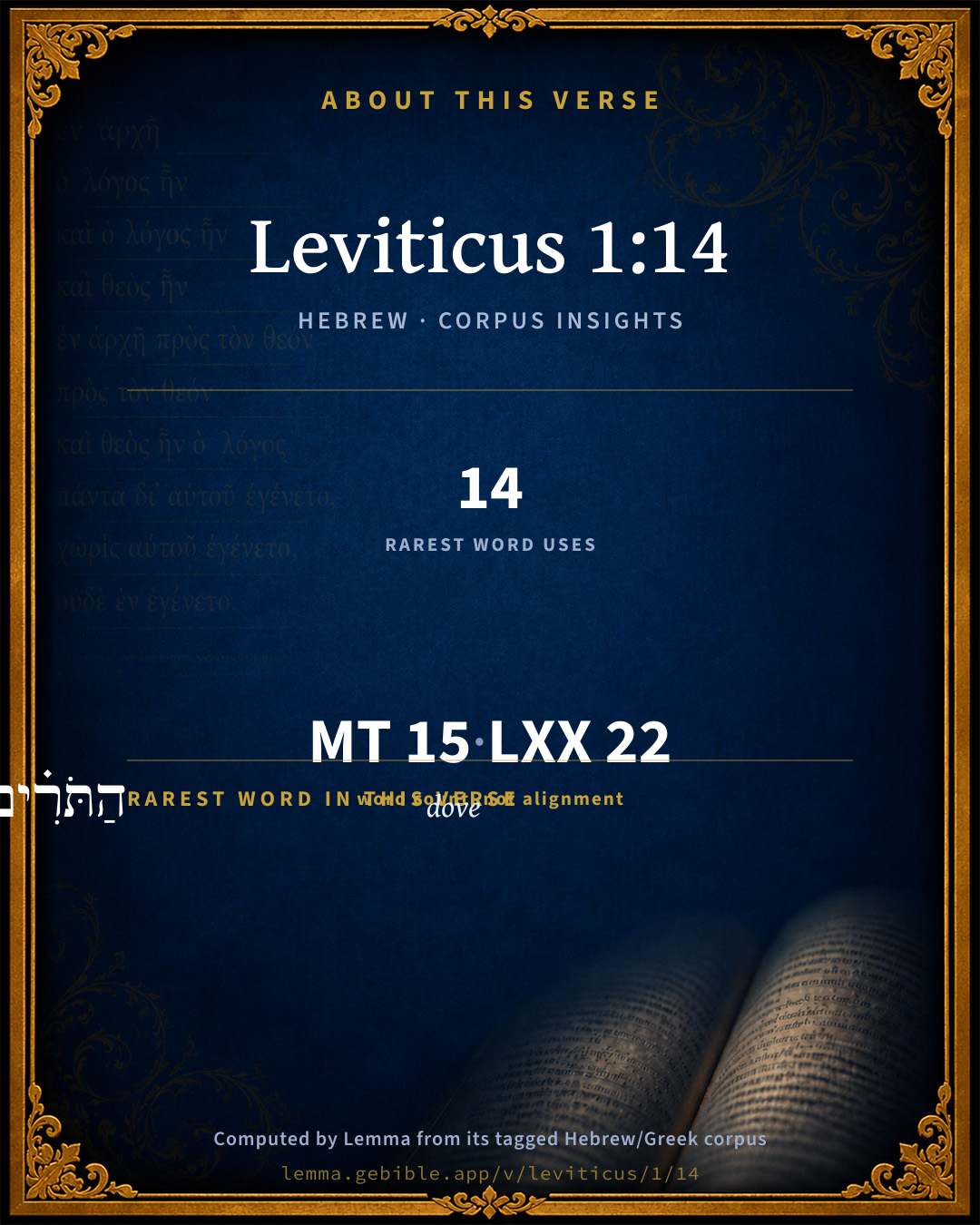
The rarest word here is הַתֹּרִ֗ים dove H8449 — appearing just 14 times in the whole Hebrew Bible.

Shared distinctive vocabulary

הַתֹּרִ֗ים dove H8449 occurs in 14 verses of the Hebrew Bible. Also found in:

Grammatical profile

  • 1 verb
  • 8 nouns
  • 3 prepositions
  • 2 conjunctions
  • 1 particle

Verb forms

  • וְהִקְרִ֣יב Hiphil · Sequential Perfect

Repetition

Words recur within this verse — often emphatic in Hebrew:

  • קָרְבָּנ֖וֹ offering H7133 ×2
  • מִן from H4480 ×3

Hebrew & Septuagint length

In English translation the verse runs 23 words from the Hebrew and 24 from the Septuagint (LXX English) — closely comparable.

A rough comparison of the two English renderings, which tokenize alike — not a word-level alignment.

Word counts can differ between the Hebrew and the Greek without any difference in meaning — e.g. the Hebrew direct-object marker אֵת has no separate Greek word, and Greek often adds the article ὁ.

In the original languages it is 15 Hebrew tokens and 22 Greek tokens — but the two are counted differently (Hebrew bundles its prefixes and suffixes into one token; the Greek is in lemma form), so that isn’t a like-for-like length.

Cross-references

7

Topical passages linked to Leviticus 1:14 in the Treasury of Scripture Knowledge — connected by theme and wording, ordered by reader-vote popularity; previews shown in the World English Bible.

  • Leviticus 5:7 "'If he can't afford a lamb, then he shall bring his trespass offering for that in which he has sinned, two turtledoves, or two young pigeons, to Yahweh; one for a sin offering, and the other for a burnt offering.
  • Luke 2:24 and to offer a sacrifice according to that which is said in the law of the Lord, "A pair of turtledoves, or two young pigeons."
  • Leviticus 12:8 If she cannot afford a lamb, then she shall take two turtledoves, or two young pigeons; the one for a burnt offering, and the other for a sin offering: and the priest shall make atonement for her, and she shall be clean.'"
  • Genesis 15:9 He said to him, "Take me a heifer three years old, a female goat three years old, a ram three years old, a turtle-dove, and a young pigeon."
  • Matthew 11:29 Take my yoke upon you, and learn from me, for I am gentle and lowly in heart; and you will find rest for your souls.
  • 2 Corinthians 8:12 For if the readiness is there, it is acceptable according to what you have, not according to what you don't have.
  • Hebrews 7:26 For such a high priest was fitting for us: holy, guiltless, undefiled, separated from sinners, and made higher than the heavens;

Cross-references courtesy of OpenBible.info (CC BY 4.0).

Hebrew and Greek witnesses Masoretic Hebrew ↔ Greek Septuagint

The same verse in the two great witnesses to the Old Testament, shown verse-for-verse.

These are two independent witnesses, not word-aligned to each other, and the Septuagint is shown in lemma (dictionary) form.

Hebrew Leviticus 1:14 Masoretic · Westminster Leningrad Codex

וְאִ֧ם מִן הָע֛וֹף עֹלָ֥ה קָרְבָּנ֖וֹ לַֽיהוָ֑ה וְהִקְרִ֣יב מִן הַתֹּרִ֗ים א֛וֹ מִן בְּנֵ֥י הַיּוֹנָ֖ה אֶת קָרְבָּנֽוֹ

"'If his offering to Yahweh is a burnt offering of birds, then he shall offer his offering of turtledoves, or of young pigeons.

World English Bible · Public Domain

Greek LXX Leviticus 1:14 Septuagint · lemma form

ἐάν δέ ἀπό ὁ πετεινόν κάρπωμα προςφέρω δῶρον ὁ κύριος καί προςφέρω ἀπό ὁ τρυγών ἤ ἀπό ὁ περιστερά ὁ δῶρον αὐτός

And if he bring his gift, a burnt offering to the Lord, of birds, then shall he bring his gift of doves or pigeons.

LXX2012 (modern English Septuagint) · Public Domain

On this verse, Haydock's Catholic Bible Commentary discusses the Septuagint’s reading. Read the note in Commentary ↓

Hebrew: Westminster Leningrad Codex (CC BY 4.0). Greek: Septuagint (public domain); English from LXX2012 (modern English Septuagint) (Public Domain). How the Septuagint differs from the Hebrew →

Targum (Aramaic paraphrase)

2

The Targum is the ancient Jewish Aramaic paraphrase of the Hebrew Scriptures — an interpretive translation, not the Hebrew text itself. Onkelos (literal) and Pseudo-Jonathan (expansive) render the Torah, and Jonathan the Prophets. Coverage is partial: where no permissively-licensed English translation exists for a verse, only the Aramaic is shown. This is verse-level text, not a word-by-word alignment to the Hebrew. Some Onkelos verses here show an unreviewed machine translation (clearly flagged), not a published edition.

  1. Targum Onkelos Torah (Genesis–Deuteronomy)
    וְאִם מִן עוֹפָא עֲלָתָא קוּרְבָּנֵיהּ קֳדָם יְיָ וִיקָרֵב מִן שַׁפְנִינַיָא אוֹ מִן בְּנֵי יוֹנָה יָת קוּרְבָּנֵיהּ

    Unreviewed machine translation (Claude Sonnet 5) — not public domain confidence: high

    And if his offering before the Lord is a burnt offering from the fowl, he shall bring his offering from the turtledoves or from the young pigeons.

    Generated by an AI translate-then-audit pipeline and checked against an independent public-domain English translation of the underlying Hebrew for drift only. Not a published edition; pending human review.

    Aramaic base: public-domain Targum Onkelos (via Sefaria). The English above is the unreviewed machine translation, not public domain.

  2. Targum Pseudo-Jonathan Torah (Genesis–Deuteronomy)
    וְאִם מִן עוֹפָא עֲלָתָא קוּרְבָּנֵיהּ קֳדָם יְיָ וִיקָרֵב מִן שַׁפְנִינַיָא אוֹ מִן בְּנֵי יוֹנַיָא יַת קוּרְבָּנֵיהּ בְּרַם שַׁפְנִינַיָא יַקְרִיב מִן רַבְרְבִין וּבְנֵי יוֹנַיָא מִן גוֹזְלִין

    And if his oblation before the Lord be of birds he shall bring his oblation from the turtle doves or the young Of pigeons; but of the turtle doves he shall bring the largest, and of the pigeons the young ones.

    Targum Pseudo-Jonathan — Aramaic: “Targum Jonathan on Genesis” (public domain); “Targum Jonathan on Exodus” (public domain); “Targum Jonathan on Leviticus” (public domain); “Targum Jonathan on Numbers” (public domain); “Targum Jonathan on Deuteronomy” (public domain). English: “The Targum of Jonathan ben Uzziel, trans. J. W. Etheridge, London, 1862” (public domain). Text via Sefaria.

Commentary

Notes on Leviticus 1:14 from classic Christian and Jewish commentators (each source and its license shown beneath its notes). The classic Christian expositions comment on the surrounding passage and are grouped to its opening verse, so a note may address several verses; the Jewish commentaries on the Tanakh (Rashi and others) are per-verse, so they appear only where the commentator wrote on this verse.

Lemma curates 59 commentaries, every one of them public domain or Creative Commons licensed, each selected and text-cleaned for this edition rather than reprinted as found. About our sources →

Trapp's Complete Commentary

John Trapp

Lev 1:14 And if the burnt sacrifice for his offering to the LORD [be] of fowls, then he shall bring his offering of turtledoves, or of young pigeons.

Ver. 14. Turtle doves, or young pigeons.] Old turtles and young pigeons are the best: God must have the very best of the best, as being best worthy.

John Trapp, A Commentary or Exposition upon All the Books of the Old and New Testament (1647–1656) — public domain. Text from a community e-Sword module.

The Biblical Illustrator

Joseph S. Exell

Lev_1:14-17

Bring his offering of turtledoves.

The burnt sacrifice of birds

I. We observe, in the first place, that worship and dedication to god are the general ideas connected with sacrifices in the sacred scriptures, and this is most important to a right understanding of them. His own Divine love induced the Saviour to glorify His humanity through sufferings, that He might be a Saviour for ever to bring His children to Himself; and thus He suffered, as the apostle says, the just for the unjust, to bring us to God. He suffered to satisfy His love, not as a punishment to appease the anger of another Divine person. In the sacrifice before us, it is a burnt sacrifice, an offering made by fire, of a sweet savour unto the Lord. A symbol this of the offering of interior worship from love, the fire of the soul, on the altar of the heart.

II. But secondly, the objects offered up were correspondences of good principles or powers in the mind. The animals used in the sacrifices were lambs, sheep, oxen, goats, turtledoves, and pigeons, and a consideration of the typical character of each will assist us to confirm the truth of our first proposition. The lamb is used in Scripture as the symbol of innocence, and is so expressive of this grace that it is almost a household word for those who are in possession of it. I send you forth, said our Lord, as lambs in the midst of wolves. Sheep are the types of the gentle principles of charity, or sympathising brotherly love. The sheep described by the Lord Jesus in Mat_25:1-46. were those who had fed the hungry, clothed the naked, visited the sick and the prisoners, and succoured the strangers. Oxen are the types of the dispositions to duty and obedience. It was the animal chiefly devoted to the plough, and ploughing, in the spiritual sense, means the preparation of the soul to receive the knowledge of heavenly things. The goat, whose delight is in leaping from rock to rock, is the symbol of the disposition to regard the truths of faith with great pleasure, which sometimes degenerates into a love of faith only, and then is strongly condemned by the Lord (Eze_34:1-31.; Mat_25:1-46.). Birds, from their soaring power, are the symbols of thoughts. Turtledoves and pigeons are correspondences of those tender thoughts and yearnings after the heavenly life which the soul has in the early part of its regeneration. The cooing of the turtledove was first heard in the groves of Palestine, on the return of spring. Its sweet sound was the sign of the approach of a brighter and warmer season. When the soul, therefore, is coming to a more genial condition, the sweet thoughts of hope and trust that encourage its advance towards the heavenly state and kingdom are like the soft notes of a God-sent turtledove. All these types, then, of good affections and thoughts, as well as the mode of offering up by fire, abundantly confirm the view we have drawn from tile Holy Word, that the sacrifices were representative of good things and principles dedicated to the Lord in worship, not of punishment for human sin. May I not ask you if you have no spiritual sacrifice to make? Have not the turtledove, or the young pigeon of heavenward thought, begun to make themselves heard within you? Have you no yearnings after a better land? Have you not felt the aspirations after a fuller conformity to the Lord, after greater purity of heart, and greater usefulness on earth? If you have, follow their leadings, and offer them up to the Lord in love. Let the fire glow on the altar of your heart. Acknowledge that these first yearnings for good are from Him. He will not despise the gift, but bless it, as an offering made by fire, a sweet savour unto the Lord.

III. We observe that so far from the idea of sacrifices being regarded as symbolical of punishment by the Divine Being, the truth is, that outward sacrifices never were in accordance with the divine command at all, but were mere permissions to serve as types during human darkness and degeneracy. A common idea has been entertained that outward sacrifices are frequently commanded by God, and He originated the Divine arrangement with the Israelites; but this is altogether an error. Sacrifices were prevalent among the nations of the East before God spoke from Sinai at all. Pharaoh told the Hebrews they could sacrifice in his land, before a single law respecting sacrifice was given them (Exo_8:25). In the Book of Leviticus, where the laws respecting sacrifices are all expressly given, they do not command sacrifices, they only regulate them. The language is, If any man of you bring an offering unto the Lord, as in Lev_1:2; If his offering be of the flocks (Lev_1:10); If the burnt sacrifice for the offering of the Lord be of fowls (Lev_1:14); and so on through the book, evidently implying no command, but regulation. The Israelitish people, like all their neighbours, had sunk from worshipping God in the heart and mind, with those affections and thoughts to which animals are the figures and correspondences, and were only too ready to offer up animals instead of offering up themselves. God only regulated this disposition to be a shadow of a better worship to come. The graces of the heart are what God requires, not the slaughter of animals (see Jer_7:22-23; 1Sa_15:22; Mic_6:7-8). Let us never suppose, then, that any sacrifice will be acceptable to Him, instead of that devotion of all the principles of the soul to do His holy will, which is the inward meaning of all the sacrifices.

IV. Lastly, To enable us to do this, and thus to return to the order of heaven, and to offer spiritual sacrifices again, the lord himself took human nature upon himself, and purified, perfected, and glorified this, so that all the sacrifices have their highest fulfilment in the lord Jesus Christ, the great high priest and the supreme sacrifice. Now we have seen that in relation to man the sacrifices represent the dedication of the several principles of his nature to the Divine will, by the destruction of selfishness in him, and his consequent regeneration. In our blessed Lord this sanctification of His humanity was far higher; it was the making of it Divine, and thus tile supreme sacrifice. He had the same principles in His humanity which we have in ours, thus He had the innocence represented by the lamb, the charity of which the sheep is the symbol, the obedience typified by the ox, the desire for faith of which the goat is the emblem, the thought and yearnings for the salvation of the human race represented by the turtledoves and young pigeons. As His humanity was from Jehovah interiorly, being the Son of God, but clothed with infirm coverings from His mother, He needed to sanctify and perfect it by a process precisely similar to that by means of which His children are prepared for heaven. (J. Bayley, Ph. D.)

Our Lords tenderness in dealing with the offerings of the poor

Then he shall bring his offering of turtledoves, or of young pigeons. There is a great deal of tenderness in the Lords way of dealing with the offerings of the poor among men; but there is a great deal of meanness in mans way of giving poor offerings to the Lord. The Lord says, If the offering is of the herd, let it be of the best; if the offerer is too poor to bring a bullock, let him take a choice offering from his sheep or his goats; if indeed he has neither herd nor flock, let him bring the best he can find from among his fowls or his pigeons, and the willing spirit shall enlarge the small offering in the sight of the Lord. But man says, My cows are all Alderney or Durham stock; I must hold on to them. My sheep are South Down and Cotesworth; they are needed for wool and mutton. Some of my fowls and pigeons are of fancy breed: I dont see how I can let them go. But there is a sickly pigeon, and a chicken with the pip. Theyll do for an offering. And the close-fisted believer goes up smilingly to the sanctuary, and passes in his shabby offering, with a self-gratulatory likening of his gift to the widows mites. There is a world of beauty in the Lords regard for the circumstances and necessities of His children. There is a shameful perversion, by ungrateful men, of Gods goodness in His call for offerings according to the means--not according to the meanness--of those who profess to love and serve Him. (H. C. Trumbull.)

.

The Biblical Illustrator, edited by Joseph S. Exell (c. 1880s–1900s) — public domain. Text from a community e-Sword module.

Joseph Benson's Commentary

Lev 1:14. Turtle-doves — Those who were not able to go to the charge of a sheep or goat might offer a bird. And these birds were preferred before others, 1st, Because they were easily obtained; for Maimonides observes, that they were so plenteous in Canaan, and consequently so cheap, that the poorer sort could easily afford to bring this oblation. 2d, Because they fitly represented Christ’s chastity, meekness, and gentleness, and that purity of mind which becomes every worshipper of God. Hence birds of prey, and those of a coarser kind, were not to be offered. The pigeons were to be young, because then they are best; but the turtle-doves are better when they are grown up, and therefore they are not confined to that age.

Joseph Benson's Commentary on the Old and New Testaments (1811–1818) — public domain. Text from a community e-Sword module.

Tyndale Open Study Notes

Tyndale Open Resources

1:14-17 Birds were plentiful, cheap, and easy to catch. This meant that atonement and worship through sacrifices were not only for the rich and privileged; the poor were also included (see also 5:7; 12:8; see Luke 2:24).

Tyndale Open Study Notes — © Tyndale Open Resources, licensed CC BY-SA 4.0. Text via the HelloAO Bible API.

Jamieson, Fausset & Brown

Robert Jamieson, A. R. Fausset & David Brown

if the burnt sacrifice . . . be of fowls--The gentle nature and cleanly habits of the dove led to its selection, while all other fowls were rejected, either for the fierceness of their disposition or the grossness of their taste; and in this case, there being from the smallness of the animal no blood for waste, the priest was directed to prepare it at the altar and sprinkle the blood. This was the offering appointed for the poor. The fowls were always offered in pairs, and the reason why Moses ordered two turtledoves or two young pigeons, was not merely to suit the convenience of the offerer, but according as the latter was in season; for pigeons are sometimes quite hard and unfit for eating, at which time turtledoves are very good in Egypt and Palestine. The turtledoves are not restricted to any age because they are always good when they appear in those countries, being birds of passage; but the age of the pigeons is particularly marked that they might not be offered to God at times when they are rejected by men [HARMER]. It is obvious, from the varying scale of these voluntary sacrifices, that the disposition of the offerer was the thing looked to--not the costliness of his offering.

Next: Leviticus Chapter 2

Jamieson, Fausset & Brown — Commentary Critical and Explanatory on the Whole Bible (1871) — public domain (CC PDM 1.0). Text via the HelloAO Bible API.

Ellicott's Commentary for English Readers

(14) Be of fowls.—The fowls here are in contrast to the cattle in Lev_1:2. And as the quadrupeds there are immediately defined to consist of bullocks, sheep and goats, so the generic term winged creature is here restricted to the dove and pigeon. It will thus be seen that five different kinds are allowed for the burnt offering, viz., the bullock, lamb, goat, dove and pigeon, the same that Abram was commanded to offer (Gen_15:9).

Of turtledoves.—Though in the case of the burnt offering, as well as of the sin offering, pigeons were permitted to those who were too poor to offer quadrupeds, yet in certain other cases birds were prescribed for all irrespective of their circumstances. Not only did turtledoves regularly come in large flocks (Son_2:11-12; Jer_8:7) into Palestine at certain periods, but owing to these sacrifices the Jews have always kept dove-cots and reared pigeons (2Ki_6:25; Isa_60:8; Joseph. Wars, v. 4, 4). To supply the demand for them, dealers in these birds sat about with them in cages on stalls in the Temple court (Mat_21:2; Joh_11:16, &c.).

A Bible Commentary for English Readers, edited by Charles John Ellicott (1878–1897) — public domain. Text from a community e-Sword module.

The Cambridge Bible for Schools and Colleges

gen. ed. J. J. S. Perowne

(c) Fowls (14–17)

This kind of offering is not included in the general introduction in Lev_1:2. The ritual is slightly altered; the laying the hand on the victim is omitted, the bringing in the hand being equivalent; and the priest performs all the ceremonial.

The Cambridge Bible for Schools and Colleges (gen. ed. J. J. S. Perowne; Cambridge University Press, 1878–1918) — public domain. Text from a community e-Sword module.

John Gill's Exposition

And if the burnt sacrifice for his offering to the Lord be of fowls,.... As it might be for the poorer sort, who could not offer a bullock, nor a sheep, or a lamb, Lev 5:7,

then he shall bring his offering of turtledoves, or of young pigeons; the Jewish writers all agree, that the turtles should be old, and not young, as the pigeons young, and not old; so the Targum of Jonathan, Jarchi, Aben Ezra and Gersom (l); the latter gives two reasons for it, because then they are the choicest and easiest to be found and taken: no mention is made of their being male or female, either would do, or of their being perfect and unblemished, as in the other burnt offerings; but if any part was wanting, it was not fit for sacrifice, as Maimonides (m) observes. These creatures were proper emblems of Christ, and therefore used in sacrifice, whose voice is compared to the turtle's, and his eyes to the eyes of doves, Sol 2:12 and who is fitly represented by them for his meekness and humility, for his chaste and strong affection to his church, as the turtledove to its mate, and for those dove like graces of the Spirit which are in him.

(l) Vid. T. Bab. Cholin, fol. 22. 1, 2. (m) Issure Mizbeach, c. 3. sect. 1, 2. Vid. Misn. Zebachim, c. 7. sect. 5. & Maimon. & Bartenora, in ib.

John Gill's Exposition of the Whole Bible (1746–1763) — public domain (CC PDM 1.0). Text via the HelloAO Bible API.

Albert Barnes' Notes on the Bible

Of turtledoves, or of young pigeons - The offering of a bird was permitted to one who was too poor to offer a quadruped. (Compare the marginal references.) But in certain rites of purification birds were appointed for all, whatever might be their circumstances. See Lev 15:14, Lev 15:29; Num 6:10. The limitation of the age of the pigeons may be accounted for by the natural habits of the birds. It would seem that the species which are most likely to have been the sacrificial dove and pigeon are the common turtle and the bluerock pigeon, a bird like our stock-dove, and considerably larger than the turtle. The turtles come in the early part of April, but as the season advances they wholly disappear. The pigeons, on the contrary, do not leave the country; and their nests, with young ones in them, may be easily found at any season of the year. Hence, it would appear, that when turtledoves could not be obtained, nestling pigeons were accepted as a substitute.

Albert Barnes' Notes on the Bible (1834–1885) — public domain. Text from a community e-Sword/MySword module.

Haydock's Catholic Bible Commentary

Pigeons. Hebrew and Septuagint say nothing about the age; though the Rabbins assure us, that old turtles and young pigeons were to be immolated, as being more excellent. God requires only what each person may easily procure. This third species of holocaust was chiefly intended for the poor, chap. xii. 8. But if they could not afford even this, they might offer flour, chap. ii.

George Leo Haydock (1774–1849), Haydock's Catholic Family Bible and Commentary, 1859 edition — public domain. Excludes Psalms (Douay-Rheims chapter numbering differs from Protestant) and Deuterocanonical books (Catholic canon only).

Matthew Poole's English Annotations

These birds were appointed for the relief of the poor who could not bring better. And these birds are preferred before others, partly because they were easily gotten, and partly because they are fit representations of Christ’s chastity, and meekness, and gentleness, for which these birds are remarkable. The pigeons must be young, because then they are best; but the turtle-doves are better when they are more grown up, and therefore they are not confined to that age.

Matthew Poole's English Annotations on the Holy Bible (1683–1685) — public domain. Text from a community e-Sword/MySword module.

Whedon's Commentary on the Bible

Daniel D. Whedon

14. Offering… of fowls — In a descending scale Jehovah adjusts his requirements to the ability of the offerer, from a bull to a pigeon.

Turtledoves — These are first spoken of as appropriate for sacrifice in Gen_15:9, where Abram is commanded to offer one, together with a young pigeon, in addition to larger sacrifices. The admission of a pair of turtledoves for a burnt offering is a step of condescension lower than the concession of the young pigeons, since the former are not property, not being domesticated. For the practicability of the sacrifice of the turtledove in the wilderness see Introduction, (4.) For a few months in winter this bird was absent from Palestine seeking a warmer climate. Hence “the voice of the turtle in the land” (Son_2:12) was the grateful sign of spring. Thus the poor could bring their tame pigeons, and the poorest, with a little effort, might capture and offer to the Lord a pair of turtledoves, an offering eminently appropriate on account of their imagined fidelity and devotion to each other, which might be taken as symbolizing devotion to God.

Young pigeons — These are too well known to require description. This offering was always possible. See Introduction, (4.)

Daniel D. Whedon (gen. ed.), Commentary on the Old and New Testaments (1874–1909) — public domain. Text from a community e-Sword module.

The Pulpit Commentary

If the burnt sacrifice for his offering to the Lord be of fowls. A comparison of Lev_12:8 leads us to infer that the permission to offer a bird was a concession to poverty. The pigeon and the turtle-dove were the most easy to procure, as the domestic fowl was at this time unknown to the Hebrews. The first and only allusion in the Bible to the hen occurs in the New Testament (Mat_23:37 Luk_13:30) nor is there any representation of the domestic fowl in ancient Egyptian paintings. The domicile of the bird was still confined to India. A single pigeon or turtle-dove formed a sacrifice, and there was no rule in respect to sex, as there was in the ease of the quadrupeds.

Vers. 14-17. The offering of fowls turtle-doves or young pigeons.

The great abundance of these birds in the East would make the provision one which was easy even for the poorest to fulfil. How gracious this appointment! God is no "hard master." He delights not in mere burdensome sacrifice no costliness, suffering, or privation has merit with him. He demands the willing obedience of the heart. He asks for that which really represents a surrender of self. All these minute regulations were simply intended to develop the principle of voluntary obedience.

There was the same subdivision in the case of the bird as in the case of the quadruped, to remind the very poorest and humblest offerer that he must not shelter himself in the insignificance of his offering from the obligations which it represented. The application of fire to the second bird denoted the application of the righteousness of God to the life of the offerer, and while it was as a prescribed offering a promise of acceptance, and therefore of renewing grace and spiritual restoration, it was on the part of the offerer the pledge and promise of an entire obedience in which body, soul, and spirit, all the life and all the possessions, should be consecrated to God. R.

The Pulpit Commentary (1880–1919), ed. H.D.M. Spence-Jones & Joseph S. Exell — public domain. Text from a community e-Sword module.

Keil & Delitzsch

C. F. Keil & F. Delitzsch

The burnt-offering of fowls was to consist of turtle-doves or young pigeons. The Israelites have reared pigeons and kept dovecots from time immemorial (Isa 60:8, cf. Kg2 6:25); and the rearing of pigeons continued to be a favourite pursuit with the later Jews (Josephus, de bell. jud. v. 4, 4), so that they might very well be reckoned among the domesticated animals. There are also turtle-doves and wild pigeons in Palestine in such abundance, that they could easily furnish the ordinary animal food of the poorer classes, and serve as sacrifices in the place of the larger animals. The directions for sacrificing these, were that the priest was to bring the bird to the altar, to hip off its head, and cause it to ascend in smoke upon the altar. מלק, which only occurs in Lev 1:15 and Lev 5:8, signifies undoubtedly to pinch off, and not merely to pinch; for otherwise the words in Lev 5:8, "and shall not divide it asunder," would be superfluous. We have therefore to think of it as a severance of the head, as the lxx (ἀποκνίζειν) and Rabbins have done, and not merely a wringing of the neck and incision in the skin by which the head was left hanging to the body; partly because the words, "and not divide it asunder," are wanting here, and partly also because of the words, "and burn it upon the altar," which immediately follow, and which must refer to the head, and can only mean that, after the head had been pinched off, it was to be put at once into the burning altar-fire. For it is obviously unnatural to regard these words as anticipatory, and refer them to the burning of the whole dove; not only from the construction itself, but still more on account of the clause which follows: "and the blood thereof shall be pressed out against the wall of the altar." The small quantity that there was of the blood prevented it from being caught in a vessel, and swung from it against the altar.

Keil & Delitzsch — Biblical Commentary on the Old Testament (1861–1891) — public domain (CC PDM 1.0). Text via the HelloAO Bible API. (Old Testament only.)

Kretzmann's Popular Commentary

Paul E. Kretzmann

Of Fowls

v. 14. And if the burnt sacrifice for his offering to the Lord be of fowls, in the case of very poor people, then he shall bring his offering of turtle-doves or of young pigeons, either the mild or the tame species being acceptable for a gift-offering.

v. 15. And the priest shall bring it unto the altar, and wring off his head, separate his head from his body by pinching, and burn it on the altar, toss the head into the fire; and the blood thereof shall be wrung out at the side of the altar, since there was hardly enough to be sprinkled or poured.

v. 16. And he shall pluck away his crop with his feathers, either the crop with the entire intestinal tract and its filth, or the entire intestinal tract while the dove was unplucked, and cast it beside the altar on the east part, by the place of the ashes, where all the refuse was heaped up.

v. 17. And he shall cleave it with the wings thereof, split it open lengthwise, or make an incision at its wings, but shall not divide it asunder; and the priest shall burn it upon the altar, up on the wood that is upon the fire; it is a burnt sacrifice, an offering made by fire, of a sweet savor unto the Lord. The sacrifice of the poor was just as acceptable to the Lord as the more costly sacrifice of the rich. The sacrificial worship was a shadow of things to come, in the person of the Messiah. In anticipation of the perfect sacrifice of Christ God accepted these figurative offerings as atonements for sin. But Christ is the only true Sacrifice, who bore the sins of all men in His body on the tree, burning under the wrath of the just God and dying as the Substitute for all men. In view of this sacrifice, whose blessings are ours through faith, we Christians are bound to offer ourselves to the Lord in daily obedience and service. Such sacrifice is a sweet savor to the Lord, a living sacrifice, holy, acceptable unto God, Rom 12:1-2.

Paul E. Kretzmann, Popular Commentary of the Bible (1921–1924) — public domain. Text from a community e-Sword module.

unfoldingWord translationNotes

Door43 World Missions Community

General Information:

Yahweh continues telling Moses what the people must do.

wring off its head

"twist off its head"

Then its blood must be drained out

This can be translated in active form. AT: "Then the priest must drain its blood" (See: Active or Passive)

translationWords

Yahweh

burnt offering

dove

priest

altar

unfoldingWord translationNotes — © Distant Shores Media and the Door43 World Missions Community, licensed CC BY-SA 4.0. Source: git.door43.org/Door43/en_tn.

Rashi

Rabbi Shlomo Yitzchaki (Rashi)

מן העוף [AND IF A BURNT OFFERING … BE] OF FOWLS — of (i.e. of some of) but not of every description of fowls (cf. Rashi on Leviticus 1.2 and Rashi on Leviticus 1:10). Since Scripture states, (Leviticus 22:19) “[Ye shall offer, to be accepted for you,] a male without blemish (תמים זכר) of the oxen, of the sheep and of the goats”, it is evident (cf. Rashi on Leviticus 1.2 and Rashi on Leviticus 1:10) that unblemished condition and male sex in sacrifices are required only in the case of cattle, but unblemished condition and male sex are not required in the case of fowls. If, then, the condition of the fowl is immaterial one might think that a fowl may be brought as a sacrifice even if it lacks a limb! Scripture therefore states: “of fowls” — but not all fowls (Sifra, Emor, Section 7 2; Kiddushin 24b).

התרים TURTLEDOVES — Grown-up ones only may be offered but not young ones.

בני יונה YOUNG DOVES — Young doves only may be offered but not grown-up ones (Sifra, Vayikra Dibbura d'Nedavah, Chapter 8 4; Chullin 22a).

מן התרים או מן בני היונה OF TURTLEDOVES AND OF YOUNG DOVES — The word מן is intended to exclude birds in the first stage of their plumage becoming golden-coloured in the case of the one as of the other, for this stage makes the bird unfit for sacrifice, since such a bird is a grown-up one in the case of בני יונה and a young one in the case of תורים (Sifra, Vayikra Dibbura d'Nedavah, Chapter 8 5; Chullin 22b).

Rashi on the Tanakh — English translations: “The Judaica Press complete Tanach with Rashi, translated by A. J. Rosenberg” (CC BY 4.0); “Pentateuch with Rashi's commentary by M. Rosenbaum and A.M. Silbermann, 1929-1934” (public domain); “The Metsudah Tanach series, Lakewood, N.J” (CC BY 4.0); and “The Book of Joshua, Metsudah Publications, 1997” (CC BY 4.0). Text via Sefaria.

Ramban (Nachmanides)

Rabbi Moshe ben Nachman (Ramban / Nachmanides)

OF TURTLEDOVES OR OF YOUNG PIGEONS. Scripture chose these two species [of birds] because they are accessible and can be more easily caught than other [birds], just as our Rabbis have mentioned with reference to any of the sheep, and any of the goats, that [Scripture chose these species so that] a person should be able to bring an offering from those animals that feed at his crib, and should not have to take his weapons, quiver and bow, to go out on the hunt to bring it., Verse 3. He chose grown-up turtledoves 3:2). because they abstain [from pairing with strangers] and attach themselves only to their mates, and once they lose their companions they never associate with others. So Israel cleave to the Eternal their G-d, and never attach themselves to another deity, Pigeons, on the other hand, are very jealous and as a result of their jealousy they part [from their previous mates] and take on other mates. Therefore He chose them [as offerings] only when they are young, before their mating begins, for as long as the pigeon is young it is attached with greater love to the nest where it is reared than are all other fowls. Our Rabbis have mentioned that if a person touches the nest of all other fowls to take therefrom the young ones or the eggs, they leave it and never nest therein again, but the pigeon never abandons it under any condition. And so is [the people of] Israel. They will never exchange their Creator and His Torah, but “either Jews or nailed to the stake.” He did not choose cocks [as offerings although they are readily accessible] because of their inclination to lewdness.Now the Rabbi [Moshe ben Maimon] wrote in the Moreh Nebuchim that the reason for choosing grown-up turtledoves and young pigeons as offerings is that these are the best of their species, since old pigeons are less tasty. But this is not true, for young pigeons are almost inedible as a result of their excessive moistness. If, however, we are to take into consideration their natural tendencies as far as eating them is concerned, it is possible that they were chosen for their special qualities; for turtledoves have a propensity to sharpening of the mind, and young pigeons have a propensity to benefit greatly those who are not fully-matured physically, such as youths in the intermediate stage between boyhood and maturity, and the like.

Ramban (Nachmanides) on the Tanakh — English translation: “Commentary on the Torah by Ramban (Nachmanides). Translated and annotated by Charles B. Chavel. New York, Shilo Pub. House, 1971-1976” (CC BY 4.0). Text via Sefaria.

Lesson kit

Teaching starters — assembled from the data on this page, not authored interpretation. Every prompt links to the verse data it draws on. Edit before teaching.

Leviticus, in the Pentateuch, opens this verse with 15 words (12 distinct Hebrew lemmas). Its most distinctive word is tôwr (“dove”). A historical commentator’s framing appears above. Read the whole chapter for the surrounding context.

Discussion questions

  1. How does “dove” (tôwr) shape what this verse is saying?
  2. Genesis 15:9 shares the word «dove» with this verse. How do the two illuminate each other?
  3. “offering” occurs 2× in this one verse. What is the effect of the repetition?
  4. These translations render this verse differently; the difference is in the English rendering, not the original. What questions does that raise?
  5. The verb «וְהִקְרִ֣יב» is Hiphil Sequential Perfect. How does its form color the action?
  6. Reading how Trapp's Complete Commentary and The Biblical Illustrator read this verse, where do the two commentators agree and where do they part?

Things to notice

Reading settings

Reading text

Shown beneath each verse's original-language words.

Old Testament
Old Testament edition

Read the OT as the Masoretic Hebrew (MT) or the Greek Septuagint (LXX).

English shown for the Greek Septuagint (in the Hebrew ↔ Greek comparison).

Comparing translations? Open the Compare panel on any verse page to stack up to four side by side.