
Leviticus 5:4

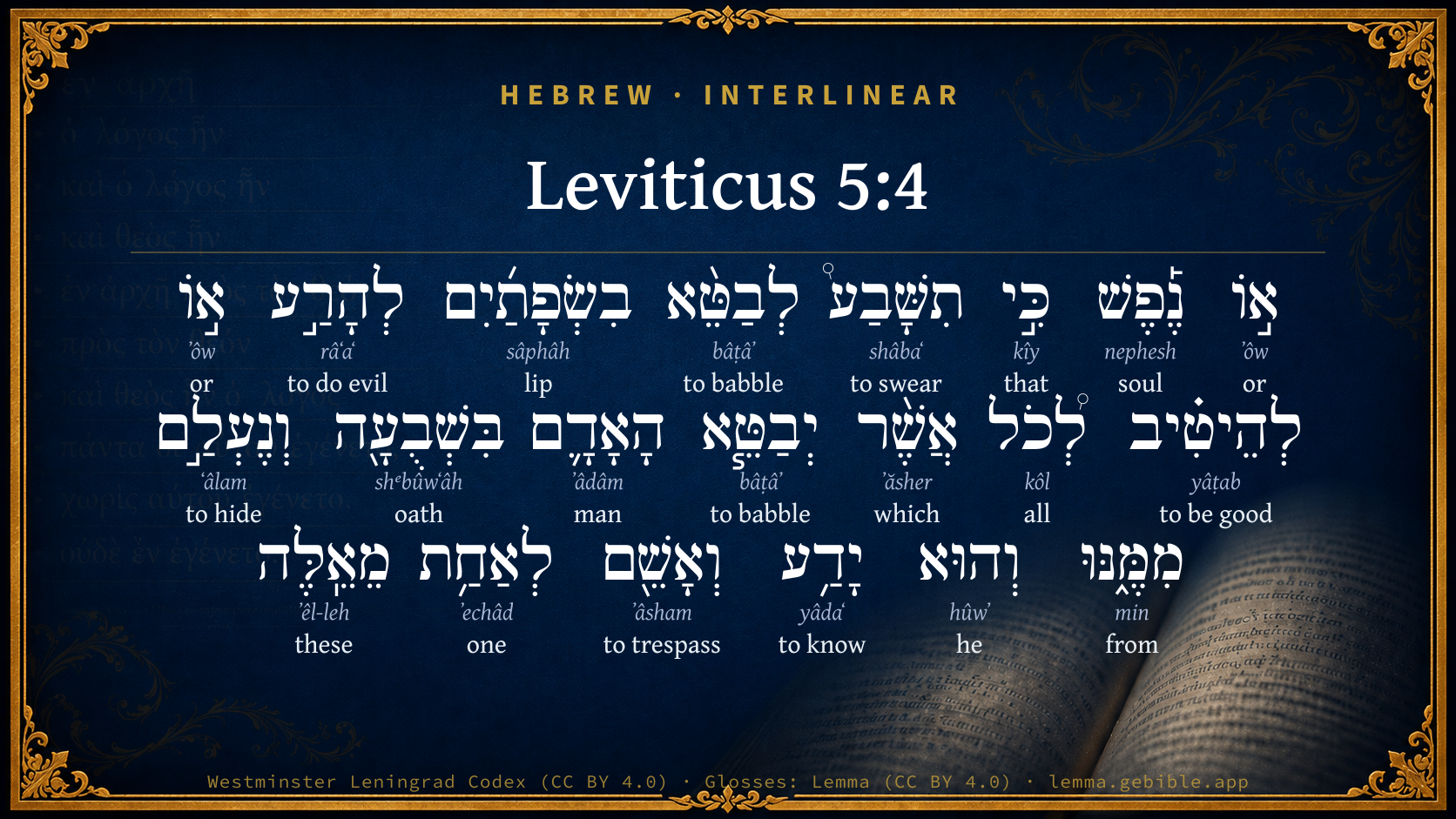
Hebrew (Westminster Leningrad Codex) Leviticus 5:4 appears in the Hebrew Old Testament. The text above is from the Westminster Leningrad Codex. Each word links to its Strong’s number, a concise gloss, and parsing drawn from the Open Scriptures Hebrew Bible morphology. Click any word for its full Brown-Driver-Briggs (BDB) entry.
Download image
Cite this verse

Leviticus 5:4 (World English Bible). Public Domain. Lemma interlinear Bible study tool, https://lemma.gebible.app/v/leviticus/5/4.

Show BibTeX & RIS
BibTeX
RIS
English Translation
"'Or if anyone swears rashly with his lips to do evil, or to do good, whatever it is that a man might utter rashly with an oath, and it is hidden from him; when he knows of it, then he shall be guilty of one of these.
World English Bible · Public Domain
Highlights
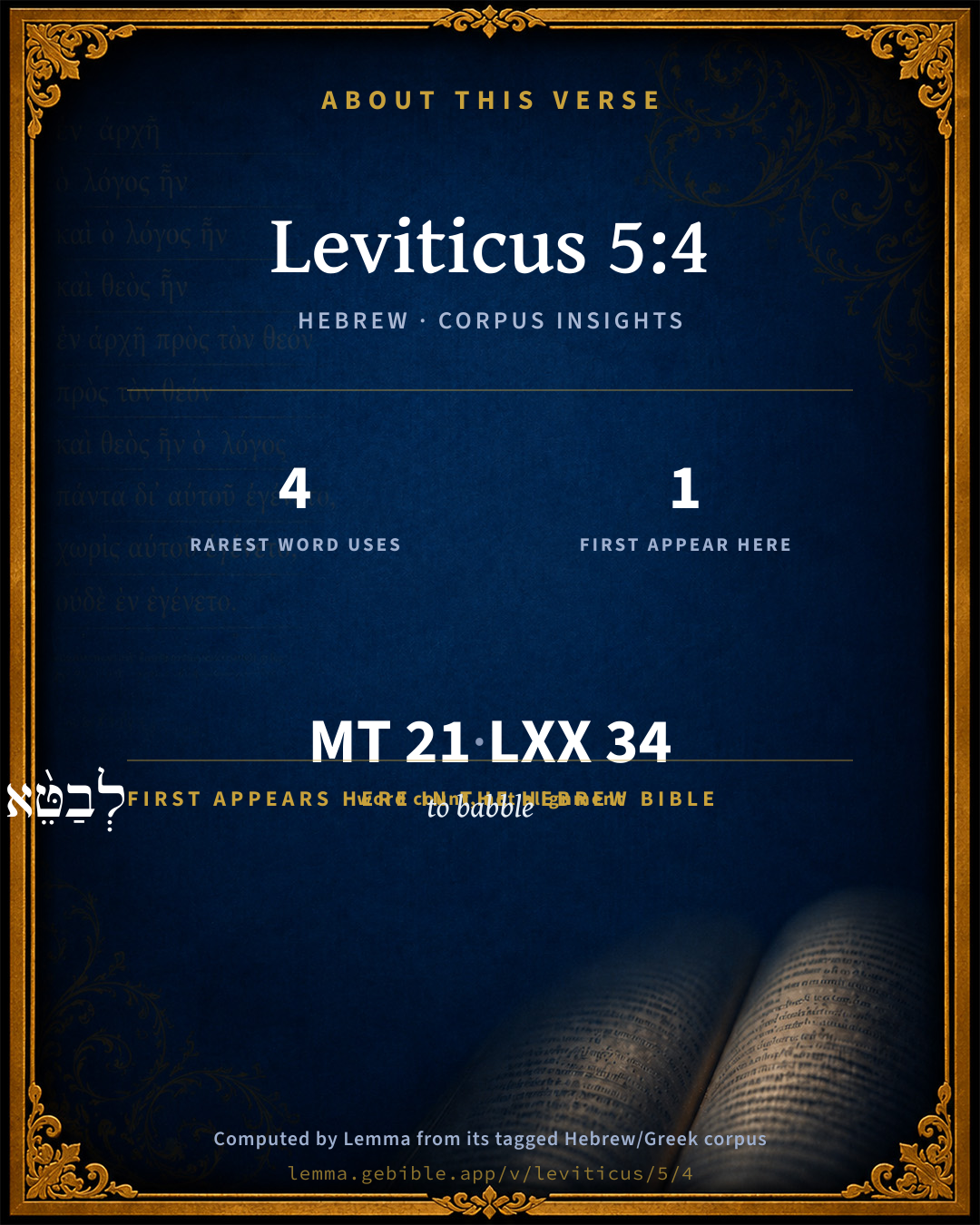
  • 1 first appearance in the Hebrew Bible
Full analysis ↓
Download a study sheet

One document with this verse’s original text, its word-by-word gloss line, the meaning frame, cross-references with their text, attributed commentary, and full source and license credits — printable, and it pastes into notes with its structure intact.

This verse Autodidact and up

Study sheet (.html) Plain text (.txt)

A passage Seminary Student

Up to 50 verses in one chapter. A passage sheet keeps up to 6 commentary sources and 12 cross-references per verse, in the order this page ranks them, and says so on the sheet whenever that leaves anything out. Ask for a single verse and you get the Autodidact verse sheet above.

Everything on this page stays free to read, with no account — the sheet is a download of what is already on screen, not access to it.

Want to remove ads? Support Godless Engineer
Compare translations 3

The same verse in 3 English versions, stacked beneath the original-language interlinear above. Click any original word for its lexicon entry.

Each is an independent rendering of the whole verse — the interlinear is not word-aligned to these translations.

Highlighted words mark where these versions differ — a whole-verse word diff, not a word-by-word alignment.

  • World English Bible Public Domain
    "'Or if anyone swears rashly with his lips to do evil, or to do good, whatever it is that a man might utter rashly with an oath, and it is hidden from him; when he knows of it, then he shall be guilty of one of these.
  • King James Version Public Domain
    Or if a soul swear, pronouncing with his lips to do evil, or to do good, whatsoever it be that a man shall pronounce with an oath, and it be hid from him; when he knoweth of it, then he shall be guilty in one of these.
  • unfoldingWord Literal Text CC BY-SA 4.0
    Or a person, when he swears by speaking thoughtlessly with two lips to do evil or to do good, with regard to everything that the man thoughtlessly speaks in an oath, and it is hidden from him, but when he knows, then he will be guilty with regard to one from these.

unfoldingWord Literal Text — © unfoldingWord, licensed CC BY-SA 4.0. Word-aligned USFM3 via Door43 (git.door43.org/unfoldingWord/en_ult).

Versions to compare (up to 4)

3 of 4 selected

Show all 18 translations

Every available English version of this verse, each an independent rendering of the whole verse.

  • World English Bible Public Domain
    "'Or if anyone swears rashly with his lips to do evil, or to do good, whatever it is that a man might utter rashly with an oath, and it is hidden from him; when he knows of it, then he shall be guilty of one of these.
  • Berean Standard Bible Public Domain
    Or if someone swears thoughtlessly with his lips to do anything good or evil—in whatever matter a man may rashly pronounce an oath—even if he is unaware of it, when he realizes it, he is guilty in the matter.
  • Majority Standard Bible Public Domain
    Or if someone swears thoughtlessly with his lips to do anything good or evil—in whatever matter a man may rashly pronounce an oath—even if he is unaware of it, when he realizes it, he is guilty in the matter.
  • King James Version Public Domain
    Or if a soul swear, pronouncing with his lips to do evil, or to do good, whatsoever it be that a man shall pronounce with an oath, and it be hid from him; when he knoweth of it, then he shall be guilty in one of these.
  • American Standard Version (1901) Public Domain
    Or if any one swear rashly with his lips to do evil, or to do good, whatsoever it be that a man shall utter rashly with an oath, and it be hid from him; when he knoweth of it, then he shall be guilty in one of these `things'.
  • Revised Version (1885) Public Domain
    or if any one swear rashly with his lips to do evil, or to do good, whatsoever it be that a man shall utter rashly with an oath, and it be hid from him; when he knoweth of it, then he shall be guilty in one of these things:
  • Geneva Bible (1599) Public Domain
    Either if any sweare and pronounce with his lippes to do euill, or to doe good (whatsoeuer it bee that a man shall pronounce with an othe) and it be hid from him, and after knoweth that he hath offended in one of these poyntes,
  • Douay-Rheims (1899) Public Domain
    The person that sweareth, and uttereth with his lips, that he would do either evil or good, and bindeth the same with an oath, and his word, and having forgotten it afterwards understandeth his offence,
  • Young's Literal Translation Public Domain
    `Or when a person sweareth, speaking wrongfully with the lips to do evil, or to do good, even anything which man speaketh wrongfully with an oath, and it hath been hid from him; -- when he hath known then he hath been guilty of one of these;
  • Literal Standard Version CC BY-SA 4.0
    Or when a person swears, speaking wrongfully with the lips to do evil, or to do good, even anything which man speaks wrongfully with an oath, and it has been hid from him—when he has known then he has been guilty of one of these;
  • Unlocked Literal Bible CC BY-SA 4.0
    Or if anyone swears rashly with his lips to do evil, or to do good, whatever it is that a man swears rashly with an oath, even if he is unaware of it, when he learns about it, then he will be guilty, in any of these things.
  • unfoldingWord Literal Text CC BY-SA 4.0
    Or a person, when he swears by speaking thoughtlessly with two lips to do evil or to do good, with regard to everything that the man thoughtlessly speaks in an oath, and it is hidden from him, but when he knows, then he will be guilty with regard to one from these.
  • Darby Bible Public Domain
    Or if any one swear, talking rashly with the lips, to do evil or to do good, in everything that a man shall say rashly with an oath, and it be hid from him, when he knoweth [it], then is he guilty in one of these.
  • World Messianic Bible Public Domain
    “‘Or if anyone swears rashly with his lips to do evil or to do good—whatever it is that a man might utter rashly with an oath, and it is hidden from him—when he knows of it, then he will be guilty of one of these.
  • Webster's Bible Public Domain
    Or if a soul shall swear, pronouncing with his lips to do evil, or to do good, whatever it may be, that a man shall pronounce with an oath, and it be hid from him; when he knoweth of it, then he shall be guilty in one of these.
  • Free Bible Version CC BY-SA 4.0
    If you foolishly swear to do something (whether good or bad, and in whatever way people impulsively swear an oath), even if you're unaware of it being wrong, when you eventually realize it, you are guilty.
  • Bible in Basic English Public Domain
    Or if anyone, without thought, takes an oath to do evil or to do good, whatever he says without thought, with an oath, having no knowledge of what he is doing; when it becomes clear to him, he will be responsible for any of these things.
  • JPS Tanakh (1917) Public Domain
    or if any one swear clearly with his lips to do evil, or to do good, whatsoever it be that a man shall utter clearly with an oath, and it be hid from him; and, when he knoweth of it, be guilty in one of these things;

Literal Standard Version (2020), Covenant Press — licensed CC BY-SA 4.0. Text via the HelloAO Bible API (eBible.org). Unlocked Literal Bible (unfoldingWord) — licensed CC BY-SA 4.0. Text via the HelloAO Bible API (eBible.org). unfoldingWord Literal Text — © unfoldingWord, licensed CC BY-SA 4.0. Word-aligned USFM3 via Door43 (git.door43.org/unfoldingWord/en_ult). Free Bible Version, Dr. Jonathan Gallagher — licensed CC BY-SA 4.0. Text via the HelloAO Bible API (eBible.org).

Word by word

More ways to search: Search by grammar → Find every occurrence → Compare this word →

Practice this passage: Drill this verse → Learn its vocabulary →

לְבַטֵּ֨א
bâṭâʼ
H981
“to babble”
Preposition + Verb, Piel, Infinitive Construct
Part of Speech
Preposition + Verb
Stem
Piel
Form
Infinitive Construct
Full BDB Definition

Origin: a primitive root

TWOT: 232

to speak rashly or angrily, speak thoughtlessly - (Qal) one that babbles, speaks rashly (participle) - (Piel) to speak rashly, unadvisedly
  1. א֣וֹ ʼôw H176 “or” Conjunction
  2. נֶ֡פֶשׁ nephesh H5315 “soul” Noun, Common, Both, Singular, Absolute
  3. כִּ֣י kîy H3588 “that” Conjunction
  4. תִשָּׁבַע֩ shâbaʻ H7650 “to swear” Verb, Niphal, Imperfect, 3rd Person, Feminine, Singular
  5. בִשְׂפָתַ֜יִם sâphâh H8193 “in/at · lips” Preposition + Noun, Common, Feminine, Dual, Absolute
  6. לְהָרַ֣ע râʻaʻ H7489 “to do evil” Preposition + Verb, Hiphil, Infinitive Construct
  7. א֣וֹ ʼôw H176 “or” Conjunction
  8. לְהֵיטִ֗יב yâṭab H3190 “to be good” Preposition + Verb, Hiphil, Infinitive Construct
  9. לְ֠כֹל kôl H3605 “to/for · all” Preposition + Noun, Common, Masculine, Singular, Absolute
  10. אֲשֶׁ֨ר ʼăsher H834 “which” Particle, Relative
  11. יְבַטֵּ֧א bâṭâʼ H981 “to babble” Verb, Piel, Imperfect, 3rd Person, Masculine, Singular
  12. הָאָדָ֛ם ʼâdâm H120 “the · man” Particle, Definite Article + Noun, Common, Masculine, Singular, Absolute
  13. בִּשְׁבֻעָ֖ה shᵉbûwʻâh H7621 “in/at · oath” Preposition + Noun, Common, Feminine, Singular, Absolute
  14. וְנֶעְלַ֣ם ʻâlam H5956 “and · to hide” Conjunction + Verb, Niphal, Sequential Perfect, 3rd Person, Masculine, Singular
  15. מִמֶּ֑נּוּ min H4480 “from · us” Preposition + Suffix, Personal, 1st Person, Common, Plural
  16. וְהוּא hûwʼ H1931 “and · he” Conjunction + Pronoun, Personal, 3rd Person, Masculine, Singular
  17. יָדַ֥ע yâdaʻ H3045 “to know” Verb, Qal, Perfect, 3rd Person, Masculine, Singular
  18. וְאָשֵׁ֖ם ʼâsham H816 “and · to trespass” Conjunction + Verb, Qal, Sequential Perfect, 3rd Person, Masculine, Singular
  19. לְאַחַ֥ת ʼechâd H259 “to/for · one” Preposition + Adjective, Cardinal number, Feminine, Singular, Absolute
  20. מֵאֵֽלֶּה ʼêl-leh H428 “from · these” Preposition + Pronoun, Demonstrative, Common, Plural

About this verse

These counts appear in no published source. They are computed here, from the morphology-tagged text and Lemma’s own curated glosses. What Lemma adds →

21
words
19
distinct lemmas
Pentateuch
section

Notable vocabulary

The rarest word here is לְבַטֵּ֨א to babble H981 — appearing just 4 times in the whole Hebrew Bible.

First appearance in Scripture

This word makes its first canonical appearance in the Hebrew Bible here:

  • לְבַטֵּ֨א to babble H981

Shared distinctive vocabulary

לְבַטֵּ֨א to babble H981 occurs in 3 verses of the Hebrew Bible. Also found in:

Grammatical profile

  • 8 verbs
  • 5 nouns
  • 1 adjective
  • 2 pronouns
  • 1 preposition
  • 3 conjunctions
  • 1 particle

Verb forms

  • תִשָּׁבַע֩ Niphal · Imperfect
  • לְבַטֵּ֨א Piel · Infinitive Construct
  • לְהָרַ֣ע Hiphil · Infinitive Construct
  • לְהֵיטִ֗יב Hiphil · Infinitive Construct
  • יְבַטֵּ֧א Piel · Imperfect
  • וְנֶעְלַ֣ם Niphal · Sequential Perfect
  • יָדַ֥ע Qal · Perfect
  • וְאָשֵׁ֖ם Qal · Sequential Perfect

Repetition

Words recur within this verse — often emphatic in Hebrew:

  • לְבַטֵּ֨א to babble H981 ×2
  • א֣וֹ or H176 ×2

Hebrew & Septuagint length

In English translation the verse runs 47 words from the Hebrew and 49 from the Septuagint (LXX English) — closely comparable.

A rough comparison of the two English renderings, which tokenize alike — not a word-level alignment.

Word counts can differ between the Hebrew and the Greek without any difference in meaning — e.g. the Hebrew direct-object marker אֵת has no separate Greek word, and Greek often adds the article ὁ.

In the original languages it is 21 Hebrew tokens and 34 Greek tokens — but the two are counted differently (Hebrew bundles its prefixes and suffixes into one token; the Greek is in lemma form), so that isn’t a like-for-like length.

Cross-references

22

Topical passages linked to Leviticus 5:4 in the Treasury of Scripture Knowledge — connected by theme and wording, ordered by reader-vote popularity; previews shown in the World English Bible.

  • Ecclesiastes 5:2–6 Don't be rash with your mouth, and don't let your heart be hasty to utter anything before God; for God is in heaven, and you on earth. Therefore let your words be few.
  • Judges 11:31 then it shall be, that whatever comes forth from the doors of my house to meet me, when I return in peace from the children of Ammon, it shall be Yahweh's, and I will offer it up for a burnt offering.
  • Mark 6:23 He swore to her, "Whatever you shall ask of me, I will give you, up to half of my kingdom."
  • Acts 23:12 When it was day, some of the Jews banded together, and bound themselves under a curse, saying that they would neither eat nor drink until they had killed Paul.
  • Numbers 30:8 But if her husband disallow her in the day that he hears it, then he shall make void her vow which is on her, and the rash utterance of her lips, with which she has bound her soul: and Yahweh will forgive her.
  • 1 Samuel 25:22 God do so to the enemies of David, and more also, if I leave of all that belongs to him by the morning light so much as one man-child.
  • Leviticus 27:2–34 "Speak to the children of Israel, and say to them, 'When a man makes a vow, the persons shall be for Yahweh by your valuation.
  • Numbers 30:6 If she be [married] to a husband, while her vows are on her, or the rash utterance of her lips, with which she has bound her soul,
  • Joshua 9:15 Joshua made peace with them, and made a covenant with them, to let them live: and the princes of the congregation swore to them.
  • Judges 9:19 if you then have dealt truly and righteously with Jerubbaal and with his house this day, then rejoice you in Abimelech, and let him also rejoice in you:
  • Judges 21:7 How shall we do for wives for those who remain, seeing we have sworn by Yahweh that we will not give them of our daughters to wives?
  • Judges 21:18 However we may not give them wives of our daughters, for the children of Israel had sworn, saying, Cursed be he who gives a wife to Benjamin.
  • 1 Samuel 1:11 She vowed a vow, and said, Yahweh of hosts, if you will indeed look on the affliction of your handmaid, and remember me, and not forget your handmaid, but will give to your handmaid a man-child, then I will give him to Yahweh all the days of his life, and there shall no razor come on his head.
  • 1 Samuel 14:24–28 The men of Israel were distressed that day; for Saul had adjured the people, saying, Cursed be the man who eats any food until it be evening, and I be avenged on my enemies. So none of the people tasted food.
  • 1 Samuel 24:21–22 Swear now therefore to me by Yahweh, that you will not cut off my seed after me, and that you will not destroy my name out of my father's house.
  • 2 Samuel 21:7 But the king spared Mephibosheth, the son of Jonathan the son of Saul, because of Yahweh's oath that was between them, between David and Jonathan the son of Saul.
  • 2 Kings 6:31 Then he said, God do so to me, and more also, if the head of Elisha the son of Shaphat shall stand on him this day.
  • Psalms 132:2–5 How he swore to Yahweh, And vowed to the Mighty One of Jacob:
  • Ezekiel 17:18–19 For he has despised the oath by breaking the covenant; and behold, he had given his hand, and yet has done all these things; he shall not escape.
  • Matthew 14:7 Whereupon he promised with an oath to give her whatever she should ask.
  • Matthew 14:9 The king was grieved, but for the sake of his oaths, and of those who sat at the table with him, he commanded it to be given,
  • Joshua 2:14 The men said to her, Our life for yours, if you don't utter this our business; and it shall be, when Yahweh gives us the land, that we will deal kindly and truly with you.

Cross-references courtesy of OpenBible.info (CC BY 4.0).

Hebrew and Greek witnesses Masoretic Hebrew ↔ Greek Septuagint

The same verse in the two great witnesses to the Old Testament, shown verse-for-verse.

These are two independent witnesses, not word-aligned to each other, and the Septuagint is shown in lemma (dictionary) form.

Hebrew Leviticus 5:4 Masoretic · Westminster Leningrad Codex

א֣וֹ נֶ֡פֶשׁ כִּ֣י תִשָּׁבַע֩ לְבַטֵּ֨א בִשְׂפָתַ֜יִם לְהָרַ֣ע א֣וֹ לְהֵיטִ֗יב לְ֠כֹל אֲשֶׁ֨ר יְבַטֵּ֧א הָאָדָ֛ם בִּשְׁבֻעָ֖ה וְנֶעְלַ֣ם מִמֶּ֑נּוּ וְהוּא יָדַ֥ע וְאָשֵׁ֖ם לְאַחַ֥ת מֵאֵֽלֶּה

"'Or if anyone swears rashly with his lips to do evil, or to do good, whatever it is that a man might utter rashly with an oath, and it is hidden from him; when he knows of it, then he shall be guilty of one of these.

World English Bible · Public Domain

Greek LXX Leviticus 5:4 Septuagint · lemma form

ἤ ψυχή ὁ ἄν ὄμνυμι διαστέλλω ὁ χεῖλος κακοποιέω ἤ καλῶς ποιέω κατά πᾶς ὅσος ἐάν διαστέλλω ὁ ἄνθρωπος μετά ὅρκος καί λανθάνω αὐτός πρό ὀφθαλμός καί οὗτος γιγνώσκω καί ἁμαρτάνω εἷς τις οὗτος

That unrighteous soul, which determines with his lips to do evil or to do good according to whatever a man may determine with an oath, and it shall have escaped his notice, and he shall afterwards know it, and so he should sin in some one of these things:

LXX2012 (modern English Septuagint) · Public Domain

On this verse, The Cambridge Bible for Schools and Colleges discusses the Septuagint’s reading. Read the note in Commentary ↓

Hebrew: Westminster Leningrad Codex (CC BY 4.0). Greek: Septuagint (public domain); English from LXX2012 (modern English Septuagint) (Public Domain). How the Septuagint differs from the Hebrew →

Targum (Aramaic paraphrase)

2

The Targum is the ancient Jewish Aramaic paraphrase of the Hebrew Scriptures — an interpretive translation, not the Hebrew text itself. Onkelos (literal) and Pseudo-Jonathan (expansive) render the Torah, and Jonathan the Prophets. Coverage is partial: where no permissively-licensed English translation exists for a verse, only the Aramaic is shown. This is verse-level text, not a word-by-word alignment to the Hebrew.

  1. Targum Onkelos Torah (Genesis–Deuteronomy)
    אוֹ אֱנַשׁ אֲרֵי יְקַיֵם לְפָרָשָׁא בְסִפְוָן לְאַבְאָשָׁא אוֹ לְאוֹטָבָא לְכֹל דִי יְפָרֵשׁ אֱנָשָׁא בְּקִיוּם וִיהֵי מְכַסָא מִנֵהּ וְהוּא יָדַע וְחָב לַחֲדָא מֵאִלֵין

    (no public-domain English translation for this verse)

    Targum Onkelos — Aramaic: “Onkelos Genesis” (public domain); “Onkelos Exodus” (public domain); “Onkelos Leviticus” (public domain); “Onkelos Numbers” (public domain); “Onkelos Deuteronomy” (public domain). English: “Sefaria Community Translation” (CC0 1.0 (public-domain dedication)); “J.W. Etheridge. The Targums of Onkelos and Jonathan Ben Uzziel on the Pentateuch. London: Longmans, Green, 1862” (public domain). Text via Sefaria.

  2. Targum Pseudo-Jonathan Torah (Genesis–Deuteronomy)
    אוֹ בַר נַשׁ אֲרוּם יוֹמֵי לְפָרָשָׁא בְּשִׁיפְוָון לְאַבְאָשָׁא אוֹ לְאוֹטָבָא לְכָל גִוַון דִיפָרֵשׁ אֵינָשָׁא לִדְהָוֵוה וְלִדְעָתִיד לְמֵיתֵי בְּאוֹמָתָא וּמְשַׁקֵיר בֵּיהּ וְיִתְכַסֵי מִינֵיהּ וּמִבָּתַר דְעָבַד אִיתְגְלֵי לֵיהּ וְאִיהוּ יָדַע דְשַׁקָר וְלָא תַב וְאִתְחַיֵיב לַחֲדָא מִן אִילֵין

    Or if a man shall swear to make declaration with his lips to do evil or good upon any matter upon which a man may affirm, whether of the present or the future, that he can make declaration by oath, and he falsify therein, and it be hidden from him, but afterward it be discovered to him and he know that he hath falsified, and he repent not; though he hath become guilty in any one of these,

    Targum Pseudo-Jonathan — Aramaic: “Targum Jonathan on Genesis” (public domain); “Targum Jonathan on Exodus” (public domain); “Targum Jonathan on Leviticus” (public domain); “Targum Jonathan on Numbers” (public domain); “Targum Jonathan on Deuteronomy” (public domain). English: “The Targum of Jonathan ben Uzziel, trans. J. W. Etheridge, London, 1862” (public domain). Text via Sefaria.

Commentary

Notes on Leviticus 5:4 from classic Christian and Jewish commentators (each source and its license shown beneath its notes). The classic Christian expositions comment on the surrounding passage and are grouped to its opening verse, so a note may address several verses; the Jewish commentaries on the Tanakh (Rashi and others) are per-verse, so they appear only where the commentator wrote on this verse.

Lemma curates 59 commentaries, every one of them public domain or Creative Commons licensed, each selected and text-cleaned for this edition rather than reprinted as found. About our sources →

Jamieson, Fausset & Brown

Robert Jamieson, A. R. Fausset & David Brown

FOR SWEARING. (Lev 5:4-19)

if a soul swear--a rash oath, without duly considering the nature and consequences of the oath, perhaps inconsiderately binding himself to do anything wrong, or neglecting to perform a vow to do something good. In all such cases a person might have transgressed one of the divine commandments unwittingly, and have been afterwards brought to a sense of his delinquency.

Jamieson, Fausset & Brown — Commentary Critical and Explanatory on the Whole Bible (1871) — public domain (CC PDM 1.0). Text via the HelloAO Bible API.

The Cambridge Bible for Schools and Colleges

gen. ed. J. J. S. Perowne

4. The third case—when anyone utters a rash oath or vow.

swear rashly] The Heb. verb occurs in the Pi‘el form (baṭṭç) only here and Psa_106:33; in sound it resembles the first part of βαττολογήσητε in Mat_6:7. To take an oath or vow lightly, without considering its purport, is a breach of the 3rd commandment, and when he knoweth of it (i.e. reflects on, or is reminded of, what he has thoughtlessly uttered), he will acknowledge his guilt, and bring a Sin-Offering. It is not clear whether the offering not only makes atonement for the sin of rash swearing but also procures release from the obligation incurred by the rash oath.

to do evil, or to do good] i.e. to perform any act whatever.

Each of the four verses forms a complete sentence with protasis and apodosis in the text of R.V. and A.V., but all four verses should be taken as forming one long protasis to which Lev_5:5 is the apodosis. The translation would then be as follows: 1 If anyone sin … if he do not utter it, but bears his iniquity; 2 or if anyone touch … things, [and it be hidden from him, and he be unclean and guilty;] 3 or if he touch the uncleanness … wherewith he is unclean, and it be hid from him, and he knoweth of it, and is guilty; 4or if anyone swear … oath, and it be hid from him, and he knoweth of it, and is guilty in one of these things: 5then it shall be, when he shall be guilty in one of these things, that.… The words in brackets are omitted in LXX.; ‘in one of these things’ at the end of Lev_5:4 seems strange, and may be a repetition of the phrase in Lev_5:5.

The Cambridge Bible for Schools and Colleges (gen. ed. J. J. S. Perowne; Cambridge University Press, 1878–1918) — public domain. Text from a community e-Sword module.

Trapp's Complete Commentary

John Trapp

Lev 5:4 Or if a soul swear, pronouncing with [his] lips to do evil, or to do good, whatsoever [it be] that a man shall pronounce with an oath, and it be hid from him; when he knoweth [of it], then he shall be guilty in one of these.

Ver. 4. To do evil.] As David did to slay Nabal. {1Sa 25:22}

Or to do good.] As the same David did to do good to Mephibosheth, and yet he was not so good as his oath.

And it be hid from him.] As is usual with your common swearers, who will swear that they swear not. If men had such distempers of body, as their excrements come from them when they knew not of it, it would trouble them; but they swear, and let go much filth, and it is hid from them.

John Trapp, A Commentary or Exposition upon All the Books of the Old and New Testament (1647–1656) — public domain. Text from a community e-Sword module.

Joseph Benson's Commentary

Lev 5:4. If a soul swear — Rashly and unadvisedly, without consideration, either of God’s law or of his own power or right, as David did, 1Sa 25:22: so the following word, לבשׂא, lebattee, rendered pronouncing, properly signifies, Psa 106:33. The meaning is, Whosoever shall, in a passion or otherwise, make an oath to do a person an injury, or to do him a kindness, and afterward, forgetting his oath, shall fail in the performance, so soon as he recollects himself he shall make atonement for his offence. In the case of threatening private revenge, or to do evil in any other way, the oath ought to be recalled, as being a thing in itself unlawful. But the person who thus rashly uttered that oath was involved in guilt, and needed to have his sin expiated. And for a similar reason he was punishable, if with an oath he promised to do any thing that was not in his power. It may also be understood of a person’s making a vow to do something either beneficial or hurtful to himself, as to fast, or afflict himself. For that is the sense of swearing to do evil, or to his own hurt. And it be hid from him — That is, if through forgetfulness he neglect punctually to perform what he promised on oath. When he knoweth it, he shall be guilty in one of these — As soon as he recollects himself, and comes to the knowledge of such an omission, he shall be obliged to expiate his offence by sacrifices, being guilty in one of these; that is, in one of the things which are forbidden to be done.

Joseph Benson's Commentary on the Old and New Testaments (1811–1818) — public domain. Text from a community e-Sword module.

Whedon's Commentary on the Bible

Daniel D. Whedon

INADVERTENCY IN OATHS, Lev_5:4-5.

4. If a soul swear… to do evil — This refers to an inconsiderate vow. In the light of subsequent knowledge it is found that the performance of the vow would be evil. In this dilemma he must refrain from that evil deed. Nevertheless his broken vow must be accounted a fault to be atoned for by a trespass offering.

Or to do good — The good may have become impracticable by reason of circumstances hid from him when the vow was made, or because of neglect or procrastination till the opportunity has passed by. Keil extends the inadvertency in oaths to any thing affirmed with an oath without due reflection, and afterwards discovered to be a deviation from the truth.

5. He shall confess — Confession is the natural expression of true penitence, breaking down pride and promoting the virtue of humility, an essential of true piety. For the traditional form of confession, see note on Lev_4:4.

Sinned in that thing — The public acknowledgment of specific sins is much more difficult than the vague confession of sinfulness, easily made, because it does not isolate the sinner from a sinful race. While a general confession of sins is required, there are occasions demanding their individual and specific disclosure both to God and man. TRESPASS OFFERING THEREFOR, 6-13.

Daniel D. Whedon (gen. ed.), Commentary on the Old and New Testaments (1874–1909) — public domain. Text from a community e-Sword module.

Tyndale Open Study Notes

Tyndale Open Resources

5:4 Oaths could be taken in the name of the Lord. However, a foolish vow, one thoughtlessly made, was a blasphemous misuse of the Lord’s name (Exod 20:7). Accordingly, vows must be fulfilled (see Num 30:2; Deut 23:21-23; Eccl 5:4-6).

Tyndale Open Study Notes — © Tyndale Open Resources, licensed CC BY-SA 4.0. Text via the HelloAO Bible API.

Geneva Bible (1599)

Geneva Bible translators

Or, vow rashly without just examination of the circumstances, and not knowing what shall be the issue of the same.

Geneva Bible (1599) marginal notes — public domain. Text via Bolls.life.

Adam Clarke's Commentary

Verse 4. To do evil, or to do good] It is very likely that rash promises are here intended; for if a man vow to do an act that is evil, though it would be criminal to keep such an oath or vow, yet he is guilty because he made it, and therefore must offer the trespass-offering. If he neglect to do the good he has vowed, he is guilty, and must in both cases confess his iniquity, and bring his trespass-offering.

Adam Clarke's Commentary on the Bible (1810–1826) — public domain. Text from a community e-Sword/MySword module.

Ellicott's Commentary for English Readers

(4) Pronouncing with his lips.—Better, speaking heedlessly with his lips. That is, if he uttered an oath in thoughtlessness or in passion, without his heart realising it, that he will do this or that.

To do evil, or to do good.—That is, anything whatsoever which is comprehended under the name good and evil, as these two categories are idiomatically used to embrace all human action. (Comp. Gen_24:50; Gen_31:24; Num_24:13; Isa_51:23.)

Whatsoever it be that a man shall pronounce with an oath.—Better, that a man heedlessly utters with an oath. That is, anything that a man may rashly or thoughtlessly undertake to do, or to abstain from doing, with an oath.

And it be hid from him.—That is, if through this careless way in which it was done, he forgot all about it. (See Lev_5:2.)

When he knoweth of it . . . —Better, and he then considereth it, and acknowledgeth that he is guilty (see Lev_4:13; Lev_4:22; Lev_5:2, &c.), in one of these things with regard to which a man may rashly swear that he will do or not do them, and contract guilt.

A Bible Commentary for English Readers, edited by Charles John Ellicott (1878–1897) — public domain. Text from a community e-Sword module.

John Gill's Exposition

Or if a soul swear,.... A rash or vain oath:

pronouncing with his lips; not in his heart, as Jarchi notes; not saying within himself that he would do this, or that, or the other thing, but expressing his oath plainly and distinctly, with an audible voice:

to do good, or to do evil; which was either impossible or unlawful for him to do; whether the good or evil he swears to do is to himself or to another; whether he swears to do good to himself, and evil to another, or, good to another, and evil to himself, see Psa 15:4. The Targum of Jonathan paraphrases it,"whatsoever a man expresses, whether of anything present or future;''as if he swears he has done such and such a thing, whether good or evil; or that he will do it, be it what it will, and it is not in the power of his hands to do it, or, if he did it, it would be doing a wrong thing:

whatsoever it be that a man shall pronounce with an oath, and it be hid from him; he has forgot that he ever swore such an oath:

and when he knoweth of it, then he shall be guilty in one of these; when he is told of it, and it is made clearly to appear to him, that he did at such a time, and in such a place, deliver out a rash oath concerning this, or the other thing, then he shall be chargeable with guilt in one of these; either in rashly swearing to do good when it was not in his power, or to do evil, which would have been unlawful. The Targum of Jonathan is,"if he knows that he has falsified, and repents not, he is guilty.''

John Gill's Exposition of the Whole Bible (1746–1763) — public domain (CC PDM 1.0). Text via the HelloAO Bible API.

Haydock's Catholic Bible Commentary

Lips. This is necessary before he can be punished by men; but every secret promise binds before God. (Tostat) --- Evil or good: any thing whatsoever, whether favour or punishment, whether the completion of it be difficult or easy. (Calmet) --- Thus parents sometimes foolishly swear that they will chastise their children unmercifully; libertines that they will live in luxuries as long as they have any money; ill-natured people that they will never speak to such a one, that they will murder, &c. To execute such promises, even confirmed by an oath, would be a double crime. Let them ask pardon of God for their rash oath. (Philo) --- Herod made his oath a pretext for killing John the Baptist, deluding himself, perhaps, with a false interpretation of this law. (Haydock) --- As such hasty oaths are easily forgotten, when the guilty person recollected himself, he was bound to confess his fault to the priest in the following manner, according to the Rabbins: Placing his hands between the horns of his victim, he shall say, "I beseech you, Lord, I have sinned; I have committed iniquity and prevarication; I have committed such a fault. I repent, I am filled with sorrow and confusion for having done so; I will relapse no more." These doctors teach, that without confession and sorrow no sacrifice will remit sin. (Calmet) --- To preserve the secret of confession, the priests were ordered to eat the victims alone. (Philo, &c.) (Tirinus)

George Leo Haydock (1774–1849), Haydock's Catholic Family Bible and Commentary, 1859 edition — public domain. Excludes Psalms (Douay-Rheims chapter numbering differs from Protestant) and Deuterocanonical books (Catholic canon only).

Matthew Poole's English Annotations

If a soul swear, to wit, rashly, without consideration, either of God’s law, or his own power or right, as David did, 1Sa 25:22.

To do evil; either,

1. To himself, to wit, to punish himself, either in his body, or estate, or something else which is dear to him. Or rather,

2. To his neighbour, as 1Sa 25:22; Act 23:12.

Or to do good, to wit, to his neighbour, as Mar 6:23, when a man either may not or cannot do it, which may frequently happen.

And it be hid from him, i.e. he did not know, or not consider, that what he swore to do, was or would be impossible or unlawful.

When he knoweth of it; when he discovers it to be so, either by his own consideration, or by information from others.

In one of these; either in the good or evil which he swore to do.

Matthew Poole's English Annotations on the Holy Bible (1683–1685) — public domain. Text from a community e-Sword/MySword module.

The Pulpit Commentary

The ease of a man who had neglected to fulfill a thoughtless oath. If he sware to do evil, or to do good, that is, to do anything whatever, good or bad, (see Num_24:13) and failed to fulfill his oath from carelessness or negligence, he too must bring his offering, as above.

Redeeming promises.

The reference in the text is to inconsiderate oaths: the hasty undertaking, before God, to do some act of piety or kindness on the one hand (swearing "to do good"), or of retribution and permissible punishment on the other (swearing "to do evil"). It is contemplated that such pledges into which the Divine Being is introduced, rashly and thoughtlessly taken, may be overlooked and remain unfulfilled. We learn

I THAT THE FORMAL ASSOCIATION OF THE DIVINE BEING WITH ANY ACT LENDS TO IT AN INVIOLABLE SACREDNESS. That which is done before God, or with which his holy name is intentionally associated, must be regarded as peculiarly sacred: even if done impulsively and without due deliberation, an obligation is thereby incurred: "God"s vows are upon us.

II THAT IT IS WISE ON ORDINARY OCCASIONS NOT TO INCUR SUCH MULTIPLIED RESPONSIBILITY. Better to use the yea, yea, or nay, nay; the simple affirmation or denial with the lesser obligation than to strengthen our utterance with an oath, and so run the risk of more serious sin in non-fulfillment. Calm, quiet, unimpassioned words are Best for daily use. Reserve oaths for large occasions.

III THAT SUCH RESPONSIBILITY AS WE DO INCUR WE MUST RELIGIOUSLY DISCHARGE. If we only affirm in our own name, but far more if we introduce the Divine name, we must see to it that we redeem our word. Negligence, on whatever grounds, though it be through sheer inadvertence if "it he hid" from us is culpable in the sight of God. Wherefore:

1. Study to avoid promising without a due sense of the bond that is entered into.

2. Take the earliest opportunity of redeeming your word, for good or evil.

3. Make an opportunity, if one does not soon offer.

4. Take necessary means of keeping the promise in remembrance; by natural, or (if necessary) by artificial means. We may infer

IV THAT IF SPECIAL RESPONSIBILITY ATTACHES TO A PROMISE WITH WHICH GOD"S NAME IS ASSOCIATED, SO DOES IT TO ONE IN CONNECTION WITH HIS CAUSE. If we cannot vow, before him, to do any humblest thing without incurring added liability, neither can we undertake to serve in the affairs of his kingdom without similar obligation. A promise made to take any post or fill any office in the Church of Christ should be regarded as exceptionally sacred and. binding; neglect by inadvertence is wrong, sinful. We are bound to keep before our mind and on our heart anything with which God"s name and cause are immediately connected. C.

The Pulpit Commentary (1880–1919), ed. H.D.M. Spence-Jones & Joseph S. Exell — public domain. Text from a community e-Sword module.

John Wesley's Explanatory Notes

If a soul swear - Rashly, without consideration either of God's law, or his own power or right, as David did, 1 Sam. xxv, 22. To do evil - To himself, to punish himself either in his body, or estate, or something else which is dear to him. Or rather to his neighbour. And it be hid from him - That is, he did not know, or not consider, that what he swore to do, was or would be impossible, or unlawful: When he discovers it to be so, either by his own consideration, or by information from others, whether it was good or evil which he swore to do.

John Wesley, Explanatory Notes Upon the Whole Bible (1754–1765) — public domain. Text via the GEBible commentary corpus.

Rashi

Rabbi Shlomo Yitzchaki (Rashi)

בשפתים [OR IF A SOUL SWEAR, PRONOUNCING] WITH HIS LIPS [FOR HARM, OR FOR GOOD] — with his lips but not merely in his heart (Sifra, Vayikra Dibbura d'Chovah, Section 9 2; Shevuot 26b).

להרע TO DO HARM to himself,

או להטיב OR TO DO GOOD to himself, — as for instance, if he swears: “I shall eat” (which is להטיב), or, “I shall not eat” (להרע), “I shall sleep” (להטיב) or, “I shall not sleep” (להרע) (cf. Shevuot 27a).

לכל אשר יבטא WHATSOEVER IT BE THAT A MAN PRONOUNCETH [WITH AN OATH] whatsoever it be: — this is intended to include the case where the oath refers to something that happened in the past (e.g., he swore, “I have eaten” etc. but he has not) (Sifra, Vayikra Dibbura d'Chovah, Section 9 8; Shevuot 26a).

‎‏ונעלם ממנו AND IT BE HID FROM HIM (he forgot that he had taken such an oath) and consequently he violated his oath. — All these cases come under the law of “a sacrifice of higher or lesser value” (according to pecuniary conditions), as is set forth here (vv. 6—13): but an oath which involves the false repudiation of a claim to money does not come under the law of this sacrifice but under that of a guilt-offering (v. 25).

Rashi on the Tanakh — English translations: “The Judaica Press complete Tanach with Rashi, translated by A. J. Rosenberg” (CC BY 4.0); “Pentateuch with Rashi's commentary by M. Rosenbaum and A.M. Silbermann, 1929-1934” (public domain); “The Metsudah Tanach series, Lakewood, N.J” (CC BY 4.0); and “The Book of Joshua, Metsudah Publications, 1997” (CC BY 4.0). Text via Sefaria.

Lesson kit

Teaching starters — assembled from the data on this page, not authored interpretation. Every prompt links to the verse data it draws on. Edit before teaching.

Leviticus, in the Pentateuch, opens this verse with 21 words (19 distinct Hebrew lemmas). Its most distinctive word is bâṭâʼ (“to babble”). A historical commentator’s framing appears above. Read the whole chapter for the surrounding context.

Discussion questions

  1. The word bâṭâʼ carries the sense “to babble.” How does it shape the verse?
  2. This is the first place “to babble” appears in Scripture (first appears here). What does its debut here establish?
  3. How does Psalms 106:33, which shares the word «to babble», read alongside this verse?
  4. What does the repetition of “to babble” (2× in this one verse) do in this verse?
  5. These translations render this verse differently. What is at stake in choosing one wording over another?
  6. «תִשָּׁבַע֩» is a Niphal Imperfect verb. How does that grammatical form shape the action described?
  7. Compare how Jamieson, Fausset & Brown and The Cambridge Bible for Schools and Colleges read this verse. Where do they agree or differ?

Things to notice

Reading settings

Reading text

Shown beneath each verse's original-language words.

Old Testament
Old Testament edition

Read the OT as the Masoretic Hebrew (MT) or the Greek Septuagint (LXX).

English shown for the Greek Septuagint (in the Hebrew ↔ Greek comparison).

Comparing translations? Open the Compare panel on any verse page to stack up to four side by side.