
Genesis 7:23

Hebrew (Westminster Leningrad Codex) Genesis 7:23 appears in the Hebrew Old Testament. The text above is from the Westminster Leningrad Codex. Each word links to its Strong’s number, a concise gloss, and parsing drawn from the Open Scriptures Hebrew Bible morphology. Click any word for its full Brown-Driver-Briggs (BDB) entry.
Download image
Cite this verse

Genesis 7:23 (World English Bible). Public Domain. Lemma interlinear Bible study tool, https://lemma.gebible.app/v/genesis/7/23.

Show BibTeX & RIS
BibTeX
RIS
English Translation
Every living thing was destroyed that was on the surface of the ground, including man, cattle, creeping things, and birds of the sky. They were destroyed from the earth. Only Noah was left, and those who were with him in the ark.
World English Bible · Public Domain
Highlights
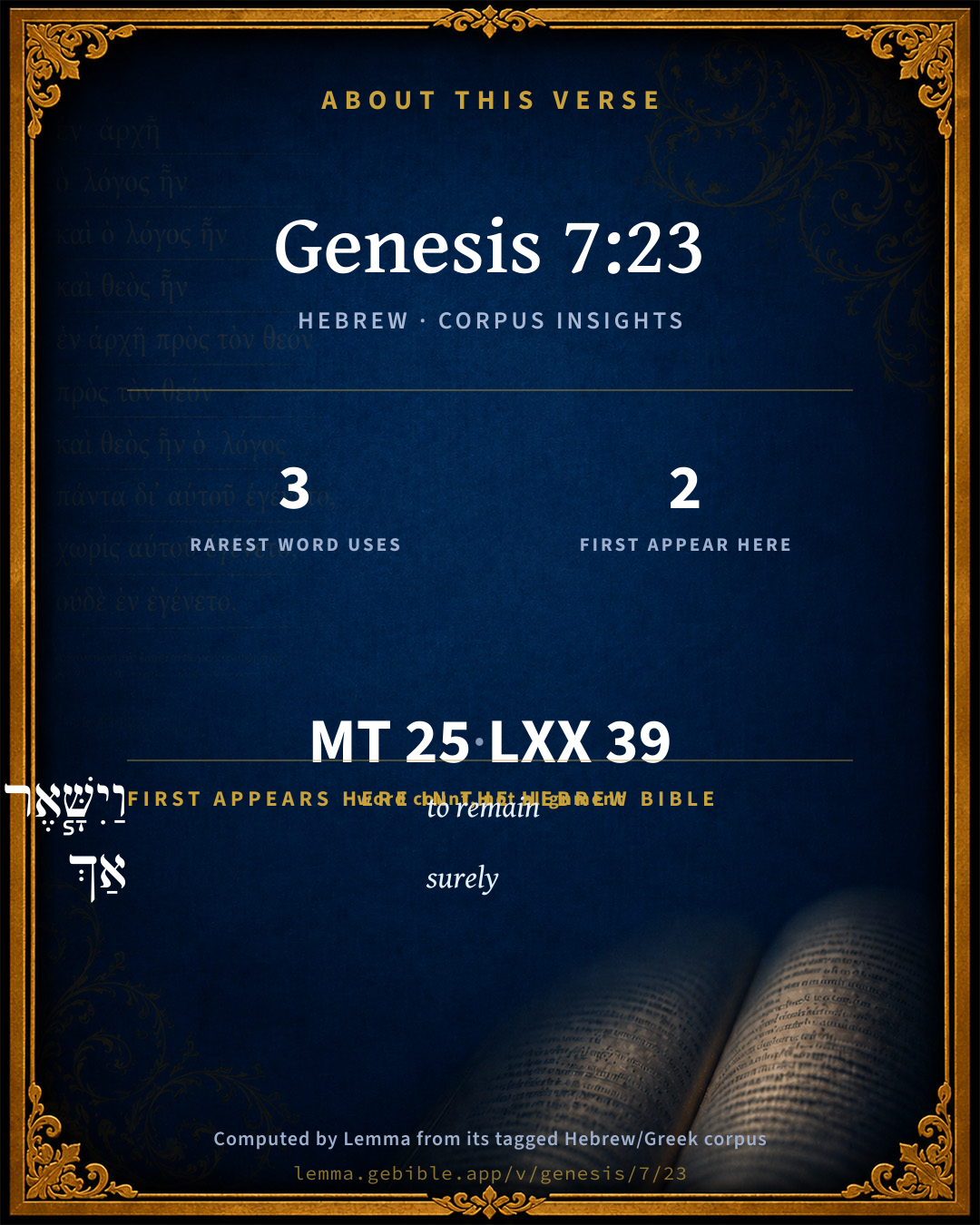
  • 2 first appearances in the Hebrew Bible
Full analysis ↓
Download a study sheet

One document with this verse’s original text, its word-by-word gloss line, the meaning frame, cross-references with their text, attributed commentary, and full source and license credits — printable, and it pastes into notes with its structure intact.

This verse Autodidact and up

Study sheet (.html) Plain text (.txt)

A passage Seminary Student

Up to 50 verses in one chapter. A passage sheet keeps up to 6 commentary sources and 12 cross-references per verse, in the order this page ranks them, and says so on the sheet whenever that leaves anything out. Ask for a single verse and you get the Autodidact verse sheet above.

Everything on this page stays free to read, with no account — the sheet is a download of what is already on screen, not access to it.

Want to remove ads? Support Godless Engineer
Compare translations 3

The same verse in 3 English versions, stacked beneath the original-language interlinear above. Click any original word for its lexicon entry.

Each is an independent rendering of the whole verse — the interlinear is not word-aligned to these translations.

Highlighted words mark where these versions differ — a whole-verse word diff, not a word-by-word alignment.

  • World English Bible Public Domain
    Every living thing was destroyed that was on the surface of the ground, including man, cattle, creeping things, and birds of the sky. They were destroyed from the earth. Only Noah was left, and those who were with him in the ark.
  • King James Version Public Domain
    And every living substance was destroyed which was upon the face of the ground, both man, and cattle, and the creeping things, and the fowl of the heaven; and they were destroyed from the earth: and Noah only remained alive, and they that were with him in the ark.
  • unfoldingWord Literal Text CC BY-SA 4.0
    So he wiped away every living thing that on the surface of the ground, including mankind and livestock and crawling creatures and also the birds of the sky. So they were wiped off the earth, and only Noah was left and who with him in the ark. God Ends the Flood 7:24-8:19

unfoldingWord Literal Text — © unfoldingWord, licensed CC BY-SA 4.0. Word-aligned USFM3 via Door43 (git.door43.org/unfoldingWord/en_ult).

Versions to compare (up to 4)

3 of 4 selected

Show all 18 translations

Every available English version of this verse, each an independent rendering of the whole verse.

  • World English Bible Public Domain
    Every living thing was destroyed that was on the surface of the ground, including man, cattle, creeping things, and birds of the sky. They were destroyed from the earth. Only Noah was left, and those who were with him in the ark.
  • Berean Standard Bible Public Domain
    And every living thing on the face of the earth was destroyed—man and livestock, crawling creatures and birds of the air; they were blotted out from the earth, and only Noah and those with him in the ark remained.
  • Majority Standard Bible Public Domain
    And every living thing on the face of the earth was destroyed—man and livestock, crawling creatures and birds of the air; they were blotted out from the earth, and only Noah and those with him in the ark remained.
  • King James Version Public Domain
    And every living substance was destroyed which was upon the face of the ground, both man, and cattle, and the creeping things, and the fowl of the heaven; and they were destroyed from the earth: and Noah only remained alive, and they that were with him in the ark.
  • American Standard Version (1901) Public Domain
    And every living thing was destroyed that was upon the face of the ground, both man, and cattle, and creeping things, and birds of the heavens; and they were destroyed from the earth: and Noah only was left, and they that were with him in the ark.
  • Revised Version (1885) Public Domain
    And every living thing was destroyed which was upon the face of the ground, both man, and cattle, and creeping thing, and fowl of the heaven; and they were destroyed from the earth: and Noah only was left, and they that were with him in the ark.
  • Geneva Bible (1599) Public Domain
    So he destroyed euery thing that was vpon the earth, from man to beast, to ye creeping thing, and to the foule of the heauen: they were euen destroyed from the earth. And Noah onely remained; and they that were with him in ye Arke.
  • Douay-Rheims (1899) Public Domain
    And he destroyed all the substance that was upon the earth, from man to beast, and the creeping things and fowls of the air: and they were destroyed from the earth: and Noe only remained, and they that were with him in the ark.
  • Young's Literal Translation Public Domain
    And wiped away is all the substance that is on the face of the ground, from man unto beast, unto creeping thing, and unto fowl of the heavens; yea, they are wiped away from the earth, and only Noah is left, and those who `are' with him in the ark;
  • Literal Standard Version CC BY-SA 4.0
    And all the substance that is on the face of the ground is wiped away—from man to beast, to creeping thing, and to bird of the heavens; indeed, they are wiped away from the earth, and only Noah is left, and those who [are] with him in the Ark;
  • Unlocked Literal Bible CC BY-SA 4.0
    So every living thing that was on the surface of the earth was wiped out, from mankind to the larger animals, to creeping things, and to birds of the sky. They were all destroyed from the earth. Only Noah and those with him in the ark were left.
  • unfoldingWord Literal Text CC BY-SA 4.0
    So he wiped away every living thing that on the surface of the ground, including mankind and livestock and crawling creatures and also the birds of the sky. So they were wiped off the earth, and only Noah was left and who with him in the ark. God Ends the Flood 7:24-8:19
  • Darby Bible Public Domain
    And every living being was destroyed that was on the ground, both man, and cattle, and creeping things, and fowl of the heavens; and they were destroyed from the earth. And Noah alone remained, and what was with him in the ark.
  • World Messianic Bible Public Domain
    Every living thing was destroyed that was on the surface of the ground, including man, livestock, creeping things, and birds of the sky. They were destroyed from the earth. Only Noah was left, and those who were with him in the ship.
  • Webster's Bible Public Domain
    And every living substance was destroyed which was upon the face of the ground, both man, and cattle, and the creeping animals, and the fowl of heaven; and they were destroyed from the earth; and Noah only remained alive, and they that were with him in the ark.
  • Free Bible Version CC BY-SA 4.0
    The Lord wiped out all life on earth—people, livestock, creatures that run along the ground, and birds. All were killed. The only ones left were Noah and those with him on the ark.
  • Bible in Basic English Public Domain
    Every living thing on the face of all the earth, man and cattle and things moving on the face of the earth, and birds of the air, came to destruction: only Noah and those who were with him in the ark, were kept from death.
  • JPS Tanakh (1917) Public Domain
    And He blotted out every living substance which was upon the face of the ground, both man, and cattle, and creeping thing, and fowl of the heaven; and they were blotted out from the earth; and Noah only was left, and they that were with him in the ark.

Literal Standard Version (2020), Covenant Press — licensed CC BY-SA 4.0. Text via the HelloAO Bible API (eBible.org). Unlocked Literal Bible (unfoldingWord) — licensed CC BY-SA 4.0. Text via the HelloAO Bible API (eBible.org). unfoldingWord Literal Text — © unfoldingWord, licensed CC BY-SA 4.0. Word-aligned USFM3 via Door43 (git.door43.org/unfoldingWord/en_ult). Free Bible Version, Dr. Jonathan Gallagher — licensed CC BY-SA 4.0. Text via the HelloAO Bible API (eBible.org).

Word by word

More ways to search: Search by grammar → Find every occurrence → Compare this word →

Practice this passage: Drill this verse → Learn its vocabulary →

הַיְק֣וּם
yᵉqûwm
H3351
“the · substance”
Particle, Definite Article + Noun, Common, Masculine, Singular, Absolute
Part of Speech
Particle + Noun
Type
Common
Gender
Masculine
Number
Singular
State
Absolute
Full BDB Definition

Origin: from H6965

TWOT: 1999f

living substance, that which stands or exists, existence, substance
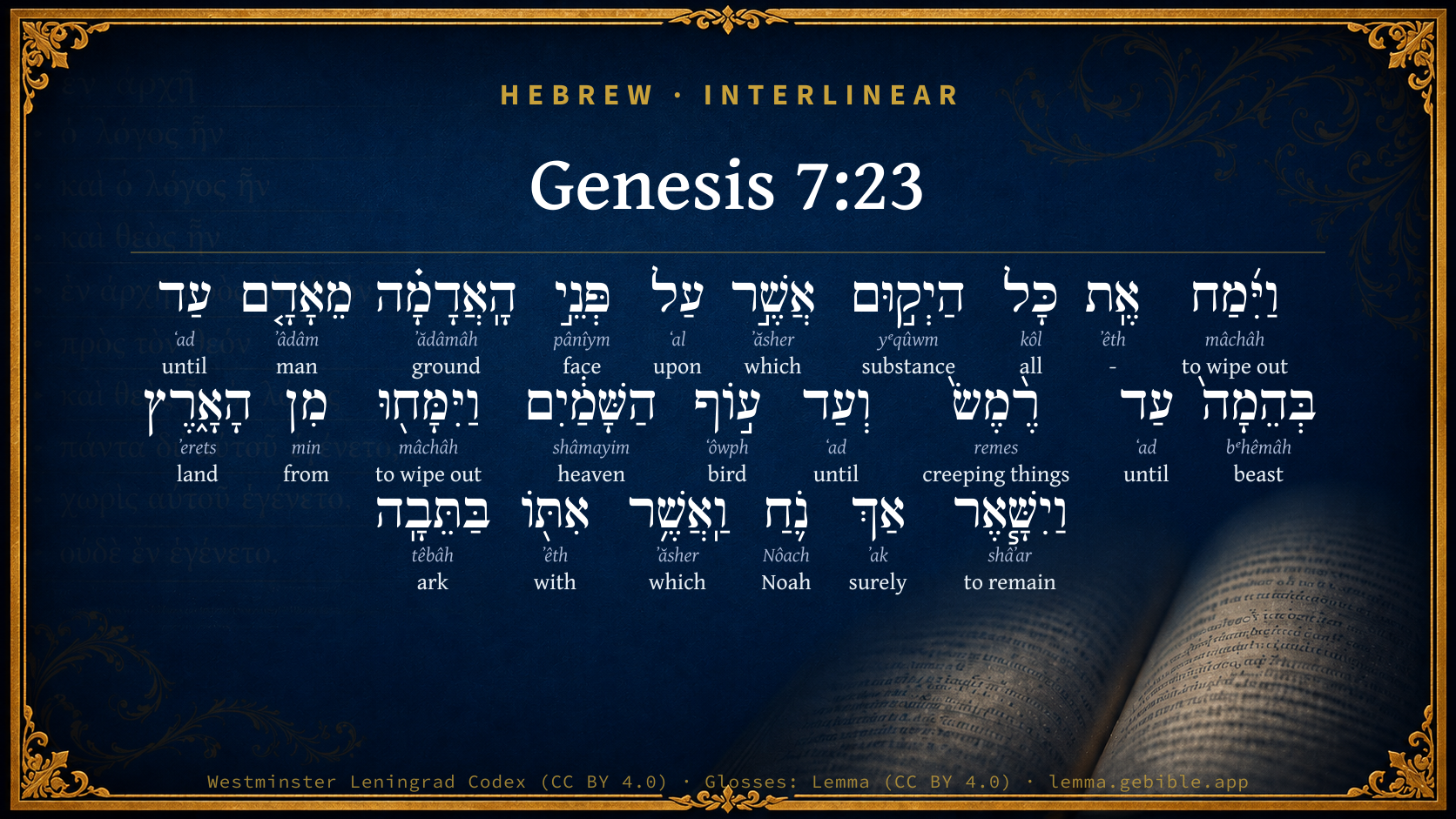
  1. וַיִּ֜מַח mâchâh H4229 “and · to wipe out” Conjunction + Verb, Qal, Sequential Imperfect, 3rd Person, Masculine, Singular
  2. אֶֽת ʼêth H853 “-” Particle, Direct Object
  3. כָּל kôl H3605 “all of” Noun, Common, Masculine, Singular, Construct
  4. אֲשֶׁ֣ר ʼăsher H834 “which” Particle, Relative
  5. עַל ʻal H5921 “upon” Preposition
  6. פְּנֵ֣י pânîym H6440 “face(s) of” Noun, Common, Both, Plural, Construct
  7. הָֽאֲדָמָ֗ה ʼădâmâh H127 “the · ground” Particle, Definite Article + Noun, Common, Feminine, Singular, Absolute
  8. מֵאָדָ֤ם ʼâdâm H120 “from · man” Preposition + Noun, Common, Masculine, Singular, Absolute
  9. עַד ʻad H5704 “until” Preposition
  10. בְּהֵמָה֙ bᵉhêmâh H929 “beast” Noun, Common, Feminine, Singular, Absolute
  11. עַד ʻad H5704 “until” Preposition
  12. רֶ֨מֶשׂ֙ remes H7431 “creeping things” Noun, Common, Masculine, Singular, Absolute
  13. וְעַד ʻad H5704 “and · until” Conjunction + Preposition
  14. ע֣וֹף ʻôwph H5775 “bird of” Noun, Common, Masculine, Singular, Construct
  15. הַשָּׁמַ֔יִם shâmayim H8064 “the · heaven(s)” Particle, Definite Article + Noun, Common, Masculine, Plural, Absolute
  16. וַיִּמָּח֖וּ mâchâh H4229 “and · to wipe out” Conjunction + Verb, Niphal, Sequential Imperfect, 3rd Person, Masculine, Plural
  17. מִן min H4480 “from” Preposition
  18. הָאָ֑רֶץ ʼerets H776 “the · land” Particle, Definite Article + Noun, Common, Both, Singular, Absolute
  19. וַיִשָּׁ֧אֶר shâʼar H7604 “and · to remain” Conjunction + Verb, Niphal, Sequential Imperfect, 3rd Person, Masculine, Singular
  20. אַךְ ʼak H389 “surely” Particle, Accusative
  21. נֹ֛חַ Nôach H5146 “Noah” Noun, Proper
  22. וַֽאֲשֶׁ֥ר ʼăsher H834 “and · which” Conjunction + Particle, Relative
  23. אִתּ֖וֹ ʼêth H854 “with · him” Preposition + Suffix, Personal, 3rd Person, Masculine, Singular
  24. בַּתֵּבָֽה têbâh H8392 “in/at the · ark” Preposition, Determined + Noun, Common, Feminine, Singular, Absolute

About this verse

These counts appear in no published source. They are computed here, from the morphology-tagged text and Lemma’s own curated glosses. What Lemma adds →

25
words
21
distinct lemmas
Pentateuch
section

Notable vocabulary

The rarest word here is הַיְק֣וּם substance H3351 — appearing just 3 times in the whole Hebrew Bible.

First appearance in Scripture

These words make their first canonical appearance in the Hebrew Bible here:

  • וַיִשָּׁ֧אֶר to remain H7604
  • אַךְ surely H389

Shared distinctive vocabulary

הַיְק֣וּם substance H3351 occurs in 3 verses of the Hebrew Bible. Also found in:

Grammatical profile

  • 3 verbs
  • 12 nouns
  • 6 prepositions
  • 4 particles

Verb forms

  • וַיִּ֜מַח Qal · Sequential Imperfect
  • וַיִּמָּח֖וּ Niphal · Sequential Imperfect
  • וַיִשָּׁ֧אֶר Niphal · Sequential Imperfect

Repetition

Words recur within this verse — often emphatic in Hebrew:

  • עַד until H5704 ×3
  • וַיִּ֜מַח to wipe out H4229 ×2
  • אֲשֶׁ֣ר which H834 ×2

Hebrew & Septuagint length

In English translation the verse runs 42 words from the Hebrew and 45 from the Septuagint (LXX English) — closely comparable.

A rough comparison of the two English renderings, which tokenize alike — not a word-level alignment.

Word counts can differ between the Hebrew and the Greek without any difference in meaning — e.g. the Hebrew direct-object marker אֵת has no separate Greek word, and Greek often adds the article ὁ.

In the original languages it is 25 Hebrew tokens and 39 Greek tokens — but the two are counted differently (Hebrew bundles its prefixes and suffixes into one token; the Greek is in lemma form), so that isn’t a like-for-like length.

Cross-references

17

Topical passages linked to Genesis 7:23 in the Treasury of Scripture Knowledge — connected by theme and wording, ordered by reader-vote popularity; previews shown in the World English Bible.

  • 2 Peter 2:5 and didn't spare the ancient world, but preserved Noah with seven others, a preacher of righteousness, when he brought a flood on the world of the ungodly;
  • Hebrews 11:7 By faith, Noah, being warned about things not yet seen, moved with godly fear, prepared an ark for the saving of his house, through which he condemned the world, and became heir of the righteousness which is according to faith.
  • 1 Peter 3:20 who before were disobedient, when God waited patiently in the days of Noah, while the ark was being built. In it, few, that is, eight souls, were saved through water.
  • Luke 17:26–27 As it happened in the days of Noah, even so will it be also in the days of the Son of Man.
  • Matthew 24:37–39 "As the days of Noah were, so will be the coming of the Son of Man.
  • 2 Peter 3:6 by which means the world that then was, being overflowed with water, perished.
  • Genesis 7:21–22 All flesh died that moved on the earth, including birds, cattle, animals, every creeping thing that creeps on the earth, and every man.
  • Job 22:15–17 Will you keep the old way Which wicked men have trodden,
  • Isaiah 24:1–8 Behold, Yahweh makes the earth empty, and makes it waste, and turns it upside down, and scatters abroad the inhabitants of it.
  • Malachi 3:17–18 They shall be mine," says Yahweh of Hosts, "my own possession in the day that I make, and I will spare them, as a man spares his own son who serves him.
  • Matthew 25:46 These will go away into eternal punishment, but the righteous into eternal life."
  • Exodus 14:28–30 The waters returned, and covered the chariots and the horsemen, even all Pharaoh's army that went in after them into the sea. There remained not so much as one of them.
  • Job 5:19 He will deliver you in six troubles; Yes, in seven there shall no evil touch you.
  • Psalms 91:1 He who dwells in the secret place of the Most High Will rest in the shadow of the Almighty.
  • Psalms 91:9–10 Because you have made Yahweh your refuge, And the Most High your dwelling place,
  • Ezekiel 14:14–20 though these three men, Noah, Daniel, and Job, were in it, they should deliver but their own souls by their righteousness, says the Lord Yahweh.
  • 2 Peter 2:9 the Lord knows how to deliver the godly out of temptation and to keep the unrighteous under punishment for the day of judgment;

Cross-references courtesy of OpenBible.info (CC BY 4.0).

Hebrew and Greek witnesses Masoretic Hebrew ↔ Greek Septuagint

The same verse in the two great witnesses to the Old Testament, shown verse-for-verse.

These are two independent witnesses, not word-aligned to each other, and the Septuagint is shown in lemma (dictionary) form.

Hebrew Genesis 7:23 Masoretic · Westminster Leningrad Codex

וַיִּ֜מַח אֶֽת כָּל הַיְק֣וּם אֲשֶׁ֣ר עַל פְּנֵ֣י הָֽאֲדָמָ֗ה מֵאָדָ֤ם עַד בְּהֵמָה֙ עַד רֶ֨מֶשׂ֙ וְעַד ע֣וֹף הַשָּׁמַ֔יִם וַיִּמָּח֖וּ מִן הָאָ֑רֶץ וַיִשָּׁ֧אֶר אַךְ נֹ֛חַ וַֽאֲשֶׁ֥ר אִתּ֖וֹ בַּתֵּבָֽה

Every living thing was destroyed that was on the surface of the ground, including man, cattle, creeping things, and birds of the sky. They were destroyed from the earth. Only Noah was left, and those who were with him in the ark.

World English Bible · Public Domain

Greek LXX Genesis 7:23 Septuagint · lemma form

καί ἐκἀλείφω πᾶς ὁ ἀνάστημα ὅς εἰμί ἐπί πρόσωπον πᾶς ὁ γῆ ἀπό ἄνθρωπος ἕως κτῆνος καί ἑρπετόν καί ὁ πετεινόν ὁ οὐρανός καί ἐκἀλείφω ἀπό ὁ γῆ καί καταλείπω μόνος νωε καί ὁ μετά αὐτός ἐν ὁ κιβωτός

And God blotted out every offspring which was upon the face of the earth, both man and beast, and reptiles, and birds of the sky, and they were blotted out from the earth, and Noe was left alone, and those with him in the ark.

LXX2012 (modern English Septuagint) · Public Domain

Hebrew: Westminster Leningrad Codex (CC BY 4.0). Greek: Septuagint (public domain); English from LXX2012 (modern English Septuagint) (Public Domain). How the Septuagint differs from the Hebrew →

Targum (Aramaic paraphrase)

2

The Targum is the ancient Jewish Aramaic paraphrase of the Hebrew Scriptures — an interpretive translation, not the Hebrew text itself. Onkelos (literal) and Pseudo-Jonathan (expansive) render the Torah, and Jonathan the Prophets. Coverage is partial: where no permissively-licensed English translation exists for a verse, only the Aramaic is shown. This is verse-level text, not a word-by-word alignment to the Hebrew.

  1. Targum Onkelos Torah (Genesis–Deuteronomy)
    וּמְחָא יָת כָּל יְקוּמָא דִּי עַל אַפֵּי אַרְעָא מֵאֱנָשָׁא עַד בְּעִירָא עַד רִחֲשָׁא וְעַד עוֹפָא דִּשְׁמַיָּא וְאִתְמְחִיאוּ מִן אַרְעָא וְאִשְׁתָּאַר בְּרַם נֹחַ וְדִי עִמֵּהּ בְּתֵבוֹתָא

    And every subsistence was blotted out that was upon the faces of the earth, from man to the beast, to the reptile, and to the fowl of heaven, it was blotted out from the earth, and Noach was left alone, and they who were with him in the ark.

    Targum Onkelos — Aramaic: “Onkelos Genesis” (public domain); “Onkelos Exodus” (public domain); “Onkelos Leviticus” (public domain); “Onkelos Numbers” (public domain); “Onkelos Deuteronomy” (public domain). English: “Sefaria Community Translation” (CC0 1.0 (public-domain dedication)); “J.W. Etheridge. The Targums of Onkelos and Jonathan Ben Uzziel on the Pentateuch. London: Longmans, Green, 1862” (public domain). Text via Sefaria.

  2. Targum Pseudo-Jonathan Torah (Genesis–Deuteronomy)
    וְשֵׁיצֵי יַת כָּל גְוִויַית אֵינַשׁ וּבְעִיר דְעַל אַנְפֵּי אַרְעָא מֵאֵינָשָׁא עַד בְּעִירָא עַד רִיחֲשָׁא וְעַד עוֹפָא דְפָרַח בְּאַוֵיר שְׁמַיָא וְאִשְׁתֵּיצֵי מִן אַרְעָא וְאִשְׁתְּאַר בְּרַם נחַ וּדְעִמֵיהּ בְּתֵיבוּתָא

    And all the bodies of men and of beasts upon the face of the earth, from man to cattle, to creeping thing, and to the fowl which wingeth in the air of heaven, perished from the earth; and Noah only was left, and they who were with him in the ark.

    Targum Pseudo-Jonathan — Aramaic: “Targum Jonathan on Genesis” (public domain); “Targum Jonathan on Exodus” (public domain); “Targum Jonathan on Leviticus” (public domain); “Targum Jonathan on Numbers” (public domain); “Targum Jonathan on Deuteronomy” (public domain). English: “The Targum of Jonathan ben Uzziel, trans. J. W. Etheridge, London, 1862” (public domain). Text via Sefaria.

Commentary

Notes on Genesis 7:23 from classic Christian and Jewish commentators (each source and its license shown beneath its notes). The classic Christian expositions comment on the surrounding passage and are grouped to its opening verse, so a note may address several verses; the Jewish commentaries on the Tanakh (Rashi and others) are per-verse, so they appear only where the commentator wrote on this verse.

Lemma curates 59 commentaries, every one of them public domain or Creative Commons licensed, each selected and text-cleaned for this edition rather than reprinted as found. About our sources →

Trapp's Complete Commentary

John Trapp

Gen 7:23 And every living substance was destroyed which was upon the face of the ground, both man, and cattle, and the creeping things, and the fowl of the heaven; and they were destroyed from the earth: and Noah only remained [alive], and they that [were] with him in the ark.

Ver. 23. And every living substance was destroyed.] That all ensuing ages, considering this standing monument of God’s wrath against sin (whence once it is become, as physicians say of some diseases, corruptio totius substantiae), might hear, and fear, and do no more so.

John Trapp, A Commentary or Exposition upon All the Books of the Old and New Testament (1647–1656) — public domain. Text from a community e-Sword module.

The Biblical Illustrator

Joseph S. Exell

Gen_7:23

Noah only remained alive, and they that were with him in the ark

The almost solitary preservation of a good man from imminent and long-continued peril

I.

THEN MORAL GOODNESS IS SOMETIMES A SAFEGUARD FROM THE IMMINENT PERILS OF LIFE.

II. THEN MORAL GOODNESS IS SIGNALLY HONOURED AND REWARDED BY GOD.

III. THEN MORAL GOODNESS MAY SOMETIMES BRING A MAN INTO THE MOST UNUSUAL AND EXCEPTIONAL CIRCUMSTANCES. It may make a man lonely in his occupation and life mission, even though he be surrounded by a crowded world; it may make him unique in his character, and it may render him solitary in his preservation and safety. (J. S. Exell, M. A.)

God destroys that He may save

A mariner in a storm would very fain save his goods, but to save his ship he heaves them overboard, a tender-hearted mother corrects her child, whereas the stripes are deeper in her heart than in its flesh. As it was said of a judge who, being about to pass sentence of death upon an offender, said, I do that good which I would not. Thus God, more loving than the careful mariner, more tender than the indulgent mother, and more merciful than the pitiful judge, is willingly unwilling that any sinner should die. He punisheth no man as he is a man, but as he is a sinful man; He loves him, yet turns him over to justice. It is Gods work to punish, but it is withal His strange work, His strange and foreign act, not His good will and pleasure. (J. Spencer.)

Noahs sojourn in the ark

Now, first of all, it was a great mercy to escape the wickedness of a wicked world, to be delivered from the blasphemies, the daring excess of iniquity which abounded openly on every side, to be rescued from sights and sounds that only jarred upon a soul that thirsted for the living God; when the door was closed, and the little Church and family of God were separated from the sinners; when the rain descended and the world began to drown; when Noah and his children felt themselves alone with God, there must have been an inexpressible sensation of release. However awful the scene without, they were able to live without disturbance, and to be at rest. And yet while in this, their awful and most merciful severance from the world, we see some, though lesser, trials. As that calm and holy house moved on from day to day, from month to month, was there not with all its peace, with all its opportunity of undisturbed intercourse with God, the loss of much that had rejoiced the soul? As day rose on day, must not the sense of confinement and restraint have come at times over the faithful Noah and his sons? Must there not have risen some longings for the green meadows and the evening walk, the beauty of the fields and the cheerful sights of Gods excellent works, that give great pleasure to godly men? To be shut in that lonely house, and to see the spring and the summer come round, the changing seasons without any change to them, all watery and blank without, must have been a trial; and yet the very fact of such a cutting off from the world and worldly things, of such loss and privation of pleasures, innocent and allowed, likens this sojourn in the ark to a long and holy fast--a lengthened Lent filling up the circle of a year. But still, we may be sure that Noah looked upon it as a space of retirement, which was to be carefully husbanded and spent for the profit of his soul. The very loss of innocent delights, the very separation from the world, must have led Noah to search for some proper duties and proper work, there providentially assigned, and there to be fulfilled. We cannot but believe that the months were crowded with constant meditations on the things of God, constant liftings up of soul, and constant exercises of faith. No idle space was it to the man of God, and, though inactive as regards the labours of the world, it was a season of spiritual husbandry and of inward toil. And thus when Noah walked forth on that sort of Easter time of the visible material world, he was doubtless all the more prepared for future trials, with a still firmer trust in God, a still sublimer faith, a deeper knowledge of the things of God, and with a larger measure of spiritual strength. And now to turn from the stay of Noah in the ark to ourselves, it is true that, while such a kind of retirement from the world can never be given to us, and that such a length of retirement may never be given, yet God does carry us away, at times, from active life, and shuts upon us the door of our house, as it were the door of the ark. Often in the midst of our life, our hand is forced from the plough, our feet from the crowded ways of the world; and even of the guileless pleasures which good men may find in the works of God, we are for a time deprived.

Surely, in our wiser and more thoughtful hours, we may thank God for these forced seasons of retirement, forced upon us that we may escape the pollutions of the world, study our Saviours will and word, give ourselves to fervent and more frequent prayer, commune with our heart and in our chamber, and be still--examine the tenor of our past lives, repent deeply, and at length, of those things which we have done amiss and contrary to the motions of the Spirit of grace, break off evil habits that have been formed, or are beginning to be formed, and by dwelling on all the love and all the truths of Jesus our Lord, be moved to consecrate ourselves afresh to Him, and to make our sickness the beginning of a more holy life. (Bp. Armstrong.)

.

The Biblical Illustrator, edited by Joseph S. Exell (c. 1880s–1900s) — public domain. Text from a community e-Sword module.

Geneva Bible (1599)

Geneva Bible translators

That is, God.

Learn what it is to obey God only, and to forsake the multitude, 1 Pet. 3:20.

Geneva Bible (1599) marginal notes — public domain. Text via Bolls.life.

Ellicott's Commentary for English Readers

(23) Every living substance.—Every thing that stood erect (See Note on Gen_7:4.)

Upon the face of the ground.—The adâmâh, the portion subdued to his use by the adam, man.

A Bible Commentary for English Readers, edited by Charles John Ellicott (1878–1897) — public domain. Text from a community e-Sword module.

Matthew Poole's English Annotations

This is so often repeated, that it may be more deeply ingrafted into the dull minds and hard hearts of men, to teach men that they ought again and again to consider this dreadful instance of God’s justice against sin and incorrigible sinners.

Matthew Poole's English Annotations on the Holy Bible (1683–1685) — public domain. Text from a community e-Sword/MySword module.

The Pulpit Commentary

And every living substance was destroyed literally, wiped out (cf. Gen_6:7 Gen_7:4) which was upon the face of the ground, both man, and literally, from, man urgecattle, and the creeping things, and the fowl of the hearten; and they were destroyed wiped, out by washing (cf. Gen_6:7) from the earth: and Noah only remained alive, and they that were with him in the ark. The straits to which the advocates of the documentary hypothesis are sometimes reduced are remarkably exemplified by the fortunes of these verses (21-23) in the attempt to assign them to their respective authors. Astruc conjectures that ver. 21 was taken from what he calls monumentum B, ver. 22 from "monument" A, and ver. 23 from monument C. Eichhorn ascribes vers. 21, 22 to an Elohistic author, and ver. 23 to a Jehovistic. Ilgen assigns vers. 21, 22 to the first, and ver. 23 to the second Elohist. Bleek, all three to the Elohist; and Davidson ver. 21 to the Elohist, vers. 22, 23 to the Jehovist. Amid such uncertainty it will be reasonable to cling to the belief that Moses wrote all the three verses, at least till the higher criticism knows its own mind.

The Deluge.

I A STRIKING TESTIMONY TO THE DIVINE FAITHFULNESS.

1. In respect of threatenings against the wicked. Whether the faith of Noah ever betrayed symptoms of wavering during the long interval of waiting for the coming of the Flood it is impossible to say; it can scarcely be doubted that the men who for six score years had seen the sun rise and set with unwearied regularity, that had watched the steady and continuous movement of nature"s laws and forces throughout the passing century, oftentimes exclaimed, Where is the promise of his coming, for all things continue as they were from the beginning?" And yet God kept his word, and fulfilled his threatening. "The flood came, and took them all away". (Mat_24:39) Cf. the Divine threatenings against Babylon, (Jer_51:33) against Tyre, (Isa_23:12) against Jerusalem (2Ki_21:13; Jer_26:18) against the Jews. (Deu_28:49) Let impenitent sinners thereby be reminded that there is one more word of doom which he will yet cause to come to pass (Psa_9:17; 2Th_1:8; 2Pe_3:10)

2. In respect of promises to the saints. At the same time that he foretold to Noah the destruction of his licentious and violent contemporaries, he distinctly promised that he would establish his covenant with Noah, and preserve both him and his amid the general overthrow. And that too he implemented in due time and to the letter. Let the saints then learn to trust the precious promises of God (2Pe_1:4) which have been given to enable them to escape the corruption that is in the world through lust (thv ejn kosmw ejn ejpiqumia fqorav, i.e. the destruction that is already operating in the world and coming out of, as it is carried in, the world"s lust).

II A SIGNAL DISPLAY or THE DIVINE POWER.

1. In controlling his creatures.

(1) In collecting the animals, which he did, doubtless, by making use of their instincts which led them to apprehend the coming danger. Vide Job 39-41, for God"s power over the animal creation.

(2) In using the powers of nature breaking up the flood-gates of the deep, and opening the windows of heaven. The phenomenon was distinctly miraculous; but if God made the world, causing it to stand together out of the water and through the water, the supernatural character of the Deluge should not occasion difficulty. Nor should the power of God be overlooked in the ordinary phenomena of nature. "Nature is but another name for an effect whose cause is God." In the miracle God reveals what he is always silently and imperceptibly doing in the natural event. Nothing happens in the realm of providence without the concurrence of Almighty power (Amo_3:6; Mat_10:29) Let God"s power exhibited over nature"s forces remind us of his ability to bring the present terrestrial economy to an end as he has promised. (2Pe_3:10, 2Pe_3:11)

(3) In destroying the lives of men. In every case life is a gift of God, and can only be recalled by him (Deu_32:39; 2Sa_2:6) Yet, unless when God interposes to destroy on a large scale, e.g. by famine, pestilence, war, accident, his absolute and unchallengeable control over men"s lives (Psa_31:15) is apt to be forgotten. And with what infinite ease he can depopulate the fairest and most crowded regions he has often shown; witness, in addition to the Flood, the destruction of the cities of the plain Gen_19:24, Gen_19:25) of the first-born in Egypt, (Exo_12:29) of the army of Pharaoh, (Exo_14:27) of the host of Sennacherib. (2Ki_19:35)

2. In punishing his enemies. That appalling visitation is fitted to remind us that God is able to execute vengeance

(1) On the greatest sinners. Having cast down the sinning angels, and drowned the world of the ungodly, and burnt up the filthy Sodomites, it is scarcely likely that any criminal will be beyond his power to apprehend and chastise. (2Pe_2:9 Jud_1:15)

(2) In the severest forms. Having all the resources of nature at his command, the gleaming thunderbolt, the sweeping flood, the sleeping volcano, the tempestuous hurricane, all the several and combined potencies of fire, air, earth, and water, he can never want a weapon wherewith to inflict upon his adversaries "the tribulation and wrath, indignation and anguish," he has decreed for their portion (Rom_2:8, Rom_2:9; 2Th_1:8, 2Th_1:9; Rev_20:15 Rev_21:8)

(3) It the most unexpected times. Few things connected with the Noachic Deluge are more impressive and paralyzing to the mind than the suddenness of the surprisal with which it sprang upon the wicked generation that for 120 years had been disbelieving its reality and ridiculing the warnings of the patriarch. "So ALSO SHALL THE COMING OF THE SON OF MAN BE.

(4) With the most inevitable certainty. Tempted by their long lives to imagine that the penalty of death was cancelled or had become inoperative, or at least would not really be put in force against them, these men of the first age were recalled from their delusive reasonings. The Deluge was God"s proclamation that the penalty was still in force against sinners, God"s explanation of what that penalty meant, God"s certification that that penalty was sure.

3. In protecting his people. The ark floating on the waters was a visible sermon to all time coming of God"s ability to save them who believe and obey him. And, like the shelter enjoyed by Noah, the salvation which God bestows upon his people is

(1) gracious flowing from the Divine mercy;

(2) free with no condition attached except that men shall, like Noah, believe and obey;

(3) adequate containing all that is required for their spiritual necessities, as the ark held abundant provision for the voyage;

(4) secure " the Lord shut him inn.

So says Christ, "I give unto them eternal life, and they shall never perish". (Joh_10:28)

III A SOLEMN ATTESTATION OF THE DIVINE HOLINESS. Proclaiming

1. That the Divine character was holy. A deity who is himself subject to imperfection is inconceivable. But sinful men are prone to forget that God is of purer eyes than to look upon iniquity. In this last age of the world God has discovered that to men by sending forth an image or likeness of himself in the person of his Son, who was holy, harmless, undefiled, and separate from sinners (cf. Joh_14:9) In the first age he announced the same great truth by the water-flood.

1. That the Divine law was holy. That, besides being himself personally pure, he requires sinless obedience at the hands of his creatures, the Almighty has in every separate era or epoch of human history taken pains

2. to inform men; in Edenic times by the forbidden tree; in ante diluvian by the Deluge; in Mosaic by Mount Sinai; in Christian by the cross of Cal vary.

3. That the Divine government was holy. That from the first the world has been governed in the interests of holiness is unmistakably me a doctrine or scripture. If any in Noah"s time believed either that God was indifferent to righteousness, or that it was possible for "the throne of iniquity to have fellowship with him" they must have been terribly undeceived when the crack of doom was heard above their heads. So will it be when the righteous Judge reveals himself a second time in flaming fire to render unto every man according to his deeds.

Lessons:

1. It is impossible for God to lie". (Heb_6:18)

2. "There is nothing too hard for the Lord". (Gen_18:14)

3. "It is a fearful thing to fall into the hands of the living God.". (Heb_10:31)

The Pulpit Commentary (1880–1919), ed. H.D.M. Spence-Jones & Joseph S. Exell — public domain. Text from a community e-Sword module.

unfoldingWord translationNotes

Door43 World Missions Community

So every living thing ... was wiped out

If necessary, this can be stated in active form. AT: "So every living thing ... perished" or "So the flood completely destroyed every living thing" (See: Active or Passive)

They were all destroyed

This can be stated in active form. AT: "God destroyed them all" (See: Active or Passive)

from the earth

"so they were no longer on the earth"

those with him

"the people and animals that were with him"

were left

"remained" or "lived" or "remained alive"

translationWords

blot out

unfoldingWord translationNotes — © Distant Shores Media and the Door43 World Missions Community, licensed CC BY-SA 4.0. Source: git.door43.org/Door43/en_tn.

Rashi

Rabbi Shlomo Yitzchaki (Rashi)

וימח AND HE BLOTTED OUT — The word וימח is a Kal form and not a Niphal, and it is of the same grammatical form as ויפן and ויבן Every verb whose last root letter is ה, such as בנה, מחה, קנה when י and ו are perfixed, has Chireq as its vowel beneath the yod.

אך נח means NOAH ONLY. This is its real meaning. But the Midrashic explanation is (Midrash Tanchuma, Noach 9) that he was coughing and spitting blood because of the trouble he had with the cattle and beasts (אך is taken as a מיעוט limitation, meaning to say that something is defective); others say, that he was once late in bringing food to a lion, so it struck him. Regarding him may the words be applied (Proverbs 11:31), “Behold, even the righteous is paid (for his evil deeds) in this world’’.

Rashi on the Tanakh — English translations: “The Judaica Press complete Tanach with Rashi, translated by A. J. Rosenberg” (CC BY 4.0); “Pentateuch with Rashi's commentary by M. Rosenbaum and A.M. Silbermann, 1929-1934” (public domain); “The Metsudah Tanach series, Lakewood, N.J” (CC BY 4.0); and “The Book of Joshua, Metsudah Publications, 1997” (CC BY 4.0). Text via Sefaria.

Ramban (Nachmanides)

Rabbi Moshe ben Nachman (Ramban / Nachmanides)

AND HE BLOTTED OUT EVERY LIVING SUBSTANCE WHICH WAS UPON THE FACE OF THE EARTH. After having said, And all flesh perished, and having said, whatever was in the dry land, died, Scripture continues to say, And He blotted out, meaning that the bodies dissolved and became water, just as is in the verse, And he shall blot them out in the water of bitterness — for the waters of the flood were hot, as our Rabbis have said. But if so, the fish also would have died. Perhaps it was as the Rabbis have said in Bereshith Rabbah: “Whatever was in the dry land died, but not the fish in the sea. And some authorities say that they too were destined to be destroyed, but they fled to the Mediterranean.” (ocean), but usually meaning the Mediterranean Sea. (See Jastrow.) Either way the fish were saved.Both of these opinions are plausible. For it is conceivable that the hot waters of the flood mingled with the seas, heating only their upper waters, while the fish descended to the depths of the ponds and lived there. Or, in accordance with the opinion of some authorities, it is possible that the fish in the waters of the countries near the Mediterranean (ocean), but usually meaning the Mediterranean Sea. (See Jastrow.) fled there when they felt the heat of the water, and were thus saved. And even if all those outside the Mediterranean died, since the majority of fish are in the Mediterranean (ocean), but usually meaning the Mediterranean Sea. (See Jastrow.) where the waters of the flood did not come down — as it is said, And the rain was upon the earth — the fish were thus saved. For none of the fish were brought into the ark to keep their seed alive, and at the time of the covenant it is said, I establish My covenant with you… and with every living creature that is with you, the fowl, and cattle, and every beast of the earth with you; of all that go out of the ark, but it does not mention the fish of the sea.

AND THEY WERE BLOTTED OUT FROM THE EARTH. The commentators have explained that the reason for the double [expression, And He blotted out … and they were blotted out], is that their remembrance was forgotten since they had no seed. But what need is there to say that after we are told that they all died? Perhaps on account of the fowl and some creeping things, Scripture tells that none of their eggs were left on any tree or under the earth for everything was blotted out. It is probable that the sense of the verse is as follows: “And He blotted out every living substance which was upon the face of the earth, for from man to beast to creeping things and to fowl of the heaven, they were blotted out from the earth, only Noah remaining alive.” Now our Rabbis have expounded: “And He blotted out, meaning from this world. And they were blotted out from the earth, meaning from the World to Come.” The Rabbis thus explained “the earth” mentioned here as meaning “the land of eternal life.” I have already alluded to its secret.

Ramban (Nachmanides) on the Tanakh — English translation: “Commentary on the Torah by Ramban (Nachmanides). Translated and annotated by Charles B. Chavel. New York, Shilo Pub. House, 1971-1976” (CC BY 4.0). Text via Sefaria.

Radak

Rabbi David Kimhi (Radak)

וימח, the word is in the kal conjugation similar to וישע in Genesis 4,4, but it is in a transitive mode. There are verbs which by definition are in a transitive mode though they appear in the conjugation kal. [prominent examples are such roots as נתן, to give, רצח, to murder, etc. Ed.] וימחו מן הארץ, if G’d wiped out these creatures, וימח, is it not obvious that they were wiped out, וימחו? So what do these words tell us? The repetition is to indicate that they were so thoroughly wiped out that not a trace of them remained. [scientists digging for their remains would not find any. Ed.] There were no ruins left behind, concerning which anyone could ever say: “this building had been owned or built by a certain individual.” Our sages in Sanhedrin 108 understand the repetition asוימח referring to their destruction in this physical material world, whereas the word וימחו refers to their obliteration also from the world to come.

Radak on the Tanakh — English translations: “Sefaria Community Translation” (CC0 1.0 (public-domain dedication)); “Eliyahu Munk, HaChut Hameshulash” (CC BY 4.0); “Rabbi Mike Feuer, Jerusalem Anthology” (CC BY 4.0); and “R. David Kimhi on the first book of Psalms, Translated by R.G. Finch, London, 1919” (public domain). Text via Sefaria.

Lesson kit

Teaching starters — assembled from the data on this page, not authored interpretation. Every prompt links to the verse data it draws on. Edit before teaching.

Genesis, in the Pentateuch, opens this verse with 25 words (21 distinct Hebrew lemmas). Its most distinctive word is yᵉqûwm (“substance”). A historical commentator’s framing appears above. Read the whole chapter for the surrounding context.

Discussion questions

  1. How does “substance” (yᵉqûwm) shape what this verse is saying?
  2. 2 words here appear for the first time in Scripture. What is being introduced at this debut?
  3. Genesis 7:4 shares the word «substance» with this verse. How do the two illuminate each other?
  4. “until” occurs 3× in this one verse. What is the effect of the repetition?
  5. These translations render this verse differently. What is at stake in choosing one wording over another?
  6. The verb «וַיִּ֜מַח» is Qal Sequential Imperfect. How does its form color the action?
  7. Reading how Trapp's Complete Commentary and The Biblical Illustrator read this verse, where do the two commentators agree and where do they part?

Things to notice

Reading settings

Reading text

Shown beneath each verse's original-language words.

Old Testament
Old Testament edition

Read the OT as the Masoretic Hebrew (MT) or the Greek Septuagint (LXX).

English shown for the Greek Septuagint (in the Hebrew ↔ Greek comparison).

Comparing translations? Open the Compare panel on any verse page to stack up to four side by side.