Genesis 5:29

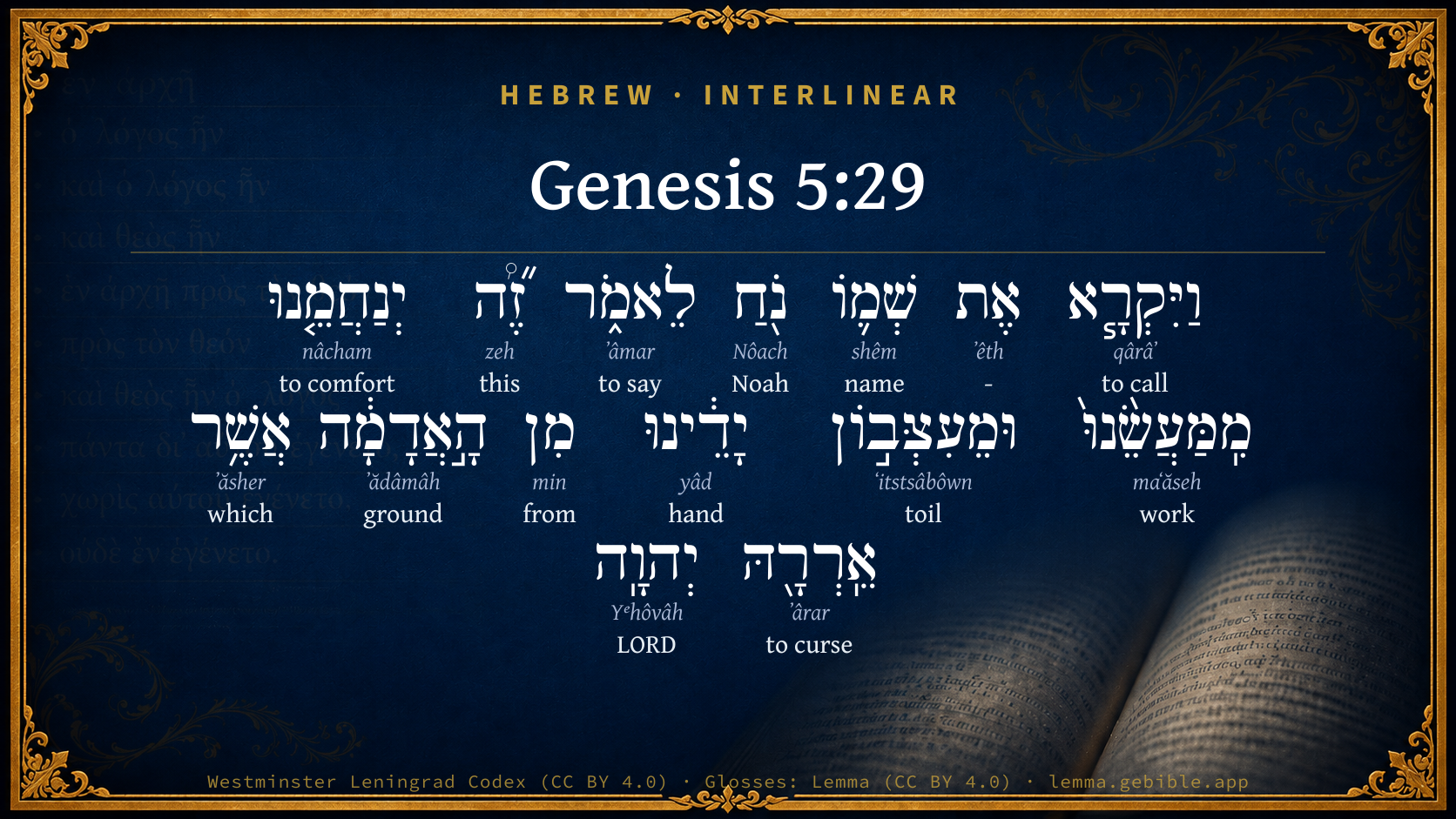
Hebrew (Westminster Leningrad Codex) Genesis 5:29 appears in the Hebrew Old Testament. The text above is from the Westminster Leningrad Codex. Each word links to its Strong’s number, a concise gloss, and parsing drawn from the Open Scriptures Hebrew Bible morphology. Click any word for its full Brown-Driver-Briggs (BDB) entry.
Download image
Cite this verse

Genesis 5:29 (World English Bible). Public Domain. Lemma interlinear Bible study tool, https://lemma.gebible.app/v/genesis/5/29.

Show BibTeX & RIS
BibTeX
RIS
English Translation
and he named him Noah, saying, "This same will comfort us in our work and in the toil of our hands, because of the ground which Yahweh has cursed."
World English Bible · Public Domain
Highlights
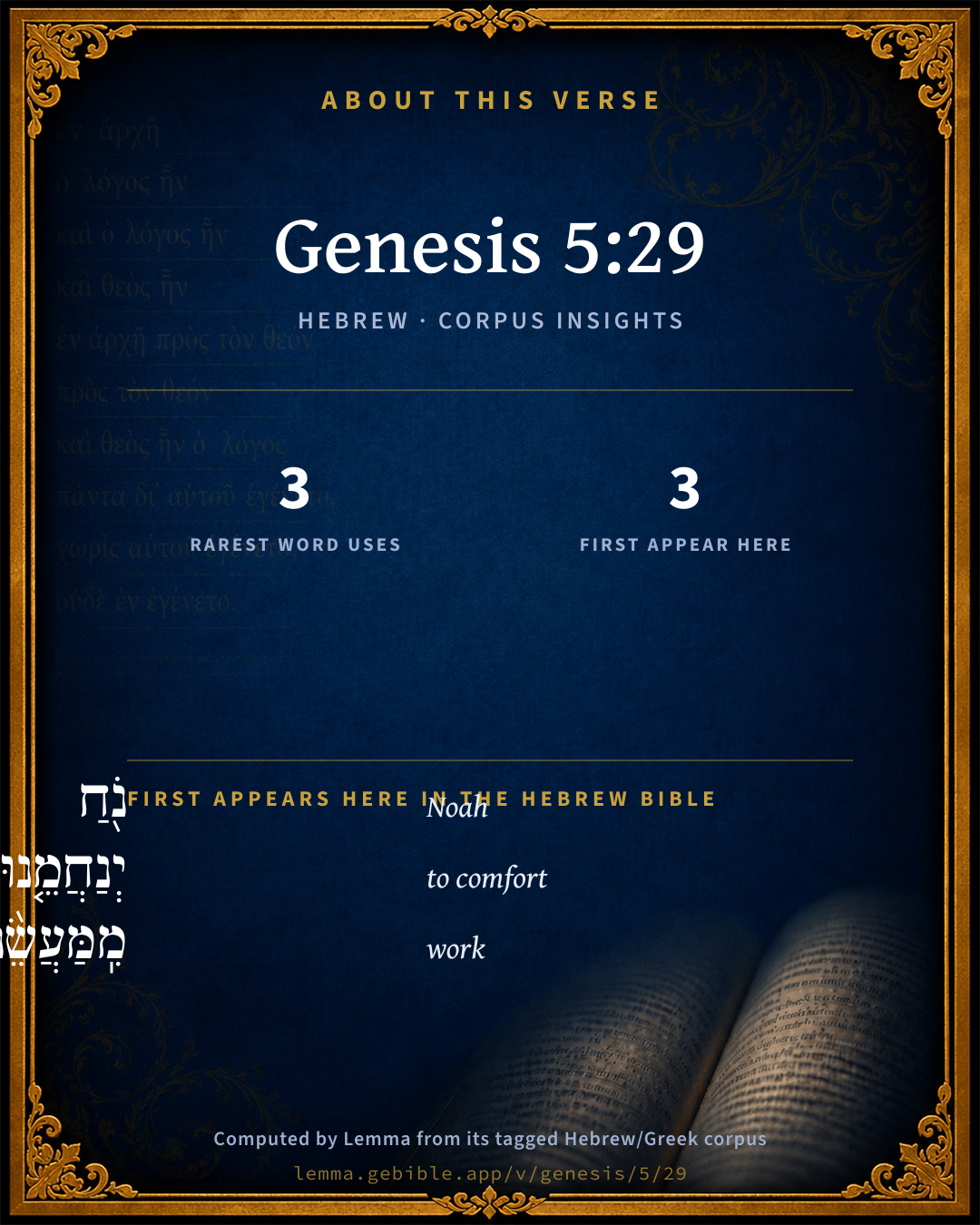
  • 3 first appearances in the Hebrew Bible
Full analysis ↓
Download a study sheet

One document with this verse’s original text, its word-by-word gloss line, the meaning frame, cross-references with their text, attributed commentary, and full source and license credits — printable, and it pastes into notes with its structure intact.

This verse Autodidact and up

Study sheet (.html) Plain text (.txt)

A passage Seminary Student

Up to 50 verses in one chapter. A passage sheet keeps up to 6 commentary sources and 12 cross-references per verse, in the order this page ranks them, and says so on the sheet whenever that leaves anything out. Ask for a single verse and you get the Autodidact verse sheet above.

Everything on this page stays free to read, with no account — the sheet is a download of what is already on screen, not access to it.

Want to remove ads? Support Godless Engineer
Compare translations 3

The same verse in 3 English versions, stacked beneath the original-language interlinear above. Click any original word for its lexicon entry.

Each is an independent rendering of the whole verse — the interlinear is not word-aligned to these translations.

Highlighted words mark where these versions differ — a whole-verse word diff, not a word-by-word alignment.

  • World English Bible Public Domain
    and he named him Noah, saying, "This same will comfort us in our work and in the toil of our hands, because of the ground which Yahweh has cursed."
  • King James Version Public Domain
    And he called his name Noah, saying, This same shall comfort us concerning our work and toil of our hands, because of the ground which the LORD hath cursed.
  • unfoldingWord Literal Text CC BY-SA 4.0
    and he called his name Noah, saying, “This will comfort us from our labors and from the toil of our hands because of the ground which Yahweh has cursed.”

unfoldingWord Literal Text — © unfoldingWord, licensed CC BY-SA 4.0. Word-aligned USFM3 via Door43 (git.door43.org/unfoldingWord/en_ult).

Versions to compare (up to 4)

3 of 4 selected

Show all 18 translations

Every available English version of this verse, each an independent rendering of the whole verse.

  • World English Bible Public Domain
    and he named him Noah, saying, "This same will comfort us in our work and in the toil of our hands, because of the ground which Yahweh has cursed."
  • Berean Standard Bible Public Domain
    And he named him Noah, saying, “May this one comfort us in the labor and toil of our hands caused by the ground that the LORD has cursed.”
  • Majority Standard Bible Public Domain
    And he named him Noah, saying, “May this one comfort us in the labor and toil of our hands caused by the ground that the LORD has cursed.”
  • King James Version Public Domain
    And he called his name Noah, saying, This same shall comfort us concerning our work and toil of our hands, because of the ground which the LORD hath cursed.
  • American Standard Version (1901) Public Domain
    and he called his name Noah, saying, This same shall comfort us in our work and in the toil of our hands, `which cometh' because of the ground which Jehovah hath cursed.
  • Revised Version (1885) Public Domain
    and he called his name Noah, saying, This same shall comfort us for our work and for the toil of our hands, because of the ground which the LORD hath cursed.
  • Geneva Bible (1599) Public Domain
    And called his name Noah, saying, This same shall comfort vs concerning our worke and sorowe of our hands, as touching the earth, which the Lord hath cursed.
  • Douay-Rheims (1899) Public Domain
    And he called his name Noe, saying: This same shall comfort us from the works and labours of our hands on the earth which the Lord hath cursed.
  • Young's Literal Translation Public Domain
    and calleth his name Noah, saying, `This `one' doth comfort us concerning our work, and concerning the labour of our hands, because of the ground which Jehovah hath cursed.'
  • Literal Standard Version CC BY-SA 4.0
    and calls his name Noah, saying, “This [one] comforts us concerning our work, and concerning the labor of our hands, because of the ground which YHWH has cursed.”
  • Unlocked Literal Bible CC BY-SA 4.0
    He called his name Noah, saying, “This one will give us rest from our work and from the painful labor of our hands, which we must do because of the ground that Yahweh has cursed.”
  • unfoldingWord Literal Text CC BY-SA 4.0
    and he called his name Noah, saying, “This will comfort us from our labors and from the toil of our hands because of the ground which Yahweh has cursed.”
  • Darby Bible Public Domain
    And he called his name Noah, saying, This [one] shall comfort us concerning our work and concerning the toil of our hands, because of the ground which Jehovah has cursed.
  • World Messianic Bible Public Domain
    He named him Noah, saying, “This one will comfort us in our work and in the toil of our hands, caused by the ground which the LORD has cursed.”
  • Webster's Bible Public Domain
    And he called his name Noah, saying, This same shall comfort us concerning our work and toil of our hands, because of the ground which the LORD hath cursed.
  • Free Bible Version CC BY-SA 4.0
    He named him Noah, with the explanation, “He will provide relief for us from all the hard manual labor we need to do in cultivating the ground the Lord has cursed.”
  • Bible in Basic English Public Domain
    And he gave him the name of Noah, saying, Truly, he will give us rest from our trouble and the hard work of our hands, because of the earth which was cursed by God.
  • JPS Tanakh (1917) Public Domain
    And he called his name Noah, saying: 'This same shall comfort us in our work and in the toil of our hands, which cometh from the ground which the LORD hath cursed.'

Literal Standard Version (2020), Covenant Press — licensed CC BY-SA 4.0. Text via the HelloAO Bible API (eBible.org). Unlocked Literal Bible (unfoldingWord) — licensed CC BY-SA 4.0. Text via the HelloAO Bible API (eBible.org). unfoldingWord Literal Text — © unfoldingWord, licensed CC BY-SA 4.0. Word-aligned USFM3 via Door43 (git.door43.org/unfoldingWord/en_ult). Free Bible Version, Dr. Jonathan Gallagher — licensed CC BY-SA 4.0. Text via the HelloAO Bible API (eBible.org).

Word by word

More ways to search: Search by grammar → Find every occurrence → Compare this word →

Practice this passage: Drill this verse → Learn its vocabulary →

וּמֵעִצְּב֣וֹן
ʻitstsâbôwn
H6093
“and · from · toil of”
Conjunction + Preposition + Noun, Common, Masculine, Singular, Construct
Part of Speech
Conjunction + Preposition + Noun
Type
Common
Gender
Masculine
Number
Singular
State
Construct
Full BDB Definition

Origin: from H6087

TWOT: 1666e

pain, labour, hardship, sorrow, toil
  1. וַיִּקְרָ֧א qârâʼ H7121 “and · to call” Conjunction + Verb, Qal, Sequential Imperfect, 3rd Person, Masculine, Singular
  2. אֶת ʼêth H853 “-” Particle, Direct Object
  3. שְׁמ֛וֹ shêm H8034 “name · his” Noun, Common, Masculine, Singular, Construct + Suffix, Personal, 3rd Person, Masculine, Singular
  4. נֹ֖חַ Nôach H5146 “Noah” Noun, Proper
  5. לֵאמֹ֑ר ʼâmar H559 “to say” Preposition + Verb, Qal, Infinitive Construct
  6. זֶ֞֠ה zeh H2088 “this” Pronoun, Demonstrative, Masculine, Singular
  7. יְנַחֲמֵ֤נוּ nâcham H5162 “to comfort · us” Verb, Piel, Imperfect, 3rd Person, Masculine, Singular + Suffix, Personal, 1st Person, Common, Plural
  8. מִֽמַּעֲשֵׂ֨נוּ֙ maʻăseh H4639 “from · work · our” Preposition + Noun, Common, Masculine, Singular, Construct + Suffix, Personal, 1st Person, Common, Plural
  9. יָדֵ֔ינוּ yâd H3027 “hands · our” Noun, Common, Both, Dual, Construct + Suffix, Personal, 1st Person, Common, Plural
  10. מִן min H4480 “from” Preposition
  11. הָ֣אֲדָמָ֔ה ʼădâmâh H127 “the · ground” Particle, Definite Article + Noun, Common, Feminine, Singular, Absolute
  12. אֲשֶׁ֥ר ʼăsher H834 “which” Particle, Relative
  13. אֵֽרְרָ֖הּ ʼârar H779 “to curse · her” Verb, Piel, Perfect, 3rd Person, Masculine, Singular + Suffix, Personal, 3rd Person, Feminine, Singular
  14. יְהוָֽה Yᵉhôvâh H3068 “LORD” Noun, Proper

About this verse

These counts appear in no published source. They are computed here, from the morphology-tagged text and Lemma’s own curated glosses. What Lemma adds →

15
words
15
distinct lemmas
Pentateuch
section

Notable vocabulary

The rarest word here is וּמֵעִצְּב֣וֹן toil H6093 — appearing just 3 times in the whole Hebrew Bible.

First appearance in Scripture

These words make their first canonical appearance in the Hebrew Bible here:

  • נֹ֖חַ Noah H5146
  • יְנַחֲמֵ֤נוּ to comfort H5162
  • מִֽמַּעֲשֵׂ֨נוּ֙ work H4639

Shared distinctive vocabulary

וּמֵעִצְּב֣וֹן toil H6093 occurs in 3 verses of the Hebrew Bible. Also found in:

Grammatical profile

  • 4 verbs
  • 7 nouns
  • 1 pronoun
  • 1 preposition
  • 2 particles

Verb forms

  • וַיִּקְרָ֧א Qal · Sequential Imperfect
  • לֵאמֹ֑ר Qal · Infinitive Construct
  • יְנַחֲמֵ֤נוּ Piel · Imperfect
  • אֵֽרְרָ֖הּ Piel · Perfect

Hebrew & Septuagint length

In English translation the verse runs 29 words from the Hebrew and 34 from the Septuagint (LXX English) — closely comparable.

A rough comparison of the two English renderings, which tokenize alike — not a word-level alignment.

Word counts can differ between the Hebrew and the Greek without any difference in meaning — e.g. the Hebrew direct-object marker אֵת has no separate Greek word, and Greek often adds the article ὁ.

Cross-references

14

Topical passages linked to Genesis 5:29 in the Treasury of Scripture Knowledge — connected by theme and wording, ordered by reader-vote popularity; previews shown in the World English Bible.

  • Matthew 24:37 "As the days of Noah were, so will be the coming of the Son of Man.
  • Hebrews 11:7 By faith, Noah, being warned about things not yet seen, moved with godly fear, prepared an ark for the saving of his house, through which he condemned the world, and became heir of the righteousness which is according to faith.
  • 2 Peter 2:5 and didn't spare the ancient world, but preserved Noah with seven others, a preacher of righteousness, when he brought a flood on the world of the ungodly;
  • Genesis 9:24 Noah awoke from his wine, and knew what his youngest son had done to him.
  • Isaiah 54:9 For this is [as] the waters of Noah to me; for as I have sworn that the waters of Noah shall no more go over the earth, so have I sworn that I will not be angry with you, nor rebuke you.
  • Ezekiel 14:14 though these three men, Noah, Daniel, and Job, were in it, they should deliver but their own souls by their righteousness, says the Lord Yahweh.
  • Ezekiel 14:20 though Noah, Daniel, and Job, were in it, as I live, says the Lord Yahweh, they should deliver neither son nor daughter; they should but deliver their own souls by their righteousness.
  • Genesis 3:17–19 To Adam he said, "Because you have listened to your wife's voice, and have eaten of the tree, of which I commanded you, saying, 'You shall not eat of it,' cursed is the ground for your sake. In toil you will eat of it all the days of your life.
  • Genesis 4:11–12 Now you are cursed because of the ground, which has opened its mouth to receive your brother's blood from your hand.
  • Genesis 6:8–9 But Noah found favor in Yahweh's eyes.
  • Genesis 7:23 Every living thing was destroyed that was on the surface of the ground, including man, cattle, creeping things, and birds of the sky. They were destroyed from the earth. Only Noah was left, and those who were with him in the ark.
  • Luke 3:36 the son of Cainan, the son of Arphaxad, the son of Shem, the son of Noah, the son of Lamech,
  • 1 Peter 3:20 who before were disobedient, when God waited patiently in the days of Noah, while the ark was being built. In it, few, that is, eight souls, were saved through water.
  • Luke 17:26–27 As it happened in the days of Noah, even so will it be also in the days of the Son of Man.

Cross-references courtesy of OpenBible.info (CC BY 4.0).

Hebrew and Greek witnesses Masoretic Hebrew ↔ Greek Septuagint

The same verse in the two great witnesses to the Old Testament, shown verse-for-verse.

These are two independent witnesses, not word-aligned to each other, and the Septuagint is shown in lemma (dictionary) form.

Hebrew Genesis 5:29 Masoretic · Westminster Leningrad Codex

וַיִּקְרָ֧א אֶת שְׁמ֛וֹ נֹ֖חַ לֵאמֹ֑ר זֶ֞֠ה יְנַחֲמֵ֤נוּ מִֽמַּעֲשֵׂ֨נוּ֙ וּמֵעִצְּב֣וֹן יָדֵ֔ינוּ מִן הָ֣אֲדָמָ֔ה אֲשֶׁ֥ר אֵֽרְרָ֖הּ יְהוָֽה

and he named him Noah, saying, "This same will comfort us in our work and in the toil of our hands, because of the ground which Yahweh has cursed."

World English Bible · Public Domain

Greek LXX Genesis 5:29 Septuagint · lemma form

καί ἐπιὀνομάζω ὁ ὄνομα αὐτός νωε λέγω οὗτος δια ἀναπαύω ἐγώ ἀπό ὁ ἔργον ἐγώ καί ἀπό ὁ λύπη ὁ χείρ ἐγώ καί ἀπό ὁ γῆ ὅς καταἀράομαι κύριος ὁ θεός

And he called his name Noe, saying, This one will cause us to cease from our works, and from the toils of our hands, and from the earth, which the Lord God has cursed.

LXX2012 (modern English Septuagint) · Public Domain

On this verse, The Cambridge Bible for Schools and Colleges discusses the Septuagint’s reading. Read the note in Commentary ↓

Hebrew: Westminster Leningrad Codex (CC BY 4.0). Greek: Septuagint (public domain); English from LXX2012 (modern English Septuagint) (Public Domain). How the Septuagint differs from the Hebrew →

Targum (Aramaic paraphrase)

2

The Targum is the ancient Jewish Aramaic paraphrase of the Hebrew Scriptures — an interpretive translation, not the Hebrew text itself. Onkelos (literal) and Pseudo-Jonathan (expansive) render the Torah, and Jonathan the Prophets. Coverage is partial: where no permissively-licensed English translation exists for a verse, only the Aramaic is shown. This is verse-level text, not a word-by-word alignment to the Hebrew.

  1. Targum Onkelos Torah (Genesis–Deuteronomy)
    וּקְרָא יָת שְׁמֵהּ נֹחַ לְמֵימָר דֵּין יְנַחֲמִנָּנָא מֵעוֹבָדָנָא וּמִלֵּאוּת יְדָנָא מִן אַרְעָא דִּי לַטְטַהּ יְיָ

    (no public-domain English translation for this verse)

    Targum Onkelos — Aramaic: “Onkelos Genesis” (public domain); “Onkelos Exodus” (public domain); “Onkelos Leviticus” (public domain); “Onkelos Numbers” (public domain); “Onkelos Deuteronomy” (public domain). English: “Sefaria Community Translation” (CC0 1.0 (public-domain dedication)); “J.W. Etheridge. The Targums of Onkelos and Jonathan Ben Uzziel on the Pentateuch. London: Longmans, Green, 1862” (public domain). Text via Sefaria.

  2. Targum Pseudo-Jonathan Torah (Genesis–Deuteronomy)
    וּקְרָא יַת שְׁמֵיהּ נחַ לְמֵימָר דֵין יְנַחֲמִינָנָא מִפּוּלְחָנָא דְלָא מַצְלְחָא וּמִלֵיעוֹת יְדָנָא מִן אַרְעָא דִלִטָא יְיָ בְּגִין חוֹבֵי בְּנֵי אֱנָשָׁא

    and he called his name Noah, (Consolation,) saying, This shall console us for our works that are not prosperous, and for the labour of our hands with the earth which the Lord hath cursed on account of the guilt of the sons of men.

    Targum Pseudo-Jonathan — Aramaic: “Targum Jonathan on Genesis” (public domain); “Targum Jonathan on Exodus” (public domain); “Targum Jonathan on Leviticus” (public domain); “Targum Jonathan on Numbers” (public domain); “Targum Jonathan on Deuteronomy” (public domain). English: “The Targum of Jonathan ben Uzziel, trans. J. W. Etheridge, London, 1862” (public domain). Text via Sefaria.

Commentary

Notes on Genesis 5:29 from classic Christian and Jewish commentators (each source and its license shown beneath its notes). The classic Christian expositions comment on the surrounding passage and are grouped to its opening verse, so a note may address several verses; the Jewish commentaries on the Tanakh (Rashi and others) are per-verse, so they appear only where the commentator wrote on this verse.

Lemma curates 59 commentaries, every one of them public domain or Creative Commons licensed, each selected and text-cleaned for this edition rather than reprinted as found. About our sources →

Trapp's Complete Commentary

John Trapp

Gen 5:29 And he called his name Noah, saying, This [same] shall comfort us concerning our work and toil of our hands, because of the ground which the LORD hath cursed.

Ver. 29. This same shall comfort us.] Herein a figure of Christ. And Peter Martyr thinks that Lamech was in hope that this son of his would have been the Christ. A pardonable error, proceeding from an earnest desire of seeing his day, whom their souls loved, and longed for: “Greeting {a} the promise afar off,” {Heb 11:13} and “waiting for the consolation of Israel.” {Luk 2:25}

{a} ασπασαμενοι

John Trapp, A Commentary or Exposition upon All the Books of the Old and New Testament (1647–1656) — public domain. Text from a community e-Sword module.

The Biblical Illustrator

Joseph S. Exell

Gen_5:29

This same shall comfort us concerning our work and toil of our hands

Hope through the gloom

I.

THE HARDNESS AND DIFFICULTY OF LIFE. These words are the words of parents. Lamech, the powerful, is not ashamed to confess that he needs comfort; and when this child comes to him he accepts him as a Divine gift, as a commissioned, competent, and thrice-welcome messenger of comfort from God.

II. THE COMFORT THAT COMES INTO THE WORLD WITH CHILDREN. These words of Lamech are the permanent inscription in the horoscope which parents everywhere and always see over the cradle of the latest born. There is a bright prophecy of God concerning the future in this invincible hopefulness of the parental heart.

III. THE SECURITY WE HAVE FOR THIS IN THE GREAT PACT OF OUR REDEMPTION. Our Noah has been born; the Rest-giver, strong Burden bearer, all-pitying and all-suffering Saviour. Noah was a preacher of righteousness, but Jesus Christ brings and gives righteousness, instilling it into every believing heart. (A. Raleigh, D. D.)

Comfort in toil

These words, used by Lamech, apply far more truly to the descendant of Noah after the flesh, even Jesus Christ.

I. When our Lord appeared among men the world was in almost as sad and hopeless a condition as when Lamech looked around him. Among the Gentiles there was ignorance, darkness, and false imaginations; among the chosen people there Was hardness and impenitence. Christ comforted His disciples after His resurrection by raising up the temple of their wrecked faith, as He raised again the temple of His own body. He comforted them with the assurance that their faith was not in vain, that He had the keys of death and hell, and was able to succour to the uttermost those who trusted in Him.

II. The risen Christ comforted also the fathers of the ancient covenant. Moses and Elias appeared unto Him on Tabor, speaking with Him of the things concerning His passion. The ancient patriarchs could not enter into heaven till the gates were opened by the cross of Christ, and the handwriting that was against all sinners was taken away.

III. The resurrection of Christ is a joy and comfort to us also--

1. Because in Him a way of safety was opened to the world.

2. Because He will repay a hundredfold all that is done for him. (S. BaringGould, M. A.)

The third Sunday in Advent

I. THE DEEPER MEANING OF THE GENEALOGICAL LISTS OF SCRIPTURE. They serve to tell us not only--

1. Of the physical interdependence of the race, awakening thus our attention to the great problem of heredity; but

2. Of the moral variety of the race, bringing us face to face with human free will; and

3. Of the great glory of the race. There are names, like mountain peaks, of spiritual grandeur; they find their apex in the Name which is above every name.

II. THE MERCIFUL DEALING OF GOD WITH A SINFUL WORLD. Samples of Gods education of man by--

1. Promise;

2. Disappointment;

3. Manifold discipline.

III. THE TRANSCENDENT SUPERIORITY OF OUR PRIVILEGES. In the advent of Jesus Christ--

1. We find no disappointment;

2. We have profound satisfaction. (Homilist.)

.

The Biblical Illustrator, edited by Joseph S. Exell (c. 1880s–1900s) — public domain. Text from a community e-Sword module.

Joseph Benson's Commentary

Gen 5:29. He called his name Noah — Which signifies rest; saying — No doubt by a spirit of prophecy; This same shall comfort us concerning our toil, &c. — That is, the hard labour and manifold troubles to which they were sentenced. This he did, 1st, By the invention of instruments of husbandry, whereby tillage was made more easy: 2d, By removing a part of the curse inflicted on the earth: and especially, 3d, By preserving a remnant of mankind from that deluge which Enoch had foretold, and which he foresaw would come, and by repeopling the empty earth with a new generation of men.

Joseph Benson's Commentary on the Old and New Testaments (1811–1818) — public domain. Text from a community e-Sword module.

Geneva Bible (1599)

Geneva Bible translators

Lamech had respect to the promise, Gen. 3:15, and desired to see the deliverer which should be sent, and yet saw but a figure thereof, he also spake this by the spirit of prophecy because Noah delivered the Church and preserved it by his obedience.

Geneva Bible (1599) marginal notes — public domain. Text via Bolls.life.

Adam Clarke's Commentary

Verse 29. This same shall comfort us] This is an allusion, as some think, to the name a Noah, which they derive from נחם nacham, to comfort; but it is much more likely that it comes from נח nach or נוח nuach, to rest, to settle, c. And what is more comfortable than rest after toil and labour? These words seem to have been spoken prophetically concerning Noah, who built the ark for the preservation of the human race, and who seems to have been a typical person for when he offered his sacrifice after the drying up of the waters, it is said that God smelled a savour of REST, and said he would not curse the ground any more for man's sake, Ge 8:21; and from that time the earth seems to have had upon an average the same degree of fertility; and the life of man, in a few generations after, was settled in the mean at threescore years and ten. See Ge 9:3.

Adam Clarke's Commentary on the Bible (1810–1826) — public domain. Text from a community e-Sword/MySword module.

John Calvin's Commentaries

29. And he called his name Noah, saying, This same shall comfort us concerning our work. In the Hebrew languages the etymology of the verb נחם (nacham) does not correspond with the noun נוח (noach,) unless we call the letter ם (mem) superfluous; as sometimes, in composition, certain letters are redundant. נוח Noach signifies to give rest, but נחם nacham to comfort. The name Noah is derived from the former verb. Wherefore, there is either the transmutation of one letter into another, or only a bare allusion, when Lamech says, “This same shall comfort us concerning our work.” But as to the point in hand, there is no doubt that he promises to himself an alleviation, or solace, of his labors. But it is asked, whence he had conceived such hope from a son whose disposition he could not yet have discerned. The Jews do not judge erroneously in declaring Lamech’s expression to be a prophecy; but they are too gross in restricting to agriculture what is applicable to all those miseries of human life which proceed from the curse of God, and are the fruits of sin. I come, indeed, to this conclusion; that the holy fathers anxiously sighed, when, being surrounded with so many evils they were continually reminded of the first origin of all evils, and regarded themselves as under the displeasure of God. Therefore in the expression, the toil of our hands, there is the figure synecdochee ; because under one kind of toil he comprises the whole miserable state into which mankind had fallen. For they undoubtedly remembered what Moses has related above, concerning the labourious, sad, and anxious life to which Adam had been doomed: and since the wickedness of man was daily increasing, no mitigation of the penalty could be hoped for, unless the Lord should bring unexpected succor. It is probable that they were very earnestly looking for the mercy of God; for their faith was strong, and necessity urged them ardently to desire help. But that the name was not rashly given to Noah, we may infer hence, that Moses expressly notes it as a thing worthy to be remembered. Certainly some meaning was couched under the names of other patriarchs; yet he passes by the reason why they were so called, and only insists upon this name of Noah. Therefore the contentious reader is not to be allowed hence to pronounce a judgment, that there was something peculiar in Noah, which did not suit others before him. I have, then, no doubt that Lamech hoped for something rare and unwonted from his son; and that, too, by the inspiration of the Spirit. Some suppose him to have been deceived, inasmuch as he believed that Noah was the Christ; but they adduce no rational conjecture in support of the opinion. It is more probable, that, seeing something great was promised concerning his son, he did not refrain from mixing his own imagination with the oracle; as holy men are also sometimes wont to exceed the measure of revelation, and thus it comes to pass, that they neither touch heaven nor earth.

John Calvin's Commentaries (1540-1563) — public domain. Text from the Calvin Translation Society English edition (1840s-50s) via the Christian Classics Ethereal Library (ccel.org). Calvin's coverage is partial (roughly two-thirds of the Bible); uncommented books and verses are honest gaps, never fabricated. The 19th-century editor's footnotes and remarks are omitted so the notes are faithfully Calvin's own voice.

Ellicott's Commentary for English Readers

(29) He called his name Noah.—This is the first recorded instance, since the days of Eve, of a child being named at his birth, and in both cases the name ended in disappointment. Noah brought no rest, but in his days came the flood to punish human sin. We have already noticed that this longing of Lamech for comfort is in strong contrast with the arrogance of his namesake of the race of Cain. (Comp. Gen_4:18.)

This same shall comfort us . . . of our hands.—These words form a couplet in the Hebrew, and rhyme like the Arabic couplets in the Koran.

The ground (adâmâh) which the Lord hath cursed.—It is usual to style this section Elohistic, because it so evidently takes up the narrative at Gen_2:3. Yet, first, the writer distinctly refers to Gen_3:17, where it is Jehovah-Elohim who curses the ground; and next he uses the name Jehovah as equivalent to God, according to what we are told in Gen_4:26. Here, then, as in several other places, the idea that Genesis can be arranged in two portions, distinguished as Elohistic or Jehovistic, according to the name of God employed in them, entirely breaks down. It is remarkable, also, that the word for “toil” in Lantech’s distich is the same as that rendered sorrow in Gen_3:16-17, and that it occurs only in these three places.

A Bible Commentary for English Readers, edited by Charles John Ellicott (1878–1897) — public domain. Text from a community e-Sword module.

The Cambridge Bible for Schools and Colleges

gen. ed. J. J. S. Perowne

29. saying, This same shall comfort us, &c.] It is generally supposed that this verse, containing a poetical couplet which is intended to explain the name of Noah, has been inserted from the same source of tradition (J) as Gen_4:25-26. Certainly, (a) the saying interrupts the bare list of names and years; (b) it contains a reference to the curse pronounced upon the soil, Gen_3:17; (c) it recurs to the use of the sacred name “Jehovah” (“Jahveh”), whereas “God” (“Elohim”) has been used in Gen_5:1; Gen_5:22; Gen_5:24.

comfort] Heb. naḥem, “to comfort,” “relieve.” The name “Noah,” however, is not derived from naḥem, but there is a play on the general similarity of sound. The LXX renders “gives us rest.”

for our work] The word “for” is in the Heb. “from,” and the meaning is that Noah will comfort his fellow-creatures and give them relief and refreshment “from” their toil.

because of the ground] Better, as R.V. marg., “which cometh from the ground.” This clause is in prose, following two metrical clauses.

In what way did the tradition connect the name of Noah with “comfort” as regards work upon the ground? According to the Hebrew figures in this chapter, Lamech, Noah’s father, must have died either before or in the Flood. It is conceivable that the saying recorded in this verse is taken from a group of Israelite traditions which contained no account of the Flood, and only associated the name of Noah with the work of an husbandman and with the first planting of a vineyard (Gen_9:20).

The Cambridge Bible for Schools and Colleges (gen. ed. J. J. S. Perowne; Cambridge University Press, 1878–1918) — public domain. Text from a community e-Sword module.

Haydock's Catholic Bible Commentary

Noe means consolation, or repose. After he had beheld the most dreadful catastrophe or disturbance that ever happened in the world, he settled mankind once more in the friendship of God, and merited a blessing both for himself and for the whole earth. He gave, likewise, comfort to all, by useful inventions in agriculture, and in the art of making wine. He saw an end of the distractions caused by the wicked sons of Cain, and became the restorer of a new world: in a word, he was the progenitor of the Messias, who is the King of Peace, and our only solid comfort. (Menochius) (Haydock)

George Leo Haydock (1774–1849), Haydock's Catholic Family Bible and Commentary, 1859 edition — public domain. Excludes Psalms (Douay-Rheims chapter numbering differs from Protestant) and Deuterocanonical books (Catholic canon only).

Matthew Poole's English Annotations

And he called his name Noah, which signifies rest,

saying, by the Spirit of prophecy:

This same shall comfort us, concerning the hard labour and manifold troubles to which we are sentenced, Gen 3:19.

And this he did either,

1. By the invention of instruments of husbandry, whereby tillage was made more easy. Or,

2. By removing in some part the curse inflicted upon the earth, and reconciling God unto mankind. Possibly he might suppose that this was the Messias, or promised Seed, and the Saviour of the undone world; as it was frequent with the ancient fathers, through their earnest desire of the Messias, to expect him long before he came, and to mistake other persons for him. Or,

3. By preserving a remnant of mankind from that deluge which he by the Spirit foresaw would come, and repeopling the emptied earth with a new generation of men, and by restoring and improving the art of husbandry: see Gen 9:20.

Matthew Poole's English Annotations on the Holy Bible (1683–1685) — public domain. Text from a community e-Sword/MySword module.

Whedon's Commentary on the Bible

Daniel D. Whedon

29. Noah — This name signifies rest or comfort. The godly hope and prophetic aspiration of the Sethite, Lamech, as expressed in this name, contrast strongly with the fierce and defiant song of the warrior and polygamist of the same name, who was descended from Cain. Lamech groans under the curse of severe bodily toil, the consequence of sin. In this son he expects deliverance, and, therefore, names him Rest. Rest and deliverance came to man through Noah, but in a way that Lamech had not thought. Exactly what Lamech expected is not clear; perhaps, like Eve, he looked upon his firstborn son as the great promised Deliverer.

Daniel D. Whedon (gen. ed.), Commentary on the Old and New Testaments (1874–1909) — public domain. Text from a community e-Sword module.

John Wesley's Explanatory Notes

This same shall comfort us concerning our work and toil of our hands, because of the ground which the Lord hath cursed - Very probably there were some prophecies that went before of him, as a person that should be wonderfully serviceable to his generation.

John Wesley, Explanatory Notes Upon the Whole Bible (1754–1765) — public domain. Text via the GEBible commentary corpus.

Rashi

Rabbi Shlomo Yitzchaki (Rashi)

זה ינחמנו THIS WILL COMFORT US — He will ease from off us (ינחמנו) the toil of our hands. For until Noah came people had no agricultural instruments and he prepared such for them. The earth had brought forth thorns and thistles when they sowed wheat in consequence of the curse imposed upon Adam Harishon: in the days of Noah, however, this ceased (Tanchuma 1:1:11). This is what is meant by the word ינחמנו (viz., ינח מנו). If, however, you do not explain it in this manner, but from the root נחם “to comfort”, then the meaning you give to this expression (connecting it with the idea of “comfort”) will have no application to the name נח, and you would have to call him מנחם “Comforter”.

Rashi on the Tanakh — English translations: “The Judaica Press complete Tanach with Rashi, translated by A. J. Rosenberg” (CC BY 4.0); “Pentateuch with Rashi's commentary by M. Rosenbaum and A.M. Silbermann, 1929-1934” (public domain); “The Metsudah Tanach series, Lakewood, N.J” (CC BY 4.0); and “The Book of Joshua, Metsudah Publications, 1997” (CC BY 4.0). Text via Sefaria.

Radak

Rabbi David Kimhi (Radak)

ויקרא את שמו נח, לאמור זה ינחמנו ממעשינו, our sages (Bereshit Rabbah 25,2) say that לא השם הוא המדרש, ולא המדרש הוא השם, that the name נח is not compatible with the allegorical explanation offered by the Midrash, neither is the Midrash compatible with the name נח. Lemech should not have related the name נח to נחמה, but should have related it to נח זה יניחנו, “this one will bring relief,” as opposed to: “this one will comfort us, i.e. the meaning of the word נחמה. On the other hand, if what he had in mind by naming his son נח, was נחמה, the comfort that he expected or hoped that his son would bring to the world, he should have named him נחמן זה ינחמנו. “this one will bring us comfort, consolation.” The Midrash is absolutely correct. However, if someone finds rest, relief after having experienced troubles, this is in itself his comfort, his consolation. The Hebrew language does not make such fine distinctions when it comes to the names reflecting linguistically accurately what the giver of the name had in mind. When Chanah named her first born son, the one for whom she had prayed in the Tabernacle at Shiloh, שמואל, giving as her reason for this name כי מה' שאלתיו, “for I have borrowed him from the Lord,” she should have called him שאול, if she had taken the words of our Midrash to heart. (Samuel I 1,20) The word שאול means something or someone borrowed. The name שמואל is close enough to make us realise what she had had in mind. In fact Chanah’s thoughts are reflected more accurately in the name שמואל than they would have been in the name שאול. The name שמואל actually contains not only the thought that he has been borrowed, or asked for, but that he had been borrowed, or asked for from G’d. Similar considerations apply to the name יעבץ, derived from עצב, anguish, sadness, (Chronicles I 4,9) His mother mentioned that she named him so because he had been born out of pain. There are more such examples to be found throughout the Bible. According to our sages Lemech must have been a great prophet, for how else could he predict that Noach, his son, would turn out to be a boon to mankind? What did he see or know that caused him to make such a prediction? According to Tanchuma Bereshit 11, people did not know what a plough was and they had to do all their work on the soil by hand. Noach invented the plough, thus becoming a great benefactor of mankind. He trained oxen and donkeys to pull a ploughshare, thus easing the labour the farmers had to perform. This was the relief and consolation he provided for all of the human species. When Lemech referred to ממעשי ידינו, “from what we had to do with our hands,” he meant that henceforth due to his son, animals could perform some of the labour which, up until then had been performed by each farmer literally with his own hands. [In accepting this interpretation, we must assume that the name Noach was not bestowed on Noach at birth. Ed.] The word מעשה as applying to working one’s field, appears in Judges 19,16 ממעשהו מן השדה, “from his work, from the field.” Even though the word מעשה can apply to any kind of work, it is used in the main in connection with work in the field. ומעצבון ידינו, from the frustration we have been experiencing over the work of our hands 'אשר אררה ה, which the Lord had cursed. Lemech referred to 3,17 where G’d had told Adam that as a result of his having listened to his wife, the earth would be cursed and he would have to eat his bread only after experiencing עצבון. In spite of Noach having invented the plough, people after him continued to work very hard to gain their livelihood through tilling the soil. However, he had definitely made their chores easier due to his clever invention. According to the plain meaning of the text, when Lemech had said זה ינחמנו, he had certainly not expressed a prophetic vision with these words, but he had called Noach by that name as a sort of prayer, seeing in his birth a special blessing. [perhaps the fact that he had not become a father until he was 182 years old had something to do with this. Everyone else mentioned in the chapter fathered a son at a much younger age. Ed.] When Rachel gave birth to Joseph, she called him Joseph as a good omen, saying that she named him thus so that G’d might give her another son. (Genesis 30,24). Moses recorded, at the command of G’d, all these vital statistics of the people from Adam until Noach, in order that we, who have inherited the Torah, should know that the universe has not always existed but was created by G’d, an important fact for every human being to be aware of.

Radak on the Tanakh — English translations: “Sefaria Community Translation” (CC0 1.0 (public-domain dedication)); “Eliyahu Munk, HaChut Hameshulash” (CC BY 4.0); “Rabbi Mike Feuer, Jerusalem Anthology” (CC BY 4.0); and “R. David Kimhi on the first book of Psalms, Translated by R.G. Finch, London, 1919” (public domain). Text via Sefaria.

Ibn Ezra

Rabbi Abraham ibn Ezra

This one will bring us rest (or “consolation”). Adam informed Lemech through prophecy that his son would bring about the salvation of the world.

Ibn Ezra on the Tanakh — English translations: “Sefaria Community Translation” (CC0 1.0 (public-domain dedication)); “Yalkut, Sifsei Chachomim Chumash, Metsudah Publications, 2009” (CC BY 4.0); and “Commentary of Ibn Ezra on Isaiah - trans. by M. Friedlander, 1873” (public domain). Text via Sefaria.

Lesson kit

Teaching starters — assembled from the data on this page, not authored interpretation. Every prompt links to the verse data it draws on. Edit before teaching.

Genesis, in the Pentateuch, opens this verse with 15 words (15 distinct Hebrew lemmas). Its most distinctive word is ʻitstsâbôwn (“toil”). A historical commentator’s framing appears above. Read the whole chapter for the surrounding context.

Discussion questions

  1. What does “toil” (ʻitstsâbôwn) contribute to the verse as a whole?
  2. 3 words here appear for the first time in Scripture. What is being introduced at this debut?
  3. Genesis 3:16 shares the word «toil» with this verse. How do the two illuminate each other?
  4. These translations render this verse differently. What is at stake in choosing one wording over another?
  5. The verb «וַיִּקְרָ֧א» is Qal Sequential Imperfect. How does its form color the action?
  6. Reading how Trapp's Complete Commentary and The Biblical Illustrator read this verse, where do the two commentators agree and where do they part?

Things to notice

Reading settings

Reading text

Shown beneath each verse's original-language words.

Old Testament
Old Testament edition

Read the OT as the Masoretic Hebrew (MT) or the Greek Septuagint (LXX).

English shown for the Greek Septuagint (in the Hebrew ↔ Greek comparison).

Comparing translations? Open the Compare panel on any verse page to stack up to four side by side.