
Ezekiel 20:38

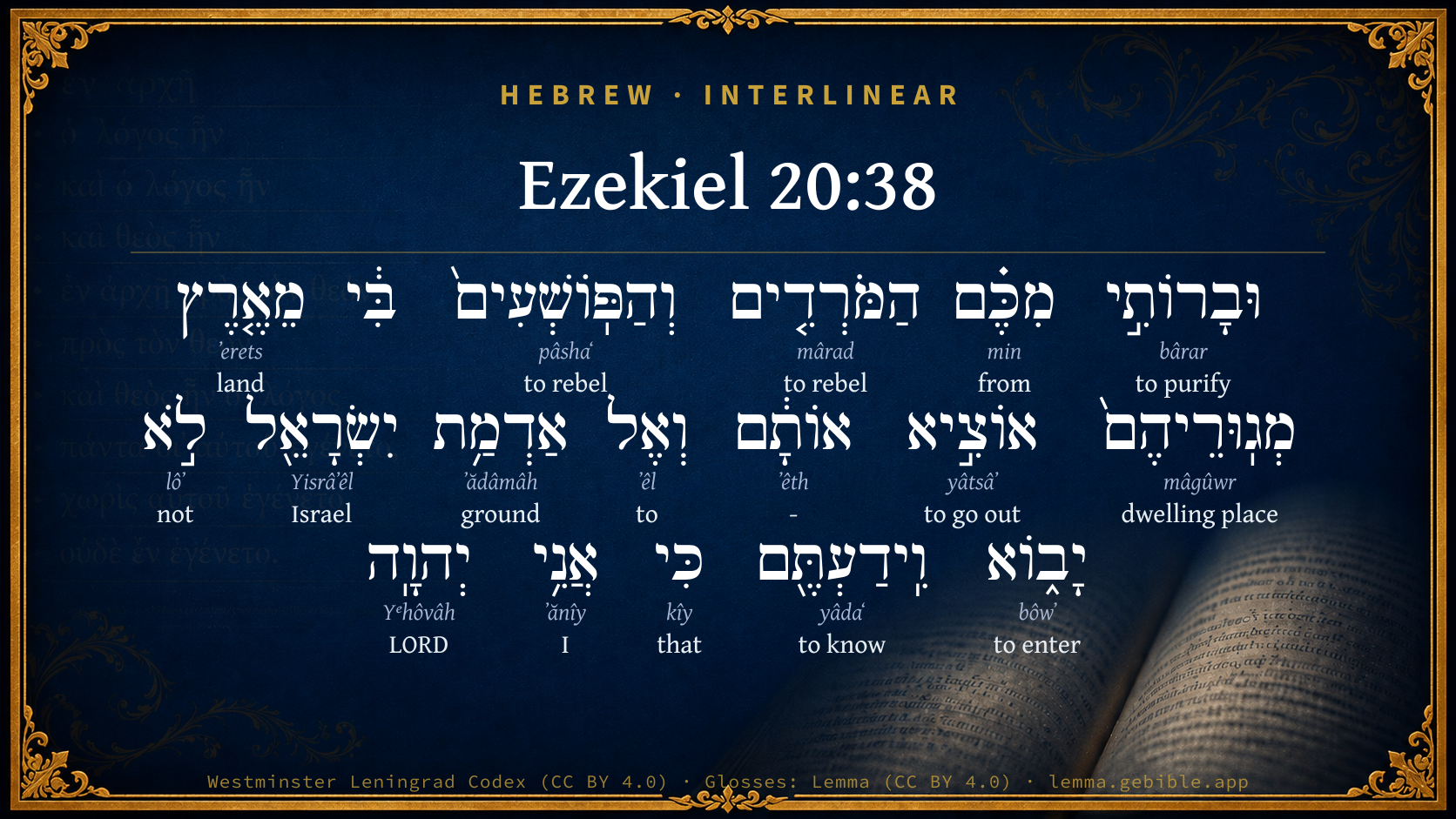
Hebrew (Westminster Leningrad Codex) Ezekiel 20:38 appears in the Hebrew Old Testament. The text above is from the Westminster Leningrad Codex. Each word links to its Strong’s number, a concise gloss, and parsing drawn from the Open Scriptures Hebrew Bible morphology. Click any word for its full Brown-Driver-Briggs (BDB) entry.
Download image
Cite this verse

Ezekiel 20:38 (World English Bible). Public Domain. Lemma interlinear Bible study tool, https://lemma.gebible.app/v/ezekiel/20/38.

Show BibTeX & RIS
BibTeX
RIS
English Translation
and I will purge out from among you the rebels, and those who disobey against me; I will bring them forth out of the land where they sojourn, but they shall not enter into the land of Israel: and you shall know that I am Yahweh.
World English Bible · Public Domain
Download a study sheet

One document with this verse’s original text, its word-by-word gloss line, the meaning frame, cross-references with their text, attributed commentary, and full source and license credits — printable, and it pastes into notes with its structure intact.

This verse Autodidact and up

Study sheet (.html) Plain text (.txt)

A passage Seminary Student

Up to 50 verses in one chapter. A passage sheet keeps up to 6 commentary sources and 12 cross-references per verse, in the order this page ranks them, and says so on the sheet whenever that leaves anything out. Ask for a single verse and you get the Autodidact verse sheet above.

Everything on this page stays free to read, with no account — the sheet is a download of what is already on screen, not access to it.

Want to remove ads? Support Godless Engineer
Compare translations 3

The same verse in 3 English versions, stacked beneath the original-language interlinear above. Click any original word for its lexicon entry.

Each is an independent rendering of the whole verse — the interlinear is not word-aligned to these translations.

Highlighted words mark where these versions differ — a whole-verse word diff, not a word-by-word alignment.

  • World English Bible Public Domain
    and I will purge out from among you the rebels, and those who disobey against me; I will bring them forth out of the land where they sojourn, but they shall not enter into the land of Israel: and you shall know that I am Yahweh.
  • King James Version Public Domain
    And I will purge out from among you the rebels, and them that transgress against me: I will bring them forth out of the country where they sojourn, and they shall not enter into the land of Israel: and ye shall know that I am the LORD.
  • unfoldingWord Literal Text CC BY-SA 4.0
    I will purge from among you the rebels and those who revolt against me. I will send them out from the land where they are staying as foreigners, but they will not enter the land of Israel. Then you will know that I am Yahweh.

unfoldingWord Literal Text — © unfoldingWord, licensed CC BY-SA 4.0. Word-aligned USFM3 via Door43 (git.door43.org/unfoldingWord/en_ult).

Versions to compare (up to 4)

3 of 4 selected

Show all 18 translations

Every available English version of this verse, each an independent rendering of the whole verse.

  • World English Bible Public Domain
    and I will purge out from among you the rebels, and those who disobey against me; I will bring them forth out of the land where they sojourn, but they shall not enter into the land of Israel: and you shall know that I am Yahweh.
  • Berean Standard Bible Public Domain
    And I will purge you of those who rebel and transgress against Me. I will bring them out of the land in which they dwell, but they will not enter the land of Israel. Then you will know that I am the LORD.
  • Majority Standard Bible Public Domain
    And I will purge you of those who rebel and transgress against Me. I will bring them out of the land in which they dwell, but they will not enter the land of Israel. Then you will know that I am the LORD.
  • King James Version Public Domain
    And I will purge out from among you the rebels, and them that transgress against me: I will bring them forth out of the country where they sojourn, and they shall not enter into the land of Israel: and ye shall know that I am the LORD.
  • American Standard Version (1901) Public Domain
    and I will purge out from among you the rebels, and them that transgress against me; I will bring them forth out of the land where they sojourn, but they shall not enter into the land of Israel: and ye shall know that I am Jehovah.
  • Revised Version (1885) Public Domain
    and I will purge out from among you the rebels, and them that transgress against me; I will bring them forth out of the land where they sojourn, but they shall not enter into the land of Israel: and ye shall know that I am the LORD.
  • Geneva Bible (1599) Public Domain
    And I wil chuse out from among you the rebels, and them that transgresse against mee: I will bring them out of the land where they dwel, and they shall not enter into the lande of Israel, and you shall knowe that I am the Lord.
  • Douay-Rheims (1899) Public Domain
    And I will pick out from among you the transgressors, and the wicked, and will bring them out of the land where they sojourn, and they shall not enter into the land of Israel: and you shall know that I am the Lord.
  • Young's Literal Translation Public Domain
    And cleared out from you the rebels, And them transgressing against Me, From the land of their sojournings I bring them out, And unto the land of Israel they come not, And ye have known that I `am' Jehovah.
  • Literal Standard Version CC BY-SA 4.0
    And cleared out the rebels from you, || And those transgressing against Me, || I bring them out from the land of their sojournings, || And they do not come to the land of Israel, || And you have known that I [am] YHWH.
  • Unlocked Literal Bible CC BY-SA 4.0
    I will purge from among you the rebels and those who revolt against me. I will send them out from the land where they are staying as foreigners, but they will not enter the land of Israel. Then you will know that I am Yahweh.
  • unfoldingWord Literal Text CC BY-SA 4.0
    I will purge from among you the rebels and those who revolt against me. I will send them out from the land where they are staying as foreigners, but they will not enter the land of Israel. Then you will know that I am Yahweh.
  • Darby Bible Public Domain
    And I will purge out from among you the rebels, and them that transgress against me; I will bring them forth out of the country where they sojourn, but they shall not enter into the land of Israel: and ye shall know that I [am] Jehovah.
  • World Messianic Bible Public Domain
    I will purge out from among you the rebels and those who disobey me. I will bring them out of the land where they live, but they shall not enter into Eretz-Israel. Then you will know that I am the LORD.”
  • Webster's Bible Public Domain
    And I will purge out from among you the rebels, and them that transgress against me: I will bring them forth out of the country where they sojourn, and they shall not enter into the land of Israel: and ye shall know that I am the LORD.
  • Free Bible Version CC BY-SA 4.0
    I will get rid of those of you who rebel against me, those who sin against me. I will lead them out of the country where they're currently living, but they won't enter the land of Israel. Then you will know that I am the Lord.
  • Bible in Basic English Public Domain
    Clearing out from among you all those who are uncontrolled and who are sinning against me; I will take them out of the land where they are living, but they will not come into the land of Israel: and you will be certain that I am the Lord.
  • JPS Tanakh (1917) Public Domain
    and I will purge out from among you the rebels, and them that transgress against Me; I will bring them forth out of the land where they sojourn, but they shall not enter into the land of Israel; and ye shall know that I am the LORD.

Literal Standard Version (2020), Covenant Press — licensed CC BY-SA 4.0. Text via the HelloAO Bible API (eBible.org). Unlocked Literal Bible (unfoldingWord) — licensed CC BY-SA 4.0. Text via the HelloAO Bible API (eBible.org). unfoldingWord Literal Text — © unfoldingWord, licensed CC BY-SA 4.0. Word-aligned USFM3 via Door43 (git.door43.org/unfoldingWord/en_ult). Free Bible Version, Dr. Jonathan Gallagher — licensed CC BY-SA 4.0. Text via the HelloAO Bible API (eBible.org).

Word by word

More ways to search: Search by grammar → Find every occurrence → Compare this word →

Practice this passage: Drill this verse → Learn its vocabulary →

מְגֽוּרֵיהֶם֙
mâgûwr
H4033
“dwelling places · their”
Noun, Common, Masculine, Plural, Construct + Suffix, Personal, 3rd Person, Masculine, Plural
Part of Speech
Noun
Type
Common
Gender
Masculine
Number
Plural
State
Construct
Full BDB Definition

Origin: from H1481 in the sense lodging

TWOT: 330c

sojourning place, dwelling-place, sojourning - dwelling-place - sojourning, lifetime
  1. וּבָרוֹתִ֣י bârar H1305 “and · to purify” Conjunction + Verb, Qal, Sequential Perfect, 1st Person, Common, Singular
  2. מִכֶּ֗ם min H4480 “from · you” Preposition + Suffix, Personal, 2nd Person, Masculine, Plural
  3. הַמֹּרְדִ֤ים mârad H4775 “the · rebelling” Particle, Definite Article + Verb, Qal, Participle Active, Masculine, Plural, Absolute
  4. וְהַפּֽוֹשְׁעִים֙ pâshaʻ H6586 “and · the · rebelling” Conjunction + Particle, Definite Article + Verb, Qal, Participle Active, Masculine, Plural, Absolute
  5. מֵאֶ֤רֶץ ʼerets H776 “from · land of” Preposition + Noun, Common, Both, Singular, Construct
  6. אוֹצִ֣יא yâtsâʼ H3318 “to go out” Verb, Hiphil, Imperfect, 1st Person, Common, Singular
  7. אוֹתָ֔ם ʼêth H853 “- · them” Particle, Direct Object + Suffix, Personal, 3rd Person, Masculine, Plural
  8. וְאֶל ʼêl H413 “and · to” Conjunction + Preposition
  9. אַדְמַ֥ת ʼădâmâh H127 “ground of” Noun, Common, Feminine, Singular, Construct
  10. יִשְׂרָאֵ֖ל Yisrâʼêl H3478 “Israel” Noun, Proper
  11. לֹ֣א lôʼ H3808 “not” Particle, Negative
  12. יָב֑וֹא bôwʼ H935 “to enter” Verb, Qal, Imperfect, 3rd Person, Masculine, Singular
  13. וִֽידַעְתֶּ֖ם yâdaʻ H3045 “and · to know” Conjunction + Verb, Qal, Sequential Perfect, 2nd Person, Masculine, Plural
  14. כִּי kîy H3588 “that” Conjunction
  15. אֲנִ֥י ʼănîy H589 “I” Pronoun, Personal, 1st Person, Common, Singular
  16. יְהוָֽה Yᵉhôvâh H3068 “LORD” Noun, Proper

About this verse

These counts appear in no published source. They are computed here, from the morphology-tagged text and Lemma’s own curated glosses. What Lemma adds →

18
words
17
distinct lemmas
Prophets
section

Notable vocabulary

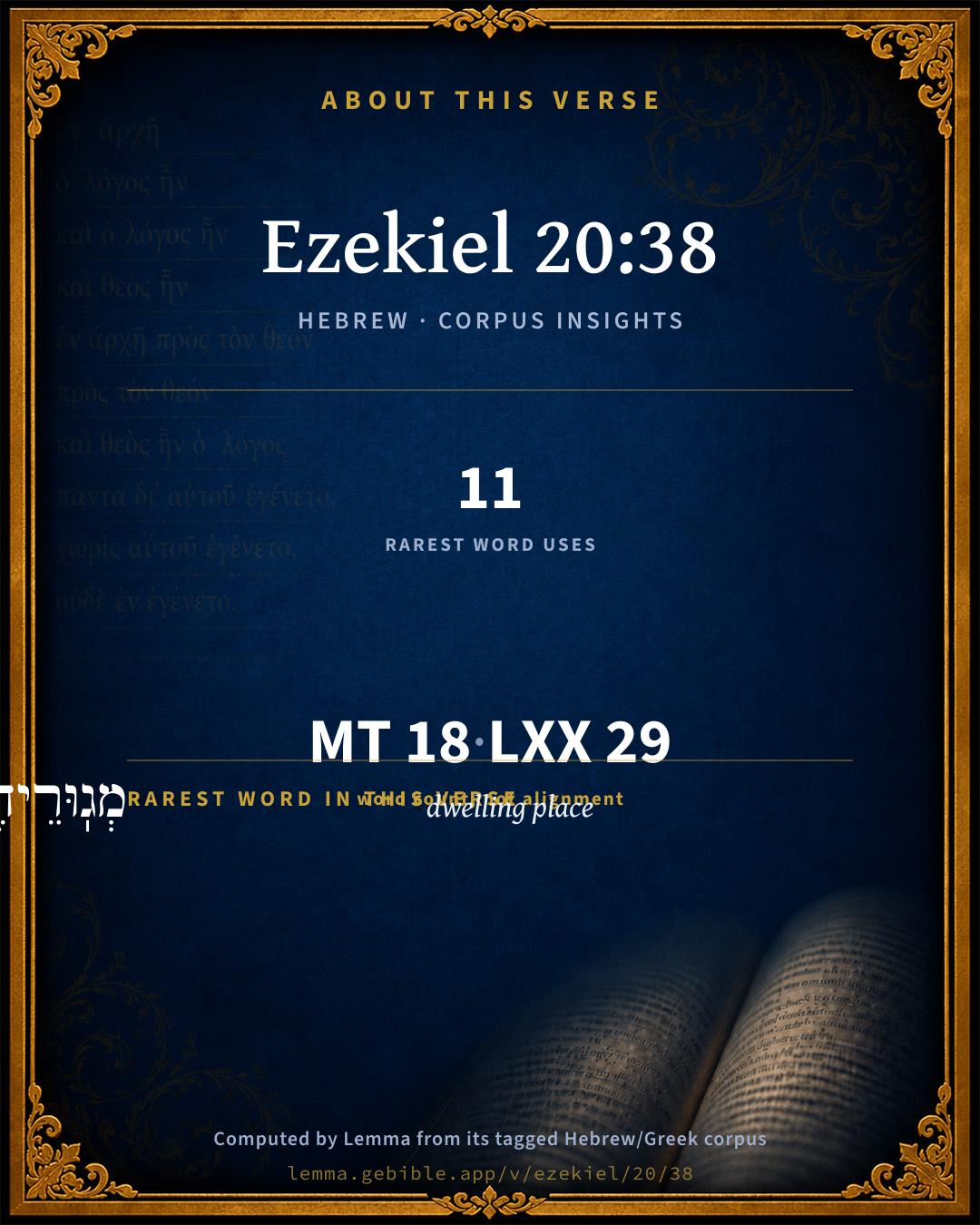
The rarest word here is מְגֽוּרֵיהֶם֙ dwelling place H4033 — appearing just 11 times in the whole Hebrew Bible.

Shared distinctive vocabulary

מְגֽוּרֵיהֶם֙ dwelling place H4033 occurs in 10 verses of the Hebrew Bible. Also found in:

Grammatical profile

  • 6 verbs
  • 5 nouns
  • 1 pronoun
  • 3 prepositions
  • 1 conjunction
  • 2 particles

Verb forms

  • וּבָרוֹתִ֣י Qal · Sequential Perfect
  • הַמֹּרְדִ֤ים Qal · Participle Active
  • וְהַפּֽוֹשְׁעִים֙ Qal · Participle Active
  • אוֹצִ֣יא Hiphil · Imperfect
  • יָב֑וֹא Qal · Imperfect
  • וִֽידַעְתֶּ֖ם Qal · Sequential Perfect

Hebrew & Septuagint length

In English translation the verse runs 46 words from the Hebrew and 46 from the Septuagint (LXX English) — the same length.

A rough comparison of the two English renderings, which tokenize alike — not a word-level alignment.

Word counts can differ between the Hebrew and the Greek without any difference in meaning — e.g. the Hebrew direct-object marker אֵת has no separate Greek word, and Greek often adds the article ὁ.

In the original languages it is 18 Hebrew tokens and 29 Greek tokens — but the two are counted differently (Hebrew bundles its prefixes and suffixes into one token; the Greek is in lemma form), so that isn’t a like-for-like length.

Cross-references

15

Topical passages linked to Ezekiel 20:38 in the Treasury of Scripture Knowledge — connected by theme and wording, ordered by reader-vote popularity; previews shown in the World English Bible.

  • Psalms 95:11 Therefore I swore in my wrath, "They won't enter into my rest."
  • Ezekiel 13:9 My hand shall be against the prophets who see false visions, and who divine lies: they shall not be in the council of my people, neither shall they be written in the writing of the house of Israel, neither shall they enter into the land of Israel; and you shall know that I am the Lord Yahweh.
  • Amos 9:9–10 "For, behold, I will command, and I will sift the house of Israel among all the nations, as grain is sifted in a sieve, yet not the least kernel will fall on the earth.
  • Jeremiah 44:14 so that none of the remnant of Judah, who have gone into the land of Egypt to sojourn there, shall escape or be left, to return into the land of Judah, to which they have a desire to return to dwell there: for none shall return save such as shall escape.
  • Ezekiel 6:7 The slain shall fall in the midst of you, and you shall know that I am Yahweh.
  • Zechariah 13:8–9 It shall happen that in all the land," says Yahweh, Two parts in it will be cut off and die; But the third will be left in it.
  • Malachi 3:3 and he will sit as a refiner and purifier of silver, and he will purify the sons of Levi, and refine them as gold and silver; and they shall offer to Yahweh offerings in righteousness.
  • Malachi 4:1–3 "For, behold, the day comes, it burns as a furnace; and all the proud, and all who work wickedness, will be stubble; and the day that comes will burn them up," says Yahweh of Hosts, "that it shall leave them neither root nor branch.
  • Numbers 14:28–30 Tell them, As I live, says Yahweh, surely as you have spoken in my ears, so will I do to you:
  • Psalms 9:16 Yahweh has made himself known. He has executed judgment. The wicked is snared by the work of his own hands. Meditation. Selah.
  • Ezekiel 11:21 But as for them whose heart walks after the heart of their detestable things and their abominations, I will bring their way on their own heads, says the Lord Yahweh.
  • Ezekiel 15:7 I will set my face against them; they shall go forth from the fire, but the fire shall devour them; and you shall know that I am Yahweh, when I set my face against them.
  • Ezekiel 23:49 They shall recompense your lewdness on you, and you shall bear the sins of your idols; and you shall know that I am the Lord Yahweh.
  • Ezekiel 34:17–22 As for you, O my flock, thus says the Lord Yahweh: Behold, I judge between sheep and sheep, the rams and the male goats.
  • Matthew 25:32–33 Before him all the nations will be gathered, and he will separate them one from another, as a shepherd separates the sheep from the goats.

Cross-references courtesy of OpenBible.info (CC BY 4.0).

Hebrew and Greek witnesses Masoretic Hebrew ↔ Greek Septuagint

The same verse in the two great witnesses to the Old Testament, shown verse-for-verse.

These are two independent witnesses, not word-aligned to each other, and the Septuagint is shown in lemma (dictionary) form.

Hebrew Ezekiel 20:38 Masoretic · Westminster Leningrad Codex

וּבָרוֹתִ֣י מִכֶּ֗ם הַמֹּרְדִ֤ים וְהַפּֽוֹשְׁעִים֙ בִּ֔י מֵאֶ֤רֶץ מְגֽוּרֵיהֶם֙ אוֹצִ֣יא אוֹתָ֔ם וְאֶל אַדְמַ֥ת יִשְׂרָאֵ֖ל לֹ֣א יָב֑וֹא וִֽידַעְתֶּ֖ם כִּי אֲנִ֥י יְהוָֽה

and I will purge out from among you the rebels, and those who disobey against me; I will bring them forth out of the land where they sojourn, but they shall not enter into the land of Israel: and you shall know that I am Yahweh.

World English Bible · Public Domain

Greek LXX Ezekiel 20:38 Septuagint · lemma form

καί ἐκλέγω ἐκ σύ ὁ ἀσεβής καί ὁ ἀποἵστημι διότι ἐκ ὁ παροικεσία αὐτός ἐκἄγω αὐτός καί εἰς ὁ γῆ ὁ ἰσραήλ οὐ εἰςἔρχομαι καί ἐπιγιγνώσκω διότι ἐγώ κύριος

And I will separate from among you the ungodly and the revolters; for I will lead them forth out of their place of sojourning, and they shall not enter into the land of Israel: and you⌃ shall know that I am the Lord, even the Lord.

LXX2012 (modern English Septuagint) · Public Domain

Hebrew: Westminster Leningrad Codex (CC BY 4.0). Greek: Septuagint (public domain); English from LXX2012 (modern English Septuagint) (Public Domain). How the Septuagint differs from the Hebrew →

Targum (Aramaic paraphrase)

1

The Targum is the ancient Jewish Aramaic paraphrase of the Hebrew Scriptures — an interpretive translation, not the Hebrew text itself. Onkelos (literal) and Pseudo-Jonathan (expansive) render the Torah, and Jonathan the Prophets. Coverage is partial: where no permissively-licensed English translation exists for a verse, only the Aramaic is shown. This is verse-level text, not a word-by-word alignment to the Hebrew.

  1. Targum Jonathan Prophets (Joshua–Malachi)
    וְאַפְרִישׁ מִנְכוֹן דִי מְרָדוּ וְדִי שַׁקָרוּ בְמֵימְרִי מֵאַרְעָא תוֹתְבוּתְהוֹן אַפֵיק יַתְהוֹן וּלְאַרְעָא דְיִשְׂרָאֵל לָא יַעֲלוּן וְתֵידְעוּן אֲרֵי אֲנָא יְיָ:

    (no public-domain English translation for this verse)

    Targum Jonathan — Aramaic: “Mikraot Gedolot” (public domain). English: “Sefaria Community Translation” (CC0 1.0 (public-domain dedication)); “London "Chaldee Paraphrase," 1871” (public domain). Text via Sefaria.

Commentary

Notes on Ezekiel 20:38 from classic Christian and Jewish commentators (each source and its license shown beneath its notes). The classic Christian expositions comment on the surrounding passage and are grouped to its opening verse, so a note may address several verses; the Jewish commentaries on the Tanakh (Rashi and others) are per-verse, so they appear only where the commentator wrote on this verse.

Lemma curates 59 commentaries, every one of them public domain or Creative Commons licensed, each selected and text-cleaned for this edition rather than reprinted as found. About our sources →

Trapp's Complete Commentary

John Trapp

Eze 20:38 And I will purge out from among you the rebels, and them that transgress against me: I will bring them forth out of the country where they sojourn, and they shall not enter into the land of Israel: and ye shall know that I [am] the LORD.

Ver. 38. And I will purge out from among you the rebels.] Making first a difference, and then a riddance of them from among my covenanters.

And they shall not enter into the land of Israel.] But either die by the way, or, if they live to enter, they shall find it a strange land to what they or their fathers left it. See Jer 44:14. Lavater maketh the sense to be, They shall not enter into the heavenly Canaan. {a} See the like, Psa 95:11.

{a} Non eos perducam ad promissiones aeternas. - Oecol.

John Trapp, A Commentary or Exposition upon All the Books of the Old and New Testament (1647–1656) — public domain. Text from a community e-Sword module.

Geneva Bible (1599)

Geneva Bible translators

Signifying, that he will not burn the corn with the chaff, but choose out the wicked to punish them when he will spare his.

Geneva Bible (1599) marginal notes — public domain. Text via Bolls.life.

Jamieson, Fausset & Brown

Robert Jamieson, A. R. Fausset & David Brown

(Zac 13:9; Zac 14:2).

purge out--or, "separate." Hebrew, barothi, forming a designed alliteration with "berith," the covenant; not a promise of grace, but a threat against those Jews who thought they could in exile escape the observation and "rule" of God.

land of Israel--Though brought out of the country of their sojourn or exile (Babylon formerly, and the various lands of their exile hereafter) into the literal land of Palestine, even it shall be to them an exile state, "they shall not enter into the land of Israel," that is, the spiritual state of restored favor of God to His covenant people, ,which shall only be given to the remnant to be saved (Zac 13:8-9).

Jamieson, Fausset & Brown — Commentary Critical and Explanatory on the Whole Bible (1871) — public domain (CC PDM 1.0). Text via the HelloAO Bible API.

Adam Clarke's Commentary

Verse 38. I will purge out from among you the rebels] The incorrigibly wicked I will destroy; those who will not receive him whom I have appointed for this purpose as the Saviour of Israel. And I will gather you who believe out of all the countries where you sojourn, and bring you into your own land; but those of you who will not believe - will not receive the Son of David to reign over you, shall never enter into the land of Israel, but die in your dispersions. This is what the contradicting and blaspheming Jews of the present day have to expect. And thus, both of you shall know that he is Jehovah, fulfilling his threatenings against the one, and his promises to the other.

Adam Clarke's Commentary on the Bible (1810–1826) — public domain. Text from a community e-Sword/MySword module.

John Calvin's Commentaries

He continues the discourse which he had commenced, namely, that God would not suffer the exiles to withdraw themselves from him from the time he had adopted them. Then, since they were bound by the blessing of redemption, although they thought themselves far removed from the sight of God, after they were cast into exile, he says he would be present to gather them from the land of their dwellings; that is, wherever they were dispersed to bring them out. Some suppose the phrase to include a promise of favor, because it is said, I will purge you; but the word to choose, as I prefer to render it, or to discern, means, that God will drag to light those who think they have obtained hiding-places in which they can escape his eyes. Although, therefore, they promise themselves complete exemption from God’s authority, he, on the other hand, pronounces them deceived, since he would collect them all together from the land of their habitations, although they were dispersed in different places. God’s threatenings are sufficiently evident from the second clause of the verse, they shall not come, says he, into the land of Israel, and you shall know that I am Jehovah. He confirms what we saw before, that when liberty was granted them, they did not on that account become God’s Church, since he had another reason for ruling over them, namely, to chastise them severely for their wickedness. They shall not come, therefore, into the land of Israel; that is, they shall remain, and grow corrupt in the desert, as we know that to be a most severe punishment, when God swore, that except two persons, Caleb and Joshua, no one should enter the land of Canaan. (Numbers 14:23, 24.) So also in this passage, I will free you, that is, when your return to your country shall be evident, a new light shall seem to have shone forth, but yet reflect on what happened to your fathers; for although redeemed, they perished in the desert, and never possessed the land of Canaan. The same thing shall happen to you also:, since your return is only a prelude to my favor: but you shall never return to the land of Israel. But this is extended to those who returned and dwelt in their native land. But we said that Judea was a place of exile since the course of God’s favor was broken off, and God begun to plead with them afresh, even when he had led them from their captivity at Babylon And you shall know that I am Jehovah: as we said yesterday, God is recognized by the reprobate, while they are compelled to acknowledged a judge whose fatherly clemency they had despised. It follows —

John Calvin's Commentaries (1540-1563) — public domain. Text from the Calvin Translation Society English edition (1840s-50s) via the Christian Classics Ethereal Library (ccel.org). Calvin's coverage is partial (roughly two-thirds of the Bible); uncommented books and verses are honest gaps, never fabricated. The 19th-century editor's footnotes and remarks are omitted so the notes are faithfully Calvin's own voice.

Ellicott's Commentary for English Readers

(38) I will purge out.—The discipline of affliction should have the effect of separating the rebellious in heart from the purified remnant, so that they should not return with them to the land of their fathers. A striking instance of the way in which the Divine purposes are fulfilled through the operations of ordinary laws, occurred on the return of the Jews from their exile. After a residence of more than two generations in Babylonia, they had made themselves homes there, and had become prosperous and contented. Jerusalem and Judæa were utterly desolated and environed with their persistent enemies. The journey thither was long, attended with hardships and danger, and at its close lay the toilsome and self-sacrificing work of pioneers. When therefore, the permission was given for the return, only those who were most earnest in their zeal for the home and religion of their fathers were ready to avail themselves of the opportunity. A great sifting of the people thus took place from the very circumstances of the case, and only a comparatively small portion constituting the better part, returned to rebuild Jerusalem and the Temple.

A Bible Commentary for English Readers, edited by Charles John Ellicott (1878–1897) — public domain. Text from a community e-Sword module.

The Cambridge Bible for Schools and Colleges

gen. ed. J. J. S. Perowne

38. Describes the other side of the process from Eze_20:37, the separating of the unworthy from among the people, ch. Eze_34:17; Eze_34:20.

and they shall not enter] But they. They shall be brought out but shall fall in the wilderness of the peoples as the rebellious generation aforetime fell in the wilderness of Egypt.

The Cambridge Bible for Schools and Colleges (gen. ed. J. J. S. Perowne; Cambridge University Press, 1878–1918) — public domain. Text from a community e-Sword module.

John Gill's Exposition

As for you, O house of Israel,.... The then present house of Israel, and the elders of it, who were upon the spot with the prophet:

go ye, serve ye everyone his idols; or dunghill gods; since they liked not to serve the true God: this is not giving them leave to serve idols, or approving their idolatrous practices; but is said "ironically", as Kimchi and Ben Melech observe, who compare it with Ecc 11:9,

and hereafter also, if ye will not hearken unto me; not only serve them now, but for the future; seeing ye choose not to hearken to my voice, to obey my laws, and to worship me, and me only; for it suggests, that it was better to attend to the service of the one, or of the other, and not halt between two opinions; but either, if the God of Israel was the true God, then serve him, and him only; but if Baal, or any other Heathen deity, was so, then serve them, and keep serving them:

but pollute ye my holy name no more with your gifts and with your idols; to worship him along with them, and them along with him; to pretend they worshipped him in them, and offered their gifts and sacrifices to him through them; and so made use of his name as a cover to their idolatrous practices: this was a polluting his name, and was abominable to him.

John Gill's Exposition of the Whole Bible (1746–1763) — public domain (CC PDM 1.0). Text via the HelloAO Bible API.

Haydock's Catholic Bible Commentary

Israel. They shall continue in exile; or the rebel Jews who will not believe in Christ, shall be cast off. (Calmet)

George Leo Haydock (1774–1849), Haydock's Catholic Family Bible and Commentary, 1859 edition — public domain. Excludes Psalms (Douay-Rheims chapter numbering differs from Protestant) and Deuterocanonical books (Catholic canon only).

Matthew Poole's English Annotations

Purge out; cull, and pick out, that they may be rejected, as they deserve, or brought forth to shame and punishment.

The rebels, the contumacious sinners, who harden themselves against God; his severe wasting judgments shall find them out in their hiding-places, and drag them out, but not to return them to Canaan, they shall no more return thither.

Ye shall know that I am the Lord; by which it shall appear, that though apostates may change their religion, and deny their God, yet he hath not less power to restrain, nor less right to govern, nor less sovereignty to dispose of them.

Matthew Poole's English Annotations on the Holy Bible (1683–1685) — public domain. Text from a community e-Sword/MySword module.

Whedon's Commentary on the Bible

Daniel D. Whedon

38. I will bring them forth — These rebellious Hebrews, who think to settle down in Egypt or Babylon and adopt the religion of the country and make their home there, shall find it to be no pleasant home for them. They shall be forced to leave — as the true Israelite will — but they shall not find the same glad end to their journey. They shall remain outcasts from their native land, the scorn both of the heathen and of their own people.

Daniel D. Whedon (gen. ed.), Commentary on the Old and New Testaments (1874–1909) — public domain. Text from a community e-Sword module.

The Pulpit Commentary

The thought of the shepherd suggests, as in Mat_25:33, the separation of the sheep from the goats. The land of the restored Israel was to be a land of righteousness, and the rebels were not to enter into it. Was Ezekiel thinking of those who were thus to die in the "wilderness of the peoples" as a counterpart of those who perished in the forty years of the wandering, and did not enter Canaan? Ver. 36 seems to imply that he was looking for a repetition of that history. The solemn fast kept by Ezra by the river of Ahava (Ezr 8:21-2:2) may be noted as corresponding, on a small scale, to Ezekiel"s expectations.

The Pulpit Commentary (1880–1919), ed. H.D.M. Spence-Jones & Joseph S. Exell — public domain. Text from a community e-Sword module.

John Wesley's Explanatory Notes

The rebels - The stubborn sinners.

John Wesley, Explanatory Notes Upon the Whole Bible (1754–1765) — public domain. Text via the GEBible commentary corpus.

Rashi

Rabbi Shlomo Yitzchaki (Rashi)

And I shall separate Heb. וּבָרוֹתִי, an expression of ברר [selecting, separating].

from the land of their sojournings From the land of their exile I shall take them and slay them in the wilderness.

Rashi on the Tanakh — English translations: “The Judaica Press complete Tanach with Rashi, translated by A. J. Rosenberg” (CC BY 4.0); “Pentateuch with Rashi's commentary by M. Rosenbaum and A.M. Silbermann, 1929-1934” (public domain); “The Metsudah Tanach series, Lakewood, N.J” (CC BY 4.0); and “The Book of Joshua, Metsudah Publications, 1997” (CC BY 4.0). Text via Sefaria.

Lesson kit

Teaching starters — assembled from the data on this page, not authored interpretation. Every prompt links to the verse data it draws on. Edit before teaching.

Ezekiel, in the Prophets, opens this verse with 18 words (17 distinct Hebrew lemmas). Its most distinctive word is mâgûwr (“dwelling place”). A historical commentator’s framing appears above. Read the whole chapter for the surrounding context.

Discussion questions

  1. What does “dwelling place” (mâgûwr) contribute to the verse as a whole?
  2. Genesis 17:8 shares the word «dwelling place» with this verse. How do the two illuminate each other?
  3. The translations on this page render this verse differently — a whole-verse word diff, not a word-by-word alignment. What might account for the different wordings?
  4. The verb «וּבָרוֹתִ֣י» is Qal Sequential Perfect. How does its form color the action?
  5. Reading how Trapp's Complete Commentary and Geneva Bible (1599) read this verse, where do the two commentators agree and where do they part?

Things to notice

Reading settings

Reading text

Shown beneath each verse's original-language words.

Old Testament
Old Testament edition

Read the OT as the Masoretic Hebrew (MT) or the Greek Septuagint (LXX).

English shown for the Greek Septuagint (in the Hebrew ↔ Greek comparison).

Comparing translations? Open the Compare panel on any verse page to stack up to four side by side.