
Leviticus 5:6

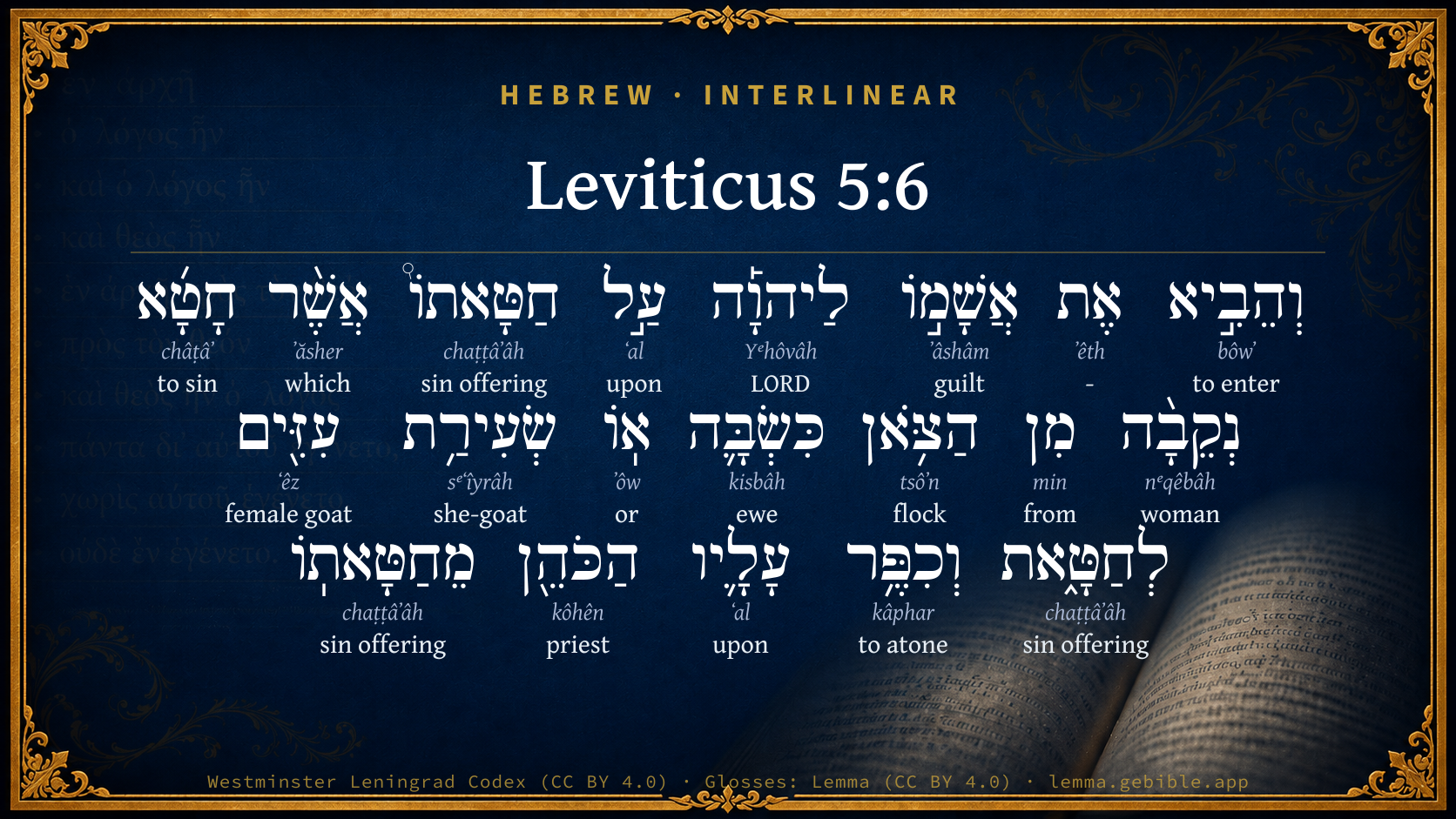
Hebrew (Westminster Leningrad Codex) Leviticus 5:6 appears in the Hebrew Old Testament. The text above is from the Westminster Leningrad Codex. Each word links to its Strong’s number, a concise gloss, and parsing drawn from the Open Scriptures Hebrew Bible morphology. Click any word for its full Brown-Driver-Briggs (BDB) entry.
Download image
Cite this verse

Leviticus 5:6 (World English Bible). Public Domain. Lemma interlinear Bible study tool, https://lemma.gebible.app/v/leviticus/5/6.

Show BibTeX & RIS
BibTeX
RIS
English Translation
and he shall bring his trespass offering to Yahweh for his sin which he has sinned, a female from the flock, a lamb or a goat, for a sin offering; and the priest shall make atonement for him concerning his sin.
World English Bible · Public Domain
Highlights
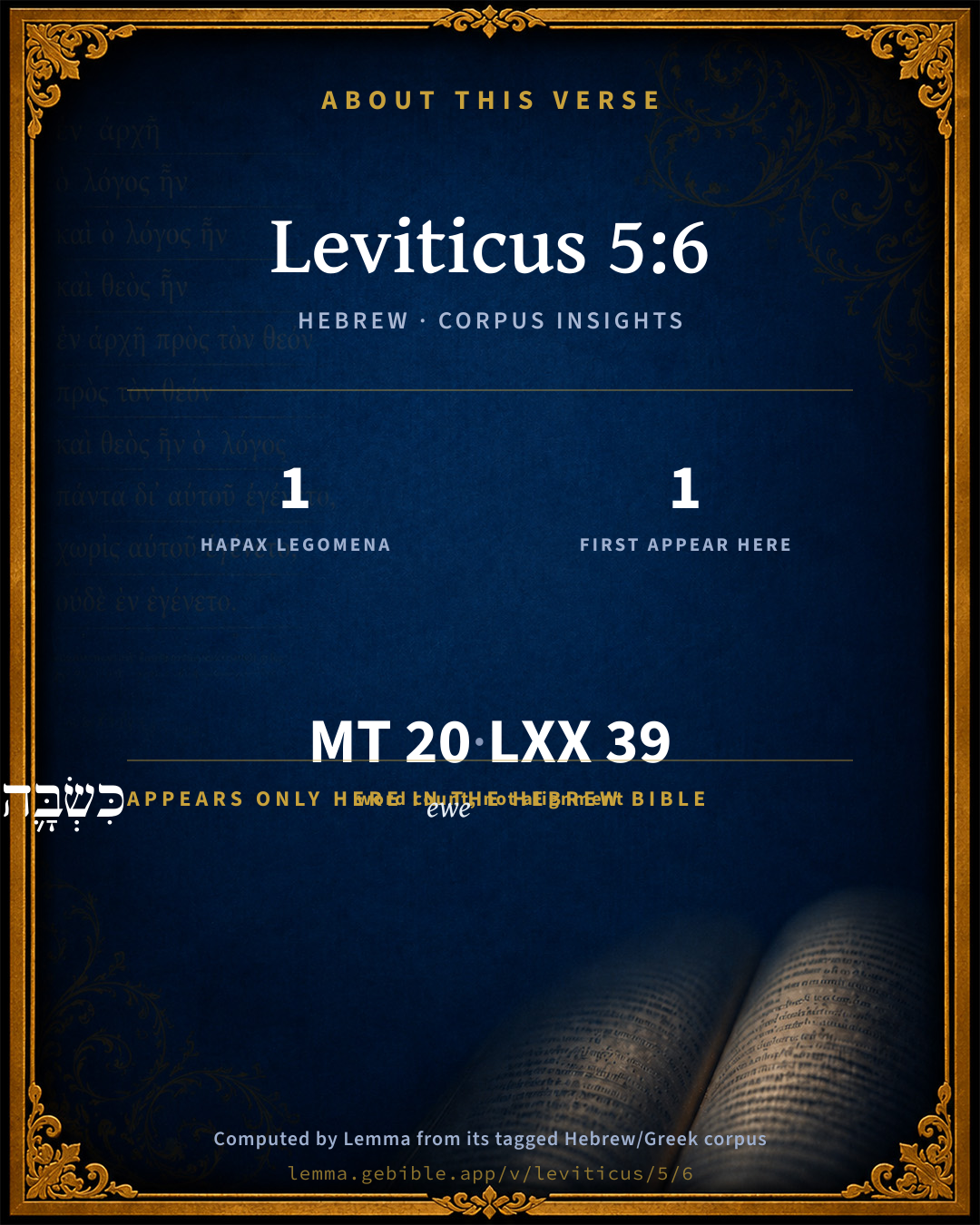
  • 1 hapax legomenon — only here in the Hebrew Bible
  • 1 first appearance in the Hebrew Bible
Full analysis ↓
Download a study sheet

One document with this verse’s original text, its word-by-word gloss line, the meaning frame, cross-references with their text, attributed commentary, and full source and license credits — printable, and it pastes into notes with its structure intact.

This verse Autodidact and up

Study sheet (.html) Plain text (.txt)

A passage Seminary Student

Up to 50 verses in one chapter. A passage sheet keeps up to 6 commentary sources and 12 cross-references per verse, in the order this page ranks them, and says so on the sheet whenever that leaves anything out. Ask for a single verse and you get the Autodidact verse sheet above.

Everything on this page stays free to read, with no account — the sheet is a download of what is already on screen, not access to it.

Want to remove ads? Support Godless Engineer
Compare translations 3

The same verse in 3 English versions, stacked beneath the original-language interlinear above. Click any original word for its lexicon entry.

Each is an independent rendering of the whole verse — the interlinear is not word-aligned to these translations.

Highlighted words mark where these versions differ — a whole-verse word diff, not a word-by-word alignment.

  • World English Bible Public Domain
    and he shall bring his trespass offering to Yahweh for his sin which he has sinned, a female from the flock, a lamb or a goat, for a sin offering; and the priest shall make atonement for him concerning his sin.
  • King James Version Public Domain
    And he shall bring his trespass offering unto the LORD for his sin which he hath sinned, a female from the flock, a lamb or a kid of the goats, for a sin offering; and the priest shall make an atonement for him concerning his sin.
  • unfoldingWord Literal Text CC BY-SA 4.0
    And he shall bring his guilt to Yahweh for his sin that he sinned, a female from the flock, a lamb or a kid of the goats, for a sin offering. And the priest shall make atonement for him from his sin.

unfoldingWord Literal Text — © unfoldingWord, licensed CC BY-SA 4.0. Word-aligned USFM3 via Door43 (git.door43.org/unfoldingWord/en_ult).

Versions to compare (up to 4)

3 of 4 selected

Show all 18 translations

Every available English version of this verse, each an independent rendering of the whole verse.

  • World English Bible Public Domain
    and he shall bring his trespass offering to Yahweh for his sin which he has sinned, a female from the flock, a lamb or a goat, for a sin offering; and the priest shall make atonement for him concerning his sin.
  • Berean Standard Bible Public Domain
    and he must bring his guilt offering to the LORD for the sin he has committed: a female lamb or goat from the flock as a sin offering. And the priest will make atonement for him concerning his sin.
  • Majority Standard Bible Public Domain
    and he must bring his guilt offering to the LORD for the sin he has committed: a female lamb or goat from the flock as a sin offering. And the priest will make atonement for him concerning his sin.
  • King James Version Public Domain
    And he shall bring his trespass offering unto the LORD for his sin which he hath sinned, a female from the flock, a lamb or a kid of the goats, for a sin offering; and the priest shall make an atonement for him concerning his sin.
  • American Standard Version (1901) Public Domain
    and he shall bring his trespass-offering unto Jehovah for his sin which he hath sinned, a female from the flock, a lamb or a goat, for a sin-offering; and the priest shall make atonement for him as concerning his sin.
  • Revised Version (1885) Public Domain
    and he shall bring his guilt offering unto the LORD for his sin which he hath sinned, a female from the flock, a lamb or a goat, for a sin offering; and the priest shall make atonement for him as concerning his sin.
  • Geneva Bible (1599) Public Domain
    Therefore shall he bring his trespasse offring vnto the Lord for his sinne which he hath committed, euen a female from ye flocke, be it a lambe or a she goat for a sinne offring, and the Priest shall make an atonement for him, concerning his sinne.
  • Douay-Rheims (1899) Public Domain
    And offer of the flocks an ewe lamb, or a she goat, and the priest shall pray for him and for his sin:
  • Young's Literal Translation Public Domain
    and hath brought in his guilt-offering to Jehovah for his sin which he hath sinned, a female out of the flock, a lamb, or a kid of the goats, for a sin-offering, and the priest hath made atonement for him, because of his sin.
  • Literal Standard Version CC BY-SA 4.0
    and has brought in his guilt-offering to YHWH for his sin which he has sinned, a female out of the flock, a lamb, or a kid of the goats, for a sin-offering, and the priest has made atonement for him because of his sin.
  • Unlocked Literal Bible CC BY-SA 4.0
    Then he must bring his guilt offering to Yahweh for the sin that he has committed, a female animal from the flock, either a lamb or a goat, for a sin offering, and the priest will make atonement for him concerning his sin.
  • unfoldingWord Literal Text CC BY-SA 4.0
    And he shall bring his guilt to Yahweh for his sin that he sinned, a female from the flock, a lamb or a kid of the goats, for a sin offering. And the priest shall make atonement for him from his sin.
  • Darby Bible Public Domain
    and he shall bring his trespass-offering to Jehovah for his sin which he hath sinned, a female from the small cattle, a sheep or doe goat, for a sin-offering; and the priest shall make atonement for him [to cleanse him] from his sin.
  • World Messianic Bible Public Domain
    and he shall bring his trespass offering to the LORD for his sin which he has sinned: a female from the flock, a lamb or a goat, for a sin offering; and the priest shall make atonement for him concerning his sin.
  • Webster's Bible Public Domain
    And he shall bring his trespass-offering to the LORD for his sin which he hath sinned, a female from the flock, a lamb or a kid of the goats, for a sin-offering; and the priest shall make an atonement for him concerning his sin.
  • Free Bible Version CC BY-SA 4.0
    and you must take your guilt offering of a female lamb or goat to the Lord as a sin offering for your sin. The priest will make your sin right.
  • Bible in Basic English Public Domain
    And take to the Lord the offering for the wrong which he has done, a female from the flock, a lamb or a goat, for a sin-offering, and the priest will take away his sin.
  • JPS Tanakh (1917) Public Domain
    and he shall bring his forfeit unto the LORD for his sin which he hath sinned, a female from the flock, a lamb or a goat, for a sin-offering; and the priest shall make atonement for him as concerning his sin.

Literal Standard Version (2020), Covenant Press — licensed CC BY-SA 4.0. Text via the HelloAO Bible API (eBible.org). Unlocked Literal Bible (unfoldingWord) — licensed CC BY-SA 4.0. Text via the HelloAO Bible API (eBible.org). unfoldingWord Literal Text — © unfoldingWord, licensed CC BY-SA 4.0. Word-aligned USFM3 via Door43 (git.door43.org/unfoldingWord/en_ult). Free Bible Version, Dr. Jonathan Gallagher — licensed CC BY-SA 4.0. Text via the HelloAO Bible API (eBible.org).

Word by word

More ways to search: Search by grammar → Find every occurrence → Compare this word →

Practice this passage: Drill this verse → Learn its vocabulary →

כִּשְׂבָּ֛ה
kisbâh
H3776
“ewe”
Noun, Common, Feminine, Singular, Absolute
Part of Speech
Noun
Type
Common
Gender
Feminine
Number
Singular
State
Absolute
Full BDB Definition

Origin: from H3775

TWOT: 949

ewe-lamb, lamb, sheep
  1. וְהֵבִ֣יא bôwʼ H935 “and · to enter” Conjunction + Verb, Hiphil, Sequential Perfect, 3rd Person, Masculine, Singular
  2. אֶת ʼêth H853 “-” Particle, Direct Object
  3. אֲשָׁמ֣וֹ ʼâshâm H817 “guilt · his” Noun, Common, Masculine, Singular, Construct + Suffix, Personal, 3rd Person, Masculine, Singular
  4. לַיהוָ֡ה Yᵉhôvâh H3068 “to/for · LORD” Preposition + Noun, Proper
  5. עַ֣ל ʻal H5921 “upon” Preposition
  6. חַטָּאתוֹ֩ chaṭṭâʼâh H2403 “sin offering · his” Noun, Common, Feminine, Singular, Construct + Suffix, Personal, 3rd Person, Masculine, Singular
  7. אֲשֶׁ֨ר ʼăsher H834 “which” Particle, Relative
  8. חָטָ֜א châṭâʼ H2398 “to sin” Verb, Qal, Perfect, 3rd Person, Masculine, Singular
  9. נְקֵבָ֨ה nᵉqêbâh H5347 “woman” Noun, Common, Feminine, Singular, Absolute
  10. מִן min H4480 “from” Preposition
  11. הַצֹּ֥אן tsôʼn H6629 “the · flock” Particle, Definite Article + Noun, Common, Both, Singular, Absolute
  12. אֽוֹ ʼôw H176 “or” Conjunction
  13. שְׂעִירַ֥ת sᵉʻîyrâh H8166 “she-goat of” Noun, Common, Feminine, Singular, Construct
  14. עִזִּ֖ים ʻêz H5795 “female goats” Noun, Common, Feminine, Plural, Absolute
  15. לְחַטָּ֑את chaṭṭâʼâh H2403 “to/for · sin offering” Preposition + Noun, Common, Feminine, Singular, Absolute
  16. וְכִפֶּ֥ר kâphar H3722 “and · to atone” Conjunction + Verb, Piel, Sequential Perfect, 3rd Person, Masculine, Singular
  17. עָלָ֛יו ʻal H5921 “upon · him” Preposition + Suffix, Personal, 3rd Person, Masculine, Singular
  18. הַכֹּהֵ֖ן kôhên H3548 “the · priest” Particle, Definite Article + Noun, Common, Masculine, Singular, Absolute
  19. מֵחַטָּאתֽוֹ chaṭṭâʼâh H2403 “from · sin offering · his” Preposition + Noun, Common, Feminine, Singular, Construct + Suffix, Personal, 3rd Person, Masculine, Singular

About this verse

These counts appear in no published source. They are computed here, from the morphology-tagged text and Lemma’s own curated glosses. What Lemma adds →

20
words
17
distinct lemmas
Pentateuch
section

Notable vocabulary

1 hapax legomenon — a word that appears only here in the entire Hebrew Bible:

  • כִּשְׂבָּ֛ה ewe H3776

First appearance in Scripture

This word makes its first canonical appearance in the Hebrew Bible here:

  • כִּשְׂבָּ֛ה ewe H3776

Shared distinctive vocabulary

שְׂעִירַ֥ת she-goat H8166 occurs in 2 verses of the Hebrew Bible. Also found in:

Grammatical profile

  • 3 verbs
  • 11 nouns
  • 3 prepositions
  • 1 conjunction
  • 2 particles

Verb forms

  • וְהֵבִ֣יא Hiphil · Sequential Perfect
  • חָטָ֜א Qal · Perfect
  • וְכִפֶּ֥ר Piel · Sequential Perfect

Repetition

Words recur within this verse — often emphatic in Hebrew:

  • חַטָּאתוֹ֩ sin offering H2403 ×3
  • עַ֣ל upon H5921 ×2

Hebrew & Septuagint length

In English translation the verse runs 41 words from the Hebrew and 55 from the Septuagint (LXX English) — closely comparable.

A rough comparison of the two English renderings, which tokenize alike — not a word-level alignment.

Word counts can differ between the Hebrew and the Greek without any difference in meaning — e.g. the Hebrew direct-object marker אֵת has no separate Greek word, and Greek often adds the article ὁ.

In the original languages it is 20 Hebrew tokens and 39 Greek tokens — but the two are counted differently (Hebrew bundles its prefixes and suffixes into one token; the Greek is in lemma form), so that isn’t a like-for-like length.

Cross-references

10

Topical passages linked to Leviticus 5:6 in the Treasury of Scripture Knowledge — connected by theme and wording, ordered by reader-vote popularity; previews shown in the World English Bible.

  • Leviticus 4:28 if his sin, which he has sinned, is made known to him, then he shall bring for his offering a goat, a female without blemish, for his sin which he has sinned.
  • Leviticus 4:32 "'If he brings a lamb as his offering for a sin offering, he shall bring a female without blemish.
  • Leviticus 4:20 Thus shall he do with the bull; as he did with the bull of the sin offering, so shall he do with this; and the priest shall make atonement for them, and they shall be forgiven.
  • Leviticus 6:6 He shall bring his trespass offering to Yahweh, a ram without blemish from the flock, according to your estimation, for a trespass offering, to the priest.
  • Leviticus 7:1–7 "'This is the law of the trespass offering. It is most holy.
  • Leviticus 14:12–13 "The priest shall take one of the male lambs, and offer him for a trespass offering, with the log of oil, and wave them for a wave offering before Yahweh.
  • Leviticus 19:21–22 He shall bring his trespass offering to Yahweh, to the door of the Tent of Meeting, even a ram for a trespass offering.
  • Ezekiel 40:39 In the porch of the gate were two tables on this side, and two tables on that side, to kill thereon the burnt offering and the sin-offering and the trespass-offering.
  • Ezekiel 42:13 Then said he to me, The north chambers and the south chambers, which are before the separate place, they are the holy chambers, where the priests who are near to Yahweh shall eat the most holy things: there shall they lay the most holy things, and the meal-offering, and the sin-offering, and the trespass-offering; for the place is holy.
  • Numbers 6:12 He shall separate to Yahweh the days of his separation, and shall bring a male lamb a year old for a trespass offering; but the former days shall be void, because his separation was defiled.

Cross-references courtesy of OpenBible.info (CC BY 4.0).

Hebrew and Greek witnesses Masoretic Hebrew ↔ Greek Septuagint

The same verse in the two great witnesses to the Old Testament, shown verse-for-verse.

These are two independent witnesses, not word-aligned to each other, and the Septuagint is shown in lemma (dictionary) form.

Hebrew Leviticus 5:6 Masoretic · Westminster Leningrad Codex

וְהֵבִ֣יא אֶת אֲשָׁמ֣וֹ לַיהוָ֡ה עַ֣ל חַטָּאתוֹ֩ אֲשֶׁ֨ר חָטָ֜א נְקֵבָ֨ה מִן הַצֹּ֥אן כִּשְׂבָּ֛ה אֽוֹ שְׂעִירַ֥ת עִזִּ֖ים לְחַטָּ֑את וְכִפֶּ֥ר עָלָ֛יו הַכֹּהֵ֖ן מֵחַטָּאתֽוֹ

and he shall bring his trespass offering to Yahweh for his sin which he has sinned, a female from the flock, a lamb or a goat, for a sin offering; and the priest shall make atonement for him concerning his sin.

World English Bible · Public Domain

Greek LXX Leviticus 5:6 Septuagint · lemma form

καί φέρω περί ὅς πλημμελέω κύριος περί ὁ ἁμαρτία ὅς ἁμαρτάνω θῆλυς ἀπό ὁ πρόβατον ἀμνάς ἤ χίμαιρα ἐκ αἴξ περί ἁμαρτία καί ἐκἱλάσκομαι περί αὐτός ὁ ἱερεύς περί ὁ ἁμαρτία αὐτός ὅς ἁμαρτάνω καί ἀποἵημι αὐτός ὁ ἁμαρτία

And he shall bring for his transgressions against the Lord, for his sin which he has sinned, a ewe lamb of the flock, or a kid of the goats, for a sin-offering; and the priest shall make an atonement for him for his sin which he has sinned, and his sin shall be forgiven him.

LXX2012 (modern English Septuagint) · Public Domain

On this verse, The Cambridge Bible for Schools and Colleges discusses the Septuagint’s reading. Read the note in Commentary ↓

Hebrew: Westminster Leningrad Codex (CC BY 4.0). Greek: Septuagint (public domain); English from LXX2012 (modern English Septuagint) (Public Domain). How the Septuagint differs from the Hebrew →

Targum (Aramaic paraphrase)

2

The Targum is the ancient Jewish Aramaic paraphrase of the Hebrew Scriptures — an interpretive translation, not the Hebrew text itself. Onkelos (literal) and Pseudo-Jonathan (expansive) render the Torah, and Jonathan the Prophets. Coverage is partial: where no permissively-licensed English translation exists for a verse, only the Aramaic is shown. This is verse-level text, not a word-by-word alignment to the Hebrew.

  1. Targum Onkelos Torah (Genesis–Deuteronomy)
    וְיַיְתִי יָת אַשְׁמֵהּ קֳדָם יְיָ עַל חוֹבְתֵהּ דִי חָב נְקוּבְתָא מִן עָנָא אִמְרָתָא אוֹ צְפִירַת עִזִין לְחַטָאתָא וִיכַפֵּר עֲלוֹהִי כַהֲנָא מֵחוֹבְתֵהּ

    (no public-domain English translation for this verse)

    Targum Onkelos — Aramaic: “Onkelos Genesis” (public domain); “Onkelos Exodus” (public domain); “Onkelos Leviticus” (public domain); “Onkelos Numbers” (public domain); “Onkelos Deuteronomy” (public domain). English: “Sefaria Community Translation” (CC0 1.0 (public-domain dedication)); “J.W. Etheridge. The Targums of Onkelos and Jonathan Ben Uzziel on the Pentateuch. London: Longmans, Green, 1862” (public domain). Text via Sefaria.

  2. Targum Pseudo-Jonathan Torah (Genesis–Deuteronomy)
    וְיַיְתִי יַת קָרְבַּן אַשְׁמֵיהּ לִקְדָם יְיָ מְטוֹל חוֹבְתֵיהּ דְחַב נוּקְבָא מִן עָנָא אִימַרְתָּא אוֹ צְפִירְתָּא דְעִיזֵי לְחַטָאתָא וִיכַפֵּר עֲלוֹי כַּהֲנָא מִן חוֹבָתֵיהּ

    And he shall bring the oblation of his trespass offering to the Presence of the Lord for the sin that he hath sinned, a female lamb of the flock, or a kid of the goats, for a sin offering; and the priest shall atone for him (that he may be absolved) from his sin.

    Targum Pseudo-Jonathan — Aramaic: “Targum Jonathan on Genesis” (public domain); “Targum Jonathan on Exodus” (public domain); “Targum Jonathan on Leviticus” (public domain); “Targum Jonathan on Numbers” (public domain); “Targum Jonathan on Deuteronomy” (public domain). English: “The Targum of Jonathan ben Uzziel, trans. J. W. Etheridge, London, 1862” (public domain). Text via Sefaria.

Commentary

Notes on Leviticus 5:6 from classic Christian and Jewish commentators (each source and its license shown beneath its notes). The classic Christian expositions comment on the surrounding passage and are grouped to its opening verse, so a note may address several verses; the Jewish commentaries on the Tanakh (Rashi and others) are per-verse, so they appear only where the commentator wrote on this verse.

Lemma curates 59 commentaries, every one of them public domain or Creative Commons licensed, each selected and text-cleaned for this edition rather than reprinted as found. About our sources →

The Cambridge Bible for Schools and Colleges

gen. ed. J. J. S. Perowne

6. his guilt offering] The Heb. word ’âshâm, guilt, here and in Lev_5:7 is also translated guilt (trespass A.V.) offering in Lev_5:15-16; Lev_5:18, Lev_6:6 (for the attitude of the Heb. mind which led to this ambiguity in the sense of ’âshâm see Kennett, etc. Conceptions of Righteousness and Sin, p. 8). But the offering here brought is described as a Sin-Offering, and the two birds of Lev_5:7 are intended the one for a Sin-Offering, and the other for a Burnt-Offering. Moreover the substitute for the offering of Lev_5:7-10 (Lev_5:11-13) is twice called a Sin-Offering. In the regulations for the Sin-Offering (Lev_4:13; Lev_4:22; Lev_4:27, Lev_5:2-4) the bringer of a Sin-Offering is described as guilty (’âshçm), and from 2Ki_12:16 (‘money for the guilt offerings,’ A.V. ‘trespass money,’ Heb. késeph’âshâm) it appears that Guilt-Offerings were sometimes brought in money. It seems that in these verses the Sin-Offering is regarded as a fine due from one who is guilty, and the clause might be translated ‘and he shall bring as his guilt-fine unto the Lord,’ and similarly in Lev_5:7. From the LXX. rendering in Lev_5:7 it is possible, but by no means certain, that they read ‘he shall bring his Sin-Offering for that wherein he hath sinned.’ If this reading be adopted, the unusual meaning of’ âshâm will be confined to Lev_5:6.

for his sin which he hath sinned] more literally, as his penalty which he has incurred by sin.

The Cambridge Bible for Schools and Colleges (gen. ed. J. J. S. Perowne; Cambridge University Press, 1878–1918) — public domain. Text from a community e-Sword module.

Trapp's Complete Commentary

John Trapp

Lev 5:6 And he shall bring his trespass offering unto the LORD for his sin which he hath sinned, a female from the flock, a lamb or a kid of the goats, for a sin offering; and the priest shall make an atonement for him concerning his sin.

Ver. 6. For his sin which he hath sinned.] Bending his thoughts upon that particular sin. It is charged upon Israel, that they "remembered not that they lay in their blood." {Eze 16:22}

John Trapp, A Commentary or Exposition upon All the Books of the Old and New Testament (1647–1656) — public domain. Text from a community e-Sword module.

Joseph Benson's Commentary

Lev 5:6. His trespass-offering — But how come confession and sacrifice to be necessary for him that touched an unclean thing, when such persons were cleansed with simple washing, as appears from Leviticus 11., and Numbers 19.? This place speaks of him that being so unclean did come into the tabernacle, as may be gathered by comparing this place with Num 19:13; which if any man did, knowing himself to be unclean, which was the case there, he was to be cut off for it; and if he did it ignorantly, which was the case here, he was, upon discovery of it, to offer this sacrifice.

Joseph Benson's Commentary on the Old and New Testaments (1811–1818) — public domain. Text from a community e-Sword module.

Tyndale Open Study Notes

Tyndale Open Resources

5:6 The penalty was apparently fulfilled by the required sacrifice (see study note on 4:1–5:13). • The actions described in 5:1-5 best fit those of a layperson, so a female offering was permitted, in keeping with the principle demonstrated in 4:28, 32.

Tyndale Open Study Notes — © Tyndale Open Resources, licensed CC BY-SA 4.0. Text via the HelloAO Bible API.

Jamieson, Fausset & Brown

Robert Jamieson, A. R. Fausset & David Brown

he shall bring his trespass offering unto the Lord for his sins which he hath sinned--A trespass offering differed from a sin offering in the following respects: that it was appointed for persons who had either done evil unwittingly, or were in doubt as to their own criminality; or felt themselves in such a special situation as required sacrifices of that kind [BROWN]. The trespass offering appointed in such cases was a female lamb or kid; if unable to make such an offering, he might bring a pair of turtledoves or two young pigeons--the one to be offered for a sin offering, the other for a burnt offering; or if even that was beyond his ability, the law would be satisfied with the tenth part of an ephah of fine flour without oil or frankincense.

Jamieson, Fausset & Brown — Commentary Critical and Explanatory on the Whole Bible (1871) — public domain (CC PDM 1.0). Text via the HelloAO Bible API.

Ellicott's Commentary for English Readers

(6) And he shall bring his trespass offering . . . a lamb or a kid of the goats.—Better, a sheep, or a shaggy she-goat (see Lev_4:23; Lev_4:32). The first thing to be noticed is that the sacrifice is here called (âshâm) “trespass offering,” which is the right rendering of the word, and is so translated in thirty-five out of the thirty-six passages in which it is used for a sacrifice. In the verse before us, and in the rest of this section, viz., Lev_5:7-13, which treat of this sacrifice, no distinction is made between the ranks of the offenders. There is no special legislation for the high priest, the whole congregation, or the prince, as in the case with the (châtâth) sin offering, which is described in the former chapter. The spiritual officer and temporal sovereign are here on a level with the ordinary layman. There is no scale in the sacrifices corresponding to the position of the sinner. They are all alike to bring the same victim, either sheep or she goat. Though nothing is here said about the sacrificial rites which were to be performed in connection with the victim, in this case it is implied that, apart from the minor deviations here specified, they were to be the same as those in connection with the sin offering. The rule which obtained during the second Temple, is as follows: the trespass offerings were killed, and their blood sprinkled, as is before described in Numbers 4; they were then flayed, the fat and the inwards taken out and salted, and strewed on the fire upon the altar. The residue of this flesh was eaten by the priests in the court, like the sin offerings.

A Bible Commentary for English Readers, edited by Charles John Ellicott (1878–1897) — public domain. Text from a community e-Sword module.

John Gill's Exposition

And he shall bring his trespass offering unto the Lord, for the sin which he hath sinned,.... To make atonement for it; this was typical of the sacrifice of Christ, whose soul was made an offering for sin, "Asham" a trespass offering, Isa 53:10 where the same word is used as here:

a female from the flock, a lamb, or kid of the goats, for a sin offering; it is generally thought there was a difference between a trespass offering and a sin offering; but it is not easy to say wherein the difference lies; and what has been observed by learned men is not very satisfactory: and certain it is, that the same offering is here called both a trespass offering and a sin offering; and such as were men of substance, and capable of it, were to bring a female lamb or kid; it being for sins of ignorance, a sacrifice of a less value was admitted; yet it must be a lamb, typical of Christ the Lamb of God; and atonement cannot be made, even for sins of ignorance, but by the blood and sacrifice of Christ:

and the priest shall make an atonement for him concerning his sin; that is, by offering his sacrifice for him, which was a type of the atonement made by the precious blood of Christ, as of a lamb without spot and blemish.

John Gill's Exposition of the Whole Bible (1746–1763) — public domain (CC PDM 1.0). Text via the HelloAO Bible API.

Matthew Poole's English Annotations

Quest. How comes confession and a sacrifice to be necessary for him that touched an unclean thing, when such persons were cleansed with simple washing, as appears from Le 11; Num 19?

Answ. This place speaks of him that being so unclean did come into the tabernacle, as may be gathered by comparing this place with Num 19:13, which if any man did, knowing himself to be unclean, which was the case there, he was to be cut off for it; and if he did it ignorantly, which is the case here, Lev 4:2, he was upon discovery of it to offer this sacrifice. Interpreters dispute much what the difference is between sins and trespasses, and between sin-offerings and trespass-offerings. Some make the one for omissions, the other for commissions; the one for greater, the other for lesser sins; the one for known sins, the other for sins of ignorance; in all which there seems to be more curiosity than solidity. Either they seem to be the same, as may be gathered from Lev 4:6, where those two words, asham and theta, which they so carefully and critically distinguish, are both used concerning the trespass-offerings, and from Lev 4:9; or the difference may be this, that sin-offerings were more indefinite or general, being for any particular sin, and trespass-offerings more restrained and particular, for such sins as were more scandalous and injurious, either to God by blasphemy, as Lev 4:1, or to his sanctuary, by approaching to it in one’s uncleanness, Lev 4:2,3, as hath been now said; or to one’s neighbour, by swearing to do to them either the good which we afterwards cannot or do not, or the evil which we should not; or to the priests and holy things of God, Lev 4:15.

A female; because those sins were less than others, as being committed ignorantly or unwittingly, and therefore God would accept a meaner sacrifice for them.

Matthew Poole's English Annotations on the Holy Bible (1683–1685) — public domain. Text from a community e-Sword/MySword module.

Whedon's Commentary on the Bible

Daniel D. Whedon

6. Trespass offering… sin offering — These are here apparently used as equivalent or convertible terms. This constitutes the difficulty of discriminating between them confessed by Gesenius. He has scriptural grounds for viewing them as essentially identical in Lev_7:7, where it is said “as is the sin offering so is the trespass offering, there is one law for them.” Keil endeavours to maintain a difference by denying that asham, trespass offering, or rather guilt or debt offering, in this verse and the following, “means either guilt offering or debitum, (Knobel,) but culpa, guilt, or delictum, offence. But this meaning would not make good sense if substituted for trespass offering in this verse. Keil reads the next verse thus: “he shall bring as his guilt, that is, for the expiation of his guilt.” This is approved by Fairbairn, who resolves this double star into two distinct orbs by assuming that the asham, as an offering, is not spoken of till Lev_5:14, and then is limited to offences admitting of some sort of an estimation and recompense, and quotes Num_5:5-8 in proof. This view is now generally concurred in, also, by Hengstenberg, Keil, Bahr, Kurtz, and others. Professor Murphy’s distinction is this, in brief: in propitiation are two distinct things — expiation, the payment of the penalty, and satisfaction, the performance of the righteousness due to the law. The sin offering typifies chiefly the expiation, and the trespass offering the obedience or satisfaction. Every moral offence is both a sin and a trespass, hence both offerings may be made for the same act. But, if this theory be correct, both offerings ought to be made for every sin, in order to its perfect propitiation.

Daniel D. Whedon (gen. ed.), Commentary on the Old and New Testaments (1874–1909) — public domain. Text from a community e-Sword module.

John Wesley's Explanatory Notes

His trespass-offering - But how comes confession and a sacrifice to be necessary for him that touched an unclean thing, when such persons were cleansed with simple washing, as appears from chap. xi, 25, 28, 32, 40, 43, and Num. xix, 7, 8, 10, 19? This place speaks of him that being so unclean did come into the tabernacle, as may be gathered by comparing this place with Num. xix, 13, which if any man did, knowing himself to be unclean, which was the case there, he was to be cut off for it; and if he did it ignorantly, which is the case here, he was upon discovery of it to offer this sacrifice.

John Wesley, Explanatory Notes Upon the Whole Bible (1754–1765) — public domain. Text via the GEBible commentary corpus.

Scofield Reference Notes

C. I. Scofield

trespass offering

The trespass-offerings have in view rather the injury which sin does than its guilt-- which is the sin-offering aspect. What is due to God’s rights in every human being is here meant. Psa 51:4, is a perfect expression of this.

The Scofield Reference Bible (1917 edition), notes by C. I. Scofield — public domain. Text from a community e-Sword module.

Lesson kit

Teaching starters — assembled from the data on this page, not authored interpretation. Every prompt links to the verse data it draws on. Edit before teaching.

Leviticus, in the Pentateuch, opens this verse with 20 words (17 distinct Hebrew lemmas). Its most distinctive word is kisbâh (“ewe”). A historical commentator’s framing appears above. Read the whole chapter for the surrounding context.

Discussion questions

  1. The word kisbâh carries the sense “ewe.” How does it shape the verse?
  2. 1 word here appears nowhere else in the Hebrew Bible. Why might the author reach for such rare wording?
  3. This is the first place “ewe” appears in Scripture (first appears here). What does its debut here establish?
  4. How does Leviticus 4:28, which shares the word «she-goat», read alongside this verse?
  5. What does the repetition of “sin offering” (3× in this one verse) do in this verse?
  6. These translations render this verse differently; the difference is in the English rendering, not the original. What questions does that raise?
  7. «וְהֵבִ֣יא» is a Hiphil Sequential Perfect verb. How does that grammatical form shape the action described?
  8. Compare how The Cambridge Bible for Schools and Colleges and Trapp's Complete Commentary read this verse. Where do they agree or differ?

Things to notice

  • 1 word in this verse appears nowhere else in the Hebrew Bible.
  • 1 word makes its first canonical appearance in Scripture here.
  • This verse counts 20 Hebrew ↔ 39 Greek words.
  • These translations choose different wording for 10 words in this verse.
  • “sin offering” occurs 3× in this single verse.

Reading settings

Reading text

Shown beneath each verse's original-language words.

Old Testament
Old Testament edition

Read the OT as the Masoretic Hebrew (MT) or the Greek Septuagint (LXX).

English shown for the Greek Septuagint (in the Hebrew ↔ Greek comparison).

Comparing translations? Open the Compare panel on any verse page to stack up to four side by side.