Leviticus 7:15

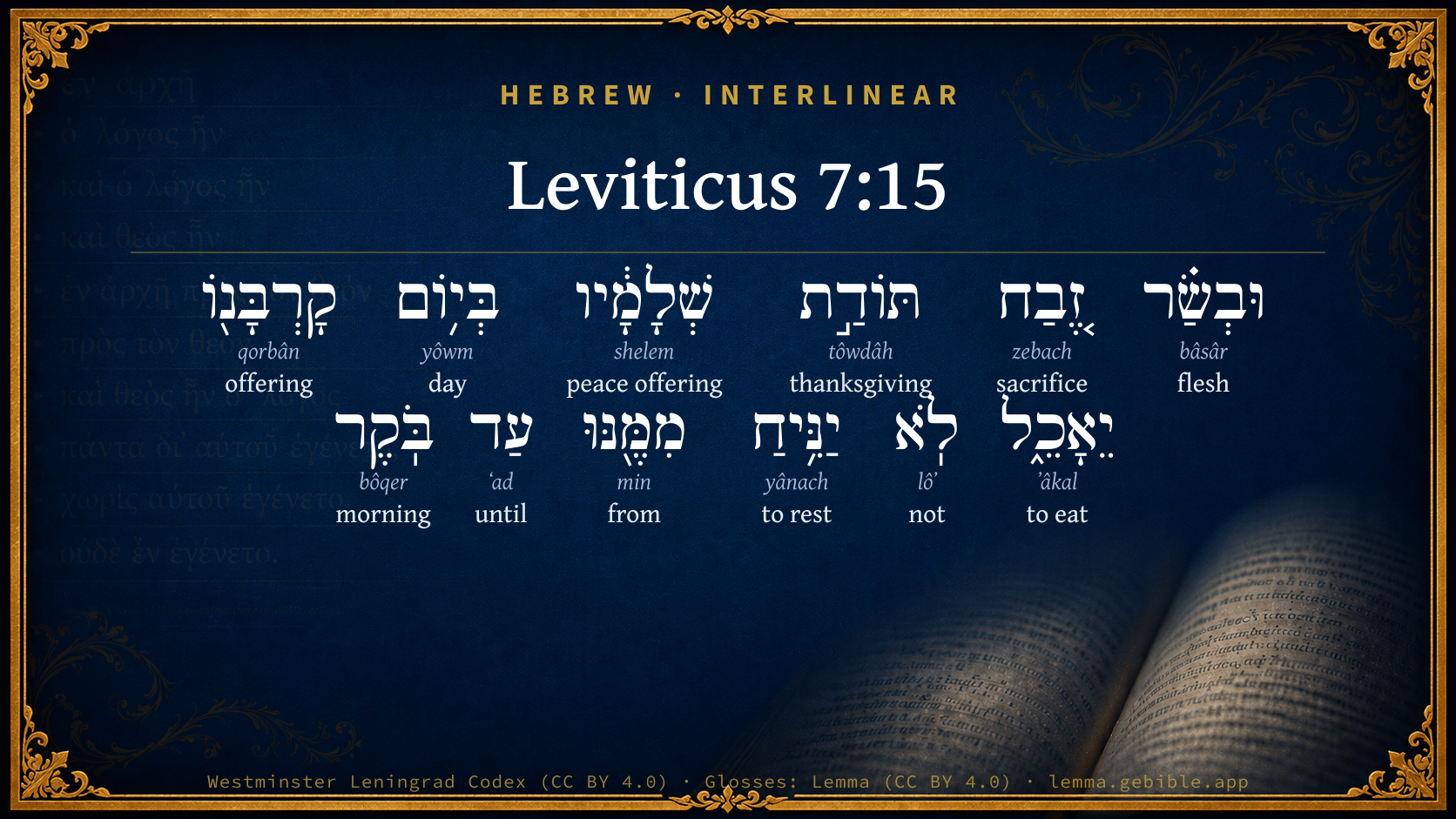
Hebrew (Westminster Leningrad Codex) Leviticus 7:15 appears in the Hebrew Old Testament. The text above is from the Westminster Leningrad Codex. Each word links to its Strong’s number, a concise gloss, and parsing drawn from the Open Scriptures Hebrew Bible morphology. Click any word for its full Brown-Driver-Briggs (BDB) entry.
Download image
Cite this verse

Leviticus 7:15 (World English Bible). Public Domain. Lemma interlinear Bible study tool, https://lemma.gebible.app/v/leviticus/7/15.

Show BibTeX & RIS
BibTeX
RIS
English Translation
The flesh of the sacrifice of his peace offerings for thanksgiving shall be eaten on the day of his offering. He shall not leave any of it until the morning.
World English Bible · Public Domain
Download a study sheet

One document with this verse’s original text, its word-by-word gloss line, the meaning frame, cross-references with their text, attributed commentary, and full source and license credits — printable, and it pastes into notes with its structure intact.

This verse Autodidact and up

Study sheet (.html) Plain text (.txt)

A passage Seminary Student

Up to 50 verses in one chapter. A passage sheet keeps up to 6 commentary sources and 12 cross-references per verse, in the order this page ranks them, and says so on the sheet whenever that leaves anything out. Ask for a single verse and you get the Autodidact verse sheet above.

Everything on this page stays free to read, with no account — the sheet is a download of what is already on screen, not access to it.

Want to remove ads? Support Godless Engineer
Compare translations 3

The same verse in 3 English versions, stacked beneath the original-language interlinear above. Click any original word for its lexicon entry.

Each is an independent rendering of the whole verse — the interlinear is not word-aligned to these translations.

Highlighted words mark where these versions differ — a whole-verse word diff, not a word-by-word alignment.

  • World English Bible Public Domain
    The flesh of the sacrifice of his peace offerings for thanksgiving shall be eaten on the day of his offering. He shall not leave any of it until the morning.
  • King James Version Public Domain
    And the flesh of the sacrifice of his peace offerings for thanksgiving shall be eaten the same day that it is offered; he shall not leave any of it until the morning.
  • unfoldingWord Literal Text CC BY-SA 4.0
    And the meat of the sacrifice of thanksgiving of his peace offerings shall be eaten on the day of his offering. He shall not leave some of it until morning.

unfoldingWord Literal Text — © unfoldingWord, licensed CC BY-SA 4.0. Word-aligned USFM3 via Door43 (git.door43.org/unfoldingWord/en_ult).

Versions to compare (up to 4)

3 of 4 selected

Show all 18 translations

Every available English version of this verse, each an independent rendering of the whole verse.

  • World English Bible Public Domain
    The flesh of the sacrifice of his peace offerings for thanksgiving shall be eaten on the day of his offering. He shall not leave any of it until the morning.
  • Berean Standard Bible Public Domain
    The meat of the sacrifice of his peace offering of thanksgiving must be eaten on the day he offers it; none of it may be left until morning.
  • Majority Standard Bible Public Domain
    The meat of the sacrifice of his peace offering of thanksgiving must be eaten on the day he offers it; none of it may be left until morning.
  • King James Version Public Domain
    And the flesh of the sacrifice of his peace offerings for thanksgiving shall be eaten the same day that it is offered; he shall not leave any of it until the morning.
  • American Standard Version (1901) Public Domain
    And the flesh of the sacrifice of his peace-offerings for thanksgiving shall be eaten on the day of his oblation; he shall not leave any of it until the morning.
  • Revised Version (1885) Public Domain
    And the flesh of the sacrifice of his peace offerings for thanksgiving shall be eaten on the day of his oblation; he shall not leave any of it until the morning.
  • Geneva Bible (1599) Public Domain
    Also the flesh of his peace offerings, for thankesgiuing, shalbe eaten the same day that it is offered: he shall leaue nothing thereof vntill the morning.
  • Douay-Rheims (1899) Public Domain
    And the flesh of it shall be eaten the same day, neither shall any of it remain until the morning.
  • Young's Literal Translation Public Domain
    as to the flesh of the sacrifice of the thank-offering of his peace-offerings, in the day of his offering it is eaten; he doth not leave of it till morning.
  • Literal Standard Version CC BY-SA 4.0
    as for the flesh of the sacrifice of the thank-offering of his peace-offerings, it is eaten in the day of his offering; he does not leave of it until morning.
  • Unlocked Literal Bible CC BY-SA 4.0
    The person presenting a peace offering for the purpose of giving thanks must eat the meat of his offering on the day of the sacrifice. He must not leave any of it until the next morning.
  • unfoldingWord Literal Text CC BY-SA 4.0
    And the meat of the sacrifice of thanksgiving of his peace offerings shall be eaten on the day of his offering. He shall not leave some of it until morning.
  • Darby Bible Public Domain
    And the flesh of the sacrifice of his peace-offering of thanksgiving shall be eaten the same day that it is presented; he shall not let any of it remain until the morning.
  • World Messianic Bible Public Domain
    The flesh of the sacrifice of his peace offerings for thanksgiving shall be eaten on the day of his offering. He shall not leave any of it until the morning.
  • Webster's Bible Public Domain
    And the flesh of the sacrifice of his peace-offerings for thanksgiving shall be eaten the same day that it is offered; he shall not leave any of it until the morning.
  • Free Bible Version CC BY-SA 4.0
    The meat of the sacrifice of your peace offering of thanksgiving must be eaten the same day you offer it. Don't leave any of it until the morning.
  • Bible in Basic English Public Domain
    And the flesh of the praise-offering is to be taken as food on the day when it is offered; no part of it may be kept till the morning.
  • JPS Tanakh (1917) Public Domain
    And the flesh of the sacrifice of his peace-offerings for thanksgiving shall be eaten on the day of his offering; he shall not leave any of it until the morning.

Literal Standard Version (2020), Covenant Press — licensed CC BY-SA 4.0. Text via the HelloAO Bible API (eBible.org). Unlocked Literal Bible (unfoldingWord) — licensed CC BY-SA 4.0. Text via the HelloAO Bible API (eBible.org). unfoldingWord Literal Text — © unfoldingWord, licensed CC BY-SA 4.0. Word-aligned USFM3 via Door43 (git.door43.org/unfoldingWord/en_ult). Free Bible Version, Dr. Jonathan Gallagher — licensed CC BY-SA 4.0. Text via the HelloAO Bible API (eBible.org).

Word by word

More ways to search: Search by grammar → Find every occurrence → Compare this word →

Practice this passage: Drill this verse → Learn its vocabulary →

תּוֹדַ֣ת
tôwdâh
H8426
“thanksgiving of”
Noun, Common, Feminine, Singular, Construct
Part of Speech
Noun
Type
Common
Gender
Feminine
Number
Singular
State
Construct
Full BDB Definition

Origin: from H3034

TWOT: 847b

confession, praise, thanksgiving - give praise to God - thanksgiving in songs of liturgical worship, hymn of praise - thanksgiving choir or procession or line or company - thank-offering, sacrifice of thanksgiving - confession
  1. וּבְשַׂ֗ר bâsâr H1320 “and · flesh of” Conjunction + Noun, Common, Masculine, Singular, Construct
  2. זֶ֚בַח zebach H2077 “sacrifice of” Noun, Common, Masculine, Singular, Construct
  3. שְׁלָמָ֔יו shelem H8002 “peace offerings · his” Noun, Common, Masculine, Plural, Construct + Suffix, Personal, 3rd Person, Masculine, Singular
  4. בְּי֥וֹם yôwm H3117 “in/at · day of” Preposition + Noun, Common, Masculine, Singular, Construct
  5. קָרְבָּנ֖וֹ qorbân H7133 “offering · his” Noun, Common, Masculine, Singular, Construct + Suffix, Personal, 3rd Person, Masculine, Singular
  6. יֵאָכֵ֑ל ʼâkal H398 “to eat” Verb, Niphal, Imperfect, 3rd Person, Masculine, Singular
  7. לֹֽא lôʼ H3808 “not” Particle, Negative
  8. יַנִּ֥יחַ yânach H3240 “to rest” Verb, Hiphil, Imperfect, 3rd Person, Masculine, Singular
  9. מִמֶּ֖נּוּ min H4480 “from · us” Preposition + Suffix, Personal, 1st Person, Common, Plural
  10. עַד ʻad H5704 “until” Preposition
  11. בֹּֽקֶר bôqer H1242 “morning” Noun, Common, Masculine, Singular, Absolute

About this verse

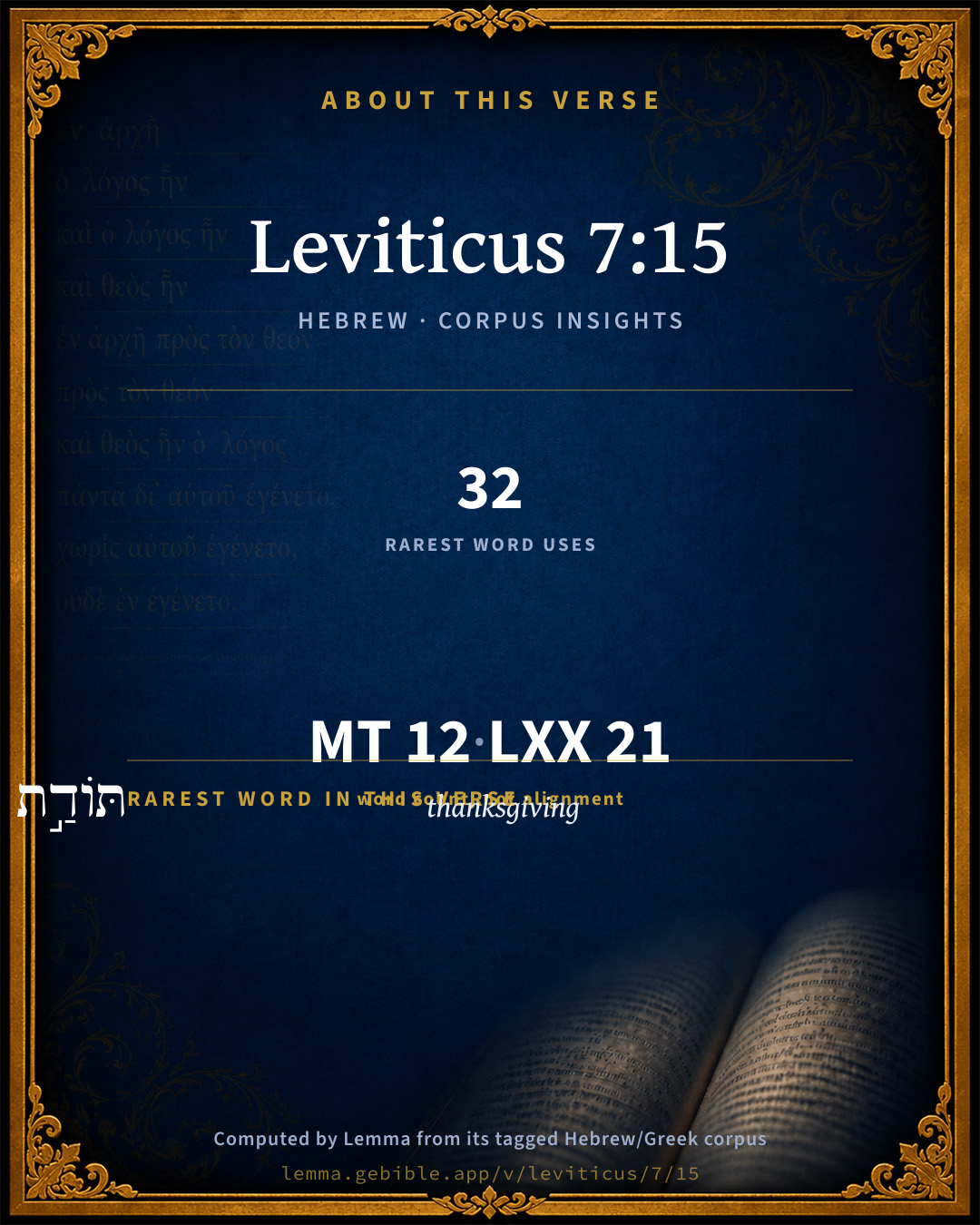
These counts appear in no published source. They are computed here, from the morphology-tagged text and Lemma’s own curated glosses. What Lemma adds →

12
words
12
distinct lemmas
Pentateuch
section

Shared distinctive vocabulary

תּוֹדַ֣ת thanksgiving H8426 occurs in 30 verses of the Hebrew Bible. Also found in:

Grammatical profile

  • 2 verbs
  • 7 nouns
  • 2 prepositions
  • 1 particle

Verb forms

  • יֵאָכֵ֑ל Niphal · Imperfect
  • יַנִּ֥יחַ Hiphil · Imperfect

Hebrew & Septuagint length

In English translation the verse runs 30 words from the Hebrew and 25 from the Septuagint (LXX English) — closely comparable.

A rough comparison of the two English renderings, which tokenize alike — not a word-level alignment.

Word counts can differ between the Hebrew and the Greek without any difference in meaning — e.g. the Hebrew direct-object marker אֵת has no separate Greek word, and Greek often adds the article ὁ.

In the original languages it is 12 Hebrew tokens and 21 Greek tokens — but the two are counted differently (Hebrew bundles its prefixes and suffixes into one token; the Greek is in lemma form), so that isn’t a like-for-like length.

Cross-references

1

Topical passages linked to Leviticus 7:15 in the Treasury of Scripture Knowledge — connected by theme and wording, ordered by reader-vote popularity; previews shown in the World English Bible.

  • Leviticus 22:29–30 "When you sacrifice a sacrifice of thanksgiving to Yahweh, you shall sacrifice it so that you may be accepted.

Cross-references courtesy of OpenBible.info (CC BY 4.0).

Hebrew and Greek witnesses Masoretic Hebrew ↔ Greek Septuagint

The same verse in the two great witnesses to the Old Testament, shown verse-for-verse.

These are two independent witnesses, not word-aligned to each other, and the Septuagint is shown in lemma (dictionary) form.

Hebrew Leviticus 7:15 Masoretic · Westminster Leningrad Codex

וּבְשַׂ֗ר זֶ֚בַח תּוֹדַ֣ת שְׁלָמָ֔יו בְּי֥וֹם קָרְבָּנ֖וֹ יֵאָכֵ֑ל לֹֽא יַנִּ֥יחַ מִמֶּ֖נּוּ עַד בֹּֽקֶר

The flesh of the sacrifice of his peace offerings for thanksgiving shall be eaten on the day of his offering. He shall not leave any of it until the morning.

World English Bible · Public Domain

Greek LXX Leviticus 7:15 Septuagint · lemma form

καί ὁ κρέας θυσία αἴνεσις σωτήριον αὐτός εἰμί καί ἐν ὅς ἡμέρα δωρέομαι βιβρώσκω οὐ καταλείπω ἀπό αὐτός εἰς ὁ πρωΐ

Every one that eats fat off the beasts, from which he will bring a burnt offering to the Lord—that soul shall perish from his people.

LXX2012 (modern English Septuagint) · Public Domain

On this verse, The Cambridge Bible for Schools and Colleges discusses the Septuagint’s reading. Read the note in Commentary ↓

Hebrew: Westminster Leningrad Codex (CC BY 4.0). Greek: Septuagint (public domain); English from LXX2012 (modern English Septuagint) (Public Domain). How the Septuagint differs from the Hebrew →

Targum (Aramaic paraphrase)

2

The Targum is the ancient Jewish Aramaic paraphrase of the Hebrew Scriptures — an interpretive translation, not the Hebrew text itself. Onkelos (literal) and Pseudo-Jonathan (expansive) render the Torah, and Jonathan the Prophets. Coverage is partial: where no permissively-licensed English translation exists for a verse, only the Aramaic is shown. This is verse-level text, not a word-by-word alignment to the Hebrew.

  1. Targum Onkelos Torah (Genesis–Deuteronomy)
    וּבְשַׂר נִכְסַת תּוֹדַת קוּדְשׁוֹהִי בְּיוֹם קֻרְבָּנֵהּ יִתְאֲכֵל לָא יַצְנַע מִנֵהּ עַד צַפְרָא

    (no public-domain English translation for this verse)

    Targum Onkelos — Aramaic: “Onkelos Genesis” (public domain); “Onkelos Exodus” (public domain); “Onkelos Leviticus” (public domain); “Onkelos Numbers” (public domain); “Onkelos Deuteronomy” (public domain). English: “Sefaria Community Translation” (CC0 1.0 (public-domain dedication)); “J.W. Etheridge. The Targums of Onkelos and Jonathan Ben Uzziel on the Pentateuch. London: Longmans, Green, 1862” (public domain). Text via Sefaria.

  2. Targum Pseudo-Jonathan Torah (Genesis–Deuteronomy)
    וּבְשַר נִכְסַת תּוֹדַת קוּדְשׁוֹי בְּיוֹם קוּרְבָּנֵיהּ יִתְאָכֵיל לֵית אֶפְשַׁר לְאִצְטַנְעָא מִנֵיהּ עַד צַפְרָא

    And the flesh of his hallowed sacrifice of thanksgiving shall be eaten on the day when it is offered; none of it may be laid up (or covered up) until the morning.

    Targum Pseudo-Jonathan — Aramaic: “Targum Jonathan on Genesis” (public domain); “Targum Jonathan on Exodus” (public domain); “Targum Jonathan on Leviticus” (public domain); “Targum Jonathan on Numbers” (public domain); “Targum Jonathan on Deuteronomy” (public domain). English: “The Targum of Jonathan ben Uzziel, trans. J. W. Etheridge, London, 1862” (public domain). Text via Sefaria.

Commentary

Notes on Leviticus 7:15 from classic Christian and Jewish commentators (each source and its license shown beneath its notes). The classic Christian expositions comment on the surrounding passage and are grouped to its opening verse, so a note may address several verses; the Jewish commentaries on the Tanakh (Rashi and others) are per-verse, so they appear only where the commentator wrote on this verse.

Lemma curates 59 commentaries, every one of them public domain or Creative Commons licensed, each selected and text-cleaned for this edition rather than reprinted as found. About our sources →

Trapp's Complete Commentary

John Trapp

Lev 7:15 And the flesh of the sacrifice of his peace offerings for thanksgiving shall be eaten the same day that it is offered; he shall not leave any of it until the morning.

Ver. 15. Eaten the same day.] Thanks must be returned while mercies are fresh; lest, as fish, they putrify with keeping. Eaten bread is soon forgotten. Hezekiah wrote his song the third day after his recovery. Jehoshaphat gave thanks first upon the ground where he had the victory, calling it Berachah; and three days after again at Jerusalem. {2Ch 20:25-26} See David’s Now, now, now, - "I will pay my vows." {Psa 116:14-15}

John Trapp, A Commentary or Exposition upon All the Books of the Old and New Testament (1647–1656) — public domain. Text from a community e-Sword module.

Joseph Benson's Commentary

Lev 7:15. The flesh shall be eaten the same day — This was partly that none of it might be exposed to corruption, (for by the third day it might easily, in those hot countries, putrefy,) and partly that the offerer might not be sordidly saving of this sacred banquet, but be taught to show his piety to God by his love to his fellow-creatures, forthwith inviting his friends to partake of it with him; and in case he and they could not eat it up, by distributing the remains among the poor. This law might also be intended to prevent their spending many days in feasting under the pretence of religion. It may be observed further here, that the longest time allowed for eating the flesh of any of the sacrifices enjoined by Moses, was the day after that on which they were killed; the eating of it on the third day is declared to be an abomination.

Joseph Benson's Commentary on the Old and New Testaments (1811–1818) — public domain. Text from a community e-Sword module.

Tyndale Open Study Notes

Tyndale Open Resources

7:15 The thanksgiving offering was given when the worshiper was thankful (Jer 17:26; 33:11). The sacrifice was to be eaten on the same day it was offered so that the event would not fade from the worshiper’s memory.

Tyndale Open Study Notes — © Tyndale Open Resources, licensed CC BY-SA 4.0. Text via the HelloAO Bible API.

Jamieson, Fausset & Brown

Robert Jamieson, A. R. Fausset & David Brown

the flesh of the sacrifice of his peace offerings . . . shall be eaten the same day that it is offered--The flesh of the sacrifices was eaten on the day of the offering or on the day following. But if any part of it remained till the third day, it was, instead of being made use of, to be burned with fire. In the East, butcher-meat is generally eaten the day it is killed, and it is rarely kept a second day, so that as a prohibition was issued against any of the flesh in the peace offerings being used on the third day, it has been thought, not without reason, that this injunction must have been given to prevent a superstitious notion arising that there was some virtue or holiness belonging to it.

Jamieson, Fausset & Brown — Commentary Critical and Explanatory on the Whole Bible (1871) — public domain (CC PDM 1.0). Text via the HelloAO Bible API.

Adam Clarke's Commentary

Verse 15. He shall not leave any of it until the morning.] Because in such a hot country it was apt to putrefy, and as it was considered to be holy, it would have been very improper to expose that to putrefaction which had been consecrated to the Divine Being. Mr. Harmer supposes that the law here refers rather to the custom of drying flesh which had been devoted to religious purposes, which is practised among the Mohammedans to the present time. This, he thinks, might have given rise to the prohibition, as the sacred flesh thus preserved might have been abused to superstitious purposes. Therefore God says, Le 7:18, "If any of the flesh of the sacrifice - be eaten at all on the third day, it shall not be accepted, neither shall it be imputed unto him that offereth it; it is an abomination, and the soul that eateth of it shall bear his iniquity." That is, on Mr. Harmer's hypothesis, This sacred flesh shall avail nothing to him that eats it after the first or second day on which it is offered; however consecrated before, it shall not be considered sacred after that time. See Harmer's Obs., vol. i., p. 394, edit. 1808.

Adam Clarke's Commentary on the Bible (1810–1826) — public domain. Text from a community e-Sword/MySword module.

Ellicott's Commentary for English Readers

(15) And the flesh of the sacrifice.—That is, after the priest had the breast and the shoulder, the share of the victim which belongs to the offerer, together with the remaining loaves, he with his family and poor guests (see Deu_12:11-18) are to eat up before the morning, which at the time of the second Temple was limited to midnight. This limitation of time was designed both to encourage liberality to the poor, and to impress upon those who partook of it that it was a sacrificial and sacred feast, so as to prevent its being turned into unseemly conviviality.

A Bible Commentary for English Readers, edited by Charles John Ellicott (1878–1897) — public domain. Text from a community e-Sword module.

The Cambridge Bible for Schools and Colleges

gen. ed. J. J. S. Perowne

15–18. Limits of time within which the Peace-Offerings must be consumed. When they are for thanksgiving, the whole of the flesh must be eaten on the day they are offered; before midnight is the traditional rule. A similar condition is prescribed in Exo_23:18, which is taken by some as referring to the festivals mentioned in Lev_7:14-17; another view limits the injunction to the passover, as in Exo_34:25. In many ancient heathen rites, the flesh of the victim was consumed as soon as possible (Rel. Sem.2, p. 387). When the offering is made in fulfilment of a vow, or as a freewill offering (Lev_7:16), two days are allowed for consuming the remainder. In no case may the flesh be eaten on the third day (Lev_7:17-18). Such eating rendered the sacrifice unacceptable, and the offerer had to bring a fresh sacrifice, while anyone so eating incurred punishment (Lev_19:6-8). The words following ‘the morrow’ in Lev_7:16 are omitted in the LXX.; with this omission the passage more closely resembles Lev_19:6 f. In Lev_22:17-25 further rules are given concerning those animals which may be offered for a vow or as a freewill-offering, and in Lev_22:29 a sacrifice of thanksgiving, though not called a Peace-Offering, is described as one of which the flesh must be consumed on the same day that it is offered (see note there).

The Cambridge Bible for Schools and Colleges (gen. ed. J. J. S. Perowne; Cambridge University Press, 1878–1918) — public domain. Text from a community e-Sword module.

John Gill's Exposition

But if the sacrifice of his offering be a vow,.... Be on account of a vow made, as, that if he was favoured with such and such benefits, or delivered out of such and such troubles and distresses, then he would offer such a sacrifice:

or a voluntary offering; without any condition or obligation; what from the mere motion of his mind he freely offered, not being directed to it by any command of God, or under any necessity from a vow of his own, and without any view to; any future good to be enjoyed: Aben Ezra describes both the one and the other thus; a "vow" which he uttered with his lips in his distresses, a "voluntary offering", which his spirit made him willing to bring, a sacrifice to God neither for a vow nor for thanksgiving:

it shall be eaten the same day that he offereth his sacrifice; that is, it shall be begun to be eaten then, and if all is eaten up it is very well, but they were not obliged in either of these cases, as in the preceding, to eat up all, and leave none to the morning, for it follows:

and on the morrow also the remainder of it shall be eaten; some of it, if thought fit, and could not be conveniently eaten, might be kept till the day after the sacrifice, but no longer.

John Gill's Exposition of the Whole Bible (1746–1763) — public domain (CC PDM 1.0). Text via the HelloAO Bible API.

Haydock's Catholic Bible Commentary

Morning. Thus were they admonished to let the poor share of the bounty which God had bestowed upon them. (Theodoret and Philo)

George Leo Haydock (1774–1849), Haydock's Catholic Family Bible and Commentary, 1859 edition — public domain. Excludes Psalms (Douay-Rheims chapter numbering differs from Protestant) and Deuterocanonical books (Catholic canon only).

Matthew Poole's English Annotations

By the priests and offerers this flesh was eaten, Lev 22:30.

Matthew Poole's English Annotations on the Holy Bible (1683–1685) — public domain. Text from a community e-Sword/MySword module.

Whedon's Commentary on the Bible

Daniel D. Whedon

15. The flesh… shall be eaten the same day — The right shoulder, or heave offering, and the wave breast were to be eaten by the priests and their families in the camp, or in Jerusalem, and the remainder of this sacrifice was returned to the offerer, to be eaten by himself and his friends, denoting that they were admitted to a state of intimate companionship with God, sharing part and part with him and his priests, having a standing in his house and a seat at his table. It was an occasion of peculiar joy and gladness, strikingly prefiguring the Lord’s Supper, rightly called the Holy Eucharist, or Thanksgiving, and the blessedness of eating and drinking in the kingdom of God. Luk_14:15.

He shall not leave any… until the morning — It would be very improper to expose to putrefaction any thing considered holy. This is supposed to be the ground of the prohibition. Harmer thinks that it is aimed at the Arabian practice of drying the meats presented in sacrifice, which is contrary to both the genius of the Mosaic and of the Christian dispensations. The Gospel does not impart to the believer grace to be put aside for a time of future need, as a soldier puts several days’ rations in his haversack when he is to be separated from his base of supplies, nor does it require him to live on old experiences, since only unbelief can cut him off from access to the bread of life. He is therefore taught to pray, “Give us this day our daily bread.”

Daniel D. Whedon (gen. ed.), Commentary on the Old and New Testaments (1874–1909) — public domain. Text from a community e-Sword module.

The Pulpit Commentary

HOMILIES BY S.R. ALDRIDGE Vers. 15-18. Fidelity to precept enforced

The peace offering was essentially a tribute of gratitude and praise, it was especially suited to national festivities and family rejoicings. Cakes and bread accompanied the flesh of the sacrificial animal. Three classes of peace offering are spoken of, viz. for thanksgiving, or for a vow, or as a free-will offering. The flesh must be partaken of by the offerers (the priests having received their portion) and consumed on the first day in the case of the first-mentioned class, and by the close of the second day in the case of the others. The stress laid upon this command may set in clear light the obligatoriness of Divine instructions.

I STRICT OBSERVANCE IS DEMANDED, EVEN THOUGH THE SIGNIFICANCE OF THE PRECEPT BE NOT PERCEIVED. Little explanation is afforded in the Law of the many ceremonies instituted. The Israelites were treated as children, whose chief virtue is unquestioning obedience. Why should the flesh be so quickly consumed? The devout Israelite might not know, yet must he rigidly conform to the order. He is not to reason, but to do. This course may be recommended to the many who wish a full explanation of the reasons for the institution of the ordinances connected with the Christian Church. Reliance may be placed upon the wisdom of the Divine Legislator, and faith rather than knowledge may glorify God. "The secret things" (the explanations, the reasons) "belong unto the Lord our God; but those things which are revealed" (the facts, the commands) "belong unto us for ever, that we may do all the words of the Law." That Jesus Christ has ordained Baptism and the Lord"s Supper is sufficient to lead us to practice them, however confused may be our apprehension of the mysteries and principles involved. And in relation to the counsels addressed to us for the guidance of our lives, and the events that are seen to necessitate certain action upon our parts, it may stall be said, "What I do thou knowest not now, but thou shall know hereafter.

II MORE LIGHT MAY BE EXPECTED TO DAWN UPON US CONTINUALLY AS TO THE MEANING OF DIVINE ORDINANCES. Faith is not intended to exclude or supersede knowledge, but to form a basis for it, an avenue through which it may pass to the mind, an appendix by which its volume may be supplemented. Patient and prayerful study is ever rewarded with keener appreciation of the will of God. If the Israelites reflected for a moment, they would call to mind warnings against desecrating holy things, and against treating what was offered to God as if it were a portion of common food. Surely God would distinguish thus between ordinary slaughter and sacrificial victims, and would guard against that additional risk of putrefaction to which flesh is liable in a hot climate, and which, if it occurred, would be an insult to his majesty. For us at any rate the types and ceremonies of Judaism have been interpreted by Christianity. The Great Prophet has revealed the obscure, and, endowed with his Spirit, apostles have Been inspired to comment authoritatively upon the preceding dispensation. And. we need. not limit our aspirations after an intelligent perception of the meaning of Christian laws. Events as they occur, and reverent, persevering investigation, may unfold to us with increasing clearness the ways of God. But we ought not to delay observance of his precepts until their design is fully manifest. That servant is slothful who refuses to work by candle-light, and waits for the brightness of the sun.

III PARTIAL DISOBEDIENCE NEUTRALIZES THE EFFECT OF A RELIGIOUS OBSERVANCE, AND MAY APPEAR MORE OFFENSIVE THAN TOTAL NEGLECT OF THE DIVINE COMMANDS. Let the worshipper trifle with the Law and venture to eat the flesh on the third day, and he shall find to his cost that the whole of his offering is rejected; it is not pleasing to God, and will not procure him favour. His effort proves useless, it shall not be reckoned to his credit. Worse still, his offering "shall be an abomination" in the eyes of God; there shall be no grateful odour exhaled, but it shall be a stench in his nostrils. Sin has not been obliterated but augmented by the sacrifice. When the Earl of Oxford would honour King Henry VII by the presence of a large body of retainers, the king only saw in the men an infraction of the law, and could not consent to have his laws broken in his sight. Honour and dishonour are an ill-assorted pair. The partially obedient worshipper shows himself as knowing God"s will and doing it not. Total abstinence might have proclaimed him sinful through ignorance. Half-heartedness is often as productive of evil effects as fiat rebellion. It is not for us to presume to say what may be disregarded and what not. To follow the Lord fully is the path of duty and of safety. S.R.A.

Vers. 15-17. Three features of acceptable service.

We have commanded or suggested here

I CAREFUL PRESERVATION OF PURITY. The "flesh of the sacrifice of his peace offering" was to be eaten on the very day of its presentation (verse 15); that of another kind of offering might be eaten partly on the day following (verse 16), but on no account might anything offered in sacrifice be partaken of on the third day (verses 17, 18). It was one of the objects, probably the primary intention, of this restriction, that nothing offered to God should be allowed to become unsound. No danger was to be incurred in the way of putrefaction. Another statute in defense of purity in worship! In the service of the Holy One of Israel we must be pure in thought, in word, in act. He is "of purer eyes than to behold evil," etc., (Hab_1:13) and can find no pleasure in any service tainted with iniquity. The connection in which this restriction occurs suggests that, especially in those religious engagements in which we find social pleasure, we should be careful to maintain purity of spirit, integrity of heart.

II CAREFUL RETENTION OF SACREDNESS OF THOUGHT. The partaking of the flesh and the bread which had been presented to God, though these were eaten at home, was to be regarded as a sacred act. It was sacramental. Therefore it was fitting that no great interval of time should come between the act of presentation and the consumption. For the consequence would inevitably be that the sacred festival would tend to sink to the level of an ordinary meal. Sacred thoughts would be less vivid and less frequent; the engagement would become more secular and more simply social as more time intervened. We learn that we should take the greatest care to retain in our mind the sense of the sacredness of religious acts during their performance. When they become mechanical, or wholly bodily, or simply social; when the realization of the religious and the Divine element falls out, then their virtue is gone; they are no longer "an acceptable offering unto the Lord." We must accomplish this end by:

1. Studious spiritual endeavour to realize what we are doing.

2. By wise precautions, judicious measures, which will tend to preserve sanctity and to guard against secularity of thought.

III UNSELFISHNESS IN RELIGIOUS SERVICE. The commandment to consume everything within one or two days pointed to an increase in the number of partakers; it suggested the calling together friends and dependents; also the invitation of the poor and needy. This was not only the design but the effect of the injunction. (see Deu_12:18 Deu_16:11) The Israelites, in "eating before the Lord," showed a generous hospitality while they were engaged in an act of piety and of sacred joy. Let unselfishness be a prominent feature in our religious institutions. It is well to remember:

1. That selfishness is apt to show itself here as elsewhere.

2. That it is never so inconsistent and unsightly as in connection with the service of God.

3. That it is a painful exhibition to the Lord of love.

4. That the more generous and self-forgetting we are in sacred things, the more we approach the spirit and life of our Divine Exemplar. (Php_2:4-8) C.

The Pulpit Commentary (1880–1919), ed. H.D.M. Spence-Jones & Joseph S. Exell — public domain. Text from a community e-Sword module.

Keil & Delitzsch

C. F. Keil & F. Delitzsch

The flesh of the praise-offering was to be eaten on the day of presentation, and none of it was to be left till the next morning (cf. Lev 22:29-30); but that of the vow and freewill-offerings might be eaten on both the first and second days. Whatever remained after that was to be burnt on the third day, i.e., to be destroyed by burning. If any was eaten on the third day, it was not well-pleasing (ירצה "good pleasure," see Lev 1:4), and was "not reckoned to the offerer," sc., as a sacrifice well-pleasing to God; it was "an abomination." פּגּוּל, an abomination, is only applied to the flesh of the sacrifices (Lev 19:7; Eze 4:14; Isa 65:4), and signifies properly a stench; - compare the talmudic word פּגּל faetidum reddere. Whoever ate thereof would bear his sin (see Lev 5:1). "The soul that eateth" is not to be restricted, as Knobel supposes, to the other participators in the sacrificial meal, but applies to the offerer also, in fact to every one who partook of such flesh. The burning on the third day was commanded, not to compel the offerer to invite the poor to share in the meal (Theodoret, Clericus, etc.), but to guard against the danger of a desecration of the meal. The sacrificial flesh was holy (Exo 29:34); and in Lev 19:8, where this command is repeated,

(Note: There is no foundation for Knobel's assertion, that in Lev 19:5. another early lawgiver introduces a milder regulation with regard to the thank-offering, and allows all the thank-offerings to be eaten on the second day. For Lev 19:5. does not profess to lay down a universal rule with regard to all the thank-offerings, but presupposes our law, and simply enforces its regulations with regard to the vow and freewill-offerings, and threatens transgressors with severe punishment.)

eating it on the third day is called a profanation of that which was holy to Jehovah, and ordered to be punished with extermination. It became a desecration of what was holy, through the fact that in warm countries, if flesh is not most carefully preserved by artificial means, it begins to putrefy, or becomes offensive (פּגּוּל) on the third day. But to eat flesh that was putrid or stinking, would be like eating unclean carrion, or the נבלה with which putrid flesh is associated in Eze 4:14. It was for this reason that burning was commanded, as Philo (de vict. p. 842) and Maimonides (More Neboch iii. 46) admit; though the former also associates with this the purpose mentioned above, which we decidedly reject (cf. Outram l.c. p. 185 seq., and Bhr, ii. pp. 375-6).

Keil & Delitzsch — Biblical Commentary on the Old Testament (1861–1891) — public domain (CC PDM 1.0). Text via the HelloAO Bible API. (Old Testament only.)

unfoldingWord translationNotes

Door43 World Missions Community

The person presenting

"The person who offers"

for the purpose of giving thanks

The abstract noun "thanks" can be stated as a verb. AT: "for the purpose of thanking Yahweh" (See: Abstract Nouns)

the meat must be eaten ... it may be eaten

This can be translated in active form. AT: "he must eat the meat ... he may eat it" (See: Active or Passive)

translationWords

peace offering

vow

freewill offering

unfoldingWord translationNotes — © Distant Shores Media and the Door43 World Missions Community, licensed CC BY-SA 4.0. Source: git.door43.org/Door43/en_tn.

Rashi

Rabbi Shlomo Yitzchaki (Rashi)

ובשר זבח תורת שלמיו AND THE FLESH OF THE SACRIFICE OF THE PEACE OFFERING FOR ACKNOWLEDGEMENT [SHALL BE EATEN THE SAME DAY] — There are here many apparently redundant words (רבויין); they are intended to include in this law the sin-offering, the guilt-offering, the Nazarite’s ram and the חגיגה (the festive offering of the pilgrims) brought on the fourteenth of Nisan — that these should be eaten only during one day (the day of slaughtering) and the following night, just as the תודה, and not two days and the intervening night as is the period assigned for שלמים - Sifra, Tzav, Chapter 12 1; Zevachim 36a)

ביום קרבנו יאכל [AND THE FLESH …] SHALL BE EATEN ON THE DAY THAT HIS OFFERING IS EATEN — and as the period prescribed for eating its flesh is the period during which its bread may be eaten (Sifra, Tzav, Chapter 12 1).

לא יניח ממנו עד בקר HE SHALL NOT LEAVE ANY OF IT TILL THE MORNING, but during the whole night he may eat of it. But if this be so why have they (the Rabbis) said, (Zevachim 55a) “The sacrifice of acknowledgement etc. … may only be eaten during the day and the following night till midnight”? As a precaution to keep people far from the possibility of sinning (cf. Berakhot 2a).

Rashi on the Tanakh — English translations: “The Judaica Press complete Tanach with Rashi, translated by A. J. Rosenberg” (CC BY 4.0); “Pentateuch with Rashi's commentary by M. Rosenbaum and A.M. Silbermann, 1929-1934” (public domain); “The Metsudah Tanach series, Lakewood, N.J” (CC BY 4.0); and “The Book of Joshua, Metsudah Publications, 1997” (CC BY 4.0). Text via Sefaria.

Ramban (Nachmanides)

Rabbi Moshe ben Nachman (Ramban / Nachmanides)

AND THE FLESH OF THE OFFERING OF HIS PEACE-OFFERINGS FOR THANKSGIVING SHALL BE EATEN ON THE DAY OF HIS OFFERING. “There are here many terms of amplification [all the seemingly redundant words thus being intended to widen the scope of the law]. Thus they include in this law the sin-offering and guilt-offering, the Nazirite’s ram, ) and a peace-offering may be eaten for two days and the one intervening night. Yet Scripture establishes here that the Nazirite’s ram is an exception, and may be eaten as a thanks-offering which is only for a day and night. and the Festal-offering of the fourteenth day of Nisan, that they may all be eaten for a day and a night.” This is Rashi’s language. But it is not correct, for the Festal-offering of the fourteenth day of Nisan may be eaten for two days and the one intervening night, like the rest of the peace-offerings. So also we have been taught in Tractate Pesachim: “Neither shall any of the flesh, which thou offerest on the first day at even, remain all night until the morning. Scripture speaks here of the Festal-offering of the fourteenth day of Nisan, teaching that it may be eaten for two days and the one intervening night, ) is thus as follows: “Neither shall any of the flesh which thou offerest at even [i.e., towards eventide on the fourteenth of Nisan] remain on the first day [of the festival, i.e., the fifteenth day of Nisan] all night until the morning of the sixteenth,” but it may be eaten only on the fourteenth and fifteenth days and the one intervening night. and when Scripture states on the first day … until the morning, it means the second morning.” (until the morning) must perforce refer to the morning of the second day. Rashi himself wrote this in the Seder R’eih Anochi. Here, however, the Rabbi [Rashi] follows the words of Ben Teima, who says that the Festal-offering of the fourteenth of Nisan which comes with the Passover-offering, is like the Passover-offering, and may be eaten [only] on that day [the fourteenth of Nisan] and the following night, and may be eaten only roasted and until midnight, [like the Passover-offering] which is eaten only at night [but not on the fourteenth day]. But according to Ben Teima, these amplifications [referred to by Rashi] only come to indicate that it [the Festal-offering accompanying the Passover-offering] is like the Passover-offering in every respect, coming only from the sheep, a male of the first year, since it is written, Neither shall the offering of the feast of the Passover be left unto the morning, [which Ben Teima interpreted to mean: “the offering of the feast, namely the Festal-offering; of the Passover, namely the Passover-offering,” the same law thus applying to both], as it is stated there..But that which the Rabbi [Rashi] wrote here [namely, that the terms of amplification of the verse teach that the Festal-offering is to be eaten only for a day and a night] is on the basis of a Beraitha Note 65. taught in the Torath Kohanim, 12:1. which states as follows: “And the flesh of the offering of his peace-offerings for thanksgiving, shall be eaten on the day of his offering. This verse comes to teach that those offerings which Scripture states are to be eaten for one day [and the following night] may only be eaten during that time [and not for two days and the intervening night, as is the period assigned for the peace-offering]. I would only know that such is the law for the thanks-offering [i.e., the offering itself, which is mentioned explicitly in the verse]. Whence do I know to include the breads thereof? Scripture therefore says, his offering. Whence do I know to include the offspring of the thanks-offering and animals substituted for it in the same law? Scripture therefore says, ‘and’ the flesh. Whence do I know to include the sin-offerings and guilt-offering [that they, too, may be eaten only during the day and the ensuing night]? Scripture therefore says, the offering. Whence do I know to include the Nazirite’s peace-offering, ) and a peace-offering may be eaten for two days and the one intervening night. Yet Scripture establishes here that the Nazirite’s ram is an exception, and may be eaten as a thanks-offering which is only for a day and night. and the peace-offerings which come on account of the Passover-offering? Scripture therefore says, his peace-offerings.”This is the Beraitha Note 65. [taught in the Torath Kohanim]. Now the Rabbi [Rashi] explained the phrase “the peace-offerings which come on account of the Passover-offering” as referring to the Festal-offering of the fourteenth day of Nisan, which comes together with the Passover-offering, [thus providing the authority for his comment here that the Festal-offering of the fourteenth of Nisan may be eaten only during the day and ensuing night.] Thus also I have found in Tractate Pesachim, in the Chapter Mi Shehayah (If any man shall be unclean), that Rashi gave two explanations of this phrase — “the peace-offerings which come on account of the Passover-offering” — and wrote [after explaining the first interpretation]: “Another explanation is that it means the Festal-offering of the fourteenth. This explanation I have heard.” Here then [in his commentary on the Torah] the Rabbi relied on the interpretation he had heard [and consequently he wrote that the Festal-offering of the fourteenth may be eaten only for one day and the following night].But the matter is not so. [The correct explanation of the phrase] “peace-offerings which come on account of the Passover-offering,” is that it refers to [those animals] which remain over from the Passover-offering, 4:10). such as where the owners substituted another one for it, or where the owners of a Passover-offering fulfilled their duty (that they were forgiven)” — a term borrowed from a sin-offering. But in the case of the Passover-offering the sense is that the owners had fulfilled their duty through another offering. by bringing another offering. [In these cases they are to be eaten only for one day and the ensuing night], as since they were at the beginning only meant to be eaten for one day and the ensuing night, [namely the night following the day on which they were slaughtered, as is the law of all Passover-offerings], so also in the end [i.e., when they are offered up as peace-offerings they are to be eaten only for one day and the ensuing night]. But the Festal-offering of the fourteenth [since it is not originally brought as a Passover-offering], is eaten for two days [and the intervening night] in accordance with the words of the Sages. So also we have been taught in that very same Beraitha 12:1. at the end thereof: “And on the morrow. also on the morrow. This verse comes to teach that those offerings which [Scripture states] are to be eaten for two days [and the intervening night] may only be eaten during that time. I know only that this applies to the peace-offering [which is clearly mentioned in the verse]. Whence do I know to include the Festal-offering which comes at its proper time [i.e., the regular Festal-offering of the fifteenth day of Nisan]? etc. Now I know to include the Festal-offering which comes at its regular time. Whence do I know to include the Festal-offering which comes with the Passover-offering [that it may be eaten only for two days and the intervening night]? etc.” [Thus it is clearly stated that the Festal-offering of the fourteenth may be eaten for only two days and the intervening night, and not as Rashi wrote that it may be eaten only for one day and the following night].

Ramban (Nachmanides) on the Tanakh — English translation: “Commentary on the Torah by Ramban (Nachmanides). Translated and annotated by Charles B. Chavel. New York, Shilo Pub. House, 1971-1976” (CC BY 4.0). Text via Sefaria.

Lesson kit

Teaching starters — assembled from the data on this page, not authored interpretation. Every prompt links to the verse data it draws on. Edit before teaching.

Leviticus, in the Pentateuch, opens this verse with 12 words (12 distinct Hebrew lemmas). Its most distinctive word is tôwdâh (“thanksgiving”). A historical commentator’s framing appears above. Read the whole chapter for the surrounding context.

Discussion questions

  1. How does “thanksgiving” (tôwdâh) shape what this verse is saying?
  2. How does Leviticus 7:12, which shares the word «thanksgiving», read alongside this verse?
  3. The translations on this page render this verse differently — a whole-verse word diff, not a word-by-word alignment. What might account for the different wordings?
  4. «יֵאָכֵ֑ל» is a Niphal Imperfect verb. How does that grammatical form shape the action described?
  5. Compare how Trapp's Complete Commentary and Joseph Benson's Commentary read this verse. Where do they agree or differ?

Things to notice

Reading settings

Reading text

Shown beneath each verse's original-language words.

Old Testament
Old Testament edition

Read the OT as the Masoretic Hebrew (MT) or the Greek Septuagint (LXX).

English shown for the Greek Septuagint (in the Hebrew ↔ Greek comparison).

Comparing translations? Open the Compare panel on any verse page to stack up to four side by side.