Exodus 2:7

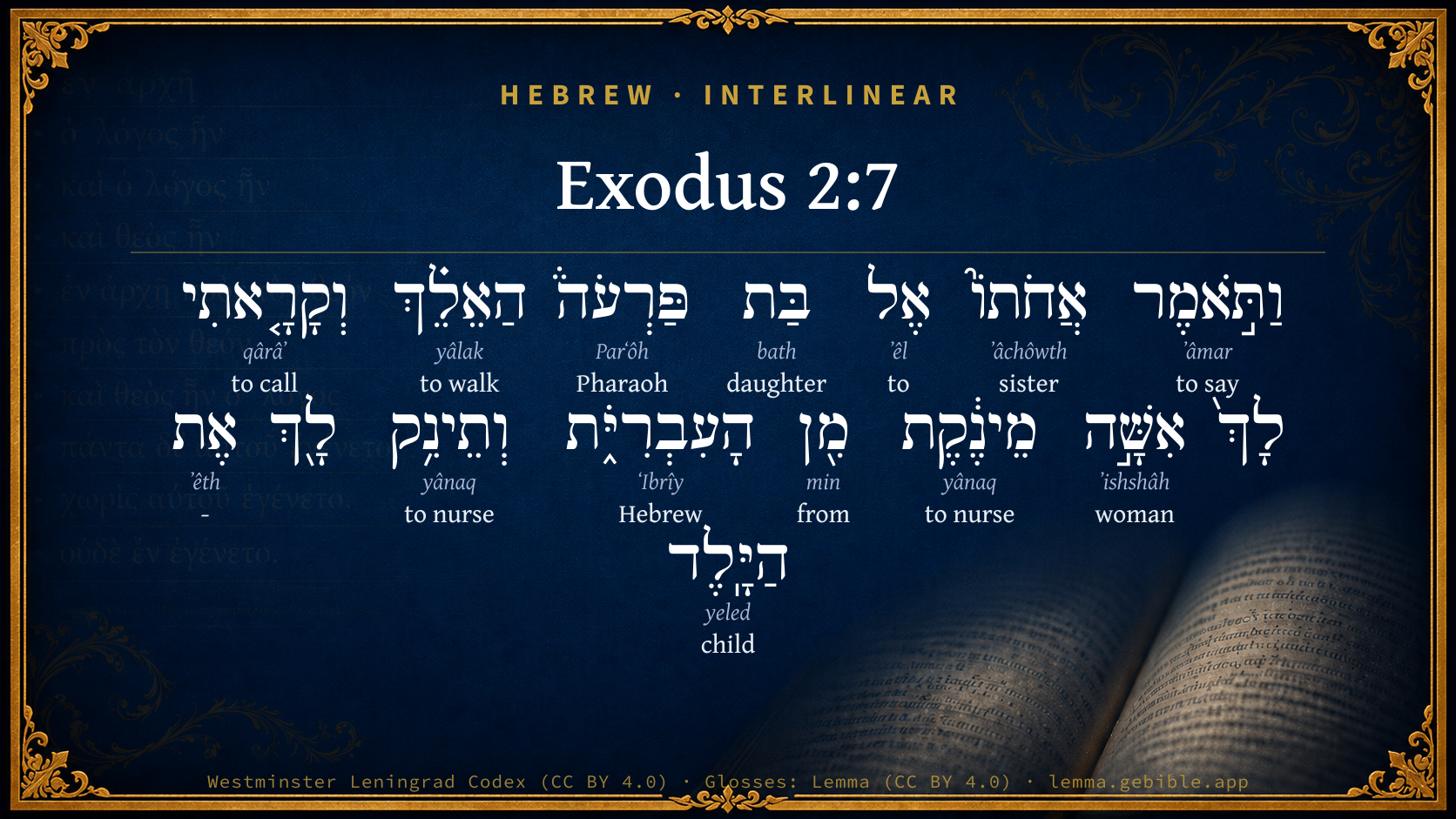
Hebrew (Westminster Leningrad Codex) Exodus 2:7 appears in the Hebrew Old Testament. The text above is from the Westminster Leningrad Codex. Each word links to its Strong’s number, a concise gloss, and parsing drawn from the Open Scriptures Hebrew Bible morphology. Click any word for its full Brown-Driver-Briggs (BDB) entry.
Download image
Cite this verse

Exodus 2:7 (World English Bible). Public Domain. Lemma interlinear Bible study tool, https://lemma.gebible.app/v/exodus/2/7.

Show BibTeX & RIS
BibTeX
RIS
English Translation
Then his sister said to Pharaoh's daughter, "Should I go and call a nurse for you from the Hebrew women, that she may nurse the child for you?"
World English Bible · Public Domain
Download a study sheet

One document with this verse’s original text, its word-by-word gloss line, the meaning frame, cross-references with their text, attributed commentary, and full source and license credits — printable, and it pastes into notes with its structure intact.

This verse Autodidact and up

Study sheet (.html) Plain text (.txt)

A passage Seminary Student

Up to 50 verses in one chapter. A passage sheet keeps up to 6 commentary sources and 12 cross-references per verse, in the order this page ranks them, and says so on the sheet whenever that leaves anything out. Ask for a single verse and you get the Autodidact verse sheet above.

Everything on this page stays free to read, with no account — the sheet is a download of what is already on screen, not access to it.

Want to remove ads? Support Godless Engineer
Compare translations 3

The same verse in 3 English versions, stacked beneath the original-language interlinear above. Click any original word for its lexicon entry.

Each is an independent rendering of the whole verse — the interlinear is not word-aligned to these translations.

Highlighted words mark where these versions differ — a whole-verse word diff, not a word-by-word alignment.

  • World English Bible Public Domain
    Then his sister said to Pharaoh's daughter, "Should I go and call a nurse for you from the Hebrew women, that she may nurse the child for you?"
  • King James Version Public Domain
    Then said his sister to Pharaoh's daughter, Shall I go and call to thee a nurse of the Hebrew women, that she may nurse the child for thee?
  • unfoldingWord Literal Text CC BY-SA 4.0
    And his sister said to the daughter of Pharaoh, “Should I go and call for you a nursing woman from the Hebrews? And she could cause the child to nurse for you.”

unfoldingWord Literal Text — © unfoldingWord, licensed CC BY-SA 4.0. Word-aligned USFM3 via Door43 (git.door43.org/unfoldingWord/en_ult).

Versions to compare (up to 4)

3 of 4 selected

Show all 18 translations

Every available English version of this verse, each an independent rendering of the whole verse.

  • World English Bible Public Domain
    Then his sister said to Pharaoh's daughter, "Should I go and call a nurse for you from the Hebrew women, that she may nurse the child for you?"
  • Berean Standard Bible Public Domain
    Then his sister said to Pharaoh’s daughter, “Shall I go and call one of the Hebrew women to nurse the child for you?”
  • Majority Standard Bible Public Domain
    Then his sister said to Pharaoh’s daughter, “Shall I go and call one of the Hebrew women to nurse the child for you?”
  • King James Version Public Domain
    Then said his sister to Pharaoh's daughter, Shall I go and call to thee a nurse of the Hebrew women, that she may nurse the child for thee?
  • American Standard Version (1901) Public Domain
    Then said his sister to Pharaoh's daughter, Shall I go and call thee a nurse of the Hebrew women, that she may nurse the child for thee?
  • Revised Version (1885) Public Domain
    Then said his sister to Pharaoh’s daughter, Shall I go and call thee a nurse of the Hebrew women, that she may nurse the child for thee?
  • Geneva Bible (1599) Public Domain
    Then said his sister vnto Pharaohs daughter, Shall I go and cal vnto thee a nurce of the Ebrew women to nurce thee the childe?
  • Douay-Rheims (1899) Public Domain
    And the child's sister said to her Shall I go and call to thee a Hebrew woman, to nurse the babe?
  • Young's Literal Translation Public Domain
    And his sister saith unto the daughter of Pharaoh, `Do I go? when I have called for thee a suckling woman of the Hebrews, then she doth suckle the lad for thee;'
  • Literal Standard Version CC BY-SA 4.0
    And his sister says to the daughter of Pharaoh, “Do I go? When I have called a suckling woman of the Hebrews for you, then she suckles the boy for you”;
  • Unlocked Literal Bible CC BY-SA 4.0
    Then the baby's sister said to Pharaoh's daughter, “Should I go and find you a Hebrew woman to nurse the child for you?”
  • unfoldingWord Literal Text CC BY-SA 4.0
    And his sister said to the daughter of Pharaoh, “Should I go and call for you a nursing woman from the Hebrews? And she could cause the child to nurse for you.”
  • Darby Bible Public Domain
    And his sister said to Pharaoh's daughter, Shall I go and call thee a wet-nurse of the Hebrew women, that she may nurse the child for thee?
  • World Messianic Bible Public Domain
    Then his sister said to Pharaoh’s daughter, “Should I go and call a nurse for you from the Hebrew women, that she may nurse the child for you?”
  • Webster's Bible Public Domain
    Then said his sister to Pharaoh's daughter, Shall I go, and call to thee a nurse of the Hebrew women, that she may nurse the child for thee?
  • Free Bible Version CC BY-SA 4.0
    His sister asked Pharaoh's daughter, “Would you like me to go and find one of the Hebrew women to nurse him for you?”
  • Bible in Basic English Public Domain
    Then his sister said to Pharaoh's daughter, May I go and get you one of the Hebrew women to give him the breast?
  • JPS Tanakh (1917) Public Domain
    Then said his sister to Pharaoh's daughter: 'Shall I go and call thee a nurse of the Hebrew women, that she may nurse the child for thee?'

Literal Standard Version (2020), Covenant Press — licensed CC BY-SA 4.0. Text via the HelloAO Bible API (eBible.org). Unlocked Literal Bible (unfoldingWord) — licensed CC BY-SA 4.0. Text via the HelloAO Bible API (eBible.org). unfoldingWord Literal Text — © unfoldingWord, licensed CC BY-SA 4.0. Word-aligned USFM3 via Door43 (git.door43.org/unfoldingWord/en_ult). Free Bible Version, Dr. Jonathan Gallagher — licensed CC BY-SA 4.0. Text via the HelloAO Bible API (eBible.org).

Word by word

More ways to search: Search by grammar → Find every occurrence → Compare this word →

Practice this passage: Drill this verse → Learn its vocabulary →

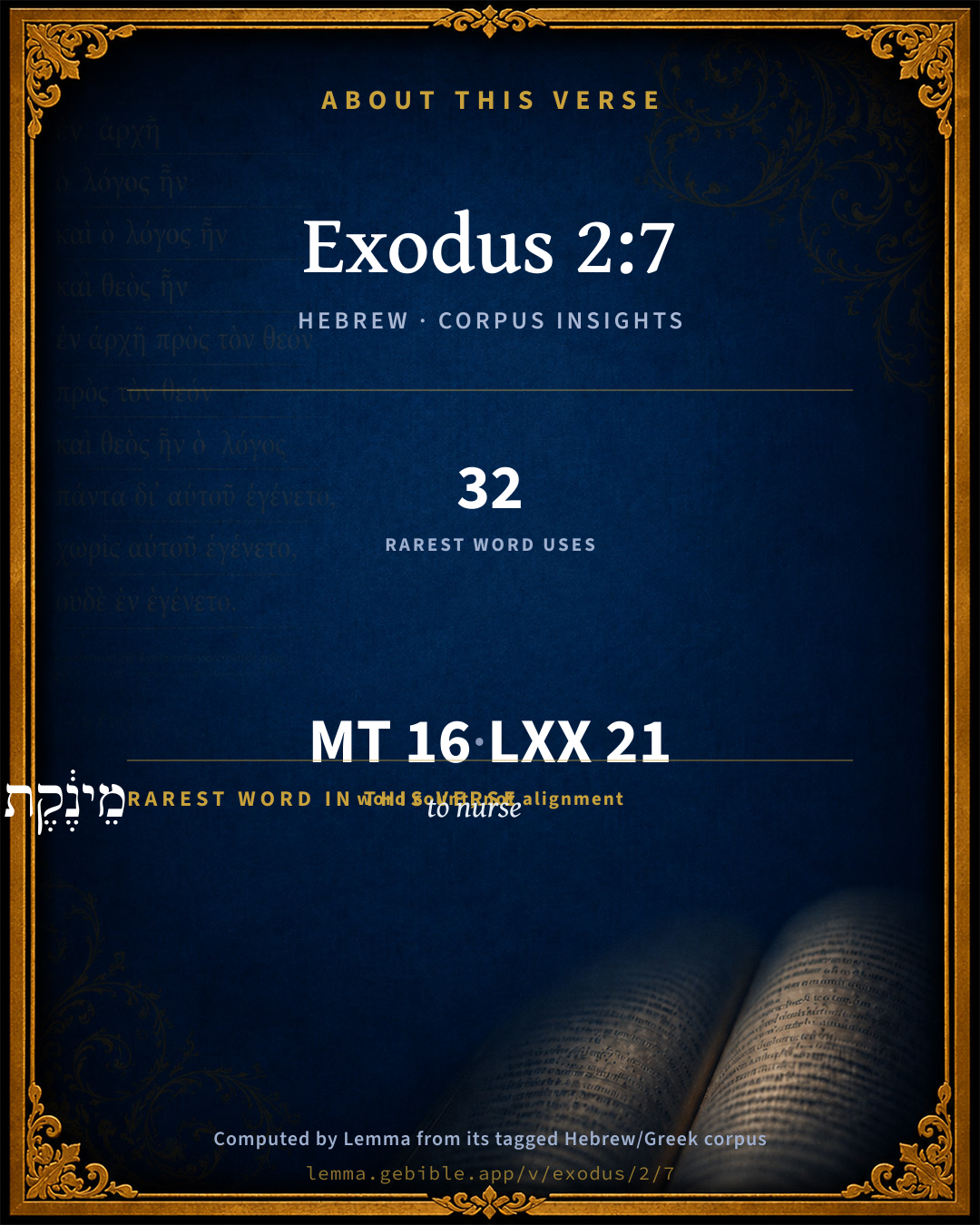
מֵינֶ֔קֶת
yânaq
H3243
“nurse”
Noun, Common, Feminine, Singular, Absolute
Part of Speech
Noun
Type
Common
Gender
Feminine
Number
Singular
State
Absolute
Full BDB Definition

Origin: a primitive root

TWOT: 874

to suckle, nurse, suck - (Qal) - to suck - suckling, babe (substantive) - (Hiphil) - to give suck to, nurse - nursing, nursing woman, nurse (participle)
  1. וַתֹּ֣אמֶר ʼâmar H559 “and · to say” Conjunction + Verb, Qal, Sequential Imperfect, 3rd Person, Feminine, Singular
  2. אֲחֹתוֹ֮ ʼâchôwth H269 “sister · his” Noun, Common, Feminine, Singular, Construct + Suffix, Personal, 3rd Person, Masculine, Singular
  3. אֶל ʼêl H413 “to” Preposition
  4. בַּת bath H1323 “daughter of” Noun, Common, Feminine, Singular, Construct
  5. פַּרְעֹה֒ Parʻôh H6547 “Pharaoh” Noun, Proper
  6. הַאֵלֵ֗ךְ yâlak H3212 “to walk” Particle, Interrogative + Verb, Qal, Imperfect, 1st Person, Common, Singular
  7. וְקָרָ֤אתִי qârâʼ H7121 “and · to call” Conjunction + Verb, Qal, Sequential Perfect, 1st Person, Common, Singular
  8. אִשָּׁ֣ה ʼishshâh H802 “woman” Noun, Common, Feminine, Singular, Absolute
  9. מִ֖ן min H4480 “from” Preposition
  10. הָעִבְרִיֹּ֑ת ʻIbrîy H5680 “the · Hebrews” Particle, Definite Article + Noun, Gentilic, Feminine, Plural, Absolute
  11. וְתֵינִ֥ק yânaq H3243 “and · to nurse” Conjunction + Verb, Hiphil, Imperfect, 3rd Person, Feminine, Singular
  12. אֶת ʼêth H853 “-” Particle, Direct Object
  13. הַיָּֽלֶד yeled H3206 “the · child” Particle, Definite Article + Noun, Common, Masculine, Singular, Absolute

About this verse

These counts appear in no published source. They are computed here, from the morphology-tagged text and Lemma’s own curated glosses. What Lemma adds →

16
words
13
distinct lemmas
Pentateuch
section

Shared distinctive vocabulary

מֵינֶ֔קֶת to nurse H3243 occurs in 30 verses of the Hebrew Bible. Also found in:

Grammatical profile

  • 4 verbs
  • 7 nouns
  • 4 prepositions
  • 1 particle

Verb forms

  • וַתֹּ֣אמֶר Qal · Sequential Imperfect
  • הַאֵלֵ֗ךְ Qal · Imperfect
  • וְקָרָ֤אתִי Qal · Sequential Perfect
  • וְתֵינִ֥ק Hiphil · Imperfect

Repetition

A word recurs within this verse — often emphatic in Hebrew:

  • מֵינֶ֔קֶת to nurse H3243 ×2

Hebrew & Septuagint length

In English translation the verse runs 28 words from the Hebrew and 29 from the Septuagint (LXX English) — closely comparable.

A rough comparison of the two English renderings, which tokenize alike — not a word-level alignment.

Word counts can differ between the Hebrew and the Greek without any difference in meaning — e.g. the Hebrew direct-object marker אֵת has no separate Greek word, and Greek often adds the article ὁ.

In the original languages it is 16 Hebrew tokens and 21 Greek tokens — but the two are counted differently (Hebrew bundles its prefixes and suffixes into one token; the Greek is in lemma form), so that isn’t a like-for-like length.

Cross-references

4

Topical passages linked to Exodus 2:7 in the Treasury of Scripture Knowledge — connected by theme and wording, ordered by reader-vote popularity; previews shown in the World English Bible.

  • Exodus 2:4 His sister stood far off, to see what would be done to him.
  • Numbers 26:59 The name of Amram's wife was Jochebed, the daughter of Levi, who was born to Levi in Egypt: and she bore to Amram Aaron and Moses, and Miriam their sister.
  • Numbers 12:1 Miriam and Aaron spoke against Moses because of the Cushite woman whom he had married; for he had married a Cushite woman.
  • Exodus 15:20 Miriam the prophetess, the sister of Aaron, took a tambourine in her hand; and all the women went out after her with tambourines and with dances.

Cross-references courtesy of OpenBible.info (CC BY 4.0).

Hebrew and Greek witnesses Masoretic Hebrew ↔ Greek Septuagint

The same verse in the two great witnesses to the Old Testament, shown verse-for-verse.

These are two independent witnesses, not word-aligned to each other, and the Septuagint is shown in lemma (dictionary) form.

Hebrew Exodus 2:7 Masoretic · Westminster Leningrad Codex

וַתֹּ֣אמֶר אֲחֹתוֹ֮ אֶל בַּת פַּרְעֹה֒ הַאֵלֵ֗ךְ וְקָרָ֤אתִי לָךְ֙ אִשָּׁ֣ה מֵינֶ֔קֶת מִ֖ן הָעִבְרִיֹּ֑ת וְתֵינִ֥ק לָ֖ךְ אֶת הַיָּֽלֶד

Then his sister said to Pharaoh's daughter, "Should I go and call a nurse for you from the Hebrew women, that she may nurse the child for you?"

World English Bible · Public Domain

Greek LXX Exodus 2:7 Septuagint · lemma form

καί εἶπον ὁ ἀδελφή αὐτός ὁ θυγάτηρ φαραώ θέλω καλέω σύ γυνή τροφεύω ἐκ ὁ εβραῖος καί θηλάω σύ ὁ παιδίον

And his sister said to the daughter of Pharao, Will you that I call to you a nurse of the Hebrews, and shall she suckle the child for you?

LXX2012 (modern English Septuagint) · Public Domain

Hebrew: Westminster Leningrad Codex (CC BY 4.0). Greek: Septuagint (public domain); English from LXX2012 (modern English Septuagint) (Public Domain). How the Septuagint differs from the Hebrew →

Targum (Aramaic paraphrase)

2

The Targum is the ancient Jewish Aramaic paraphrase of the Hebrew Scriptures — an interpretive translation, not the Hebrew text itself. Onkelos (literal) and Pseudo-Jonathan (expansive) render the Torah, and Jonathan the Prophets. Coverage is partial: where no permissively-licensed English translation exists for a verse, only the Aramaic is shown. This is verse-level text, not a word-by-word alignment to the Hebrew.

  1. Targum Onkelos Torah (Genesis–Deuteronomy)
    וַאֲמֶרֶת אֲחָתֵהּ לְבַת פַרְעֹה הַאֵיזִיל וְאִקְרֵי לִיךְ אִתְּתָא מֵינִקְתָּא מִן יְהוּדַיָתָא וְתוֹנִיק לִיךְ יָת רַבְיָא:

    (no public-domain English translation for this verse)

    Targum Onkelos — Aramaic: “Onkelos Genesis” (public domain); “Onkelos Exodus” (public domain); “Onkelos Leviticus” (public domain); “Onkelos Numbers” (public domain); “Onkelos Deuteronomy” (public domain). English: “Sefaria Community Translation” (CC0 1.0 (public-domain dedication)); “J.W. Etheridge. The Targums of Onkelos and Jonathan Ben Uzziel on the Pentateuch. London: Longmans, Green, 1862” (public domain). Text via Sefaria.

  2. Targum Pseudo-Jonathan Torah (Genesis–Deuteronomy)
    וַאֲמָרַת אַחְתֵיהּ לְבַת פַּרְעה הַאִיזֵיל וְאִיקְרֵי לִיךְ אִיתְּתָא מֵנִיקְתָא יְהוּדַיְיתָא וְתוֹנִיק לִיךְ יַת רַבְיָא

    And his sister said to Pharoh's daughter, May I go and call for thee a nursing woman from the Jehudesses, to suckle the babe for thee?

    Targum Pseudo-Jonathan — Aramaic: “Targum Jonathan on Genesis” (public domain); “Targum Jonathan on Exodus” (public domain); “Targum Jonathan on Leviticus” (public domain); “Targum Jonathan on Numbers” (public domain); “Targum Jonathan on Deuteronomy” (public domain). English: “The Targum of Jonathan ben Uzziel, trans. J. W. Etheridge, London, 1862” (public domain). Text via Sefaria.

Commentary

Notes on Exodus 2:7 from classic Christian and Jewish commentators (each source and its license shown beneath its notes). The classic Christian expositions comment on the surrounding passage and are grouped to its opening verse, so a note may address several verses; the Jewish commentaries on the Tanakh (Rashi and others) are per-verse, so they appear only where the commentator wrote on this verse.

Lemma curates 59 commentaries, every one of them public domain or Creative Commons licensed, each selected and text-cleaned for this edition rather than reprinted as found. About our sources →

Trapp's Complete Commentary

John Trapp

Exo 2:7 Then said his sister to Pharaoh’s daughter, Shall I go and call to thee a nurse of the Hebrew women, that she may nurse the child for thee?

Ver. 7. A nurse of the Hebrew women.] God’s providence excludeth not man’s prudence. Here is a concurrence of both, for the preservation of the child.

John Trapp, A Commentary or Exposition upon All the Books of the Old and New Testament (1647–1656) — public domain. Text from a community e-Sword module.

Tyndale Open Study Notes

Tyndale Open Resources

2:7-9 It is evidence of God’s grace and sovereignty that Pharaoh’s daughter ironically paid Moses’ mother to nurse her own baby rather than having him killed according to Pharaoh’s command. The narrator seems to imply that the princess realized who the baby’s mother was (since she didn’t ask any embarrassing questions). If so, the two women chose to understand each other while maintaining a legal fiction. Moses was saved because God was at work, not because anyone was fooled.

Tyndale Open Study Notes — © Tyndale Open Resources, licensed CC BY-SA 4.0. Text via the HelloAO Bible API.

Adam Clarke's Commentary

Verse 7. Shall I go and call a nurse] Had not the different circumstances marked here been placed under the superintendence of an especial providence, there is no human probability that they could have had such a happy issue. The parents had done every thing to save their child that piety, affection, and prudence could dictate, and having done so, they left the event to God. By faith, says the apostle, Heb 11:23, Moses, when he was born, was hid three months of his parents, because they saw he was a proper child; and they were not afraid of the king's commandment. Because of the king's commandment they were obliged to make use of the most prudent caution to save the child's life; and their faith in God enabled them to risk their own safety, for they were not afraid of the king's commandment- they feared God, and they had no other fear.

Adam Clarke's Commentary on the Bible (1810–1826) — public domain. Text from a community e-Sword/MySword module.

Ellicott's Commentary for English Readers

(7) Then said his sister.—Miriam had bided her time. She had still kept in the background, but had approached within hearing distance; and when the princess observed that the babe must be “one of the Hebrews’ children,” was prompt with the rejoinder, “Shall I not fetch thee then a Hebrew mother to nurse him?” If the child was to be nursed at all—if he was to be brought up—a Hebrew nurse would be the fittest.

That she may nurse the child for thee.—“For thee.” Miriam divines the thought of the princess, or half divines, half anticipates it, and helps to make it take a fixed shape. She assumes that the child is to be brought up, and for the princess, as her protegé, at any rate, if not something more.

A Bible Commentary for English Readers, edited by Charles John Ellicott (1878–1897) — public domain. Text from a community e-Sword module.

The Cambridge Bible for Schools and Colleges

gen. ed. J. J. S. Perowne

7. of the Hebrew women] The Egyptians, even till the time when they came in contact with the Greeks (Hdt. ii. 178), were exclusive, and unfriendly towards foreigners (cf. ibid. 41; Gen_43:32). So a native Egyptian woman would not have undertaken the task.

a nurse] lit. a woman giving suck: so Gen_24:59; Gen_35:8. So the verb ‘nurse’ is lit. give suck to (vv. 7, 9).

The Cambridge Bible for Schools and Colleges (gen. ed. J. J. S. Perowne; Cambridge University Press, 1878–1918) — public domain. Text from a community e-Sword module.

John Gill's Exposition

Then said his sister to Pharaoh's daughter,.... Miriam the sister of Moses, who observing the ark taken up, and the maidens that were walking upon the bank of the river, and other women perhaps, gathering about it to see it; she made one among them, and after hearing their discourse about it, proposed what follows to Pharaoh's daughter: Jarchi says, that Pharaoh's daughter tried several Egyptian women to suckle it, but it would not suck of them: Josephus (r) says the same, and it also is in the Talmud (s); and that, if true, gave Miriam a fair opportunity to offer to do the following message for her:

shall I go and call for thee a nurse of the Hebrew women, that she may nurse the child for thee? for she perceived that she was desirous of having the child brought up as her own.

(r) Antiqu. l. 2. c. 9. sect. 5. (s) T. Bab. Sotah, ut supra. (fol. 12.1)

John Gill's Exposition of the Whole Bible (1746–1763) — public domain (CC PDM 1.0). Text via the HelloAO Bible API.

The Pulpit Commentary

Then said his sister. Miriam had watched to some purpose. She had seen everything she had drawn near as she beheld the "maid" go down to the water"s edge, and take the ark out. She had heard the words of the princess; and thereupon she promptly spoke"Shall I go and call thee a nurse of the Hebrew women? No doubt, all had been prepared beforehand by the mother, who had selected the place and time of the exposure from a knowledge of the habits and character of the princess, had set her daughter to watch, and so far as was possible instructed her what she was to say. But Miriant at least carried out the instructions given her with excellent judgment and tact. She did not speak too soon, nor too late. She did not say a word too much, nor too little. "Surely," exclaimed the princess, "this is one of the Hebrews, children." "Shall I fetch thee then a Hebrew mother to nurse him? is the rejoinder. Egyptians, it is implied, cannot properly nurse Hebrews cannot know how they ought to be treated; an Egyptian nurse would mismanage the boy shall I fetch one of his own nation? And the princess, feeling all the force of the reasoning, answers in one short pregnant wordGo." "Yes," she means, "do so; that will be best." And then the result followsThe maid (Miriam) went and called the child"s mother." So the scheming of the loving mother, and the skilful performance of the part assigned her by the clever sister, were crowned with success Moses" life was saved, and yet he was not separated from his natural guardian, nor given over to the tender mercies of strangers: the child went back to his own home, to his own apartment, to his own cradle; continued to be nourished by his own mother"s milk; and received those first impressions, which are so indelibly impressed upon the mind, in a Hebrew family. Pharaoh"s daughter said, "Take this child away, and nurse it for me." "Take him with you take him to your own home for a while and there nurse him for me, as long as he needs nursing." And to mark that he is mine, and not yours to silence inquiry to stop the mouths of informersI will give thee thy wages." Jochebed was more than content, and took the child and nursed it."

The Pulpit Commentary (1880–1919), ed. H.D.M. Spence-Jones & Joseph S. Exell — public domain. Text from a community e-Sword module.

unfoldingWord translationNotes

Door43 World Missions Community

nurse

feed with milk from the breast

unfoldingWord translationNotes — © Distant Shores Media and the Door43 World Missions Community, licensed CC BY-SA 4.0. Source: git.door43.org/Door43/en_tn.

Rashi

Rabbi Shlomo Yitzchaki (Rashi)

מן העבריות OF THE HEBREWS — She expressly said, “shall I call a nurse of the Hebrews?” because she (Pharaoh’s daughter) had handed him to many Egyptian women to suckle him and he had refused to take suck — this was because he was destined to hold converse with the Shechina (Exodus Rabbah 1:21 and Sotah 12b).

Rashi on the Tanakh — English translations: “The Judaica Press complete Tanach with Rashi, translated by A. J. Rosenberg” (CC BY 4.0); “Pentateuch with Rashi's commentary by M. Rosenbaum and A.M. Silbermann, 1929-1934” (public domain); “The Metsudah Tanach series, Lakewood, N.J” (CC BY 4.0); and “The Book of Joshua, Metsudah Publications, 1997” (CC BY 4.0). Text via Sefaria.

Lesson kit

Teaching starters — assembled from the data on this page, not authored interpretation. Every prompt links to the verse data it draws on. Edit before teaching.

Exodus, in the Pentateuch, opens this verse with 16 words (13 distinct Hebrew lemmas). Its most distinctive word is yânaq (“to nurse”). A historical commentator’s framing appears above. Read the whole chapter for the surrounding context.

Discussion questions

  1. The word yânaq carries the sense “to nurse.” How does it shape the verse?
  2. How does Genesis 21:7, which shares the word «to nurse», read alongside this verse?
  3. What does the repetition of “to nurse” (2× in this one verse) do in this verse?
  4. The translations on this page render this verse differently — a whole-verse word diff, not a word-by-word alignment. What might account for the different wordings?
  5. «וַתֹּ֣אמֶר» is a Qal Sequential Imperfect verb. How does that grammatical form shape the action described?
  6. Compare how Trapp's Complete Commentary and Tyndale Open Study Notes read this verse. Where do they agree or differ?

Things to notice

Reading settings

Reading text

Shown beneath each verse's original-language words.

Old Testament
Old Testament edition

Read the OT as the Masoretic Hebrew (MT) or the Greek Septuagint (LXX).

English shown for the Greek Septuagint (in the Hebrew ↔ Greek comparison).

Comparing translations? Open the Compare panel on any verse page to stack up to four side by side.