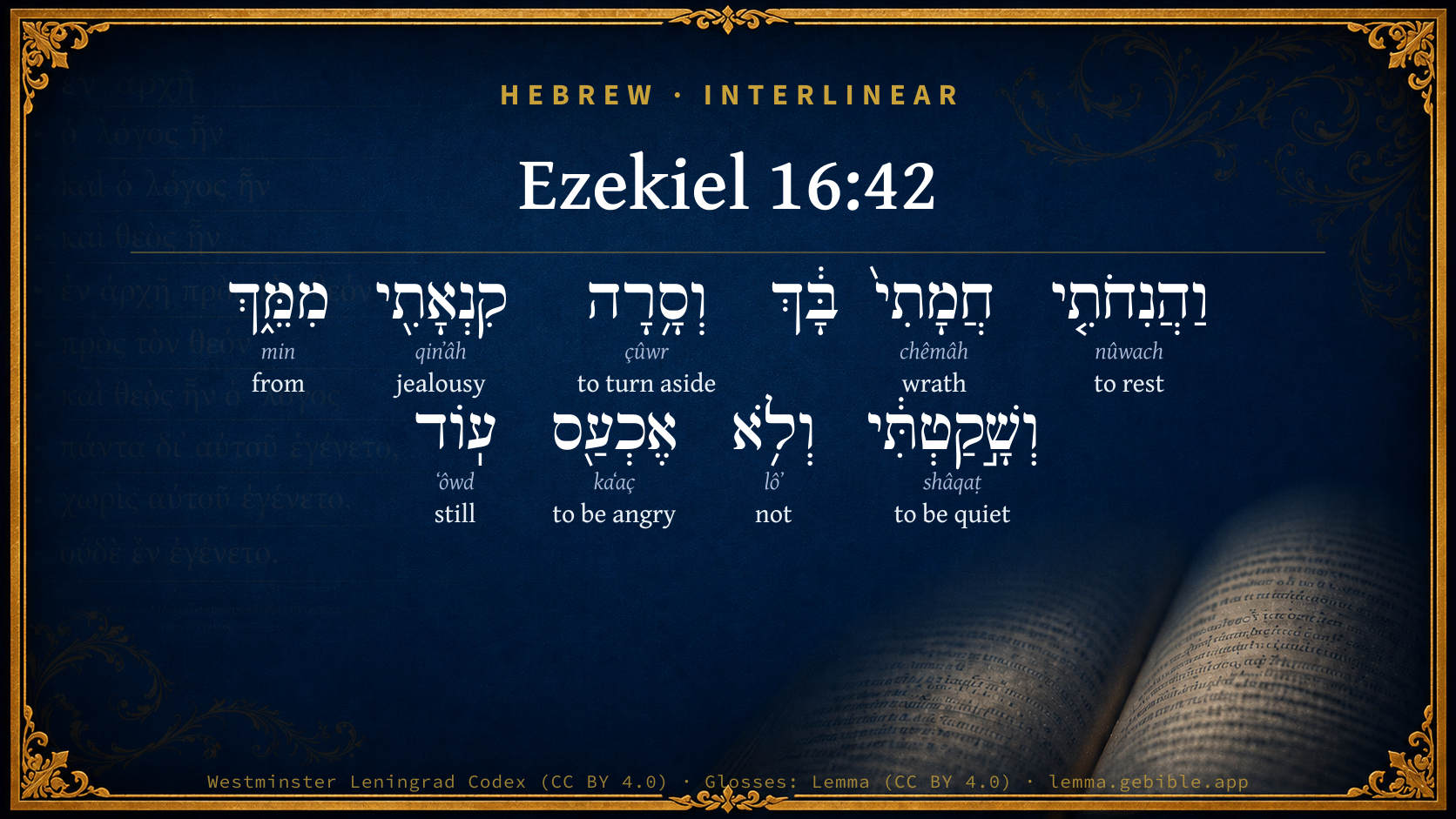
Ezekiel 16:42

Hebrew (Westminster Leningrad Codex) Ezekiel 16:42 appears in the Hebrew Old Testament. The text above is from the Westminster Leningrad Codex. Each word links to its Strong’s number, a concise gloss, and parsing drawn from the Open Scriptures Hebrew Bible morphology. Click any word for its full Brown-Driver-Briggs (BDB) entry.
Download image
Cite this verse

Ezekiel 16:42 (World English Bible). Public Domain. Lemma interlinear Bible study tool, https://lemma.gebible.app/v/ezekiel/16/42.

Show BibTeX & RIS
BibTeX
RIS
English Translation
So will I cause my wrath toward you to rest, and my jealousy shall depart from you, and I will be quiet, and will be no more angry.
World English Bible · Public Domain
Download a study sheet

One document with this verse’s original text, its word-by-word gloss line, the meaning frame, cross-references with their text, attributed commentary, and full source and license credits — printable, and it pastes into notes with its structure intact.

This verse Autodidact and up

Study sheet (.html) Plain text (.txt)

A passage Seminary Student

Up to 50 verses in one chapter. A passage sheet keeps up to 6 commentary sources and 12 cross-references per verse, in the order this page ranks them, and says so on the sheet whenever that leaves anything out. Ask for a single verse and you get the Autodidact verse sheet above.

Everything on this page stays free to read, with no account — the sheet is a download of what is already on screen, not access to it.

Want to remove ads? Support Godless Engineer
Compare translations 3

The same verse in 3 English versions, stacked beneath the original-language interlinear above. Click any original word for its lexicon entry.

Each is an independent rendering of the whole verse — the interlinear is not word-aligned to these translations.

Highlighted words mark where these versions differ — a whole-verse word diff, not a word-by-word alignment.

  • World English Bible Public Domain
    So will I cause my wrath toward you to rest, and my jealousy shall depart from you, and I will be quiet, and will be no more angry.
  • King James Version Public Domain
    So will I make my fury toward thee to rest, and my jealousy shall depart from thee, and I will be quiet, and will be no more angry.
  • unfoldingWord Literal Text CC BY-SA 4.0
    Then I will calm my fury against you; my anger will leave you, for I will be satisfied, and will no longer be angry.

unfoldingWord Literal Text — © unfoldingWord, licensed CC BY-SA 4.0. Word-aligned USFM3 via Door43 (git.door43.org/unfoldingWord/en_ult).

Versions to compare (up to 4)

3 of 4 selected

Show all 18 translations

Every available English version of this verse, each an independent rendering of the whole verse.

  • World English Bible Public Domain
    So will I cause my wrath toward you to rest, and my jealousy shall depart from you, and I will be quiet, and will be no more angry.
  • Berean Standard Bible Public Domain
    So I will lay to rest My wrath against you, and My jealousy will turn away from you. Then I will be calm and no longer angry.
  • Majority Standard Bible Public Domain
    So I will lay to rest My wrath against you, and My jealousy will turn away from you. Then I will be calm and no longer angry.
  • King James Version Public Domain
    So will I make my fury toward thee to rest, and my jealousy shall depart from thee, and I will be quiet, and will be no more angry.
  • American Standard Version (1901) Public Domain
    So will I cause my wrath toward thee to rest, and my jealousy shall depart from thee, and I will be quiet, and will be no more angry.
  • Revised Version (1885) Public Domain
    So will I satisfy my fury upon thee, and my jealousy shall depart from thee, and I will be quiet, and will be no more angry.
  • Geneva Bible (1599) Public Domain
    So will I make my wrath towarde thee to rest, and my ielousie shall depart from thee, and I will cease and be no more angrie.
  • Douay-Rheims (1899) Public Domain
    And my indignation shall rest in thee: and my jealousy shall depart from thee, and I will cease and be angry no more.
  • Young's Literal Translation Public Domain
    And I have caused My fury against thee to rest, And My jealousy hath turned aside from thee, And I have been quiet, and I am not angry any more.
  • Literal Standard Version CC BY-SA 4.0
    And I have caused My fury against you to rest, || And My jealousy has turned aside from you, || And I have been quiet, and I am not angry anymore.
  • Unlocked Literal Bible CC BY-SA 4.0
    Then I will calm my fury against you; my anger will leave you, for I will be satisfied, and will no longer be angry.
  • unfoldingWord Literal Text CC BY-SA 4.0
    Then I will calm my fury against you; my anger will leave you, for I will be satisfied, and will no longer be angry.
  • Darby Bible Public Domain
    And I will appease my fury against thee, and my jealousy shall depart from thee; and I will be quiet, and will be no more angry.
  • World Messianic Bible Public Domain
    So I will cause my wrath toward you to rest, and my jealousy will depart from you. I will be quiet, and will not be angry any more.
  • Webster's Bible Public Domain
    So will I make my fury towards thee to rest, and my jealousy shall depart from thee, and I will be quiet, and will be no more angry.
  • Free Bible Version CC BY-SA 4.0
    Then I will finish being jealous and furious with you. I will calm down and won't be angry any more.
  • Bible in Basic English Public Domain
    And the heat of my wrath against you will have an end, and my bitter feeling will be turned away from you, and I will be quiet and will be angry no longer.
  • JPS Tanakh (1917) Public Domain
    So will I satisfy My fury upon thee, and My jealousy shall depart from thee, and I will be quiet, and will be no more angry.

Literal Standard Version (2020), Covenant Press — licensed CC BY-SA 4.0. Text via the HelloAO Bible API (eBible.org). Unlocked Literal Bible (unfoldingWord) — licensed CC BY-SA 4.0. Text via the HelloAO Bible API (eBible.org). unfoldingWord Literal Text — © unfoldingWord, licensed CC BY-SA 4.0. Word-aligned USFM3 via Door43 (git.door43.org/unfoldingWord/en_ult). Free Bible Version, Dr. Jonathan Gallagher — licensed CC BY-SA 4.0. Text via the HelloAO Bible API (eBible.org).

Word by word

More ways to search: Search by grammar → Find every occurrence → Compare this word →

Practice this passage: Drill this verse → Learn its vocabulary →

וְשָׁ֣קַטְתִּ֔י
shâqaṭ
H8252
“and · to be quiet”
Conjunction + Verb, Qal, Sequential Perfect, 1st Person, Common, Singular
Part of Speech
Conjunction + Verb
Stem
Qal
Form
Sequential Perfect
Person
1st Person
Gender
Common
Number
Singular
Full BDB Definition

Origin: a primitive root

TWOT: 2453

to be quiet, be tranquil, be at peace, be quiet, rest, lie still, be undisturbed - (Qal) - to be quiet, be undisturbed - to be at peace (of land) - to be quiet, be inactive - (Hiphil) - to show quietness - quietness, display of quietness (substantive) - to quiet, be quiet - to cause quietness, pacify, allay
  1. וַהֲנִחֹתִ֤י nûwach H5117 “and · to rest” Conjunction + Verb, Hiphil, Sequential Perfect, 1st Person, Common, Singular
  2. חֲמָתִי֙ chêmâh H2534 “wrath · my” Noun, Common, Feminine, Singular, Construct + Suffix, Personal, 1st Person, Common, Singular
  3. וְסָ֥רָה çûwr H5493 “and · to turn aside” Conjunction + Verb, Qal, Sequential Perfect, 3rd Person, Feminine, Singular
  4. קִנְאָתִ֖י qinʼâh H7068 “jealousy · my” Noun, Common, Feminine, Singular, Construct + Suffix, Personal, 1st Person, Common, Singular
  5. מִמֵּ֑ךְ min H4480 “from · you” Preposition + Suffix, Personal, 2nd Person, Feminine, Singular
  6. וְלֹ֥א lôʼ H3808 “and · not” Conjunction + Particle, Negative
  7. אֶכְעַ֖ס kaʻaç H3707 “to be angry” Verb, Qal, Imperfect, 1st Person, Common, Singular
  8. עֽוֹד ʻôwd H5750 “still” Adverb

About this verse

These counts appear in no published source. They are computed here, from the morphology-tagged text and Lemma’s own curated glosses. What Lemma adds →

10
words
9
distinct lemmas
Prophets
section

Shared distinctive vocabulary

וְשָׁ֣קַטְתִּ֔י to be quiet H8252 occurs in 41 verses of the Hebrew Bible. Also found in:

Grammatical profile

  • 4 verbs
  • 2 nouns
  • 2 prepositions
  • 1 adverb
  • 1 particle

Verb forms

  • וַהֲנִחֹתִ֤י Hiphil · Sequential Perfect
  • וְסָ֥רָה Qal · Sequential Perfect
  • וְשָׁ֣קַטְתִּ֔י Qal · Sequential Perfect
  • אֶכְעַ֖ס Qal · Imperfect

Hebrew & Septuagint length

In English translation the verse runs 28 words from the Hebrew and 27 from the Septuagint (LXX English) — closely comparable.

A rough comparison of the two English renderings, which tokenize alike — not a word-level alignment.

Word counts can differ between the Hebrew and the Greek without any difference in meaning — e.g. the Hebrew direct-object marker אֵת has no separate Greek word, and Greek often adds the article ὁ.

Cross-references

8

Topical passages linked to Ezekiel 16:42 in the Treasury of Scripture Knowledge — connected by theme and wording, ordered by reader-vote popularity; previews shown in the World English Bible.

  • Ezekiel 5:13 Thus shall my anger be accomplished, and I will cause my wrath toward them to rest, and I shall be comforted; and they shall know that I, Yahweh, have spoken in my zeal, when I have accomplished my wrath on them.
  • Isaiah 40:1–2 Comfort you, comfort you my people, says your God.
  • Ezekiel 21:17 I will also strike my hands together, and I will cause my wrath to rest: I, Yahweh, have spoken it.
  • Ezekiel 39:29 neither will I hide my face any more from them; for I have poured out my Spirit on the house of Israel, says the Lord Yahweh.
  • Isaiah 54:9–10 For this is [as] the waters of Noah to me; for as I have sworn that the waters of Noah shall no more go over the earth, so have I sworn that I will not be angry with you, nor rebuke you.
  • Zechariah 6:8 Then he called to me, and spoke to me, saying, "Behold, those who go toward the north country have quieted my spirit in the north country."
  • 2 Samuel 21:14 They buried the bones of Saul and Jonathan his son in the country of Benjamin in Zela, in the tomb of Kish his father: and they performed all that the king commanded. After that God was entreated for the land.
  • Isaiah 1:24 Therefore the Lord, Yahweh of Hosts, The Mighty One of Israel, says: "Ah, I will get relief from my adversaries, And avenge myself of my enemies;

Cross-references courtesy of OpenBible.info (CC BY 4.0).

Hebrew and Greek witnesses Masoretic Hebrew ↔ Greek Septuagint

The same verse in the two great witnesses to the Old Testament, shown verse-for-verse.

These are two independent witnesses, not word-aligned to each other, and the Septuagint is shown in lemma (dictionary) form.

Hebrew Ezekiel 16:42 Masoretic · Westminster Leningrad Codex

וַהֲנִחֹתִ֤י חֲמָתִי֙ בָּ֔ךְ וְסָ֥רָה קִנְאָתִ֖י מִמֵּ֑ךְ וְשָׁ֣קַטְתִּ֔י וְלֹ֥א אֶכְעַ֖ס עֽוֹד

So will I cause my wrath toward you to rest, and my jealousy shall depart from you, and I will be quiet, and will be no more angry.

World English Bible · Public Domain

Greek LXX Ezekiel 16:42 Septuagint · lemma form

καί ἐπι ἀποἵημι ὁ θυμός ἐγώ ἐπί σύ καί ἐκαἴρω ὁ ζῆλος ἐγώ ἐκ σύ καί ἀναπαύω καί οὐ μή μεριμνάω οὐκέτι

So will I slacken my fury against you, and my jealousy shall be removed from you, and I will rest, and be no more careful for you.

LXX2012 (modern English Septuagint) · Public Domain

On this verse, John Gill's Exposition discusses the Septuagint’s reading. Read the note in Commentary ↓

Hebrew: Westminster Leningrad Codex (CC BY 4.0). Greek: Septuagint (public domain); English from LXX2012 (modern English Septuagint) (Public Domain). How the Septuagint differs from the Hebrew →

Targum (Aramaic paraphrase)

1

The Targum is the ancient Jewish Aramaic paraphrase of the Hebrew Scriptures — an interpretive translation, not the Hebrew text itself. Onkelos (literal) and Pseudo-Jonathan (expansive) render the Torah, and Jonathan the Prophets. Coverage is partial: where no permissively-licensed English translation exists for a verse, only the Aramaic is shown. This is verse-level text, not a word-by-word alignment to the Hebrew.

  1. Targum Jonathan Prophets (Joshua–Malachi)
    וַאֲנִיחַ חֵמְתִי בִיךְ וְתַעְדֵי קִנְאָתִי מִנִיךְ וַאֲסִיף וְלָא יְהֵי רוּגְזִי עוֹד:

    (no public-domain English translation for this verse)

    Targum Jonathan — Aramaic: “Mikraot Gedolot” (public domain). English: “Sefaria Community Translation” (CC0 1.0 (public-domain dedication)); “London "Chaldee Paraphrase," 1871” (public domain). Text via Sefaria.

Commentary

Notes on Ezekiel 16:42 from classic Christian and Jewish commentators (each source and its license shown beneath its notes). The classic Christian expositions comment on the surrounding passage and are grouped to its opening verse, so a note may address several verses; the Jewish commentaries on the Tanakh (Rashi and others) are per-verse, so they appear only where the commentator wrote on this verse.

Lemma curates 59 commentaries, every one of them public domain or Creative Commons licensed, each selected and text-cleaned for this edition rather than reprinted as found. About our sources →

Trapp's Complete Commentary

John Trapp

Eze 16:42 So will I make my fury toward thee to rest, and my jealousy shall depart from thee, and I will be quiet, and will be no more angry.

Ver. 42. So I will make my fury toward thee to rest.] Sept., I will dismiss mine anger upon thee. Like as when Haman was hanged, Ahasuerus’s wrath was pacified; {Est 7:10} and as when Jonah was cast overboard, the sea was calmed.

John Trapp, A Commentary or Exposition upon All the Books of the Old and New Testament (1647–1656) — public domain. Text from a community e-Sword module.

Geneva Bible (1599)

Geneva Bible translators

I will utterly destroy thee, and so my jealousy shall cease.

Geneva Bible (1599) marginal notes — public domain. Text via Bolls.life.

Jamieson, Fausset & Brown

Robert Jamieson, A. R. Fausset & David Brown

my fury . . . rest--when My justice has exacted the full penalty commensurate with thy awful guilt (see on Eze 5:13). It is not a mitigation of the penalty that is here foretold, but such an utter destruction of all the guilty that there shall be no need of further punishment [CALVIN].

Jamieson, Fausset & Brown — Commentary Critical and Explanatory on the Whole Bible (1871) — public domain (CC PDM 1.0). Text via the HelloAO Bible API.

Adam Clarke's Commentary

Verse 42. I will be quiet and will be no more angry.] I will completely abandon thee; have nothing more to do with thee; think no more of thee. When God in judgment ceases to reprehend, this is the severest judgment.

Adam Clarke's Commentary on the Bible (1810–1826) — public domain. Text from a community e-Sword/MySword module.

John Calvin's Commentaries

Although God seems here to promise some mitigation of his wrath, there is no doubt that he expresses what we formerly saw, namely, that such should be the destruction of the nation that there would be no need to return again to punish them. When, therefore, he says, I will make my indignation rest upon thee, it means that he would satiate himself with vengeance for all their crimes: so that the consumption of the people is here called the rest of God’s indignation, as if he had said, When I have utterly reduced you to nothing, then my indignation against thee shall rest. In the same way he afterwards adds, and my indignation shall depart from thee. But I cannot finish today.

John Calvin's Commentaries (1540-1563) — public domain. Text from the Calvin Translation Society English edition (1840s-50s) via the Christian Classics Ethereal Library (ccel.org). Calvin's coverage is partial (roughly two-thirds of the Bible); uncommented books and verses are honest gaps, never fabricated. The 19th-century editor's footnotes and remarks are omitted so the notes are faithfully Calvin's own voice.

Ellicott's Commentary for English Readers

(42) My fury . . . to rest.—Not in pity but in satiety, as having accomplished the utter desolation of Israel.

A Bible Commentary for English Readers, edited by Charles John Ellicott (1878–1897) — public domain. Text from a community e-Sword module.

The Cambridge Bible for Schools and Colleges

gen. ed. J. J. S. Perowne

42. make my fury … to rest] i.e. satisfy and appease it. Cf. ch. Eze_5:13.

The Cambridge Bible for Schools and Colleges (gen. ed. J. J. S. Perowne; Cambridge University Press, 1878–1918) — public domain. Text from a community e-Sword module.

John Gill's Exposition

Because thou hast not remembered the days of thy youth,.... The low estate they were once in, and the great favours bestowed upon them, which laid them under great obligation to serve the Lord, and him only; but these they forgot, which highly provoked him, and caused him to do the things he did; see Eze 16:22,

and hast fretted me in all these things; irritated, provoked him, moved him to wrath and anger, stirred up in his breast a tumult, speaking after the manner of men; this they did by their ingratitude, idolatry, and other sins:

behold, therefore, I also will recompense thy way upon thine head,

saith the Lord God; retaliate their evils, punish them according as their sins deserved, and in a way which they led unto:

and thou shall not commit this lewdness above all thine abominations; or add to all thine abominable idolatries this shocking piece of wickedness, the sacrificing of their children to their idols: or rather the words may be rendered, "for thou hast not taken this thought" (or counsel) "upon" or "concerning all thine abominations" (u); to repent of them and turn from them So the Targum,

"and thou hast not taken counsel to thyself, to turn from all thine abominations.''

Or, as Jarchi,

"thou hast hot taken counsel to put the, heart upon thine abominations to turn from them;''

and he observes, that the word here used always signifies counsels either good or evil. There is a double reading of this clause; we follow the "Keri", or marginal reading; but the "Cetib", or textual writing or reading, is, "and I have not done according to this lewdness above all thine abominations"; and so expresses the mercy and long suffering of God (w).

(u) "et non fecisti cogitationem super omnibus abominationibus tuis", Pagninus, Montanus, Calvin; "nec tamen fecisti", &c. Vatablus, Grotius. (w) This is followed by the Septuagint, Vulgate Latin, Luther, Starckius, and others.

John Gill's Exposition of the Whole Bible (1746–1763) — public domain (CC PDM 1.0). Text via the HelloAO Bible API.

Haydock's Catholic Bible Commentary

No more. I will entirely repudiate thee, so as to observe thy conduct no longer, (Calmet) with the eyes of an husband. (Haydock) --- This is the most terrible effect of God’s wrath, (Calmet) when the sinner is left to himself, Osee iv. 14. (St. Jerome)

George Leo Haydock (1774–1849), Haydock's Catholic Family Bible and Commentary, 1859 edition — public domain. Excludes Psalms (Douay-Rheims chapter numbering differs from Protestant) and Deuterocanonical books (Catholic canon only).

Matthew Poole's English Annotations

It may admit a doubt, whether this be spoken in way of promise and kindness, or of menace and wrath. This latter seems intended, as if God said, The jealousy whereto you have provoked me will never cease till these judgments have utterly destroyed you, and cut you off, as the anger of an abused husband ceaseth in the divorce and public punishment of the adulteress.

My jealousy shall depart from thee; I will no more concern myself for thee, nor be troubled at thy carriage, whatever it be, since thou art no more mine.

Will be no more angry, with the anger which is in the breast of a husband troubled for and angry at the miscarriages of a wife he loved.

Matthew Poole's English Annotations on the Holy Bible (1683–1685) — public domain. Text from a community e-Sword/MySword module.

Whedon's Commentary on the Bible

Daniel D. Whedon

42. Make my fury toward thee to rest — Literally, satisfy my fury upon thee. (See Eze_16:13.)

Daniel D. Whedon (gen. ed.), Commentary on the Old and New Testaments (1874–1909) — public domain. Text from a community e-Sword module.

The Pulpit Commentary

So will I make my fury, etc.; read, with the Revised Version, will satisfy. The words are not primarily words of comfort. They speak of the satisfaction of the jealous husband"s righteous anger, and therefore of a completed punishment. And vet that thought was, as the sequel shows (vers. 53, 60-63), the beginning of hope for the future, as the prophet thought of his people. For here the forms of punishment were not final The daughter of Zion survived the stoning, the sword, and the burning. And so, when wrath had done its work of retribution, it might become corrective and purgatorial. The injured husband, in the bold anthropomorphic language of the parable, would be no more angry. The Lord God of Israel would remember his covenant, and forgive.

How God"s anger ceases.

I IT CANNOT CEASE WHILE THE CAUSE FOR IT REMAINS. An irascible person is provoked to wrath by slight causes; but inasmuch as his anger springs chiefly from his own fiery disposition, the cooling of passion allays the rage of wrath, even though circumstances remain unchanged. But God is "slow to anger"; (Psa_103:8) he is not wrathful by nature, because in essence he is love. But the anger which is slow to begin is the more deep and terrible, as it does not arise without adequate reason. Further, a weak person may tire of his anger, even though the cause of it remains unchanged. An explosion of wrath exhausts him. He has not the energy for sustained anger. The fire simply burns out. But this cannot be the case with the great, the unexhaustible nature of God. God is ever the same, always true, just, active. Therefore so long as the cause for anger is unchanged, the anger too must remain. "God is angry with the wicked every day". (Psa_7:11) As long as men continue in sin, so long must God abide in wrath. An eternity of sin must, be accompanied by an eternity of Divine anger.

II IT WILL CEASE WHEN THE OBJECTS OF IT ARE DESTROYED. This appears to be the terrible goal of the text. Gracious as it reads in word, the purport of it is most fearful. It stands between passages of denunciation and condemnation; it cannot describe a kindly cessation of wrath. The anger of God will burn till it has nothing further to consume. Then his fury will rest. Thus it was with Israel nationally. The people were swept away, consumed off the land. Only a "remnant" was spared, a mere stump of the old tree, from which new growths could sprout. We see no more of God"s anger against a man when he has been killed. If nothing were interposed for the saving of his soul, the natural consequence of sin run out to its extremity would be destruction. Then God would cease to be angry with the sinner, for the plain reason that there would be no sinner left against whom his wrath would be called forth.

III IT WILL CEASE WHEN THE CAUSE FOR IT CEASES. There is another way by which the anger of God may be allayed. He is not desirous to see his children destroyed, for he is merciful and gracious. When sin is pardoned, God"s fury towards the sinner rests and his jealousy departs. But this pardon does not depend only on the will of God, or he would forgive all his children.

1. It is dependent on repentance. So long as the soul persists in impenitence, God"s anger cannot cease to burn. It is not simply a question of the amount and guilt of the sin which first provoked God"s wrath. The continued impenitence is virtually a prolongation of the guilt. But when the sinner truly repents, God"s anger abates.

2. It is also dependent on Christ"s atonement. We are able to read the words of Ezekiel with a more hopeful meaning than that which the prophet seems to have put upon them, because "we have an Advocate with the Father, Jesus Christ the righteous; and he is the Propitiation for our sins: and not for ours only, but also for the sins of the whole world". (1Jn_2:1, 1Jn_2:2) We read that "the mercy of the Lord eudureth forever," but never that the anger of the Lord endureth forever. On the contrary, "He will not always chide, neither will he keep his anger forever". (Psa_103:9) Still, God only ceases to be angry either because sin destroys the sinner or because God destroys the sin.

The Pulpit Commentary (1880–1919), ed. H.D.M. Spence-Jones & Joseph S. Exell — public domain. Text from a community e-Sword module.

John Wesley's Explanatory Notes

My jealousy - The jealousy whereto you have provoked me, will never cease, 'till these judgments have utterly destroyed you, as the anger of an abused husband ceases in the publick punishment of the adulteress. No more angry - I will no more concern myself about thee.

John Wesley, Explanatory Notes Upon the Whole Bible (1754–1765) — public domain. Text via the GEBible commentary corpus.

Lesson kit

Teaching starters — assembled from the data on this page, not authored interpretation. Every prompt links to the verse data it draws on. Edit before teaching.

Ezekiel, in the Prophets, opens this verse with 10 words (9 distinct Hebrew lemmas). Its most distinctive word is shâqaṭ (“to be quiet”). A historical commentator’s framing appears above. Read the whole chapter for the surrounding context.

Discussion questions

  1. What does “to be quiet” (shâqaṭ) contribute to the verse as a whole?
  2. Joshua 11:23 shares the word «to be quiet» with this verse. How do the two illuminate each other?
  3. The translations on this page render this verse differently — a whole-verse word diff, not a word-by-word alignment. What might account for the different wordings?
  4. The verb «וַהֲנִחֹתִ֤י» is Hiphil Sequential Perfect. How does its form color the action?
  5. Reading how Trapp's Complete Commentary and Geneva Bible (1599) read this verse, where do the two commentators agree and where do they part?

Things to notice

Reading settings

Reading text

Shown beneath each verse's original-language words.

Old Testament
Old Testament edition

Read the OT as the Masoretic Hebrew (MT) or the Greek Septuagint (LXX).

English shown for the Greek Septuagint (in the Hebrew ↔ Greek comparison).

Comparing translations? Open the Compare panel on any verse page to stack up to four side by side.