
Leviticus 13:30

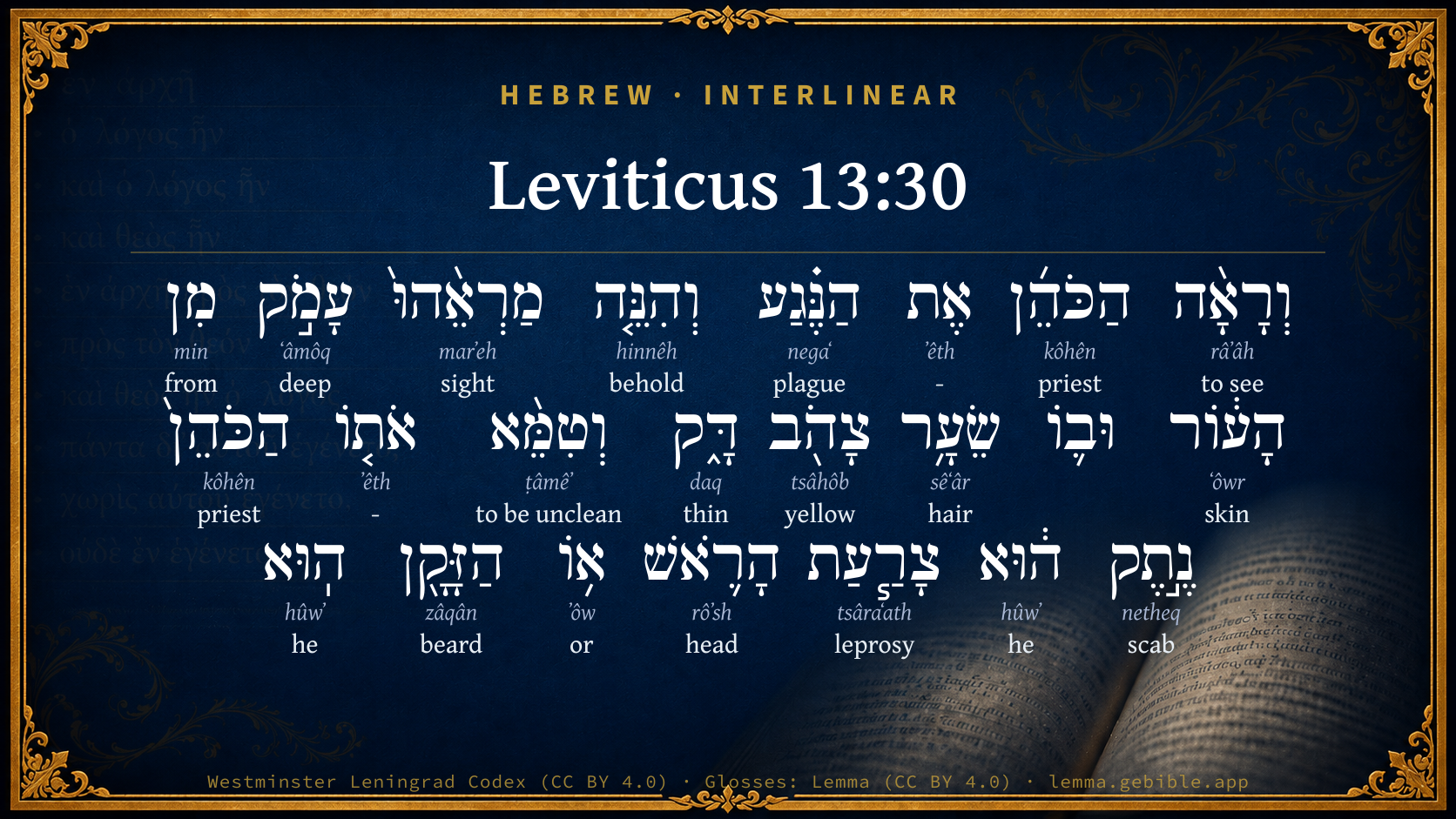
Hebrew (Westminster Leningrad Codex) Leviticus 13:30 appears in the Hebrew Old Testament. The text above is from the Westminster Leningrad Codex. Each word links to its Strong’s number, a concise gloss, and parsing drawn from the Open Scriptures Hebrew Bible morphology. Click any word for its full Brown-Driver-Briggs (BDB) entry.
Download image
Cite this verse

Leviticus 13:30 (World English Bible). Public Domain. Lemma interlinear Bible study tool, https://lemma.gebible.app/v/leviticus/13/30.

Show BibTeX & RIS
BibTeX
RIS
English Translation
then the priest shall examine the plague; and, behold, if the appearance of it is deeper than the skin, and the hair in it is yellow and thin, then the priest shall pronounce him unclean: it is an itch, it is leprosy of the head or of the beard.
World English Bible · Public Domain
Highlights
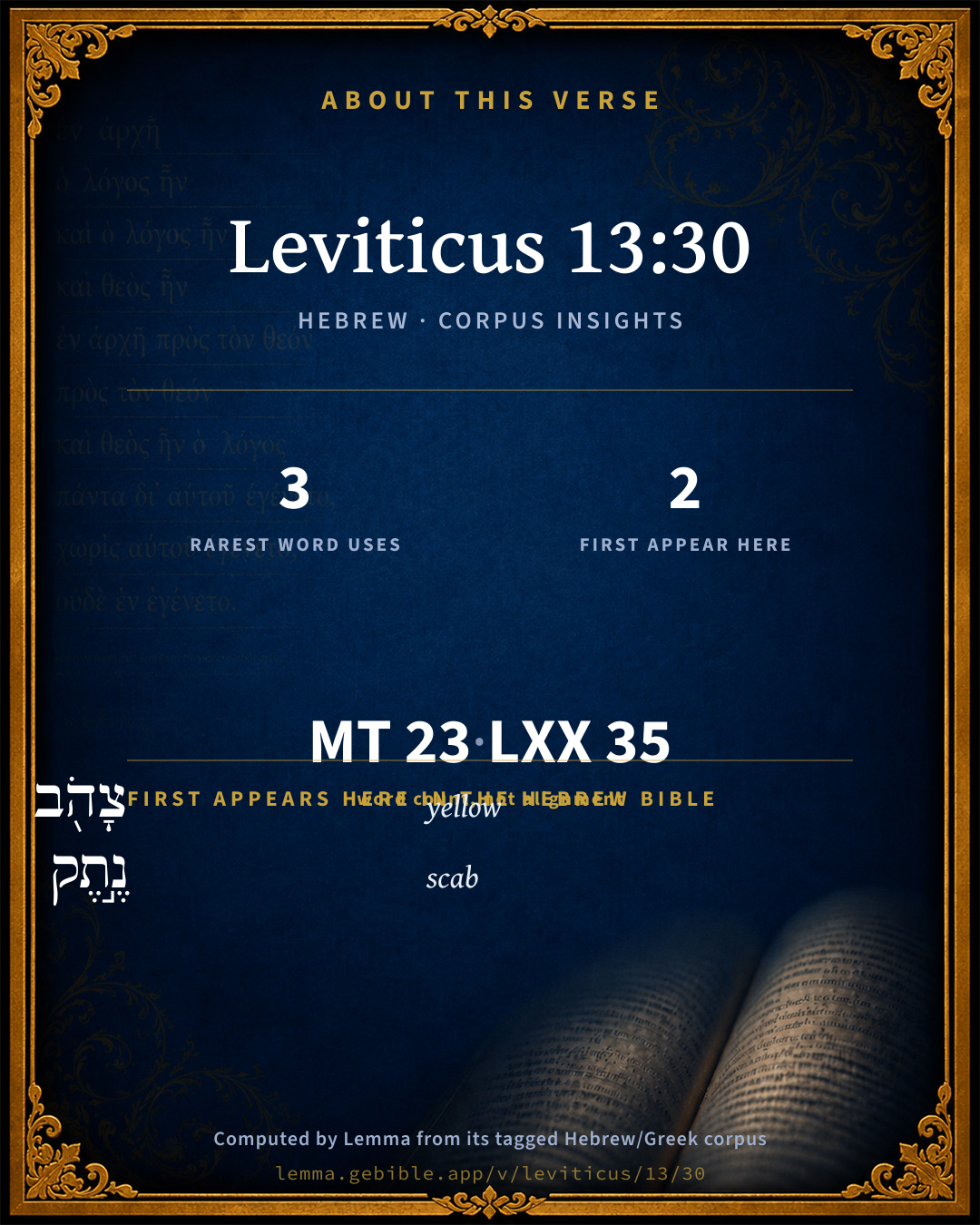
  • 2 first appearances in the Hebrew Bible
Full analysis ↓
Download a study sheet

One document with this verse’s original text, its word-by-word gloss line, the meaning frame, cross-references with their text, attributed commentary, and full source and license credits — printable, and it pastes into notes with its structure intact.

This verse Autodidact and up

Study sheet (.html) Plain text (.txt)

A passage Seminary Student

Up to 50 verses in one chapter. A passage sheet keeps up to 6 commentary sources and 12 cross-references per verse, in the order this page ranks them, and says so on the sheet whenever that leaves anything out. Ask for a single verse and you get the Autodidact verse sheet above.

Everything on this page stays free to read, with no account — the sheet is a download of what is already on screen, not access to it.

Want to remove ads? Support Godless Engineer
Compare translations 3

The same verse in 3 English versions, stacked beneath the original-language interlinear above. Click any original word for its lexicon entry.

Each is an independent rendering of the whole verse — the interlinear is not word-aligned to these translations.

Highlighted words mark where these versions differ — a whole-verse word diff, not a word-by-word alignment.

  • World English Bible Public Domain
    then the priest shall examine the plague; and, behold, if the appearance of it is deeper than the skin, and the hair in it is yellow and thin, then the priest shall pronounce him unclean: it is an itch, it is leprosy of the head or of the beard.
  • King James Version Public Domain
    Then the priest shall see the plague: and, behold, if it be in sight deeper than the skin; and there be in it a yellow thin hair; then the priest shall pronounce him unclean: it is a dry scall, even a leprosy upon the head or beard.
  • unfoldingWord Literal Text CC BY-SA 4.0
    then the priest shall see the infection. And behold, the appearance of it deeper than the skin, and on it yellow, thin hair. Then the priest shall pronounce him unclean. It a scall. It a skin disease of the head or the beard.

unfoldingWord Literal Text — © unfoldingWord, licensed CC BY-SA 4.0. Word-aligned USFM3 via Door43 (git.door43.org/unfoldingWord/en_ult).

Versions to compare (up to 4)

3 of 4 selected

Show all 18 translations

Every available English version of this verse, each an independent rendering of the whole verse.

  • World English Bible Public Domain
    then the priest shall examine the plague; and, behold, if the appearance of it is deeper than the skin, and the hair in it is yellow and thin, then the priest shall pronounce him unclean: it is an itch, it is leprosy of the head or of the beard.
  • Berean Standard Bible Public Domain
    the priest shall examine the infection, and if it appears to be deeper than the skin and the hair in it is yellow and thin, the priest must pronounce him unclean; it is a scaly outbreak, an infectious disease of the head or chin.
  • Majority Standard Bible Public Domain
    the priest shall examine the infection, and if it appears to be deeper than the skin and the hair in it is yellow and thin, the priest must pronounce him unclean; it is a scaly outbreak, an infectious disease of the head or chin.
  • King James Version Public Domain
    Then the priest shall see the plague: and, behold, if it be in sight deeper than the skin; and there be in it a yellow thin hair; then the priest shall pronounce him unclean: it is a dry scall, even a leprosy upon the head or beard.
  • American Standard Version (1901) Public Domain
    then the priest shall look on the plague; and, behold, if the appearance thereof be deeper than the skin, and there be in it yellow thin hair, then the priest shall pronounce him unclean: it is a scall, it is leprosy of the head or of the beard.
  • Revised Version (1885) Public Domain
    then the priest shall look on the plague: and, behold, if the appearance thereof be deeper than the skin, and there be in it yellow thin hair, then the priest shall pronounce him unclean: it is a scall, it is leprosy of the head or of the beard.
  • Geneva Bible (1599) Public Domain
    Then the Priest shall see his sore: and if it appeare lower then the skin, and there be in it a small yellow haire, then the Priest shall pronouce him vncleane: for it is a blacke spot, and leprosie of the head or of the beard.
  • Douay-Rheims (1899) Public Domain
    And if the place be lower than the other flesh, and the hair yellow, and thinner than usual: he shall declare them unclean, because it is the leprosy of the head and the beard;
  • Young's Literal Translation Public Domain
    then hath the priest seen the plague, and lo, its appearance is deeper than the skin, and in it a thin shining hair, and the priest hath pronounced him unclean; it `is' a scall -- it `is' a leprosy of the head or of the beard.
  • Literal Standard Version CC BY-SA 4.0
    then the priest has seen the plague, and behold, its appearance is deeper than the skin, and a thin, shining hair [is] in it, and the priest has pronounced him unclean; it [is] a scale—it [is] a leprosy of the head or of the beard.
  • Unlocked Literal Bible CC BY-SA 4.0
    then the priest must examine the person for an infectious disease to see if it appears to be deeper than the skin, and if there is yellow, thin hair in it. If there is, then the priest must pronounce him unclean. It is an itch, an infectious disease on the head or the chin.
  • unfoldingWord Literal Text CC BY-SA 4.0
    then the priest shall see the infection. And behold, the appearance of it deeper than the skin, and on it yellow, thin hair. Then the priest shall pronounce him unclean. It a scall. It a skin disease of the head or the beard.
  • Darby Bible Public Domain
    and the priest look on the sore, and behold, it looketh deeper than the skin, and there is in it yellow thin hair, then the priest shall pronounce him unclean; it is a scall, the leprosy of the head or the beard.
  • World Messianic Bible Public Domain
    then the priest shall examine the plague; and behold, if its appearance is deeper than the skin, and the hair in it is yellow and thin, then the priest shall pronounce him unclean. It is an itch. It is leprosy of the head or of the beard.
  • Webster's Bible Public Domain
    Then the priest shall see the plague: and behold, if it is in sight deeper than the skin, and there is in it a yellow thin hair; then the priest shall pronounce him unclean: it is a dry scall, even a leprosy upon the head or beard.
  • Free Bible Version CC BY-SA 4.0
    the priest shall inspect it, and if it appears to be more than superficial and the hair in it has become pale and thin, the priest must declare them unclean; it is an infection producing scabs, a serious disease of the head or chin.
  • Bible in Basic English Public Domain
    Then the priest is to see the diseased place: and if it seems to go deeper than the skin, and if there is thin yellow hair in it, then the priest will say that he is unclean: he has the mark of the leper's disease on his head or in the hair of his chin.
  • JPS Tanakh (1917) Public Domain
    then the priest shall look on the plague; and, behold, if the appearance thereof be deeper than the skin, and there be in it yellow thin hair, then the priest shall pronounce him unclean: it is a scall, it is leprosy of the head or of the beard.

Literal Standard Version (2020), Covenant Press — licensed CC BY-SA 4.0. Text via the HelloAO Bible API (eBible.org). Unlocked Literal Bible (unfoldingWord) — licensed CC BY-SA 4.0. Text via the HelloAO Bible API (eBible.org). unfoldingWord Literal Text — © unfoldingWord, licensed CC BY-SA 4.0. Word-aligned USFM3 via Door43 (git.door43.org/unfoldingWord/en_ult). Free Bible Version, Dr. Jonathan Gallagher — licensed CC BY-SA 4.0. Text via the HelloAO Bible API (eBible.org).

Word by word

More ways to search: Search by grammar → Find every occurrence → Compare this word →

Practice this passage: Drill this verse → Learn its vocabulary →

צָהֹ֖ב
tsâhôb
H6669
“yellow”
Adjective, Adjective, Masculine, Singular, Absolute
Part of Speech
Adjective
Type
Adjective
Gender
Masculine
Number
Singular
State
Absolute
Full BDB Definition

Origin: from H6668

TWOT: 1880a

gleaming, yellow (of hair)
  1. וְרָאָ֨ה râʼâh H7200 “and · to see” Conjunction + Verb, Qal, Sequential Perfect, 3rd Person, Masculine, Singular
  2. הַכֹּהֵ֜ן kôhên H3548 “the · priest” Particle, Definite Article + Noun, Common, Masculine, Singular, Absolute
  3. אֶת ʼêth H853 “-” Particle, Direct Object
  4. הַנֶּ֗גַע negaʻ H5061 “the · plague” Particle, Definite Article + Noun, Common, Masculine, Singular, Absolute
  5. וְהִנֵּ֤ה hinnêh H2009 “and · behold” Conjunction + Particle, Demonstrative
  6. מַרְאֵ֨הוּ֙ marʼeh H4758 “sight · his” Noun, Common, Masculine, Singular, Construct + Suffix, Personal, 3rd Person, Masculine, Singular
  7. עָמֹ֣ק ʻâmôq H6013 “deep” Adjective, Adjective, Masculine, Singular, Absolute
  8. מִן min H4480 “from” Preposition
  9. הָע֔וֹר ʻôwr H5785 “the · skin” Particle, Definite Article + Noun, Common, Masculine, Singular, Absolute
  10. שֵׂעָ֥ר sêʻâr H8181 “hair” Noun, Common, Masculine, Singular, Absolute
  11. דָּ֑ק daq H1851 “thin” Adjective, Adjective, Masculine, Singular, Absolute
  12. וְטִמֵּ֨א ṭâmêʼ H2930 “and · to be unclean” Conjunction + Verb, Piel, Sequential Perfect, 3rd Person, Masculine, Singular
  13. אֹת֤וֹ ʼêth H853 “- · him” Particle, Direct Object + Suffix, Personal, 3rd Person, Masculine, Singular
  14. הַכֹּהֵן֙ kôhên H3548 “the · priest” Particle, Definite Article + Noun, Common, Masculine, Singular, Absolute
  15. נֶ֣תֶק netheq H5424 “scab” Noun, Common, Masculine, Singular, Absolute
  16. ה֔וּא hûwʼ H1931 “he” Pronoun, Personal, 3rd Person, Masculine, Singular
  17. צָרַ֧עַת tsâraʻath H6883 “leprosy of” Noun, Common, Feminine, Singular, Construct
  18. הָרֹ֛אשׁ rôʼsh H7218 “the · head” Particle, Definite Article + Noun, Common, Masculine, Singular, Absolute
  19. א֥וֹ ʼôw H176 “or” Conjunction
  20. הַזָּקָ֖ן zâqân H2206 “the · beard” Particle, Definite Article + Noun, Common, Both, Singular, Absolute
  21. הֽוּא hûwʼ H1931 “he” Pronoun, Personal, 3rd Person, Masculine, Singular

About this verse

These counts appear in no published source. They are computed here, from the morphology-tagged text and Lemma’s own curated glosses. What Lemma adds →

23
words
19
distinct lemmas
Pentateuch
section

Notable vocabulary

The rarest word here is צָהֹ֖ב yellow H6669 — appearing just 3 times in the whole Hebrew Bible.

First appearance in Scripture

These words make their first canonical appearance in the Hebrew Bible here:

  • צָהֹ֖ב yellow H6669
  • נֶ֣תֶק scab H5424

Shared distinctive vocabulary

צָהֹ֖ב yellow H6669 occurs in 3 verses of the Hebrew Bible. Also found in:

Grammatical profile

  • 2 verbs
  • 10 nouns
  • 3 adjectives
  • 2 pronouns
  • 2 prepositions
  • 1 conjunction
  • 3 particles

Verb forms

  • וְרָאָ֨ה Qal · Sequential Perfect
  • וְטִמֵּ֨א Piel · Sequential Perfect

Repetition

Words recur within this verse — often emphatic in Hebrew:

  • הַכֹּהֵ֜ן priest H3548 ×2
  • ה֔וּא he H1931 ×2

Hebrew & Septuagint length

In English translation the verse runs 49 words from the Hebrew and 51 from the Septuagint (LXX English) — closely comparable.

A rough comparison of the two English renderings, which tokenize alike — not a word-level alignment.

Word counts can differ between the Hebrew and the Greek without any difference in meaning — e.g. the Hebrew direct-object marker אֵת has no separate Greek word, and Greek often adds the article ὁ.

In the original languages it is 23 Hebrew tokens and 35 Greek tokens — but the two are counted differently (Hebrew bundles its prefixes and suffixes into one token; the Greek is in lemma form), so that isn’t a like-for-like length.

Cross-references

2

Topical passages linked to Leviticus 13:30 in the Treasury of Scripture Knowledge — connected by theme and wording, ordered by reader-vote popularity; previews shown in the World English Bible.

  • Leviticus 13:34–37 On the seventh day, the priest shall examine the itch; and, behold, if the itch hasn't spread in the skin, and its appearance isn't deeper than the skin, then the priest shall pronounce him clean. He shall wash his clothes, and be clean.
  • Leviticus 14:54 This is the law for any plague of leprosy, and for an itch,

Cross-references courtesy of OpenBible.info (CC BY 4.0).

Hebrew and Greek witnesses Masoretic Hebrew ↔ Greek Septuagint

The same verse in the two great witnesses to the Old Testament, shown verse-for-verse.

These are two independent witnesses, not word-aligned to each other, and the Septuagint is shown in lemma (dictionary) form.

Hebrew Leviticus 13:30 Masoretic · Westminster Leningrad Codex

וְרָאָ֨ה הַכֹּהֵ֜ן אֶת הַנֶּ֗גַע וְהִנֵּ֤ה מַרְאֵ֨הוּ֙ עָמֹ֣ק מִן הָע֔וֹר וּב֛וֹ שֵׂעָ֥ר צָהֹ֖ב דָּ֑ק וְטִמֵּ֨א אֹת֤וֹ הַכֹּהֵן֙ נֶ֣תֶק ה֔וּא צָרַ֧עַת הָרֹ֛אשׁ א֥וֹ הַזָּקָ֖ן הֽוּא

then the priest shall examine the plague; and, behold, if the appearance of it is deeper than the skin, and the hair in it is yellow and thin, then the priest shall pronounce him unclean: it is an itch, it is leprosy of the head or of the beard.

World English Bible · Public Domain

Greek LXX Leviticus 13:30 Septuagint · lemma form

καί ὁράω ὁ ἱερεύς ὁ ἁφή καί ἰδού ὁ ὄψις αὐτός ἔγκοιλος ὁ δέρμα ἐν αὐτός δέ θρίξ ξανθίζω λεπτός καί μιαίνω αὐτός ὁ ἱερεύς θραῦσμα εἰμί λέπρα ὁ κεφαλή ἤ λέπρα ὁ πώγων εἰμί

then the priest shall look on the plague, and, behold, if the appearance of it be beneath the skin, and in it there be thin yellowish hair, then the priest shall pronounce him unclean: it is a scurf, it is a leprosy of the head or a leprosy of the beard.

LXX2012 (modern English Septuagint) · Public Domain

Hebrew: Westminster Leningrad Codex (CC BY 4.0). Greek: Septuagint (public domain); English from LXX2012 (modern English Septuagint) (Public Domain). How the Septuagint differs from the Hebrew →

Targum (Aramaic paraphrase)

2

The Targum is the ancient Jewish Aramaic paraphrase of the Hebrew Scriptures — an interpretive translation, not the Hebrew text itself. Onkelos (literal) and Pseudo-Jonathan (expansive) render the Torah, and Jonathan the Prophets. Coverage is partial: where no permissively-licensed English translation exists for a verse, only the Aramaic is shown. This is verse-level text, not a word-by-word alignment to the Hebrew.

  1. Targum Onkelos Torah (Genesis–Deuteronomy)
    וְיֶחֱזֵי כַהֲנָא יָת מַכְתָּשָׁא וְהָא מֶחֱזוֹהִי עַמִיק מִן מַשְׁכָּא וּבֵהּ שֵׂעָר סֻמָק דַעְדָק וִיסָאֵב יָתֵהּ כַּהֲנָא נִתְקָא הוּא סְגִירוּת רֵישָׁא אוֹ דִקְנָא הוּא

    (no public-domain English translation for this verse)

    Targum Onkelos — Aramaic: “Onkelos Genesis” (public domain); “Onkelos Exodus” (public domain); “Onkelos Leviticus” (public domain); “Onkelos Numbers” (public domain); “Onkelos Deuteronomy” (public domain). English: “Sefaria Community Translation” (CC0 1.0 (public-domain dedication)); “J.W. Etheridge. The Targums of Onkelos and Jonathan Ben Uzziel on the Pentateuch. London: Longmans, Green, 1862” (public domain). Text via Sefaria.

  2. Targum Pseudo-Jonathan Torah (Genesis–Deuteronomy)
    וְיֶחֱמֵי כַּהֲנָא יַת מַכְתָּשָׁא וְהָא חֶזְוֵיהּ עַמִיק לְמִחְוַור יַתִּיר מִן מַשְׁכָא וּבֵיהּ שְעַר מְצַלְהַב כְּחֵיזוּ דְהַב דָקִיק וְיִסְאַב יָתֵיהּ כַהֲנָא נִיתְקָא הוּא סְגִירוּת רֵישָׁא אוֹ דִיקְנָא הוּא

    the priest shall look upon the plague; and, behold, if the appearance is deeper and whiter than the skin, and yellow hair be in it, in sight like a thin thread of gold, the priest shall make him unclean; it is a scurvy, a leprosy in the head or the beard.

    Targum Pseudo-Jonathan — Aramaic: “Targum Jonathan on Genesis” (public domain); “Targum Jonathan on Exodus” (public domain); “Targum Jonathan on Leviticus” (public domain); “Targum Jonathan on Numbers” (public domain); “Targum Jonathan on Deuteronomy” (public domain). English: “The Targum of Jonathan ben Uzziel, trans. J. W. Etheridge, London, 1862” (public domain). Text via Sefaria.

Commentary

Notes on Leviticus 13:30 from classic Christian and Jewish commentators (each source and its license shown beneath its notes). The classic Christian expositions comment on the surrounding passage and are grouped to its opening verse, so a note may address several verses; the Jewish commentaries on the Tanakh (Rashi and others) are per-verse, so they appear only where the commentator wrote on this verse.

Lemma curates 59 commentaries, every one of them public domain or Creative Commons licensed, each selected and text-cleaned for this edition rather than reprinted as found. About our sources →

Trapp's Complete Commentary

John Trapp

Lev 13:30 Then the priest shall see the plague: and, behold, if it [be] in sight deeper than the skin; [and there be] in it a yellow thin hair; then the priest shall pronounce him unclean: it [is] a dry scall, [even] a leprosy upon the head or beard.

Ver. 30. A yellow thin hair.] Which is a true sign of a scall.

John Trapp, A Commentary or Exposition upon All the Books of the Old and New Testament (1647–1656) — public domain. Text from a community e-Sword module.

Joseph Benson's Commentary

Lev 13:30. A yellow thin hair — The leprosy in the body turned the hair white, in the head or beard it turned it yellow. And if a man’s hair was yellow before, this might easily be distinguished from the rest, either by the thinness or smallness of it, or by its peculiar kind of yellow, for there are divers kinds of the same colour, manifestly differing from one another.

Joseph Benson's Commentary on the Old and New Testaments (1811–1818) — public domain. Text from a community e-Sword module.

Tyndale Open Study Notes

Tyndale Open Resources

13:30 The scabby sore suggested a fungal infection in the scalp or beard, hidden by hair. The symptoms included loss of hair and crusty skin.

Tyndale Open Study Notes — © Tyndale Open Resources, licensed CC BY-SA 4.0. Text via the HelloAO Bible API.

Geneva Bible (1599)

Geneva Bible translators

Which was not wont to be there, or else smaller than in any other part of the body.

Geneva Bible (1599) marginal notes — public domain. Text via Bolls.life.

Ellicott's Commentary for English Readers

(30) Behold, if it be in sight deeper.—Better, Behold, if its appearance is deeper. The first symptom of its existence is the same as usual—the depression of the affected spot.

And there be in it a yellow thin hair.—Whilst the symptom of leprosy in other parts of the body consisted of the hair turning white on the affected spot, in the case of this distemper breaking out on the head or chin it was indicated by the naturally black hair changing its colour into a golden appearance, and becoming short. According to the administrators of the law during the second Temple, the colour of the hair became like that of the new plumage of young pigeons after they have lost their first feathers, or, in other words, like the appearance of thin gold. By the “thin hair” those authorities who came in contact with the disorder understand small or short hair. Hence they laid down the following rule: The condition of the hair constituting one of the signs of leprosy is its becoming short; but if it be long, though it is as yellow as gold, it is no sign of uncleanness. Two yellow and short hairs, whether close to one another or far from each other, whether in the centre of the affected spot or on the edge thereof,—no matter whether the affection on the spot precedes the yellow hair, or the yellow hair precedes the affection on the spot,—are symptoms of uncleanness.

It is a dry scall, even a leprosy.—The ancient canons laid down by those authorities in the time of Christ who had the official treatment of this distemper define the word (nethek), which is translated “dry scall” by an affection on the head or chin, which causes the hair on those affected parts to fall off by the roots, so that the place of the hair is quite bare.

A Bible Commentary for English Readers, edited by Charles John Ellicott (1878–1897) — public domain. Text from a community e-Sword module.

The Cambridge Bible for Schools and Colleges

gen. ed. J. J. S. Perowne

30. yellow thin hair] The Heb. word for ‘yellow’ is used only here and in Lev_13:32; Lev_13:36.

a scall] a dry scall A.V.; the Heb. word néthek is used only in this section, and denotes ‘what one is inclined to scratch or tear away’ (Oxf. Lex.).

The Cambridge Bible for Schools and Colleges (gen. ed. J. J. S. Perowne; Cambridge University Press, 1878–1918) — public domain. Text from a community e-Sword module.

John Gill's Exposition

And if the priest look on the plague of the scall,.... As it may appear in another person, brought to him for inspection and examination:

and, behold, it be not in the sight deeper than the skin; it do not seem to be got into the flesh, or lower than the skin:

and that there is no black hair in it; or, "but no black hair in it"; for, as Jarchi says, if there was a black hair in it, he would be clean, and there would be no need of shutting up; for black hair in scalls is a sign of cleanness, as it is said, Lev 13:37; it would be a clear case that such a man had no leprosy on him; for black hair is a token of a strong and healthful constitution; and there could remain no doubt about it, and it would require no further trial and examination: Ben Gersom says it means two black hairs; and further observes, that black hair in the midst of a scall is a sign of cleanness; but this being wanting:

then the priest shall shut up him that hath the plague of the scall seven days; from the time of his viewing the scall; and so Ben Gersom, this is the seventh day from the time of looking upon the scall.

John Gill's Exposition of the Whole Bible (1746–1763) — public domain (CC PDM 1.0). Text via the HelloAO Bible API.

Albert Barnes' Notes on the Bible

Scall - As this is the name for another disease not allied to the leprosy, it would have been better to retain the original word נתק netheq. It is a true elephantiasis, and is recognized by modern writers under the name of the Fox mange.

Albert Barnes' Notes on the Bible (1834–1885) — public domain. Text from a community e-Sword/MySword module.

Haydock's Catholic Bible Commentary

Leprosy, or scurf. (Calmet) --- This species causes the hair to be yellow, and not white. (Menochius)

George Leo Haydock (1774–1849), Haydock's Catholic Family Bible and Commentary, 1859 edition — public domain. Excludes Psalms (Douay-Rheims chapter numbering differs from Protestant) and Deuterocanonical books (Catholic canon only).

Matthew Poole's English Annotations

The leprosy in the body turned the hair white, in the head or beard it turned it yellow. And if a man’s hair was yellow before, this might easily be distinguished from the rest, either by the thinness or smallness of it, which is here noted, or by its peculiar kind of yellow, for there are divers kinds or degrees of the same colour manifestly differing one from another, as in green colours, &c.

Matthew Poole's English Annotations on the Holy Bible (1683–1685) — public domain. Text from a community e-Sword/MySword module.

John Wesley's Explanatory Notes

A yellow, thin hair - The leprosy in the body turned the hair white, in the head or beard it turned it yellow. And if a man's hair was yellow before, this might easily be distinguished from the rest, either by the thinness or smallness of it, or by its peculiar kind of yellow, for there are divers kinds of the same colour manifestly differing from one another.

John Wesley, Explanatory Notes Upon the Whole Bible (1754–1765) — public domain. Text via the GEBible commentary corpus.

Rashi

Rabbi Shlomo Yitzchaki (Rashi)

ובו שער צהוב AND THERE BE IN IT A GOLD-COLOURED HAIR — This means that the black hair that was in it has turned into gold-coloured (cf. Rashi on v. 3).

נתק הוא — this (נתק) is the name of a plague which is on the spot where hair grows.

Rashi on the Tanakh — English translations: “The Judaica Press complete Tanach with Rashi, translated by A. J. Rosenberg” (CC BY 4.0); “Pentateuch with Rashi's commentary by M. Rosenbaum and A.M. Silbermann, 1929-1934” (public domain); “The Metsudah Tanach series, Lakewood, N.J” (CC BY 4.0); and “The Book of Joshua, Metsudah Publications, 1997” (CC BY 4.0). Text via Sefaria.

Lesson kit

Teaching starters — assembled from the data on this page, not authored interpretation. Every prompt links to the verse data it draws on. Edit before teaching.

Leviticus, in the Pentateuch, opens this verse with 23 words (19 distinct Hebrew lemmas). Its most distinctive word is tsâhôb (“yellow”). A historical commentator’s framing appears above. Read the whole chapter for the surrounding context.

Discussion questions

  1. The word tsâhôb carries the sense “yellow.” How does it shape the verse?
  2. 2 words make their first appearance in Scripture here. What does this debut establish?
  3. How does Leviticus 13:32, which shares the word «yellow», read alongside this verse?
  4. What does the repetition of “priest” (2× in this one verse) do in this verse?
  5. The translations on this page render this verse differently — a whole-verse word diff, not a word-by-word alignment. What might account for the different wordings?
  6. «וְרָאָ֨ה» is a Qal Sequential Perfect verb. How does that grammatical form shape the action described?
  7. Compare how Trapp's Complete Commentary and Joseph Benson's Commentary read this verse. Where do they agree or differ?

Things to notice

Reading settings

Reading text

Shown beneath each verse's original-language words.

Old Testament
Old Testament edition

Read the OT as the Masoretic Hebrew (MT) or the Greek Septuagint (LXX).

English shown for the Greek Septuagint (in the Hebrew ↔ Greek comparison).

Comparing translations? Open the Compare panel on any verse page to stack up to four side by side.