
Leviticus 5:15

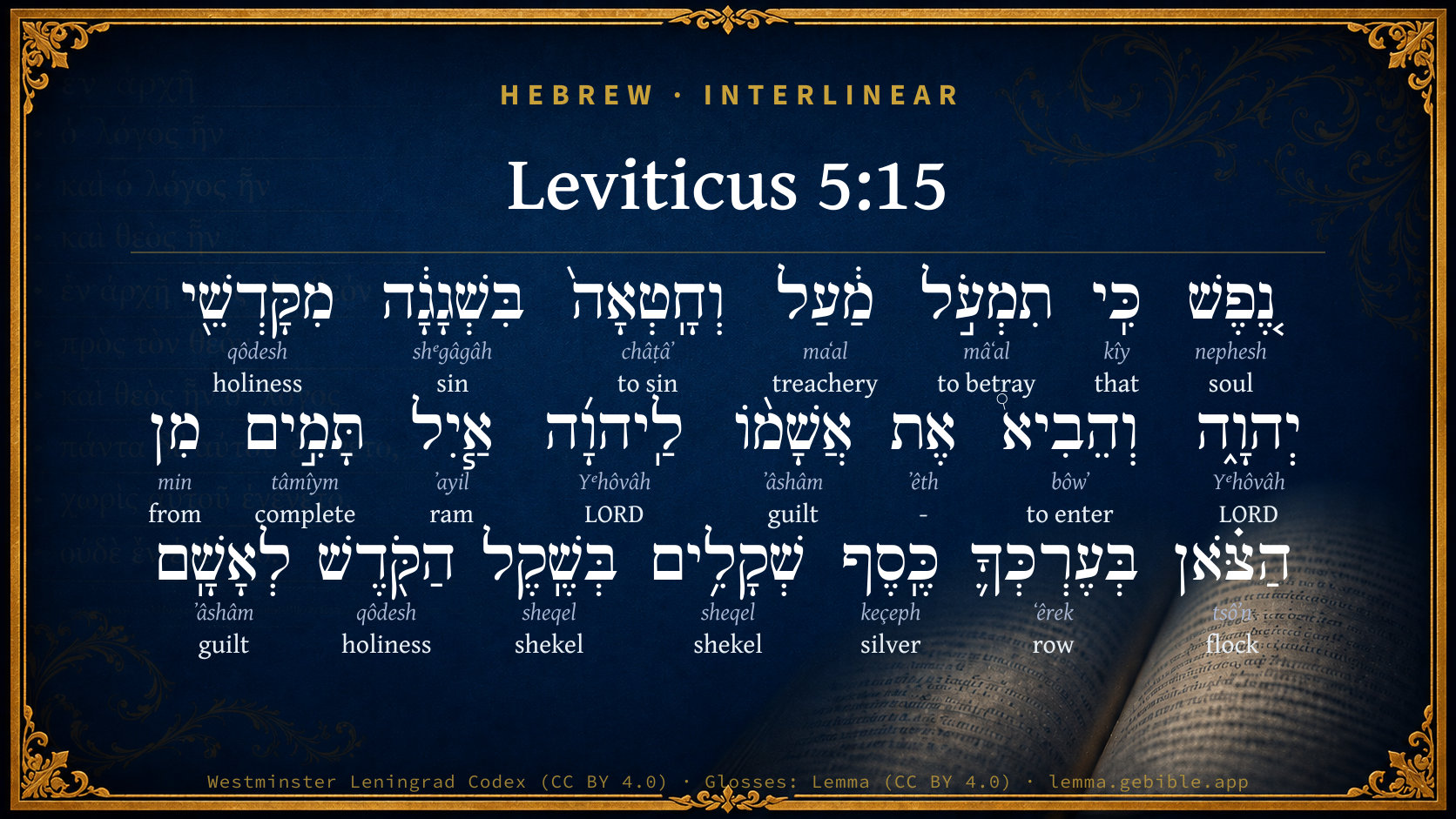
Hebrew (Westminster Leningrad Codex) Leviticus 5:15 appears in the Hebrew Old Testament. The text above is from the Westminster Leningrad Codex. Each word links to its Strong’s number, a concise gloss, and parsing drawn from the Open Scriptures Hebrew Bible morphology. Click any word for its full Brown-Driver-Briggs (BDB) entry.
Download image
Cite this verse

Leviticus 5:15 (World English Bible). Public Domain. Lemma interlinear Bible study tool, https://lemma.gebible.app/v/leviticus/5/15.

Show BibTeX & RIS
BibTeX
RIS
English Translation
"If anyone commits a trespass, and sins unwittingly, in the holy things of Yahweh; then he shall bring his trespass offering to Yahweh, a ram without blemish from the flock, according to your estimation in silver by shekels, after the shekel of the sanctuary, for a trespass offering.
World English Bible · Public Domain
Highlights
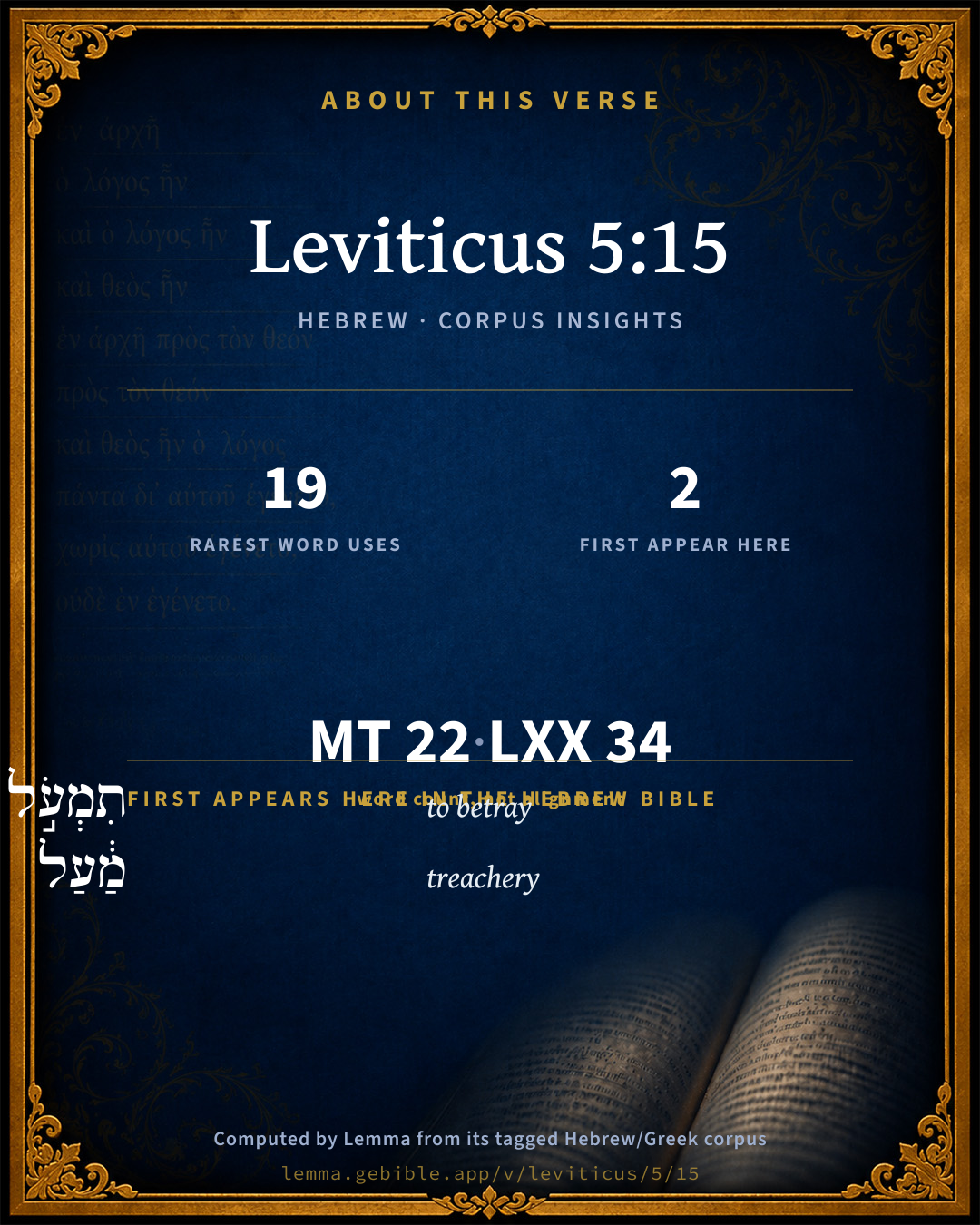
  • 2 first appearances in the Hebrew Bible
Full analysis ↓
Download a study sheet

One document with this verse’s original text, its word-by-word gloss line, the meaning frame, cross-references with their text, attributed commentary, and full source and license credits — printable, and it pastes into notes with its structure intact.

This verse Autodidact and up

Study sheet (.html) Plain text (.txt)

A passage Seminary Student

Up to 50 verses in one chapter. A passage sheet keeps up to 6 commentary sources and 12 cross-references per verse, in the order this page ranks them, and says so on the sheet whenever that leaves anything out. Ask for a single verse and you get the Autodidact verse sheet above.

Everything on this page stays free to read, with no account — the sheet is a download of what is already on screen, not access to it.

Want to remove ads? Support Godless Engineer
Compare translations 3

The same verse in 3 English versions, stacked beneath the original-language interlinear above. Click any original word for its lexicon entry.

Each is an independent rendering of the whole verse — the interlinear is not word-aligned to these translations.

Highlighted words mark where these versions differ — a whole-verse word diff, not a word-by-word alignment.

  • World English Bible Public Domain
    "If anyone commits a trespass, and sins unwittingly, in the holy things of Yahweh; then he shall bring his trespass offering to Yahweh, a ram without blemish from the flock, according to your estimation in silver by shekels, after the shekel of the sanctuary, for a trespass offering.
  • King James Version Public Domain
    If a soul commit a trespass, and sin through ignorance, in the holy things of the LORD; then he shall bring for his trespass unto the LORD a ram without blemish out of the flocks, with thy estimation by shekels of silver, after the shekel of the sanctuary, for a trespass offering.
  • unfoldingWord Literal Text CC BY-SA 4.0
    “A person, when he trespasses a trespass and he sins by mistake from the holy of Yahweh, then he shall bring his guilt to Yahweh, a perfect ram from the flock, in your valuation, silver shekels, in the shekel of the Holy, for a guilt offering.

unfoldingWord Literal Text — © unfoldingWord, licensed CC BY-SA 4.0. Word-aligned USFM3 via Door43 (git.door43.org/unfoldingWord/en_ult).

Versions to compare (up to 4)

3 of 4 selected

Show all 18 translations

Every available English version of this verse, each an independent rendering of the whole verse.

  • World English Bible Public Domain
    "If anyone commits a trespass, and sins unwittingly, in the holy things of Yahweh; then he shall bring his trespass offering to Yahweh, a ram without blemish from the flock, according to your estimation in silver by shekels, after the shekel of the sanctuary, for a trespass offering.
  • Berean Standard Bible Public Domain
    “If someone acts unfaithfully and sins unintentionally against any of the LORD’s holy things, he must bring his guilt offering to the LORD: an unblemished ram from the flock, of proper value in silver shekels according to the sanctuary shekel; it is a guilt offering.
  • Majority Standard Bible Public Domain
    “If someone acts unfaithfully and sins unintentionally against any of the LORD’s holy things, he must bring his guilt offering to the LORD: an unblemished ram from the flock, of proper value in silver shekels according to the sanctuary shekel; it is a guilt offering.
  • King James Version Public Domain
    If a soul commit a trespass, and sin through ignorance, in the holy things of the LORD; then he shall bring for his trespass unto the LORD a ram without blemish out of the flocks, with thy estimation by shekels of silver, after the shekel of the sanctuary, for a trespass offering.
  • American Standard Version (1901) Public Domain
    If any one commit a trespass, and sin unwittingly, in the holy things of Jehovah; then he shall bring his trespass-offering unto Jehovah, a ram without blemish out of the flock, according to thy estimation in silver by shekels, after the shekel of the sanctuary, for a trespass-offering:
  • Revised Version (1885) Public Domain
    If any one commit a trespass, and sin unwittingly, in the holy things of the LORD; then he shall bring his guilt offering unto the LORD, a ram without blemish out of the flock, according to thy estimation in silver by shekels, after the shekel of the sanctuary, for a guilt offering:
  • Geneva Bible (1599) Public Domain
    If any person transgresse and sinne through ignorance by taking away things consecrated vnto the Lord, hee shall then bring for his trespasse offring vnto the Lord a ramme without blemish out of the flocke, worth two shekels of siluer by thy estimation after the shekel of the Sanctuarie, for a trespasse offring.
  • Douay-Rheims (1899) Public Domain
    If any one shall sin through mistake, transgressing the ceremonies in those things that are sacrificed to the Lord, he shall offer for his offence a ram without blemish out of the flocks, that may be bought for two sicles, according to the weight of the sanctuary:
  • Young's Literal Translation Public Domain
    `When a person committeth a trespass, and hath sinned through ignorance against the holy things of Jehovah, then he hath brought in his guilt-offering to Jehovah, a ram, a perfect one, out of the flock, at thy valuation `in' silver -- shekels by the shekel of the sanctuary -- for a guilt-offering.
  • Literal Standard Version CC BY-SA 4.0
    “When a person commits a trespass, and has sinned through ignorance against the holy things of YHWH, then he has brought in his guilt-offering to YHWH, a ram, a perfect one, out of the flock, at your valuation [in] silver—shekels by the shekel of the holy place—for a guilt-offering.
  • Unlocked Literal Bible CC BY-SA 4.0
    “If anyone sins and acts unfaithfully in regard to the things that belong to Yahweh, but did so unintentionally, then he must bring his guilt offering to Yahweh. This offering must be a ram without blemish from the flock; its value must be appraised in silver shekels—the shekel of the sanctuary—as a guilt offering.
  • unfoldingWord Literal Text CC BY-SA 4.0
    “A person, when he trespasses a trespass and he sins by mistake from the holy of Yahweh, then he shall bring his guilt to Yahweh, a perfect ram from the flock, in your valuation, silver shekels, in the shekel of the Holy, for a guilt offering.
  • Darby Bible Public Domain
    If any one act unfaithfully and sin through inadvertence in the holy things of Jehovah, then he shall bring his trespass-offering to Jehovah, a ram without blemish out of the small cattle, according to thy valuation by shekels of silver, according to the shekel of the sanctuary, for a trespass-offering.
  • World Messianic Bible Public Domain
    “If anyone commits a trespass, and sins unwittingly regarding the LORD’s holy things, then he shall bring his trespass offering to the LORD: a ram without defect from the flock, according to your estimation in silver by shekels, according to the shekel of the sanctuary, for a trespass offering.
  • Webster's Bible Public Domain
    If a soul shall commit a trespass, and sin through ignorance, in the holy things of the LORD; then he shall bring for his trespass to the LORD a ram without blemish out of the flocks, with thy estimation by shekels of silver, after the shekel of the sanctuary, for a trespass-offering:
  • Free Bible Version CC BY-SA 4.0
    “If any of you neglects unintentionally anything that the Lord has declared belong to him and are holy, you must bring your guilt offering to the Lord: a ram without defects from your herd or the equivalent value in silver shekels (according to the sanctuary shekel standard). It is a guilt offering.
  • Bible in Basic English Public Domain
    If anyone is untrue, sinning in error in connection with the holy things of the Lord, let him take his offering to the Lord, a male sheep from the flock, without any mark, of the value fixed by you in silver by shekels, by the scale of the holy place.
  • JPS Tanakh (1917) Public Domain
    If any one commit a trespass, and sin through error, in the holy things of the LORD, then he shall bring his forfeit unto the LORD, a ram without blemish out of the flock, according to thy valuation in silver by shekels, after the shekel of the sanctuary, for a guilt-offering.

Literal Standard Version (2020), Covenant Press — licensed CC BY-SA 4.0. Text via the HelloAO Bible API (eBible.org). Unlocked Literal Bible (unfoldingWord) — licensed CC BY-SA 4.0. Text via the HelloAO Bible API (eBible.org). unfoldingWord Literal Text — © unfoldingWord, licensed CC BY-SA 4.0. Word-aligned USFM3 via Door43 (git.door43.org/unfoldingWord/en_ult). Free Bible Version, Dr. Jonathan Gallagher — licensed CC BY-SA 4.0. Text via the HelloAO Bible API (eBible.org).

Word by word

More ways to search: Search by grammar → Find every occurrence → Compare this word →

Practice this passage: Drill this verse → Learn its vocabulary →

בִּשְׁגָגָ֔ה
shᵉgâgâh
H7684
“in/at · sin”
Preposition + Noun, Common, Feminine, Singular, Absolute
Part of Speech
Preposition + Noun
Type
Common
Gender
Feminine
Number
Singular
State
Absolute
Full BDB Definition

Origin: from H7683

TWOT: 2324a

sin, sin of error or inadvertence, inadvertent sin - error
  1. נֶ֚פֶשׁ nephesh H5315 “soul” Noun, Common, Both, Singular, Absolute
  2. כִּֽי kîy H3588 “that” Conjunction
  3. תִמְעֹ֣ל mâʻal H4603 “to betray” Verb, Qal, Imperfect, 3rd Person, Feminine, Singular
  4. מַ֔עַל maʻal H4604 “treachery” Noun, Common, Masculine, Singular, Absolute
  5. וְחָֽטְאָה֙ châṭâʼ H2398 “and · to sin” Conjunction + Verb, Qal, Sequential Perfect, 3rd Person, Feminine, Singular
  6. מִקָּדְשֵׁ֖י qôdesh H6944 “from · holy things of” Preposition + Noun, Common, Masculine, Plural, Construct
  7. יְהוָ֑ה Yᵉhôvâh H3068 “LORD” Noun, Proper
  8. וְהֵבִיא֩ bôwʼ H935 “and · to enter” Conjunction + Verb, Hiphil, Sequential Perfect, 3rd Person, Masculine, Singular
  9. אֶת ʼêth H853 “-” Particle, Direct Object
  10. אֲשָׁמ֨וֹ ʼâshâm H817 “guilt · his” Noun, Common, Masculine, Singular, Construct + Suffix, Personal, 3rd Person, Masculine, Singular
  11. לַֽיהוָ֜ה Yᵉhôvâh H3068 “to/for · LORD” Preposition + Noun, Proper
  12. אַ֧יִל ʼayil H352 “ram” Noun, Common, Masculine, Singular, Absolute
  13. תָּמִ֣ים tâmîym H8549 “complete” Adjective, Adjective, Masculine, Singular, Absolute
  14. מִן min H4480 “from” Preposition
  15. הַצֹּ֗אן tsôʼn H6629 “the · flock” Particle, Definite Article + Noun, Common, Both, Singular, Absolute
  16. בְּעֶרְכְּךָ֛ ʻêrek H6187 “in/at · row · your” Preposition + Noun, Common, Masculine, Singular, Construct + Suffix, Personal, 2nd Person, Masculine, Singular
  17. כֶּֽסֶף keçeph H3701 “silver of” Noun, Common, Masculine, Singular, Construct
  18. שְׁקָלִ֥ים sheqel H8255 “shekels” Noun, Common, Masculine, Plural, Absolute
  19. בְּשֶֽׁקֶל sheqel H8255 “in/at · shekel of” Preposition + Noun, Common, Masculine, Singular, Construct
  20. הַקֹּ֖דֶשׁ qôdesh H6944 “the · holiness” Particle, Definite Article + Noun, Common, Masculine, Singular, Absolute
  21. לְאָשָֽׁם ʼâshâm H817 “to/for · guilt” Preposition + Noun, Common, Masculine, Singular, Absolute

About this verse

These counts appear in no published source. They are computed here, from the morphology-tagged text and Lemma’s own curated glosses. What Lemma adds →

22
words
18
distinct lemmas
Pentateuch
section

Notable vocabulary

The rarest word here is בִּשְׁגָגָ֔ה sin H7684 — appearing just 19 times in the whole Hebrew Bible.

First appearance in Scripture

These words make their first canonical appearance in the Hebrew Bible here:

  • תִמְעֹ֣ל to betray H4603
  • מַ֔עַל treachery H4604

Shared distinctive vocabulary

בִּשְׁגָגָ֔ה sin H7684 occurs in 18 verses of the Hebrew Bible. Also found in:

Grammatical profile

  • 3 verbs
  • 15 nouns
  • 1 adjective
  • 1 preposition
  • 1 conjunction
  • 1 particle

Verb forms

  • תִמְעֹ֣ל Qal · Imperfect
  • וְחָֽטְאָה֙ Qal · Sequential Perfect
  • וְהֵבִיא֩ Hiphil · Sequential Perfect

Repetition

Words recur within this verse — often emphatic in Hebrew:

  • מִקָּדְשֵׁ֖י holiness H6944 ×2
  • יְהוָ֑ה LORD H3068 ×2
  • אֲשָׁמ֨וֹ guilt H817 ×2
  • שְׁקָלִ֥ים shekel H8255 ×2

Hebrew & Septuagint length

In English translation the verse runs 48 words from the Hebrew and 55 from the Septuagint (LXX English) — closely comparable.

A rough comparison of the two English renderings, which tokenize alike — not a word-level alignment.

Word counts can differ between the Hebrew and the Greek without any difference in meaning — e.g. the Hebrew direct-object marker אֵת has no separate Greek word, and Greek often adds the article ὁ.

In the original languages it is 22 Hebrew tokens and 34 Greek tokens — but the two are counted differently (Hebrew bundles its prefixes and suffixes into one token; the Greek is in lemma form), so that isn’t a like-for-like length.

Cross-references

23

Topical passages linked to Leviticus 5:15 in the Treasury of Scripture Knowledge — connected by theme and wording, ordered by reader-vote popularity; previews shown in the World English Bible.

  • Exodus 30:13 They shall give this, everyone who passes over to those who are numbered, half a shekel after the shekel of the sanctuary; (the shekel is twenty gerahs;) half a shekel for an offering to Yahweh.
  • Leviticus 4:2 "Speak to the children of Israel, saying, 'If anyone sins unintentionally, in any of the things which Yahweh has commanded not to be done, and does any one of them:
  • Leviticus 6:6 He shall bring his trespass offering to Yahweh, a ram without blemish from the flock, according to your estimation, for a trespass offering, to the priest.
  • Leviticus 7:1 "'This is the law of the trespass offering. It is most holy.
  • Leviticus 7:6 Every male among the priests may eat of it. It shall be eaten in a holy place. It is most holy.
  • Deuteronomy 15:19–20 All the firstborn males that are born of your herd and of your flock you shall sanctify to Yahweh your God: you shall do no work with the firstborn of your herd, nor shear the firstborn of your flock.
  • Ezra 10:19 They gave their hand that they would put away their wives; and being guilty, [they offered] a ram of the flock for their guilt.
  • Leviticus 5:1–2 "'If anyone sins, in that he hears the voice of adjuration, he being a witness, whether he has seen or known, if he doesn't report it, then he shall bear his iniquity.
  • Leviticus 5:16 He shall make restitution for that which he has done wrong in the holy thing, and shall add a fifth part to it, and give it to the priest; and the priest shall make atonement for him with the ram of the trespass offering, and he will be forgiven.
  • Leviticus 5:18 He shall bring a ram without blemish from of the flock, according to your estimation, for a trespass offering, to the priest; and the priest shall make atonement for him concerning the thing in which he sinned and didn't know it, and he will be forgiven.
  • Leviticus 10:17–18 "Why haven't you eaten the sin offering in the place of the sanctuary, seeing it is most holy, and he has given it you to bear the iniquity of the congregation, to make atonement for them before Yahweh?
  • Leviticus 22:1–16 Yahweh spoke to Moses, saying,
  • Leviticus 24:5–9 "You shall take fine flour, and bake twelve cakes of it: two tenth parts of an ephah shall be in one cake.
  • Leviticus 26:2–8 "'You shall keep my Sabbaths, and have reverence for my sanctuary. I am Yahweh.
  • Leviticus 26:12–13 I will walk among you, and will be your God, and you will be my people.
  • Leviticus 26:17–18 I will set my face against you, and you will be struck before your enemies. Those who hate you will rule over you; and you will flee when no one pursues you.
  • Leviticus 26:23–27 "'If by these things you won't be reformed to me, but will walk contrary to me;
  • Leviticus 27:9–33 "'If it is an animal, of which men offer an offering to Yahweh, all that any man gives of such to Yahweh becomes holy.
  • Numbers 5:8 But if the man has no kinsman to whom restitution may be made for the guilt, the restitution for guilt which is made to Yahweh shall be the priest's; besides the ram of the atonement, by which atonement shall be made for him.
  • Numbers 18:9–32 This shall be your of the most holy things, [reserved] from the fire: every offering of theirs, even every meal-offering of theirs, and every sin-offering of theirs, and every trespass-offering of theirs, which they shall render to me, shall be most holy for you and for your sons.
  • Deuteronomy 12:5–12 But to the place which Yahweh your God shall choose out of all your tribes, to put his name there, even to his habitation shall you seek, and there you shall come;
  • Deuteronomy 12:26 Only your holy things which you have, and your vows, you shall take, and go to the place which Yahweh shall choose:
  • Deuteronomy 26:1–15 It shall be, when you are come in to the land which Yahweh your God gives you for an inheritance, and possess it, and dwell therein,

Cross-references courtesy of OpenBible.info (CC BY 4.0).

Hebrew and Greek witnesses Masoretic Hebrew ↔ Greek Septuagint

The same verse in the two great witnesses to the Old Testament, shown verse-for-verse.

These are two independent witnesses, not word-aligned to each other, and the Septuagint is shown in lemma (dictionary) form.

Hebrew Leviticus 5:15 Masoretic · Westminster Leningrad Codex

נֶ֚פֶשׁ כִּֽי תִמְעֹ֣ל מַ֔עַל וְחָֽטְאָה֙ בִּשְׁגָגָ֔ה מִקָּדְשֵׁ֖י יְהוָ֑ה וְהֵבִיא֩ אֶת אֲשָׁמ֨וֹ לַֽיהוָ֜ה אַ֧יִל תָּמִ֣ים מִן הַצֹּ֗אן בְּעֶרְכְּךָ֛ כֶּֽסֶף שְׁקָלִ֥ים בְּשֶֽׁקֶל הַקֹּ֖דֶשׁ לְאָשָֽׁם

"If anyone commits a trespass, and sins unwittingly, in the holy things of Yahweh; then he shall bring his trespass offering to Yahweh, a ram without blemish from the flock, according to your estimation in silver by shekels, after the shekel of the sanctuary, for a trespass offering.

World English Bible · Public Domain

Greek LXX Leviticus 5:15 Septuagint · lemma form

ψυχή ἐάν λανθάνω αὐτός λήθη καί ἁμαρτάνω ἀκουσίως ἀπό ὁ ἅγιος κύριος καί φέρω ὁ πλημμέλεια αὐτός ὁ κύριος κριός ἄμωμος ἐκ ὁ πρόβατον τιμή ἀργύριον σίκλος ὁ σίκλος ὁ ἅγιος περί ὅς πλημμελέω

The soul which shall be really unconscious, and shall sin unwillingly in any of the holy things of the Lord, shall even bring to the Lord for his transgression, a ram of the flock without blemish, valued according to shekels of silver according to the shekel of the sanctuary, for his transgression wherein he transgressed.

LXX2012 (modern English Septuagint) · Public Domain

On this verse, Haydock's Catholic Bible Commentary discusses the Septuagint’s reading. Read the note in Commentary ↓

Hebrew: Westminster Leningrad Codex (CC BY 4.0). Greek: Septuagint (public domain); English from LXX2012 (modern English Septuagint) (Public Domain). How the Septuagint differs from the Hebrew →

Targum (Aramaic paraphrase)

2

The Targum is the ancient Jewish Aramaic paraphrase of the Hebrew Scriptures — an interpretive translation, not the Hebrew text itself. Onkelos (literal) and Pseudo-Jonathan (expansive) render the Torah, and Jonathan the Prophets. Coverage is partial: where no permissively-licensed English translation exists for a verse, only the Aramaic is shown. This is verse-level text, not a word-by-word alignment to the Hebrew.

  1. Targum Onkelos Torah (Genesis–Deuteronomy)
    אֱנַשׁ אֲרֵי יְשַׁקַר שְׁקַר וְיֵחוֹב בְּשָׁלוּ מִקוּדְשַׁיָא דַיְיָ וְיַיְתִי יָת אַשְׁמֵהּ קֳדָם יְיָ דְכַר שְׁלִים מִן עָנָא בְּפֻרְסָנֵהּ כְּסַף סִלְעִין בְּסִלְעֵי קוּדְשָׁא לַאֲשָׁמָא

    (no public-domain English translation for this verse)

    Targum Onkelos — Aramaic: “Onkelos Genesis” (public domain); “Onkelos Exodus” (public domain); “Onkelos Leviticus” (public domain); “Onkelos Numbers” (public domain); “Onkelos Deuteronomy” (public domain). English: “Sefaria Community Translation” (CC0 1.0 (public-domain dedication)); “J.W. Etheridge. The Targums of Onkelos and Jonathan Ben Uzziel on the Pentateuch. London: Longmans, Green, 1862” (public domain). Text via Sefaria.

  2. Targum Pseudo-Jonathan Torah (Genesis–Deuteronomy)
    בַּר נַשׁ אֲרוּם יְשַׁקֵר שְׁקַר וְיֵיחוֹב בְּשָׁלוּ וְיִתְהֲנִי מִן קוּדְשַׁיָא דַיְיָ וְיַיְתֵי יַת קוּרְבַּן אַשְׁמֵיהּ לִקְדָם יְיָ דְכַר שְׁלִים מִן עֲנָא בְּעִילוּיָיהּ כְּסַף הֵי כִּדְמֵי הַיְנִית קוּדְשָׁא דְאִתְהֲנֵי סִילְעִין בְּסִלְעֵי קוּדְשָׁא לְקָרְבַּן אֲשָׁמָא

    When a man falsifieth with falsity and sinneth, though with inadvertence, in making misuse of the holy things of the Lord, he shall bring the oblation for his trespass to the presence of the Lord, an unblemished ram from the flock, with an estimation in silver according to the value of the holy thing which hath been misappropriated, in shekels, after the shekels of the sanctuary, for a trespass offering.

    Targum Pseudo-Jonathan — Aramaic: “Targum Jonathan on Genesis” (public domain); “Targum Jonathan on Exodus” (public domain); “Targum Jonathan on Leviticus” (public domain); “Targum Jonathan on Numbers” (public domain); “Targum Jonathan on Deuteronomy” (public domain). English: “The Targum of Jonathan ben Uzziel, trans. J. W. Etheridge, London, 1862” (public domain). Text via Sefaria.

Commentary

Notes on Leviticus 5:15 from classic Christian and Jewish commentators (each source and its license shown beneath its notes). The classic Christian expositions comment on the surrounding passage and are grouped to its opening verse, so a note may address several verses; the Jewish commentaries on the Tanakh (Rashi and others) are per-verse, so they appear only where the commentator wrote on this verse.

Lemma curates 59 commentaries, every one of them public domain or Creative Commons licensed, each selected and text-cleaned for this edition rather than reprinted as found. About our sources →

Ellicott's Commentary for English Readers

(15) If a soul commit a trespass.—The word used here for trespass is not the same which is so rendered in Lev_5:19, and from which the noun rendered in this very chapter by trespass offering (Lev_5:6-7; Lev_5:15-16; Lev_5:19), is derived. It literally denotes to cover, then to act covertly, to be faithless, especially in matters of a sacred covenant made either with God (Lev_26:40; Num_31:16; Deu_32:51, &c.), or between husband and wife (Num_5:12; Num_5:27).

And sin through ignorance.—If at the time of its committal he did not know that it was a transgression. (See Lev_4:2.)

In the holy things of the Lord.—That is, inadvertently keeping back the things which belong to the sanctuary, and to the service of the Lord, as, for instance, the tithes, the firstfruits, or not consecrating or redeeming his firstborn (Exo_28:38; Num_5:6-8).

A ram without blemish.—For committing any of these transgressions presumptuously, the transgressor incurred the punishment of excision (Num_15:30; Heb_10:28); but when they were done unawares, he was to bring a ram as a sacrifice. According to the rules which obtained during the second Temple, it must be over thirty-one days in the second year of its age. It was of greater value than the female sheep. The sacrifice for a trespass in holy things, though ignorantly committed, was therefore more costly than for the sin of ignorance mentioned in Lev_5:6.

With thy estimation by shekels of silver.—That is, according to the valuation of Moses, to whom this was primarily addressed, the ram is to be so grown up as to be worth several, or at least two shekels. The act of valuing was transferred by Moses to the officiating priests. (See Lev_27:8; Lev_27:12; Num_18:16.) For the shekels of the sanctuary see Exo_30:13.

A Bible Commentary for English Readers, edited by Charles John Ellicott (1878–1897) — public domain. Text from a community e-Sword module.

Trapp's Complete Commentary

John Trapp

Lev 5:15 If a soul commit a trespass, and sin through ignorance, in the holy things of the LORD; then he shall bring for his trespass unto the LORD a ram without blemish out of the flocks, with thy estimation by shekels of silver, after the shekel of the sanctuary, for a trespass offering:

Ver. 15. In the holy things of the Lord.] Things consecrate to him, by robbing and wronging of God and his priests; be it but through ignorance or error. For to do such a thing presumptuously was death, {Num 15:30} and by the laws of the twelve tables in Rome, such were to be punished as parricides. {a}

{a} Sacrum qui clepserit, rapseritve, parricida esto.

John Trapp, A Commentary or Exposition upon All the Books of the Old and New Testament (1647–1656) — public domain. Text from a community e-Sword module.

Joseph Benson's Commentary

Lev 5:15. A trespass — Against the Lord and his priests. Through ignorance — For if a man did it knowingly, he was to be cut off, Num 15:30. In the holy things — In things consecrated to God, and to holy uses; these were many, and by various ways a man might be guilty, even unwittingly, with respect to them; such as tithes and first-fruits, or any thing due or devoted to God, which possibly a man might either withhold, or employ to some common use. A ram — A more chargeable sacrifice than the former, as the sin of sacrilege was greater. With thy estimation — As thou, O priest, shalt esteem or rate it; and at present, thou, O Moses, for he as yet performed the priest’s part. And this was an additional charge and punishment to him; besides the ram, he was to pay for the holy thing which he had withheld or abused, so many shekels of silver as the priests should esteem proportionable to it.

Joseph Benson's Commentary on the Old and New Testaments (1811–1818) — public domain. Text from a community e-Sword module.

Tyndale Open Study Notes

Tyndale Open Resources

5:15 unintentionally defiling: Damage to sacred property was distinguished from damage to secular property. The sacrifice was effective only if the damage to sacred property had been committed accidentally. Deliberate damage, such as vandalism, to something sacred was blasphemous. As with other deliberate sins (Num 15:30-31), no means was specified for its atonement. No devout believer would defiantly continue in sin (see 1 Jn 3:9). • The sanctuary shekel was not a coin but a standardized unit for measuring weight. It was used to evaluate the ram being offered. Some scholars suggest that this text permits the substitution of the appropriate amount of silver for the ram.

Tyndale Open Study Notes — © Tyndale Open Resources, licensed CC BY-SA 4.0. Text via the HelloAO Bible API.

Geneva Bible (1599)

Geneva Bible translators

By the estimation of the Priest, Lev. 27:12.

As touching the firstfruits or tithes, due to the Priests and Levites.

Geneva Bible (1599) marginal notes — public domain. Text via Bolls.life.

Jamieson, Fausset & Brown

Robert Jamieson, A. R. Fausset & David Brown

sin through ignorance, in the holy things of the Lord, &c.--This is a case of sacrilege committed ignorantly, either in not paying the full due of tithes, first-fruits, and similar tribute in eating of meats, which belonged to the priests alone--or he was required, along with the restitution in money, the amount of which was to be determined by the priest, to offer a ram for a trespass offering, as soon as he came to the knowledge of his involuntary fraud.

Jamieson, Fausset & Brown — Commentary Critical and Explanatory on the Whole Bible (1871) — public domain (CC PDM 1.0). Text via the HelloAO Bible API.

Adam Clarke's Commentary

Verse 15. In the holy things of the Lord] This law seems to relate particularly to sacrilege, and defrauds in spiritual matters; such as the neglect to consecrate or redeem the firstborn, the withholding of the first-fruits, tithes, and such like; and, according to the rabbins, making any secular gain of Divine things, keeping back any part of the price of things dedicated to God, or withholding what man had vowed to pay. See a long list of these things in Ainsworth.

With thy estimation] The wrong done or the defraud committed should be estimated at the number of shekels it was worth, or for which it would sell. These the defrauder was to pay down, to which he was to add a fifth part more, and bring a ram without blemish for a sin-offering besides. There is an obscurity in the text, but this seems to be its meaning.

Adam Clarke's Commentary on the Bible (1810–1826) — public domain. Text from a community e-Sword/MySword module.

The Cambridge Bible for Schools and Colleges

gen. ed. J. J. S. Perowne

Chs. Lev_5:14 to Lev_6:7. The Guilt-Offering

Three cases where a Guilt-Offering should be brought are here specified:

(a) 15, 16; if part of what is due to the Lord has been withheld.

15. commit a trespass] The Heb. word (mâ‘al) here and in Lev_6:2 is different from that which is rendered ‘be guilty,’ ‘bring guilt,’ and ‘guilt offering’ (trespass offering A.V.) in Lev_4:3 to Lev_5:7 (’âshâm). It means ‘to deal deceitfully.’

in the holy things of the Lord] i.e. by keeping back what is His due (e.g. tithes or firstfruits). The offender shall make restitution of what he has kept back unwittingly, adding a fifth part, and shall also bring as a Guilt-Offering a ram of sufficient value estimated after the shekel of the sanctuary. According to tradition this shekel was double the value of the ordinary shekel, but see A. R. S. Kennedy’s Art. Money, in HDB. iii. 422, or Lev. (Cent. Bible) p. 58, where he makes it to be ‘the so-called Phœnician silver shekel of 224 grains, and its value about 2 Samuel 9 d.’ It thus would weigh but little more than the Jewish shekels now extant.

according to thy estimation] also in Lev_5:18 and Lev_6:6.

in silver by shekels] i.e. the ram must be worth at the least two shekels. According to Tal. Bab. (Zebâḥîm 90 b) it must be two years old.

The Cambridge Bible for Schools and Colleges (gen. ed. J. J. S. Perowne; Cambridge University Press, 1878–1918) — public domain. Text from a community e-Sword module.

John Gill's Exposition

If a soul commit a trespass, and sin through ignorance in the holy things of the Lord,.... In the payment of tithes, or offering first fruits as he ought, by withholding them, or any part of them, or through eating of sacred things he ought not:

then shall he bring for his trespass unto the Lord; for it being a trespass in holy things, it might be properly called a trespass to or against the Lord; unless this is rather to be understood of the offering brought to the Lord for his trespass as follows:

a ram without blemish out of the flocks; out of the sheep and not the goats, as Ben Gersom observes; and this being for sacrifice, or for a trespass in holy things though ignorantly done, an offering of more value is required than for sins of ignorance in other cases, Lev 5:6 a type of Christ, who for his strength may be compared to a ram, and to one without blemish, for his purity and holiness, and to a choice one, selected out of the flock, for his being chosen out from among the people:

with thy estimation by shekels of silver, after the shekel of the sanctuary, for a trespass offering; that is, either an estimation was to be taken of the damage done in the holy things, an account of which was to be brought along with the ram, and the cost paid; or else the ram brought was to be of the value of, or worth shekels of silver; and the least of many being two, as Aben Ezra and Ben Gersom observe, the sense is, that the ram brought for the trespass offering should be at least worth two shekels of silver; so Jarchi and Ben Gersom.

John Gill's Exposition of the Whole Bible (1746–1763) — public domain (CC PDM 1.0). Text via the HelloAO Bible API.

Albert Barnes' Notes on the Bible

Commit a trespass - Rather, here and in Lev 6:2, perpetrate a wrong. The word is different from that rendered trespass elsewhere in these chapters.

Through ignorance - Through inadvertence. See Lev 4:2 note.

In the holy things of the Lord - The reference is to a failure in the payment of firstfruits, tithes or fees of any kind connected with the public service of religion by which the sanctuary suffered loss; compare Num 5:6-8.

Shekel of the sanctuary - See Exo 38:24 note.

Albert Barnes' Notes on the Bible (1834–1885) — public domain. Text from a community e-Sword/MySword module.

Haydock's Catholic Bible Commentary

The ceremonies: omitted in Hebrew and Septuagint --- Sanctified [Sacrificed?], neglecting to pay the first-fruits; or, by mistake, eating any of the victims reserved for God, or for the priests. --- Two sicles. St. Jerome seems to have read in the dual number, whereas the Hebrew pointed copies have sicles indefinitely; and the Rabbins understand two, when the word is plural and undetermined. Theodoret reads fifty, which some maintain is the ancient translation of the Septuagint, though it is not found in any of our copies. Hebrew may be rendered "a ram (or) according to thy estimation, sicles of silver." The particle or is sometimes understood. It is probable that when the fault was considerable, a ram was to be sacrificed, and restitution made of what was due with the fifth part besides; but if the fault was small, the priest determined how many sicles were to be presented for sacred purposes. --- Sanctuary. See Exodus xxx. 13.

George Leo Haydock (1774–1849), Haydock's Catholic Family Bible and Commentary, 1859 edition — public domain. Excludes Psalms (Douay-Rheims chapter numbering differs from Protestant) and Deuterocanonical books (Catholic canon only).

Matthew Poole's English Annotations

If a soul commit a trespass against the Lord and his priests.

And sin through ignorance; for if a man did it knowingly, he was to be cut off, Num 15:30.

In the holy things of the Lord; in things consecrated to God, and to holy uses; of which see Lev 22:2; such as tithes and first-fruits, or any things due, or devoted, or offered to God, which possibly a man might either withhold, or employ to some common use. See Exo 34:26; Deu 12:17,18; 15:19; Jer 2:3.

A ram was a more chargeable sacrifice than the former, as the sin of sacrilege was greater. With thy estimation; as thou shalt esteem or rate it, thou, O priest, as appears from Lev 5:16,18; 6:6; 22:14; 27:2,3; and at present, thou, O Moses, Lev 27:3, for he as yet performed the priest’s part. And this either,

1. May be referred to the ram, which was to be of such a price and worth as the priest should appoint. Or rather,

2. Is an additional charge and punishment to him, which, besides the ram, he was to pay for the holy thing which he had withheld or abused, so many shekels of silver ms the priest should esteem proportionable to it; which was, as it were, another part or branch of his trespass-offering.

The shekel of the sanctuary; of which see Poole "Gen 23:15".

Matthew Poole's English Annotations on the Holy Bible (1683–1685) — public domain. Text from a community e-Sword/MySword module.

John Wesley's Explanatory Notes

A trespass - Against the Lord and his priests. Through ignorance - For if a man did it knowingly, he was to be cut off, Num. xv, 30. In the holy things - In things consecrated to God, and to holy uses; such as tithes and first-fruits, or any things due, or devoted to God, which possibly a man might either with-hold, or employ to some common use. A ram - A more chargeable sacrifice than the former, as the sin of sacrilege was greater. With thy estimation - As thou shalt esteem or rate it, thou, O priest; and at present, thou, O Moses, for he as yet performed the priest's part. And this was an additional charge and punishment to him; besides the ram, he was to pay for the holy thing which he had with-held or abused, so many shekels of silver as the priest should esteem proportionable to it.

John Wesley, Explanatory Notes Upon the Whole Bible (1754–1765) — public domain. Text via the GEBible commentary corpus.

Rashi

Rabbi Shlomo Yitzchaki (Rashi)

כי תמעל מעל — The term מעל everywhere in Scripture denotes “changing”. Similarly it stales, (I Chronicles 5:25) “And they committed a מעל against the God of their fathers; for they went a whoring after the gods of the people of the land” (i. e. they exchanged Him for their gods). And similarly it states of the faithless wife, (Numbers 5:12) “[If any man’s wife go aside] and commit a מעל in respect to him” (i. e. she changes her relationship to him for one to another man) (Sifra, Vayikra Dibbura d'Chovah, Section 11 1; Meilah 18a).

‎'‎‎וחטאה כשגגה מקדשי ה‎‎ AND SIN IN ERROR, CONCERNING THE HOLY THINGS OF THE LORD — i. e. that one has derived some benefit from (made use of) a holy thing. And where is this prohibited, that Scripture should describe it here as sin? But the expression חטא is mentioned here and חטא is mentioned further on in the case of misuse of תרומה (Leviticus 22:9): “[They — the priests — shall therefore keep my charge] not to eat תרומה when they are in a state of uncleanness: (see Rashi thereon), lest they bear sin (חטא) for it”. How is it there? Scripture forbids it! (See Rashi on Leviticus 22:10). So here, too, by the term וחטאה it forbids it. (The translation is therefore: If a person commit a מעל, whereby it would be sinning even though it be in error). But if you should argue that the analogy may be put thus: How is it there? Scripture imposes the prohibition only upon one who would eat Terumah, so, too, here it imposes a prohibition only upon one who would eat of sacred things (‎וחטאה … ‎'מקדשי ה‎)! But Scripture uses here the double expression: תמעל מעל, and thereby it enlarges the scope of the prohibition to include a benefit (הנאה) of any description (Sifra, Vayikra Dibbura d'Chovah, Section 11 2; Meilah 18b).

מקדשי ה׳ CONCERNING THE HOLY THINGS OF THE LORD — i.e. those which are specially assigned to the Lord; therefore sacrifices holy in a minor degree are excluded from this law (Sifra, Vayikra Dibbura d'Chovah, Chapter 20 1).

איל is an expression for “strong”, “mighty”, as in (Ezekiel 17:13) “he hath also taken the mighty of (אילי) the land”.Here, too, איל means a ram which has grown strong, i. e. one two years old (Sifra, Vayikra Dibbura d'Chovah, Chapter 20 6; cf. Rashi on Genesis 31:38).

בערכך כסף שקלים WITH THE VALUATION IN SHEKELS OF SILVER — This (the plural שקלים) implies that it must have the value of at least two shekels (cf. Keritot 10b).

Rashi on the Tanakh — English translations: “The Judaica Press complete Tanach with Rashi, translated by A. J. Rosenberg” (CC BY 4.0); “Pentateuch with Rashi's commentary by M. Rosenbaum and A.M. Silbermann, 1929-1934” (public domain); “The Metsudah Tanach series, Lakewood, N.J” (CC BY 4.0); and “The Book of Joshua, Metsudah Publications, 1997” (CC BY 4.0). Text via Sefaria.

Ramban (Nachmanides)

Rabbi Moshe ben Nachman (Ramban / Nachmanides)

AND HE SHALL BRING ‘ASHAMO’ (HIS GUILT-OFFERING) UNTO THE ETERNAL. This offering is called asham (“guilt-offering” — as distinguished from the sin-offering), just as He has said [here in the verse] after the shekel of the Sanctuary, for a guilt-offering. But he shall bring ‘ashamo’ unto the Eternal ’ [literally, “guilt”] is not the name of the offering, but merely indicates “the offering — i.e., a sin-offering — brought because of guilt.” mentioned above in the case of the offering of higher and lower value means, “and he shall bring his offering unto the Eternal,” for that offering was a sin-offering, as He said, a female from the flock, a lamb or a goat, for a sin-offering. ’ [literally, “guilt”] is not the name of the offering, but merely indicates “the offering — i.e., a sin-offering — brought because of guilt.”Now it has not been explained why the name of one offering is “a sin-offering,” and that of the other, “a guilt-offering,” since they both come to effect atonement for sin! We cannot say that the reason is since the sin-offering is a female [unlike the guilt-offering which is male, and therefore the word asham which is masculine cannot be applied to the female sin-offering], for there are sin-offerings which are male — namely the goats [brought as sin-offerings in case of the public worshipping idols, Verse 22, etc.) is also a he-goat as a sin-offering. or the usual sin-offering of the prince], Verse 22, etc.) is also a he-goat as a sin-offering. and the bullocks [brought by the anointed priest as a sin-offering, Verse 14), and by the High Priest on the Day of Atonement (further, 16:3). as well as his bullock on the Day of Atonement]., Verse 14), and by the High Priest on the Day of Atonement (further, 16:3). Again, it cannot be said that [the guilt-offering is so called] on account of the severity of the sin [for which it is brought], for behold, the leper brings two offerings — the name of one being “the sin-offering” and the name of the other, the “guilt-offering!”, Chapter 14, Verses 12 and 19. How could one person have a simultaneous liability to bring these two offerings?It appears to me that the term asham denotes some serious deeds for which the person who did it deserves to be shameim (ruined) and destroyed because of it, similar to the expressions: ‘ha’ashimeim’ (destroy them), O G-d; the pastures of the wilderness waste away., and predicts that the cities of Judah will be sh’mama (wasted away). Thus both phrases occur in juxtaposition, and Ramban deduces therefrom the underlying idea of the root shamam. Perhaps it is a combination of Isaiah 24:6 [where the word vaye’shmu — “and they wasted away”] and Joel 1:19 [where the pastures of the wilderness] are mentioned. So also: ‘Te’sham Shomron’ (Samaria shall be laid waste), for she hath rebelled against her G-d, and we are ‘asheimim — means “we are being punished.” The word chatath (sin) denotes something which has turned aside off the way, this being of the expression, every one could sling stones at a hair-breadth and not ‘yachti’ (miss). Now the guilt-offering for robberies, and the guilt-offering for carnally knowing a handmaid already promised in marriage would then be called asham [indicating a serious sin] because they have to be brought even for wilful commission of the sin. So also the asham (guilt-offering) of the Nazirite [which he brings for becoming defiled by a dead body, even if his defilement was caused wilfully, and is therefore deserving to be shameim — destroyed]. The guilt-offering for misusing sanctified objects, however, even though it is brought only when the sin was committed in error, yet because it concerns the holy things of the Eternal, it is called asham, because the great sin that he did makes him deserve to be shameim (destroyed) because of it, even as it is called me’ilah (treachery). ’ (if any one commit a treachery) (in Verse 15). The reason for the name [asham] of the leper’s offering, Verse 19). In the light of the above explanation of the term asham, Ramban suggests a reason why the leper brings the two offerings at the same time when both atone for sin, and why the guilt-offering first. There is indeed a third offering — namely, the burnt-offering — that the leper brought on that day (ibid., Verse 20). But since that presents no difficulty, Ramban does not refer to it. is because a leper is regarded as dead, and thus he is shameim (ruined) and destroyed. The leper’s first offering, then, Verse 19). In the light of the above explanation of the term asham, Ramban suggests a reason why the leper brings the two offerings at the same time when both atone for sin, and why the guilt-offering first. There is indeed a third offering — namely, the burnt-offering — that the leper brought on that day (ibid., Verse 20). But since that presents no difficulty, Ramban does not refer to it. is called asham in order to protect him from the guilt for which he is “ruined,” and the second is the sin-offering which effects atonement for his errors.The reason for the suspensive guilt-offering is because the owner thinks that he is not liable to be punished [since his sin has not been confirmed]; therefore Scripture was more severe with him in the case of his doubt than in that of certainty [of sin], requiring him to bring a ram of the value of shekels of silver,. See also Rashi on Verse 18 [speaking of the suspensive guilt-offering]: “a ram … with thy valuation — according to the value stated above” [in Verse 15, i.e., at least two shekels]. whilst if the sin is confirmed, he brings a sin-offering which could be worth only a danka [a small Persian coin — the sixth of a denar]. Scripture calls it asham in order to say that it must be worth two s’laim just like the graver guilt-offerings [i.e., like the guilt-offering brought for appropriating sanctified objects, and that brought for carnally knowing a handmaid already promised in marriage, which must be worth at least two s’laim], thus indicating to the sinner [since he is in doubt as to whether he has sinned], that if he treats it lightly and will not bring his [offering for] atonement, he will be destroyed by his sin. This is the sense of the verse, ‘Asham hu, ashom asham lashem’ (It is a guilt-offering — he hath surely incurred guilt before the Eternal). That is to say, although this offering is brought only on a doubtful sin, it is a guilt-offering, for he has surely incurred guilt before the Eternal Who knows all hidden things, and if indeed he did sin before Him, He will requite him. Similarly, that which He said above, and he shall bring his guilt-offering, (his guilt-offering) when it is really a sin-offering — Ramban now proposes to answer that “it is because etc.” is because among those sins mentioned above are also those which require the bringing of an offering even when they are committed wilfully, such as for the “oath of testimony; ”. therefore He mentions the term asham with reference to them although the offering is called a sin-offering.Also by way of the Truth, [the mystic teachings of the Cabala], a female offering for a sin is called chatath (sin-offering), and the male offering is called asham. and the asham is whether the offering is male or female. For the fuller mystical implication, see my Hebrew commentary, p. 26. The goats, Verse 22, etc.) is also a he-goat as a sin-offering. and the bullocks, Verse 14), and by the High Priest on the Day of Atonement (further, 16:3). [even though they are male] are also called chatath (sin-offering), because they are brought [as an atonement] for sin.Tzav

Ramban (Nachmanides) on the Tanakh — English translation: “Commentary on the Torah by Ramban (Nachmanides). Translated and annotated by Charles B. Chavel. New York, Shilo Pub. House, 1971-1976” (CC BY 4.0). Text via Sefaria.

Lesson kit

Teaching starters — assembled from the data on this page, not authored interpretation. Every prompt links to the verse data it draws on. Edit before teaching.

Leviticus, in the Pentateuch, opens this verse with 22 words (18 distinct Hebrew lemmas). Its most distinctive word is shᵉgâgâh (“sin”). A historical commentator’s framing appears above. Read the whole chapter for the surrounding context.

Discussion questions

  1. How does “sin” (shᵉgâgâh) shape what this verse is saying?
  2. 2 words make their first appearance in Scripture here. What does this debut establish?
  3. How does Leviticus 4:2, which shares the word «sin», read alongside this verse?
  4. What does the repetition of “holiness” (2× in this one verse) do in this verse?
  5. These translations render this verse differently; the difference is in the English rendering, not the original. What questions does that raise?
  6. «תִמְעֹ֣ל» is a Qal Imperfect verb. How does that grammatical form shape the action described?
  7. Compare how Ellicott's Commentary for English Readers and Trapp's Complete Commentary read this verse. Where do they agree or differ?

Things to notice

Reading settings

Reading text

Shown beneath each verse's original-language words.

Old Testament
Old Testament edition

Read the OT as the Masoretic Hebrew (MT) or the Greek Septuagint (LXX).

English shown for the Greek Septuagint (in the Hebrew ↔ Greek comparison).

Comparing translations? Open the Compare panel on any verse page to stack up to four side by side.