
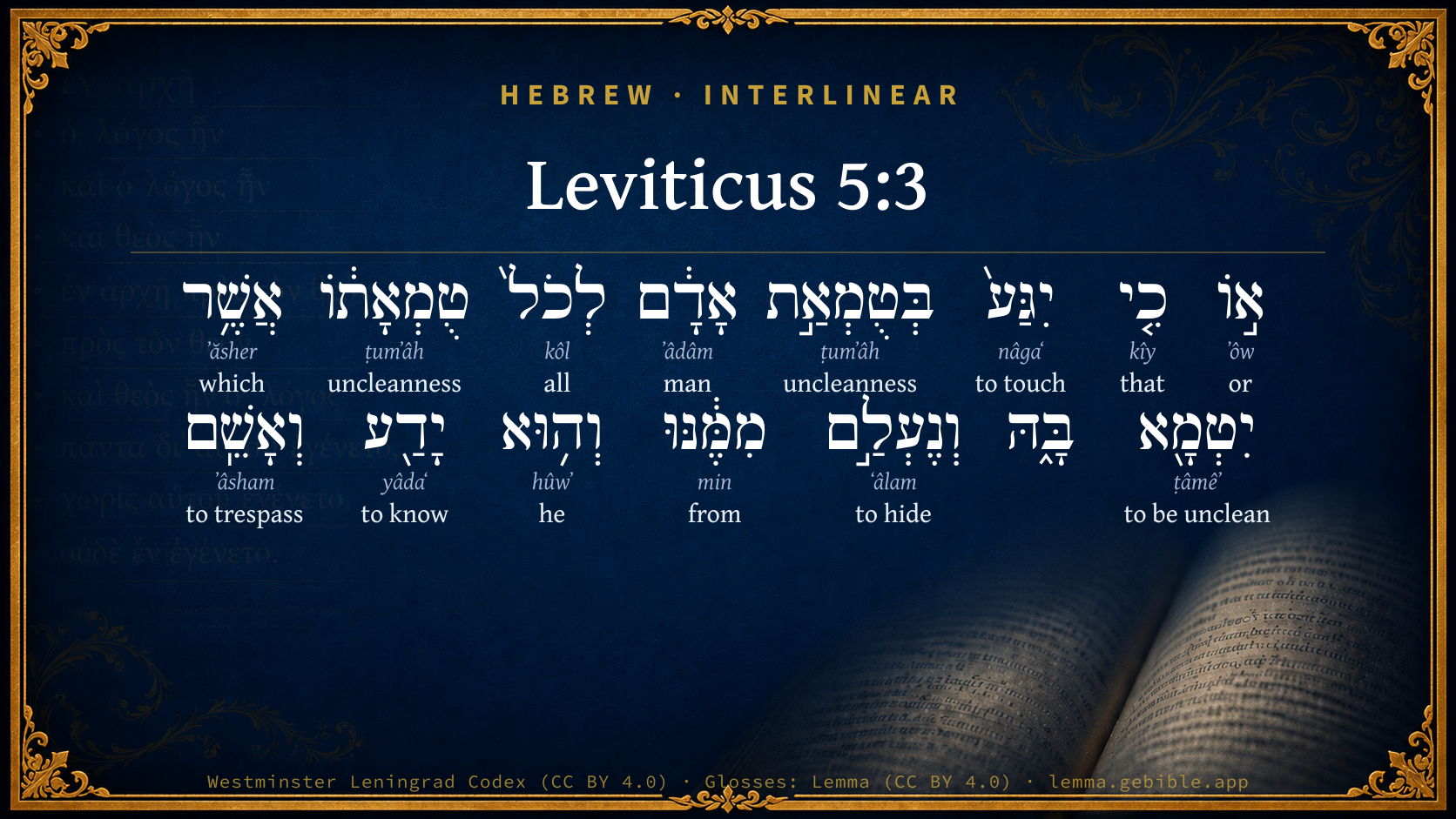
Leviticus 5:3

Hebrew (Westminster Leningrad Codex) Leviticus 5:3 appears in the Hebrew Old Testament. The text above is from the Westminster Leningrad Codex. Each word links to its Strong’s number, a concise gloss, and parsing drawn from the Open Scriptures Hebrew Bible morphology. Click any word for its full Brown-Driver-Briggs (BDB) entry.
Download image
Cite this verse

Leviticus 5:3 (World English Bible). Public Domain. Lemma interlinear Bible study tool, https://lemma.gebible.app/v/leviticus/5/3.

Show BibTeX & RIS
BibTeX
RIS
English Translation
"'Or if he touches the uncleanness of man, whatever his uncleanness is with which he is unclean, and it is hidden from him; when he knows of it, then he shall be guilty.
World English Bible · Public Domain
Highlights
  • 1 first appearance in the Hebrew Bible
Full analysis ↓
Download a study sheet

One document with this verse’s original text, its word-by-word gloss line, the meaning frame, cross-references with their text, attributed commentary, and full source and license credits — printable, and it pastes into notes with its structure intact.

This verse Autodidact and up

Study sheet (.html) Plain text (.txt)

A passage Seminary Student

Up to 50 verses in one chapter. A passage sheet keeps up to 6 commentary sources and 12 cross-references per verse, in the order this page ranks them, and says so on the sheet whenever that leaves anything out. Ask for a single verse and you get the Autodidact verse sheet above.

Everything on this page stays free to read, with no account — the sheet is a download of what is already on screen, not access to it.

Want to remove ads? Support Godless Engineer
Compare translations 3

The same verse in 3 English versions, stacked beneath the original-language interlinear above. Click any original word for its lexicon entry.

Each is an independent rendering of the whole verse — the interlinear is not word-aligned to these translations.

Highlighted words mark where these versions differ — a whole-verse word diff, not a word-by-word alignment.

  • World English Bible Public Domain
    "'Or if he touches the uncleanness of man, whatever his uncleanness is with which he is unclean, and it is hidden from him; when he knows of it, then he shall be guilty.
  • King James Version Public Domain
    Or if he touch the uncleanness of man, whatsoever uncleanness it be that a man shall be defiled withal, and it be hid from him; when he knoweth of it, then he shall be guilty.
  • unfoldingWord Literal Text CC BY-SA 4.0
    Or when he touches the uncleanness of a man with regard to all of his uncleanness that he becomes unclean with it, and it is hidden from him, when he knows, then he will be guilty.

unfoldingWord Literal Text — © unfoldingWord, licensed CC BY-SA 4.0. Word-aligned USFM3 via Door43 (git.door43.org/unfoldingWord/en_ult).

Versions to compare (up to 4)

3 of 4 selected

Show all 18 translations

Every available English version of this verse, each an independent rendering of the whole verse.

  • World English Bible Public Domain
    "'Or if he touches the uncleanness of man, whatever his uncleanness is with which he is unclean, and it is hidden from him; when he knows of it, then he shall be guilty.
  • Berean Standard Bible Public Domain
    Or if he touches human uncleanness—anything by which one becomes unclean—even if he is unaware of it, when he realizes it, he is guilty.
  • Majority Standard Bible Public Domain
    Or if he touches human uncleanness—anything by which one becomes unclean—even if he is unaware of it, when he realizes it, he is guilty.
  • King James Version Public Domain
    Or if he touch the uncleanness of man, whatsoever uncleanness it be that a man shall be defiled withal, and it be hid from him; when he knoweth of it, then he shall be guilty.
  • American Standard Version (1901) Public Domain
    Or if he touch the uncleanness of man, whatsoever his uncleanness be wherewith he is unclean, and it be hid from him; when he knoweth of it, then he shall be guilty.
  • Revised Version (1885) Public Domain
    or if he touch the uncleanness of man, whatsoever his uncleanness be wherewith he is unclean, and it be hid from him; when he knoweth of it, then he shall be guilty:
  • Geneva Bible (1599) Public Domain
    Eyther if hee touche any vncleannesse of man (whatsoeuer vncleannes it be, that hee is defiled with) and is not ware of it, and after commeth to the knowledge of it, he hath sinned:
  • Douay-Rheims (1899) Public Domain
    And if he touch any thing of the uncleanness of man, according to any uncleanness wherewith he is wont to be defiled, and having forgotten it, come afterwards to know it, he shall be guilty of an offence.
  • Young's Literal Translation Public Domain
    `Or when he cometh against uncleanness of man, even any of his uncleanness whereby he is unclean, and it hath been hidden from him, and he hath known, and hath been guilty:
  • Literal Standard Version CC BY-SA 4.0
    or when he comes against [the] uncleanness of man, even any of his uncleanness whereby he is unclean, and it has been hidden from him, and he has known, then he has been guilty.
  • Unlocked Literal Bible CC BY-SA 4.0
    Or if he touches the uncleanness of someone, whatever that uncleanness is, and if he is unaware of it, then he will be guilty when he learns about it.
  • unfoldingWord Literal Text CC BY-SA 4.0
    Or when he touches the uncleanness of a man with regard to all of his uncleanness that he becomes unclean with it, and it is hidden from him, when he knows, then he will be guilty.
  • Darby Bible Public Domain
    or if he touch the uncleanness of man, any uncleanness of him by which he is defiled, and it be hid from him, when he knoweth [it], then he is guilty.
  • World Messianic Bible Public Domain
    “‘Or if he touches the uncleanness of man, whatever his uncleanness is with which he is unclean, and it is hidden from him; when he knows of it, then he shall be guilty.
  • Webster's Bible Public Domain
    Or if he shall touch the uncleanness of man, whatever uncleanness it may be that a man shall be defiled with, and it be hid from him; when he knoweth of it, then he shall be guilty.
  • Free Bible Version CC BY-SA 4.0
    If you touch something unclean from someone else who is unclean, even if you're unaware of it, you become guilty.
  • Bible in Basic English Public Domain
    Or if he becomes unclean through touching unconsciously any unclean thing of man, whatever it may be, when it is made clear to him he will be responsible:
  • JPS Tanakh (1917) Public Domain
    or if he touch the uncleanness of man, whatsoever his uncleanness be wherewith he is unclean, and it be hid from him; and, when he knoweth of it, be guilty;

Literal Standard Version (2020), Covenant Press — licensed CC BY-SA 4.0. Text via the HelloAO Bible API (eBible.org). Unlocked Literal Bible (unfoldingWord) — licensed CC BY-SA 4.0. Text via the HelloAO Bible API (eBible.org). unfoldingWord Literal Text — © unfoldingWord, licensed CC BY-SA 4.0. Word-aligned USFM3 via Door43 (git.door43.org/unfoldingWord/en_ult). Free Bible Version, Dr. Jonathan Gallagher — licensed CC BY-SA 4.0. Text via the HelloAO Bible API (eBible.org).

Word by word

More ways to search: Search by grammar → Find every occurrence → Compare this word →

Practice this passage: Drill this verse → Learn its vocabulary →

וְנֶעְלַ֣ם
ʻâlam
H5956
“and · to hide”
Conjunction + Verb, Niphal, Sequential Perfect, 3rd Person, Masculine, Singular
Part of Speech
Conjunction + Verb
Stem
Niphal
Form
Sequential Perfect
Person
3rd Person
Gender
Masculine
Number
Singular
Full BDB Definition

Origin: a primitive root

TWOT: 1629

to conceal, hide, be hidden, be concealed, be secret - (Qal) secret (participle) - (Niphal) - to be concealed - concealed, dissembler (participle) - (Hiphil) to conceal, hide - (Hithpael) to hide oneself
  1. א֣וֹ ʼôw H176 “or” Conjunction
  2. כִ֤י kîy H3588 “that” Conjunction
  3. יִגַּע֙ nâgaʻ H5060 “to touch” Verb, Qal, Imperfect, 3rd Person, Masculine, Singular
  4. בְּטֻמְאַ֣ת ṭumʼâh H2932 “in/at · uncleanness of” Preposition + Noun, Common, Feminine, Singular, Construct
  5. אָדָ֔ם ʼâdâm H120 “man” Noun, Common, Masculine, Singular, Absolute
  6. לְכֹל֙ kôl H3605 “to/for · all of” Preposition + Noun, Common, Masculine, Singular, Construct
  7. טֻמְאָת֔וֹ ṭumʼâh H2932 “uncleanness · his” Noun, Common, Feminine, Singular, Construct + Suffix, Personal, 3rd Person, Masculine, Singular
  8. אֲשֶׁ֥ר ʼăsher H834 “which” Particle, Relative
  9. יִטְמָ֖א ṭâmêʼ H2930 “to be unclean” Verb, Qal, Imperfect, 3rd Person, Masculine, Singular
  10. מִמֶּ֔נּוּ min H4480 “from · us” Preposition + Suffix, Personal, 1st Person, Common, Plural
  11. וְה֥וּא hûwʼ H1931 “and · he” Conjunction + Pronoun, Personal, 3rd Person, Masculine, Singular
  12. יָדַ֖ע yâdaʻ H3045 “to know” Verb, Qal, Perfect, 3rd Person, Masculine, Singular
  13. וְאָשֵֽׁם ʼâsham H816 “and · to trespass” Conjunction + Verb, Qal, Sequential Perfect, 3rd Person, Masculine, Singular

About this verse

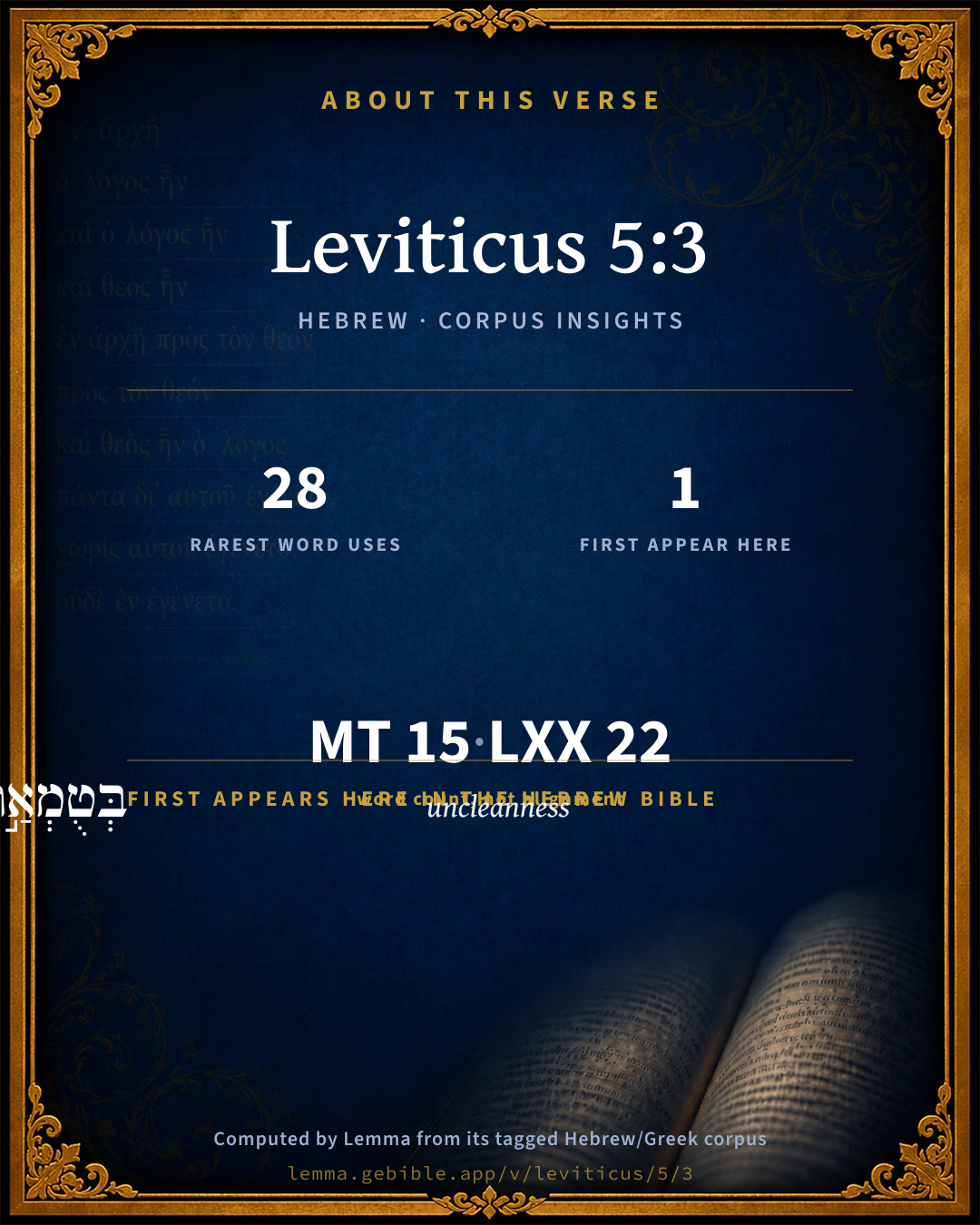
These counts appear in no published source. They are computed here, from the morphology-tagged text and Lemma’s own curated glosses. What Lemma adds →

15
words
13
distinct lemmas
Pentateuch
section

First appearance in Scripture

This word makes its first canonical appearance in the Hebrew Bible here:

  • בְּטֻמְאַ֣ת uncleanness H2932

Shared distinctive vocabulary

וְנֶעְלַ֣ם to hide H5956 occurs in 27 verses of the Hebrew Bible. Also found in:

Grammatical profile

  • 5 verbs
  • 4 nouns
  • 1 pronoun
  • 2 prepositions
  • 2 conjunctions
  • 1 particle

Verb forms

  • יִגַּע֙ Qal · Imperfect
  • יִטְמָ֖א Qal · Imperfect
  • וְנֶעְלַ֣ם Niphal · Sequential Perfect
  • יָדַ֖ע Qal · Perfect
  • וְאָשֵֽׁם Qal · Sequential Perfect

Repetition

A word recurs within this verse — often emphatic in Hebrew:

  • בְּטֻמְאַ֣ת uncleanness H2932 ×2

Hebrew & Septuagint length

In English translation the verse runs 33 words from the Hebrew and 35 from the Septuagint (LXX English) — closely comparable.

A rough comparison of the two English renderings, which tokenize alike — not a word-level alignment.

Word counts can differ between the Hebrew and the Greek without any difference in meaning — e.g. the Hebrew direct-object marker אֵת has no separate Greek word, and Greek often adds the article ὁ.

In the original languages it is 15 Hebrew tokens and 22 Greek tokens — but the two are counted differently (Hebrew bundles its prefixes and suffixes into one token; the Greek is in lemma form), so that isn’t a like-for-like length.

Cross-references

4

Topical passages linked to Leviticus 5:3 in the Treasury of Scripture Knowledge — connected by theme and wording, ordered by reader-vote popularity; previews shown in the World English Bible.

  • Leviticus 12:1–8 Yahweh spoke to Moses, saying,
  • Leviticus 15:1–33 Yahweh spoke to Moses and to Aaron, saying,
  • Numbers 19:11–16 He who touches the dead body of any man shall be unclean seven days:
  • Leviticus 22:4–6 "'Whoever of the seed of Aaron is a leper or has an issue; he shall not eat of the holy things, until he is clean. Whoever touches anything that is unclean by the dead, or a man whose seed goes from him;

Cross-references courtesy of OpenBible.info (CC BY 4.0).

Hebrew and Greek witnesses Masoretic Hebrew ↔ Greek Septuagint

The same verse in the two great witnesses to the Old Testament, shown verse-for-verse.

These are two independent witnesses, not word-aligned to each other, and the Septuagint is shown in lemma (dictionary) form.

Hebrew Leviticus 5:3 Masoretic · Westminster Leningrad Codex

א֣וֹ כִ֤י יִגַּע֙ בְּטֻמְאַ֣ת אָדָ֔ם לְכֹל֙ טֻמְאָת֔וֹ אֲשֶׁ֥ר יִטְמָ֖א בָּ֑הּ וְנֶעְלַ֣ם מִמֶּ֔נּוּ וְה֥וּא יָדַ֖ע וְאָשֵֽׁם

"'Or if he touches the uncleanness of man, whatever his uncleanness is with which he is unclean, and it is hidden from him; when he knows of it, then he shall be guilty.

World English Bible · Public Domain

Greek LXX Leviticus 5:3 Septuagint · lemma form

ἤ ἅπτομαι ἀπό ἀκαθαρσία ἄνθρωπος ἀπό πᾶς ἀκαθαρσία αὐτός ὅς ἄν ἅπτομαι μιαίνω καί λανθάνω αὐτός μετά οὗτος δέ γιγνώσκω καί πλημμηλέω

or should touch the uncleanness of a man, or whatever kind, which he may touch and be defiled by, and it should have escaped him, but afterwards he should know, —then he shall have transgressed.

LXX2012 (modern English Septuagint) · Public Domain

Hebrew: Westminster Leningrad Codex (CC BY 4.0). Greek: Septuagint (public domain); English from LXX2012 (modern English Septuagint) (Public Domain). How the Septuagint differs from the Hebrew →

Targum (Aramaic paraphrase)

2

The Targum is the ancient Jewish Aramaic paraphrase of the Hebrew Scriptures — an interpretive translation, not the Hebrew text itself. Onkelos (literal) and Pseudo-Jonathan (expansive) render the Torah, and Jonathan the Prophets. Coverage is partial: where no permissively-licensed English translation exists for a verse, only the Aramaic is shown. This is verse-level text, not a word-by-word alignment to the Hebrew.

  1. Targum Onkelos Torah (Genesis–Deuteronomy)
    אוֹ אֲרֵי יִקְרַב בְּסוֹאֲבַת אֱנָשָׁא לְכָל סוֹבְתֵהּ דִי יִסְתָּאַב בַּהּ וִיהֵי מְכַסָא מִנֵהּ וְהוּא יְדַע וְחָב

    (no public-domain English translation for this verse)

    Targum Onkelos — Aramaic: “Onkelos Genesis” (public domain); “Onkelos Exodus” (public domain); “Onkelos Leviticus” (public domain); “Onkelos Numbers” (public domain); “Onkelos Deuteronomy” (public domain). English: “Sefaria Community Translation” (CC0 1.0 (public-domain dedication)); “J.W. Etheridge. The Targums of Onkelos and Jonathan Ben Uzziel on the Pentateuch. London: Longmans, Green, 1862” (public domain). Text via Sefaria.

  2. Targum Pseudo-Jonathan Torah (Genesis–Deuteronomy)
    אוֹ אֲרוּם יִקְרַב בְּסוֹאֲבִית אֵינָשָׁא לְכָל סוֹבְתֵיהּ דְמִסְתָּאֵב בָּהּ וְיִתְכַסֵי מִנֵּיהּ וְיִקְרַב בְּכָל קוּדְשַׁיָא וּמִן בָּתַר כְּדֵין אִתְגְלֵי לֵיהּ וְאִיהוּ יָדַע דִמְסָאַב וְלָא אִידְכֵּי וְיִתְחַיֵיב

    Or if he touch the uncleanness of a man, even whatever uncleanness that defileth him, and it be hidden from him, and he touch anything consecrated, after that it is discovered by him, and he knoweth that he is defiled and not clean, he shall be guilty.

    Targum Pseudo-Jonathan — Aramaic: “Targum Jonathan on Genesis” (public domain); “Targum Jonathan on Exodus” (public domain); “Targum Jonathan on Leviticus” (public domain); “Targum Jonathan on Numbers” (public domain); “Targum Jonathan on Deuteronomy” (public domain). English: “The Targum of Jonathan ben Uzziel, trans. J. W. Etheridge, London, 1862” (public domain). Text via Sefaria.

Commentary

Notes on Leviticus 5:3 from classic Christian and Jewish commentators (each source and its license shown beneath its notes). The classic Christian expositions comment on the surrounding passage and are grouped to its opening verse, so a note may address several verses; the Jewish commentaries on the Tanakh (Rashi and others) are per-verse, so they appear only where the commentator wrote on this verse.

Lemma curates 59 commentaries, every one of them public domain or Creative Commons licensed, each selected and text-cleaned for this edition rather than reprinted as found. About our sources →

Trapp's Complete Commentary

John Trapp

Lev 5:3 Or if he touch the uncleanness of man, whatsoever uncleanness [it be] that a man shall be defiled withal, and it be hid from him; when he knoweth [of it], then he shall be guilty.

Ver. 3. Then he shall be guilty.] Guilty he was before, {Lev 5:2} but now shall see himself so, and be ready to say, as Pro 5:14, "I was almost in all evil in the midst of the congregation and the assembly." "By the law is the knowledge of sin." {Rom 3:20}

John Trapp, A Commentary or Exposition upon All the Books of the Old and New Testament (1647–1656) — public domain. Text from a community e-Sword module.

Tyndale Open Study Notes

Tyndale Open Resources

5:3 Any bodily discharge, even blood, would render a person temporarily unclean (chs 11–15). The uncleanness itself was not sin, but it was a sin to neglect the uncleanness, allowing it to spread. Once people became aware of their unclean state, they were guilty if they neglected it.

Tyndale Open Study Notes — © Tyndale Open Resources, licensed CC BY-SA 4.0. Text via the HelloAO Bible API.

Ellicott's Commentary for English Readers

(3) Or if he touch the uncleanness of man.—The sundry classes of defilement which a human being might contract and impart to others by contact, are set forth in Leviticus 12-15.

When he knoweth of it, then he shall be guilty.—Better, and he knoweth it, and feeleth that he is guilty. That is, he afterwards becomes conscious that he has contracted the defilement, and feels his guilt. (See Lev_5:2.)

A Bible Commentary for English Readers, edited by Charles John Ellicott (1878–1897) — public domain. Text from a community e-Sword module.

John Gill's Exposition

Or if he touch the uncleanness of man,.... The dead body of a man, or the bone of a dead body, or a grave, or any profluvious or menstruous person:

whatsoever uncleanness it be that a man shall be defiled withal: not morally, but ceremonially:

and it be hid from him; he is not sensible that he has touched any thing ceremonially unclean:

when he knoweth of it, then he shall be guilty: acknowledge his guilt, and offer a sacrifice for it, as after directed.

John Gill's Exposition of the Whole Bible (1746–1763) — public domain (CC PDM 1.0). Text via the HelloAO Bible API.

Haydock's Catholic Bible Commentary

Of man, who may be in a state of legal uncleanness. If he neglect or forget to purify himself, he must offer a sacrifice, either such as he may choose, (St. Augustine, q. 2.) or such as the priest may require. (Lyranus) (Calmet)

George Leo Haydock (1774–1849), Haydock's Catholic Family Bible and Commentary, 1859 edition — public domain. Excludes Psalms (Douay-Rheims chapter numbering differs from Protestant) and Deuterocanonical books (Catholic canon only).

Matthew Poole's English Annotations

As soon as he knoweth it, he must not delay to make his peace with God. And though it was sin before, though not known, yet the knowledge of it made it worse, and therefore required the more speedy repentance.

He shall be guilty, not only ceremonially by that touch, but morally for his violation and contempt of God’s authority and command.

Matthew Poole's English Annotations on the Holy Bible (1683–1685) — public domain. Text from a community e-Sword/MySword module.

John Wesley's Explanatory Notes

When he knoweth - As soon as he knoweth it, he must not delay to make his peace with God. Otherwise he shall be guilty - For his violation and contempt of God's authority and command.

John Wesley, Explanatory Notes Upon the Whole Bible (1754–1765) — public domain. Text via the GEBible commentary corpus.

unfoldingWord translationNotes

Door43 World Missions Community

if he touches the uncleanness of someone, whatever that uncleanness is

The abstract noun "uncleanness" can be stated as an adjective. AT: "if he touches anything that makes a person unclean" (See: Abstract Nouns)

the uncleanness

Something that Yahweh has declared unfit for a person to touch or eat is spoken of as if it were physically unclean. (See: Metaphor)

he is unaware of it

"he does not realize it" or "he does not know about it"

if anyone swears rashly with his lips

Here "lips" represents the whole person. AT: "if anyone swears rashly" (See: Synecdoche)

if anyone swears rashly

This means to swear an oath without thinking seriously about it. It implies that after the person swears the oath that he either cannot fulfill it or he does not really want to fulfill it. (See: Assumed Knowledge and Implicit Information)

translationWords

clean

guilt

oath

evil

good

unfoldingWord translationNotes — © Distant Shores Media and the Door43 World Missions Community, licensed CC BY-SA 4.0. Source: git.door43.org/Door43/en_tn.

Rashi

Rabbi Shlomo Yitzchaki (Rashi)

בטמאת אדם [OR IF HE TOUCHES] THE UNCLEANNESS OF MAN — This refers to uncleanness resulting from a corpse (i. e. it implies both touching the corpse itself or touching anyone who has come in contact with the corpse) (Sifra, Vayikra Dibbura d'Chovah, Chapter 13 8).

לכל טמאתו WHATSOEVER UNCLEANNESS OF HIM IT BE — This is intended to include in this law the uncleanness resulting from touching men or women who have a flux (and those in similar physical condition e. g. ‎'וכו‎ יולדת ‎ נדה‎) Sifra, Vayikra Dibbura d'Chovah, Chapter 13 8.

‎‏אשר יטמא‎ — these apparently redundant words are intended to include in this law one who touches a man who had intercourse with a ה‎‏נד and has not yet immersed himself (cf. Leviticus 15:24) (Sifra, Vayikra Dibbura d'Chovah, Chapter 13 8).

בה — is intended to include in this law one who swallows the carrion of a clean bird (Sifra, Vayikra Dibbura d'Chovah, Chapter 13 8).

והוא ידע … ‎ונעלם AND IT WAS HIDDEN [FROM HIM], BUT HE KNOWETH afterwards) that he had forgotten his state of uncleanness.

ואשם AND HAD INCURRED GUILT by eating sacred food or by entering the Sanctuary in this state.

Rashi on the Tanakh — English translations: “The Judaica Press complete Tanach with Rashi, translated by A. J. Rosenberg” (CC BY 4.0); “Pentateuch with Rashi's commentary by M. Rosenbaum and A.M. Silbermann, 1929-1934” (public domain); “The Metsudah Tanach series, Lakewood, N.J” (CC BY 4.0); and “The Book of Joshua, Metsudah Publications, 1997” (CC BY 4.0). Text via Sefaria.

Lesson kit

Teaching starters — assembled from the data on this page, not authored interpretation. Every prompt links to the verse data it draws on. Edit before teaching.

Leviticus, in the Pentateuch, opens this verse with 15 words (13 distinct Hebrew lemmas). Its most distinctive word is ʻâlam (“to hide”). A historical commentator’s framing appears above. Read the whole chapter for the surrounding context.

Discussion questions

  1. What does “to hide” (ʻâlam) contribute to the verse as a whole?
  2. The word “uncleanness” first appears here in Scripture. What is being introduced at this debut?
  3. Leviticus 4:13 shares the word «to hide» with this verse. How do the two illuminate each other?
  4. “uncleanness” occurs 2× in this one verse. What is the effect of the repetition?
  5. These translations render this verse differently. What is at stake in choosing one wording over another?
  6. The verb «יִגַּע֙» is Qal Imperfect. How does its form color the action?
  7. Reading how Trapp's Complete Commentary and Tyndale Open Study Notes read this verse, where do the two commentators agree and where do they part?

Things to notice

Reading settings

Reading text

Shown beneath each verse's original-language words.

Old Testament
Old Testament edition

Read the OT as the Masoretic Hebrew (MT) or the Greek Septuagint (LXX).

English shown for the Greek Septuagint (in the Hebrew ↔ Greek comparison).

Comparing translations? Open the Compare panel on any verse page to stack up to four side by side.