Genesis 22:11

Hebrew (Westminster Leningrad Codex) Genesis 22:11 appears in the Hebrew Old Testament. The text above is from the Westminster Leningrad Codex. Each word links to its Strong’s number, a concise gloss, and parsing drawn from the Open Scriptures Hebrew Bible morphology. Click any word for its full Brown-Driver-Briggs (BDB) entry.
Download image
Cite this verse

Genesis 22:11 (World English Bible). Public Domain. Lemma interlinear Bible study tool, https://lemma.gebible.app/v/genesis/22/11.

Show BibTeX & RIS
BibTeX
RIS
English Translation
The angel of Yahweh called to him out of the sky, and said, "Abraham, Abraham!" He said, "Here I am."
World English Bible · Public Domain
Download a study sheet

One document with this verse’s original text, its word-by-word gloss line, the meaning frame, cross-references with their text, attributed commentary, and full source and license credits — printable, and it pastes into notes with its structure intact.

This verse Autodidact and up

Study sheet (.html) Plain text (.txt)

A passage Seminary Student

Up to 50 verses in one chapter. A passage sheet keeps up to 6 commentary sources and 12 cross-references per verse, in the order this page ranks them, and says so on the sheet whenever that leaves anything out. Ask for a single verse and you get the Autodidact verse sheet above.

Everything on this page stays free to read, with no account — the sheet is a download of what is already on screen, not access to it.

Want to remove ads? Support Godless Engineer
Compare translations 3

The same verse in 3 English versions, stacked beneath the original-language interlinear above. Click any original word for its lexicon entry.

Each is an independent rendering of the whole verse — the interlinear is not word-aligned to these translations.

Highlighted words mark where these versions differ — a whole-verse word diff, not a word-by-word alignment.

  • World English Bible Public Domain
    The angel of Yahweh called to him out of the sky, and said, "Abraham, Abraham!" He said, "Here I am."
  • King James Version Public Domain
    And the angel of the LORD called unto him out of heaven, and said, Abraham, Abraham: and he said, Here am I.
  • unfoldingWord Literal Text CC BY-SA 4.0
    But an angel of Yahweh called to him from heaven and said, “Abraham! Abraham!” And he said, “Behold me.”

unfoldingWord Literal Text — © unfoldingWord, licensed CC BY-SA 4.0. Word-aligned USFM3 via Door43 (git.door43.org/unfoldingWord/en_ult).

Versions to compare (up to 4)

3 of 4 selected

Show all 18 translations

Every available English version of this verse, each an independent rendering of the whole verse.

  • World English Bible Public Domain
    The angel of Yahweh called to him out of the sky, and said, "Abraham, Abraham!" He said, "Here I am."
  • Berean Standard Bible Public Domain
    Just then the angel of the LORD called out to him from heaven, “Abraham, Abraham!” “Here I am,” he replied.
  • Majority Standard Bible Public Domain
    Just then the angel of the LORD called out to him from heaven, “Abraham, Abraham!” “Here I am,” he replied.
  • King James Version Public Domain
    And the angel of the LORD called unto him out of heaven, and said, Abraham, Abraham: and he said, Here am I.
  • American Standard Version (1901) Public Domain
    And the angel of Jehovah called unto him out of heaven, and said, Abraham, Abraham. And he said, Here I am.
  • Revised Version (1885) Public Domain
    And the angel of the LORD called unto him out of heaven, and said, Abraham, Abraham: and he said, Here am I.
  • Geneva Bible (1599) Public Domain
    But the Angel of the Lord called vnto him from heauen, saying, Abraham, Abraham. And he answered, Here am I.
  • Douay-Rheims (1899) Public Domain
    And behold an angel of the Lord from heaven called to him, saying: Abraham, Abraham. And he answered: Here I am.
  • Young's Literal Translation Public Domain
    And the messenger of Jehovah calleth unto him from the heavens, and saith, `Abraham, Abraham;' and he saith, `Here `am' I;'
  • Literal Standard Version CC BY-SA 4.0
    And the Messenger of YHWH calls to him from the heavens and says, “Abraham, Abraham”; and he says, “Here I [am]”;
  • Unlocked Literal Bible CC BY-SA 4.0
    Then the angel of Yahweh called to him from heaven and said, “Abraham, Abraham!” and he said, “Here I am.”
  • unfoldingWord Literal Text CC BY-SA 4.0
    But an angel of Yahweh called to him from heaven and said, “Abraham! Abraham!” And he said, “Behold me.”
  • Darby Bible Public Domain
    And the Angel of Jehovah called to him from the heavens, and said, Abraham, Abraham! And he said, Here am I.
  • World Messianic Bible Public Domain
    The LORD’s angel called to him out of the sky, and said, “Abraham, Abraham!” He said, “Here I am.”
  • Webster's Bible Public Domain
    And the angel of the LORD called to him from heaven, and said, Abraham, Abraham. And he said, Here am I.
  • Free Bible Version CC BY-SA 4.0
    But the angel of the Lord shouted to him from heaven, “Abraham! Abraham!” “Yes, I'm here,” he replied.
  • Bible in Basic English Public Domain
    But the voice of the angel of the Lord came from heaven, saying, Abraham, Abraham: and he said, Here am I.
  • JPS Tanakh (1917) Public Domain
    And the angel of the LORD called unto him out of heaven, and said: 'Abraham, Abraham.' And he said: 'Here am I.'

Literal Standard Version (2020), Covenant Press — licensed CC BY-SA 4.0. Text via the HelloAO Bible API (eBible.org). Unlocked Literal Bible (unfoldingWord) — licensed CC BY-SA 4.0. Text via the HelloAO Bible API (eBible.org). unfoldingWord Literal Text — © unfoldingWord, licensed CC BY-SA 4.0. Word-aligned USFM3 via Door43 (git.door43.org/unfoldingWord/en_ult). Free Bible Version, Dr. Jonathan Gallagher — licensed CC BY-SA 4.0. Text via the HelloAO Bible API (eBible.org).

Word by word

More ways to search: Search by grammar → Find every occurrence → Compare this word →

Practice this passage: Drill this verse → Learn its vocabulary →

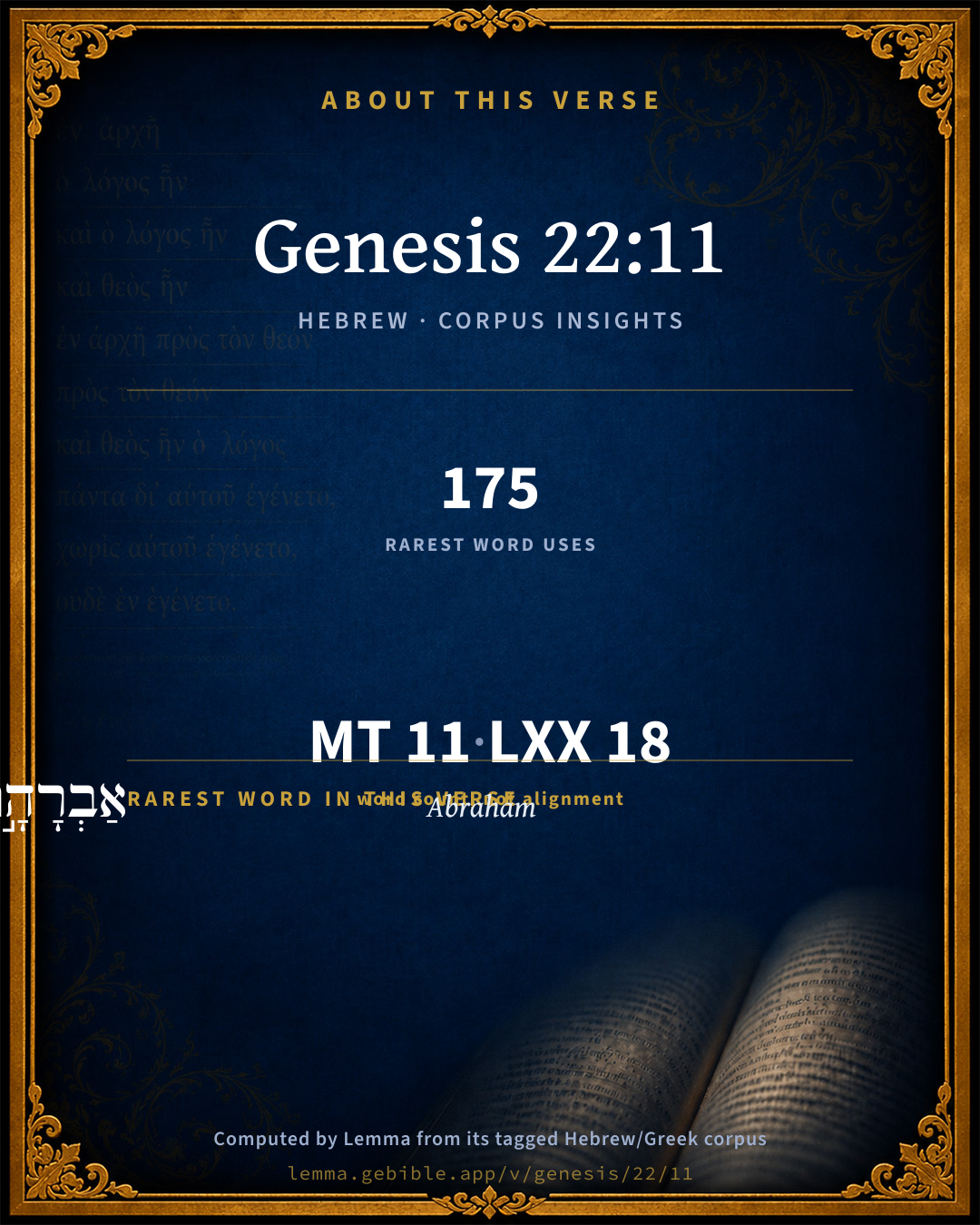
אַבְרָהָ֣ם
ʼAbrâhâm
H85
“Abraham”
Noun, Proper
Part of Speech
Noun
Type
Proper
Full BDB Definition

Origin: contracted from H1 and an unused root (probably meaning to be populous)

TWOT: 4b

Abraham = "father of a multitude" or " chief of multitude" - friend of God and founder of Hebrew nation via God's elective covenant
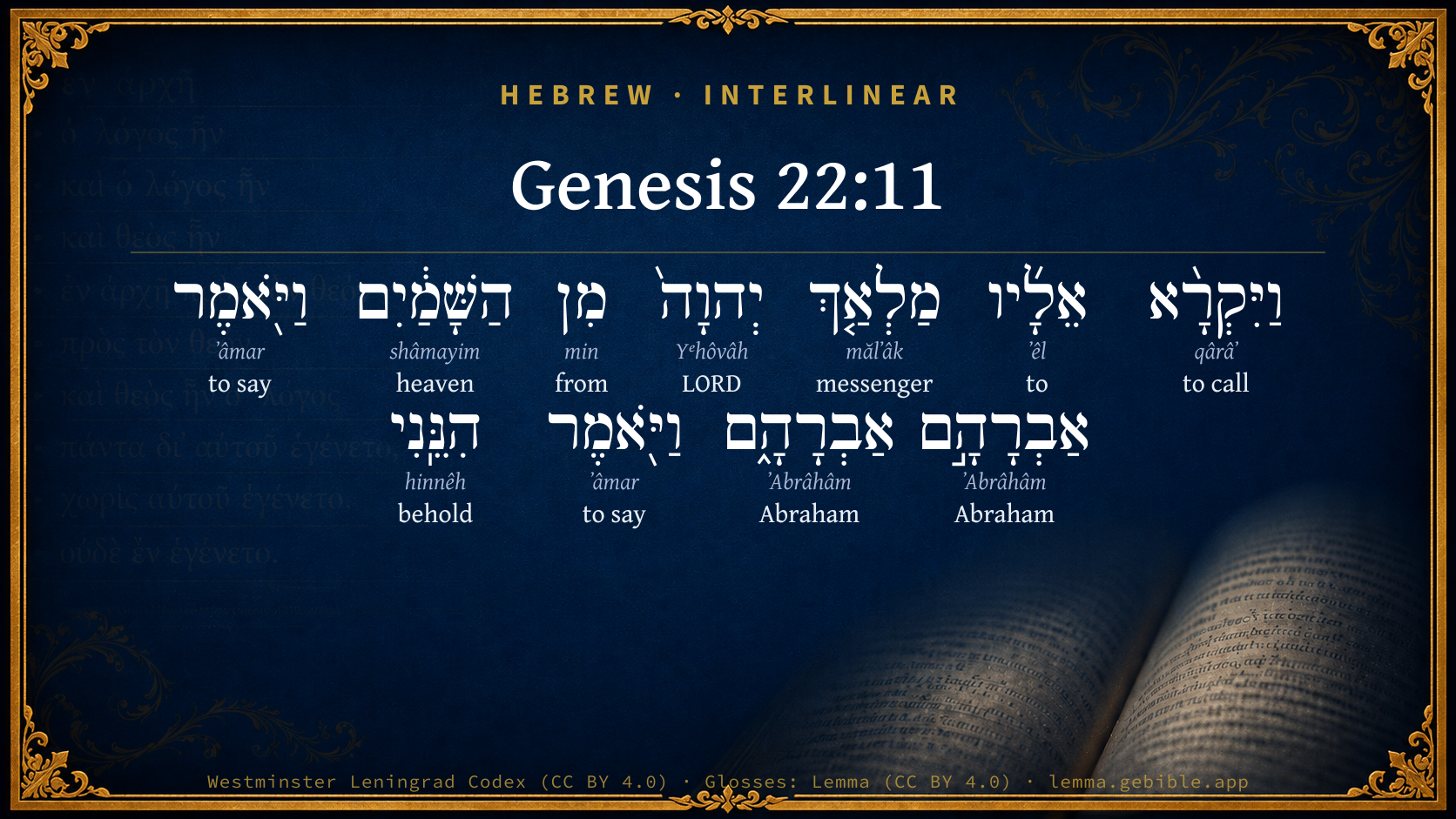
  1. וַיִּקְרָ֨א qârâʼ H7121 “and · to call” Conjunction + Verb, Qal, Sequential Imperfect, 3rd Person, Masculine, Singular
  2. אֵלָ֜יו ʼêl H413 “to · him” Preposition + Suffix, Personal, 3rd Person, Masculine, Singular
  3. מַלְאַ֤ךְ mălʼâk H4397 “messenger of” Noun, Common, Masculine, Singular, Construct
  4. יְהוָה֙ Yᵉhôvâh H3068 “LORD” Noun, Proper
  5. מִן min H4480 “from” Preposition
  6. הַשָּׁמַ֔יִם shâmayim H8064 “the · heaven(s)” Particle, Definite Article + Noun, Common, Masculine, Plural, Absolute
  7. וַיֹּ֖אמֶר ʼâmar H559 “and · to say” Conjunction + Verb, Qal, Sequential Imperfect, 3rd Person, Masculine, Singular
  8. אַבְרָהָ֑ם ʼAbrâhâm H85 “Abraham” Noun, Proper
  9. וַיֹּ֖אמֶר ʼâmar H559 “and · to say” Conjunction + Verb, Qal, Sequential Imperfect, 3rd Person, Masculine, Singular
  10. הִנֵּֽנִי hinnêh H2009 “behold · me” Particle, Demonstrative + Suffix, Personal, 1st Person, Common, Singular

About this verse

These counts appear in no published source. They are computed here, from the morphology-tagged text and Lemma’s own curated glosses. What Lemma adds →

11
words
9
distinct lemmas
Pentateuch
section

Grammatical profile

  • 3 verbs
  • 5 nouns
  • 2 prepositions
  • 1 particle

Verb forms

  • וַיִּקְרָ֨א Qal · Sequential Imperfect
  • וַיֹּ֖אמֶר Qal · Sequential Imperfect
  • וַיֹּ֖אמֶר Qal · Sequential Imperfect

Repetition

Words recur within this verse — often emphatic in Hebrew:

  • וַיֹּ֖אמֶר to say H559 ×2
  • אַבְרָהָ֣ם Abraham H85 ×2

Hebrew & Septuagint length

In English translation the verse runs 20 words from the Hebrew and 22 from the Septuagint (LXX English) — closely comparable.

A rough comparison of the two English renderings, which tokenize alike — not a word-level alignment.

Word counts can differ between the Hebrew and the Greek without any difference in meaning — e.g. the Hebrew direct-object marker אֵת has no separate Greek word, and Greek often adds the article ὁ.

In the original languages it is 11 Hebrew tokens and 18 Greek tokens — but the two are counted differently (Hebrew bundles its prefixes and suffixes into one token; the Greek is in lemma form), so that isn’t a like-for-like length.

Cross-references

10

Topical passages linked to Genesis 22:11 in the Treasury of Scripture Knowledge — connected by theme and wording, ordered by reader-vote popularity; previews shown in the World English Bible.

  • Genesis 21:17 God heard the voice of the boy. The angel of God called to Hagar out of the sky, and said to her, "What ails you, Hagar? Don't be afraid. For God has heard the voice of the boy where he is.
  • Exodus 3:4 When Yahweh saw that he turned aside to see, God called to him out of the midst of the bush, and said, "Moses! Moses!" He said, "Here I am."
  • Genesis 16:9–10 The angel of Yahweh said to her, "Return to your mistress, and submit yourself under her hands."
  • Genesis 22:16 and said, "I have sworn by myself, says Yahweh, because you have done this thing, and have not withheld your son, your only son,
  • Genesis 16:7 The angel of Yahweh found her by a fountain of water in the wilderness, by the fountain in the way to Shur.
  • Genesis 22:1 It happened after these things, that God tested Abraham, and said to him, "Abraham!" He said, "Here I am."
  • Genesis 22:12 He said, "Don't lay your hand on the boy, neither do anything to him. For now I know that you fear God, seeing you have not withheld your son, your only son, from me."
  • 1 Samuel 3:10 Yahweh came, and stood, and called as at other times, Samuel, Samuel. Then Samuel said, Speak; for your servant hears.
  • Acts 9:4 He fell on the earth, and heard a voice saying to him, "Saul, Saul, why do you persecute me?"
  • Acts 26:14 When we had all fallen to the earth, I heard a voice saying to me in the Hebrew language, 'Saul, Saul, why are you persecuting me? It is hard for you to kick against the goads.'

Cross-references courtesy of OpenBible.info (CC BY 4.0).

Hebrew and Greek witnesses Masoretic Hebrew ↔ Greek Septuagint

The same verse in the two great witnesses to the Old Testament, shown verse-for-verse.

These are two independent witnesses, not word-aligned to each other, and the Septuagint is shown in lemma (dictionary) form.

Hebrew Genesis 22:11 Masoretic · Westminster Leningrad Codex

וַיִּקְרָ֨א אֵלָ֜יו מַלְאַ֤ךְ יְהוָה֙ מִן הַשָּׁמַ֔יִם וַיֹּ֖אמֶר אַבְרָהָ֣ם אַבְרָהָ֑ם וַיֹּ֖אמֶר הִנֵּֽנִי

The angel of Yahweh called to him out of the sky, and said, "Abraham, Abraham!" He said, "Here I am."

World English Bible · Public Domain

Greek LXX Genesis 22:11 Septuagint · lemma form

καί καλέω αὐτός ἄγγελος κύριος ἐκ ὁ οὐρανός καί εἶπον αὐτός αβρααμ αβρααμ ὁ δέ εἶπον ἰδού ἐγώ

And an angel of the Lord called him out of heaven, and said, Abraam, Abraam. And he said, Behold, I am here.

LXX2012 (modern English Septuagint) · Public Domain

Hebrew: Westminster Leningrad Codex (CC BY 4.0). Greek: Septuagint (public domain); English from LXX2012 (modern English Septuagint) (Public Domain). How the Septuagint differs from the Hebrew →

Targum (Aramaic paraphrase)

2

The Targum is the ancient Jewish Aramaic paraphrase of the Hebrew Scriptures — an interpretive translation, not the Hebrew text itself. Onkelos (literal) and Pseudo-Jonathan (expansive) render the Torah, and Jonathan the Prophets. Coverage is partial: where no permissively-licensed English translation exists for a verse, only the Aramaic is shown. This is verse-level text, not a word-by-word alignment to the Hebrew.

  1. Targum Onkelos Torah (Genesis–Deuteronomy)
    וּקְרָא לֵהּ מַלְאָכָא דַּיְיָ מִן שְׁמַיָּא וַאֲמַר אַבְרָהָם אַבְרָהָם וַאֲמַר הָא אֲנָא

    (no public-domain English translation for this verse)

    Targum Onkelos — Aramaic: “Onkelos Genesis” (public domain); “Onkelos Exodus” (public domain); “Onkelos Leviticus” (public domain); “Onkelos Numbers” (public domain); “Onkelos Deuteronomy” (public domain). English: “Sefaria Community Translation” (CC0 1.0 (public-domain dedication)); “J.W. Etheridge. The Targums of Onkelos and Jonathan Ben Uzziel on the Pentateuch. London: Longmans, Green, 1862” (public domain). Text via Sefaria.

  2. Targum Pseudo-Jonathan Torah (Genesis–Deuteronomy)
    וּקְרָא לֵיהּ מַלְאָכָא דַיְיָ מִן שְׁמַיָא וַאֲמַר לֵיהּ אַבְרָהָם אַבְרָהָם וַאֲמַר הָא נָא

    And the Angel of the Lord called to him from the heavens, and said to him, Abraham! Abraham! And he said, Behold me.

    Targum Pseudo-Jonathan — Aramaic: “Targum Jonathan on Genesis” (public domain); “Targum Jonathan on Exodus” (public domain); “Targum Jonathan on Leviticus” (public domain); “Targum Jonathan on Numbers” (public domain); “Targum Jonathan on Deuteronomy” (public domain). English: “The Targum of Jonathan ben Uzziel, trans. J. W. Etheridge, London, 1862” (public domain). Text via Sefaria.

Commentary

Notes on Genesis 22:11 from classic Christian and Jewish commentators (each source and its license shown beneath its notes). The classic Christian expositions comment on the surrounding passage and are grouped to its opening verse, so a note may address several verses; the Jewish commentaries on the Tanakh (Rashi and others) are per-verse, so they appear only where the commentator wrote on this verse.

Lemma curates 59 commentaries, every one of them public domain or Creative Commons licensed, each selected and text-cleaned for this edition rather than reprinted as found. About our sources →

Matthew Henry's Commentary

Hitherto this story has been very melancholy, and seemed to hasten towards a most tragical period; but here the sky suddenly clears up, the sun breaks out, and a bright and pleasant scene opens. The same hand that had wounded and cast down here heals and lifts up; for, though he cause grief, he will have compassion. The angel of the Lord, that is, God himself, the eternal Word, the angel of the covenant, who was to be the great Redeemer and comforter, he interposed, and gave a happy issue to this trial.

I. Isaac is rescued, Gen 22:11, Gen 22:12. The command to offer him was intended only for trial, and it appearing, upon trial, that Abraham did indeed love God better than he loved Isaac, the end of the command was answered; and therefore the order is countermanded, without any reflection at all upon the unchangeableness of the divine counsels: Lay not thy hand upon the lad. Note, 1. Our creature-comforts are most likely to be continued to us when we are most likely to be continued to us when we are most willing to resign them up to God's will. 2. God's time to help and relieve his people is when they are brought to the greatest extremity. The more imminent the danger is, and the nearer to be put in execution, the more wonderful and the more welcome is the deliverance.

II. Abraham is not only approved, but applauded. He obtains an honourable testimony that he is righteous: Now know I that thou fearest God. God knew it before, but now Abraham had given a most memorable evidence of it. He needed do no more; what he had done was sufficient to prove the religious regard he had to God and his authority. Note, 1. When God, by his providence, hinders the performance of our sincere intentions in his services, he graciously accepts the will for the deed, and the honest endeavour, though it come short of finishing. 2. The best evidence of our fearing God is our being willing of serve and honour him with that which is dearest to us, and to part with all to him or for him.

III. Another sacrifice is provided instead of Isaac, Gen 22:13. Now that the altar was built, and the wood laid in order, it was necessary that something should be offered. For, 1. God must be acknowledged with thankfulness for the deliverance of Isaac; and the sooner the better, when here is an altar ready. 2. Abraham's words must be made good: God will provide himself a lamb. God will not disappoint those expectations of his people which are of his own raising; but according to their faith it is to them. Thou shalt decree a thing, and it shall be established. 3. Reference must be had to the promised Messiah, the blessed seed. (1.) Christ was sacrificed in our stead, as this ram instead of Isaac, and his death was our discharge. "Here am I (said he,) let these go their way." (2.) Though that blessed seed was lately promised, and now typified by Isaac, yet the offering of him up should be suspended till the latter end of the world: and in the mean time the sacrifice of beasts should be accepted, as this ram was, as a pledge of that expiation which should one day be made by that great sacrifice. And it is observable that the temple, the place of sacrifice, was afterwards built upon this mount Moriah (Ch2 3:1); and mount Calvary, where Christ was crucified, was not far off.

IV. A new name is given to the place, to the honour of God, and for the encouragement of all believers, to the end of the world, cheerfully to trust in God in the way of obedience: Jehovah-jireh, The Lord will provide (Gen 22:14), probably alluding to what he had said (Gen 22:8), God will provide himself a lamb. I was not owing to any contrivance of Abraham, nor was it in answer to his prayer, though he was a distinguished intercessor; but it was purely the Lord's doing. Let it be recorded for the generations to come, 1. That the Lord will see; he will always have his eye upon his people in their straits and distresses, that he may come in with seasonable succour in the critical juncture. 2. That he will be seen, be seen in the mount, in the greatest perplexities of his people. He will not only manifest, but magnify, his wisdom, power, and goodness, in their deliverance. Where God sees and provides, he should be seen and praised. And, perhaps, it may refer to God manifest in the flesh.

Matthew Henry's Commentary on the Whole Bible (1708–1710) — public domain (CC PDM 1.0). Text via the HelloAO Bible API.

Trapp's Complete Commentary

John Trapp

Gen 22:11 And the angel of the LORD called unto him out of heaven, and said, Abraham, Abraham: and he said, Here [am] I.

Ver. 11. And said, Abraham, Abraham!] Twice, for haste’s sake: yet not at all till the very instant. When the knife was up, the Lord came. God delights to bring his people to the mount, yea, to the very brow of the hill, till their feet slip, and then delivers them. He reserves his holy hand for a dead lift. Only be sure you look to your calling; for it was otherwise with Jephthah, {Jdg 11:1} whom St Augustine calls facinorosum et improbum , a lewd and naughty man, in his questions upon the Old Testament. What then would he have said to Thomas the Anabaptist, who beheaded his brother Leonard, in the sight of his parents, at Sangal in France, Anno 1526, pretending the example of Abraham? {a} As did likewise those odious idolaters of old, that offered their children in sacrifice to Moloch in the valley of Hinnom; which was so called, because the poor child put into the arms of the red-hot image, was נהס, nohem, that is, roaring; or because the priests comforting the parents said, Jehenneh lach. "It shall be profitable or pleasant to thee," as Kimchi hath it. {b} So, because Abraham planted a grove to serve God in, {Gen 21:33} the devil, God’s ape, set the blind heathens a work to plant a thicket near the altar of their god Priapus, whereinto his worshippers stepped when the sacrifice was ended, and there, like brute beasts promiscuously satisfied their lusts, thereby, as they conceived, best pleasing their god; which was the true cause, as it seems, that the true God commanded that no groves should be planted near the place of his worship; and if any were, they should be cut down.

{a} Stumpt., lib. v.

{b} Condimentum erit tibi . - Falkut in Jerem.

John Trapp, A Commentary or Exposition upon All the Books of the Old and New Testament (1647–1656) — public domain. Text from a community e-Sword module.

Tyndale Open Study Notes

Tyndale Open Resources

22:11 The angel of the Lord stopped Abraham just as he was ready to plunge the knife into his son.

Tyndale Open Study Notes — © Tyndale Open Resources, licensed CC BY-SA 4.0. Text via the HelloAO Bible API.

Jamieson, Fausset & Brown

Robert Jamieson, A. R. Fausset & David Brown

the angel . . . called, &c.--The sacrifice was virtually offered--the intention, the purpose to do it, was shown in all sincerity and fulness. The Omniscient witness likewise declared His acceptance in the highest terms of approval; and the apostle speaks of it as actually made (Heb 11:17; Jam 2:21).

Jamieson, Fausset & Brown — Commentary Critical and Explanatory on the Whole Bible (1871) — public domain (CC PDM 1.0). Text via the HelloAO Bible API.

Adam Clarke's Commentary

Verse 11. The angel of the Lord] The very person who was represented by this offering; the Lord Jesus, who calls himself Jehovah, Ge 22:16, and on his own authority renews the promises of the covenant. HE was ever the great Mediator between God and man. See this point proved, Ge 15:7.

Adam Clarke's Commentary on the Bible (1810–1826) — public domain. Text from a community e-Sword/MySword module.

John Calvin's Commentaries

11. And the angel of the Lord called unto him. The inward temptation had been already overcome, when Abraham intrepidly raised his hand to slay his son; and it was by the special grace of God that he obtained so signal a victory. But now Moses subjoins, that suddenly beyond all hope, his sorrow was changed into joy. Poets, in their fables, when affairs are desperate, introduce some god who, unexpectedly, appears at the critical juncture. It is possible that Satan, by figments of this kind, has endeavored to obscure the wonderful and stupendous interpositions of God, when he has unexpectedly appeared for the purpose of bringing assistance to his servants. This history ought certainly to be known and celebrated among all people; yet, by the subtlety of Satan, not only has the truth of God been adulterated and turned into a lie, but also distorted into materials for fable, in order to render it the more ridiculous. But it is our business, with earnest minds to consider how wonderfully God, in the very article of death, both recalled Isaac from death to life, and restored to Abraham his son, as one who had risen from the tomb. Moses also describes the voice of the angel, as having sounded out of heaven, to give assurance to Abraham that he had come from God, in order that he might withdraw his hand, under the direction of the same faith by which he had stretched it out. For, in a cause of such magnitude, it was not lawful for him either to undertake or to relinquish anything, except under the authority of God. Let us, therefore, learn from his example, by no means, to pursue what our carnal sense may declare to be, probably, our right course; but let God, by his sole will, prescribe to us our manner of acting and of ceasing to act. And truly Abraham does not charge God with inconstancy, because he considers that there had been just cause for the exercising of his faith.

John Calvin's Commentaries (1540-1563) — public domain. Text from the Calvin Translation Society English edition (1840s-50s) via the Christian Classics Ethereal Library (ccel.org). Calvin's coverage is partial (roughly two-thirds of the Bible); uncommented books and verses are honest gaps, never fabricated. The 19th-century editor's footnotes and remarks are omitted so the notes are faithfully Calvin's own voice.

Ellicott's Commentary for English Readers

(11) The angel of the Lord.—Up to this point, the narrative had been Elohistic, but it is the angel of Jehovah who interferes to stop the sacrifice (see on Gen_16:7).

A Bible Commentary for English Readers, edited by Charles John Ellicott (1878–1897) — public domain. Text from a community e-Sword module.

The Cambridge Bible for Schools and Colleges

gen. ed. J. J. S. Perowne

11. the angel of the Lord] See note on Gen_16:11.

Abraham, Abraham] For the reiteration of the name, denoting special earnestness, compare Gen_46:2; Exo_3:4; 1Sa_3:10; Act_9:4. Abraham’s act is arrested at the last possible moment. The sacrifice of Isaac was practically completed, when the hand of Abraham raised the knife over his son. The moral surrender had been complete.

The Cambridge Bible for Schools and Colleges (gen. ed. J. J. S. Perowne; Cambridge University Press, 1878–1918) — public domain. Text from a community e-Sword module.

John Gill's Exposition

And the Angel of the Lord called unto him out of heaven,.... Not a created angel, but the eternal one, the Son of God, who perhaps appeared in an human form, and spoke with an articulate voice, as be frequently did; for that this was a divine Person is clear from his swearing by himself, and renewing the promise unto Abraham, Gen 22:16,

and said, Abraham, Abraham; the repeating his name denotes haste to prevent the slaughter of his son, which was just upon the point of doing, and in which Abraham was not dilatory, but ready to make quick dispatch; and therefore with the greater eagerness and vehemency the angel calls him by name, and doubles it, to raise a quick and immediate attention to him, which it did:

and he said, here am I: ready to hearken to what shall be said, and to obey what should be ordered; see Gill on Gen 22:1.

John Gill's Exposition of the Whole Bible (1746–1763) — public domain (CC PDM 1.0). Text via the HelloAO Bible API.

Matthew Poole's English Annotations

The angel of the Lord, i.e. Christ the Angel of the covenant, as appears from Gen 22:12,16. He repeats his name to prevent Abraham, whom he knew to be most expeditious in God’s service, and just ready to give the deadly blow.

Matthew Poole's English Annotations on the Holy Bible (1683–1685) — public domain. Text from a community e-Sword/MySword module.

Whedon's Commentary on the Bible

Daniel D. Whedon

11. The Angel of the Lord called — This climax of the faith of Abraham is worthy of the coming of the angel of Jehovah. On this name see note, chap. 16:7. It is appropriate that the interruption and the countermand of the words of the Elohim of Gen_22:1 (note) come from the angel of the covenant, who in the fulness of times will, on this same mountain, lay down his life a ransom for many.

Abraham, Abraham — This repetition of Abraham’s name gives an intense liveliness to the scene, and shows the urgency of the new commandment now to be given.

Daniel D. Whedon (gen. ed.), Commentary on the Old and New Testaments (1874–1909) — public domain. Text from a community e-Sword module.

The Pulpit Commentary

And the angel of the Lord Maleach Jehovah; (vide Gen_16:7) introduced into the narrative at this point not as a Jehovistic alteration (Bleek, Kalisch, et alii), but because the God of redemption now interposes for the deliverance of both Isaac and Abraham (Hengetenberg)called unto him out of heaven, and said, Abraham, Abraham (the repetition denotes urgency, as contrasted with Ver. 1): and he said, Here am I

The Pulpit Commentary (1880–1919), ed. H.D.M. Spence-Jones & Joseph S. Exell — public domain. Text from a community e-Sword module.

John Wesley's Explanatory Notes

The Angel of the Lord - That is, God himself, the eternal Word, the Angel of the covenant, who was to be the great Redeemer and Comforter.

John Wesley, Explanatory Notes Upon the Whole Bible (1754–1765) — public domain. Text via the GEBible commentary corpus.

Keil & Delitzsch

C. F. Keil & F. Delitzsch

In this eventful moment, when Isaac lay bound like a lamb upon the altar, about to receive the fatal stroke, the angel of the Lord called down from heaven to Abraham to stop, and do his son no harm. For the Lord now knew that Abraham was אלהים ירא God-fearing, and that his obedience of faith did extend even to the sacrifice of his own beloved son. The sacrifice was already accomplished in his heart, and he had fully satisfied the requirements of God. He was not to slay his son: therefore God prevented the outward fulfilment of the sacrifice by an immediate interposition, and showed him a ram, which he saw, probably being led to look round through a rustling behind him, with its horns fast in a thicket (אחר adv. behind, in the background); and as an offering provided by God Himself, he sacrificed it instead of his son.

Keil & Delitzsch — Biblical Commentary on the Old Testament (1861–1891) — public domain (CC PDM 1.0). Text via the HelloAO Bible API. (Old Testament only.)

Scofield Reference Notes

C. I. Scofield

angel

(See Scofield "Heb 1:4").

The Scofield Reference Bible (1917 edition), notes by C. I. Scofield — public domain. Text from a community e-Sword module.

unfoldingWord translationNotes

Door43 World Missions Community

the angel of Yahweh

Possible meanings are 1) Yahweh made himself look like an angel or 2) this was one of Yahweh's angels or 3) this was a special messenger from God (some scholars think it was Jesus). Since the phrase is not well understood, it is best to simply translate it as "the angel of Yahweh" using the normal word that you use for "angel." See the note about this phrase in Genesis 16:7.

from heaven

This refers to the place where God lives.

Here I am

"Yes, I am listening" or "Yes, what is it?" See how you translated this in Genesis 22:1.

Do not lay your hand upon the lad, nor do anything to harm him

The phrase "Do no lay your hand upon" is a way of saying "do not harm." God said basically the same thing twice to emphasize that Abraham should not hurt Isaac. AT: "Do not hurt the boy in any way" (See: Idiom and Parallelism)

now I know ... from me

The words "I" and "me" refer to Yahweh. When translating what is in the quote, do it as the angel of Yahweh did and use the words "I" and "me" when referring to Yahweh.

you fear God

This refers to deeply respecting God and showing that respect by obeying him.

seeing that

"because I see that"

you have not withheld your son ... from me

"you have not held back your son ... from me." This can be stated in positive form. AT: "you were willing to offer your son ... to me" (See: Double Negatives)

your son, your only son

It is implied that God knows that Abraham has another son, Ishmael. This emphasizes that Isaac is the son that God promised to give Abraham. See how you translated a similar phrase in Genesis 22:2. (See: Assumed Knowledge and Implicit Information)

translationWords

angel

Yahweh

heaven

Abraham

fear

unfoldingWord translationNotes — © Distant Shores Media and the Door43 World Missions Community, licensed CC BY-SA 4.0. Source: git.door43.org/Door43/en_tn.

Rashi

Rabbi Shlomo Yitzchaki (Rashi)

אברהם אברהם ABRAHAM, ABRAHAM — The repetition of his name is an expression of affection (Genesis Rabbah 56:7).

Rashi on the Tanakh — English translations: “The Judaica Press complete Tanach with Rashi, translated by A. J. Rosenberg” (CC BY 4.0); “Pentateuch with Rashi's commentary by M. Rosenbaum and A.M. Silbermann, 1929-1934” (public domain); “The Metsudah Tanach series, Lakewood, N.J” (CC BY 4.0); and “The Book of Joshua, Metsudah Publications, 1997” (CC BY 4.0). Text via Sefaria.

Radak

Rabbi David Kimhi (Radak)

ויקרא...מן השמים, he heard a voice without seeing a visual image.

אברהם, אברהם, G’d repeated his name to ensure that Avraham would listen immediately.

Radak on the Tanakh — English translations: “Sefaria Community Translation” (CC0 1.0 (public-domain dedication)); “Eliyahu Munk, HaChut Hameshulash” (CC BY 4.0); “Rabbi Mike Feuer, Jerusalem Anthology” (CC BY 4.0); and “R. David Kimhi on the first book of Psalms, Translated by R.G. Finch, London, 1919” (public domain). Text via Sefaria.

Lesson kit

Teaching starters — assembled from the data on this page, not authored interpretation. Every prompt links to the verse data it draws on. Edit before teaching.

Genesis, in the Pentateuch, opens this verse with 11 words (9 distinct Hebrew lemmas). Its most distinctive word is ʼAbrâhâm (“Abraham”). A historical commentator’s framing appears above. Read the whole chapter for the surrounding context.

Discussion questions

  1. How does “Abraham” (ʼAbrâhâm) shape what this verse is saying?
  2. Genesis 21:17 shares this passage’s theme. How do the two illuminate each other?
  3. “to say” occurs 2× in this one verse. What is the effect of the repetition?
  4. These translations render this verse differently. What is at stake in choosing one wording over another?
  5. The verb «וַיִּקְרָ֨א» is Qal Sequential Imperfect. How does its form color the action?
  6. Reading how Matthew Henry's Commentary and Trapp's Complete Commentary read this verse, where do the two commentators agree and where do they part?

Things to notice

Reading settings

Reading text

Shown beneath each verse's original-language words.

Old Testament
Old Testament edition

Read the OT as the Masoretic Hebrew (MT) or the Greek Septuagint (LXX).

English shown for the Greek Septuagint (in the Hebrew ↔ Greek comparison).

Comparing translations? Open the Compare panel on any verse page to stack up to four side by side.