
Ecclesiastes 7:26

Hebrew (Westminster Leningrad Codex) Ecclesiastes 7:26 appears in the Hebrew Old Testament. The text above is from the Westminster Leningrad Codex. Each word links to its Strong’s number, a concise gloss, and parsing drawn from the Open Scriptures Hebrew Bible morphology. Click any word for its full Brown-Driver-Briggs (BDB) entry.
Download image
Cite this verse

Ecclesiastes 7:26 (World English Bible). Public Domain. Lemma interlinear Bible study tool, https://lemma.gebible.app/v/ecclesiastes/7/26.

Show BibTeX & RIS
BibTeX
RIS
English Translation
I find more bitter than death the woman whose heart is snares and traps, whose hands are chains. Whoever pleases God shall escape from her; but the sinner will be ensnared by her.
World English Bible · Public Domain
Download a study sheet

One document with this verse’s original text, its word-by-word gloss line, the meaning frame, cross-references with their text, attributed commentary, and full source and license credits — printable, and it pastes into notes with its structure intact.

This verse Autodidact and up

Study sheet (.html) Plain text (.txt)

A passage Seminary Student

Up to 50 verses in one chapter. A passage sheet keeps up to 6 commentary sources and 12 cross-references per verse, in the order this page ranks them, and says so on the sheet whenever that leaves anything out. Ask for a single verse and you get the Autodidact verse sheet above.

Everything on this page stays free to read, with no account — the sheet is a download of what is already on screen, not access to it.

Want to remove ads? Support Godless Engineer
Compare translations 3

The same verse in 3 English versions, stacked beneath the original-language interlinear above. Click any original word for its lexicon entry.

Each is an independent rendering of the whole verse — the interlinear is not word-aligned to these translations.

Highlighted words mark where these versions differ — a whole-verse word diff, not a word-by-word alignment.

  • World English Bible Public Domain
    I find more bitter than death the woman whose heart is snares and traps, whose hands are chains. Whoever pleases God shall escape from her; but the sinner will be ensnared by her.
  • King James Version Public Domain
    And I find more bitter than death the woman, whose heart is snares and nets, and her hands as bands: whoso pleaseth God shall escape from her; but the sinner shall be taken by her.
  • unfoldingWord Literal Text CC BY-SA 4.0
    And I am finding more bitter than death: the woman who, she snares— and nets, her heart; chains, her hands. good to the face of the God will flee from her, but a sinner will be captured by her.

unfoldingWord Literal Text — © unfoldingWord, licensed CC BY-SA 4.0. Word-aligned USFM3 via Door43 (git.door43.org/unfoldingWord/en_ult).

Versions to compare (up to 4)

3 of 4 selected

Show all 18 translations

Every available English version of this verse, each an independent rendering of the whole verse.

  • World English Bible Public Domain
    I find more bitter than death the woman whose heart is snares and traps, whose hands are chains. Whoever pleases God shall escape from her; but the sinner will be ensnared by her.
  • Berean Standard Bible Public Domain
    And I find more bitter than death the woman who is a snare, whose heart is a net, and whose hands are chains. The man who pleases God escapes her, but the sinner is ensnared.
  • Majority Standard Bible Public Domain
    And I find more bitter than death the woman who is a snare, whose heart is a net, and whose hands are chains. The man who pleases God escapes her, but the sinner is ensnared.
  • King James Version Public Domain
    And I find more bitter than death the woman, whose heart is snares and nets, and her hands as bands: whoso pleaseth God shall escape from her; but the sinner shall be taken by her.
  • American Standard Version (1901) Public Domain
    And I find more bitter than death the woman whose heart is snares and nets, `and' whose hands are bands: whoso pleaseth God shall escape from her; but the sinner shall be taken by her.
  • Revised Version (1885) Public Domain
    And I find a thing more bitter than death, even the woman whose heart is snares and nets, and her hands as bands: whoso pleaseth God shall escape from her; but the sinner shall be taken by her.
  • Geneva Bible (1599) Public Domain
    It is farre off, what may it be? and it is a profound deepenesse, who can finde it?
  • Douay-Rheims (1899) Public Domain
    I have surveyed all things with my mind, to know, and consider, and seek out wisdom and reason: and to know the wickedness of the fool, and the error of the imprudent:
  • Young's Literal Translation Public Domain
    And I am finding more bitter than death, the woman whose heart `is' nets and snares, her hands `are' bands; the good before God escapeth from her, but the sinner is captured by her.
  • Literal Standard Version CC BY-SA 4.0
    And I am finding more bitter than death, the woman whose heart [is] nets and snares, her hands [are] bands; the good before God escapes from her, but the sinner is captured by her.
  • Unlocked Literal Bible CC BY-SA 4.0
    I found that more bitter than death is any woman whose heart is full of snares and nets, and whose hands are chains. Whoever pleases God will escape from her, but the sinner will be taken by her.
  • unfoldingWord Literal Text CC BY-SA 4.0
    And I am finding more bitter than death: the woman who, she snares— and nets, her heart; chains, her hands. good to the face of the God will flee from her, but a sinner will be captured by her.
  • Darby Bible Public Domain
    and I found more bitter than death the woman whose heart is nets and snares, [and] whose hands are bands: whoso pleaseth God shall escape from her; but the sinner shall be caught by her.
  • World Messianic Bible Public Domain
    I find more bitter than death the woman whose heart is snares and traps, whose hands are chains. Whoever pleases God shall escape from her; but the sinner will be ensnared by her.
  • Webster's Bible Public Domain
    And I find more bitter than death the woman whose heart is snares and nets, and her hands as bands: whoever pleaseth God shall escape from her; but the sinner shall be taken by her.
  • Free Bible Version CC BY-SA 4.0
    I discovered something more horrible than death: foolishness like a woman who tries to entrap you, who wants to use her mind and hands to catch you and tie you up. Those who follow God will not be caught, but sinners will fall into her trap.
  • Bible in Basic English Public Domain
    And I saw a thing more bitter than death, even the woman whose heart is full of tricks and nets, and whose hands are as bands. He with whom God is pleased will get free from her, but the sinner will be taken by her.
  • JPS Tanakh (1917) Public Domain
    and I find more bitter than death the woman, whose heart is snares and nets, and her hands as bands; whoso pleaseth God shall escape from her; but the sinner shall be taken by her.

Literal Standard Version (2020), Covenant Press — licensed CC BY-SA 4.0. Text via the HelloAO Bible API (eBible.org). Unlocked Literal Bible (unfoldingWord) — licensed CC BY-SA 4.0. Text via the HelloAO Bible API (eBible.org). unfoldingWord Literal Text — © unfoldingWord, licensed CC BY-SA 4.0. Word-aligned USFM3 via Door43 (git.door43.org/unfoldingWord/en_ult). Free Bible Version, Dr. Jonathan Gallagher — licensed CC BY-SA 4.0. Text via the HelloAO Bible API (eBible.org).

Word by word

More ways to search: Search by grammar → Find every occurrence → Compare this word →

Practice this passage: Drill this verse → Learn its vocabulary →

אֲסוּרִ֣ים
ʼêçûwr
H612
“bonds”
Noun, Common, Masculine, Plural, Absolute
Part of Speech
Noun
Type
Common
Gender
Masculine
Number
Plural
State
Absolute
Full BDB Definition

Origin: from H631

TWOT: 141a

band, bond - house of bonds, prison (figurative)
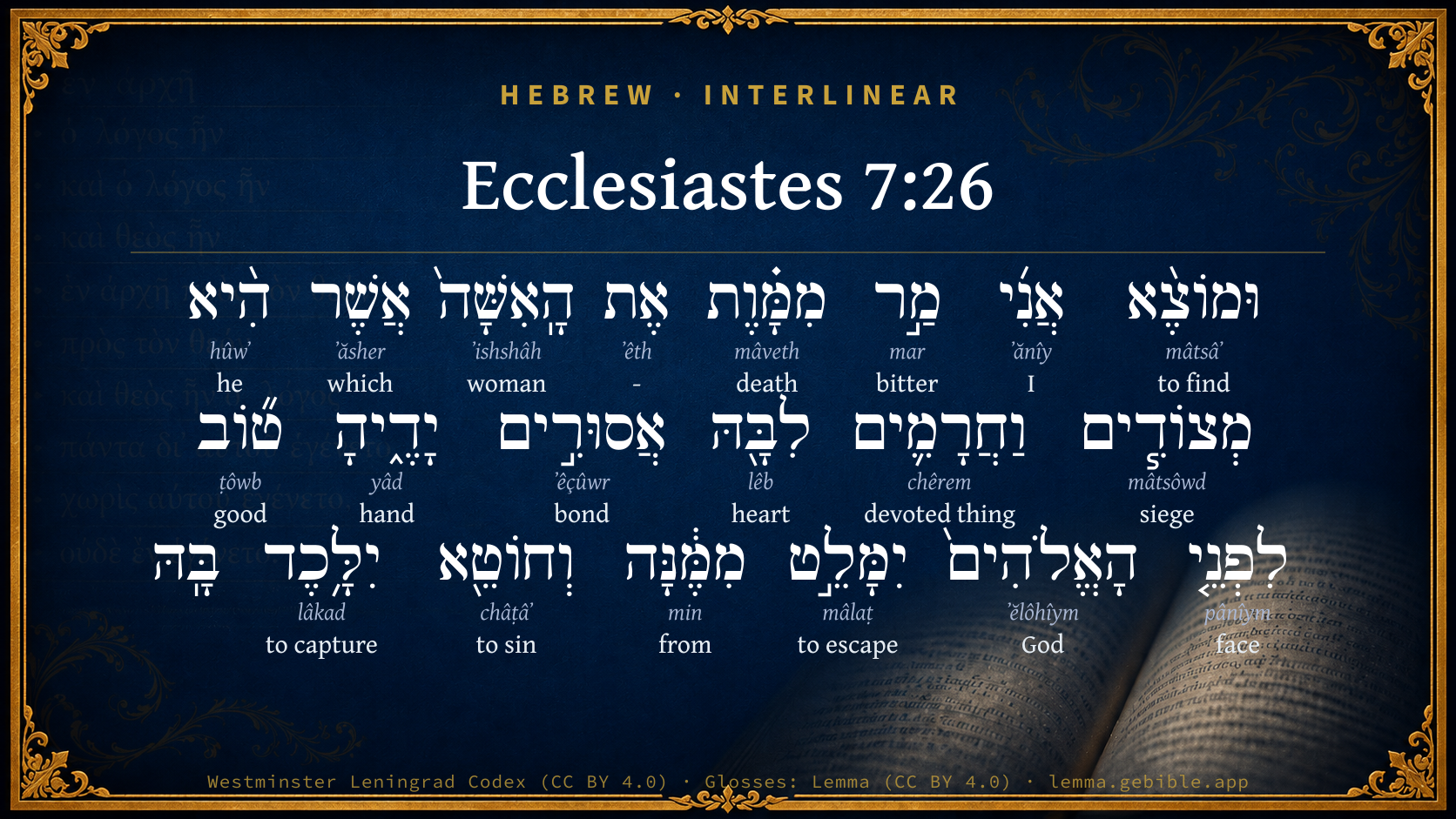
  1. וּמוֹצֶ֨א mâtsâʼ H4672 “and · finding” Conjunction + Verb, Qal, Participle Active, Masculine, Singular, Absolute
  2. אֲנִ֜י ʼănîy H589 “I” Pronoun, Personal, 1st Person, Common, Singular
  3. מַ֣ר mar H4751 “bitter” Adjective, Adjective, Masculine, Singular, Absolute
  4. מִמָּ֗וֶת mâveth H4194 “from · death” Preposition + Noun, Common, Masculine, Singular, Absolute
  5. אֶת ʼêth H853 “-” Particle, Direct Object
  6. הָֽאִשָּׁה֙ ʼishshâh H802 “the · woman” Particle, Definite Article + Noun, Common, Feminine, Singular, Absolute
  7. אֲשֶׁר ʼăsher H834 “which” Particle, Relative
  8. הִ֨יא hûwʼ H1931 “he” Pronoun, Personal, 3rd Person, Feminine, Singular
  9. מְצוֹדִ֧ים mâtsôwd H4685 “sieges” Noun, Common, Both, Plural, Absolute
  10. וַחֲרָמִ֛ים chêrem H2764 “and · devoted things” Conjunction + Noun, Common, Masculine, Plural, Absolute
  11. לִבָּ֖הּ lêb H3820 “heart · her” Noun, Common, Masculine, Singular, Construct + Suffix, Personal, 3rd Person, Feminine, Singular
  12. יָדֶ֑יהָ yâd H3027 “hands · her” Noun, Common, Both, Dual, Construct + Suffix, Personal, 3rd Person, Feminine, Singular
  13. ט֞וֹב ṭôwb H2896 “good” Adjective, Adjective, Masculine, Singular, Absolute
  14. לִפְנֵ֤י pânîym H6440 “to/for · face(s) of” Preposition + Noun, Common, Both, Plural, Construct
  15. הָאֱלֹהִים֙ ʼĕlôhîym H430 “the · God(s)” Particle, Definite Article + Noun, Common, Masculine, Plural, Absolute
  16. יִמָּלֵ֣ט mâlaṭ H4422 “to escape” Verb, Niphal, Imperfect, 3rd Person, Masculine, Singular
  17. מִמֶּ֔נָּה min H4480 “from · her” Preposition + Suffix, Personal, 3rd Person, Feminine, Singular
  18. וְחוֹטֵ֖א châṭâʼ H2398 “and · sinning” Conjunction + Verb, Qal, Participle Active, Masculine, Singular, Absolute
  19. יִלָּ֥כֶד lâkad H3920 “to capture” Verb, Niphal, Imperfect, 3rd Person, Masculine, Singular

About this verse

These counts appear in no published source. They are computed here, from the morphology-tagged text and Lemma’s own curated glosses. What Lemma adds →

21
words
20
distinct lemmas
Wisdom
section

Notable vocabulary

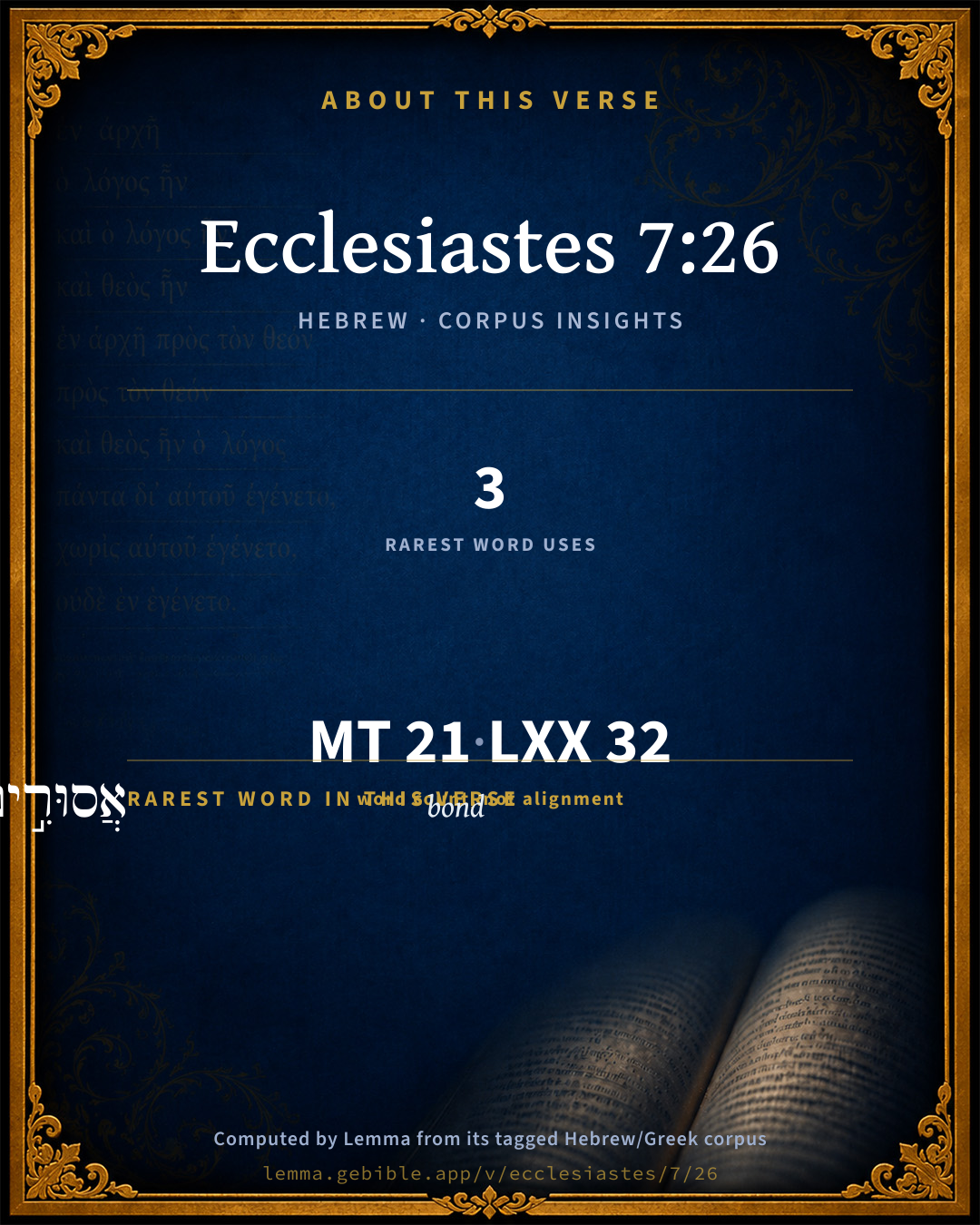
The rarest word here is אֲסוּרִ֣ים bond H612 — appearing just 3 times in the whole Hebrew Bible.

Shared distinctive vocabulary

אֲסוּרִ֣ים bond H612 occurs in 3 verses of the Hebrew Bible. Also found in:

Grammatical profile

  • 4 verbs
  • 9 nouns
  • 2 adjectives
  • 2 pronouns
  • 2 prepositions
  • 2 particles

Verb forms

  • וּמוֹצֶ֨א Qal · Participle Active
  • יִמָּלֵ֣ט Niphal · Imperfect
  • וְחוֹטֵ֖א Qal · Participle Active
  • יִלָּ֥כֶד Niphal · Imperfect

Hebrew & Septuagint length

In English translation the verse runs 33 words from the Hebrew and 34 from the Septuagint (LXX English) — closely comparable.

A rough comparison of the two English renderings, which tokenize alike — not a word-level alignment.

Word counts can differ between the Hebrew and the Greek without any difference in meaning — e.g. the Hebrew direct-object marker אֵת has no separate Greek word, and Greek often adds the article ὁ.

In the original languages it is 21 Hebrew tokens and 32 Greek tokens — but the two are counted differently (Hebrew bundles its prefixes and suffixes into one token; the Greek is in lemma form), so that isn’t a like-for-like length.

Cross-references

9

Topical passages linked to Ecclesiastes 7:26 in the Treasury of Scripture Knowledge — connected by theme and wording, ordered by reader-vote popularity; previews shown in the World English Bible.

  • Proverbs 22:14 The mouth of an adulteress is a deep pit: He who is under Yahweh's wrath will fall into it.
  • Proverbs 5:3–5 For the lips of an adulteress drip honey. Her mouth is smoother than oil,
  • Proverbs 2:16 To deliver you from the strange woman, Even from the foreigner who flatters with her words;
  • Proverbs 2:18–19 For her house leads down to death, Her paths to the dead.
  • Ecclesiastes 2:26 For to the man who pleases him, God gives wisdom, knowledge, and joy; but to the sinner he gives travail, to gather and to heap up, that he may give to him who pleases God. This also is vanity and a chasing after wind.
  • Proverbs 23:27–28 For a prostitute is a deep pit; And a wayward wife is a narrow well.
  • Proverbs 7:21–27 With persuasive words, she led him astray. With the flattering of her lips, she seduced him.
  • Judges 16:18–21 When Delilah saw that he had told her all his heart, she sent and called for the lords of the Philistines, saying, Come up this once, for he has told me all his heart. Then the lords of the Philistines came up to her, and brought the money in their hand.
  • Proverbs 9:18 But he doesn't know that the dead are there, That her guests are in the depths of Sheol.

Cross-references courtesy of OpenBible.info (CC BY 4.0).

Hebrew and Greek witnesses Masoretic Hebrew ↔ Greek Septuagint

The same verse in the two great witnesses to the Old Testament, shown verse-for-verse.

These are two independent witnesses, not word-aligned to each other, and the Septuagint is shown in lemma (dictionary) form.

Hebrew Ecclesiastes 7:26 Masoretic · Westminster Leningrad Codex

וּמוֹצֶ֨א אֲנִ֜י מַ֣ר מִמָּ֗וֶת אֶת הָֽאִשָּׁה֙ אֲשֶׁר הִ֨יא מְצוֹדִ֧ים וַחֲרָמִ֛ים לִבָּ֖הּ אֲסוּרִ֣ים יָדֶ֑יהָ ט֞וֹב לִפְנֵ֤י הָאֱלֹהִים֙ יִמָּלֵ֣ט מִמֶּ֔נָּה וְחוֹטֵ֖א יִלָּ֥כֶד בָּֽהּ

I find more bitter than death the woman whose heart is snares and traps, whose hands are chains. Whoever pleases God shall escape from her; but the sinner will be ensnared by her.

World English Bible · Public Domain

Greek LXX Ecclesiastes 7:26 Septuagint · lemma form

καί εὑρίσκω ἐγώ πικρός ὑπέρ θάνατος σύν ὁ γυνή ὅστις εἰμί θήρευμα καί σαγήνη καρδία αὐτός δεσμός χείρ αὐτός ἀγαθός πρό πρόσωπον ὁ θεός ἐκαἱρέω ἀπό αὐτός καί ἁμαρτάνω συνλαμβάνω ἐν αὐτός

I and my heart went round about to know, and to examine, and to seek wisdom, and the account of things, and to know the folly and trouble and madness of the ungodly man.

LXX2012 (modern English Septuagint) · Public Domain

On this verse, Haydock's Catholic Bible Commentary discusses the Septuagint’s reading. Read the note in Commentary ↓

Hebrew: Westminster Leningrad Codex (CC BY 4.0). Greek: Septuagint (public domain); English from LXX2012 (modern English Septuagint) (Public Domain). How the Septuagint differs from the Hebrew →

Commentary

Notes on Ecclesiastes 7:26 from classic Christian and Jewish commentators (each source and its license shown beneath its notes). The classic Christian expositions comment on the surrounding passage and are grouped to its opening verse, so a note may address several verses; the Jewish commentaries on the Tanakh (Rashi and others) are per-verse, so they appear only where the commentator wrote on this verse.

Lemma curates 59 commentaries, every one of them public domain or Creative Commons licensed, each selected and text-cleaned for this edition rather than reprinted as found. About our sources →

Trapp's Complete Commentary

John Trapp

Ecc 7:26 And I find more bitter than death the woman, whose heart [is] snares and nets, [and] her hands [as] bands: whoso pleaseth God shall escape from her; but the sinner shall be taken by her.

Ver. 26. And I found more bitter than death.] Amantes amentes: Amor amaror, Plus aloes quam mellis habet. Knowest thou not that there is bitterness in the end? Heus scholastiae, said the harlot to Apuleius, Hark, scholar, your sweet bits will prove bitter in the close. {a}

“ Principium dulce est, at finis amoris amarus. ”

The pomegranate, with its sweet kernels, but bitter rind, is an emblem of the bitter sweet pleasure of sin. It is observed of our Edward III that he had always fair weather at his passage into France, and foul upon his return. {b} Laeta venire Venus, tristis abire solet. The panther hides her head till she sees her time to make prey of those other beasts that, drawn by her sweet smell, follow her to their own destruction. {c} The poet’s fable, that pleasure and pain complained one of another to Jupiter, and that, when he could not decide the controversy between them, he tied them together with chains of adamant, never to be sundered.

The woman.] The wanton woman, that shame of her sex. A bitch, Moses calls her; {Deu 23:18} St Paul, a living ghost, a walking sepulchre of herself. {1Ti 5:6} Cum careat pura mente, cadaver agit. "This I find," saith Solomon, where "I" is "I" with a witness; he had found it by woeful experience, and now relates it for a warning to others. Saith he -

“ Quid facies facies veneris cum veneris ante?

Non sedeas, sed eas: ne pereas, per eas. ”

Whose heart is snares and nets.] Heb., Hunters’ snares; for she "hunteth for the precious life," {Pro 6:26} and the devil, by her, hunts for the precious soul, there being not anything that hath more enriched hell than harlots. All is good fish that comes to these nets; but they are "taken alive by the devil at his pleasure" {2Ti 2:26}

And her hands as bands.] To captivate and enslave those that haunt her, as Delilah did Samson, as the harlot did the young novice, {Pro 7:22} as Solomon’s Moabitish mistress did him, and as it is said of the Persian kings, that they were captivarum suarum captivi, {d} captives to their concubines, who dared to take the crown from their heads, or do anything to them almost, when others might not come near them uncalled upon pain of death {Est 4:11}

Whoso pleaseth God shall escape from her.] As Joseph did, and Bellerophon, though with a difference: Joseph out of a principle of chastity, Bellerophon of continence. The continent person refrains either for love of praise, or fear of punishment, but not without grief, for inwardly he is scalded with boiling lust, as Alexander, Scipio, and Pompey were, when, tempted with the exquisiteness and variety of choicest beauties, they forbare. Vellem, si non essem imperator. I would if I were not a general. But now the chaste man, who is good before God - one whom he approves and takes pleasure in - is holy both in body and spirit, {1Co 7:34} and this with delight, out of fear of God and love of virtue. God did much for that libidinous gentleman, who, sporting with a courtezan in a house of sin, happened to ask her name, which she said was Mary; whereat he was stricken with such a remorse and reverence, that he instantly not only cast off the harlot, but amended his future life. {e}

But the sinner shall be taken by her.] {See Trapp on "Pro 22:14"} The poet’s fable, that when Prometheus had discovered truth to men, that had long lain hid from them, Jupiter, or the devil, to cross that design, sent Pandora, - that is, pleasure - that should so besot them, as that they should neither mind nor make out after truth and honesty.

{a} Dulce et amarum gustulum carpis.

{b} Speed, 710. Walsingham.

{c} Solin., cap. 27.

{d} Plutarch.

{e} Montaigne’s Essays.

John Trapp, A Commentary or Exposition upon All the Books of the Old and New Testament (1647–1656) — public domain. Text from a community e-Sword module.

Joseph Benson's Commentary

Ecc 7:26. And I find — By my own sad experience, which Solomon here records as a testimony of his true repentance for his foul miscarriages, for which he was willing to take shame to himself, not only from the present, but from all succeeding generations; more bitter than death is the woman — The strange woman, of whom he speaks so much in the Proverbs; more vexatious and pernicious, as producing those horrors of conscience, those reproaches, diseases, and other plagues, both temporal and spiritual, from God, which are far worse than the mere death of the body, and, after all these, everlasting destruction; whose heart is snares and nets — Who is full of crafty devices to ensnare men; and her hands — By gifts, or lascivious actions, as bands — Wherewith she holds them in cruel bondage, so that they have neither power nor will to forsake her, notwithstanding all the dangers and mischiefs which they know attend upon such practices. Whoso pleaseth God — Hebrew, he that is good before God, who is sincerely, and in the judgment of God, truly pious; shall escape her — Shall be preserved from falling into her hands. Hereby he intimates, that neither a good temper of mind, nor great discretion, nor a good education, nor any other thing, except God’s grace, is a sufficient preservative from the dominion of fleshy lusts; but the sinner — Who rests satisfied without the saving grace of God and true piety, and therefore lives in known and wilful sin; shall be taken by her — Shall be entangled and held in her chains.

Joseph Benson's Commentary on the Old and New Testaments (1811–1818) — public domain. Text from a community e-Sword module.

Tyndale Open Study Notes

Tyndale Open Resources

7:26 a seductive woman: Cp. Prov 5; 6:20–7:27.

Tyndale Open Study Notes — © Tyndale Open Resources, licensed CC BY-SA 4.0. Text via the HelloAO Bible API.

Geneva Bible (1599)

Geneva Bible translators

Meaning, wisdom.

Geneva Bible (1599) marginal notes — public domain. Text via Bolls.life.

Jamieson, Fausset & Brown

Robert Jamieson, A. R. Fausset & David Brown

"I find" that, of all my sinful follies, none has been so ruinous a snare in seducing me from God as idolatrous women (Kg1 11:3-4; Pro 5:3-4; Pro 22:14). As "God's favor is better than life," she who seduces from God is "more bitter than death."

whoso pleaseth God--as Joseph (Gen 39:2-3, Gen 39:9). It is God's grace alone that keeps any from falling.

Jamieson, Fausset & Brown — Commentary Critical and Explanatory on the Whole Bible (1871) — public domain (CC PDM 1.0). Text via the HelloAO Bible API.

Adam Clarke's Commentary

Verse 26. And I find more bitter than death the woman] After all his investigation of the wickedness of folly, and the foolishness of madness, he found nothing equally dangerous and ruinous with the blandishments of cunning women. When once the affections are entangled, escape without ruin is almost impossible.

Whoso pleaseth God] The man who walks with God, and he alone, shall escape this sore evil: and even he that fears God, if he get with an artful woman, may be soon robbed of his strength, and become like other men. A bad or artful woman is represented as a company of hunters, with nets, gins, &c., to catch their prey.

Adam Clarke's Commentary on the Bible (1810–1826) — public domain. Text from a community e-Sword/MySword module.

Ellicott's Commentary for English Readers

(26) Sir_9:3; Sir_26:23.

Snares.—See Ecc_9:12; used for siege works, Ecc_9:14.

Nets.—Hab_1:15; Eze_26:5.

Bands.—Jdg_15:14.

A Bible Commentary for English Readers, edited by Charles John Ellicott (1878–1897) — public domain. Text from a community e-Sword module.

The Cambridge Bible for Schools and Colleges

gen. ed. J. J. S. Perowne

26. And I find more bitter than death] The result is a strange one in its contrast to the dominant tendency of Hebrew thought; especially we may add to that thought as represented by the Son of David with whom the Debater identifies himself. We think of the praises of the Shulamite in the Song of Solomon; of the language of Pro_5:13; and (though that is probably of later date) of the acrostic panegyric on the virtuous woman in Pro_31:10-31; and we find here nothing like an echo of them, but rather a tone of scorn, culminating in Ecc_7:28 in that which reminds us of the misogyny of the later maxim-makers of Greece, or of the Eastern king who never heard of any great calamity or crime without asking, Who is she? Such a change might, it is true, be explained as the result of the satiety into which the historical Solomon might have fallen as the penalty of his sensuality; and has its parallel in the cynical scorn of Catullus for the Lesbia whom he had once loved so tenderly (see Introduction, ch. iii.) and in that of a thousand others. Doubtless the words speak of such a personal experience on the part of the Debater. He had found no wickedness like that of the “strange woman,” such as she is painted in Pro_2:16-19; Pro_7:1-27. But we can scarcely fail to trace the influence of the Greek thought with which, as we have seen, the writer had come into contact. Of this the following may serve as samples out of a somewhat large collection.

Μεστὸν κακῶν πέφυκε φορτίον γυνή.

“A woman is a burden full of ills.”

Ὅπου γυναῖκες εἰσι, πάντʼ ἐκεῖ κακά.

“Where women are, all evils there are found.”

Θηρῶν ἁπάντων ἀγριωτέρα γυνή.

“Woman is fiercer than all beasts of prey.”

Poet. Graec. Gnomici, Ed. Tauchnitz, p. 182.

It might, perhaps, be pleaded in reference to this verse that the writer speaks of one class of women only, probably that represented in the pictures of Proverbs 2 or 7 and that the “corruptio optimi est pessima,” but the next verse makes the condemnation yet more sweeping. The suggestion that the writer allegorizes, and means by “the woman” here the abstract ideal of sensuality is quite untenable.

In the imagery of “snares” and “nets” and “bands” some critics (Tyler) have traced a reminiscence of the history of Samson and Delilah (Judges 16). Such a reference to Hebrew history is however not at all after the writer’s manner, and it is far more natural to see in it the result of his own personal experience (see Introduction, ch. iii.). The Son of Sirach follows, it may be noted, in the same track of thought, though with a somewhat less sweeping condemnation (Sir_25:15-26; Sir_26:6-12).

whoso pleaseth God] The marginal reading, whoso is good before God should be noted as closer to the Hebrew.

The Cambridge Bible for Schools and Colleges (gen. ed. J. J. S. Perowne; Cambridge University Press, 1878–1918) — public domain. Text from a community e-Sword module.

John Gill's Exposition

And I find more bitter than death the woman,.... This was the issue of his diligent studies and researches, and the observations he had made; this was what he found by sad and woeful experience, and which he chose to take particular notice of; that he might not only expose this vanity among others, and caution men against it, even the love of women, which at best is a bitter sweet, as the poet (k) calls it, though here adulterous love is meant; but having this opportunity, might express his sincere repentance for this folly of his life, than which nothing had been more bitter to him, in the reflection of his mind upon it: death is a bitter thing, and terrible to nature, Sa1 15:32; but to be ensnared by an adulterous woman is worse than that; it brings not only such diseases of body as are both painful and scandalous, but such horrors into the conscience, when awakened, as are intolerable, and exposes to eternal death; see Pro 5:3. By "the woman" is not meant the sex in general, which was far from Solomon's intention to reflect upon and reproach; nor any woman in particular, not Eve, the first woman, through whom came sin and death into the world; but an adulterous woman: see Pro 5:4. Some interpret this of original sin, or the corruption of nature, evil concupiscence, which draws men into sin, and holds them in it, the consequence of which is death eternal; but such who find favour in the eyes of God are delivered from the power and dominion of it; but obstinate and impenitent sinners are held under it, and perish eternally. Jarchi, by the woman, understands heresy; and so Jerom and others interpret it of heretics and idolaters: it may very well be applied to that Jezebel, the whore of Rome, the mother of harlots, that deceives men, and leads them into perdition with herself, Rev 17:4; and who is intended by the harlot, and foolish and strange woman, in the book of Proverbs, as has been observed;

whose heart is snares and nets, and her hands as bands; all the schemes and contrivances of a harlot are to ensnare men by her wanton looks and lascivious gestures; which are like snares laid for the beasts, and likeness spread for fishes, to take them in; and when she has got them, she holds them fast; it is a very difficult thing and a very rare one, ever to get out of her hands; so Plautus (l) makes mention of the nets of harlots: the same holds true of error and heresy, and of idolatry, which is spiritual adultery; the words used being in the plural number, shows the many ways the adulterous woman has to ensnare men, and the multitudes that are taken by her; see Rev 13:3;

whoso pleaseth God shall escape from her: or, "who is good before God", or "in his sight" (m); See Gill on Ecc 2:26; to whom he gives his grace and is acceptable to him; such an one as Joseph was shall escape the snares and nets, the hands and bands, of such a woman; or if fallen into them, as Solomon fell, shall be delivered out of them, as it is observed by various interpreters: nothing but the grace of God, the true fear of God, the power of godliness and undefiled religion, can preserve a person from being ensnared and held by an impure woman; not a liberal nor religious education, not learning and good sense, nor any thing else; if a man is kept out of the hands of such creatures, he ought to esteem it a mercy, and ascribe it to the grace and goodness of God;

but the sinner shall be taken by her; a hardened and impenitent sinner, that is destitute of the grace and fear of God; who is habitually a sinner, and gives up himself to commit iniquity; whose life is a continued series of sinning; who has no guard upon himself, but rushes into sin, as the horse into the battle; he becomes an easy prey to a harlot; he falls into her snares, and is caught and held by her; see Pro 22:14.

(k) Musaeus, v. 166. Vid. Barthii ad Claudian. de Nupt. Honor. v. 70. (l) Epidicus, Act. 2. Sc. 2. v. 32. "Illecebrosius nihil fieri potest", ib. Bacchides, Sc. 1. v. 55. Truculentus, Act. 1. Sc. 1. v. 14-21. (m) "bonus coram Deo", Pagninus, Mercerus, Drusius, Amama, Rambachius; "qui bonus videtur coram Deo ipso", Junius & Tremellius.

John Gill's Exposition of the Whole Bible (1746–1763) — public domain (CC PDM 1.0). Text via the HelloAO Bible API.

Albert Barnes' Notes on the Bible

Compare the account of Solomon’s wives 1Ki 11:1-8 : see also Pro 2:16-19; Pro 5:3...

Albert Barnes' Notes on the Bible (1834–1885) — public domain. Text from a community e-Sword/MySword module.

Haydock's Catholic Bible Commentary

Reason. Of all things. In this natural wisdom consists. Septuagint, "and number." He examined the pretensions of philosophy, which attempted thus to predict future events; but found that it was all deceit, like a harlot. (Olympiod.) --- He explored the qualities of different things, as an arithmetician counts numbers. (Menochius)

George Leo Haydock (1774–1849), Haydock's Catholic Family Bible and Commentary, 1859 edition — public domain. Excludes Psalms (Douay-Rheims chapter numbering differs from Protestant) and Deuterocanonical books (Catholic canon only).

Matthew Poole's English Annotations

I find, by my own sad experience; which Solomon here records, partly as an instance of that folly and madness which he expressed in general, Ecc 7:25, and partly as a testimony of his true repentance for his foul miscarriages, for which he was willing to take shame to himself, not only from the present, but from all succeeding generations.

More bitter; more vexatious and pernicious, as producing those horrors of conscience, those reproaches, and diseases, and other plagues, both temporal and spiritual, from God, which are far worse than simple death and, after all these, everlasting destruction.

The woman, the strange woman, of whom he speaks so much in the Proverbs,

whose heart is snares and nets; who being subtle of heart, Pro 7:10, is full of crafty devices to ensnare men; and her hands, either by gifts, or rather by lascivious actions, as bands; wherewith she holds them fast in cruel bondage; so that they have neither power nor will to forsake her, notwithstanding all the dangers and mischiefs which they know do attend upon such practices.

Whoso pleaseth God, Heb. he that is good before God; either,

1. Whom God loves and favours. Or rather,

2. Who is good sincerely, or in the judgment of God, who cannot be deceived, whereas hypocrites are frequently good in the eyes or opinions of men; which sense seems to be confirmed from the opposition of

the sinner to him, both here and Ecc 2:26. Hereby he intimates that neither a good temper of mind, nor great discretion, nor good education and instruction, nor any other thing, except God’s grace, is a sufficient preservative from the dominion of this lust.

Shall escape from her; shall be prevented from falling into that sin; or if by surprisal or strong temptation he be drawn to it, he shall be recovered out of it by true repentance. The sinner; the wilful and obstinate sinner, who gives himself up to the common practice of this or other sins; he who is a sinner before the Lord, as the Sodomites are called, Gen 13:13, who is fitly opposed to him that is good before God; he in whom there is not a dram of true goodness; for otherwise all men are sinners, as was said, Ecc 7:20.

Shall be taken by her; shall be entangled and kept fast in her chains, as is implied, because this is opposed to escaping from her.

Matthew Poole's English Annotations on the Holy Bible (1683–1685) — public domain. Text from a community e-Sword/MySword module.

Whedon's Commentary on the Bible

Daniel D. Whedon

26. The woman — That is, the sex, better without the “the.” I find woman more bitter than death — her heart, etc. The views of woman here given are such as began with Adam, were enjoined by the Jewish rabbies, and prevail in the East to this day. Woman’s emancipation coincides in its date and extent with Christianity, and the Virgin-Mother is the bright morning-star leading an ever-increasing host of faithful women who find joy and freedom in the train of a greater than Solomon. From the days of the gospel the character of woman has opened like a flower, and her past in Christianity has been brave and beautiful and true.

“Not she with traitorous kiss her Master stung,

Not she denied him with unfaithful tongue;

She, when apostles fled, could danger brave,

Last at the cross and earliest at his grave.”

The position of woman is the most false and cruel thing in heathen and Moslem lands, and Moses was, “from the hardness of their hearts,” obliged to leave it but partially mitigated among the Jews. Koheleth here speaks after the best common sense of his time: and we can see that there was need enough of a better dispensation. That he should think of woman as a demon hunting for victims!

Daniel D. Whedon (gen. ed.), Commentary on the Old and New Testaments (1874–1909) — public domain. Text from a community e-Sword module.

The Pulpit Commentary

One practical result of his quest Koheleth cannot avoid mentioning, though it comes with a suddenness which is somewhat startling. And I find more bitter than death the woman. Tracing men"s folly and madness to their source, he finds that they arise generally from the seductions of the female sex. Beginning with Adam, woman has continued to work mischief in the world. "Of the woman came the beginning of sin," says Siracides, "and through her we all die" (Ecc 25:24); it was owing to her that the punishment of death was inflicted on the human race. If Solomon himself were speaking, he had indeed a bitter experience of the sin and misery into which women lead their victims. (see 1Ki_11:1, 1Ki_11:4, 1Ki_11:11) It may be thought that Koheleth refers here especially to "the strange woman" of Pro_2:16, etc.; 5:3, etc.; but in ver. 28 he speaks of the whole sex without qualification; so that we must conclude that he had a very low opinion of them. It is no ideal personage whom he is introducing; it is not a personification of vice or folly; but woman in her totality, such as he knew her to be in Oriental courts and homes, denied her proper position, degraded, uneducated, all natural affections crushed or undeveloped, the plaything of her lord, to be flung aside at any moment. It is not surprising that Koheleth"s impression of the female sex should be unfavorable. He is not singular in such an opinion. One might fill a large page with proverbs and gnomes uttered in disparagement of woman by men of all ages and countries. Men, having the making of such apothegms, have used their license unmercifully; if the maligned sex had equal liberty, the tables might have been reversed. But, really, in this as in other cases the mean is the safest; and practically those who have given the darkest picture of women have not been slow to recognize the brighter side. If. for instance, the Book of Proverbs paints the adulteress and the harlot in the soberest, most appalling colors, the same book affords us such a sketch of the virtuous matron as is unequalled for vigor, truth, and high appreciation. And if, as in our present chapter, Koheleth shows a bitter feeling against the evil side of woman"s nature, he knows how to value the comfort of married life, (Ecc_4:8) and to look upon a good wife as one who makes a man"s home happy. (Ecc_9:9) Since the incarnation of our blessed Lord Jesus Christ, "the Seed of the woman," we have learned to regard woman in her true light, and to assign her that position to which she is entitled, giving honor unto her as the weaker vessel, and, at the same time, heir with us of the glorious hope and destiny of our renewed nature. (1Pe_3:7) Whose heart is snares and nets; more accurately, who is snares, and nets in her heart; Septuagint, "The woman who is a snare, and her heart nets;" Vulgate, Quae laqueus venatorum est, et sagena cot ejus. The imagery is obvious (comp. Pro_5:4, Pro_22:7:22 Pro_22:14; Hab_1:15) the thoughts of the evil woman"s heart are nets, occupied in meditating how she may entrap and retain victims; and her outward look and words are snares that captivate the foolish, Mhnta gunaikinh, says the Son of Sirach, Lest thou fall "into her snares" (Ecc_9:3). Plautus, Asin .," 1:3. 67

Auceps sum ego; Esca est meretrix; lectus illex est; amatores aves.

The fowler I; My bait the courtesan; her bed the lure; The birds the lovers.

So ancient critics, stronger m morals than in etymology, derive Venus from venari, to hunt," and mulier Item mollire, "to soften," or malleus, "a hammer," because the devil uses women to mould and fashion men to his will. And her hands as bands, Asurim, "bands" or "fetters," is found in Jud_1:15:14, where it is used of the chains with which the men of Judah bound Samson; it refers here to the wicked woman"s voluptuous embraces. Whoso pleaseth God (more literally, he who is good before God) shall escape from her. He whom God regards as good (Ecc_2:26, where see note) shall have grace to avoid these seductions. But the sinner shall be taken by her; HB; in her," in the snare which is herself. In some manuscripts of Ecclesiasticus (26:23) are these words; "A wicked woman is given as a portion to a wicked man; but a godly woman is given to him that feareth the Lord."

The Pulpit Commentary (1880–1919), ed. H.D.M. Spence-Jones & Joseph S. Exell — public domain. Text from a community e-Sword module.

John Wesley's Explanatory Notes

I find - By my own sad experience. Shall escape - Shall be prevented from falling into her hands.

John Wesley, Explanatory Notes Upon the Whole Bible (1754–1765) — public domain. Text via the GEBible commentary corpus.

Keil & Delitzsch

C. F. Keil & F. Delitzsch

"And I found woman more bitter than death; she is like hunting-nets. and like snares is her heart, her hands are bands: he who pleaseth God will escape from her; but the sinner is caught by them." As א ושׁ, Ecc 4:2, so here וּם א gains by the preceding אני וסבּותי a past sense;

(Note: With reference to this passage and Pro 18:22, it was common in Palestine when one was married to ask מצא או מוחא = happy or unhappy? Jebamoth 63b.)

the particip. clause stands frequently thus, not only as a circumstantial clause, Gen 14:12., but also as principal clause, Gen 2:10, in an historical connection. The preceding pred. מר, in the mas. ground-form, follows the rule, Gesen. 147. Regarding the construction of the relative clause, Hitzig judges quite correctly: "היא is copula between subj. and pred., and precedes for the sake of the contrast, giving emphasis to the pred. It cannot be a nomin., which would be taken up by the suff. in לבהּ, since if this latter were subject also to מץ, היא would not certainly be found. Also asher here is not a conj." This הוּא (היא), which in relative substantival clauses represents the copula, for the most part stands separated from asher, e.g., Gen 7:2; Gen 17:12; Num 17:5; Deu 17:15; less frequently immediately with it, Num 35:31; Sa1 10:19; Kg2 25:19; Lev 11:26; Deu 20:20. But this asher hu (hi) never represents the subj., placed foremost and again resumed by the reflex. pronoun, so as to be construed as the accentuation requires: quae quidem retia et laquei cor ejus = cajus quidem cor sunt retia et laquei (Heiligst.). מצוד is the means of searching, i.e., either of hunting: hunting-net (mitsodah, Ecc 9:12), or of blockading: siege-work, bulwarks, Ecc 9:14; here it is the plur. of the word in the former meaning. חרם, Hab 1:14, plur. Eze 26:5, etc. (perhaps from חרם, to pierce, bore through), is one of the many synon. for fishing-net. אסוּרים, fetters, the hands (arms) of voluptuous embrace. The primary form, after Jer 37:15, is אסוּר, אסוּר; cf. אבוּס, אב, Job 39:9. Of the three clauses following asher, vav is found in the second and is wanting to the third, as at Deu 29:22; Job 42:9; Psa 45:9; Isa 1:13; cf. on the other hand, Isa 33:6. Similar in their import are these Leonine verses:

Femina praeclara facie quasi pestis amara,

Et quasi fermentum corrumpit cor sapientum.

That the author is in full earnest in this harsh judgment regarding woman, is shown by 26b: he who appears to God as good (cf. Ecc 2:26) escapes from her (the fut. of the consequence of this his relation to God); but the sinner (חוטאו) is caught by her, or, properly, in her, viz., the net-like woman, or the net to which she is compared (Psa 9:16; Isa 24:18). The harsh judgment is, however, not applicable to woman as such, but to woman as she is, with only rare exceptions; among a thousand women he has not found one corresponding to the idea of a woman.

Keil & Delitzsch — Biblical Commentary on the Old Testament (1861–1891) — public domain (CC PDM 1.0). Text via the HelloAO Bible API. (Old Testament only.)

unfoldingWord translationNotes

Door43 World Missions Community

any woman whose heart is full of snares and nets, and whose hands are chains

The writer says that the seductive woman is like traps that hunters use to catch animals. The author speaks of a woman being seductive as if she traps men like a hunter traps animals. Her "heart" represents her thoughts and emotions. AT: "any woman who traps men by seducing them" (See: Metaphor and Metonymy)

snares and nets

These two words both refer to ways in which people trap animals to emphasize how the woman traps men. (See: Doublet)

whose hands are chains

Here the word "hands" refers to her power and control. This speaks of her being seductive as if hands were chains that she bound people with. AT: "from whom no one can escape" (See: Metaphor and Metonymy)

the sinner will be taken by her

This can be stated in active form. AT: "she will capture the sinner" (See: Active or Passive)

translationWords

die

snare

God

sin

unfoldingWord translationNotes — © Distant Shores Media and the Door43 World Missions Community, licensed CC BY-SA 4.0. Source: git.door43.org/Door43/en_tn.

Rashi

Rabbi Shlomo Yitzchaki (Rashi)

And I find more bitter than death which is the most severe of the ten severe things that were created in the world, as appears in Baba Bathra, in [the chapter entitled] “The Partners” (10a), and I find more bitter and more severe than it, the woman, i.e., apostasy.

whose heart is snares and nets Heb. חֲרָמִים, an expression of a net, like (Hab. 1:15): “he catches them in his net (בְּחֶרְמוֹ) and gathers them in his trawl.”

her hands are bonds and as soon as she seizes a man, he is as though bound in bonds of ropes.

bonds Heb. אֲסוּרִים, a noun meaning bonds, like (Jud. 15:14); “and his bonds (אֲסוּרָיו) melted,” and so did Menahem explain it (Machbereth p. 28).

Rashi on the Tanakh — English translations: “The Judaica Press complete Tanach with Rashi, translated by A. J. Rosenberg” (CC BY 4.0); “Pentateuch with Rashi's commentary by M. Rosenbaum and A.M. Silbermann, 1929-1934” (public domain); “The Metsudah Tanach series, Lakewood, N.J” (CC BY 4.0); and “The Book of Joshua, Metsudah Publications, 1997” (CC BY 4.0). Text via Sefaria.

Lesson kit

Teaching starters — assembled from the data on this page, not authored interpretation. Every prompt links to the verse data it draws on. Edit before teaching.

Ecclesiastes, in the Wisdom, opens this verse with 21 words (20 distinct Hebrew lemmas). Its most distinctive word is ʼêçûwr (“bond”). A historical commentator’s framing appears above. Read the whole chapter for the surrounding context.

Discussion questions

  1. What does “bond” (ʼêçûwr) contribute to the verse as a whole?
  2. How does Judges 15:14, which shares the word «bond», read alongside this verse?
  3. These translations render this verse differently. What is at stake in choosing one wording over another?
  4. «וּמוֹצֶ֨א» is a Qal Participle Active verb. How does that grammatical form shape the action described?
  5. Compare how Trapp's Complete Commentary and Joseph Benson's Commentary read this verse. Where do they agree or differ?

Things to notice

Reading settings

Reading text

Shown beneath each verse's original-language words.

Old Testament
Old Testament edition

Read the OT as the Masoretic Hebrew (MT) or the Greek Septuagint (LXX).

English shown for the Greek Septuagint (in the Hebrew ↔ Greek comparison).

Comparing translations? Open the Compare panel on any verse page to stack up to four side by side.