
Exodus 37:25

Hebrew (Westminster Leningrad Codex) Exodus 37:25 appears in the Hebrew Old Testament. The text above is from the Westminster Leningrad Codex. Each word links to its Strong’s number, a concise gloss, and parsing drawn from the Open Scriptures Hebrew Bible morphology. Click any word for its full Brown-Driver-Briggs (BDB) entry.
Download image
Cite this verse

Exodus 37:25 (World English Bible). Public Domain. Lemma interlinear Bible study tool, https://lemma.gebible.app/v/exodus/37/25.

Show BibTeX & RIS
BibTeX
RIS
English Translation
He made the altar of incense of acacia wood. It was square: its length was a cubit, and its breadth a cubit. Its height was two cubits. Its horns were of one piece with it.
World English Bible · Public Domain
Download a study sheet

One document with this verse’s original text, its word-by-word gloss line, the meaning frame, cross-references with their text, attributed commentary, and full source and license credits — printable, and it pastes into notes with its structure intact.

This verse Autodidact and up

Study sheet (.html) Plain text (.txt)

A passage Seminary Student

Up to 50 verses in one chapter. A passage sheet keeps up to 6 commentary sources and 12 cross-references per verse, in the order this page ranks them, and says so on the sheet whenever that leaves anything out. Ask for a single verse and you get the Autodidact verse sheet above.

Everything on this page stays free to read, with no account — the sheet is a download of what is already on screen, not access to it.

Want to remove ads? Support Godless Engineer
Compare translations 3

The same verse in 3 English versions, stacked beneath the original-language interlinear above. Click any original word for its lexicon entry.

Each is an independent rendering of the whole verse — the interlinear is not word-aligned to these translations.

Highlighted words mark where these versions differ — a whole-verse word diff, not a word-by-word alignment.

  • World English Bible Public Domain
    He made the altar of incense of acacia wood. It was square: its length was a cubit, and its breadth a cubit. Its height was two cubits. Its horns were of one piece with it.
  • King James Version Public Domain
    And he made the incense altar of shittim wood: the length of it was a cubit, and the breadth of it a cubit; it was foursquare; and two cubits was the height of it; the horns thereof were of the same.
  • unfoldingWord Literal Text CC BY-SA 4.0
    And he made the altar of incense of wood of acacias. Its length one cubit, and its width one cubit. It square, and its height two cubits. Its horns were part of it.

unfoldingWord Literal Text — © unfoldingWord, licensed CC BY-SA 4.0. Word-aligned USFM3 via Door43 (git.door43.org/unfoldingWord/en_ult).

Versions to compare (up to 4)

3 of 4 selected

Show all 18 translations

Every available English version of this verse, each an independent rendering of the whole verse.

  • World English Bible Public Domain
    He made the altar of incense of acacia wood. It was square: its length was a cubit, and its breadth a cubit. Its height was two cubits. Its horns were of one piece with it.
  • Berean Standard Bible Public Domain
    He made the altar of incense out of acacia wood. It was square, a cubit long, a cubit wide, and two cubits high. Its horns were of one piece.
  • Majority Standard Bible Public Domain
    He made the altar of incense out of acacia wood. It was square, a cubit long, a cubit wide, and two cubits high. Its horns were of one piece.
  • King James Version Public Domain
    And he made the incense altar of shittim wood: the length of it was a cubit, and the breadth of it a cubit; it was foursquare; and two cubits was the height of it; the horns thereof were of the same.
  • American Standard Version (1901) Public Domain
    And he made the altar of incense of acacia wood: a cubit was the length thereof, and a cubit the breadth thereof, foursquare; and two cubits was the height thereof; the horns thereof were of one piece with it.
  • Revised Version (1885) Public Domain
    And he made the altar of incense of acacia wood: a cubit was the length thereof, and a cubit the breadth thereof, foursquare; and two cubits was the height thereof; the horns thereof were of one piece with it.
  • Geneva Bible (1599) Public Domain
    Furthermore he made the perfume altar of Shittim wood: the length of it was a cubite, and the breadth of it a cubite (it was square) and two cubites hie, and the hornes thereof were of ye same.
  • Douay-Rheims (1899) Public Domain
    He made also the altar of incense of setim wood, being a cubit on every side foursquare, and in height two cubits: from the corners of which went out horns.
  • Young's Literal Translation Public Domain
    And he maketh the perfume-altar of shittim wood; a cubit its length, and a cubit its breadth (square), and two cubits its height; its horns have been of the same;
  • Literal Standard Version CC BY-SA 4.0
    And he makes the incense-altar of shittim wood; a cubit its length, and a cubit its breadth (square), and two cubits its height; its horns have been of the same;
  • Unlocked Literal Bible CC BY-SA 4.0
    Bezalel made the incense altar. He made it with acacia wood. Its length was one cubit, and its width one cubit. It was square, and its height was two cubits. Its horns were made as one piece with it.
  • unfoldingWord Literal Text CC BY-SA 4.0
    And he made the altar of incense of wood of acacias. Its length one cubit, and its width one cubit. It square, and its height two cubits. Its horns were part of it.
  • Darby Bible Public Domain
    And he made the altar of incense of acacia-wood; a cubit the length thereof, and a cubit the breadth thereof, square, and two cubits the height thereof: its horns were of itself.
  • World Messianic Bible Public Domain
    He made the altar of incense of acacia wood. It was square: its length was a cubit, and its width a cubit. Its height was two cubits. Its horns were of one piece with it.
  • Webster's Bible Public Domain
    And he made the incense-altar of shittim wood: the length of it was a cubit, and the breadth of it a cubit; it was foursquare; and two cubits was the hight of it; the horns of it were of the same.
  • Free Bible Version CC BY-SA 4.0
    He made the altar for burning incense from acacia wood. It was square, measuring a cubit by a cubit, by two cubits high, with horns on its corners that were all one piece with the altar.
  • Bible in Basic English Public Domain
    And he made the altar for the burning of spices, using the same hard wood; it was square, a cubit long and a cubit wide and two cubits high; the horns made of the same.
  • JPS Tanakh (1917) Public Domain
    And he made the altar of incense of acacia-wood: a cubit was the length thereof, and a cubit the breadth thereof, four-square; and two cubits was the height thereof; the horns thereof were of one piece with it.

Literal Standard Version (2020), Covenant Press — licensed CC BY-SA 4.0. Text via the HelloAO Bible API (eBible.org). Unlocked Literal Bible (unfoldingWord) — licensed CC BY-SA 4.0. Text via the HelloAO Bible API (eBible.org). unfoldingWord Literal Text — © unfoldingWord, licensed CC BY-SA 4.0. Word-aligned USFM3 via Door43 (git.door43.org/unfoldingWord/en_ult). Free Bible Version, Dr. Jonathan Gallagher — licensed CC BY-SA 4.0. Text via the HelloAO Bible API (eBible.org).

Word by word

More ways to search: Search by grammar → Find every occurrence → Compare this word →

Practice this passage: Drill this verse → Learn its vocabulary →

רָב֗וּעַ
râbaʻ
H7251
“squared”
Verb, Qal, Participle Passive, Masculine, Singular, Absolute
Part of Speech
Verb
Stem
Qal
Form
Participle Passive
Gender
Masculine
Number
Singular
State
Absolute
Full BDB Definition

Origin: a primitive root [rather identical with H7250 through the idea of sprawling "at all fours" (or possibly the reverse is the order of deriv)

TWOT: 2107

to square, be squared - (Qal) square (participle) - (Pual) square (participle)
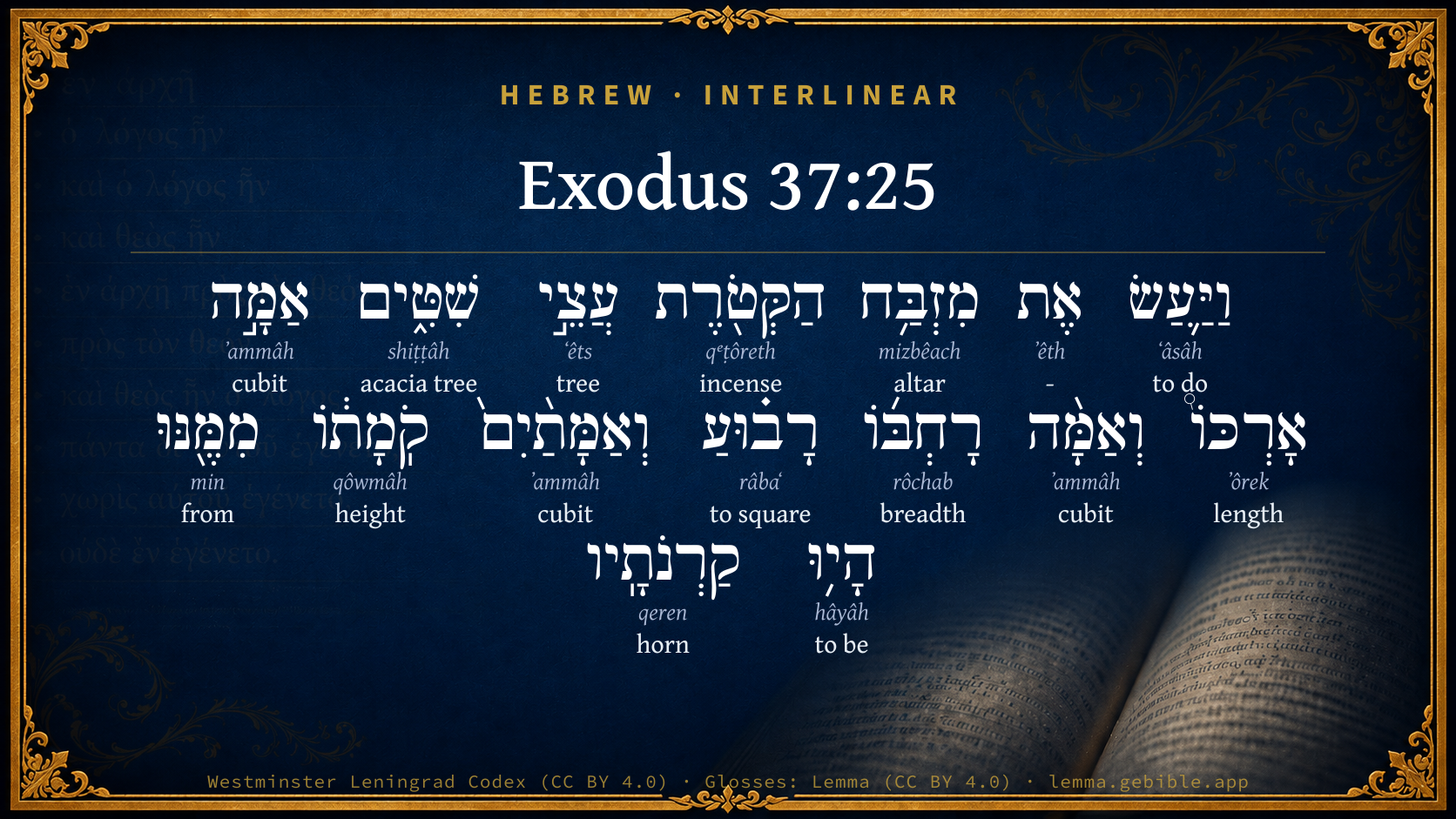
  1. וַיַּ֛עַשׂ ʻâsâh H6213 “and · to do” Conjunction + Verb, Qal, Sequential Imperfect, 3rd Person, Masculine, Singular
  2. אֶת ʼêth H853 “-” Particle, Direct Object
  3. מִזְבַּ֥ח mizbêach H4196 “altar of” Noun, Common, Masculine, Singular, Construct
  4. הַקְּטֹ֖רֶת qᵉṭôreth H7004 “the · incense” Particle, Definite Article + Noun, Common, Feminine, Singular, Absolute
  5. עֲצֵ֣י ʻêts H6086 “trees of” Noun, Common, Masculine, Plural, Construct
  6. שִׁטִּ֑ים shiṭṭâh H7848 “acacia trees” Noun, Common, Feminine, Plural, Absolute
  7. אַמָּ֣ה ʼammâh H520 “cubit” Noun, Common, Feminine, Singular, Absolute
  8. אָרְכּוֹ֩ ʼôrek H753 “length · his” Noun, Common, Masculine, Singular, Construct + Suffix, Personal, 3rd Person, Masculine, Singular
  9. וְאַמָּ֨ה ʼammâh H520 “and · cubit” Conjunction + Noun, Common, Feminine, Singular, Absolute
  10. רָחְבּ֜וֹ rôchab H7341 “breadth · his” Noun, Common, Masculine, Singular, Construct + Suffix, Personal, 3rd Person, Masculine, Singular
  11. וְאַמָּתַ֨יִם֙ ʼammâh H520 “and · cubits” Conjunction + Noun, Common, Feminine, Dual, Absolute
  12. קֹֽמָת֔וֹ qôwmâh H6967 “height · his” Noun, Common, Feminine, Singular, Construct + Suffix, Personal, 3rd Person, Masculine, Singular
  13. מִמֶּ֖נּוּ min H4480 “from · us” Preposition + Suffix, Personal, 1st Person, Common, Plural
  14. הָי֥וּ hâyâh H1961 “to be” Verb, Qal, Perfect, 3rd Person, Common, Plural
  15. קַרְנֹתָֽיו qeren H7161 “horns · his” Noun, Common, Both, Plural, Construct + Suffix, Personal, 3rd Person, Masculine, Singular

About this verse

These counts appear in no published source. They are computed here, from the morphology-tagged text and Lemma’s own curated glosses. What Lemma adds →

16
words
14
distinct lemmas
Pentateuch
section

Notable vocabulary

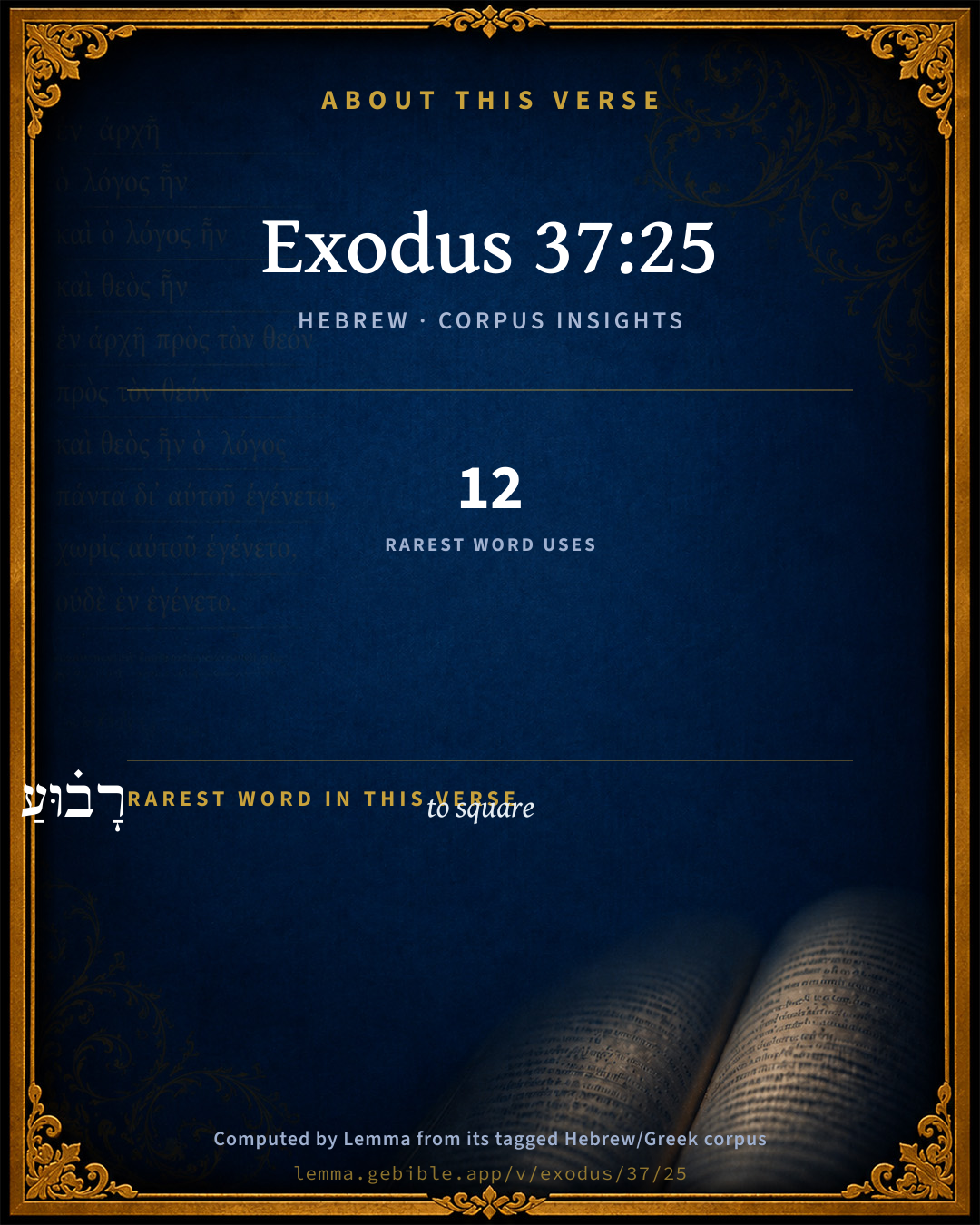
The rarest word here is רָב֗וּעַ to square H7251 — appearing just 12 times in the whole Hebrew Bible.

Shared distinctive vocabulary

רָב֗וּעַ to square H7251 occurs in 12 verses of the Hebrew Bible. Also found in:

Grammatical profile

  • 3 verbs
  • 11 nouns
  • 1 preposition
  • 1 particle

Verb forms

  • וַיַּ֛עַשׂ Qal · Sequential Imperfect
  • רָב֗וּעַ Qal · Participle Passive
  • הָי֥וּ Qal · Perfect

Repetition

A word recurs within this verse — often emphatic in Hebrew:

  • אַמָּ֣ה cubit H520 ×3

Cross-references

10

Topical passages linked to Exodus 37:25 in the Treasury of Scripture Knowledge — connected by theme and wording, ordered by reader-vote popularity; previews shown in the World English Bible.

  • Exodus 30:1–5 "You shall make an altar to burn incense on. You shall make it of acacia wood.
  • Hebrews 7:25 Therefore he is also able to save to the uttermost those who draw near to God through him, seeing he ever lives to make intercession for them.
  • 1 Peter 2:5 You also, as living stones, are built up as a spiritual house, to be a holy priesthood, to offer up spiritual sacrifices, acceptable to God through Jesus Christ.
  • Revelation 8:3–4 Another angel came and stood over the altar, having a golden censer. Much incense was given to him, that he should add it to the prayers of all the saints on the golden altar which was before the throne.
  • Exodus 40:5 You shall set the golden altar for incense before the ark of the testimony, and put the screen of the door to the tent.
  • Exodus 40:26–27 He put the golden altar in the tent of meeting before the veil;
  • 2 Chronicles 26:16 But when he was strong, his heart was lifted up, so that he did corruptly, and he trespassed against Yahweh his God; for he went into the temple of Yahweh to burn incense on the altar of incense.
  • Matthew 23:19 You blind fools! For which is greater, the gift, or the altar that sanctifies the gift?
  • Luke 1:9–10 according to the custom of the priest's office, his lot was to enter into the temple of the Lord and burn incense.
  • Hebrews 13:10 We have an altar from which those who serve the holy tabernacle have no right to eat.

Cross-references courtesy of OpenBible.info (CC BY 4.0).

Hebrew and Greek witnesses Masoretic Hebrew ↔ Greek Septuagint

The same verse in the two great witnesses to the Old Testament, shown verse-for-verse.

These are two independent witnesses, not word-aligned to each other, and the Septuagint is shown in lemma (dictionary) form.

Hebrew Exodus 37:25 Masoretic · Westminster Leningrad Codex

וַיַּ֛עַשׂ אֶת מִזְבַּ֥ח הַקְּטֹ֖רֶת עֲצֵ֣י שִׁטִּ֑ים אַמָּ֣ה אָרְכּוֹ֩ וְאַמָּ֨ה רָחְבּ֜וֹ רָב֗וּעַ וְאַמָּתַ֨יִם֙ קֹֽמָת֔וֹ מִמֶּ֖נּוּ הָי֥וּ קַרְנֹתָֽיו

He made the altar of incense of acacia wood. It was square: its length was a cubit, and its breadth a cubit. Its height was two cubits. Its horns were of one piece with it.

World English Bible · Public Domain

Hebrew: Westminster Leningrad Codex (CC BY 4.0). Greek: Septuagint (public domain); English from a public-domain English Septuagint. How the Septuagint differs from the Hebrew →

Targum (Aramaic paraphrase)

2

The Targum is the ancient Jewish Aramaic paraphrase of the Hebrew Scriptures — an interpretive translation, not the Hebrew text itself. Onkelos (literal) and Pseudo-Jonathan (expansive) render the Torah, and Jonathan the Prophets. Coverage is partial: where no permissively-licensed English translation exists for a verse, only the Aramaic is shown. This is verse-level text, not a word-by-word alignment to the Hebrew.

  1. Targum Onkelos Torah (Genesis–Deuteronomy)
    וַעֲבַד יָת מַדְבְּחָא דִקְטֹּרֶת בּוּסְמַיָא דְאָעֵי שִׁטִין אַמְתָא אֻרְכֵּהּ וְאַמְתָא פְתָיֵהּ מְרַבַּע וְתַרְתֵּין אַמִין רוּמֵהּ מִנֵהּ הֲווֹ קַרְנוֹהִי:

    (no public-domain English translation for this verse)

    Targum Onkelos — Aramaic: “Onkelos Genesis” (public domain); “Onkelos Exodus” (public domain); “Onkelos Leviticus” (public domain); “Onkelos Numbers” (public domain); “Onkelos Deuteronomy” (public domain). English: “Sefaria Community Translation” (CC0 1.0 (public-domain dedication)); “J.W. Etheridge. The Targums of Onkelos and Jonathan Ben Uzziel on the Pentateuch. London: Longmans, Green, 1862” (public domain). Text via Sefaria.

  2. Targum Pseudo-Jonathan Torah (Genesis–Deuteronomy)
    וַעֲבַד יַת מַדְבְּחָא דִקְטוֹרֶת בּוּסְמַיָא מִן קִיסֵי שִׁיטָא אַמְתָא אוּרְכֵּיהּ וְאַמְתָא פּוּתְיֵיהּ מְרַבַּע וְתַרְתֵּין אַמִּין רוּמֵיהּ מִינֵיהּ הֲווֹן קַרְנוֹי זְקִיפִין

    And he made the ALTAR OF SWEET INCENSE of sitta wood, a cubit its length, and a cubit its breadth, foursquare, and two cubits was its height; its two upright horns were of the same.

    Targum Pseudo-Jonathan — Aramaic: “Targum Jonathan on Genesis” (public domain); “Targum Jonathan on Exodus” (public domain); “Targum Jonathan on Leviticus” (public domain); “Targum Jonathan on Numbers” (public domain); “Targum Jonathan on Deuteronomy” (public domain). English: “The Targum of Jonathan ben Uzziel, trans. J. W. Etheridge, London, 1862” (public domain). Text via Sefaria.

Commentary

Notes on Exodus 37:25 from classic Christian and Jewish commentators (each source and its license shown beneath its notes). The classic Christian expositions comment on the surrounding passage and are grouped to its opening verse, so a note may address several verses; the Jewish commentaries on the Tanakh (Rashi and others) are per-verse, so they appear only where the commentator wrote on this verse.

Lemma curates 59 commentaries, every one of them public domain or Creative Commons licensed, each selected and text-cleaned for this edition rather than reprinted as found. About our sources →

Joseph Benson's Commentary

Exo 37:25. The incense burned on this altar daily. signified both the prayers of saints and the intercession of Christ, to which is owing the acceptableness of them.

Joseph Benson's Commentary on the Old and New Testaments (1811–1818) — public domain. Text from a community e-Sword module.

unfoldingWord translationNotes

Door43 World Missions Community

General Information:

Bezalel's work crew continues to build the tabernacle and furniture.

Bezalel made ... gold for it

For Exo 37:25-26 see how you translated many of these words in Exodus 30:1-2 and Exodus 30:3.

cubit

A cubit is 46 centimeters. (See: Biblical Distance)

Its horns were made as one piece with it

This can be stated in active form. AT: "He made the horns as one piece with the altar" (See: Active or Passive)

translationWords

altar of incense

acacia

pure

gold

unfoldingWord translationNotes — © Distant Shores Media and the Door43 World Missions Community, licensed CC BY-SA 4.0. Source: git.door43.org/Door43/en_tn.

Matthew Henry's Commentary

Here is, 1. The making of the golden altar, on which incense was to be burnt daily, which signified both the prayers of saints and the intercession of Christ, to which are owing the acceptableness and success of those prayers. The rings and staves, and all the appurtenances of this altar, were overlaid with gold, as all the vessels of the table and candlestick were of gold, for these were used in the holy place. God is the best, and we must serve him with the best we have; but the best we can serve him with in his courts on earth is but as brass, compared with the gold, the sinless and spotless perfection, with which his saints shall serve him in his holy place above. 2. The preparing of the incense which was to be burnt upon this altar, and with it the holy anointing oil (Exo 37:29), according to the dispensatory, Exo 30:22, etc. God taught Bezaleel this art also; so that though he was not before acquainted with it yet he made up these things according to the work of the apothecary, as dexterously and exactly as if he had been bred up to the trade. Where God gives wisdom and grace, it will make the man of God perfect, thoroughly furnished to every good work.

Matthew Henry's Commentary on the Whole Bible (1708–1710) — public domain (CC PDM 1.0). Text via the HelloAO Bible API.

Adam Clarke's Commentary

Verse 25. He made the incense altar] See this described Ex 30:1. See Clarke on Ex 30:1.

Adam Clarke's Commentary on the Bible (1810–1826) — public domain. Text from a community e-Sword/MySword module.

Ellicott's Commentary for English Readers

(25-28) And he made . . . —The order of the instructions given on Mount Sinai is here departed from. In them the directions for the altar of incense were separated off from those concerning the table of shewbread and the golden candlestick. Here the construction of the three pieces of furniture belonging to the Holy Place is given consecutively. The present passage corresponds with Exo_37:1-5 of Exodus 30, with which it is in the closest agreement.

A Bible Commentary for English Readers, edited by Charles John Ellicott (1878–1897) — public domain. Text from a community e-Sword module.

The Pulpit Commentary

The incense altar here occurs in its right place, among the furniture of the outer chamber of the tabernacle not, as in Exo_30:1-6, out of place.

Vers. 25-29. The altar of incense.

See Homily on Exo_30:1-11, Exo_30:34-38. J.O.

The Pulpit Commentary (1880–1919), ed. H.D.M. Spence-Jones & Joseph S. Exell — public domain. Text from a community e-Sword module.

John Wesley's Explanatory Notes

The incense burnt on this altar daily, signified both the prayers of saints, and the intercession of Christ, to which is owing the acceptableness of them.

John Wesley, Explanatory Notes Upon the Whole Bible (1754–1765) — public domain. Text via the GEBible commentary corpus.

Kretzmann's Popular Commentary

Paul E. Kretzmann

The Altar of Incense

v. 25. And he made the incense altar of shittim wood; the length of it was a cubit, and the breadth of it a cubit; it was foursquare; and two cubits was the height of it; the horns thereof were of the same.

v. 26. And he overlaid it with pure gold, both the top, the plate, of it, and the sides thereof round about, and the horns of it; also he made unto it a crown of gold round about, a heavy, decorated molding.

v. 27. And he made two rings of gold for it under the crown thereof, next to the heavy molding, by the two corners of it, upon the two sides thereof, to be places for the staves to bear it withal. Thus was the "golden altar" finished.

v. 28. And he made the staves of shittim wood and overlaid them with gold. Cf Exo 30:1-10.

v. 29. And he made the holy anointing oil and the pure incense of sweet spices according to the work of the apothecary. Cf Exo 30:22-28.

Paul E. Kretzmann, Popular Commentary of the Bible (1921–1924) — public domain. Text from a community e-Sword module.

Lesson kit

Teaching starters — assembled from the data on this page, not authored interpretation. Every prompt links to the verse data it draws on. Edit before teaching.

Exodus, in the Pentateuch, opens this verse with 16 words (14 distinct Hebrew lemmas). Its most distinctive word is râbaʻ (“to square”). A historical commentator’s framing appears above. Read the whole chapter for the surrounding context.

Discussion questions

  1. How does “to square” (râbaʻ) shape what this verse is saying?
  2. How does Exodus 27:1, which shares the word «to square», read alongside this verse?
  3. What does the repetition of “cubit” (3× in this one verse) do in this verse?
  4. These translations render this verse differently. What is at stake in choosing one wording over another?
  5. «וַיַּ֛עַשׂ» is a Qal Sequential Imperfect verb. How does that grammatical form shape the action described?
  6. Compare how Joseph Benson's Commentary and unfoldingWord translationNotes read this verse. Where do they agree or differ?

Things to notice

Reading settings

Reading text

Shown beneath each verse's original-language words.

Old Testament
Old Testament edition

Read the OT as the Masoretic Hebrew (MT) or the Greek Septuagint (LXX).

English shown for the Greek Septuagint (in the Hebrew ↔ Greek comparison).

Comparing translations? Open the Compare panel on any verse page to stack up to four side by side.