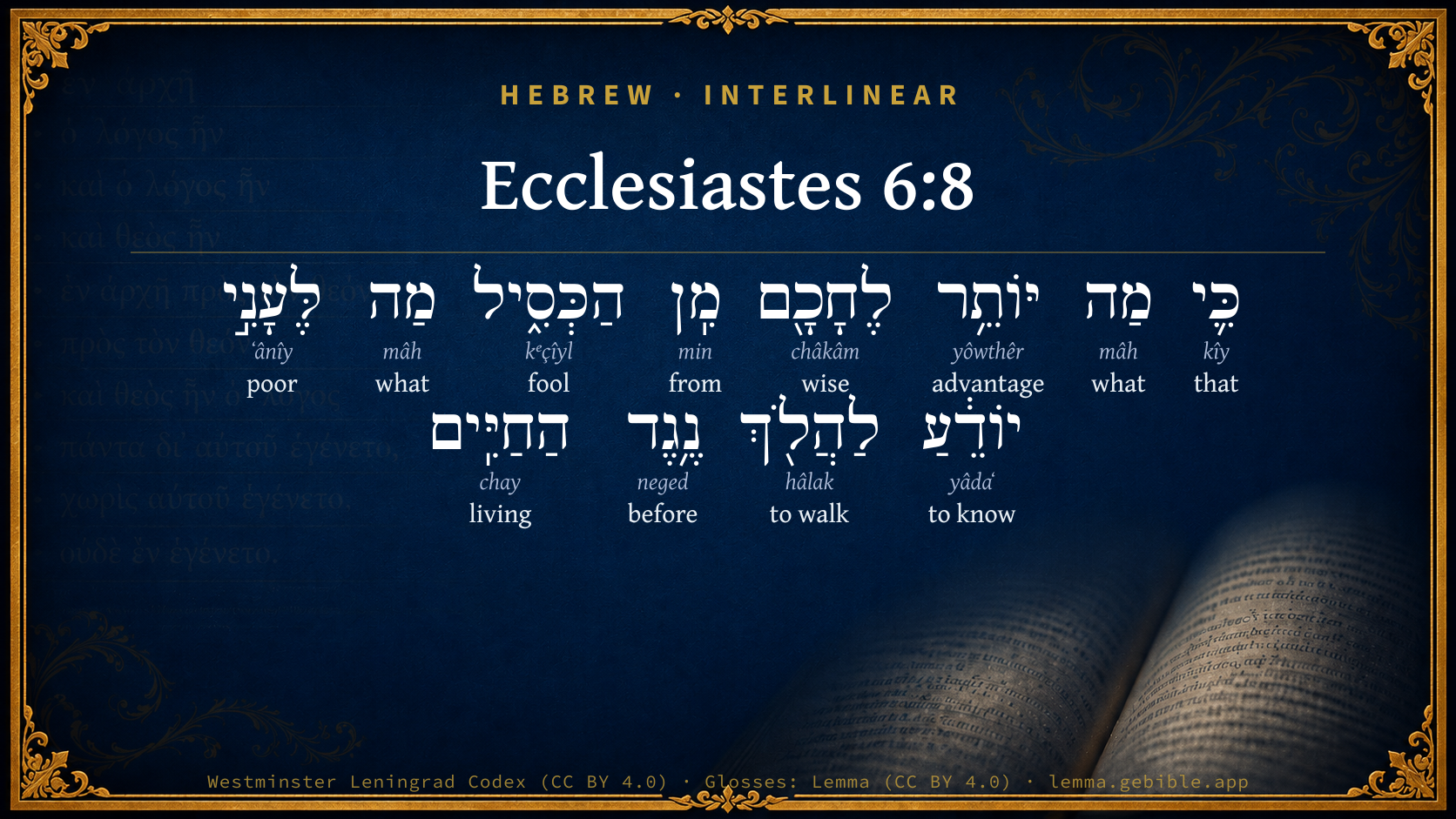
Ecclesiastes 6:8

Hebrew (Westminster Leningrad Codex) Ecclesiastes 6:8 appears in the Hebrew Old Testament. The text above is from the Westminster Leningrad Codex. Each word links to its Strong’s number, a concise gloss, and parsing drawn from the Open Scriptures Hebrew Bible morphology. Click any word for its full Brown-Driver-Briggs (BDB) entry.
Download image
Cite this verse

Ecclesiastes 6:8 (World English Bible). Public Domain. Lemma interlinear Bible study tool, https://lemma.gebible.app/v/ecclesiastes/6/8.

Show BibTeX & RIS
BibTeX
RIS
English Translation
For what advantage has the wise more than the fool? What has the poor man, that knows how to walk before the living?
World English Bible · Public Domain
Download a study sheet

One document with this verse’s original text, its word-by-word gloss line, the meaning frame, cross-references with their text, attributed commentary, and full source and license credits — printable, and it pastes into notes with its structure intact.

This verse Autodidact and up

Study sheet (.html) Plain text (.txt)

A passage Seminary Student

Up to 50 verses in one chapter. A passage sheet keeps up to 6 commentary sources and 12 cross-references per verse, in the order this page ranks them, and says so on the sheet whenever that leaves anything out. Ask for a single verse and you get the Autodidact verse sheet above.

Everything on this page stays free to read, with no account — the sheet is a download of what is already on screen, not access to it.

Want to remove ads? Support Godless Engineer
Compare translations 3

The same verse in 3 English versions, stacked beneath the original-language interlinear above. Click any original word for its lexicon entry.

Each is an independent rendering of the whole verse — the interlinear is not word-aligned to these translations.

Highlighted words mark where these versions differ — a whole-verse word diff, not a word-by-word alignment.

  • World English Bible Public Domain
    For what advantage has the wise more than the fool? What has the poor man, that knows how to walk before the living?
  • King James Version Public Domain
    For what hath the wise more than the fool? what hath the poor, that knoweth to walk before the living?
  • unfoldingWord Literal Text CC BY-SA 4.0
    For what advantage to the wise more than the fool? What to the poor person who knows to walk before the living?

unfoldingWord Literal Text — © unfoldingWord, licensed CC BY-SA 4.0. Word-aligned USFM3 via Door43 (git.door43.org/unfoldingWord/en_ult).

Versions to compare (up to 4)

3 of 4 selected

Show all 18 translations

Every available English version of this verse, each an independent rendering of the whole verse.

  • World English Bible Public Domain
    For what advantage has the wise more than the fool? What has the poor man, that knows how to walk before the living?
  • Berean Standard Bible Public Domain
    What advantage, then, has the wise man over the fool? What gain comes to the poor man who knows how to conduct himself before others?
  • Majority Standard Bible Public Domain
    What advantage, then, has the wise man over the fool? What gain comes to the poor man who knows how to conduct himself before others?
  • King James Version Public Domain
    For what hath the wise more than the fool? what hath the poor, that knoweth to walk before the living?
  • American Standard Version (1901) Public Domain
    For what advantage hath the wise more than the fool? `or' what hath the poor man, that knoweth how to walk before the living?
  • Revised Version (1885) Public Domain
    For what advantage hath the wise more than the fool? or what hath the poor man, that knoweth to walk before the living?
  • Geneva Bible (1599) Public Domain
    For what hath the wise man more then the foole? what hath the poore that knoweth how to walke before the liuing?
  • Douay-Rheims (1899) Public Domain
    What hath the wise man more than the fool? and what the poor man, but to go thither, where there is life?
  • Young's Literal Translation Public Domain
    For what advantage `is' to the wise above the fool? What to the poor who knoweth to walk before the living?
  • Literal Standard Version CC BY-SA 4.0
    For what advantage [is] to the wise above the fool? What to the poor who knows to walk before the living?
  • Unlocked Literal Bible CC BY-SA 4.0
    Indeed, what advantage has the wise person over the fool? What advantage does the poor man have even if he knows how to act in front of other people?
  • unfoldingWord Literal Text CC BY-SA 4.0
    For what advantage to the wise more than the fool? What to the poor person who knows to walk before the living?
  • Darby Bible Public Domain
    For what advantage hath the wise above the fool? what hath the poor, that knoweth to walk before the living?
  • World Messianic Bible Public Domain
    For what advantage has the wise more than the fool? What has the poor man, that knows how to walk before the living?
  • Webster's Bible Public Domain
    For what hath the wise more than the fool? what hath the poor, that knoweth to walk before the living?
  • Free Bible Version CC BY-SA 4.0
    So then, what real advantage do wise people have over those who are fools? And do poor people really gain anything in knowing how to behave in front of others?
  • Bible in Basic English Public Domain
    What have the wise more than the foolish? and what has the poor man by walking wisely before the living?
  • JPS Tanakh (1917) Public Domain
    For what advantage hath the wise more than the fool? or the poor man that hath understanding, in walking before the living?

Literal Standard Version (2020), Covenant Press — licensed CC BY-SA 4.0. Text via the HelloAO Bible API (eBible.org). Unlocked Literal Bible (unfoldingWord) — licensed CC BY-SA 4.0. Text via the HelloAO Bible API (eBible.org). unfoldingWord Literal Text — © unfoldingWord, licensed CC BY-SA 4.0. Word-aligned USFM3 via Door43 (git.door43.org/unfoldingWord/en_ult). Free Bible Version, Dr. Jonathan Gallagher — licensed CC BY-SA 4.0. Text via the HelloAO Bible API (eBible.org).

Word by word

More ways to search: Search by grammar → Find every occurrence → Compare this word →

Practice this passage: Drill this verse → Learn its vocabulary →

יּוֹתֵ֥ר
yôwthêr
H3148
“advantage”
Noun, Common, Masculine, Singular, Absolute
Part of Speech
Noun
Type
Common
Gender
Masculine
Number
Singular
State
Absolute
Full BDB Definition

Origin: active participle of H3498

TWOT: 936d

superiority, advantage, excess (noun masculine) - excess, better (adverb) - besides, moreover, more (conjuntion)
  1. כִּ֛י kîy H3588 “that” Conjunction
  2. מַה mâh H4100 “what” Particle, Interrogative
  3. לֶחָכָ֖ם châkâm H2450 “to/for the · wise” Preposition, Determined + Adjective, Adjective, Masculine, Singular, Absolute
  4. מִֽן min H4480 “from” Preposition
  5. הַכְּסִ֑יל kᵉçîyl H3684 “the · fool” Particle, Definite Article + Adjective, Adjective, Masculine, Singular, Absolute
  6. מַה mâh H4100 “what” Particle, Interrogative
  7. לֶּעָנִ֣י ʻânîy H6041 “to/for the · poor” Preposition, Determined + Adjective, Adjective, Masculine, Singular, Absolute
  8. יוֹדֵ֔עַ yâdaʻ H3045 “knowing” Verb, Qal, Participle Active, Masculine, Singular, Absolute
  9. לַהֲלֹ֖ךְ hâlak H1980 “to walk” Preposition + Verb, Qal, Infinitive Construct
  10. נֶ֥גֶד neged H5048 “before” Preposition
  11. הַחַיִּֽים chay H2416 “the · living” Particle, Definite Article + Adjective, Adjective, Masculine, Plural, Absolute

About this verse

These counts appear in no published source. They are computed here, from the morphology-tagged text and Lemma’s own curated glosses. What Lemma adds →

12
words
11
distinct lemmas
Wisdom
section

Notable vocabulary

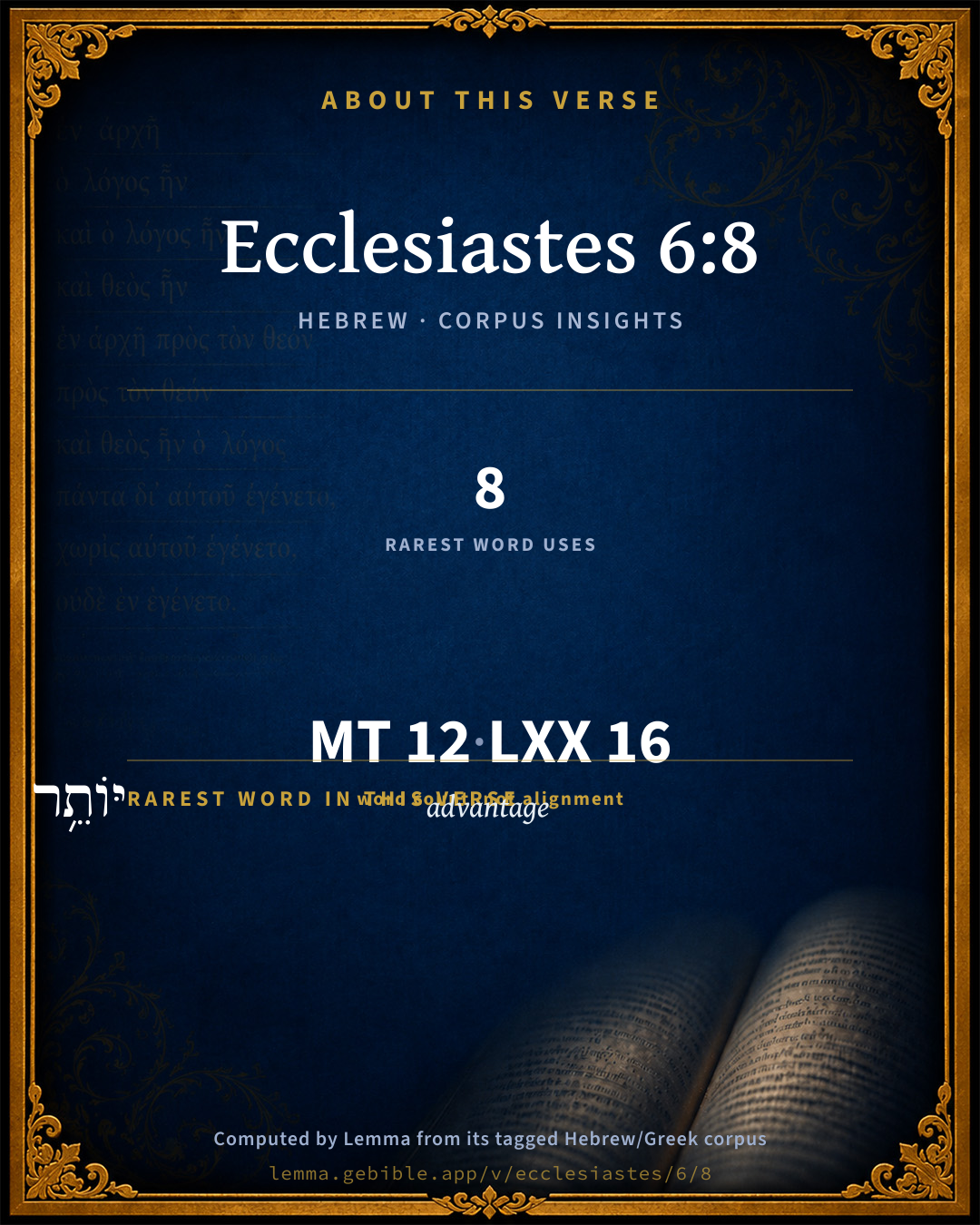
The rarest word here is יּוֹתֵ֥ר advantage H3148 — appearing just 8 times in the whole Hebrew Bible.

Shared distinctive vocabulary

יּוֹתֵ֥ר advantage H3148 occurs in 8 verses of the Hebrew Bible. Also found in:

Grammatical profile

  • 2 verbs
  • 1 noun
  • 4 adjectives
  • 2 prepositions
  • 1 conjunction
  • 2 particles

Verb forms

  • יוֹדֵ֔עַ Qal · Participle Active
  • לַהֲלֹ֖ךְ Qal · Infinitive Construct

Repetition

A word recurs within this verse — often emphatic in Hebrew:

Hebrew & Septuagint length

In English translation the verse runs 23 words from the Hebrew and 23 from the Septuagint (LXX English) — the same length.

A rough comparison of the two English renderings, which tokenize alike — not a word-level alignment.

Word counts can differ between the Hebrew and the Greek without any difference in meaning — e.g. the Hebrew direct-object marker אֵת has no separate Greek word, and Greek often adds the article ὁ.

In the original languages it is 12 Hebrew tokens and 16 Greek tokens — but the two are counted differently (Hebrew bundles its prefixes and suffixes into one token; the Greek is in lemma form), so that isn’t a like-for-like length.

Cross-references

8

Topical passages linked to Ecclesiastes 6:8 in the Treasury of Scripture Knowledge — connected by theme and wording, ordered by reader-vote popularity; previews shown in the World English Bible.

  • Proverbs 19:1 Better is the poor who walks in his integrity Than he who is perverse in his lips and is a fool.
  • Ecclesiastes 2:14–16 The wise man's eyes are in his head, and the fool walks in darkness--and yet I perceived that one event happens to them all.
  • Genesis 17:1 When Abram was ninety-nine years old, Yahweh appeared to Abram, and said to him, "I am God Almighty. Walk before me, and be blameless.
  • Psalms 101:2 I will be careful to live a blameless life. When will you come to me? I will walk within my house with a blameless heart.
  • Psalms 116:9 I will walk before Yahweh in the land of the living.
  • Ecclesiastes 5:11 When goods increase, those who eat them are increased; and what advantage is there to its owner, except to feast on them with his eyes?
  • Luke 1:6 They were both righteous before God, walking blamelessly in all the commandments and ordinances of the Lord.
  • 1 Timothy 6:17 Charge those who are rich in this present world that they not be haughty, nor have their hope set on the uncertainty of riches, but on the living God, who richly provides us with everything to enjoy;

Cross-references courtesy of OpenBible.info (CC BY 4.0).

Hebrew and Greek witnesses Masoretic Hebrew ↔ Greek Septuagint

The same verse in the two great witnesses to the Old Testament, shown verse-for-verse.

These are two independent witnesses, not word-aligned to each other, and the Septuagint is shown in lemma (dictionary) form.

Hebrew Ecclesiastes 6:8 Masoretic · Westminster Leningrad Codex

כִּ֛י מַה יּוֹתֵ֥ר לֶחָכָ֖ם מִֽן הַכְּסִ֑יל מַה לֶּעָנִ֣י יוֹדֵ֔עַ לַהֲלֹ֖ךְ נֶ֥גֶד הַחַיִּֽים

For what advantage has the wise more than the fool? What has the poor man, that knows how to walk before the living?

World English Bible · Public Domain

Greek LXX Ecclesiastes 6:8 Septuagint · lemma form

ὅτι τίς περισσεία ὁ σοφός ὑπέρ ὁ ἄφρων διότι ὁ πένης οἶδα πορεύομαι κατέναντι ὁ ζωή

For what advantage has the wise man over the fool, since even the poor knows how to walk in the direction of life?

LXX2012 (modern English Septuagint) · Public Domain

On this verse, The Pulpit Commentary discusses the Septuagint’s reading. Read the note in Commentary ↓

Hebrew: Westminster Leningrad Codex (CC BY 4.0). Greek: Septuagint (public domain); English from LXX2012 (modern English Septuagint) (Public Domain). How the Septuagint differs from the Hebrew →

Commentary

Notes on Ecclesiastes 6:8 from classic Christian and Jewish commentators (each source and its license shown beneath its notes). The classic Christian expositions comment on the surrounding passage and are grouped to its opening verse, so a note may address several verses; the Jewish commentaries on the Tanakh (Rashi and others) are per-verse, so they appear only where the commentator wrote on this verse.

Lemma curates 59 commentaries, every one of them public domain or Creative Commons licensed, each selected and text-cleaned for this edition rather than reprinted as found. About our sources →

Trapp's Complete Commentary

John Trapp

Ecc 6:8 For what hath the wise more than the fool? what hath the poor, that knoweth to walk before the living?

Ver. 8. For what hath the wise more than the fool?] Nothing at all in this vanity of human nature, that it needeth still new supply of nourishment to preserve it. When a wise man hath eaten, is he not again hungry? and must not his hunger again be satisfied as well as a fool’s hunger? Indeed, as any man is more wise, he is more temperate: he eats to live, not lives to eat. He needs not much, nor is a slave to his appetite, or to his palate. He can feed upon gruel for a need, with Daniel; upon coleworts, with Elisha; upon a cake on the coals and a cruise of water, with Elijah; upon locusts and wild honey, with the Baptist; upon barley bread, with the disciples; upon a herring or two, as Luther, &c. This a fool can ill frame to. He eats as a beast with the old world - Tρωγοντες {Mat 24:38} - and "feeds without fear"; {Jdg 1:12} he "caters for the flesh" {Rom 13:14} and "overchargeth it with surfeiting and drunkenness"; {Luk 21:34} he measureth not his cheer by that which nature requireth, but that which greedy appetite desireth, as if therein consisteth his whole happiness.

What hath the poor that knoweth to walk before the living,] viz., The poor wise man that lives by his wits can "serve the time," in St Paul’s sense (if ever he meant it there, Rom 12:11), and make an honest shift to rub through the world. What hath such a one more than a simpler man in this particular? Doth not his hunger return - his stomach crave new nourishment? Animantis cuiusque vita est fuga, saith the philosopher: Were it not for the repair of nutrition, the natural life would be soon extinguished.

John Trapp, A Commentary or Exposition upon All the Books of the Old and New Testament (1647–1656) — public domain. Text from a community e-Sword module.

Tyndale Open Study Notes

Tyndale Open Resources

6:8-9 are wise people really better off . . . being wise? Yes, as long as they enjoy and are content with what the Lord has provided.

Tyndale Open Study Notes — © Tyndale Open Resources, licensed CC BY-SA 4.0. Text via the HelloAO Bible API.

Geneva Bible (1599)

Geneva Bible translators

That knoweth to use his goods well in the judgment of men.

Geneva Bible (1599) marginal notes — public domain. Text via Bolls.life.

Jamieson, Fausset & Brown

Robert Jamieson, A. R. Fausset & David Brown

For--"However" [MAURER]. The "for" means (in contrast to the insatiability of the miser), For what else is the advantage which the wise man hath above the fool?"

What--advantage, that is, superiority, above him who knows not how to walk uprightly

hath the poor who knoweth to walk before the living?--that is, to use and enjoy life aright (Ecc 5:18-19), a cheerful, thankful, godly "walk" (Psa 116:9).

Jamieson, Fausset & Brown — Commentary Critical and Explanatory on the Whole Bible (1871) — public domain (CC PDM 1.0). Text via the HelloAO Bible API.

Adam Clarke's Commentary

Verse 8. For what hath the wise more than the fool?] They must both labour for the same end. Both depend upon the labour of themselves or others for the necessaries of life. Both must eat and drink in order to live; and the rich man can no more eat two meals at a time, than he can comfortably wear two changes of raiment. The necessaries of life are the same to both, and their condition in life is nearly similar; liable to the same diseases, dissolution, and death.

Adam Clarke's Commentary on the Bible (1810–1826) — public domain. Text from a community e-Sword/MySword module.

Ellicott's Commentary for English Readers

(8) That knoweth to walk.—Understands how to conduct himself. But why this should be limited to the poor is not obvious.

A Bible Commentary for English Readers, edited by Charles John Ellicott (1878–1897) — public domain. Text from a community e-Sword module.

The Cambridge Bible for Schools and Colleges

gen. ed. J. J. S. Perowne

8. For what hath wise more than the fool?] The question so far is easy. In this matter, the gifts of intellect make no difference. The wise, no less than the fool, is subject to the pressure of bodily necessities, and has to labour for them. The second clause is somewhat less clear. Of the many interpretations that have been given, two have most to commend them, (1) supplying the subject of comparison from the first clause, what advantage hath the poor that knows to walk before the living (i.e. that has learnt the art to live) over the fool (who is the mere slave of appetite)? what does wisdom and self-control and freedom from the snares of wealth really profit him? and (2), treating the sentence as elliptical, What advantage hath the poor over him who knows how to walk before the living (i.e. the man of high birth or station, who lives in public, with the eyes of men on him)? The latter explanation has the merit of giving a more balanced symmetry to the two clauses. The question, with its implied answer, seems at first at variance with the praise of the lot of the labouring poor in ch. Ecc_5:12, “Don’t trust,” the writer seems to say in his half-cynical, half-ironical mood, “even to poverty, as a condition of happiness. The poor man is as open to cares and anxieties as the man of culture and refinement. After all, poor and rich stand on nearly the same level.”

The Cambridge Bible for Schools and Colleges (gen. ed. J. J. S. Perowne; Cambridge University Press, 1878–1918) — public domain. Text from a community e-Sword module.

John Gill's Exposition

For what hath the wise more than the fool,.... More delight and pleasure, in gratifying his senses, by eating and drinking: the wise man enjoys no more than the fool; the fool finds as much pleasure in the labour of his hands, which is for his mouth, as the wise man does; and the wise man can get no more satisfaction to his mind, from these outward gratifications, than the fool;

what hath the poor, that knoweth to walk before the living? either, what does the poor man want more than the rich man, that knows how to get his bread, and is diligent and industrious among men to live, and does get a livelihood for himself and family; he enjoys all the sweets and comforts of life, as well as the rich man: or what hath the poor knowing man? as Aben Ezra interprets it, according to the accents; what has he more or does he enjoy more, than the poor foolish man, provided he has but sense enough to behave himself among men, so as to have bread to eat, and clothes to wear; which is as much as any man can enjoy, be he ever so rich or so wise?

John Gill's Exposition of the Whole Bible (1746–1763) — public domain (CC PDM 1.0). Text via the HelloAO Bible API.

Haydock's Catholic Bible Commentary

Life. The wise poor shall be blessed. Hebrew, "the poor knowing how to walk before the living," (Haydock) in society (Calmet) among the saints. (Haydock)

George Leo Haydock (1774–1849), Haydock's Catholic Family Bible and Commentary, 1859 edition — public domain. Excludes Psalms (Douay-Rheims chapter numbering differs from Protestant) and Deuterocanonical books (Catholic canon only).

Matthew Poole's English Annotations

The fool, to wit, in these matters. Both are equally subject to the same calamities, and partakers of the same comforts of this life.

Before the living, to wit, before the poor, that doth not know this; which words are easily understood by comparing this clause with the former. And such defects are usual, both in Scripture and other authors, as hath been formerly noted, by a figure which the learned call anantapodoton. And by this phrase, that knoweth, &c., he means such a poor man who is ingenious and industrious; who is fit for service and business, and knows how to carry himself towards rich men, so as to deserve and gain their favour, and to procure a livelihood.

Matthew Poole's English Annotations on the Holy Bible (1683–1685) — public domain. Text from a community e-Sword/MySword module.

Whedon's Commentary on the Bible

Daniel D. Whedon

8. The familiar question is asked, If this be the case, What hath, etc. — The latter part should be, What hath the poor more than he who knoweth, etc. In the phraseology of the Old Testament “poor” is often synonymous with “humble,” “obscure.” To walk before the living, means, as in chap.

Ecc_4:16, to have leadership and supremacy. The contrast is between the obscure and him who is able to govern the generation living with him. Thus the verse includes the most opposite classes of men, and therefore all men.

Daniel D. Whedon (gen. ed.), Commentary on the Old and New Testaments (1874–1909) — public domain. Text from a community e-Sword module.

The Pulpit Commentary

For what hath the wise more fire than the fool? i.e. What advantage hath the wise man over the fool? This verse confirms the previous one by an interrogative argument. The same labor for support, the same unsatisfied desires, belong to all, wise or foolish; in this respect intellectual gifts have no superiority. (For a similar interrogation implying an emphatic denial, see Ec 1) What hath the poor, that knoweth to walk before the living? The Septuagint gives the verse thus: Oti tiv perisseia (A, C, a) tw sofw uJper ton afrona; dioti oJ penhv oijde poreuqhnai katenanti thv zwhv, "For what advantage hath the wise man over the fool? since the poor man knows how to walk before life?" Vulgate, Quid habet amplius sapiens a stulto? et quid pauper, nisi ut pergat illuc, ubi est vita? "And what hath the poor man except that he go thither where is life?" Both these versions regard as used in the sense of "life," and that the life beyond the grave; but this idea is foreign to the context; and the expression must be rendered, as in the Authorized Version, "the living." The interpretation of the clause has much exercised critics. Plumptre adheres to that of Bernstein and others, "What advantage hath the poor over him who knows how to walk before the living?" (i.e. the man of high birth or station, who lives in public, with the eyes of men upon him). The poor has his cares and unsatisfied desires as much as the man of culture and position. Poverty offers no protection against such assaults, But the expression, to know how to walk before the living, means to understand and to follow the correct path of life; to know how to behave properly and uprightly in the intercourse with one"s fellowmen; to have what the French call savoir vivre. (So Volok.) The question must be completed thus: "What advantage has the discreet and properly conducted poor man over the fool?" None, at least in this respect. The poor man, even though he be well vetoed in the rule of life, has insatiable desires which he has to check or conceal, and so is no better off than the fool, who equally is unable to gratify them. The two "extremities of the social scale are taken the rich wise man, and the prudent poor man and both are shown to fail in enjoying life; and what is true of these must be also true of all that come between these two limits, "the appetite is not filled" (ver. 7).

The Pulpit Commentary (1880–1919), ed. H.D.M. Spence-Jones & Joseph S. Exell — public domain. Text from a community e-Sword module.

John Wesley's Explanatory Notes

More - In these matters. Both are subject to the same calamities, and partakers of the same comforts of this life. The poor - More than the poor that doth not know this. He means such a poor man as is ingenious and industrious; fit for service and business.

John Wesley, Explanatory Notes Upon the Whole Bible (1754–1765) — public domain. Text via the GEBible commentary corpus.

Keil & Delitzsch

C. F. Keil & F. Delitzsch

"For what hath the wise more than the fool; what the poor who knoweth to walk before the living?" The old translators present nothing for the interpretation, but defend the traditional text; for Jerome, like the Syr., which translates freely, follows the Midrash (fixed in the Targ.), which understands החיים, contrary to the spirit of the book, of the blessed future. The question would be easier if we could, with Bernst. and Ginsburg, introduce a comparat. min before יודע; we would then require to understand by him who knows to walk before the living, some one who acts a part in public life; but how strange a designation of distinguished persons would that be! Thus, as the text stands, יודע ,sdnat is attrib. to לעני, what preference hath the poor, such an one, viz., as understands (vid., regarding יודע instead of היודע, under Psa 143:10); not: who is intelligent (Aben Ezra); יודע is not, as at Ecc 9:11, an idea contained in itself, but by the foll. הח ... לה (cf. Ecc 4:13, Ecc 4:14; and the inf. form, Exo 3:19; Num 22:13; Job 34:23) obtains the supplement and colouring required: the sequence of the accents (Zakeph, Tifcha, Silluk, as e.g., at Gen 7:4) is not against this. How the lxx understood its πορευθῆναι κατέναντι τῆς ζωῆς, and the Venet. it's ἀπιέναι ἀντικρὺ τῆς ζωῆς, is not clear; scarcely as Grtz, with Mendelss.: who, to go against (נגד, as at Ecc 4:12) life, to fight against it, has to exercise himself in self-denial and patience; for "to fight with life" is an expression of modern coinage. הח signifies here, without doubt, not life, but the living. But we explain now, not as Ewald, who separates יודע from the foll. inf. להלך: What profit has then the wise man, the intelligent, patient man, above the fool, that he walks before the living? - by which is meant (but how does this interrog. form agree thereto?), that the wise, patient man has thereby an advantage which makes life endurable by him, in this, that he does not suffer destroying eagerness of desire so to rule over him, but is satisfied to live in quietness.Also this meaning of a quiet life does not lie in the words הח ... הלך. "To know to walk before the living" is, as is now generally acknowledged = to understand the right rule of life (Elst.), to possess the savoir vivre (Heiligst.), to be experienced in the right art of living. the question accordingly is: What advantage has the wise above the fool; and what the poor, who, although poor, yet knows how to maintain his social position? The matter treated of is the insatiable nature of sensual desire. The wise seeks to control his desire; and he who is more closely designated poor, knows how to conceal it; for he lays upon himself restraints, that he may be able to appear and make something of himself. But desire is present in both; and they have in this nothing above the fool, who follows the bent of his desire and lives for the day. He is a fool because he acts as one not free, and without consideration; but, in itself, it is and remains true, that enjoyment and satisfaction stand higher than striving and longing for a thing.

Keil & Delitzsch — Biblical Commentary on the Old Testament (1861–1891) — public domain (CC PDM 1.0). Text via the HelloAO Bible API. (Old Testament only.)

Rashi

Rabbi Shlomo Yitzchaki (Rashi)

For what is the advantage [i.e., what advantage] did he have with his wisdom, more than if he were a fool?

What has the poor man a disadvantage over the rich man who has no satisfaction? He too knows how to go along with the living. Another explanation: [7] yet the appetite is not sated for the World to Come, for he did not perform good deeds in his lifetime.

Rashi on the Tanakh — English translations: “The Judaica Press complete Tanach with Rashi, translated by A. J. Rosenberg” (CC BY 4.0); “Pentateuch with Rashi's commentary by M. Rosenbaum and A.M. Silbermann, 1929-1934” (public domain); “The Metsudah Tanach series, Lakewood, N.J” (CC BY 4.0); and “The Book of Joshua, Metsudah Publications, 1997” (CC BY 4.0). Text via Sefaria.

Lesson kit

Teaching starters — assembled from the data on this page, not authored interpretation. Every prompt links to the verse data it draws on. Edit before teaching.

Ecclesiastes, in the Wisdom, opens this verse with 12 words (11 distinct Hebrew lemmas). Its most distinctive word is yôwthêr (“advantage”). A historical commentator’s framing appears above. Read the whole chapter for the surrounding context.

Discussion questions

  1. The word yôwthêr carries the sense “advantage.” How does it shape the verse?
  2. Esther 6:6 shares the word «advantage» with this verse. How do the two illuminate each other?
  3. “what” occurs 2× in this one verse. What is the effect of the repetition?
  4. These translations render this verse differently. What is at stake in choosing one wording over another?
  5. The verb «יוֹדֵ֔עַ» is Qal Participle Active. How does its form color the action?
  6. Reading how Trapp's Complete Commentary and Tyndale Open Study Notes read this verse, where do the two commentators agree and where do they part?

Things to notice

Reading settings

Reading text

Shown beneath each verse's original-language words.

Old Testament
Old Testament edition

Read the OT as the Masoretic Hebrew (MT) or the Greek Septuagint (LXX).

English shown for the Greek Septuagint (in the Hebrew ↔ Greek comparison).

Comparing translations? Open the Compare panel on any verse page to stack up to four side by side.