
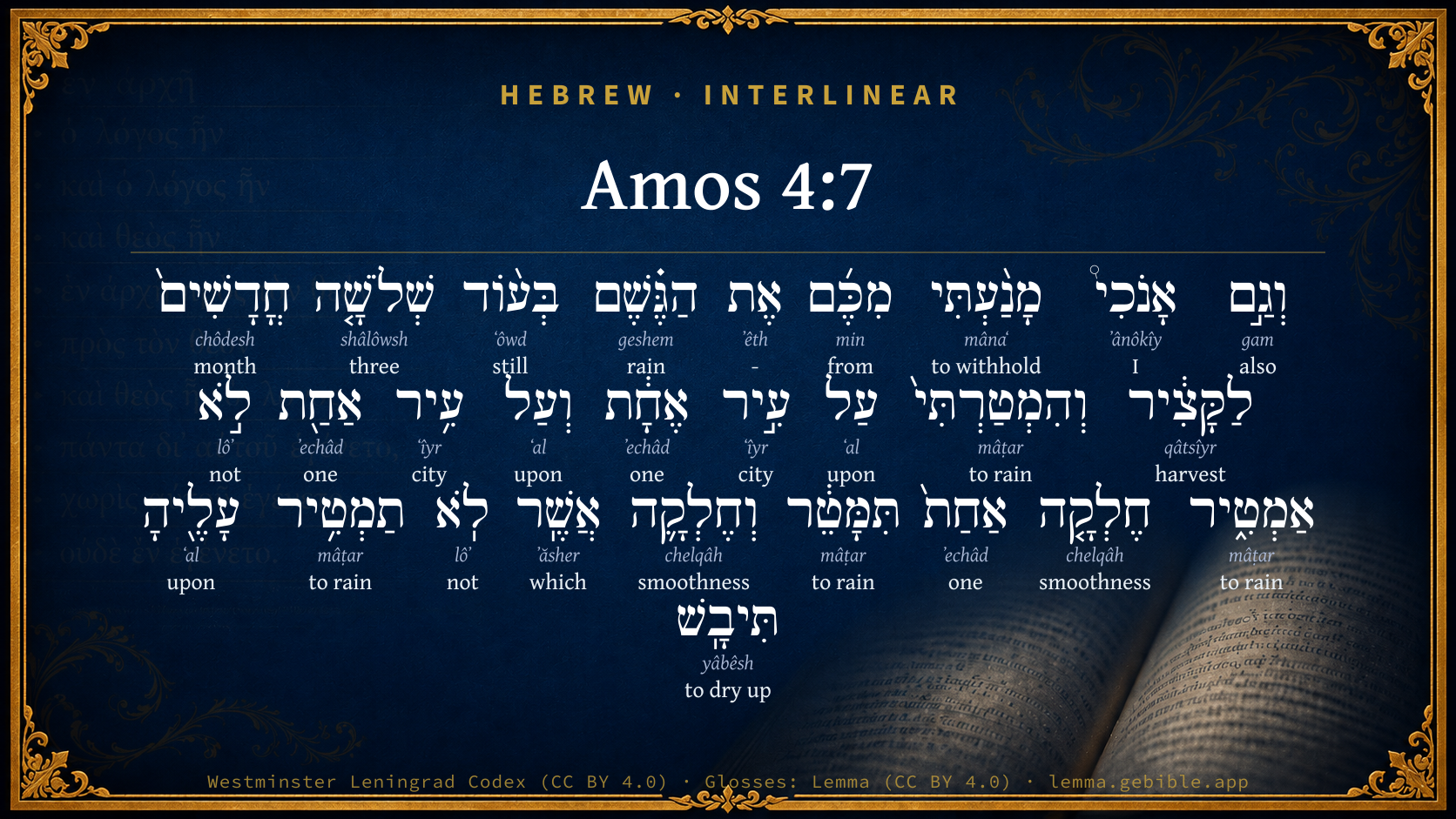
Amos 4:7

Hebrew (Westminster Leningrad Codex) Amos 4:7 appears in the Hebrew Old Testament. The text above is from the Westminster Leningrad Codex. Each word links to its Strong’s number, a concise gloss, and parsing drawn from the Open Scriptures Hebrew Bible morphology. Click any word for its full Brown-Driver-Briggs (BDB) entry.
Download image
Cite this verse

Amos 4:7 (World English Bible). Public Domain. Lemma interlinear Bible study tool, https://lemma.gebible.app/v/amos/4/7.

Show BibTeX & RIS
BibTeX
RIS
English Translation
"I also have withheld the rain from you, When there were yet three months to the harvest; And I caused it to rain on one city, And caused it not to rain on another city. One place was rained on, And the piece where it didn't rain withered.
World English Bible · Public Domain
Download a study sheet

One document with this verse’s original text, its word-by-word gloss line, the meaning frame, cross-references with their text, attributed commentary, and full source and license credits — printable, and it pastes into notes with its structure intact.

This verse Autodidact and up

Study sheet (.html) Plain text (.txt)

A passage Seminary Student

Up to 50 verses in one chapter. A passage sheet keeps up to 6 commentary sources and 12 cross-references per verse, in the order this page ranks them, and says so on the sheet whenever that leaves anything out. Ask for a single verse and you get the Autodidact verse sheet above.

Everything on this page stays free to read, with no account — the sheet is a download of what is already on screen, not access to it.

Want to remove ads? Support Godless Engineer
Compare translations 3

The same verse in 3 English versions, stacked beneath the original-language interlinear above. Click any original word for its lexicon entry.

Each is an independent rendering of the whole verse — the interlinear is not word-aligned to these translations.

Highlighted words mark where these versions differ — a whole-verse word diff, not a word-by-word alignment.

  • World English Bible Public Domain
    "I also have withheld the rain from you, When there were yet three months to the harvest; And I caused it to rain on one city, And caused it not to rain on another city. One place was rained on, And the piece where it didn't rain withered.
  • King James Version Public Domain
    And also I have withholden the rain from you, when there were yet three months to the harvest: and I caused it to rain upon one city, and caused it not to rain upon another city: one piece was rained upon, and the piece whereupon it rained not withered.
  • unfoldingWord Literal Text CC BY-SA 4.0
    I also withheld rain from you when there were still three months to the harvest. I caused it to rain on one city, and caused it not to rain on another city. One piece of land was rained on, but the piece of land where he caused it not to rain on it dried up.

unfoldingWord Literal Text — © unfoldingWord, licensed CC BY-SA 4.0. Word-aligned USFM3 via Door43 (git.door43.org/unfoldingWord/en_ult).

Versions to compare (up to 4)

3 of 4 selected

Show all 18 translations

Every available English version of this verse, each an independent rendering of the whole verse.

  • World English Bible Public Domain
    "I also have withheld the rain from you, When there were yet three months to the harvest; And I caused it to rain on one city, And caused it not to rain on another city. One place was rained on, And the piece where it didn't rain withered.
  • Berean Standard Bible Public Domain
    “I also withheld the rain from you when the harvest was three months away. I sent rain on one city but withheld it from another. One field received rain; another without rain withered.
  • Majority Standard Bible Public Domain
    “I also withheld the rain from you when the harvest was three months away. I sent rain on one city but withheld it from another. One field received rain; another without rain withered.
  • King James Version Public Domain
    And also I have withholden the rain from you, when there were yet three months to the harvest: and I caused it to rain upon one city, and caused it not to rain upon another city: one piece was rained upon, and the piece whereupon it rained not withered.
  • American Standard Version (1901) Public Domain
    And I also have withholden the rain from you, when there were yet three months to the harvest; and I caused it to rain upon one city, and caused it not to rain upon another city: one piece was rained upon, and the piece whereupon it rained not withered.
  • Revised Version (1885) Public Domain
    And I also have withholden the rain from you, when there were yet three months to the harvest: and I caused it to rain upon one city, and caused it not to rain upon another city: one piece was rained upon, and the piece whereupon it rained not withered.
  • Geneva Bible (1599) Public Domain
    And also I haue withholden the raine from you, when there were yet three moneths to the haruest, and I caused it to raine vpon one citie, and haue not caused it to raine vpon another citie: one piece was rained vpon, and the piece whereupon it rained not, withered.
  • Douay-Rheims (1899) Public Domain
    I also have withholden the rain from you, when there were yet three months to the harvest: and I caused it to rain upon one city, and caused it not to rain upon another city: one piece was rained upon: and the piece whereupon I rained not, withered.
  • Young's Literal Translation Public Domain
    And I also -- I have withheld from you the rain. While yet three months to harvest, And I have sent rain on one city, And on another city I do not send rain, One portion is rained on, And the portion on which it raineth not withereth.
  • Literal Standard Version CC BY-SA 4.0
    “And I also—I have withheld from you the rain, || While yet three months to harvest, || And I have sent rain on one city, || And on another city I do not send rain, || One portion is rained on, || And the portion on which it does not rain withers.
  • Unlocked Literal Bible CC BY-SA 4.0
    I also withheld rain from you when there were still three months to the harvest. I caused it to rain on one city, and caused it not to rain on another city. One piece of land was rained on, but the piece of land where it did not rain dried up.
  • unfoldingWord Literal Text CC BY-SA 4.0
    I also withheld rain from you when there were still three months to the harvest. I caused it to rain on one city, and caused it not to rain on another city. One piece of land was rained on, but the piece of land where he caused it not to rain on it dried up.
  • Darby Bible Public Domain
    And I also have withholden the rain from you, when there were yet three months to the harvest; and I caused it to rain upon one city, and caused it not to rain upon another city: one piece [of land] was rained upon, and the piece whereupon it rained not withered.
  • World Messianic Bible Public Domain
    “I also have withheld the rain from you, when there were yet three months to the harvest; and I caused it to rain on one city, and caused it not to rain on another city. One field was rained on, and the field where it didn’t rain withered.
  • Webster's Bible Public Domain
    And also I have withheld the rain from you, when there were yet three months to the harvest: and I caused it to rain upon one city, and caused it not to rain upon another city: one piece was rained upon, and the piece on which it rained not withered.
  • Free Bible Version CC BY-SA 4.0
    It was I who kept the rain from falling when there were still three months before harvest. One city would have rain, while another would not. One field would have rain, another would dry up from lack of rain.
  • Bible in Basic English Public Domain
    And I have kept back the rain from you, when it was still three months before the grain-cutting: I sent rain on one town and kept it back from another: one part was rained on, and the part where there was no rain became a waste.
  • JPS Tanakh (1917) Public Domain
    And I also have withholden the rain from you, when there were yet three months to the harvest; and I caused it to rain upon one city, and caused it not to rain upon another city; one piece was rained upon, and the piece whereupon it rained not withered.

Literal Standard Version (2020), Covenant Press — licensed CC BY-SA 4.0. Text via the HelloAO Bible API (eBible.org). Unlocked Literal Bible (unfoldingWord) — licensed CC BY-SA 4.0. Text via the HelloAO Bible API (eBible.org). unfoldingWord Literal Text — © unfoldingWord, licensed CC BY-SA 4.0. Word-aligned USFM3 via Door43 (git.door43.org/unfoldingWord/en_ult). Free Bible Version, Dr. Jonathan Gallagher — licensed CC BY-SA 4.0. Text via the HelloAO Bible API (eBible.org).

Word by word

More ways to search: Search by grammar → Find every occurrence → Compare this word →

Practice this passage: Drill this verse → Learn its vocabulary →

וְהִמְטַרְתִּי֙
mâṭar
H4305
“and · to rain”
Conjunction + Verb, Hiphil, Sequential Perfect, 1st Person, Common, Singular
Part of Speech
Conjunction + Verb
Stem
Hiphil
Form
Sequential Perfect
Person
1st Person
Gender
Common
Number
Singular
Full BDB Definition

Origin: a primitive root

TWOT: 1187

to rain - (Niphal) to be rained on or upon - (Hiphil) - to rain, send rain - to rain hail, send hail
  1. וְגַ֣ם gam H1571 “and · also” Conjunction + Particle, Accusative
  2. אָנֹכִי֩ ʼânôkîy H595 “I” Pronoun, Personal, 1st Person, Common, Singular
  3. מָנַ֨עְתִּי mânaʻ H4513 “to withhold” Verb, Qal, Perfect, 1st Person, Common, Singular
  4. מִכֶּ֜ם min H4480 “from · you” Preposition + Suffix, Personal, 2nd Person, Masculine, Plural
  5. אֶת ʼêth H853 “-” Particle, Direct Object
  6. הַגֶּ֗שֶׁם geshem H1653 “the · rain” Particle, Definite Article + Noun, Common, Masculine, Singular, Absolute
  7. בְּע֨וֹד ʻôwd H5750 “in/at · still” Preposition + Adverb
  8. שְׁלֹשָׁ֤ה shâlôwsh H7969 “three” Adjective, Cardinal number, Masculine, Singular, Absolute
  9. חֳדָשִׁים֙ chôdesh H2320 “months” Noun, Common, Masculine, Plural, Absolute
  10. לַקָּצִ֔יר qâtsîyr H7105 “to/for the · harvest” Preposition, Determined + Noun, Common, Masculine, Singular, Absolute
  11. עַל ʻal H5921 “upon” Preposition
  12. עִ֣יר ʻîyr H5892 “city” Noun, Common, Feminine, Singular, Absolute
  13. אֶחָ֔ת ʼechâd H259 “one” Adjective, Cardinal number, Feminine, Singular, Absolute
  14. וְעַל ʻal H5921 “and · upon” Conjunction + Preposition
  15. עִ֥יר ʻîyr H5892 “city” Noun, Common, Feminine, Singular, Absolute
  16. אַחַ֖ת ʼechâd H259 “one” Adjective, Cardinal number, Feminine, Singular, Absolute
  17. לֹ֣א lôʼ H3808 “not” Particle, Negative
  18. אַמְטִ֑יר mâṭar H4305 “to rain” Verb, Hiphil, Imperfect, 1st Person, Common, Singular
  19. חֶלְקָ֤ה chelqâh H2513 “smoothness” Noun, Common, Feminine, Singular, Absolute
  20. אַחַת֙ ʼechâd H259 “one” Adjective, Cardinal number, Feminine, Singular, Absolute
  21. תִּמָּטֵ֔ר mâṭar H4305 “to rain” Verb, Niphal, Imperfect, 3rd Person, Feminine, Singular
  22. וְחֶלְקָ֛ה chelqâh H2513 “and · smoothness” Conjunction + Noun, Common, Feminine, Singular, Absolute
  23. אֲשֶֽׁר ʼăsher H834 “which” Particle, Relative
  24. לֹֽא lôʼ H3808 “not” Particle, Negative
  25. תַמְטִ֥יר mâṭar H4305 “to rain” Verb, Hiphil, Imperfect, 3rd Person, Feminine, Singular
  26. עָלֶ֖יהָ ʻal H5921 “upon · her” Preposition + Suffix, Personal, 3rd Person, Feminine, Singular
  27. תִּיבָֽשׁ yâbêsh H3001 “to dry up” Verb, Qal, Imperfect, 3rd Person, Feminine, Singular

About this verse

These counts appear in no published source. They are computed here, from the morphology-tagged text and Lemma’s own curated glosses. What Lemma adds →

28
words
18
distinct lemmas
Prophets
section

Notable vocabulary

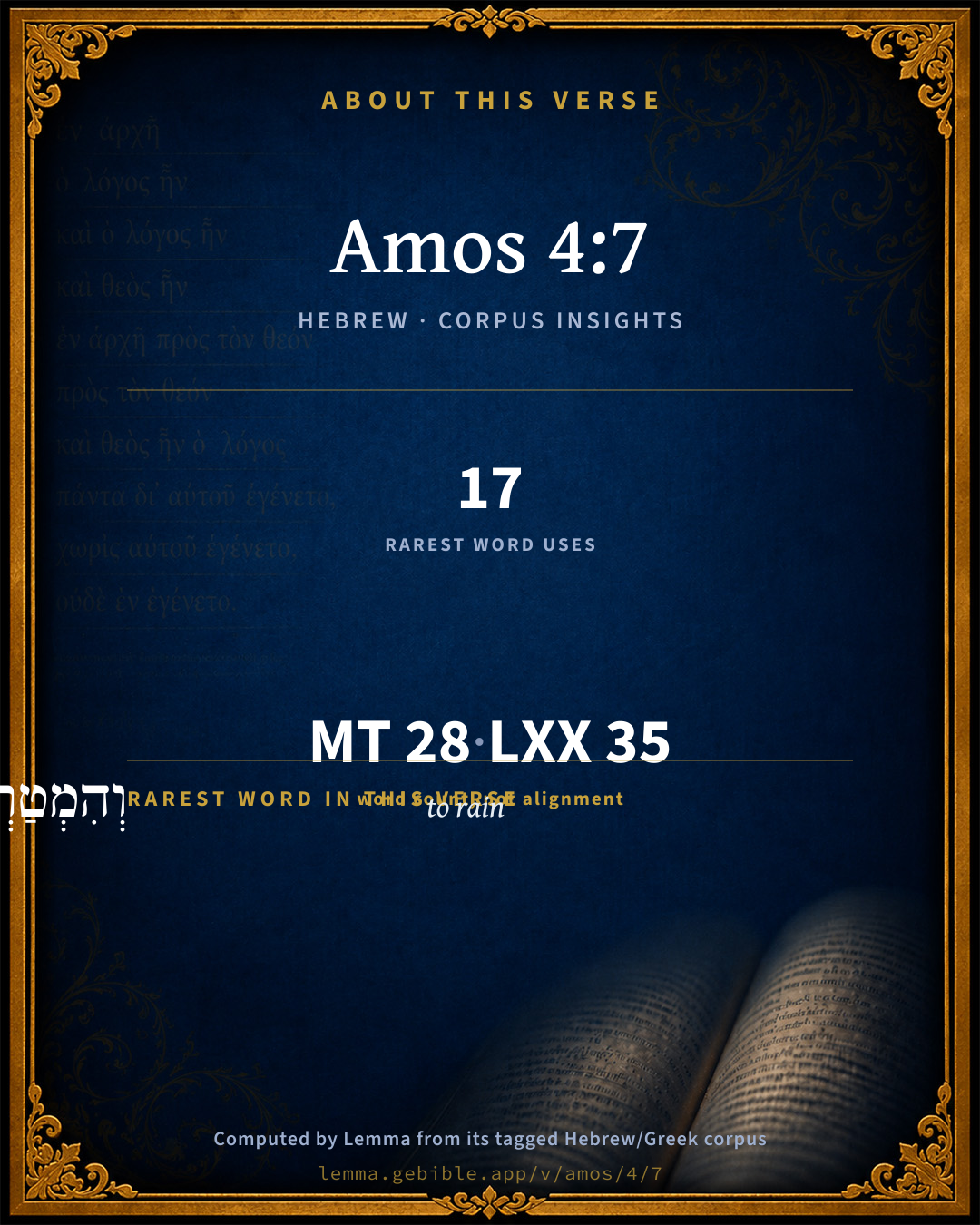
The rarest word here is וְהִמְטַרְתִּי֙ to rain H4305 — appearing just 17 times in the whole Hebrew Bible.

Shared distinctive vocabulary

וְהִמְטַרְתִּי֙ to rain H4305 occurs in 14 verses of the Hebrew Bible. Also found in:

Grammatical profile

  • 6 verbs
  • 7 nouns
  • 4 adjectives
  • 1 pronoun
  • 4 prepositions
  • 1 adverb
  • 5 particles

Verb forms

  • מָנַ֨עְתִּי Qal · Perfect
  • וְהִמְטַרְתִּי֙ Hiphil · Sequential Perfect
  • אַמְטִ֑יר Hiphil · Imperfect
  • תִּמָּטֵ֔ר Niphal · Imperfect
  • תַמְטִ֥יר Hiphil · Imperfect
  • תִּיבָֽשׁ Qal · Imperfect

Repetition

Words recur within this verse — often emphatic in Hebrew:

  • וְהִמְטַרְתִּי֙ to rain H4305 ×4
  • עַל upon H5921 ×3
  • אֶחָ֔ת one H259 ×3
  • עִ֣יר city H5892 ×2
  • חֶלְקָ֤ה smoothness H2513 ×2
  • לֹ֣א not H3808 ×2

Hebrew & Septuagint length

In English translation the verse runs 48 words from the Hebrew and 46 from the Septuagint (LXX English) — closely comparable.

A rough comparison of the two English renderings, which tokenize alike — not a word-level alignment.

Word counts can differ between the Hebrew and the Greek without any difference in meaning — e.g. the Hebrew direct-object marker אֵת has no separate Greek word, and Greek often adds the article ὁ.

In the original languages it is 28 Hebrew tokens and 35 Greek tokens — but the two are counted differently (Hebrew bundles its prefixes and suffixes into one token; the Greek is in lemma form), so that isn’t a like-for-like length.

Cross-references

25

Topical passages linked to Amos 4:7 in the Treasury of Scripture Knowledge — connected by theme and wording, ordered by reader-vote popularity; previews shown in the World English Bible.

  • Exodus 9:26 Only in the land of Goshen, where the children of Israel were, there was no hail.
  • Jeremiah 3:3 Therefore the showers have been withheld, and there has been no latter rain; yet you have a prostitute's forehead, you refused to be ashamed.
  • Exodus 9:4 Yahweh will make a distinction between the cattle of Israel and the cattle of Egypt; and there shall nothing die of all that belongs to the children of Israel."'"
  • Exodus 10:23 They didn't see one another, neither did anyone rise from his place for three days; but all the children of Israel had light in their dwellings.
  • 2 Chronicles 7:13–14 If I shut up the sky so that there is no rain, or if I command the locust to devour the land, or if I send pestilence among my people;
  • Isaiah 5:6 I will lay it a wasteland. It won't be pruned nor hoed, But it will grow briers and thorns. I will also command the clouds that they rain no rain on it."
  • Leviticus 26:18–21 "'If you in spite of these things will not listen to me, then I will chastise you seven times more for your sins.
  • Leviticus 26:23–24 "'If by these things you won't be reformed to me, but will walk contrary to me;
  • Leviticus 26:27–28 "'If you in spite of this won't listen to me, but walk contrary to me;
  • Deuteronomy 11:17 and the anger of Yahweh be kindled against you, and he shut up the sky, so that there shall be no rain, and the land shall not yield its fruit; and you perish quickly from off the good land which Yahweh gives you.
  • Judges 6:37–40 behold, I will put a fleece of wool on the threshing floor; if there be dew on the fleece only, and it be dry on all the ground, then shall I know that you will save Israel by my hand, as you have spoken.
  • 1 Kings 8:35–36 When the sky is shut up, and there is no rain, because they have sinned against you; if they pray toward this place, and confess your name, and turn from their sin, when you do afflict them:
  • Joel 2:23 "Be glad then, you children of Zion, And rejoice in Yahweh, your God; For he gives you the former rain in just measure, And he causes the rain to come down for you, The former rain and the latter rain, As before.
  • James 5:17 Elijah was a man with a nature like ours, and he prayed earnestly that it might not rain, and it didn't rain on the earth for three years and six months.
  • Exodus 8:22 I will set apart in that day the land of Goshen, in which my people dwell, that no swarms of flies shall be there; to the end you may know that I am Yahweh in the midst of the earth.
  • Deuteronomy 28:23–24 Your sky that is over your head shall be brass, and the earth that is under you shall be iron.
  • Jeremiah 5:24–25 Neither say they in their heart, Let us now fear Yahweh our God, who gives rain, both the former and the latter, in its season; who preserves to us the appointed weeks of the harvest.
  • Jeremiah 14:4 Because of the ground which is cracked, because no rain has been in the land, the plowmen are disappointed, they cover their heads.
  • Jeremiah 14:22 Are there any among the vanities of the nations that can cause rain? or can the sky give showers? Aren't you he, Yahweh our God? therefore we will wait for you; for you have made all these things.
  • Joel 1:10–18 The field is laid waste. The land mourns, for the grain is destroyed, The new wine has dried up, And the oil languishes.
  • Haggai 1:10–11 Therefore for your sake the heavens withhold the dew, and the earth withholds its fruit.
  • Zechariah 14:17 It will be, that whoever of all the families of the earth doesn't go up to Jerusalem to worship the King, Yahweh of Hosts, on them there will be no rain.
  • John 4:35 Don't you say, 'There are yet four months until the harvest?' Behold, I tell you, lift up your eyes, and look at the fields, that they are white for harvest already.
  • Revelation 11:6 These have the power to shut up the sky, that it may not rain during the days of their prophecy. They have power over the waters, to turn them into blood, and to strike the earth with every plague, as often as they desire.
  • 1 Corinthians 4:7 For who makes you different? And what do you have that you didn't receive? But if you did receive it, why do you boast as if you had not received it?

Cross-references courtesy of OpenBible.info (CC BY 4.0).

Hebrew and Greek witnesses Masoretic Hebrew ↔ Greek Septuagint

The same verse in the two great witnesses to the Old Testament, shown verse-for-verse.

These are two independent witnesses, not word-aligned to each other, and the Septuagint is shown in lemma (dictionary) form.

Hebrew Amos 4:7 Masoretic · Westminster Leningrad Codex

וְגַ֣ם אָנֹכִי֩ מָנַ֨עְתִּי מִכֶּ֜ם אֶת הַגֶּ֗שֶׁם בְּע֨וֹד שְׁלֹשָׁ֤ה חֳדָשִׁים֙ לַקָּצִ֔יר וְהִמְטַרְתִּי֙ עַל עִ֣יר אֶחָ֔ת וְעַל עִ֥יר אַחַ֖ת לֹ֣א אַמְטִ֑יר חֶלְקָ֤ה אַחַת֙ תִּמָּטֵ֔ר וְחֶלְקָ֛ה אֲשֶֽׁר לֹֽא תַמְטִ֥יר עָלֶ֖יהָ תִּיבָֽשׁ

"I also have withheld the rain from you, When there were yet three months to the harvest; And I caused it to rain on one city, And caused it not to rain on another city. One place was rained on, And the piece where it didn't rain withered.

World English Bible · Public Domain

Greek LXX Amos 4:7 Septuagint · lemma form

καί ἐγώ ἀναἔχω ἐκ σύ ὁ ὑετός πρό τρεῖς μήν ὁ τρύγητος καί βρέχω ἐπί πόλις εἷς ἐπί δέ πόλις εἷς οὐ βρέχω μερίς εἷς βρέχω καί μερίς ἐπί ὅς οὐ βρέχω ἐπί αὐτός ξηραίνω

Also I withheld from you the rain three months before the harvest: and I will rain upon one city, and on another city I will not rain: one part shall be rained upon, and the part on which I shall not rain shall be dried up.

LXX2012 (modern English Septuagint) · Public Domain

On this verse, Haydock's Catholic Bible Commentary discusses the Septuagint’s reading. Read the note in Commentary ↓

Hebrew: Westminster Leningrad Codex (CC BY 4.0). Greek: Septuagint (public domain); English from LXX2012 (modern English Septuagint) (Public Domain). How the Septuagint differs from the Hebrew →

Targum (Aramaic paraphrase)

1

The Targum is the ancient Jewish Aramaic paraphrase of the Hebrew Scriptures — an interpretive translation, not the Hebrew text itself. Onkelos (literal) and Pseudo-Jonathan (expansive) render the Torah, and Jonathan the Prophets. Coverage is partial: where no permissively-licensed English translation exists for a verse, only the Aramaic is shown. This is verse-level text, not a word-by-word alignment to the Hebrew.

  1. Targum Jonathan Prophets (Joshua–Malachi)
    וְאַף אֲנָא מְנָעִית מִנְכוֹן יַת מִטְרָא בְּסוֹף תְּלָתָא יַרְחִין לִזְמַן חַצְדָא וְאָחֵית מִטְרָא עַל קַרְתָּא חֲדָא וְעַל קַרְתָּא חֲדָא לָא אָחֵית מִטְרָא אַחֲסָנְתָּא חֲדָא יֵחוֹת עֲלָהּ מִטְרָא וְאַחֲסַנְתָּא דְלָא יֵחוֹת עֲלָהּ מִטְרָא תִּיבָשׁ:

    (no public-domain English translation for this verse)

    Targum Jonathan — Aramaic: “Mikraot Gedolot” (public domain). English: “Sefaria Community Translation” (CC0 1.0 (public-domain dedication)); “London "Chaldee Paraphrase," 1871” (public domain). Text via Sefaria.

Commentary

Notes on Amos 4:7 from classic Christian and Jewish commentators (each source and its license shown beneath its notes). The classic Christian expositions comment on the surrounding passage and are grouped to its opening verse, so a note may address several verses; the Jewish commentaries on the Tanakh (Rashi and others) are per-verse, so they appear only where the commentator wrote on this verse.

Lemma curates 59 commentaries, every one of them public domain or Creative Commons licensed, each selected and text-cleaned for this edition rather than reprinted as found. About our sources →

Trapp's Complete Commentary

John Trapp

Amo 4:7 And also I have withholden the rain from you, when [there were] yet three months to the harvest: and I caused it to rain upon one city, and caused it not to rain upon another city: one piece was rained upon, and the piece whereupon it rained not withered.

Ver. 7. And also I have withholden the rain from you, &c.] And so have punished you with thirst and drought, as well as with dearth and famine: and because I have found you wells without the water of piety, 2Pe 2:17, therefore I have refused to rain upon you, as I threatened, Deu 28:23-24.

“ En quia iam vobis sunt ferrea pectora, reddit

Coelum etiam vobis durius aere, Deus. ”

When there were yet three months, &c.] When you could worst of all want it {See Trapp on "Joe 2:23"} for the watering of the seed and opening of the earth.

And I caused it to rain upon one city] It rains not then by haphazard; neither are the seasons of the year (whether barren or fruitful) ruled by the course of nature or influence of the stars, but by God, Act 14:17. It is he that giveth rain from heaven, and fruitful seasons. He covereth the heaven with clouds, he prepareth rain for the earth, he maketh grass to grow upon the mountains, and standing corn in the fields, Psa 147:8. He weighs these waters by measure; so that not a drop falls in vain, or in a wrong place, but by Divine decree, Job 28:26, for the fattening of the earth, allaying the heat, nourishing the herb and tree, Deu 32:2 Isa 63:14, producing unto us "the appointed weeks of harvest," Jer 5:24, "that it may give seed to the sower, and bread to the eater," Isa 55:10. This the poor Pagans ascribed to their god Jupiter, whom they therefore styled Nεφεληγερετης. Him they confessed the greatest of all, calling him υπατος, the overseer of their trading; hence αγαραιος, the keeper of their houses, hence Jupiter Herceus, from ερκος, a wall, or hedge. This they did, to the great shame of many atheists among us, who hold that all things come either by benign nature or blind chance.

One piece] sc. Of the same field, was rained upon, and fructified (this was near to a miracle; as when Gideon’s fleece was wet and no place else; and again, every place else, and not Gideon’s fleece, Jdg 6:37).

And the piece whereupon it rained not] It, that is, the cloud, but by God’s appointment; for he it is that filleth those bottles of the sky, and emptieth them again, where and when he pleaseth, either in mercy, as Joe 2:23 Zec 10:1 Lev 26:4, or for a judgment, as Joe 1:17 Gen 17:11-12 1Sa 12:18-19. In the year of grace 1551 a great multitude of men and cattle in Germany were drowned and destroyed; decidentibus subito nubibus, ac effusis certatim aquis, saith Bartholinus; by excessive showers and immoderate waters, pouring down upon people as by spouts. This was the very finger of God, who will one day rain upon the wicked snares, fire and brimstone, and a horrible tempest, Psa 11:6, Heb. a burning tempest; like as now out of those very clouds where hence he raineth, he doth again scatter sudden fires unto all parts of the earth, astonishing the world with the fearful noise of that eruption.

Withered] It must needs do so; and so must God’s own vineyard, the Church, when he shall command the clouds that they rain no rain upon it, Isa 5:6, that is, his ministers, that they drop no doctrine upon it, Deu 32:2 Eze 21:2 Amo 7:16, fitly resembled to rain in regard, 1. of cooling heat; 2. quenching thirst; 3. cleansing the air; 4. allaying the winds; 5. mollifying and mellowing the parched and heat hardened earth; 6. causing all things to grow and fructify. This rain of righteousness goes sometimes by coasts, as here: God tying up the tongues of his most faithful labourers, and withholding their showers, though they be clouds thick, and full, and likely enough to drop down in abundance; see Eze 3:26-27 Hos 9:7 Pro 16:1. Pray, therefore, oh pray earnestly, both ministers, for ability and liberty to "drop their word toward the holy places, and prophesy," Eze 21:2, and people, that he would fill their ministers as full of good matter as ever Elihu was, Job 32:18, and then be with their mouths, Exo 4:12, yea, stretch out his holy hand, and touch them, Jer 1:9, performing that piece of midwifery, Pro 16:1, that they may freely utter their conceptions, "and come to their hearers in the fulness of the blessing of the gospel of peace," Rom 15:29. In the Island of St Thomas, on the back side of Africa, in the midst of it, is a hill; and over that a continual cloud, wherewith the whole island is watered. This is our happiness for present. Oh that we knew but this gift of God, Joh 4:10, and were answerably thankful and fruitful! Oh, how cursed a generation are those that repine at it, saying, Never was merry world, since so much preaching, &c. How shall such miscreants one day wish to have but one drop fall from these full clouds to cool the heat and horrors of their consciences, but shall not obtain it.

John Trapp, A Commentary or Exposition upon All the Books of the Old and New Testament (1647–1656) — public domain. Text from a community e-Sword module.

Whedon's Commentary on the Bible

Daniel D. Whedon

7, 8. Drought.

The rain — Hebrews geshem (see on Joe_2:23), here rain in general.

When there were yet three months to the harvest — Since the harvest is in April and May, the drought must have set in during January or February. A drought at that time would be disastrous, and might completely destroy the prospects of harvest. A similar phenomenon occurred in Palestine in the winter of 1894-95. “After raining several times quite heavily in December, especially on the coast, the weather has been since before Christmas pleasant and mild, and if no more rain falls there will be great suffering, for up till now (February 16) no one has filled his cisterns.”

Caused it to rain — The tenses in Amo_4:7-8 are frequentatives. Jehovah did the things mentioned again and again. To the ancients the phenomenon of a partial drought would be an even stronger proof of the presence of the supernatural than a universal withholding of rain. Partial rainfall such as is described here has been experienced in Palestine in more modern times. “There has been a smart shower here (Tiberias), while at Samakh the ground was baked hard, and the grain drooping sadly. The same was true on a former occasion when I came up the Jordan valley. The ground in the Ghor was like a parched desert. There had not been sufficient rain to bring up the grain,… while here at Tiberias the whole country was a paradise of herbs and flowers.” And again, “It was literally so about Samakh and ‘Abadiyeh, while their nearest neighbors were rejoicing in abundant showers” (Thomson, ii, p. 66).

Piece — Field (Rth_2:3; Rth_4:3).

Two or three cities — That had suffered from the drought. For the ascending enumeration see on Amo_1:3.

Wandered — Literally, tottered, or, staggered. The people were so weak from thirst that they could not walk with a firm step.

One city — One favored with rain. With reference to this passage Thomson says (on the same page): “A fact often repeated in this country. No longer ago than last autumn it had its exemplification complete in Belad Besharah, the ancient inheritance of Naphtali.” Since there are few springs throughout Palestine, people are dependent largely upon rain water stored in cisterns; when the rainfall is irregular the water supply soon becomes exhausted.

They were not satisfied — The water was not sufficient to supply the needs of all. This judgment also was in vain.

9a. Blasting and mildew. 9b. Locusts.

You — Your fields and crops.

Blasting and mildew — The two words are frequently joined (Deu_28:22; 1Ki_8:37; Hag_2:17). The former, from a verb to burn, describes the disastrous effects of the scorching east wind or Sirocco (see on Hos_12:1); the latter, literally, greenness, is “a blight in which the ears turn untimely a pale yellow, and have no grain.”

One word in the Hebrew makes the rest of Amo_4:9 awkward. With a very slight change, favored by most modern commentators, it may be translated, “I laid waste your gardens and your vineyards; and your fig trees and your olive trees hath the palmerworm devoured.”

I laid waste — By some blow not specified by the prophet.

Fig trees — See on Joe_1:7.

Olive trees — See on Hos_14:6; Joe_1:10.

Palmer-worm — See on Joe_1:4, where reference is made to the frequency with which locusts visit Palestine.

Daniel D. Whedon (gen. ed.), Commentary on the Old and New Testaments (1874–1909) — public domain. Text from a community e-Sword module.

Geneva Bible (1599)

Geneva Bible translators

I stayed the rain till the fruits of the earth were destroyed with drought, and yet you would not consider it to return to me by repentance.

Geneva Bible (1599) marginal notes — public domain. Text via Bolls.life.

Jamieson, Fausset & Brown

Robert Jamieson, A. R. Fausset & David Brown

withholden . . . rain . . . three months to . . . harvest--the time when rain was most needed, and when usually "the latter rain" fell, namely, in spring, the latter half of February, and the whole of March and April (Hos 6:3; Joe 2:23). The drought meant is that mentioned in Kg1 17:1 [GROTIUS].

rain upon one city . . . not . . . upon another--My rain that fell was only partial.

Jamieson, Fausset & Brown — Commentary Critical and Explanatory on the Whole Bible (1871) — public domain (CC PDM 1.0). Text via the HelloAO Bible API.

Adam Clarke's Commentary

Verse 7. When there were yet three months to the harvest] St. Jerome says, from the end of April, when the latter rain falls, until harvest, there are three months, May, June, and July, in which no rain falls in Judea. The rain, therefore, that God had withheld from them, was that which was usual in the spring months, particularly in April.

I caused it to rain upon one city] To prove to them that this rain did not come fortuitously or of necessity, God was pleased to make these most evident distinctions. One city had rain, and could fill all its tanks or cisterns, while a neighbouring city had none. One farm or field was well watered, and abundant in its crops, while one contiguous to it had not a shower. In these instances a particular providence was most evident. "And yet, they did not return to the Lord."

Adam Clarke's Commentary on the Bible (1810–1826) — public domain. Text from a community e-Sword/MySword module.

John Calvin's Commentaries

I have said that another kind of punishment is here recorded by the Prophet; it is not, however, wholly different: for whence comes the want we have noticed, except through drought? For when God intends to deprive men of support, he shuts up heaven and makes it iron, so that it hears not the earth, according to what we have noticed elsewhere. Yet these words of the Prophet are not superfluous; for God would have the punishment he inflicts on men to be more attentively considered. When men are reduced to want, they will indeed acknowledge it to be the curse of God, except they be very stupid; but when a drought precedes, when the earth disappoints its cultivators, and then a want of food follows, more time is given to men to think of God’s displeasure. This is the reason why the Prophet now distinctly speaks of rain being withheld, after having said that the people had been before visited with a deficiency of provisions; as though he said “Ye ought to have returned, at least after a long course of time, to a sound mind. If God had been offended with you only for one day, and had given tokens of his displeasure, the shortness of time might have been some excuse for you: but as the earth had become dry; as God had restrained rain, and as hence sterility followed, and afterwards there came want, how great was your stupidity not to attend to so many and so successive tokens of God’s wrath?” We now perceive why the Prophet here connects drought with want of food, the cause with the effect: it was, that the stupidity of the people might hence be more evident.

But he says that God had withheld rain from them, when three months still remained to the harvest. When it rains not for a whole month, the earth becomes dry, and men become anxious, for it is an ill omen: but when two months pass without rain, men begin to be filled with apprehension and even dread; but if continual dryness lasts to the end of the third month, it is a sign of some great evil. The Prophet, then, here shows that the Israelites had not been in an ordinary way chastised, and that they were very stupid, as they did not, during the whole three months, apply their minds to consider their sins, though God urged them, and though his wrath had been manifested for so long a time. We now then see that the hardness of the people is amplified by the consideration of time, inasmuch as they were not awakened by a sign so portentous, When there were yet three months, he says, to the harvests I withheld rain from you.

Another circumstance follows, “God rained on one city, on another he did not rain; one part was watered, and no drop of rain fell on another This difference could not be ascribed to chance: except men resolved to be willfully mad, and to reject all reason, they must surely have been constrained to confess these to have been manifest signs of God’s wrath. How came it, that one place was rained upon, and another remained dry? that two neighboring cities were treated so differently? Whence was this, except that God appeared angry from heaven? The Prophet then does here again condemn the obstinacy of the people: they did not see in this difference the wrath of God, which was yet so very conspicuous. The import of the whole is, that God shows that he had to do with a people past recovery; for they were refractory and obstinate in their wickedness, and could bear the application of no remedy. It follows —

John Calvin's Commentaries (1540-1563) — public domain. Text from the Calvin Translation Society English edition (1840s-50s) via the Christian Classics Ethereal Library (ccel.org). Calvin's coverage is partial (roughly two-thirds of the Bible); uncommented books and verses are honest gaps, never fabricated. The 19th-century editor's footnotes and remarks are omitted so the notes are faithfully Calvin's own voice.

Ellicott's Commentary for English Readers

(7, 8) Three months to the harvest.—The withdrawal of rain at this period (February and March) is at the present day most calamitous to the crops in Palestine.

Caused it to rain . . .—The tenses should be regarded as expressing repetition of the act, and might be, with advantage, rendered as present cause it to rain . . . is rained upon, &c. The inhabitants of the most suffering districts wander, distracted and weary, to a more favoured city, and find no sufficiency. Comp. the graphic description in Jer_14:1-6. Moreover, the specialties of affliction, in particular localities. reveal the purpose of God rather than the operation of universal laws.

A Bible Commentary for English Readers, edited by Charles John Ellicott (1878–1897) — public domain. Text from a community e-Sword module.

The Cambridge Bible for Schools and Colleges

gen. ed. J. J. S. Perowne

7–8. Drought.

And I also have withholden the winter-rain from you, when there were &c.]. The Heb. is not mâṭâr, but géshem, i.e. a burst of rain: the heavy rains of winter, which continue as a rule from the end of October to the end of February and are then followed by the ‘latter rain,’ or showers of March and April, which refresh and advance the ripening ears (see on Joe_2:23), had ceased prematurely; the crops were consequently deficient in fulness and strength, and the harvest (which comes in May) was seriously damaged. Something of the same sort happened in the winter of 1895; there had been hardly any rain since the Christmas of 1894, and in a report, dated Feb. 16, it was stated that unless rain fell shortly there would be great deficiency of water, as no houses had their cisterns full (G. A. Smith, p. 161). Géshem, though a general term for an abundant rain (as 1Ki_17:14; 1Ki_18:41; 1Ki_18:44-45), is used specially of the heavy rains of winter in Son_2:11; comp. Lev_26:4, Eze_34:26, Joe_2:23 (see note).

I caused it to rain &c.] would cause it to rain … would be rained upon … would wither. The tenses, both here and to the end of the verse, are frequentative, indicating what had happened repeatedly.

piece] i.e. plot of land, or portion belonging to a particular proprietor (Rth_2:3; Rth_4:3; 2Sa_14:30). The same partial character of the rain-fall is still sometimes observable in Palestine.

The Cambridge Bible for Schools and Colleges (gen. ed. J. J. S. Perowne; Cambridge University Press, 1878–1918) — public domain. Text from a community e-Sword module.

John Gill's Exposition

And also I have withholden the rain from you,.... As he did for the space of three years successively in the days of Ahab, as predicted by Elijah, Kg1 17:1; the consequences of which are very bad to men and beast, and bring on a scarcity of food for both, and a famine if long withheld:

when there were yet three months to the harvest; that is, three months before the harvest, as Jarchi; when, as Kimchi observes, there was need of rain: this was the latter rain which was usually given and expected about this time, and on which the goodness of the crop, and so of the harvest, greatly depended; these three months before barley harvest were December, January, and February, that being in March; and before the wheat harvest, February, March, and April, that being in May usually:

and I caused it to rain upon one city, and caused it not to rain upon another city; so that it might appear to be not by the course of nature, or through the influence of the planets, or by chance; but was according to the direction of divine Providence, the hand of God was manifestly in it: yea,

one piece was rained upon, and the piece whereupon it rained not withered; one piece of ground or field had a plentiful shower on it, whereby it became fruitful; and another field or close on the other side of the hedge or partition had none, whereby what did spring up withered away and came to nothing: or "one inheritance" (u), or farm, as some render it; one man's estate was well watered with rain from heaven, and brought forth much fruit; and another man's estate, for want of it, was barren, and brought forth nothing: thus God was pleased to do in his providence, to show his sovereignty, and to chastise men for their sins; and in such a manner as that they might, if not blind easily perceive his hand in it.

(u) "fundus", Mercerus, Vatablus; "hereditas", Targum.

John Gill's Exposition of the Whole Bible (1746–1763) — public domain (CC PDM 1.0). Text via the HelloAO Bible API.

Albert Barnes' Notes on the Bible

And I, I too have withholden the rain - Jerome, dwelling in Palestine, says, that “this rain, when “three months yet remained until harvest,” was the “latter rain,” of the very greatest necessity for the fields of Palestine and the thirsty ground, lest, when the blade is swelling into the crop, and gendering the wheat, it should dry up through lack of moisture. The time intended is the spring, at the end of April, whence, to the wheat-harvest, there remain three months, May, June, July.” “God withheld the rain that they might endure, not only lack of bread, but burning thirst and penury of drink also. For in these places, where we now live, all the water, except small fountains, is of cisterns; and if the wrath of God should withhold the rain, there is greater peril of thirst than of hunger, such its Scripture relates to have endured for three years and six months in the days of the prophet Elijah. And lest they should think that this had befallen their cities and people, by a law of nature, or the influence of the stars, or the variety of the seasons, He says, that He rained upon one city and its fields, and from another withheld the rain.”

This was a second visitation of God. First, a general famine, “in all their cities;” secondly, a discriminating visitation. “Nature” possesses no discrimination or power over her supplies. Seeming waste is one of the mysteries of God in nature, “to cause it to rain on the earth” Job 38:26 where “no man” is; on “the wilderness wherein” there, “is no man.” Ordinarily too, God “maketh His sun to rise on the evil and on the good, and sendeth rain on the just and on the unjust” Mat 5:45. But God does not enslave Himself, (as people would have it) to His own laws. Amos appeals to them, that God had dealt with them, not according to His ordinary laws; that not only God had given to one city the rain which he had withheld from another, but that He had made the same difference as to smaller “pieces” of ground, the inherited “portions” of individuals . Some such variations have been observed in Palestine now. But this would have been no indication of God’s Providence, had not the consciences of people responded to the prophet’s appeal, and recognized that the rain had been given or withheld according to the penitence or impenitence, the deeper or more mitigated idolatry, the greater or less sinfulness of the people. We have. then, in these few words a law of God’s dealing with Israel. God, in His word, reveals to us the meaning of His daily variations in the workings of nature; yet, hardly even in such instances, as people can scarcely elude, do they think of God the Creator, rather than of nature, His creation.

Albert Barnes' Notes on the Bible (1834–1885) — public domain. Text from a community e-Sword/MySword module.

Haydock's Catholic Bible Commentary

Months. The latter rain falls in April. See Deuteronomy xi. 14. (Calmet) --- Harvest. Septuagint have as usual, "vintage." But this is less accurate, as it never rains in the preceding summer months. (St. Jerome)

George Leo Haydock (1774–1849), Haydock's Catholic Family Bible and Commentary, 1859 edition — public domain. Excludes Psalms (Douay-Rheims chapter numbering differs from Protestant) and Deuterocanonical books (Catholic canon only).

Matthew Poole's English Annotations

I also have withholden the rain from you; your vanities could not, and because ye did so greatly sin against me I would not, give you rain; I forbade the clouds from above, and they, thus prohibited, did withhold their rain, as I threatened, Deu 28:23,24.

When there were yet three months to the harvest; at a season when your country most usually had, and as then it ever did most need, rain: see Joe 2:23. Three months drought then, as it was unusual in the course of nature, so it was an extraordinary curse and punishment on them. That you might see my hand in it and be instructed, I gave rain to one city, and withheld rain from the next neighbour city; nay, one part of a field, the same field, was watered and flourished, another part dry and withered. All this to convince and turn you.

Matthew Poole's English Annotations on the Holy Bible (1683–1685) — public domain. Text from a community e-Sword/MySword module.

The Pulpit Commentary

The second punishment is drought, as predicted (Lev_26:19, etc.; Deu_28:23) When there were yet three months to the harvest, and when rain was most necessary to swell the grain. The season meant is in February and March, when what was called "the latter rain" fell. In the south of Palestine the harvest commenced at the end of April, but in the northern parts it was some weeks later, so that it might be said in round numbers that it took place three months after the latter rain. I caused it to rain upon one city. That they might not attribute this drought to the blind laws of nature, God caused it to be of a partial character, giving rain to one city while he withheld it from another. One piece. The portion of ground belonging to an individual is so called. (Rth_2:3 Rth_4:3)

The Pulpit Commentary (1880–1919), ed. H.D.M. Spence-Jones & Joseph S. Exell — public domain. Text from a community e-Sword module.

John Wesley's Explanatory Notes

When - At a season when your country most needed it. Upon one city - That you might see my hand in it, I gave rain to one city, and withheld it from the next; nay one part of the same field was watered and flourished: another part, dry and withered.

John Wesley, Explanatory Notes Upon the Whole Bible (1754–1765) — public domain. Text via the GEBible commentary corpus.

Rashi

Rabbi Shlomo Yitzchaki (Rashi)

when there were yet three months before the harvest—Until the harvest. I.e, three months before the harvest.

field Heb. חֶלְקָה, a fielded plain, campagne in French.

shall receive rain Heb. תִמָּטֵר, shall be a place of rain. The master stated: Both of them are for a curse; this one will rot, and this one will wither. [from Taanith 6b]

and the field upon which no rain shall fall—That will not show itself rained upon.

Rashi on the Tanakh — English translations: “The Judaica Press complete Tanach with Rashi, translated by A. J. Rosenberg” (CC BY 4.0); “Pentateuch with Rashi's commentary by M. Rosenbaum and A.M. Silbermann, 1929-1934” (public domain); “The Metsudah Tanach series, Lakewood, N.J” (CC BY 4.0); and “The Book of Joshua, Metsudah Publications, 1997” (CC BY 4.0). Text via Sefaria.

Lesson kit

Teaching starters — assembled from the data on this page, not authored interpretation. Every prompt links to the verse data it draws on. Edit before teaching.

Amos, in the Prophets, opens this verse with 28 words (18 distinct Hebrew lemmas). Its most distinctive word is mâṭar (“to rain”). A historical commentator’s framing appears above. Read the whole chapter for the surrounding context.

Discussion questions

  1. The word mâṭar carries the sense “to rain.” How does it shape the verse?
  2. How does Genesis 2:5, which shares the word «to rain», read alongside this verse?
  3. What does the repetition of “to rain” (4× in this one verse) do in this verse?
  4. The translations on this page render this verse differently — a whole-verse word diff, not a word-by-word alignment. What might account for the different wordings?
  5. «מָנַ֨עְתִּי» is a Qal Perfect verb. How does that grammatical form shape the action described?
  6. Compare how Trapp's Complete Commentary and Whedon's Commentary on the Bible read this verse. Where do they agree or differ?

Things to notice

Reading settings

Reading text

Shown beneath each verse's original-language words.

Old Testament
Old Testament edition

Read the OT as the Masoretic Hebrew (MT) or the Greek Septuagint (LXX).

English shown for the Greek Septuagint (in the Hebrew ↔ Greek comparison).

Comparing translations? Open the Compare panel on any verse page to stack up to four side by side.