
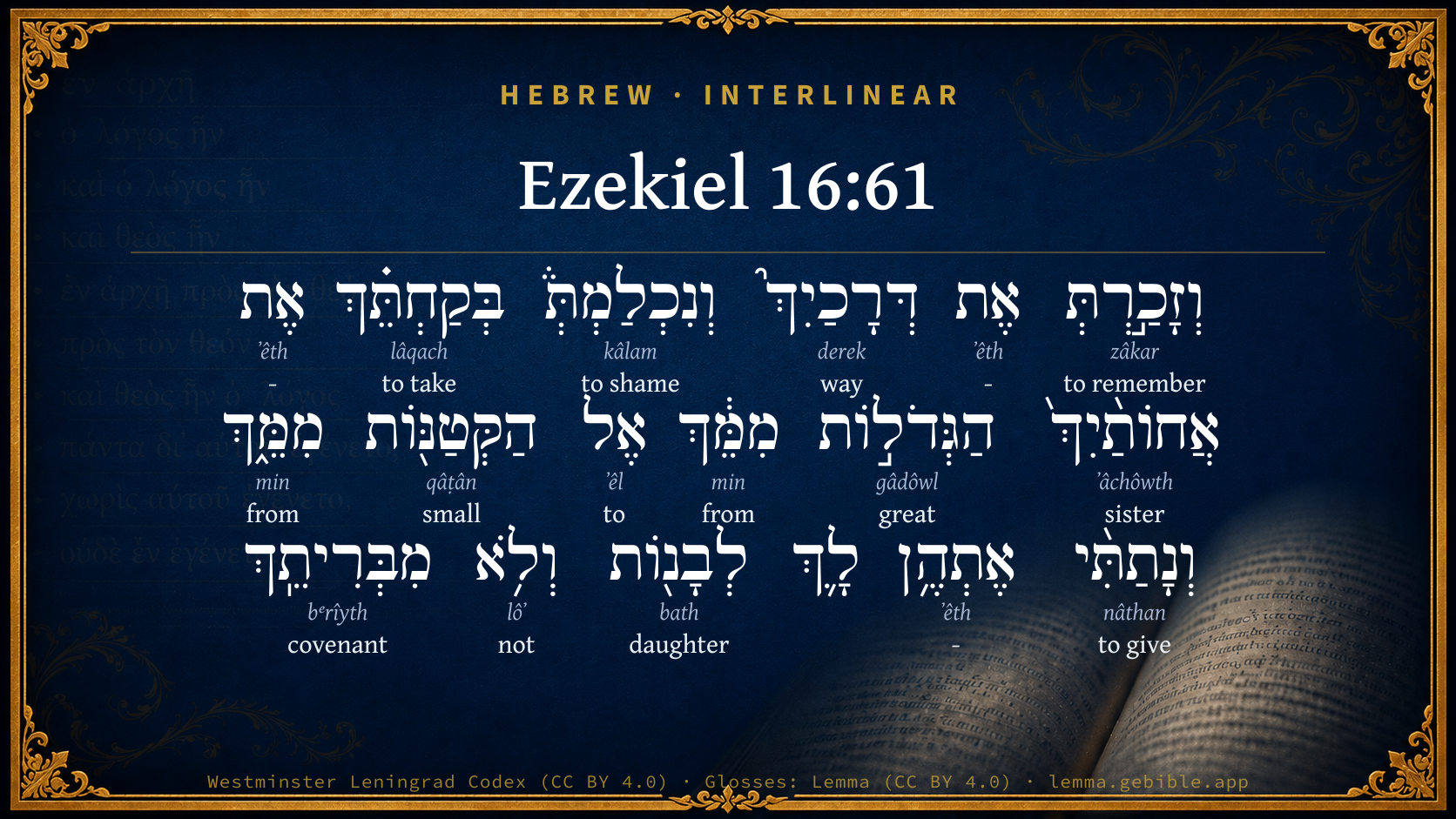
Ezekiel 16:61

Hebrew (Westminster Leningrad Codex) Ezekiel 16:61 appears in the Hebrew Old Testament. The text above is from the Westminster Leningrad Codex. Each word links to its Strong’s number, a concise gloss, and parsing drawn from the Open Scriptures Hebrew Bible morphology. Click any word for its full Brown-Driver-Briggs (BDB) entry.
Download image
Cite this verse

Ezekiel 16:61 (World English Bible). Public Domain. Lemma interlinear Bible study tool, https://lemma.gebible.app/v/ezekiel/16/61.

Show BibTeX & RIS
BibTeX
RIS
English Translation
Then shall you remember your ways, and be ashamed, when you shall receive your sisters, your elder [sisters] and your younger; and I will give them to you for daughters, but not by your covenant.
World English Bible · Public Domain
Download a study sheet

One document with this verse’s original text, its word-by-word gloss line, the meaning frame, cross-references with their text, attributed commentary, and full source and license credits — printable, and it pastes into notes with its structure intact.

This verse Autodidact and up

Study sheet (.html) Plain text (.txt)

A passage Seminary Student

Up to 50 verses in one chapter. A passage sheet keeps up to 6 commentary sources and 12 cross-references per verse, in the order this page ranks them, and says so on the sheet whenever that leaves anything out. Ask for a single verse and you get the Autodidact verse sheet above.

Everything on this page stays free to read, with no account — the sheet is a download of what is already on screen, not access to it.

Want to remove ads? Support Godless Engineer
Compare translations 3

The same verse in 3 English versions, stacked beneath the original-language interlinear above. Click any original word for its lexicon entry.

Each is an independent rendering of the whole verse — the interlinear is not word-aligned to these translations.

Highlighted words mark where these versions differ — a whole-verse word diff, not a word-by-word alignment.

  • World English Bible Public Domain
    Then shall you remember your ways, and be ashamed, when you shall receive your sisters, your elder [sisters] and your younger; and I will give them to you for daughters, but not by your covenant.
  • King James Version Public Domain
    Then thou shalt remember thy ways, and be ashamed, when thou shalt receive thy sisters, thine elder and thy younger: and I will give them unto thee for daughters, but not by thy covenant.
  • unfoldingWord Literal Text CC BY-SA 4.0
    Then you will call to mind your ways and be ashamed when you receive your older sisters and your younger sisters. I will give them to you as daughters, but not because of your covenant.

unfoldingWord Literal Text — © unfoldingWord, licensed CC BY-SA 4.0. Word-aligned USFM3 via Door43 (git.door43.org/unfoldingWord/en_ult).

Versions to compare (up to 4)

3 of 4 selected

Show all 18 translations

Every available English version of this verse, each an independent rendering of the whole verse.

  • World English Bible Public Domain
    Then shall you remember your ways, and be ashamed, when you shall receive your sisters, your elder [sisters] and your younger; and I will give them to you for daughters, but not by your covenant.
  • Berean Standard Bible Public Domain
    Then you will remember your ways and be ashamed when you receive your older and younger sisters. I will give them to you as daughters, but not because of My covenant with you.
  • Majority Standard Bible Public Domain
    Then you will remember your ways and be ashamed when you receive your older and younger sisters. I will give them to you as daughters, but not because of My covenant with you.
  • King James Version Public Domain
    Then thou shalt remember thy ways, and be ashamed, when thou shalt receive thy sisters, thine elder and thy younger: and I will give them unto thee for daughters, but not by thy covenant.
  • American Standard Version (1901) Public Domain
    Then shalt thou remember thy ways, and be ashamed, when thou shalt receive thy sisters, thine elder `sisters' and thy younger; and I will give them unto thee for daughters, but not by thy covenant.
  • Revised Version (1885) Public Domain
    Then shalt thou remember thy ways, and be ashamed, when thou shalt receive thy sisters, thine elder sisters and thy younger: and I will give them unto thee for daughters, but not by thy covenant.
  • Geneva Bible (1599) Public Domain
    Then thou shalt remember thy wayes, and be ashamed, when thou shalt receiue thy sisters, both thy elder and thy yonger, and I will giue them vnto thee for daughters, but not by thy couenat.
  • Douay-Rheims (1899) Public Domain
    And thou shalt remember thy ways, and be ashamed: when thou shalt receive thy sisters, thy elder and thy younger: and I will give them to thee for daughters, but not by thy covenant.
  • Young's Literal Translation Public Domain
    And thou hast remembered thy ways, And thou hast been ashamed, In thy receiving thy sisters -- Thine elder with thy younger, And I have given them to thee for daughters, And not by thy covenant.
  • Literal Standard Version CC BY-SA 4.0
    And you have remembered your ways, || And you have been ashamed, || In your receiving your sisters—Your older with your younger, || And I have given them to you for daughters, || And not by your covenant.
  • Unlocked Literal Bible CC BY-SA 4.0
    Then you will call to mind your ways and be ashamed when you receive your older sisters and your younger sisters. I will give them to you as daughters, but not because of your covenant.
  • unfoldingWord Literal Text CC BY-SA 4.0
    Then you will call to mind your ways and be ashamed when you receive your older sisters and your younger sisters. I will give them to you as daughters, but not because of your covenant.
  • Darby Bible Public Domain
    And thou shalt remember thy ways, and be confounded, when thou shalt receive thy sisters who are older than thou, together with those who are younger than thou; for I will give them unto thee for daughters, but not by virtue of thy covenant.
  • World Messianic Bible Public Domain
    Then you will remember your ways and be ashamed when you receive your sisters, your elder sisters and your younger; and I will give them to you for daughters, but not by your covenant.
  • Webster's Bible Public Domain
    Then thou shalt remember thy ways, and be ashamed, when thou shalt receive thy sisters, thy elder and thy younger: and I will give them to thee for daughters, but not by thy covenant.
  • Free Bible Version CC BY-SA 4.0
    Then you will remember the way you are meant to live and be ashamed when you meet your older and younger sisters when they return to you. I will give them to you as daughters, even though this was not part of our original agreement.
  • Bible in Basic English Public Domain
    Then at the memory of your ways you will be overcome with shame, when I take your sisters, the older and the younger, and give them to you for daughters, but not by your agreement.
  • JPS Tanakh (1917) Public Domain
    Then shalt thou remember thy ways, and be ashamed, when thou shalt receive thy sisters, thine elder sisters and thy younger; and I will give them unto thee for daughters, but not because of thy covenant.

Literal Standard Version (2020), Covenant Press — licensed CC BY-SA 4.0. Text via the HelloAO Bible API (eBible.org). Unlocked Literal Bible (unfoldingWord) — licensed CC BY-SA 4.0. Text via the HelloAO Bible API (eBible.org). unfoldingWord Literal Text — © unfoldingWord, licensed CC BY-SA 4.0. Word-aligned USFM3 via Door43 (git.door43.org/unfoldingWord/en_ult). Free Bible Version, Dr. Jonathan Gallagher — licensed CC BY-SA 4.0. Text via the HelloAO Bible API (eBible.org).

Word by word

More ways to search: Search by grammar → Find every occurrence → Compare this word →

Practice this passage: Drill this verse → Learn its vocabulary →

וְנִכְלַמְתְּ֒
kâlam
H3637
“and · to shame”
Conjunction + Verb, Niphal, Sequential Perfect, 2nd Person, Feminine, Singular
Part of Speech
Conjunction + Verb
Stem
Niphal
Form
Sequential Perfect
Person
2nd Person
Gender
Feminine
Number
Singular
Full BDB Definition

Origin: a primitive root

TWOT: 987

to insult, shame, humiliate, blush, be ashamed, be put to shame, be reproached, be put to confusion, be humiliated - (Niphal) - to be humiliated, be ashamed - to be put to shame, be dishonoured, be confounded - (Hiphil) - to put to shame, insult, humiliate, cause shame to - to exhibit shame - (Hophal) - to be insulted, be humiliated - to be put to shame, be dishonoured, be confounded
  1. וְזָכַ֣רְתְּ zâkar H2142 “and · to remember” Conjunction + Verb, Qal, Sequential Perfect, 2nd Person, Feminine, Singular
  2. אֶת ʼêth H853 “-” Particle, Direct Object
  3. דְּרָכַיִךְ֮ derek H1870 “ways · your” Noun, Common, Both, Plural, Construct + Suffix, Personal, 2nd Person, Feminine, Singular
  4. בְּקַחְתֵּ֗ךְ lâqach H3947 “in/at · to take · you” Preposition + Verb, Qal, Infinitive Construct + Suffix, Personal, 2nd Person, Feminine, Singular
  5. אֶת ʼêth H853 “-” Particle, Direct Object
  6. אֲחוֹתַ֨יִךְ֙ ʼâchôwth H269 “sisters · your” Noun, Common, Feminine, Plural, Construct + Suffix, Personal, 2nd Person, Feminine, Singular
  7. הַגְּדֹל֣וֹת gâdôwl H1419 “the · great” Particle, Definite Article + Adjective, Adjective, Feminine, Plural, Absolute
  8. מִמֵּ֔ךְ min H4480 “from · you” Preposition + Suffix, Personal, 2nd Person, Feminine, Singular
  9. אֶל ʼêl H413 “to” Preposition
  10. הַקְּטַנּ֖וֹת qâṭân H6996 “the · small” Particle, Definite Article + Adjective, Adjective, Feminine, Plural, Absolute
  11. מִמֵּ֑ךְ min H4480 “from · you” Preposition + Suffix, Personal, 2nd Person, Feminine, Singular
  12. וְנָתַתִּ֨י nâthan H5414 “and · to give” Conjunction + Verb, Qal, Sequential Perfect, 1st Person, Common, Singular
  13. אֶתְהֶ֥ן ʼêth H853 “- · them” Particle, Direct Object + Suffix, Personal, 3rd Person, Feminine, Plural
  14. לְבָנ֖וֹת bath H1323 “to/for · daughters” Preposition + Noun, Common, Feminine, Plural, Absolute
  15. וְלֹ֥א lôʼ H3808 “and · not” Conjunction + Particle, Negative
  16. מִבְּרִיתֵֽךְ bᵉrîyth H1285 “from · covenant · your” Preposition + Noun, Common, Feminine, Singular, Construct + Suffix, Personal, 2nd Person, Feminine, Singular

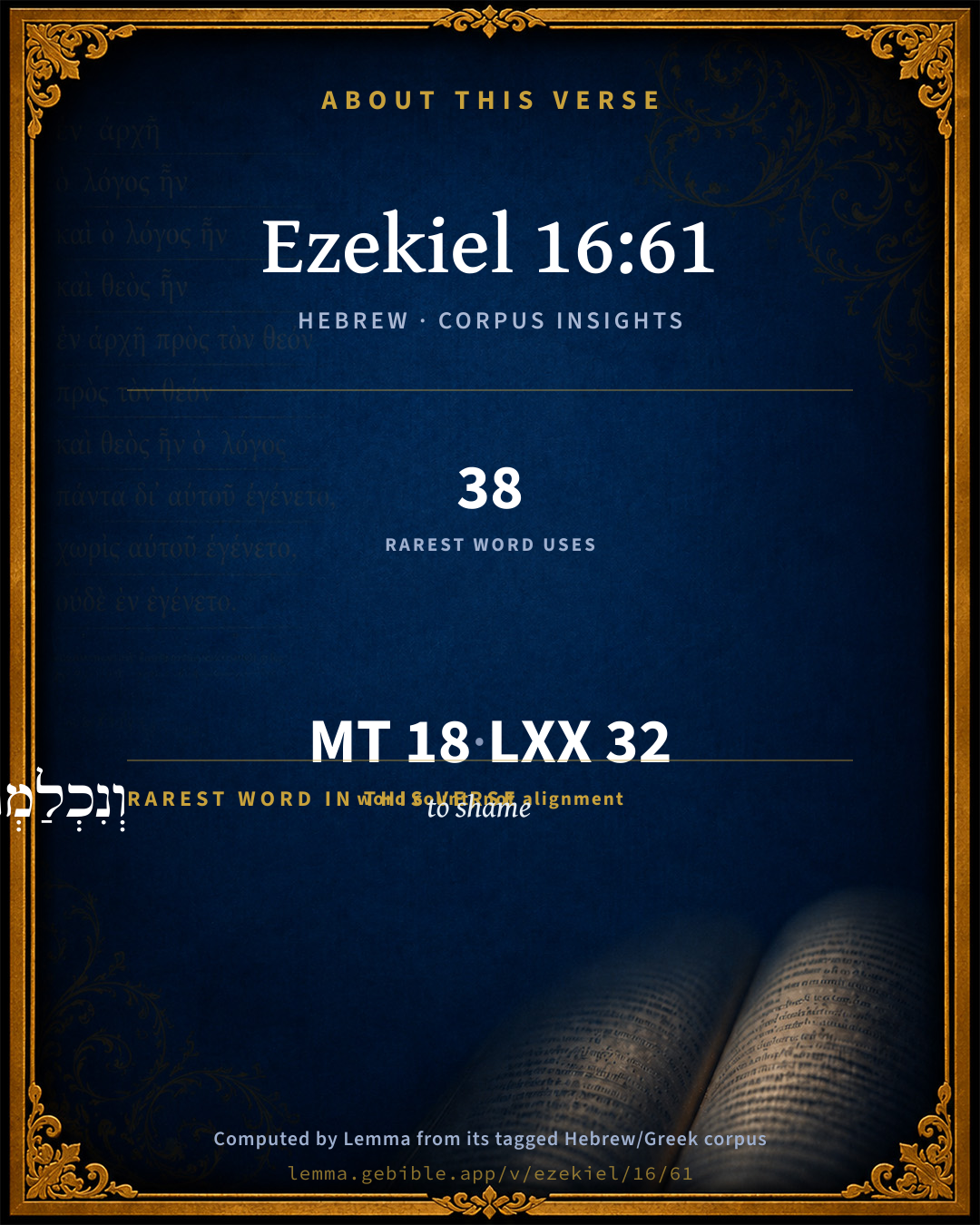
About this verse

These counts appear in no published source. They are computed here, from the morphology-tagged text and Lemma’s own curated glosses. What Lemma adds →

18
words
14
distinct lemmas
Prophets
section

Shared distinctive vocabulary

וְנִכְלַמְתְּ֒ to shame H3637 occurs in 38 verses of the Hebrew Bible. Also found in:

Grammatical profile

  • 4 verbs
  • 4 nouns
  • 2 adjectives
  • 4 prepositions
  • 4 particles

Verb forms

  • וְזָכַ֣רְתְּ Qal · Sequential Perfect
  • וְנִכְלַמְתְּ֒ Niphal · Sequential Perfect
  • בְּקַחְתֵּ֗ךְ Qal · Infinitive Construct
  • וְנָתַתִּ֨י Qal · Sequential Perfect

Repetition

A word recurs within this verse — often emphatic in Hebrew:

  • מִמֵּ֔ךְ from H4480 ×2

Hebrew & Septuagint length

In English translation the verse runs 35 words from the Hebrew and 36 from the Septuagint (LXX English) — closely comparable.

A rough comparison of the two English renderings, which tokenize alike — not a word-level alignment.

Word counts can differ between the Hebrew and the Greek without any difference in meaning — e.g. the Hebrew direct-object marker אֵת has no separate Greek word, and Greek often adds the article ὁ.

In the original languages it is 18 Hebrew tokens and 32 Greek tokens — but the two are counted differently (Hebrew bundles its prefixes and suffixes into one token; the Greek is in lemma form), so that isn’t a like-for-like length.

Cross-references

26

Topical passages linked to Ezekiel 16:61 in the Treasury of Scripture Knowledge — connected by theme and wording, ordered by reader-vote popularity; previews shown in the World English Bible.

  • Galatians 4:26–31 But the Jerusalem that is above is free, which is the mother of us all.
  • Hebrews 8:13 In that he says, "A new covenant," he has made the first old. But that which is becoming old and grows aged is near to vanishing away.
  • Isaiah 66:7–12 Before she travailed, she brought forth; before her pain came, she was delivered of a man-child.
  • Jeremiah 50:4–5 In those days, and in that time, says Yahweh, the children of Israel shall come, they and the children of Judah together; they shall go on their way weeping, and shall seek Yahweh their God.
  • Ezekiel 20:43 There shall you remember your ways, and all your doings, in which you have polluted yourselves; and you shall loathe yourselves in your own sight for all your evils that you have committed.
  • Romans 11:11 I ask then, did they stumble that they might fall? May it never be! But by their fall salvation has come to the Gentiles, to provoke them to jealousy.
  • Romans 15:16 that I should be a servant of Christ Jesus to the Gentiles, ministering as a priest the Gospel of God, that the offering up of the Gentiles might be made acceptable, sanctified by the Holy Spirit.
  • Ephesians 3:6 that the Gentiles are fellow heirs, and fellow members of the body, and fellow partakers of his promise in Christ Jesus through the Gospel,
  • Job 42:5–6 I had heard of you by the hearing of the ear, But now my eye sees you.
  • Psalms 119:59 I considered my ways, And turned my steps to your statutes.
  • Song of Solomon 8:8–9 We have a little sister. She has no breasts. What shall we do for our sister In the day when she is to be spoken for?
  • Isaiah 2:2–5 It shall happen in the latter days, that the mountain of Yahweh's house shall be established on the top of the mountains, And shall be raised above the hills; And all nations shall flow to it.
  • Isaiah 11:9–10 They shall not hurt nor destroy in all my holy mountain; for the earth shall be full of the knowledge of Yahweh, as the waters cover the sea.
  • Isaiah 49:18–23 Lift up your eyes round about, and see: all these gather themselves together, and come to you. As I live, says Yahweh, you shall surely clothe you with them all as with an ornament, and gird yourself with them, like a bride.
  • Isaiah 54:1–2 Sing, barren, you who didn't bear; break forth into singing, and cry aloud, you who did not travail with child: for more are the children of the desolate than the children of the married wife, says Yahweh.
  • Isaiah 60:4 Lift up your eyes round about, and see: they all gather themselves together, they come to you; your sons shall come from far, and your daughters shall be carried in the arms.
  • Jeremiah 31:18–20 I have surely heard Ephraim bemoaning himself [thus], You have chastised me, and I was chastised, as a calf unaccustomed [to the yoke]: turn you me, and I shall be turned; for you are Yahweh my God.
  • Ezekiel 6:9 Those of you that escape shall remember me among the nations where they shall be carried captive, how that I have been broken with their lewd heart, which has departed from me, and with they eyes, which play the prostitute after their idols: and they shall loathe themselves in their own sight for the evils which they have committed in all their abominations.
  • Ezekiel 16:53–55 I will turn again their captivity, the captivity of Sodom and her daughters, and the captivity of Samaria and her daughters, and the captivity of your captives in the midst of them;
  • Ezekiel 16:63 that you may remember, and be confounded, and never open your mouth any more, because of your shame, when I have forgiven you all that you have done, says the Lord Yahweh.
  • Ezekiel 36:31–32 Then shall you remember your evil ways, and your doings that were not good; and you shall loathe yourselves in your own sight for your iniquities and for your abominations.
  • Hosea 1:9–11 He said, "Call his name Lo-Ammi; for you are not my people, and I will not be yours.
  • John 15:16 You didn't choose me, but I chose you, and appointed you, that you should go and bear fruit, and that your fruit should remain; that whatever you will ask of the Father in my name, he may give it to you.
  • Romans 15:8–9 Now I say that Christ has been made a minister of the circumcision for the truth of God, that he might confirm the promises given to the fathers,
  • Ephesians 2:12–14 that you were at that time separate from Christ, alienated from the commonwealth of Israel, and strangers from the covenants of the promise, having no hope and without God in the world.
  • Jeremiah 31:31–40 Behold, the days come, says Yahweh, that I will make a new covenant with the house of Israel, and with the house of Judah:

Cross-references courtesy of OpenBible.info (CC BY 4.0).

Hebrew and Greek witnesses Masoretic Hebrew ↔ Greek Septuagint

The same verse in the two great witnesses to the Old Testament, shown verse-for-verse.

These are two independent witnesses, not word-aligned to each other, and the Septuagint is shown in lemma (dictionary) form.

Hebrew Ezekiel 16:61 Masoretic · Westminster Leningrad Codex

וְזָכַ֣רְתְּ אֶת דְּרָכַיִךְ֮ וְנִכְלַמְתְּ֒ בְּקַחְתֵּ֗ךְ אֶת אֲחוֹתַ֨יִךְ֙ הַגְּדֹל֣וֹת מִמֵּ֔ךְ אֶל הַקְּטַנּ֖וֹת מִמֵּ֑ךְ וְנָתַתִּ֨י אֶתְהֶ֥ן לָ֛ךְ לְבָנ֖וֹת וְלֹ֥א מִבְּרִיתֵֽךְ

Then shall you remember your ways, and be ashamed, when you shall receive your sisters, your elder [sisters] and your younger; and I will give them to you for daughters, but not by your covenant.

World English Bible · Public Domain

Greek LXX Ezekiel 16:61 Septuagint · lemma form

καί μιμνήσκω ὁ ὁδός σύ καί ἐκἀτιμόω ἐν ὁ ἀναλαμβάνω σύ ὁ ἀδελφή σύ ὁ πρεσβύτερος σύ σύν ὁ νέος σύ καί δίδωμι αὐτός σύ εἰς οἰκοδομή καί οὐ ἐκ διαθήκη σύ

Then you shall remember your way, and shall be utterly dishonored when you receive your elder sisters with your younger ones: and I will give them to you for building up, but not by your covenant.

LXX2012 (modern English Septuagint) · Public Domain

Hebrew: Westminster Leningrad Codex (CC BY 4.0). Greek: Septuagint (public domain); English from LXX2012 (modern English Septuagint) (Public Domain). How the Septuagint differs from the Hebrew →

Targum (Aramaic paraphrase)

1

The Targum is the ancient Jewish Aramaic paraphrase of the Hebrew Scriptures — an interpretive translation, not the Hebrew text itself. Onkelos (literal) and Pseudo-Jonathan (expansive) render the Torah, and Jonathan the Prophets. Coverage is partial: where no permissively-licensed English translation exists for a verse, only the Aramaic is shown. This is verse-level text, not a word-by-word alignment to the Hebrew.

  1. Targum Jonathan Prophets (Joshua–Malachi)
    וְתִדְכְּרִין יַת אוֹרְחָתַיִךְ וְתִתְכַּנְעוּן בְּקָרְבוּתִיךְ יַת מְדִינָן דְרַבְרְבָן מִנִיךְ עִם דְעַדְקָן מִנִיךְ וּמְסָרֵית יַתְהוֹן לִיךְ לְאִשְׁתְּמָעָא וְאַתְּ לָא עֲבַדְתְּ יַת אוֹרַיְתָא:

    (no public-domain English translation for this verse)

    Targum Jonathan — Aramaic: “Mikraot Gedolot” (public domain). English: “Sefaria Community Translation” (CC0 1.0 (public-domain dedication)); “London "Chaldee Paraphrase," 1871” (public domain). Text via Sefaria.

Commentary

Notes on Ezekiel 16:61 from classic Christian and Jewish commentators (each source and its license shown beneath its notes). The classic Christian expositions comment on the surrounding passage and are grouped to its opening verse, so a note may address several verses; the Jewish commentaries on the Tanakh (Rashi and others) are per-verse, so they appear only where the commentator wrote on this verse.

Lemma curates 59 commentaries, every one of them public domain or Creative Commons licensed, each selected and text-cleaned for this edition rather than reprinted as found. About our sources →

Trapp's Complete Commentary

John Trapp

Eze 16:61 Then thou shalt remember thy ways, and be ashamed, when thou shalt receive thy sisters, thine elder and thy younger: and I will give them unto thee for daughters, but not by thy covenant.

Ver. 61. And be ashamed.] With a saving and savoury shame, such as was that of Ezra and of the penitent publican, proceeding from true compunction, and producing repentance never to be repented of.

When thou shalt receive thy sisters.] Not Sodom only and Samaria, but all the Gentiles whom thou hast imitated; but now shalt become a worthy example of better things.

But not by thy covenant.] Made with thee in Mount Sinai, but by a covenant of grace made in Mount Zion.

John Trapp, A Commentary or Exposition upon All the Books of the Old and New Testament (1647–1656) — public domain. Text from a community e-Sword module.

Geneva Bible (1599)

Geneva Bible translators

But of my free mercy.

Whereby he showeth that among the most wicked, he had ever some seed of his Church, which he would cause to fructify in due time: and here he declareth how he will call the Gentiles.

Geneva Bible (1599) marginal notes — public domain. Text via Bolls.life.

Jamieson, Fausset & Brown

Robert Jamieson, A. R. Fausset & David Brown

thou shalt remember--It is God who first remembers her before she remembers Him and her own ways before Him (Eze 16:60; Eze 20:43; Eze 36:31).

ashamed--the fruit of repentance (Co2 7:10-11). None please God unless those who displease themselves; a foretaste of the Gospel (Luk 18:9-14).

I will give them unto thee for daughters-- (Isa 54:1; Isa 60:3-4; Gal 4:26, &c.). All the heathen nations, not merely Sodom and Samaria, are meant by "thy sisters, elder and younger." In Jerusalem first, individual believers were gathered into the elect Church. From Jerusalem the Gospel went forth to gather in individuals of the Gentiles; and Judah with Jerusalem shall also be the first nation which, as such, shall be converted to Christ; and to her the other nations shall attach themselves as believers in Messiah, Jerusalem's King (Psa 110:2; Isa 2:2-3). "The king's daughter" in Psa 45:12-14 is Judah; her "companions," as "the daughter of Tyre," are the nations given to her as converts, here called "daughters."

not by thy covenant--This does not set aside the Old Testament in its spirit, but in its mere letter on which the Jews had rested, while they broke it: the latter ("thy covenant") was to give place to God's covenant of grace and promise in Christ who "fulfilled" the law. God means, "not that thou on thy part hast stood to the covenant, but that 'I am the Lord, I change not' (Mal 3:6) from My original love to thee in thy youth" (see Rom 3:3).

Jamieson, Fausset & Brown — Commentary Critical and Explanatory on the Whole Bible (1871) — public domain (CC PDM 1.0). Text via the HelloAO Bible API.

Adam Clarke's Commentary

Verse 61. Thy sisters, thine elder and thy younger] The Gentiles, who were before the Jews were called, and after the Jews were cast off, are here termed the elder and younger sister. These were to be given to Jerusalem for daughters; the latter should be converted to God by the ministry of men who should spring out of the Jewish Church. The former, who were patriarchs, c., profited by the Lamb who was slain from the foundation of the world. Among the latter the Gospel was preached, first by Christ and his apostles, and since by persons raised up from among themselves.

But not by thy covenant.] This was the ancient covenant, the conditions of which they broke, and the blessings of which they forfeited but by that new covenant, or the renewal to the Gentiles of that covenant that was made originally with Abraham while he was a Gentile, promising that in his seed all the nations of the earth should be blessed; that covenant which respected the incarnation of Christ, and was ratified by the blood of his cross.

Adam Clarke's Commentary on the Bible (1810–1826) — public domain. Text from a community e-Sword/MySword module.

John Calvin's Commentaries

As God, then, shows that he would not be merciful to the Jews for any other reason than through being mindful of his covenant, so now, in return, he informs us what he requires from them, namely, that they should begin to acknowledge how basely they had abjured their pledged fidelity — how unworthily they had despised his law — how impiously obstinate they had been against all his prophets in deriding their threats, and in being stupid under manifest penalties. But this passage is worthy of notice, since we gather that none are capable of obtaining God’s mercy except those who are dissatisfied with themselves, and, being ashamed and confounded, betake themselves to his mercy. In fine, we see that God’s grace does not profit the obstinate at all: it is offered to all in common; but none receive it except those who condemn themselves, and bear in mind their crimes, so that they are forgotten before God. If, therefore, we wish our sins to be buried before God, we must remember them ourselves; if we wish our iniquities to be blotted out before God and the angels, we must disgrace ourselves; that is, we must blush and be ashamed of our baseness whenever we transgress and provoke God’s wrath. Hence we here see that the whole contents of the Gospel are shortly summed up; for the Gospel contains nothing else but repentance and faith, as is well known. Concerning faith, Ezekiel has proclaimed that God, mindful of his covenant, will become reconciled to the lost; but he now adds an exhortation that they should acknowledge their faults: but we know that the shame of which the Prophet speaks is the fruit or part of repentance, as is evident from Paul’s description of penitence in the seventh chapter of his second epistle to the Corinthians, (2 Corinthians 7:9-11.) But we shall have yet to speak on this subject, so that I now hasten forwards, because what I have hitherto taught cannot be understood until we come to the end of the verse. He says, when you shall receive thy sisters, as well the elder as the younger; for he does not speak here of Sodom and Samaria alone,, but of all nations; for all the nations may properly be called sisters, for all the world was corrupt. Since, therefore, they were all alike in vices, their union was like that of relationship. For this reason he says, that when the Jews shall return to favor, they shall then have a great multitude with them, who shall receive their own sisters; that is, shall collect from all sides an immense multitude, so that all shall be assembled in obedience to God, and shall be partakers of the same covenant. If any one object that this has never been fulfilled, the answer is at hand, that the prophets speak of the calling of the Gentiles in two ways. They sometimes proclaim it so as to declare that the Jews and Israelites are the leaders of all the others, so as to confer upon them the favor and patronage of God. In that day seven men shall lay hold of the skirt of a single Jew, and shall say, Lead us to your God, (Zechariah 8:23;) and this was the legitimate order, that the Jews, as first-born, should join others in alliance to themselves, and thus unite all into one body and one Church: but because the Jews were cut off through their ingratitude, the prophets make mention of another calling, that the Gentiles should succeed in the place of the ungrateful people, as Paul says that the natural branches were cut off, and that we were grafted in who belonged to the unfruitful tree. (Romans 11:16-19.) The Prophet adds this former reason, that the Jews should receive their sisters, both elder and younger, since they should collect God’s Church from all nations; and this has been partly fulfilled. For whence came the Gospel except from this fountain? as it had been foretold, A law shall go out from Zion, and God’s word from Jerusalem. (Isaiah 2:3; Micah 4:2.) Again, in the 110th Psalm, (Psalm 110:1,) Thy scepter shall go forth from Zion; that is, the kingdom of Christ shall be propagated throughout the whole world: because, therefore, salvation flowed from the Jews, and the Gospel emanated from thence, what is here promised was partly fulfilled, namely, that other people were received by the Jews.

He now subjoins, I will give them to thee for daughters: for if the Jews had not, by their ingratitude, rejected the honor of which God had reckoned them worthy, they had always been the first-born in the Church. Then the Gentiles would have been, as it were, under a mother, since they were “the primitive Church“ (according to the language of the day,) and thus they would have obtained the degree of mother among all nations. Therefore God here deservedly pronounces that he would give them, all nations for daughters, to be added to the Jews, when the Gentiles were grafted into the same body of the Church by faith in the Gospel. But he adds, not from thy covenant. Some refer this to ceremonies, since, when the Gentiles were adopted, they still remained free from the ceremonies of the law; but that is cold. Others compare this passage with Jeremiah: I will establish a new covenant with you, not such as I established with your fathers, which they rendered vain; but this is the covenant which I will make with you, etc. (Jeremiah 31:31-33.) Since, then, it is here said, the covenant shall not be according to the covenant of the people, this is said with truth, because it will be a New Testament. But such expounders are partly right, but not wholly so; for a contrast must be understood between the people’s covenant and God’s. He had said just before, I will be mindful of my covenant: he now says, not of thine. Hence he reconciles what seemed opposites, namely, that he would be mindful of his own agreement, and yet it had been dissipated, broken, and abolished. He shows that it was fixed on his own side, as they say, but vain on the people’s side. I will be reconciled, then, but not through thy covenant; for there was now no covenant, as Hosea says — Not my people, not beloved. (Hosea 1:9.) All the progeny of Abraham were not God’s people, nor all their daughters beloved: but although the covenant was vain through the people’s perfidy, yet God overcame their malice, and so he again erected his own covenant towards them. And when he says, I will establish a covenant, we may explain it, I will set it up again, or restore it afresh: for we said that the New Testament was so distinguished from the Old, that it was founded upon it. For what is proposed to us in Christ, unless what God had promised in the law? and therefore Christ is called the end of the law, and elsewhere its spirit: for if the law be separated from Christ, it is like a dead letter: Christ alone gives it life. Since, therefore, God at this day exhibits to us nothing in his only-begotten Son but what he had formerly promised in the law, it follows that his covenant is set up again, and so perpetually established; and yet this is not man’s part. Wherefore? For men had so revolted from the faith, that God was free; nay, the covenant itself had no force, and lost its effect through their perfidy: for it is easy to collect the points in which the New and Old Testaments are alike, and those, in which they differ. They have this similarity, that God to this day confirms to us what he had formerly promised to Abraham, and in no other sense could Abraham be called the Father of the Faithful.

Since, therefore, Abraham is at this time the father of all the faithful, it, follows that our safety is not to be thought otherwise than in that covenant which God established with Abraham; but afterwards the same covenant was ratified by the hand of Moses. A difference must now be briefly remarked from a passage in Jeremiah, (Jeremiah 31:32,) namely, because the ancient covenant was abolished through the fault of man, there was reed of a better remedy, which is there shown to be twofold, namely, that God should bury men’s sins, and inscribe his law on their hearts: that also was done in Abraham’s time. Abraham believed in God: faith was always the gift of the Holy Spirit; therefore God inscribed his covenant in Abraham’s heart. (Genesis 15:6; Romans 4:3; Ephesians 2:8.) He inscribed his law on the heart of Moses and on the rest of the faithful. This is true: but at first that inner grace was more obscure under the law, and then it was an additional benefit. It could not therefore be ascribed to the law that God regenerated his own elect, because the spirit of regeneration was from Christ, and therefore from the Gospel and the new covenant. But yet we must remember what I have said, that the faithful under the ancient covenant were gifted and endowed with a spirit of regeneration. As far as relates to the remission of sins, it was still more obscure: for cattle were sacrificed, which could not acquire salvation for miserable men, nor blot out their sins. Therefore, if the law is regarded in itself, the promise in the new covenant will not be found in it: I will not remember thy sins: yet to this day God is propitious to us, because he promised to Abraham that all nations should be blest in his seed. (Jeremiah 31:34; Genesis 12:3, and Genesis 18:18.) We see then that the difference which Jeremiah points out was really true; and yet the new covenant so flowed from the old, that it was almost the same in substance, while distinguished in form.

John Calvin's Commentaries (1540-1563) — public domain. Text from the Calvin Translation Society English edition (1840s-50s) via the Christian Classics Ethereal Library (ccel.org). Calvin's coverage is partial (roughly two-thirds of the Bible); uncommented books and verses are honest gaps, never fabricated. The 19th-century editor's footnotes and remarks are omitted so the notes are faithfully Calvin's own voice.

Ellicott's Commentary for English Readers

(61) Give them unto thee for daughters.—The humiliation of Jerusalem must be so complete that she will gladly receive these once-despised enemies to the closest family relationship. We are not here to think of Sodom specifically, but (the concrete passing into the general) of that which Sodom represented, the heathen world at large. This shall be received with Jerusalem to the church of God; “but not by thy covenant.” The covenant with Israel, however it may have been preceded by a “preaching of the Gospel” to Abraham (Gal_3:8), was distinctly a covenant of works, under which neither Jew nor Gentile could attain salvation (see Rom. and Gal. throughout). Not, therefore, by this should the nations of the earth be given to Jerusalem as representing the Church.

A Bible Commentary for English Readers, edited by Charles John Ellicott (1878–1897) — public domain. Text from a community e-Sword module.

The Cambridge Bible for Schools and Colleges

gen. ed. J. J. S. Perowne

61. Sodom and Samaria, the sisters of Jerusalem, shall be restored also with her and given her for daughters. This restoration of her sinful sisters and her receiving them for daughters shall bring the sense of her own sin home to Jerusalem, and she shall be ashamed of all she has done.

not by thy covenant] This glory of receiving Samaria and Sodom and her other sister cities and nationalities for daughters shall not accrue to Jerusalem as the result of her former covenant with Jehovah, for that covenant of his she broke. It shall be like the new covenant itself, something altogether additional, an act of God’s goodness in no way depending on former relations (Eze_16:62).

The Cambridge Bible for Schools and Colleges (gen. ed. J. J. S. Perowne; Cambridge University Press, 1878–1918) — public domain. Text from a community e-Sword module.

John Gill's Exposition

And I will establish my covenant with thee,.... See Gill on Eze 16:60; and which is repeated for the comfort of the Lord's people, being ashamed upon the remembrance of their evil ways; and to show the certainty of it, as well as because it is a matter of the greatest importance:

and thou shalt know that I am the Lord; a covenant keeping God; true and faithful to my promises, and able to make them good: this is a principal blessing of the covenant of grace, to know the Lord, Jer 31:34.

John Gill's Exposition of the Whole Bible (1746–1763) — public domain (CC PDM 1.0). Text via the HelloAO Bible API.

Haydock's Catholic Bible Commentary

Daughters. The countries were conquered by the Machabees. All nations embrace the gospel. --- Covenant. It is broken. I will, out of pity, re-establish it, or a better, to last for ever under Christ, free from the servitude and fear of the old law. (Calmet)

George Leo Haydock (1774–1849), Haydock's Catholic Family Bible and Commentary, 1859 edition — public domain. Excludes Psalms (Douay-Rheims chapter numbering differs from Protestant) and Deuterocanonical books (Catholic canon only).

Matthew Poole's English Annotations

Then; when that new covenant, made and confirmed, shall operate and take effect.

Remember; consider and lay to heart, repent of, mourn for, loathe and abhor, and turn from all thy wicked ways, all thy evil practices and doings.

Be ashamed; though whilst thou wast an adulteress, and false to thy Husband, thou didst not blush, now thou shalt with a deep shame remember and detest thy lewdness.

Receive; admit into church communion, own them as members of the church of God.

Thy sisters; the Gentiles, now strangers, but then sisters.

Thine elder; or those that are greater and mightier than thou, or that by their power, wealth, and honour are as much above thee as the elder children are above the younger.

Thy younger; thy lesser or meaner sister.

I will give them unto thee; they shall be to thee as a gift bestowed in love.

For daughters: as daughters in duty hearken to and obey, so shall the Gentiles brought into the church hearken to the word of God, which sounded out from the Jews from Jerusalem.

By thy covenant; not by that old covenant which was violated, not by external ceremonies, which were a great part of the first covenant, but by that covenant which writes the law in the heart, and puts the fear of God into the inward parts.

Matthew Poole's English Annotations on the Holy Bible (1683–1685) — public domain. Text from a community e-Sword/MySword module.

Whedon's Commentary on the Bible

Daniel D. Whedon

61. But not by thy covenant — Smend and Cornill, “but not because of thy covenant;” Kliefoth and Keil, “though they be not of thy covenant.” None of these new glories of Israel will bring pride, but only shame to the nation’s heart; for the old covenant has been broken and these new honors only come because of the unquenchable mercy and love of the God whom they have dishonored. These come not because of the Mosaic covenant, but are of grace alone. (Compare Romans iii, etc.)

Daniel D. Whedon (gen. ed.), Commentary on the Old and New Testaments (1874–1909) — public domain. Text from a community e-Sword module.

The Pulpit Commentary

Then thou shalt remember thy ways, etc. The pardon which God gives is not, as men sometimes dream, a water of Lethe, blotting out the memory of the evil past. Ezekiel represents that memory as quickened to a new intensity in the very hour of restoration. The shame which it brings with it is necessary as the safeguard of the new blessedness. Thy sisters, thine elder and thy younger. It is significant that, as in the Revised Version, both the adjectives are now in the plural. What was possible for Sodom and Samaria was possible also, as for the cities more immediately connected with them, so also for other nations of the heathen world. They to should be admitted into fellowship, not now as alters, but as daughters, acknowledging, i.e., her superiority. The limitation which follows, not by thy covenant, asserts, as it were, the restored prerogative of Judah, much as St. Paul asserts it in Romans 9-11. Those who are within the covenant of Israel, including, as it does, those who are the heirs of the faith of Abraham as well as his children according to the flesh, are in a closer relation to him than others who share in what have been called (the phrase, perhaps, taking its origin from these very words) the "uncovenanted mercies" of God.

The Pulpit Commentary (1880–1919), ed. H.D.M. Spence-Jones & Joseph S. Exell — public domain. Text from a community e-Sword module.

John Wesley's Explanatory Notes

Then - When that new covenant shall take effect. Receive - Admit into church-communion, the Gentiles, now strangers, but then sisters. Thine elder - Those that are greater and mightier than thou; that by their power, wealth and honour are as much above thee as the elder children are above the younger. Thy younger - Thy lesser or meaner sister. For daughters - As daughters hearken to, and obey, so shall the Gentiles brought into the church, hearken to the word of God, which sounded out from Jerusalem. But not - Not by that old covenant which was violated; nor by external ceremonies, which were a great part of the first covenant, but by that covenant which writes the law in the heart, and puts the fear of God into the inward parts.

John Wesley, Explanatory Notes Upon the Whole Bible (1754–1765) — public domain. Text via the GEBible commentary corpus.

Rashi

Rabbi Shlomo Yitzchaki (Rashi)

And you will remember when I improve you evil ways for you, and you will be humiliated before Me for repaying Me with evil whereas I paid you with good.

when you take your sisters When you conquer to inherit the nations that are around you, the small and the great.

for daughters For your suburbs, subordinate to you, like (verse 55): “Sodom and her daughters,” [translated by Jonathan as] וְכָפְרָנָהָא, its suburbs.

but not from your covenant But not because of your observance of the covenant that I made with you, but because of My kindnesses and My mercies, [namely] that I observe My covenant. Midrash Aggadah of Rabbi Tanchuma (Buber, Devarim 3a) states: but not from your covenant (מִבְּרִיתֵךְ) not from your ‘patromonia’: I did not grant them to Abraham your father [in the covenant] ‘between the segments’ (Gen. 15:1). This term is close to the French, for now, kinship is called patremone, patrimony, and this is what they call anything a person has from the inheritance of his fathers.

Rashi on the Tanakh — English translations: “The Judaica Press complete Tanach with Rashi, translated by A. J. Rosenberg” (CC BY 4.0); “Pentateuch with Rashi's commentary by M. Rosenbaum and A.M. Silbermann, 1929-1934” (public domain); “The Metsudah Tanach series, Lakewood, N.J” (CC BY 4.0); and “The Book of Joshua, Metsudah Publications, 1997” (CC BY 4.0). Text via Sefaria.

Lesson kit

Teaching starters — assembled from the data on this page, not authored interpretation. Every prompt links to the verse data it draws on. Edit before teaching.

Ezekiel, in the Prophets, opens this verse with 18 words (14 distinct Hebrew lemmas). Its most distinctive word is kâlam (“to shame”). A historical commentator’s framing appears above. Read the whole chapter for the surrounding context.

Discussion questions

  1. The word kâlam carries the sense “to shame.” How does it shape the verse?
  2. How does Numbers 12:14, which shares the word «to shame», read alongside this verse?
  3. What does the repetition of “from” (2× in this one verse) do in this verse?
  4. These translations render this verse differently; the difference is in the English rendering, not the original. What questions does that raise?
  5. «וְזָכַ֣רְתְּ» is a Qal Sequential Perfect verb. How does that grammatical form shape the action described?
  6. Compare how Trapp's Complete Commentary and Geneva Bible (1599) read this verse. Where do they agree or differ?

Things to notice

Reading settings

Reading text

Shown beneath each verse's original-language words.

Old Testament
Old Testament edition

Read the OT as the Masoretic Hebrew (MT) or the Greek Septuagint (LXX).

English shown for the Greek Septuagint (in the Hebrew ↔ Greek comparison).

Comparing translations? Open the Compare panel on any verse page to stack up to four side by side.