
Exodus 30:19

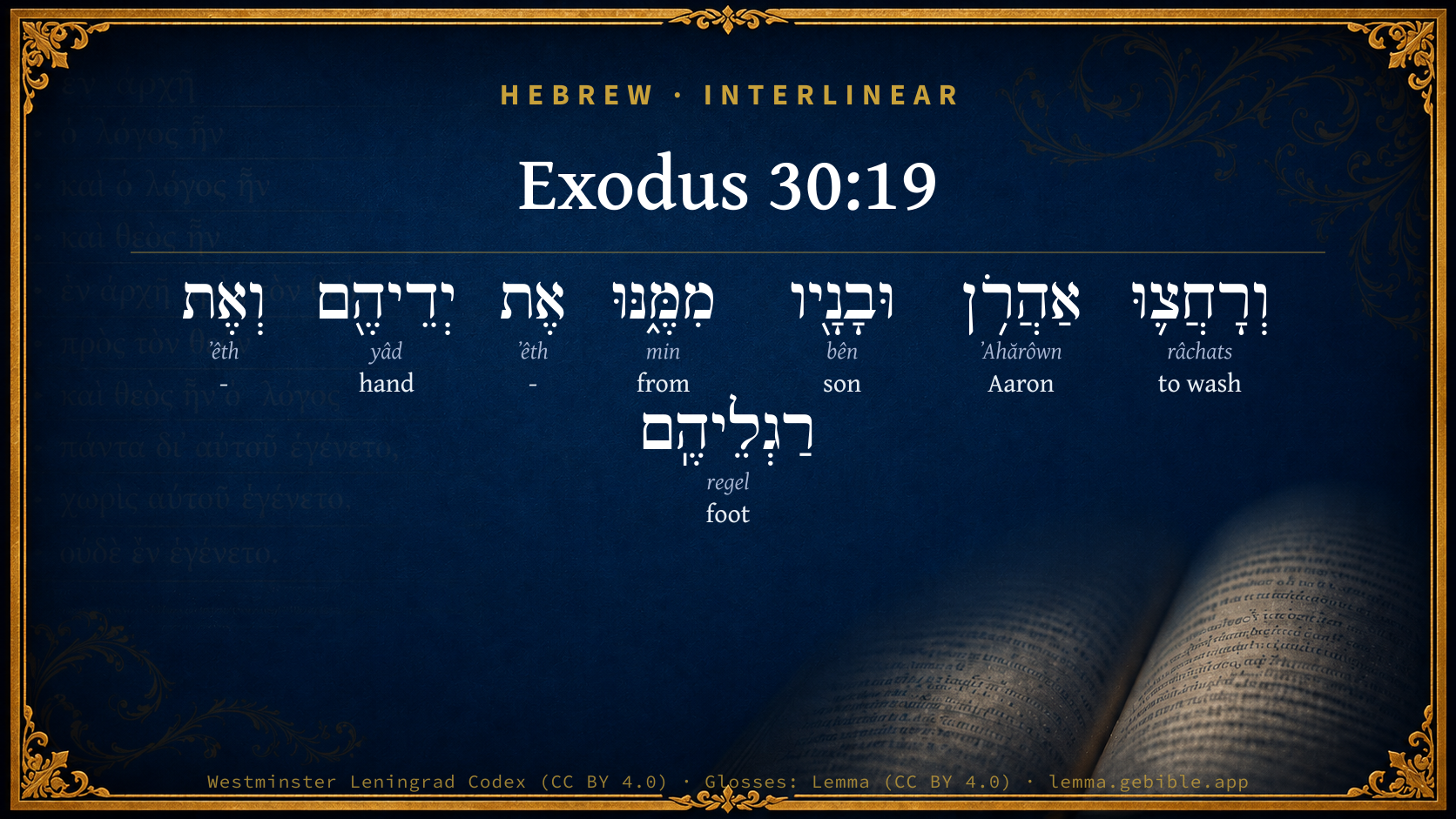
Hebrew (Westminster Leningrad Codex) Exodus 30:19 appears in the Hebrew Old Testament. The text above is from the Westminster Leningrad Codex. Each word links to its Strong’s number, a concise gloss, and parsing drawn from the Open Scriptures Hebrew Bible morphology. Click any word for its full Brown-Driver-Briggs (BDB) entry.
Download image
Cite this verse

Exodus 30:19 (World English Bible). Public Domain. Lemma interlinear Bible study tool, https://lemma.gebible.app/v/exodus/30/19.

Show BibTeX & RIS
BibTeX
RIS
English Translation
Aaron and his sons shall wash their hands and their feet in it.
World English Bible · Public Domain
Download a study sheet

One document with this verse’s original text, its word-by-word gloss line, the meaning frame, cross-references with their text, attributed commentary, and full source and license credits — printable, and it pastes into notes with its structure intact.

This verse Autodidact and up

Study sheet (.html) Plain text (.txt)

A passage Seminary Student

Up to 50 verses in one chapter. A passage sheet keeps up to 6 commentary sources and 12 cross-references per verse, in the order this page ranks them, and says so on the sheet whenever that leaves anything out. Ask for a single verse and you get the Autodidact verse sheet above.

Everything on this page stays free to read, with no account — the sheet is a download of what is already on screen, not access to it.

Want to remove ads? Support Godless Engineer
Compare translations 3

The same verse in 3 English versions, stacked beneath the original-language interlinear above. Click any original word for its lexicon entry.

Each is an independent rendering of the whole verse — the interlinear is not word-aligned to these translations.

Highlighted words mark where these versions differ — a whole-verse word diff, not a word-by-word alignment.

  • World English Bible Public Domain
    Aaron and his sons shall wash their hands and their feet in it.
  • King James Version Public Domain
    For Aaron and his sons shall wash their hands and their feet thereat:
  • unfoldingWord Literal Text CC BY-SA 4.0
    And Aaron and his sons shall wash their hands and their feet in it.

unfoldingWord Literal Text — © unfoldingWord, licensed CC BY-SA 4.0. Word-aligned USFM3 via Door43 (git.door43.org/unfoldingWord/en_ult).

Versions to compare (up to 4)

3 of 4 selected

Show all 18 translations

Every available English version of this verse, each an independent rendering of the whole verse.

  • World English Bible Public Domain
    Aaron and his sons shall wash their hands and their feet in it.
  • Berean Standard Bible Public Domain
    with which Aaron and his sons are to wash their hands and feet.
  • Majority Standard Bible Public Domain
    with which Aaron and his sons are to wash their hands and feet.
  • King James Version Public Domain
    For Aaron and his sons shall wash their hands and their feet thereat:
  • American Standard Version (1901) Public Domain
    And Aaron and his sons shall wash their hands and their feet thereat:
  • Revised Version (1885) Public Domain
    And Aaron and his sons shall wash their hands and their feet thereat:
  • Geneva Bible (1599) Public Domain
    For Aaron and his sonnes shall wash their hands and their feete thereat.
  • Douay-Rheims (1899) Public Domain
    Aaron and his sons shall wash their hands and feet in it:
  • Young's Literal Translation Public Domain
    and Aaron and his sons have washed at it their hands and their feet,
  • Literal Standard Version CC BY-SA 4.0
    and Aaron and his sons have washed their hands and their feet from it;
  • Unlocked Literal Bible CC BY-SA 4.0
    Aaron and his sons must wash their hands and their feet with the water in it.
  • unfoldingWord Literal Text CC BY-SA 4.0
    And Aaron and his sons shall wash their hands and their feet in it.
  • Darby Bible Public Domain
    And Aaron and his sons shall wash their hands and their feet out of it.
  • World Messianic Bible Public Domain
    Aaron and his sons shall wash their hands and their feet in it.
  • Webster's Bible Public Domain
    For Aaron and their sons shall wash their hands and their feet thereat:
  • Free Bible Version CC BY-SA 4.0
    Aaron and his sons will use it to wash their hands and feet.
  • Bible in Basic English Public Domain
    That it may be used by Aaron and his sons for washing their hands and feet;
  • JPS Tanakh (1917) Public Domain
    And Aaron and his sons shall wash their hands and their feet thereat;

Literal Standard Version (2020), Covenant Press — licensed CC BY-SA 4.0. Text via the HelloAO Bible API (eBible.org). Unlocked Literal Bible (unfoldingWord) — licensed CC BY-SA 4.0. Text via the HelloAO Bible API (eBible.org). unfoldingWord Literal Text — © unfoldingWord, licensed CC BY-SA 4.0. Word-aligned USFM3 via Door43 (git.door43.org/unfoldingWord/en_ult). Free Bible Version, Dr. Jonathan Gallagher — licensed CC BY-SA 4.0. Text via the HelloAO Bible API (eBible.org).

Word by word

More ways to search: Search by grammar → Find every occurrence → Compare this word →

Practice this passage: Drill this verse → Learn its vocabulary →

וְרָחֲצ֛וּ
râchats
H7364
“and · to wash”
Conjunction + Verb, Qal, Sequential Perfect, 3rd Person, Common, Plural
Part of Speech
Conjunction + Verb
Stem
Qal
Form
Sequential Perfect
Person
3rd Person
Gender
Common
Number
Plural
Full BDB Definition

Origin: a primitive root

TWOT: 2150

to wash, wash off, wash away, bathe - (Qal) - to wash, wash off, wash away - to wash, bathe (oneself) - (Pual) to be washed - (Hithpael) to wash oneself
  1. אַהֲרֹ֥ן ʼAhărôwn H175 “Aaron” Noun, Proper
  2. וּבָנָ֖יו bên H1121 “and · sons · his” Conjunction + Noun, Common, Masculine, Plural, Construct + Suffix, Personal, 3rd Person, Masculine, Singular
  3. מִמֶּ֑נּוּ min H4480 “from · us” Preposition + Suffix, Personal, 1st Person, Common, Plural
  4. אֶת ʼêth H853 “-” Particle, Direct Object
  5. יְדֵיהֶ֖ם yâd H3027 “hands · their” Noun, Common, Both, Dual, Construct + Suffix, Personal, 3rd Person, Masculine, Plural
  6. וְאֶת ʼêth H853 “and · -” Conjunction + Particle, Direct Object
  7. רַגְלֵיהֶֽם regel H7272 “feet · their” Noun, Common, Feminine, Dual, Construct + Suffix, Personal, 3rd Person, Masculine, Plural

About this verse

These counts appear in no published source. They are computed here, from the morphology-tagged text and Lemma’s own curated glosses. What Lemma adds →

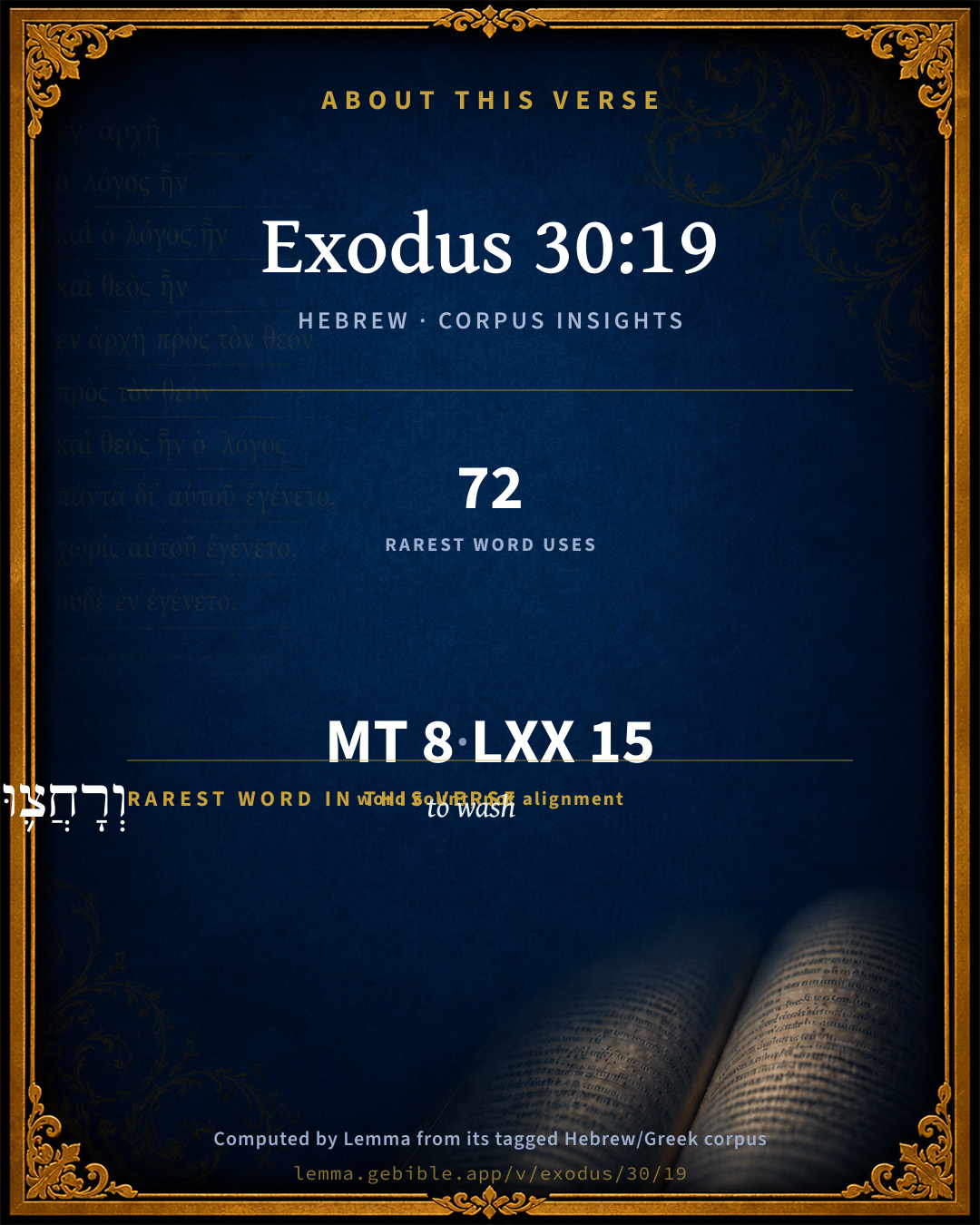
8
words
7
distinct lemmas
Pentateuch
section

Grammatical profile

  • 1 verb
  • 4 nouns
  • 1 preposition
  • 2 particles

Verb forms

  • וְרָחֲצ֛וּ Qal · Sequential Perfect

Hebrew & Septuagint length

In English translation the verse runs 13 words from the Hebrew and 16 from the Septuagint (LXX English) — closely comparable.

A rough comparison of the two English renderings, which tokenize alike — not a word-level alignment.

Word counts can differ between the Hebrew and the Greek without any difference in meaning — e.g. the Hebrew direct-object marker אֵת has no separate Greek word, and Greek often adds the article ὁ.

In the original languages it is 8 Hebrew tokens and 15 Greek tokens — but the two are counted differently (Hebrew bundles its prefixes and suffixes into one token; the Greek is in lemma form), so that isn’t a like-for-like length.

Cross-references

9

Topical passages linked to Exodus 30:19 in the Treasury of Scripture Knowledge — connected by theme and wording, ordered by reader-vote popularity; previews shown in the World English Bible.

  • Isaiah 52:11 Depart you, depart you, go you out from there, touch no unclean thing; go you out of the midst of her; cleanse yourselves, you who bear the vessels of Yahweh.
  • Exodus 40:31–32 Moses, Aaron, and his sons washed their hands and their feet there.
  • Psalms 26:6 I will wash my hands in innocence, So I will go about your altar, Yahweh;
  • Hebrews 10:22 let's draw near with a true heart in fullness of faith, having our hearts sprinkled from an evil conscience, and having our body washed with pure water,
  • 1 Corinthians 6:9–11 Or don't you know that the unrighteous will not inherit the Kingdom of God? Don't be deceived. Neither the sexually immoral, nor idolaters, nor adulterers, nor male prostitutes, nor homosexuals,
  • Titus 3:5 not by works of righteousness, which we did ourselves, but according to his mercy, he saved us, through the washing of regeneration and renewing by the Holy Spirit,
  • Hebrews 9:10 being only (with meats and drinks and various washings) fleshly ordinances, imposed until a time of reformation.
  • John 13:8–10 Peter said to him, "You will never wash my feet!" Jesus answered him, "If I don't wash you, you have no part with me."
  • Revelation 1:5–6 and from Jesus Christ, the faithful witness, the firstborn of the dead, and the ruler of the kings of the earth. To him who loves us, and washed us from our sins by his blood;

Cross-references courtesy of OpenBible.info (CC BY 4.0).

Hebrew and Greek witnesses Masoretic Hebrew ↔ Greek Septuagint

The same verse in the two great witnesses to the Old Testament, shown verse-for-verse.

These are two independent witnesses, not word-aligned to each other, and the Septuagint is shown in lemma (dictionary) form.

Hebrew Exodus 30:19 Masoretic · Westminster Leningrad Codex

וְרָחֲצ֛וּ אַהֲרֹ֥ן וּבָנָ֖יו מִמֶּ֑נּוּ אֶת יְדֵיהֶ֖ם וְאֶת רַגְלֵיהֶֽם

Aaron and his sons shall wash their hands and their feet in it.

World English Bible · Public Domain

Greek LXX Exodus 30:19 Septuagint · lemma form

καί νίπτω ααρων καί ὁ υἱός αὐτός ἐκ αὐτός ὁ χείρ καί ὁ πούς ὕδωρ

And Aaron and his sons shall wash their hands and their feet with water from it.

LXX2012 (modern English Septuagint) · Public Domain

Hebrew: Westminster Leningrad Codex (CC BY 4.0). Greek: Septuagint (public domain); English from LXX2012 (modern English Septuagint) (Public Domain). How the Septuagint differs from the Hebrew →

Targum (Aramaic paraphrase)

2

The Targum is the ancient Jewish Aramaic paraphrase of the Hebrew Scriptures — an interpretive translation, not the Hebrew text itself. Onkelos (literal) and Pseudo-Jonathan (expansive) render the Torah, and Jonathan the Prophets. Coverage is partial: where no permissively-licensed English translation exists for a verse, only the Aramaic is shown. This is verse-level text, not a word-by-word alignment to the Hebrew.

  1. Targum Onkelos Torah (Genesis–Deuteronomy)
    וִיקַדְשׁוּן אַהֲרֹן וּבְנוֹהִי מִנֵהּ יָת יְדֵיהוֹן וְיָת רַגְלֵיהוֹן:

    (no public-domain English translation for this verse)

    Targum Onkelos — Aramaic: “Onkelos Genesis” (public domain); “Onkelos Exodus” (public domain); “Onkelos Leviticus” (public domain); “Onkelos Numbers” (public domain); “Onkelos Deuteronomy” (public domain). English: “Sefaria Community Translation” (CC0 1.0 (public-domain dedication)); “J.W. Etheridge. The Targums of Onkelos and Jonathan Ben Uzziel on the Pentateuch. London: Longmans, Green, 1862” (public domain). Text via Sefaria.

  2. Targum Pseudo-Jonathan Torah (Genesis–Deuteronomy)
    וְיִסְבּוּן מִנֵּיהּ בִּנְטִילָא דַכְיָא וִיקַדְשׁוּן בְּמוֹהִי אַהֲרן וּבְנוֹי יַת יְדֵיהוֹן וְיַת רִיגְלֵיהוֹן

    And they shall take from it for a cleansing ablution. And Aharon and his sons shall sanctify their hands and their feet with its water;

    Targum Pseudo-Jonathan — Aramaic: “Targum Jonathan on Genesis” (public domain); “Targum Jonathan on Exodus” (public domain); “Targum Jonathan on Leviticus” (public domain); “Targum Jonathan on Numbers” (public domain); “Targum Jonathan on Deuteronomy” (public domain). English: “The Targum of Jonathan ben Uzziel, trans. J. W. Etheridge, London, 1862” (public domain). Text via Sefaria.

Commentary

Notes on Exodus 30:19 from classic Christian and Jewish commentators (each source and its license shown beneath its notes). The classic Christian expositions comment on the surrounding passage and are grouped to its opening verse, so a note may address several verses; the Jewish commentaries on the Tanakh (Rashi and others) are per-verse, so they appear only where the commentator wrote on this verse.

Lemma curates 59 commentaries, every one of them public domain or Creative Commons licensed, each selected and text-cleaned for this edition rather than reprinted as found. About our sources →

Trapp's Complete Commentary

John Trapp

Exo 30:19 For Aaron and his sons shall wash their hands and their feet thereat:

Ver. 19. For Aaron and his sons.] Here they were to wash before they prayed for the people. {Heb 10:22} We must first make our own peace with God before we take upon us to intercede for others. So did David. {Psa 25:22; Psa 51:18-19} So we are advised to do, Lam 3:39-40.

John Trapp, A Commentary or Exposition upon All the Books of the Old and New Testament (1647–1656) — public domain. Text from a community e-Sword module.

Geneva Bible (1599)

Geneva Bible translators

Signifying, that he that cometh to God, must be washed from all sin and corruption.

Geneva Bible (1599) marginal notes — public domain. Text via Bolls.life.

Ellicott's Commentary for English Readers

(19) Aaron and his sons shall wash their hands and their feet.—Washing the hands symbolised purity in act; washing the feet, holiness in all their walk and conversation.

A Bible Commentary for English Readers, edited by Charles John Ellicott (1878–1897) — public domain. Text from a community e-Sword module.

John Gill's Exposition

For Aaron and his sons shall wash their hands and their feet thereat. Not in it, but at it; the laver had mouths or spouts, as Ben Melech says, from whence the water flowed when the priests washed their hands and feet at it; and so Bartenora says (z) they did not wash out of the laver, but from water flowing out of it; it is said "out of it", not in it; it seems at first there were but two of these spouts; for it is said (a) Ben Katin made twelve spouts or cocks, which had but two before; so that twelve priests could wash their hands and feet at one time, and which they could do at once, presently, by putting the right hand on the top of the right foot, and the left hand upon the left foot, as both Jarchi and Ben Melech relate: and now the hands being the instruments of action, and the feet of walking, this shows that the actions of good men, the priests of the Lord, and their walk and conversation, are not without sin, and that these need washing in the laver of Christ's blood, to which there must be daily application, see Zac 13:1. Our Lord seems to have reference to this ceremony, Joh 13:10 the Egyptian priests washed twice every day in cold water, and twice every night (b).

(z) In Misn. Zebachim, c. 2. sect. 1. (a) Misn. Yoma. c. 3. sect. 10. (b) Herodot. Euterpe, sive, l. 2. c. 37.

John Gill's Exposition of the Whole Bible (1746–1763) — public domain (CC PDM 1.0). Text via the HelloAO Bible API.

Haydock's Catholic Bible Commentary

Feet. The priests went barefoot in the tabernacle. In the Misna we find the same law binds laymen. None were allowed to enter the temple of Diana, in Crete, with shoes on; and the Roman ladies followed the same custom, when they came down to the temple of Vesta. Huc pede matronam nudo descendere vidi. (Ovid, Fast. 6.) (Calmet) --- The priest is ordered to put off his shoes on Good Friday, out of respect for Jesus Christ, who suffered on the cross. (Haydock)

George Leo Haydock (1774–1849), Haydock's Catholic Family Bible and Commentary, 1859 edition — public domain. Excludes Psalms (Douay-Rheims chapter numbering differs from Protestant) and Deuterocanonical books (Catholic canon only).

Matthew Poole's English Annotations

To signify their natural impurity and unworthiness, either to handle holy things, or to come into the holy place, and their need of washing with the blood and Spirit of Christ, which was typified by this washing.

Matthew Poole's English Annotations on the Holy Bible (1683–1685) — public domain. Text from a community e-Sword/MySword module.

The Pulpit Commentary

Aaron and his sons shall wash their hands and their feet. Ablution by clear fresh water is so plain and simple a type of purity as to have been used in almost all religions. The hands and the feet would designate symbolically all a man"s active doings, and even his whole walk in life his "goings out" and his "comings in," in the phraseology of the Hebrews. There would also be a special practical need for such ablutions in the case of persons who were employed about bloody sacrifices, who slew the victims, sprinkled, the blood, and even dashed it against the base of the altar. On some rare occasions the priests were required to bathe their whole persons, and not their hands and feet only. (see above, Exo_29:4; and Lev_16:4)

The Pulpit Commentary (1880–1919), ed. H.D.M. Spence-Jones & Joseph S. Exell — public domain. Text from a community e-Sword module.

John Wesley's Explanatory Notes

The high priest was to take this in his way as he came out from the holy of holies. This was to intimate, that the sins of the priests who ministered at this altar, and of the people for whom they ministered, put a ceremonial impurity upon it, from which it must be cleansed by the blood of atonement. This altar typified the mediation of Christ: the brazen altar in the court was a type of Christ dying on earth; the golden altar in the sanctuary was a type of Christ interceding in heaven. This altar was before the mercy- seat, for Christ always appears in the presence of God for us; and his intercession is unto God of a sweet smelling savour. And it typified the devotions of the saints, whose prayers are said to be set forth before God as incense, Psalm 1xli, 2. As the smoke of the incense ascended, so must our desires, being kindled with the fire of holy love. When the priest was burning incense the people were praying, Luke i, 10, to signify that prayer is the true incense. This incense was a perpetual incense, for we must pray always. The lamps were dressed or lighted at the same time that the incense was burnt, to teach us that the reading of the scriptures (which are our light and lamp) is a part of our daily work, and should ordinarily accompany our prayers and praises. The devotions of sanctified souls are well-pleasing to God, of a sweet- smelling savour; the prayers of saints are compared to sweet odours, Rev. v, 8, but it is the incense which Christ adds to them that makes them acceptable; and his blood that atones for the guilt which cleaves to our best services. Yet if the heart and life be not holy, even incense is an abomination, Isaiah i, 13.

John Wesley, Explanatory Notes Upon the Whole Bible (1754–1765) — public domain. Text via the GEBible commentary corpus.

unfoldingWord translationNotes

Door43 World Missions Community

General Information:

Yahweh continues telling Moses what the people must do.

water in it

"water in the basin"

for Aaron and his descendants throughout their people's generations

"for Aaron and all the generations of his descendants." See how you translated a similar phrase in Exodus 12:14.

translationWords

Aaron

tent of meeting

altar

servant

burnt offering

descend

generation

unfoldingWord translationNotes — © Distant Shores Media and the Door43 World Missions Community, licensed CC BY-SA 4.0. Source: git.door43.org/Door43/en_tn.

Rashi

Rabbi Shlomo Yitzchaki (Rashi)

את ידיהם ואת רגליהם THEIR HANDS AND THEIR FEET The priest washed his hands and his feet simultaneously. Thus we learn in Zevachim 19b: How was the procedure in washing hands and feet? He placed his right hand upon his right foot (knee) and his left hand upon his left foot (knee) and thus washed both simultaneously.

Rashi on the Tanakh — English translations: “The Judaica Press complete Tanach with Rashi, translated by A. J. Rosenberg” (CC BY 4.0); “Pentateuch with Rashi's commentary by M. Rosenbaum and A.M. Silbermann, 1929-1934” (public domain); “The Metsudah Tanach series, Lakewood, N.J” (CC BY 4.0); and “The Book of Joshua, Metsudah Publications, 1997” (CC BY 4.0). Text via Sefaria.

Ramban (Nachmanides)

Rabbi Moshe ben Nachman (Ramban / Nachmanides)

AND AARON AND HIS SONS SHALL WASH THEIR HANDS AND THEIR FEET THEREAT. This washing was out of reverence for Him Who is on high, for whoever approaches the King’s table to serve, or to touch the portion of the king’s food, and of the wine which he drinks, washes his hands, because “hands are busy” [touching unclean things automatically]. In addition He prescribed here the washing of feet because the priests performed the Service barefooted, and there are some people who have impurities and dirt on their feet.By way of the Truth, [the mystic teachings of the Cabala], these parts of the body had to be washed because the extremities of the person’s body are his hands and feet, for when the hands are upraised they are higher than the rest of the body, and the feet are the lowest point. They allude in the human form to the Ten Emanations, with the whole body between them, just as the Rabbis have said in Sefer Yetzirah: “He made a covenant with him [i.e., Abraham] between the ten fingers of his hands and the ten fingers of his feet, with the protrusive part of the tongue and with the protrusive part of the nakedness.” Therefore the ministers of the One on High were commanded to wash their hands and feet, this washing being for the sake of holiness, as Onkelos translated here, l’rochtzah (to wash): l’kidush (to sanctify). (washing) literally. It is on the basis of the idea of this commandment that our Rabbis have instituted the washing of hands before prayer, in order that one should direct one’s thoughts to this matter, just as in the uplifting of hands by the priests when blessing the people. It is the washing which is the essence of the commandment, but He commanded [the making of] the laver only in order that the water should be ready in it. Thus the absence of the laver does not invalidate the washing, neither is there any duty [to do the washing specifically from the laver]; thus on the Day of Atonement the High Priest washed his hands and feet from a golden jug which they made in his honor. However, what we do learn from the laver [that the Torah mentions], is that the washing [of the hands and feet by the priests] must be performed from a vessel.

Ramban (Nachmanides) on the Tanakh — English translation: “Commentary on the Torah by Ramban (Nachmanides). Translated and annotated by Charles B. Chavel. New York, Shilo Pub. House, 1971-1976” (CC BY 4.0). Text via Sefaria.

Lesson kit

Teaching starters — assembled from the data on this page, not authored interpretation. Every prompt links to the verse data it draws on. Edit before teaching.

Exodus, in the Pentateuch, opens this verse with 8 words (7 distinct Hebrew lemmas). Its most distinctive word is râchats (“to wash”). A historical commentator’s framing appears above. Read the whole chapter for the surrounding context.

Discussion questions

  1. How does “to wash” (râchats) shape what this verse is saying?
  2. How does Isaiah 52:11, which shares this passage’s theme, read alongside this verse?
  3. These translations render this verse differently. What is at stake in choosing one wording over another?
  4. «וְרָחֲצ֛וּ» is a Qal Sequential Perfect verb. How does that grammatical form shape the action described?
  5. Compare how Trapp's Complete Commentary and Geneva Bible (1599) read this verse. Where do they agree or differ?

Things to notice

Reading settings

Reading text

Shown beneath each verse's original-language words.

Old Testament
Old Testament edition

Read the OT as the Masoretic Hebrew (MT) or the Greek Septuagint (LXX).

English shown for the Greek Septuagint (in the Hebrew ↔ Greek comparison).

Comparing translations? Open the Compare panel on any verse page to stack up to four side by side.