
Exodus 18:14

Hebrew (Westminster Leningrad Codex) Exodus 18:14 appears in the Hebrew Old Testament. The text above is from the Westminster Leningrad Codex. Each word links to its Strong’s number, a concise gloss, and parsing drawn from the Open Scriptures Hebrew Bible morphology. Click any word for its full Brown-Driver-Briggs (BDB) entry.
Download image
Cite this verse

Exodus 18:14 (World English Bible). Public Domain. Lemma interlinear Bible study tool, https://lemma.gebible.app/v/exodus/18/14.

Show BibTeX & RIS
BibTeX
RIS
English Translation
When Moses' father-in-law saw all that he did to the people, he said, "What is this thing that you do for the people? Why do you sit alone, and all the people stand around you from morning to evening?"
World English Bible · Public Domain
Download a study sheet

One document with this verse’s original text, its word-by-word gloss line, the meaning frame, cross-references with their text, attributed commentary, and full source and license credits — printable, and it pastes into notes with its structure intact.

This verse Autodidact and up

Study sheet (.html) Plain text (.txt)

A passage Seminary Student

Up to 50 verses in one chapter. A passage sheet keeps up to 6 commentary sources and 12 cross-references per verse, in the order this page ranks them, and says so on the sheet whenever that leaves anything out. Ask for a single verse and you get the Autodidact verse sheet above.

Everything on this page stays free to read, with no account — the sheet is a download of what is already on screen, not access to it.

Want to remove ads? Support Godless Engineer
Compare translations 3

The same verse in 3 English versions, stacked beneath the original-language interlinear above. Click any original word for its lexicon entry.

Each is an independent rendering of the whole verse — the interlinear is not word-aligned to these translations.

Highlighted words mark where these versions differ — a whole-verse word diff, not a word-by-word alignment.

  • World English Bible Public Domain
    When Moses' father-in-law saw all that he did to the people, he said, "What is this thing that you do for the people? Why do you sit alone, and all the people stand around you from morning to evening?"
  • King James Version Public Domain
    And when Moses' father in law saw all that he did to the people, he said, What is this thing that thou doest to the people? why sittest thou thyself alone, and all the people stand by thee from morning unto even?
  • unfoldingWord Literal Text CC BY-SA 4.0
    And the father-in-law of Moses was watching all that he did for the people, and he said, “What is this thing that you are doing with the people? For what purpose do you sit alone, and all the people position themselves next to you from morning until evening?”

unfoldingWord Literal Text — © unfoldingWord, licensed CC BY-SA 4.0. Word-aligned USFM3 via Door43 (git.door43.org/unfoldingWord/en_ult).

Versions to compare (up to 4)

3 of 4 selected

Show all 18 translations

Every available English version of this verse, each an independent rendering of the whole verse.

  • World English Bible Public Domain
    When Moses' father-in-law saw all that he did to the people, he said, "What is this thing that you do for the people? Why do you sit alone, and all the people stand around you from morning to evening?"
  • Berean Standard Bible Public Domain
    When his father-in-law saw all that Moses was doing for the people, he asked, “What is this that you are doing for the people? Why do you sit alone as judge, with all the people standing around you from morning till evening?”
  • Majority Standard Bible Public Domain
    When his father-in-law saw all that Moses was doing for the people, he asked, “What is this that you are doing for the people? Why do you sit alone as judge, with all the people standing around you from morning till evening?”
  • King James Version Public Domain
    And when Moses' father in law saw all that he did to the people, he said, What is this thing that thou doest to the people? why sittest thou thyself alone, and all the people stand by thee from morning unto even?
  • American Standard Version (1901) Public Domain
    And when Moses' father-in-law saw all that he did to the people, he said, What is this thing that thou doest to the people? why sittest thou thyself alone, and all the people stand about thee from morning unto even?
  • Revised Version (1885) Public Domain
    And when Moses’ father in law saw all that he did to the people, he said, What is this thing that thou doest to the people? why sittest thou thyself alone, and all the people stand about thee from morning unto even?
  • Geneva Bible (1599) Public Domain
    And when Moses father in law saw all that he did to the people, he sayde, What is this that thou doest to the people? why sittest thou thy selfe alone, and all the people stande about thee from morning vnto euen?
  • Douay-Rheims (1899) Public Domain
    And when his kinsman had seen all things that he did among the people, he said: What is it that thou dost among the people? Why sittest thou alone, and all the people wait from morning till night.
  • Young's Literal Translation Public Domain
    and the father-in-law of Moses seeth all that he is doing to the people, and saith, `What `is' this thing which thou art doing to the people? wherefore art thou sitting by thyself, and all the people standing by thee from morning till evening?'
  • Literal Standard Version CC BY-SA 4.0
    and the father-in-law of Moses sees all that he is doing for the people and says, “What [is] this thing which you are doing for the people? Why are you sitting by yourself, and all the people standing by you from morning until evening?”
  • Unlocked Literal Bible CC BY-SA 4.0
    When Moses' father-in-law saw all that he did for the people, he said, “What is this that you are doing with the people? Why is it that you sit alone and all the people stand about you from morning until evening?”
  • unfoldingWord Literal Text CC BY-SA 4.0
    And the father-in-law of Moses was watching all that he did for the people, and he said, “What is this thing that you are doing with the people? For what purpose do you sit alone, and all the people position themselves next to you from morning until evening?”
  • Darby Bible Public Domain
    And Moses' father-in-law saw all that he did with the people, and said, What is this thing which thou art doing with the people? why dost thou sit alone, and all the people are standing by thee from morning to evening?
  • World Messianic Bible Public Domain
    When Moses’ father-in-law saw all that he did to the people, he said, “What is this thing that you do for the people? Why do you sit alone, and all the people stand around you from morning to evening?”
  • Webster's Bible Public Domain
    And when Moses's father-in-law saw all that he did to the people, he said, What is this thing that thou doest to the people? Why sittest thou thyself alone, and all the people stand by thee from morning to evening?
  • Free Bible Version CC BY-SA 4.0
    When his father-in-law saw everything that Moses was doing for the people, he asked, “What's all this you're doing for the people? Why are you sitting alone as judge, with everyone presenting their cases to you from morning to evening?”
  • Bible in Basic English Public Domain
    And when Moses' father-in-law saw all he was doing, he said, What is this you are doing for the people? why are you seated here by yourself, with all the people waiting before you from morning till evening?
  • JPS Tanakh (1917) Public Domain
    And when Moses' father-in-law saw all that he did to the people, he said: 'What is this thing that thou doest to the people? why sittest thou thyself alone, and all the people stand about thee from morning unto even?'

Literal Standard Version (2020), Covenant Press — licensed CC BY-SA 4.0. Text via the HelloAO Bible API (eBible.org). Unlocked Literal Bible (unfoldingWord) — licensed CC BY-SA 4.0. Text via the HelloAO Bible API (eBible.org). unfoldingWord Literal Text — © unfoldingWord, licensed CC BY-SA 4.0. Word-aligned USFM3 via Door43 (git.door43.org/unfoldingWord/en_ult). Free Bible Version, Dr. Jonathan Gallagher — licensed CC BY-SA 4.0. Text via the HelloAO Bible API (eBible.org).

Word by word

More ways to search: Search by grammar → Find every occurrence → Compare this word →

Practice this passage: Drill this verse → Learn its vocabulary →

חֹתֵ֣ן
châthan
H2859
“marrying”
Verb, Qal, Participle Active, Masculine, Singular, Construct
Part of Speech
Verb
Stem
Qal
Form
Participle Active
Gender
Masculine
Number
Singular
State
Construct
Full BDB Definition

Origin: a primitive root

TWOT: 781b

to become a son-in-law, make oneself a daughter's husband - (Qal) wife's father, wife's mother, father-in-law, mother-in-law (participle) - (Hithpael) to make oneself a daughter's husband
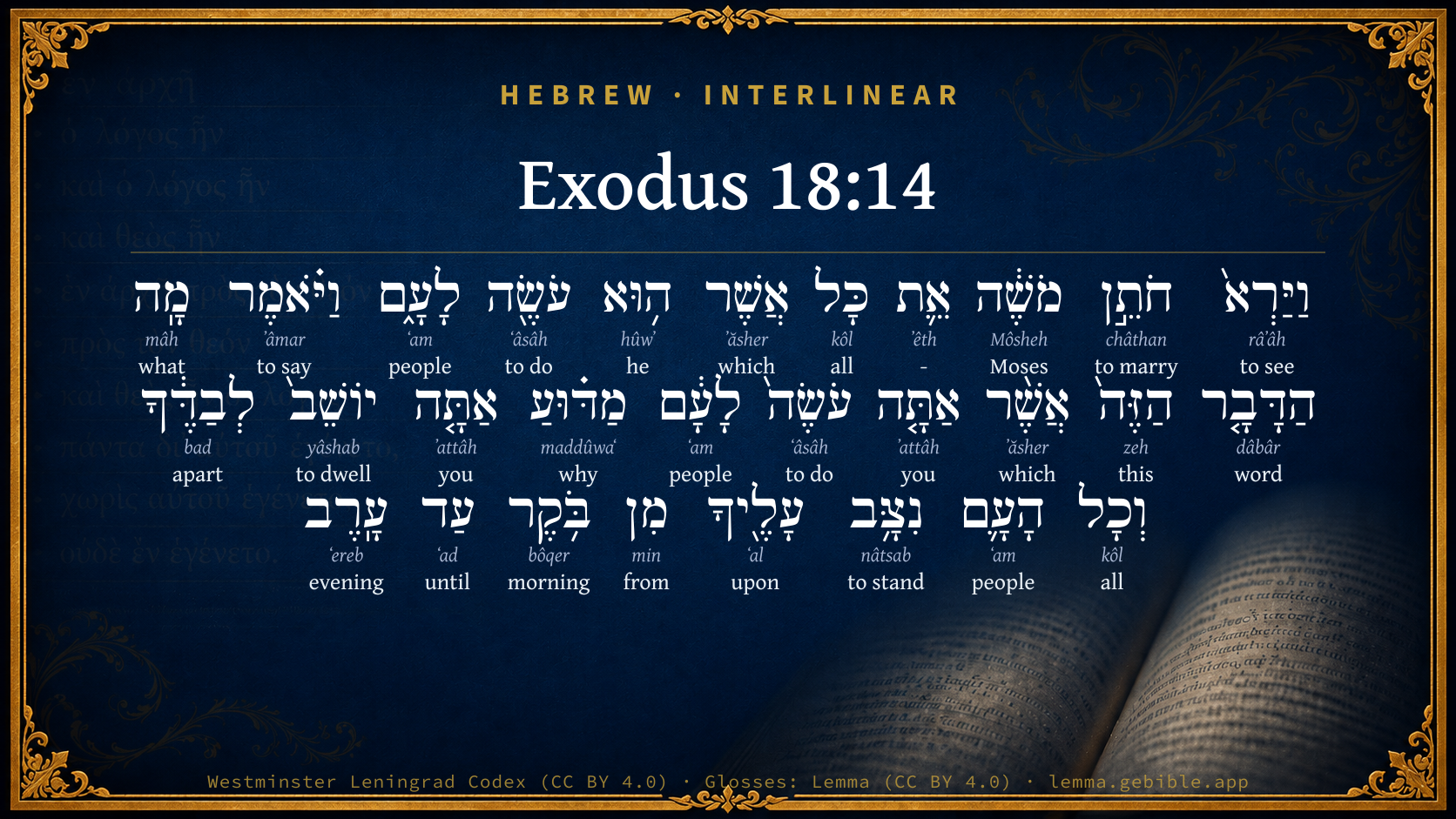
  1. וַיַּרְא֙ râʼâh H7200 “and · to see” Conjunction + Verb, Qal, Sequential Imperfect, 3rd Person, Masculine, Singular
  2. מֹשֶׁ֔ה Môsheh H4872 “Moses” Noun, Proper
  3. אֵ֛ת ʼêth H853 “-” Particle, Direct Object
  4. כָּל kôl H3605 “all of” Noun, Common, Masculine, Singular, Construct
  5. אֲשֶׁר ʼăsher H834 “which” Particle, Relative
  6. ה֥וּא hûwʼ H1931 “he” Pronoun, Personal, 3rd Person, Masculine, Singular
  7. עֹשֶׂ֖ה ʻâsâh H6213 “doing” Verb, Qal, Participle Active, Masculine, Singular, Absolute
  8. לָעָ֑ם ʻam H5971 “to/for the · people” Preposition, Determined + Noun, Common, Masculine, Singular, Absolute
  9. וַיֹּ֗אמֶר ʼâmar H559 “and · to say” Conjunction + Verb, Qal, Sequential Imperfect, 3rd Person, Masculine, Singular
  10. מָֽה mâh H4100 “what” Particle, Interrogative
  11. הַדָּבָ֤ר dâbâr H1697 “the · word” Particle, Definite Article + Noun, Common, Masculine, Singular, Absolute
  12. הַזֶּה֙ zeh H2088 “the · this” Particle, Definite Article + Pronoun, Demonstrative, Masculine, Singular
  13. אֲשֶׁ֨ר ʼăsher H834 “which” Particle, Relative
  14. אַתָּ֤ה ʼattâh H859 “you” Pronoun, Personal, 2nd Person, Masculine, Singular
  15. עֹשֶׂה֙ ʻâsâh H6213 “doing” Verb, Qal, Participle Active, Masculine, Singular, Absolute
  16. לָעָ֔ם ʻam H5971 “to/for the · people” Preposition, Determined + Noun, Common, Masculine, Singular, Absolute
  17. מַדּ֗וּעַ maddûwaʻ H4069 “why” Particle, Interrogative
  18. אַתָּ֤ה ʼattâh H859 “you” Pronoun, Personal, 2nd Person, Masculine, Singular
  19. יוֹשֵׁב֙ yâshab H3427 “dwelling” Verb, Qal, Participle Active, Masculine, Singular, Absolute
  20. לְבַדֶּ֔ךָ bad H905 “to/for · apart · your” Preposition + Noun, Common, Masculine, Singular, Construct + Suffix, Personal, 2nd Person, Masculine, Singular
  21. וְכָל kôl H3605 “and · all of” Conjunction + Noun, Common, Masculine, Singular, Construct
  22. הָעָ֛ם ʻam H5971 “the · people” Particle, Definite Article + Noun, Common, Masculine, Singular, Absolute
  23. נִצָּ֥ב nâtsab H5324 “standing” Verb, Niphal, Participle Active, Masculine, Singular, Absolute
  24. עָלֶ֖יךָ ʻal H5921 “upon · you” Preposition + Suffix, Personal, 2nd Person, Masculine, Singular
  25. מִן min H4480 “from” Preposition
  26. בֹּ֥קֶר bôqer H1242 “morning” Noun, Common, Masculine, Singular, Absolute
  27. עַד ʻad H5704 “until” Preposition
  28. עָֽרֶב ʻereb H6153 “evening” Noun, Common, Masculine, Singular, Absolute

About this verse

These counts appear in no published source. They are computed here, from the morphology-tagged text and Lemma’s own curated glosses. What Lemma adds →

29
words
23
distinct lemmas
Pentateuch
section

Shared distinctive vocabulary

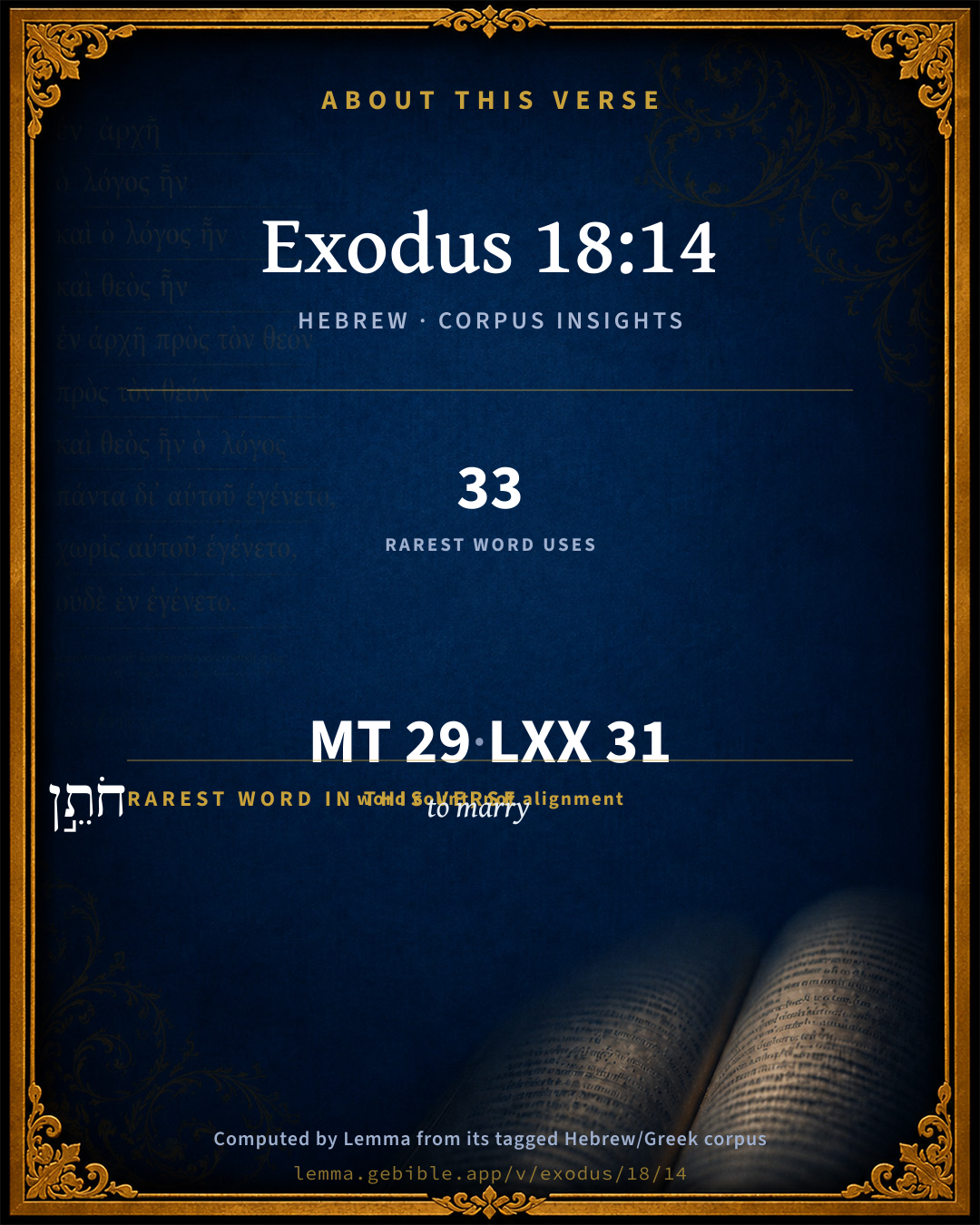
חֹתֵ֣ן to marry H2859 occurs in 32 verses of the Hebrew Bible. Also found in:

Grammatical profile

  • 7 verbs
  • 10 nouns
  • 4 pronouns
  • 3 prepositions
  • 5 particles

Verb forms

  • וַיַּרְא֙ Qal · Sequential Imperfect
  • חֹתֵ֣ן Qal · Participle Active
  • עֹשֶׂ֖ה Qal · Participle Active
  • וַיֹּ֗אמֶר Qal · Sequential Imperfect
  • עֹשֶׂה֙ Qal · Participle Active
  • יוֹשֵׁב֙ Qal · Participle Active
  • נִצָּ֥ב Niphal · Participle Active

Repetition

Words recur within this verse — often emphatic in Hebrew:

  • לָעָ֑ם people H5971 ×3
  • כָּל all H3605 ×2
  • עֹשֶׂ֖ה to do H6213 ×2
  • אֲשֶׁר which H834 ×2
  • אַתָּ֤ה you H859 ×2

Hebrew & Septuagint length

In English translation the verse runs 39 words from the Hebrew and 36 from the Septuagint (LXX English) — closely comparable.

A rough comparison of the two English renderings, which tokenize alike — not a word-level alignment.

Word counts can differ between the Hebrew and the Greek without any difference in meaning — e.g. the Hebrew direct-object marker אֵת has no separate Greek word, and Greek often adds the article ὁ.

In the original languages it is 29 Hebrew tokens and 31 Greek tokens — but the two are counted differently (Hebrew bundles its prefixes and suffixes into one token; the Greek is in lemma form), so that isn’t a like-for-like length.

Hebrew and Greek witnesses Masoretic Hebrew ↔ Greek Septuagint

The same verse in the two great witnesses to the Old Testament, shown verse-for-verse.

These are two independent witnesses, not word-aligned to each other, and the Septuagint is shown in lemma (dictionary) form.

Hebrew Exodus 18:14 Masoretic · Westminster Leningrad Codex

וַיַּרְא֙ חֹתֵ֣ן מֹשֶׁ֔ה אֵ֛ת כָּל אֲשֶׁר ה֥וּא עֹשֶׂ֖ה לָעָ֑ם וַיֹּ֗אמֶר מָֽה הַדָּבָ֤ר הַזֶּה֙ אֲשֶׁ֨ר אַתָּ֤ה עֹשֶׂה֙ לָעָ֔ם מַדּ֗וּעַ אַתָּ֤ה יוֹשֵׁב֙ לְבַדֶּ֔ךָ וְכָל הָעָ֛ם נִצָּ֥ב עָלֶ֖יךָ מִן בֹּ֥קֶר עַד עָֽרֶב

When Moses' father-in-law saw all that he did to the people, he said, "What is this thing that you do for the people? Why do you sit alone, and all the people stand around you from morning to evening?"

World English Bible · Public Domain

Greek LXX Exodus 18:14 Septuagint · lemma form

καί ὁράω ιοθορ πᾶς ὅσος ποιέω ὁ λαός λέγω τίς οὗτος ὅς σύ ποιέω ὁ λαός διά τίς σύ καταἧμαι μόνος πᾶς δέ ὁ λαός παραἵστημι σύ ἀπό πρωίθεν ἕως δειλός

And Jothor having seen all that Moses did to the people, says, What is this that you do to the people? therefore sit you alone, and all the people stand by you from morning till evening?

LXX2012 (modern English Septuagint) · Public Domain

Hebrew: Westminster Leningrad Codex (CC BY 4.0). Greek: Septuagint (public domain); English from LXX2012 (modern English Septuagint) (Public Domain). How the Septuagint differs from the Hebrew →

Targum (Aramaic paraphrase)

2

The Targum is the ancient Jewish Aramaic paraphrase of the Hebrew Scriptures — an interpretive translation, not the Hebrew text itself. Onkelos (literal) and Pseudo-Jonathan (expansive) render the Torah, and Jonathan the Prophets. Coverage is partial: where no permissively-licensed English translation exists for a verse, only the Aramaic is shown. This is verse-level text, not a word-by-word alignment to the Hebrew.

  1. Targum Onkelos Torah (Genesis–Deuteronomy)
    וַחֲזָא חֲמוּהִי דְמשֶׁה יָת כָּל דִי הוּא עָבֵד לְעַמָא וַאֲמַר מָא פִתְגָמָא הָדֵין דִי אַתְּ עָבֵד לְּעַמָא מָה דֵין אַתְּ יָתֵב בִּלְחוֹדָךְ וְכָל עַמָא קָיְמִין עִלָוָךְ מִן צַפְרָא עַד רַמְשָׁא:

    (no public-domain English translation for this verse)

    Targum Onkelos — Aramaic: “Onkelos Genesis” (public domain); “Onkelos Exodus” (public domain); “Onkelos Leviticus” (public domain); “Onkelos Numbers” (public domain); “Onkelos Deuteronomy” (public domain). English: “Sefaria Community Translation” (CC0 1.0 (public-domain dedication)); “J.W. Etheridge. The Targums of Onkelos and Jonathan Ben Uzziel on the Pentateuch. London: Longmans, Green, 1862” (public domain). Text via Sefaria.

  2. Targum Pseudo-Jonathan Torah (Genesis–Deuteronomy)
    וַחֲמָא חָמוֹי דְמשֶׁה יַת כָּל דְּהוּא טָרַח וְעָבֵיד לְעַמֵּיהּ וַאֲמַר מַה פִּתְגָמָא הָדֵין דְּאַנְתְּ עָבֵיד לְעַמָּא מַה דֵּין אַנְתְּ יָתֵב לְבִלְחוֹדָךְ לְמִידוּן וְכָל עַמָּא קַיְימִין קֳדָמָךְ מִן צַפְרָא עַד רַמְשָׁא

    And the father-in-law of Mosheh saw how much he toiled and laboured for his people; and he said, What thing is this that thou art doing to the people? Why dost thou sit alone to judge, and all the people stand before thee from morning until evening?

    Targum Pseudo-Jonathan — Aramaic: “Targum Jonathan on Genesis” (public domain); “Targum Jonathan on Exodus” (public domain); “Targum Jonathan on Leviticus” (public domain); “Targum Jonathan on Numbers” (public domain); “Targum Jonathan on Deuteronomy” (public domain). English: “The Targum of Jonathan ben Uzziel, trans. J. W. Etheridge, London, 1862” (public domain). Text via Sefaria.

Commentary

Notes on Exodus 18:14 from classic Christian and Jewish commentators (each source and its license shown beneath its notes). The classic Christian expositions comment on the surrounding passage and are grouped to its opening verse, so a note may address several verses; the Jewish commentaries on the Tanakh (Rashi and others) are per-verse, so they appear only where the commentator wrote on this verse.

Lemma curates 59 commentaries, every one of them public domain or Creative Commons licensed, each selected and text-cleaned for this edition rather than reprinted as found. About our sources →

Trapp's Complete Commentary

John Trapp

Exo 18:14 And when Moses’ father in law saw all that he did to the people, he said, What [is] this thing that thou doest to the people? why sittest thou thyself alone, and all the people stand by thee from morning unto even?

Ver. 14. What is this thing?] A man by good counsel may become an angel; nay, a god to another. Alexander, being requested by some ambassadors to show them his treasures, showed them his faithful counsellors.

John Trapp, A Commentary or Exposition upon All the Books of the Old and New Testament (1647–1656) — public domain. Text from a community e-Sword module.

Ellicott's Commentary for English Readers

(14) Why sittest thou thyself alone?—The emphatic word is “alone.” Why dost thou not, Jethro means, devolve a part of the duty upon others?

A Bible Commentary for English Readers, edited by Charles John Ellicott (1878–1897) — public domain. Text from a community e-Sword module.

John Gill's Exposition

And Moses said unto his father in law,.... In answer to his question; and there were two things, as Aben Ezra observes, he did to the people, and for which they came to him; the one is observed in this verse, and the other in the next:

because the people come unto me to inquire of God; of his mind and will in certain cases, and of his statutes and laws, as the following verse shows; what they should observe, and according to which they should conduct themselves: they came to inquire what God would have them to do; and, in doubtful cases, what was his will and pleasure, and to desire Moses to inform them; and if the things were of such a nature that he could not easily and readily do it, then to inquire of God for them, which in later times was done by Urim and Thummim.

John Gill's Exposition of the Whole Bible (1746–1763) — public domain (CC PDM 1.0). Text via the HelloAO Bible API.

Whedon's Commentary on the Bible

Daniel D. Whedon

14. Why sittest thou thyself alone? — A question which might well be put to others besides Moses, who never appear to reflect that much important work is often better done by many than by one. He who assumes to do all the judging and counselling in the Church and congregation of the Lord is likely both to injure himself and to hinder others from entering fields of useful labour.

Daniel D. Whedon (gen. ed.), Commentary on the Old and New Testaments (1874–1909) — public domain. Text from a community e-Sword module.

The Pulpit Commentary

Why sittest thou thyself alone etc. A perverse ingenuity has discovered that the emphatic words in this passage are "sittest" and "stand," Jethro having blamed Moses for humiliating the people by requiring them to stand up while he himself sat! But the context makes it abundantly clear that what Jethro really blames, is Moses sitting alone and judging the whole people single-handed.

Vers. 14-23. The unwisdom of a monopoly of power.

The principle of the division of labour, which is essential to progress in the arts, was well known in Egypt, and was applied there, not to the arts only, but also to government and administration. Moses, who had resided forty years at the court of a Pharaoh, (Act_7:23) must have been thoroughly acquainted with the fact that, in a well-ordered community, judicial functions were separated kern legislative and administrative, and entrusted to a large number of persons, not monopolised by a single individual. But it had appeared to him that the condition of his own people was exceptional. Just released from the cruel bondage of a hard and pitiless slavery, without education, without habits of command or self-control, without any knowledge of the principles of law or experience in the practice of courts, they seemed to him unfit for the exercise of the judicial office especially as he understood it. For his view was, that each particular decision should be made an occasion of educating the people in the principles of law and justice (ver. 16), and upon these it was his habit to descant in connection with each judgment that he delivered. As he felt that he alone among all the Israelites was equal to this task, he had undertaken to discharge singly the office of judge in a community consisting of above two millions of persons. Jethro, on visiting him, was struck with the unwisdom of such an attempt, and honestly gave expression to his feelings. Jethro saw

I THAT TO MONOPOLISE THE JUDICIAL FUNCTION IN SO LARGE A COMMUNITY WAS UNWISE, AS AN UNDUE STRAIN UPON THE MENTAL AND PHYSICAL POWERS OF THE MONOPOLISER. SO numerous were the causes brought before him that Moses had to sit "from morning to evening probably from early dawn until the dusk of the evening twilight hearing them. At eighty years of age, or more, (Exo_7:7) his physical strength was not equal to this exertion. Our physical powers have to be considered. No one is justified in overtaxing them unnecessarily. The body needs change of attitude and employment, air, gentle exercise, freedom from restraint, confinement, tension. No one could habitually sit at any one task for twelve hours continuously without its telling on his bodily frame and injuring his constitution. Again, the mental strain must have been injurious to him, and if not actually impairing his faculties, must have interfered with their due exercise and rendered him unfit to perform the delicate duties of a judge late in the day. Had necessity been laid upon him, had God appointed him to be the sole judge of the people, or had there actually been no one else among the Israelites competent to the performance of any part of the work, he would have been right in acting as he did, for health is not the first consideration; but this was not so. God had not spoken upon the point; and there was an abundance of men in the congregation, quite competent to perform raider judicial functions, as Jethro clearly perceived, and as he himself also saw when it was pointed out to him. Thus he was exhausting himself unnecessarily, a proceeding which cannot be justified.

II THAT IT WAS ALSO UNWISE, AS UNDULY TAXING THE PATIENCE OF THE PEOPLE. One man could not keep pace with the number of constantly arising causes, which must have tended to accumulate, whence would arise a delay of justice. It was inconvenient enough to have to wait from the morning until the evening before obtaining a hearing; but probably the ease was not uncommon of a cause being put off to the next court-day, which, if the people were on the march, might be several days distant. The convenience of suitors is an important consideration in the administration of justice, which should be prompt as well as sure, to content men"s natural sense of what is fitting.

III THAT, FURTHER, IT TENDED TO CRAMP THE EXERCISE BY THE PEOPLE OF POWERS WHICH THEY POSSESSED, AND THE EMPLOYMENT OF WHICH WOULD HAVE ELEVATED THEM. There were in Israel and will always be in every community, "able men," well fitted to take part in the decision of causes. Such men will commonly be very numerous; and if they have no part in the administration of justice, a large section of the community will at once be dissatisfied with the slight passed upon them, and debarred from an employment which would have tended to their moral education and elevation. The jury system of modern states is a recognition of the fact, that judicial capacity is widely spread, and that society ought to provide a field for its exercise. It is important to utilise the powers possessed by all members of the community, both for their own contentation and for the general welfare of the community itself. The world is over-full of despots and monopolists, persons who desire to grasp as much power as possible, and are unwilling to share their office with others. We may acquit Moses of such selfishness; but we cannot acquit all those who follow in his footsteps. It would be well if persons in positions of authority nowadays sought generally to associate others in their work to call out latent talent, exercise it, and so educate its possessors.

The Pulpit Commentary (1880–1919), ed. H.D.M. Spence-Jones & Joseph S. Exell — public domain. Text from a community e-Sword module.

Lesson kit

Teaching starters — assembled from the data on this page, not authored interpretation. Every prompt links to the verse data it draws on. Edit before teaching.

Exodus, in the Pentateuch, opens this verse with 29 words (23 distinct Hebrew lemmas). Its most distinctive word is châthan (“to marry”). A historical commentator’s framing appears above. Read the whole chapter for the surrounding context.

Discussion questions

  1. The word châthan carries the sense “to marry.” How does it shape the verse?
  2. Genesis 34:9 shares the word «to marry» with this verse. How do the two illuminate each other?
  3. “people” occurs 3× in this one verse. What is the effect of the repetition?
  4. The translations on this page render this verse differently — a whole-verse word diff, not a word-by-word alignment. What might account for the different wordings?
  5. The verb «וַיַּרְא֙» is Qal Sequential Imperfect. How does its form color the action?
  6. Reading how Trapp's Complete Commentary and Ellicott's Commentary for English Readers read this verse, where do the two commentators agree and where do they part?

Things to notice

Reading settings

Reading text

Shown beneath each verse's original-language words.

Old Testament
Old Testament edition

Read the OT as the Masoretic Hebrew (MT) or the Greek Septuagint (LXX).

English shown for the Greek Septuagint (in the Hebrew ↔ Greek comparison).

Comparing translations? Open the Compare panel on any verse page to stack up to four side by side.