
Genesis 26:16

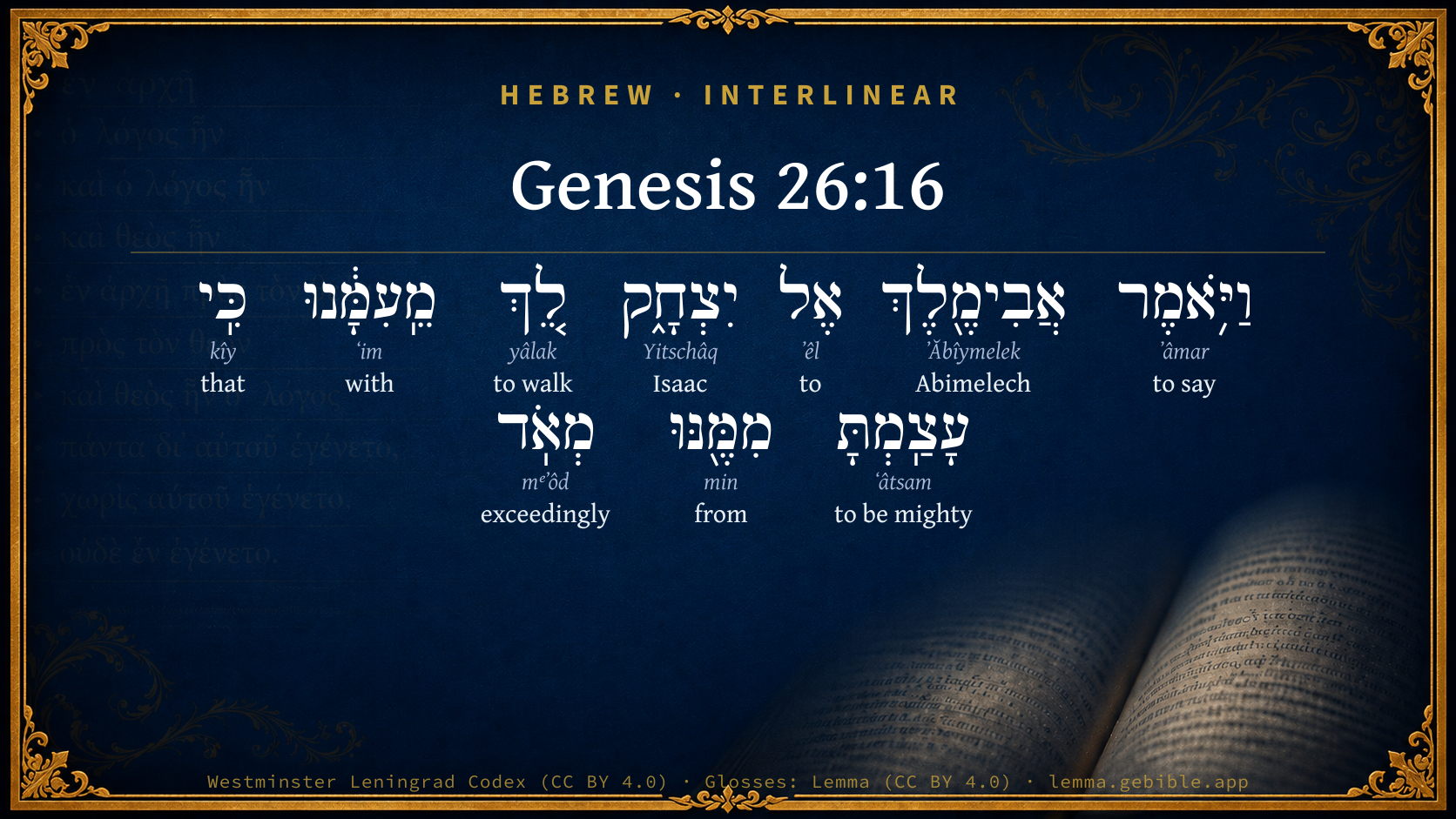
Hebrew (Westminster Leningrad Codex) Genesis 26:16 appears in the Hebrew Old Testament. The text above is from the Westminster Leningrad Codex. Each word links to its Strong’s number, a concise gloss, and parsing drawn from the Open Scriptures Hebrew Bible morphology. Click any word for its full Brown-Driver-Briggs (BDB) entry.
Download image
Cite this verse

Genesis 26:16 (World English Bible). Public Domain. Lemma interlinear Bible study tool, https://lemma.gebible.app/v/genesis/26/16.

Show BibTeX & RIS
BibTeX
RIS
English Translation
Abimelech said to Isaac, "Go from us, for you are much mightier than we."
World English Bible · Public Domain
Highlights
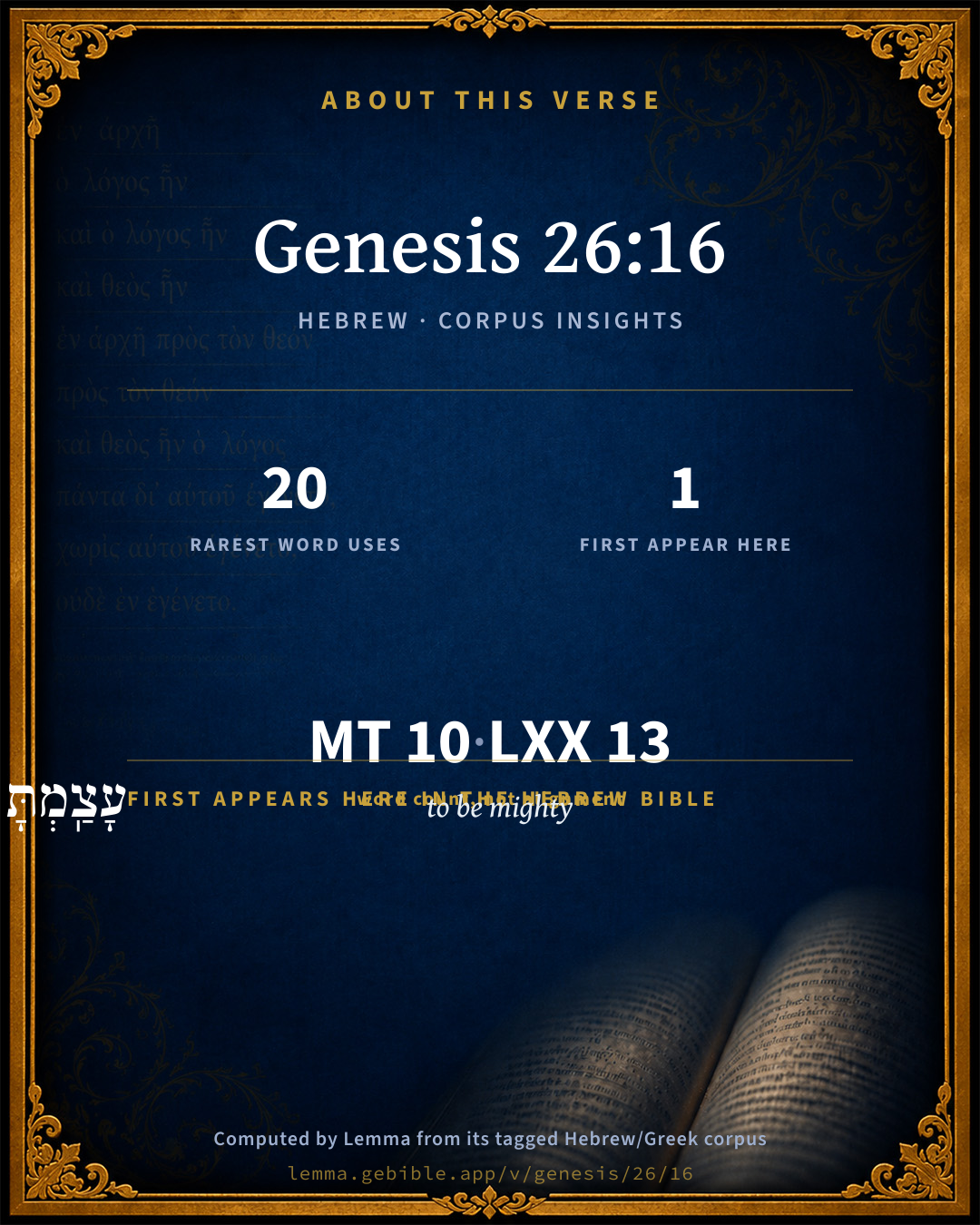
  • 1 first appearance in the Hebrew Bible
Full analysis ↓
Download a study sheet

One document with this verse’s original text, its word-by-word gloss line, the meaning frame, cross-references with their text, attributed commentary, and full source and license credits — printable, and it pastes into notes with its structure intact.

This verse Autodidact and up

Study sheet (.html) Plain text (.txt)

A passage Seminary Student

Up to 50 verses in one chapter. A passage sheet keeps up to 6 commentary sources and 12 cross-references per verse, in the order this page ranks them, and says so on the sheet whenever that leaves anything out. Ask for a single verse and you get the Autodidact verse sheet above.

Everything on this page stays free to read, with no account — the sheet is a download of what is already on screen, not access to it.

Want to remove ads? Support Godless Engineer
Compare translations 3

The same verse in 3 English versions, stacked beneath the original-language interlinear above. Click any original word for its lexicon entry.

Each is an independent rendering of the whole verse — the interlinear is not word-aligned to these translations.

Highlighted words mark where these versions differ — a whole-verse word diff, not a word-by-word alignment.

  • World English Bible Public Domain
    Abimelech said to Isaac, "Go from us, for you are much mightier than we."
  • King James Version Public Domain
    And Abimelech said unto Isaac, Go from us; for thou art much mightier than we.
  • unfoldingWord Literal Text CC BY-SA 4.0
    Then Abimelech said to Isaac, “Go away from us, because you are more powerful than we.”

unfoldingWord Literal Text — © unfoldingWord, licensed CC BY-SA 4.0. Word-aligned USFM3 via Door43 (git.door43.org/unfoldingWord/en_ult).

Versions to compare (up to 4)

3 of 4 selected

Show all 18 translations

Every available English version of this verse, each an independent rendering of the whole verse.

  • World English Bible Public Domain
    Abimelech said to Isaac, "Go from us, for you are much mightier than we."
  • Berean Standard Bible Public Domain
    Then Abimelech said to Isaac, “Depart from us, for you are much too powerful for us.”
  • Majority Standard Bible Public Domain
    Then Abimelech said to Isaac, “Depart from us, for you are much too powerful for us.”
  • King James Version Public Domain
    And Abimelech said unto Isaac, Go from us; for thou art much mightier than we.
  • American Standard Version (1901) Public Domain
    And Abimelech said unto Isaac, Go from us. For thou art much mightier than we.
  • Revised Version (1885) Public Domain
    And Abimelech said unto Isaac, Go from us; for thou art much mightier than we.
  • Geneva Bible (1599) Public Domain
    Then Abimelech sayde vnto Izhak, Get thee from vs, for thou art mightier then wee a great deale.
  • Douay-Rheims (1899) Public Domain
    Insomuch that Abimelech himself said to Isaac: Depart from us, for thou art become much mightier than we.
  • Young's Literal Translation Public Domain
    And Abimelech saith unto Isaac, `Go from us; for thou hast become much mightier than we;'
  • Literal Standard Version CC BY-SA 4.0
    And Abimelech says to Isaac, “Go from us; for you have become much mightier than we”;
  • Unlocked Literal Bible CC BY-SA 4.0
    Abimelech said to Isaac, “Go away from us, for you are much mightier than we.”
  • unfoldingWord Literal Text CC BY-SA 4.0
    Then Abimelech said to Isaac, “Go away from us, because you are more powerful than we.”
  • Darby Bible Public Domain
    And Abimelech said to Isaac, Go from us; for thou art become much mightier than we.
  • World Messianic Bible Public Domain
    Abimelech said to Isaac, “Go away from us, for you are much mightier than we.”
  • Webster's Bible Public Domain
    And Abimelech said to Isaac, Go from us: for thou art much mightier than we.
  • Free Bible Version CC BY-SA 4.0
    Then Abimelech told Isaac, “You have to leave our country, because you've become much too powerful for us.”
  • Bible in Basic English Public Domain
    And Abimelech said to Isaac, Go away from us, for you are stronger than we are.
  • JPS Tanakh (1917) Public Domain
    And Abimelech said unto Isaac: 'Go from us; for thou art much mightier than we.'

Literal Standard Version (2020), Covenant Press — licensed CC BY-SA 4.0. Text via the HelloAO Bible API (eBible.org). Unlocked Literal Bible (unfoldingWord) — licensed CC BY-SA 4.0. Text via the HelloAO Bible API (eBible.org). unfoldingWord Literal Text — © unfoldingWord, licensed CC BY-SA 4.0. Word-aligned USFM3 via Door43 (git.door43.org/unfoldingWord/en_ult). Free Bible Version, Dr. Jonathan Gallagher — licensed CC BY-SA 4.0. Text via the HelloAO Bible API (eBible.org).

Word by word

More ways to search: Search by grammar → Find every occurrence → Compare this word →

Practice this passage: Drill this verse → Learn its vocabulary →

עָצַֽמְתָּ
ʻâtsam
H6105
“to be mighty”
Verb, Qal, Perfect, 2nd Person, Masculine, Singular
Part of Speech
Verb
Stem
Qal
Form
Perfect
Person
2nd Person
Gender
Masculine
Number
Singular
Full BDB Definition

Origin: a primitive root

TWOT: 1673 , 1674

to be vast, be numerous, be mighty - (Qal) - to be mighty - to be numerous - (Hiphil) to make strong, make mighty - to shut (the eyes), close (the eyes) - (Qal) to shut (the eyes) - (Piel) to shut tightly (the eyes)
  1. וַיֹּ֥אמֶר ʼâmar H559 “and · to say” Conjunction + Verb, Qal, Sequential Imperfect, 3rd Person, Masculine, Singular
  2. אֲבִימֶ֖לֶךְ ʼĂbîymelek H40 “Abimelech” Noun, Proper
  3. אֶל ʼêl H413 “to” Preposition
  4. יִצְחָ֑ק Yitschâq H3327 “Isaac” Noun, Proper
  5. לֵ֚ךְ yâlak H3212 “walk” Verb, Qal, Imperative, 2nd Person, Masculine, Singular
  6. מֵֽעִמָּ֔נוּ ʻim H5973 “from · with · us” Preposition + Preposition + Suffix, Personal, 1st Person, Common, Plural
  7. כִּֽי kîy H3588 “that” Conjunction
  8. מִמֶּ֖נּוּ min H4480 “from · us” Preposition + Suffix, Personal, 1st Person, Common, Plural
  9. מְאֹֽד mᵉʼôd H3966 “exceedingly” Adverb

About this verse

These counts appear in no published source. They are computed here, from the morphology-tagged text and Lemma’s own curated glosses. What Lemma adds →

10
words
10
distinct lemmas
Pentateuch
section

Notable vocabulary

The rarest word here is עָצַֽמְתָּ to be mighty H6105 — appearing just 20 times in the whole Hebrew Bible.

First appearance in Scripture

This word makes its first canonical appearance in the Hebrew Bible here:

  • עָצַֽמְתָּ to be mighty H6105

Shared distinctive vocabulary

עָצַֽמְתָּ to be mighty H6105 occurs in 20 verses of the Hebrew Bible. Also found in:

Grammatical profile

  • 3 verbs
  • 2 nouns
  • 3 prepositions
  • 1 conjunction
  • 1 adverb

Verb forms

  • וַיֹּ֥אמֶר Qal · Sequential Imperfect
  • לֵ֚ךְ Qal · Imperative
  • עָצַֽמְתָּ Qal · Perfect

Hebrew & Septuagint length

In English translation the verse runs 14 words from the Hebrew and 16 from the Septuagint (LXX English) — closely comparable.

A rough comparison of the two English renderings, which tokenize alike — not a word-level alignment.

Word counts can differ between the Hebrew and the Greek without any difference in meaning — e.g. the Hebrew direct-object marker אֵת has no separate Greek word, and Greek often adds the article ὁ.

In the original languages it is 10 Hebrew tokens and 13 Greek tokens — but the two are counted differently (Hebrew bundles its prefixes and suffixes into one token; the Greek is in lemma form), so that isn’t a like-for-like length.

Cross-references

1

Topical passages linked to Genesis 26:16 in the Treasury of Scripture Knowledge — connected by theme and wording, ordered by reader-vote popularity; previews shown in the World English Bible.

  • Exodus 1:9 He said to his people, "Behold, the people of the children of Israel are more and mightier than we.

Cross-references courtesy of OpenBible.info (CC BY 4.0).

Hebrew and Greek witnesses Masoretic Hebrew ↔ Greek Septuagint

The same verse in the two great witnesses to the Old Testament, shown verse-for-verse.

These are two independent witnesses, not word-aligned to each other, and the Septuagint is shown in lemma (dictionary) form.

Hebrew Genesis 26:16 Masoretic · Westminster Leningrad Codex

וַיֹּ֥אמֶר אֲבִימֶ֖לֶךְ אֶל יִצְחָ֑ק לֵ֚ךְ מֵֽעִמָּ֔נוּ כִּֽי עָצַֽמְתָּ מִמֶּ֖נּוּ מְאֹֽד

Abimelech said to Isaac, "Go from us, for you are much mightier than we."

World English Bible · Public Domain

Greek LXX Genesis 26:16 Septuagint · lemma form

εἶπον δέ αβιμελεχ πρός ισαακ ἀποἔρχομαι ἀπό ἐγώ ὅτι δυνατός ἐγώ γίγνομαι σφόδρα

And Abimelech said to Isaac, Depart from us, for you are become much mightier than we.

LXX2012 (modern English Septuagint) · Public Domain

Hebrew: Westminster Leningrad Codex (CC BY 4.0). Greek: Septuagint (public domain); English from LXX2012 (modern English Septuagint) (Public Domain). How the Septuagint differs from the Hebrew →

Targum (Aramaic paraphrase)

2

The Targum is the ancient Jewish Aramaic paraphrase of the Hebrew Scriptures — an interpretive translation, not the Hebrew text itself. Onkelos (literal) and Pseudo-Jonathan (expansive) render the Torah, and Jonathan the Prophets. Coverage is partial: where no permissively-licensed English translation exists for a verse, only the Aramaic is shown. This is verse-level text, not a word-by-word alignment to the Hebrew.

  1. Targum Onkelos Torah (Genesis–Deuteronomy)
    וַאֲמַר אֲבִימֶלֶךְ לְיִצְחָק אִזְּל מֵעִמָּנָא אֲרֵי תְקֵפְתָּא מִנָּנָא לַחֲדָא

    (no public-domain English translation for this verse)

    Targum Onkelos — Aramaic: “Onkelos Genesis” (public domain); “Onkelos Exodus” (public domain); “Onkelos Leviticus” (public domain); “Onkelos Numbers” (public domain); “Onkelos Deuteronomy” (public domain). English: “Sefaria Community Translation” (CC0 1.0 (public-domain dedication)); “J.W. Etheridge. The Targums of Onkelos and Jonathan Ben Uzziel on the Pentateuch. London: Longmans, Green, 1862” (public domain). Text via Sefaria.

  2. Targum Pseudo-Jonathan Torah (Genesis–Deuteronomy)
    וַאֲמַר אֲבִימֶלֶךְ לְיִצְחָק אִיזֵל מֵעִמָנָא אֲרֵי תַקִיפְתָּא מִינָנָא בְּנִיכְסִין לַחֲדָא

    And Abimelek said to Izhak, Go from us; for thou art stronger than we in riches very much.

    Targum Pseudo-Jonathan — Aramaic: “Targum Jonathan on Genesis” (public domain); “Targum Jonathan on Exodus” (public domain); “Targum Jonathan on Leviticus” (public domain); “Targum Jonathan on Numbers” (public domain); “Targum Jonathan on Deuteronomy” (public domain). English: “The Targum of Jonathan ben Uzziel, trans. J. W. Etheridge, London, 1862” (public domain). Text via Sefaria.

Commentary

Notes on Genesis 26:16 from classic Christian and Jewish commentators (each source and its license shown beneath its notes). The classic Christian expositions comment on the surrounding passage and are grouped to its opening verse, so a note may address several verses; the Jewish commentaries on the Tanakh (Rashi and others) are per-verse, so they appear only where the commentator wrote on this verse.

Lemma curates 59 commentaries, every one of them public domain or Creative Commons licensed, each selected and text-cleaned for this edition rather than reprinted as found. About our sources →

Trapp's Complete Commentary

John Trapp

Gen 26:16 And Abimelech said unto Isaac, Go from us; for thou art much mightier than we.

Ver. 16. Go from us; for thou art, &c.] Isaaco ob benedictionem Dei Ostracismus indicitur. It was well they had nothing against him. Of Isaac it may be more truly said, than of Mithridates, Virtute eximius, aliquando fortuna, semper animo maximus. {a} Dαμπρυτατα μεν πραξας αλγεινοτατα επαθε as Dio saith of Pompey. {b}

{a} Paterculus.

{b} Dio, lib. 41.

John Trapp, A Commentary or Exposition upon All the Books of the Old and New Testament (1647–1656) — public domain. Text from a community e-Sword module.

Joseph Benson's Commentary

Gen 26:16. Go from us: for thou art much mightier than we — It seems Isaac’s increasing riches and power caused envy, jealousy, and fear among Abimelech’s subjects, and he was afraid that unpleasant consequences might follow should Isaac continue in that neighbourhood.

Gen 26:20-21. Esek means contention; and Sitnah, hatred.

Joseph Benson's Commentary on the Old and New Testaments (1811–1818) — public domain. Text from a community e-Sword module.

Adam Clarke's Commentary

Verse 16. Go from us; for thou art much mightier than we.] This is the first instance on record of what was termed among the Greeks ostracism; i.e., the banishment of a person from the state, of whose power, influence, or riches, the people were jealous. There is a remarkable saying of Bacon on this subject, which seems to intimate that he had this very circumstance under his eye: "Public envy is an ostracism that eclipseth men when they grow too great." On this same principle Pharaoh oppressed the Israelites. The Philistines appear to have been jealous of Isaac's growing prosperity, and to have considered it, not as a due reward of his industry and holiness, but as their individual loss, as though his gain was at their expense; therefore they resolved to drive him out, and take his well-cultivated ground, &c., to themselves, and compelled Abimelech to dismiss him, who gave this reason for it, עצמת ממנו atsamta mimmennu, Thou hast obtained much wealth among us, and my people are envious of thee. Is not this the better translation? for it can hardly be supposed that Isaac was "mightier" than the king of whole tribes.

Adam Clarke's Commentary on the Bible (1810–1826) — public domain. Text from a community e-Sword/MySword module.

John Calvin's Commentaries

16. And Abimelech said unto Isaac. It is uncertain whether the king of Gerar expelled Isaac of his own accord from his kingdom, or whether he commanded him to settle elsewhere, because he perceived him to be envied by the people. He possibly might, in this manner, advise him as a friend; although it is more probable that his mind had become alienated from Isaac; for at the close of the chapter Moses relates, that the holy man complains strongly of the king as well as of others. But since we can assert nothing with certainty respecting the real feelings of the king, let it suffice to maintain, what is of more importance, that in consequence of the common wickedness of mankind, they who are the most eminent fall under the suspicion of the common people. Satiety, indeed, produces ferocity. Wherefore there is nothing to which the rich are more prone than proudly to boast, to carry themselves more insolently than they ought, and to stretch every nerve of their power to oppress others. No such suspicion, indeed, could fall upon Isaac; but he had to bear that envy which was the attendant on a common vice. Whence we infer, how much more useful and desirable it often is, for us to be placed in a moderate condition; which is, at least, more peaceful, and which is neither exposed to the storms of envy, nor obnoxious to unjust suspicions. Moreover, how rare and unwonted was the blessing of God in rendering Isaac prosperous, may be inferred from the fact, that his wealth had become formidable both to the king and to the people. A large inheritance truly had descended to him from his father; but Moses shows, that from his first entrance into the land, he had so greatly prospered in a very short time, that it seemed no longer possible for the inhabitants to endure him.

John Calvin's Commentaries (1540-1563) — public domain. Text from the Calvin Translation Society English edition (1840s-50s) via the Christian Classics Ethereal Library (ccel.org). Calvin's coverage is partial (roughly two-thirds of the Bible); uncommented books and verses are honest gaps, never fabricated. The 19th-century editor's footnotes and remarks are omitted so the notes are faithfully Calvin's own voice.

The Cambridge Bible for Schools and Colleges

gen. ed. J. J. S. Perowne

16. Go from us] Abimelech recognized that, after such conduct on the part of his people, it would be best in the interests of peace that Isaac should withdraw. Isaac’s attitude is one of concession and compliance towards the people among whom he sojourns. He is the type of the race that grows rich, but excites envy and hatred in the land of its sojourn.

The Cambridge Bible for Schools and Colleges (gen. ed. J. J. S. Perowne; Cambridge University Press, 1878–1918) — public domain. Text from a community e-Sword module.

John Gill's Exposition

And Isaac departed thence,.... At once, peaceably and quietly, though to his loss and disadvantage, without taking himself either to argument or arms, in favour of himself; he departed immediately, as soon as he perceived his abode was disagreeable to the king and his people; which gives us a very agree, able idea of the calm and peaceable disposition of Isaac:

and pitched his tent in the valley of Gerar, and dwelt there; at some distance from the city of Gerar, as Jarchi observes. Josephus (g) says it was not far from it; but how far is not certain; very probably it was not out of the country, though on the borders of it. Some render it, "the brook of Gerar" (h), and interpret it, that he pitched his tent, and dwelt by it; and the word used does signify a brook as well as a valley; and there was a brook of Gerar, which Sozomen (i) makes mention of.

(g) Antiqu. l. 1. c. 18. sect. 2. (h) "ad torrentem Gerarae", V. L. (i) Eccl. Hist. l. 6. c. 32.

John Gill's Exposition of the Whole Bible (1746–1763) — public domain (CC PDM 1.0). Text via the HelloAO Bible API.

Haydock's Catholic Bible Commentary

Depart. Instead of repressing the outrages of his subjects, the king enters into their jealousies, and banishes a wealthy person, (Haydock) as the Athenians so frequently did afterwards with respect to their best citizens. (Aristotle, Polit. iii. 9.) --- And Pharao used the same pretext, when he persecuted the Hebrews. (Calmet)

George Leo Haydock (1774–1849), Haydock's Catholic Family Bible and Commentary, 1859 edition — public domain. Excludes Psalms (Douay-Rheims chapter numbering differs from Protestant) and Deuterocanonical books (Catholic canon only).

Matthew Poole's English Annotations

Which breeds envy, and jealousy, and fear among my subjects, and may occasion greater mischiefs; and therefore it is better that we should part friends, than by continuing together be turned into enemies.

Matthew Poole's English Annotations on the Holy Bible (1683–1685) — public domain. Text from a community e-Sword/MySword module.

Whedon's Commentary on the Bible

Daniel D. Whedon

16. Go from us — The Philistine king perceives that such a rich and prosperous chief as Isaac cannot peaceably dwell in Gerar. The strife between the different herdmen would be likely to be more bitter than that of the herdmen of Abram and Lot. Gen_13:7. So while Abraham was invited to stay and settle anywhere, (Gen_20:15,) Isaac is invited to leave.

Daniel D. Whedon (gen. ed.), Commentary on the Old and New Testaments (1874–1909) — public domain. Text from a community e-Sword module.

The Pulpit Commentary

And Abimelech said unto Isaac (almost leading to the suspicion that the Philistine monarch had instigated the outbreak of hostilities amongst his people), Go from us (a royal command rather than a friendly advice); for thou art much mightier than we. The same apprehension of the growing numbers and strength of Isaac"s descendants in Egypt took possession of the heart of Pharaoh, and led to their enslavement. (vide Exo_1:9)

The Pulpit Commentary (1880–1919), ed. H.D.M. Spence-Jones & Joseph S. Exell — public domain. Text from a community e-Sword module.

Radak

Rabbi David Kimhi (Radak)

ויאמר..כי עצמת, you have become wealthier and able to dispense more good than we. He used the plural ending nu instead of nee, i.e. ממני, meaning that Yitzchok had become not only more powerful than any individual in his country, but even more powerful than a whole group of Philistines collectively. He suggested that Yitzchok exposed himself to acts of violence due to the jealousy of him of so many Philistines so that even Avimelech’s warning to his people not to molest him might be ignored. My father of blessed memory understood the word ממנו as applying to all the Philistines collectively.

Radak on the Tanakh — English translations: “Sefaria Community Translation” (CC0 1.0 (public-domain dedication)); “Eliyahu Munk, HaChut Hameshulash” (CC BY 4.0); “Rabbi Mike Feuer, Jerusalem Anthology” (CC BY 4.0); and “R. David Kimhi on the first book of Psalms, Translated by R.G. Finch, London, 1919” (public domain). Text via Sefaria.

Lesson kit

Teaching starters — assembled from the data on this page, not authored interpretation. Every prompt links to the verse data it draws on. Edit before teaching.

Genesis, in the Pentateuch, opens this verse with 10 words (10 distinct Hebrew lemmas). Its most distinctive word is ʻâtsam (“to be mighty”). A historical commentator’s framing appears above. Read the whole chapter for the surrounding context.

Discussion questions

  1. What does “to be mighty” (ʻâtsam) contribute to the verse as a whole?
  2. This is the first place “to be mighty” appears in Scripture (first appears here). What does its debut here establish?
  3. How does Exodus 1:7, which shares the word «to be mighty», read alongside this verse?
  4. The translations on this page render this verse differently — a whole-verse word diff, not a word-by-word alignment. What might account for the different wordings?
  5. «וַיֹּ֥אמֶר» is a Qal Sequential Imperfect verb. How does that grammatical form shape the action described?
  6. Compare how Trapp's Complete Commentary and Joseph Benson's Commentary read this verse. Where do they agree or differ?

Things to notice

Reading settings

Reading text

Shown beneath each verse's original-language words.

Old Testament
Old Testament edition

Read the OT as the Masoretic Hebrew (MT) or the Greek Septuagint (LXX).

English shown for the Greek Septuagint (in the Hebrew ↔ Greek comparison).

Comparing translations? Open the Compare panel on any verse page to stack up to four side by side.