
Genesis 31:13

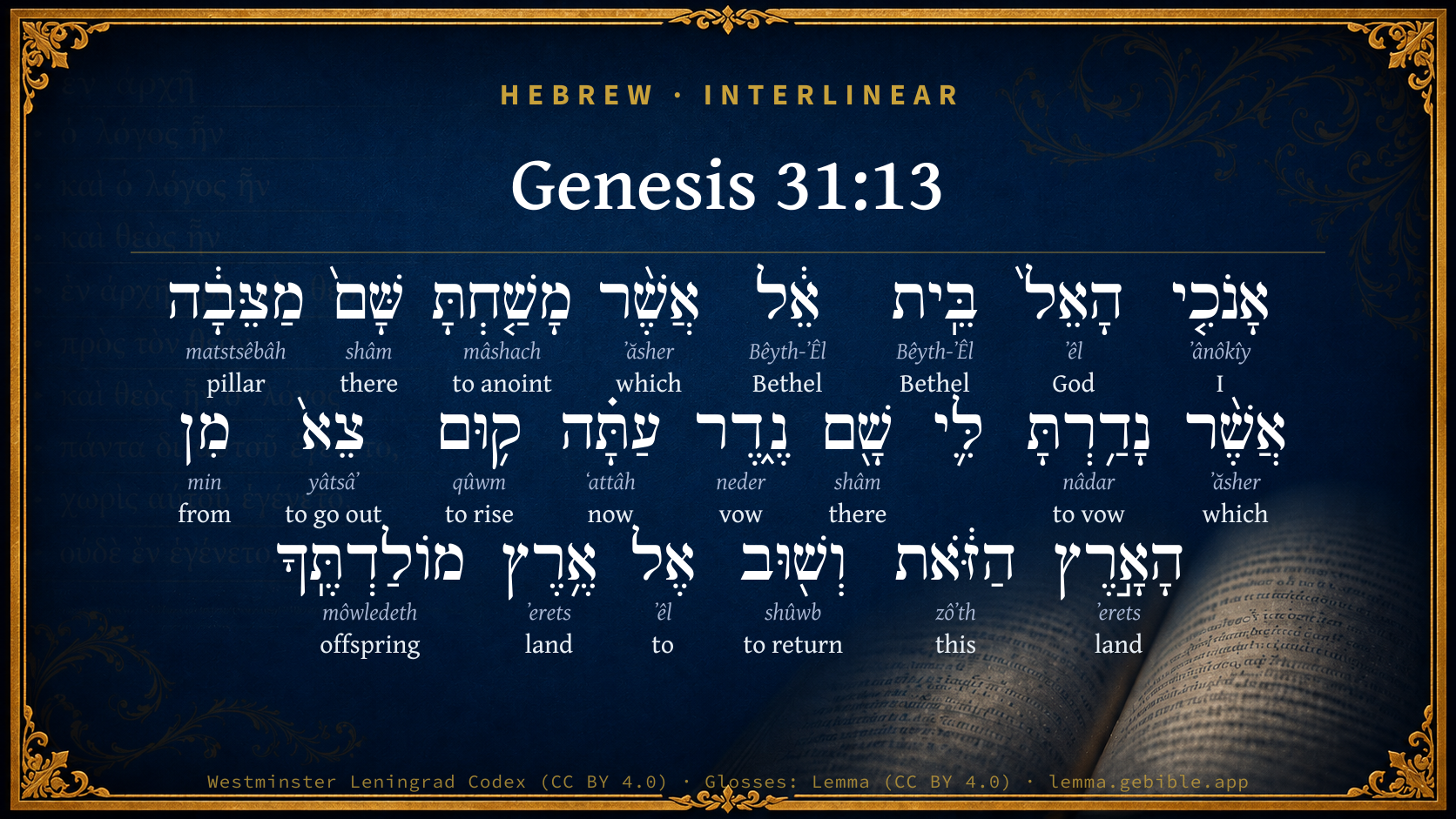
Hebrew (Westminster Leningrad Codex) Genesis 31:13 appears in the Hebrew Old Testament. The text above is from the Westminster Leningrad Codex. Each word links to its Strong’s number, a concise gloss, and parsing drawn from the Open Scriptures Hebrew Bible morphology. Click any word for its full Brown-Driver-Briggs (BDB) entry.
Download image
Cite this verse

Genesis 31:13 (World English Bible). Public Domain. Lemma interlinear Bible study tool, https://lemma.gebible.app/v/genesis/31/13.

Show BibTeX & RIS
BibTeX
RIS
English Translation
I am the God of Bethel, where you anointed a pillar, where you vowed a vow to me. Now arise, get out from this land, and return to the land of your birth."
World English Bible · Public Domain
Highlights Full analysis ↓
Download a study sheet

One document with this verse’s original text, its word-by-word gloss line, the meaning frame, cross-references with their text, attributed commentary, and full source and license credits — printable, and it pastes into notes with its structure intact.

This verse Autodidact and up

Study sheet (.html) Plain text (.txt)

A passage Seminary Student

Up to 50 verses in one chapter. A passage sheet keeps up to 6 commentary sources and 12 cross-references per verse, in the order this page ranks them, and says so on the sheet whenever that leaves anything out. Ask for a single verse and you get the Autodidact verse sheet above.

Everything on this page stays free to read, with no account — the sheet is a download of what is already on screen, not access to it.

Want to remove ads? Support Godless Engineer
Compare translations 3

The same verse in 3 English versions, stacked beneath the original-language interlinear above. Click any original word for its lexicon entry.

Each is an independent rendering of the whole verse — the interlinear is not word-aligned to these translations.

Highlighted words mark where these versions differ — a whole-verse word diff, not a word-by-word alignment.

  • World English Bible Public Domain
    I am the God of Bethel, where you anointed a pillar, where you vowed a vow to me. Now arise, get out from this land, and return to the land of your birth."
  • King James Version Public Domain
    I am the God of Bethel, where thou anointedst the pillar, and where thou vowedst a vow unto me: now arise, get thee out from this land, and return unto the land of thy kindred.
  • unfoldingWord Literal Text CC BY-SA 4.0
    I the God of Bethel, where you anointed a pillar, where you vowed a vow to me. Now get up, go out from this land, and return to the land of your birth.’”

unfoldingWord Literal Text — © unfoldingWord, licensed CC BY-SA 4.0. Word-aligned USFM3 via Door43 (git.door43.org/unfoldingWord/en_ult).

Versions to compare (up to 4)

3 of 4 selected

Show all 18 translations

Every available English version of this verse, each an independent rendering of the whole verse.

  • World English Bible Public Domain
    I am the God of Bethel, where you anointed a pillar, where you vowed a vow to me. Now arise, get out from this land, and return to the land of your birth."
  • Berean Standard Bible Public Domain
    I am the God of Bethel, where you anointed the pillar and made a solemn vow to Me. Now get up and leave this land at once, and return to your native land.’”
  • Majority Standard Bible Public Domain
    I am the God of Bethel, where you anointed the pillar and made a solemn vow to Me. Now get up, leave this land at once, and return to your native land.’”
  • King James Version Public Domain
    I am the God of Bethel, where thou anointedst the pillar, and where thou vowedst a vow unto me: now arise, get thee out from this land, and return unto the land of thy kindred.
  • American Standard Version (1901) Public Domain
    I am the God of Beth-el, where thou anointedst a pillar, where thou vowedst a vow unto me: now arise, get thee out from this land, and return unto the land of thy nativity.
  • Revised Version (1885) Public Domain
    I am the God of Beth-el, where thou anointedst a pillar, where thou vowedst a vow unto me: now arise, get thee out from this land, and return unto the land of thy nativity.
  • Geneva Bible (1599) Public Domain
    I am the God of Beth-el, where thou anoyntedst the pillar, where thou vowedst a vowe vnto me. Nowe arise, get thee out of this countrey and returne vnto ye land where thou wast borne.
  • Douay-Rheims (1899) Public Domain
    I am the God of Bethel, where thou didst anoint the stone, and make a vow to me. Now therefore arise, and go out of this land, and return into thy native country.
  • Young's Literal Translation Public Domain
    I `am' the God of Bethel where thou hast anointed a standing pillar, where thou hast vowed a vow to me; now, arise, go out from this land, and turn back unto the land of thy birth.'
  • Literal Standard Version CC BY-SA 4.0
    I [am] the God of Bethel where you have anointed a standing pillar, where you have vowed a vow to me; now, arise, go out from this land, and return to the land of your birth.”
  • Unlocked Literal Bible CC BY-SA 4.0
    I am the God of Bethel, where you anointed a pillar, where you made a vow to me. Now rise up and leave this land and return to the land of your birth.'”
  • unfoldingWord Literal Text CC BY-SA 4.0
    I the God of Bethel, where you anointed a pillar, where you vowed a vow to me. Now get up, go out from this land, and return to the land of your birth.’”
  • Darby Bible Public Domain
    I am the ùGod of Bethel, where thou anointedst the pillar, where thou vowedst a vow to me. Now arise, depart out of this land, and return to the land of thy kindred.
  • World Messianic Bible Public Domain
    I am the God of Bethel, where you anointed a pillar, where you vowed a vow to me. Now arise, get out from this land, and return to the land of your birth.’”
  • Webster's Bible Public Domain
    I am the God of Beth-el, where thou anointedst the pillar, and where thou vowedst to me a vow: now arise, depart from this land, and return to the land of thy kindred.
  • Free Bible Version CC BY-SA 4.0
    I am the God of Bethel, where you poured olive oil on the stone pillar and made a solemn promise to me. Now get ready to leave this land and go back to your homeland.’”
  • Bible in Basic English Public Domain
    I am the God of Beth-el, where you put oil on the pillar and took an oath to me: now then, come out of this land and go back to the country of your birth.
  • JPS Tanakh (1917) Public Domain
    I am the God of Beth-el, where thou didst anoint a pillar, where thou didst vow a vow unto Me. Now arise, get thee out from this land, and return unto the land of thy nativity.'

Literal Standard Version (2020), Covenant Press — licensed CC BY-SA 4.0. Text via the HelloAO Bible API (eBible.org). Unlocked Literal Bible (unfoldingWord) — licensed CC BY-SA 4.0. Text via the HelloAO Bible API (eBible.org). unfoldingWord Literal Text — © unfoldingWord, licensed CC BY-SA 4.0. Word-aligned USFM3 via Door43 (git.door43.org/unfoldingWord/en_ult). Free Bible Version, Dr. Jonathan Gallagher — licensed CC BY-SA 4.0. Text via the HelloAO Bible API (eBible.org).

Word by word

More ways to search: Search by grammar → Find every occurrence → Compare this word →

Practice this passage: Drill this verse → Learn its vocabulary →

מוֹלַדְתֶּֽךָ
môwledeth
H4138
“offspring · your”
Noun, Common, Feminine, Singular, Construct + Suffix, Personal, 2nd Person, Masculine, Singular
Part of Speech
Noun
Type
Common
Gender
Feminine
Number
Singular
State
Construct
Full BDB Definition

Origin: from H3205

TWOT: 867f

kindred, birth, offspring, relatives - kindred - birth, circumstances of birth - one born, begotten, issue, offspring, female offspring
  1. אָנֹכִ֤י ʼânôkîy H595 “I” Pronoun, Personal, 1st Person, Common, Singular
  2. הָאֵל֙ ʼêl H410 “the · God” Particle, Definite Article + Noun, Common, Masculine, Singular, Absolute
  3. בֵּֽית Bêyth-ʼÊl H1008 “Bethel” Noun, Proper
  4. אֵ֔ל Bêyth-ʼÊl H1008 “Bethel” Noun, Proper
  5. אֲשֶׁ֨ר ʼăsher H834 “which” Particle, Relative
  6. מָשַׁ֤חְתָּ mâshach H4886 “to anoint” Verb, Qal, Perfect, 2nd Person, Masculine, Singular
  7. שָּׁם֙ shâm H8033 “there” Adverb
  8. מַצֵּבָ֔ה matstsêbâh H4676 “pillar” Noun, Common, Feminine, Singular, Absolute
  9. אֲשֶׁ֨ר ʼăsher H834 “which” Particle, Relative
  10. נָדַ֥רְתָּ nâdar H5087 “to vow” Verb, Qal, Perfect, 2nd Person, Masculine, Singular
  11. שָׁ֖ם shâm H8033 “there” Adverb
  12. נֶ֑דֶר neder H5088 “vow” Noun, Common, Masculine, Singular, Absolute
  13. עַתָּ֗ה ʻattâh H6258 “now” Adverb
  14. ק֥וּם qûwm H6965 “rise” Verb, Qal, Imperative, 2nd Person, Masculine, Singular
  15. צֵא֙ yâtsâʼ H3318 “go out” Verb, Qal, Imperative, 2nd Person, Masculine, Singular
  16. מִן min H4480 “from” Preposition
  17. הָאָ֣רֶץ ʼerets H776 “the · land” Particle, Definite Article + Noun, Common, Both, Singular, Absolute
  18. הַזֹּ֔את zôʼth H2063 “the · this” Particle, Definite Article + Pronoun, Demonstrative, Feminine, Singular
  19. וְשׁ֖וּב shûwb H7725 “and · return” Conjunction + Verb, Qal, Imperative, 2nd Person, Masculine, Singular
  20. אֶל ʼêl H413 “to” Preposition
  21. אֶ֥רֶץ ʼerets H776 “land of” Noun, Common, Both, Singular, Construct

About this verse

These counts appear in no published source. They are computed here, from the morphology-tagged text and Lemma’s own curated glosses. What Lemma adds →

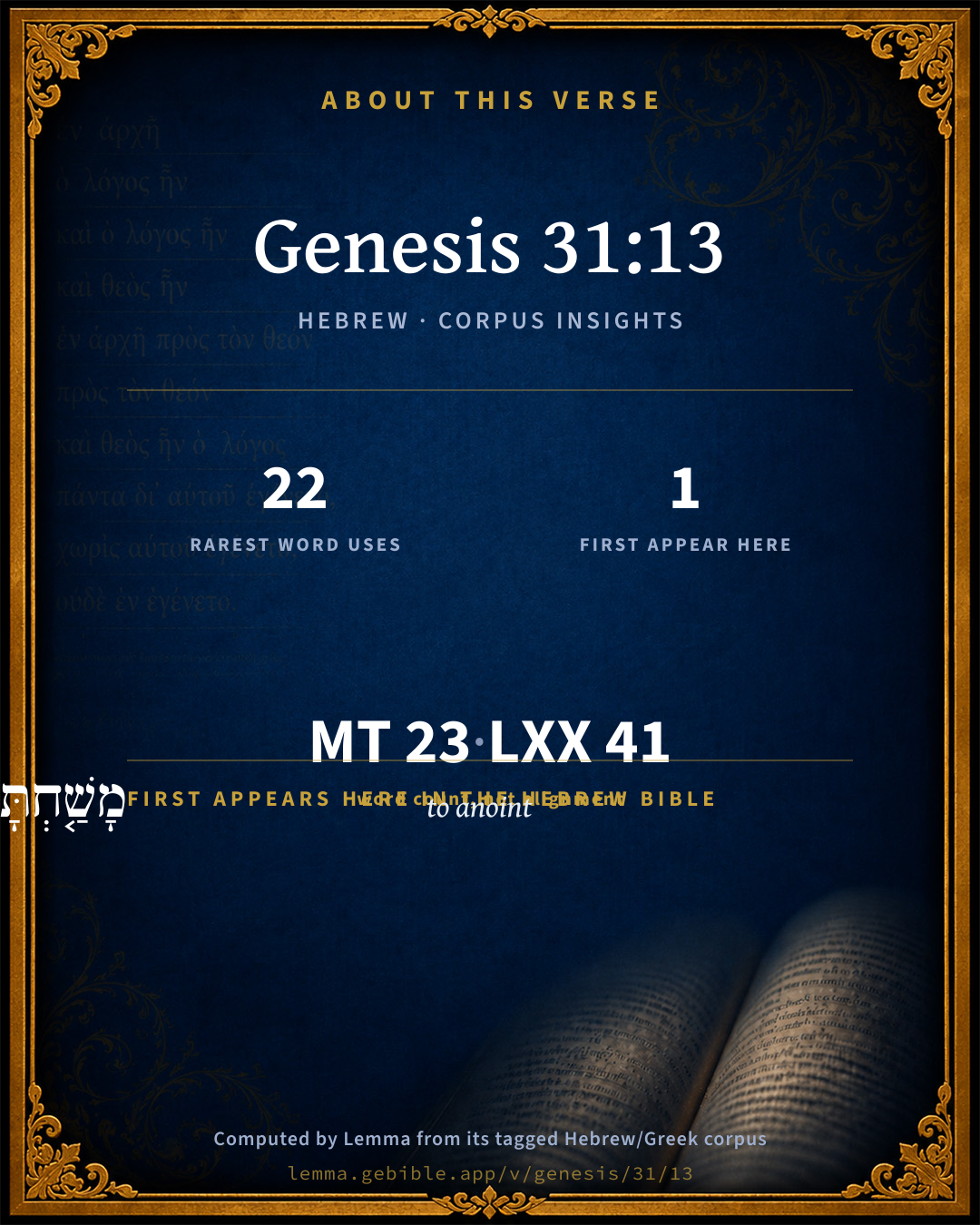
23
words
18
distinct lemmas
Pentateuch
section

Notable vocabulary

The rarest word here is מוֹלַדְתֶּֽךָ offspring H4138 — appearing just 22 times in the whole Hebrew Bible.

First appearance in Scripture

This word makes its first canonical appearance in the Hebrew Bible here:

  • מָשַׁ֤חְתָּ to anoint H4886

Shared distinctive vocabulary

מוֹלַדְתֶּֽךָ offspring H4138 occurs in 21 verses of the Hebrew Bible. Also found in:

Grammatical profile

  • 5 verbs
  • 8 nouns
  • 2 pronouns
  • 3 prepositions
  • 3 adverbs
  • 2 particles

Verb forms

  • מָשַׁ֤חְתָּ Qal · Perfect
  • נָדַ֥רְתָּ Qal · Perfect
  • ק֥וּם Qal · Imperative
  • צֵא֙ Qal · Imperative
  • וְשׁ֖וּב Qal · Imperative

Repetition

Words recur within this verse — often emphatic in Hebrew:

  • בֵּֽית Bethel H1008 ×2
  • שָּׁם֙ there H8033 ×2
  • הָאָ֣רֶץ land H776 ×2
  • אֲשֶׁ֨ר which H834 ×2

Hebrew & Septuagint length

In English translation the verse runs 33 words from the Hebrew and 48 from the Septuagint (LXX English) — the Septuagint runs noticeably longer here. See the side-by-side →

A rough comparison of the two English renderings, which tokenize alike — not a word-level alignment.

Word counts can differ between the Hebrew and the Greek without any difference in meaning — e.g. the Hebrew direct-object marker אֵת has no separate Greek word, and Greek often adds the article ὁ.

In the original languages it is 23 Hebrew tokens and 41 Greek tokens — but the two are counted differently (Hebrew bundles its prefixes and suffixes into one token; the Greek is in lemma form), so that isn’t a like-for-like length.

Cross-references

4

Topical passages linked to Genesis 31:13 in the Treasury of Scripture Knowledge — connected by theme and wording, ordered by reader-vote popularity; previews shown in the World English Bible.

  • Genesis 31:3 Yahweh said to Jacob, "Return to the land of your fathers, and to your relatives, and I will be with you."
  • Genesis 32:9 Jacob said, "God of my father Abraham, and God of my father Isaac, Yahweh, who said to me, 'Return to your country, and to your relatives, and I will do you good.'
  • Genesis 28:12–22 He dreamed. Behold, a stairway set up on the earth, and the top of it reached to heaven. Behold, the angels of God ascending and descending on it.
  • Genesis 35:7 He built an altar there, and called the place El Beth El; because there God was revealed to him, when he fled from the face of his brother.

Cross-references courtesy of OpenBible.info (CC BY 4.0).

Hebrew and Greek witnesses Masoretic Hebrew ↔ Greek Septuagint

The same verse in the two great witnesses to the Old Testament, shown verse-for-verse.

Here the Septuagint runs noticeably longer than the Hebrew — LXX2012 (modern English Septuagint) 48 words vs World English Bible 33. A rough length comparison of the two English translations, not a word-level alignment — read both below.

These are two independent witnesses, not word-aligned to each other, and the Septuagint is shown in lemma (dictionary) form.

Hebrew Genesis 31:13 Masoretic · Westminster Leningrad Codex

אָנֹכִ֤י הָאֵל֙ בֵּֽית אֵ֔ל אֲשֶׁ֨ר מָשַׁ֤חְתָּ שָּׁם֙ מַצֵּבָ֔ה אֲשֶׁ֨ר נָדַ֥רְתָּ לִּ֛י שָׁ֖ם נֶ֑דֶר עַתָּ֗ה ק֥וּם צֵא֙ מִן הָאָ֣רֶץ הַזֹּ֔את וְשׁ֖וּב אֶל אֶ֥רֶץ מוֹלַדְתֶּֽךָ

I am the God of Bethel, where you anointed a pillar, where you vowed a vow to me. Now arise, get out from this land, and return to the land of your birth."

World English Bible · Public Domain

Greek LXX Genesis 31:13 Septuagint · lemma form

ἐγώ εἰμί ὁ θεός ὁ ὁράω σύ ἐν τόπος θεός οὗ ἀλείφω ἐγώ ἐκεῖ στήλη καί εὔχομαι ἐγώ ἐκεῖ εὐχή νῦν οὖν ἀναἵστημι καί ἐκἔρχομαι ἐκ ὁ γῆ οὗτος καί ἀποἔρχομαι εἰς ὁ γῆ ὁ γένεσις σύ καί εἰμί μετά σύ

I am God that appeared to you in the place of God where you anointed a pillar to me, and vowed to me there a vow; now then arise and depart out of this land, depart into the land of your nativity, and I will be with you.

LXX2012 (modern English Septuagint) · Public Domain

On this verse, The Cambridge Bible for Schools and Colleges discusses the Septuagint’s reading. Read the note in Commentary ↓

Hebrew: Westminster Leningrad Codex (CC BY 4.0). Greek: Septuagint (public domain); English from LXX2012 (modern English Septuagint) (Public Domain). How the Septuagint differs from the Hebrew →

Targum (Aramaic paraphrase)

2

The Targum is the ancient Jewish Aramaic paraphrase of the Hebrew Scriptures — an interpretive translation, not the Hebrew text itself. Onkelos (literal) and Pseudo-Jonathan (expansive) render the Torah, and Jonathan the Prophets. Coverage is partial: where no permissively-licensed English translation exists for a verse, only the Aramaic is shown. This is verse-level text, not a word-by-word alignment to the Hebrew.

  1. Targum Onkelos Torah (Genesis–Deuteronomy)
    אֲנָא אֱלָהָא דְּאִתְגְּלֵיתִי עֲלָךְ בְּבֵית אֵל דִּי מְשַׁחְתָּא תַמָּן קָמָא דִּי קַיִּמְתָּא קֳדָמַי תַּמָּן קְיָם כְּעַן קוּם פּוּק מִן אַרְעָא הָדָא וְתוּב לְאַרְעָא יַלָּדוּתָךְ

    (no public-domain English translation for this verse)

    Targum Onkelos — Aramaic: “Onkelos Genesis” (public domain); “Onkelos Exodus” (public domain); “Onkelos Leviticus” (public domain); “Onkelos Numbers” (public domain); “Onkelos Deuteronomy” (public domain). English: “Sefaria Community Translation” (CC0 1.0 (public-domain dedication)); “J.W. Etheridge. The Targums of Onkelos and Jonathan Ben Uzziel on the Pentateuch. London: Longmans, Green, 1862” (public domain). Text via Sefaria.

  2. Targum Pseudo-Jonathan Torah (Genesis–Deuteronomy)
    אֲנָא הוּא אֱלָהָא דְאִתְגְלֵיתִי עֲלָךְ בְּבֵית אֵל דִי רִיבִיתָא תַּמָן קָמָא דְקַיְימִית קֳדָמַי תַּמָן קְיַים כְּדוּן קוּם פּוּק מִן אַרְעָא הָדָא וְתוּב לְאַרַע יַלְדוּתָךְ

    I am Eloha who did reveal Myself to thee at Beth El where thou didst anoint the pillar, and swear the oath before Me. Arise now, go forth from this land, and return to the land of thy birth.

    Targum Pseudo-Jonathan — Aramaic: “Targum Jonathan on Genesis” (public domain); “Targum Jonathan on Exodus” (public domain); “Targum Jonathan on Leviticus” (public domain); “Targum Jonathan on Numbers” (public domain); “Targum Jonathan on Deuteronomy” (public domain). English: “The Targum of Jonathan ben Uzziel, trans. J. W. Etheridge, London, 1862” (public domain). Text via Sefaria.

Commentary

Notes on Genesis 31:13 from classic Christian and Jewish commentators (each source and its license shown beneath its notes). The classic Christian expositions comment on the surrounding passage and are grouped to its opening verse, so a note may address several verses; the Jewish commentaries on the Tanakh (Rashi and others) are per-verse, so they appear only where the commentator wrote on this verse.

Lemma curates 59 commentaries, every one of them public domain or Creative Commons licensed, each selected and text-cleaned for this edition rather than reprinted as found. About our sources →

Trapp's Complete Commentary

John Trapp

Gen 31:13 I [am] the God of Bethel, where thou anointedst the pillar, [and] where thou vowedst a vow unto me: now arise, get thee out from this land, and return unto the land of thy kindred.

Ver. 13. I am the God of Bethel, &c.] Here God pulls Jacob by the ear, as it were, and reminds him of his vow which he had well nigh forgotten. But the Lord looked for a performance, and afterward punished him for his slackness. Most men’s practice proclaims, that having escaped the danger, they would willingly deceive the saint. {a} And of those that vow against sin, how many have we, who, when temptations, like strong Philistines, are upon them, break all bonds of God, whereby foul breaches are made into their consciences, such as nothing can cure, but the blood of that great votary, that Nazarite, Christ Jesus. Vows are solemn services; and they have much to answer for that care not either to make or keep them; that dally and play with them, as children do with nuts and beads. When the cardinals meet to choose a pope, they make a vow, Whosoever is chosen, he shall swear to such articles as they make. And Sleidan {b} saith, The pope is no sooner chosen, but he breaks them all, and checks their insolences; as if they went about to limit his power, to whom all power is given, both in heaven and earth. Is not this pretty collusion? But "God is the avenger of all such."

{a} Sciapato il morbo, fraudato il Santo .

{b} Sleid., Comm.

John Trapp, A Commentary or Exposition upon All the Books of the Old and New Testament (1647–1656) — public domain. Text from a community e-Sword module.

The Biblical Illustrator

Joseph S. Exell

Gen_31:13

I am the God of Bethel

The God of Bethel

I.

THE GOD OF BETHED IS A GOD OF PROVIDENCE, of a special gracious Providence towards His people; and of this as exercised through a Mediator, by the ministry of angels.

1. He is the God of Providence, extending to all the creatures He has made. God did not make the world, and then leave it, confining Himself to heaven, as some would have Him. Though His throne be above, His kingdom ruleth over all. He is no unconcerned spectator of what is done; but like a skilful pilot sits at the helm, and steers the world to what course it shall move. His providence is often mysterious, but nevertheless real and universal.

2. God exercises a special gracious providence about His servants. God has a regard to all the works of His hands; but it is spoken with an emphasis, Behold the eye of the Lord is upon them that fear Him, upon them that hope in His mercy. Upon every one of this number His eye is fixed with satisfaction and delight.

3. God employs His angels as the ministers of His providence in the world, particularly as to His people. Not that God needs the agency of any of His creatures, but for the honour of His majesty He is pleased to use them.

II. THE GOD OF BETHEL IS THE GOD OF PROMISE. And as it is here declared by Himself, I am the God of Bethel, it plainly denotes--

1. That He takes delight in the promises He hath made to His people, and the covenant engagements in which He stands to them.

2. These words, I am the God of Bethel, being spoken twenty years after the promises and appearances there, were first made, God intimated by them, that He was the same now as heretofore; as able to guide and guard, as formerly.

3. God proclaims this to tell His servant that all the mercies he enjoyed came from His hand and love, as his God in covenant; and that under this notion, he was still to look to Him for all he should further need.

III. At Bethel Jacob vowed a vow, which was in confirmation of his covenant with God: and so Gods styling Himself the God of Bethel denotes in general that HE TAKES SPECIAL NOTICE OF THE SOLEMN TRANSACTIONS OF HIS SERVANTS, what promises and vows they make to Him and where. Particularly He is the God of Bethel, i.e., of His house, of every place appointed for His worship, as observing who there vow and dedicate themselves to Him, and who do not; in what manner any vow unto Him, whether in truth and with the heart, or deceitfully and with guile. God cannot be ignorant of what is done, and where; but He would be considered as particularly observing what passes at Bethel, i.e., in His hoarse, and at His table there, now under these New Testament ages.

1. God takes notice who tarries away from His house that ought to be there; and He takes notice too, in what dress every individual comes thither.

2. God is the God of Bethel, as approving His peoples dedicating themselves by vow, in confirmation of their covenant to Him. This is their reasonable service, and what His promises and grace should readily lead them to.

3. God is the God of Bethel, as He is ready to reward His servants who make conscience of keeping their engagements, and walk in a sense of the vows of God upon their souls.

IV. And now as THE USE of all.

1. How desirable is a special relation to the God of Bethel, as the God of Providence, and of this as in a peculiar manner exercised about His people.

2. As the God of Bethel is ever mindful of His promises, His people can never want encouragement to come to His throne of grace.

3. Does God style Himself the God of Bethel, as denoting His strict observance of what passes in His house? What seriousness becomes us in all religious duties and services, or when, in a way of worship, we have to do with God?

4. Is the God of Bethel to be conceived of, as a witness to all our solemn transactions and engagements? how great must be the sin and folly of being formal and insincere in vowing to the Lord, or in pretending, either to enter into or confirm our covenant with Him, when leaving our hearts behind?

5. Does God as the God of Bethel remember the vows there made, with what confusion will they appear before Him who have omitted to perform their promises? (D. Wilson.)

The God of Bethel

I am the God of Bethel! When at Bethel, the Lord said, I am Jehovah, God of Abraham thy father, and the God of Isaac. He might have said the same now; but it was His pleasure to direct the attention of His servant to the last, and to Him the most interesting of His manifestations. By giving him hold of the last link in the chain, he would be in possession of the whole. The God of Bethel was the God of his fathers, Abraham and Isaac; the God who had entered into covenant with the former, had renewed it with the latter, and again renewed it with him. What satisfaction must it afford, to be directed by such a God! (A. Fuller.)

Gods reminders

I am the God of Bethel, where thou anointedst the pillar, and vowedst a vow unto Me. It is not only necessary that we be reminded of Gods promises for our support in troubles, but of our own solemn engagements, that the same affections which distinguished the best seasons of our life may be renewed, and that in all our movements we may keep in view the end for which we live. The object of the vow was, that Jehovah should be his God: and whenever he should return, that that stone should be Gods house. And now that the Lord commands him to return, He reminds him of his vow. He must not go to Canaan with a view to promote his own temporal interest, but to introduce the knowledge and worship of the true God. This was the great end which Jehovah had in view in all that He did for Abrahams posterity, and they must never lose sight of it. (A. Fuller.)

Lessons

1. God sets Himself out to His saints distinctly and eminently from the misconceits of Him by nations.

2. God is the God of Bethel to His Jacobs, of sweet providences and precious promises to His saints.

3. Gods providence and promise may justly cause souls to dedicate and vow themselves to Him.

4. Souls devoting of themselves to God, engageth them to follow Him at this call.

5. God is forced to put His saints in mind of their engagement sometimes before they think of 2:6. Gods call alone is the just ground of the egress and regress of His servants, for blessing, and with 2:7. God will surely call in His set time to His saints for their returning to the place of rest.

8. Preparation and execution to go where God calleth, is due from saints to the call of God (Gen_2:13). (G. Hughes, B. D.)

The God of Bethel

I. Does not that mean, first, that our God is the God of our early mercies 2 Bethel was to Jacob the place of early mercy. Let us look back upon our early mercies. Did they not come to us, as they did to him, unsought and unexpected, and when, perhaps, we were unprepared for them?

II. Does it not mean, the God of our Lord Jesus Christ? What is Beth-el but the house of God. And the house of God, the true Bethel, is the person of the Lord Jesus Christ, for In Him dwelleth all the fulness of the Godhead bodily.

III. Still further let us remember that this God of Bethel is the God of angels. We do not often say much about those mysterious beings, for it is but little that we know of them. This, however, we know--that angels are set by God to be the watchers over His people. We shall not come to harm if we put our trust in God. I will lay me down to sleep, for Thou makest me to dwell in safety. These angels were also messengers. Are they not all ministering spirits? and are they not sent with messages from God? Moreover, they are our protectors. God employs them to bear us up in their hands, lest at any time we dash our foot against a stone. We do not see them, but unseen agencies are probably the strongest agencies in the world.

IV. Notice, once more, that the God of Bethel is the God of our vows. (C. H.Spurgeon.)

The Biblical Illustrator, edited by Joseph S. Exell (c. 1880s–1900s) — public domain. Text from a community e-Sword module.

Geneva Bible (1599)

Geneva Bible translators

This Angel was Christ which appeared to Jacob in Bethel: and hereby appeareth he had taught his wives the fear of God: for he talketh as though they knew this thing.

Geneva Bible (1599) marginal notes — public domain. Text via Bolls.life.

John Calvin's Commentaries

13. I am the God of Beth-el. It is not wonderful that the angel should assume the person of God: either because God the Father appeared to the holy patriarchs in his own Word, as in a lively mirror, and that under the form of an angel; or because angels, speaking by the command of God, rightly utter their words, as from his mouth. For the prophets are accustomed to this form of speaking; not that they may exalt themselves into the place of God; but only that the majesty of God, whose ministers they are, may shine forth in his message. Now, it is proper that we should more carefully consider the force of this form of expression. He does not call himself the God of Bethel, because he is confined within the limits of a given place, but for the purpose of renewing to his servant the remembrance of his own promise; for holy Jacob had not yet attained to that degree of perfection which rendered the more simple rudiments unnecessary for him. But little light of true doctrine at that time prevailed; and even that was wrapped in many shadows. Nearly the whole world had apostatized to false gods; and that region, nay, even the house of his father-in-law, was filled with unholy superstitions. Therefore, amid so many hindrances, nothing was more difficult for him than to hold his faith in the one true God firm and invincible. Wherefore, in the first place, pure religion is commended to him, in order that, among the various errors of the world, he may adhere to the obedience and worship of that God whom he had once known. Secondly; the promise which he had before received is anew confirmed to him, in order that he may always keep his mind fixed on the special covenant which God had made with Abraham and his posterity. Thus he is directed to the land of Canaan, which was his own inheritance; lest the temporal blessing of God, which he was soon to enjoy, should detain his heart in Mesopotamia. For since this oracle was only an appendix of the previous one, whatever benefits God afterwards bestowed ought to be referred to that first design. We may also conjecture from this passage, that Jacob had before preached to his household concerning the true God and the true religion, as became a pious father of his family. For he would have acted absurdly in uttering this discourse, unless his wives had been previously instructed respecting that wonderful vision. To the same point belongs what he had said before, that the God of his father had brought him assistance. For it is just as if he would openly distinguish the God whom he worshipped from the god of Laban. And now, because he holds familiar discourse with his wives, as on subjects which they know, the conjecture is probable, that it was not Jacob’s fault if they were not imbued with the knowledge of the one God, and with sincere piety. Further, by this oracle the Lord declared that he is always mindful of the godly, even when they seem to be cast down and deserted. For who would not have said that the outcast Jacob was now deprived of all celestial help? And truly the Lord appears to him late; but beyond all expectation shows, that he had never been forgetful of him. Let the faithful, also, at this day, feel that he is the same towards them; and if, in any way, the wicked tyrannically oppress them by unjust violence, let them bear it patiently, until at length, in due time, he shall avenge them.

John Calvin's Commentaries (1540-1563) — public domain. Text from the Calvin Translation Society English edition (1840s-50s) via the Christian Classics Ethereal Library (ccel.org). Calvin's coverage is partial (roughly two-thirds of the Bible); uncommented books and verses are honest gaps, never fabricated. The 19th-century editor's footnotes and remarks are omitted so the notes are faithfully Calvin's own voice.

Ellicott's Commentary for English Readers

(13) I am the God of Beth-el.—The angel of Elohim (Gen_31:11) was the speaker, but the words were those of God (1Th_2:13; Heb_1:1). With this verse compare Gen_28:13.

A Bible Commentary for English Readers, edited by Charles John Ellicott (1878–1897) — public domain. Text from a community e-Sword module.

The Cambridge Bible for Schools and Colleges

gen. ed. J. J. S. Perowne

13. the God of Beth-el] i.e. the God who appeared unto thee at Beth-el; see Gen_35:7. For the mention of the pillar and the vow, see Gen_28:18-22. By the words “I am the God of Beth-el,” the Angel is shewn to be not a created angel, but Jehovah Himself in a manifested form; cf. Exo_23:20-21, “Behold, I send an angel before thee … my name is in him.” See notes on Gen_16:10, Gen_21:17-18, Gen_22:11-12. The Hebrew text is ungrammatical: LXX ὁ θεὸς ὁ ὀφθείς σοι ἐν τόπῳ θεοῦ.

The Cambridge Bible for Schools and Colleges (gen. ed. J. J. S. Perowne; Cambridge University Press, 1878–1918) — public domain. Text from a community e-Sword module.

John Gill's Exposition

And Rachel and Leah answered and said unto him,.... One after another, and their answers agreeing, are put together; it may be Rachel answered in the name of Leah, and for herself, since she is mentioned first, and the verb is singular. The Targum of Jonathan is, Rachel answered with the consent of Leah:

is there yet any portion or inheritance for us in our father's house? it was what might have been justly expected, as they were his children, that they should have been used as such, and have had children's portions given them; but by the whole of Laban's attitude towards them, both at their marriage, and ever since, it was plain he never intended to give them anything; but kept all he had to himself, or designed it for his sons, and therefore it was in vain for them to hope for anything; signifying to Jacob hereby, that they were willing to leave their father's house, and go with him when he pleased, since they could expect nothing by their stay here.

John Gill's Exposition of the Whole Bible (1746–1763) — public domain (CC PDM 1.0). Text via the HelloAO Bible API.

Matthew Poole's English Annotations

Where thou vowedst a vow unto me; of which see Gen 28:19,20. And this God here mentions to show his acceptance of that action of Jacob’s, his mindfulness even of the past and forgotten services of his people, and his purpose now to fulfil the promise there made to him.

Matthew Poole's English Annotations on the Holy Bible (1683–1685) — public domain. Text from a community e-Sword/MySword module.

Whedon's Commentary on the Bible

Daniel D. Whedon

13. I am the God of Beth-el — See Gen_28:12-22. The revelations and promises of Jacob’s dream at Beth-el were incompatible with his remaining permanently in Haran, and it was now time for him to get himself away. Keil argues that this dream was largely the work of Jacob’s excited imagination, “the materials being supplied by the three thoughts that were most frequently in his mind, by night as well as by day, namely: 1) His own schemes and their success; 2) The promise received at Beth-el, 3) The wish to justify his actions to his own conscience.” No doubt absorbing thoughts and schemes, united with strong desires to succeed, may furnish the proper physical conditions for dreams like this of Jacob; but it seems entirely superfluous to insinuate such a suspicion of the objective reality of the angel’s words to Jacob. If we allow such an exposition here, we introduce a principle of hermeneutics that would as easily make against the reality of other recorded revelations. Jacob had natural reason to withhold from his wives his own artifices, but we can scarcely believe that he tells a falsehood in respect to this dream. As in all the wrong actions of his life God overruled and wrought good out of evil, so in this.

Daniel D. Whedon (gen. ed.), Commentary on the Old and New Testaments (1874–1909) — public domain. Text from a community e-Sword module.

The Pulpit Commentary

I am the God of Bethel, the angel here identifies himself with Jehovah. (vide Gen_28:13) Contrary to usual custom, laeh; though in the construct, state, has the art. (vide Ewald, "Hebrews Synt.," where thou anointedst the pillar, and where thou vowedst a vow unto me: now arise, get thee out from this land, and return unto the land of thy kindredi.e. to the land of Canaan, which was Jacob"s true inheritance.

The Pulpit Commentary (1880–1919), ed. H.D.M. Spence-Jones & Joseph S. Exell — public domain. Text from a community e-Sword module.

Rashi

Rabbi Shlomo Yitzchaki (Rashi)

האל בית אל is the same as אל בית אל the ה of האל being redundant. It is customary for Scripture to speak thus, e. g. (Numbers 34:2) “When ye come into the land of Canaan הארץ כנען (instead of ארץ כנען).

משחת שם WHERE THOU ANOINTEDST [A PILLAR] — This denotes distinction and eminence just as when one is anointed king one is raised to eminence: thus, too (Genesis 28:18) “and he poured oil upon the top of it (the stone)” that it might be anointed to be an altar (thus being distinguished among other stones).

אשר נדרת לי WHERE THOU VOWEDST A VOW UNTO ME —and you are bound to fulfill it, for you said (Genesis 28:22) “it shall be God’s house”, signifying that you would offer sacrifice there.

Rashi on the Tanakh — English translations: “The Judaica Press complete Tanach with Rashi, translated by A. J. Rosenberg” (CC BY 4.0); “Pentateuch with Rashi's commentary by M. Rosenbaum and A.M. Silbermann, 1929-1934” (public domain); “The Metsudah Tanach series, Lakewood, N.J” (CC BY 4.0); and “The Book of Joshua, Metsudah Publications, 1997” (CC BY 4.0). Text via Sefaria.

Ramban (Nachmanides)

Rabbi Moshe ben Nachman (Ramban / Nachmanides)

I AM THE G-D OF BETH-EL. Jacob related to his wives all that G-d’s angel had told him in the dream, all this serving to persuade them to go with him. However, what he told did not consist of one dream. The statement, Lift up now thine eyes, and see, all the he-goats was made to him when he served Laban for his flock, at the time the flock conceived in one of the first years. The statement, I am the G-d of Beth-el was made to him after that, at the time of the journey, for after He said to him, Now arise, get thee out from this land, he no longer remained in Haran to further tend Laban’s flocks so that the he-goats would mount the flocks and the flocks would give birth to speckled and spotted. But on the morrow of the dream, he sent for Rachel and Leah and told them his dream, and they left Haran.I am ‘ha’e-il’ (the G-d) of Beth-el. The meaning thereof is, as Rashi explained it, that the letter hei in ha’e-il is redundant and is the same as if it were written: “I am e-il Beth-el (the G-d of Beth-el).” Similarly, To ‘ha’aretz’ (the land) of Canaan; [the hei is redundant and is the same as if it were written: “to eretz Canaan (the land of Canaan).”] Grammarians adjusted it by saying that it is as if it were written, “I am the G-d, who is the G-d of Beth-el.” Similarly, And the tree of the knowledge of good and evil, [which is as if it said: “and the tree of the knowledge, namely the knowledge of good and evil”]; the cords of gold, [which is as if it said, “the cords, which are cords of gold]. And the angel here speaks in the name of He Who sent him, [therefore, he speaks in the first person and says, “I am, etc.”] ….

WHERE THOU DIDST ANOINT A PILLAR, WHERE THOU DIDST VOW A VOW UNTO ME. The meaning thereof is that “you have vowed to worship the Proper Name of the Eternal in the Chosen Land, and that this stone should be to you a house of G-d in which to set aside your tithes, and if you further delay the fulfillment of your vows, G-d might yet be angry at your voice.”

Ramban (Nachmanides) on the Tanakh — English translation: “Commentary on the Torah by Ramban (Nachmanides). Translated and annotated by Charles B. Chavel. New York, Shilo Pub. House, 1971-1976” (CC BY 4.0). Text via Sefaria.

Radak

Rabbi David Kimhi (Radak)

אנכי הא-ל בית א-ל, the noun to which the word בית א-ל is attached is absent, i.e. the line should have been:אנכי הא-ל א-ל בית א-ל. We have a similar construction in Joshua 3,14 הארון הברית, where the word ארון in the middle in the construct mode is also missing. In our verse the meaning of the whole line is: “I am the Lord that has revealed Himself to you as G’d at Beyt El.”

אשר נדרת לי, we already explained that when the angel speaks as messenger of G’d he describes himself by the name applicable to his Master, i.e. to G’d.

Radak on the Tanakh — English translations: “Sefaria Community Translation” (CC0 1.0 (public-domain dedication)); “Eliyahu Munk, HaChut Hameshulash” (CC BY 4.0); “Rabbi Mike Feuer, Jerusalem Anthology” (CC BY 4.0); and “R. David Kimhi on the first book of Psalms, Translated by R.G. Finch, London, 1919” (public domain). Text via Sefaria.

Lesson kit

Teaching starters — assembled from the data on this page, not authored interpretation. Every prompt links to the verse data it draws on. Edit before teaching.

Genesis, in the Pentateuch, opens this verse with 23 words (18 distinct Hebrew lemmas). Its most distinctive word is môwledeth (“offspring”). The Greek Septuagint runs longer here. A historical commentator’s framing appears above. Read the whole chapter for the surrounding context.

Discussion questions

  1. How does “offspring” (môwledeth) shape what this verse is saying?
  2. The word “to anoint” first appears here in Scripture. What is being introduced at this debut?
  3. Genesis 11:28 shares the word «offspring» with this verse. How do the two illuminate each other?
  4. “Bethel” occurs 2× in this one verse. What is the effect of the repetition?
  5. Compared with the Hebrew, the Septuagint runs longer here. What questions does that raise?
  6. The translations on this page render this verse differently — a whole-verse word diff, not a word-by-word alignment. What might account for the different wordings?
  7. The verb «מָשַׁ֤חְתָּ» is Qal Perfect. How does its form color the action?
  8. Reading how Trapp's Complete Commentary and The Biblical Illustrator read this verse, where do the two commentators agree and where do they part?

Things to notice

Reading settings

Reading text

Shown beneath each verse's original-language words.

Old Testament
Old Testament edition

Read the OT as the Masoretic Hebrew (MT) or the Greek Septuagint (LXX).

English shown for the Greek Septuagint (in the Hebrew ↔ Greek comparison).

Comparing translations? Open the Compare panel on any verse page to stack up to four side by side.