
Genesis 8:16

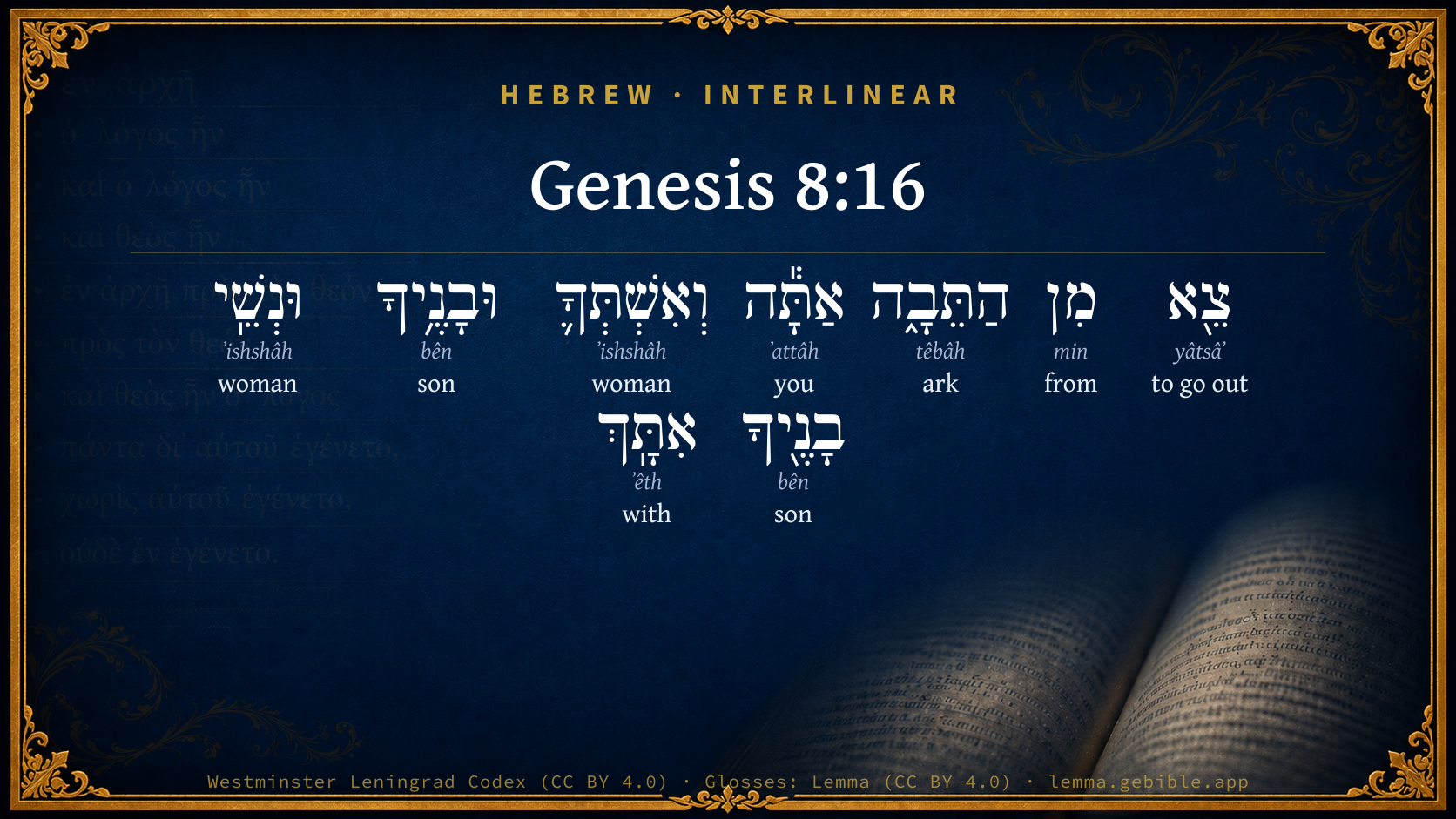
Hebrew (Westminster Leningrad Codex) Genesis 8:16 appears in the Hebrew Old Testament. The text above is from the Westminster Leningrad Codex. Each word links to its Strong’s number, a concise gloss, and parsing drawn from the Open Scriptures Hebrew Bible morphology. Click any word for its full Brown-Driver-Briggs (BDB) entry.
Download image
Cite this verse

Genesis 8:16 (World English Bible). Public Domain. Lemma interlinear Bible study tool, https://lemma.gebible.app/v/genesis/8/16.

Show BibTeX & RIS
BibTeX
RIS
English Translation
"Go forth from the ark, you, and your wife, and your sons, and your sons' wives with you.
World English Bible · Public Domain
Download a study sheet

One document with this verse’s original text, its word-by-word gloss line, the meaning frame, cross-references with their text, attributed commentary, and full source and license credits — printable, and it pastes into notes with its structure intact.

This verse Autodidact and up

Study sheet (.html) Plain text (.txt)

A passage Seminary Student

Up to 50 verses in one chapter. A passage sheet keeps up to 6 commentary sources and 12 cross-references per verse, in the order this page ranks them, and says so on the sheet whenever that leaves anything out. Ask for a single verse and you get the Autodidact verse sheet above.

Everything on this page stays free to read, with no account — the sheet is a download of what is already on screen, not access to it.

Want to remove ads? Support Godless Engineer
Compare translations 3

The same verse in 3 English versions, stacked beneath the original-language interlinear above. Click any original word for its lexicon entry.

Each is an independent rendering of the whole verse — the interlinear is not word-aligned to these translations.

Highlighted words mark where these versions differ — a whole-verse word diff, not a word-by-word alignment.

  • World English Bible Public Domain
    "Go forth from the ark, you, and your wife, and your sons, and your sons' wives with you.
  • King James Version Public Domain
    Go forth of the ark, thou, and thy wife, and thy sons, and thy sons' wives with thee.
  • unfoldingWord Literal Text CC BY-SA 4.0
    “Go out of the ark, you and your wife and your sons and the wives of your sons with you.

unfoldingWord Literal Text — © unfoldingWord, licensed CC BY-SA 4.0. Word-aligned USFM3 via Door43 (git.door43.org/unfoldingWord/en_ult).

Versions to compare (up to 4)

3 of 4 selected

Show all 18 translations

Every available English version of this verse, each an independent rendering of the whole verse.

  • World English Bible Public Domain
    "Go forth from the ark, you, and your wife, and your sons, and your sons' wives with you.
  • Berean Standard Bible Public Domain
    “Come out of the ark, you and your wife, along with your sons and their wives.
  • Majority Standard Bible Public Domain
    “Come out of the ark, you and your wife, along with your sons and their wives.
  • King James Version Public Domain
    Go forth of the ark, thou, and thy wife, and thy sons, and thy sons' wives with thee.
  • American Standard Version (1901) Public Domain
    Go forth from the ark, thou, and thy wife, and thy sons, and thy sons' wives with thee.
  • Revised Version (1885) Public Domain
    Go forth of the ark, thou, and thy wife, and thy sons, and thy sons’ wives with thee.
  • Geneva Bible (1599) Public Domain
    Goe forth of the Arke, thou and thy wife, and thy sonnes and thy sonnes wiues with thee.
  • Douay-Rheims (1899) Public Domain
    Go out of the ark, thou and thy wife, thy sons, and the wives of thy sons with thee.
  • Young's Literal Translation Public Domain
    every living thing that `is' with thee, of all flesh, among fowl, and among cattle, and among every creeping thing which is creeping on the earth, bring out with thee;
  • Literal Standard Version CC BY-SA 4.0
    every living thing that [is] with you, of all flesh, among bird, and among livestock, and among every creeping thing which is creeping on the earth, bring out with you;
  • Unlocked Literal Bible CC BY-SA 4.0
    “Go out of the ark, you, your wife, your sons, and your sons' wives with you.
  • unfoldingWord Literal Text CC BY-SA 4.0
    “Go out of the ark, you and your wife and your sons and the wives of your sons with you.
  • Darby Bible Public Domain
    Go out of the ark, thou, and thy wife, and thy sons, and thy sons' wives with thee.
  • World Messianic Bible Public Domain
    “Go out of the ship, you, your wife, your sons, and your sons’ wives with you.
  • Webster's Bible Public Domain
    Go forth from the ark, thou, and thy wife, and thy sons, and thy sons' wives with thee.
  • Free Bible Version CC BY-SA 4.0
    “Leave the ark, you and your wife, your sons and their wives.
  • Bible in Basic English Public Domain
    Go out of the ark, you and your wife and your sons and your sons' wives.
  • JPS Tanakh (1917) Public Domain
    'Go forth from the ark, thou, and thy wife, and thy sons, and thy sons' wives with thee.

Literal Standard Version (2020), Covenant Press — licensed CC BY-SA 4.0. Text via the HelloAO Bible API (eBible.org). Unlocked Literal Bible (unfoldingWord) — licensed CC BY-SA 4.0. Text via the HelloAO Bible API (eBible.org). unfoldingWord Literal Text — © unfoldingWord, licensed CC BY-SA 4.0. Word-aligned USFM3 via Door43 (git.door43.org/unfoldingWord/en_ult). Free Bible Version, Dr. Jonathan Gallagher — licensed CC BY-SA 4.0. Text via the HelloAO Bible API (eBible.org).

Word by word

More ways to search: Search by grammar → Find every occurrence → Compare this word →

Practice this passage: Drill this verse → Learn its vocabulary →

הַתֵּבָ֑ה
têbâh
H8392
“the · ark”
Particle, Definite Article + Noun, Common, Feminine, Singular, Absolute
Part of Speech
Particle + Noun
Type
Common
Gender
Feminine
Number
Singular
State
Absolute
Full BDB Definition

Origin: perhaps of foreign derivation

TWOT: 2492

ark - vessel which Noah built - basket vessel in which Moses was placed
  1. צֵ֖א yâtsâʼ H3318 “go out” Verb, Qal, Imperative, 2nd Person, Masculine, Singular
  2. מִן min H4480 “from” Preposition
  3. אַתָּ֕ה ʼattâh H859 “you” Pronoun, Personal, 2nd Person, Masculine, Singular
  4. וְאִשְׁתְּךָ֛ ʼishshâh H802 “and · woman · your” Conjunction + Noun, Common, Feminine, Singular, Construct + Suffix, Personal, 2nd Person, Masculine, Singular
  5. וּבָנֶ֥יךָ bên H1121 “and · sons · your” Conjunction + Noun, Common, Masculine, Plural, Construct + Suffix, Personal, 2nd Person, Masculine, Singular
  6. וּנְשֵֽׁי ʼishshâh H802 “and · women of” Conjunction + Noun, Common, Feminine, Plural, Construct
  7. בָנֶ֖יךָ bên H1121 “sons · your” Noun, Common, Masculine, Plural, Construct + Suffix, Personal, 2nd Person, Masculine, Singular
  8. אִתָּֽךְ ʼêth H854 “with · you” Preposition + Suffix, Personal, 2nd Person, Feminine, Singular

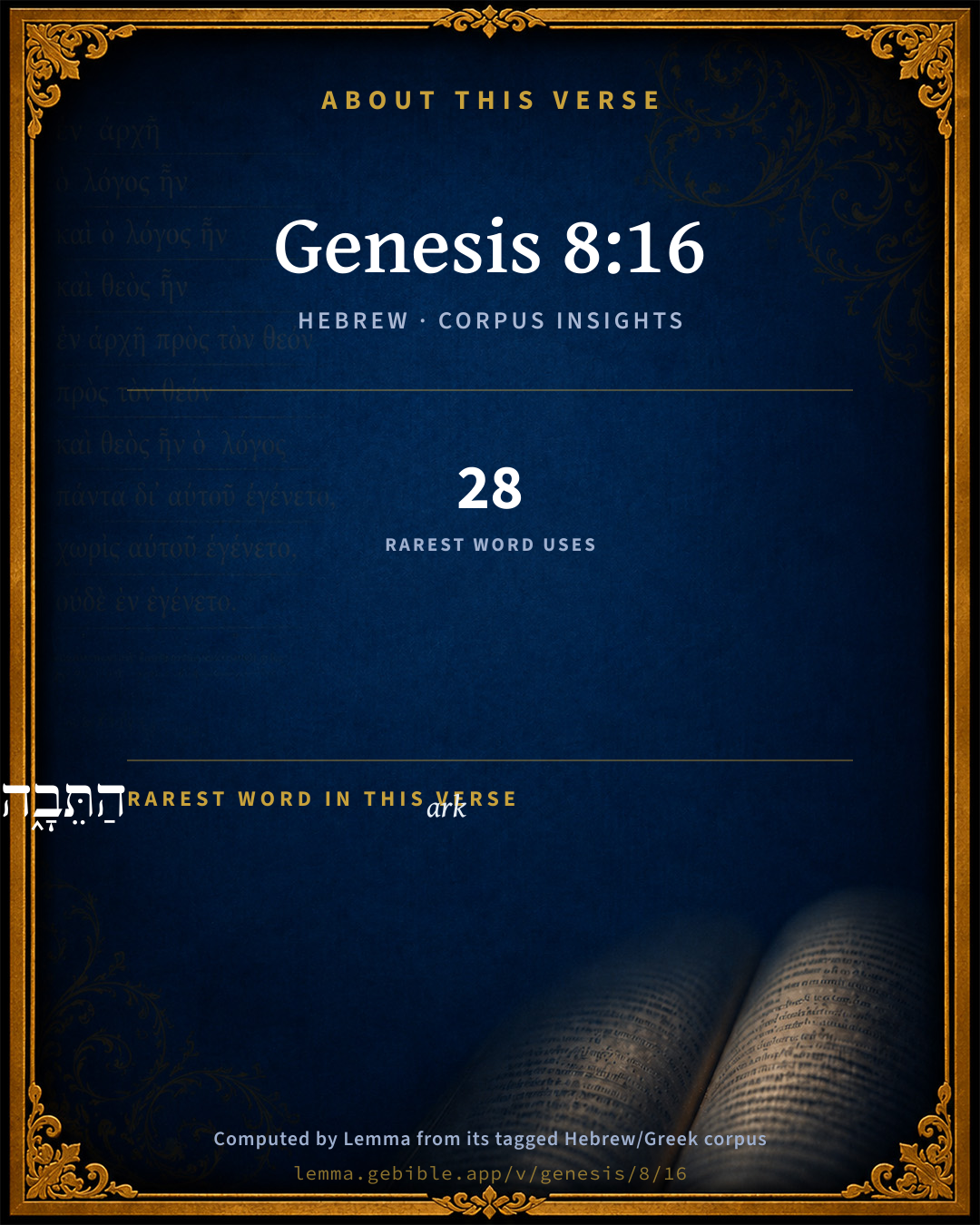
About this verse

These counts appear in no published source. They are computed here, from the morphology-tagged text and Lemma’s own curated glosses. What Lemma adds →

9
words
7
distinct lemmas
Pentateuch
section

Shared distinctive vocabulary

הַתֵּבָ֑ה ark H8392 occurs in 25 verses of the Hebrew Bible. Also found in:

Grammatical profile

  • 1 verb
  • 5 nouns
  • 1 pronoun
  • 2 prepositions

Verb forms

  • צֵ֖א Qal · Imperative

Repetition

Words recur within this verse — often emphatic in Hebrew:

  • וְאִשְׁתְּךָ֛ woman H802 ×2
  • וּבָנֶ֥יךָ son H1121 ×2

Hebrew & Septuagint length

In English translation the verse runs 18 words from the Hebrew and 18 from the Septuagint (LXX English) — the same length.

A rough comparison of the two English renderings, which tokenize alike — not a word-level alignment.

Word counts can differ between the Hebrew and the Greek without any difference in meaning — e.g. the Hebrew direct-object marker אֵת has no separate Greek word, and Greek often adds the article ὁ.

Cross-references

12

Topical passages linked to Genesis 8:16 in the Treasury of Scripture Knowledge — connected by theme and wording, ordered by reader-vote popularity; previews shown in the World English Bible.

  • Genesis 7:13 In the same day Noah, and Shem, Ham, and Japheth, the sons of Noah, and Noah's wife, and the three wives of his sons with them, entered into the ark;
  • Psalms 121:8 Yahweh will keep your going out and your coming in, From this time forth, and forevermore.
  • Zechariah 9:11 As for you also, Because of the blood of your covenant, I have set free your prisoners from the pit in which is no water.
  • Genesis 7:1 Yahweh said to Noah, "Come with all of your household into the ark, for I have seen your righteousness before me in this generation.
  • Genesis 7:7 Noah went into the ark with his sons, his wife, and his sons' wives, because of the waters of the flood.
  • Joshua 3:17 The priests who bore the ark of the covenant of Yahweh stood firm on dry ground in the midst of the Jordan; and all Israel passed over on dry ground, until all the nation were passed clean over the Jordan.
  • Joshua 4:10 For the priests who bore the ark stood in the midst of the Jordan, until everything was finished that Yahweh commanded Joshua to speak to the people, according to all that Moses commanded Joshua: and the people hurried and passed over.
  • Joshua 4:16–18 Command the priests who bear the ark of the testimony, that they come up out of the Jordan.
  • Psalms 91:11 For he will give his angels charge over you, To guard you in all your ways.
  • Daniel 9:25–26 Know therefore and discern, that from the going forth of the commandment to restore and to build Jerusalem to the Anointed One, the prince, shall be seven weeks, and sixty-two weeks: it shall be built again, with street and moat, even in troubled times.
  • Acts 16:37–39 But Paul said to them, "They have beaten us publicly, without a trial, men who are Romans, and have cast us into prison! Do they now release us secretly? No, most assuredly, but let them come themselves and bring us out!"
  • Acts 16:27–28 The jailer, being roused out of sleep and seeing the prison doors open, drew his sword and was about to kill himself, supposing that the prisoners had escaped.

Cross-references courtesy of OpenBible.info (CC BY 4.0).

Hebrew and Greek witnesses Masoretic Hebrew ↔ Greek Septuagint

The same verse in the two great witnesses to the Old Testament, shown verse-for-verse.

These are two independent witnesses, not word-aligned to each other, and the Septuagint is shown in lemma (dictionary) form.

Hebrew Genesis 8:16 Masoretic · Westminster Leningrad Codex

צֵ֖א מִן הַתֵּבָ֑ה אַתָּ֕ה וְאִשְׁתְּךָ֛ וּבָנֶ֥יךָ וּנְשֵֽׁי בָנֶ֖יךָ אִתָּֽךְ

"Go forth from the ark, you, and your wife, and your sons, and your sons' wives with you.

World English Bible · Public Domain

Greek LXX Genesis 8:16 Septuagint · lemma form

ἐκἔρχομαι ἐκ ὁ κιβωτός σύ καί ὁ γυνή σύ καί ὁ υἱός σύ καί ὁ γυνή ὁ υἱός σύ μετά σύ

Come out from the ark, you and your wife and your sons, and your sons' wives with you.

LXX2012 (modern English Septuagint) · Public Domain

Hebrew: Westminster Leningrad Codex (CC BY 4.0). Greek: Septuagint (public domain); English from LXX2012 (modern English Septuagint) (Public Domain). How the Septuagint differs from the Hebrew →

Targum (Aramaic paraphrase)

2

The Targum is the ancient Jewish Aramaic paraphrase of the Hebrew Scriptures — an interpretive translation, not the Hebrew text itself. Onkelos (literal) and Pseudo-Jonathan (expansive) render the Torah, and Jonathan the Prophets. Coverage is partial: where no permissively-licensed English translation exists for a verse, only the Aramaic is shown. This is verse-level text, not a word-by-word alignment to the Hebrew.

  1. Targum Onkelos Torah (Genesis–Deuteronomy)
    פּוּק מִן תֵּבוֹתָא אַתְּ וְאִתְּתָךְ וּבְנָךְ וּנְשֵׁי בְנָיךְ עִמָךְ

    Go forth from the ark, thou, and thy wife, and thy sons, and the wives of thy sons with thee.

    Targum Onkelos — Aramaic: “Onkelos Genesis” (public domain); “Onkelos Exodus” (public domain); “Onkelos Leviticus” (public domain); “Onkelos Numbers” (public domain); “Onkelos Deuteronomy” (public domain). English: “Sefaria Community Translation” (CC0 1.0 (public-domain dedication)); “J.W. Etheridge. The Targums of Onkelos and Jonathan Ben Uzziel on the Pentateuch. London: Longmans, Green, 1862” (public domain). Text via Sefaria.

  2. Targum Pseudo-Jonathan Torah (Genesis–Deuteronomy)
    פּוּק מִן תֵּיבוּתָא אַנְתְּ וְאִנְתְּתָךְ וּבְנָךְ וּנְשֵׁי בְנָךְ עִמָךְ

    Go forth from the ark, thou, and thy wife, and thy sons, and the wives of thy sons, with thee.

    Targum Pseudo-Jonathan — Aramaic: “Targum Jonathan on Genesis” (public domain); “Targum Jonathan on Exodus” (public domain); “Targum Jonathan on Leviticus” (public domain); “Targum Jonathan on Numbers” (public domain); “Targum Jonathan on Deuteronomy” (public domain). English: “The Targum of Jonathan ben Uzziel, trans. J. W. Etheridge, London, 1862” (public domain). Text via Sefaria.

Commentary

Notes on Genesis 8:16 from classic Christian and Jewish commentators (each source and its license shown beneath its notes). The classic Christian expositions comment on the surrounding passage and are grouped to its opening verse, so a note may address several verses; the Jewish commentaries on the Tanakh (Rashi and others) are per-verse, so they appear only where the commentator wrote on this verse.

Lemma curates 59 commentaries, every one of them public domain or Creative Commons licensed, each selected and text-cleaned for this edition rather than reprinted as found. About our sources →

Trapp's Complete Commentary

John Trapp

Gen 8:16 Go forth of the ark, thou, and thy wife, and thy sons, and thy sons’ wives with thee.

Ver. 16. Go forth of the ark.] Learn we of this holy patriarch, to do all by God’s direction, and not dare to attempt anything without his warrant; approving ourselves to him in our comings in and goings out. He hath "charged his angels" {Psa 91:11} with us, so long as we keep the king’s highway; but if we go out of his precincts, we go out of his protection. Take counsel at his mouth, and then we may safely say, "Lord, if I be deceived, thou hast deceived me". {Jer 20:7} This, as at all times we have need to do, so now especially, when there is {as 2Ch 15:5} "no peace to him that goeth out, nor to him that cometh in, but great vexation upon all countries. Nation being destroyed of nation, and city of city," &c.

John Trapp, A Commentary or Exposition upon All the Books of the Old and New Testament (1647–1656) — public domain. Text from a community e-Sword module.

Geneva Bible (1599)

Geneva Bible translators

Noah declareth his obedience, in that he would not depart out of the Ark without God’s express commandment, as he did not enter in without the same: the Ark being a figure of the Church, wherein nothing must be done without the word of God.

Geneva Bible (1599) marginal notes — public domain. Text via Bolls.life.

John Gill's Exposition

Bring forth with thee every living thing that is with thee,.... There is a various reading of the word for "bring forth"; according to the margin, as Jarchi observes, the sense is, order them to come forth; and according to the Scripture, if they will not, oblige them to come:

of all flesh, both of fowl, and of cattle, and of every creeping thing that creepeth upon the earth; for of each of these there were some that went with him into the ark, and continued there:

that they may breed abundantly in the earth, and be fruitful, and multiply upon the earth, for which end they were preserved in the ark. Jarchi observes, it is said "on the earth", not in the ark, which shows he thinks that birds and beasts were not allowed to couple, and that they did not breed there. It is a question with some, how the creatures, which were only in Asia at their coming out of the ark, could spread themselves all over the earth; particularly how they could get into islands, and especially into America: to which it may be answered, that this might be done by many of them, by swimming over narrow seas, for some wild creatures will swim whole days and nights together, when they are forced to it; and by men's carrying others in vessels to distant and different parts, on one account or another, either for profit or pleasure; and especially, what is it the power and providence of God cannot do, who could not be at a loss for ways and means to replenish a world in all the parts of it he had made desolate, when it was his pleasure?(Most creationists think the earth entered an ice age after the flood. This would make the sea level lower than it is today. If the average sea level was lowered by only six hundred feet, all the major continents would be connected by land bridges. Animals could easily migrate to any continent. Ed.)

John Gill's Exposition of the Whole Bible (1746–1763) — public domain (CC PDM 1.0). Text via the HelloAO Bible API.

Matthew Poole's English Annotations

As Noah expected the command of God for his going into the ark, Gen 7:1-2, so for his coming forth of it.

Matthew Poole's English Annotations on the Holy Bible (1683–1685) — public domain. Text from a community e-Sword/MySword module.

Whedon's Commentary on the Bible

Daniel D. Whedon

16. Go forth — Noah patiently waited for the divine word, and did not hasten to leave the ark, although it was now about two months since he lifted the cover and saw that the earth was dry. Although, probably, he could see no reason for delay, and the narrative does not enable us to assign any reason for it, yet walking by faith, as one does who “walks with God,” he waited for Jehovah, who “shut him in,” to lead him forth. They who dwell most closely with God are often thus mysteriously bidden to stand and wait when every thing seems to call for action.

Daniel D. Whedon (gen. ed.), Commentary on the Old and New Testaments (1874–1909) — public domain. Text from a community e-Sword module.

Rashi

Rabbi Shlomo Yitzchaki (Rashi)

’אתה ואשתך וגו THOU AND THY WIFE etc. — Husband and wife are mentioned together— now He allowed them to resume family life (Genesis Rabbah 34:8).

Rashi on the Tanakh — English translations: “The Judaica Press complete Tanach with Rashi, translated by A. J. Rosenberg” (CC BY 4.0); “Pentateuch with Rashi's commentary by M. Rosenbaum and A.M. Silbermann, 1929-1934” (public domain); “The Metsudah Tanach series, Lakewood, N.J” (CC BY 4.0); and “The Book of Joshua, Metsudah Publications, 1997” (CC BY 4.0). Text via Sefaria.

Radak

Rabbi David Kimhi (Radak)

וידבר...צא מן התבה אתה ואשתך, in this verse, as opposed to the phraseology used when he was bidden to enter the ark, Noach and his wife were mentioned together, i.e. an indication that henceforth the mating of man and wife was once again permitted.

Radak on the Tanakh — English translations: “Sefaria Community Translation” (CC0 1.0 (public-domain dedication)); “Eliyahu Munk, HaChut Hameshulash” (CC BY 4.0); “Rabbi Mike Feuer, Jerusalem Anthology” (CC BY 4.0); and “R. David Kimhi on the first book of Psalms, Translated by R.G. Finch, London, 1919” (public domain). Text via Sefaria.

Lesson kit

Teaching starters — assembled from the data on this page, not authored interpretation. Every prompt links to the verse data it draws on. Edit before teaching.

Genesis, in the Pentateuch, opens this verse with 9 words (7 distinct Hebrew lemmas). Its most distinctive word is têbâh (“ark”). A historical commentator’s framing appears above. Read the whole chapter for the surrounding context.

Discussion questions

  1. How does “ark” (têbâh) shape what this verse is saying?
  2. How does Genesis 6:14, which shares the word «ark», read alongside this verse?
  3. What does the repetition of “woman” (2× in this one verse) do in this verse?
  4. These translations render this verse differently; the difference is in the English rendering, not the original. What questions does that raise?
  5. «צֵ֖א» is a Qal Imperative verb. How does that grammatical form shape the action described?
  6. Compare how Trapp's Complete Commentary and Geneva Bible (1599) read this verse. Where do they agree or differ?

Things to notice

  • These translations choose different wording for 3 words in this verse.
  • “woman” occurs 2× in this single verse.
  • 7 distinct Hebrew lemmas span 9 words in this verse.

Reading settings

Reading text

Shown beneath each verse's original-language words.

Old Testament
Old Testament edition

Read the OT as the Masoretic Hebrew (MT) or the Greek Septuagint (LXX).

English shown for the Greek Septuagint (in the Hebrew ↔ Greek comparison).

Comparing translations? Open the Compare panel on any verse page to stack up to four side by side.