Exodus 9:15

Hebrew (Westminster Leningrad Codex) Exodus 9:15 appears in the Hebrew Old Testament. The text above is from the Westminster Leningrad Codex. Each word links to its Strong’s number, a concise gloss, and parsing drawn from the Open Scriptures Hebrew Bible morphology. Click any word for its full Brown-Driver-Briggs (BDB) entry.
Download image
Cite this verse

Exodus 9:15 (World English Bible). Public Domain. Lemma interlinear Bible study tool, https://lemma.gebible.app/v/exodus/9/15.

Show BibTeX & RIS
BibTeX
RIS
English Translation
For now I would have put forth my hand, and struck you and your people with pestilence, and you would have been cut off from the earth;
World English Bible · Public Domain
Download a study sheet

One document with this verse’s original text, its word-by-word gloss line, the meaning frame, cross-references with their text, attributed commentary, and full source and license credits — printable, and it pastes into notes with its structure intact.

This verse Autodidact and up

Study sheet (.html) Plain text (.txt)

A passage Seminary Student

Up to 50 verses in one chapter. A passage sheet keeps up to 6 commentary sources and 12 cross-references per verse, in the order this page ranks them, and says so on the sheet whenever that leaves anything out. Ask for a single verse and you get the Autodidact verse sheet above.

Everything on this page stays free to read, with no account — the sheet is a download of what is already on screen, not access to it.

Want to remove ads? Support Godless Engineer
Compare translations 3

The same verse in 3 English versions, stacked beneath the original-language interlinear above. Click any original word for its lexicon entry.

Each is an independent rendering of the whole verse — the interlinear is not word-aligned to these translations.

Highlighted words mark where these versions differ — a whole-verse word diff, not a word-by-word alignment.

  • World English Bible Public Domain
    For now I would have put forth my hand, and struck you and your people with pestilence, and you would have been cut off from the earth;
  • King James Version Public Domain
    For now I will stretch out my hand, that I may smite thee and thy people with pestilence; and thou shalt be cut off from the earth.
  • unfoldingWord Literal Text CC BY-SA 4.0
    For now I could have stretched out my hand and struck you and your people with a plague, and you would have been destroyed from the land.

unfoldingWord Literal Text — © unfoldingWord, licensed CC BY-SA 4.0. Word-aligned USFM3 via Door43 (git.door43.org/unfoldingWord/en_ult).

Versions to compare (up to 4)

3 of 4 selected

Show all 18 translations

Every available English version of this verse, each an independent rendering of the whole verse.

  • World English Bible Public Domain
    For now I would have put forth my hand, and struck you and your people with pestilence, and you would have been cut off from the earth;
  • Berean Standard Bible Public Domain
    For by this time I could have stretched out My hand and struck you and your people with a plague to wipe you off the earth.
  • Majority Standard Bible Public Domain
    For by this time I could have stretched out My hand and struck you and your people with a plague to wipe you off the earth.
  • King James Version Public Domain
    For now I will stretch out my hand, that I may smite thee and thy people with pestilence; and thou shalt be cut off from the earth.
  • American Standard Version (1901) Public Domain
    For now I had put forth my hand, and smitten thee and thy people with pestilence, and thou hadst been cut off from the earth:
  • Revised Version (1885) Public Domain
    For now I had put forth my hand, and smitten thee and thy people with pestilence, and thou hadst been cut off from the earth:
  • Geneva Bible (1599) Public Domain
    For nowe I will stretch out mine hande, that I may smite thee and thy people with the pestilence: and thou shalt perish from the earth.
  • Douay-Rheims (1899) Public Domain
    For now I will stretch out my hand to strike thee, and thy people with pestilence, and thou shalt perish from the earth.
  • Young's Literal Translation Public Domain
    for now I have put forth My hand, and I smite thee, and thy people, with pestilence, and thou art hidden from the earth.
  • Literal Standard Version CC BY-SA 4.0
    for now I have put forth My hand, and I strike you, and your people, with pestilence, and you are hidden from the earth.
  • Unlocked Literal Bible CC BY-SA 4.0
    By now I could have reached out with my hand and attacked you and your people with disease, and you would have been eradicated from the land.
  • unfoldingWord Literal Text CC BY-SA 4.0
    For now I could have stretched out my hand and struck you and your people with a plague, and you would have been destroyed from the land.
  • Darby Bible Public Domain
    For now shall I put forth my hand, and I will smite thee and thy people with pestilence; and thou shalt be cut off from the earth.
  • World Messianic Bible Public Domain
    For now I would have stretched out my hand, and struck you and your people with pestilence, and you would have been cut off from the earth;
  • Webster's Bible Public Domain
    For now I will stretch out my hand, that I may smite thee and thy people with pestilence; and thou shalt be cut off from the earth.
  • Free Bible Version CC BY-SA 4.0
    By now I could have reached out to strike you and your people with a plague that would have completely destroyed you.
  • Bible in Basic English Public Domain
    For if I had put the full weight of my hand on you and your people, you would have been cut off from the earth:
  • JPS Tanakh (1917) Public Domain
    Surely now I had put forth My hand, and smitten thee and thy people with pestilence, and thou hadst been cut off from the earth.

Literal Standard Version (2020), Covenant Press — licensed CC BY-SA 4.0. Text via the HelloAO Bible API (eBible.org). Unlocked Literal Bible (unfoldingWord) — licensed CC BY-SA 4.0. Text via the HelloAO Bible API (eBible.org). unfoldingWord Literal Text — © unfoldingWord, licensed CC BY-SA 4.0. Word-aligned USFM3 via Door43 (git.door43.org/unfoldingWord/en_ult). Free Bible Version, Dr. Jonathan Gallagher — licensed CC BY-SA 4.0. Text via the HelloAO Bible API (eBible.org).

Word by word

More ways to search: Search by grammar → Find every occurrence → Compare this word →

Practice this passage: Drill this verse → Learn its vocabulary →

וַתִּכָּחֵ֖ד
kâchad
H3582
“and · to hide”
Conjunction + Verb, Niphal, Sequential Imperfect, 2nd Person, Masculine, Singular
Part of Speech
Conjunction + Verb
Stem
Niphal
Form
Sequential Imperfect
Person
2nd Person
Gender
Masculine
Number
Singular
Full BDB Definition

Origin: a primitive root

TWOT: 972

to hide, conceal, cut off, cut down, make desolate, kick - (Niphal) - to be hidden - to be effaced, be destroyed, be cut off - (Piel) to cover, hide - (Hiphil) - to hide - to efface, annihilate
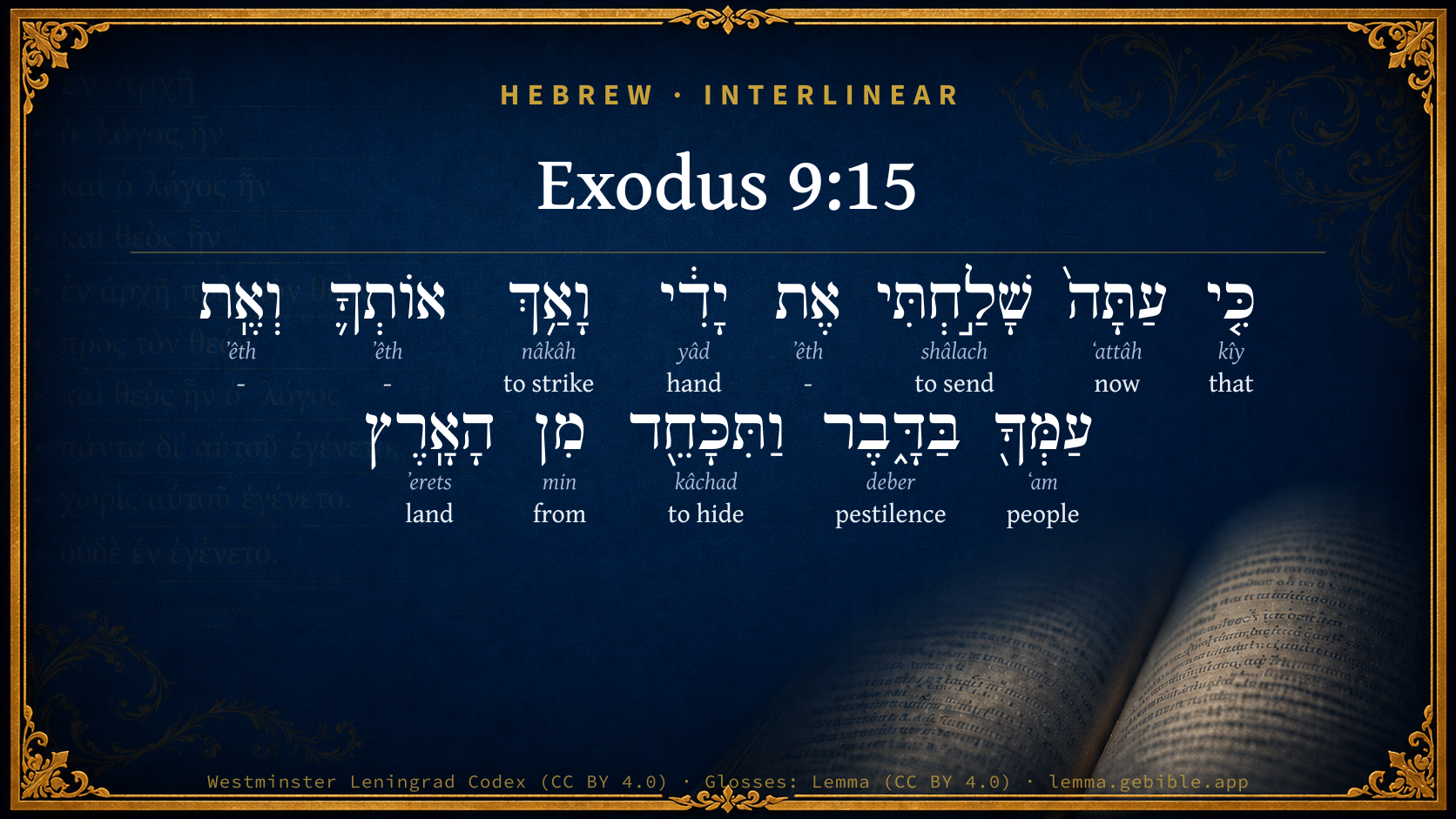
  1. כִּ֤י kîy H3588 “that” Conjunction
  2. עַתָּה֙ ʻattâh H6258 “now” Adverb
  3. שָׁלַ֣חְתִּי shâlach H7971 “to send” Verb, Qal, Perfect, 1st Person, Common, Singular
  4. אֶת ʼêth H853 “-” Particle, Direct Object
  5. יָדִ֔י yâd H3027 “hand · my” Noun, Common, Both, Singular, Construct + Suffix, Personal, 1st Person, Common, Singular
  6. וָאַ֥ךְ nâkâh H5221 “and · to strike” Conjunction + Verb, Hiphil, Sequential Imperfect, 1st Person, Common, Singular
  7. אוֹתְךָ֛ ʼêth H853 “- · you” Particle, Direct Object + Suffix, Personal, 2nd Person, Masculine, Singular
  8. וְאֶֽת ʼêth H853 “and · -” Conjunction + Particle, Direct Object
  9. עַמְּךָ֖ ʻam H5971 “people · your” Noun, Common, Masculine, Singular, Construct + Suffix, Personal, 2nd Person, Masculine, Singular
  10. בַּדָּ֑בֶר deber H1698 “in/at the · pestilence” Preposition, Determined + Noun, Common, Masculine, Singular, Absolute
  11. מִן min H4480 “from” Preposition
  12. הָאָֽרֶץ ʼerets H776 “the · land” Particle, Definite Article + Noun, Common, Both, Singular, Absolute

About this verse

These counts appear in no published source. They are computed here, from the morphology-tagged text and Lemma’s own curated glosses. What Lemma adds →

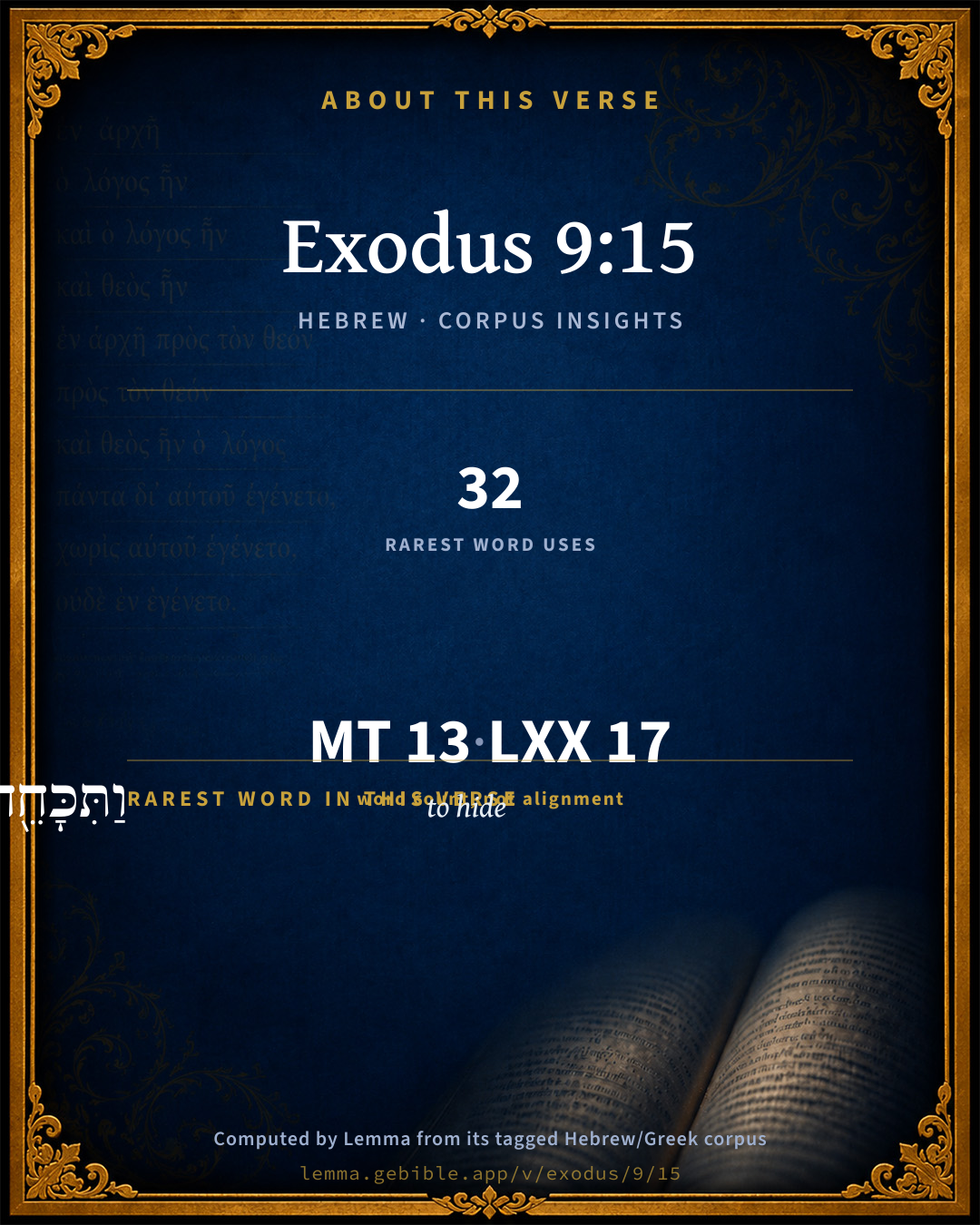
13
words
11
distinct lemmas
Pentateuch
section

Shared distinctive vocabulary

וַתִּכָּחֵ֖ד to hide H3582 occurs in 30 verses of the Hebrew Bible. Also found in:

Grammatical profile

  • 3 verbs
  • 4 nouns
  • 1 preposition
  • 1 conjunction
  • 1 adverb
  • 3 particles

Verb forms

  • שָׁלַ֣חְתִּי Qal · Perfect
  • וָאַ֥ךְ Hiphil · Sequential Imperfect
  • וַתִּכָּחֵ֖ד Niphal · Sequential Imperfect

Hebrew & Septuagint length

In English translation the verse runs 27 words from the Hebrew and 24 from the Septuagint (LXX English) — closely comparable.

A rough comparison of the two English renderings, which tokenize alike — not a word-level alignment.

Word counts can differ between the Hebrew and the Greek without any difference in meaning — e.g. the Hebrew direct-object marker אֵת has no separate Greek word, and Greek often adds the article ὁ.

In the original languages it is 13 Hebrew tokens and 17 Greek tokens — but the two are counted differently (Hebrew bundles its prefixes and suffixes into one token; the Greek is in lemma form), so that isn’t a like-for-like length.

Cross-references

9

Topical passages linked to Exodus 9:15 in the Treasury of Scripture Knowledge — connected by theme and wording, ordered by reader-vote popularity; previews shown in the World English Bible.

  • Exodus 3:20 I will put forth my hand and strike Egypt with all my wonders which I will do in the midst of it, and after that he will let you go.
  • Exodus 9:3 behold, the hand of Yahweh is on your cattle which are in the field, on the horses, on the donkeys, on the camels, on the herds, and on the flocks with a very grievous pestilence.
  • Exodus 9:6 Yahweh did that thing on the next day; and all the cattle of Egypt died, but of the cattle of the children of Israel, not one died.
  • Exodus 9:16 but indeed for this cause I have made you stand: to show you my power, and that my name may be declared throughout all the earth;
  • Exodus 11:4–6 Moses said, "This is what Yahweh says: 'About midnight I will go out into the midst of Egypt,
  • Exodus 12:29–30 It happened at midnight, that Yahweh struck all the firstborn in the land of Egypt, from the firstborn of Pharaoh who sat on his throne to the firstborn of the captive who was in the dungeon; and all the firstborn of cattle.
  • Exodus 14:28 The waters returned, and covered the chariots and the horsemen, even all Pharaoh's army that went in after them into the sea. There remained not so much as one of them.
  • 1 Kings 13:34 This thing became sin to the house of Jeroboam, even to cut it off, and to destroy it from off the surface of the earth.
  • Proverbs 2:22 But the wicked will be cut off from the land. The treacherous will be rooted out of it.

Cross-references courtesy of OpenBible.info (CC BY 4.0).

Hebrew and Greek witnesses Masoretic Hebrew ↔ Greek Septuagint

The same verse in the two great witnesses to the Old Testament, shown verse-for-verse.

These are two independent witnesses, not word-aligned to each other, and the Septuagint is shown in lemma (dictionary) form.

Hebrew Exodus 9:15 Masoretic · Westminster Leningrad Codex

כִּ֤י עַתָּה֙ שָׁלַ֣חְתִּי אֶת יָדִ֔י וָאַ֥ךְ אוֹתְךָ֛ וְאֶֽת עַמְּךָ֖ בַּדָּ֑בֶר וַתִּכָּחֵ֖ד מִן הָאָֽרֶץ

For now I would have put forth my hand, and struck you and your people with pestilence, and you would have been cut off from the earth;

World English Bible · Public Domain

Greek LXX Exodus 9:15 Septuagint · lemma form

νῦν γάρ ἀποστέλλω ὁ χείρ πατάσσω σύ καί ὁ λαός σύ θάνατος καί ἐκτρίβω ἀπό ὁ γῆ

For now I will stretch forth my hand and strike you and kill your people, and you shall be consumed from off the earth.

LXX2012 (modern English Septuagint) · Public Domain

Hebrew: Westminster Leningrad Codex (CC BY 4.0). Greek: Septuagint (public domain); English from LXX2012 (modern English Septuagint) (Public Domain). How the Septuagint differs from the Hebrew →

Targum (Aramaic paraphrase)

2

The Targum is the ancient Jewish Aramaic paraphrase of the Hebrew Scriptures — an interpretive translation, not the Hebrew text itself. Onkelos (literal) and Pseudo-Jonathan (expansive) render the Torah, and Jonathan the Prophets. Coverage is partial: where no permissively-licensed English translation exists for a verse, only the Aramaic is shown. This is verse-level text, not a word-by-word alignment to the Hebrew.

  1. Targum Onkelos Torah (Genesis–Deuteronomy)
    אֲרֵי כְעַן קְרֵיב קֳדָמַי דְאֶשְׁלַח פּוֹן יָת מַחַת גְבֻרְתִּי וְאֶמְחֵי יָתָךְ וְיָת עַמָךְ בְּמוֹתָא וְשֵׁיצִיאַת מִן אַרְעָא:

    (no public-domain English translation for this verse)

    Targum Onkelos — Aramaic: “Onkelos Genesis” (public domain); “Onkelos Exodus” (public domain); “Onkelos Leviticus” (public domain); “Onkelos Numbers” (public domain); “Onkelos Deuteronomy” (public domain). English: “Sefaria Community Translation” (CC0 1.0 (public-domain dedication)); “J.W. Etheridge. The Targums of Onkelos and Jonathan Ben Uzziel on the Pentateuch. London: Longmans, Green, 1862” (public domain). Text via Sefaria.

  2. Targum Pseudo-Jonathan Torah (Genesis–Deuteronomy)
    אֲרוּם כְּדוֹן שַׁדָרִית יַת מְחַת גְבוּרְתִּי מִן דִינָא הוּא דְמָחִיתִי יָתָךְ וְיַת עַמָךְ בְּמוֹתָא וְאִישְׁתֵּצִית מִן אַרְעָא

    Now could I send the plague of My strength by judgment (or, with justice) to strike thee and thy people with death, and destroy thee from the earth;

    Targum Pseudo-Jonathan — Aramaic: “Targum Jonathan on Genesis” (public domain); “Targum Jonathan on Exodus” (public domain); “Targum Jonathan on Leviticus” (public domain); “Targum Jonathan on Numbers” (public domain); “Targum Jonathan on Deuteronomy” (public domain). English: “The Targum of Jonathan ben Uzziel, trans. J. W. Etheridge, London, 1862” (public domain). Text via Sefaria.

Commentary

Notes on Exodus 9:15 from classic Christian and Jewish commentators (each source and its license shown beneath its notes). The classic Christian expositions comment on the surrounding passage and are grouped to its opening verse, so a note may address several verses; the Jewish commentaries on the Tanakh (Rashi and others) are per-verse, so they appear only where the commentator wrote on this verse.

Lemma curates 59 commentaries, every one of them public domain or Creative Commons licensed, each selected and text-cleaned for this edition rather than reprinted as found. About our sources →

Trapp's Complete Commentary

John Trapp

Exo 9:15 For now I will stretch out my hand, that I may smite thee and thy people with pestilence; and thou shalt be cut off from the earth.

Ver. 15. For now I will stretch out.] His former preservation was but a reservation: and he hath hitherto escaped with his life; not for any love that God bare to him, but "to show his power on him." Wicked men may have common mercies and deliverances, but "the Lord Ioveth the righteous." {Psa 146:8}

John Trapp, A Commentary or Exposition upon All the Books of the Old and New Testament (1647–1656) — public domain. Text from a community e-Sword module.

Adam Clarke's Commentary

Verse 15. For now I will stretch out my hand] In the Hebrew the verbs are in the past tense, and not in the future, as our translation improperly expresses them, by which means a contradiction appears in the text: for neither Pharaoh nor his people were smitten by a pestilence, nor was he by any kind of mortality cut off from the earth. It is true the first-born were slain by a destroying angel, and Pharaoh himself was drowned in the Red Sea; but these judgments do not appear to be referred to in this place. If the words be translated, as they ought, in the subjunctive mood, or in the past instead of the future, this seeming contradiction to facts, as well as all ambiguity, will be avoided: For if now I HAD STRETCHED OUT (שלהתי shalachti, had set forth) my hand, and had smitten thee (ואך אותך vaach otheca) and thy people with the pestilence, thou SHOULDST HAVE BEEN cut off (תכחד ticcached) from the earth.

Adam Clarke's Commentary on the Bible (1810–1826) — public domain. Text from a community e-Sword/MySword module.

Ellicott's Commentary for English Readers

(15) For now I will stretch out my hand.—The words admit of this translation, but the context will not allow it. Translate—And now I might have stretched out mine hand, and smitten both thee and thy people with pestilence; and then thou hadst been cut off from the earth; but, &c.

A Bible Commentary for English Readers, edited by Charles John Ellicott (1878–1897) — public domain. Text from a community e-Sword module.

The Cambridge Bible for Schools and Colleges

gen. ed. J. J. S. Perowne

15. For now, &c.] ‘had put forth’ is hypothetical: For else (i.e. except for the motive just stated) I should now have put forth, &c., would express the sense more clearly.

hadst] i.e. wouldest have been.

The Cambridge Bible for Schools and Colleges (gen. ed. J. J. S. Perowne; Cambridge University Press, 1878–1918) — public domain. Text from a community e-Sword module.

John Gill's Exposition

For now will I stretch out my hand, that I may smite thee and thy people with pestilence,.... Which yet we never find was done; for though this by many is referred to the slaying of the firstborn, yet it is not certain that this was done by the pestilence: besides, Pharaoh was not then smitten, nor his people, only their firstborn; wherefore these words are to be rendered, not in the future, but in the imperfect or preterpluperfect tense, thus; "for when now I stretched out my hand, or if now I had stretched out my hand to smite thee and thy people with pestilence" (a); that is, at the time when he smote the cattle with the murrain or pestilence, when he could as well have smote him and his people with it; there was no want of power in God to do it, and had he done it, it would have been all over with him and them:

and thou shall be cut off from the earth; or "thou hadst been, or wouldest have been cut off from the earth" (b) must have perished out of it, and been no more in the land of the living.

(a) "modo enim cum extendi", Junius & Tremellius, Piscator, Drusius, "vel si extendissem", Fagius, Cocceius; so Jarchi, Gersom, Targ. Onk. & Jon. (b) "sic fuisses excisus", Junius & Tremellius, Piscator, Drusius, Cocceius.

John Gill's Exposition of the Whole Bible (1746–1763) — public domain (CC PDM 1.0). Text via the HelloAO Bible API.

Haydock's Catholic Bible Commentary

Pestilence, or various evils which now came fast upon Pharao. (Menochius)

George Leo Haydock (1774–1849), Haydock's Catholic Family Bible and Commentary, 1859 edition — public domain. Excludes Psalms (Douay-Rheims chapter numbering differs from Protestant) and Deuterocanonical books (Catholic canon only).

Matthew Poole's English Annotations

Pestilence; not properly so called, but largely, as the word is used Hos 13:14, meaning with an utter and irrecoverable destruction. This relates partly to the killing of the first-born, which plague did more immediately and nearly concern both him and his people, and principally to their destruction in the Red Sea.

Matthew Poole's English Annotations on the Holy Bible (1683–1685) — public domain. Text from a community e-Sword/MySword module.

Whedon's Commentary on the Bible

Daniel D. Whedon

15. For now I will stretch out my hand — The verb (שׁלחתי) is here to be rendered as conditional past, (Ewald, Lehrb., § 358, a.; Nordh., Gram., § 991, 3, a.,) thus, For now I would have stretched out my hand and smitten. For a similar construction see 1Sa_13:13. So the Arabic, Fagius, Adam Clarke, Kalisch, Keil, Knobel, Stier and Theil, Murphy. The verse is closely connected to the following, thus: “For now I would have stretched out my hand and smitten thee… but yet for this have I preserved thee, to show thee my power,” etc.

Daniel D. Whedon (gen. ed.), Commentary on the Old and New Testaments (1874–1909) — public domain. Text from a community e-Sword module.

The Pulpit Commentary

For now I will stretch out my hand. It is generally agreed by modern writers that this translation fails to give the true sense of the original God does not here announce what he is going to do, but what he might have done, and would have done, but for certain considerations. Translate, "For now might I have stretched out my hand, and smitten thee and thy people with pestilence; and then thou hadst been cut off from the earth." Scripture shows that pestilence is always in God"s power, and may at any time be let loose to scourge his foes, and sweep them into the pit of destruction. (see Lev_26:25; Num_11:33 Num_14:12 Num_16:46; 2Sa_24:13-15, etc.) He had not done now what he might have done, and what Pharaoh"s obstinacy might well have provoked him to do; and why? On account of the considerations contained in the next verse.

The Pulpit Commentary (1880–1919), ed. H.D.M. Spence-Jones & Joseph S. Exell — public domain. Text from a community e-Sword module.

unfoldingWord translationNotes

Door43 World Missions Community

reached out with my hand and attacked you

Here "my hand" refers to God's power. AT: "used my power to strike you" (See: Metonymy)

so that my name may be proclaimed throughout all the earth

Here "my name" represents Yahweh's reputation. AT: "so that people everywhere will know I am great" (See: Metonymy)

lifting yourself up against my people

Pharaoh's opposition to letting Israel go to worship Yahweh is spoken of as if he was raising himself up as a barrier to them. (See: Metaphor)

translationWords

hand

people group

power

name

earth

people of God

unfoldingWord translationNotes — © Distant Shores Media and the Door43 World Missions Community, licensed CC BY-SA 4.0. Source: git.door43.org/Door43/en_tn.

Rashi

Rabbi Shlomo Yitzchaki (Rashi)

כי עתה שלחתי את ידי וגו׳ FOR NOW I MIGHT HAVE STRETCHED OUT MY HAND etc. — For had I so desired it, when My hand was upon thy cattle which I smote with pestilence I could have stretched it forth and smitten thee and thy people together with the cattle, ותכחד מן הארץ AND THOU WOULDST HAVE BEEN EXTERMINATED FROM THE EARTH, BUT (this word אבל corresponds to ואולם in the Hebrew text) בעבור זאת העמדתיך FOR THIS REASON I MADE THEE REMAIN [IN LIFE IN ORDER TO SHOW THEE MY POWER], etc.

Rashi on the Tanakh — English translations: “The Judaica Press complete Tanach with Rashi, translated by A. J. Rosenberg” (CC BY 4.0); “Pentateuch with Rashi's commentary by M. Rosenbaum and A.M. Silbermann, 1929-1934” (public domain); “The Metsudah Tanach series, Lakewood, N.J” (CC BY 4.0); and “The Book of Joshua, Metsudah Publications, 1997” (CC BY 4.0). Text via Sefaria.

Lesson kit

Teaching starters — assembled from the data on this page, not authored interpretation. Every prompt links to the verse data it draws on. Edit before teaching.

Exodus, in the Pentateuch, opens this verse with 13 words (11 distinct Hebrew lemmas). Its most distinctive word is kâchad (“to hide”). A historical commentator’s framing appears above. Read the whole chapter for the surrounding context.

Discussion questions

  1. How does “to hide” (kâchad) shape what this verse is saying?
  2. How does Genesis 47:18, which shares the word «to hide», read alongside this verse?
  3. These translations render this verse differently; the difference is in the English rendering, not the original. What questions does that raise?
  4. «שָׁלַ֣חְתִּי» is a Qal Perfect verb. How does that grammatical form shape the action described?
  5. Compare how Trapp's Complete Commentary and Adam Clarke's Commentary read this verse. Where do they agree or differ?

Things to notice

Reading settings

Reading text

Shown beneath each verse's original-language words.

Old Testament
Old Testament edition

Read the OT as the Masoretic Hebrew (MT) or the Greek Septuagint (LXX).

English shown for the Greek Septuagint (in the Hebrew ↔ Greek comparison).

Comparing translations? Open the Compare panel on any verse page to stack up to four side by side.