
Ezekiel 14:13

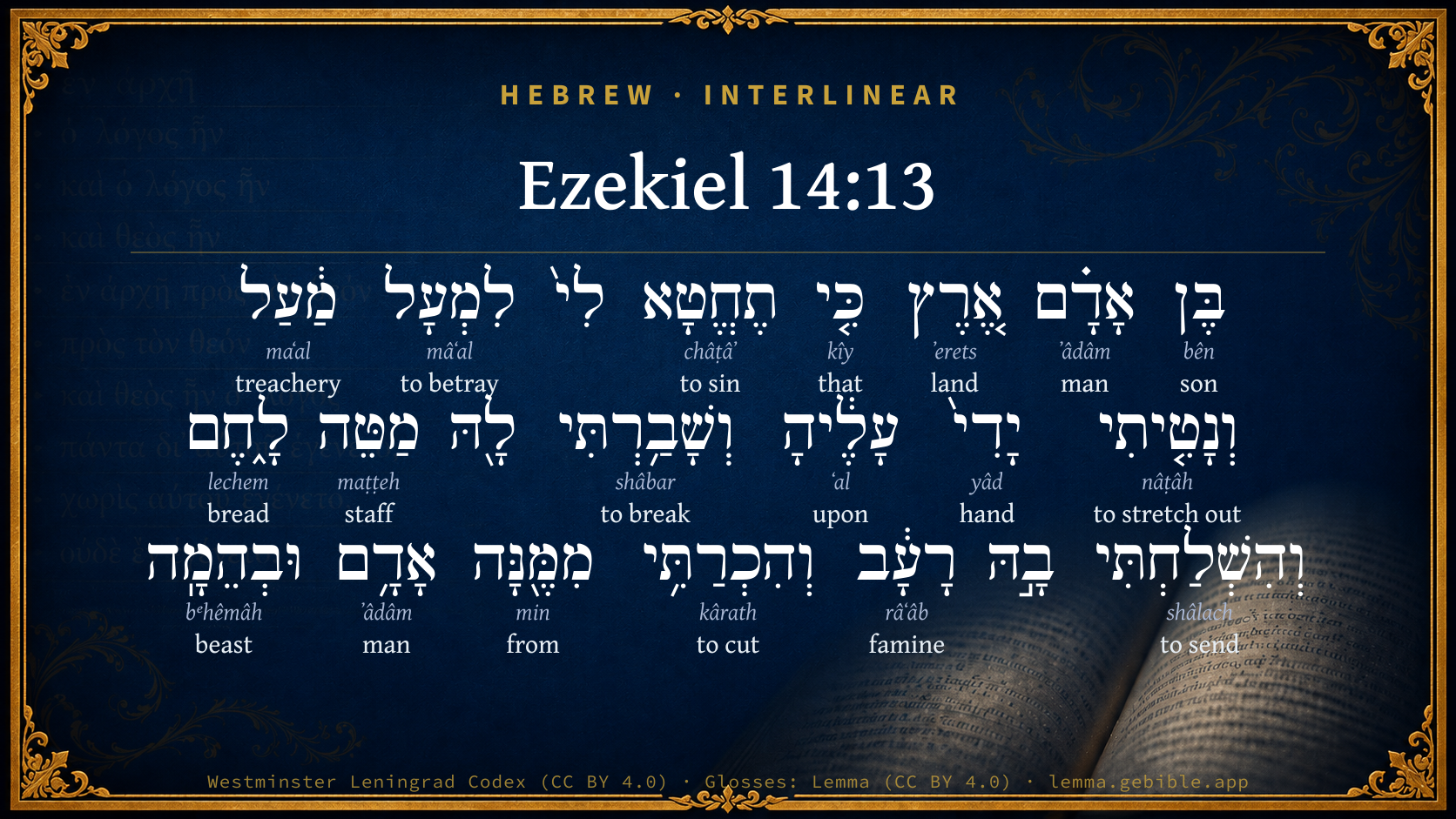
Hebrew (Westminster Leningrad Codex) Ezekiel 14:13 appears in the Hebrew Old Testament. The text above is from the Westminster Leningrad Codex. Each word links to its Strong’s number, a concise gloss, and parsing drawn from the Open Scriptures Hebrew Bible morphology. Click any word for its full Brown-Driver-Briggs (BDB) entry.
Download image
Cite this verse

Ezekiel 14:13 (World English Bible). Public Domain. Lemma interlinear Bible study tool, https://lemma.gebible.app/v/ezekiel/14/13.

Show BibTeX & RIS
BibTeX
RIS
English Translation
Son of man, when a land sins against me by committing a trespass, and I stretch out my hand on it, and break the staff of the bread of it, and send famine on it, and cut off from it man and animal;
World English Bible · Public Domain
Download a study sheet

One document with this verse’s original text, its word-by-word gloss line, the meaning frame, cross-references with their text, attributed commentary, and full source and license credits — printable, and it pastes into notes with its structure intact.

This verse Autodidact and up

Study sheet (.html) Plain text (.txt)

A passage Seminary Student

Up to 50 verses in one chapter. A passage sheet keeps up to 6 commentary sources and 12 cross-references per verse, in the order this page ranks them, and says so on the sheet whenever that leaves anything out. Ask for a single verse and you get the Autodidact verse sheet above.

Everything on this page stays free to read, with no account — the sheet is a download of what is already on screen, not access to it.

Want to remove ads? Support Godless Engineer
Compare translations 3

The same verse in 3 English versions, stacked beneath the original-language interlinear above. Click any original word for its lexicon entry.

Each is an independent rendering of the whole verse — the interlinear is not word-aligned to these translations.

Highlighted words mark where these versions differ — a whole-verse word diff, not a word-by-word alignment.

  • World English Bible Public Domain
    Son of man, when a land sins against me by committing a trespass, and I stretch out my hand on it, and break the staff of the bread of it, and send famine on it, and cut off from it man and animal;
  • King James Version Public Domain
    Son of man, when the land sinneth against me by trespassing grievously, then will I stretch out mine hand upon it, and will break the staff of the bread thereof, and will send famine upon it, and will cut off man and beast from it:
  • unfoldingWord Literal Text CC BY-SA 4.0
    “Son of man, when a land sins against me by committing a sin so that I reach out with my hand against it and break the staff of its bread, and send out over it a famine and cut off both man and beast from the land;

unfoldingWord Literal Text — © unfoldingWord, licensed CC BY-SA 4.0. Word-aligned USFM3 via Door43 (git.door43.org/unfoldingWord/en_ult).

Versions to compare (up to 4)

3 of 4 selected

Show all 18 translations

Every available English version of this verse, each an independent rendering of the whole verse.

  • World English Bible Public Domain
    Son of man, when a land sins against me by committing a trespass, and I stretch out my hand on it, and break the staff of the bread of it, and send famine on it, and cut off from it man and animal;
  • Berean Standard Bible Public Domain
    “Son of man, if a land sins against Me by acting unfaithfully, and I stretch out My hand against it to cut off its supply of food, to send famine upon it, and to cut off from it both man and beast,
  • Majority Standard Bible Public Domain
    “Son of man, if a land sins against Me by acting unfaithfully, and I stretch out My hand against it to cut off its supply of food, to send famine upon it, and to cut off from it both man and beast,
  • King James Version Public Domain
    Son of man, when the land sinneth against me by trespassing grievously, then will I stretch out mine hand upon it, and will break the staff of the bread thereof, and will send famine upon it, and will cut off man and beast from it:
  • American Standard Version (1901) Public Domain
    Son of man, when a land sinneth against me by committing a trespass, and I stretch out my hand upon it, and break the staff of the bread thereof, and send famine upon it, and cut off from it man and beast;
  • Revised Version (1885) Public Domain
    Son of man, when a land sinneth against me by committing a trespass, and I stretch out mine hand upon it, and break the staff of the bread thereof, and send famine upon it, and cut off from it man and beast;
  • Geneva Bible (1599) Public Domain
    Sonne of man, when ye land sinneth against me by committing a trespasse, then will I stretch out mine hand vpon it, and will breake the staffe of the bread thereof, and will send famine vpon it, and I will destroy man and beast forth of it.
  • Douay-Rheims (1899) Public Domain
    Son of man, when a land shall sin against me, so as to transgress grievously, I will stretch forth my hand upon it, and will break the staff of the bread thereof: and I will send famine upon it, and will destroy man and beast out of it.
  • Young's Literal Translation Public Domain
    `Son of man, the land -- when it sinneth against Me to commit a trespass, and I have stretched out My hand against it, and broken for it the staff of bread, and sent into it famine, and cut off from it man and beast --
  • Literal Standard Version CC BY-SA 4.0
    “Son of man, when the land sins against Me to commit a trespass, and I have stretched out My hand against it, and broken the staff of bread for it, and sent famine into it, and cut off man and beast from it—
  • Unlocked Literal Bible CC BY-SA 4.0
    “Son of man, when a land sins against me by committing a sin so that I reach out with my hand against it and break the staff of its bread, and send out over it a famine and cut off both man and beast from the land;
  • unfoldingWord Literal Text CC BY-SA 4.0
    “Son of man, when a land sins against me by committing a sin so that I reach out with my hand against it and break the staff of its bread, and send out over it a famine and cut off both man and beast from the land;
  • Darby Bible Public Domain
    Son of man, when a land sinneth against me by working unfaithfulness, and I stretch out my hand upon it, and break the staff of the bread thereof, and send famine upon it, and cut off man and beast from it;
  • World Messianic Bible Public Domain
    “Son of man, when a land sins against me by committing a trespass, and I stretch out my hand on it, and break the staff of its bread and send famine on it, and cut off from it man and animal—
  • Webster's Bible Public Domain
    Son of man, when the land sinneth against me by trespassing grievously, then will I stretch out my hand upon it, and will break the staff of the bread thereof, and will send famine upon it, and will cut off man and beast from it:
  • Free Bible Version CC BY-SA 4.0
    “Son of man, if a people in a country sin against me by being unfaithful to me, then I will act against them by cutting off their food supply, so they experience famine, with no food for people or animals.
  • Bible in Basic English Public Domain
    Son of man, when a land, sinning against me, does wrong, and my hand is stretched out against it, and the support of its bread is broken, and I make it short of food, cutting off man and beast from it:
  • JPS Tanakh (1917) Public Domain
    'Son of man, when a land sinneth against Me by trespassing grievously, and I stretch out My hand upon it, and break the staff of the bread thereof, and send famine upon it, and cut off from it man and beast;

Literal Standard Version (2020), Covenant Press — licensed CC BY-SA 4.0. Text via the HelloAO Bible API (eBible.org). Unlocked Literal Bible (unfoldingWord) — licensed CC BY-SA 4.0. Text via the HelloAO Bible API (eBible.org). unfoldingWord Literal Text — © unfoldingWord, licensed CC BY-SA 4.0. Word-aligned USFM3 via Door43 (git.door43.org/unfoldingWord/en_ult). Free Bible Version, Dr. Jonathan Gallagher — licensed CC BY-SA 4.0. Text via the HelloAO Bible API (eBible.org).

Word by word

More ways to search: Search by grammar → Find every occurrence → Compare this word →

Practice this passage: Drill this verse → Learn its vocabulary →

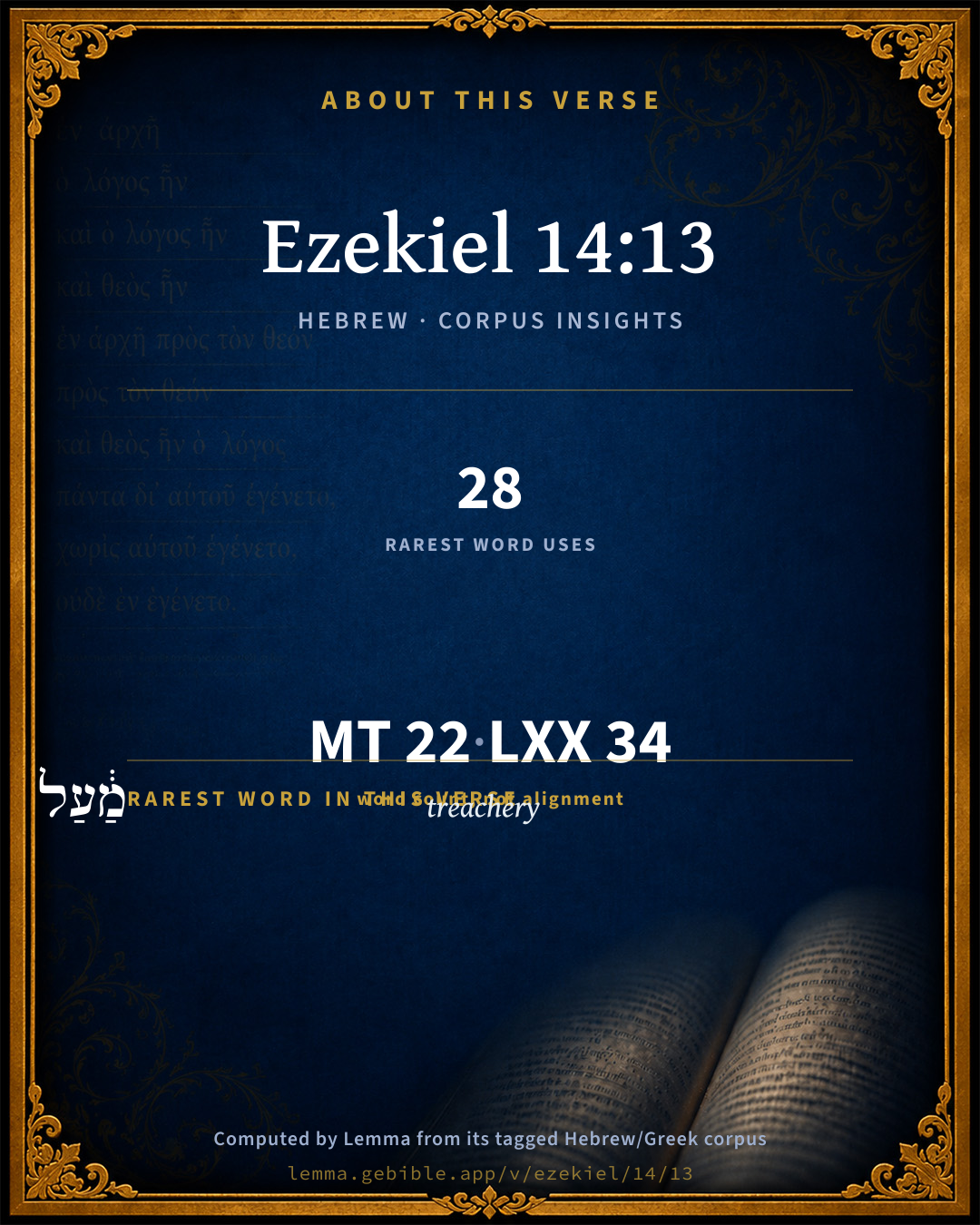
מַ֔עַל
maʻal
H4604
“treachery”
Noun, Common, Masculine, Singular, Absolute
Part of Speech
Noun
Type
Common
Gender
Masculine
Number
Singular
State
Absolute
Full BDB Definition

Origin: from H4603

TWOT: 1230a

unfaithful or treacherous act, trespass - against man - against God
  1. בֶּן bên H1121 “son of” Noun, Common, Masculine, Singular, Construct
  2. אָדָ֗ם ʼâdâm H120 “man” Noun, Common, Masculine, Singular, Absolute
  3. אֶ֚רֶץ ʼerets H776 “land” Noun, Common, Both, Singular, Absolute
  4. כִּ֤י kîy H3588 “that” Conjunction
  5. תֶחֱטָא châṭâʼ H2398 “to sin” Verb, Qal, Imperfect, 3rd Person, Feminine, Singular
  6. לִמְעָל mâʻal H4603 “to betray” Preposition + Verb, Qal, Infinitive Construct
  7. וְנָטִ֤יתִי nâṭâh H5186 “and · to stretch out” Conjunction + Verb, Qal, Sequential Perfect, 1st Person, Common, Singular
  8. יָדִי֙ yâd H3027 “hand · my” Noun, Common, Both, Singular, Construct + Suffix, Personal, 1st Person, Common, Singular
  9. עָלֶ֔יהָ ʻal H5921 “upon · her” Preposition + Suffix, Personal, 3rd Person, Feminine, Singular
  10. וְשָׁבַ֥רְתִּי shâbar H7665 “and · to break” Conjunction + Verb, Qal, Sequential Perfect, 1st Person, Common, Singular
  11. מַטֵּה maṭṭeh H4294 “staff of” Noun, Common, Masculine, Singular, Construct
  12. לָ֑חֶם lechem H3899 “bread” Noun, Common, Both, Singular, Absolute
  13. וְהִשְׁלַחְתִּי shâlach H7971 “and · to send” Conjunction + Verb, Hiphil, Sequential Perfect, 1st Person, Common, Singular
  14. רָעָ֔ב râʻâb H7458 “famine” Noun, Common, Masculine, Singular, Absolute
  15. וְהִכְרַתִּ֥י kârath H3772 “and · to cut” Conjunction + Verb, Hiphil, Sequential Perfect, 1st Person, Common, Singular
  16. מִמֶּ֖נָּה min H4480 “from · her” Preposition + Suffix, Personal, 3rd Person, Feminine, Singular
  17. אָדָ֥ם ʼâdâm H120 “man” Noun, Common, Masculine, Singular, Absolute
  18. וּבְהֵמָֽה bᵉhêmâh H929 “and · beast” Conjunction + Noun, Common, Feminine, Singular, Absolute

About this verse

These counts appear in no published source. They are computed here, from the morphology-tagged text and Lemma’s own curated glosses. What Lemma adds →

22
words
18
distinct lemmas
Prophets
section

Shared distinctive vocabulary

מַ֔עַל treachery H4604 occurs in 28 verses of the Hebrew Bible. Also found in:

Grammatical profile

  • 6 verbs
  • 10 nouns
  • 5 prepositions
  • 1 conjunction

Verb forms

  • תֶחֱטָא Qal · Imperfect
  • לִמְעָל Qal · Infinitive Construct
  • וְנָטִ֤יתִי Qal · Sequential Perfect
  • וְשָׁבַ֥רְתִּי Qal · Sequential Perfect
  • וְהִשְׁלַחְתִּי Hiphil · Sequential Perfect
  • וְהִכְרַתִּ֥י Hiphil · Sequential Perfect

Repetition

A word recurs within this verse — often emphatic in Hebrew:

  • אָדָ֗ם man H120 ×2

Hebrew & Septuagint length

In English translation the verse runs 43 words from the Hebrew and 45 from the Septuagint (LXX English) — closely comparable.

A rough comparison of the two English renderings, which tokenize alike — not a word-level alignment.

Word counts can differ between the Hebrew and the Greek without any difference in meaning — e.g. the Hebrew direct-object marker אֵת has no separate Greek word, and Greek often adds the article ὁ.

In the original languages it is 22 Hebrew tokens and 34 Greek tokens — but the two are counted differently (Hebrew bundles its prefixes and suffixes into one token; the Greek is in lemma form), so that isn’t a like-for-like length.

Cross-references

23

Topical passages linked to Ezekiel 14:13 in the Treasury of Scripture Knowledge — connected by theme and wording, ordered by reader-vote popularity; previews shown in the World English Bible.

  • Leviticus 26:26 When I break your staff of bread, ten women shall bake your bread in one oven, and they shall deliver your bread again by weight: and you shall eat, and not be satisfied.
  • Ezekiel 4:16 Moreover he said to me, Son of man, behold, I will break the staff of bread in Jerusalem: and they shall eat bread by weight, and with fearfulness; and they shall drink water by measure, and in dismay:
  • Isaiah 3:1 For, behold, the Lord, Yahweh of Hosts, takes away from Jerusalem and from Judah supply and support, The whole supply of bread, And the whole supply of water;
  • Isaiah 24:20 The earth shall stagger like a drunken man, and shall sway back and forth like a hammock; and the disobedience of it shall be heavy on it, and it shall fall, and not rise again.
  • Jeremiah 32:43 Fields shall be bought in this land, about which you say, It is desolate, without man or animal; it is given into the hand of the Chaldeans.
  • Ezekiel 5:16 when I shall send on them the evil arrows of famine, that are for destruction, which I will send to destroy you: and I will increase the famine on you, and will break your staff of bread;
  • Ezekiel 14:17 Or if I bring a sword on that land, and say, Sword, go through the land; so that I cut off from it man and animal;
  • Ezekiel 14:19 Or if I send a pestilence into that land, and pour out my wrath on it in blood, to cut off from it man and animal;
  • Ezekiel 14:21 For thus says the Lord Yahweh: How much more when I send my four sore judgments on Jerusalem, the sword, and the famine, and the evil animals, and the pestilence, to cut off from it man and animal!
  • Ezekiel 15:8 I will make the land desolate, because they have committed a trespass, says the Lord Yahweh.
  • Genesis 6:7 Yahweh said, "I will destroy man whom I have created from the surface of the ground; man, along with animals, creeping things, and birds of the sky; for I am sorry that I have made them."
  • Ezra 9:6 and I said, my God, I am ashamed and blush to lift up my face to you, my God; for our iniquities are increased over our head, and our guiltiness is grown up to the heavens.
  • Jeremiah 7:20 Therefore thus says the Lord Yahweh: Behold, my anger and my wrath shall be poured out on this place, on man, and on animal, and on the trees of the field, and on the fruit of the ground; and it shall burn, and shall not be quenched.
  • Jeremiah 15:2–3 It shall happen, when they tell you, Where shall we go forth? then you shall tell them, Thus says Yahweh: Such as are for death, to death; and such as are for the sword, to the sword; and such as are for the famine, to the famine; and such as are for captivity, to captivity.
  • Jeremiah 36:29 Concerning Jehoiakim king of Judah you shall say, Thus says Yahweh: You have burned this scroll, saying, Why have you written therein, saying, The king of Babylon shall certainly come and destroy this land, and shall cause to cease from there man and animal?
  • Lamentations 1:8 Jerusalem has grievously sinned; therefore she is become as an unclean thing; All who honored her despise her, because they have seen her nakedness: Yes, she sighs, and turns backward.
  • Lamentations 4:9–10 Those who are killed with the sword are better than those who are killed with hunger; For these pine away, stricken through, for want of the fruits of the field.
  • Ezekiel 9:9 Then said he to me, The iniquity of the house of Israel and Judah is exceeding great, and the land is full of blood, and the city full of wrestling [of judgment]: for they say, Yahweh has forsaken the land, and Yahweh doesn't see.
  • Ezekiel 20:27 Therefore, son of man, speak to the house of Israel, and tell them, Thus says the Lord Yahweh: In this moreover have your fathers blasphemed me, in that they have committed a trespass against me.
  • Ezekiel 25:13 therefore thus says the Lord Yahweh, I will stretch out my hand on Edom, and will cut off man and animal from it; and I will make it desolate from Teman; even to Dedan shall they fall by the sword.
  • Daniel 9:5 we have sinned, and have dealt perversely, and have done wickedly, and have rebelled, even turning aside from your precepts and from your ordinances;
  • Daniel 9:10–12 neither have we obeyed the voice of Yahweh our God, to walk in his laws, which he set before us by his servants the prophets.
  • Lamentations 1:20 See, Yahweh; for I am in distress; my heart is troubled; My heart is turned within me; for I have grievously rebelled: Abroad the sword bereaves, at home there is as death.

Cross-references courtesy of OpenBible.info (CC BY 4.0).

Hebrew and Greek witnesses Masoretic Hebrew ↔ Greek Septuagint

The same verse in the two great witnesses to the Old Testament, shown verse-for-verse.

These are two independent witnesses, not word-aligned to each other, and the Septuagint is shown in lemma (dictionary) form.

Hebrew Ezekiel 14:13 Masoretic · Westminster Leningrad Codex

בֶּן אָדָ֗ם אֶ֚רֶץ כִּ֤י תֶחֱטָא לִי֙ לִמְעָל מַ֔עַל וְנָטִ֤יתִי יָדִי֙ עָלֶ֔יהָ וְשָׁבַ֥רְתִּי לָ֖הּ מַטֵּה לָ֑חֶם וְהִשְׁלַחְתִּי בָ֣הּ רָעָ֔ב וְהִכְרַתִּ֥י מִמֶּ֖נָּה אָדָ֥ם וּבְהֵמָֽה

Son of man, when a land sins against me by committing a trespass, and I stretch out my hand on it, and break the staff of the bread of it, and send famine on it, and cut off from it man and animal;

World English Bible · Public Domain

Greek LXX Ezekiel 14:13 Septuagint · lemma form

υἱός ἄνθρωπος γῆ ἐάν ἁμαρτάνω ἐγώ ὁ παραπίπτω παράπτωμα καί ἐκτείνω ὁ χείρ ἐγώ ἐπί αὐτός καί συντρίβω αὐτός στήριγμα ἄρτος καί ἐκ ἀποστέλλω ἐπί αὐτός λιμός καί ἐκαἴρω ἐκ αὐτός ἄνθρωπος καί κτῆνος

Son of man, if a land shall sin against me by committing a trespass, then will I stretch out my hand upon it, and will break its staff of bread, and will send forth famine upon it, and cut off from it man and beast.

LXX2012 (modern English Septuagint) · Public Domain

Hebrew: Westminster Leningrad Codex (CC BY 4.0). Greek: Septuagint (public domain); English from LXX2012 (modern English Septuagint) (Public Domain). How the Septuagint differs from the Hebrew →

Targum (Aramaic paraphrase)

1

The Targum is the ancient Jewish Aramaic paraphrase of the Hebrew Scriptures — an interpretive translation, not the Hebrew text itself. Onkelos (literal) and Pseudo-Jonathan (expansive) render the Torah, and Jonathan the Prophets. Coverage is partial: where no permissively-licensed English translation exists for a verse, only the Aramaic is shown. This is verse-level text, not a word-by-word alignment to the Hebrew.

  1. Targum Jonathan Prophets (Joshua–Malachi)
    בַּר אָדָם אַרְעָא אֲרֵי תֵיחוֹב קֳדָמַי לְשַׁקָרָא שְׁקַר וַאֲרֵים מְחַת גְבוּרְתִּי עֲלָהּ וְאֶתְבַּר בָּהּ סְעֵיד מֵיכְלָא וְאֶשְׁלַח בָּהּ כַּפְנָא וֶאֱשֵׁיצֵי מִנָהּ אֱנָשָׁא וּבְעִירָא:

    (no public-domain English translation for this verse)

    Targum Jonathan — Aramaic: “Mikraot Gedolot” (public domain). English: “Sefaria Community Translation” (CC0 1.0 (public-domain dedication)); “London "Chaldee Paraphrase," 1871” (public domain). Text via Sefaria.

Commentary

Notes on Ezekiel 14:13 from classic Christian and Jewish commentators (each source and its license shown beneath its notes). The classic Christian expositions comment on the surrounding passage and are grouped to its opening verse, so a note may address several verses; the Jewish commentaries on the Tanakh (Rashi and others) are per-verse, so they appear only where the commentator wrote on this verse.

Lemma curates 59 commentaries, every one of them public domain or Creative Commons licensed, each selected and text-cleaned for this edition rather than reprinted as found. About our sources →

The Cambridge Bible for Schools and Colleges

gen. ed. J. J. S. Perowne

13. when the land] Rather: a land. The whole of Eze_14:13 is supposition: when a land sinneth … and I stretch … and break … and send … and cut off.

The Cambridge Bible for Schools and Colleges (gen. ed. J. J. S. Perowne; Cambridge University Press, 1878–1918) — public domain. Text from a community e-Sword module.

Trapp's Complete Commentary

John Trapp

Eze 14:13 Son of man, when the land sinneth against me by trespassing grievously, then will I stretch out mine hand upon it, and will break the staff of the bread thereof, and will send famine upon it, and will cut off man and beast from it:

Ver. 13. Son of man.] See on Eze 2:1.

When the land sinneth against me,] i.e., The inhabitants of the land; not as if the land itself were alive and indued with reason, as Origen {a} doated, and as Plato held that the Spirit of God was the soul of the world.

By trespassing grievously.] Praevaricando perfide; by doing evil as men could.

Then will I stretch out my hand.] See Eze 14:9.

And will break the staff.] See Eze 4:16; Eze 5:16.

And I will send famine.] Extreme famine, a heavy judgment, as hath eleswhere been shown out of sacred and profane history.

{a} Hom. 4, in loc.

John Trapp, A Commentary or Exposition upon All the Books of the Old and New Testament (1647–1656) — public domain. Text from a community e-Sword module.

Joseph Benson's Commentary

Eze 14:13-14. When the land, or, when a land sinneth, &c. — The meaning of this and the following verses is, that when the inhabitants of a land have filled up the measure of their iniquities, and God ariseth to execute judgment upon them, the few righteous that are left among them shall not be able, by their prayers and intercessions, to deliver the nation from the judgments decreed against it. They shall but deliver their own souls; as we see in the case of Sodom, where there were none righteous but Lot and his family: those just persons saved themselves, but no intercession could avail to save the city. Though these three men, Noah, Daniel, and Job, were in it — All of them persons eminent for piety. Noah, as a reward of his piety, saved eight persons out of the universal deluge, and obtained a promise from God that he would never destroy the world so again, Gen 8:21. Daniel interceded with God for the whole nation of the Jews, and obtained a promise of their restoration, and of the coming of the Messiah, Daniel 9. Job was appointed by God to make intercession for his three friends, and obtained pardon for them, Job 42:8. But when God’s irreversible decree is gone out against a nation which hath filled up the measure of its iniquity, even the prayers of such men will be ineffectual toward their deliverance. For it is only for those that are not arrived to that height of wickedness, that the prayers of the righteous avail: compare Jer 15:1. We may observe here how early the fame of Daniel’s piety was spread over Chaldea, who at this time was probably not above thirty years of age; he having been carried to Babylon only fourteen years before, when he was very young. For he was taken captive in the third year of Jehoiakim, (Dan 1:1,) who, after this, reigned eight years, 2Ki 23:36. And this prophecy, as appears from chap. Eze 8:1, was uttered in the sixth year of Jehoiachin’s captivity, who succeeded Jehoiakim, and only reigned three months.

Joseph Benson's Commentary on the Old and New Testaments (1811–1818) — public domain. Text from a community e-Sword module.

Geneva Bible (1599)

Geneva Bible translators

Read Ezek. 4:16 and 5:17; Isa. 3:1.

Geneva Bible (1599) marginal notes — public domain. Text via Bolls.life.

Jamieson, Fausset & Brown

Robert Jamieson, A. R. Fausset & David Brown

staff of . . . bread--on which man's existence is supported as on a staff (Eze 4:16; Eze 5:16; Lev 26:26; Psa 104:15; Isa 3:1). I will send a famine.

Jamieson, Fausset & Brown — Commentary Critical and Explanatory on the Whole Bible (1871) — public domain (CC PDM 1.0). Text via the HelloAO Bible API.

Adam Clarke's Commentary

Verse 13. By trespassing grievously] Having been frequently warned, and having refused to leave their sin, and so filled up the measure of their iniquity.

Adam Clarke's Commentary on the Bible (1810–1826) — public domain. Text from a community e-Sword/MySword module.

John Calvin's Commentaries

The next verse thought to be joined: for some interpreters altogether pervert the Prophet’s sense by finishing the sentence there, as if he had said, I will extend my hand over it, &e. But the sentence is dependent, as we shall see —

John Calvin's Commentaries (1540-1563) — public domain. Text from the Calvin Translation Society English edition (1840s-50s) via the Christian Classics Ethereal Library (ccel.org). Calvin's coverage is partial (roughly two-thirds of the Bible); uncommented books and verses are honest gaps, never fabricated. The 19th-century editor's footnotes and remarks are omitted so the notes are faithfully Calvin's own voice.

Ellicott's Commentary for English Readers

(13) When the land sinneth.—The definite article is not in the Hebrew, and should be omitted, as the proposition is a general one. Also the future tenses throughout the verse should be rendered as present, in accordance with this character of a general statement: “When a land sinneth . . . and I stretch out . . . and break the staff . . . and send famine . . . and cut off.” The particular judgment of famine was threatened in the warnings of the law (Lev_26:26; Deu_28:38-40), and also, in immediate connection with it, all the other woes here mentioned.

A Bible Commentary for English Readers, edited by Charles John Ellicott (1878–1897) — public domain. Text from a community e-Sword module.

John Gill's Exposition

Though these three men, Noah, Daniel, and Job, were in it,.... In the sinning land, and made intercession for it, that the famine might be removed, and the inhabitants of it be saved alive, this would not be granted; though they were men that found favour in the sight of God, and were eminent for prayer, and successful in it, and the means of saving many; as Noah his family, by preparing an ark according to the will of God; and Daniel was an instrument of saving the lives of his companions, and of the wise men of Chaldea; and Job, by his prayer for his friends, prevented the wrath of God, that was kindled against them, coming upon them; and yet, if they had been upon the spot at this time, their intercession for this people would have been of no avail; the decree was gone forth, and was not to be called in; it was unalterable, and God was inexorable: nor could it have been depended upon, if this declaration had not been made, that their prayers would have been effectual, had they been upon the spot, and put them up for this nation; since it might be observed, that the old world was not saved from a deluge in Noah's time, only he and his family; nor were the people of the Jews preserved from captivity in Daniel's time, nor even he himself; nor were Job's children saved, though he was greatly concerned for them: it may be observed from hence, that there was such a man as Job, as well as Noah and Daniel; and that the latter, though a young man, not above thirty years of age, at this time, yet was become very famous, not only for his dignity and grandeur in Babylon, but for his religion and piety; and is placed between those two great men, Noah and Job; and being a person now living, precludes any argument being formed by the Papists, in favour of the intercession of departed saints; and which would not be conclusive from such a supposition as here made, had they been all such as had departed this life; see Jer 15:1; the design of the whole is only to show that the prayers of the best of men would not have prevailed with the Lord to avert his judgments from a people that had so grievously sinned against him:

they should deliver but their own souls by their righteousness, saith the Lord; as Noah was saved at the time of the flood; Daniel in the captivity; and Job midst his great afflictions: this is to be understood not of the eternal salvation of the souls of these men, which is not, nor can it be, by works of righteousness done by the best of men; by these men cannot be justified in the sight of God, and so not saved; but of temporal salvation, of the salvation of their souls or lives from temporal calamities. Besides, these men had knowledge of another and better righteousness than their own, and believed in it, and trusted to it, even the righteousness of faith, the righteousness of Christ received by faith Noah was both an heir and a preacher of the righteousness which is by faith; and Daniel knew that it was one branch of the Messiah's work to bring in everlasting righteousness; and Job was fully persuaded that his Redeemer lived, by whom he should be justified, Heb 11:7.

John Gill's Exposition of the Whole Bible (1746–1763) — public domain (CC PDM 1.0). Text via the HelloAO Bible API.

Matthew Poole's English Annotations

When; at what time soever.

The land, put for the men that dwell in the land.

By trespassing grievously; as a hypocritical, backsliding people, that give fair promises, but perform them not, rather act contrary to their professions, as the Hebrew intimateth.

Upon it; against it. Break the staff of the bread: scarcity and famine are effects of the power of God, which makes that barren for the sins of a people which otherwise would be fruitful.

Will cut off man and beast from it; make the land utterly desolate by famishing the cattle as well as their owners.

Matthew Poole's English Annotations on the Holy Bible (1683–1685) — public domain. Text from a community e-Sword/MySword module.

Whedon's Commentary on the Bible

Daniel D. Whedon

THE CERTAINTY OF PUNISHMENT PROPHESIED AND A STATEMENT OF THE DIVINE LAW GOVERNING IT, Eze_14:12-21.

13. Then will… and will — Literally, and.

Trespassing grievously — Literally, committing unfaithfulness.

Daniel D. Whedon (gen. ed.), Commentary on the Old and New Testaments (1874–1909) — public domain. Text from a community e-Sword module.

John Wesley's Explanatory Notes

When - At what time soever.

John Wesley, Explanatory Notes Upon the Whole Bible (1754–1765) — public domain. Text via the GEBible commentary corpus.

Rashi

Rabbi Shlomo Yitzchaki (Rashi)

staff of bread Support [provided by] bread.

Rashi on the Tanakh — English translations: “The Judaica Press complete Tanach with Rashi, translated by A. J. Rosenberg” (CC BY 4.0); “Pentateuch with Rashi's commentary by M. Rosenbaum and A.M. Silbermann, 1929-1934” (public domain); “The Metsudah Tanach series, Lakewood, N.J” (CC BY 4.0); and “The Book of Joshua, Metsudah Publications, 1997” (CC BY 4.0). Text via Sefaria.

Lesson kit

Teaching starters — assembled from the data on this page, not authored interpretation. Every prompt links to the verse data it draws on. Edit before teaching.

Ezekiel, in the Prophets, opens this verse with 22 words (18 distinct Hebrew lemmas). Its most distinctive word is maʻal (“treachery”). A historical commentator’s framing appears above. Read the whole chapter for the surrounding context.

Discussion questions

  1. What does “treachery” (maʻal) contribute to the verse as a whole?
  2. Leviticus 5:15 shares the word «treachery» with this verse. How do the two illuminate each other?
  3. “man” occurs 2× in this one verse. What is the effect of the repetition?
  4. These translations render this verse differently; the difference is in the English rendering, not the original. What questions does that raise?
  5. The verb «תֶחֱטָא» is Qal Imperfect. How does its form color the action?
  6. Reading how The Cambridge Bible for Schools and Colleges and Trapp's Complete Commentary read this verse, where do the two commentators agree and where do they part?

Things to notice

Reading settings

Reading text

Shown beneath each verse's original-language words.

Old Testament
Old Testament edition

Read the OT as the Masoretic Hebrew (MT) or the Greek Septuagint (LXX).

English shown for the Greek Septuagint (in the Hebrew ↔ Greek comparison).

Comparing translations? Open the Compare panel on any verse page to stack up to four side by side.