
Exodus 23:16

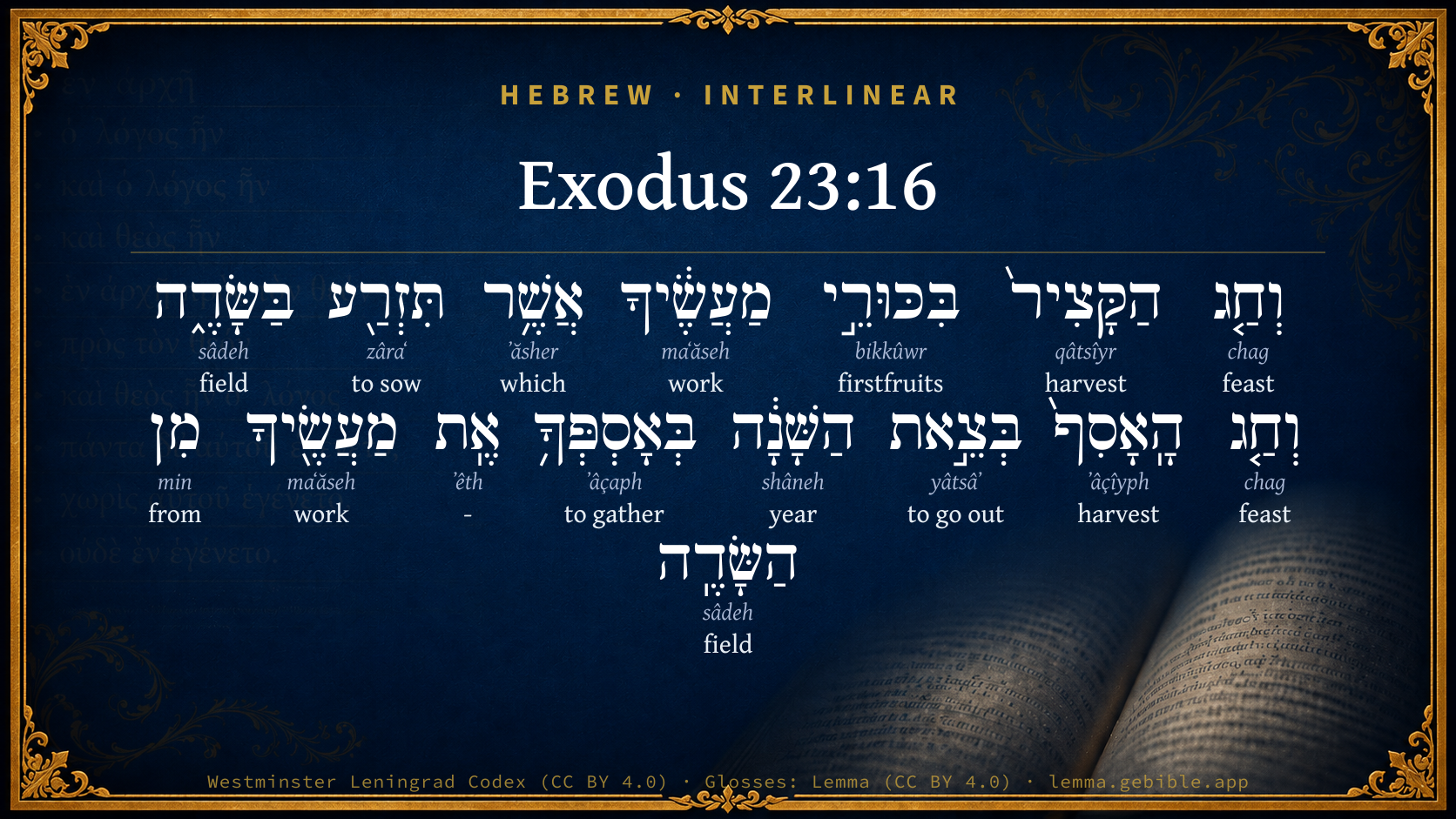
Hebrew (Westminster Leningrad Codex) Exodus 23:16 appears in the Hebrew Old Testament. The text above is from the Westminster Leningrad Codex. Each word links to its Strong’s number, a concise gloss, and parsing drawn from the Open Scriptures Hebrew Bible morphology. Click any word for its full Brown-Driver-Briggs (BDB) entry.
Download image
Cite this verse

Exodus 23:16 (World English Bible). Public Domain. Lemma interlinear Bible study tool, https://lemma.gebible.app/v/exodus/23/16.

Show BibTeX & RIS
BibTeX
RIS
English Translation
And the feast of harvest, the first fruits of your labors, which you sow in the field: and the feast of harvest, at the end of the year, when you gather in your labors out of the field.
World English Bible · Public Domain
Highlights
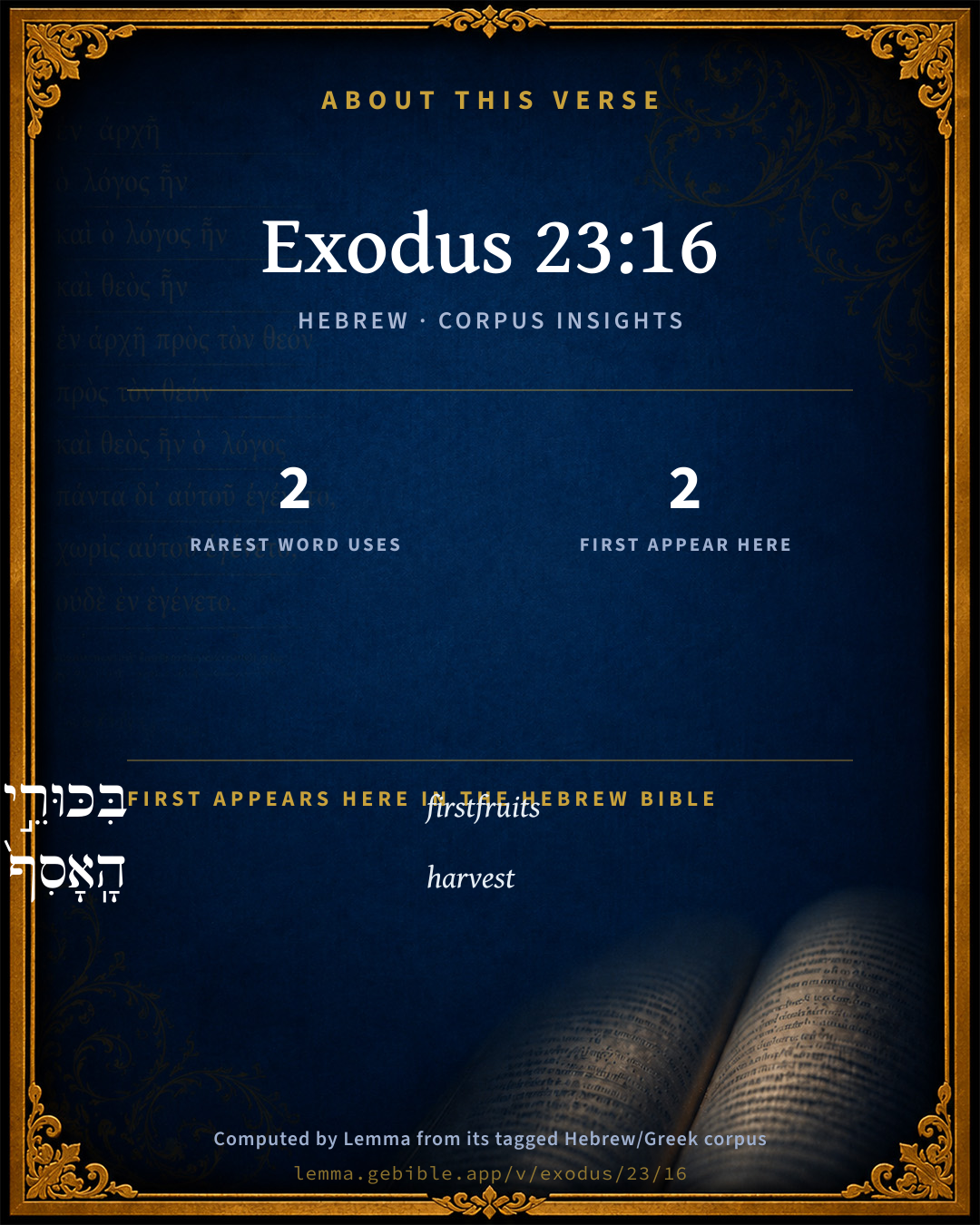
  • 2 first appearances in the Hebrew Bible
Full analysis ↓
Download a study sheet

One document with this verse’s original text, its word-by-word gloss line, the meaning frame, cross-references with their text, attributed commentary, and full source and license credits — printable, and it pastes into notes with its structure intact.

This verse Autodidact and up

Study sheet (.html) Plain text (.txt)

A passage Seminary Student

Up to 50 verses in one chapter. A passage sheet keeps up to 6 commentary sources and 12 cross-references per verse, in the order this page ranks them, and says so on the sheet whenever that leaves anything out. Ask for a single verse and you get the Autodidact verse sheet above.

Everything on this page stays free to read, with no account — the sheet is a download of what is already on screen, not access to it.

Want to remove ads? Support Godless Engineer
Compare translations 3

The same verse in 3 English versions, stacked beneath the original-language interlinear above. Click any original word for its lexicon entry.

Each is an independent rendering of the whole verse — the interlinear is not word-aligned to these translations.

Highlighted words mark where these versions differ — a whole-verse word diff, not a word-by-word alignment.

  • World English Bible Public Domain
    And the feast of harvest, the first fruits of your labors, which you sow in the field: and the feast of harvest, at the end of the year, when you gather in your labors out of the field.
  • King James Version Public Domain
    And the feast of harvest, the firstfruits of thy labors, which thou hast sown in the field: and the feast of ingathering, which is in the end of the year, when thou hast gathered in thy labors out of the field.
  • unfoldingWord Literal Text CC BY-SA 4.0
    And the Festival of the Harvest, the first fruits of your labors which you sowed in the field. And the Festival of the Gathering in the exiting of the year, in your gathering of your labors from the field.

unfoldingWord Literal Text — © unfoldingWord, licensed CC BY-SA 4.0. Word-aligned USFM3 via Door43 (git.door43.org/unfoldingWord/en_ult).

Versions to compare (up to 4)

3 of 4 selected

Show all 18 translations

Every available English version of this verse, each an independent rendering of the whole verse.

  • World English Bible Public Domain
    And the feast of harvest, the first fruits of your labors, which you sow in the field: and the feast of harvest, at the end of the year, when you gather in your labors out of the field.
  • Berean Standard Bible Public Domain
    You are also to keep the Feast of Harvest with the firstfruits of the produce from what you sow in the field. And keep the Feast of Ingathering at the end of the year, when you gather your produce from the field.
  • Majority Standard Bible Public Domain
    You are also to keep the Feast of Harvest with the firstfruits of the produce from what you sow in the field. And keep the Feast of Ingathering at the end of the year, when you gather your produce from the field.
  • King James Version Public Domain
    And the feast of harvest, the firstfruits of thy labors, which thou hast sown in the field: and the feast of ingathering, which is in the end of the year, when thou hast gathered in thy labors out of the field.
  • American Standard Version (1901) Public Domain
    and the feast of harvest, the first-fruits of thy labors, which thou sowest in the field: and the feast of ingathering, at the end of the year, when thou gatherest in thy labors out of the field.
  • Revised Version (1885) Public Domain
    and the feast of harvest, the firstfruits of thy labours, which thou sowest in the field: and the feast of ingathering, at the end of the year, when thou gatherest in thy labours out of the field.
  • Geneva Bible (1599) Public Domain
    The feast also of the haruest of the first fruites of thy labours, which thou hast sowen in the fielde: and the feast of gathering fruites in the ende of the yere, when thou hast gathered in thy labours out of the fielde.
  • Douay-Rheims (1899) Public Domain
    And the feast of the harvest of the firstfruits of thy work, whatsoever thou hast sown in the field. The feast also in the end of the year, when thou hast gathered in all thy corn out of the field.
  • Young's Literal Translation Public Domain
    and the Feast of Harvest, the first fruits of thy works which thou sowest in the field; and the Feast of the In-Gathering, in the outgoing of the year, in thy gathering thy works out of the field.
  • Literal Standard Version CC BY-SA 4.0
    and the Celebration of Harvest, the first-fruits of your works which you sow in the field; and the Celebration of the Ingathering in the outgoing of the year, in your gathering your works out of the field.
  • Unlocked Literal Bible CC BY-SA 4.0
    You must observe the Festival of Harvest, the firstfruits of your labors when you sowed seed in the fields. Also you must observe the Festival of Ingathering at the end of the year, when you gather in your produce from the fields.
  • unfoldingWord Literal Text CC BY-SA 4.0
    And the Festival of the Harvest, the first fruits of your labors which you sowed in the field. And the Festival of the Gathering in the exiting of the year, in your gathering of your labors from the field.
  • Darby Bible Public Domain
    and the feast of harvest, the first-fruits of thy labours which thou hast sown in the field, and the feast of in-gathering, at the end of the year, when thou gatherest in thy labours out of the field.
  • World Messianic Bible Public Domain
    And the feast of harvest, the first fruits of your labors, which you sow in the field; and the feast of ingathering, at the end of the year, when you gather in your labors out of the field.
  • Webster's Bible Public Domain
    And the feast of harvest, the first-fruits of thy labors, which thou hast sown in the field: and the feast of in-gathering, which is in the end of the year, when thou hast gathered in thy labors out of the field.
  • Free Bible Version CC BY-SA 4.0
    You are also to observe the Festival of Harvest when you present the firstfruits of the produce from what you've sown in the fields. Lastly you are to observe the Festival of Gathering-In the Harvest at the end of the year, when you gather in the harvest of the rest of your crops from the field.
  • Bible in Basic English Public Domain
    And the feast of the grain-cutting, the first-fruits of your planted fields: and the feast at the start of the year, when you have got in all the fruit from your fields.
  • JPS Tanakh (1917) Public Domain
    and the feast of harvest, the first-fruits of thy labours, which thou sowest in the field; and the feast of ingathering, at the end of the year, when thou gatherest in thy labours out of the field.

Literal Standard Version (2020), Covenant Press — licensed CC BY-SA 4.0. Text via the HelloAO Bible API (eBible.org). Unlocked Literal Bible (unfoldingWord) — licensed CC BY-SA 4.0. Text via the HelloAO Bible API (eBible.org). unfoldingWord Literal Text — © unfoldingWord, licensed CC BY-SA 4.0. Word-aligned USFM3 via Door43 (git.door43.org/unfoldingWord/en_ult). Free Bible Version, Dr. Jonathan Gallagher — licensed CC BY-SA 4.0. Text via the HelloAO Bible API (eBible.org).

Word by word

More ways to search: Search by grammar → Find every occurrence → Compare this word →

Practice this passage: Drill this verse → Learn its vocabulary →

הָֽאָסִף֙
ʼâçîyph
H614
“the · harvest”
Particle, Definite Article + Noun, Common, Masculine, Singular, Absolute
Part of Speech
Particle + Noun
Type
Common
Gender
Masculine
Number
Singular
State
Absolute
Full BDB Definition

Origin: from H622

TWOT: 140b

ingathering, harvest
  1. וְחַ֤ג chag H2282 “and · feast of” Conjunction + Noun, Common, Masculine, Singular, Construct
  2. הַקָּצִיר֙ qâtsîyr H7105 “the · harvest” Particle, Definite Article + Noun, Common, Masculine, Singular, Absolute
  3. בִּכּוּרֵ֣י bikkûwr H1061 “firstfruits of” Noun, Common, Both, Plural, Construct
  4. מַעֲשֶׂ֔יךָ maʻăseh H4639 “works · your” Noun, Common, Masculine, Plural, Construct + Suffix, Personal, 2nd Person, Masculine, Singular
  5. אֲשֶׁ֥ר ʼăsher H834 “which” Particle, Relative
  6. תִּזְרַ֖ע zâraʻ H2232 “to sow” Verb, Qal, Imperfect, 2nd Person, Masculine, Singular
  7. בַּשָּׂדֶ֑ה sâdeh H7704 “in/at the · field” Preposition, Determined + Noun, Common, Masculine, Singular, Absolute
  8. וְחַ֤ג chag H2282 “and · feast of” Conjunction + Noun, Common, Masculine, Singular, Construct
  9. בְּצֵ֣את yâtsâʼ H3318 “in/at · to go out” Preposition + Verb, Qal, Infinitive Construct
  10. הַשָּׁנָ֔ה shâneh H8141 “the · year” Particle, Definite Article + Noun, Common, Feminine, Singular, Absolute
  11. בְּאָסְפְּךָ֥ ʼâçaph H622 “in/at · to gather · you” Preposition + Verb, Qal, Infinitive Construct + Suffix, Personal, 2nd Person, Masculine, Singular
  12. אֶֽת ʼêth H853 “-” Particle, Direct Object
  13. מַעֲשֶׂ֖יךָ maʻăseh H4639 “works · your” Noun, Common, Masculine, Plural, Construct + Suffix, Personal, 2nd Person, Masculine, Singular
  14. מִן min H4480 “from” Preposition
  15. הַשָּׂדֶֽה sâdeh H7704 “the · field” Particle, Definite Article + Noun, Common, Masculine, Singular, Absolute

About this verse

These counts appear in no published source. They are computed here, from the morphology-tagged text and Lemma’s own curated glosses. What Lemma adds →

16
words
13
distinct lemmas
Pentateuch
section

Notable vocabulary

The rarest word here is הָֽאָסִף֙ harvest H614 — appearing just 2 times in the whole Hebrew Bible.

First appearance in Scripture

These words make their first canonical appearance in the Hebrew Bible here:

  • בִּכּוּרֵ֣י firstfruits H1061
  • הָֽאָסִף֙ harvest H614

Shared distinctive vocabulary

הָֽאָסִף֙ harvest H614 occurs in 2 verses of the Hebrew Bible. Also found in:

Grammatical profile

  • 3 verbs
  • 10 nouns
  • 1 preposition
  • 2 particles

Verb forms

  • תִּזְרַ֖ע Qal · Imperfect
  • בְּצֵ֣את Qal · Infinitive Construct
  • בְּאָסְפְּךָ֥ Qal · Infinitive Construct

Repetition

Words recur within this verse — often emphatic in Hebrew:

  • וְחַ֤ג feast H2282 ×2
  • מַעֲשֶׂ֔יךָ work H4639 ×2
  • בַּשָּׂדֶ֑ה field H7704 ×2

Hebrew & Septuagint length

In English translation the verse runs 38 words from the Hebrew and 45 from the Septuagint (LXX English) — closely comparable.

A rough comparison of the two English renderings, which tokenize alike — not a word-level alignment.

Word counts can differ between the Hebrew and the Greek without any difference in meaning — e.g. the Hebrew direct-object marker אֵת has no separate Greek word, and Greek often adds the article ὁ.

Cross-references

12

Topical passages linked to Exodus 23:16 in the Treasury of Scripture Knowledge — connected by theme and wording, ordered by reader-vote popularity; previews shown in the World English Bible.

  • Exodus 34:22 You shall observe the feast of weeks with the first fruits of wheat harvest, and the feast of harvest at the year's end.
  • Leviticus 23:9–21 Yahweh spoke to Moses, saying,
  • Exodus 22:29 "You shall not delay to offer from your harvest and from the outflow of your presses. "You shall give the firstborn of your sons to me.
  • Leviticus 23:34–44 "Speak to the children of Israel, and say, 'On the fifteenth day of this seventh month is the feast of tents for seven days to Yahweh.
  • Deuteronomy 16:9–15 Seven weeks shall you number to you: from the time you begin to put the sickle to the standing grain shall you begin to number seven weeks.
  • Numbers 29:12–39 On the fifteenth day of the seventh month you shall have a holy convocation; you shall do no servile work, and you shall keep a feast to Yahweh seven days:
  • Nehemiah 8:14–18 They found written in the law, how that Yahweh had commanded by Moses, that the children of Israel should dwell in booths in the feast of the seventh month;
  • Zechariah 14:16–19 It will happen that everyone who is left of all the nations that came against Jerusalem will go up from year to year to worship the King, Yahweh of Hosts, and to keep the feast of tents.
  • John 7:2 Now the feast of the Jews, the Feast of Booths, was at hand.
  • John 7:37 Now on the last and greatest day of the feast, Jesus stood and cried out, "If anyone is thirsty, let him come to me and drink!
  • Acts 2:1 Now when the day of Pentecost had come, they were all with one accord in one place.
  • Numbers 28:26–31 Also in the day of the first fruits, when you offer a new meal-offering to Yahweh in your [feast of] weeks, you shall have a holy convocation; you shall do no servile work;

Cross-references courtesy of OpenBible.info (CC BY 4.0).

Hebrew and Greek witnesses Masoretic Hebrew ↔ Greek Septuagint

The same verse in the two great witnesses to the Old Testament, shown verse-for-verse.

These are two independent witnesses, not word-aligned to each other, and the Septuagint is shown in lemma (dictionary) form.

Hebrew Exodus 23:16 Masoretic · Westminster Leningrad Codex

וְחַ֤ג הַקָּצִיר֙ בִּכּוּרֵ֣י מַעֲשֶׂ֔יךָ אֲשֶׁ֥ר תִּזְרַ֖ע בַּשָּׂדֶ֑ה וְחַ֤ג הָֽאָסִף֙ בְּצֵ֣את הַשָּׁנָ֔ה בְּאָסְפְּךָ֥ אֶֽת מַעֲשֶׂ֖יךָ מִן הַשָּׂדֶֽה

And the feast of harvest, the first fruits of your labors, which you sow in the field: and the feast of harvest, at the end of the year, when you gather in your labors out of the field.

World English Bible · Public Domain

Greek LXX Exodus 23:16 Septuagint · lemma form

καί ἑορτή θερισμός πρωτογένημα ποιέω ὁ ἔργον σύ ὅς ἐάν σπείρω ἐν ὁ ἀγρός σύ καί ἑορτή συντέλεια ἐπί ἔξοδος ὁ ἐνιαυτός ἐν ὁ συναγωγή ὁ ἔργον σύ ὁ ἐκ ὁ ἀγρός σύ

And you shall keep the feast of the harvest of first fruits of your labors, whatever you shall have sown in your field, and the feast of completion at the end of the year in the gathering in of your fruits out of your field.

LXX2012 (modern English Septuagint) · Public Domain

Hebrew: Westminster Leningrad Codex (CC BY 4.0). Greek: Septuagint (public domain); English from LXX2012 (modern English Septuagint) (Public Domain). How the Septuagint differs from the Hebrew →

Targum (Aramaic paraphrase)

2

The Targum is the ancient Jewish Aramaic paraphrase of the Hebrew Scriptures — an interpretive translation, not the Hebrew text itself. Onkelos (literal) and Pseudo-Jonathan (expansive) render the Torah, and Jonathan the Prophets. Coverage is partial: where no permissively-licensed English translation exists for a verse, only the Aramaic is shown. This is verse-level text, not a word-by-word alignment to the Hebrew.

  1. Targum Onkelos Torah (Genesis–Deuteronomy)
    וְחַגָא דַחֲצָדָא בִּכּוּרֵי עוֹבָדָיךְ דִי תִזְרַע בְּחַקְלָא וְחַגָא דִכְנָשָׁא בְּמִפְּקָא דְשַׁתָּא בְּמִכְנְשָׁךְ יָת עוֹבָדָיךְ מִן חַקְלָא:

    (no public-domain English translation for this verse)

    Targum Onkelos — Aramaic: “Onkelos Genesis” (public domain); “Onkelos Exodus” (public domain); “Onkelos Leviticus” (public domain); “Onkelos Numbers” (public domain); “Onkelos Deuteronomy” (public domain). English: “Sefaria Community Translation” (CC0 1.0 (public-domain dedication)); “J.W. Etheridge. The Targums of Onkelos and Jonathan Ben Uzziel on the Pentateuch. London: Longmans, Green, 1862” (public domain). Text via Sefaria.

  2. Targum Pseudo-Jonathan Torah (Genesis–Deuteronomy)
    וְחַגָא דְחַצְדָא בִּכּוּרֵי עוּבְדָךְ דְּתִזְרַע בְּחַקְלָא וְחַגָא דִּכְנָשָׁא בְּמִפְקָא דְשַׁתָּא בְּמִכְנְשָׁךְ יַת עוּבְדָךְ מִן חַקְלָא

    And the feast of the harvest first-fruits of the work thou didst sow in the field; and the feast of gathering, at the end of the year, when thou hast gathered in thy work from the field.

    Targum Pseudo-Jonathan — Aramaic: “Targum Jonathan on Genesis” (public domain); “Targum Jonathan on Exodus” (public domain); “Targum Jonathan on Leviticus” (public domain); “Targum Jonathan on Numbers” (public domain); “Targum Jonathan on Deuteronomy” (public domain). English: “The Targum of Jonathan ben Uzziel, trans. J. W. Etheridge, London, 1862” (public domain). Text via Sefaria.

Commentary

Notes on Exodus 23:16 from classic Christian and Jewish commentators (each source and its license shown beneath its notes). The classic Christian expositions comment on the surrounding passage and are grouped to its opening verse, so a note may address several verses; the Jewish commentaries on the Tanakh (Rashi and others) are per-verse, so they appear only where the commentator wrote on this verse.

Lemma curates 59 commentaries, every one of them public domain or Creative Commons licensed, each selected and text-cleaned for this edition rather than reprinted as found. About our sources →

Trapp's Complete Commentary

John Trapp

Exo 23:16 And the feast of harvest, the firstfruits of thy labours, which thou hast sown in the field: and the feast of ingathering, [which is] in the end of the year, when thou hast gathered in thy labours out of the field.

Ver. 16. And the feast of harvest.] Pentecost, when their wheat harvest came in.

In the end of the year.] See the reason of this law in Deu 11:12. It was "a land which the Lord cared for: the eyes of the Lord were always upon it from the beginning of the year even unto the end of the year."

John Trapp, A Commentary or Exposition upon All the Books of the Old and New Testament (1647–1656) — public domain. Text from a community e-Sword module.

The Biblical Illustrator

Joseph S. Exell

Exo_23:16

The feast of harvest.

The feast of harvest

I. The instruction it communicates

1. It exhibits the wonderful power of God.

2. We have an establishment of the faithfulness and truth of God.

3. We have a manifestation of the goodness and bounty of God.

4. It displays the mercy and forbearance of God.

5. It shows us the connection between means and the end.

II. What feelings it should produce. It should produce feelings--

1. Of deep humiliation.

2. Of heartfelt gratitude.

3. Our constant dependence upon God.

4. A constant desire to please Him.

III. What practical influence the subject should exert upon us.

1. To labour for the provision suited to our souls.

2. To do good in our respective spheres and stations in life.

3. Prepare for the final harvest.

Application:

1. Let us gratefully enjoy the bounties of Providence. Many are abusing, many forgetting, etc.

2. Let us be especially anxious about the blessings of eternal life.

3. Let us always act in reference to the final harvest of the world. (J. Burns, D. D.)

Pilgrimage feasts

I. Religious feasts are memorials.

1. Of Gods past dealings.

2. Of our dependence on Gods care.

3. Of our present condition. Pilgrims. This earth is not our rest.

II. Religious feasts are not to interfere with the duties of life.

III. stated religious feasts are helpful to a religious spirit.

IV. Religious feasts must promote the social and benevolent instincts of our nature.

V. The offerings at religious feasts must be--

1. Pure,

2. Of the best. (W. Burrows, B. A.)

The feast of harvest

This was their Pentecost; so called from a Greek word signifying fifty--because it occurred on the fiftieth day from the feast of unleavened bread. It was, properly, a harvest festival, in which the Jew offered thanksgiving unto God for the ripened fruits of the earth. To understand the peculiar interest the Jew took in this holiday, you must remember that the Israelites, after their establishment in Canaan, were almost entirely a nation of farmers. The peasant and the noble, in their respective spheres, were alike husbandmen. And the whole land of Israel was in the highest state of cultivation. Now, to such a people, inhabiting such a country, the feast of harvest was necessarily a grand festival.

1. We, too, want great national and religious holidays, to keep in mind great national providences.

2. We need them, moreover, as verily as the Jews, for their conservative political influence--to counteract the sectional and unsocial tendencies of our great tribal divisions. If we could come up nationally to such Pentecosts, then no living man would ever again dare breathe of discord and disunion--for chords, tender as our loves and stronger than our lives woven of religion and holy with old memories, as the memorial festivals uniting Judah and Ephraim, would bind us together and bind us to God!

3. Meanwhile we need such pentecostal holidays for those personal advantages which they brought to the Hebrews. They furnish that harmless relaxation so constitutionally necessary to our highest well-being. Real pleasure, as well physical as moral, is always the true law of life. True virtue is genial and joyous, walking earth in bright raiment, and with bounding footsteps. And the nervous, restless, unreposing, devouring intensity of purpose wherewith our men follow their business, is as disastrous to the nobler moral bloom and aroma of the heart, as a roaring hurricane to a garden of roses. Above all, our religious nature needs them. The true joy of the Lord is the Christians strength. Cheerfulness is a very element of godliness.

4. This is our Pentecost--our feast of harvest. And even in its lowest aspect, as a grateful acknowledgment of Gods goodness, in preserving for our use the kindly fruits of the earth, it is a fitting occasion of thankfulness. It is scarcely possible to over-estimate the importance of agriculture. It surpasses commerce and manufacture, as a cause is superior to its effects--as an inner life is of more moment than its various outward functions. Meanwhile, the reflex influences of industrial agriculture on our physical and social well-being are as well incalculable. After all, the finest products of our farm-lands are found in our farm-houses. Things better than corn and cabbages are grown on plough-ground--bone, muscle, sinew, nerve, brain, heart; these all thrive and strengthen by agriculture. The specimens of strong, hale, common-sense manhood seen at our annual fairs are a finer show than all the fat cattle and sheep, and noble horses, and the brave array of farm-fruits and implements. Agriculture purifies morals, chastens taste, deepens the religious element, develops the individual man.

5. Our thanksgiving is partly in view of the ripened fruits of the earth; but mainly in view of other and higher blessings. And in this regard as well, it is properly--a feast of harvest. In respect of all things--not merely the natural fruits of the earth, but all great human interests, political, intellectual, religious--we may be said to live in the worlds great harvest time. We have reaped, and are reaping, the ripened and ripening fruits of all earths past generations. Consider this a little.

(1) First: This is true--politically. Philosophically considered, the grand end and aim of all civil progress is human freedom--the highest development and culture of the individual and free manhood. Monarchy the one-man-power, oligarchy the few-men-power, are but the successive stages of the growing life, up to the ripened product of the true democracy--the all-men power. To this end hath tendered all political progress; and beyond this there is no progress. This is the harvest of earths long political husbandry, and we are reaping it.

(2) Then passing from the political, the same thought is true in regard of the intellectual. It is a thought well worthy our pondering, on an occasion like this--that we live in the harvest-time of mind and thought! Carefully considered, the development of the mental follows the law of material development. First, the blade, then the ear, after that the full corn in the ear. Genius is first poetical, then practical. First, the flaunting blossom; then the substantial fruit. From the beginning, mans law of intellectual progress has been from the abstract to the practical--from ideas to facts. The practical, being the fruit of the imaginative, as the ripened corn is the fruit of the plants inner life. In past generations, intellect has been busy in a rudimental husbandry--felling the great forests; draining the low marshes; subduing the rugged soil; scattering the seed; and watching and waiting for the increase. The old philosophy; the old civilization; the old polities, civil and ecclesiastical; the old chivalry; the old poetry--these were the thought-germs, the thought-leaves, the thought-blossoms, which have ripened, and are ripening around us into Gods glorious fruit! We live in earths prodigal and luxuriant autumn--in times when marvellous things are the rule, and mean things the exception--in an economy of prodigies, each one a seeming miracle to mens earlier comprehension, and yet all, only the ripened development of their own thought-germs. And if the law of all husbandry be to sow in tears and reap in joy, then our thanksgiving, that we live in these eventful times, should be unto God, this day, a great feast of harvest!

(3) Passing this, we observe once more, and finally, That this same law of development we have been tracing through the political and intellectual, will be found to rule in the spiritual--and in this regard should we mainly rejoice that we live in lifes harvest-time.

6. In respects, then, like these, political, intellectual, religious, we live in times of unexampled blessedness. We have come up to Zion from hills purple with vintage, and valleys golden with corn, in the rapturous harvest-home of the mortal! And it becomes us to keep festival before God as the old Jew kept his Pentecost. As men, as patriots, as philanthropists, as Christians, our cup of joy mantles brightly. What more could God have done for us that He hath not done? What people can be happy before God, if we are not happy? Living here, in this nineteenth century, free men--free Christians--we seem to stand on the very mount of God, flung up in the waste of ages, for the enthronement of His great man-child! We look backward, and lo! all the past has been working together for our national and individual beatitude. Patriarchs, prophets, bards, sages, mighty men, conquerors, have all been our servants. Generation after generation, that have lived and died--great empires, that have risen and flourished, and trod imperial paths, and passed away for ever--seem to rise from their old death-dust, and march in vision before us, laying down all their accumulated thoughts, and arts, and honours--all the trophies of their mighty triumphs, in homage, at our feet! We look forward, and the eye is dazzled with the vision of the glory about to be accorded to Gods kingly creature, man! when standing upon this redeemed world, he shall assert his birthright--a child of God here! an heir of God for ever! Verily, we have cause for thanksgiving. The Lord hath done great things for us, whereof we are glad. Let us give, then, free course to our grateful emotions! Thankful for the present, trustful for the future, let us rejoice before God with the joy of harvest. (C. Wadsworth.)

The Biblical Illustrator, edited by Joseph S. Exell (c. 1880s–1900s) — public domain. Text from a community e-Sword module.

MacLaren's Expositions of Holy Scripture

Alexander MacLaren

Exodus

THE FEAST OF INGATHERING IN THE END OF THE YEAR

Exo 23:16.

The Israelites seem to have had a double beginning of the year-one in spring, one at the close of harvest; or it may only be that here the year is regarded from the natural point of view-a farmer’s year. This feast was at the gathering in of the fruits, which was the natural close of the agricultural year.

This festival of ingathering was the Feast of Tabernacles. It is remarkable that the three great sacred festivals, the Passover, Pentecost, Tabernacles, had all a reference to agriculture, though two of them also received a reference to national deliverances. This fact may show that they were in existence before Moses, and that he simply imposed a new meaning on them.

Be that as it may, I take these words now simply as a starting-point for some thoughts naturally suggested by the period at which we stand. We have come to the end of another year-looked for so long, passed so swiftly, and now seeming to have so utterly departed!

I desire to recall to you and to myself the solemn real sense in which for us too the end of the year is a ‘time of ingathering’ and ‘harvest.’ We too begin the new year with the accumulated consequences of these past days in our ‘barns and garners.’

Now, in dealing with this thought, let me put it in two or three forms.

I. Think of the past as still living in and shaping the present.

It is a mere illusion of sense that the past is gone utterly. ‘Thou carriest them away, as with a flood.’ We speak of it as irrevocable, unalterable, that dreadful past. It is solemnly true that ‘ye shall no more return that way.’

But there is a deeper truth in the converse thought that the apparently transient is permanent, that nothing human ever dies, that the past is present. ‘The grass withereth, the flower fadeth,’-yes, but only its petals drop, and as they fall, the fruit which they sheltered swells and matures.

The thought of the present as the harvest from the past brings out in vivid and picturesque form two solemn truths.

The first is the passing away of all the external, but of it only. It has all gone where the winter’s cold, the spring rains, the summer’s heats have gone. But just as these live in the fruitful results that have accrued from them, just as the glowing sunshine of the departed ardent summer is in the yellow, bending wheat-ear or glows in the cluster, so, in a very solemn sense, ‘that which hath been is now’ in regard to every life. The great law of continuity makes the present the inheritor of the past. That law operates in national life, in which national characteristics are largely precipitates, so to speak, from national history. But it works even more energetically, and with yet graver consequences, in our individual lives. ‘The child is father of the man.’ What we are depends largely on what we have been, and what we have been powerfully acts in determining what we shall be. Life is a mystic chain, not a heap of unconnected links.

And there is another very solemn way in which the past lives on in each of us. For not only is our present self the direct descendant of our past selves, but that past still subsists in that we are responsible for it, and shall one day have to answer for it. The writer of Ecclesiastes followed the statement just now quoted as to the survival of the past, with another, which is impressive in its very vagueness: ‘God seeketh again that which is passed away.’

So the undying past lives in its results in ourselves, and in our being answerable for it to God.

This metaphor is insufficient in one respect. There is not one epoch for sowing and another for reaping, but the two processes are simultaneous, and every moment is at once a harvest and a seed-time.

This fact masks the reality of the reaping here, but it points on to the great harvest when God shall say, ‘Gather the wheat into My barns!’

II. Notice some specific forms of this reaping and ingathering.

{1} Memory.

It is quite possible that in the future it may embrace all the life.

‘Chambers of imagery.’

{2} Habits and character. Like the deposit of a flood. ‘Habitus’ means clothing, and cloth is woven from single threads.

{3} Outward consequences, position, reputation, etc.

III. Make a personal reference to ourselves.

What sort of harvest are we carrying over from this year? Lay this to heart as certain, that we enter on no new year-or new day-empty-handed, but always ‘bearing our sheaves with us.’ ‘Be not deceived! God is not mocked. Whatsoever a man soweth, that shall he also reap.’

But remember, that while this law remains, there is also the law of forgiveness, ‘Go in peace!’ and there may be a new beginning, ‘Sin no more!’

Alexander MacLaren, Expositions of Holy Scripture (1904–1910) — public domain. Text from a community e-Sword module.

Tyndale Open Study Notes

Tyndale Open Resources

23:16 The Festival of Harvest was celebrated seven weeks after Passover, around the end of the barley harvest and the beginning of the wheat harvest (mid-May to mid-June). In postbiblical Judaism, this festival commemorated the giving of the Sinai covenant, which was calculated to have occurred fifty days after the first Passover in Egypt (see Lev 23:15-21; Deut 16:9-12). • The Festival of the Final Harvest was celebrated on the fifteenth day of the seventh month of the Hebrew calendar (mid-September to mid-October), after the final harvest of grapes was complete. This festival commemorated the wilderness wanderings when God provided for his people.

Tyndale Open Study Notes — © Tyndale Open Resources, licensed CC BY-SA 4.0. Text via the HelloAO Bible API.

Geneva Bible (1599)

Geneva Bible translators

This is the feast of Tabernacles, signifying that they dwelled 40 years under the tents or the Tabernacles in wilderness.

Which is Whitsuntide, in token that the Law was given 50 days after they departed from Egypt.

Geneva Bible (1599) marginal notes — public domain. Text via Bolls.life.

Ellicott's Commentary for English Readers

(16) The feast of harvest.—It was calculated that the grain-harvest would be completed fifty days after it had begun. On this fiftieth day (Pentecost) the second festival was to commence by the offering of two loaves made of the new wheat just gathered in. On the other offerings commanded, see Lev_23:18-20. The Law limited the feast to a single day—the “day of Pentecost”—but in practice it was early extended to two days, in order to cover a possible miscalculation as to the exact time.

The feast of ingathering.—Elsewhere commonly called “the feast of tabernacles” (Lev_23:34; Deu_16:13; Deu_16:16; Deu_31:10; 2Ch_8:13; Ezr_3:4; Zec_14:16-19, &c.). Like the feast of unleavened bread, this lasted for a week. It corresponded to a certain extent with modern “harvest-homes,” but was more prolonged and of a more distinctly religious character. The time fixed for it was the week commencing with the fifteenth and terminating with the twenty-first of the month Tisri, corresponding to our October. The vintage and the olive-harvest had by that time been completed, and thanks were given for God’s bounties through the whole year. At the same time the sojourn in the wilderness was commemorated; and as a memorial of that time those who attended the feast dwelt during its continuance in booths made of branches of trees. (See Lev_23:40; Neh_8:14-17.)

A Bible Commentary for English Readers, edited by Charles John Ellicott (1878–1897) — public domain. Text from a community e-Sword module.

The Cambridge Bible for Schools and Colleges

gen. ed. J. J. S. Perowne

16a. The second pilgrimage, the Feast of Harvest, celebrating the completion of the wheat harvest (Exo_34:22), in June, and marked by the offering of firstfruits from the ripened grain (in Exo_34:22 ‘the firstfruits of wheat harvest’ takes the place of ‘the firstfruits of thy labours’ here). The term ‘Feast of Harvest’ is found only here: in Exo_34:22 and in Dt. (Deu_16:10; Deu_16:16) it is called the Feast of Weeks, on account of its being kept seven weeks after the sickle was first put to the corn, Deu_16:9, or (in H) after the first sheaf of the year’s harvest had been presented to Jehovah as a wave-offering, Lev_23:15 (see v. 10); and in Num_28:26 (P) the Day of firstfruits. For the regulations in the other codes, see Deu_16:9-12; Lev_23:15-21 (H and P: in H loaf of fine flour, baked with leaven, is to be ‘waved’ as firstfruits to Jehovah; in a gloss (based on Num_Exo_28:27-30) the required sacrifices are prescribed); Num_28:26-31 (P).

labours] work, as v. 12 (G.-K. § 93ss); cf. 1Sa_25:2 Heb. The following words explain what is meant: (even) of that which thou sowest would be clearer.

(even) of the firstfruits &c.] Heb. bikkurim (cognate with bekôr, ‘firstborn,’ ‘firstling’), denoting properly firstripe fruit (including cereals) in general (as Nah_3:12 lit. ‘figtrees with bikkurim’), but used specially of those portions of the ‘firstripe fruit’ which were presented to Jehovah. Bikkurim occurs besides v. 19 (and the || || Exo_34:22; Exo_34:26), Lev_2:14; Lev_23:17; Lev_23:20, Num_13:20; Num_18:13; Num_23:26, 2Ki_4:42 (‘bread of firstfruits’ brought to Elisha), Neh_10:35; Neh_13:31, Eze_44:30†. Cf. p. 246.

No historical significance is in the OT. attached to this festival; but by the later Jews it was regarded as commemorating the giving of the law ‘in the third month’ of the Exodus (Exo_19:1), which was supposed to have taken place 50 days after the 15th of the first month (Lev_23:6; the morning after the Passover on the 14th, Exo_12:18).

16b. The third pilgrimage, the Feast of Ingathering, held at the end of the year, in September, when the threshing was finished, the vintage over, and the juice pressed out from the grapes and olives (Deu_16:13 ‘when thou gatherest in from thy threshing-floor and from thy wine-vat’). It is called the ‘Feast of Ingathering’ also in Exo_34:22†: in Dt. (Deu_16:13; Deu_16:16, Deu_31:10) and P (Lev_23:34), as also in later writers generally (Ezr_3:4, 2Ch_8:13, Zec_14:16; Zec_14:18-19†), it is called, from the custom of dwelling at the time in booths made of the branches of trees (Lev_23:40; Lev_23:42 [H]; Neh_8:14-17), the Feast of Booths. This feast, according to Dt. (Deu_16:13; Deu_16:15), H and P (Lev_23:34; Lev_23:39, Num_29:12), lasted for 7 days (cf. Neh_8:18). It was an occasion of hilarity (cf. Deu_16:15 end, Lev_23:40 b): in Jdg_9:27 a festival is mentioned, which seems to have been its Canaanite counterpart. Cf. also Jdg_21:19; Jdg_21:21. Comp., in the other codes, Deu_16:13-15; Lev_23:39-43 (mostly H); Lev_23:33-36, Num_29:12-38 (both P). In Lev_23:43 (H) the custom of dwelling in booths is explained as commemorating the fact that the Israelites dwelt in ‘booths’ after their departure from Egypt. ‘Booths,’ or huts, are not however the same as tents: and the actual origin of the custom is more probably to be found in the fact that those employed in gathering the fruit-harvest would sleep at the time in huts in the vineyards and olive-gardens (cf. Isa_1:8). Afterwards, however, the ancient practice had a commemorative meaning attached to it (cf. on vv. 14–17); and it was treated as a reminder of important events.

at the going out of the year] The old Hebrew year ended, with the agricultural operations for the year, in autumn: cf. on Exo_12:2.

labours] lit. work—here of the product of the year’s work in agriculture.

The Cambridge Bible for Schools and Colleges (gen. ed. J. J. S. Perowne; Cambridge University Press, 1878–1918) — public domain. Text from a community e-Sword module.

John Gill's Exposition

Thou shall not offer the blood of my sacrifice with leavened bread,.... This belongs to the feast of the passover; for, as all the Jewish writers agree, this sacrifice is the sacrifice of the passover, as it is sometimes called, see Exo 12:27 now when the paschal lamb was killed, and its blood shed, and its flesh eaten, there was to be no leaven along with it; it was to be eaten with unleavened bread, and there was to be no leaven in their houses at this time; nay, it was not to be slain until all was removed: this was the first thing the Jews did, as soon as the fourteenth day was come, to search for leaven, remove and burn it; and this sense of the law is confirmed by the Targum of Jonathan, which is,"not a man shall slay, while there is leaven in your houses, the sacrifice of my passover;''and to the same purpose is the note of Jarchi:

neither shall the fat of my sacrifice remain until the morning; and indeed no part of the passover lamb was to remain until the morning, what did was to be burnt with fire, Exo 12:10 the Targum of Jonathan is,"neither shall there remain without the altar the fat of the sacrifice of my passover until the morning, nor of the flesh which ye ate in the evening;''and so Jarchi interprets it of its not remaining without the altar.

John Gill's Exposition of the Whole Bible (1746–1763) — public domain (CC PDM 1.0). Text via the HelloAO Bible API.

Matthew Poole's English Annotations

The feast of harvest, i.e. of wheat harvest, for barley harvest was before this time. This feast was otherwise called pentecost.

Quest. How were these the first-fruits, when a sheaf was offered to God in the feast of the passover?

Answ. That sheaf was generally of barley, which was less considerable than their wheat; but this was the first-fruits of their wheat, which was their principal grain, and they had no bread before this time from the growth of that year.

The feast of ingathering, to wit, of all the rest of the fruits of the earth, as of the vines and olives. This was also called the feast of booths, and of tabernacles. See Lev 13:43; Num 29:12; Deu 16:13. All their three feasts had a respect to the harvest, which began in the passover, was carried on at pentecost, and was fully completed and ended in this feast.

In the end of the year; of the common or civil year, which began in September, as the sacred year began in March.

Matthew Poole's English Annotations on the Holy Bible (1683–1685) — public domain. Text from a community e-Sword/MySword module.

The Pulpit Commentary

The feast of harvest. Fifty days were to be numbered from the day of offering the barley sheaf, and on the fiftieth the feast of harvest, thence called "Pentecost," was to be celebrated. Different Jewish sects make different calculations; but the majority celebrate Pentecost on the sixth of Sivan (May 25). The main ceremony was the offering to God of two leavened loaves of the finest flour made out of the wheat just gathered in, and called the first-fruits of the harvest. The festival lasted only a single day; but it was one of a peculiarly social and joyful character. (Deu_16:9-11) Jewish tradition connects the feast further with the giving of the law, which must certainly have taken place about the time. (see Exo_19:1-16) The firstfruits. Rather, "Of the first-fruits." The word is in apposition with "harvest," not with "feast." Which thou hast sown. The sown harvest was gathered in by Pentecost; what remained to collect afterwards was the produce of plantations.

The feast of ingathering. Called elsewhere, and more commonly, "the feast of tabernacles" (Lev_23:34; Deu_16:13 Deu_31:10 Joh_7:2) from the circumstance that the people were commanded to make themselves booths, and dwell in them during the time of the feast. The festival began on the 15th of Tisri, or in the early part of our October, when the olives had been gathered in and the vintage was completed. It lasted seven, or (according to some) eight days, and comprised two holy convocations. In one point of view it was a festival of thanksgiving for the final getting in of the crops; in another, a commemoration of the safe passage through the desert from Egypt to Palestine. The feast seems to have been neglected during the captivity, but was celebrated with much glee in the time of Nehemiah. (Neh_8:17) In the end of the yeari.e. , the end of the agricultural year when the harvest was over as explained in the following clause.

The Pulpit Commentary (1880–1919), ed. H.D.M. Spence-Jones & Joseph S. Exell — public domain. Text from a community e-Sword module.

unfoldingWord translationNotes

Door43 World Missions Community

General Information:

Yahweh continues telling Moses his laws for the people of Israel.

You must observe

"You must honor" or "You must celebrate"

Festival of Ingathering

This festival celebrated the final harvesting of all the crops for the year.

All your males must appear before the Lord Yahweh

Here to "appear" means to gather for worship. AT: "All the men must gather to worship the Lord Yahweh" (See: Assumed Knowledge and Implicit Information)

translationWords

festival

harvest

firstfruits

Yahweh

unfoldingWord translationNotes — © Distant Shores Media and the Door43 World Missions Community, licensed CC BY-SA 4.0. Source: git.door43.org/Door43/en_tn.

Rashi

Rabbi Shlomo Yitzchaki (Rashi)

וחג הקציר AND THE FESTIVAL OF HARVEST — this is the Feast of Weeks,

בכורי מעשיך which is the time for bringing the first-fruits, for the offering of the two loaves that were brought on the Feast of Weeks made it permissible for the first time during the year to use the new harvest of wheat for the meal offerings (Menachot 68b), and to bring the first fruits into the Temple, (Mishnah Bikkurim 1:3) for it is said, (Numbers 28:26) “And on the day of the first fruits etc., [בשבעתיכם on your weeks etc.]” (cf. Rashi on that verse).

וחג האסף AND THE FESTIVAL OF THE INGATHERING — that is the Feast of Tabernacles.

באספך את מעשיך WHEN THOU HAST GATHERED IN THY LABOURS — For during the whole summer-time the fruits are drying in the fields and about the Festival (הָחָג is a Talmudical term for the Feast of Tabernacles) they are gathered into the barns on account of the rain that is then due.

Rashi on the Tanakh — English translations: “The Judaica Press complete Tanach with Rashi, translated by A. J. Rosenberg” (CC BY 4.0); “Pentateuch with Rashi's commentary by M. Rosenbaum and A.M. Silbermann, 1929-1934” (public domain); “The Metsudah Tanach series, Lakewood, N.J” (CC BY 4.0); and “The Book of Joshua, Metsudah Publications, 1997” (CC BY 4.0). Text via Sefaria.

Ramban (Nachmanides)

Rabbi Moshe ben Nachman (Ramban / Nachmanides)

AND THE FEAST OF HARVEST, THE FIRST-FRUITS OF THY LABORS, AND THE FEAST OF INGATHERING AT THE END OF THE YEAR. I do not know why Scripture mentions the names of the festivals with the definite article since He has not yet commanded about or mentioned them at all till now, and it ought to have said first: “and you shall keep a feast of harvest, the first-fruits of your labors,” just as He said in the Book of Deuteronomy, And thou shalt keep a festival of weeks unto the Eternal thy G-d. But perhaps because He had already said, Three times thou shalt keep a feast unto Me in the year, and further explained, The feast of unleavened bread shalt thou keep… in the mouth of Aviv, [literally: “maturity”] means the month when the grain becomes full in its ripe state (Rashi). It is the month of spring. meaning that you are to make sure that the Passover festival is observed at the beginning of the month of Aviv, He referred back [to these verses] and said, “And as for the other festival, make sure that it be the feast of harvest, the first-fruits of thy labors, and as for the third one, make sure that it be the feast of ingathering, at the end of the year. Now all these festivals are thus named with reference to man’s activities in the field, in order that he give thanks for them to G-d who guards the ordinances of heaven, and brings forth bread out of the earth to satisfy the longing soul, and the hungry soul He hath filled with good., 107:9. This is Scripture’s intention in using here the expression: el pnei Ha’adon Hashem (three times in the year shall all thy males appear — ‘before the Master, the Eternal’), for He is the Master who provides the needs of His servants, and when they take their part from before Him, they come to Him to see what He commands them to do. Thus the expression el pnei is like ‘liphnei’ (“before”) — before the Master. But by way of the Truth, [the mystic teachings of the Cabala], the word pnei is derived from the term panim [literally: “face”], and I have already alluded to the explanation of panim in the Ten Commandments. This is why He said Ha’adon Hashem (the Master, the Eternal), just as He said the second time, the Master, the Eternal, the G-d of Israel. here is not in the grammatical form of construct with the word Hashem; this is evident from the same expression which occurs a second time [in 34:23] where it is written Hashem Elokei Yisrael, thus indicating that here too the word Hashem is not in construct with Ha’adon (Abusaula). Similarly: Behold, the ark of the covenant of the Master of all the earth; Tremble, thou earth, ‘miliphnei’ (at the presence) of the Master. which is suggestive of panim, as mentioned above (Abusaula).

Ramban (Nachmanides) on the Tanakh — English translation: “Commentary on the Torah by Ramban (Nachmanides). Translated and annotated by Charles B. Chavel. New York, Shilo Pub. House, 1971-1976” (CC BY 4.0). Text via Sefaria.

Lesson kit

Teaching starters — assembled from the data on this page, not authored interpretation. Every prompt links to the verse data it draws on. Edit before teaching.

Exodus, in the Pentateuch, opens this verse with 16 words (13 distinct Hebrew lemmas). Its most distinctive word is ʼâçîyph (“harvest”). A historical commentator’s framing appears above. Read the whole chapter for the surrounding context.

Discussion questions

  1. The word ʼâçîyph carries the sense “harvest.” How does it shape the verse?
  2. 2 words here appear for the first time in Scripture. What is being introduced at this debut?
  3. Exodus 34:22 shares the word «harvest» with this verse. How do the two illuminate each other?
  4. “feast” occurs 2× in this one verse. What is the effect of the repetition?
  5. These translations render this verse differently; the difference is in the English rendering, not the original. What questions does that raise?
  6. The verb «תִּזְרַ֖ע» is Qal Imperfect. How does its form color the action?
  7. Reading how Trapp's Complete Commentary and The Biblical Illustrator read this verse, where do the two commentators agree and where do they part?

Things to notice

  • 2 words make their first canonical appearance in Scripture here.
  • These translations choose different wording for 17 words in this verse.
  • “feast” occurs 2× in this single verse.
  • 13 distinct Hebrew lemmas span 16 words in this verse.

Reading settings

Reading text

Shown beneath each verse's original-language words.

Old Testament
Old Testament edition

Read the OT as the Masoretic Hebrew (MT) or the Greek Septuagint (LXX).

English shown for the Greek Septuagint (in the Hebrew ↔ Greek comparison).

Comparing translations? Open the Compare panel on any verse page to stack up to four side by side.