
Leviticus 7:16

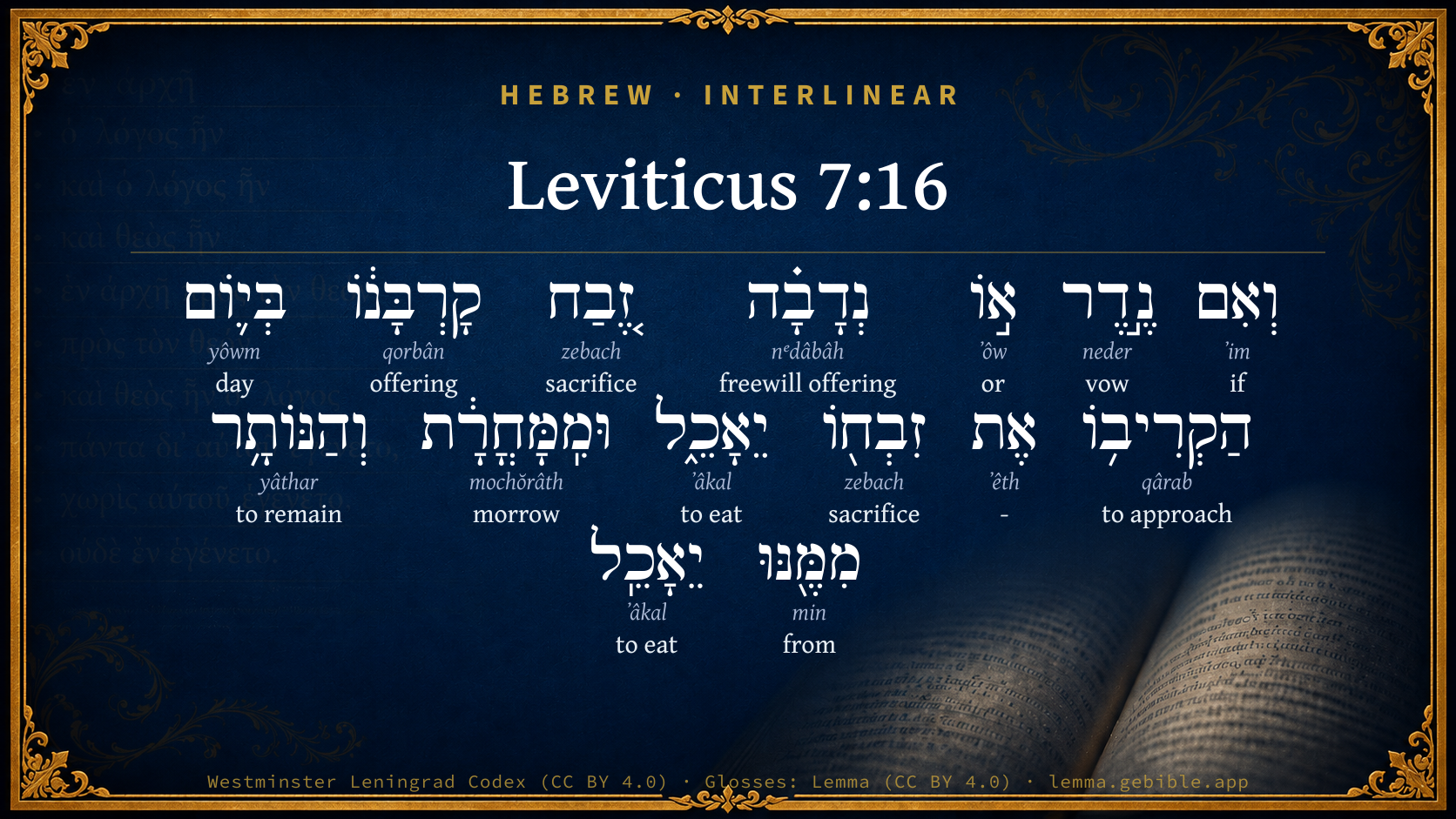
Hebrew (Westminster Leningrad Codex) Leviticus 7:16 appears in the Hebrew Old Testament. The text above is from the Westminster Leningrad Codex. Each word links to its Strong’s number, a concise gloss, and parsing drawn from the Open Scriptures Hebrew Bible morphology. Click any word for its full Brown-Driver-Briggs (BDB) entry.
Download image
Cite this verse

Leviticus 7:16 (World English Bible). Public Domain. Lemma interlinear Bible study tool, https://lemma.gebible.app/v/leviticus/7/16.

Show BibTeX & RIS
BibTeX
RIS
English Translation
"'But if the sacrifice of his offering is a vow, or a freewill offering, it shall be eaten on the day that he offers his sacrifice; and on the next day what remains of it shall be eaten:
World English Bible · Public Domain
Download a study sheet

One document with this verse’s original text, its word-by-word gloss line, the meaning frame, cross-references with their text, attributed commentary, and full source and license credits — printable, and it pastes into notes with its structure intact.

This verse Autodidact and up

Study sheet (.html) Plain text (.txt)

A passage Seminary Student

Up to 50 verses in one chapter. A passage sheet keeps up to 6 commentary sources and 12 cross-references per verse, in the order this page ranks them, and says so on the sheet whenever that leaves anything out. Ask for a single verse and you get the Autodidact verse sheet above.

Everything on this page stays free to read, with no account — the sheet is a download of what is already on screen, not access to it.

Want to remove ads? Support Godless Engineer
Compare translations 3

The same verse in 3 English versions, stacked beneath the original-language interlinear above. Click any original word for its lexicon entry.

Each is an independent rendering of the whole verse — the interlinear is not word-aligned to these translations.

Highlighted words mark where these versions differ — a whole-verse word diff, not a word-by-word alignment.

  • World English Bible Public Domain
    "'But if the sacrifice of his offering is a vow, or a freewill offering, it shall be eaten on the day that he offers his sacrifice; and on the next day what remains of it shall be eaten:
  • King James Version Public Domain
    But if the sacrifice of his offering be a vow, or a voluntary offering, it shall be eaten the same day that he offereth his sacrifice: and on the morrow also the remainder of it shall be eaten:
  • unfoldingWord Literal Text CC BY-SA 4.0
    And if the sacrifice of his offering a vow or a freewill offering, it shall be eaten on the day of his presenting his sacrifice. Also from tomorrow, the remainder of it may be eaten.

unfoldingWord Literal Text — © unfoldingWord, licensed CC BY-SA 4.0. Word-aligned USFM3 via Door43 (git.door43.org/unfoldingWord/en_ult).

Versions to compare (up to 4)

3 of 4 selected

Show all 18 translations

Every available English version of this verse, each an independent rendering of the whole verse.

  • World English Bible Public Domain
    "'But if the sacrifice of his offering is a vow, or a freewill offering, it shall be eaten on the day that he offers his sacrifice; and on the next day what remains of it shall be eaten:
  • Berean Standard Bible Public Domain
    If, however, the sacrifice he offers is a vow or a freewill offering, it shall be eaten on the day he presents his sacrifice, but the remainder may be eaten on the next day.
  • Majority Standard Bible Public Domain
    If, however, the sacrifice he offers is a vow or a freewill offering, it shall be eaten on the day he presents his sacrifice, but the remainder may be eaten on the next day.
  • King James Version Public Domain
    But if the sacrifice of his offering be a vow, or a voluntary offering, it shall be eaten the same day that he offereth his sacrifice: and on the morrow also the remainder of it shall be eaten:
  • American Standard Version (1901) Public Domain
    But if the sacrifice of his oblation be a vow, or a freewill-offering, it shall be eaten on the day that he offereth his sacrifice; and on the morrow that which remaineth of it shall be eaten:
  • Revised Version (1885) Public Domain
    But if the sacrifice of his oblation be a vow, or a freewill offering, it shall be eaten on the day that he offereth his sacrifice: and on the morrow that which remaineth of it shall be eaten:
  • Geneva Bible (1599) Public Domain
    But if the sacrifice of his offring be a vow, or a free offering, it shalbe eaten the same day that he offreth his sacrifice: and so in the morning the residue thereof shalbe eaten.
  • Douay-Rheims (1899) Public Domain
    If any man by vow, or of his own accord offer a sacrifice, it shall in like manner be eaten the same day: and if any of it remain until the morrow, it is lawful to eat it:
  • Young's Literal Translation Public Domain
    `And if the sacrifice of his offering `is' a vow or free-will offering, in the day of his bringing near his sacrifice it is eaten; and on the morrow also the remnant of it is eaten;
  • Literal Standard Version CC BY-SA 4.0
    And if the sacrifice of his offering [is] a vow or free-will offering, it is eaten in the day of his bringing his sacrifice near; and on the next day the remnant of it is also eaten;
  • Unlocked Literal Bible CC BY-SA 4.0
    But if the sacrifice of his offering is for the purpose of a vow, or for the purpose of a freewill offering, the meat must be eaten on the day that he offers his sacrifice, but whatever remains of it may be eaten on the next day.
  • unfoldingWord Literal Text CC BY-SA 4.0
    And if the sacrifice of his offering a vow or a freewill offering, it shall be eaten on the day of his presenting his sacrifice. Also from tomorrow, the remainder of it may be eaten.
  • Darby Bible Public Domain
    And if the sacrifice of his offering be a vow, or voluntary, it shall be eaten the same day that he presented his sacrifice; on the morrow also the remainder of it shall be eaten;
  • World Messianic Bible Public Domain
    “‘But if the sacrifice of his offering is a vow, or a free will offering, it shall be eaten on the day that he offers his sacrifice. On the next day what remains of it shall be eaten,
  • Webster's Bible Public Domain
    But if the sacrifice of his offering shall be a vow or a voluntary offering, it shall be eaten the same day that he offereth his sacrifice: and on the morrow also the remainder of it shall be eaten:
  • Free Bible Version CC BY-SA 4.0
    If the sacrifice you're offering is to pay a vow or a freewill offering, it shall be eaten on the day you present your sacrifice, but what's left can be eaten the next day.
  • Bible in Basic English Public Domain
    But if his offering is made because of an oath or given freely, it may be taken as food on the day when it is offered; and the rest may be used up on the day after:
  • JPS Tanakh (1917) Public Domain
    But if the sacrifice of his offering be a vow, or a freewill-offering, it shall be eaten on the day that he offereth his sacrifice; and on the morrow that which remaineth of it may be eaten.

Literal Standard Version (2020), Covenant Press — licensed CC BY-SA 4.0. Text via the HelloAO Bible API (eBible.org). Unlocked Literal Bible (unfoldingWord) — licensed CC BY-SA 4.0. Text via the HelloAO Bible API (eBible.org). unfoldingWord Literal Text — © unfoldingWord, licensed CC BY-SA 4.0. Word-aligned USFM3 via Door43 (git.door43.org/unfoldingWord/en_ult). Free Bible Version, Dr. Jonathan Gallagher — licensed CC BY-SA 4.0. Text via the HelloAO Bible API (eBible.org).

Word by word

More ways to search: Search by grammar → Find every occurrence → Compare this word →

Practice this passage: Drill this verse → Learn its vocabulary →

נְדָבָ֗ה
nᵉdâbâh
H5071
“freewill offering”
Noun, Common, Feminine, Singular, Absolute
Part of Speech
Noun
Type
Common
Gender
Feminine
Number
Singular
State
Absolute
Full BDB Definition

Origin: from H5068

TWOT: 1299a

voluntariness, free-will offering - voluntariness - freewill, voluntary, offering
  1. וְאִם ʼim H518 “and · if” Conjunction + Conjunction
  2. נֶ֣דֶר neder H5088 “vow” Noun, Common, Masculine, Singular, Absolute
  3. א֣וֹ ʼôw H176 “or” Conjunction
  4. זֶ֚בַח zebach H2077 “sacrifice of” Noun, Common, Masculine, Singular, Construct
  5. קָרְבָּנ֔וֹ qorbân H7133 “offering · his” Noun, Common, Masculine, Singular, Construct + Suffix, Personal, 3rd Person, Masculine, Singular
  6. בְּי֛וֹם yôwm H3117 “in/at · day of” Preposition + Noun, Common, Masculine, Singular, Construct
  7. הַקְרִיב֥וֹ qârab H7126 “to approach · him” Verb, Hiphil, Infinitive Construct + Suffix, Personal, 3rd Person, Masculine, Singular
  8. אֶת ʼêth H853 “-” Particle, Direct Object
  9. זִבְח֖וֹ zebach H2077 “sacrifice · his” Noun, Common, Masculine, Singular, Construct + Suffix, Personal, 3rd Person, Masculine, Singular
  10. יֵאָכֵ֑ל ʼâkal H398 “to eat” Verb, Niphal, Imperfect, 3rd Person, Masculine, Singular
  11. וּמִֽמָּחֳרָ֔ת mochŏrâth H4283 “and · from · morrow” Conjunction + Preposition + Noun, Common, Feminine, Singular, Absolute
  12. וְהַנּוֹתָ֥ר yâthar H3498 “and · the · remaining” Conjunction + Particle, Definite Article + Verb, Niphal, Participle Active, Masculine, Singular, Absolute
  13. מִמֶּ֖נּוּ min H4480 “from · us” Preposition + Suffix, Personal, 1st Person, Common, Plural
  14. יֵאָכֵֽל ʼâkal H398 “to eat” Verb, Niphal, Imperfect, 3rd Person, Masculine, Singular

About this verse

These counts appear in no published source. They are computed here, from the morphology-tagged text and Lemma’s own curated glosses. What Lemma adds →

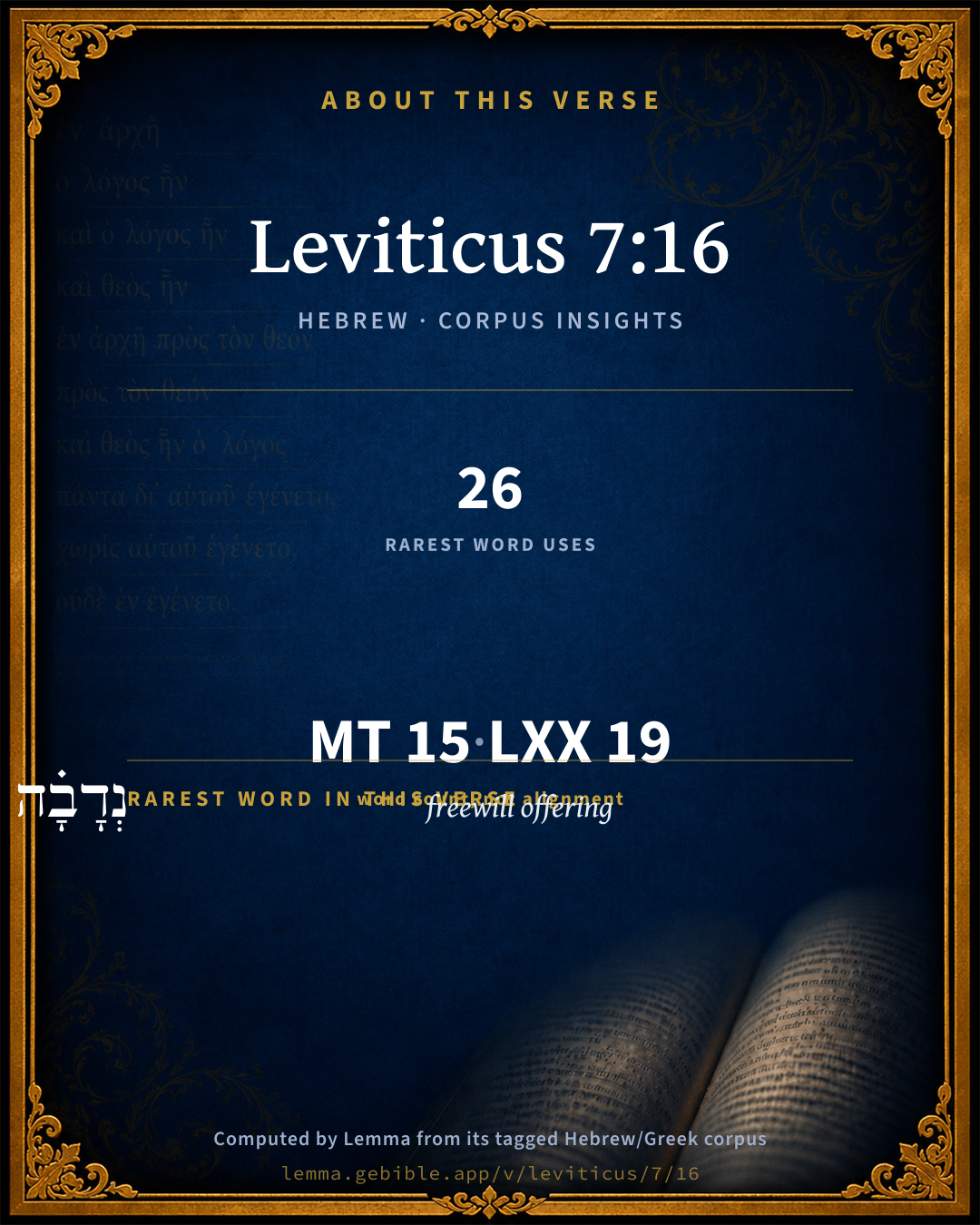
15
words
13
distinct lemmas
Pentateuch
section

Shared distinctive vocabulary

נְדָבָ֗ה freewill offering H5071 occurs in 25 verses of the Hebrew Bible. Also found in:

Grammatical profile

  • 4 verbs
  • 7 nouns
  • 1 preposition
  • 2 conjunctions
  • 1 particle

Verb forms

  • הַקְרִיב֥וֹ Hiphil · Infinitive Construct
  • יֵאָכֵ֑ל Niphal · Imperfect
  • וְהַנּוֹתָ֥ר Niphal · Participle Active
  • יֵאָכֵֽל Niphal · Imperfect

Repetition

Words recur within this verse — often emphatic in Hebrew:

  • זֶ֚בַח sacrifice H2077 ×2
  • יֵאָכֵ֑ל to eat H398 ×2

Hebrew & Septuagint length

In English translation the verse runs 38 words from the Hebrew and 15 from the Septuagint (LXX English) — the Septuagint runs noticeably shorter here. See the side-by-side →

A rough comparison of the two English renderings, which tokenize alike — not a word-level alignment.

Word counts can differ between the Hebrew and the Greek without any difference in meaning — e.g. the Hebrew direct-object marker אֵת has no separate Greek word, and Greek often adds the article ὁ.

In the original languages it is 15 Hebrew tokens and 19 Greek tokens — but the two are counted differently (Hebrew bundles its prefixes and suffixes into one token; the Greek is in lemma form), so that isn’t a like-for-like length.

Cross-references

15

Topical passages linked to Leviticus 7:16 in the Treasury of Scripture Knowledge — connected by theme and wording, ordered by reader-vote popularity; previews shown in the World English Bible.

  • Leviticus 19:5–8 "'When you offer a sacrifice of peace offerings to Yahweh, you shall offer it so that you may be accepted.
  • Deuteronomy 12:6 and there you shall bring your burnt offerings, and your sacrifices, and your tithes, and the heave-offering of your hand, and your vows, and your freewill-offerings, and the firstborn of your herd and of your flock:
  • Leviticus 22:18–21 "Speak to Aaron, and to his sons, and to all the children of Israel, and say to them, 'Whoever is of the house of Israel, or of the foreigners in Israel, who offers his offering, whether it be any of their vows, or any of their freewill offerings, which they offer to Yahweh for a burnt offering;
  • Leviticus 22:23 Either a bull or a lamb that has any deformity or lacking in his parts, that you may offer for a freewill offering; but for a vow it shall not be accepted.
  • Leviticus 22:29 "When you sacrifice a sacrifice of thanksgiving to Yahweh, you shall sacrifice it so that you may be accepted.
  • Leviticus 23:38 besides the Sabbaths of Yahweh, and besides your gifts, and besides all your vows, and besides all your freewill offerings, which you give to Yahweh.
  • Numbers 15:3 and will make an offering by fire to Yahweh, a burnt offering, or a sacrifice, to accomplish a vow, or as a freewill-offering, or in your set feasts, to make a sweet savor to Yahweh, of the herd, or of the flock;
  • Deuteronomy 12:11 then it shall happen that to the place which Yahweh your God shall choose, to cause his name to dwell there, there shall you bring all that I command you: your burnt offerings, and your sacrifices, your tithes, and the heave-offering of your hand, and all your choice vows which you vow to Yahweh.
  • Deuteronomy 12:17 You may not eat within your gates the tithe of your grain, or of your new wine, or of your oil, or the firstborn of your herd or of your flock, nor any of your vows which you vow, nor your freewill-offerings, nor the heave-offering of your hand;
  • Deuteronomy 12:26 Only your holy things which you have, and your vows, you shall take, and go to the place which Yahweh shall choose:
  • Psalms 66:13 I will come into your temple with burnt offerings. I will pay my vows to you,
  • Psalms 116:14 I will pay my vows to Yahweh, Yes, in the presence of all his people.
  • Psalms 116:18 I will pay my vows to Yahweh, Yes, in the presence of all his people,
  • Ezekiel 46:12 When the prince shall prepare a freewill-offering, a burnt offering or peace-offerings as a freewill-offering to Yahweh, one shall open for him the gate that looks toward the east; and he shall prepare his burnt offering and his peace-offerings, as he does on the Sabbath day: then he shall go forth; and after his going forth one shall shut the gate.
  • Nahum 1:15 Behold, on the mountains the feet of him who brings good news, who publishes peace! Keep your feasts, Judah! Perform your vows, for the wicked one will no more pass through you. He is utterly cut off.

Cross-references courtesy of OpenBible.info (CC BY 4.0).

Hebrew and Greek witnesses Masoretic Hebrew ↔ Greek Septuagint

The same verse in the two great witnesses to the Old Testament, shown verse-for-verse.

Here the Septuagint runs noticeably shorter than the Hebrew — LXX2012 (modern English Septuagint) 15 words vs World English Bible 38. A rough length comparison of the two English translations, not a word-level alignment — read both below.

These are two independent witnesses, not word-aligned to each other, and the Septuagint is shown in lemma (dictionary) form.

Hebrew Leviticus 7:16 Masoretic · Westminster Leningrad Codex

וְאִם נֶ֣דֶר א֣וֹ נְדָבָ֗ה זֶ֚בַח קָרְבָּנ֔וֹ בְּי֛וֹם הַקְרִיב֥וֹ אֶת זִבְח֖וֹ יֵאָכֵ֑ל וּמִֽמָּחֳרָ֔ת וְהַנּוֹתָ֥ר מִמֶּ֖נּוּ יֵאָכֵֽל

"'But if the sacrifice of his offering is a vow, or a freewill offering, it shall be eaten on the day that he offers his sacrifice; and on the next day what remains of it shall be eaten:

World English Bible · Public Domain

Greek LXX Leviticus 7:16 Septuagint · lemma form

καΐἄν εὐχή ἤ ἑκούσιος θυσιάζω ὁ δῶρον αὐτός ὅς ἄν ἡμέρα προςἄγω ὁ θυσία αὐτός βιβρώσκω καί ὁ αὔριον

You⌃ shall eat no blood in all your habitations, either of beasts or of birds.

LXX2012 (modern English Septuagint) · Public Domain

Hebrew: Westminster Leningrad Codex (CC BY 4.0). Greek: Septuagint (public domain); English from LXX2012 (modern English Septuagint) (Public Domain). How the Septuagint differs from the Hebrew →

Targum (Aramaic paraphrase)

2

The Targum is the ancient Jewish Aramaic paraphrase of the Hebrew Scriptures — an interpretive translation, not the Hebrew text itself. Onkelos (literal) and Pseudo-Jonathan (expansive) render the Torah, and Jonathan the Prophets. Coverage is partial: where no permissively-licensed English translation exists for a verse, only the Aramaic is shown. This is verse-level text, not a word-by-word alignment to the Hebrew.

  1. Targum Onkelos Torah (Genesis–Deuteronomy)
    וְאִם נִדְרָא אוֹ נְדַבְתָּא נִכְסַת קֻרְבָּנֵהּ בְּיוֹמָא דִי יְקָרֵב יָת נִכְסְתֵיהּ יִתְאֲכֵל וּבְיוֹמָא דְבַתְרוֹהִי וּדְאִשְׁתָּאַר מִנֵהּ יִתְאֲכֵלּ

    (no public-domain English translation for this verse)

    Targum Onkelos — Aramaic: “Onkelos Genesis” (public domain); “Onkelos Exodus” (public domain); “Onkelos Leviticus” (public domain); “Onkelos Numbers” (public domain); “Onkelos Deuteronomy” (public domain). English: “Sefaria Community Translation” (CC0 1.0 (public-domain dedication)); “J.W. Etheridge. The Targums of Onkelos and Jonathan Ben Uzziel on the Pentateuch. London: Longmans, Green, 1862” (public domain). Text via Sefaria.

  2. Targum Pseudo-Jonathan Torah (Genesis–Deuteronomy)
    וְאִם נִדְרָא אוֹ נְדַבְתָּא נִכְסַת קוּרְבָּנֵיהּ בְּיוֹמָא דְיַקְרֵיב יַת נִכְסְתֵיהּ יִתְאֲכֵיל וּבְיוֹם מָחֳרָן וּמַה דְמִשְׁתַּיֵיר מִנֵּיהּ יִתְאֲכֵיל בְּפַנְיָא

    But if his hallowed sacrifice be a vow or a free-will gift, the sacrifice may be (partly) eaten on the day when it is offered, and the remainder may be eaten on the day following at evening.

    Targum Pseudo-Jonathan — Aramaic: “Targum Jonathan on Genesis” (public domain); “Targum Jonathan on Exodus” (public domain); “Targum Jonathan on Leviticus” (public domain); “Targum Jonathan on Numbers” (public domain); “Targum Jonathan on Deuteronomy” (public domain). English: “The Targum of Jonathan ben Uzziel, trans. J. W. Etheridge, London, 1862” (public domain). Text via Sefaria.

Commentary

Notes on Leviticus 7:16 from classic Christian and Jewish commentators (each source and its license shown beneath its notes). The classic Christian expositions comment on the surrounding passage and are grouped to its opening verse, so a note may address several verses; the Jewish commentaries on the Tanakh (Rashi and others) are per-verse, so they appear only where the commentator wrote on this verse.

Lemma curates 59 commentaries, every one of them public domain or Creative Commons licensed, each selected and text-cleaned for this edition rather than reprinted as found. About our sources →

Trapp's Complete Commentary

John Trapp

Lev 7:16 But if the sacrifice of his offering [be] a vow, or a voluntary offering, it shall be eaten the same day that he offereth his sacrifice: and on the morrow also the remainder of it shall be eaten:

Ver. 16. And on the morrow also.] This was not allowed in a thank offering. {Lev 7:15} Hereby God would teach them, that he must be worshipped as himself appointeth, and not as they in their reason should think fit.

John Trapp, A Commentary or Exposition upon All the Books of the Old and New Testament (1647–1656) — public domain. Text from a community e-Sword module.

Joseph Benson's Commentary

Lev 7:16. If the sacrifice be a vow — Offered in performance of a vow, the offerer having desired some special favour from God, and vowed the sacrifice to God if he would grant it. A voluntary offering, which a person offered freely to God, in testimony of his faith and love, not being under the obligation of any particular vow of his own, or command from God. On the morrow also the remainder shall be eaten — Which was not allowed in the case of the thank-offering. The reason of which is to be fetched only from God’s good pleasure and will, to which he expects our obedience, though we discern not the reason of his appointments.

Joseph Benson's Commentary on the Old and New Testaments (1811–1818) — public domain. Text from a community e-Sword module.

Tyndale Open Study Notes

Tyndale Open Resources

7:16-18 In contrast to the “peace offering of thanksgiving,” which was presented as an expression of thanks to the Lord (7:12-15), the offering to fulfill a vow related to a vow made by a worshiper. The festive meal that followed was more relaxed and could extend into the next day. However, because the vow offering involved a vow made to God, it was still more restrictive than the voluntary offering, which could even use a deformed animal (22:23).

Tyndale Open Study Notes — © Tyndale Open Resources, licensed CC BY-SA 4.0. Text via the HelloAO Bible API.

Geneva Bible (1599)

Geneva Bible translators

If he makes a vow to offer: for else the flesh of the peace offerings must be eaten the same day.

Geneva Bible (1599) marginal notes — public domain. Text via Bolls.life.

Ellicott's Commentary for English Readers

(16) Be a vow or a voluntary offering.—The vow and the voluntary offering which constitute the second class of peace offerings are both entirely voluntary. The distinction between them, as defined by the canon law, which obtained in the time of Christ, is as follows :—A vow (nçdçr) is an obligation voluntarily imposed upon oneself with the formula, “Behold, I take it upon myself to bring a bullock, &c., for a peace offering.” This undertaking is binding upon the person till he fulfils it. Hence, if the bullock in question dies, or is stolen, or becomes disqualified for a sacrifice, he must bring another. A free-will offering (nedabah) simply pledges voluntarily a certain animal for a peace offering, with the formula, “ Behold, this animal I devote for a peace offering.” Hence, if the animal in question dies, or is stolen, or has otherwise become disqualified for sacrifice, the obligation ceases, since it does not extend beyond the animal thus devoted.

It shall be eaten the same day.—As both these votive offerings were an indirect mode of supplication having respect to future favours, and hence were not a spontaneous expression of pious devotion, they were not so sacred as the former. They were, therefore, allowed to be eaten both on the day of presentation and on the following day.

A Bible Commentary for English Readers, edited by Charles John Ellicott (1878–1897) — public domain. Text from a community e-Sword module.

John Gill's Exposition

But the remainder of the flesh of the sacrifice on the third day,.... What remained of it uneaten on the second day, and was kept till the third:

shall be burnt with fire; that it might neither corrupt, nor be put to superstitious uses, nor be of any profit in any respect; that so niggardliness and distrust of the care of Providence might be discouraged: perhaps some respect may be had in the type to the resurrection of Christ on the third day, having seen no corruption.

John Gill's Exposition of the Whole Bible (1746–1763) — public domain (CC PDM 1.0). Text via the HelloAO Bible API.

Albert Barnes' Notes on the Bible

The vow-offering appears to have been a peace-offering vowed upon a certain condition; the voluntary-offering, one offered as the simple tribute of a devout heart rejoicing in peace with God and man offered on no external occasion (compare Lev 22:17-25).

Albert Barnes' Notes on the Bible (1834–1885) — public domain. Text from a community e-Sword/MySword module.

Haydock's Catholic Bible Commentary

It. The victim of thanksgiving was more worthy, as it proceeded from a more disinterested motive. (Menochius) --- Such victims as were perfectly voluntary might be received, though they had some defect, chap. xxii. 23.

George Leo Haydock (1774–1849), Haydock's Catholic Family Bible and Commentary, 1859 edition — public domain. Excludes Psalms (Douay-Rheims chapter numbering differs from Protestant) and Deuterocanonical books (Catholic canon only).

Matthew Poole's English Annotations

Be a vow; offered in performance of a vow, the man having desired some special favour from God, and vowed the sacrifice to God if he would grant it. A

voluntary offering, which a malt freely offered to God, in testimony of his faith and love to God, without any particular injunction from God, or design of his own special advantage thereby. See Lev 22:23; Eze 46:12.

On the morrow also the remainder of it shall be eaten, which was not allowed for the thankoffering; the reason of which difference is to be fetched only from God’s good pleasure and will, to which he expects our obedience, though we discern not the reason of his appointments.

Matthew Poole's English Annotations on the Holy Bible (1683–1685) — public domain. Text from a community e-Sword/MySword module.

Whedon's Commentary on the Bible

Daniel D. Whedon

16. A vow, or a voluntary offering — See Lev_7:11, note. Since these were inferior offerings, they were considered less sacred. Hence two days were allowed for eating them. There was little difficulty in this matter where friends were numerous and near. The requirement to eat within one or two days would often induce the offerer to invite the poor to this religious banquet. Theodoret, Clericus, and others, assert that the limit of two days was designed to compel the worshipper to invite the poor to his religious banquet. It is more probable that it is a safeguard against the desecration of holy things.

Daniel D. Whedon (gen. ed.), Commentary on the Old and New Testaments (1874–1909) — public domain. Text from a community e-Sword module.

The Pulpit Commentary

Vers. 16-27. The sanctity of the service of God.

The peace offering may be offered for thanksgiving, in which case it has appropriate ceremonies (verses 12-15). There is also the peace offering of a vow, the ceremonies of which are the same as those of the voluntary offering. (verse 16; also Lev_19:5-8) In connection with this subject, we are admonished of the sanctity of the service of God; and similar admonitions arc given in what follows.

I WE SEE THIS SANCTITY IN THE SANCTIONS OF THE LAW OF THE PEACE OFFERING.

1. Consider the precept.

(1) Look at it in the letter. "It shall be eaten the same day that he offereth his sacrifice." The same day in which the fat is burnt on the altar, the flesh is consumed by the worshipper and his friends. What remains must be eaten on the morrow. If any remain over to the third day, it must not then be eaten, but burnt with fire.

(2) The first reason for this is hygienic. The flesh would, of course, be wholesome on the day it was killed, and so it would continue to be on the day following. But on the third day, in a hot climate, it would tend to corruption. The laws of health are well considered in the Levitical system, upon which account the study of that system may be commended to the votaries of social science.

(3) But there must be a deeper reason still, else the penalties would not be so formidable as they are. The peace offering was undoubtedly a type of Christ in his passion. (Eph_2:13-18) Our Lord was two days in the tomb after his death without seeing corruption. Then rising from the dead on the third day, the typical sacrifices of the Law, having answered their end, were abolished, This abolition was foreshadowed in the burning of what remained of the peace offering on the third day. (1Co_15:3) To eat of the typical peace offering on the third day would be therefore highly improper, as it would suggest return to the "beggarly elements" after the "bringing in of the better hope". (Gal_3:3 Gal_4:9-11, Gal_4:30, 31 5:1-4)

(4) If the" third day" represent the Christian dispensation in which typical sacrifices are done away, how are we to view the "two days" during which they were serviceable? There were exactly two great dispensations before the Christian, in which typical sacrifices were ordained, viz. first, the Patriarchal, from Adam to Moses; and secondly, the Levitical, from Moses to Christ.

2. Consider the penalties.

(1) If the flesh of the peace offering be eaten on the third day, the sacrifice "shall not be accepted." The reason will now be obvious. In the third, or gospel, dispensation, there is a better Sacrifice. Typical sacrifices are now out of place and worthless, since the Antitype is come.

(2) "It shall not be imputed to him that offereth it." The typical sacrifices were useful in procuring the "forbearance of God" until the true atonement should be made; but now it is made, Christ will profit them nothing who return to the Law,

(3) "He shall bear his sin." He shall be treated as the sacrifice was treated. He shall himself be sacrificed for his own sin.

II THIS SANCTITY IS FURTHER SEEN IN THE PENALTIES IMPOSED IN OTHER CASES. Thus:

1. When the flesh of sacrifice is unlawfully eaten.

(1) This would happen if it had touched "any unclean thing" (verse 19). Instead of being eaten, it should then be "burnt with fire." The teaching is that an unclean thing is of no use for purposes of atonement. The sacrifice of Christ could not be accepted were he not immaculate.

(2) It would happen if the cater were unclean. "As for the flesh, all that be clean shall eat thereof" (Hebrew, "The flesh of all that is clean shall eat the flesh"), i.e. , every clean person shall eat the flesh of his peace offering. As Christ is without spot of sin, so is his flesh meat only to the holy. "But the soul" etc. (verses 20, 21). To the wicked, the very gospel becomes the savour of death. (1Co_11:29 2Co_2:15, 2Co_2:16)

2. When holy things are profaned.

(1) When the fat is eaten (verse 23) the fat of such animals as were offered in sacrifice. There is no law against the eating of the fat of the roebuck or the hart. And that portion of the fat which was offered in sacrifice. The fat mingled with the flesh, which was not burnt on the altar, was not forbidden. There must be the most careful avoidance of whatever would profane the sacrifice of Christ. The fat even of an animal of the sacrificial kind, which by any accident might be rendered unfit for sacrifice, must not be eaten (verse 24). The moral here is that the very appearance of evil must be avoided.

(2) When the blood is eaten. This law is universal. Blood, viz. of every description of animal, is forbidden. The Jews properly expound this law as forbidding the blood of the life as distinguished from the gravy . And the reason given for the prohibition is that the life maketh atonement for the life. Our life, which is redeemed by the life of Jesus sacrificed for us, must be wholly given to God. The highest sanctity is associated with the blood of Christ.

(3) "That soul shall be cut off from his people" (verses 20, 21, 25, 27). The penalty in all these cases is extreme. It means separation from religious and civil privileges, if not also death. The penalties of the Mosaic Law terminated in the death of the body; but "a much sorer punishment" is reserved for those who despise and desecrate the blood of Christ. J.A.M. (Heb_10:28, Heb_10:29)

The Pulpit Commentary (1880–1919), ed. H.D.M. Spence-Jones & Joseph S. Exell — public domain. Text from a community e-Sword module.

John Wesley's Explanatory Notes

A vow - Offered in performance of a vow, the man having desired some special favour from God, and vowed the sacrifice to God if he would grant it. On the morrow also - Which was not allowed for the thank-offering.

John Wesley, Explanatory Notes Upon the Whole Bible (1754–1765) — public domain. Text via the GEBible commentary corpus.

Rashi

Rabbi Shlomo Yitzchaki (Rashi)

ואם נדר או נדבה BUT IF [THE SACRIFICE OF HIS OFFERING BE] A VOW OR A FREE WILL OFFERING — i. e., that he does not bring it as an acknowledgement of some miraculous deliverance (cf. Rashi v. 12), then it does ‘not require the offering of bread and may be eaten during two days as is set forth in the section.

וממחרת והנותר ממנו AND ON THE MORROW ALSO THE REMAINDER OF IT — i. e. what remained on the first day, יאכל MAY BE EATEN; — this ו (that of והנותר) is redundant (the text being equivalent to וממחרת הנותר ממנו יאכל); there are many similar examples in Scripture: (Genesis 36:24) “And these are the sons of Zibean: And Ajah (ואיה) and Anah”; (Daniel 8:13): “to give and the Sanctuary (וקדש) and the host to be trampled under foot”.

Rashi on the Tanakh — English translations: “The Judaica Press complete Tanach with Rashi, translated by A. J. Rosenberg” (CC BY 4.0); “Pentateuch with Rashi's commentary by M. Rosenbaum and A.M. Silbermann, 1929-1934” (public domain); “The Metsudah Tanach series, Lakewood, N.J” (CC BY 4.0); and “The Book of Joshua, Metsudah Publications, 1997” (CC BY 4.0). Text via Sefaria.

Ramban (Nachmanides)

Rabbi Moshe ben Nachman (Ramban / Nachmanides)

AND ON THE MORROW ‘V’HANOTHAR’ (AND THAT WHICH REMAINETH) OF IT SHALL BE EATEN. “The letter vav [in the word v’hanothar — ‘and’ that which remaineth] is redundant [thus the meaning of the verse is: “and on the morrow, that which remaineth of it shall be eaten”]. There are many examples of this in Scripture, such as: and these are the children of Zibeon: ‘v’ayah’ (and Ajah) and Anah. in v’ayah (“and” Ajah) is redundant. See in Vol. I, p. 440. So also: to give ‘v’kodesh’ (‘and’ the Sanctuary) and the host to be trampled upon.” in v’kodesh (“and” the Sanctuary) is here redundant. This is Rashi’s language, and so did Rabbi Abraham ibn Ezra interpret the verse.In my opinion the meaning of the verse is as follows: Since He said, it shall be eaten on the day that he offereth his offering, and on the morrow, this might imply that it is a commandment that it [the peace-offering] be eaten in two days, [namely] that he should eat part of it on the first day, and should leave part of it to be eaten on the morrow. Therefore He explained again, ‘and’ that which remaineth is to be eaten on the first day and also on the morrow [if by chance it was not all eaten on the first day]. But he is not to leave some over intentionally, nor is he permitted to leave it all over to be eaten on the second day. Rather, it is a commandment that he should eat it on the first day, and that which is left over by chance, should be eaten on the morrow previously mentioned.This matter we have learned from the words of our Rabbis, who have said in the Torath Kohanim: 12:11-12. “On the day that he offereth it, shall it be eaten. It is a commandment that it be eaten thereof during the first day. I might think that he is commanded to eat the whole of it; Scripture therefore says, and on the morrow. I might then think that it is a commandment to eat it in two days; Scripture therefore states, and that which remaineth — if it remains, it remains [i.e., it may still be eaten]. If [we are to go by the expression] and that which remaineth, I might think that if he left it all over for the second day it is invalid [since that does not come under the term “remaineth” which indicates only a part thereof]; Scripture therefore says [that which remaineth of it] shall be eaten, even all of it.” And even if you hold the vav in v’hanothar (and that which remaineth) to be redundant, [as Rashi explained], the verse can also be explained to mean: “and on the morrow that which remained of it [from the first day] may be eaten,” but not that he is to leave it over intentionally.But I do not know why Rashi held the vav of the verse, to give ‘v’kodesh’ (‘and’ the Sanctuary) and the host to be trampled upon in v’kodesh (“and” the Sanctuary) is here redundant. to be redundant, since the meaning of the verse is that [the angel] is asking: “How long shall the transgression give appalment, and how long shall the Sanctuary and the host be trampled underfoot?” in v’kodesh thus stands for the repetition of the phrase ad mathai (how long), and is therefore not redundant.

Ramban (Nachmanides) on the Tanakh — English translation: “Commentary on the Torah by Ramban (Nachmanides). Translated and annotated by Charles B. Chavel. New York, Shilo Pub. House, 1971-1976” (CC BY 4.0). Text via Sefaria.

Lesson kit

Teaching starters — assembled from the data on this page, not authored interpretation. Every prompt links to the verse data it draws on. Edit before teaching.

Leviticus, in the Pentateuch, opens this verse with 15 words (13 distinct Hebrew lemmas). Its most distinctive word is nᵉdâbâh (“freewill offering”). The Greek Septuagint runs shorter here. A historical commentator’s framing appears above. Read the whole chapter for the surrounding context.

Discussion questions

  1. How does “freewill offering” (nᵉdâbâh) shape what this verse is saying?
  2. Exodus 35:29 shares the word «freewill offering» with this verse. How do the two illuminate each other?
  3. “sacrifice” occurs 2× in this one verse. What is the effect of the repetition?
  4. Compared with the Hebrew, the Septuagint runs shorter here. What questions does that raise?
  5. These translations render this verse differently; the difference is in the English rendering, not the original. What questions does that raise?
  6. The verb «הַקְרִיב֥וֹ» is Hiphil Infinitive Construct. How does its form color the action?
  7. Reading how Trapp's Complete Commentary and Joseph Benson's Commentary read this verse, where do the two commentators agree and where do they part?

Things to notice

Reading settings

Reading text

Shown beneath each verse's original-language words.

Old Testament
Old Testament edition

Read the OT as the Masoretic Hebrew (MT) or the Greek Septuagint (LXX).

English shown for the Greek Septuagint (in the Hebrew ↔ Greek comparison).

Comparing translations? Open the Compare panel on any verse page to stack up to four side by side.