Genesis 8:19

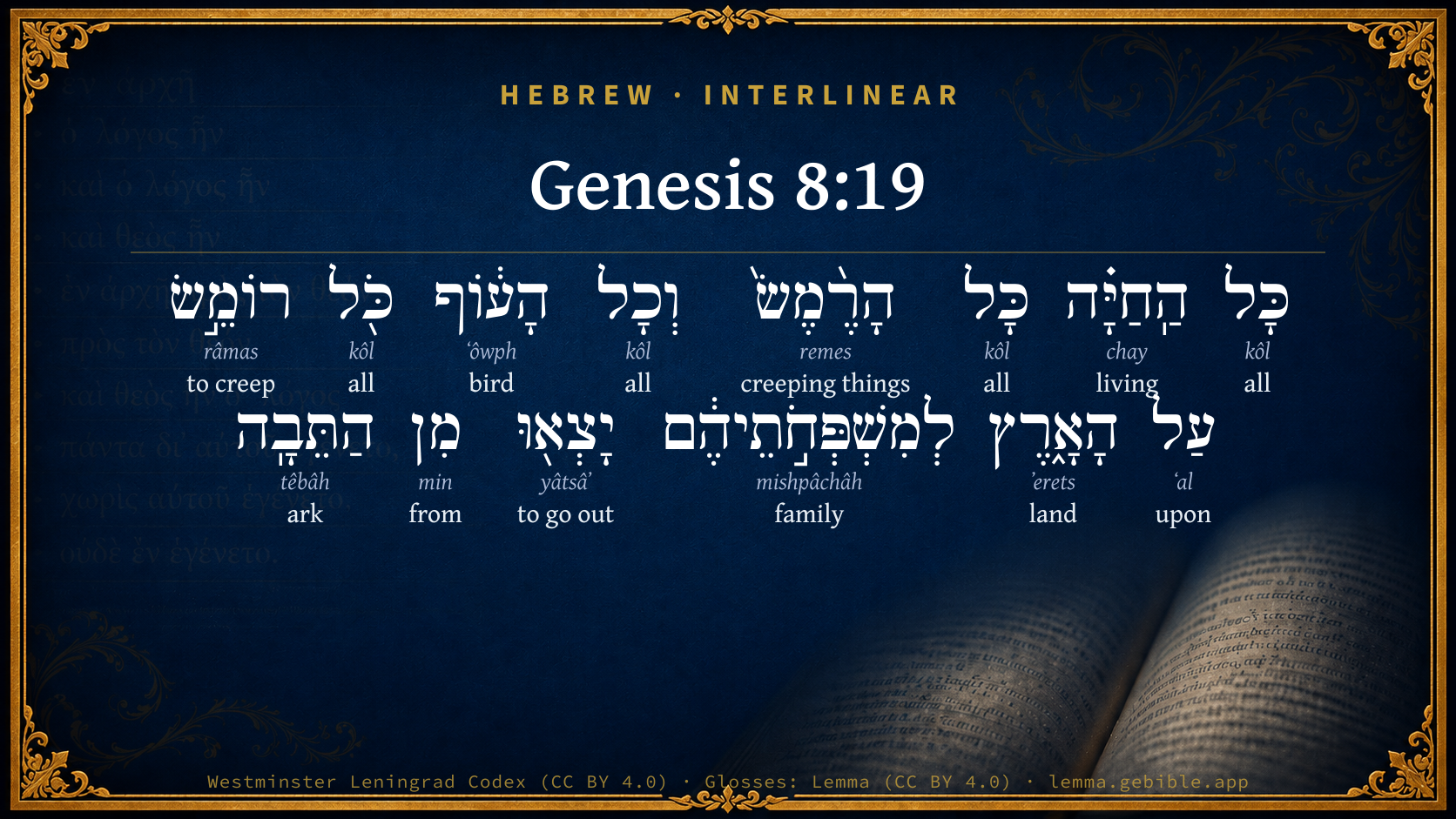
Hebrew (Westminster Leningrad Codex) Genesis 8:19 appears in the Hebrew Old Testament. The text above is from the Westminster Leningrad Codex. Each word links to its Strong’s number, a concise gloss, and parsing drawn from the Open Scriptures Hebrew Bible morphology. Click any word for its full Brown-Driver-Briggs (BDB) entry.
Download image
Cite this verse

Genesis 8:19 (World English Bible). Public Domain. Lemma interlinear Bible study tool, https://lemma.gebible.app/v/genesis/8/19.

Show BibTeX & RIS
BibTeX
RIS
English Translation
Every animal, every creeping thing, and every bird, whatever moves on the earth, after their families, went forth out of the ark.
World English Bible · Public Domain
Highlights
  • 1 first appearance in the Hebrew Bible
Full analysis ↓
Download a study sheet

One document with this verse’s original text, its word-by-word gloss line, the meaning frame, cross-references with their text, attributed commentary, and full source and license credits — printable, and it pastes into notes with its structure intact.

This verse Autodidact and up

Study sheet (.html) Plain text (.txt)

A passage Seminary Student

Up to 50 verses in one chapter. A passage sheet keeps up to 6 commentary sources and 12 cross-references per verse, in the order this page ranks them, and says so on the sheet whenever that leaves anything out. Ask for a single verse and you get the Autodidact verse sheet above.

Everything on this page stays free to read, with no account — the sheet is a download of what is already on screen, not access to it.

Want to remove ads? Support Godless Engineer
Compare translations 3

The same verse in 3 English versions, stacked beneath the original-language interlinear above. Click any original word for its lexicon entry.

Each is an independent rendering of the whole verse — the interlinear is not word-aligned to these translations.

Highlighted words mark where these versions differ — a whole-verse word diff, not a word-by-word alignment.

  • World English Bible Public Domain
    Every animal, every creeping thing, and every bird, whatever moves on the earth, after their families, went forth out of the ark.
  • King James Version Public Domain
    Every beast, every creeping thing, and every fowl, and whatsoever creepeth upon the earth, after their kinds, went forth out of the ark.
  • unfoldingWord Literal Text CC BY-SA 4.0
    Every living thing, every crawling thing and every bird, everything moving on the earth, went out of the ark by their families. Yahweh Establishes His Covenant with Noah and His Descendants 8:20-9:17

unfoldingWord Literal Text — © unfoldingWord, licensed CC BY-SA 4.0. Word-aligned USFM3 via Door43 (git.door43.org/unfoldingWord/en_ult).

Versions to compare (up to 4)

3 of 4 selected

Show all 18 translations

Every available English version of this verse, each an independent rendering of the whole verse.

  • World English Bible Public Domain
    Every animal, every creeping thing, and every bird, whatever moves on the earth, after their families, went forth out of the ark.
  • Berean Standard Bible Public Domain
    Every living creature, every creeping thing, and every bird—everything that moves upon the earth—came out of the ark, kind by kind.
  • Majority Standard Bible Public Domain
    Every living creature, every creeping thing, and every bird—everything that moves upon the earth—came out of the ark, kind by kind.
  • King James Version Public Domain
    Every beast, every creeping thing, and every fowl, and whatsoever creepeth upon the earth, after their kinds, went forth out of the ark.
  • American Standard Version (1901) Public Domain
    every beast, every creeping thing, and every bird, whatsoever moveth upon the earth, after their families, went forth out of the ark.
  • Revised Version (1885) Public Domain
    every beast, every creeping thing, and every fowl, whatsoever moveth upon the earth, after their families, went forth out of the ark.
  • Geneva Bible (1599) Public Domain
    Euery beast, euery creeping thing, and euery foule, all that moueth vpon the earth after their kindes went out of the Arke.
  • Douay-Rheims (1899) Public Domain
    And all living things, and cattle, and creeping things that creep upon the earth, according to their kinds, went out of the ark.
  • Young's Literal Translation Public Domain
    every beast, every creeping thing, and every fowl; every creeping thing on the earth, after their families, have gone out from the ark.
  • Literal Standard Version CC BY-SA 4.0
    every beast, every creeping thing, and every bird; every creeping thing on the earth, after their families, have gone out from the Ark.
  • Unlocked Literal Bible CC BY-SA 4.0
    Every living creature, every creeping thing, and every bird, everything that moves on the earth, according to their families, left the ark.
  • unfoldingWord Literal Text CC BY-SA 4.0
    Every living thing, every crawling thing and every bird, everything moving on the earth, went out of the ark by their families. Yahweh Establishes His Covenant with Noah and His Descendants 8:20-9:17
  • Darby Bible Public Domain
    All the animals, all the creeping things, and all the fowl -- everything that moves on the earth, after their kinds, went out of the ark.
  • World Messianic Bible Public Domain
    Every animal, every creeping thing, and every bird, whatever moves on the earth, after their families, went out of the ship.
  • Webster's Bible Public Domain
    Every beast, every creeping animal, and every fowl, and whatsoever creepeth upon the earth, after their kinds, went out of the ark.
  • Free Bible Version CC BY-SA 4.0
    All the animals, all the creatures that run along the ground, all the birds—everything that lives on land—also left, each kind leaving together.
  • Bible in Basic English Public Domain
    And every beast and bird and every living thing of every sort which goes on the earth, went out of the ark.
  • JPS Tanakh (1917) Public Domain
    every beast, every creeping thing, and every fowl, whatsoever moveth upon the earth, after their families; went forth out of the ark.

Literal Standard Version (2020), Covenant Press — licensed CC BY-SA 4.0. Text via the HelloAO Bible API (eBible.org). Unlocked Literal Bible (unfoldingWord) — licensed CC BY-SA 4.0. Text via the HelloAO Bible API (eBible.org). unfoldingWord Literal Text — © unfoldingWord, licensed CC BY-SA 4.0. Word-aligned USFM3 via Door43 (git.door43.org/unfoldingWord/en_ult). Free Bible Version, Dr. Jonathan Gallagher — licensed CC BY-SA 4.0. Text via the HelloAO Bible API (eBible.org).

Word by word

More ways to search: Search by grammar → Find every occurrence → Compare this word →

Practice this passage: Drill this verse → Learn its vocabulary →

הָרֶ֨מֶשׂ֙
remes
H7431
“the · creeping things”
Particle, Definite Article + Noun, Common, Masculine, Singular, Absolute
Part of Speech
Particle + Noun
Type
Common
Gender
Masculine
Number
Singular
State
Absolute
Full BDB Definition

Origin: from H7430

TWOT: 2177a

creeping things, moving things, creeping organism - creeping things - gliding things (of sea animals) - moving things (of all animals)
  1. כָּל kôl H3605 “all of” Noun, Common, Masculine, Singular, Construct
  2. הַֽחַיָּ֗ה chay H2416 “the · living” Particle, Definite Article + Noun, Common, Feminine, Singular, Absolute
  3. כָּל kôl H3605 “all of” Noun, Common, Masculine, Singular, Construct
  4. וְכָל kôl H3605 “and · all of” Conjunction + Noun, Common, Masculine, Singular, Construct
  5. הָע֔וֹף ʻôwph H5775 “the · bird” Particle, Definite Article + Noun, Common, Masculine, Singular, Absolute
  6. כֹּ֖ל kôl H3605 “all” Noun, Common, Masculine, Singular, Absolute
  7. רוֹמֵ֣שׂ râmas H7430 “creeping” Verb, Qal, Participle Active, Masculine, Singular, Absolute
  8. עַל ʻal H5921 “upon” Preposition
  9. הָאָ֑רֶץ ʼerets H776 “the · land” Particle, Definite Article + Noun, Common, Both, Singular, Absolute
  10. לְמִשְׁפְּחֹ֣תֵיהֶ֔ם mishpâchâh H4940 “to/for · families · their” Preposition + Noun, Common, Feminine, Plural, Construct + Suffix, Personal, 3rd Person, Masculine, Plural
  11. יָצְא֖וּ yâtsâʼ H3318 “to go out” Verb, Qal, Perfect, 3rd Person, Common, Plural
  12. מִן min H4480 “from” Preposition
  13. הַתֵּבָֽה têbâh H8392 “the · ark” Particle, Definite Article + Noun, Common, Feminine, Singular, Absolute

About this verse

These counts appear in no published source. They are computed here, from the morphology-tagged text and Lemma’s own curated glosses. What Lemma adds →

14
words
11
distinct lemmas
Pentateuch
section

Notable vocabulary

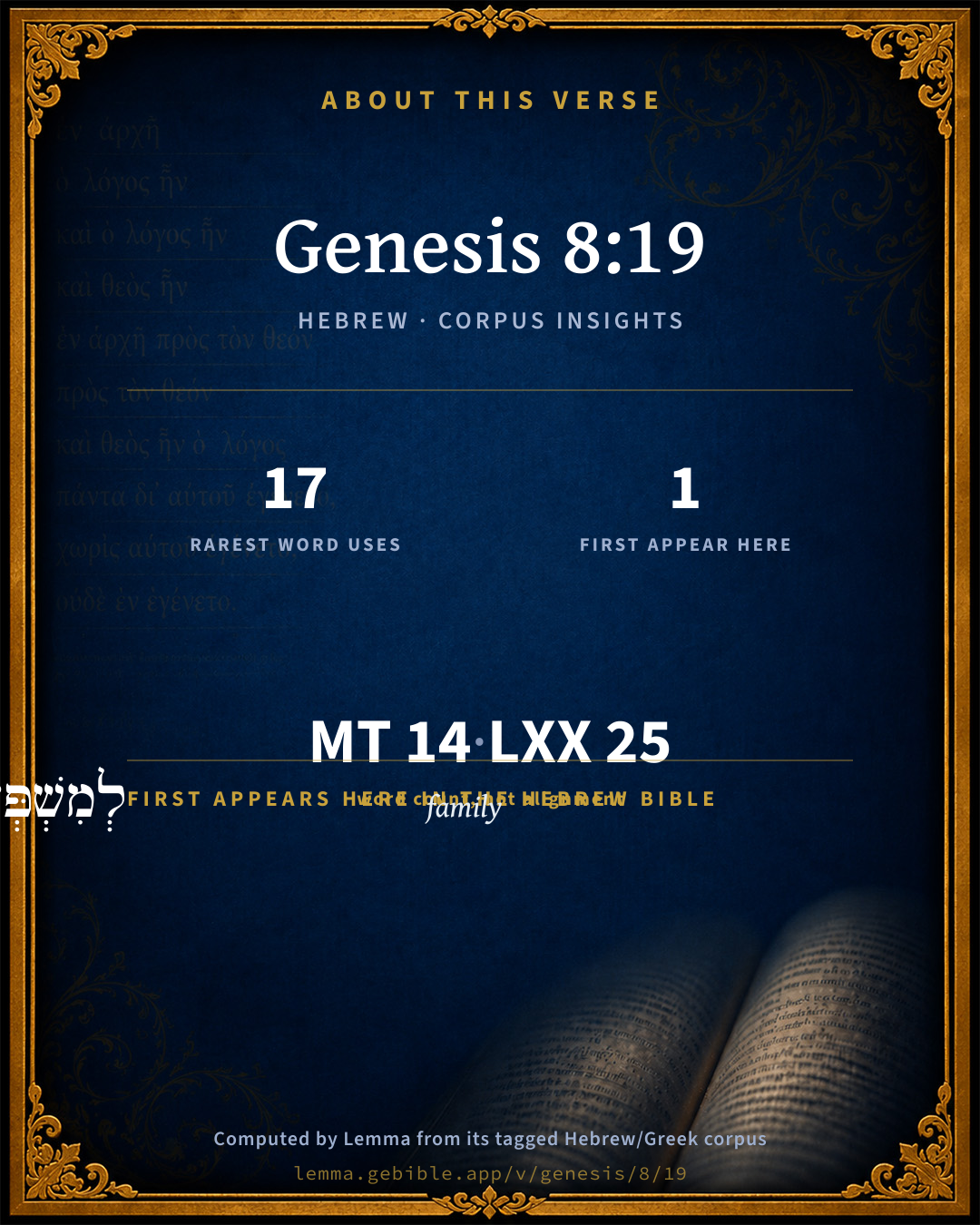
The rarest word here is הָרֶ֨מֶשׂ֙ creeping things H7431 — appearing just 17 times in the whole Hebrew Bible.

First appearance in Scripture

This word makes its first canonical appearance in the Hebrew Bible here:

  • לְמִשְׁפְּחֹ֣תֵיהֶ֔ם family H4940

Shared distinctive vocabulary

הָרֶ֨מֶשׂ֙ creeping things H7431 occurs in 17 verses of the Hebrew Bible. Also found in:

Grammatical profile

  • 2 verbs
  • 10 nouns
  • 2 prepositions

Verb forms

  • רוֹמֵ֣שׂ Qal · Participle Active
  • יָצְא֖וּ Qal · Perfect

Repetition

A word recurs within this verse — often emphatic in Hebrew:

Hebrew & Septuagint length

In English translation the verse runs 22 words from the Hebrew and 28 from the Septuagint (LXX English) — closely comparable.

A rough comparison of the two English renderings, which tokenize alike — not a word-level alignment.

Word counts can differ between the Hebrew and the Greek without any difference in meaning — e.g. the Hebrew direct-object marker אֵת has no separate Greek word, and Greek often adds the article ὁ.

In the original languages it is 14 Hebrew tokens and 25 Greek tokens — but the two are counted differently (Hebrew bundles its prefixes and suffixes into one token; the Greek is in lemma form), so that isn’t a like-for-like length.

Hebrew and Greek witnesses Masoretic Hebrew ↔ Greek Septuagint

The same verse in the two great witnesses to the Old Testament, shown verse-for-verse.

These are two independent witnesses, not word-aligned to each other, and the Septuagint is shown in lemma (dictionary) form.

Hebrew Genesis 8:19 Masoretic · Westminster Leningrad Codex

כָּל הַֽחַיָּ֗ה כָּל הָרֶ֨מֶשׂ֙ וְכָל הָע֔וֹף כֹּ֖ל רוֹמֵ֣שׂ עַל הָאָ֑רֶץ לְמִשְׁפְּחֹ֣תֵיהֶ֔ם יָצְא֖וּ מִן הַתֵּבָֽה

Every animal, every creeping thing, and every bird, whatever moves on the earth, after their families, went forth out of the ark.

World English Bible · Public Domain

Greek LXX Genesis 8:19 Septuagint · lemma form

καί πᾶς ὁ θηρίον καί πᾶς ὁ κτῆνος καί πᾶς πετεινόν καί πᾶς ἑρπετόν κινέω ἐπί ὁ γῆ κατά γένος αὐτός ἐκἔρχομαι ἐκ ὁ κιβωτός

And all the wild beasts and all the cattle and every bird, and every reptile creeping upon the earth after their kind, came forth out of the ark.

LXX2012 (modern English Septuagint) · Public Domain

Hebrew: Westminster Leningrad Codex (CC BY 4.0). Greek: Septuagint (public domain); English from LXX2012 (modern English Septuagint) (Public Domain). How the Septuagint differs from the Hebrew →

Targum (Aramaic paraphrase)

2

The Targum is the ancient Jewish Aramaic paraphrase of the Hebrew Scriptures — an interpretive translation, not the Hebrew text itself. Onkelos (literal) and Pseudo-Jonathan (expansive) render the Torah, and Jonathan the Prophets. Coverage is partial: where no permissively-licensed English translation exists for a verse, only the Aramaic is shown. This is verse-level text, not a word-by-word alignment to the Hebrew.

  1. Targum Onkelos Torah (Genesis–Deuteronomy)
    כָּל חַיְתָא כָּל רִחֲשָׁא וְכָל עוֹפָא כֹּל דְּרָחֵשׁ עַל אַרְעָא לְזַרְעֲיָתְהוֹן נְפָקוּ מִן תֵּבוֹתָא

    every animal, every reptile and bird, everything which moveth upon the earth after their kind, went forth from the ark.

    Targum Onkelos — Aramaic: “Onkelos Genesis” (public domain); “Onkelos Exodus” (public domain); “Onkelos Leviticus” (public domain); “Onkelos Numbers” (public domain); “Onkelos Deuteronomy” (public domain). English: “Sefaria Community Translation” (CC0 1.0 (public-domain dedication)); “J.W. Etheridge. The Targums of Onkelos and Jonathan Ben Uzziel on the Pentateuch. London: Longmans, Green, 1862” (public domain). Text via Sefaria.

  2. Targum Pseudo-Jonathan Torah (Genesis–Deuteronomy)
    כָּל חַיְתָא כָּל רִיחֲשָׁא וְכָל עוֹפָא דִרְחִישׁ עַל אַרְעָא לְזַרְעֲיַתְהוֹן נְפָקוּ מִן תֵּיבוּתָא

    Every animal, every reptile, and every bird, which moveth upon the earth, according to its seed, went forth from the ark.

    Targum Pseudo-Jonathan — Aramaic: “Targum Jonathan on Genesis” (public domain); “Targum Jonathan on Exodus” (public domain); “Targum Jonathan on Leviticus” (public domain); “Targum Jonathan on Numbers” (public domain); “Targum Jonathan on Deuteronomy” (public domain). English: “The Targum of Jonathan ben Uzziel, trans. J. W. Etheridge, London, 1862” (public domain). Text via Sefaria.

Commentary

Notes on Genesis 8:19 from classic Christian and Jewish commentators (each source and its license shown beneath its notes). The classic Christian expositions comment on the surrounding passage and are grouped to its opening verse, so a note may address several verses; the Jewish commentaries on the Tanakh (Rashi and others) are per-verse, so they appear only where the commentator wrote on this verse.

Lemma curates 59 commentaries, every one of them public domain or Creative Commons licensed, each selected and text-cleaned for this edition rather than reprinted as found. About our sources →

Trapp's Complete Commentary

John Trapp

Gen 8:19 Every beast, every creeping thing, and every fowl, [and] whatsoever creepeth upon the earth, after their kinds, went forth out of the ark.

Ver. 19. Every beast after their kind.] Heb., After their families: that is, not confusedly and pell-mell, as we say, but distinctly and in order: the lion with the lioness, &c., every male with his female, the clean by themselves, and the unclean by themselves. And as these latter came to the ark unclean, and unclean they departed; so do millions, now-a-days, to the ordinances. A preacher hath as much joy to see them there as John Baptist had to see the Pharisees thronging to his baptism, when he cried out, "O generation of vipers," who sent for you "who hath forewarned you?" &c. {Mat 3:7}

John Trapp, A Commentary or Exposition upon All the Books of the Old and New Testament (1647–1656) — public domain. Text from a community e-Sword module.

The Cambridge Bible for Schools and Colleges

gen. ed. J. J. S. Perowne

19. after their families] A phrase characteristic of P. Cf. Gen_10:5; Gen_10:20; Gen_10:31, Gen_36:40. It is in accordance with P’s fondness for method and order that, in his description, the animals are made to leave the ark “after their families”; they had entered it “after their kind” (Gen_7:14 P).

The Cambridge Bible for Schools and Colleges (gen. ed. J. J. S. Perowne; Cambridge University Press, 1878–1918) — public domain. Text from a community e-Sword module.

John Gill's Exposition

And Noah builded an altar unto the Lord,.... Not an house for himself and his family, but an altar for God; his first and greatest concern being for the glory of God, and not for the temporal good of himself and his: this altar was erected, and devoted to the service of God; it was built according to his will, and by his direction: Noah's view was to renew the worship of God, preserve and propagate it by his example; and this was done by way of thanksgiving to God for his wonderful preservation of him, and was also propitiatory and typical of Christ: the Jewish writers (d) say, this was the altar on which Adam sacrificed, when expelled the garden of Eden, and on which Cain and Abel offered; and being demolished by the flood, was rebuilt by Noah, which is not at all probable; it is much more likely what Aben Ezra says, that it was built on one of the mountains of Ararat, and that as Noah took the first opportunity, so he built it in the first place he came to, or at least not far from the place where he came out of the ark:

and took of every clean beast, and of every clean fowl, and offered burnt offerings on the altar; the clean beasts were the bullock, the sheep, and goat, and the clean fowl, the turtle and young pigeon, one of each sort at least was taken. The Targum of Jonathan says, he offered four upon the altar: these were typical of Christ; the bullock or heifer might denote his strength, the sheep or lamb his patience and harmlessness, the turtle or dove his meekness; and being burnt offerings, may signify the painful and dolorous sufferings of Christ, when the wrath of God was poured on him like fire.

(d) Zohar in Gen. fol. 51. 3, 4. Targum Jon. in loc. Pirke Eliezer, c. 23.

John Gill's Exposition of the Whole Bible (1746–1763) — public domain (CC PDM 1.0). Text via the HelloAO Bible API.

Rashi

Rabbi Shlomo Yitzchaki (Rashi)

למשפחתיהם AFTER THEIR FAMILIES — They took upon themselves to keep to their specie.

Rashi on the Tanakh — English translations: “The Judaica Press complete Tanach with Rashi, translated by A. J. Rosenberg” (CC BY 4.0); “Pentateuch with Rashi's commentary by M. Rosenbaum and A.M. Silbermann, 1929-1934” (public domain); “The Metsudah Tanach series, Lakewood, N.J” (CC BY 4.0); and “The Book of Joshua, Metsudah Publications, 1997” (CC BY 4.0). Text via Sefaria.

Radak

Rabbi David Kimhi (Radak)

כל החיה, as we explained on verse 17. הרמש וכל העוף, followed by כל הרומש על הארץ, including both the domesticated animals and the free-roaming beasts.

למשפחותיהם, according to their species, every species separately.

Radak on the Tanakh — English translations: “Sefaria Community Translation” (CC0 1.0 (public-domain dedication)); “Eliyahu Munk, HaChut Hameshulash” (CC BY 4.0); “Rabbi Mike Feuer, Jerusalem Anthology” (CC BY 4.0); and “R. David Kimhi on the first book of Psalms, Translated by R.G. Finch, London, 1919” (public domain). Text via Sefaria.

Lesson kit

Teaching starters — assembled from the data on this page, not authored interpretation. Every prompt links to the verse data it draws on. Edit before teaching.

Genesis, in the Pentateuch, opens this verse with 14 words (11 distinct Hebrew lemmas). Its most distinctive word is remes (“creeping things”). A historical commentator’s framing appears above. Read the whole chapter for the surrounding context.

Discussion questions

  1. The word remes carries the sense “creeping things.” How does it shape the verse?
  2. The word “family” first appears here in Scripture. What is being introduced at this debut?
  3. Genesis 1:24 shares the word «creeping things» with this verse. How do the two illuminate each other?
  4. “all” occurs 4× in this one verse. What is the effect of the repetition?
  5. These translations render this verse differently; the difference is in the English rendering, not the original. What questions does that raise?
  6. The verb «רוֹמֵ֣שׂ» is Qal Participle Active. How does its form color the action?
  7. Reading how Trapp's Complete Commentary and The Cambridge Bible for Schools and Colleges read this verse, where do the two commentators agree and where do they part?

Things to notice

Reading settings

Reading text

Shown beneath each verse's original-language words.

Old Testament
Old Testament edition

Read the OT as the Masoretic Hebrew (MT) or the Greek Septuagint (LXX).

English shown for the Greek Septuagint (in the Hebrew ↔ Greek comparison).

Comparing translations? Open the Compare panel on any verse page to stack up to four side by side.