Leviticus 8:11

Hebrew (Westminster Leningrad Codex) Leviticus 8:11 appears in the Hebrew Old Testament. The text above is from the Westminster Leningrad Codex. Each word links to its Strong’s number, a concise gloss, and parsing drawn from the Open Scriptures Hebrew Bible morphology. Click any word for its full Brown-Driver-Briggs (BDB) entry.
Download image
Cite this verse

Leviticus 8:11 (World English Bible). Public Domain. Lemma interlinear Bible study tool, https://lemma.gebible.app/v/leviticus/8/11.

Show BibTeX & RIS
BibTeX
RIS
English Translation
He sprinkled it on the altar seven times, and anointed the altar and all its vessels, and the basin and its base, to sanctify them.
World English Bible · Public Domain
Download a study sheet

One document with this verse’s original text, its word-by-word gloss line, the meaning frame, cross-references with their text, attributed commentary, and full source and license credits — printable, and it pastes into notes with its structure intact.

This verse Autodidact and up

Study sheet (.html) Plain text (.txt)

A passage Seminary Student

Up to 50 verses in one chapter. A passage sheet keeps up to 6 commentary sources and 12 cross-references per verse, in the order this page ranks them, and says so on the sheet whenever that leaves anything out. Ask for a single verse and you get the Autodidact verse sheet above.

Everything on this page stays free to read, with no account — the sheet is a download of what is already on screen, not access to it.

Want to remove ads? Support Godless Engineer
Compare translations 3

The same verse in 3 English versions, stacked beneath the original-language interlinear above. Click any original word for its lexicon entry.

Each is an independent rendering of the whole verse — the interlinear is not word-aligned to these translations.

Highlighted words mark where these versions differ — a whole-verse word diff, not a word-by-word alignment.

  • World English Bible Public Domain
    He sprinkled it on the altar seven times, and anointed the altar and all its vessels, and the basin and its base, to sanctify them.
  • King James Version Public Domain
    And he sprinkled thereof upon the altar seven times, and anointed the altar and all his vessels, both the laver and his foot, to sanctify them.
  • unfoldingWord Literal Text CC BY-SA 4.0
    And he sprinkled some of it on the altar seven times, and he anointed the altar and all its utensils and the basin and its base to consecrate them.

unfoldingWord Literal Text — © unfoldingWord, licensed CC BY-SA 4.0. Word-aligned USFM3 via Door43 (git.door43.org/unfoldingWord/en_ult).

Versions to compare (up to 4)

3 of 4 selected

Show all 18 translations

Every available English version of this verse, each an independent rendering of the whole verse.

  • World English Bible Public Domain
    He sprinkled it on the altar seven times, and anointed the altar and all its vessels, and the basin and its base, to sanctify them.
  • Berean Standard Bible Public Domain
    He sprinkled some of the oil on the altar seven times, anointing the altar and all its utensils, and the basin with its stand, to consecrate them.
  • Majority Standard Bible Public Domain
    He sprinkled some of the oil on the altar seven times, anointing the altar and all its utensils, and the basin with its stand, to consecrate them.
  • King James Version Public Domain
    And he sprinkled thereof upon the altar seven times, and anointed the altar and all his vessels, both the laver and his foot, to sanctify them.
  • American Standard Version (1901) Public Domain
    And he sprinkled thereof upon the altar seven times, and anointed the altar and all its vessels, and the laver and its base, to sanctify them.
  • Revised Version (1885) Public Domain
    And he sprinkled thereof upon the altar seven times, and anointed the altar and all its vessels, and the laver and its base, to sanctify them.
  • Geneva Bible (1599) Public Domain
    And sprinkled thereof vpon the altar seuen times, and anointed the altar and all his instruments, and the lauer, and his foote, to sanctifie them)
  • Douay-Rheims (1899) Public Domain
    And when he had sanctified and sprinkled the altar seven times, he anointed it, and all the vessels thereof, and the laver with the foot thereof, he sanctified with the oil.
  • Young's Literal Translation Public Domain
    and he sprinkleth of it on the altar seven times, and anointeth the altar, and all its vessels, and the laver, and its base, to sanctify them;
  • Literal Standard Version CC BY-SA 4.0
    and he sprinkles of it on the altar seven times, and anoints the altar, and all its vessels, and the laver, and its base, to sanctify them;
  • Unlocked Literal Bible CC BY-SA 4.0
    He sprinkled the oil on the altar seven times, and anointed the altar and all its utensils, and the washbasin and its base, to set them apart to Yahweh.
  • unfoldingWord Literal Text CC BY-SA 4.0
    And he sprinkled some of it on the altar seven times, and he anointed the altar and all its utensils and the basin and its base to consecrate them.
  • Darby Bible Public Domain
    And he sprinkled thereof on the altar seven times, and anointed the altar and all its utensils, and the laver and its stand, to hallow them.
  • World Messianic Bible Public Domain
    He sprinkled it on the altar seven times, and anointed the altar and all its vessels, and the basin and its base, to sanctify them.
  • Webster's Bible Public Domain
    And he sprinkled part of it upon the altar seven times, and anointed the altar and all its vessels, both the laver and its foot, to sanctify them.
  • Free Bible Version CC BY-SA 4.0
    He sprinkled some of the oil on the altar seven times to anoint it and all its utensils, as well as the basin with its stand to dedicate them.
  • Bible in Basic English Public Domain
    Seven times he put oil on the altar and on all its vessels, and on the washing-basin and its base, to make them holy.
  • JPS Tanakh (1917) Public Domain
    And he sprinkled thereof upon the altar seven times, and anointed the altar and all its vessels, and the laver and its base, to sanctify them.

Literal Standard Version (2020), Covenant Press — licensed CC BY-SA 4.0. Text via the HelloAO Bible API (eBible.org). Unlocked Literal Bible (unfoldingWord) — licensed CC BY-SA 4.0. Text via the HelloAO Bible API (eBible.org). unfoldingWord Literal Text — © unfoldingWord, licensed CC BY-SA 4.0. Word-aligned USFM3 via Door43 (git.door43.org/unfoldingWord/en_ult). Free Bible Version, Dr. Jonathan Gallagher — licensed CC BY-SA 4.0. Text via the HelloAO Bible API (eBible.org).

Word by word

More ways to search: Search by grammar → Find every occurrence → Compare this word →

Practice this passage: Drill this verse → Learn its vocabulary →

כַּנּ֖וֹ
kên
H3653
“pedestal · his”
Noun, Common, Masculine, Singular, Construct + Suffix, Personal, 3rd Person, Masculine, Singular
Part of Speech
Noun
Type
Common
Gender
Masculine
Number
Singular
State
Construct
Full BDB Definition

Origin: the same as H3651 , used as a noun

TWOT: 998a

base, stand, pedestal, office, foot, place, estate - base, pedestal - office, place
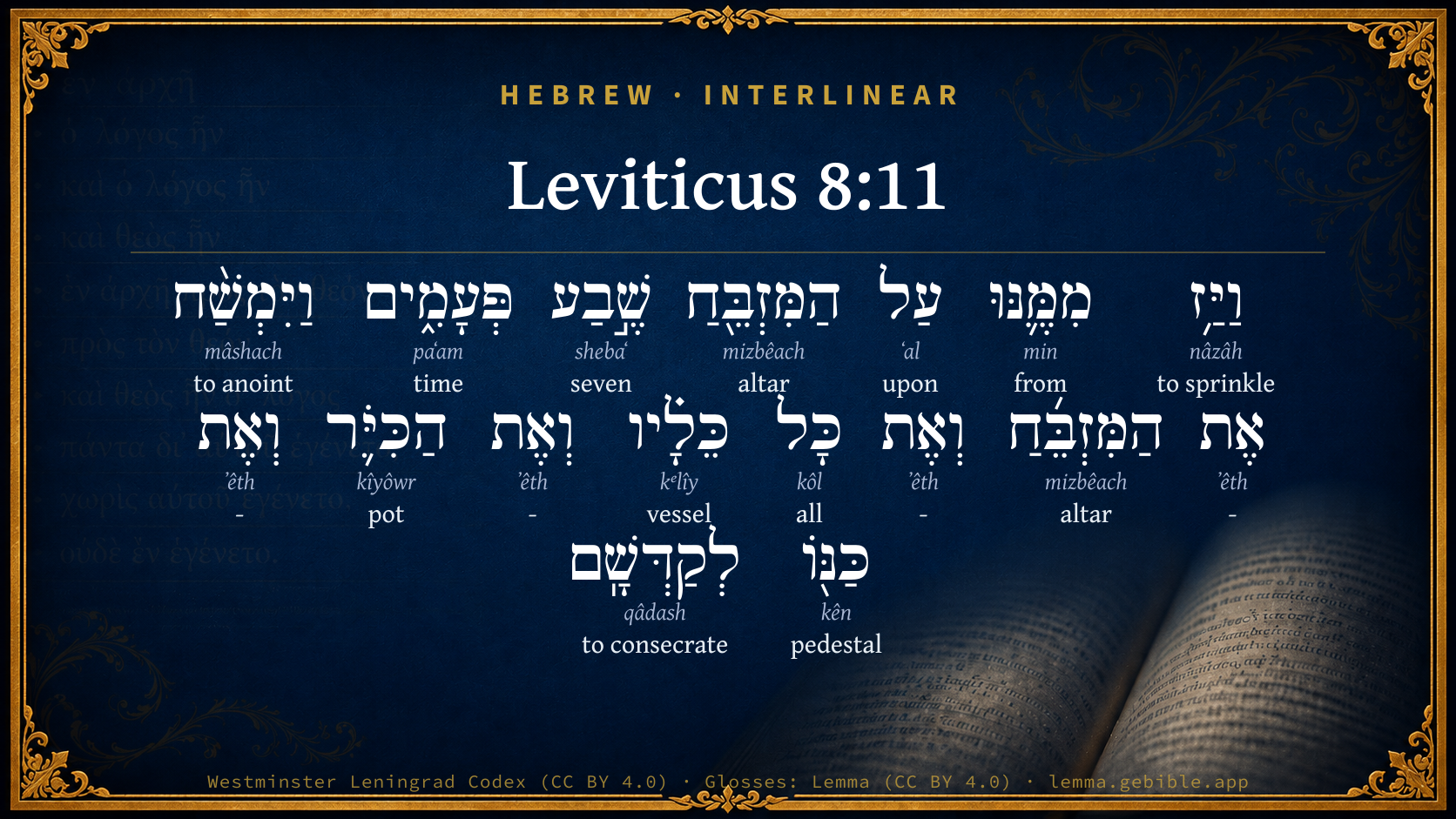
  1. וַיַּ֥ז nâzâh H5137 “and · to sprinkle” Conjunction + Verb, Hiphil, Sequential Imperfect, 3rd Person, Masculine, Singular
  2. מִמֶּ֛נּוּ min H4480 “from · us” Preposition + Suffix, Personal, 1st Person, Common, Plural
  3. עַל ʻal H5921 “upon” Preposition
  4. הַמִּזְבֵּ֖חַ mizbêach H4196 “the · altar” Particle, Definite Article + Noun, Common, Masculine, Singular, Absolute
  5. שֶׁ֣בַע shebaʻ H7651 “seven” Adjective, Cardinal number, Feminine, Singular, Absolute
  6. פְּעָמִ֑ים paʻam H6471 “times” Noun, Common, Feminine, Plural, Absolute
  7. וַיִּמְשַׁ֨ח mâshach H4886 “and · to anoint” Conjunction + Verb, Qal, Sequential Imperfect, 3rd Person, Masculine, Singular
  8. אֶת ʼêth H853 “-” Particle, Direct Object
  9. הַמִּזְבֵּ֜חַ mizbêach H4196 “the · altar” Particle, Definite Article + Noun, Common, Masculine, Singular, Absolute
  10. וְאֶת ʼêth H853 “and · -” Conjunction + Particle, Direct Object
  11. כָּל kôl H3605 “all of” Noun, Common, Masculine, Singular, Construct
  12. כֵּלָ֗יו kᵉlîy H3627 “vessels · his” Noun, Common, Masculine, Plural, Construct + Suffix, Personal, 3rd Person, Masculine, Singular
  13. וְאֶת ʼêth H853 “and · -” Conjunction + Particle, Direct Object
  14. הַכִּיֹּ֛ר kîyôwr H3595 “the · pot” Particle, Definite Article + Noun, Common, Masculine, Singular, Absolute
  15. וְאֶת ʼêth H853 “and · -” Conjunction + Particle, Direct Object
  16. לְקַדְּשָֽׁם qâdash H6942 “to consecrate · them” Preposition + Verb, Piel, Infinitive Construct + Suffix, Personal, 3rd Person, Masculine, Plural

About this verse

These counts appear in no published source. They are computed here, from the morphology-tagged text and Lemma’s own curated glosses. What Lemma adds →

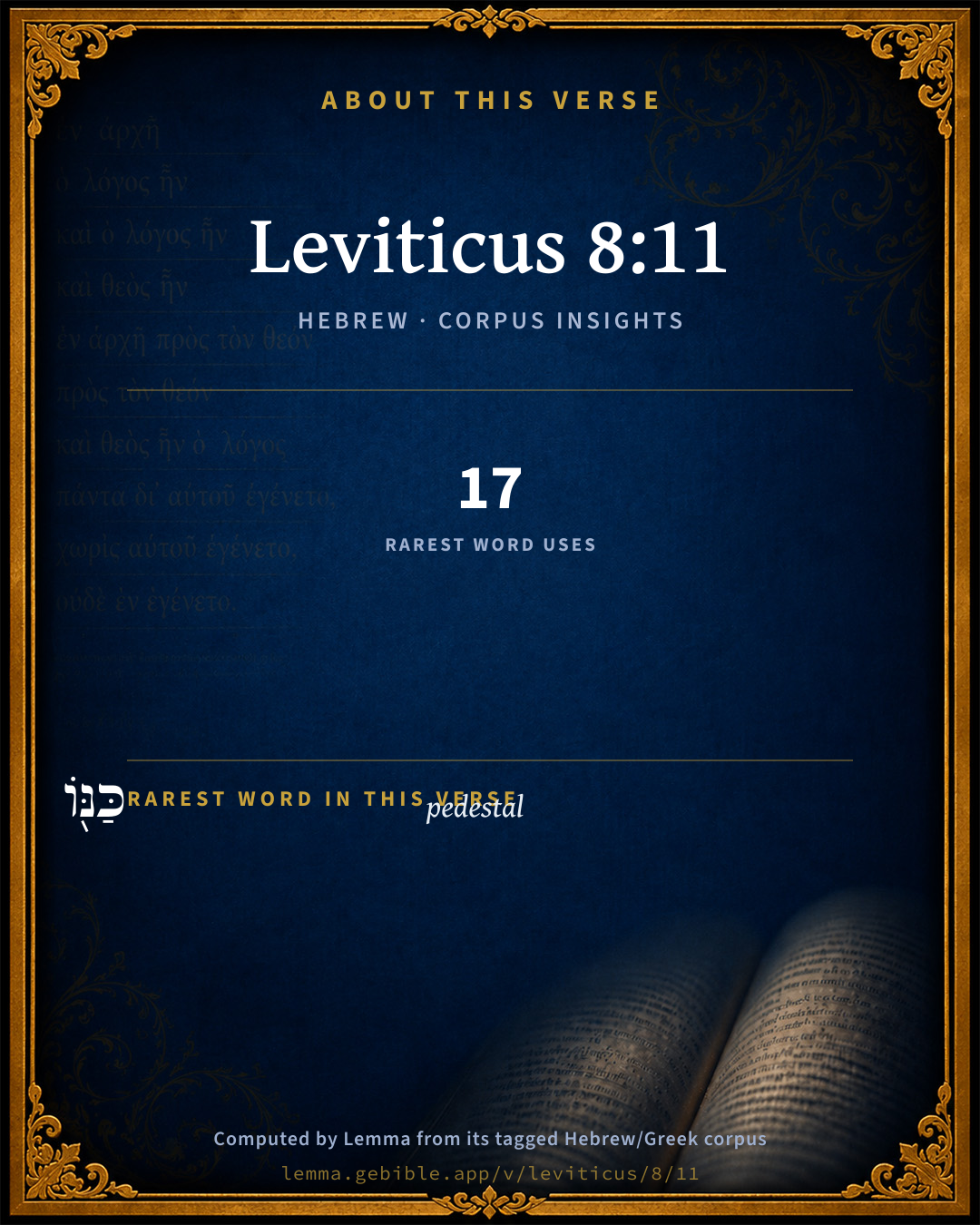
17
words
13
distinct lemmas
Pentateuch
section

Notable vocabulary

The rarest word here is כַּנּ֖וֹ pedestal H3653 — appearing just 17 times in the whole Hebrew Bible.

Shared distinctive vocabulary

כַּנּ֖וֹ pedestal H3653 occurs in 17 verses of the Hebrew Bible. Also found in:

Grammatical profile

  • 3 verbs
  • 7 nouns
  • 1 adjective
  • 2 prepositions
  • 4 particles

Verb forms

  • וַיַּ֥ז Hiphil · Sequential Imperfect
  • וַיִּמְשַׁ֨ח Qal · Sequential Imperfect
  • לְקַדְּשָֽׁם Piel · Infinitive Construct

Repetition

A word recurs within this verse — often emphatic in Hebrew:

  • הַמִּזְבֵּ֖חַ altar H4196 ×2

Hebrew & Septuagint length

In English translation the verse runs 25 words from the Hebrew and 41 from the Septuagint (LXX English) — the Septuagint runs noticeably longer here. See the side-by-side →

A rough comparison of the two English renderings, which tokenize alike — not a word-level alignment.

Word counts can differ between the Hebrew and the Greek without any difference in meaning — e.g. the Hebrew direct-object marker אֵת has no separate Greek word, and Greek often adds the article ὁ.

Cross-references

8

Topical passages linked to Leviticus 8:11 in the Treasury of Scripture Knowledge — connected by theme and wording, ordered by reader-vote popularity; previews shown in the World English Bible.

  • Exodus 4:6 Yahweh said furthermore to him, "Now put your hand inside your cloak." He put his hand inside his cloak, and when he took it out, behold, his hand was leprous, as white as snow.
  • Exodus 4:17 You shall take this rod in your hand, with which you shall do the signs."
  • Exodus 16:14 When the dew that lay had gone, behold, on the surface of the wilderness was a small round thing, small as the hoar-frost on the ground.
  • Exodus 16:19 Moses said to them, "Let no one leave of it until the morning."
  • Exodus 30:29 You shall sanctify them, that they may be most holy. Whatever touches them shall be holy.
  • Isaiah 52:15 so shall he sprinkle many nations; kings shall shut their mouths at him: for that which had not been told them shall they see; and that which they had not heard shall they understand.
  • Ezekiel 36:25 I will sprinkle clean water on you, and you shall be clean: from all your filthiness, and from all your idols, will I cleanse you.
  • Titus 3:6 which he poured out on us richly, through Jesus Christ our Savior;

Cross-references courtesy of OpenBible.info (CC BY 4.0).

Hebrew and Greek witnesses Masoretic Hebrew ↔ Greek Septuagint

The same verse in the two great witnesses to the Old Testament, shown verse-for-verse.

Here the Septuagint runs noticeably longer than the Hebrew — LXX2012 (modern English Septuagint) 41 words vs World English Bible 25. A rough length comparison of the two English translations, not a word-level alignment — read both below.

These are two independent witnesses, not word-aligned to each other, and the Septuagint is shown in lemma (dictionary) form.

Hebrew Leviticus 8:11 Masoretic · Westminster Leningrad Codex

וַיַּ֥ז מִמֶּ֛נּוּ עַל הַמִּזְבֵּ֖חַ שֶׁ֣בַע פְּעָמִ֑ים וַיִּמְשַׁ֨ח אֶת הַמִּזְבֵּ֜חַ וְאֶת כָּל כֵּלָ֗יו וְאֶת הַכִּיֹּ֛ר וְאֶת כַּנּ֖וֹ לְקַדְּשָֽׁם

He sprinkled it on the altar seven times, and anointed the altar and all its vessels, and the basin and its base, to sanctify them.

World English Bible · Public Domain

Greek LXX Leviticus 8:11 Septuagint · lemma form

καί ῥαίνω ἀπό αὐτός ἐπί ὁ θυσιαστήριον ἑπτάκις καί χρίω ὁ θυσιαστήριον καί ἁγιάζω αὐτός καί πᾶς ὁ σκεῦος αὐτός καί ὁ λουτήρ καί ὁ βάσις αὐτός καί ἁγιάζω αὐτός καί χρίω ὁ σκηνή καί πᾶς ὁ ἐν αὐτός καί ἁγιάζω αὐτός

and sprinkled of it seven times on the altar; and anointed the altar, and hallowed it, and all things on it, and the laver, and its foot, and sanctified them; and anointed the tabernacle and all its furniture, and hallowed it.

LXX2012 (modern English Septuagint) · Public Domain

Hebrew: Westminster Leningrad Codex (CC BY 4.0). Greek: Septuagint (public domain); English from LXX2012 (modern English Septuagint) (Public Domain). How the Septuagint differs from the Hebrew →

Targum (Aramaic paraphrase)

2

The Targum is the ancient Jewish Aramaic paraphrase of the Hebrew Scriptures — an interpretive translation, not the Hebrew text itself. Onkelos (literal) and Pseudo-Jonathan (expansive) render the Torah, and Jonathan the Prophets. Coverage is partial: where no permissively-licensed English translation exists for a verse, only the Aramaic is shown. This is verse-level text, not a word-by-word alignment to the Hebrew.

  1. Targum Onkelos Torah (Genesis–Deuteronomy)
    וְאַדִי מִנֵהּ עַל מַדְבְּחָא שְׁבַע זִמְנִין וְרַבִּי יָת מַדְבְּחָא וְיָת כָּל מָנוֹהִי וְיָת כִּיוֹרָא וְיָת בְּסִיסֵהּ לְקַדָשׁוּתְהוֹן

    (no public-domain English translation for this verse)

    Targum Onkelos — Aramaic: “Onkelos Genesis” (public domain); “Onkelos Exodus” (public domain); “Onkelos Leviticus” (public domain); “Onkelos Numbers” (public domain); “Onkelos Deuteronomy” (public domain). English: “Sefaria Community Translation” (CC0 1.0 (public-domain dedication)); “J.W. Etheridge. The Targums of Onkelos and Jonathan Ben Uzziel on the Pentateuch. London: Longmans, Green, 1862” (public domain). Text via Sefaria.

  2. Targum Pseudo-Jonathan Torah (Genesis–Deuteronomy)
    וְאַדֵי מִנֵיהּ עַל מַדְבְּחָא שְׁבַע זִימְנִין וְרַבֵּי יַת מַדְבְּחָא וְיַת כָּל מְנוֹי וְיַת כִּיּוֹרָא וְיַת בְּסִיסֵיהּ לְקַדָשׁוּתְהוֹן

    And he sprinkled upon the altar seven times, and sanctified the altar and all its vessels, and the laver and its foundation to sanctify them.

    Targum Pseudo-Jonathan — Aramaic: “Targum Jonathan on Genesis” (public domain); “Targum Jonathan on Exodus” (public domain); “Targum Jonathan on Leviticus” (public domain); “Targum Jonathan on Numbers” (public domain); “Targum Jonathan on Deuteronomy” (public domain). English: “The Targum of Jonathan ben Uzziel, trans. J. W. Etheridge, London, 1862” (public domain). Text via Sefaria.

Commentary

Notes on Leviticus 8:11 from classic Christian and Jewish commentators (each source and its license shown beneath its notes). The classic Christian expositions comment on the surrounding passage and are grouped to its opening verse, so a note may address several verses; the Jewish commentaries on the Tanakh (Rashi and others) are per-verse, so they appear only where the commentator wrote on this verse.

Lemma curates 59 commentaries, every one of them public domain or Creative Commons licensed, each selected and text-cleaned for this edition rather than reprinted as found. About our sources →

Joseph Benson's Commentary

Lev 8:11. He sprinkled thereof upon the altar seven times — To signify the singular use and holiness of it, which it was not only to have in itself, but to communicate to all the sacrifices laid upon it. And thus does the blood of atonement give efficacy to all the services of believers, and render them acceptable to God.

Joseph Benson's Commentary on the Old and New Testaments (1811–1818) — public domain. Text from a community e-Sword module.

Ellicott's Commentary for English Readers

(11) And he sprinkled thereof upon the altar seven times.—That is, the altar of burnt offering. This rite of sprinkling the altar seven times is not mentioned in the directions given in Exo_30:28; Exo_40:10. For the import of the number seven, see Lev_4:6.

And anointed the altar and all his vessels.—That is, the same altar of burnt sacrifice. The altar, having thus been sanctified, was thenceforward considered as sanctifying the sacrifices and oblations offered upon it. Hence the remark of Christ, “Ye fools and blind, for whether is greater, the gift, or the altar that sanctifieth the gift ?” (Mat_23:19).

A Bible Commentary for English Readers, edited by Charles John Ellicott (1878–1897) — public domain. Text from a community e-Sword module.

The Cambridge Bible for Schools and Colleges

gen. ed. J. J. S. Perowne

11. upon the altar seven times] The sprinkling seven times is not enjoined in Exodus 29, but in Lev_8:36 of that ch. the sanctification of the altar is appointed for seven days, on each of which the altar is to be anointed.

The Cambridge Bible for Schools and Colleges (gen. ed. J. J. S. Perowne; Cambridge University Press, 1878–1918) — public domain. Text from a community e-Sword module.

John Gill's Exposition

And he sprinkled thereof upon the altar seven times,.... The altar of burnt offering; the order for anointing it is given in Exo 30:28 but in that no directions are given for the manner of doing it by sprinkling, nor the number of times it was to be sprinkled: hence Jarchi confesses his ignorance, and says,"I know not how it was ordered about these sprinklings;''but no doubt Moses was instructed of God in what manner to anoint it, and how often; and the number seven may denote the perfect unction of it, and made it a fitter type of Christ, who received the unction of the Spirit without measure:

and anointed the altar, and all its vessels; pans, shovels, basins, flesh hooks, and fire pans:

both the laver and his foot; which was for the priests to wash at; and very probably this was done before Moses brought Aaron and his sons thither and washed them, Lev 8:6 since it seems most proper that it should be consecrated before used, as it follows:

to sanctify them; set them apart for sacred use.

John Gill's Exposition of the Whole Bible (1746–1763) — public domain (CC PDM 1.0). Text via the HelloAO Bible API.

Albert Barnes' Notes on the Bible

Sprinkled ... the altar seven times - The altar of burnt-offering was distinguished by this sevenfold sprinkling with the holy oil. The number of the covenant was thus brought into connection with those acts of sacrifice by which the covenant between Yahweh and the worshipper was formally renewed and confirmed.

Albert Barnes' Notes on the Bible (1834–1885) — public domain. Text from a community e-Sword/MySword module.

Matthew Poole's English Annotations

Seven times, to signify the singular use and holiness of it, which it was not only to have in itself, but also to communicate to all the sacrifices laid upon it. The laver, where the priests washed themselves, and the sacrifices, and vessels or instruments of the holy ministration. See Lev 6:28.

Matthew Poole's English Annotations on the Holy Bible (1683–1685) — public domain. Text from a community e-Sword/MySword module.

Whedon's Commentary on the Bible

Daniel D. Whedon

11. Seven times — This number indicates perfection. See Lev_4:6, note. The perfect consecration of Aaron is alluded to in Heb_7:28, in connection with our High Priest, “who is consecrated (τετελειωμενον, perfected) forever.” In the Seventy the term “consecration” is translated τελειωσις, making perfect. Lev_8:33. Hence Jesus is spoken of as fully prepared for his priestly office when he is said to have been made perfect through sufferings. Heb_2:10; Heb_5:8-9. In his personal relation to the moral law he was always perfect.

Daniel D. Whedon (gen. ed.), Commentary on the Old and New Testaments (1874–1909) — public domain. Text from a community e-Sword module.

Rashi

Rabbi Shlomo Yitzchaki (Rashi)

ויז ממנו על המזבח AND HE SPRINKLED THEREOF UPON THE ALTAR — I do not know where he was given any command about these sprinklings (cf., however Nachmanides).

Rashi on the Tanakh — English translations: “The Judaica Press complete Tanach with Rashi, translated by A. J. Rosenberg” (CC BY 4.0); “Pentateuch with Rashi's commentary by M. Rosenbaum and A.M. Silbermann, 1929-1934” (public domain); “The Metsudah Tanach series, Lakewood, N.J” (CC BY 4.0); and “The Book of Joshua, Metsudah Publications, 1997” (CC BY 4.0). Text via Sefaria.

Ramban (Nachmanides)

Rabbi Moshe ben Nachman (Ramban / Nachmanides)

AND HE SPRINKLED THEREOF [i.e., of the anointing oil] UPON THE ALTAR. Rashi commented: “I do not know where Moses was commanded about these sprinklings.” It is possible that that which He said of the altar, and thou shalt sanctify the altar, and the altar shall be most holy, Verse 10. means that he should add this sanctification to the altar through the sprinklings [of the anointing oil], and it could not be done merely by anointing the altar, for the expression and the altar shall be most holy, means that he should give it an additional sanctity above that of the other anointed things in the Tabernacle and all its vessels. Moses thus sanctified the altar in the same way that he was commanded to do to the ministering priests, concerning whom He said, and thou shalt sprinkle it upon Aaron, and upon his garments, 29:21. since the altar, which is the vessel for the offerings, is not of a lesser degree of holiness than the garments of the ministering priests, and it is an inference from minor to major [that if the garments had to be sprinkled with the anointing oil, surely the altar, being more holy, had to be sprinkled]! And so also is it said with reference to the Day of Atonement, And he shall sprinkle of the blood upon it [the altar] with his finger seven times, and cleanse it, and hallow it from the uncleannesses of the children of Israel. Thus [we see that] all sanctifications of the altar were done by sprinklings, and it follows all the more so that [when the altar was consecrated] at the very beginning that it had to be sanctified by sprinkling from uncleanness and “strangeness” [i.e., from that which is not holy].Scripture did not mention here [in Verse 13] the anointing of Aaron’s sons, for it is self-evident that Moses did to them as he did to their father, in accordance with that which he was commanded, And thou shalt anoint them, as thou didst anoint their father, and He included it here in saying with reference to the sons that everything was done as the Eternal commanded Moses. It appears to me that the anointing of Aaron’s sons was not done by means of pouring the oil on their heads, for that is said only of Aaron, Then shalt thou take the anointing oil, and pour it upon his [Aaron’s] head, and anoint him, but the anointing of the sons is not mentioned there at all, as it was not done by means of pouring the oil as in Aaron’s case. It is [also] possible that there was no anointing of the sons, except for the sprinklings which Moses sprinkled on Aaron’s sons and their garments from the oil of anointment. Thus you see in the section of And this is the thing that thou shalt do unto them to hallow them, Verse 1. that He commanded to anoint the father [i.e., Aaron], as it says, Then shalt thou take the anointing oil, and pour it upon his head, but did not command to anoint the sons at all, either by pouring of the oil, or by anointing. However, in the section of the erection of the Tabernacle He says, And thou shalt anoint them, as thou didst anoint their father, because He did not mention the sprinklings there at all, [hence He mentioned “anointing,” whilst referring really to sprinkling]. Similarly, in the section of the oil of anointment [the verse mentions anointing of Aaron and his sons because it does not mention the sprinklings at all]. But both sprinkling and anointing are nowhere mentioned with reference to the sons of Aaron in one place. Therefore I say that he only did one of the two to them, namely, the sprinklings.

Ramban (Nachmanides) on the Tanakh — English translation: “Commentary on the Torah by Ramban (Nachmanides). Translated and annotated by Charles B. Chavel. New York, Shilo Pub. House, 1971-1976” (CC BY 4.0). Text via Sefaria.

Lesson kit

Teaching starters — assembled from the data on this page, not authored interpretation. Every prompt links to the verse data it draws on. Edit before teaching.

Leviticus, in the Pentateuch, opens this verse with 17 words (13 distinct Hebrew lemmas). Its most distinctive word is kên (“pedestal”). The Greek Septuagint runs longer here. A historical commentator’s framing appears above. Read the whole chapter for the surrounding context.

Discussion questions

  1. How does “pedestal” (kên) shape what this verse is saying?
  2. Genesis 40:13 shares the word «pedestal» with this verse. How do the two illuminate each other?
  3. “altar” occurs 2× in this one verse. What is the effect of the repetition?
  4. Compared with the Hebrew, the Septuagint runs longer here. What questions does that raise?
  5. These translations render this verse differently. What is at stake in choosing one wording over another?
  6. The verb «וַיַּ֥ז» is Hiphil Sequential Imperfect. How does its form color the action?
  7. Reading how Joseph Benson's Commentary and Ellicott's Commentary for English Readers read this verse, where do the two commentators agree and where do they part?

Things to notice

Reading settings

Reading text

Shown beneath each verse's original-language words.

Old Testament
Old Testament edition

Read the OT as the Masoretic Hebrew (MT) or the Greek Septuagint (LXX).

English shown for the Greek Septuagint (in the Hebrew ↔ Greek comparison).

Comparing translations? Open the Compare panel on any verse page to stack up to four side by side.