
Leviticus 8:30

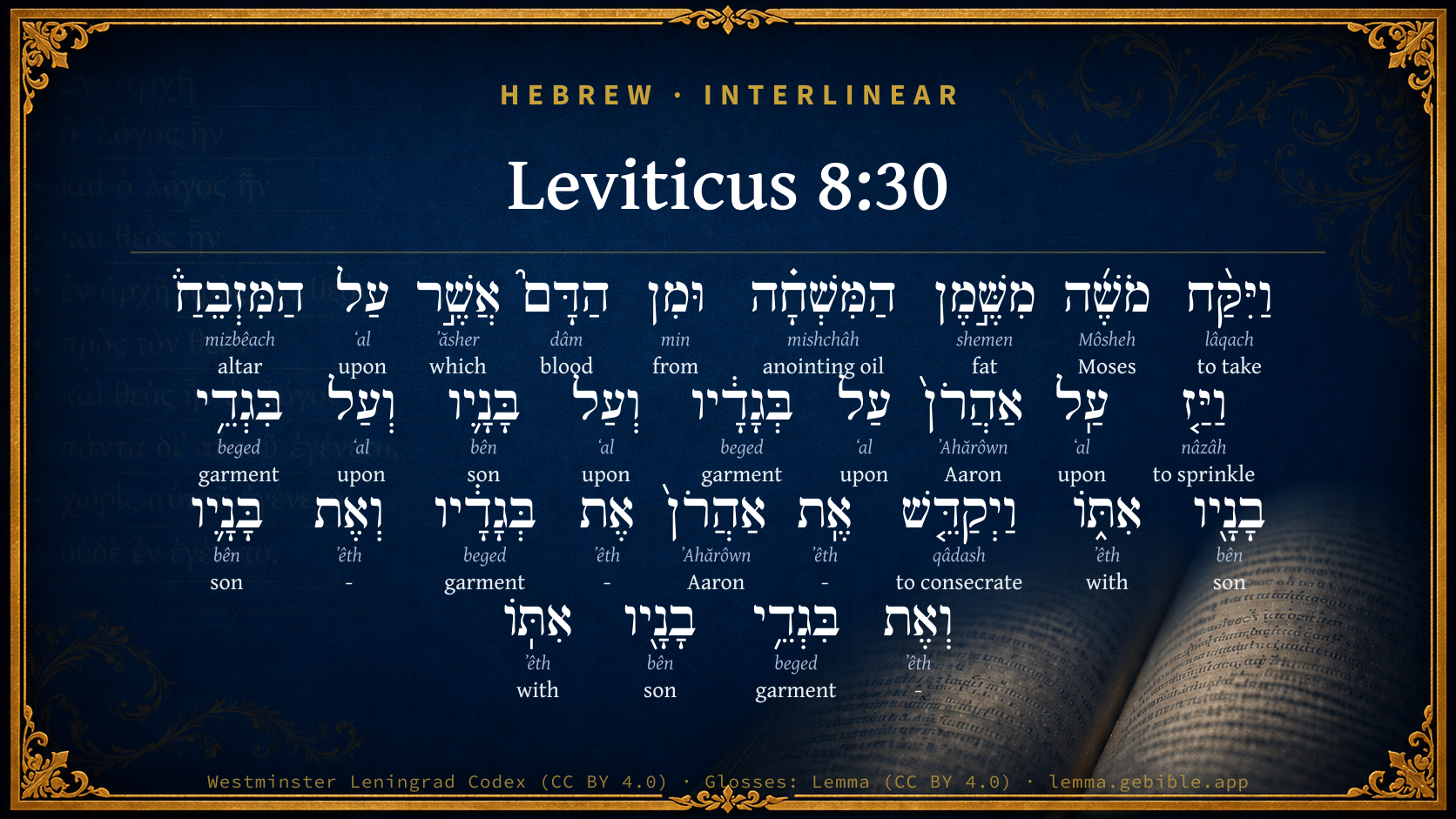
Hebrew (Westminster Leningrad Codex) Leviticus 8:30 appears in the Hebrew Old Testament. The text above is from the Westminster Leningrad Codex. Each word links to its Strong’s number, a concise gloss, and parsing drawn from the Open Scriptures Hebrew Bible morphology. Click any word for its full Brown-Driver-Briggs (BDB) entry.
Download image
Cite this verse

Leviticus 8:30 (World English Bible). Public Domain. Lemma interlinear Bible study tool, https://lemma.gebible.app/v/leviticus/8/30.

Show BibTeX & RIS
BibTeX
RIS
English Translation
Moses took some of the anointing oil, and some of the blood which was on the altar, and sprinkled it on Aaron, on his garments, and on his sons, and on his sons' garments with him, and sanctified Aaron, his garments, and his sons, and his sons' garments with him.
World English Bible · Public Domain
Download a study sheet

One document with this verse’s original text, its word-by-word gloss line, the meaning frame, cross-references with their text, attributed commentary, and full source and license credits — printable, and it pastes into notes with its structure intact.

This verse Autodidact and up

Study sheet (.html) Plain text (.txt)

A passage Seminary Student

Up to 50 verses in one chapter. A passage sheet keeps up to 6 commentary sources and 12 cross-references per verse, in the order this page ranks them, and says so on the sheet whenever that leaves anything out. Ask for a single verse and you get the Autodidact verse sheet above.

Everything on this page stays free to read, with no account — the sheet is a download of what is already on screen, not access to it.

Want to remove ads? Support Godless Engineer
Compare translations 3

The same verse in 3 English versions, stacked beneath the original-language interlinear above. Click any original word for its lexicon entry.

Each is an independent rendering of the whole verse — the interlinear is not word-aligned to these translations.

Highlighted words mark where these versions differ — a whole-verse word diff, not a word-by-word alignment.

  • World English Bible Public Domain
    Moses took some of the anointing oil, and some of the blood which was on the altar, and sprinkled it on Aaron, on his garments, and on his sons, and on his sons' garments with him, and sanctified Aaron, his garments, and his sons, and his sons' garments with him.
  • King James Version Public Domain
    And Moses took of the anointing oil, and of the blood which was upon the altar, and sprinkled it upon Aaron, and upon his garments, and upon his sons, and upon his sons' garments with him; and sanctified Aaron, and his garments, and his sons, and his sons' garments with him.
  • unfoldingWord Literal Text CC BY-SA 4.0
    And Moses took some of the oil of anointing and some of the blood that on the altar, and he sprinkled on Aaron, on his clothes, and on his sons, and on the clothes of his sons with him. And he consecrated Aaron, his clothes, and his sons, and the clothes of his sons with him.

unfoldingWord Literal Text — © unfoldingWord, licensed CC BY-SA 4.0. Word-aligned USFM3 via Door43 (git.door43.org/unfoldingWord/en_ult).

Versions to compare (up to 4)

3 of 4 selected

Show all 18 translations

Every available English version of this verse, each an independent rendering of the whole verse.

  • World English Bible Public Domain
    Moses took some of the anointing oil, and some of the blood which was on the altar, and sprinkled it on Aaron, on his garments, and on his sons, and on his sons' garments with him, and sanctified Aaron, his garments, and his sons, and his sons' garments with him.
  • Berean Standard Bible Public Domain
    Next, Moses took some of the anointing oil and some of the blood that was on the altar and sprinkled them on Aaron and his garments, and on his sons and their garments. So he consecrated Aaron and his garments, as well as Aaron’s sons and their garments.
  • Majority Standard Bible Public Domain
    Next, Moses took some of the anointing oil and some of the blood that was on the altar and sprinkled them on Aaron and his garments, and on his sons and their garments. So he consecrated Aaron and his garments, as well as Aaron’s sons and their garments.
  • King James Version Public Domain
    And Moses took of the anointing oil, and of the blood which was upon the altar, and sprinkled it upon Aaron, and upon his garments, and upon his sons, and upon his sons' garments with him; and sanctified Aaron, and his garments, and his sons, and his sons' garments with him.
  • American Standard Version (1901) Public Domain
    And Moses took of the anointing oil, and of the blood which was upon the altar, and sprinkled it upon Aaron, upon his garments, and upon his sons, and upon his sons' garments with him, and sanctified Aaron, his garments, and his sons, and his sons' garments with him.
  • Revised Version (1885) Public Domain
    And Moses took of the anointing oil, and of the blood which was upon the altar, and sprinkled it upon Aaron, upon his garments, and upon his sons, and upon his sons’ garments with him; and sanctified Aaron, his garments, and his sons, and his sons’ garments with him.
  • Geneva Bible (1599) Public Domain
    Also Moses tooke of the anointing oyle, and of the blood which was vpon the Altar, and sprinkled it vpon Aaron, vpon his garments, and vpon his sonnes, and on his sonnes garments with him: so hee sanctified Aaron, his garments, and his sonnes, and his sonnes garments with him.
  • Douay-Rheims (1899) Public Domain
    And taking the ointment, and the blood that was upon the altar, he sprinkled Aaron, and his vestments, and his sons, and their vestments with it.
  • Young's Literal Translation Public Domain
    And Moses taketh of the anointing oil, and of the blood which `is' on the altar, and sprinkleth on Aaron, on his garments, and on his sons, and on the garments of his sons with him, and he sanctifieth Aaron, his garments, and his sons, and the garments of his sons with him.
  • Literal Standard Version CC BY-SA 4.0
    And Moses takes of the anointing oil, and of the blood which [is] on the altar, and sprinkles [them] on Aaron, on his garments, and on his sons, and on the garments of his sons with him, and he sanctifies Aaron, his garments, and his sons, and the garments of his sons with him.
  • Unlocked Literal Bible CC BY-SA 4.0
    Moses took some of the anointing oil and the blood that was on the altar; he sprinkled these on Aaron, on his clothes, on his sons, and on his sons' clothes with him. In this way he set apart Aaron and his clothes, and his sons and their clothes to Yahweh.
  • unfoldingWord Literal Text CC BY-SA 4.0
    And Moses took some of the oil of anointing and some of the blood that on the altar, and he sprinkled on Aaron, on his clothes, and on his sons, and on the clothes of his sons with him. And he consecrated Aaron, his clothes, and his sons, and the clothes of his sons with him.
  • Darby Bible Public Domain
    And Moses took of the anointing oil, and of the blood that was on the altar, and sprinkled [it] on Aaron, on his garments, and on his sons, and on his sons' garments with him; and hallowed Aaron, his garments, and his sons, and his sons' garments with him.
  • World Messianic Bible Public Domain
    Moses took some of the anointing oil, and some of the blood which was on the altar, and sprinkled it on Aaron, on his garments, and on his sons, and on his sons’ garments with him, and sanctified Aaron, his garments, and his sons, and his sons’ garments with him.
  • Webster's Bible Public Domain
    And Moses took of the anointing oil, and of the blood which was upon the altar, and sprinkled it upon Aaron, and upon his garments, and upon his sons, and upon his sons' garments with him; and sanctified Aaron, and his garments, and his sons, and his sons' garments with him.
  • Free Bible Version CC BY-SA 4.0
    Moses then took some of the anointing oil and some of the blood from the altar. He sprinkled them both on the clothes of Aaron and his sons. This is how he dedicated the clothes of Aaron and his sons.
  • Bible in Basic English Public Domain
    And Moses took some of the holy oil and of the blood which was on the altar and put it on Aaron and on his robes, and on his sons and on his sons' robes; and made Aaron holy, and his robes and his sons and his sons' robes with him.
  • JPS Tanakh (1917) Public Domain
    And Moses took of the anointing oil, and of the blood which was upon the altar, and sprinkled it upon Aaron, and upon his garments, and upon his sons, and upon his sons' garments with him, and sanctified Aaron, and his garments, and his sons, and his sons' garments with him.

Literal Standard Version (2020), Covenant Press — licensed CC BY-SA 4.0. Text via the HelloAO Bible API (eBible.org). Unlocked Literal Bible (unfoldingWord) — licensed CC BY-SA 4.0. Text via the HelloAO Bible API (eBible.org). unfoldingWord Literal Text — © unfoldingWord, licensed CC BY-SA 4.0. Word-aligned USFM3 via Door43 (git.door43.org/unfoldingWord/en_ult). Free Bible Version, Dr. Jonathan Gallagher — licensed CC BY-SA 4.0. Text via the HelloAO Bible API (eBible.org).

Word by word

More ways to search: Search by grammar → Find every occurrence → Compare this word →

Practice this passage: Drill this verse → Learn its vocabulary →

וַיַּ֤ז
nâzâh
H5137
“and · to sprinkle”
Conjunction + Verb, Hiphil, Sequential Imperfect, 3rd Person, Masculine, Singular
Part of Speech
Conjunction + Verb
Stem
Hiphil
Form
Sequential Imperfect
Person
3rd Person
Gender
Masculine
Number
Singular
Full BDB Definition

Origin: a primitive root

TWOT: 1335 , 1336

to spurt, spatter, sprinkle - (Qal) to spurt, spatter - (Hiphil) to cause to spurt, sprinkle upon - to spring, leap - (Hiphil) to cause to leap, startle
  1. וַיִּקַּ֨ח lâqach H3947 “and · to take” Conjunction + Verb, Qal, Sequential Imperfect, 3rd Person, Masculine, Singular
  2. מֹשֶׁ֜ה Môsheh H4872 “Moses” Noun, Proper
  3. מִשֶּׁ֣מֶן shemen H8081 “from · fat of” Preposition + Noun, Common, Masculine, Singular, Construct
  4. הַמִּשְׁחָ֗ה mishchâh H4888 “the · anointing oil” Particle, Definite Article + Noun, Common, Feminine, Singular, Absolute
  5. וּמִן min H4480 “and · from” Conjunction + Preposition
  6. הַדָּם֮ dâm H1818 “the · blood” Particle, Definite Article + Noun, Common, Masculine, Singular, Absolute
  7. אֲשֶׁ֣ר ʼăsher H834 “which” Particle, Relative
  8. עַל ʻal H5921 “upon” Preposition
  9. הַמִּזְבֵּחַ֒ mizbêach H4196 “the · altar” Particle, Definite Article + Noun, Common, Masculine, Singular, Absolute
  10. עַֽל ʻal H5921 “upon” Preposition
  11. אַהֲרֹן֙ ʼAhărôwn H175 “Aaron” Noun, Proper
  12. עַל ʻal H5921 “upon” Preposition
  13. בְּגָדָ֔יו beged H899 “garments · his” Noun, Common, Masculine, Plural, Construct + Suffix, Personal, 3rd Person, Masculine, Singular
  14. וְעַל ʻal H5921 “and · upon” Conjunction + Preposition
  15. בָּנָ֛יו bên H1121 “sons · his” Noun, Common, Masculine, Plural, Construct + Suffix, Personal, 3rd Person, Masculine, Singular
  16. וְעַל ʻal H5921 “and · upon” Conjunction + Preposition
  17. בִּגְדֵ֥י beged H899 “garments of” Noun, Common, Masculine, Plural, Construct
  18. בָנָ֖יו bên H1121 “sons · his” Noun, Common, Masculine, Plural, Construct + Suffix, Personal, 3rd Person, Masculine, Singular
  19. אִתּ֑וֹ ʼêth H854 “with · him” Preposition + Suffix, Personal, 3rd Person, Masculine, Singular
  20. וַיְקַדֵּ֤שׁ qâdash H6942 “and · to consecrate” Conjunction + Verb, Piel, Sequential Imperfect, 3rd Person, Masculine, Singular
  21. אֶֽת ʼêth H853 “-” Particle, Direct Object
  22. אַהֲרֹן֙ ʼAhărôwn H175 “Aaron” Noun, Proper
  23. אֶת ʼêth H853 “-” Particle, Direct Object
  24. בְּגָדָ֔יו beged H899 “garments · his” Noun, Common, Masculine, Plural, Construct + Suffix, Personal, 3rd Person, Masculine, Singular
  25. וְאֶת ʼêth H853 “and · -” Conjunction + Particle, Direct Object
  26. בָּנָ֛יו bên H1121 “sons · his” Noun, Common, Masculine, Plural, Construct + Suffix, Personal, 3rd Person, Masculine, Singular
  27. וְאֶת ʼêth H853 “and · -” Conjunction + Particle, Direct Object
  28. בִּגְדֵ֥י beged H899 “garments of” Noun, Common, Masculine, Plural, Construct
  29. בָנָ֖יו bên H1121 “sons · his” Noun, Common, Masculine, Plural, Construct + Suffix, Personal, 3rd Person, Masculine, Singular
  30. אִתּֽוֹ ʼêth H854 “with · him” Preposition + Suffix, Personal, 3rd Person, Masculine, Singular

About this verse

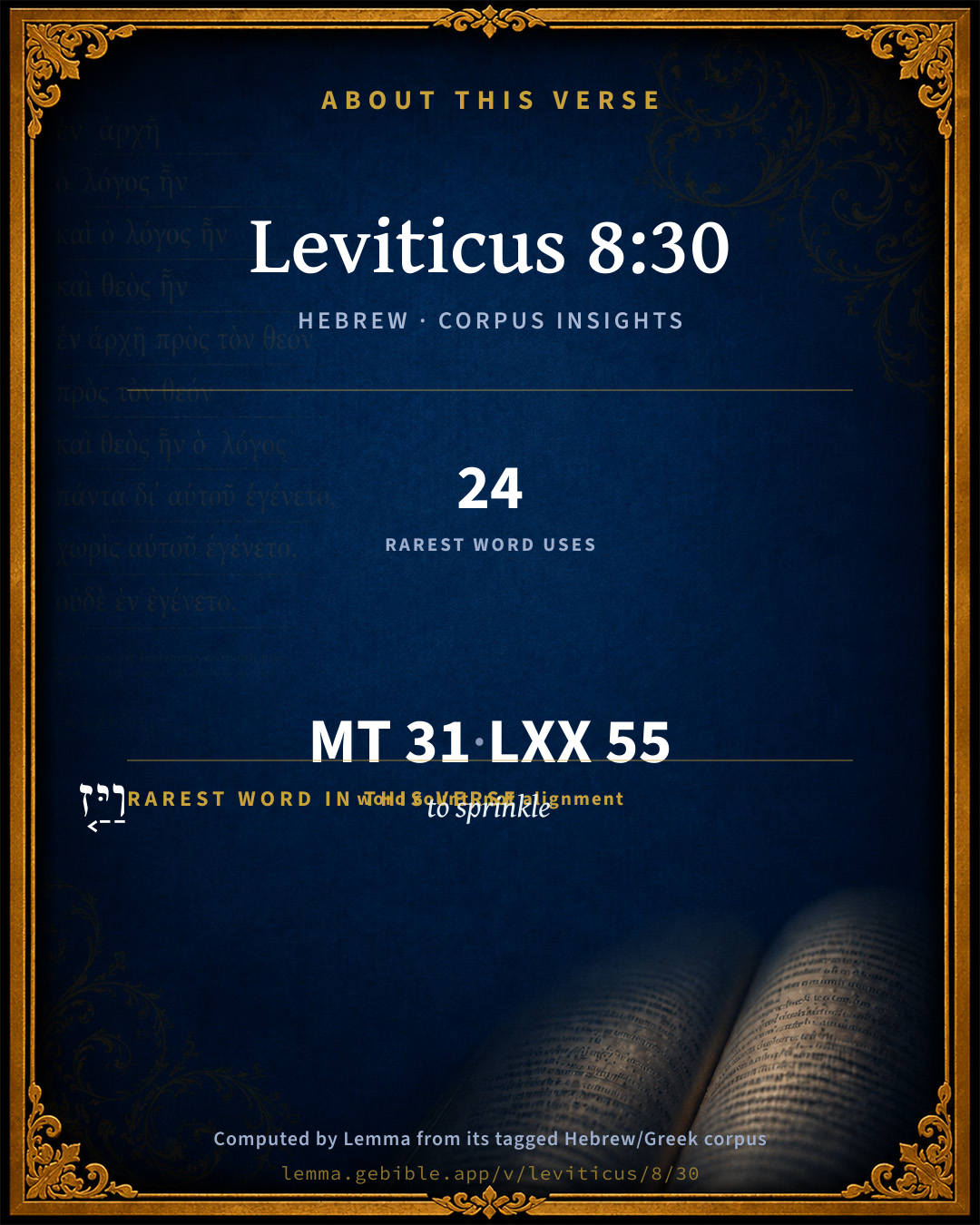
These counts appear in no published source. They are computed here, from the morphology-tagged text and Lemma’s own curated glosses. What Lemma adds →

31
words
16
distinct lemmas
Pentateuch
section

Notable vocabulary

The rarest word here is וַיַּ֤ז to sprinkle H5137 — appearing just 24 times in the whole Hebrew Bible.

Shared distinctive vocabulary

וַיַּ֤ז to sprinkle H5137 occurs in 22 verses of the Hebrew Bible. Also found in:

Grammatical profile

  • 3 verbs
  • 15 nouns
  • 8 prepositions
  • 5 particles

Verb forms

  • וַיִּקַּ֨ח Qal · Sequential Imperfect
  • וַיַּ֤ז Hiphil · Sequential Imperfect
  • וַיְקַדֵּ֤שׁ Piel · Sequential Imperfect

Repetition

Words recur within this verse — often emphatic in Hebrew:

  • עַל upon H5921 ×5
  • בְּגָדָ֔יו garment H899 ×4
  • בָּנָ֛יו son H1121 ×4
  • אַהֲרֹן֙ Aaron H175 ×2
  • אִתּ֑וֹ with H854 ×2

Hebrew & Septuagint length

In English translation the verse runs 50 words from the Hebrew and 18 from the Septuagint (LXX English) — the Septuagint runs noticeably shorter here. See the side-by-side →

A rough comparison of the two English renderings, which tokenize alike — not a word-level alignment.

Word counts can differ between the Hebrew and the Greek without any difference in meaning — e.g. the Hebrew direct-object marker אֵת has no separate Greek word, and Greek often adds the article ὁ.

In the original languages it is 31 Hebrew tokens and 55 Greek tokens — but the two are counted differently (Hebrew bundles its prefixes and suffixes into one token; the Greek is in lemma form), so that isn’t a like-for-like length.

Cross-references

11

Topical passages linked to Leviticus 8:30 in the Treasury of Scripture Knowledge — connected by theme and wording, ordered by reader-vote popularity; previews shown in the World English Bible.

  • Exodus 29:21 You shall take of the blood that is on the altar, and of the anointing oil, and sprinkle it on Aaron, and on his garments, and on his sons, and on the garments of his sons with him: and he shall be made holy, and his garments, and his sons, and his sons' garments with him.
  • Exodus 30:30 You shall anoint Aaron and his sons, and sanctify them, that they may minister to me in the priest's office.
  • Numbers 3:3 These are the names of the sons of Aaron, the priests who were anointed, whom he consecrated to minister in the priest's office.
  • Leviticus 10:3 Then Moses said to Aaron, "This is what Yahweh spoke of, saying, "'I will show myself holy to those who come near me, And before all the people I will be glorified.'" Aaron held his peace.
  • Isaiah 61:1 The Spirit of the Lord Yahweh is on me; because Yahweh has anointed me to preach good news to the humble; he has sent me to bind up the broken-hearted, to proclaim liberty to the captives, and the opening [of the prison] to those who are bound;
  • Isaiah 61:3 to appoint to those who mourn in Zion, to give to them a garland for ashes, the oil of joy for mourning, the garment of praise for the spirit of heaviness; that they may be called trees of righteousness, the planting of Yahweh, that he may be glorified.
  • Galatians 5:22–25 But the fruit of the Spirit is love, joy, peace, patience, kindness, goodness, faithfulness,
  • Hebrews 2:11 For both he who sanctifies and those who are sanctified are all from one, for which cause he is not ashamed to call them brothers,
  • 1 Peter 1:2 according to the foreknowledge of God the Father, in sanctification of the Spirit, that you may obey Jesus Christ and be sprinkled in his blood: Grace to you and peace be multiplied.
  • 1 John 2:27 As for you, the anointing which you received from him remains in you, and you don't need for anyone to teach you. But as his anointing teaches you concerning all things, and is true, and is no lie, and even as it taught you, you will remain in him.
  • Revelation 7:14 I told him, "My lord, you know." He said to me, "These are those who came out of the great tribulation. They washed their robes, and made them white in the Lamb's blood.

Cross-references courtesy of OpenBible.info (CC BY 4.0).

Hebrew and Greek witnesses Masoretic Hebrew ↔ Greek Septuagint

The same verse in the two great witnesses to the Old Testament, shown verse-for-verse.

Here the Septuagint runs noticeably shorter than the Hebrew — LXX2012 (modern English Septuagint) 18 words vs World English Bible 50. A rough length comparison of the two English translations, not a word-level alignment — read both below.

These are two independent witnesses, not word-aligned to each other, and the Septuagint is shown in lemma (dictionary) form.

Hebrew Leviticus 8:30 Masoretic · Westminster Leningrad Codex

וַיִּקַּ֨ח מֹשֶׁ֜ה מִשֶּׁ֣מֶן הַמִּשְׁחָ֗ה וּמִן הַדָּם֮ אֲשֶׁ֣ר עַל הַמִּזְבֵּחַ֒ וַיַּ֤ז עַֽל אַהֲרֹן֙ עַל בְּגָדָ֔יו וְעַל בָּנָ֛יו וְעַל בִּגְדֵ֥י בָנָ֖יו אִתּ֑וֹ וַיְקַדֵּ֤שׁ אֶֽת אַהֲרֹן֙ אֶת בְּגָדָ֔יו וְאֶת בָּנָ֛יו וְאֶת בִּגְדֵ֥י בָנָ֖יו אִתּֽוֹ

Moses took some of the anointing oil, and some of the blood which was on the altar, and sprinkled it on Aaron, on his garments, and on his sons, and on his sons' garments with him, and sanctified Aaron, his garments, and his sons, and his sons' garments with him.

World English Bible · Public Domain

Greek LXX Leviticus 8:30 Septuagint · lemma form

καί λαμβάνω μωυσῆς ἀπό ὁ ἔλαιον ὁ χρῖσις καί ἀπό ὁ αἷμα ὁ ἐπί ὁ θυσιαστήριον καί προςῥαίνω ἐπί ἀαρών καί ὁ στολή αὐτός καί ὁ υἱός αὐτός καί ὁ στολή ὁ υἱός αὐτός μετά αὐτός καί ἁγιάζω ἀαρών καί ὁ στολή αὐτός καί ὁ υἱός αὐτός καί ὁ στολή ὁ υἱός αὐτός μετά αὐτός

And he sanctified Aaron and his garments, and his sons, and the garments of his sons with him.

LXX2012 (modern English Septuagint) · Public Domain

Hebrew: Westminster Leningrad Codex (CC BY 4.0). Greek: Septuagint (public domain); English from LXX2012 (modern English Septuagint) (Public Domain). How the Septuagint differs from the Hebrew →

Targum (Aramaic paraphrase)

2

The Targum is the ancient Jewish Aramaic paraphrase of the Hebrew Scriptures — an interpretive translation, not the Hebrew text itself. Onkelos (literal) and Pseudo-Jonathan (expansive) render the Torah, and Jonathan the Prophets. Coverage is partial: where no permissively-licensed English translation exists for a verse, only the Aramaic is shown. This is verse-level text, not a word-by-word alignment to the Hebrew.

  1. Targum Onkelos Torah (Genesis–Deuteronomy)
    וּנְסִיב מֹשֶׁה מִמִשְׁחָא דִרְבוּתָא וּמִן דְמָא דִי עַל מַדְבְּחָא וְאַדִי עַל אַהֲרֹן עַל לְבוּשׁוֹהִי וְעַל בְּנוֹהִי וְעַל לְבוּשֵׁי בְנוֹהִי עִמֵהּ וְקַדִישׁ יָת אַהֲרֹן יָת לְבוּשׁוֹהִי וְיָת בְּנוֹהִי וְיָת לְבוּשֵׁי בְנוֹהִי עִמֵהּ

    (no public-domain English translation for this verse)

    Targum Onkelos — Aramaic: “Onkelos Genesis” (public domain); “Onkelos Exodus” (public domain); “Onkelos Leviticus” (public domain); “Onkelos Numbers” (public domain); “Onkelos Deuteronomy” (public domain). English: “Sefaria Community Translation” (CC0 1.0 (public-domain dedication)); “J.W. Etheridge. The Targums of Onkelos and Jonathan Ben Uzziel on the Pentateuch. London: Longmans, Green, 1862” (public domain). Text via Sefaria.

  2. Targum Pseudo-Jonathan Torah (Genesis–Deuteronomy)
    וּנְסֵיב משֶׁה מִמִשְׁחָא דִרְבוּתָא וּמִן אַדְמָא דְעַל מַדְבְּחָא וְאַדִי עַל אַהֲרן וְעַל לְבוּשׁוֹי וְעַל בְּנוֹי וְעַל לְבוּשֵׁי בְנוֹי עִמֵיהּ וְקַדִישׁ יַת אַהֲרן וְיַת לְבוּשׁוֹי וְיַת בְּנוֹי וְיַת לְבוּשֵׁי בְנוֹי עִמֵיהּ

    And Mosheh took the consecrating oil, and of the blood which was upon the altar, and sprinkled upon Aharon, and upon his vestments, and on his sons, and on their vestments with him; and sanctified Aharon and his vestments, and his sons and their vestments with him.

    Targum Pseudo-Jonathan — Aramaic: “Targum Jonathan on Genesis” (public domain); “Targum Jonathan on Exodus” (public domain); “Targum Jonathan on Leviticus” (public domain); “Targum Jonathan on Numbers” (public domain); “Targum Jonathan on Deuteronomy” (public domain). English: “The Targum of Jonathan ben Uzziel, trans. J. W. Etheridge, London, 1862” (public domain). Text via Sefaria.

Commentary

Notes on Leviticus 8:30 from classic Christian and Jewish commentators (each source and its license shown beneath its notes). The classic Christian expositions comment on the surrounding passage and are grouped to its opening verse, so a note may address several verses; the Jewish commentaries on the Tanakh (Rashi and others) are per-verse, so they appear only where the commentator wrote on this verse.

Lemma curates 59 commentaries, every one of them public domain or Creative Commons licensed, each selected and text-cleaned for this edition rather than reprinted as found. About our sources →

Tyndale Open Study Notes

Tyndale Open Resources

8:30 anointing oil: See study note on 8:2; see also Ps 133:2.

Tyndale Open Study Notes — © Tyndale Open Resources, licensed CC BY-SA 4.0. Text via the HelloAO Bible API.

Adam Clarke's Commentary

Verse 30. And Moses took - the blood - and sprinkled it upon Aaron, c.] Thus we find that the high priest himself must be sprinkled with the blood of the sacrifice and our blessed Lord, of whom Aaron was a type, was sprinkled with his own blood.

1. In his agony in the garden.

2. In his being crowned with thorns.

3. In the piercing of his hands and his feet. And,

4. In his side being pierced with the spear. All these were so many acts of atonement performed by the high priest.

Adam Clarke's Commentary on the Bible (1810–1826) — public domain. Text from a community e-Sword/MySword module.

Ellicott's Commentary for English Readers

(30) And of the blood which was upon the altar.—That is, some of the blood of the ram of consecration, which was probably kept in the bowl, and placed upon the altar for this purpose. Whether the anointing oil and the blood were sprinkled separately, or whether they were mixed together, cannot possibly be gathered either from this passage, or from Exo_29:21, which gives the order. As the sacred garments were the badge of office, they received the same cleansing and sanctification as the priests themselves. Hence the remark of the apostle, “almost all things were by the law purged with blood” (Heb_9:22).

A Bible Commentary for English Readers, edited by Charles John Ellicott (1878–1897) — public domain. Text from a community e-Sword module.

The Cambridge Bible for Schools and Colleges

gen. ed. J. J. S. Perowne

30. And Moses took of the anointing oil] In Exo_29:21 this ceremony is enjoined before the offering of Lev_8:25-29 = Exo_29:22-26. It is not clear whether the oil and the blood are mingled together for one sprinkling (here the word is a correct rendering of the Heb.), or whether each is sprinkled separately. The difference of order in Exo_29:21, where the blood is mentioned before the oil, is easily explained on the first hypothesis, but a separate sprinkling seems required if the ceremonial described in this verse is regarded as carrying out the injunctions of Exo_28:41 to anoint Aaron and his sons. See note on Lev_8:13. The reason for sprinkling Aaron with oil after the anointing of Lev_8:12 is not apparent. The absence of the conjunction after Aaron twice in the Heb. text of this verse (note and A.V., twice in italics, omitted in R.V.), may indicate a doubt whether any further unction of Aaron was necessary. But the injunction in Exo_29:21 is definite, including the person of Aaron as well as his garments.

The Cambridge Bible for Schools and Colleges (gen. ed. J. J. S. Perowne; Cambridge University Press, 1878–1918) — public domain. Text from a community e-Sword module.

John Gill's Exposition

And Moses took of the anointing oil, and of the blood which was upon the altar,.... Which was sprinkled upon the altar round about, Lev 8:24 and these two seem to be mixed together, since it follows:

and sprinkled it upon Aaron, &c. See Gill on Exo 29:21.

John Gill's Exposition of the Whole Bible (1746–1763) — public domain (CC PDM 1.0). Text via the HelloAO Bible API.

Haydock's Catholic Bible Commentary

Vestments. It is a maxim among the Rabbins, that a priest without his vestments, is not considered as such; and he is put to death, if he should dare to approach the altar in that condition. When the priests lay aside their sacred robes, they are looked upon as laymen. (Calmet) --- The high priest was consecrated by the unction on the head; (ver. 12,) those of an inferior condition, were sprinkled with ointment mixed with blood, &c. (Menochius)

George Leo Haydock (1774–1849), Haydock's Catholic Family Bible and Commentary, 1859 edition — public domain. Excludes Psalms (Douay-Rheims chapter numbering differs from Protestant) and Deuterocanonical books (Catholic canon only).

Whedon's Commentary on the Bible

Daniel D. Whedon

30. The anointing oil — For its elements see Exo_30:23-24. These spices beautifully typify the gifts and graces of the Holy Spirit, which impart no acerbity of disposition, no acid tempers, but only gentle qualities and benevolent affections.

And of the blood — Since both oil and blood prefigure, the first the consecration and the second the purifying of the soul, their union typifies the blending of the office of the atoning Saviour, who hath redeemed us by his blood, with that of the Holy Spirit, who transforms and sanctifies by his cleansing power. Hence, since under the Gospel all believers are dignified as priests, we are exhorted to “draw near with a true heart, in full assurance of faith, having our hearts sprinkled from an evil conscience,” by the blood of the Lamb, “and our bodies washed with pure water,” the symbol of purification by the Holy Spirit.

Heb_10:22; see Lev_14:5, note. Sacrifice for sin alone does not suffice; there must be an inward cleansing by the Spirit. To pardon sin is to leave the house swept and garnished but unoccupied; to fill with the Holy Ghost is to put in a keeper.

Upon Aaron, and upon his garments — The person and the garments were sprinkled to prefigure both inward and outward purification, holiness of heart and of life. When the blood and the oil could be connected together, then Aaron and his sons could be anointed and sanctified together. Thus Jesus set himself apart as a bleeding sacrifice for the purchase of the holy unction for all believers, made priests unto God. This explains Joh_17:19.

Daniel D. Whedon (gen. ed.), Commentary on the Old and New Testaments (1874–1909) — public domain. Text from a community e-Sword module.

The Pulpit Commentary

The sprinkling with oil and blood completes the ceremony of anointing, and suffices of itself for the sons of Aaron, in addition to their virtual participation in the anointing of their father (verse 12). "In the mingling of the blood and oil for the anointing seems to be taught that not sacrifice for sin alone suffices; but that with this must be joined the unction of the Holy Spirit" (Gardiner).

The Pulpit Commentary (1880–1919), ed. H.D.M. Spence-Jones & Joseph S. Exell — public domain. Text from a community e-Sword module.

unfoldingWord translationNotes

Door43 World Missions Community

translationWords

Moses

anoint

oil

blood

altar

set apart

Aaron

clothe

son

unfoldingWord translationNotes — © Distant Shores Media and the Door43 World Missions Community, licensed CC BY-SA 4.0. Source: git.door43.org/Door43/en_tn.

Ramban (Nachmanides)

Rabbi Moshe ben Nachman (Ramban / Nachmanides)

AND MOSES TOOK OF THE ANOINTING OIL, AND OF THE BLOOD WHICH WAS UPON THE ALTAR [AND SPRINKLED IT UPON AARON etc.]. I do not know whether he mixed [the oil with the blood] for these sprinklings, something like that which it says, and he shall take of the blood of the bullock, and of the blood of the goat, and put it upon the horns of the altar. Nor has it become clear to me why Moses performed these sprinklings after the burning of the ram of consecration, for in the section containing the command about the consecration Services He mentioned first the sprinklings, and only afterwards He said, And thou shalt take of the ram the fat, and the fat tail., Verse 22. Perhaps since He said there [in the same verse where He mentioned these sprinklings], and he [Aaron] and his garments shall be hallowed, and his sons and his sons’ garments with him, Moses deduced that these sprinklings were the last things to be done to them, through which they would become completely holy, for in connection with anointing the priests He did not mention the term “hallowed,” nor in connection with the placing of the blood upon their thumbs., Verse 20. [Therefore, since it is only stated in connection with the sprinklings of the oil and the blood that the priests are to become hallowed, Moses deduced that this was to be done after the burning of the ram of consecration.] And when it says here [immediately following Moses’ pouring the anointing oil upon Aaron’s head], and he anointed him, to sanctify him, it was not a complete sanctification until Moses had done the sprinklings, even as it says [in the verse before us, after he had done the sprinklings], and he sanctified Aaron, and his garments, and his sons. Thus he completed the sanctification of the father and sons together by means of these sprinklings. The Rabbis have also said so in the Torath Kohanim: 34. “And he sanctified Aaron. From here you learn that the sanctification of Aaron and his sons was completed only with the sprinkling of the blood.”

Ramban (Nachmanides) on the Tanakh — English translation: “Commentary on the Torah by Ramban (Nachmanides). Translated and annotated by Charles B. Chavel. New York, Shilo Pub. House, 1971-1976” (CC BY 4.0). Text via Sefaria.

Lesson kit

Teaching starters — assembled from the data on this page, not authored interpretation. Every prompt links to the verse data it draws on. Edit before teaching.

Leviticus, in the Pentateuch, opens this verse with 31 words (16 distinct Hebrew lemmas). Its most distinctive word is nâzâh (“to sprinkle”). The Greek Septuagint runs shorter here. A historical commentator’s framing appears above. Read the whole chapter for the surrounding context.

Discussion questions

  1. What does “to sprinkle” (nâzâh) contribute to the verse as a whole?
  2. How does Exodus 29:21, which shares the word «to sprinkle», read alongside this verse?
  3. What does the repetition of “upon” (5× in this one verse) do in this verse?
  4. The Septuagint runs shorter here than the Hebrew. What might account for the difference?
  5. These translations render this verse differently; the difference is in the English rendering, not the original. What questions does that raise?
  6. «וַיִּקַּ֨ח» is a Qal Sequential Imperfect verb. How does that grammatical form shape the action described?
  7. Compare how Tyndale Open Study Notes and Adam Clarke's Commentary read this verse. Where do they agree or differ?

Things to notice

Reading settings

Reading text

Shown beneath each verse's original-language words.

Old Testament
Old Testament edition

Read the OT as the Masoretic Hebrew (MT) or the Greek Septuagint (LXX).

English shown for the Greek Septuagint (in the Hebrew ↔ Greek comparison).

Comparing translations? Open the Compare panel on any verse page to stack up to four side by side.