
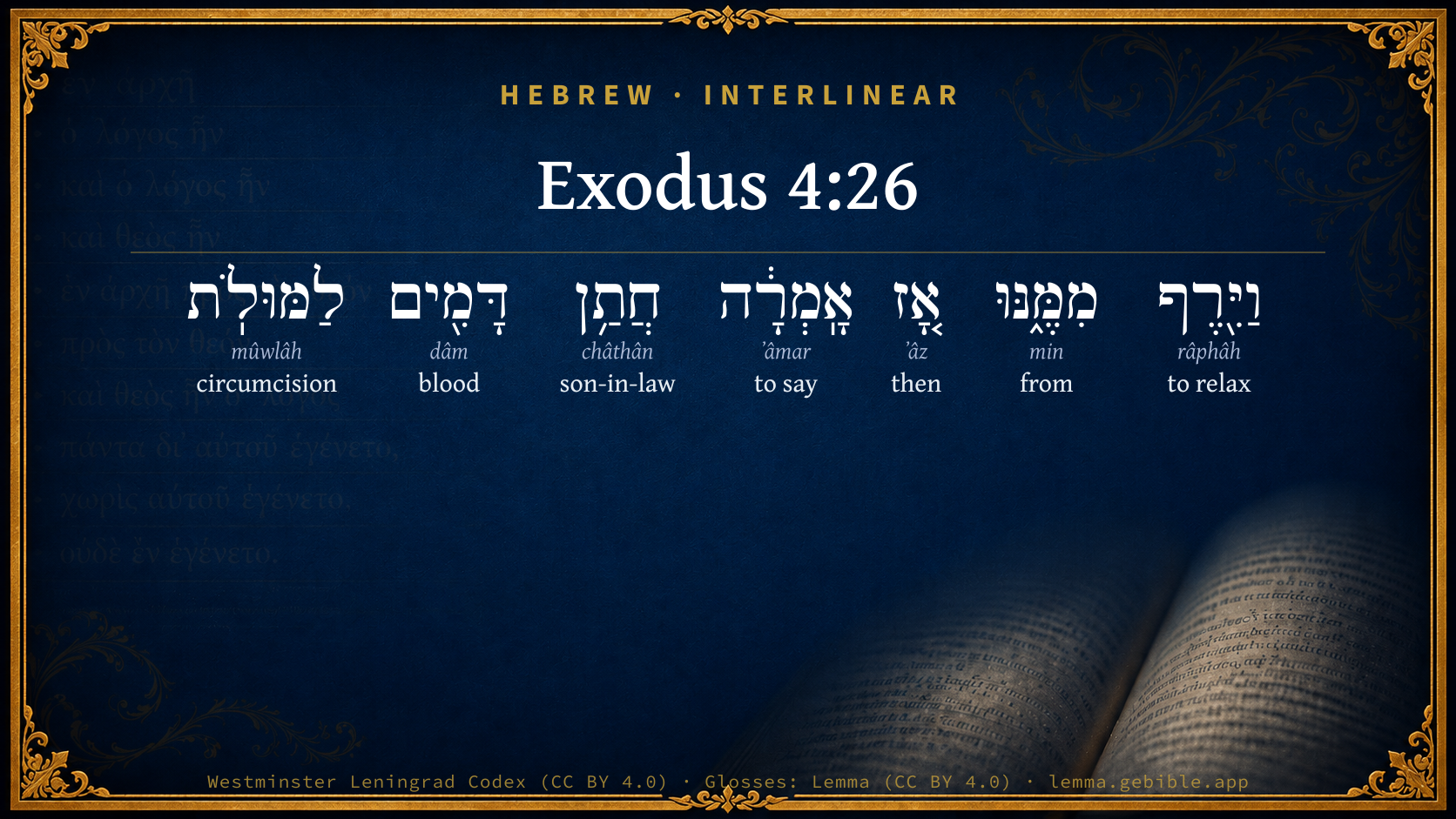
Exodus 4:26

Hebrew (Westminster Leningrad Codex) Exodus 4:26 appears in the Hebrew Old Testament. The text above is from the Westminster Leningrad Codex. Each word links to its Strong’s number, a concise gloss, and parsing drawn from the Open Scriptures Hebrew Bible morphology. Click any word for its full Brown-Driver-Briggs (BDB) entry.
Download image
Cite this verse

Exodus 4:26 (World English Bible). Public Domain. Lemma interlinear Bible study tool, https://lemma.gebible.app/v/exodus/4/26.

Show BibTeX & RIS
BibTeX
RIS
English Translation
So he let him alone. Then she said, "You are a bridegroom of blood," because of the circumcision.
World English Bible · Public Domain
Highlights
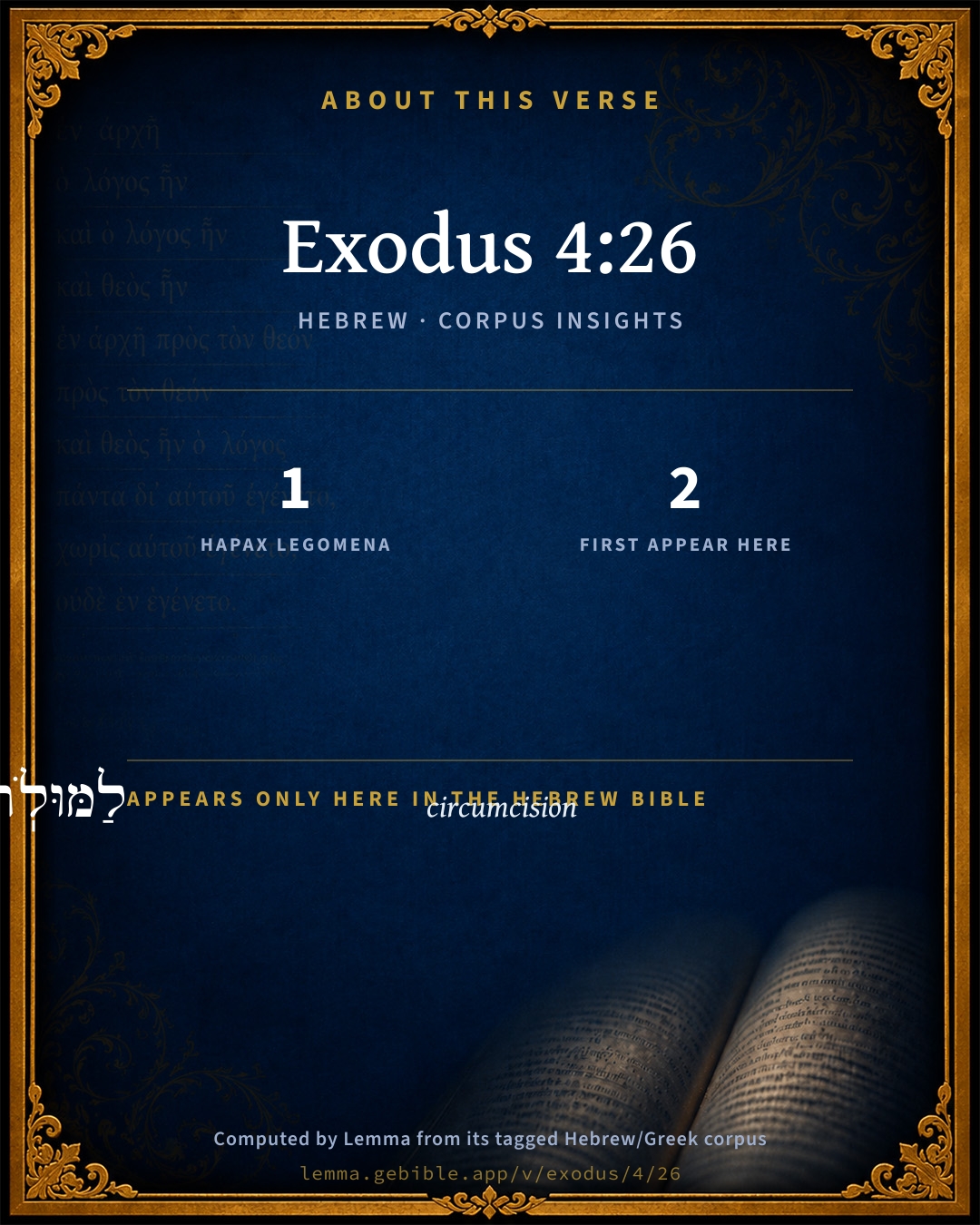
  • 1 hapax legomenon — only here in the Hebrew Bible
  • 2 first appearances in the Hebrew Bible
Full analysis ↓
Download a study sheet

One document with this verse’s original text, its word-by-word gloss line, the meaning frame, cross-references with their text, attributed commentary, and full source and license credits — printable, and it pastes into notes with its structure intact.

This verse Autodidact and up

Study sheet (.html) Plain text (.txt)

A passage Seminary Student

Up to 50 verses in one chapter. A passage sheet keeps up to 6 commentary sources and 12 cross-references per verse, in the order this page ranks them, and says so on the sheet whenever that leaves anything out. Ask for a single verse and you get the Autodidact verse sheet above.

Everything on this page stays free to read, with no account — the sheet is a download of what is already on screen, not access to it.

Want to remove ads? Support Godless Engineer
Compare translations 3

The same verse in 3 English versions, stacked beneath the original-language interlinear above. Click any original word for its lexicon entry.

Each is an independent rendering of the whole verse — the interlinear is not word-aligned to these translations.

Highlighted words mark where these versions differ — a whole-verse word diff, not a word-by-word alignment.

  • World English Bible Public Domain
    So he let him alone. Then she said, "You are a bridegroom of blood," because of the circumcision.
  • King James Version Public Domain
    So he let him go: then she said, A bloody husband thou art, because of the circumcision.
  • unfoldingWord Literal Text CC BY-SA 4.0
    And he relented from him. That was when she said, “bridegroom of blood” because of the circumcision.

unfoldingWord Literal Text — © unfoldingWord, licensed CC BY-SA 4.0. Word-aligned USFM3 via Door43 (git.door43.org/unfoldingWord/en_ult).

Versions to compare (up to 4)

3 of 4 selected

Show all 18 translations

Every available English version of this verse, each an independent rendering of the whole verse.

  • World English Bible Public Domain
    So he let him alone. Then she said, "You are a bridegroom of blood," because of the circumcision.
  • Berean Standard Bible Public Domain
    So the LORD let him alone. (When she said, “bridegroom of blood,” she was referring to the circumcision.)
  • Majority Standard Bible Public Domain
    So the LORD let him alone. (When she said, “bridegroom of blood,” she was referring to the circumcision.)
  • King James Version Public Domain
    So he let him go: then she said, A bloody husband thou art, because of the circumcision.
  • American Standard Version (1901) Public Domain
    So he let him alone. Then she said, A bridegroom of blood `art thou', because of the circumcision.
  • Revised Version (1885) Public Domain
    So he let him alone. Then she said, A bridegroom of blood art thou, because of the circumcision.
  • Geneva Bible (1599) Public Domain
    So he departed from him. Then she saide, O bloodie husband (because of the circumcision)
  • Douay-Rheims (1899) Public Domain
    And he let him go after she had said A bloody spouse art thou to me, because of the circumcision.
  • Young's Literal Translation Public Domain
    and He desisteth from him: then she said, `A bridegroom of blood,' in reference to the circumcision.
  • Literal Standard Version CC BY-SA 4.0
    and He desists from him. Then she said, “A bridegroom of blood,” in reference to the circumcision.
  • Unlocked Literal Bible CC BY-SA 4.0
    So Yahweh let him alone. She said, “You are a bridegroom of blood” because of the circumcision.
  • unfoldingWord Literal Text CC BY-SA 4.0
    And he relented from him. That was when she said, “bridegroom of blood” because of the circumcision.
  • Darby Bible Public Domain
    And he let him go. Then she said, A bloody husband -- because of the circumcision.
  • World Messianic Bible Public Domain
    So he let him alone. Then she said, “You are a bridegroom of blood,” because of the circumcision.
  • Webster's Bible Public Domain
    So he let him go: then she said, A bloody husband thou art, because of the circumcision.
  • Free Bible Version CC BY-SA 4.0
    (Calling him a blood-husband referred to circumcision.) After this the Lord left Moses alone.
  • Bible in Basic English Public Domain
    So he let him go. Then she said, You are a husband of blood because of the circumcision.
  • JPS Tanakh (1917) Public Domain
    So He let him alone. Then she said: 'A bridegroom of blood in regard of the circumcision.'

Literal Standard Version (2020), Covenant Press — licensed CC BY-SA 4.0. Text via the HelloAO Bible API (eBible.org). Unlocked Literal Bible (unfoldingWord) — licensed CC BY-SA 4.0. Text via the HelloAO Bible API (eBible.org). unfoldingWord Literal Text — © unfoldingWord, licensed CC BY-SA 4.0. Word-aligned USFM3 via Door43 (git.door43.org/unfoldingWord/en_ult). Free Bible Version, Dr. Jonathan Gallagher — licensed CC BY-SA 4.0. Text via the HelloAO Bible API (eBible.org).

Word by word

More ways to search: Search by grammar → Find every occurrence → Compare this word →

Practice this passage: Drill this verse → Learn its vocabulary →

About this verse

These counts appear in no published source. They are computed here, from the morphology-tagged text and Lemma’s own curated glosses. What Lemma adds →

7
words
7
distinct lemmas
Pentateuch
section

Notable vocabulary

1 hapax legomenon — a word that appears only here in the entire Hebrew Bible:

  • לַמּוּלֹֽת circumcision H4139

First appearance in Scripture

These words make their first canonical appearance in the Hebrew Bible here:

  • וַיִּ֖רֶף to relax H7503
  • לַמּוּלֹֽת circumcision H4139

Shared distinctive vocabulary

חֲתַ֥ן son-in-law H2860 occurs in 19 verses of the Hebrew Bible. Also found in:

Grammatical profile

  • 2 verbs
  • 3 nouns
  • 1 preposition
  • 1 adverb

Verb forms

  • וַיִּ֖רֶף Qal · Sequential Imperfect
  • אָֽמְרָ֔ה Qal · Perfect

Hebrew & Septuagint length

In English translation the verse runs 18 words from the Hebrew and 18 from the Septuagint (LXX English) — the same length.

A rough comparison of the two English renderings, which tokenize alike — not a word-level alignment.

Word counts can differ between the Hebrew and the Greek without any difference in meaning — e.g. the Hebrew direct-object marker אֵת has no separate Greek word, and Greek often adds the article ὁ.

Hebrew and Greek witnesses Masoretic Hebrew ↔ Greek Septuagint

The same verse in the two great witnesses to the Old Testament, shown verse-for-verse.

These are two independent witnesses, not word-aligned to each other, and the Septuagint is shown in lemma (dictionary) form.

Hebrew Exodus 4:26 Masoretic · Westminster Leningrad Codex

וַיִּ֖רֶף מִמֶּ֑נּוּ אָ֚ז אָֽמְרָ֔ה חֲתַ֥ן דָּמִ֖ים לַמּוּלֹֽת

So he let him alone. Then she said, "You are a bridegroom of blood," because of the circumcision.

World English Bible · Public Domain

Greek LXX Exodus 4:26 Septuagint · lemma form

καί ἀποἔρχομαι ἀπό αὐτός διότι εἶπον ἵστημι ὁ αἷμα ὁ περιτομή ὁ παιδίον ἐγώ

and he departed from him, because she said, The blood of the circumcision of my son is staunched.

LXX2012 (modern English Septuagint) · Public Domain

Hebrew: Westminster Leningrad Codex (CC BY 4.0). Greek: Septuagint (public domain); English from LXX2012 (modern English Septuagint) (Public Domain). How the Septuagint differs from the Hebrew →

Targum (Aramaic paraphrase)

2

The Targum is the ancient Jewish Aramaic paraphrase of the Hebrew Scriptures — an interpretive translation, not the Hebrew text itself. Onkelos (literal) and Pseudo-Jonathan (expansive) render the Torah, and Jonathan the Prophets. Coverage is partial: where no permissively-licensed English translation exists for a verse, only the Aramaic is shown. This is verse-level text, not a word-by-word alignment to the Hebrew.

  1. Targum Onkelos Torah (Genesis–Deuteronomy)
    וְנָח מִנֵהּ בְּכֵן אֲמֶרֶת אִלוּלֵי דְמָא דִמְהֻלְתָּא הָדֵין אִתְחַיַב חַתְנָא קְטוֹל:

    (no public-domain English translation for this verse)

    Targum Onkelos — Aramaic: “Onkelos Genesis” (public domain); “Onkelos Exodus” (public domain); “Onkelos Leviticus” (public domain); “Onkelos Numbers” (public domain); “Onkelos Deuteronomy” (public domain). English: “Sefaria Community Translation” (CC0 1.0 (public-domain dedication)); “J.W. Etheridge. The Targums of Onkelos and Jonathan Ben Uzziel on the Pentateuch. London: Longmans, Green, 1862” (public domain). Text via Sefaria.

  2. Targum Pseudo-Jonathan Torah (Genesis–Deuteronomy)
    וּפְסַק מַלְאָךְ חַבָּלָא מִנֵיהּ בְּכֵן שַׁבְּחַת צִפּוֹרָה וַאֲמַרַת מַה חָבִיב הוּא אֲדָם גְזוּרְתָּא הָדֵין דְשֵׁזִיב יַת חֲתָנָא מִן יְדוֹי דְמַלְאָךְ חֲבָּלָא

    And the destroying angel desisted from him, so that Zipporah gave thanks, and said, How lovely is the blood of this circumcision that hath delivered my husband from the angel of destruction!

    Targum Pseudo-Jonathan — Aramaic: “Targum Jonathan on Genesis” (public domain); “Targum Jonathan on Exodus” (public domain); “Targum Jonathan on Leviticus” (public domain); “Targum Jonathan on Numbers” (public domain); “Targum Jonathan on Deuteronomy” (public domain). English: “The Targum of Jonathan ben Uzziel, trans. J. W. Etheridge, London, 1862” (public domain). Text via Sefaria.

Commentary

Notes on Exodus 4:26 from classic Christian and Jewish commentators (each source and its license shown beneath its notes). The classic Christian expositions comment on the surrounding passage and are grouped to its opening verse, so a note may address several verses; the Jewish commentaries on the Tanakh (Rashi and others) are per-verse, so they appear only where the commentator wrote on this verse.

Lemma curates 59 commentaries, every one of them public domain or Creative Commons licensed, each selected and text-cleaned for this edition rather than reprinted as found. About our sources →

Trapp's Complete Commentary

John Trapp

Exo 4:26 So he let him go: then she said, A bloody husband [thou art], because of the circumcision.

Ver. 26. A bloody husband thou art.] This peal she rings oft in his ears, and so taught him patience.

“Coniugium humanae divina Academia vitae.”

Certain it is that we are a bloody spouse to Christ: the Church is Aceldama, a field of blood.

John Trapp, A Commentary or Exposition upon All the Books of the Old and New Testament (1647–1656) — public domain. Text from a community e-Sword module.

Geneva Bible (1599)

Geneva Bible translators

Or, the Angel.

Geneva Bible (1599) marginal notes — public domain. Text via Bolls.life.

Jamieson, Fausset & Brown

Robert Jamieson, A. R. Fausset & David Brown

So he let him go--Moses recovered; but the remembrance of this critical period in his life would stimulate the Hebrew legislator to enforce a faithful attention to the rite of circumcision when it was established as a divine ordinance in Israel, and made their peculiar distinction as a people.

Jamieson, Fausset & Brown — Commentary Critical and Explanatory on the Whole Bible (1871) — public domain (CC PDM 1.0). Text via the HelloAO Bible API.

Ellicott's Commentary for English Readers

(26) So he let him go.—God let Moses go, i.e., allowed him to recover—accepted Zipporah’s act as sufficient, albeit tardy, reparation, and spared the life of her husband.

Then she said.—When Moses was sufficiently recovered, Zipporah explained to him why she had called him “a bloody husband;” it was “on account of the circumcisions,” i.e., the two circumcisions—of Gershom in Midian, many years previously, and now of Eliezer. We learn from Exo_18:2-3, that Zipporah and her boys were sent back to Jethro by Moses, probably at this time. Moses was in haste, and the child could not have travelled conveniently for some days.

A Bible Commentary for English Readers, edited by Charles John Ellicott (1878–1897) — public domain. Text from a community e-Sword module.

The Cambridge Bible for Schools and Colleges

gen. ed. J. J. S. Perowne

26. let him alone] Heb. relaxed from him: cf. Jdg_11:37, Deu_9:14.

Then she said (viz. when she spoke the words given in v. 25b), ‘A blood-bridegroom,’ with regard to circumcisions] The last word is plural in the Heb. ‘Blood-bridegroom’ was apparently a current expression: and the passage seems to attribute to Zipporah the new sense of it explained in the last note but one.

It seems that in this narrative an archaic stage in the history of circumcision is referred to, which is not elsewhere mentioned in the OT. Circumcision is a rite which has been, and still is, largely practised in the world: among the Hebrews (besides its religious associations) its distinctive feature was that it was performed in infancy. Among the Arabs it is performed upon boys of ages varying, in different places, from 3 to 15; but in many parts of the world it is performed upon youths at the approach of puberty. A practice so widely diffused must rest upon some common principle: and the idea which appears generally to underlie circumcision is that it is a rite of initiation into manhood; a youth, till he has been circumcised, is not reckoned a full member of the tribe, or (as in Australia, for instance) allowed to marry. Now the fact that the Heb. word for ‘father-in-law’ (ḥôthçn) is derived from a root which in Arabic signifies to circumcise, seems to shew that it meant originally circumciser, and to indicate that in primitive times circumcision was among the Hebrews, as among the other nations just referred to, a general preliminary to marriage, which it was the duty of the future father-in-law to see enforced. These facts throw light upon the present narrative. The reason why Moses had incurred Jehovah’s wrath was because he was not a ‘blood-bridegroom,’ i.e. because he had not, according to established custom, submitted to circumcision before marriage: Zipporah, seizing a flint, circumcises her son instead of her husband, and so makes the latter symbolically a ‘blood-bridegroom,’ and delivers him from the wrath of Jehovah. At the same time, the circumcision of male infants is explained as a more humane substitute for the original circumcision of young men before marriage (Wellh. Hist. p. 340; EB. ii. 830, 832; DB. v. 622a). On circumcision, see now very fully Hastings’ Encycl. of Rel. and Ethics, s.v.

The Cambridge Bible for Schools and Colleges (gen. ed. J. J. S. Perowne; Cambridge University Press, 1878–1918) — public domain. Text from a community e-Sword module.

John Gill's Exposition

And the Lord said unto Aaron,.... He appeared to him in a dream or vision, and to this reference is had in Sa1 2:27.

go into the wilderness to meet Moses; in the wilderness of Arabia, through which Moses was to pass into Egypt, and who was now set out on his journey thitherward:

and he went; immediately, being obedient to the heavenly vision: and met him in the mount of God; in Horeb, where the Lord had appeared to Moses, and therefore called the mount of God, and where afterwards the law was given, and the covenant made with the people of Israel; and so the Targum of Jonathan paraphrases it,"in the mount on which the glory of God was revealed:"

and kissed him: as relations and intimate friends used to do at meeting or parting, to testify affection and respect; and Aaron must on all accounts be glad to meet Moses, both as he was his brother, whom he had not seen for many years, and as he was come to be a deliverer of the people of Israel. And it is observed, that it was but two days' journey from the land of Midian, where Jethro lived, from whence Moses set out; and that a common traveller cannot conveniently make the journey from Ramesses, or Grand Cairo (from whence it may be supposed Aaron set out), to Mount Horeb, in less than a fortnight, though he be carried on the back of a camel (g); and yet Aaron reached this place by the time that Moses did, which shows that either he delayed setting out on his journey, or was detained long at the inn on the road, on account of what happened there.

(g) Clayton's Chronology of the Hebrew Bible, p 221.

John Gill's Exposition of the Whole Bible (1746–1763) — public domain (CC PDM 1.0). Text via the HelloAO Bible API.

Albert Barnes' Notes on the Bible

So he let him go - i. e. God withdrew His visitation from Moses.

Moses sent Zipporah and her children back to Jethro before he went to Egypt, Exo 18:2. The journey would have been delayed had he waited for the healing of the child.

Albert Barnes' Notes on the Bible (1834–1885) — public domain. Text from a community e-Sword/MySword module.

Matthew Poole's English Annotations

So he let him go; or, he, i.e. God, or the destroying angel sent from God, departed from him, i.e. from Moses, and removed the tokens of God’s indignation, the sickness or stroke laid upon him.

Zipporah both repeats and amplifies her former censure, and reproacheth not only her husband, but also God’s ordinance; which perverse and obstinate spirit her husband observing in her, and wisely forecasting how much disturbance she might give him in his great and difficult work in Egypt, he thought fit to send her and her children back to her father, as appears from Exo 18:1-3. In the Hebrew it is,

because of the circumcisions, to wit, of her two sons, who possibly were both circumcised at this time, though it be not so expressed; but one being mentioned for an example, we are left to suppose the like concerning the other; or the circumcision of this child brings the other to her remembrance, and so she upbraids him with both. Only this doth more provoke her than it seems the other did, because she was forced to do this speedily, and with her own hands, and that to a tender infant; whereas the elder peradventure was circumcised when he was more grown and strong, and able to bear the pain. Let none think it strange that Zipporah should quarrel so much at circumcision, because the Midianites were descended from Abraham, and therefore were circumcised. For if they were so, it was done when they were grown up, about the thirteenth year of their age, from the example of Ishmael, who was circumcised at that age. But indeed it is more likely that those people, being cast out of God’s covenant, as to the benefit of it, would, and did in a little time, throw off the sign of it, as having much more of pain and danger in it, than of use and privilege.

Matthew Poole's English Annotations on the Holy Bible (1683–1685) — public domain. Text from a community e-Sword/MySword module.

The Pulpit Commentary

So he let him go. i.e. "God let Moses go allowed him to escape death, accepted Zipporah"s tardy act as a removal of the cause of offence, and gave her husband back to her. Then she said, etc. This is not a second address of Zipporah to Moses, conceived in the same terms, but an explanation of her previous address. She called him "a bloody husband because of the circumcision." Literally, "of the circumcisions." The two circumcisions, of Gershom in Midian, and of Eliezer on the way to Egypt, are especially in the writer"s mind.

The Pulpit Commentary (1880–1919), ed. H.D.M. Spence-Jones & Joseph S. Exell — public domain. Text from a community e-Sword module.

John Wesley's Explanatory Notes

So he let him go - The destroying angel withdrew. But still Zipporah cannot forget, but will unreasonably call Moses a bloody husband, because he obliged her to circumcise the child; and upon this occasion, (it is probable) he sent them back to his father-in-law, that they might not create him any further uneasiness. When we have any special service to do for God, we should remove that as far from us as we can, which is likely to be our hindrance: let the dead bury their dead, but follow thou me.

John Wesley, Explanatory Notes Upon the Whole Bible (1754–1765) — public domain. Text via the GEBible commentary corpus.

Rashi

Rabbi Shlomo Yitzchaki (Rashi)

וירף SO HE LOOSENED HIS HOLD — the angel loosened his hold ממנו FROM HIM; (cf. Exodus Rabbah 5:8). אז THEN she understood that he had come to kill him because of the delay in the circumcision,

אמרה חתן דמים למלות SHE SAID “BRIDEGROOM OF BLOOD BECAUSE OF THE CIRCUMCISION” — my bridegroom was on the point of being killed on account of the circumcision.

למלות means on account of (ל) the circumcision (מולות). The word מולות it a noun, and the ל prefixed it used in the tense of על, “on account of”, just as in (Exodus 14:3) “And Pharaoh will say regarding the children (לבני) of Israel”. Onkelos, however, translated the word דמים as having reference to the blood of the circumcision (whilst, according to Rashi, it refers to the blood of Moses which was about to be shed).

Rashi on the Tanakh — English translations: “The Judaica Press complete Tanach with Rashi, translated by A. J. Rosenberg” (CC BY 4.0); “Pentateuch with Rashi's commentary by M. Rosenbaum and A.M. Silbermann, 1929-1934” (public domain); “The Metsudah Tanach series, Lakewood, N.J” (CC BY 4.0); and “The Book of Joshua, Metsudah Publications, 1997” (CC BY 4.0). Text via Sefaria.

Lesson kit

Teaching starters — assembled from the data on this page, not authored interpretation. Every prompt links to the verse data it draws on. Edit before teaching.

Exodus, in the Pentateuch, opens this verse with 7 words (7 distinct Hebrew lemmas). Its most distinctive word is mûwlâh (“circumcision”). A historical commentator’s framing appears above. Read the whole chapter for the surrounding context.

Discussion questions

  1. The word mûwlâh carries the sense “circumcision.” How does it shape the verse?
  2. This verse holds 1 word here found nowhere else in the Hebrew Bible. What might the rare word draw attention to?
  3. 2 words here appear for the first time in Scripture. What is being introduced at this debut?
  4. Genesis 19:12 shares the word «son-in-law» with this verse. How do the two illuminate each other?
  5. The translations on this page render this verse differently — a whole-verse word diff, not a word-by-word alignment. What might account for the different wordings?
  6. The verb «וַיִּ֖רֶף» is Qal Sequential Imperfect. How does its form color the action?
  7. Reading how Trapp's Complete Commentary and Geneva Bible (1599) read this verse, where do the two commentators agree and where do they part?

Things to notice

  • 1 word in this verse appears nowhere else in the Hebrew Bible.
  • 2 words make their first canonical appearance in Scripture here.
  • These translations choose different wording for 10 words in this verse.
  • 7 distinct Hebrew lemmas span 7 words in this verse.

Reading settings

Reading text

Shown beneath each verse's original-language words.

Old Testament
Old Testament edition

Read the OT as the Masoretic Hebrew (MT) or the Greek Septuagint (LXX).

English shown for the Greek Septuagint (in the Hebrew ↔ Greek comparison).

Comparing translations? Open the Compare panel on any verse page to stack up to four side by side.