Exodus 30:2

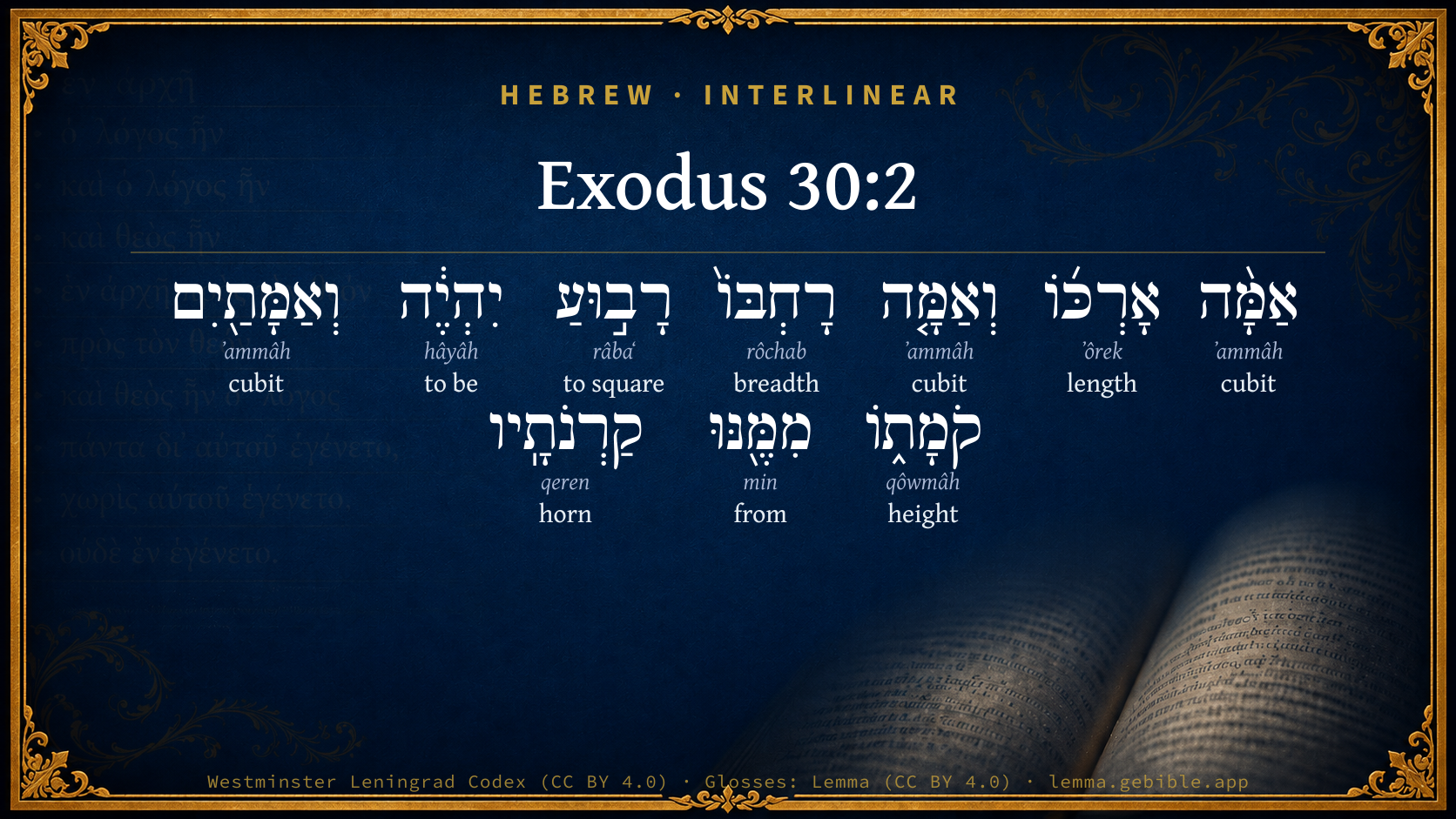
Hebrew (Westminster Leningrad Codex) Exodus 30:2 appears in the Hebrew Old Testament. The text above is from the Westminster Leningrad Codex. Each word links to its Strong’s number, a concise gloss, and parsing drawn from the Open Scriptures Hebrew Bible morphology. Click any word for its full Brown-Driver-Briggs (BDB) entry.
Download image
Cite this verse

Exodus 30:2 (World English Bible). Public Domain. Lemma interlinear Bible study tool, https://lemma.gebible.app/v/exodus/30/2.

Show BibTeX & RIS
BibTeX
RIS
English Translation
Its length shall be a cubit, and its breadth a cubit. It shall be square, and its height shall be two cubits. Its horns shall be of one piece with it.
World English Bible · Public Domain
Download a study sheet

One document with this verse’s original text, its word-by-word gloss line, the meaning frame, cross-references with their text, attributed commentary, and full source and license credits — printable, and it pastes into notes with its structure intact.

This verse Autodidact and up

Study sheet (.html) Plain text (.txt)

A passage Seminary Student

Up to 50 verses in one chapter. A passage sheet keeps up to 6 commentary sources and 12 cross-references per verse, in the order this page ranks them, and says so on the sheet whenever that leaves anything out. Ask for a single verse and you get the Autodidact verse sheet above.

Everything on this page stays free to read, with no account — the sheet is a download of what is already on screen, not access to it.

Want to remove ads? Support Godless Engineer
Compare translations 3

The same verse in 3 English versions, stacked beneath the original-language interlinear above. Click any original word for its lexicon entry.

Each is an independent rendering of the whole verse — the interlinear is not word-aligned to these translations.

Highlighted words mark where these versions differ — a whole-verse word diff, not a word-by-word alignment.

  • World English Bible Public Domain
    Its length shall be a cubit, and its breadth a cubit. It shall be square, and its height shall be two cubits. Its horns shall be of one piece with it.
  • King James Version Public Domain
    A cubit shall be the length thereof, and a cubit the breadth thereof; foursquare shall it be: and two cubits shall be the height thereof: the horns thereof shall be of the same.
  • unfoldingWord Literal Text CC BY-SA 4.0
    Its length shall be one cubit and its width shall be one cubit. It shall be square, and its height shall be two cubits. Its horns part of it.

unfoldingWord Literal Text — © unfoldingWord, licensed CC BY-SA 4.0. Word-aligned USFM3 via Door43 (git.door43.org/unfoldingWord/en_ult).

Versions to compare (up to 4)

3 of 4 selected

Show all 18 translations

Every available English version of this verse, each an independent rendering of the whole verse.

  • World English Bible Public Domain
    Its length shall be a cubit, and its breadth a cubit. It shall be square, and its height shall be two cubits. Its horns shall be of one piece with it.
  • Berean Standard Bible Public Domain
    It is to be square, a cubit long, a cubit wide, and two cubits high. Its horns must be of one piece.
  • Majority Standard Bible Public Domain
    It is to be square, a cubit long, a cubit wide, and two cubits high. Its horns must be of one piece.
  • King James Version Public Domain
    A cubit shall be the length thereof, and a cubit the breadth thereof; foursquare shall it be: and two cubits shall be the height thereof: the horns thereof shall be of the same.
  • American Standard Version (1901) Public Domain
    A cubit shall be the length thereof, and a cubit the breadth thereof; foursquare shall it be; and two cubits shall be the height thereof: the horns thereof shall be of one piece with it.
  • Revised Version (1885) Public Domain
    A cubit shall be the length thereof, and a cubit the breadth thereof; foursquare shall it be: and two cubits shall be the height thereof: the horns thereof shall be of one piece with it.
  • Geneva Bible (1599) Public Domain
    The length therof a cubite and the breadth thereof a cubite (it shalbe foure square) and the height thereof two cubites: the hornes thereof shalbe of the same,
  • Douay-Rheims (1899) Public Domain
    It shall be a cubit in length, and another in breadth, that is, foursquare, and two in height. Horns shall go out of the same.
  • Young's Literal Translation Public Domain
    a cubit its length, and a cubit its breadth, (it is square), and two cubits its height; its horns `are' of the same.
  • Literal Standard Version CC BY-SA 4.0
    a cubit its length and a cubit its breadth (it is square), and two cubits its height; its horns [are] of the same.
  • Unlocked Literal Bible CC BY-SA 4.0
    Its length must be one cubit, and its width one cubit. It must be square, and its height must be two cubits. Its horns must be made as one piece with it.
  • unfoldingWord Literal Text CC BY-SA 4.0
    Its length shall be one cubit and its width shall be one cubit. It shall be square, and its height shall be two cubits. Its horns part of it.
  • Darby Bible Public Domain
    a cubit the length thereof, and a cubit the breadth thereof -- square shall it be; and two cubits its height; of itself shall be its horns.
  • World Messianic Bible Public Domain
    Its length shall be a cubit, and its width a cubit. It shall be square, and its height shall be two cubits. Its horns shall be of one piece with it.
  • Webster's Bible Public Domain
    A cubit shall be its length, and a cubit its breadth; foursquare shall it be; and two cubits shall be its hight: its horns shall be of the same.
  • Free Bible Version CC BY-SA 4.0
    It shall be square, measuring a cubit by a cubit, by two cubits high, with horns on its corners that are all one piece with the altar.
  • Bible in Basic English Public Domain
    The altar is to be square, a cubit long and a cubit wide, and two cubits high, and its horns are to be made of the same.
  • JPS Tanakh (1917) Public Domain
    A cubit shall be the length thereof, and a cubit the breadth thereof; foursquare shall it be; and two cubits shall be the height thereof; the horns thereof shall be of one piece with it.

Literal Standard Version (2020), Covenant Press — licensed CC BY-SA 4.0. Text via the HelloAO Bible API (eBible.org). Unlocked Literal Bible (unfoldingWord) — licensed CC BY-SA 4.0. Text via the HelloAO Bible API (eBible.org). unfoldingWord Literal Text — © unfoldingWord, licensed CC BY-SA 4.0. Word-aligned USFM3 via Door43 (git.door43.org/unfoldingWord/en_ult). Free Bible Version, Dr. Jonathan Gallagher — licensed CC BY-SA 4.0. Text via the HelloAO Bible API (eBible.org).

Word by word

More ways to search: Search by grammar → Find every occurrence → Compare this word →

Practice this passage: Drill this verse → Learn its vocabulary →

רָב֣וּעַ
râbaʻ
H7251
“squared”
Verb, Qal, Participle Passive, Masculine, Singular, Absolute
Part of Speech
Verb
Stem
Qal
Form
Participle Passive
Gender
Masculine
Number
Singular
State
Absolute
Full BDB Definition

Origin: a primitive root [rather identical with H7250 through the idea of sprawling "at all fours" (or possibly the reverse is the order of deriv)

TWOT: 2107

to square, be squared - (Qal) square (participle) - (Pual) square (participle)
  1. אַמָּ֨ה ʼammâh H520 “cubit” Noun, Common, Feminine, Singular, Absolute
  2. אָרְכּ֜וֹ ʼôrek H753 “length · his” Noun, Common, Masculine, Singular, Construct + Suffix, Personal, 3rd Person, Masculine, Singular
  3. וְאַמָּ֤ה ʼammâh H520 “and · cubit” Conjunction + Noun, Common, Feminine, Singular, Absolute
  4. רָחְבּוֹ֙ rôchab H7341 “breadth · his” Noun, Common, Masculine, Singular, Construct + Suffix, Personal, 3rd Person, Masculine, Singular
  5. יִהְיֶ֔ה hâyâh H1961 “to be” Verb, Qal, Imperfect, 3rd Person, Masculine, Singular
  6. וְאַמָּתַ֖יִם ʼammâh H520 “and · cubits” Conjunction + Noun, Common, Feminine, Dual, Absolute
  7. קֹמָת֑וֹ qôwmâh H6967 “height · his” Noun, Common, Feminine, Singular, Construct + Suffix, Personal, 3rd Person, Masculine, Singular
  8. מִמֶּ֖נּוּ min H4480 “from · us” Preposition + Suffix, Personal, 1st Person, Common, Plural
  9. קַרְנֹתָֽיו qeren H7161 “horns · his” Noun, Common, Both, Plural, Construct + Suffix, Personal, 3rd Person, Masculine, Singular

About this verse

These counts appear in no published source. They are computed here, from the morphology-tagged text and Lemma’s own curated glosses. What Lemma adds →

10
words
8
distinct lemmas
Pentateuch
section

Notable vocabulary

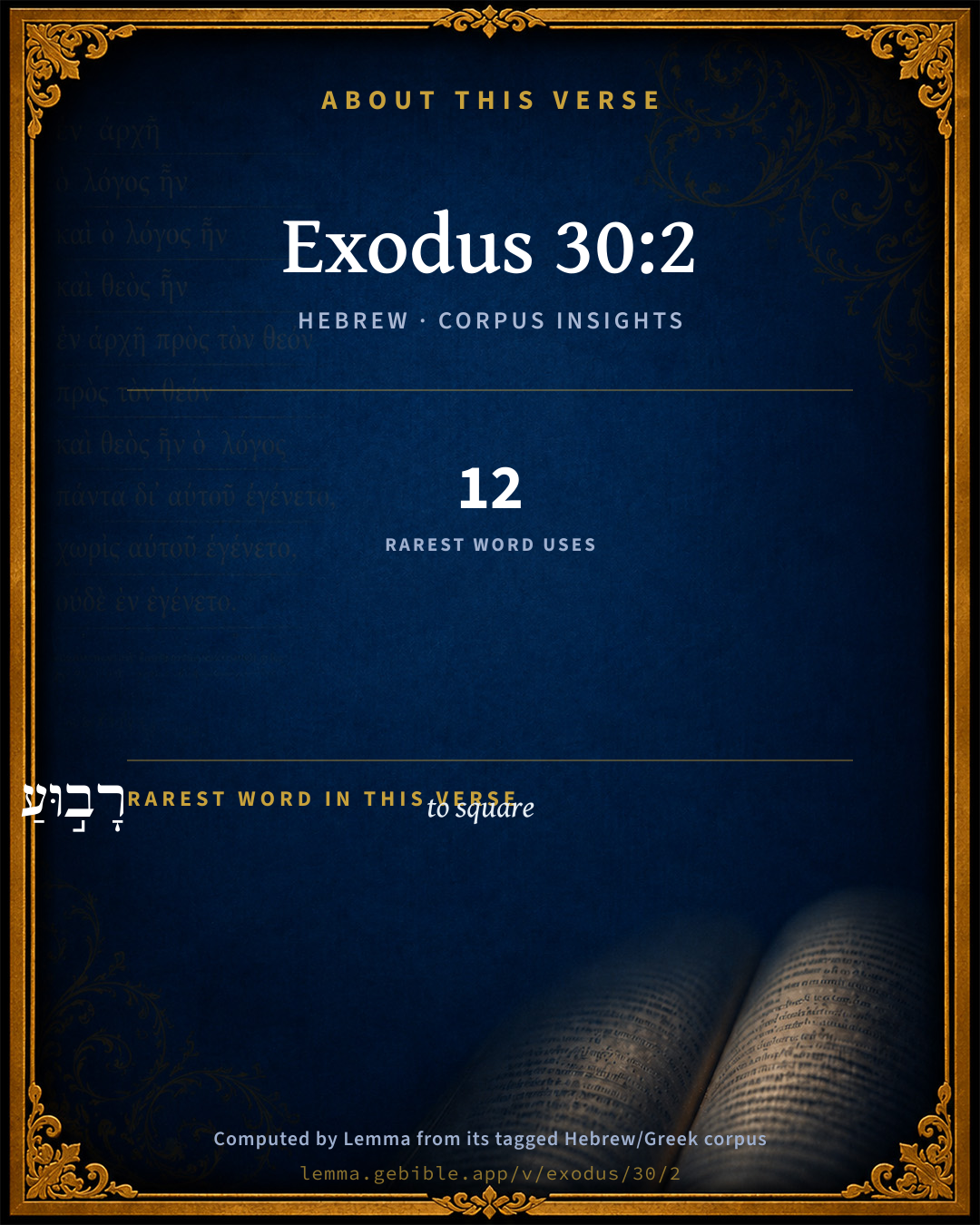
The rarest word here is רָב֣וּעַ to square H7251 — appearing just 12 times in the whole Hebrew Bible.

Shared distinctive vocabulary

רָב֣וּעַ to square H7251 occurs in 12 verses of the Hebrew Bible. Also found in:

Grammatical profile

  • 2 verbs
  • 7 nouns
  • 1 preposition

Verb forms

  • רָב֣וּעַ Qal · Participle Passive
  • יִהְיֶ֔ה Qal · Imperfect

Repetition

A word recurs within this verse — often emphatic in Hebrew:

  • אַמָּ֨ה cubit H520 ×3

Hebrew & Septuagint length

In English translation the verse runs 31 words from the Hebrew and 36 from the Septuagint (LXX English) — closely comparable.

A rough comparison of the two English renderings, which tokenize alike — not a word-level alignment.

Word counts can differ between the Hebrew and the Greek without any difference in meaning — e.g. the Hebrew direct-object marker אֵת has no separate Greek word, and Greek often adds the article ὁ.

Cross-references

1

Topical passages linked to Exodus 30:2 in the Treasury of Scripture Knowledge — connected by theme and wording, ordered by reader-vote popularity; previews shown in the World English Bible.

  • Exodus 27:2 You shall make its horns on its four corners; its horns shall be of one piece with it; and you shall overlay it with brass.

Cross-references courtesy of OpenBible.info (CC BY 4.0).

Hebrew and Greek witnesses Masoretic Hebrew ↔ Greek Septuagint

The same verse in the two great witnesses to the Old Testament, shown verse-for-verse.

These are two independent witnesses, not word-aligned to each other, and the Septuagint is shown in lemma (dictionary) form.

Hebrew Exodus 30:2 Masoretic · Westminster Leningrad Codex

אַמָּ֨ה אָרְכּ֜וֹ וְאַמָּ֤ה רָחְבּוֹ֙ רָב֣וּעַ יִהְיֶ֔ה וְאַמָּתַ֖יִם קֹמָת֑וֹ מִמֶּ֖נּוּ קַרְנֹתָֽיו

Its length shall be a cubit, and its breadth a cubit. It shall be square, and its height shall be two cubits. Its horns shall be of one piece with it.

World English Bible · Public Domain

Greek LXX Exodus 30:2 Septuagint · lemma form

πῆχυς ὁ μῆκος καί πῆχυς ὁ εὖρος τετράγωνος εἰμί καί δύο πῆχυς ὁ ὕψος ἐκ αὐτός εἰμί ὁ κέρας αὐτός

And you shall make it a cubit in length, and a cubit in breadth: it shall be square; and the height of it shall be of two cubits, its horns shall be of the same piece.

LXX2012 (modern English Septuagint) · Public Domain

Hebrew: Westminster Leningrad Codex (CC BY 4.0). Greek: Septuagint (public domain); English from LXX2012 (modern English Septuagint) (Public Domain). How the Septuagint differs from the Hebrew →

Targum (Aramaic paraphrase)

2

The Targum is the ancient Jewish Aramaic paraphrase of the Hebrew Scriptures — an interpretive translation, not the Hebrew text itself. Onkelos (literal) and Pseudo-Jonathan (expansive) render the Torah, and Jonathan the Prophets. Coverage is partial: where no permissively-licensed English translation exists for a verse, only the Aramaic is shown. This is verse-level text, not a word-by-word alignment to the Hebrew.

  1. Targum Onkelos Torah (Genesis–Deuteronomy)
    אַמְתָא אֻרְכֵּהּ וְאַמְתָא פְתָיֵהּ מְרַבַּע יְהֵי וְתַרְתֵּין אַמִין רוּמֵהּ מִנֵהּ קַרְנוֹהִי:

    (no public-domain English translation for this verse)

    Targum Onkelos — Aramaic: “Onkelos Genesis” (public domain); “Onkelos Exodus” (public domain); “Onkelos Leviticus” (public domain); “Onkelos Numbers” (public domain); “Onkelos Deuteronomy” (public domain). English: “Sefaria Community Translation” (CC0 1.0 (public-domain dedication)); “J.W. Etheridge. The Targums of Onkelos and Jonathan Ben Uzziel on the Pentateuch. London: Longmans, Green, 1862” (public domain). Text via Sefaria.

  2. Targum Pseudo-Jonathan Torah (Genesis–Deuteronomy)
    אַמְתָא אוּרְכֵּיהּ וְאַמְתָא פּוּתְיֵהּ מְרַבַּע יְהֵא וְתַרְתֵּין אַמִּין רוּמֵיהּ מִינֵיהּ יְהוֹן קַרְנוֹי זְקִיפוּן

    A cubit its length, and a cubit its breadth; foursquare shall it be: and two cubits its height: and its upright horns shall be of it.

    Targum Pseudo-Jonathan — Aramaic: “Targum Jonathan on Genesis” (public domain); “Targum Jonathan on Exodus” (public domain); “Targum Jonathan on Leviticus” (public domain); “Targum Jonathan on Numbers” (public domain); “Targum Jonathan on Deuteronomy” (public domain). English: “The Targum of Jonathan ben Uzziel, trans. J. W. Etheridge, London, 1862” (public domain). Text via Sefaria.

Commentary

Notes on Exodus 30:2 from classic Christian and Jewish commentators (each source and its license shown beneath its notes). The classic Christian expositions comment on the surrounding passage and are grouped to its opening verse, so a note may address several verses; the Jewish commentaries on the Tanakh (Rashi and others) are per-verse, so they appear only where the commentator wrote on this verse.

Lemma curates 59 commentaries, every one of them public domain or Creative Commons licensed, each selected and text-cleaned for this edition rather than reprinted as found. About our sources →

Trapp's Complete Commentary

John Trapp

Exo 30:2 A cubit [shall be] the length thereof, and a cubit the breadth thereof; foursquare shall it be: and two cubits [shall be] the height thereof: the horns thereof [shall be] of the same.

Ver. 2. A cubit shall be the length.] That in Ezekiel {Eze 41:22} is much larger, as setting forth the service of God under the gospel.

John Trapp, A Commentary or Exposition upon All the Books of the Old and New Testament (1647–1656) — public domain. Text from a community e-Sword module.

Geneva Bible (1599)

Geneva Bible translators

Of the same wood and matter.

Geneva Bible (1599) marginal notes — public domain. Text via Bolls.life.

Jamieson, Fausset & Brown

Robert Jamieson, A. R. Fausset & David Brown

foursquare--the meaning of which is not that it was to be entirely of a cubical form, but that upon its upper and under surface, it showed four equal sides. It was twice as high as it was broad, being twenty-one inches broad and three feet six inches high. It had "horns"; its top or flat surface was surmounted by an ornamental ledge or rim, called a crown, and it was furnished at the sides with rings for carriage. Its only accompanying piece of furniture was a golden censer or pan, in which the incense was set fire to upon the altar. Hence it was called the altar of incense, or the "golden altar" [Exo 39:38; Exo 40:26], from the profuse degree in which it was gilded or overlaid with the precious metal. This splendor was adapted to the early age of the church, but in later times, when the worship was to be more spiritual, the altar of incense is prophetically described as not of gold but of wood, and double the size of that in the tabernacle, because the church should be vastly extended (Mal 1:11).

Jamieson, Fausset & Brown — Commentary Critical and Explanatory on the Whole Bible (1871) — public domain (CC PDM 1.0). Text via the HelloAO Bible API.

Adam Clarke's Commentary

Verse 2. Four-square] That is, on the upper or under surface, as it showed four equal sides; but it was twice as high as it was broad, being twenty-one inches broad, and three feet six inches high. It was called, not only the altar of incense, but also the golden altar, Nu 4:11. For the crown, horns, staves, &c., see on the altar of burnt-offering, chap. xxvii. See Clarke on Ex 27:1, &c.

Adam Clarke's Commentary on the Bible (1810–1826) — public domain. Text from a community e-Sword/MySword module.

Ellicott's Commentary for English Readers

(2) Foursquare shall it be.—Of the same shape with “the brazen altar” (Exo_27:1), but much smaller—two cubits high instead of three cubits, and a cubit square at top instead of five cubits. This small space was ample for the burning of so precious a material, which could only be offered in small quantities.

The horns thereof.—Comp. Exo_27:2, and Note 1, ad loc.

Shall be of the same—i.e., of one piece with the altar, not made separately, and then attached to it.

A Bible Commentary for English Readers, edited by Charles John Ellicott (1878–1897) — public domain. Text from a community e-Sword module.

The Cambridge Bible for Schools and Colleges

gen. ed. J. J. S. Perowne

2. the horns, &c.] see on Exo_27:2; also, for of one piece with it, Exo_25:31. The blood of the sin-offering was sprinkled upon the horns of this altar in the cases specified in Exo_30:10, Lev_4:7; Lev_4:18.

The Cambridge Bible for Schools and Colleges (gen. ed. J. J. S. Perowne; Cambridge University Press, 1878–1918) — public domain. Text from a community e-Sword module.

John Gill's Exposition

A cubit shall be the length thereof, and a cubit the breadth thereof, four square shall it be,.... It was one Jewish square cubit, which is in surface, according to Bishop Cumberland, three English square feet, and about forty seven square inches; which may denote the solidity, perfection, and extensiveness of Christ's priesthood, it being unchangeable, firm, and lasting; and which passes not from one to another, and the which makes something perfect, which the law and priesthood of Aaron could not, even perfects for ever them that are sanctified; and is very extensive; the virtue of it reaches to all the elect of God, from the beginning of the world to the end of it; not his sacrifice only, but his intercession, which is principally respected; that is made for all the people of God, in all places, and in all ages, and for all things for them, both for this life, and that which is to come:

and two cubits shall be the height thereof; so that it was as high again as it was long and broad: Christ, our interceding high priest, is made higher than the heavens:

the horns thereof shall be of the same; of the same wood the altar itself was made: these were a sort of spires that rose up at the four corners of the altar; and the Targum of Jonathan paraphrases the words,"and of it its horns shall be erect;''which were chiefly for decoration and ornament; and may denote the honour and glory of Christ, as well as his power and ability to save, to the uttermost, all that come to God by him, or lay hold upon him, since he ever lives to make intercession.

John Gill's Exposition of the Whole Bible (1746–1763) — public domain (CC PDM 1.0). Text via the HelloAO Bible API.

Haydock's Catholic Bible Commentary

Height. Ezechiel (xli. 42,) describes his altar of incense, a cubit higher.

George Leo Haydock (1774–1849), Haydock's Catholic Family Bible and Commentary, 1859 edition — public domain. Excludes Psalms (Douay-Rheims chapter numbering differs from Protestant) and Deuterocanonical books (Catholic canon only).

Matthew Poole's English Annotations

See Exo 27:2. Though these horns, as they were for another use, so they seem to be here of another form, and for ornament more than for service.

Matthew Poole's English Annotations on the Holy Bible (1683–1685) — public domain. Text from a community e-Sword/MySword module.

Whedon's Commentary on the Bible

Daniel D. Whedon

2-5. Horns… rings… staves — In these respects it was fashioned after the manner of the greater altar in the court, and also of some portions of the ark, (Exo_25:12-15.) The crown of gold round about is to be understood of a rim or moulding, as that of the ark. See note on Exo_25:11. The probable form of this altar is exhibited in the annexed cut.

Daniel D. Whedon (gen. ed.), Commentary on the Old and New Testaments (1874–1909) — public domain. Text from a community e-Sword module.

The Pulpit Commentary

Four square shall it be. Like the altar of burnt-offering. See the comment on Exo_27:1. Two cubits shall be the height thereof. Altars of this small size are often represented on ancient vases and other remains. (See Dr. Smith"s Dictionary of Greek and Roman Antiquities, pp. 117 and 1174.) The horns thereof. It seems to be assumed that an altar must have horns. Those of the altar of incense were to have the blood of certain sin-offerings smeared upon them. (Lev_4:7, Lev_4:18) Shall be of the samei.e. "shall be of one piece with the top of the table not projections added to it. Compare Exo_27:2.

The Pulpit Commentary (1880–1919), ed. H.D.M. Spence-Jones & Joseph S. Exell — public domain. Text from a community e-Sword module.

Lesson kit

Teaching starters — assembled from the data on this page, not authored interpretation. Every prompt links to the verse data it draws on. Edit before teaching.

Exodus, in the Pentateuch, opens this verse with 10 words (8 distinct Hebrew lemmas). Its most distinctive word is râbaʻ (“to square”). A historical commentator’s framing appears above. Read the whole chapter for the surrounding context.

Discussion questions

  1. How does “to square” (râbaʻ) shape what this verse is saying?
  2. How does Exodus 27:1, which shares the word «to square», read alongside this verse?
  3. What does the repetition of “cubit” (3× in this one verse) do in this verse?
  4. These translations render this verse differently; the difference is in the English rendering, not the original. What questions does that raise?
  5. «רָב֣וּעַ» is a Qal Participle Passive verb. How does that grammatical form shape the action described?
  6. Compare how Trapp's Complete Commentary and Geneva Bible (1599) read this verse. Where do they agree or differ?

Things to notice

  • These translations choose different wording for 9 words in this verse.
  • “cubit” occurs 3× in this single verse.
  • 8 distinct Hebrew lemmas span 10 words in this verse.

Reading settings

Reading text

Shown beneath each verse's original-language words.

Old Testament
Old Testament edition

Read the OT as the Masoretic Hebrew (MT) or the Greek Septuagint (LXX).

English shown for the Greek Septuagint (in the Hebrew ↔ Greek comparison).

Comparing translations? Open the Compare panel on any verse page to stack up to four side by side.