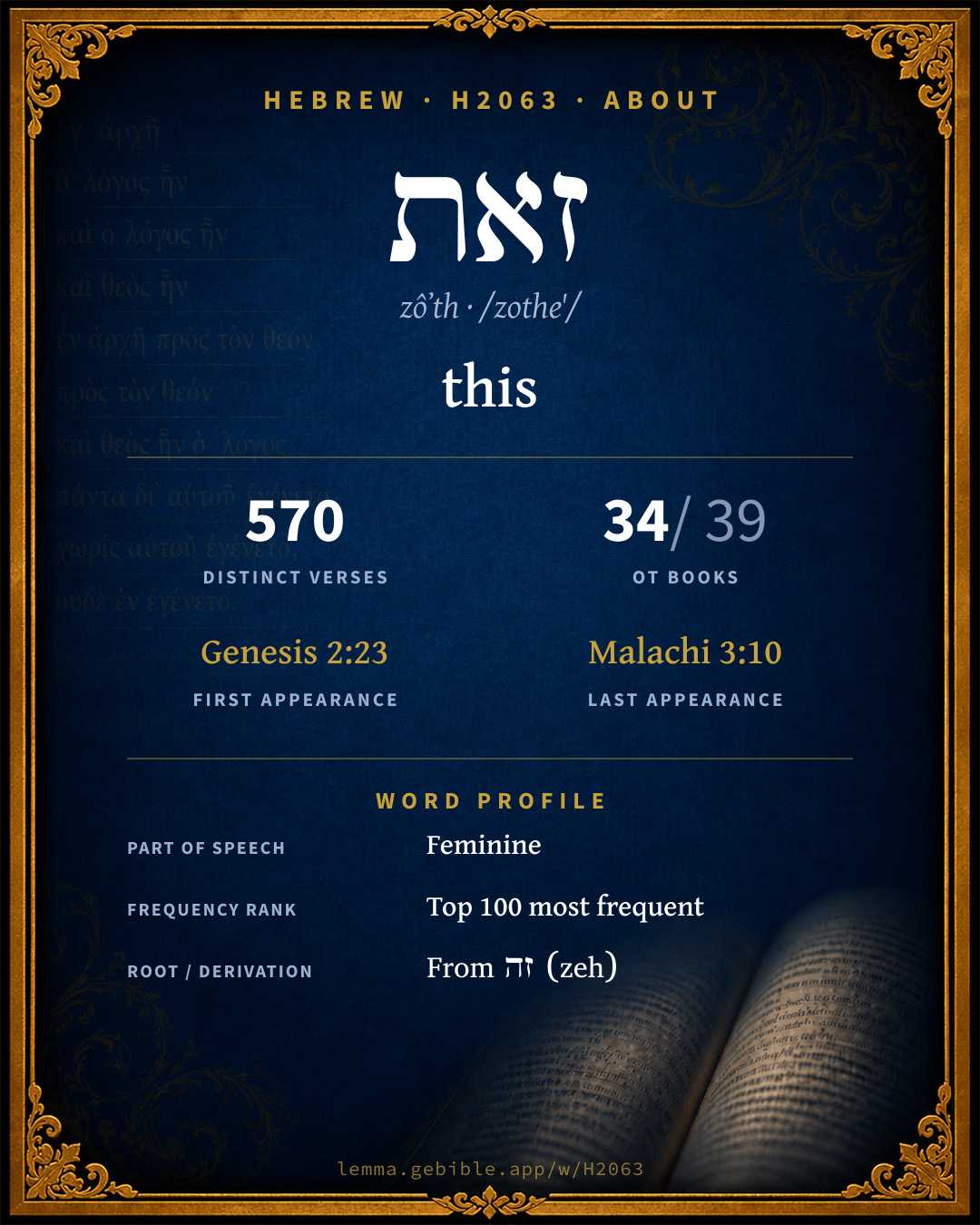
זֹאת
this
also: this one, here, which, this...that fuller range ↓
Full lexicon entry — Brown-Driver-Briggs (BDB)
From Brown-Driver-Briggs (BDB)
Where this word appears
Grammar key — what these labels mean
Part of speech
- Pronoun
- A word standing in for a noun (“he,” “this,” “who”).
Gender
- Feminine
- Grammatically feminine.
Number
- Singular
- One.
Page 1 of 3 — showing verses 1–200 of 570 distinct verses where H2063 appears, across 34 books. Click any verse to open its interlinear word-by-word view. Verse text shown in the World English Bible for context — . Each verse’s Hebrew form is shown with its reference; the English is not keyword-highlighted, since the data carries no word-level English alignment. Use “Compare translations” on any verse to read it across multiple English versions. This concordance covers the Hebrew Bible; Septuagint (Greek Old Testament) occurrences are not indexed here.
Genesis 48 verses
- Genesis 2:23 זֹ֣את לְ/זֹאת֙ זֹּֽאת pron dem fs prep + pron dem fs pron dem fs The man said, "This is now bone of my bones, and flesh of my flesh. She will be called Woman, because she was taken out of Man."
- Genesis 3:13 זֹּ֣את pron dem fs Yahweh God said to the woman, "What is this you have done?" The woman said, "The serpent deceived me, and I ate."
- Genesis 3:14 זֹּאת֒ pron dem fs Yahweh God said to the serpent, "Because you have done this, cursed are you above all cattle, and above every animal of the field. On your belly shall you go, and you shall eat dust all the days of your life.
- Genesis 9:12 זֹ֤את pron dem fs God said, "This is the token of the covenant which I make between me and you and every living creature that is with you, for perpetual generations:
- Genesis 9:17 זֹ֤את pron dem fs God said to Noah, "This is the token of the covenant which I have established between me and all flesh that is on the earth."
- Genesis 12:7 הַ/זֹּ֑את ptcl def.art + pron dem fs Yahweh appeared to Abram, and said, "I will give this land to your seed." He built an altar there to Yahweh, who appeared to him.
- Genesis 12:12 זֹ֑את pron dem fs It will happen, when the Egyptians will see you, that they will say, 'This is his wife.' They will kill me, but they will save you alive.
- Genesis 12:18 זֹּ֖את pron dem fs Pharaoh called Abram, and said, "What is this that you have done to me? Why didn't you tell me that she was your wife?
- Genesis 15:7 הַ/זֹּ֖את ptcl def.art + pron dem fs He said to him, "I am Yahweh who brought you out of Ur of the Chaldees, to give you this land to inherit it."
- Genesis 15:18 הַ/זֹּ֔את ptcl def.art + pron dem fs In that day Yahweh made a covenant with Abram, saying, "To your seed have I given this land, from the river of Egypt to the great river, the river Euphrates:
- Genesis 17:10 זֹ֣את pron dem fs This is my covenant, which you shall keep, between me and you and your seed after you. Every male among you shall be circumcised.
- Genesis 19:20 הַ/זֹּ֧את ptcl def.art + pron dem fs See now, this city is near to flee to, and it is a little one. Oh let me escape there (isn't it a little one?), and my soul will live."
- Genesis 20:5 זֹֽאת pron dem fs Didn't he tell me, 'She is my sister?' She, even she herself said, 'He is my brother.' In the integrity of my heart and the innocence of my hands have I done this."
- Genesis 20:6 זֹּ֔את pron dem fs God said to him in the dream, "Yes, I know that in the integrity of your heart you have done this, and I also withheld you from sinning against me. Therefore I didn't allow you to touch her.
- Genesis 21:10 הַ/זֹּ֖את הַ/זֹּ֔את ptcl def.art + pron dem fs ptcl def.art + pron dem fs Therefore she said to Abraham, "Cast out this handmaid and her son! For the son of this handmaid will not be heir with my son, even with Isaac."
- Genesis 21:30 הַ/זֹּֽאת ptcl def.art + pron dem fs He said, "You shall take these seven ewe lambs from my hand, that it may be a witness to me, that I have dug this well."
- Genesis 24:5 הַ/זֹּ֑את ptcl def.art + pron dem fs The servant said to him, "What if the woman isn't willing to follow me to this land? Must I bring your son again to the land you came from?"
- Genesis 24:7 הַ/זֹּ֑את ptcl def.art + pron dem fs Yahweh, the God of heaven, who took me from my father's house, and from the land of my birth, who spoke to me, and who swore to me, saying, 'I will give this land to your seed.' He will send his angel before you, and you shall take a wife for my son from there.
- Genesis 24:8 זֹ֑את pron dem fs If the woman isn't willing to follow you, then you shall be clear from this my oath. Only you shall not bring my son there again."
- Genesis 26:3 הַ/זֹּ֔את ptcl def.art + pron dem fs Sojourn in this land, and I will be with you, and will bless you. For to you, and to your seed, I will give all these lands, and I will establish the oath which I swore to Abraham your father.
- Genesis 26:10 זֹּ֖את pron dem fs Abimelech said, "What is this you have done to us? One of the people might easily have lain with your wife, and you would have brought guilt on us!"
- Genesis 28:15 הַ/זֹּ֑את ptcl def.art + pron dem fs Behold, I am with you, and will keep you, wherever you go, and will bring you again into this land. For I will not leave you, until I have done that which I have spoken of to you."
- Genesis 28:22 הַ/זֹּ֗את ptcl def.art + pron dem fs then this stone, which I have set up for a pillar, will be God's house. Of all that you will give me I will surely give the tenth to you."
- Genesis 29:25 זֹּאת֙ pron dem fs It happened in the morning that, behold, it was Leah. He said to Laban, "What is this you have done to me? Didn't I serve with you for Rachel? Why then have you deceived me?"
- Genesis 29:27 זֹ֑את זֹ֗את pron dem fs pron dem fs Fulfill the week of this one, and we will give you the other also for the service which you will serve with me yet seven other years."
- Genesis 29:28 זֹ֑את pron dem fs Jacob did so, and fulfilled her week. He gave him Rachel his daughter as wife.
- Genesis 31:13 הַ/זֹּ֔את ptcl def.art + pron dem fs I am the God of Bethel, where you anointed a pillar, where you vowed a vow to me. Now arise, get out from this land, and return to the land of your birth."
- Genesis 31:52 הַ/זֹּ֖את ptcl def.art + pron dem fs May this heap be a witness, and the pillar be a witness, that I will not pass over this heap to you, and that you will not pass over this heap and this pillar to me, for harm.
- Genesis 34:4 הַ/זֹּ֖את ptcl def.art + pron dem fs Shechem spoke to his father, Hamor, saying, "Get me this young lady as a wife."
- Genesis 34:15 בְּ/זֹ֖את prep + pron dem fs Only on this condition will we consent to you. If you will be as we are, that every male of you be circumcised;
- Genesis 34:22 בְּ֠/זֹאת prep + pron dem fs Only on this condition will the men consent to us to dwell with us, to become one people, if every male among us be circumcised, as they are circumcised.
- Genesis 37:32 זֹ֣את pron dem fs They took the coat of many colors, and they brought it to their father, and said, "We have found this. Examine it, now, whether it is your son's coat or not."
- Genesis 39:9 הַ/זֹּ֔את ptcl def.art + pron dem fs He isn't greater in this house than I, neither has he kept back anything from me but you, because you are his wife. How then can I do this great wickedness, and sin against God?"
- Genesis 41:39 זֹ֑את pron dem fs Pharaoh said to Joseph, "Because God has shown you all of this, there is none so discreet and wise as you.
- Genesis 42:15 בְּ/זֹ֖את prep + pron dem fs Hereby you shall be tested. By the life of Pharaoh you shall not go forth from here, unless your youngest brother come here.
- Genesis 42:18 זֹ֥את pron dem fs Joseph said to them the third day, "Do this, and live, for I fear God.
- Genesis 42:21 הַ/זֹּֽאת ptcl def.art + pron dem fs They said one to another, "We are most assuredly guilty concerning our brother, in that we saw the distress of his soul, when he begged us, and we wouldn't listen. Therefore this distress has come on us."
- Genesis 42:28 זֹּ֛את pron dem fs He said to his brothers, "My money is restored! Behold, it is even in my sack." Their hearts failed them, and they turned trembling one to another, saying, "What is this that God has done to us?"
- Genesis 42:33 בְּ/זֹ֣את prep + pron dem fs The man, the lord of the land, said to us, 'Hereby will I know that you are honest men. Leave one of your brothers with me, and take grain for the famine of your houses, and go your way.
- Genesis 43:11 זֹ֣את pron dem fs Their father, Israel, said to them, "If it be so now, do this. Take from the choice fruits of the land in your bags, and carry down a present for the man, a little balm, a little honey, spices and myrrh, nuts, and almonds;
- Genesis 43:15 הַ/זֹּ֔את ptcl def.art + pron dem fs The men took that present, and they took double money in their hand, and Benjamin; and rose up, went down to Egypt, and stood before Joseph.
- Genesis 44:17 זֹ֑את pron dem fs He said, "Far be it from me that I should do so. The man in whose hand the cup is found, he will be my bondservant; but as for you, go up in peace to your father."
- Genesis 45:17 זֹ֣את pron dem fs Pharaoh said to Joseph, "Tell your brothers, 'Do this. Load your animals, and go, travel to the land of Canaan.
- Genesis 45:19 זֹ֣את pron dem fs Now you are commanded: do this. Take wagons out of the land of Egypt for your little ones, and for your wives, and bring your father, and come.
- Genesis 45:23 כְּ/זֹאת֙ prep + pron dem fs To his father, he sent after this manner: ten donkeys loaded with the good things of Egypt, and ten female donkeys loaded with grain and bread and provision for his father by the way.
- Genesis 48:4 הַ/זֹּ֛את ptcl def.art + pron dem fs and said to me, 'Behold, I will make you fruitful, and multiply you, and I will make of you a company of peoples, and will give this land to your seed after you for an everlasting possession.'
- Genesis 49:28 וְ֠/זֹאת conj + pron dem fs All these are the twelve tribes of Israel, and this is what their father spoke to them and blessed them. He blessed everyone according to his blessing.
- Genesis 50:24 הַ/זֹּ֔את ptcl def.art + pron dem fs Joseph said to his brothers, "I am dying, but God will surely visit you, and bring you up out of this land to the land which he swore to Abraham, to Isaac, and to Jacob."
Exodus 17 verses
- Exodus 7:17 בְּ/זֹ֣את prep + pron dem fs Thus says Yahweh, "In this you shall know that I am Yahweh. Behold, I will strike with the rod that is in my hand on the waters which are in the river, and they shall be turned to blood.
- Exodus 7:23 לָ/זֹֽאת prep + pron dem fs Pharaoh turned and went into his house, neither did he lay even this to heart.
- Exodus 8:32 הַ/זֹּ֑את ptcl def.art + pron dem fs Pharaoh hardened his heart this time also, and he didn't let the people go.
- Exodus 9:14 הַ/זֹּ֗את ptcl def.art + pron dem fs For this time I will send all my plagues against your heart, against your officials, and against your people; that you may know that there is none like me in all the earth.
- Exodus 9:16 זֹאת֙ pron dem fs but indeed for this cause I have made you stand: to show you my power, and that my name may be declared throughout all the earth;
- Exodus 12:25 הַ/זֹּֽאת ptcl def.art + pron dem fs It shall happen when you have come to the land which Yahweh will give you, according as he has promised, that you shall keep this service.
- Exodus 12:26 הַ/זֹּ֖את ptcl def.art + pron dem fs It will happen, when your children ask you, 'What do you mean by this service?'
- Exodus 12:43 זֹ֖את pron dem fs Yahweh said to Moses and Aaron, "This is the ordinance of the Passover. There shall no foreigner eat of it,
- Exodus 13:5 הַ/זֹּ֖את ptcl def.art + pron dem fs It shall be, when Yahweh shall bring you into the land of the Canaanite, and the Hittite, and the Amorite, and the Hivite, and the Jebusite, which he swore to your fathers to give you, a land flowing with milk and honey, that you shall keep this service in this month.
- Exodus 13:10 הַ/זֹּ֖את ptcl def.art + pron dem fs You shall therefore keep this ordinance in its season from year to year.
- Exodus 13:14 זֹּ֑את pron dem fs It shall be, when your son asks you in time to come, saying, 'What is this?' that you shall tell him, 'By strength of hand Yahweh brought us out from Egypt, from the house of bondage;
- Exodus 14:5 זֹּ֣את pron dem fs It was told the king of Egypt that the people had fled; and the heart of Pharaoh and of his servants was changed towards the people, and they said, "What is this we have done, that we have let Israel go from serving us?"
- Exodus 14:11 זֹּאת֙ pron dem fs They said to Moses, "Because there were no graves in Egypt, have you taken us away to die in the wilderness? Why have you treated us this way, to bring us forth out of Egypt?
- Exodus 15:1 הַ/זֹּאת֙ ptcl def.art + pron dem fs Then Moses and the children of Israel sang this song to Yahweh, and said, "I will sing to Yahweh, for he has triumphed gloriously: The horse and his rider he has thrown into the sea.
- Exodus 17:14 זֹ֤את pron dem fs Yahweh said to Moses, "Write this for a memorial in a book, and rehearse it in the ears of Joshua: that I will utterly blot out the memory of Amalek from under the sky."
- Exodus 25:3 וְ/זֹאת֙ conj + pron dem fs This is the offering which you shall take from them: gold, silver, brass,
- Exodus 32:13 הַ/זֹּ֜את ptcl def.art + pron dem fs Remember Abraham, Isaac, and Israel, your servants, to whom you swore by your own self, and said to them, 'I will multiply your seed as the stars of the sky, and all this land that I have spoken of I will give to your seed, and they shall inherit it forever.'"
Leviticus 24 verses
- Leviticus 6:9 זֹ֥את pron dem fs "Command Aaron and his sons, saying, 'This is the law of the burnt offering: the burnt offering shall be on the hearth on the altar all night until the morning; and the fire of the altar shall be kept burning on it.
- Leviticus 6:14 וְ/זֹ֥את conj + pron dem fs "'This is the law of the meal offering: the sons of Aaron shall offer it before Yahweh, before the altar.
- Leviticus 6:25 זֹ֥את pron dem fs "Speak to Aaron and to his sons, saying, 'This is the law of the sin offering: in the place where the burnt offering is killed, the sin offering shall be killed before Yahweh. It is most holy.
- Leviticus 7:1 וְ/זֹ֥את conj + pron dem fs "'This is the law of the trespass offering. It is most holy.
- Leviticus 7:11 וְ/זֹ֥את conj + pron dem fs "'This is the law of the sacrifice of peace offerings, which one shall offer to Yahweh.
- Leviticus 7:35 זֹ֣את pron dem fs This is the anointing portion of Aaron, and the anointing portion of his sons, out of the offerings of Yahweh made by fire, in the day when he presented them to minister to Yahweh in the priest's office;
- Leviticus 7:37 זֹ֣את pron dem fs This is the law of the burnt offering, of the meal offering, and of the sin offering, and of the trespass offering, and of the consecration, and of the sacrifice of peace offerings;
- Leviticus 11:2 זֹ֤את pron dem fs "Speak to the children of Israel, saying, 'These are the living things which you may eat among all the animals that are on the earth.
- Leviticus 11:46 זֹ֣את pron dem fs "'This is the law of the animal, and of the bird, and of every living creature that moves in the waters, and of every creature that creeps on the earth,
- Leviticus 12:7 זֹ֤את pron dem fs and he shall offer it before Yahweh, and make atonement for her; and she shall be cleansed from the fountain of her blood. "'This is the law for her who bears, whether a male or a female.
- Leviticus 13:59 זֹ֠את pron dem fs This is the law of the plague of mildew in a garment of wool or linen, either in the warp, or the woof, or in anything of skin, to pronounce it clean, or to pronounce it unclean.
- Leviticus 14:2 זֹ֤את pron dem fs "This shall be the law of the leper in the day of his cleansing. He shall be brought to the priest,
- Leviticus 14:32 זֹ֣את pron dem fs This is the law for him in whom is the plague of leprosy, who is not able to afford the sacrifice for his cleansing.
- Leviticus 14:54 זֹ֖את pron dem fs This is the law for any plague of leprosy, and for an itch,
- Leviticus 14:57 זֹ֥את pron dem fs to teach when it is unclean, and when it is clean. This is the law of leprosy.
- Leviticus 15:3 וְ/זֹ֛את conj + pron dem fs This shall be his uncleanness in his discharge: whether his body runs with his discharge, or his body has stopped from his discharge, it is his uncleanness.
- Leviticus 15:32 זֹ֥את pron dem fs This is the law of him who has a discharge, and of him who has an emission of semen, so that he is unclean thereby;
- Leviticus 16:3 בְּ/זֹ֛את prep + pron dem fs "Herewith shall Aaron come into the sanctuary: with a young bull for a sin offering, and a ram for a burnt offering.
- Leviticus 16:34 זֹּ֨את pron dem fs "This shall be an everlasting statute for you, to make atonement for the children of Israel once in the year because of all their sins." It was done as Yahweh commanded Moses.
- Leviticus 17:7 זֹּ֥את pron dem fs They shall no more sacrifice their sacrifices to the goat idols, after which they play the prostitute. This shall be a statute forever to them throughout their generations.'
- Leviticus 25:13 הַ/זֹּ֑את ptcl def.art + pron dem fs "'In this Year of Jubilee each of you shall return to his property.
- Leviticus 26:16 זֹּ֣את pron dem fs I also will do this to you: I will appoint terror over you, even consumption and fever, that shall consume the eyes, and make the soul to pine away; and you will sow your seed in vain, for your enemies will eat it.
- Leviticus 26:27 בְּ/זֹ֔את prep + pron dem fs "'If you in spite of this won't listen to me, but walk contrary to me;
- Leviticus 26:44 זֹ֠את pron dem fs Yet for all that, when they are in the land of their enemies, I will not reject them, neither will I abhor them, to destroy them utterly, and to break my covenant with them; for I am Yahweh their God;
Numbers 32 verses
- Numbers 4:4 זֹ֛את pron dem fs This is the service of the sons of Kohath in the Tent of Meeting, the most holy things.
- Numbers 4:19 וְ/זֹ֣את conj + pron dem fs but thus do to them, that they may live, and not die, when they approach to the most holy things: Aaron and his sons shall go in, and appoint them everyone to his service and to his burden;
- Numbers 4:24 זֹ֣את pron dem fs This is the service of the families of the Gershonites, in serving and in bearing burdens:
- Numbers 4:28 זֹ֣את pron dem fs This is the service of the families of the sons of the Gershonites in the Tent of Meeting: and their charge shall be under the hand of Ithamar the son of Aaron the priest.
- Numbers 4:31 וְ/זֹאת֙ conj + pron dem fs This is the charge of their burden, according to all their service in the Tent of Meeting: the tabernacle's boards, its bars, its pillars, its sockets,
- Numbers 4:33 זֹ֣את pron dem fs This is the service of the families of the sons of Merari, according to all their service, in the Tent of Meeting, under the hand of Ithamar the son of Aaron the priest."
- Numbers 5:29 זֹ֥את pron dem fs "This is the law of jealousy, when a wife, being under her husband, goes astray, and is defiled;
- Numbers 5:30 הַ/זֹּֽאת ptcl def.art + pron dem fs or when the spirit of jealousy comes on a man, and he is jealous of his wife; then he shall set the woman before Yahweh, and the priest shall execute on her all this law.
- Numbers 6:13 וְ/זֹ֥את conj + pron dem fs "This is the law of the Nazirite: when the days of his separation are fulfilled, he shall be brought to the door of the Tent of Meeting,
- Numbers 6:21 זֹ֣את pron dem fs "This is the law of the Nazirite who vows, and of his offering to Yahweh for his separation, besides that which he is able to get. According to his vow which he vows, so he must do after the law of his separation."
- Numbers 7:84 זֹ֣את pron dem fs This was the dedication of the altar, on the day when it was anointed, by the princes of Israel: twelve silver platters, twelve silver bowls, twelve golden ladles;
- Numbers 7:88 זֹ֚את pron dem fs and all the oxen for the sacrifice of peace offerings twenty-four bulls, the rams sixty, the male goats sixty, the male lambs a year old sixty. This was the dedication of the altar, after it was anointed.
- Numbers 8:24 זֹ֖את pron dem fs "This is that which belongs to the Levites: from twenty-five years old and upward they shall go in to wait on the service in the work of the Tent of Meeting;
- Numbers 14:3 הַ/זֹּאת֙ ptcl def.art + pron dem fs Why does Yahweh bring us to this land, to fall by the sword? Our wives and our little ones will be a prey: wouldn't it be better for us to return into Egypt?
- Numbers 14:8 הַ/זֹּ֔את ptcl def.art + pron dem fs If Yahweh delight in us, then he will bring us into this land, and give it to us; a land which flows with milk and honey.
- Numbers 14:14 הַ/זֹּאת֒ ptcl def.art + pron dem fs and they will tell it to the inhabitants of this land. They have heard that you Yahweh are in the midst of this people; for you Yahweh are seen face to face, and your cloud stands over them, and you go before them, in a pillar of cloud by day, and in a pillar of fire by night.
- Numbers 14:27 הַ/זֹּ֔את ptcl def.art + pron dem fs How long [shall I bear] with this evil congregation, that murmur against me? I have heard the murmurings of the children of Israel, which they murmur against me.
- Numbers 14:35 זֹ֣את הַ/זֹּ֔את pron dem fs ptcl def.art + pron dem fs I, Yahweh, have spoken, surely this will I do to all this evil congregation, who are gathered together against me: in this wilderness they shall be consumed, and there they shall die.
- Numbers 16:6 זֹ֖את pron dem fs This do: take you censers, Korah, and all his company;
- Numbers 16:21 הַ/זֹּ֑את ptcl def.art + pron dem fs Separate yourselves from among this congregation, that I may consume them in a moment.
- Numbers 16:28 בְּ/זֹאת֙ prep + pron dem fs Moses said, Hereby you shall know that Yahweh has sent me to do all these works; for [I have] not [done them] of my own mind.
- Numbers 16:45 הַ/זֹּ֔את ptcl def.art + pron dem fs Get away from among this congregation, that I may consume them in a moment. They fell on their faces.
- Numbers 19:2 זֹ֚את pron dem fs This is the statute of the law which Yahweh has commanded, saying, Speak to the children of Israel, that they bring you a red heifer without spot, in which is no blemish, [and] on which never came yoke.
- Numbers 19:14 זֹ֚את pron dem fs This is the law when a man dies in a tent: everyone who comes into the tent, and everyone who is in the tent, shall be unclean seven days.
- Numbers 21:17 הַ/זֹּ֑את ptcl def.art + pron dem fs Then sang Israel this song: Spring up, well; sing you to it:
- Numbers 28:14 זֹ֣את pron dem fs Their drink-offerings shall be half a hin of wine for a bull, and the third part of a hin for the ram, and the fourth part of a hin for a lamb: this is the burnt offering of every month throughout the months of the year.
- Numbers 31:21 זֹ֚את pron dem fs Eleazar the priest said to the men of war who went to the battle, This is the statute of the law which Yahweh has commanded Moses:
- Numbers 32:5 הַ/זֹּ֛את ptcl def.art + pron dem fs They said, If we have found favor in your sight, let this land be given to your servants for a possession; don't bring us over the Jordan.
- Numbers 32:22 הַ/זֹּ֥את ptcl def.art + pron dem fs and the land is subdued before Yahweh; then afterward you shall return, and be guiltless towards Yahweh, and towards Israel; and this land shall be to you for a possession before Yahweh.
- Numbers 34:2 זֹ֣את pron dem fs Command the children of Israel, and tell them, When you come into the land of Canaan (this is the land that shall fall to you for an inheritance, even the land of Canaan according to the borders of it),
- Numbers 34:12 זֹאת֩ pron dem fs and the border shall go down to the Jordan, and the goings out of it shall be at the Salt Sea. This shall be your land according to the borders of it round about.
- Numbers 34:13 זֹ֣את pron dem fs Moses commanded the children of Israel, saying, This is the land which you shall inherit by lot, which Yahweh has commanded to give to the nine tribes, and to the half-tribe;
Deuteronomy 50 verses
- Deuteronomy 1:5 הַ/זֹּ֖את ptcl def.art + pron dem fs Beyond the Jordan, in the land of Moab, began Moses to declare this law, saying,
- Deuteronomy 3:12 הַ/זֹּ֛את ptcl def.art + pron dem fs This land we took in possession at that time: from Aroer, which is by the valley of the Arnon, and half the hill-country of Gilead, and the cities of it, gave I to the Reubenites and to the Gadites:
- Deuteronomy 3:18 הַ/זֹּאת֙ ptcl def.art + pron dem fs I commanded you at that time, saying, Yahweh your God has given you this land to possess it: you shall pass over armed before your brothers the children of Israel, all the men of valor.
- Deuteronomy 4:8 הַ/זֹּ֔את ptcl def.art + pron dem fs What great nation is there, that has statutes and ordinances so righteous as all this law, which I set before you this day?
- Deuteronomy 4:22 הַ/זֹּ֔את הַ/זֹּֽאת ptcl def.art + pron dem fs ptcl def.art + pron dem fs but I must die in this land, I must not go over the Jordan; but you shall go over, and possess that good land.
- Deuteronomy 4:44 וְ/זֹ֖את conj + pron dem fs This is the law which Moses set before the children of Israel:
- Deuteronomy 5:3 הַ/זֹּ֑את ptcl def.art + pron dem fs Yahweh didn't make this covenant with our fathers, but with us, even us, who are all of us here alive this day.
- Deuteronomy 5:25 הַ/זֹּ֑את ptcl def.art + pron dem fs Now therefore why should we die? for this great fire will consume us: if we hear the voice of Yahweh our God any more, then we shall die.
- Deuteronomy 6:1 וְ/זֹ֣את conj + pron dem fs Now this is the commandment, the statutes, and the ordinances, which Yahweh your God commanded to teach you, that you might do them in the land where you go over to possess it;
- Deuteronomy 6:25 הַ/זֹּ֗את ptcl def.art + pron dem fs It shall be righteousness to us, if we observe to do all this commandment before Yahweh our God, as he has commanded us.
- Deuteronomy 9:4 הַ/זֹּ֑את ptcl def.art + pron dem fs Don't speak in your heart, after that Yahweh your God has thrust them out from before you, saying, For my righteousness Yahweh has brought me in to possess this land; whereas for the wickedness of these nations Yahweh does drive them out from before you.
- Deuteronomy 9:6 הַ/זֹּ֖את ptcl def.art + pron dem fs Know therefore, that Yahweh your God doesn't give you this good land to possess it for your righteousness; for you are a stiff-necked people.
- Deuteronomy 11:22 הַ/זֹּ֗את ptcl def.art + pron dem fs For if you shall diligently keep all this commandment which I command you, to do it, to love Yahweh your God, to walk in all his ways, and to cleave to him;
- Deuteronomy 13:14 הַ/זֹּ֖את ptcl def.art + pron dem fs then shall you inquire, and make search, and ask diligently; and, behold, if it be truth, and the thing certain, that such abomination is done in the midst of you,
- Deuteronomy 14:4 זֹ֥את pron dem fs These are the animals which you may eat: the ox, the sheep, and the goat,
- Deuteronomy 15:5 הַ/זֹּ֔את ptcl def.art + pron dem fs if only you diligently listen to the voice of Yahweh your God, to observe to do all this commandment which I command you this day.
- Deuteronomy 17:4 הַ/זֹּ֖את ptcl def.art + pron dem fs and it be told you, and you have heard of it, then shall you inquire diligently; and, behold, if it be true, and the thing certain, that such abomination is done in Israel,
- Deuteronomy 17:18 הַ/זֹּאת֙ ptcl def.art + pron dem fs It shall be, when he sits on the throne of his kingdom, that he shall write him a copy of this law in a book, out of [that which is] before the priests the Levites:
- Deuteronomy 17:19 הַ/זֹּ֛את ptcl def.art + pron dem fs and it shall be with him, and he shall read therein all the days of his life; that he may learn to fear Yahweh his God, to keep all the words of this law and these statutes, to do them;
- Deuteronomy 18:16 הַ/זֹּ֛את ptcl def.art + pron dem fs according to all that you desired of Yahweh your God in Horeb in the day of the assembly, saying, Let me not hear again the voice of Yahweh my God, neither let me see this great fire any more, that I not die.
- Deuteronomy 19:9 הַ/זֹּ֜את ptcl def.art + pron dem fs if you shall keep all this commandment to do it, which I command you this day, to love Yahweh your God, and to walk ever in his ways; then shall you add three cities more for you, besides these three:
- Deuteronomy 22:14 הַ/זֹּאת֙ ptcl def.art + pron dem fs and lay shameful things to her charge, and bring up an evil name on her, and say, I took this woman, and when I came near to her, I didn't find in her the tokens of virginity;
- Deuteronomy 26:9 הַ/זֹּ֔את ptcl def.art + pron dem fs and he has brought us into this place, and has given us this land, a land flowing with milk and honey.
- Deuteronomy 27:3 הַ/זֹּ֖את ptcl def.art + pron dem fs and you shall write on them all the words of this law, when you are passed over; that you may go in to the land which Yahweh your God gives you, a land flowing with milk and honey, as Yahweh, the God of your fathers, has promised you.
- Deuteronomy 27:8 הַ/זֹּ֖את ptcl def.art + pron dem fs You shall write on the stones all the words of this law very plainly.
- Deuteronomy 27:26 הַ/זֹּ֖את ptcl def.art + pron dem fs Cursed be he who doesn't confirm the words of this law to do them. All the people shall say, Amen.
- Deuteronomy 28:58 הַ/זֹּ֔את ptcl def.art + pron dem fs If you will not observe to do all the words of this law that are written in this book, that you may fear this glorious and fearful name, YAHWEH YOUR GOD;
- Deuteronomy 28:61 הַ/זֹּ֑את ptcl def.art + pron dem fs Also every sickness, and every plague, which is not written in the book of this law, them will Yahweh bring on you, until you are destroyed.
- Deuteronomy 29:9 הַ/זֹּ֔את ptcl def.art + pron dem fs Keep therefore the words of this covenant, and do them, that you may prosper in all that you do.
- Deuteronomy 29:14 הַ/זֹּ֔את הַ/זֹּֽאת ptcl def.art + pron dem fs ptcl def.art + pron dem fs Neither with you only do I make this covenant and this oath,
- Deuteronomy 29:19 הַ/זֹּ֗את ptcl def.art + pron dem fs and it happen, when he hears the words of this curse, that he bless himself in his heart, saying, I shall have peace, though I walk in the stubbornness of my heart, to destroy the moist with the dry.
- Deuteronomy 29:24 הַ/זֹּ֑את ptcl def.art + pron dem fs even all the nations shall say, Why has Yahweh done thus to this land? what means the heat of this great anger?
- Deuteronomy 29:29 הַ/זֹּֽאת ptcl def.art + pron dem fs The secret things belong to Yahweh our God; but the things that are revealed belong to us and to our children forever, that we may do all the words of this law.
- Deuteronomy 30:11 הַ/זֹּ֔את ptcl def.art + pron dem fs For this commandment which I command you this day, it is not too hard for you, neither is it far off.
- Deuteronomy 31:9 הַ/זֹּאת֒ ptcl def.art + pron dem fs Moses wrote this law, and delivered it to the priests the sons of Levi, who bore the ark of the covenant of Yahweh, and to all the elders of Israel.
- Deuteronomy 31:11 הַ/זֹּ֛את ptcl def.art + pron dem fs when all Israel is come to appear before Yahweh your God in the place which he shall choose, you shall read this law before all Israel in their hearing.
- Deuteronomy 31:12 הַ/זֹּֽאת ptcl def.art + pron dem fs Assemble the people, the men and the women and the little ones, and your foreigner who is within your gates, that they may hear, and that they may learn, and fear Yahweh your God, and observe to do all the words of this law;
- Deuteronomy 31:19 הַ/זֹּ֔את הַ/זֹּ֛את ptcl def.art + pron dem fs ptcl def.art + pron dem fs Now therefore write you this song for you, and teach you it the children of Israel: put it in their mouths, that this song may be a witness for me against the children of Israel.
- Deuteronomy 31:21 הַ/זֹּ֤את ptcl def.art + pron dem fs It shall happen, when many evils and troubles are come on them, that this song shall testify before them as a witness; for it shall not be forgotten out of the mouths of their seed: for I know their imagination which they frame this day, before I have brought them into the land which I swore.
- Deuteronomy 31:22 הַ/זֹּ֖את ptcl def.art + pron dem fs So Moses wrote this song the same day, and taught it the children of Israel.
- Deuteronomy 31:24 הַ/זֹּ֖את ptcl def.art + pron dem fs It happened, when Moses had made an end of writing the words of this law in a book, until they were finished,
- Deuteronomy 31:30 הַ/זֹּ֑את ptcl def.art + pron dem fs Moses spoke in the ears of all the assembly of Israel the words of this song, until they were finished.
- Deuteronomy 32:6 זֹ֔את pron dem fs Do you thus requite Yahweh, Foolish people and unwise? Isn't he your father who has bought you? He has made you, and established you.
- Deuteronomy 32:27 זֹֽאת pron dem fs Were it not that I feared the provocation of the enemy, Lest their adversaries should judge wrongly, Lest they should say, Our hand is exalted, Yahweh has not done all this.
- Deuteronomy 32:29 זֹ֑את pron dem fs Oh that they were wise, that they understood this, That they would consider their latter end!
- Deuteronomy 32:44 הַ/זֹּ֖את ptcl def.art + pron dem fs Moses came and spoke all the words of this song in the ears of the people, he and Joshua the son of Nun.
- Deuteronomy 32:46 הַ/זֹּֽאת ptcl def.art + pron dem fs He said to them, Set your heart to all the words which I testify to you this day, which you shall command your children to observe to do, [even] all the words of this law.
- Deuteronomy 33:1 וְ/זֹ֣את conj + pron dem fs This is the blessing, with which Moses the man of God blessed the children of Israel before his death.
- Deuteronomy 33:7 וְ/זֹ֣את conj + pron dem fs This is [the blessing] of Judah: and he said, Hear, Yahweh, the voice of Judah, Bring him in to his people. With his hands he contended for himself; You shall be a help against his adversaries.
- Deuteronomy 34:4 זֹ֤את pron dem fs Yahweh said to him, This is the land which I swore to Abraham, to Isaac, and to Jacob, saying, I will give it to your seed: I have caused you to see it with your eyes, but you shall not go over there.
Joshua 28 verses
- Joshua 1:13 הַ/זֹּֽאת ptcl def.art + pron dem fs Remember the word which Moses the servant of Yahweh commanded you, saying, Yahweh your God gives you rest, and will give you this land.
- Joshua 3:10 בְּ/זֹאת֙ prep + pron dem fs Joshua said, Hereby you shall know that the living God is among you, and that he will without fail drive out from before you the Canaanite, and the Hittite, and the Hivite, and the Perizzite, and the Girgashite, and the Amorite, and the Jebusite.
- Joshua 4:6 זֹ֥את pron dem fs that this may be a sign among you, that when your children ask in time to come, saying, What do you mean by these stones?
- Joshua 6:26 הַ/זֹּאת֙ ptcl def.art + pron dem fs Joshua charged them with an oath at that time, saying, Cursed be the man before Yahweh, that rises up and builds this city Jericho: with the loss of his firstborn shall he lay the foundation of it, and with the loss of his youngest son shall he set up the gates of it.
- Joshua 7:20 וְ/כָ/זֹ֥את וְ/כָ/זֹ֖את conj + prep + pron dem fs conj + prep + pron dem fs Achan answered Joshua, and said, Of a truth I have sinned against Yahweh, the God of Israel, and thus and thus have I done:
- Joshua 9:20 זֹ֛את pron dem fs This we will do to them, and let them live; lest wrath be on us, because of the oath which we swore to them.
- Joshua 11:6 הַ/זֹּ֗את ptcl def.art + pron dem fs Yahweh said to Joshua, Don't be afraid because of them; for tomorrow at this time will I deliver them up all slain before Israel: you shall hamstring their horses, and burn their chariots with fire.
- Joshua 11:16 הַ/זֹּ֗את ptcl def.art + pron dem fs So Joshua took all that land, the hill-country, and all the South, and all the land of Goshen, and the lowland, and the Arabah, and the hill-country of Israel, and the lowland of the same;
- Joshua 13:2 זֹ֥את pron dem fs This is the land that yet remains: all the regions of the Philistines, and all the Geshurites;
- Joshua 13:7 הַ/זֹּ֛את ptcl def.art + pron dem fs Now therefore divide this land for an inheritance to the nine tribes, and the half-tribe of Manasseh.
- Joshua 13:23 זֹ֣את pron dem fs The border of the children of Reuben was the Jordan, and the border [of it]. This was the inheritance of the children of Reuben according to their families, the cities and the villages of it.
- Joshua 13:28 זֹ֛את pron dem fs This is the inheritance of the children of Gad according to their families, the cities and the villages of it.
- Joshua 15:20 זֹ֗את pron dem fs This is the inheritance of the tribe of the children of Judah according to their families.
- Joshua 16:8 זֹ֗את pron dem fs From Tappuah the border went along westward to the brook of Kanah; and the goings out of it were at the sea. This is the inheritance of the tribe of the children of Ephraim according to their families;
- Joshua 17:12 הַ/זֹּֽאת ptcl def.art + pron dem fs Yet the children of Manasseh couldn't drive out [the inhabitants of] those cities; but the Canaanites would dwell in that land.
- Joshua 18:14 זֹ֖את pron dem fs The border extended [there], and turned about on the west quarter southward, from the mountain that lies before Beth Horon southward; and the goings out of it were at Kiriath Baal (the same is Kiriath Jearim), a city of the children of Judah: this was the west quarter.
- Joshua 18:20 זֹ֡את pron dem fs The Jordan was the border of it on the east quarter. This was the inheritance of the children of Benjamin, by the borders of it round about, according to their families.
- Joshua 18:28 זֹ֛את pron dem fs and Zelah, Eleph, and the Jebusite (the same is Jerusalem), Gibeath, [and] Kiriath; fourteen cities with their villages. This is the inheritance of the children of Benjamin according to their families.
- Joshua 19:8 זֹ֗את pron dem fs and all the villages that were round about these cities to Baalath Beer, Ramah of the South. This is the inheritance of the tribe of the children of Simeon according to their families.
- Joshua 19:16 זֹ֛את pron dem fs This is the inheritance of the children of Zebulun according to their families, these cities with their villages.
- Joshua 19:23 זֹ֗את pron dem fs This is the inheritance of the tribe of the children of Issachar according to their families, the cities with their villages.
- Joshua 19:31 זֹ֗את pron dem fs This is the inheritance of the tribe of the children of Asher according to their families, these cities with their villages.
- Joshua 19:39 זֹ֗את pron dem fs This is the inheritance of the tribe of the children of Naphtali according to their families, the cities with their villages.
- Joshua 19:48 זֹ֗את pron dem fs This is the inheritance of the tribe of the children of Dan according to their families, these cities with their villages.
- Joshua 22:24 זֹ֖את pron dem fs and if we have not [rather] out of carefulness done this, [and] of purpose, saying, In time to come your children might speak to our children, saying, What have you to do with Yahweh, the God of Israel?
- Joshua 23:13 הַ/זֹּ֔את ptcl def.art + pron dem fs know for a certainty that Yahweh your God will no more drive these nations from out of your sight; but they shall be a snare and a trap to you, and a scourge in your sides, and thorns in your eyes, until you perish from off this good land which Yahweh your God has given you.
- Joshua 23:15 הַ/זֹּ֔את ptcl def.art + pron dem fs It shall happen, that as all the good things are come on you of which Yahweh your God spoke to you, so will Yahweh bring on you all the evil things, until he have destroyed you from off this good land which Yahweh your God has given you.
- Joshua 24:27 הַ/זֹּאת֙ ptcl def.art + pron dem fs Joshua said to all the people, Behold, this stone shall be a witness against us; for it has heard all the words of Yahweh which he spoke to us: it shall be therefore a witness against you, lest you deny your God.
Judges 17 verses
About this entry
At a glance — auto-summarized from this page’s data, not written by a person. Every figure links to its source below. This summary describes the numbers; it doesn’t interpret them.
The Hebrew word זאת centers on the idea of “this.” Lexicons map it across 21 senses — beyond “this” it also covers “this one”, “here”, and “which”. It appears 570 verses across 34 books of the Hebrew Bible, among its most common vocabulary. Its earliest occurrence is Genesis 2:23. For the data behind this summary, explore the sense tree and the renderings breakdown below.
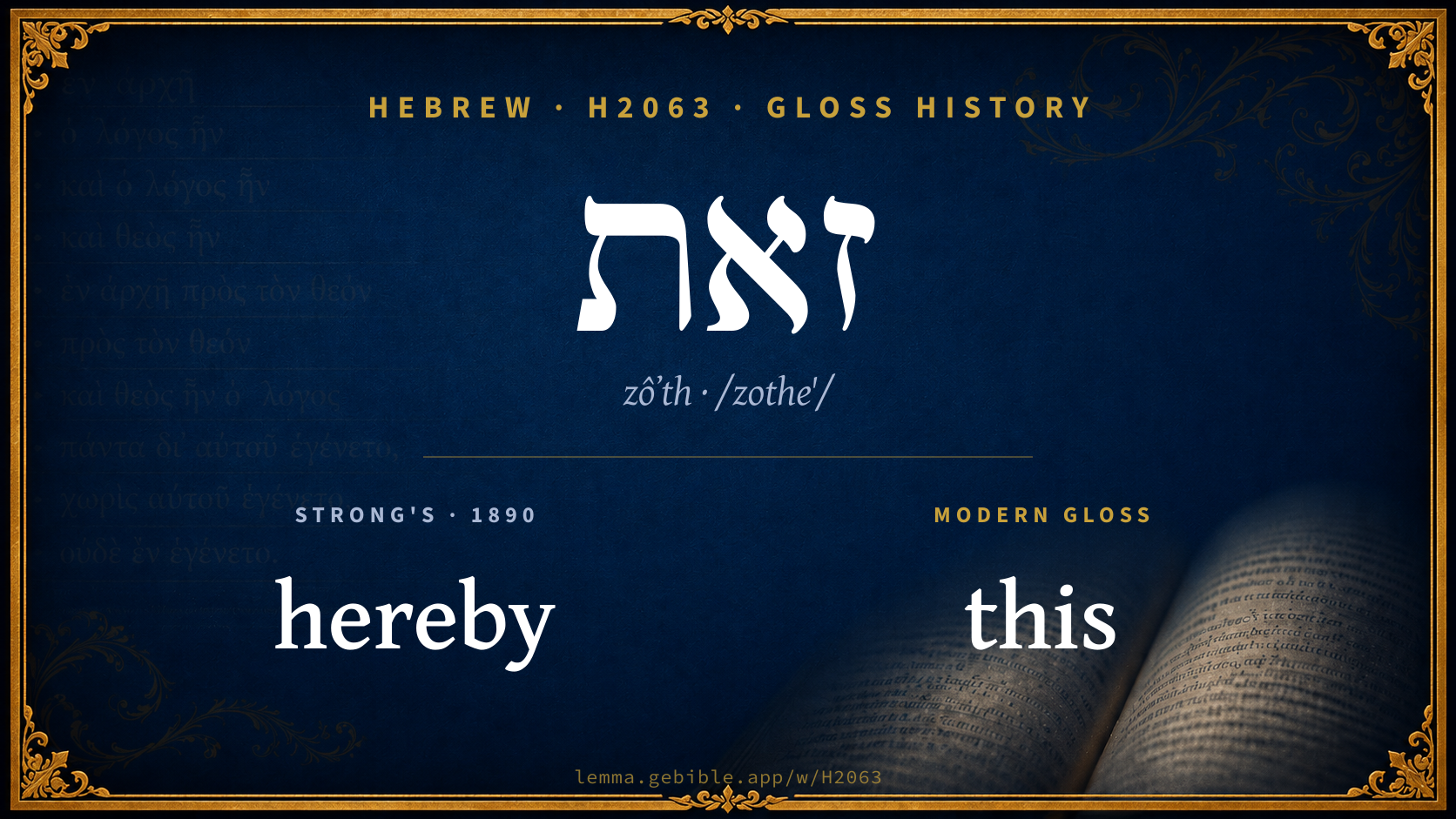
Gloss history
Strong's 1890 vs modern scholarship
About this word
Strong's H2063 catalogs a Hebrew word from the Hebrew Old Testament.
These counts are not copied from any lexicon or concordance. They are computed here, from the morphology-tagged Hebrew Old Testament. What Lemma adds →
- 570
- distinct verses
- The word appears in 570 distinct verses.
- 34 / 39
- OT books
- The word appears in 34 of 39 Old Testament books.
- #79
- by frequency
- Top 100 most frequent Hebrew words (rank 79 of 8,640 Hebrew words by occurrence).
View all 570 occurrences in the concordance →
Most concentrated in
- Jeremiah 90 verses 16%
- Deuteronomy 50 verses 9%
- Genesis 48 verses 8%
By section of the Old Testament
By traditional corpus
Conventional, traditional groupings — biblical authorship is debated, so this is a traditional corpus grouping, not an authorship claim. Each share is this word’s portion of its verses in that division of the Hebrew canon. Each figure is a share of the word’s 570 distinct verses.
- Prophets (Nevi'im) 300 verses · 53%
- Torah (Pentateuch) 171 verses · 30%
- Writings (Ketuvim) 99 verses · 17%
How translations render this word
Counts come from each version’s own published word-to-Strong’s tagging or interlinear alignment — an approximate guide to how each version renders this word, not a word-level alignment the data otherwise carries. Because each total is that version’s own tagged count, the per-version totals vary from one another and need not match the appearance or distinct-verse counts above. These counts may also differ from a printed concordance because Lemma counts each distinctly tagged rendering and does not collapse phrase taggings into a single head-word total. This is a fixed set of word-tagged versions (KJV, ASV, BSB, ULT) and does not change with the reading translation you choose elsewhere. Each version’s license is shown beside its name below (and on Sources).
- King James Version: This 9×, It 2×, She 2×
- American Standard Version: This 4×, After this 2×, Herewith 2×
- Berean Standard Bible: This 438×, Is this 12×, These 8×
- unfoldingWord Literal Text: This 467×, Is 37×, Like this 21×
King James Version Public Domain
Renders H2063 across 41 tagged occurrences — most commonly:
Plus 26 renderings that appear only once — usually multi-word phrases or single function words the recovered tagging swept in, not distinct renderings.
American Standard Version Public Domain
Renders H2063 across 41 tagged occurrences — most commonly:
Plus 25 renderings that appear only once — usually multi-word phrases or single function words the recovered tagging swept in, not distinct renderings.
Berean Standard Bible Public Domain
Renders H2063 across 559 tagged occurrences — most commonly:
Plus other, less common renderings. Plus 38 renderings that appear only once — usually multi-word phrases or single function words the recovered tagging swept in, not distinct renderings. Not rendered by a distinct English word in 45 further occurrences.
unfoldingWord Literal Text CC BY-SA 4.0
Renders H2063 across 615 tagged occurrences — most commonly:
Plus 21 renderings that appear only once — usually multi-word phrases or single function words the recovered tagging swept in, not distinct renderings.
21 senses in BDB, in lexicon order
The 21 senses BDB distinguishes for this word, in lexicon order (not ranked by frequency or importance). The full entry — with sub-senses — is in the Lexicon Entry tab.
- this, this one, here, which, this...that, the one...the other, such
(alone)
- this one
- this...that, the one...the other, another
(appos to subst)
- this
(as predicate)
- this, such
(enclitically)
- then
- who, whom
- how now, what now
- what now
- wherefore now
This word has an unusually long lexicon entry — 21 senses across its verb stems. The first 10 are shown above in lexicon order; the remaining 11 senses (more of the same, repeated under each stem) and the full sub-sense tree are in the Lexicon Entry tab.
Word origin
Derived from זה (zeh) (H2089) — lamb, sheep.
Jastrow Dictionary
A second Hebrew/Aramaic lexicon for comparison, covering Aramaic and post-biblical (Talmudic, Targumic, Midrashic) usage that the biblical-Hebrew BDB does not. Matched by lemma rather than by Strong’s number, so a lemma may carry more than one Jastrow headword (shown separately below), and the entries cover usage well beyond the Bible.
זֹאת
- , v. זֶה
A Dictionary of the Targumim, the Talmud Babli and Yerushalmi, and the Midrashic Literature (Marcus Jastrow; London, Luzac, 1903) — Public Domain. Digitized via Sefaria. Digitized via Sefaria. Full attribution on Sources.
Forms in the corpus
The 94 distinct written forms H2063 takes in the Hebrew Bible, most frequent first — each parse links to that state’s occurrences in the concordance. Hebrew forms include their vowel points and cantillation, so a single lemma takes many written forms.
| Form | Parsing | Example | Uses |
|---|---|---|---|
| הַ/זֹּ֔את | Pronoun, Demonstrative, Feminine, Singular | Daniel 10:8 | 67 |
| הַ/זֹּ֖את | Pronoun, Demonstrative, Feminine, Singular | Daniel 9:13 | 48 |
| הַ/זֹּ֑את | Pronoun, Demonstrative, Feminine, Singular | Deuteronomy 5:3 | 46 |
| הַ/זֹּֽאת | Pronoun, Demonstrative, Feminine, Singular | Deuteronomy 4:22 | 41 |
| זֹ֣את | Pronoun, Demonstrative, Feminine, Singular | Amos 4:12 | 32 |
| זֹ֑את | Pronoun, Demonstrative, Feminine, Singular | Amos 7:3 | 27 |
| הַ/זֹּאת֙ | Pronoun, Demonstrative, Feminine, Singular | Deuteronomy 3:18 | 22 |
| זֹ֥את | Pronoun, Demonstrative, Feminine, Singular | Deuteronomy 14:4 | 21 |
| זֹ֗את | Pronoun, Demonstrative, Feminine, Singular | Genesis 29:27 | 20 |
| זֹ֖את | Pronoun, Demonstrative, Feminine, Singular | Exodus 12:43 | 19 |
| הַ/זֹּ֛את | Pronoun, Demonstrative, Feminine, Singular | Deuteronomy 3:12 | 17 |
| זֹ֤את | Pronoun, Demonstrative, Feminine, Singular | Deuteronomy 34:4 | 16 |
| זֹאת֙ | Pronoun, Demonstrative, Feminine, Singular | Amos 8:8 | 15 |
| זֹ֛את | Pronoun, Demonstrative, Feminine, Singular | Amos 2:11 | 13 |
| זֹ֔את | Pronoun, Demonstrative, Feminine, Singular | Deuteronomy 32:6 | 12 |
| זֹֽאת | Pronoun, Demonstrative, Feminine, Singular | Deuteronomy 32:27 | 11 |
| הַ/זֹּ֗את | Pronoun, Demonstrative, Feminine, Singular | Deuteronomy 6:25 | 9 |
| זֹ֚את | Pronoun, Demonstrative, Feminine, Singular | Ezekiel 5:5 | 9 |
| זֹּ֣את | Pronoun, Demonstrative, Feminine, Singular | Exodus 14:5 | 8 |
| הַ/זֹּ֜את | Pronoun, Demonstrative, Feminine, Singular | Deuteronomy 19:9 | 7 |
| וְ/זֹ֣את | Pronoun, Demonstrative, Feminine, Singular | Deuteronomy 6:1 | 6 |
| זֹּֽאת | Pronoun, Demonstrative, Feminine, Singular | Amos 9:12 | 6 |
| וְ/זֹ֥את | Pronoun, Demonstrative, Feminine, Singular | Leviticus 6:14 | 5 |
| זֹ֭את | Pronoun, Demonstrative, Feminine, Singular | Job 5:27 | 5 |
| זֹּ֑את | Pronoun, Demonstrative, Feminine, Singular | Exodus 13:14 | 5 |
| בְּ/זֹאת֙ | Pronoun, Demonstrative, Feminine, Singular | 1 Samuel 11:2 | 4 |
| הַ/זֹּאת֒ | Pronoun, Demonstrative, Feminine, Singular | Deuteronomy 31:9 | 4 |
| וְ/זֹאת֙ | Pronoun, Demonstrative, Feminine, Singular | Exodus 25:3 | 4 |
| זֹּ֔את | Pronoun, Demonstrative, Feminine, Singular | Genesis 20:6 | 4 |
| זֹּ֖את | Pronoun, Demonstrative, Feminine, Singular | Genesis 12:18 | 4 |
| כָּ/זֹֽאת | Pronoun, Demonstrative, Feminine, Singular | Ezra 9:13 | 4 |
| בְּ/זֹ֖את | Pronoun, Demonstrative, Feminine, Singular | Ezekiel 16:29 | 3 |
| בְּ/זֹ֣את | Pronoun, Demonstrative, Feminine, Singular | Exodus 7:17 | 3 |
| וְ/זֹ֛את | Pronoun, Demonstrative, Feminine, Singular | 2 Samuel 7:19 | 3 |
| זֹ֕את | Pronoun, Demonstrative, Feminine, Singular | Amos 8:4 | 3 |
| זֹ֡את | Pronoun, Demonstrative, Feminine, Singular | Isaiah 54:17 | 3 |
| זֹּאת֙ | Pronoun, Demonstrative, Feminine, Singular | Exodus 14:11 | 3 |
| כָּ/זֹ֑את | Pronoun, Demonstrative, Feminine, Singular | 1 Chronicles 29:14 | 3 |
| הֲ/זֹ֣את | Pronoun, Demonstrative, Feminine, Singular | Job 20:4 | 2 |
| הֲ/זֹ֥את | Pronoun, Demonstrative, Feminine, Singular | Isaiah 23:7 | 2 |
| הַ/זֹּ֤את | Pronoun, Demonstrative, Feminine, Singular | Deuteronomy 31:21 | 2 |
| הַ/זֹּ֧את | Pronoun, Demonstrative, Feminine, Singular | Genesis 19:20 | 2 |
| הַ/זֹּאת֮ | Pronoun, Demonstrative, Feminine, Singular | 1 Samuel 14:45 | 2 |
| וְ/זֹ֖את | Pronoun, Demonstrative, Feminine, Singular | Deuteronomy 4:44 | 2 |
| וְ/זֹ֤את | Pronoun, Demonstrative, Feminine, Singular | 1 Kings 3:22 | 2 |
| וְ/כָ/זֹ֖את | Pronoun, Demonstrative, Feminine, Singular | 2 Samuel 17:15 | 2 |
| וְ/כָ/זֹ֥את | Pronoun, Demonstrative, Feminine, Singular | 2 Samuel 17:15 | 2 |
| וְ/כָ/זֹאת֙ | Pronoun, Demonstrative, Feminine, Singular | 2 Kings 5:4 | 2 |
| זֹ֠את | Pronoun, Demonstrative, Feminine, Singular | Leviticus 13:59 | 2 |
| זֹ֨את | Pronoun, Demonstrative, Feminine, Singular | Hosea 5:1 | 2 |
| זֹּ֥את | Pronoun, Demonstrative, Feminine, Singular | Judges 2:2 | 2 |
| כָּ/זֹ֔את | Pronoun, Demonstrative, Feminine, Singular | Esther 4:14 | 2 |
| כָּ/זֹ֖את | Pronoun, Demonstrative, Feminine, Singular | 1 Samuel 4:7 | 2 |
| כָּ/זֹ֣את | Pronoun, Demonstrative, Feminine, Singular | 1 Kings 7:37 | 2 |
| כָּ/זֹ֤את | Pronoun, Demonstrative, Feminine, Singular | 2 Kings 5:4 | 2 |
| בָ/זֹ֛את | Pronoun, Demonstrative, Feminine, Singular | 1 Chronicles 27:24 | 1 |
| בְּ/זֹ֔את | Pronoun, Demonstrative, Feminine, Singular | Leviticus 26:27 | 1 |
| בְּ/זֹ֛את | Pronoun, Demonstrative, Feminine, Singular | Leviticus 16:3 | 1 |
| בְּ/זֹ֞את | Pronoun, Demonstrative, Feminine, Singular | Jeremiah 9:24 | 1 |
| בְּ֝/זֹ֗את | Pronoun, Demonstrative, Feminine, Singular | Psalms 27:3 | 1 |
The 60 most common forms are shown; 34 rarer forms follow in the full concordance.
Septuagint verse parallels
This word appears in 532 verses that also exist in the Greek Old Testament (Septuagint), out of the 570 Hebrew verses it occurs in. You can read those verses in Greek by switching the Old Testament edition to the Septuagint.
Read these verses in the Septuagint
- Genesis 2:23
- Exodus 7:17
- Leviticus 6:9
- Numbers 4:4
- Deuteronomy 1:5
- Joshua 1:13
- Judges 1:27
- Ruth 1:19
- 1 Samuel 2:20
- 2 Samuel 1:17
- 1 Kings 3:17
- 2 Kings 3:18
This is a verse-level parallel only — the same verses exist in both the Hebrew and Greek Old Testaments. No word-level Hebrew↔Greek correspondence is claimed: the data carries no such alignment, so no Greek word is shown as this Hebrew word’s translation. Coverage is not total — the Septuagint omits the deuterocanon and renumbers the Psalms, so some Hebrew verses have no direct Greek parallel.