Leviticus 15:3

Hebrew (Westminster Leningrad Codex) Leviticus 15:3 appears in the Hebrew Old Testament. The text above is from the Westminster Leningrad Codex. Each word links to its Strong’s number, a concise gloss, and parsing drawn from the Open Scriptures Hebrew Bible morphology. Click any word for its full Brown-Driver-Briggs (BDB) entry.
Download image
Cite this verse

Leviticus 15:3 (World English Bible). Public Domain. Lemma interlinear Bible study tool, https://lemma.gebible.app/v/leviticus/15/3.

Show BibTeX & RIS
BibTeX
RIS
English Translation
This shall be his uncleanness in his discharge: whether his body runs with his discharge, or his body has stopped from his discharge, it is his uncleanness.
World English Bible · Public Domain
Highlights Full analysis ↓
Download a study sheet

One document with this verse’s original text, its word-by-word gloss line, the meaning frame, cross-references with their text, attributed commentary, and full source and license credits — printable, and it pastes into notes with its structure intact.

This verse Autodidact and up

Study sheet (.html) Plain text (.txt)

A passage Seminary Student

Up to 50 verses in one chapter. A passage sheet keeps up to 6 commentary sources and 12 cross-references per verse, in the order this page ranks them, and says so on the sheet whenever that leaves anything out. Ask for a single verse and you get the Autodidact verse sheet above.

Everything on this page stays free to read, with no account — the sheet is a download of what is already on screen, not access to it.

Want to remove ads? Support Godless Engineer
Compare translations 3

The same verse in 3 English versions, stacked beneath the original-language interlinear above. Click any original word for its lexicon entry.

Each is an independent rendering of the whole verse — the interlinear is not word-aligned to these translations.

Highlighted words mark where these versions differ — a whole-verse word diff, not a word-by-word alignment.

  • World English Bible Public Domain
    This shall be his uncleanness in his discharge: whether his body runs with his discharge, or his body has stopped from his discharge, it is his uncleanness.
  • King James Version Public Domain
    And this shall be his uncleanness in his issue: whether his flesh run with his issue, or his flesh be stopped from his issue, it is his uncleanness.
  • unfoldingWord Literal Text CC BY-SA 4.0
    And this is his uncleanness in his flow: his flesh secretes his flow or his flesh blocks his flow, it his uncleanness.

unfoldingWord Literal Text — © unfoldingWord, licensed CC BY-SA 4.0. Word-aligned USFM3 via Door43 (git.door43.org/unfoldingWord/en_ult).

Versions to compare (up to 4)

3 of 4 selected

Show all 18 translations

Every available English version of this verse, each an independent rendering of the whole verse.

  • World English Bible Public Domain
    This shall be his uncleanness in his discharge: whether his body runs with his discharge, or his body has stopped from his discharge, it is his uncleanness.
  • Berean Standard Bible Public Domain
    This uncleanness is from his discharge, whether his body allows the discharge to flow or blocks it. So his discharge will bring about uncleanness.
  • Majority Standard Bible Public Domain
    This uncleanness is from his discharge, whether his body allows the discharge to flow or blocks it. So his discharge will bring about uncleanness.
  • King James Version Public Domain
    And this shall be his uncleanness in his issue: whether his flesh run with his issue, or his flesh be stopped from his issue, it is his uncleanness.
  • American Standard Version (1901) Public Domain
    And this shall be his uncleanness in his issue: whether his flesh run with his issue, or his flesh be stopped from his issue, it is his uncleanness.
  • Revised Version (1885) Public Domain
    And this shall be his uncleanness in his issue: whether his flesh run with his issue, or his flesh be stopped from his issue, it is his uncleanness.
  • Geneva Bible (1599) Public Domain
    And this shalbe his vncleannes in his issue: when his flesh auoydeth his issue, or if his flesh be stopped from his issue, this is his vncleannes.
  • Douay-Rheims (1899) Public Domain
    And then shall he be judged subject to this evil, when a filthy humour, at every moment, cleaveth to his flesh, and gathereth there.
  • Young's Literal Translation Public Domain
    and this is his uncleanness in his issue -- his flesh hath run with his issue, or his flesh hath stopped from his issue; it `is' his uncleanness.
  • Literal Standard Version CC BY-SA 4.0
    and this is his uncleanness in his discharge—his flesh has run with his discharge, or his flesh has stopped from his discharge; it [is] his uncleanness.
  • Unlocked Literal Bible CC BY-SA 4.0
    His uncleanness is due to this infected fluid. Whether his body flows with fluid or is stopped up, it is unclean.
  • unfoldingWord Literal Text CC BY-SA 4.0
    And this is his uncleanness in his flow: his flesh secretes his flow or his flesh blocks his flow, it his uncleanness.
  • Darby Bible Public Domain
    And this shall be his uncleanness in his flux: whether his flesh run with his flux, or his flesh be closed from his flux, it is his uncleanness.
  • World Messianic Bible Public Domain
    This shall be his uncleanness in his discharge: whether his body runs with his discharge, or his body has stopped from his discharge, it is his uncleanness.
  • Webster's Bible Public Domain
    And this shall be his uncleanness in his issue: whether his flesh shall run with his issue, or his flesh be stopped from his issue, it is his uncleanness.
  • Free Bible Version CC BY-SA 4.0
    The uncleanness comes from his discharge, whether his body allows it to flow out or blocks it. It makes him unclean.
  • Bible in Basic English Public Domain
    If the flow goes on or if the part is stopped up, to keep back the flow, he is still unclean.
  • JPS Tanakh (1917) Public Domain
    And this shall be his uncleanness in his issue: whether his flesh run with his issue, or his flesh be stopped from his issue, it is his uncleanness.

Literal Standard Version (2020), Covenant Press — licensed CC BY-SA 4.0. Text via the HelloAO Bible API (eBible.org). Unlocked Literal Bible (unfoldingWord) — licensed CC BY-SA 4.0. Text via the HelloAO Bible API (eBible.org). unfoldingWord Literal Text — © unfoldingWord, licensed CC BY-SA 4.0. Word-aligned USFM3 via Door43 (git.door43.org/unfoldingWord/en_ult). Free Bible Version, Dr. Jonathan Gallagher — licensed CC BY-SA 4.0. Text via the HelloAO Bible API (eBible.org).

Word by word

More ways to search: Search by grammar → Find every occurrence → Compare this word →

Practice this passage: Drill this verse → Learn its vocabulary →

רָ֣ר
rûwr
H7325
“to flow”
Verb, Qal, Perfect, 3rd Person, Masculine, Singular
Part of Speech
Verb
Stem
Qal
Form
Perfect
Person
3rd Person
Gender
Masculine
Number
Singular
Full BDB Definition

Origin: a primitive root

TWOT: 2162

(Qal) to flow
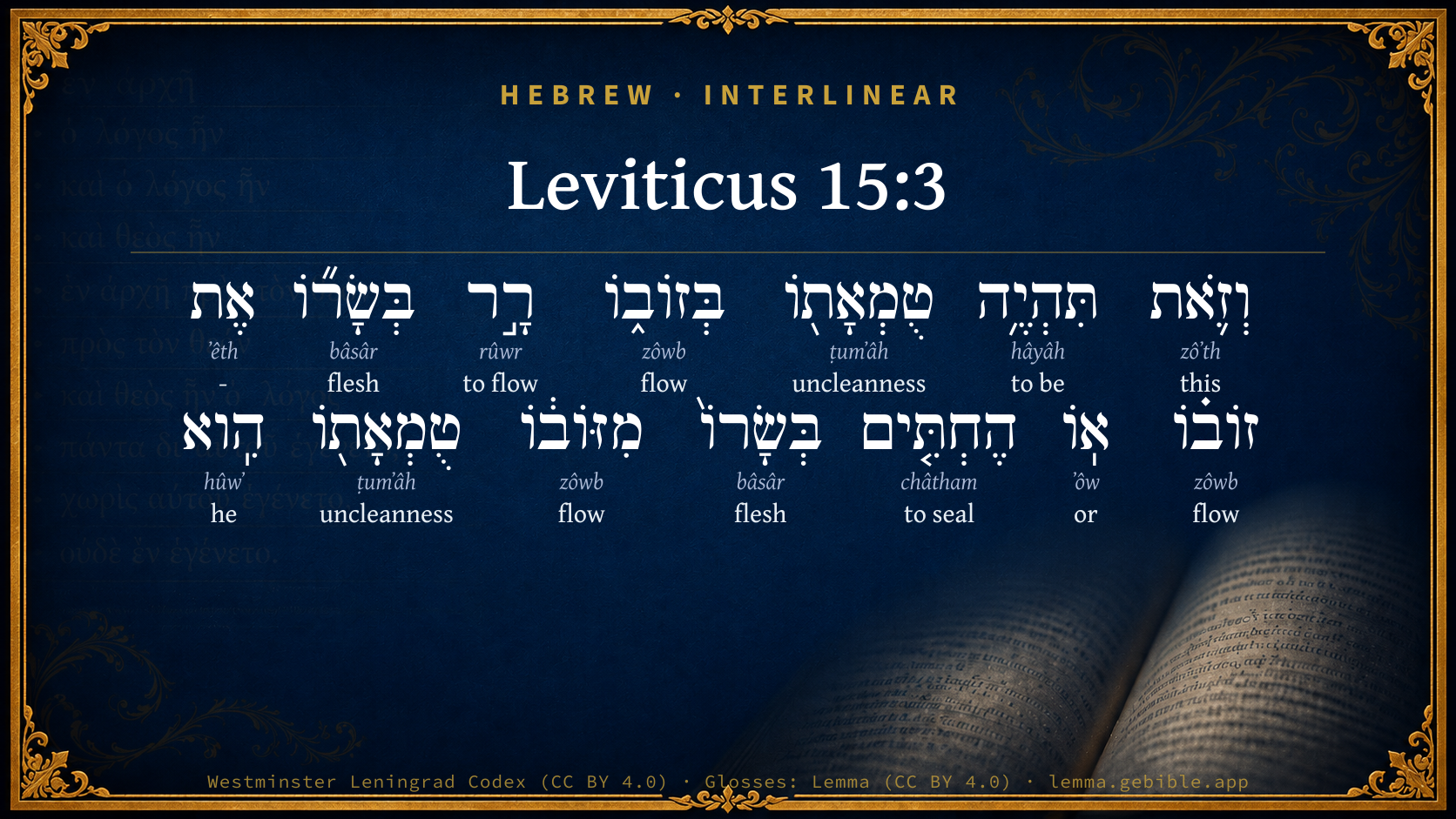
  1. וְזֹ֛את zôʼth H2063 “and · this” Conjunction + Pronoun, Demonstrative, Feminine, Singular
  2. תִּהְיֶ֥ה hâyâh H1961 “to be” Verb, Qal, Imperfect, 3rd Person, Feminine, Singular
  3. טֻמְאָת֖וֹ ṭumʼâh H2932 “uncleanness · his” Noun, Common, Feminine, Singular, Construct + Suffix, Personal, 3rd Person, Masculine, Singular
  4. בְּזוֹב֑וֹ zôwb H2101 “in/at · flow · his” Preposition + Noun, Common, Masculine, Singular, Construct + Suffix, Personal, 3rd Person, Masculine, Singular
  5. בְּשָׂר֞וֹ bâsâr H1320 “flesh · his” Noun, Common, Masculine, Singular, Construct + Suffix, Personal, 3rd Person, Masculine, Singular
  6. אֶת ʼêth H853 “-” Particle, Direct Object
  7. זוֹב֗וֹ zôwb H2101 “flow · his” Noun, Common, Masculine, Singular, Construct + Suffix, Personal, 3rd Person, Masculine, Singular
  8. אֽוֹ ʼôw H176 “or” Conjunction
  9. הֶחְתִּ֤ים châtham H2856 “to seal” Verb, Hiphil, Perfect, 3rd Person, Masculine, Singular
  10. בְּשָׂרוֹ֙ bâsâr H1320 “flesh · his” Noun, Common, Masculine, Singular, Construct + Suffix, Personal, 3rd Person, Masculine, Singular
  11. מִזּוֹב֔וֹ zôwb H2101 “from · flow · his” Preposition + Noun, Common, Masculine, Singular, Construct + Suffix, Personal, 3rd Person, Masculine, Singular
  12. טֻמְאָת֖וֹ ṭumʼâh H2932 “uncleanness · his” Noun, Common, Feminine, Singular, Construct + Suffix, Personal, 3rd Person, Masculine, Singular
  13. הִֽוא hûwʼ H1931 “he” Pronoun, Personal, 3rd Person, Feminine, Singular

About this verse

These counts appear in no published source. They are computed here, from the morphology-tagged text and Lemma’s own curated glosses. What Lemma adds →

14
words
10
distinct lemmas
Pentateuch
section

Notable vocabulary

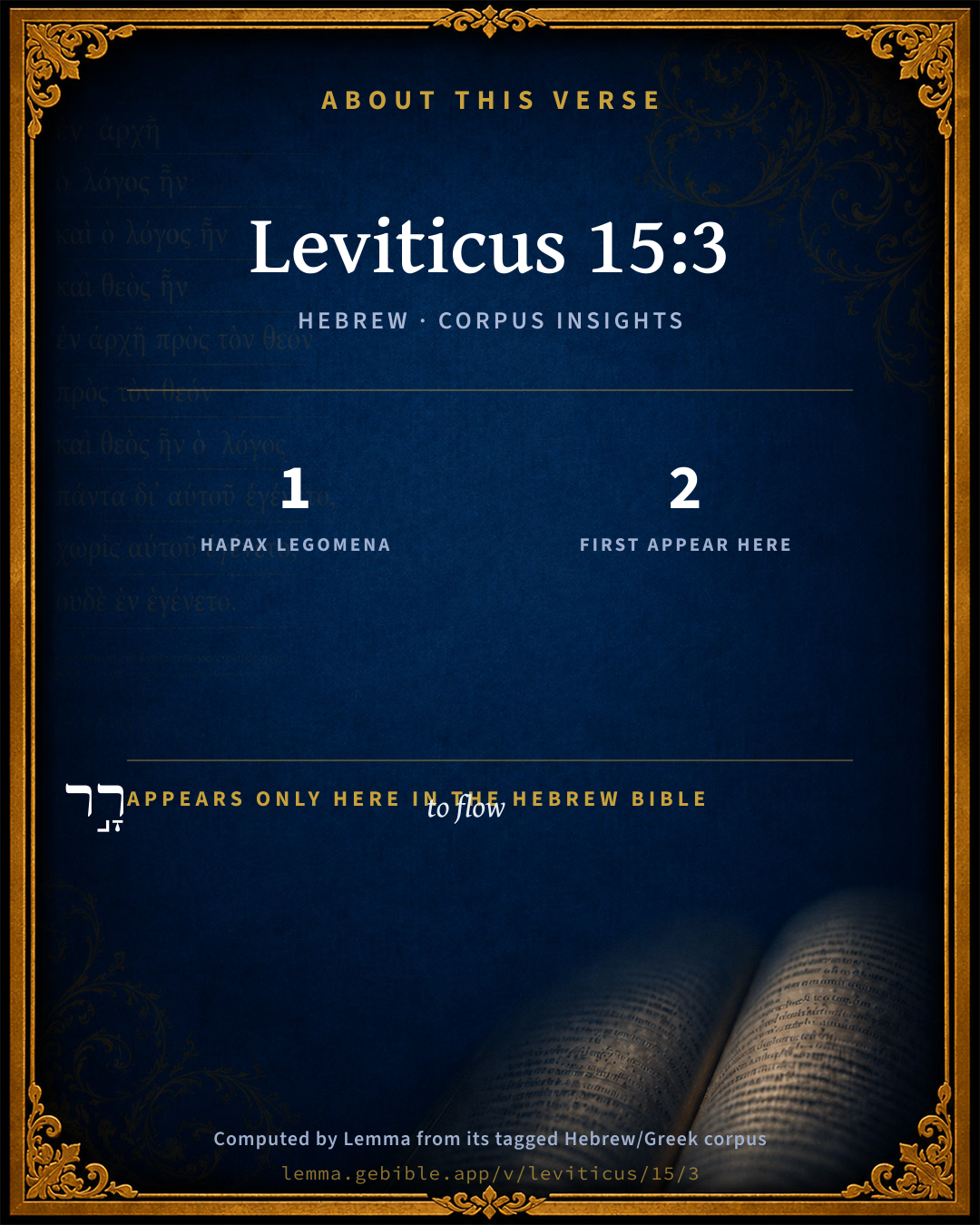
1 hapax legomenon — a word that appears only here in the entire Hebrew Bible:

First appearance in Scripture

These words make their first canonical appearance in the Hebrew Bible here:

  • רָ֣ר to flow H7325
  • הֶחְתִּ֤ים to seal H2856

Shared distinctive vocabulary

בְּזוֹב֑וֹ flow H2101 occurs in 10 verses of the Hebrew Bible. Also found in:

Grammatical profile

  • 3 verbs
  • 7 nouns
  • 2 pronouns
  • 1 conjunction
  • 1 particle

Verb forms

  • תִּהְיֶ֥ה Qal · Imperfect
  • רָ֣ר Qal · Perfect
  • הֶחְתִּ֤ים Hiphil · Perfect

Repetition

Words recur within this verse — often emphatic in Hebrew:

  • בְּזוֹב֑וֹ flow H2101 ×3
  • טֻמְאָת֖וֹ uncleanness H2932 ×2
  • בְּשָׂר֞וֹ flesh H1320 ×2

Hebrew & Septuagint length

In English translation the verse runs 27 words from the Hebrew and 58 from the Septuagint (LXX English) — the Septuagint runs noticeably longer here. See the side-by-side →

A rough comparison of the two English renderings, which tokenize alike — not a word-level alignment.

Word counts can differ between the Hebrew and the Greek without any difference in meaning — e.g. the Hebrew direct-object marker אֵת has no separate Greek word, and Greek often adds the article ὁ.

Cross-references

3

Topical passages linked to Leviticus 15:3 in the Treasury of Scripture Knowledge — connected by theme and wording, ordered by reader-vote popularity; previews shown in the World English Bible.

  • Leviticus 12:3 In the eighth day the flesh of his foreskin shall be circumcised.
  • Ezekiel 16:26 You have also committed sexual immorality with the Egyptians, your neighbors, great of flesh; and have multiplied your prostitution, to provoke me to anger.
  • Ezekiel 23:20 She doted on their paramours, whose flesh is as the flesh of donkeys, and whose issue is like the issue of horses.

Cross-references courtesy of OpenBible.info (CC BY 4.0).

Hebrew and Greek witnesses Masoretic Hebrew ↔ Greek Septuagint

The same verse in the two great witnesses to the Old Testament, shown verse-for-verse.

Here the Septuagint runs noticeably longer than the Hebrew — LXX2012 (modern English Septuagint) 58 words vs World English Bible 27. A rough length comparison of the two English translations, not a word-level alignment — read both below.

These are two independent witnesses, not word-aligned to each other, and the Septuagint is shown in lemma (dictionary) form.

Hebrew Leviticus 15:3 Masoretic · Westminster Leningrad Codex

וְזֹ֛את תִּהְיֶ֥ה טֻמְאָת֖וֹ בְּזוֹב֑וֹ רָ֣ר בְּשָׂר֞וֹ אֶת זוֹב֗וֹ אֽוֹ הֶחְתִּ֤ים בְּשָׂרוֹ֙ מִזּוֹב֔וֹ טֻמְאָת֖וֹ הִֽוא

This shall be his uncleanness in his discharge: whether his body runs with his discharge, or his body has stopped from his discharge, it is his uncleanness.

World English Bible · Public Domain

Greek LXX Leviticus 15:3 Septuagint · lemma form

καί οὗτος ὁ νόμος ὁ ἀκαθαρσία αὐτός ῥέω γόνος ἐκ σῶμα αὐτός ἐκ ὁ ῥύσις ὅς συνἵστημι ὁ σῶμα αὐτός διά ὁ ῥύσις οὗτος ὁ ἀκαθαρσία αὐτός ἐν αὐτός πᾶς ὁ ἡμέρα ῥύσις σῶμα αὐτός ὅς συνἵστημι ὁ σῶμα αὐτός διά ὁ ῥύσις ἀκαθαρσία αὐτός εἰμί

And this is the law of his uncleanness; whoever has a gonorrhoea out of his body, this is his uncleanness in him by reason of the issue, by which, his body is affected through the issue: all the days of the issue of his body, by which his body is affected through the issue, there is his uncleanness.

LXX2012 (modern English Septuagint) · Public Domain

On this verse, Haydock's Catholic Bible Commentary discusses the Septuagint’s reading. Read the note in Commentary ↓

Hebrew: Westminster Leningrad Codex (CC BY 4.0). Greek: Septuagint (public domain); English from LXX2012 (modern English Septuagint) (Public Domain). How the Septuagint differs from the Hebrew →

Targum (Aramaic paraphrase)

2

The Targum is the ancient Jewish Aramaic paraphrase of the Hebrew Scriptures — an interpretive translation, not the Hebrew text itself. Onkelos (literal) and Pseudo-Jonathan (expansive) render the Torah, and Jonathan the Prophets. Coverage is partial: where no permissively-licensed English translation exists for a verse, only the Aramaic is shown. This is verse-level text, not a word-by-word alignment to the Hebrew.

  1. Targum Onkelos Torah (Genesis–Deuteronomy)
    וְדָא תְּהֵי סוֹבְתֵהּ בְּדוֹבֵהּ רָר בִּשְׂרֵהּ יָת דוֹבֵהּ אוֹ חָתִים בִּשְׂרֵהּ מִדוֹבֵהּ סוֹבְתֵהּ הִיא

    (no public-domain English translation for this verse)

    Targum Onkelos — Aramaic: “Onkelos Genesis” (public domain); “Onkelos Exodus” (public domain); “Onkelos Leviticus” (public domain); “Onkelos Numbers” (public domain); “Onkelos Deuteronomy” (public domain). English: “Sefaria Community Translation” (CC0 1.0 (public-domain dedication)); “J.W. Etheridge. The Targums of Onkelos and Jonathan Ben Uzziel on the Pentateuch. London: Longmans, Green, 1862” (public domain). Text via Sefaria.

  2. Targum Pseudo-Jonathan Torah (Genesis–Deuteronomy)
    וְדָא תְּהֵי סְאוֹבְתֵּיהּ גַווֹן חִיוַור בְּדָיֵיהּ חֲרִיר בִּישְרֵיהּ יַת דְיֵיהּ אוֹ דְאִיסְתַתֵּם בִּישְרֵיהּ מִדוֹוֵויהּ סְאוֹבְתֵּיהּ הוּא

    And this shall be his uncleanness, the appearance of the colour of white in his defluxion inflaming, the defluxion of his flesh; or when his flesh hath stopped from his defluxion, it is his uncleanness.

    Targum Pseudo-Jonathan — Aramaic: “Targum Jonathan on Genesis” (public domain); “Targum Jonathan on Exodus” (public domain); “Targum Jonathan on Leviticus” (public domain); “Targum Jonathan on Numbers” (public domain); “Targum Jonathan on Deuteronomy” (public domain). English: “The Targum of Jonathan ben Uzziel, trans. J. W. Etheridge, London, 1862” (public domain). Text via Sefaria.

Commentary

Notes on Leviticus 15:3 from classic Christian and Jewish commentators (each source and its license shown beneath its notes). The classic Christian expositions comment on the surrounding passage and are grouped to its opening verse, so a note may address several verses; the Jewish commentaries on the Tanakh (Rashi and others) are per-verse, so they appear only where the commentator wrote on this verse.

Lemma curates 59 commentaries, every one of them public domain or Creative Commons licensed, each selected and text-cleaned for this edition rather than reprinted as found. About our sources →

Trapp's Complete Commentary

John Trapp

Lev 15:3 And this shall be his uncleanness in his issue: whether his flesh run with his issue, or his flesh be stopped from his issue, it [is] his uncleanness.

Ver. 3. It is his uncleanness.] Hereby they were taught the turpitude of sin, of original sin especially, that peccatum peccans, as the Schools call it; that sinful sin, as St Paul, {Rom 7:13} for so filthy it is, that he can call it no worse than by its own name, as wanting a fitter epithet.

John Trapp, A Commentary or Exposition upon All the Books of the Old and New Testament (1647–1656) — public domain. Text from a community e-Sword module.

Geneva Bible (1599)

Geneva Bible translators

Of the thing wherefore he shall be unclean.

Geneva Bible (1599) marginal notes — public domain. Text via Bolls.life.

Ellicott's Commentary for English Readers

(3) Whether his flesh run.—This verse defines more minutely the statement in the preceding verse.

A Bible Commentary for English Readers, edited by Charles John Ellicott (1878–1897) — public domain. Text from a community e-Sword module.

John Gill's Exposition

And this shall be his uncleanness in his issue,.... Or the sign of it, by which it may be judged whether he is unclean by it or no:

whether his flesh run with his issue; or salivates, or emits a flow of matter like a saliva, or in the manner of spittle:

or his flesh be stopped from his issue; with it, or because of it; because it is gross, as Jarchi says, it cannot come forth freely:

it is his uncleanness; whether it be one or the other, he is reckoned on account of it an unclean person. This was an emblem of the corruption and vitiosity of nature, and of all evil things that are in or flow out of the evil heart of man, which are defiling to him; see Mat 15:18.

John Gill's Exposition of the Whole Bible (1746–1763) — public domain (CC PDM 1.0). Text via the HelloAO Bible API.

Haydock's Catholic Bible Commentary

At every moment, is not in Hebrew, but something like it occurs in the Samaritan and Septuagint. According to the Hebrew, the uncleanness subsists for some time after the issue has ceased. Grotius pretends that these disorders were contagious; but the reason why God requires such purity in his people, is given [in] ver. 31. He dwelt among them, and would not allow of any disrespectful behaviour. There were to live like priests in his temple. The pagans in Egypt, Greece, and Italy, required the like attention to cleanliness in their priests. (Herod., ii.) --- Noctem flumine purgas. (Persius ii.) (Calmet)

George Leo Haydock (1774–1849), Haydock's Catholic Family Bible and Commentary, 1859 edition — public domain. Excludes Psalms (Douay-Rheims chapter numbering differs from Protestant) and Deuterocanonical books (Catholic canon only).

Matthew Poole's English Annotations

Or if it have run, and been stopped in great measure, either by the grossness of the humour, or by some obstruction in parts that it cannot run freely, as it did, but only droppeth.

Matthew Poole's English Annotations on the Holy Bible (1683–1685) — public domain. Text from a community e-Sword/MySword module.

Whedon's Commentary on the Bible

Daniel D. Whedon

3. Be stopped — Literally, whether he stop his flesh from his issue. The uncleanness continues, though the issue be temporarily obstructed, until its perfect cure.

Daniel D. Whedon (gen. ed.), Commentary on the Old and New Testaments (1874–1909) — public domain. Text from a community e-Sword module.

John Wesley's Explanatory Notes

His flesh be stopped - That is, if it have run, and be stopped in great measure, either by the grossness of the humour, or by some obstructions that it cannot run freely.

John Wesley, Explanatory Notes Upon the Whole Bible (1754–1765) — public domain. Text via the GEBible commentary corpus.

Rashi

Rabbi Shlomo Yitzchaki (Rashi)

רר [WHETHER HIS FLESH] DRIP — This word is connected with ריר "spittle" — the meaning is that his flesh runs with its issue as spittle, i. e. that it (the flow) comes forth clear in appearance (not thick and troubled).

או החתים OR [HIS FLESH] BE STOPPED — it means, that the flow issues thick and closes up the orifice of the membrum, so that his flesh is stopped up by the drop that issued from him. This is its literal meaning. The Halachic explanation is: The first verse (v. 2) enumerates two appearances of the issue and then terms him (the man affected by them) unclean, for it is said, "when there flows from his flesh a flowing he is unclean" and the other verse (v. 3) enumerates three appearances of the issue and only then terms him unclean, as it is said, "his uncleanness through his flow: if his flesh drips through its flow as with spittle, or if his flesh is stopped up through his flowing then only is it his uncleanness!" How can this be reconciled? Two appearances of the flow serve to make him unclean, and the third obligates him also to bring an offering (Niddah 43b; Megillah 8a).

Rashi on the Tanakh — English translations: “The Judaica Press complete Tanach with Rashi, translated by A. J. Rosenberg” (CC BY 4.0); “Pentateuch with Rashi's commentary by M. Rosenbaum and A.M. Silbermann, 1929-1934” (public domain); “The Metsudah Tanach series, Lakewood, N.J” (CC BY 4.0); and “The Book of Joshua, Metsudah Publications, 1997” (CC BY 4.0). Text via Sefaria.

Lesson kit

Teaching starters — assembled from the data on this page, not authored interpretation. Every prompt links to the verse data it draws on. Edit before teaching.

Leviticus, in the Pentateuch, opens this verse with 14 words (10 distinct Hebrew lemmas). Its most distinctive word is rûwr (“to flow”). The Greek Septuagint runs longer here. A historical commentator’s framing appears above. Read the whole chapter for the surrounding context.

Discussion questions

  1. The word rûwr carries the sense “to flow.” How does it shape the verse?
  2. 1 word here appears nowhere else in the Hebrew Bible. Why might the author reach for such rare wording?
  3. 2 words make their first appearance in Scripture here. What does this debut establish?
  4. How does Leviticus 15:2, which shares the word «flow», read alongside this verse?
  5. What does the repetition of “flow” (3× in this one verse) do in this verse?
  6. The Septuagint runs longer here than the Hebrew. What might account for the difference?
  7. These translations render this verse differently; the difference is in the English rendering, not the original. What questions does that raise?
  8. «תִּהְיֶ֥ה» is a Qal Imperfect verb. How does that grammatical form shape the action described?

Things to notice

  • 1 word in this verse appears nowhere else in the Hebrew Bible.
  • 2 words make their first canonical appearance in Scripture here.
  • These translations choose different wording for 13 words in this verse.
  • “flow” occurs 3× in this single verse.
  • 10 distinct Hebrew lemmas span 14 words in this verse.

Reading settings

Reading text

Shown beneath each verse's original-language words.

Old Testament
Old Testament edition

Read the OT as the Masoretic Hebrew (MT) or the Greek Septuagint (LXX).

English shown for the Greek Septuagint (in the Hebrew ↔ Greek comparison).

Comparing translations? Open the Compare panel on any verse page to stack up to four side by side.