
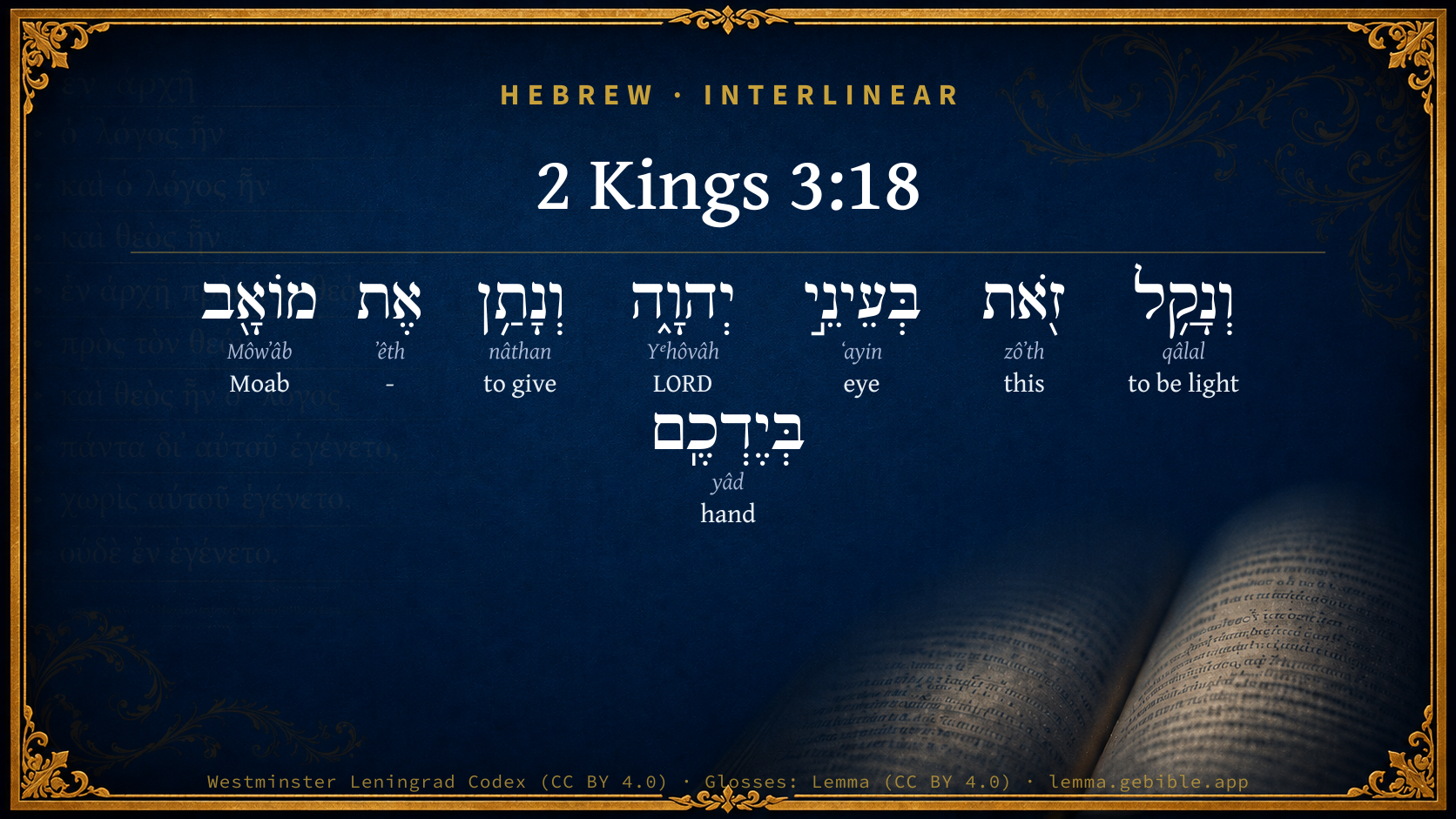
2 Kings 3:18

Hebrew (Westminster Leningrad Codex) 2 Kings 3:18 appears in the Hebrew Old Testament. The text above is from the Westminster Leningrad Codex. Each word links to its Strong’s number, a concise gloss, and parsing drawn from the Open Scriptures Hebrew Bible morphology. Click any word for its full Brown-Driver-Briggs (BDB) entry.
Download image
Cite this verse

2 Kings 3:18 (World English Bible). Public Domain. Lemma interlinear Bible study tool, https://lemma.gebible.app/v/2-kings/3/18.

Show BibTeX & RIS
BibTeX
RIS
English Translation
This is but a light thing in the sight of Yahweh: he will also deliver the Moabites into your hand.
World English Bible · Public Domain
Download a study sheet

One document with this verse’s original text, its word-by-word gloss line, the meaning frame, cross-references with their text, attributed commentary, and full source and license credits — printable, and it pastes into notes with its structure intact.

This verse Autodidact and up

Study sheet (.html) Plain text (.txt)

A passage Seminary Student

Up to 50 verses in one chapter. A passage sheet keeps up to 6 commentary sources and 12 cross-references per verse, in the order this page ranks them, and says so on the sheet whenever that leaves anything out. Ask for a single verse and you get the Autodidact verse sheet above.

Everything on this page stays free to read, with no account — the sheet is a download of what is already on screen, not access to it.

Want to remove ads? Support Godless Engineer
Compare translations 3

The same verse in 3 English versions, stacked beneath the original-language interlinear above. Click any original word for its lexicon entry.

Each is an independent rendering of the whole verse — the interlinear is not word-aligned to these translations.

Highlighted words mark where these versions differ — a whole-verse word diff, not a word-by-word alignment.

  • World English Bible Public Domain
    This is but a light thing in the sight of Yahweh: he will also deliver the Moabites into your hand.
  • King James Version Public Domain
    And this is but a light thing in the sight of the LORD: he will deliver the Moabites also into your hand.
  • unfoldingWord Literal Text CC BY-SA 4.0
    And this is easy in the eyes of Yahweh, for he will give Moab into your hand.

unfoldingWord Literal Text — © unfoldingWord, licensed CC BY-SA 4.0. Word-aligned USFM3 via Door43 (git.door43.org/unfoldingWord/en_ult).

Versions to compare (up to 4)

3 of 4 selected

Show all 18 translations

Every available English version of this verse, each an independent rendering of the whole verse.

  • World English Bible Public Domain
    This is but a light thing in the sight of Yahweh: he will also deliver the Moabites into your hand.
  • Berean Standard Bible Public Domain
    This is a simple matter in the sight of the LORD, and He will also deliver the Moabites into your hand.
  • Majority Standard Bible Public Domain
    This is a simple matter in the sight of the LORD, and He will also deliver the Moabites into your hand.
  • King James Version Public Domain
    And this is but a light thing in the sight of the LORD: he will deliver the Moabites also into your hand.
  • American Standard Version (1901) Public Domain
    And this is but a light thing in the sight of Jehovah: he will also deliver the Moabites into your hand.
  • Revised Version (1885) Public Domain
    And this is but a light thing in the sight of the LORD: he will also deliver the Moabites into your hand.
  • Geneva Bible (1599) Public Domain
    But this is a small thing in the sight of the Lord: for he will giue Moab into your hande.
  • Douay-Rheims (1899) Public Domain
    And this is a small thing in the sight of the Lord: moreover he will deliver also Moab into your hands.
  • Young's Literal Translation Public Domain
    `And this hath been light in the eyes of Jehovah, and he hath given Moab into your hand,
  • Literal Standard Version CC BY-SA 4.0
    And this has been light in the eyes of YHWH, and he has given Moab into your hand,
  • Unlocked Literal Bible CC BY-SA 4.0
    This is an easy thing in the sight of Yahweh. He will also give you victory over the Moabites.
  • unfoldingWord Literal Text CC BY-SA 4.0
    And this is easy in the eyes of Yahweh, for he will give Moab into your hand.
  • Darby Bible Public Domain
    And this is a light thing in the sight of Jehovah: he will give the Moabites also into your hand.
  • World Messianic Bible Public Domain
    This is an easy thing in the LORD’s sight. He will also deliver the Moabites into your hand.
  • Webster's Bible Public Domain
    And this is but a light thing in the sight of the LORD: he will deliver the Moabites also into your hand.
  • Free Bible Version CC BY-SA 4.0
    The Lord views this as something trivial to do; and he will also make you victorious over the Moabites.
  • Bible in Basic English Public Domain
    And this will be only a small thing to the Lord: in addition he will give the Moabites into your hands.
  • JPS Tanakh (1917) Public Domain
    And this is but a light thing in the sight of the LORD; He will also deliver the Moabites into your hand.

Literal Standard Version (2020), Covenant Press — licensed CC BY-SA 4.0. Text via the HelloAO Bible API (eBible.org). Unlocked Literal Bible (unfoldingWord) — licensed CC BY-SA 4.0. Text via the HelloAO Bible API (eBible.org). unfoldingWord Literal Text — © unfoldingWord, licensed CC BY-SA 4.0. Word-aligned USFM3 via Door43 (git.door43.org/unfoldingWord/en_ult). Free Bible Version, Dr. Jonathan Gallagher — licensed CC BY-SA 4.0. Text via the HelloAO Bible API (eBible.org).

Word by word

More ways to search: Search by grammar → Find every occurrence → Compare this word →

Practice this passage: Drill this verse → Learn its vocabulary →

וְנָקַ֥ל
qâlal
H7043
“and · to be light”
Conjunction + Verb, Niphal, Sequential Perfect, 3rd Person, Masculine, Singular
Part of Speech
Conjunction + Verb
Stem
Niphal
Form
Sequential Perfect
Person
3rd Person
Gender
Masculine
Number
Singular
Full BDB Definition

Origin: a primitive root

TWOT: 2028

to be slight, be swift, be trifling, be of little account, be light - (Qal) - to be slight, be abated (of water) - to be swift - to be trifling, be of little account - (Niphal) - to be swift, show oneself swift - to appear trifling, be too trifling, be insignificant - to be lightly esteemed - (Piel) - to make despicable - to curse - (Pual) to be cursed - (Hiphil) - to make light, lighten - to treat with contempt, bring contempt or dishonour - (Pilpel) - to shake - to whet - (Hithpalpel) to shake oneself, be moved to and fro
  1. זֹ֖את zôʼth H2063 “this” Pronoun, Demonstrative, Feminine, Singular
  2. בְּעֵינֵ֣י ʻayin H5869 “in/at · eyes of” Preposition + Noun, Common, Both, Dual, Construct
  3. יְהוָ֑ה Yᵉhôvâh H3068 “LORD” Noun, Proper
  4. וְנָתַ֥ן nâthan H5414 “and · to give” Conjunction + Verb, Qal, Sequential Perfect, 3rd Person, Masculine, Singular
  5. אֶת ʼêth H853 “-” Particle, Direct Object
  6. מוֹאָ֖ב Môwʼâb H4124 “Moab” Noun, Proper
  7. בְּיֶדְכֶֽם yâd H3027 “in/at · hand · your” Preposition + Noun, Common, Both, Singular, Construct + Suffix, Personal, 2nd Person, Masculine, Plural

About this verse

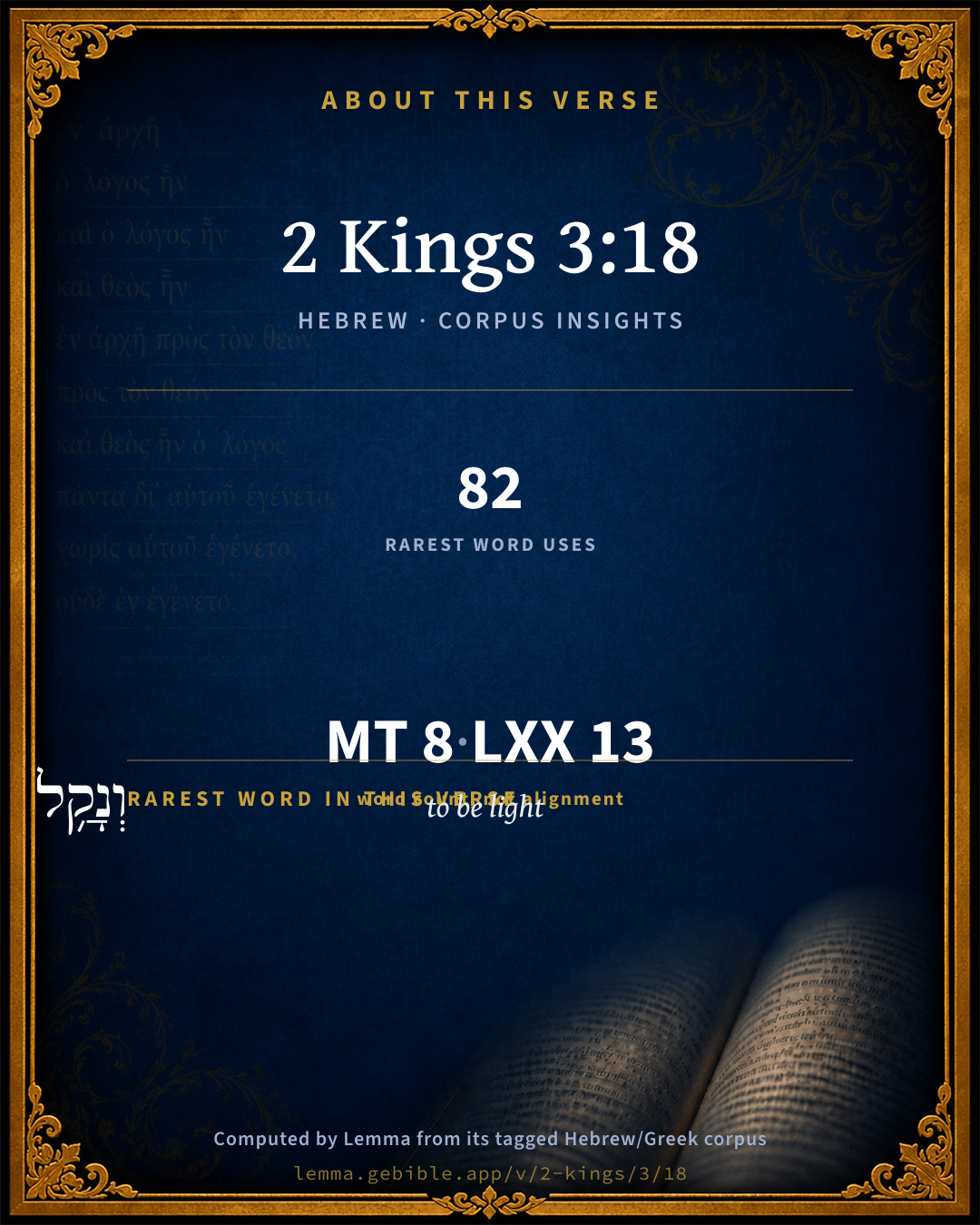
These counts appear in no published source. They are computed here, from the morphology-tagged text and Lemma’s own curated glosses. What Lemma adds →

8
words
8
distinct lemmas
Historical
section

Grammatical profile

  • 2 verbs
  • 4 nouns
  • 1 pronoun
  • 1 particle

Verb forms

  • וְנָקַ֥ל Niphal · Sequential Perfect
  • וְנָתַ֥ן Qal · Sequential Perfect

Hebrew & Septuagint length

In English translation the verse runs 20 words from the Hebrew and 20 from the Septuagint (LXX English) — the same length.

A rough comparison of the two English renderings, which tokenize alike — not a word-level alignment.

Word counts can differ between the Hebrew and the Greek without any difference in meaning — e.g. the Hebrew direct-object marker אֵת has no separate Greek word, and Greek often adds the article ὁ.

In the original languages it is 8 Hebrew tokens and 13 Greek tokens — but the two are counted differently (Hebrew bundles its prefixes and suffixes into one token; the Greek is in lemma form), so that isn’t a like-for-like length.

Cross-references

14

Topical passages linked to 2 Kings 3:18 in the Treasury of Scripture Knowledge — connected by theme and wording, ordered by reader-vote popularity; previews shown in the World English Bible.

  • Jeremiah 32:27 Behold, I am Yahweh, the God of all flesh: is there anything too hard for me?
  • Luke 1:37 For everything spoken by God is possible."
  • Jeremiah 32:17 Ah Lord Yahweh! behold, you have made the heavens and the earth by your great power and by your outstretched arm; there is nothing too hard for you,
  • 2 Kings 20:10 Hezekiah answered, It is a light thing for the shadow to decline ten steps: nay, but let the shadow return backward ten steps.
  • Isaiah 49:6 yes, he says, It is too light a thing that you should be my servant to raise up the tribes of Jacob, and to restore the preserved of Israel: I will also give you for a light to the Gentiles, that you may be my salvation to the end of the earth.
  • Mark 10:27 Jesus, looking at them, said, "With men it is impossible, but not with God, for all things are possible with God."
  • Ephesians 3:20 Now to him who is able to do exceedingly abundantly above all that we ask or think, according to the power that works in us,
  • Ezekiel 8:17 Then he said to me, Have you seen [this], son of man? Is it a light thing to the house of Judah that they commit the abominations which they commit here? for they have filled the land with violence, and have turned again to provoke me to anger: and, behold, they put the branch to their nose.
  • 1 Kings 3:13 I have also given you that which you have not asked, both riches and honor, so that there shall not be any among the kings like you, all your days.
  • 1 Kings 20:13 Behold, a prophet came near to Ahab king of Israel, and said, Thus says Yahweh, Have you seen all this great multitude? behold, I will deliver it into your hand this day; and you shall know that I am Yahweh.
  • Isaiah 7:1–9 It happened in the days of Ahaz the son of Jotham, the son of Uzziah, king of Judah, that Rezin the king of Syria, and Pekah the son of Remaliah, king of Israel, went up to Jerusalem to war against it, but could not prevail against it.
  • 1 Kings 20:28 A man of God came near and spoke to the king of Israel, and said, Thus says Yahweh, Because the Syrians have said, Yahweh is a god of the hills, but he is not a god of the valleys; therefore will I deliver all this great multitude into your hand, and you shall know that I am Yahweh.
  • Isaiah 7:13 He said, "Listen now, house of David: Is it not enough for you to try the patience of men, that you will try the patience of my God also?
  • 1 Kings 16:31 It happened, as if it had been a light thing for him to walk in the sins of Jeroboam the son of Nebat, that he took as wife Jezebel the daughter of Ethbaal king of the Sidonians, and went and served Baal, and worshiped him.

Cross-references courtesy of OpenBible.info (CC BY 4.0).

Hebrew and Greek witnesses Masoretic Hebrew ↔ Greek Septuagint

The same verse in the two great witnesses to the Old Testament, shown verse-for-verse.

These are two independent witnesses, not word-aligned to each other, and the Septuagint is shown in lemma (dictionary) form.

Hebrew 2 Kings 3:18 Masoretic · Westminster Leningrad Codex

וְנָקַ֥ל זֹ֖את בְּעֵינֵ֣י יְהוָ֑ה וְנָתַ֥ן אֶת מוֹאָ֖ב בְּיֶדְכֶֽם

This is but a light thing in the sight of Yahweh: he will also deliver the Moabites into your hand.

World English Bible · Public Domain

Greek LXX 2 Kings 3:18 Septuagint · lemma form

καί κοῦφος οὗτος ἐν ὀφθαλμός κύριος καί παραδίδωμι ὁ μωαβ ἐν χείρ σύ

And this is a light thing in the eyes of the Lord: I will also deliver Moab into your hand.

LXX2012 (modern English Septuagint) · Public Domain

Hebrew: Westminster Leningrad Codex (CC BY 4.0). Greek: Septuagint (public domain); English from LXX2012 (modern English Septuagint) (Public Domain). How the Septuagint differs from the Hebrew →

Targum (Aramaic paraphrase)

1

The Targum is the ancient Jewish Aramaic paraphrase of the Hebrew Scriptures — an interpretive translation, not the Hebrew text itself. Onkelos (literal) and Pseudo-Jonathan (expansive) render the Torah, and Jonathan the Prophets. Coverage is partial: where no permissively-licensed English translation exists for a verse, only the Aramaic is shown. This is verse-level text, not a word-by-word alignment to the Hebrew.

  1. Targum Jonathan Prophets (Joshua–Malachi)
    וּקְלִילָא דָא קֳדָם יְיָ וְיִמְסַר יַת מוֹאֲבָאֵי בְּיֶדְכוֹן:

    (no public-domain English translation for this verse)

    Targum Jonathan — Aramaic: “Mikraot Gedolot” (public domain). English: “Sefaria Community Translation” (CC0 1.0 (public-domain dedication)); “London "Chaldee Paraphrase," 1871” (public domain). Text via Sefaria.

Commentary

Notes on 2 Kings 3:18 from classic Christian and Jewish commentators (each source and its license shown beneath its notes). The classic Christian expositions comment on the surrounding passage and are grouped to its opening verse, so a note may address several verses; the Jewish commentaries on the Tanakh (Rashi and others) are per-verse, so they appear only where the commentator wrote on this verse.

Lemma curates 59 commentaries, every one of them public domain or Creative Commons licensed, each selected and text-cleaned for this edition rather than reprinted as found. About our sources →

Trapp's Complete Commentary

John Trapp

2Ki 3:18 And this is [but] a light thing in the sight of the LORD: he will deliver the Moabites also into your hand.

Ver. 18. And this is but a light thing.] A great thing it was in itself considered - else Lysimachus would never have parted with his kingdom for a cup of water, to save his life; but behold a greater, and admire the goodness of God to an undeserving people.

John Trapp, A Commentary or Exposition upon All the Books of the Old and New Testament (1647–1656) — public domain. Text from a community e-Sword module.

Joseph Benson's Commentary

2Ki 3:18. This is but a light thing in the sight of the Lord — But a small favour in comparison of what he intends to do for you, for Jehoshaphat’s sake. He will give you more than you expect or ask. For they were so weakened and discouraged by the great drought, that they had no hopes of proceeding in the offensive war, and thought it sufficient, if it were possible, to defend themselves from the Moabites, 2Ki 3:13.

Joseph Benson's Commentary on the Old and New Testaments (1811–1818) — public domain. Text from a community e-Sword module.

Tyndale Open Study Notes

Tyndale Open Resources

3:18-20 The supply of water—a simple thing for the Lord—was a harbinger of God’s enabling the allies to defeat the army of Moab.

Tyndale Open Study Notes — © Tyndale Open Resources, licensed CC BY-SA 4.0. Text via the HelloAO Bible API.

Geneva Bible (1599)

Geneva Bible translators

He will not only miraculously give you waters, but your enemies also into your hand.

Geneva Bible (1599) marginal notes — public domain. Text via Bolls.life.

Ellicott's Commentary for English Readers

(18) Is but a light thing.—Will be a light thing (1Ki_16:31).

He will deliver the Moabites.—The contrary of Jehoram’s expectation (2Ki_3:10; 2Ki_3:13).

A Bible Commentary for English Readers, edited by Charles John Ellicott (1878–1897) — public domain. Text from a community e-Sword module.

The Cambridge Bible for Schools and Colleges

gen. ed. J. J. S. Perowne

18. And this is but a light thing] For the expression cf. below ch. 2Ki_20:10. What God gives, He gives to the full. He will not only guide the forces of nature so that the bodily wants of the armies shall be supplied, but will crown their expedition with success.

The Cambridge Bible for Schools and Colleges (gen. ed. J. J. S. Perowne; Cambridge University Press, 1878–1918) — public domain. Text from a community e-Sword module.

John Gill's Exposition

And when all the Moabites heard that the kings were come up to fight against them,.... The kings of Israel, Judah, and Edom:

they gathered all that were able to put on armour, and upward; that were of an age capable of that, and all who were more grown; or "girt on a girdle" (l), a military one, with which the sword was girt, who were at age to wear and knew how to wield a sword: and stood in the border; of their land, between Edom and them, to defend themselves and their country against these invaders.

(l) "eingente cingulo", Montanus.

John Gill's Exposition of the Whole Bible (1746–1763) — public domain (CC PDM 1.0). Text via the HelloAO Bible API.

Matthew Poole's English Annotations

This is but a small favour in comparison of what he intends to you for Jehoshaphat’s sake. He will give you more than you ask or expect. For they were so weakened and discouraged with the great drought, that they had no hopes of proceeding in the offensive war, and thought it sufficient, if it were possible, to defend themselves from the Moabites, 2Ki 3:13.

Matthew Poole's English Annotations on the Holy Bible (1683–1685) — public domain. Text from a community e-Sword/MySword module.

The Pulpit Commentary

And this is but a light thing in the sight of the Lord. God, the Author of nature, has full control over nature, and it is an easy matter for him to produce at will any natural phenomena. It is otherwise when the stubborn element of the human will is brought into play. Then difficulty may arise. He will deliver the Moabites also into your hand. It would be better to translate, he will also deliver (see the Revised Version).

Vers. 18-27.

The defeat of Moab.

This also was foretold by Elisha as a mercy from the Lord, in comparison with which the supply of water was "a light thing." If these are God"s "light things," surely we need not fear to ask from him all that we require. Our sin is, not in asking too much, but in asking too little. "He (Joh_16:24) is able to do exceeding abundantly above all that we ask or think". (Eph_3:20)

I LOST THROUGH ILLUSION. The manner in which the defeat of the Moabites was brought about is very remarkable. The defeat was caused:

1. Through illusion. Their forces that were able to put on amour, and upward were mustered on the mountains opposite, ready for battle on the morrow. As the morning sun rose, its red beams, falling on the pools of water in the valley, gave the water the appearance of blood an effect to which the red soil may have contributed. This startling appearance the Moabites who knew nothing of the unlooked-for supply of water interpreted in their own way. They said, "This is blood," and concluded remembering a recent experience of their own (2Ch 20) that the attacking forces had fallen out, and destroyed each other.

2. Through over-haste and over-confidence. The cry was at once raised, "Moab, to the spoil!" and, casting aside all precautions, the people flew down, to find themselves in the power of their enemies. How many defeats are sustained in life from the same causes! We eagerly snatch at first appearances, which are often so deceptive; we hurry to the fray, without faking due precautions or counting the cost; we are confident in our strength or numbers as sufficient to bear down all opposition, if by chance we should be surprised. Therefore we fail. God often snares men through their own illusions. Haman went to Esther"s banquet under the illusion that it was the road to highest honor, and found it the way to death. (Est_5:11, Est_5:12) Of the wicked it is said, "For this cause God shall send them strong delusion, that they should believe a lie". (2Th_2:11)

II THE MERCILESS PURSUIT. The passage describing this pursuit is a terrible illustration of the severities of war. They were, perhaps, under the circumstances, not needless severities, but they are nonetheless extreme and painful to think of.

(1) The Moabites were pursued into their own country, and cut down in the pursuit.

(2) The cities were leveled to the ground.

(3) The good land was made useless by every man casting on it a stone, till it was covered with stones.

(4) Even fruit trees were cut down, and wells stopped.

(5) There remained only the city of Kir-haraseth, which, on its elevated plateau, defied direct assault; but it they besieged, while the slingers, taking their station on the surrounding eminences, galled it with their missiles. The words of the prophet in ver. 19 are perhaps prediction, not command, but it may be inferred that he gave the policy pursued his sanction. The object was so effectually to cripple the power of Moab that it would not be able to lift up the head for many a day to come.

1. The most direct lesson we can learn from the passage is the dreadfulness of war. Wherever or however waged, wars are a source of incalculable misery. Even just wars entail a loss of life, a destruction of wealth, and a waste of the means of production and of human happiness, which may well make the heart of the lover of his species sicken.

2. An indirect lesson to be gleaned from ver. 25 is the power of little things man his stone." By each man bringing but a single stone, theground was covered, and the end aimed at attained. The power was wielded here for destruction, but it may be wielded as well for good. Each doing his individual part though that in itself is little great results will be achieved.

3. We do well to carry into moral warfare the same thoroughness as is here displayed in physical warfare. Not content with operating on individuals, let us strike at causes and sources stopping the wells of poisonous influence, etc.

III THE LAST TRAGIC ACT. The war was brought to a sudden and unlooked-for termination.

1. The fearful sacrifice. Beaten into his last stronghold, driven to desperation, the King of Moab, having made an unsuccessful sortie with seven hundred men, resolved on an act which, he rightly judged, would strike horror into the hearts of his enemies, while it might also propitiate his god. He took his eldest son, the heir to his throne, and offered him up for a burnt offering on the wall.

(1) The fact that he performed the sacrifice upon the wall would seem to show that he had in view as much the effect to be produced on the spectators as the possible effect to be produced on Chemosh.

(2) The deed was awful and inhuman perhaps, from Mesha"s point of view, not without its nobler and patriotic side but in itself most detestable. We have need to be thankful for a purer religious faith, which teaches us that God does not delight in such unnatural and cruel acts. (Mic_6:6-9)

2. Repulsed by horror. "There was," we read, "great indignation against or, "upon" Israel: and they departed from him, and returned to their own land." The meaning seems to be that the ghastly act produced a universal horror, which turned into indignation against Israel as the original authors of the expedition which had so dreadful an end. There is an element of superstition in all men, and sudden revulsions of feeling, caused by an act that powerfully impresses the imagination, are not uncommon. The Israelites themselves so far sympathized with the emotion of horror which brought upon them the indignation of the Moabites, of neighboring tribes, perhaps also of the Edomites and others among their own allies, that they gave up the thought of proceeding further. This seems a more natural explanation than either

(1) that the indignation meant is that of Jehovah; or

(2) that it is the wrath of Chemosh(!); or

(3) the subjective horror of the Israelites themselves. J.O.

The Pulpit Commentary (1880–1919), ed. H.D.M. Spence-Jones & Joseph S. Exell — public domain. Text from a community e-Sword module.

unfoldingWord translationNotes

Door43 World Missions Community

This is an easy thing in the sight of Yahweh

The sight of Yahweh represents Yahweh's judgment or evaluation. AT: "Yahweh considers this as an easy thing to do" or "This is an easy thing for Yahweh to do" (See: Metaphor)

fortified city

A fortified city is well protected from enemies by such things as high walls or a easily defensible location.

ruin every good piece of land with rocks

This means to put rocks on the fertile land so that it is difficult to use. The meaning of this statement can be made clear. AT: "ruin every good piece of land by covering them with rocks" (See: Assumed Knowledge and Implicit Information)

translationWords

Moab

fountain

ruin

unfoldingWord translationNotes — © Distant Shores Media and the Door43 World Missions Community, licensed CC BY-SA 4.0. Source: git.door43.org/Door43/en_tn.

Rashi

Rabbi Shlomo Yitzchaki (Rashi)

This is easy. And furthermore, this miracle is slight and insignificant in the eyes of God, and He will proceed to act wondrously with you and [perform] another miracle, and He will deliver Moav into your hand.

Rashi on the Tanakh — English translations: “The Judaica Press complete Tanach with Rashi, translated by A. J. Rosenberg” (CC BY 4.0); “Pentateuch with Rashi's commentary by M. Rosenbaum and A.M. Silbermann, 1929-1934” (public domain); “The Metsudah Tanach series, Lakewood, N.J” (CC BY 4.0); and “The Book of Joshua, Metsudah Publications, 1997” (CC BY 4.0). Text via Sefaria.

Lesson kit

Teaching starters — assembled from the data on this page, not authored interpretation. Every prompt links to the verse data it draws on. Edit before teaching.

2 Kings, in the Historical, opens this verse with 8 words (8 distinct Hebrew lemmas). Its most distinctive word is qâlal (“to be light”). A historical commentator’s framing appears above. Read the whole chapter for the surrounding context.

Discussion questions

  1. What does “to be light” (qâlal) contribute to the verse as a whole?
  2. Jeremiah 32:27 shares this passage’s theme. How do the two illuminate each other?
  3. These translations render this verse differently. What is at stake in choosing one wording over another?
  4. The verb «וְנָקַ֥ל» is Niphal Sequential Perfect. How does its form color the action?
  5. Reading how Trapp's Complete Commentary and Joseph Benson's Commentary read this verse, where do the two commentators agree and where do they part?

Things to notice

Reading settings

Reading text

Shown beneath each verse's original-language words.

Old Testament
Old Testament edition

Read the OT as the Masoretic Hebrew (MT) or the Greek Septuagint (LXX).

English shown for the Greek Septuagint (in the Hebrew ↔ Greek comparison).

Comparing translations? Open the Compare panel on any verse page to stack up to four side by side.