
Deuteronomy 31:19

Hebrew (Westminster Leningrad Codex) Deuteronomy 31:19 appears in the Hebrew Old Testament. The text above is from the Westminster Leningrad Codex. Each word links to its Strong’s number, a concise gloss, and parsing drawn from the Open Scriptures Hebrew Bible morphology. Click any word for its full Brown-Driver-Briggs (BDB) entry.
Download image
Cite this verse

Deuteronomy 31:19 (World English Bible). Public Domain. Lemma interlinear Bible study tool, https://lemma.gebible.app/v/deuteronomy/31/19.

Show BibTeX & RIS
BibTeX
RIS
English Translation
Now therefore write you this song for you, and teach you it the children of Israel: put it in their mouths, that this song may be a witness for me against the children of Israel.
World English Bible · Public Domain
Download a study sheet

One document with this verse’s original text, its word-by-word gloss line, the meaning frame, cross-references with their text, attributed commentary, and full source and license credits — printable, and it pastes into notes with its structure intact.

This verse Autodidact and up

Study sheet (.html) Plain text (.txt)

A passage Seminary Student

Up to 50 verses in one chapter. A passage sheet keeps up to 6 commentary sources and 12 cross-references per verse, in the order this page ranks them, and says so on the sheet whenever that leaves anything out. Ask for a single verse and you get the Autodidact verse sheet above.

Everything on this page stays free to read, with no account — the sheet is a download of what is already on screen, not access to it.

Want to remove ads? Support Godless Engineer
Compare translations 3

The same verse in 3 English versions, stacked beneath the original-language interlinear above. Click any original word for its lexicon entry.

Each is an independent rendering of the whole verse — the interlinear is not word-aligned to these translations.

Highlighted words mark where these versions differ — a whole-verse word diff, not a word-by-word alignment.

  • World English Bible Public Domain
    Now therefore write you this song for you, and teach you it the children of Israel: put it in their mouths, that this song may be a witness for me against the children of Israel.
  • King James Version Public Domain
    Now therefore write ye this song for you, and teach it the children of Israel: put it in their mouths, that this song may be a witness for me against the children of Israel.
  • unfoldingWord Literal Text CC BY-SA 4.0
    And now, write this song for yourselves and teach it to the sons of Israel. Put it in their mouths, so that this song may be a witness for me against the sons of Israel.

unfoldingWord Literal Text — © unfoldingWord, licensed CC BY-SA 4.0. Word-aligned USFM3 via Door43 (git.door43.org/unfoldingWord/en_ult).

Versions to compare (up to 4)

3 of 4 selected

Show all 18 translations

Every available English version of this verse, each an independent rendering of the whole verse.

  • World English Bible Public Domain
    Now therefore write you this song for you, and teach you it the children of Israel: put it in their mouths, that this song may be a witness for me against the children of Israel.
  • Berean Standard Bible Public Domain
    Now therefore, write down for yourselves this song and teach it to the Israelites; have them recite it, so that it may be a witness for Me against them.
  • Majority Standard Bible Public Domain
    Now therefore, write down for yourselves this song and teach it to the Israelites; have them recite it, so that it may be a witness for Me against them.
  • King James Version Public Domain
    Now therefore write ye this song for you, and teach it the children of Israel: put it in their mouths, that this song may be a witness for me against the children of Israel.
  • American Standard Version (1901) Public Domain
    Now therefore write ye this song for you, and teach thou it the children of Israel: put it in their mouths, that this song may be a witness for me against the children of Israel.
  • Revised Version (1885) Public Domain
    Now therefore write ye this song for you, and teach thou it the children of Israel: put it in their mouths, that this song may be a witness for me against the children of Israel.
  • Geneva Bible (1599) Public Domain
    Now therefore write ye this song for you, and teach it the children of Israel: put it in their mouthes, that this song may be my witnesse against the children of Israel.
  • Douay-Rheims (1899) Public Domain
    Now therefore write you this canticle, and teach the children of Israel: that they may know it by heart, and sing it by mouth, and this song may be unto me for a testimony among the children of Israel.
  • Young's Literal Translation Public Domain
    `And now, write for you this song, and teach it the sons of Israel; put it in their mouths, so that this song is to Me for a witness against the sons of Israel,
  • Literal Standard Version CC BY-SA 4.0
    And now, write this song for yourselves, and teach it [to] the sons of Israel; put it in their mouths, so that this song is to Me for a witness against the sons of Israel.
  • Unlocked Literal Bible CC BY-SA 4.0
    Now therefore write this song for yourselves and teach it to the people of Israel. Put it in their mouths, so that this song may be a witness for me against the people of Israel.
  • unfoldingWord Literal Text CC BY-SA 4.0
    And now, write this song for yourselves and teach it to the sons of Israel. Put it in their mouths, so that this song may be a witness for me against the sons of Israel.
  • Darby Bible Public Domain
    And now, write ye this song, and teach it to the children of Israel; put it in their mouths, that this song may be a witness for me against the children of Israel.
  • World Messianic Bible Public Domain
    “Now therefore write this song for yourselves, and teach it to the children of Israel. Put it in their mouths, that this song may be a witness for me against the children of Israel.
  • Webster's Bible Public Domain
    Now therefore write ye this song for you, and teach it to the children of Israel: put it in their mouths, that this song may be a witness for me against the children of Israel.
  • Free Bible Version CC BY-SA 4.0
    So write down this song and teach it to the Israelites. Help them learn to sing it, so it will provide evidence for me against them.
  • Bible in Basic English Public Domain
    Make then this song for yourselves, teaching it to the children of Israel: put it in their mouths, so that this song may be a witness for me against the children of Israel.
  • JPS Tanakh (1917) Public Domain
    Now therefore write ye this song for you, and teach thou it the children of Israel; put it in their mouths, that this song may be a witness for Me against the children of Israel.

Literal Standard Version (2020), Covenant Press — licensed CC BY-SA 4.0. Text via the HelloAO Bible API (eBible.org). Unlocked Literal Bible (unfoldingWord) — licensed CC BY-SA 4.0. Text via the HelloAO Bible API (eBible.org). unfoldingWord Literal Text — © unfoldingWord, licensed CC BY-SA 4.0. Word-aligned USFM3 via Door43 (git.door43.org/unfoldingWord/en_ult). Free Bible Version, Dr. Jonathan Gallagher — licensed CC BY-SA 4.0. Text via the HelloAO Bible API (eBible.org).

Word by word

More ways to search: Search by grammar → Find every occurrence → Compare this word →

Practice this passage: Drill this verse → Learn its vocabulary →

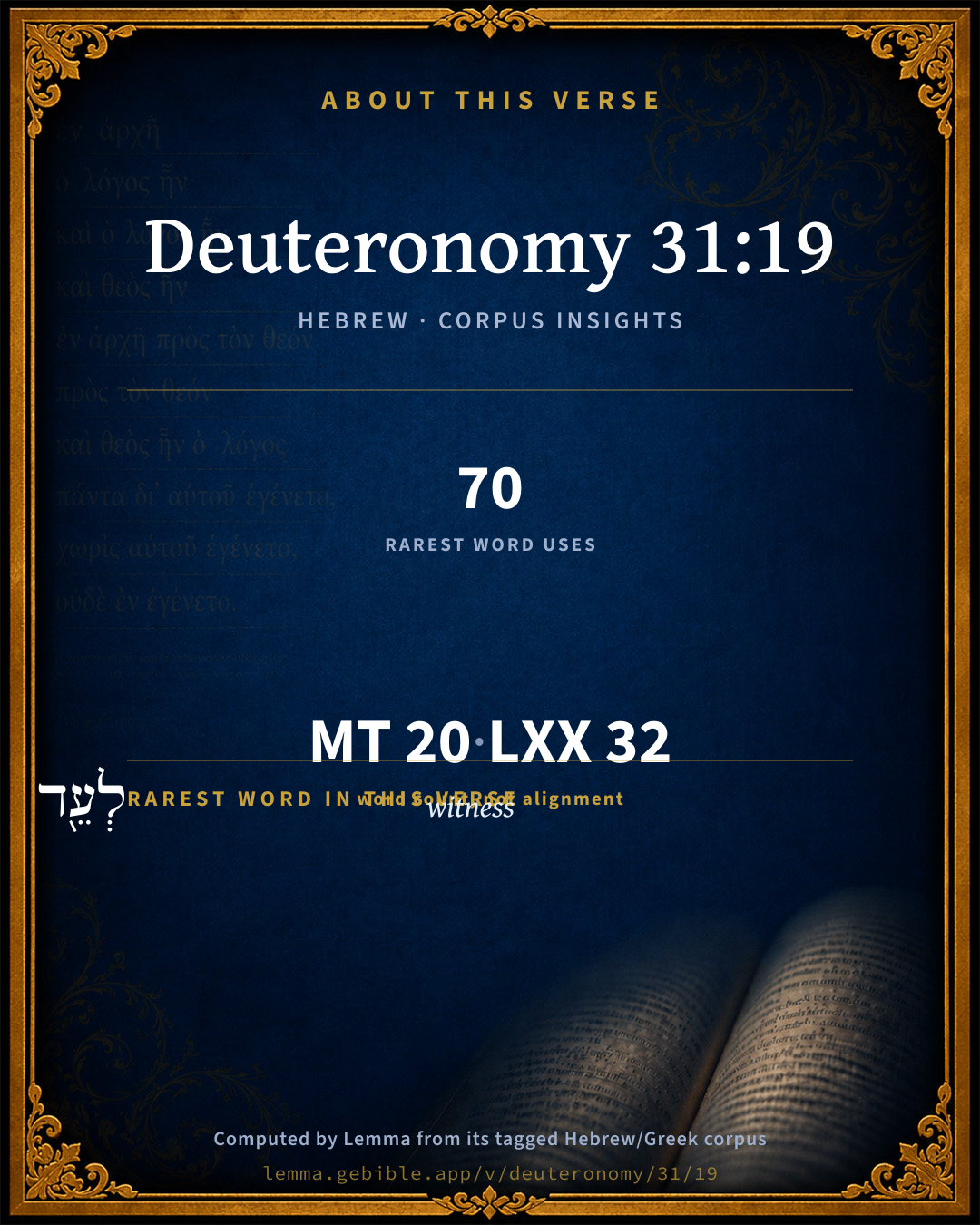
לְעֵ֖ד
ʻêd
H5707
“to/for · witness”
Preposition + Noun, Common, Masculine, Singular, Absolute
Part of Speech
Preposition + Noun
Type
Common
Gender
Masculine
Number
Singular
State
Absolute
Full BDB Definition

Origin: contracted from H5749

TWOT: 1576b

witness - witness, testimony, evidence (of things) - witness (of people)
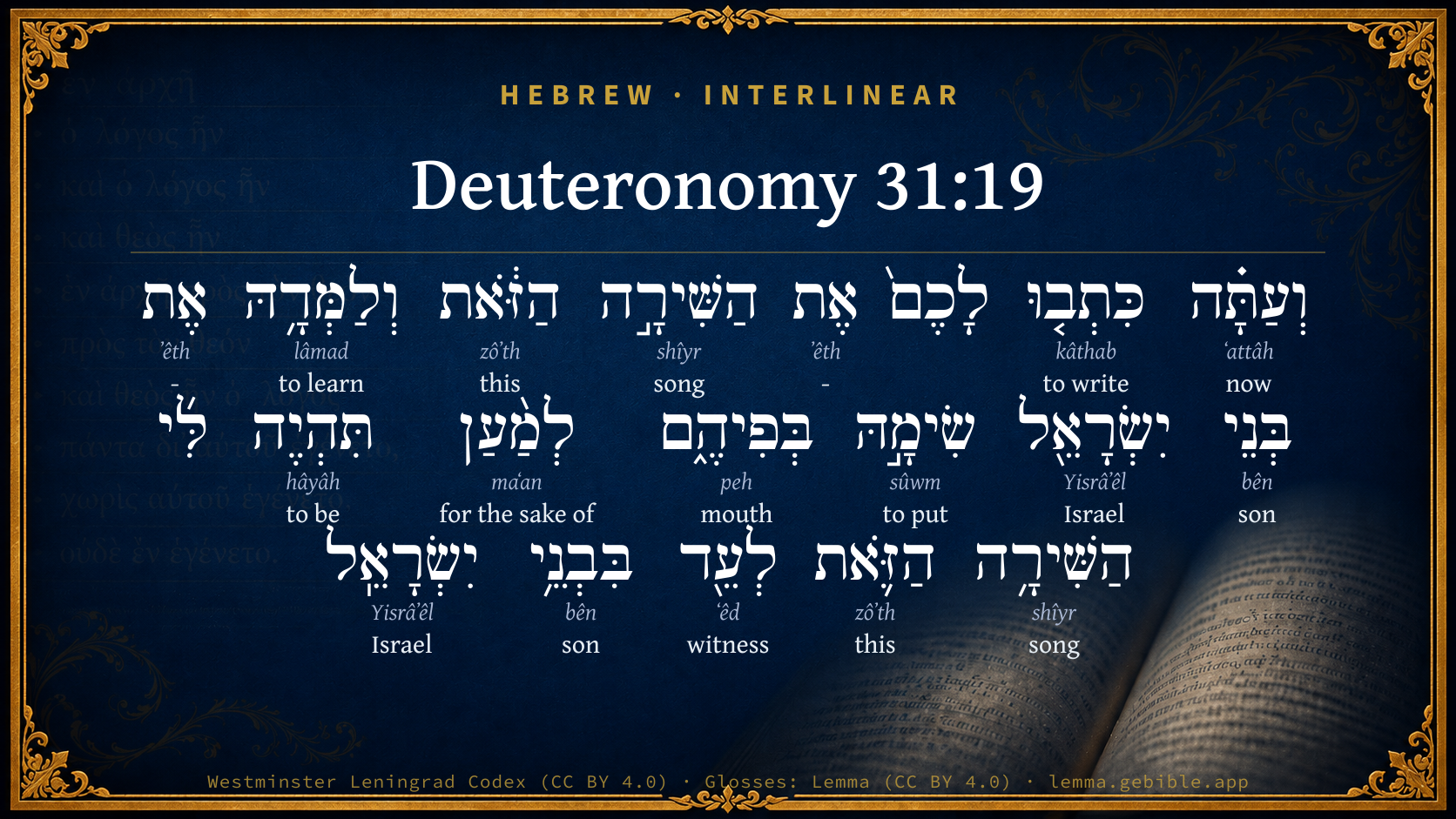
  1. וְעַתָּ֗ה ʻattâh H6258 “and · now” Conjunction + Adverb
  2. כִּתְב֤וּ kâthab H3789 “write” Verb, Qal, Imperative, 2nd Person, Masculine, Plural
  3. אֶת ʼêth H853 “-” Particle, Direct Object
  4. הַשִּׁירָ֣ה shîyr H7892 “the · song” Particle, Definite Article + Noun, Common, Both, Singular, Absolute
  5. הַזֹּ֔את zôʼth H2063 “the · this” Particle, Definite Article + Pronoun, Demonstrative, Feminine, Singular
  6. וְלַמְּדָ֥הּ lâmad H3925 “and · learn · her” Conjunction + Verb, Piel, Imperative, 2nd Person, Masculine, Singular + Suffix, Personal, 3rd Person, Feminine, Singular
  7. אֶת ʼêth H853 “-” Particle, Direct Object
  8. בְּנֵי bên H1121 “sons of” Noun, Common, Masculine, Plural, Construct
  9. יִשְׂרָאֵ֖ל Yisrâʼêl H3478 “Israel” Noun, Proper
  10. שִׂימָ֣הּ sûwm H7760 “put · her” Verb, Qal, Imperative, 2nd Person, Masculine, Singular + Suffix, Personal, 3rd Person, Feminine, Singular
  11. בְּפִיהֶ֑ם peh H6310 “in/at · mouth · their” Preposition + Noun, Common, Masculine, Singular, Construct + Suffix, Personal, 3rd Person, Masculine, Plural
  12. לְמַ֨עַן maʻan H4616 “for the sake of” Preposition
  13. תִּהְיֶה hâyâh H1961 “to be” Verb, Qal, Imperfect, 3rd Person, Feminine, Singular
  14. הַשִּׁירָ֥ה shîyr H7892 “the · song” Particle, Definite Article + Noun, Common, Both, Singular, Absolute
  15. הַזֹּ֛את zôʼth H2063 “the · this” Particle, Definite Article + Pronoun, Demonstrative, Feminine, Singular
  16. בִּבְנֵ֥י bên H1121 “in/at · sons of” Preposition + Noun, Common, Masculine, Plural, Construct
  17. יִשְׂרָאֵֽל Yisrâʼêl H3478 “Israel” Noun, Proper

About this verse

These counts appear in no published source. They are computed here, from the morphology-tagged text and Lemma’s own curated glosses. What Lemma adds →

20
words
13
distinct lemmas
Pentateuch
section

Grammatical profile

  • 4 verbs
  • 8 nouns
  • 2 pronouns
  • 3 prepositions
  • 1 adverb
  • 2 particles

Verb forms

  • כִּתְב֤וּ Qal · Imperative
  • וְלַמְּדָ֥הּ Piel · Imperative
  • שִׂימָ֣הּ Qal · Imperative
  • תִּהְיֶה Qal · Imperfect

Repetition

Words recur within this verse — often emphatic in Hebrew:

  • הַשִּׁירָ֣ה song H7892 ×2
  • בְּנֵי son H1121 ×2
  • יִשְׂרָאֵ֖ל Israel H3478 ×2
  • הַזֹּ֔את this H2063 ×2

Hebrew & Septuagint length

In English translation the verse runs 35 words from the Hebrew and 39 from the Septuagint (LXX English) — closely comparable.

A rough comparison of the two English renderings, which tokenize alike — not a word-level alignment.

Word counts can differ between the Hebrew and the Greek without any difference in meaning — e.g. the Hebrew direct-object marker אֵת has no separate Greek word, and Greek often adds the article ὁ.

In the original languages it is 20 Hebrew tokens and 32 Greek tokens — but the two are counted differently (Hebrew bundles its prefixes and suffixes into one token; the Greek is in lemma form), so that isn’t a like-for-like length.

Cross-references

14

Topical passages linked to Deuteronomy 31:19 in the Treasury of Scripture Knowledge — connected by theme and wording, ordered by reader-vote popularity; previews shown in the World English Bible.

  • Deuteronomy 6:7 and you shall teach them diligently to your children, and shall talk of them when you sit in your house, and when you walk by the way, and when you lie down, and when you rise up.
  • Deuteronomy 31:21–22 It shall happen, when many evils and troubles are come on them, that this song shall testify before them as a witness; for it shall not be forgotten out of the mouths of their seed: for I know their imagination which they frame this day, before I have brought them into the land which I swore.
  • Deuteronomy 31:26 Take this book of the law, and put it by the side of the ark of the covenant of Yahweh your God, that it may be there for a witness against you.
  • Deuteronomy 4:9–10 Only take heed to yourself, and keep your soul diligently, lest you forget the things which your eyes saw, and lest they depart from your heart all the days of your life; but make them known to your children and your children's children;
  • Deuteronomy 11:19 You shall teach them your children, talking of them, when you sit in your house, and when you walk by the way, and when you lie down, and when you rise up.
  • Deuteronomy 31:30–32:45 Moses spoke in the ears of all the assembly of Israel the words of this song, until they were finished.
  • 2 Samuel 14:3 and go in to the king, and speak on this manner to him. So Joab put the words in her mouth.
  • John 12:48 He who rejects me, and doesn't receive my sayings, has one who judges him. The word that I spoke, the same will judge him in the last day.
  • Exodus 4:15 You shall speak to him, and put the words in his mouth. I will be with your mouth, and with his mouth, and will teach you what you shall do.
  • Isaiah 51:16 I have put my words in your mouth, and have covered you in the shadow of my hand, that I may plant the heavens, and lay the foundations of the earth, and tell Zion, You are my people.
  • Isaiah 59:21 As for me, this is my covenant with them, says Yahweh: my Spirit who is on you, and my words which I have put in your mouth, shall not depart out of your mouth, nor out of the mouth of your seed, nor out of the mouth of your seed's seed, says Yahweh, from henceforth and forever.
  • Jeremiah 1:9 Then Yahweh put forth his hand, and touched my mouth; and Yahweh said to me, Behold, I have put my words in your mouth:
  • Ezekiel 2:5 They, whether they will hear, or whether they will forbear, (for they are a rebellious house), yet shall know that there has been a prophet among them.
  • Matthew 10:18 Yes, and you will be brought before governors and kings for my sake, for a testimony to them and to the Gentiles.

Cross-references courtesy of OpenBible.info (CC BY 4.0).

Hebrew and Greek witnesses Masoretic Hebrew ↔ Greek Septuagint

The same verse in the two great witnesses to the Old Testament, shown verse-for-verse.

These are two independent witnesses, not word-aligned to each other, and the Septuagint is shown in lemma (dictionary) form.

Hebrew Deuteronomy 31:19 Masoretic · Westminster Leningrad Codex

וְעַתָּ֗ה כִּתְב֤וּ לָכֶם֙ אֶת הַשִּׁירָ֣ה הַזֹּ֔את וְלַמְּדָ֥הּ אֶת בְּנֵי יִשְׂרָאֵ֖ל שִׂימָ֣הּ בְּפִיהֶ֑ם לְמַ֨עַן תִּהְיֶה לִּ֜י הַשִּׁירָ֥ה הַזֹּ֛את לְעֵ֖ד בִּבְנֵ֥י יִשְׂרָאֵֽל

Now therefore write you this song for you, and teach you it the children of Israel: put it in their mouths, that this song may be a witness for me against the children of Israel.

World English Bible · Public Domain

Greek LXX Deuteronomy 31:19 Septuagint · lemma form

καί νῦν γράφω ὁ ῥῆμα ὁ ᾠδή οὗτος καί διδάσκω αὐτός ὁ υἱός ἰσραήλ καί ἐνβάλλω αὐτός εἰς ὁ στόμα αὐτός ἵνα γίγνομαι ἐγώ ὁ ᾠδή οὗτος εἰς μαρτύριον ἐν υἱός ἰσραήλ

And now write the words of this song, and teach it to the children of Israel, and you⌃ shall put it into their mouth, that this song may witness for me among the children of Israel to their face.

LXX2012 (modern English Septuagint) · Public Domain

On this verse, The Cambridge Bible for Schools and Colleges discusses the Septuagint’s reading. Read the note in Commentary ↓

Hebrew: Westminster Leningrad Codex (CC BY 4.0). Greek: Septuagint (public domain); English from LXX2012 (modern English Septuagint) (Public Domain). How the Septuagint differs from the Hebrew →

Targum (Aramaic paraphrase)

2

The Targum is the ancient Jewish Aramaic paraphrase of the Hebrew Scriptures — an interpretive translation, not the Hebrew text itself. Onkelos (literal) and Pseudo-Jonathan (expansive) render the Torah, and Jonathan the Prophets. Coverage is partial: where no permissively-licensed English translation exists for a verse, only the Aramaic is shown. This is verse-level text, not a word-by-word alignment to the Hebrew.

  1. Targum Onkelos Torah (Genesis–Deuteronomy)
    וּכְעַן כְּתִיבוּ לְכוֹן יָת תֻּשְׁבַּחְתָּא הָדָא וְאַלְפַהּ יָת בְּנֵי יִשְׂרָאֵל שַׁוְיַהּ בְּפוּמְהוֹן בְּדִיל דִתְהֵי קֳדָמַי תֻּשְׁבַּחְתָּא הָדָא לְסָהִיד בִּבְנֵי יִשְׂרָאֵל

    (no public-domain English translation for this verse)

    Targum Onkelos — Aramaic: “Onkelos Genesis” (public domain); “Onkelos Exodus” (public domain); “Onkelos Leviticus” (public domain); “Onkelos Numbers” (public domain); “Onkelos Deuteronomy” (public domain). English: “Sefaria Community Translation” (CC0 1.0 (public-domain dedication)); “J.W. Etheridge. The Targums of Onkelos and Jonathan Ben Uzziel on the Pentateuch. London: Longmans, Green, 1862” (public domain). Text via Sefaria.

  2. Targum Pseudo-Jonathan Torah (Genesis–Deuteronomy)
    וּכְדוֹן כְּתִיבוּ לְכוֹן יַת תּוּשְׁבַּחְתָּא הֲדָא וְאַלְפָהּ יַת בְּנֵי יִשְרָאֵל שַׁוְויָהּ בְּפוּמְהוֹן בְּדִיל דְתֵהֵי תּוּשְׁבַּחְתָּא הֲדָא קֳדָמוֹי לְסָהִיד בִּבְנֵי יִשְרָאֵל

    And now, write you this hymn, and teach the children of Israel; put it upon their lips, that this hymn may be before them, for a witness against the children of Israel.

    Targum Pseudo-Jonathan — Aramaic: “Targum Jonathan on Genesis” (public domain); “Targum Jonathan on Exodus” (public domain); “Targum Jonathan on Leviticus” (public domain); “Targum Jonathan on Numbers” (public domain); “Targum Jonathan on Deuteronomy” (public domain). English: “The Targum of Jonathan ben Uzziel, trans. J. W. Etheridge, London, 1862” (public domain). Text via Sefaria.

Commentary

Notes on Deuteronomy 31:19 from classic Christian and Jewish commentators (each source and its license shown beneath its notes). The classic Christian expositions comment on the surrounding passage and are grouped to its opening verse, so a note may address several verses; the Jewish commentaries on the Tanakh (Rashi and others) are per-verse, so they appear only where the commentator wrote on this verse.

Lemma curates 59 commentaries, every one of them public domain or Creative Commons licensed, each selected and text-cleaned for this edition rather than reprinted as found. About our sources →

Trapp's Complete Commentary

John Trapp

Deu 31:19 Now therefore write ye this song for you, and teach it the children of Israel: put it in their mouths, that this song may be a witness for me against the children of Israel.

Ver. 19. Put it in their mouths.] That out of their own mouths I may judge them; things made up in metre are better remembered. Before the knowledge of letters and writing, among the ancients it was a custom to sing their laws, lest they might forget them; used in the days of Aristotle, by the Agathyrsi, a people near to the Scythians.

John Trapp, A Commentary or Exposition upon All the Books of the Old and New Testament (1647–1656) — public domain. Text from a community e-Sword module.

Joseph Benson's Commentary

Deu 31:19. Now, therefore, write this song — Recorded in the next chapter, the contents of which were put into a song, that they might be better learned and more fixed in their minds and memories. For it has always been thought the most profitable way of instructing people, and communicating things to posterity, to put them into verse. For which reason Aristotle reports that people anciently sung their laws. And Tully tells us it was the custom of the ancient Romans to have the virtues and praises of their famous men sung at their feasts. Teach it the children of Israel — Cause them to learn and understand it, and have it daily in their mouths. That this may be a witness for me — Of my kindness in giving them so many blessings, of my patience in bearing so long with them, of my clemency in giving them such fair and plain warnings, and of my justice in punishing such an incorrigible people.

Joseph Benson's Commentary on the Old and New Testaments (1811–1818) — public domain. Text from a community e-Sword module.

Tyndale Open Study Notes

Tyndale Open Resources

31:19-22 When sung by the collective community in days to come, this song (32:1-43) would remind the people of God’s faithfulness in the past and of their too-frequent disloyalty. The major blessings for obedience and curses for disobedience were implicit in the song. The people of Israel would sing it as a sign that they had placed themselves under these promises and threats. Through music, they would be reminded of God’s blessings for obedience and would invoke God’s judgment should they prove unfaithful.

Tyndale Open Study Notes — © Tyndale Open Resources, licensed CC BY-SA 4.0. Text via the HelloAO Bible API.

Geneva Bible (1599)

Geneva Bible translators

To preserve you and your children from idolatry, by remembering God’s benefits.

Geneva Bible (1599) marginal notes — public domain. Text via Bolls.life.

Jamieson, Fausset & Brown

Robert Jamieson, A. R. Fausset & David Brown

Now therefore write ye this song--National songs take deep hold of the memories and have a powerful influence in stirring the deepest feelings of a people. In accordance with this principle in human nature, a song was ordered to be composed by Moses, doubtless under divine inspiration, which was to be learnt by the Israelites themselves and to be taught to their children in every age, embodying the substance of the preceding addresses, and of a strain well suited to inspire the popular mind with a strong sense of God's favor to their nation.

Jamieson, Fausset & Brown — Commentary Critical and Explanatory on the Whole Bible (1871) — public domain (CC PDM 1.0). Text via the HelloAO Bible API.

Adam Clarke's Commentary

Verse 19. Write ye this song] The song which follows in the next chapter. Things which were of great importance and of common concern were, among the ancients, put into verse, as this was found the best method of keeping them in remembrance, especially in those times when writing was little practised. Even prose was sometimes sung. The history of Herodotus was divided into NINE books, and each inscribed with the name of one of the NINE Muses, because these books were anciently sung. Homer is reported to have sung his poems through different Greek cities. Aristotle observes that anciently the people sung their laws. And Cicero observes that it was a custom among the ancient Romans to sing the praises of their heroes at the public festivals. This was the case among the northern inhabitants of Europe, particularly in Ireland and Scotland; hence the Gaelic poetry of Ossian and others. See Dodd; and See Clarke on Ex 15:1, where the subject is largely treated.

Adam Clarke's Commentary on the Bible (1810–1826) — public domain. Text from a community e-Sword/MySword module.

Ellicott's Commentary for English Readers

(19) Put it in their mouths, that this song may be a witness.—This method of perpetuating the truth was even better adapted to the times and to the condition of the people than the delivery of a written law. It was not possible to multiply copies of the law among them to any great extent; but the rhythmical form of the song would make it easy to be retained in their memories. There is reason to believe that Samuel, the first person who (so far as we know) effected anything of importance towards the establishment of a system of religious education in Israel, employed the same means for the purpose, viz., psalms and spiritual songs. The first companies of prophets were evidently singers and minstrels (see 1Sa_10:5-6; 1Sa_19:20-24); hence their remarkable influence over Saul. And if they taught the psalms to the people, as they learnt them under Samuel and David—especially historical psalms, like the 78th, 105th, and 106th—a very efficacious means of spreading the knowledge of God in Israel was in their hands.

A Bible Commentary for English Readers, edited by Charles John Ellicott (1878–1897) — public domain. Text from a community e-Sword module.

The Cambridge Bible for Schools and Colleges

gen. ed. J. J. S. Perowne

19. write ye this song for you] This Pl. can be justified only by reference to Moses and Joshua both, but only Moses is addressed in Deu_31:10, and in the light of the following singular imperatives teach thou … and (Sam., LXX, Syr.) put, and of Deu_31:22, Moses (alone) wrote, read write thou … for thee. LXX has the plural throughout, Syr. repeats the Heb. text.

a witness for me against the children of Israel] By showing that God had sufficiently forewarned, and pleaded with, them (cp. Deu_31:26). Apart from the question of the date of the Song there is no doubt that Israel had been forewarned by the prophets, that they would perish if they ventured to reject His commands; and further it is generally true that no punishment for sin is ever unforeseen by the conscience of the sinner. On children of Israel, never found in D, but always editorial in Deut., see on Deu_31:23.

The Cambridge Bible for Schools and Colleges (gen. ed. J. J. S. Perowne; Cambridge University Press, 1878–1918) — public domain. Text from a community e-Sword module.

John Gill's Exposition

For when I shall have brought them into the land which I sware unto their fathers,.... To give it to them, and put them into the possession of it, even the land of Canaan, often thus described, and as it is by the following character:

that floweth with milk and honey; aboundeth with all good things; see Exo 3:8,

and they shall have eaten and filled themselves, and waxen fat; that is, after they have for a considerable time enjoyed the good things of the land, and they abound with them, and increase in them, and have great fullness of them:

then will they turn unto other gods: turn from the Lord who has brought them into all this plenty, from the fear, worship, and service of him, and turn to the worship of idols:

and serve them: the works of men's hands, and at most but creatures, and not the Creator; than which nothing can be more absurd and stupid, as well as wicked and ungrateful:

and provoke me: nothing being more provoking to the Lord than idolatry, it striking at his very nature, being, and glory:

and break my covenant; now made with them; this being foretold by the Lord, which exactly came to pass in numerous instances, proves his precise foreknowledge of future events, even such as depend on the inclinations, dispositions, and wills of men.

John Gill's Exposition of the Whole Bible (1746–1763) — public domain (CC PDM 1.0). Text via the HelloAO Bible API.

Haydock's Catholic Bible Commentary

This canticle, which will be given in the following chapter. Hence this law, (ver. 9,) may comprise not only what had gone before, but also the remaining part of the book of Deuteronomy. This Moses would write before his death, and deliver entire, with the preceding books, to be kept with the utmost care, by the priests, as a testimony to remind all of what had happened in past ages, and what would befall the transgressors of God’s law. (Haydock) --- The canticle, containing an abridgment of the book of Deuteronomy, (Calmet) as the latter did of the whole law, was to be copied out more frequently, (Haydock) and committed to memory. Some suppose that Moses and Josue are here ordered to see this put in execution. Others think that Moses gives this commission to the priests. --- That they. Hebrew, "put in their mouths, (Calmet) that this song may be a witness for me against," &c. God foresaw that the Israelites would prove rebellious; but he leaves them without excuse, as they could not plead ignorance. (Haydock) --- This testimony against them was written in the form of a canticle, that it might be more easily remembered. (Worthington)

George Leo Haydock (1774–1849), Haydock's Catholic Family Bible and Commentary, 1859 edition — public domain. Excludes Psalms (Douay-Rheims chapter numbering differs from Protestant) and Deuterocanonical books (Catholic canon only).

Matthew Poole's English Annotations

This song, which is contained Deu 32, and is put into a song that it may be better learned, and more fixed in their minds and memories.

Put it in their mouths; cause them to learn it, and sing it one to another, to oblige them to more circumspection and watchfulness.

A witness for me; of my kindness in giving them so many blessings, of my patience in bearing so long with them, of my clemency in giving them such fair and plain warnings, and my justice in punishing such an unthankful, perverse, and incorrigible people.

Matthew Poole's English Annotations on the Holy Bible (1683–1685) — public domain. Text from a community e-Sword/MySword module.

Whedon's Commentary on the Bible

Daniel D. Whedon

19. Write ye this song… and teach it — An ode like the one that follows, in the time when the whole nation had its popular gatherings, its commemorative festal days, would be calculated to have a powerful and enduring effect upon the people.

Daniel D. Whedon (gen. ed.), Commentary on the Old and New Testaments (1874–1909) — public domain. Text from a community e-Sword module.

The Pulpit Commentary

Write ye this song. This refers to the song which follows in next chapter. Moses and Joshua were both to write this song, Moses probably as the author, Joshua as his amanuensis, because both of them were to do their endeavor to keep the people from that apostasy which God had foretold.

The Pulpit Commentary (1880–1919), ed. H.D.M. Spence-Jones & Joseph S. Exell — public domain. Text from a community e-Sword module.

John Wesley's Explanatory Notes

Write this song - Which is contained chap. xxxii, 1-43, and is put into a song that it may be better learned, and more fixed in their minds and memories. Put it in their mouths - Cause them to learn it, and sing it one to another, to oblige them to more circumspection. A witness - Of my kindness in giving them so many blessings, of my patience in bearing so long with them, of my clemency in giving them such fair and plain warnings, and my justice in punishing such an incorrigible people.

John Wesley, Explanatory Notes Upon the Whole Bible (1754–1765) — public domain. Text via the GEBible commentary corpus.

Keil & Delitzsch

C. F. Keil & F. Delitzsch

"And now," sc., because what was announced in Deu 31:16-18 would take place, "write you this song." "This" refers to the song which follows in ch. 32. Moses and Joshua were to write the song, because they were both of them to strive to prevent the apostasy of the people; and Moses, as the author, was to teach it to the children of Israel, to make them learn it, that it might be a witness for the Lord (for Me) against the children of Israel. "This" is defined still further in Deu 31:20, Deu 31:21 : if Israel, through growing satisfied and fat in its land, which was so rich in costly good, should turn to other gods, and the Lord should visit it in consequence with grievous evils and troubles, the song was to answer before Israel as a witness; i.e., not only serve the Lord as a witness to the people that He had foretold all the evil consequences of apostasy, and had given Israel proper warning (Knobel), but to serve, as we may see from Deu 31:20, Deu 31:21, and from the contents of the song, as a witness, on the one hand, that the Lord had conferred upon the people so many benefits and bestowed upon them such abundant blessings of His grace, that apostasy from Him was the basest ingratitude, for which they would justly be punished; and, on the other hand, that the Lord had not rejected His people in spite of the punishments inflicted upon them, but would once more have compassion upon them and requite their foes, and thus would sanctify and glorify Himself as the only true God by His judgments upon Israel and the nations. The law, with its commandments, promises, and threats, was already a witness of this kind against Israel (cf. Deu 31:26); but just as in every other instance the appearance of a plurality of unanimous witnesses raises the matter into an indisputable truth, so the Lord would set up another witness against the Israelites besides the law, in the form of this song, which was adapted to give all the louder warning, "because the song would not be forgotten out of the mouths of their seed" (Deu 31:21). The song, when once it had passed into the mouths of the people, would not very readily vanish from their memory, but would be transmitted from generation to generation, and be heard from the mouths of their descendants, as a perpetual warning voice, as it would be used by Israel for God knew the invention of the people, i.e., the thoughts and purposes of their heart, which they cherished (עשׂה used to denote the doing of the heart, as in Isa 32:6) even then before He had brought them into Canaan. (On Deu 31:20, vid., Deu 7:5; Deu 9:5, and Exo 3:8.) - In Deu 31:22 the result is anticipated, and the command of God is followed immediately by an account of its completion by Moses (just as in Exo 12:50; Lev 16:34, etc.). - After this command with reference to the song, the Lord appointed Joshua to the office which he had been commanded to take, urging him at the same time to be courageous, and promising him His help in the conquest of Canaan. That the subject to ויצו is not Moses, but Jehovah, is evident partly from the words themselves, "I will be with thee' (vid., Exo 3:12). (Note: Knobel's assertion (on Num 27:23) that the appointment of Joshua on the part of Moses by the imposition of hands, as described in that passage, is at variance with this verse, scarcely needs any refutation. Or is it really the case, that the installation of Joshua on the part of God is irreconcilable with his ordination by Moses?)

Keil & Delitzsch — Biblical Commentary on the Old Testament (1861–1891) — public domain (CC PDM 1.0). Text via the HelloAO Bible API. (Old Testament only.)

unfoldingWord translationNotes

Door43 World Missions Community

General Information:

Yahweh continues speaking to Moses about the Israelites.

Put it in their mouths

This is an idiom. AT: "Make them memorize and sing it" (See: Idiom)

a land flowing with milk and honey

This is an idiom. AT: "a land where plenty of milk and honey flow" or "a land that is excellent for cattle and farming" See how you translated this in Deuteronomy 6:3.

translationWords

people group

Israel

testimony

oath

ancestor

honey

turn

false god

worship

covenant

unfoldingWord translationNotes — © Distant Shores Media and the Door43 World Missions Community, licensed CC BY-SA 4.0. Source: git.door43.org/Door43/en_tn.

Rashi

Rabbi Shlomo Yitzchaki (Rashi)

את השירה הזאת [NOW THEREFORE WRITE YE] THIS SONG — i.e. the text “Give ear, O ye heavens”, till “and make expiation for his ground, and his people” (Deuteronomy 32:1—43).

Rashi on the Tanakh — English translations: “The Judaica Press complete Tanach with Rashi, translated by A. J. Rosenberg” (CC BY 4.0); “Pentateuch with Rashi's commentary by M. Rosenbaum and A.M. Silbermann, 1929-1934” (public domain); “The Metsudah Tanach series, Lakewood, N.J” (CC BY 4.0); and “The Book of Joshua, Metsudah Publications, 1997” (CC BY 4.0). Text via Sefaria.

Ramban (Nachmanides)

Rabbi Moshe ben Nachman (Ramban / Nachmanides)

AND NOW WRITE YE THIS SONG. In line with the plain meaning of Scripture, He commands both Moses and Joshua to write it for He wanted to make Joshua His prophet during Moses’ lifetime. Now, Moses wrote it while Joshua stood by him, read it, and saw [it completed], this being the sense of the verse, So Moses wrote this Song the same day, and taught it the children of Israel. It refers to Moses who was the principal [in the writing of the Song] for it was from him that they would hear it and learn it, although Joshua, too, taught it with him, as it is stated at the conclusion [of the chapter] he [i.e., Moses], and Hoshea, the son of Nun. Now, the meaning of the expression this Song is “the Song that I will now tell you,” this being ‘Ha’azinu’ (Give ear)., Verses 1-43. It is called Song because Israel would recite it with song and psalm. was chanted each Sabbath during the Service of the Additional Offering. The cycle of the Song was completed every six weeks. Therefore, the six divisions (Aliyoth) in the reading of this Song in the Synagogue on the Sabbath of Ha’azinu, follow the same divisions as sung in the Sanctuary (Rosh Hashanah 31a). It was also written [in the Torah] in the style of a song, since songs are written with interruptions [empty spaces] indicating the places of chanting.

Ramban (Nachmanides) on the Tanakh — English translation: “Commentary on the Torah by Ramban (Nachmanides). Translated and annotated by Charles B. Chavel. New York, Shilo Pub. House, 1971-1976” (CC BY 4.0). Text via Sefaria.

Lesson kit

Teaching starters — assembled from the data on this page, not authored interpretation. Every prompt links to the verse data it draws on. Edit before teaching.

Deuteronomy, in the Pentateuch, opens this verse with 20 words (13 distinct Hebrew lemmas). Its most distinctive word is ʻêd (“witness”). A historical commentator’s framing appears above. Read the whole chapter for the surrounding context.

Discussion questions

  1. What does “witness” (ʻêd) contribute to the verse as a whole?
  2. How does Deuteronomy 6:7, which shares this passage’s theme, read alongside this verse?
  3. What does the repetition of “song” (2× in this one verse) do in this verse?
  4. These translations render this verse differently; the difference is in the English rendering, not the original. What questions does that raise?
  5. «כִּתְב֤וּ» is a Qal Imperative verb. How does that grammatical form shape the action described?
  6. Compare how Trapp's Complete Commentary and Joseph Benson's Commentary read this verse. Where do they agree or differ?

Things to notice

Reading settings

Reading text

Shown beneath each verse's original-language words.

Old Testament
Old Testament edition

Read the OT as the Masoretic Hebrew (MT) or the Greek Septuagint (LXX).

English shown for the Greek Septuagint (in the Hebrew ↔ Greek comparison).

Comparing translations? Open the Compare panel on any verse page to stack up to four side by side.